

- Industry Size (2026)
- 1130.90 Mn
- Forecast (2036)
- 1587.50 Mn
- CAGR
- (2026 to 2036)
USA Meat Trays Market Size, Market Forecast and Outlook By FMI
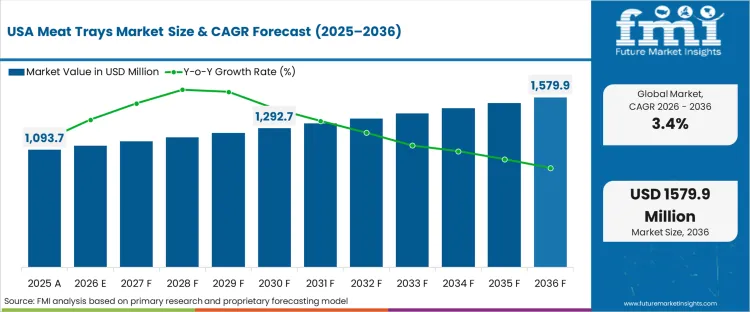
In 2025, the USA meat trays market was valued at USD 1,097.70 million. Based on Future Market Insights' analysis, demand for meat trays is estimated to grow to USD 1,130.90 million in 2026 and USD 1,587.50 million by 2036. FMI projects a CAGR of 3.4% during the forecast period.
The market is expected to generate an absolute dollar growth of USD 456.6 million between 2026 and 2036. This reflects steady, consumption-driven expansion tied to fresh and processed meat retail demand rather than structural transformation. Growth is supported by continued supermarket sales, MAP and VSP tray adoption for shelf-life extension, and rising use of rPET and recyclable materials to meet sustainability targets. However, resin price volatility, regulatory pressure on single-use plastics, and protein consumption shifts toward plant-based alternatives act as structural constraints.
Summary of USA Meat Trays Market
- Market Definition
- The USA meat trays market includes rigid and semi-rigid packaging trays designed for fresh meat, poultry, and seafood presentation, protection, and shelf-life enhancement.
- Demand Drivers in the Market
- Rising retail demand for packaged fresh meat and value-added protein products is increasing adoption of thermoformed PET and MAP-compatible tray formats.
- Growth in online grocery and direct-to-consumer meat brands is driving need for leak-resistant and durable packaging solutions.
- Sustainability commitments from retailers are accelerating transition toward rPET, molded pulp, and recyclable tray materials.
- Key Segments Analyzed in the FMI Report
- By Material: PET-based trays, including APET and rPET, dominate due to clarity, recyclability, and compatibility with modified atmosphere packaging systems.
- By Tray Type: Modified Atmosphere Packaging (MAP) trays represent a leading segment as they extend shelf life and maintain product freshness.
- By Geography: The Midwest and Southeast account for strong demand supported by large-scale meat processing and distribution networks.
- Analyst Opinion at FMI
- Ismail Sutaria, Principal Consultant for Packaging Industry at Future Market Insights, opines, ‘CXOs will find in this report strategic insight into how shelf-life extension technologies, sustainability targets, and retail channel shifts are influencing competitive positioning in the USA meat trays market.’
- Strategic Implications / Executive Takeaways
- Invest in rPET and recyclable mono-material tray systems to align with retailer sustainability benchmarks.
- Expand MAP and VSP-compatible tray capabilities to meet extended shelf-life requirements.
- Strengthen partnerships with meat processors and grocery chains to secure long-term supply contracts.
- Methodology
- Market estimates were validated through interviews with tray manufacturers and meat processors.
- Secondary research included protein production data and retail packaging statistics.
- Forecasts were developed using meat consumption trends and packaging conversion modeling.
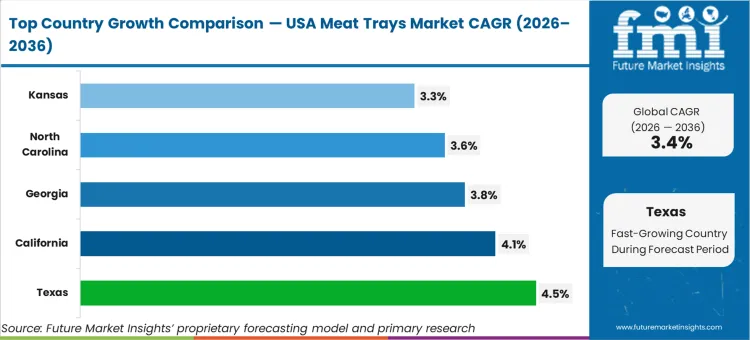
Texas (4.5%) is projected to record the fastest growth, supported by large-scale meat processing and strong retail distribution. California (4.1%) follows, driven by population scale and organized retail presence. Georgia (3.8%) and North Carolina (3.6%) benefit from poultry processing concentration and supply chain expansion. Kansas (3.3%) represents a mature meat-producing state where growth is largely replacement-driven and tied to incremental processing capacity additions rather than rapid retail expansion.
USA Meat Trays Market Definition
The USA meat trays market refers to the production and supply of rigid trays used for packaging fresh and processed meat products in retail and foodservice channels. These trays are manufactured from materials such as PET, APET, CPET, rPET, polypropylene, polystyrene, PVC, polyethylene, paper-based pulp, bioplastics, and aluminum. Meat trays are designed to support overwrap, modified atmosphere packaging, or vacuum skin packaging systems. Their primary function is to provide structural support, absorb leakage, preserve freshness, and maintain hygiene during storage and display. Key end users include meat processors, supermarkets, butcher shops, foodservice distributors, and direct-to-consumer meat brands.
USA Meat Trays Market Inclusions
The report provides USA market size estimates for 2025 and 2026, with forecasts through 2036 and CAGR analysis. It includes segmentation by material type, tray type, manufacturing process, portion capacity, distribution channel, and region. The study covers value-based sizing, sustainability trends including rPET adoption, packaging technology shifts such as MAP and VSP, and regional consumption patterns.
USA Meat Trays Market Exclusions
The scope excludes flexible meat packaging such as standalone vacuum pouches, shrink bags, and packaging films without tray structures. It does not include meat processing equipment or refrigeration systems. Finished meat products are excluded, as the analysis focuses strictly on tray manufacturing, materials, and distribution within the United States market.
USA Meat Trays Market Research Methodology
- Primary Research: Interviews were conducted with tray manufacturers, resin suppliers, meat processors, retail packaging buyers, and foodservice distributors. Resin suppliers clarified PET and polystyrene pricing trends, while processors validated demand growth for MAP and VSP tray formats.
- Desk Research: USDA meat production statistics, trade data, plastics association reports, company annual disclosures, and retail packaging data were reviewed to benchmark production volumes and regional demand.
- Market-Sizing and Forecasting: A hybrid top-down and bottom-up approach was applied. Demand was reconstructed from USA meat production volumes and validated against tray manufacturing capacity and retail sales data.
- Data Validation and Update Cycle: Data was cross-verified across production statistics, trade datasets, and stakeholder inputs, followed by structured expert review prior to final release.
Segmentation analysis
USA Meat Trays Market Analysis by Material
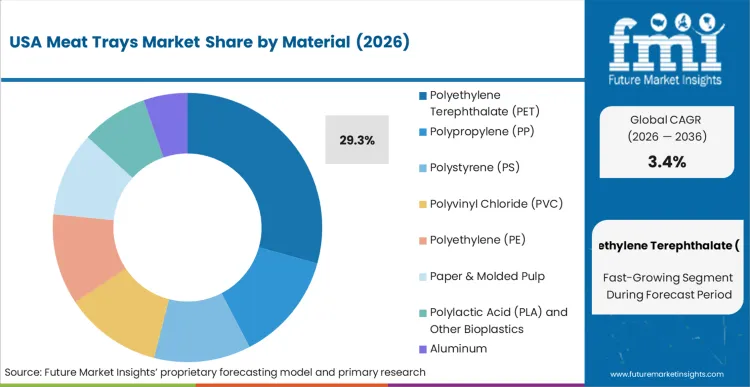
Based on FMI's USA Meat Trays market report, consumption of Polyethylene Terephthalate (PET) is estimated to hold 29.3% share in 2026. PET dominates due to its clarity, strength, and compatibility with modified atmosphere packaging used in fresh meat retail. It addresses retailer and processor requirements for product visibility, impact resistance, and recyclability. PET trays support leak resistance and structural rigidity, making them suitable for high-moisture protein packaging across supermarkets and wholesale distribution.
- Shelf Visibility: PET provides high transparency, enhancing product presentation and supporting consumer purchasing decisions in fresh meat aisles.
- Recyclability Advantage: Increasing sustainability commitments across USA retailers favor PET due to established recycling streams compared to traditional foam trays.
- MAP Compatibility: PET trays integrate efficiently with barrier films used in modified atmosphere packaging, extending shelf life and reducing spoilage rates.
USA Meat Trays Market Analysis by Distribution Channel
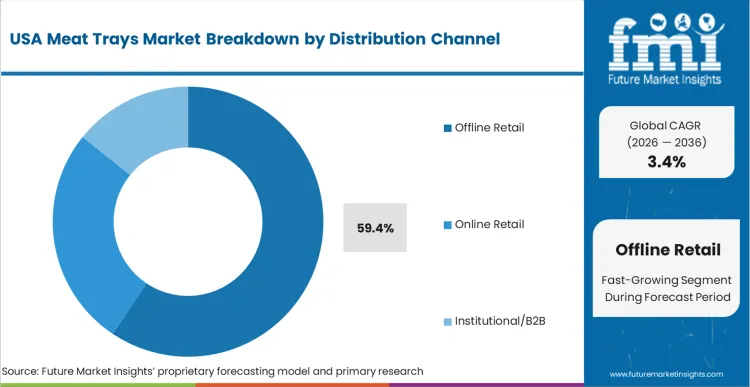
Based on FMI's USA Meat Trays market report, consumption through Offline Retail is estimated to hold 59.4% share in 2026. Offline retail dominates due to continued consumer preference for purchasing fresh meat from supermarkets, hypermarkets, and specialty butcher stores. Physical retail environments require durable, stackable, and visually clear tray packaging that supports in-store display and refrigeration standards.
- Supermarket Dominance: Large retail chains account for the majority of fresh meat sales, sustaining demand for high-volume tray packaging formats.
- Cold Chain Infrastructure: Established refrigerated distribution systems reinforce reliance on rigid tray formats suitable for chilled storage.
- In-Store Butchery: On-site meat processing and repackaging in supermarkets continue to drive consistent demand for standardized tray sizes across regional retail networks.
USA Meat Trays Market: Drivers, Restraints, and Opportunities
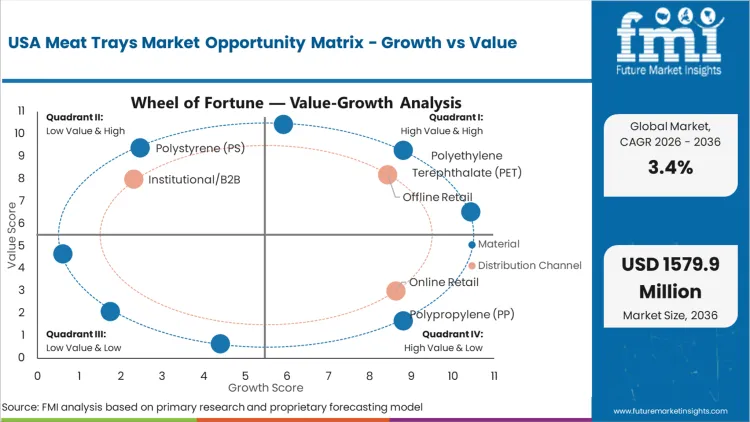
Future Market Insights analysis indicates that the USA meat trays market is structurally anchored to the country’s large-scale meat processing and retail distribution system. The market exists at its current scale because fresh poultry, beef, and pork products require rigid, moisture-resistant trays that support modified atmosphere packaging (MAP), absorbent pad integration, and retail display compatibility. Demand has historically tracked per capita meat consumption and supermarket dominance in food retail, reinforcing foam and PET trays as standard primary packaging formats within chilled supply chains.
FMI analysts observe a transition from expanded polystyrene (EPS) foam trays toward recyclable PET and fiber-based alternatives. While EPS trays continue to dominate in cost-sensitive retail segments due to low price and strong cushioning properties, regulatory pressure and retailer sustainability commitments are accelerating substitution. PET trays, particularly those incorporating recycled content, offer improved recyclability and clearer visibility, though they involve higher material and processing costs. Molded fiber trays are also gaining limited traction in premium and sustainability-focused channels. Although alternative materials may increase per-unit packaging costs, improved environmental positioning and regulatory alignment support value stability in a competitive market.
- Plastic Restriction Policies: Several USA states and municipalities are implementing restrictions on expanded polystyrene food containers. These policies are structurally encouraging the shift toward PET and fiber-based meat trays.
- Retail Sustainability Commitments: Major grocery chains are pledging reductions in virgin plastic use, influencing procurement decisions toward recyclable or PCR-based tray formats.
- Protein Consumption Stability: Consistent domestic demand for fresh meat products sustains baseline tray volumes, with seasonal fluctuations tied to grilling seasons and holiday consumption patterns.
Regional Analysis
The USA meat trays market is analyzed at the state level, covering Texas, California, Georgia, North Carolina, and Kansas. Growth differences are influenced by meat processing capacity, retail distribution networks, sustainability mandates, and state-level waste management regulations. The full report provides detailed state-wise market attractiveness analysis.
.webp "Top Country Growth Comparison Usa Meat Trays Market Cagr (2026 2036)")
| State | CAGR(2026 to 2036) |
|---|---|
| Texas | 4.5% |
| California | 4.1% |
| Georgia | 3.8% |
| North Carolina | 3.6% |
| Kansas | 3.3% |
Source: Future Market Insights (FMI) analysis, based on proprietary forecasting model and primary research
Southern and Central United States - Protein Processing and Retail Packaging Core
The Southern and Central United States represent the protein processing and retail packaging core of the meat trays market. Demand is closely tied to poultry, beef, and pork processing volumes, as well as supermarket and club store distribution. Key companies such as Sealed Air Corporation, Pactiv Evergreen Inc., Sonoco Products Company, and Amcor plc maintain strong thermoforming and protein packaging operations across the region.
Texas
Demand for meat trays in Texas is projected to rise at 4.5% CAGR through 2036. Growth is driven by Texas’ large beef and poultry processing footprint. The Texas Commission on Environmental Quality continues enforcement of solid waste and packaging disposal regulations, influencing adoption of recyclable and lightweight tray formats. In 2024, expansion announcements in meat processing facilities across the state increased capacity for packaged protein products, reinforcing tray demand. Growth in retail grocery chains and warehouse clubs further supports high-volume foam and recyclable PET tray consumption. Sustainability commitments from major food retailers are also encouraging gradual transition toward recyclable or fiber-based tray solutions.
California
Demand for meat trays in California is projected to rise at 4.1% CAGR through 2036. Growth is influenced by California’s strict environmental regulations and packaging waste policies. In 2024, continued implementation of the state’s Extended Producer Responsibility framework for packaging increased accountability for recyclability and material reduction. California’s Department of Resources Recycling and Recovery continues oversight of waste diversion programs that affect packaging selection. High per-capita consumption of packaged fresh meat, combined with strong retail penetration, supports steady tray demand. Sustainability-driven retail procurement practices are accelerating interest in recyclable PET and fiber-based alternatives.
Georgia
Demand for meat trays in Georgia is projected to rise at 3.8% CAGR through 2036. The state’s strong poultry processing sector drives consistent tray usage. Georgia’s Environmental Protection Division continues oversight of waste management compliance, reinforcing proper packaging disposal practices. In 2024, poultry production expansion projects in the Southeast supported higher output of retail-ready packaged meats. Growth in regional distribution hubs and supermarket chains further strengthens demand for protective protein packaging trays. While regulatory pressure is moderate compared to California, rising retailer sustainability targets support gradual material transition.
North Carolina
Demand for meat trays in North Carolina is projected to rise at 3.6% CAGR through 2036. Growth is tied to pork and poultry production, as the state remains a major meat supplier within the United States. The North Carolina Department of Environmental Quality continues to enforce waste reduction and landfill diversion regulations that influence packaging material choices. In 2024, modernization of meat processing facilities supported increased retail-ready packaging volumes. Expansion of regional grocery distribution networks further sustains steady tray demand. Consumer preference for fresh packaged meat products supports continued growth across foam and recyclable tray segments.
Kansas
Demand for meat trays in Kansas is projected to rise at 3.3% CAGR through 2036. Kansas’ strong beef processing industry supports consistent tray consumption. The Kansas Department of Health and Environment oversees waste management and environmental compliance frameworks that influence packaging disposal practices. In 2024, continued investment in meat processing plant upgrades increased packaging automation capacity, reinforcing demand for thermoformed trays compatible with high-speed lines. Growth remains moderate but stable, supported by sustained protein production and domestic retail supply chains.
FMI's analysis of USA meat trays market consists of state-wise assessment that includes Texas, California, Georgia, North Carolina, and Kansas. Readers can find insights on meat processing expansion, sustainability regulation impact, retail packaging trends, and material innovation developments.
Competitive Aligners for Market Players
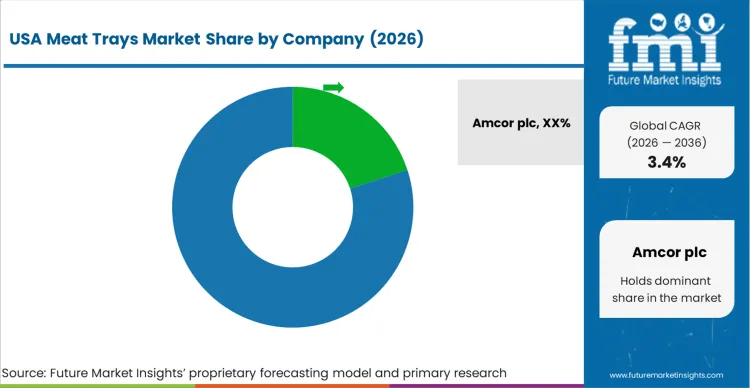
The USA meat trays market is moderately consolidated, led by large packaging manufacturers with integrated foam, PET, and fiber tray production capabilities. Companies such as Sealed Air Corporation, Amcor plc, Sonoco Products Company, Pactiv Evergreen Inc., Genpak LLC, Winpak, and Tekni-Plex hold significant market share due to their scale, national distribution networks, and strong relationships with meat processors and retail chains. These firms supply a wide range of expanded polystyrene (EPS), PET, PP, and increasingly fiber-based meat trays. Mid-sized and niche players including CKF Inc., Clearly Clean Products, Great River Plastics, Sabert Corporation, GoGreen Packaging, Treplar, and EasyPak compete through sustainable tray alternatives, custom formats, and regional production capabilities. Competition is primarily driven by material innovation, cost efficiency, product performance (absorbency, rigidity, leak resistance), and compliance with food safety regulations.
Structural advantages are concentrated among companies with vertically integrated resin processing, thermoforming, and distribution operations. Firms such as Sealed Air, Pactiv Evergreen, and Amcor benefit from advanced barrier technologies and automated tray sealing systems that integrate directly into protein processing lines. Clearly Clean and other rPET-focused producers leverage closed-loop recycling capabilities to differentiate on sustainability. Companies investing in fiber-based or recyclable mono-material trays are strengthening their position amid retailer and state-level restrictions on expanded polystyrene. Proximity to meat processing hubs in the Midwest and Southeast USA further enhances logistical competitiveness and customer retention.
Buyer leverage in the USA meat trays market is significant, particularly among large meat processors and national grocery chains. Buyers typically negotiate multi-year contracts and often dual-source to manage resin cost volatility and supply risk. However, once a tray format is validated for machine compatibility and food safety compliance, switching suppliers requires requalification and operational adjustments, limiting short-term flexibility. Growing retailer sustainability mandates and state bans on certain foam products are reshaping procurement priorities, favoring suppliers capable of delivering recyclable PET or fiber-based tray alternatives.
Recent Development
- Novolex completed its previously announced combination with Pactiv Evergreen on April 1, 2025, creating one of North America’s largest packaging suppliers with expanded reach across food, beverage, and specialty packaging products. This enlarged portfolio enhances capacity for food-contact packaging formats that include trays and related protective solutions.
- Sealed Air’s CRYOVAC® brand reached the installation of its 4,000th rotary vacuum packaging system worldwide, marking a significant milestone in food packaging automation and performance. While not specific to meat trays, this reflects Sealed Air’s continued operational deployment of high-performance food packaging equipment.
Key Players
- Amcor plc
- Sealed Air Corporation
- Sonoco Products Company
- CKF Inc.
- Tekni-Plex, Inc.
- Clearly Clean Products, Inc.
- Pactiv Evergreen Inc.
- Genpak LLC
- ProAmpac
- Winpak
- Sabert Corporation
Scope of Report
| Metric | Value |
|---|---|
| Quantitative Units | USD 1,097.70 million (2025); USD 1,130.90 million (2026) to USD 1,587.50 million (2036), at a CAGR of 3.4% |
| Market Definition | The USA meat trays market comprises the manufacturing and supply of rigid and semi-rigid trays designed for fresh, processed, and value-added meat packaging, enabling product protection, hygiene compliance, extended shelf life, and compatibility with overwrap, MAP, and vacuum skin packaging systems across retail and foodservice channels. |
| Form Segmentation | Standard Overwrap Trays; Modified Atmosphere Packaging (MAP) Trays; Vacuum Skin Packaging (VSP) Trays |
| End Use Segmentation | Supermarkets & Hypermarkets; Convenience Stores; Butcher Shops; Meat Processors; Foodservice Distributors; E-commerce & Direct-to-Consumer Meat Brands |
| Application Coverage | Fresh Red Meat; Poultry; Seafood; Processed & Marinated Meat; Ready-to-Cook Portions; Bulk & Family Packs |
| Regions Covered | United States |
| Countries Covered | United States |
| Key Companies Profiled | Amcor plc; Sealed Air Corporation; Pactiv Evergreen Inc.; Sonoco Products Company; Genpak LLC; Others |
| Forecast Period | 2026 to 2036 |
| Approach | Hybrid top-down and bottom-up market modeling validated through primary interviews with tray manufacturers, meat processors, and retail procurement managers, supported by resin consumption benchmarking, food safety compliance analysis (USDA & FDA standards), sustainability transition tracking toward rPET and fiber-based trays, and regional demand assessment across USA meat retail and foodservice sectors. |
Source: Future Market Insights (FMI) analysis, based on proprietary forecasting model and primary research
USA Meat Trays Market by Segmentation
By Material
- Polyethylene Terephthalate (PET)
- APET (Amorphous Polyethylene Terephthalate)
- CPET (Crystalline Polyethylene Terephthalate)
- rPET (Recycled PET)
- Polypropylene (PP)
- Polystyrene (PS)
- Polyvinyl Chloride (PVC)
- Polyethylene (PE)
- Paper & Molded Pulp
- Polylactic Acid (PLA) and Other Bioplastics
- Aluminum
By Tray Type
- Standard Overwrap Trays
- Modified Atmosphere Packaging (MAP) Trays
- Vacuum Skin Packaging (VSP) Trays
By Manufacturing Process
- Thermoformed Trays
- Injection Molded Trays
- Foam Extrusion Trays
- Laminated or Coated Trays
By Capacity
- Small Portion Trays (≤250g)
- Medium Portion Trays (251g-500g)
- Large Portion Trays (501g-1 kg)
- Family/Bulk Trays (>1 kg)
By Distribution Channel
- Offline Retail
- Supermarkets & Hypermarkets
- Convenience Stores
- Butcher Shops
- Wholesaler
- Online Retail
- E-commerce Marketplaces
- Grocery Delivery Platforms
- Direct-to-Consumer (D2C) Meat Brands
- Institutional/B2B
- Meat Processors
- Foodservice Distributors
By Region
- North East
- South West
- West
- South East
- Midwest
Bibliography
- USA Department of Agriculture (USDA), Economic Research Service (ERS), Livestock, Dairy, and Poultry Outlook, February 2025.
- USA Department of Agriculture (USDA), National Agricultural Statistics Service (NASS), Livestock Slaughter 2024 Summary, January 2025.
- USA Food and Drug Administration (FDA), Indirect Food Additives: Polymers (21 CFR Part 177), January 2024.
- USA Department of Agriculture (USDA), Food Safety and Inspection Service (FSIS), Sanitation Performance Standards Compliance Guide, Updated March 2024.
- USA Environmental Protection Agency (EPA), Advancing Sustainable Materials Management: Plastics and Paper Material-Specific Data, December 2023.
- ASTM International, ASTM D6400-23 - Standard Specification for Labeling of Plastics Designed to be Aerobically Composted in Municipal or Industrial Facilities, April 2023.
- Plastics Industry Association (PLASTICS), 2024 Size & Impact Report - The Plastics Industry in North America, September 2024.
- North American Meat Institute (NAMI), The Meat Industry Economic Impact Report 2024, October 2024.
This Report Addresses
- Strategic market intelligence supporting investment, capacity expansion, and material transition decisions across USA protein packaging supply chains.
- USA market size estimation with 2026 to 2036 revenue forecasts validated through meat production volumes and tray manufacturing capacity benchmarking.
- Growth opportunity mapping across MAP, VSP, and overwrap tray formats aligned with shelf-life extension and retail display requirements.
- Material transition assessment covering PET, rPET, PP, EPS foam, molded pulp, and emerging bioplastic alternatives under state plastic restrictions.
- Manufacturing process evaluation including thermoforming, injection molding, foam extrusion, and coated fiber tray production technologies.
- Distribution channel analysis across offline retail, online grocery, and institutional meat supply networks influencing tray specification and demand.
- Regulatory impact assessment addressing USDA, FDA food-contact compliance, and evolving state-level polystyrene and packaging waste regulations.
- Competitive benchmarking of leading USA tray manufacturers based on resin integration, automation compatibility, sustainability positioning, and processor partnerships.
Frequently Asked Questions
How large is the USA Meat Trays Market in 2026?
The USA Meat Trays Market is valued at 1,130.90 Million in 2026.
What was the market size of the USA Meat Trays Market in 2025?
The market was valued at 1,097.70 Million in 2025.
What will be the market size of the USA Meat Trays Market by 2036?
The market is projected to reach 1,587.50 Million by 2036.
What is the expected CAGR of the USA Meat Trays Market between 2026 and 2036?
The market is expected to grow at a CAGR of 3.4% during the forecast period.
Which tray type holds the largest share in the USA Meat Trays Market?
Modified Atmosphere Packaging (MAP) Trays lead the market with a 41.5% share, followed by Standard Overwrap Trays at 34.6% and Vacuum Skin Packaging (VSP) Trays at 23.9%.
Which material segment dominates the USA Meat Trays Market?
Polyethylene Terephthalate (PET) leads with a 29.3% share, followed by Polypropylene (PP) at 19.5% and Polystyrene (PS) at 15.3%.
How significant is the offline retail distribution channel?
Offline Retail accounts for 59.4% of total demand, compared to Institutional/B2B at 26.4% and Online Retail at 14.2%.
Which USA states are projected to grow the fastest?
Texas leads with a 4.5% CAGR, followed by California at 4.1%, Georgia at 3.8%, North Carolina at 3.6%, and Kansas at 3.3% between 2026 and 2036.
Preview the report firsthand - request a free sample
Get SampleGet the brochure for pricing and purchase details.
Get PDFTable of Content
- Executive Summary
- USA Market Outlook
- Demand-side Trends
- Supply-side Trends
- Technology Roadmap Analysis
- Analysis and Recommendations
- Market Overview
- Market Coverage / Taxonomy
- Market Definition / Scope / Limitations
- Research Methodology
- Chapter Orientation
- Analytical Lens and Working Hypotheses
- Market Structure, Signals, and Trend Drivers
- Benchmarking and Cross-market Comparability
- Market Sizing, Forecasting, and Opportunity Mapping
- Research Design and Evidence Framework
- Desk Research Programme (Secondary Evidence)
- Company Annual and Sustainability Reports
- Peer-reviewed Journals and Academic Literature
- Corporate Websites, Product Literature, and Technical Notes
- Earnings Decks and Investor Briefings
- Statutory Filings and Regulatory Disclosures
- Technical White Papers and Standards Notes
- Trade Journals, Industry Magazines, and Analyst Briefs
- Conference Proceedings, Webinars, and Seminar Materials
- Government Statistics Portals and Public Data Releases
- Press Releases and Reputable Media Coverage
- Specialist Newsletters and Curated Briefings
- Sector Databases and Reference Repositories
- FMI Internal Proprietary Databases and Historical Market Datasets
- Subscription Datasets and Paid Sources
- Social Channels, Communities, and Digital Listening Inputs
- Additional Desk Sources
- Expert Input and Fieldwork (Primary Evidence)
- Primary Modes
- Qualitative Interviews and Expert Elicitation
- Quantitative Surveys and Structured Data Capture
- Blended Approach
- Why Primary Evidence is Used
- Field Techniques
- Interviews
- Surveys
- Focus Groups
- Observational and In-context Research
- Social and Community Interactions
- Stakeholder Universe Engaged
- C-suite Leaders
- Board Members
- Presidents and Vice Presidents
- R&D and Innovation Heads
- Technical Specialists
- Domain Subject-matter Experts
- Scientists
- Physicians and Other Healthcare Professionals
- Governance, Ethics, and Data Stewardship
- Research Ethics
- Data Integrity and Handling
- Primary Modes
- Tooling, Models, and Reference Databases
- Desk Research Programme (Secondary Evidence)
- Data Engineering and Model Build
- Data Acquisition and Ingestion
- Cleaning, Normalisation, and Verification
- Synthesis, Triangulation, and Analysis
- Quality Assurance and Audit Trail
- Market Background
- Market Dynamics
- Drivers
- Restraints
- Opportunity
- Trends
- Scenario Forecast
- Demand in Optimistic Scenario
- Demand in Likely Scenario
- Demand in Conservative Scenario
- Opportunity Map Analysis
- Product Life Cycle Analysis
- Supply Chain Analysis
- Investment Feasibility Matrix
- Value Chain Analysis
- PESTLE and Porter’s Analysis
- Regulatory Landscape
- Regional Parent Market Outlook
- Production and Consumption Statistics
- Import and Export Statistics
- Market Dynamics
- USA Market Analysis 2021 to 2025 and Forecast, 2026 to 2036
- Historical Market Size Value (USD Million) Analysis, 2021 to 2025
- Current and Future Market Size Value (USD Million) Projections, 2026 to 2036
- Y-o-Y Growth Trend Analysis
- Absolute $ Opportunity Analysis
- USA Market Pricing Analysis 2021 to 2025 and Forecast 2026 to 2036
- USA Market Analysis 2021 to 2025 and Forecast 2026 to 2036, By Material
- Introduction / Key Findings
- Historical Market Size Value (USD Million) Analysis By Material , 2021 to 2025
- Current and Future Market Size Value (USD Million) Analysis and Forecast By Material , 2026 to 2036
- Polyethylene Terephthalate (PET)
- Polypropylene (PP)
- Polystyrene (PS)
- Polyvinyl Chloride (PVC)
- Polyethylene (PE)
- Paper & Molded Pulp
- Polylactic Acid (PLA) and Other Bioplastics
- Aluminum
- Polyethylene Terephthalate (PET)
- Y-o-Y Growth Trend Analysis By Material , 2021 to 2025
- Absolute $ Opportunity Analysis By Material , 2026 to 2036
- USA Market Analysis 2021 to 2025 and Forecast 2026 to 2036, By Distribution Channel
- Introduction / Key Findings
- Historical Market Size Value (USD Million) Analysis By Distribution Channel, 2021 to 2025
- Current and Future Market Size Value (USD Million) Analysis and Forecast By Distribution Channel, 2026 to 2036
- Offline Retail
- Online Retail
- Institutional/B2B
- Offline Retail
- Y-o-Y Growth Trend Analysis By Distribution Channel, 2021 to 2025
- Absolute $ Opportunity Analysis By Distribution Channel, 2026 to 2036
- Market Structure Analysis
- Competition Dashboard
- Competition Benchmarking
- Market Share Analysis of Top Players
- By Regional
- By Material
- By Distribution Channel
- Competition Analysis
- Competition Deep Dive
- Amcor plc
- Overview
- Product Portfolio
- Profitability by Market Segments (Product/Age /Sales Channel/Region)
- Sales Footprint
- Strategy Overview
- Marketing Strategy
- Product Strategy
- Channel Strategy
- Sealed Air Corporation
- Sonoco Products Company
- CKF Inc.
- Tekni-Plex, Inc.
- Clearly Clean Products, Inc.
- Pactiv Evergreen Inc.
- Genpak LLC
- ProAmpac
- Winpak
- Sabert Corporation
- Amcor plc
- Competition Deep Dive
- Assumptions & Acronyms Used


