

- Market Size (2026)
- USD 266.0 Bn
- Forecast (2036)
- USD 413.0 Bn
- CAGR (2026 to 2036)
- 4.5%
Deli Meat Market Size, Market Forecast and Outlook By FMI
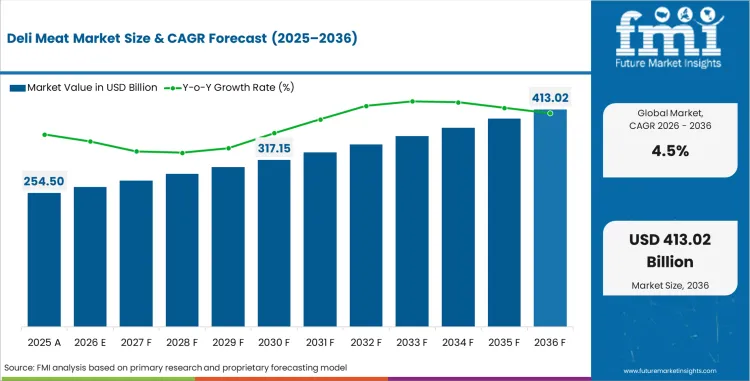
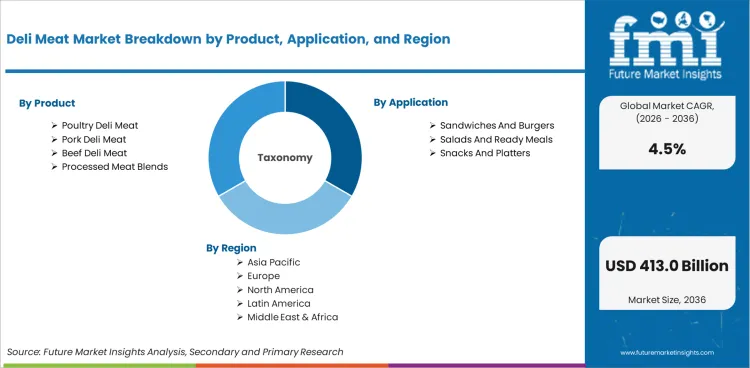
The deli meat market was valued at USD 254.5 billion in 2025. The market is set to reach USD 266.0 billion by 2026-end and grow at a CAGR of 4.5% between 2026-2036 to reach USD 413.0 billion by 2036. Poultry Deli Meat will dominate with a 40.0% share, while Sandwiches And Burgers will lead with a 50.0% share.
Key Takeaways, Market Size, and Forecast
- The deli meat market was valued at USD 254.5 billion in 2025.
- By 2036, the Deli Meat Market is expected to be worth USD 413.02 billion.
- From 2026 to 2036, the market is projected to expand at a CAGR of 4.5%.
- The market is projected to create an incremental opportunity of USD 147.06 billion between 2026 and 2036.
- In 2026, poultry deli meat is expected to account for 40% of the product segment, driven by demand for sliced and pre-portioned poultry deli products used in sandwich preparation, burger assembly, and foodservice menu applications.
- Spain (7.3%) and Australia (6.9%) are two of the fastest growing markets in the world.
Summary of the Deli Meat Market
- Demand and Growth Drivers
- The key demand drivers include foodservice sandwich chain expansion and quick-service restaurant menu development, with deli meat being the core protein input for commercial sandwich, burger and wrap preparation at scale.
- Clean-label and antibiotic-free deli meat products are tapping into the demand for premiumization, as health-conscious consumers trade up from conventional processed meats to products with transparent ingredient lists and reduced preservative content.
- Vacuum packaging and modified atmosphere packaging are extending the shelf life of deli meats, cutting down on waste and opening up wider distribution through retail outlets and online grocery delivery.
- Product and Segment View
- The leading product segment, Poultry Deli Meat, accounted for 40% share and is likely to maintain its dominance, owing to established demand and procurement patterns.
- Sandwiches And Burgers is expected to hold a share of 50% of the application segment as it is the preferred choice of the buyer and the consumption pattern.
- The foodservice sector is expected to have the largest share in the end-use segment with 60% during the forecast period.
- Geography and Competitive Outlook
- Spain is likely to remain a key market at 7.3% CAGR, supported by strong demand fundamentals and expanding consumption.
- Australia is likely to sustain growth at 6.9% CAGR owing to rising spending and expanding distribution.
- Companies with integrated supply chains and multi-channel distribution are likely to gain traction during the forecast period.
- Analyst Opinion
- The deli meat market is evolving with clear segment leaders, established supply chains, and distribution patterns shaping competitive dynamics.
- The increasing adoption is driven by growing consumer awareness, developing retail and foodservice infrastructure, and category premiumization trends.
- Demand is further supported by product format diversification and geographic expansion into developing markets with growing consumption potential.
- Companies that can secure consistent supply quality while optimizing cost across key segments are likely to strengthen their position over the forecast period.
Deli Meat Market Definition
The deli meat market encompasses commercially traded processed and cured meat products sold in sliced, pre-portioned, and bulk formats for sandwich, burger, salad, and charcuterie applications. Product categories include poultry deli meat, beef deli meat, pork deli meat, and plant-based deli meat alternatives.
Deli Meat Market Inclusions
Market scope covers all commercially traded deli meat products categorized by product (poultry deli meat, beef deli meat, pork deli meat, plant-based deli alternatives), application (sandwiches and burgers, salads and wraps, charcuterie, cooking ingredient), end use (foodservice industry, retail consumers), distribution channel (offline retail, online retail), processing method (cured meat, uncured meat, smoked meat, roasted meat), packaging (vacuum packaging, modified atmosphere packaging, deli counter), and pricing tier (mid range, economy, premium). The revenue range spans from 2026 to 2036.
Deli Meat Market Exclusions
Whole untreated meat portions, canned meat products, dried jerky and fresh sausages sold in separate categories are not included in the scope.
Deli Meat Market Research Methodology
- Primary Research FMI analysts spoke with meat processing companies, foodservice purchasing managers, deli counter operators and retail meat buyers in the key markets.
- Desk Research: Data were drawn from meat industry associations, foodservice procurement databases and retail scanner reports.
- Market sizing & forecast Bottom-up summation of product type and distribution channel with modification of regional adoption curves for per capita processed meat consumption, foodservice density, and sandwich culture penetration.
- Data validation: Cross-checked quarterly with meat processing production data and retail scanner statistics.
Why is the Deli Meat Market Growing?
- Key demand drivers include expansion of the foodservice sandwich chain and menu development of quick-service restaurants, where deli meat is a core protein input for commercial sandwich.
- Health-conscious consumers are trading up from traditional processed meats to clean label and antibiotic-free deli meat products with transparent ingredient lists and less preservative content, in a move that is riding the premiumization wave.
- And deli meat shelf life is being extended through vacuum packaging and modified atmosphere packaging technologies, reducing waste.
The deli meat market is growing at a 4.5% CAGR as foodservice channel growth and retail pre-packaged convenience converge. Poultry deli meat leads the product segment at 40.0%, as turkey and chicken products gain share from beef and pork due to their lean protein positioning. Sandwiches and burgers are responsible for 50.0% of application demand, and this is due to the structural link between the procurement of deli meat and the preparation of sandwich-format meals.
Foodservice accounts for 60.0% of end-user demand including restaurant chains, sandwich shops, catering companies and institutional foodservice who buy deli meat in bulk formats. Offline retail has the largest share (65.0%) and deli counters in supermarkets and pre-packaged refrigerated sections are important purchase points for consumers. Cured meat is the leader in processing methods at 55.0% with traditional curing providing the flavor and shelf-life characteristics consumers expect.
Market Segmentation Analysis
- Poultry Deli Meat accounts for 40% of the product segment, reflecting established demand patterns.
- Foodservice Industry leads the end use segment at 60% share.
The deli meat market is segmented by product, application, end use, distribution channel, processing method, packaging, pricing tier.
Insights into the Poultry Deli Meat Product Segment
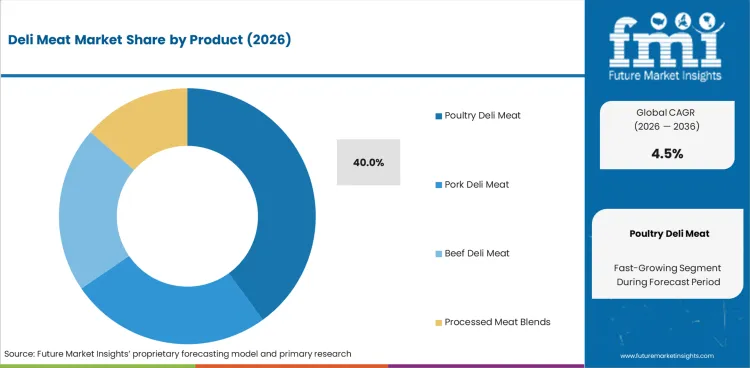
Poultry deli meat is expected to account for a 40.0% share of the product segment in 2026. Turkey and chicken deli products are winning share from beef and pork varieties, thanks to lean protein and lower fat positioning. Poultry deli meats, oven-roasted, smoked and herb-seasoned for foodservice sandwich programs and retail pre-packaged formats. Health-oriented retail channels are charging a premium for antibiotic-free and organic poultry deli products.
Insights into the Foodservice Industry End Use Segment
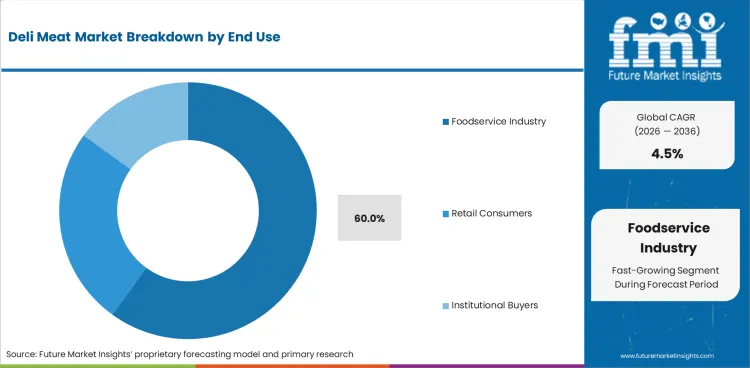
Foodservice represents 60.0% of end-user demand. Deli meat in bulk sliced and pre-portioned formats are bought by sandwich chains, quick-service restaurants and institutional catering through direct supply agreements. Volume-based pricing and consistent quality specifications are driven by standardization requirements for the menu. The supermarket deli counter offers a retail and foodservice experience.
Deli Meat Market Drivers, Restraints, and Opportunities
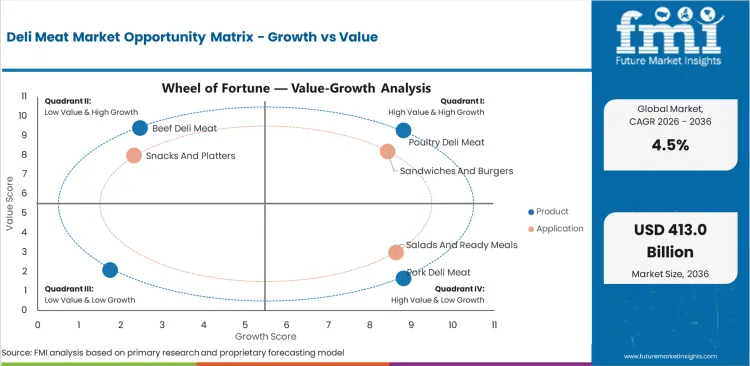
- Foodservice Channel Growth and is creating structured demand across key segments.
- Processed Meat Health Perception is moderating growth in certain consumer segments.
The deli meat market is shaped by demand-side catalysts and supply-side constraints that vary by region, channel, and price tier.
Foodservice Channel Growth and Sandwich Chain Expansion
Demand is driven by development of quick-service restaurant menu based on deli meat as a core protein ingredient and growth of sandwich chains. Subway, Panera and regional sandwich chains build large volume procurement pipelines with uniform quality and portion specifications.
Clean Label and Antibiotic-Free Premiumization
Growth is fueled by consumer demand for deli meat products with lower sodium content, no nitrates, antibiotic-free sourcing, and transparently listed ingredients. Health conscious consumers are willing to pay 20-40% more for premium clean label products than conventional products.
Processed Meat Health Perception Concerns
WHO and national health agencies’ colorectal cancer risk appraisals lead to negative health perceptions limiting processed meat adoption. Health-conscious demographics are limited by consumers’ fears of preservatives, sodium and processing techniques.
Packaging Technology and Shelf Life Extension
Vacuum packaging and modified atmosphere packaging technologies are supporting growth by extending the shelf life of deli meats from days to weeks. Extended shelf life reduces retail waste, broadens distribution and supports online grocery delivery of pre-packaged deli meat products.
Analysis of Deli Meat Market By Key Countries
.webp "Top Country Growth Comparison Deli Meat Market Cagr (2026 2036)")
| Country | CAGR |
|---|---|
| Spain | 7.3% |
| Australia | 6.9% |
| France | 6.4% |
| India | 6.1% |
| USA | 3.6% |
Source: FMI analysis based on primary research and proprietary forecasting model
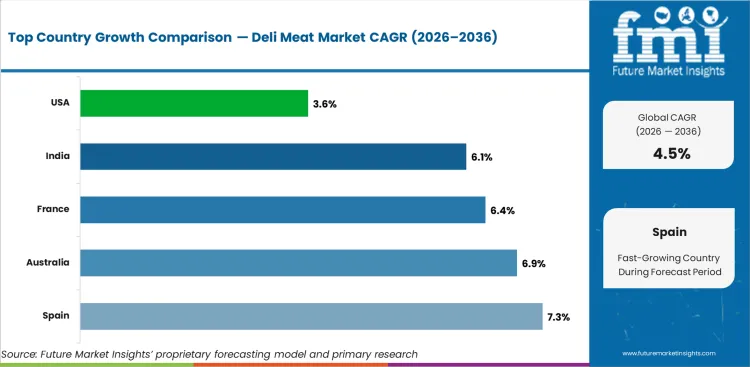
- Spain leads at 7.3% CAGR, supported by the largest demand base and expanding consumption.
- Australia at 6.9% shows strong demand supported by rising spending and distribution expansion.
- France (6.4%) and India (6.1%) sustain growth through expanding market development.
The global deli meat market is projected to expand at 4.5% per year from 2026 to 2036. The study covers more than 30 countries.
Sales Analysis of Deli Meat Market in Spain
Spain is at 7.3% through 2036. Spain has a deep cultural integration of deli meat products through its charcuterie culture of jamon, chorizo and embutidos. Products with a protected designation of origin (PDO) are sold at a significant premium on both domestic and export markets.
- Charcuterie culture including jamon and chorizo provides deep cultural integration of deli meat.
- Protected designation of origin (PDO) products command significant premiums domestically and in export.
- Foodservice and tourism sectors create sustained demand for premium Spanish deli meat products.
Demand Outlook for Deli Meat Market in Australia
Australia is growing at 6.9% through 2036. Strong cafe and sandwich culture means steady deli meat consumption. Australian consumers are increasingly seeking clean-label and free-range poultry deli products.
- Strong sandwich and cafe culture provides consistent deli meat consumption patterns.
- Consumer preference for clean-label and free-range products drives premiumization.
- Foodservice channel growth in major cities sustains institutional procurement demand.
Future Outlook for Deli Meat Market in the United States
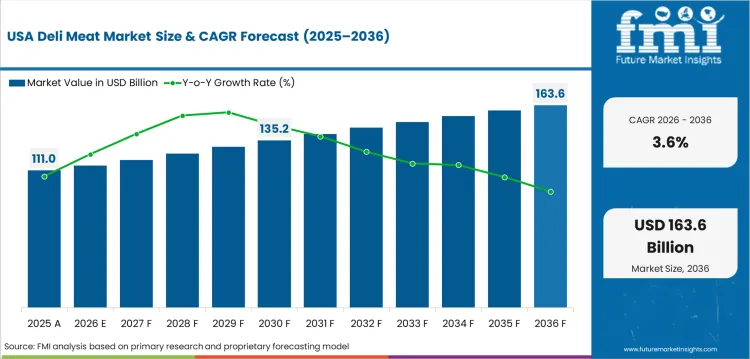
The USA is growing at 3.6% through 2036. Hormel Foods, Tyson Foods, and Cargill dominate US deli meat manufacturing and distribution. Subway and Panera represent major foodservice procurement accounts. Clean-label and antibiotic-free products are the fastest-growing segments.
- Hormel, Tyson, and Cargill dominate manufacturing and distribution infrastructure.
- Sandwich chain procurement from Subway and Panera provides large-volume demand pipelines.
- Clean-label and antibiotic-free products are the fastest-growing retail deli meat segments.
In-depth Analysis of Deli Meat Market in Germany
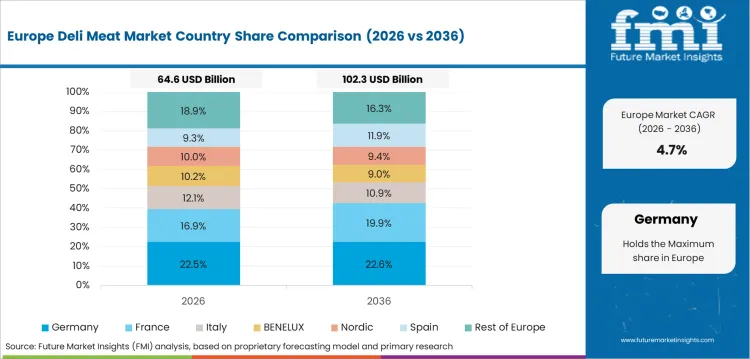
Germany is growing at 4.7% to 2036. Germany has one of the highest per capita processed meat consumption in Europe. Wurst culture and established deli counter traditions lead to deep category integration. EU labeling and food safety standards dictate the production specifications.
- Among the highest per-capita processed meat consumption in Europe provides a strong demand base.
- Wurst culture and deli counter traditions ensure deep category integration in German food culture.
- EU food safety and labeling standards shape production and marketing requirements.
In-depth Analysis of Deli Meat Market in Japan
Japan expands 3.8% through 2036. Pre-packaged deli meats are easy to eat thanks to convenience store and bento culture. Japanese consumers buy meat products primarily based on the product’s freshness and quality and accurate portioning.
- Convenience store and bento culture support pre-packaged deli meat consumption occasions.
- Quality and freshness standards shape consumer expectations for deli meat products.
- Western sandwich culture adoption alongside traditional Japanese formats expands consumption.
Opportunity Analysis of Deli Meat Market in Brazil
Brazil is growing at 5.2% through 2036. JBS S.A. and domestic meat processors maintain strong positions. Growing sandwich and fast food culture in urban centers supports deli meat demand expansion.
- JBS and domestic meat processors provide large-scale manufacturing and distribution.
- Urban sandwich and fast food culture growth drives expanding deli meat consumption.
- Export-oriented processing capacity supports quality standards for domestic retail products.
Competitive Landscape and Strategic Positioning
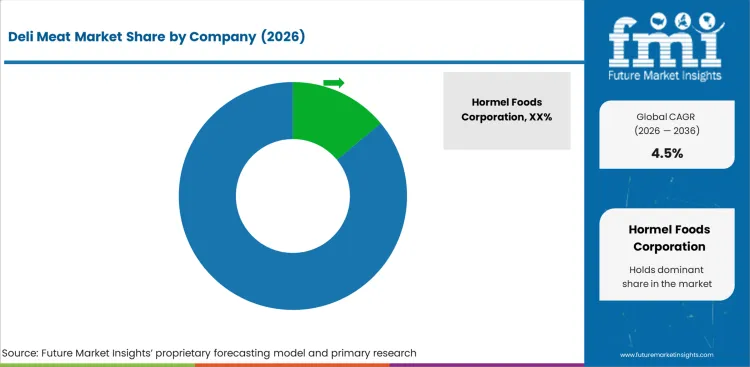
- Hormel Foods Corporation is the US market leader through its Hormel, Jennie-O and Applegate brands and offers conventional, natural and organic deli meats through retail and foodservice channels.
- Tyson Foods Inc. and Cargill Incorporated compete in large-scale poultry and beef processing, multi-brand portfolios and foodservice supply relationships with big sandwich chains.
- JBS S.A. integrated beef, poultry and pork processing operations in Brazil, USA and Australia, providing global scale with established export distribution to deli meat markets around the world.
The competitive landscape is shaped by companies with integrated supply chains, established brand portfolios, and multi-channel distribution capabilities.
Key Companies in the Deli Meat Market
Key global companies leading the deli meat market include:
- Hormel Foods Corporation (USA), Cargill Incorporated (USA), and Tyson Foods Inc. (USA) lead through multi-brand portfolios, large-scale processing, and established foodservice and retail distribution across conventional and clean-label deli meat segments.
- JBS S.A. (Brazil), Maple Leaf Foods Inc. (Canada), and Conagra Foodservice (USA) compete through integrated meat processing, clean-label product development, and institutional foodservice procurement relationships.
- American Foods Group LLC (USA), Carl Buddig Co. (USA), West Liberty Foods LLC (USA), and Dietz and Watson (USA) serve through regional specialization, value positioning, and premium artisanal deli meat product lines.
Competitive Benchmarking: Deli Meat Market
| Company | Processing Scale | Brand Portfolio | Foodservice Access | Clean Label Range |
|---|---|---|---|---|
| Hormel Foods | Very High | Very High | Very Strong | High |
| Cargill | Very High | High | Very Strong | Medium |
| Tyson Foods | Very High | High | Very Strong | Medium |
| JBS S.A. | Very High | High | Strong | Medium |
| Maple Leaf Foods | High | Medium | Strong | Very High |
| Conagra | High | High | Strong | Medium |
| American Foods Group | Medium | Medium | Moderate | Low |
| Carl Buddig | Medium | Medium | Moderate | Medium |
| West Liberty Foods | Medium | Low (Private Label) | Strong | Medium |
| Dietz & Watson | Medium | Medium | Moderate | High |
Source: Future Market Insights competitive analysis, 2026.
Key Developments in Deli Meat Market
- In 2025, Hormel Foods expanded its Applegate portfolio with additional clean-label deli meat products, including antibiotic-free turkey and chicken offerings, responding to growing demand for minimally processed and protein-focused packaged foods.
- In 2025, Maple Leaf Foods broadened its deli and prepared protein portfolio across retail channels while continuing investment in premium and alternative protein categories to address evolving consumer preferences in North America.
Key Players in the Deli Meat Market
Major Global Players
- Hormel Foods Corporation
- Cargill Incorporated
- Tyson Foods, Inc.
- JBS S.A.
- Maple Leaf Foods, Inc.
Emerging Players/Startups
- Conagra Foodservice
- American Foods Group, LLC
- Carl Buddig Co.
- West Liberty Foods LLC
- Dietz & Watson
Report Scope and Coverage
| Parameter | Details |
|---|---|
| Quantitative Units | USD 265.95 billion to USD 413.02 billion, at a CAGR of 4.5% |
| Market Definition | The deli meat market encompasses commercially traded processed and cured meat products sold in sliced, pre-portioned, and bulk formats for sandwich, burger, salad, and charcuterie applications. Product categories include poultry deli meat, beef deli meat, pork deli meat, and plant-based deli meat alternatives. |
| Regions Covered | North America, Latin America, Europe, East Asia, South Asia and Pacific, Middle East and Africa |
| Countries Covered | Spain, Australia, France, India, USA, 30 plus countries |
| Key Companies Profiled | Hormel Foods Corporation, Cargill Incorporated, Tyson Foods, Inc., JBS S.A., Maple Leaf Foods, Inc., Conagra Foodservice, American Foods Group, LLC, Carl Buddig Co. |
| Forecast Period | 2026 to 2036 |
| Approach | Hybrid bottom-up and top-down methodology starting with verified transaction data, projecting adoption velocity across segments and regions. |
Market Segmentation Analysis
Deli Meat Market Segmented by Product:
- Poultry Deli Meat
- Chicken
- Sliced Chicken
- Smoked Chicken
- Turkey
- Roasted Turkey
- Processed Turkey
- Chicken
- Pork Deli Meat
- Ham
- Cooked Ham
- Smoked Ham
- Bacon
- Streaky Bacon
- Back Bacon
- Ham
- Beef Deli Meat
- Roast Beef
- Sliced Roast Beef
- Seasoned Beef
- Corned Beef
- Cured Beef
- Brined Beef
- Roast Beef
- Processed Meat Blends
- Mixed Meat Products
- Cold Cuts
- Salami And Sausages
- Mixed Meat Products
Deli Meat Market Segmented by Application:
- Sandwiches And Burgers
- Quick Service Restaurants
- Fast Food Chains
- Takeaway Outlets
- Home Consumption
- Packed Lunches
- Convenience Meals
- Quick Service Restaurants
- Salads And Ready Meals
- Packaged Salads
- Protein Salads
- Diet Meals
- Ready To Eat Meals
- Microwave Meals
- Chilled Meals
- Packaged Salads
- Snacks And Platters
- Party Platters
- Cold Cut Platters
- Charcuterie Boards
- Convenience Snacks
- Protein Snacks
- On The Go Packs
- Party Platters
Deli Meat Market Segmented by End Use:
- Foodservice Industry
- Quick Service Restaurants
- Fast Food Chains
- Cafe Chains
- Full Service Restaurants
- Casual Dining
- Fine Dining
- Quick Service Restaurants
- Retail Consumers
- Household Consumers
- Urban Households
- Convenience Buyers
- Health Conscious Consumers
- Low Fat Diet Users
- High Protein Diet Users
- Household Consumers
- Institutional Buyers
- Hotels And Catering
- Event Catering
- Buffet Services
- Corporate And Educational Institutions
- Corporate Cafeterias
- School And College Cafeterias
- Hotels And Catering
Deli Meat Market Segmented by Distribution Channel:
- Offline Retail
- Supermarkets And Hypermarkets
- Large Format Stores
- Discount Stores
- Specialty Meat Stores
- Delicatessen Stores
- Butcher Shops
- Convenience Stores
- Urban Stores
- Transit Locations
- Supermarkets And Hypermarkets
- Online Retail
- E Commerce Platforms
- Marketplace Platforms
- Brand Owned Websites
- Quick Commerce
- Instant Delivery Platforms
- App Based Grocery Delivery
- E Commerce Platforms
Deli Meat Market Segmented by Processing Method:
- Cured Meat
- Dry Cured
- Salt Cured
- Air Dried
- Wet Cured
- Brine Cured
- Injected Cure
- Dry Cured
- Cooked Meat
- Roasted
- Oven Roasted
- Seasoned Roast
- Boiled And Steamed
- Boiled Meat
- Steamed Products
- Roasted
- Smoked Meat
- Hot Smoked
- Fully Cooked
- Flavored Smoke
- Cold Smoked
- Partially Cooked
- Traditional Smoking
- Hot Smoked
Deli Meat Market Segmented by Packaging:
- Vacuum Packaging
- Single Serve Packs
- Portion Controlled Packs
- On The Go Packs
- Bulk Packs
- Foodservice Packs
- Family Packs
- Single Serve Packs
- Modified Atmosphere Packaging
- Retail Packs
- Extended Shelf Life Packs
- Fresh Look Packaging
- Premium Packs
- High Barrier Films
- Resealable Packs
- Retail Packs
Deli Meat Market Segmented by Pricing Tier:
- Mid Range
- Standard Branded Products
- Packaged Deli Meat
- Standard Branded Products
- Economy
- Private Label Products
- Mass Market Meat
- Private Label Products
- Premium
- Specialty And Organic Products
- Organic Meat
- Artisanal Deli Meat
- Specialty And Organic Products
Deli Meat Market by Region:
- North America
- USA
- Canada
- Mexico
- Latin America
- Brazil
- Chile
- Rest of Latin America
- Western Europe
- Germany
- UK
- Italy
- Spain
- France
- Nordic
- BENELUX
- Rest of Western Europe
- Eastern Europe
- Russia
- Poland
- Hungary
- Balkan & Baltic
- Rest of Eastern Europe
- East Asia
- China
- Japan
- South Korea
- South Asia and Pacific
- India
- ASEAN
- Australia & New Zealand
- Rest of South Asia and Pacific
- Middle East & Africa
- Kingdom of Saudi Arabia
- Other GCC Countries
- Turkiye
- South Africa
- Other African Union
- Rest of Middle East & Africa
Research Sources and Bibliography
- 1. USA Department of Agriculture. (2025). USDA Livestock and Processed Meat Market Report. USDA.
- 2. Food and Agriculture Organization. (2025). FAO Global Meat Processing Industry Overview. FAO.
- 3. European Commission. (2024). EU Regulation on Processed Meat Labeling and Safety. EC.
- 4. North American Meat Institute. (2025). NAMI Annual Industry Report: Deli and Processed Meat. NAMI.
- 5. World Health Organization. (2024). WHO Dietary Guidelines on Processed Meat Consumption. WHO.
This bibliography is provided for reader reference.
This Report Answers
- Estimating the market size and revenue generation from 2026 to 2036.
- Segmenting by product, application, end use, distribution channel, processing method, packaging, and pricing tier.
- Providing regional insights across more than 30 markets.
- Analyzing foodservice channel and sandwich chain procurement dynamics.
- Assessing the competitive landscape across poultry, beef, pork, and plant-based deli meat.
- Identifying investment opportunities in clean-label and packaging technology.
- Tracking health perception and regulatory trends affecting processed meat consumption.
- Delivering data in PDF and Excel formats.
Frequently Asked Questions
How big is the deli meat market in 2026?
The global deli meat market is estimated to be valued at USD 265.95 billion in 2026.
What will be the size of deli meat market in 2036?
The market size for the deli meat market is projected to reach USD 413.02 billion by 2036.
How much will be the deli meat market growth between 2026 and 2036?
The deli meat market is expected to grow at a 4.5% CAGR between 2026 and 2036.
What are the key product types in the deli meat market?
The key product types in deli meat market are poultry deli meat, pork deli meat, beef deli meat and processed meat blends.
Which application segment is expected to contribute significant share in the deli meat market in 2026?
In terms of application, sandwiches and burgers segment is expected to command 50.0% share in the deli meat market in 2026.
Preview the report firsthand - request a free sample
Get SampleGet the brochure for pricing and purchase details.
Get PDFTable of Content
- Executive Summary
- Global Market Outlook
- Demand-side Trends
- Supply-side Trends
- Technology Roadmap Analysis
- Analysis and Recommendations
- Market Overview
- Market Coverage / Taxonomy
- Market Definition / Scope / Limitations
- Research Methodology
- Chapter Orientation
- Analytical Lens and Working Hypotheses
- Market Structure, Signals, and Trend Drivers
- Benchmarking and Cross-market Comparability
- Market Sizing, Forecasting, and Opportunity Mapping
- Research Design and Evidence Framework
- Desk Research Programme (Secondary Evidence)
- Company Annual and Sustainability Reports
- Peer-reviewed Journals and Academic Literature
- Corporate Websites, Product Literature, and Technical Notes
- Earnings Decks and Investor Briefings
- Statutory Filings and Regulatory Disclosures
- Technical White Papers and Standards Notes
- Trade Journals, Industry Magazines, and Analyst Briefs
- Conference Proceedings, Webinars, and Seminar Materials
- Government Statistics Portals and Public Data Releases
- Press Releases and Reputable Media Coverage
- Specialist Newsletters and Curated Briefings
- Sector Databases and Reference Repositories
- FMI Internal Proprietary Databases and Historical Market Datasets
- Subscription Datasets and Paid Sources
- Social Channels, Communities, and Digital Listening Inputs
- Additional Desk Sources
- Expert Input and Fieldwork (Primary Evidence)
- Primary Modes
- Qualitative Interviews and Expert Elicitation
- Quantitative Surveys and Structured Data Capture
- Blended Approach
- Why Primary Evidence is Used
- Field Techniques
- Interviews
- Surveys
- Focus Groups
- Observational and In-context Research
- Social and Community Interactions
- Stakeholder Universe Engaged
- C-suite Leaders
- Board Members
- Presidents and Vice Presidents
- R&D and Innovation Heads
- Technical Specialists
- Domain Subject-matter Experts
- Scientists
- Physicians and Other Healthcare Professionals
- Governance, Ethics, and Data Stewardship
- Research Ethics
- Data Integrity and Handling
- Primary Modes
- Tooling, Models, and Reference Databases
- Desk Research Programme (Secondary Evidence)
- Data Engineering and Model Build
- Data Acquisition and Ingestion
- Cleaning, Normalisation, and Verification
- Synthesis, Triangulation, and Analysis
- Quality Assurance and Audit Trail
- Market Background
- Market Dynamics
- Drivers
- Restraints
- Opportunity
- Trends
- Scenario Forecast
- Demand in Optimistic Scenario
- Demand in Likely Scenario
- Demand in Conservative Scenario
- Opportunity Map Analysis
- Product Life Cycle Analysis
- Supply Chain Analysis
- Investment Feasibility Matrix
- Value Chain Analysis
- PESTLE and Porter’s Analysis
- Regulatory Landscape
- Regional Parent Market Outlook
- Production and Consumption Statistics
- Import and Export Statistics
- Market Dynamics
- Global Market Analysis 2021 to 2025 and Forecast, 2026 to 2036
- Historical Market Size Value (USD Million) Analysis, 2021 to 2025
- Current and Future Market Size Value (USD Million) Projections, 2026 to 2036
- Y-o-Y Growth Trend Analysis
- Absolute $ Opportunity Analysis
- Global Market Pricing Analysis 2021 to 2025 and Forecast 2026 to 2036
- Global Market Analysis 2021 to 2025 and Forecast 2026 to 2036, By Product
- Introduction / Key Findings
- Historical Market Size Value (USD Million) Analysis By Product , 2021 to 2025
- Current and Future Market Size Value (USD Million) Analysis and Forecast By Product , 2026 to 2036
- Poultry Deli Meat
- Chicken
- Sliced Chicken
- Smoked Chicken
- Turkey
- Roasted Turkey
- Processed Turkey
- Chicken
- Pork Deli Meat
- Ham
- Cooked Ham
- Smoked Ham
- Bacon
- Streaky Bacon
- Back Bacon
- Ham
- Beef Deli Meat
- Roast Beef
- Sliced Roast Beef
- Seasoned Beef
- Corned Beef
- Cured Beef
- Brined Beef
- Roast Beef
- Processed Meat Blends
- Mixed Meat Products
- Cold Cuts
- Salami And Sausages
- Mixed Meat Products
- Poultry Deli Meat
- Y-o-Y Growth Trend Analysis By Product , 2021 to 2025
- Absolute $ Opportunity Analysis By Product , 2026 to 2036
- Global Market Analysis 2021 to 2025 and Forecast 2026 to 2036, By Application
- Introduction / Key Findings
- Historical Market Size Value (USD Million) Analysis By Application, 2021 to 2025
- Current and Future Market Size Value (USD Million) Analysis and Forecast By Application, 2026 to 2036
- Sandwiches And Burgers
- Quick Service Restaurants
- Fast Food Chains
- Takeaway Outlets
- Home Consumption
- Packed Lunches
- Convenience Meals
- Quick Service Restaurants
- Salads And Ready Meals
- Packaged Salads
- Protein Salads
- Diet Meals
- Ready To Eat Meals
- Microwave Meals
- Chilled Meals
- Packaged Salads
- Snacks And Platters
- Party Platters
- Cold Cut Platters
- Charcuterie Boards
- Convenience Snacks
- Protein Snacks
- On The Go Packs
- Party Platters
- Sandwiches And Burgers
- Y-o-Y Growth Trend Analysis By Application, 2021 to 2025
- Absolute $ Opportunity Analysis By Application, 2026 to 2036
- Global Market Analysis 2021 to 2025 and Forecast 2026 to 2036, By End Use
- Introduction / Key Findings
- Historical Market Size Value (USD Million) Analysis By End Use, 2021 to 2025
- Current and Future Market Size Value (USD Million) Analysis and Forecast By End Use, 2026 to 2036
- Foodservice Industry
- Quick Service Restaurants
- Fast Food Chains
- Cafe Chains
- Full Service Restaurants
- Casual Dining
- Fine Dining
- Quick Service Restaurants
- Retail Consumers
- Household Consumers
- Urban Households
- Convenience Buyers
- Health Conscious Consumers
- Low Fat Diet Users
- High Protein Diet Users
- Household Consumers
- Institutional Buyers
- Hotels And Catering
- Event Catering
- Buffet Services
- Corporate And Educational Institutions
- Corporate Cafeterias
- School And College Cafeterias
- Hotels And Catering
- Foodservice Industry
- Y-o-Y Growth Trend Analysis By End Use, 2021 to 2025
- Absolute $ Opportunity Analysis By End Use, 2026 to 2036
- Global Market Analysis 2021 to 2025 and Forecast 2026 to 2036, By Distribution Channel
- Introduction / Key Findings
- Historical Market Size Value (USD Million) Analysis By Distribution Channel, 2021 to 2025
- Current and Future Market Size Value (USD Million) Analysis and Forecast By Distribution Channel, 2026 to 2036
- Offline Retail
- Supermarkets And Hypermarkets
- Large Format Stores
- Discount Stores
- Specialty Meat Stores
- Delicatessen Stores
- Butcher Shops
- Convenience Stores
- Urban Stores
- Transit Locations
- Supermarkets And Hypermarkets
- Online Retail
- E Commerce Platforms
- Marketplace Platforms
- Brand Owned Websites
- Quick Commerce
- Instant Delivery Platforms
- App Based Grocery Delivery
- E Commerce Platforms
- Offline Retail
- Y-o-Y Growth Trend Analysis By Distribution Channel, 2021 to 2025
- Absolute $ Opportunity Analysis By Distribution Channel, 2026 to 2036
- Global Market Analysis 2021 to 2025 and Forecast 2026 to 2036, By Processing Method
- Introduction / Key Findings
- Historical Market Size Value (USD Million) Analysis By Processing Method, 2021 to 2025
- Current and Future Market Size Value (USD Million) Analysis and Forecast By Processing Method, 2026 to 2036
- Cured Meat
- Dry Cured
- Salt Cured
- Air Dried
- Wet Cured
- Brine Cured
- Injected Cure
- Dry Cured
- Cooked Meat
- Roasted
- Oven Roasted
- Seasoned Roast
- Boiled And Steamed
- Boiled Meat
- Steamed Products
- Roasted
- Smoked Meat
- Hot Smoked
- Fully Cooked
- Flavored Smoke
- Cold Smoked
- Partially Cooked
- Traditional Smoking
- Hot Smoked
- Cured Meat
- Y-o-Y Growth Trend Analysis By Processing Method, 2021 to 2025
- Absolute $ Opportunity Analysis By Processing Method, 2026 to 2036
- Global Market Analysis 2021 to 2025 and Forecast 2026 to 2036, By Packaging
- Introduction / Key Findings
- Historical Market Size Value (USD Million) Analysis By Packaging, 2021 to 2025
- Current and Future Market Size Value (USD Million) Analysis and Forecast By Packaging, 2026 to 2036
- Vacuum Packaging
- Single Serve Packs
- Portion Controlled Packs
- On The Go Packs
- Bulk Packs
- Foodservice Packs
- Family Packs
- Single Serve Packs
- Modified Atmosphere Packaging
- Retail Packs
- Extended Shelf Life Packs
- Fresh Look Packaging
- Premium Packs
- High Barrier Films
- Resealable Packs
- Retail Packs
- Vacuum Packaging
- Y-o-Y Growth Trend Analysis By Packaging, 2021 to 2025
- Absolute $ Opportunity Analysis By Packaging, 2026 to 2036
- Global Market Analysis 2021 to 2025 and Forecast 2026 to 2036, By Pricing Tier
- Introduction / Key Findings
- Historical Market Size Value (USD Million) Analysis By Pricing Tier, 2021 to 2025
- Current and Future Market Size Value (USD Million) Analysis and Forecast By Pricing Tier, 2026 to 2036
- Mid Range
- Standard Branded Products
- Packaged Deli Meat
- Standard Branded Products
- Economy
- Private Label Products
- Mass Market Meat
- Private Label Products
- Premium
- Specialty And Organic Products
- Organic Meat
- Artisanal Deli Meat
- Specialty And Organic Products
- Mid Range
- Y-o-Y Growth Trend Analysis By Pricing Tier, 2021 to 2025
- Absolute $ Opportunity Analysis By Pricing Tier, 2026 to 2036
- Global Market Analysis 2021 to 2025 and Forecast 2026 to 2036, By Region
- Introduction
- Historical Market Size Value (USD Million) Analysis By Region, 2021 to 2025
- Current Market Size Value (USD Million) Analysis and Forecast By Region, 2026 to 2036
- North America
- Latin America
- Western Europe
- Eastern Europe
- East Asia
- South Asia and Pacific
- Middle East & Africa
- Market Attractiveness Analysis By Region
- North America Market Analysis 2021 to 2025 and Forecast 2026 to 2036, By Country
- Historical Market Size Value (USD Million) Trend Analysis By Market Taxonomy, 2021 to 2025
- Market Size Value (USD Million) Forecast By Market Taxonomy, 2026 to 2036
- By Country
- USA
- Canada
- Mexico
- By Product
- By Application
- By End Use
- By Distribution Channel
- By Processing Method
- By Packaging
- By Pricing Tier
- By Country
- Market Attractiveness Analysis
- By Country
- By Product
- By Application
- By End Use
- By Distribution Channel
- By Processing Method
- By Packaging
- By Pricing Tier
- Key Takeaways
- Latin America Market Analysis 2021 to 2025 and Forecast 2026 to 2036, By Country
- Historical Market Size Value (USD Million) Trend Analysis By Market Taxonomy, 2021 to 2025
- Market Size Value (USD Million) Forecast By Market Taxonomy, 2026 to 2036
- By Country
- Brazil
- Chile
- Rest of Latin America
- By Product
- By Application
- By End Use
- By Distribution Channel
- By Processing Method
- By Packaging
- By Pricing Tier
- By Country
- Market Attractiveness Analysis
- By Country
- By Product
- By Application
- By End Use
- By Distribution Channel
- By Processing Method
- By Packaging
- By Pricing Tier
- Key Takeaways
- Western Europe Market Analysis 2021 to 2025 and Forecast 2026 to 2036, By Country
- Historical Market Size Value (USD Million) Trend Analysis By Market Taxonomy, 2021 to 2025
- Market Size Value (USD Million) Forecast By Market Taxonomy, 2026 to 2036
- By Country
- Germany
- UK
- Italy
- Spain
- France
- Nordic
- BENELUX
- Rest of Western Europe
- By Product
- By Application
- By End Use
- By Distribution Channel
- By Processing Method
- By Packaging
- By Pricing Tier
- By Country
- Market Attractiveness Analysis
- By Country
- By Product
- By Application
- By End Use
- By Distribution Channel
- By Processing Method
- By Packaging
- By Pricing Tier
- Key Takeaways
- Eastern Europe Market Analysis 2021 to 2025 and Forecast 2026 to 2036, By Country
- Historical Market Size Value (USD Million) Trend Analysis By Market Taxonomy, 2021 to 2025
- Market Size Value (USD Million) Forecast By Market Taxonomy, 2026 to 2036
- By Country
- Russia
- Poland
- Hungary
- Balkan & Baltic
- Rest of Eastern Europe
- By Product
- By Application
- By End Use
- By Distribution Channel
- By Processing Method
- By Packaging
- By Pricing Tier
- By Country
- Market Attractiveness Analysis
- By Country
- By Product
- By Application
- By End Use
- By Distribution Channel
- By Processing Method
- By Packaging
- By Pricing Tier
- Key Takeaways
- East Asia Market Analysis 2021 to 2025 and Forecast 2026 to 2036, By Country
- Historical Market Size Value (USD Million) Trend Analysis By Market Taxonomy, 2021 to 2025
- Market Size Value (USD Million) Forecast By Market Taxonomy, 2026 to 2036
- By Country
- China
- Japan
- South Korea
- By Product
- By Application
- By End Use
- By Distribution Channel
- By Processing Method
- By Packaging
- By Pricing Tier
- By Country
- Market Attractiveness Analysis
- By Country
- By Product
- By Application
- By End Use
- By Distribution Channel
- By Processing Method
- By Packaging
- By Pricing Tier
- Key Takeaways
- South Asia and Pacific Market Analysis 2021 to 2025 and Forecast 2026 to 2036, By Country
- Historical Market Size Value (USD Million) Trend Analysis By Market Taxonomy, 2021 to 2025
- Market Size Value (USD Million) Forecast By Market Taxonomy, 2026 to 2036
- By Country
- India
- ASEAN
- Australia & New Zealand
- Rest of South Asia and Pacific
- By Product
- By Application
- By End Use
- By Distribution Channel
- By Processing Method
- By Packaging
- By Pricing Tier
- By Country
- Market Attractiveness Analysis
- By Country
- By Product
- By Application
- By End Use
- By Distribution Channel
- By Processing Method
- By Packaging
- By Pricing Tier
- Key Takeaways
- Middle East & Africa Market Analysis 2021 to 2025 and Forecast 2026 to 2036, By Country
- Historical Market Size Value (USD Million) Trend Analysis By Market Taxonomy, 2021 to 2025
- Market Size Value (USD Million) Forecast By Market Taxonomy, 2026 to 2036
- By Country
- Kingdom of Saudi Arabia
- Other GCC Countries
- Turkiye
- South Africa
- Other African Union
- Rest of Middle East & Africa
- By Product
- By Application
- By End Use
- By Distribution Channel
- By Processing Method
- By Packaging
- By Pricing Tier
- By Country
- Market Attractiveness Analysis
- By Country
- By Product
- By Application
- By End Use
- By Distribution Channel
- By Processing Method
- By Packaging
- By Pricing Tier
- Key Takeaways
- Key Countries Market Analysis
- USA
- Pricing Analysis
- Market Share Analysis, 2025
- By Product
- By Application
- By End Use
- By Distribution Channel
- By Processing Method
- By Packaging
- By Pricing Tier
- Canada
- Pricing Analysis
- Market Share Analysis, 2025
- By Product
- By Application
- By End Use
- By Distribution Channel
- By Processing Method
- By Packaging
- By Pricing Tier
- Mexico
- Pricing Analysis
- Market Share Analysis, 2025
- By Product
- By Application
- By End Use
- By Distribution Channel
- By Processing Method
- By Packaging
- By Pricing Tier
- Brazil
- Pricing Analysis
- Market Share Analysis, 2025
- By Product
- By Application
- By End Use
- By Distribution Channel
- By Processing Method
- By Packaging
- By Pricing Tier
- Chile
- Pricing Analysis
- Market Share Analysis, 2025
- By Product
- By Application
- By End Use
- By Distribution Channel
- By Processing Method
- By Packaging
- By Pricing Tier
- Germany
- Pricing Analysis
- Market Share Analysis, 2025
- By Product
- By Application
- By End Use
- By Distribution Channel
- By Processing Method
- By Packaging
- By Pricing Tier
- UK
- Pricing Analysis
- Market Share Analysis, 2025
- By Product
- By Application
- By End Use
- By Distribution Channel
- By Processing Method
- By Packaging
- By Pricing Tier
- Italy
- Pricing Analysis
- Market Share Analysis, 2025
- By Product
- By Application
- By End Use
- By Distribution Channel
- By Processing Method
- By Packaging
- By Pricing Tier
- Spain
- Pricing Analysis
- Market Share Analysis, 2025
- By Product
- By Application
- By End Use
- By Distribution Channel
- By Processing Method
- By Packaging
- By Pricing Tier
- France
- Pricing Analysis
- Market Share Analysis, 2025
- By Product
- By Application
- By End Use
- By Distribution Channel
- By Processing Method
- By Packaging
- By Pricing Tier
- India
- Pricing Analysis
- Market Share Analysis, 2025
- By Product
- By Application
- By End Use
- By Distribution Channel
- By Processing Method
- By Packaging
- By Pricing Tier
- ASEAN
- Pricing Analysis
- Market Share Analysis, 2025
- By Product
- By Application
- By End Use
- By Distribution Channel
- By Processing Method
- By Packaging
- By Pricing Tier
- Australia & New Zealand
- Pricing Analysis
- Market Share Analysis, 2025
- By Product
- By Application
- By End Use
- By Distribution Channel
- By Processing Method
- By Packaging
- By Pricing Tier
- China
- Pricing Analysis
- Market Share Analysis, 2025
- By Product
- By Application
- By End Use
- By Distribution Channel
- By Processing Method
- By Packaging
- By Pricing Tier
- Japan
- Pricing Analysis
- Market Share Analysis, 2025
- By Product
- By Application
- By End Use
- By Distribution Channel
- By Processing Method
- By Packaging
- By Pricing Tier
- South Korea
- Pricing Analysis
- Market Share Analysis, 2025
- By Product
- By Application
- By End Use
- By Distribution Channel
- By Processing Method
- By Packaging
- By Pricing Tier
- Russia
- Pricing Analysis
- Market Share Analysis, 2025
- By Product
- By Application
- By End Use
- By Distribution Channel
- By Processing Method
- By Packaging
- By Pricing Tier
- Poland
- Pricing Analysis
- Market Share Analysis, 2025
- By Product
- By Application
- By End Use
- By Distribution Channel
- By Processing Method
- By Packaging
- By Pricing Tier
- Hungary
- Pricing Analysis
- Market Share Analysis, 2025
- By Product
- By Application
- By End Use
- By Distribution Channel
- By Processing Method
- By Packaging
- By Pricing Tier
- Kingdom of Saudi Arabia
- Pricing Analysis
- Market Share Analysis, 2025
- By Product
- By Application
- By End Use
- By Distribution Channel
- By Processing Method
- By Packaging
- By Pricing Tier
- Turkiye
- Pricing Analysis
- Market Share Analysis, 2025
- By Product
- By Application
- By End Use
- By Distribution Channel
- By Processing Method
- By Packaging
- By Pricing Tier
- South Africa
- Pricing Analysis
- Market Share Analysis, 2025
- By Product
- By Application
- By End Use
- By Distribution Channel
- By Processing Method
- By Packaging
- By Pricing Tier
- USA
- Market Structure Analysis
- Competition Dashboard
- Competition Benchmarking
- Market Share Analysis of Top Players
- By Regional
- By Product
- By Application
- By End Use
- By Distribution Channel
- By Processing Method
- By Packaging
- By Pricing Tier
- Competition Analysis
- Competition Deep Dive
- Hormel Foods Corporation
- Overview
- Product Portfolio
- Profitability by Market Segments (Product/Age /Sales Channel/Region)
- Sales Footprint
- Strategy Overview
- Marketing Strategy
- Product Strategy
- Channel Strategy
- Cargill Incorporated
- Tyson Foods, Inc.
- JBS S.A.
- Maple Leaf Foods, Inc.
- Conagra Foodservice
- American Foods Group, LLC
- Carl Buddig Co.
- West Liberty Foods LLC
- Dietz & Watson
- Hormel Foods Corporation
- Competition Deep Dive
- Assumptions & Acronyms Used


