

- Industry Size (2026)
- USD 6.2 Bn
- Forecast (2036)
- USD 11.4 Bn
- CAGR (2026 to 2036)
- 6.28%
Vacuum Skin Paperboard Packaging Market Size, Market Forecast and Outlook By FMI
The vacuum skin paperboard packaging market was valued at USD 5.8 billion in 2025. The industry is expected to reach USD 6.2 billion in 2026 at a CAGR of 6.28% during the forecast period. Sustained investment propels the total opportunity to USD 11.4 billion through 2036 as the structural shift from plastic trays to fiber-based vacuum skin packaging is accelerated by plastic taxes and escalating consumer requirements for premium protein shelf-appeal.
Retailers are no longer viewing packaging as a simple vessel for containment but as a primary tool for food waste mitigation that simultaneously satisfies circular economy mandates. This transformation forces procurement directors to decide between maintaining legacy plastic infrastructure or investing in paperboard formats that offer comparable 21-day shelf life while reducing plastic content by up to 80%. The stakes for delay involve potential exclusion from tier-1 retail networks that are tightening their supplier sustainability audits. FMI's assessment suggests that while recyclability is the public narrative, the actual driver for recycled paperboard adoption is the reduction in retail "shrink" or food waste, which carries a far higher carbon and economic penalty than the package itself.
Summary of Vacuum Skin Paperboard Packaging Market
- Vacuum Skin Paperboard Packaging Market Definition
- The market centers on structural fiber trays that utilize vacuum pressure to seal fresh proteins under a barrier film. This format is defined by its ability to provide high-visibility, "vertical-display" shelf appeal while utilizing paperboard packaging to significantly reduce the use of virgin polymers in the retail supply chain.
- Demand Drivers in the Market:
- Extended producer responsibility (EPR) mandates force packaging engineering leads to qualify repulpable alternatives to multi-layer plastic trays.
- Retail category managers require enhanced product visibility to drive sales in premium fresh protein segments where consumer inspection is a critical purchase trigger.
- Global sustainability targets compel food processing firms to eliminate non-recyclable black plastic trays that are frequently rejected by automated sorting facilities.
- Key Segments Analyzed in the FMI Report:
- Recycled Paperboard: Recycled Paperboard is expected to garner 58.4% share in 2026, as it aligns with the circularity KPIs of global retailers while providing sufficient structural rigidity.
- Fresh Meat and Poultry: Fresh Meat and Poultry is projected to hold 42.1% share in 2026, driven by the operational need to extend shelf life for high-value protein cuts.
- Food Processors: This segment is predicted to account for 65.2% share in 2026, reflecting the concentration of packaging decision-making at the point of primary manufacturing.
- India: FMI forecasts 9.4% compound growth, as the modernization of domestic seafood processing for export creates a structural requirement for high-performance vacuum packaging.
- Analyst Opinion at FMI:
- Ismail Sutaria, Principal Analyst, Packaging, at FMI, opines, "Practitioners often assume that the transition to paperboard VSP is a simple material swap, but the paradox is that the most sustainable board is often the most difficult to process. We have observed that while recycled content is the goal, the high moisture levels in fresh proteins often require more complex chemical barrier treatments, which can inadvertently complicate the very recycling stream the packaging was designed to save. The real market winners will be those who can balance barrier performance with fiber purity to ensure a truly circular lifecycle without compromising the 21-day safety window."
- Strategic Implications / Executive Takeaways:
- Packaging design heads must prioritize the development of 'easy-peel' film-to-board interfaces to ensure consumer compliance with regional recycling instructions.
- Procurement teams should secure long-term contracts for high-stiffness recycled board as competition for premium fiber intensifies among food packaging manufacturers.
- Quality assurance managers face a structural requirement to recalibrate seal-strength parameters on existing VSP lines to accommodate the unique surface energy of coated paperboard.
- Methodology:
- Primary Research: Insights were derived from direct engagement with engineering leads and sustainability officers at major meat and dairy processors.
- Desk Research: The study utilized data from global packaging associations and certification bodies to verify regional adoption trends.
- Market-Sizing and Forecasting: The model is built on current consumption of fresh meat and seafood with a 10-year projection based on plastic-to-fiber conversion rates.
- Data Validation and Update Cycle: Data is updated quarterly to reflect shifts in regional plastic legislation and advancements in barrier coating technology.
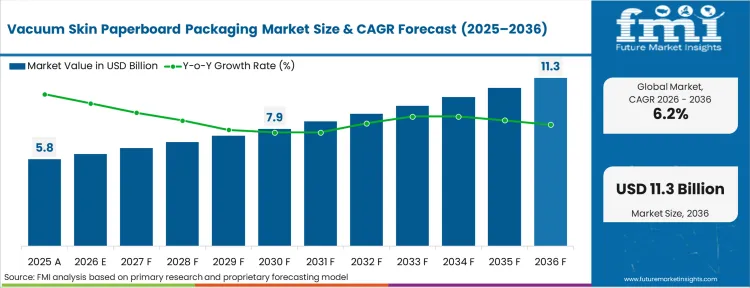
Growth becomes self-reinforcing once the "leaking barrier" threshold is crossed across the standard processing floor. The structural gate is the development of moisture-resistant coatings that prevent paperboard delamination during the high-tension skinning process. Once food processors verify that fiber-based trays can withstand the purge of high-moisture proteins like fresh poultry without structural failure, the next unit of adoption becomes significantly easier to justify at scale.
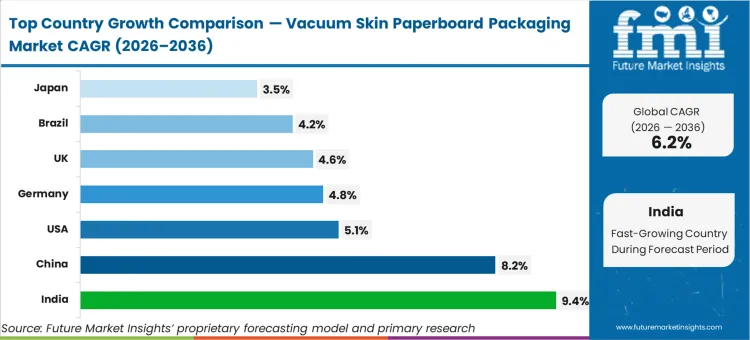
India is anticipated to record a 9.4% CAGR as organized retail and cold chain infrastructure for exported seafood undergo rapid modernization. China follows with an 8.2% growth rate, followed by the USA at 5.1% where consumer behavior pushes for premiumized fresh protein displays. Germany and the UK are projected to garner 4.8% and 4.6% respectively, driven by aggressive EU-wide plastic reduction targets. Brazil is poised to track at 4.2% while Japan registers a 3.5% CAGR as high-density urban retail environments prioritize space-efficient packaging. The structural divergence across these rates is defined by the maturity of the domestic cold chain rather than just the stringency of local environmental policy.
Vacuum Skin Paperboard Packaging Market Key Takeaways
| Metric | Details |
|---|---|
| Industry Size (2026) | USD 6.2 billion |
| Industry Value (2036) | USD 11.4 billion |
| CAGR (2026-2036) | 6.28% |
Source: Future Market Insights (FMI) analysis, based on proprietary forecasting model and primary research
Vacuum Skin Paperboard Packaging Market Definition
The vacuum skin paperboard packaging market comprises fiber-based structural trays or cards that serve as the base for vacuum skinning technology. In this process, a thin, transparent barrier film is heated and draped over a product, such as meat or seafood, forming a tight, "second skin" seal against the paperboard base. This market is analytically distinct because it bridges the gap between traditional rigid plastic tray-sealing and modern flexible-to-rigid sustainable conversions, requiring specific material properties to manage moisture and gas permeability.
Vacuum Skin Paperboard Packaging Market Inclusions
This market includes all recycled and virgin fiber paperboard substrates specifically engineered for vacuum skinning applications, including those with specialty barrier films or aqueous coatings. It covers flat cards, shallow trays, and modular inserts designed for high-tension skinning machines. Also included are integrated material systems where the paperboard and film are optimized for clean separation at the end of the product lifecycle to facilitate consumer recycling.
Vacuum Skin Paperboard Packaging Market Exclusions
Explicitly excluded are plastic-only skin packaging trays (PE, PET, or PP) that do not incorporate a fiber-based structural component. Standard modified atmosphere packaging (MAP) that uses gas flushing instead of vacuum skinning is also excluded. Additionally, the market does not cover secondary retail packaging such as corrugated outer cases or sleeves unless they serve as the direct skinning substrate for the primary food product.
Vacuum Skin Paperboard Packaging Market Research Methodology
- Primary Research: FMI conducted interviews with Packaging Engineering Leads at global food processing firms and Procurement Directors at tier-1 retail chains to understand substrate qualification cycles.
- Desk Research: Data was aggregated from international packaging standard registries, environmental compliance databases, and capital equipment procurement specification archives for vacuum skinning machinery.
- Market-Sizing and Forecasting: The baseline anchors to the observable consumption of fresh protein units in organized retail and the corresponding conversion rate from rigid plastic to fiber-based trays.
- Data Validation and Update Cycle: Forecasts were cross-validated using independent production data from major paperboard converters and triangulated with regional cold chain infrastructure investment reports.
Segmental Analysis
Vacuum Skin Paperboard Packaging Market Analysis by Material
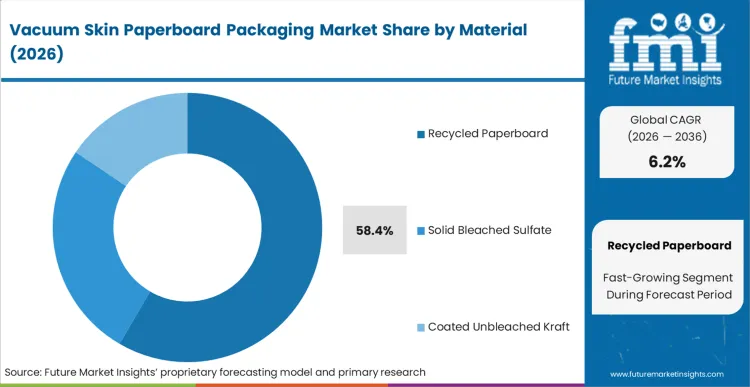
The reason recycled paperboard holds 58.4% of this market comes down to a single operational reality: retailers increasingly prioritize fiber-based systems with aqueous functional barriers, as recycled board provides the most cost-effective path to meeting the 2030 plastic reduction mandates of the EU PPWR. Based on FMI's assessment, recycled board provides the most cost-effective path to plastic reduction for high-volume processors. According to FMI's estimates, recycled paperboard is selected not merely for its environmental profile but for the specific structural rigidity it provides needed for high-speed skin packaging machines without the warping issues associated with thinner alternatives. As processors integrate these materials, the focus shifts toward ensuring that the moisture barrier does not interfere with the fiber recovery process during recycling. Buyers who fail to qualify these materials now face increasing "plastic fees" that erode margins on low-margin fresh meat products.
- Upstream sourcing costs: Recycled fiber premiums are often offset by the reduction in secondary sleeve requirements for retail-ready displays. Logistics managers capture these savings by eliminating the need for additional branding materials.
- Barrier integration expenses: Hidden costs often emerge during the application of aqueous coatings, which require specific curing times to ensure the board remains food-safe. Production leads must plan for these variances in material lead times.
- Total lifecycle savings: Comparing fiber-based VSP to rigid plastic trays reveals significant reductions in EPR taxes across European and North American jurisdictions. This lifecycle advantage makes the unit-cost premium of the board a secondary consideration for large-scale processors.
Vacuum Skin Paperboard Packaging Market Analysis by Application
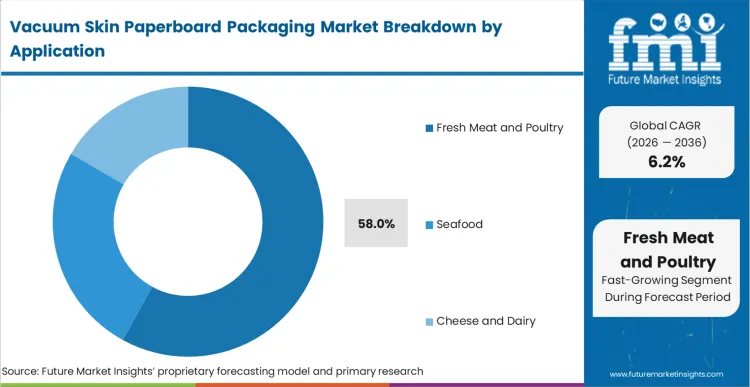
The decision to move fresh meat and poultry into vacuum skin paperboard is driven by the specific requirement for vertical shelf display in high-end retail aisles. Merchandising managers at supermarket chains are being asked to decide between standard leak-prone overwraps and premium "second skin" formats that allow the consumer to inspect the product from all angles. FMI notes that the transition to meat packaging on fiber bases allows for a 360-degree view while providing a high-quality surface for branding. The structural benefit of the paperboard tray is its ability to absorb any residual purge, preventing the "bloody" appearance that often deters consumers in traditional plastic trays. Processors who delay this transition find themselves losing shelf space to private-label brands that have already adopted the premium fiber look to justify higher price points.
- Clarity and Gloss: Performance in the fresh meat segment exceeds expectations when high-clarity barrier films are paired with matte-finish paperboard bases. This contrast enhances the perceived freshness of the protein for the retail consumer.
- Puncture Resistance: Gaps in performance can appear under edge conditions, such as bone-in ribeye or poultry with sharp edges, requiring localized reinforcements. Procurement leads must specify board weight according to the specific cut of meat.
- Seal Integrity: Qualification standards determine the acceptability of the bond between the film and the board's edge. This seal must be robust enough to survive the rough handling of the retail supply chain without compromising the vacuum.
Vacuum Skin Paperboard Packaging Market Analysis by End Use
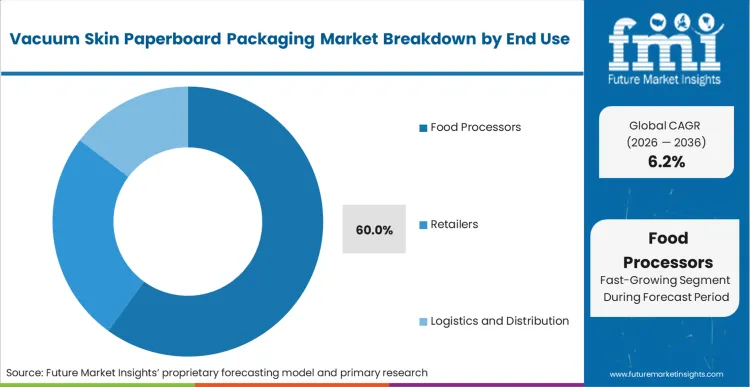
The trajectory of the food processors segment is defined by a mandatory move toward automated, high-output lines that can handle diverse substrate types. Incumbent processors are currently transitioning from dedicated plastic lines to flexible systems that can alternate between rigid trays and paperboard cards. As per FMI's assessment, this flexibility is no longer a luxury but a structural necessity for processors serving multiple retail customers with varying sustainability mandates. The market is heading toward a state where the ready-to-eat food packaging sector will lead the adoption of these hybrid systems. Food processors who reach this state last will find themselves operating legacy equipment that is incompatible with the next generation of repulpable barrier boards, leading to a permanent competitive disadvantage in the private-label manufacturing space.
- Early Adopter Advantage: Tier-1 processors adopt first to secure long-term supply contracts for high-performance board and to capture first-mover status with major retailers. This allows them to influence the development of regional packaging standards.
- Mid-Market Followership: Secondary processors follow once the machine conversion costs are amortized and the material supply chain stabilizes. They benefit from the refined barrier technologies developed during the early adoption phase.
- Laggard Conversion: Small-scale regional processors arrive at paperboard VSP last, often forced by the obsolescence of legacy plastic trays. Their conversion is triggered by the high cost of maintaining specialized plastic waste streams.
Vacuum Skin Paperboard Packaging Market Drivers, Restraints, and Opportunities
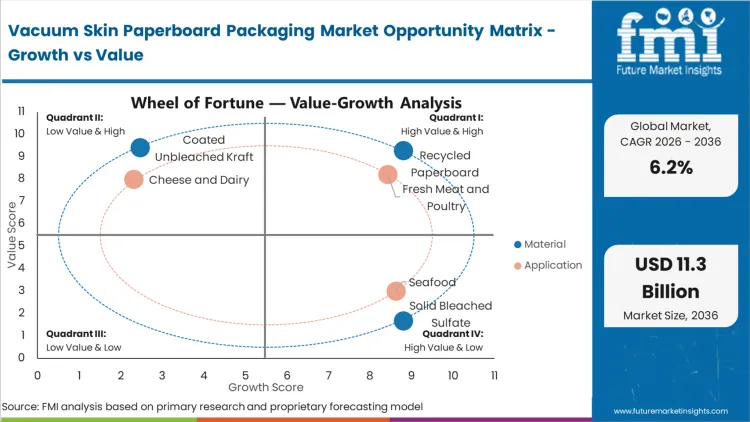
Retail-led plastic reduction mandates drives adoption which require flexible packaging to be integrated with sustainable rigid bases. Packaging leads at global food brands face the decision to either redesign their primary containers or pay escalating environmental levies. The commercial stakes involve maintaining access to premium retail shelf space where plastic-heavy formats are being phased out in favor of fiber-based alternatives. According to FMI's estimates, this shift is not a temporary trend but a permanent realignment of the protein supply chain toward sustainable packaging that can withstand the rigors of the cold chain while offering high recyclability.
The primary restraint is the machine compatibility, specifically the "stiffness gap" between traditional plastic trays and engineered paperboard. Many existing vacuum skinning lines were designed for the predictable mechanical properties of PET or PE, and the introduction of fiber-based boards can lead to higher reject rates during initial setup. This friction is structural because it requires a combination of mechanical adjustment and material re-engineering that cannot be solved by a simple component swap. FMI notes that while specialized "hybrid" machines are emerging, the installed base of legacy equipment remains a significant bottleneck for mid-market processors who lack the capital for immediate equipment refresh.
Opportunities in the Vacuum Skin Paperboard Packaging Market
- Aqueous Barrier Coatings: The shift away from plastic-laminated boards creates an opportunity for specialty chemical firms to provide high-performance aqueous barriers. Buyers who adopt these active packaging solutions capture a significant "plastic-free" marketing advantage.
- Integrated Peel Loops: Structural designs that incorporate tab-based separation systems allow for intuitive consumer recycling. Retailers who specify these designs capture higher scores in sustainability benchmarking and consumer trust metrics.
- E-commerce Protein Kits: The rise of direct-to-consumer meat subscriptions creates a structural requirement for flat-packed VSP formats that optimize shipping volume. Logistics firms capture freight density improvements by switching from bulky MAP trays to slim paperboard cards.
Regional Analysis
Based on the regional analysis, the vacuum skin paperboard packaging market is segmented into North America, Europe, Asia Pacific, Latin America, and Middle East & Africa across 40 plus countries.
.webp "Top Country Growth Comparison Vacuum Skin Paperboard Packaging Market Cagr (2026 2036)")
| Country | CAGR (2026 to 2036) |
|---|---|
| India | 9.4% |
| China | 8.2% |
| USA | 5.1% |
| Germany | 4.8% |
| UK | 4.6% |
| Brazil | 4.2% |
| Japan | 3.5% |
Source: Future Market Insights (FMI) analysis, based on proprietary forecasting model and primary research
Europe Vacuum Skin Paperboard Packaging Market Analysis
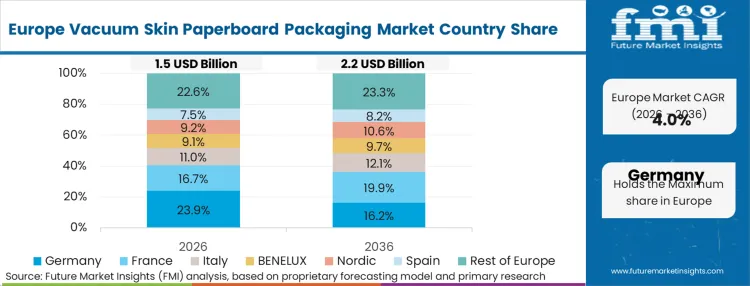
Europe's adoption pattern is fundamentally defined by the implementation mandates of the Packaging and Packaging Waste Regulation (EU) 2024/3901, which sets strict targets for plastic reduction and high-quality recycling. This policy-led environment makes the transition to paperboard VSP a compliance requirement rather than a purely commercial choice. As per FMI's view, the European market is further shaped by the maturity of the biodegradable packaging infrastructure, which allows for advanced recovery of fiber-based trays even when they contain residual organic matter. This structural condition forces European processors to prioritize "design for recycling" above all other variables, leading to the rapid adoption of mono-material barrier boards.
- Germany: Germany's updated extended producer responsibility requirements create a direct cost differential between legacy mixed-material trays and repulpable paperboard, making the transition an economic calculation for discount retailers. Food processors running German distribution routes have already begun re-qualifying their high-volume lines to accommodate the 4.8% growth rate. Companies that move first capture preferred supplier status in procurement frameworks that are unlikely to reopen once initial vendors are qualified.
- United Kingdom: The UK's plastic packaging tax acts as a structural floor for material prices, ensuring that the paperboard-to-plastic cost gap remains narrow for high-throughput processors. Retailers in the UK are currently using VSP as a tool to justify premium "terroir-based" meat branding to a consumer base that is increasingly skeptical of over-packaging. The market follows a 4.6% CAGR, reflecting a reality where the CAGR figure hides the intense competition for shelf space between the top four supermarket chains.
North America Vacuum Skin Paperboard Packaging Market Analysis
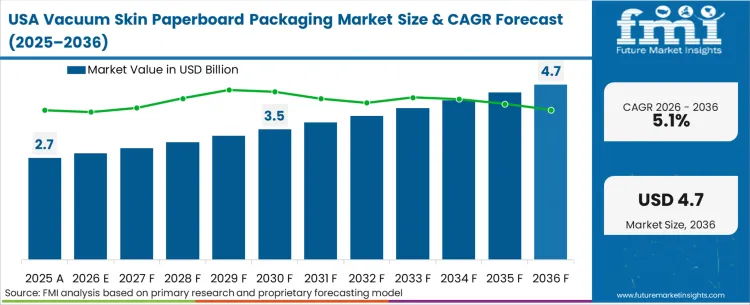
In North America, the market is primarily behavior-led, with major retail giants dictating the pace of adoption through their proprietary supplier sustainability scorecards. Unlike the policy-driven European model, North American processors are shifting to paperboard VSP to align with the branding requirements of "clean label" and "organic" protein segments. FMI analysts opine that the vast geographic distances in the US and Canada create a unique requirement for eco-friendly packaging that does not compromise the 21-day safety window during long-haul transit. This has led to a focus on high-strength boards that can withstand the temperature fluctuations of intercontinental logistics.
- USA: The USA's trajectory is defined by the rapid expansion of the premium seafood and artisanal cheese segments in urban coastal markets. Procurement directors at these firms are using paperboard VSP to distinguish their products from the "commodity" look of traditional foam trays. A 5.1% CAGR is expected, positioning American buyers as the primary testers for high-visibility "vertical" merchandising displays that are now migrating from the boutique aisle to the mass-market protein section.
Latin America Vacuum Skin Paperboard Packaging Market Analysis
Adoption in Latin America follows an economics-led lens, where the transition is dictated by the export parity requirements of global protein giants. Brazil, as a world-leading exporter of beef and poultry, faces a structural requirement to align its packaging with the rigorous sustainability and shelf-life standards of the European and North American retail markets. FMI analysts opine that while domestic adoption remains focused on premium urban centers, the vast majority of volume growth is driven by the industrial re-tooling of export-oriented processing plants. According to FMI's assessment, this creates a "two-tier" market structure where high-performance vacuum skin paperboard is utilized for international trade while legacy formats persist in local traditional retail.
- Brazil: Brazil's specific structural condition is the high concentration of the meat processing industry, where a few global players control the majority of export volumes. This procurement concentration enables a rapid, top-down shift to fiber-based VSP once a tier-1 exporter qualifies a specific board supplier for their global routes. The Brazilian market is poised for a 4.2% compound annual growth rate through 2036. This trajectory positions Brazilian exporters to maintain their competitive edge in "green" procurement tenders across the EU, where plastic-heavy imports are increasingly scrutinized.
Asia Pacific Vacuum Skin Paperboard Packaging Market Analysis
The Asia Pacific region is characterized by an infrastructure-led adoption pattern, where the development of the centralized cold chain is the primary gate for market growth. As countries like India and China invest in modern processing hubs, the requirement for standardized, export-ready smart packaging becomes a priority. Based on FMI's assessment, the growth in this region is also driven by the increasing concentration of the seafood processing sector, which requires high-performance vacuum skinning for both domestic and international markets.
- India: India rapid modernization of its seafood export hubs creates a structural requirement for packaging that can meet stringent EU and US food safety standards while remaining cost-competitive. The domestic retail sector's pivot toward organized "fresh-to-home" delivery models is pushing demand for paperboard VSP as a premium, hygienic alternative to traditional wet markets. Demand for VSP in India is set to grow at 9.4%, signaling a transition toward a fully integrated cold chain where packaging plays a critical role in maintaining the integrity of high-value exports.
- China: China's investment in automated food processing centers has created an operational environment where high-speed skinning is becoming the baseline for the "premium fresh" category. Large-scale processors are using paperboard formats to reduce their reliance on imported plastics, aligning with domestic circular economy goals. Sales of paperboard VSP products in China are on track to record an 8.2% CAGR, resulting in a significant reduction in the operational complexity of managing mixed plastic waste at the municipal level.
- Japan: Japan's high-density retail environment and sophisticated consumer base mandate packaging that is both space-efficient and exceptionally easy to recycle. The structural trajectory in Japan is toward ultra-thin, high-barrier cards that minimize household waste volume while maximizing the shelf life of high-value Wagyu beef and seasonal seafood. The market is likely to post a 3.5% CAGR, reflecting a transition toward "micro-packaging" formats where every gram of fiber is optimized for functional performance.
Competitive Aligners for Market Players
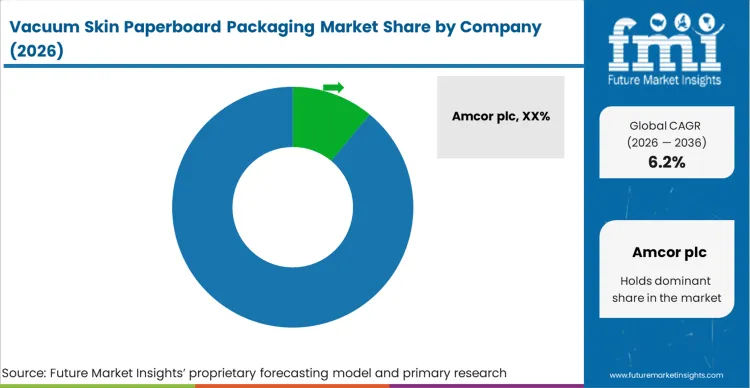
The structural concentration of the vacuum skin paperboard packaging market is driven by the significant capital investment required for high-barrier coating lines and the proprietary nature of the adhesive systems used in corrugated packaging and paperboard hybrids. Leading companies like Amcor plc, SEE (Sealed Air), and Mondi Group maintain their position not just through material supply, but by offering integrated "machine-plus-material" systems that guarantee a specific seal integrity and shelf-life outcome. Buyers in this market do not simply purchase board; they qualify a vendor based on the structural reliability of the barrier-to-fiber bond, which is the primary variable distinguishing qualified from unqualified suppliers in high-stakes fresh protein lines.
Incumbents like Smurfit WestRock hold a structural advantage through their control over the fiber supply chain and their ability to produce the specific grades of high-stiffness recycled board required for VSP. This advantage persists because challengers must not only replicate the chemistry of the barrier coatings but also match the consistency of the board's surface energy, which is critical for the high-tension skinning process. To compete, a challenger must build a category of capability that includes deep expertise in dairy packaging and seafood barrier requirements, as these segments have zero tolerance for delamination or vacuum failure. FMI notes that the integration of SynthID or similar digital watermarks into the board structure is becoming a new competitive frontier for vendors seeking to provide verifiable recycling data.
Buyer power in this market is concentrated among a few dozen global retail giants and tier-1 food processors who can dictate material specifications to the entire supply chain. This creates a structural tension where dominant vendors must continuously innovate on the "ease-of-separation" feature to prevent their customers from being penalized by future recyclability regulations. FMI's assessment indicates that the market is becoming more concentrated as the technical requirements for seafood packaging and fresh poultry become more stringent, favoring vendors who can offer global technical support and verifiable sustainability credentials through 2036.
Key Players in Vacuum Skin Paperboard Packaging Market
- Amcor plc
- SEE (Sealed Air)
- Mondi Group
- Smurfit Westrock plc
- Berry Global Group, Inc.
- Winpak Ltd.
- Atlas Flexibles
- G. Mondini SpA
- Multivac Group
Scope of the Report
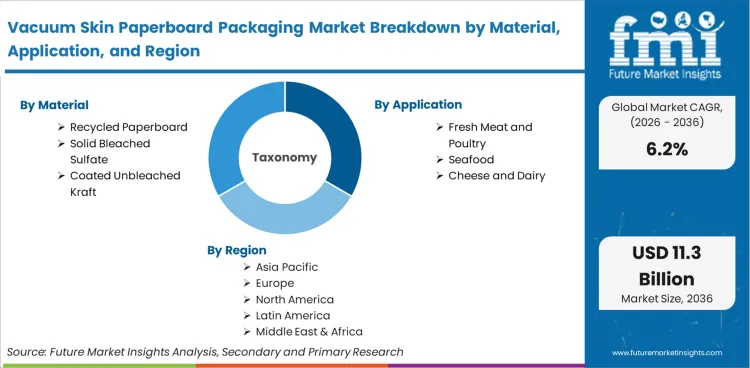
| Metric | Value |
|---|---|
| Quantitative Units | 2026 to 2036, at a CAGR of 6.28% |
| Market Definition | Structural fiber-based trays and cards designed for vacuum skinning, utilizing heat-shrunk barrier films to create a high-visibility, leak-proof seal for fresh food products. |
| Material Segmentation | Recycled Paperboard, Solid Bleached Sulfate, Coated Unbleached Kraft |
| Application Segmentation | Fresh Meat and Poultry, Seafood, Cheese and Dairy, Ready Meals |
| End Use Segmentation | Food Processors, Retailers, Logistics and Distribution |
| Regions Covered | North America, Europe, Asia Pacific, Latin America, Middle East & Africa |
| Countries Covered | India, China, USA, Germany, UK, Brazil, Japan, and 40 plus countries |
| Key Companies Profiled | Amcor plc, SEE (Sealed Air), Mondi Group, Smurfit Westrock plc, Berry Global Group, Inc., Winpak Ltd., Atlas Flexibles, G. Mondini SpA, Multivac Group |
| Forecast Period | 2026 to 2036 |
| Approach | FMI utilized a combination of bottom-up volume tracking and top-down regulatory analysis. Data was anchored to global protein consumption trends and validated through interviews with packaging engineering leads at major processors. |
Source: Future Market Insights (FMI) analysis, based on proprietary forecasting model and primary research
Vacuum Skin Paperboard Packaging Market Analysis by Segments
Material:
- Recycled Paperboard
- Solid Bleached Sulfate
- Coated Unbleached Kraft
Application:
- Fresh Meat and Poultry
- Seafood
- Cheese and Dairy
- Ready Meals
End Use:
- Food Processors
- Retailers
- Logistics and Distribution
Region:
- North America
- USA
- Canada
- Europe
- Germany
- UK
- France
- Italy
- Spain
- Asia Pacific
- India
- China
- Japan
- Australia
- South Korea
- Latin America
- Brazil
- Mexico
- Middle East & Africa
- GCC Countries
- South Africa
Bibliography
- Environment Agency. (2025, July 7). Extended producer responsibility for packaging: Fibre-based composite and paper and board obligations: RPS 351. GOV.UK.
- PackUK. (2025, June 30). Extended producer responsibility for packaging: 2025 base fees. GOV.UK. h
- HM Revenue & Customs. (2025, August 28). Plastic Packaging Tax (PPT) statistics background and references. GOV.UK.
- Confederation of Paper Industries. (2024). Design for recyclability guidelines.
- How2Recycle. (2024, February 1). Guidelines for use.
- Lee, D., Lee, H., Jo, Y., & Yoon, Y. (2024). The combined effect of vacuum-skin packaging and oxygen absorbers on the spoilage characteristics of Hanwoo beef during cold storage. Current Research in Food Science, 8, Article 100706.
This bibliography is provided for reader reference. The full FMI report contains the complete reference list with primary source documentation.
This Report Addresses
- Market intelligence to support strategic decision making across vacuum skin trays, barrier-coated boards, and fiber-based cards.
- Market size estimation and 10-year revenue forecasts from 2026 to 2036, supported by bottom-up tracking of fresh protein unit consumption.
- Growth opportunity mapping across fresh meat, seafood, and dairy segments with emphasis on the structural threshold of moisture-resistant coating development.
- Segment and regional revenue forecasts covering recycled paperboard and virgin fiber substrates across retail-led plastic reduction mandates.
- Competition strategy assessment including material-machine integration, barrier-to-fiber bond reliability, and global technical support capabilities.
- Technology development tracking including aqueous barrier coatings, easy-peel interfaces, and digital watermarks for recycling verification.
- Market access analysis covering regional plastic packaging taxes, EPR mandates, and retail supplier sustainability scorecards.
- Market report delivery in PDF, Excel, PPT, and interactive dashboard formats for executive strategy, sustainable material procurement, and operational benchmarking use.
Frequently Asked Questions
How large is the vacuum skin paperboard packaging market in 2026?
The market is projected to be valued at USD 6.2 billion in 2026. This figure reflects the initial surge in material conversion as major retailers in North America and Europe mandate the removal of non-recyclable plastic trays from their premium fresh protein sections.
What will the market be valued at by 2036?
FMI expects the market to reach USD 11.4 billion by the end of 2036. This valuation signals a completed structural shift where fiber-based VSP becomes the standard format for organized retail, displacing traditional overwraps and rigid plastic trays in most high-income and emerging urban markets.
What CAGR is projected for the vacuum skin paperboard packaging market?
A CAGR of 6.28% is projected through 2036. This rate is anchored to the replacement cycle of capital equipment in food processing plants, where older modified atmosphere packaging lines are being phased out in favor of flexible vacuum skinning systems capable of handling paperboard substrates.
Which material segment leads the market?
Recycled paperboard is the leader with a 58.4% share. Its dominance is a result of the operational mechanism where processors utilize the cost advantage of secondary fiber to offset the higher price of specialty barrier coatings, satisfying both economic and circularity requirements.
Which application leads the vacuum skin paperboard packaging market?
Fresh meat and poultry is the leading application, accounting for 42.1% of the market. This leadership is driven by the structural requirement for high-visibility "vertical" shelf displays and the superior shelf-life performance of vacuum skinning for high-moisture proteins compared to traditional MAP trays.
Which end use segment leads?
Food processors lead with 65.2% of the market share. The mechanism here is the centralization of packaging engineering decisions, where large-scale manufacturers specify board grades and barrier levels to ensure consistent performance across diverse retail customer networks.
What drives rapid growth in this market?
Growth is driven by a non-obvious mechanism: the reduction of retail "shrink" or food waste. While the public focus is on plastic reduction, the ability of paperboard VSP to extend fresh shelf life to 21 days allows retailers to optimize their logistics and reduce food spoilage, which carries a higher carbon penalty than the packaging itself.
What is the primary restraint?
The primary restraint is the structural friction of existing machinery, which often requires significant recalibration to handle the stiffness and surface energy of fiber-based boards. This friction is not a temporary hurdle but a long-term capital expenditure challenge for mid-market processors who must amortize legacy plastic-line investments before converting.
Which country grows the fastest in the vacuum skin paperboard packaging market?
India is the fastest-growing country at a 9.4% CAGR. Compared to China's 8.2%, India's growth is driven by the total modernization of its seafood export sector, where fiber-based VSP is becoming a mandatory requirement for accessing high-value Western retail contracts.
How does moisture management affect board selection?
Moisture management is a critical structural insight because fiber-based boards can delaminate if the barrier coating is compromised. Practitioners have found that the surface energy of the board must be perfectly matched to the adhesive layer of the barrier film to prevent air pockets, which would otherwise lead to premature food spoilage.
What is the impact of aqueous coatings on recyclability?
The shift toward aqueous coatings represents a key technology pivot, as they provide high barrier performance without the recycling complications of traditional plastic laminates. This shift allows the tray to be repulpable in standard paper mills, solving a major bottleneck in the circular economy for contaminated food packaging.
Why is vertical merchandising important for this market?
Vertical merchandising is the competitive dynamic that drives retailers to prefer VSP over traditional flat trays. The "second skin" seal prevents product movement and purge leak, allowing the meat or seafood to be displayed vertically, which increases shelf density and attracts higher consumer engagement.
What are the exclusions in this market report?
The report excludes all-plastic trays and traditional MAP packaging that does not use vacuum skinning technology. This exclusion is functional because it ensures the analysis focuses specifically on the sustainable conversion trend where paperboard is the primary structural component.
How is the data validated for the Indian seafood segment?
FMI validates Indian seafood data by triangulating export volume reports with the current adoption of vacuum skinning machinery in coastal processing hubs. This ensures the forecast reflects actual capital deployment rather than just theoretical material demand.
What is the role of easy-peel technology?
Easy-peel technology is a structural requirement for consumer adoption, as it ensures that the film can be cleanly separated from the board. This is a non-obvious driver because poor separation often leads to consumers discarding the entire tray in the residual waste stream, negating the sustainability benefits.
How does the US market differ from Europe?
The US market is primarily driven by "clean label" branding behavior in premium retail, whereas Europe is led by strict regulatory compliance and plastic taxes. This structural difference means US buyers prioritize branding and visual clarity, while European buyers focus on meeting specific fiber recovery percentages.
What is the significance of 21-day shelf life?
The 21-day safety window is the structural "gate" that makes paperboard VSP viable for national distribution networks. Without achieving this threshold, fiber-based formats would be limited to local, boutique retail, preventing the mass-market scale needed to drive the projected 6.28% CAGR.
What is the impact of black plastic tray bans?
Bans on black plastic are a major driver for recycled paperboard, which can be easily dyed or printed with sustainable inks to provide the same premium look. This allows processors to maintain their "premium" branding while ensuring their packaging is detectable by infrared sorting sensors in recycling plants.
How do logistics firms benefit from paperboard VSP?
Logistics firms capture value through freight density improvements; flat-packed paperboard cards take up significantly less space than empty pre-formed plastic trays. This reduces the carbon footprint of inbound packaging shipments, a key metric for modern sustainable supply chains.
What is the practitioner paradox in material selection?
The paradox is that high-recycled-content board, while environmentally superior, often lacks the internal bond strength of virgin fiber. This requires practitioners to use advanced cross-linking agents in the coatings to prevent structural failure during the high-vacuum phase of the packaging cycle.
Preview the report firsthand - request a free sample
Get SampleGet the brochure for pricing and purchase details.
Get PDFTable of Content
- Executive Summary
- Global Market Outlook
- Demand-side Trends
- Supply-side Trends
- Technology Roadmap Analysis
- Analysis and Recommendations
- Market Overview
- Market Coverage / Taxonomy
- Market Definition / Scope / Limitations
- Research Methodology
- Chapter Orientation
- Analytical Lens and Working Hypotheses
- Market Structure, Signals, and Trend Drivers
- Benchmarking and Cross-market Comparability
- Market Sizing, Forecasting, and Opportunity Mapping
- Research Design and Evidence Framework
- Desk Research Programme (Secondary Evidence)
- Company Annual and Sustainability Reports
- Peer-reviewed Journals and Academic Literature
- Corporate Websites, Product Literature, and Technical Notes
- Earnings Decks and Investor Briefings
- Statutory Filings and Regulatory Disclosures
- Technical White Papers and Standards Notes
- Trade Journals, Industry Magazines, and Analyst Briefs
- Conference Proceedings, Webinars, and Seminar Materials
- Government Statistics Portals and Public Data Releases
- Sector Databases and Reference Repositories
- FMI Internal Proprietary Databases and Historical Market Datasets
- Subscription Datasets and Paid Sources
- Social Channels, Communities, and Digital Listening Inputs
- Additional Desk Sources
- Expert Input and Fieldwork (Primary Evidence)
- Primary Modes
- Qualitative Interviews and Expert Elicitation
- Quantitative Surveys and Structured Data Capture
- Blended Approach
- Why Primary Evidence is Used
- Field Techniques
- Interviews
- Surveys
- Focus Groups
- Observational and In-context Research
- Social and Community Interactions
- Stakeholder Universe Engaged
- C-suite Leaders
- Board Members
- Presidents and Vice Presidents
- R&D and Innovation Heads
- Technical Specialists
- Domain Subject-matter Experts
- Scientists
- Physicians and Other Healthcare Professionals
- Governance, Ethics, and Data Stewardship
- Research Ethics
- Data Integrity and Handling
- Primary Modes
- Tooling, Models, and Reference Databases
- Desk Research Programme (Secondary Evidence)
- Data Engineering and Model Build
- Data Acquisition and Ingestion
- Cleaning, Normalisation, and Verification
- Synthesis, Triangulation, and Analysis
- Quality Assurance and Audit Trail
- Market Background
- Market Dynamics
- Drivers
- Restraints
- Opportunity
- Trends
- Scenario Forecast
- Demand in Optimistic Scenario
- Demand in Likely Scenario
- Demand in Conservative Scenario
- Opportunity Map Analysis
- Product Life Cycle Analysis
- Supply Chain Analysis
- Investment Feasibility Matrix
- Value Chain Analysis
- PESTLE and Porter’s Analysis
- Regulatory Landscape
- Regional Parent Market Outlook
- Production and Consumption Statistics
- Import and Export Statistics
- Market Dynamics
- Global Market Analysis 2021 to 2025 and Forecast, 2026 to 2036
- Historical Market Size Value (USD Million) Analysis, 2021 to 2025
- Current and Future Market Size Value (USD Million) Projections, 2026 to 2036
- Y-o-Y Growth Trend Analysis
- Absolute $ Opportunity Analysis
- Global Market Pricing Analysis 2021 to 2025 and Forecast 2026 to 2036
- Global Market Analysis 2021 to 2025 and Forecast 2026 to 2036, By Material
- Introduction / Key Findings
- Historical Market Size Value (USD Million) Analysis By Material , 2021 to 2025
- Current and Future Market Size Value (USD Million) Analysis and Forecast By Material , 2026 to 2036
- Recycled Paperboard
- Solid Bleached Sulfate
- Coated Unbleached Kraft
- Recycled Paperboard
- Y-o-Y Growth Trend Analysis By Material , 2021 to 2025
- Absolute $ Opportunity Analysis By Material , 2026 to 2036
- Global Market Analysis 2021 to 2025 and Forecast 2026 to 2036, By Application
- Introduction / Key Findings
- Historical Market Size Value (USD Million) Analysis By Application, 2021 to 2025
- Current and Future Market Size Value (USD Million) Analysis and Forecast By Application, 2026 to 2036
- Fresh Meat and Poultry
- Seafood
- Cheese and Dairy
- Fresh Meat and Poultry
- Y-o-Y Growth Trend Analysis By Application, 2021 to 2025
- Absolute $ Opportunity Analysis By Application, 2026 to 2036
- Global Market Analysis 2021 to 2025 and Forecast 2026 to 2036, By End Use
- Introduction / Key Findings
- Historical Market Size Value (USD Million) Analysis By End Use, 2021 to 2025
- Current and Future Market Size Value (USD Million) Analysis and Forecast By End Use, 2026 to 2036
- Food Processors
- Retailers
- Logistics and Distribution
- Food Processors
- Y-o-Y Growth Trend Analysis By End Use, 2021 to 2025
- Absolute $ Opportunity Analysis By End Use, 2026 to 2036
- Global Market Analysis 2021 to 2025 and Forecast 2026 to 2036, By Region
- Introduction
- Historical Market Size Value (USD Million) Analysis By Region, 2021 to 2025
- Current Market Size Value (USD Million) Analysis and Forecast By Region, 2026 to 2036
- North America
- Latin America
- Western Europe
- Eastern Europe
- East Asia
- South Asia and Pacific
- Middle East & Africa
- Market Attractiveness Analysis By Region
- North America Market Analysis 2021 to 2025 and Forecast 2026 to 2036, By Country
- Historical Market Size Value (USD Million) Trend Analysis By Market Taxonomy, 2021 to 2025
- Market Size Value (USD Million) Forecast By Market Taxonomy, 2026 to 2036
- By Country
- USA
- Canada
- Mexico
- By Material
- By Application
- By End Use
- By Country
- Market Attractiveness Analysis
- By Country
- By Material
- By Application
- By End Use
- Key Takeaways
- Latin America Market Analysis 2021 to 2025 and Forecast 2026 to 2036, By Country
- Historical Market Size Value (USD Million) Trend Analysis By Market Taxonomy, 2021 to 2025
- Market Size Value (USD Million) Forecast By Market Taxonomy, 2026 to 2036
- By Country
- Brazil
- Chile
- Rest of Latin America
- By Material
- By Application
- By End Use
- By Country
- Market Attractiveness Analysis
- By Country
- By Material
- By Application
- By End Use
- Key Takeaways
- Western Europe Market Analysis 2021 to 2025 and Forecast 2026 to 2036, By Country
- Historical Market Size Value (USD Million) Trend Analysis By Market Taxonomy, 2021 to 2025
- Market Size Value (USD Million) Forecast By Market Taxonomy, 2026 to 2036
- By Country
- Germany
- UK
- Italy
- Spain
- France
- Nordic
- BENELUX
- Rest of Western Europe
- By Material
- By Application
- By End Use
- By Country
- Market Attractiveness Analysis
- By Country
- By Material
- By Application
- By End Use
- Key Takeaways
- Eastern Europe Market Analysis 2021 to 2025 and Forecast 2026 to 2036, By Country
- Historical Market Size Value (USD Million) Trend Analysis By Market Taxonomy, 2021 to 2025
- Market Size Value (USD Million) Forecast By Market Taxonomy, 2026 to 2036
- By Country
- Russia
- Poland
- Hungary
- Balkan & Baltic
- Rest of Eastern Europe
- By Material
- By Application
- By End Use
- By Country
- Market Attractiveness Analysis
- By Country
- By Material
- By Application
- By End Use
- Key Takeaways
- East Asia Market Analysis 2021 to 2025 and Forecast 2026 to 2036, By Country
- Historical Market Size Value (USD Million) Trend Analysis By Market Taxonomy, 2021 to 2025
- Market Size Value (USD Million) Forecast By Market Taxonomy, 2026 to 2036
- By Country
- China
- Japan
- South Korea
- By Material
- By Application
- By End Use
- By Country
- Market Attractiveness Analysis
- By Country
- By Material
- By Application
- By End Use
- Key Takeaways
- South Asia and Pacific Market Analysis 2021 to 2025 and Forecast 2026 to 2036, By Country
- Historical Market Size Value (USD Million) Trend Analysis By Market Taxonomy, 2021 to 2025
- Market Size Value (USD Million) Forecast By Market Taxonomy, 2026 to 2036
- By Country
- India
- ASEAN
- Australia & New Zealand
- Rest of South Asia and Pacific
- By Material
- By Application
- By End Use
- By Country
- Market Attractiveness Analysis
- By Country
- By Material
- By Application
- By End Use
- Key Takeaways
- Middle East & Africa Market Analysis 2021 to 2025 and Forecast 2026 to 2036, By Country
- Historical Market Size Value (USD Million) Trend Analysis By Market Taxonomy, 2021 to 2025
- Market Size Value (USD Million) Forecast By Market Taxonomy, 2026 to 2036
- By Country
- Kingdom of Saudi Arabia
- Other GCC Countries
- Turkiye
- South Africa
- Other African Union
- Rest of Middle East & Africa
- By Material
- By Application
- By End Use
- By Country
- Market Attractiveness Analysis
- By Country
- By Material
- By Application
- By End Use
- Key Takeaways
- Key Countries Market Analysis
- USA
- Pricing Analysis
- Market Share Analysis, 2025
- By Material
- By Application
- By End Use
- Canada
- Pricing Analysis
- Market Share Analysis, 2025
- By Material
- By Application
- By End Use
- Mexico
- Pricing Analysis
- Market Share Analysis, 2025
- By Material
- By Application
- By End Use
- Brazil
- Pricing Analysis
- Market Share Analysis, 2025
- By Material
- By Application
- By End Use
- Chile
- Pricing Analysis
- Market Share Analysis, 2025
- By Material
- By Application
- By End Use
- Germany
- Pricing Analysis
- Market Share Analysis, 2025
- By Material
- By Application
- By End Use
- UK
- Pricing Analysis
- Market Share Analysis, 2025
- By Material
- By Application
- By End Use
- Italy
- Pricing Analysis
- Market Share Analysis, 2025
- By Material
- By Application
- By End Use
- Spain
- Pricing Analysis
- Market Share Analysis, 2025
- By Material
- By Application
- By End Use
- France
- Pricing Analysis
- Market Share Analysis, 2025
- By Material
- By Application
- By End Use
- India
- Pricing Analysis
- Market Share Analysis, 2025
- By Material
- By Application
- By End Use
- ASEAN
- Pricing Analysis
- Market Share Analysis, 2025
- By Material
- By Application
- By End Use
- Australia & New Zealand
- Pricing Analysis
- Market Share Analysis, 2025
- By Material
- By Application
- By End Use
- China
- Pricing Analysis
- Market Share Analysis, 2025
- By Material
- By Application
- By End Use
- Japan
- Pricing Analysis
- Market Share Analysis, 2025
- By Material
- By Application
- By End Use
- South Korea
- Pricing Analysis
- Market Share Analysis, 2025
- By Material
- By Application
- By End Use
- Russia
- Pricing Analysis
- Market Share Analysis, 2025
- By Material
- By Application
- By End Use
- Poland
- Pricing Analysis
- Market Share Analysis, 2025
- By Material
- By Application
- By End Use
- Hungary
- Pricing Analysis
- Market Share Analysis, 2025
- By Material
- By Application
- By End Use
- Kingdom of Saudi Arabia
- Pricing Analysis
- Market Share Analysis, 2025
- By Material
- By Application
- By End Use
- Turkiye
- Pricing Analysis
- Market Share Analysis, 2025
- By Material
- By Application
- By End Use
- South Africa
- Pricing Analysis
- Market Share Analysis, 2025
- By Material
- By Application
- By End Use
- USA
- Market Structure Analysis
- Competition Dashboard
- Competition Benchmarking
- Market Share Analysis of Top Players
- By Regional
- By Material
- By Application
- By End Use
- Competition Analysis
- Competition Deep Dive
- Amcor plc
- Overview
- Product Portfolio
- Profitability by Market Segments (Product/Age /Sales Channel/Region)
- Sales Footprint
- Strategy Overview
- Marketing Strategy
- Product Strategy
- Channel Strategy
- SEE (Sealed Air)
- Mondi Group
- Smurfit Westrock plc
- Berry Global Group, Inc.
- Winpak Ltd.
- Amcor plc
- Competition Deep Dive
- Assumptions & Acronyms Used


