

- Industry Size (2025)
- USD 8.7 Bn
- Forecast (2035)
- USD 11.6 Bn
- CAGR (2025 to 2035)
- 3.0%
Vacuum Skin Packaging Market Outlook from 2025 to 2035
The vacuum skin packaging market is gaining significant traction, driven by rising demand for extended shelf-life solutions and enhanced product visibility in food packaging. Industry publications and packaging company announcements have highlighted increased adoption of vacuum skin packaging (VSP) in perishable food categories, owing to its ability to reduce oxidation, prevent moisture loss, and maintain product integrity.
The growing focus on reducing food waste across global supply chains has led retailers and processors to shift toward VSP for both aesthetic appeal and functional performance. Packaging converters are investing in material innovations to enhance barrier properties and compatibility with vacuum sealing machinery.
Moreover, consumer preferences for hygienic, tamper-evident, and ready-to-cook packaging formats have further increased the popularity of vacuum skin packaging. In emerging markets, the expansion of cold chain infrastructure and modernization of food retail systems are accelerating the adoption of VSP. Segmental growth is being led by vacuum trays as the dominant product form, plastic as the preferred material for seal integrity, and fresh meat as the key application due to its perishability and need for extended shelf stability.
Quick Stats for Vacuum Skin Packaging Market
- Vacuum Skin Packaging Market Industry Value (2025): USD 8.7 billion
- Vacuum Skin Packaging Market Forecast Value (2035): USD 11.6 billion
- Vacuum Skin Packaging Market Forecast CAGR: 3.0%
- Leading Segment in Vacuum Skin Packaging Market in 2025: Vacuum Trays (54.6%)
- Key Growth Region in Vacuum Skin Packaging Market: North America, Asia-Pacific, Europe
- Top Key Players in Vacuum Skin Packaging Market: Sealed Air, Bemis Company, Inc, Berry Plastics, Clondalkin Group Holdings, LINPAC Packaging, Amcor Limited, Winpak Ltd., Plastissimo Film Co., Ltd., Plastopil Hazorea Company Ltd, Quinn Packaging Ltd.
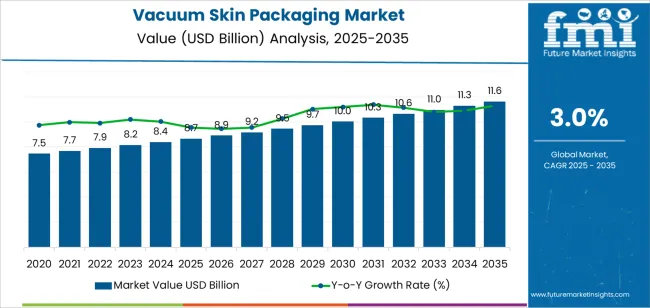
| Metric | Value |
|---|---|
| Vacuum Skin Packaging Market Estimated Value in (2025 E) | USD 8.7 billion |
| Vacuum Skin Packaging Market Forecast Value in (2035 F) | USD 11.6 billion |
| Forecast CAGR (2025 to 2035) | 3.0% |
Segmental Analysis
The market is segmented by Product Type, Material Type, and Application and region. By Product Type, the market is divided into Vacuum Trays and Vacuum Bag. In terms of Material Type, the market is classified into Plastic and Glass. Based on Application, the market is segmented into Fresh Meat, Seafood, Poultry, and Smoked & Processed Meat. Regionally, the market is classified into North America, Latin America, Western Europe, Eastern Europe, Balkan & Baltic Countries, Russia & Belarus, Central Asia, East Asia, South Asia & Pacific, and the Middle East & Africa.
Insights into the Product Type Segment: Vacuum Trays
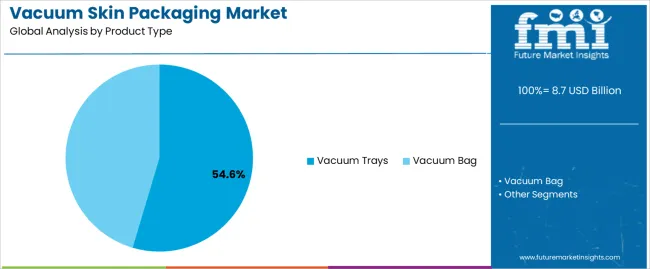
The Vacuum Trays segment is projected to contribute 54.6% of the vacuum skin packaging market revenue in 2025, establishing itself as the leading product type. This segment’s growth has been supported by its structural rigidity, which offers product protection during transportation and enhances display appeal at retail shelves.
Packaging industry sources have noted that vacuum trays are preferred for their compatibility with high-speed packaging equipment and ability to accommodate a wide range of food products. Manufacturers have adopted multi-cavity tray formats and modified tray geometries to improve pack density and consumer convenience.
The foodservice industry has also favored vacuum trays for portion control and extended storage. Additionally, the recyclability and lightweight design of newer tray variants have aligned with sustainability goals. These operational and functional benefits have helped the Vacuum Trays segment maintain its leadership within the market.
Insights into the Material Type Segment: Plastic
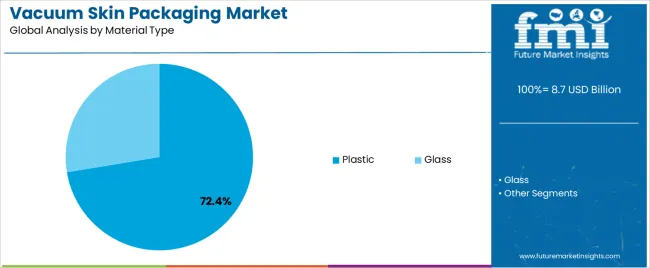
The Plastic segment is projected to hold 72.4% of the vacuum skin packaging market revenue in 2025, positioning it as the dominant material type. Growth in this segment has been driven by plastic’s barrier performance, clarity, and sealing compatibility.
Packaging companies have favored plastic materials such as polyethylene and polyamide for their ability to form tight seals over complex product shapes, maintaining vacuum integrity and product freshness. The flexibility of plastic film has enabled its use across automated and semi-automated packaging lines.
Industry innovations in mono-material plastics and recyclable multilayer films have also addressed growing regulatory and consumer concerns around sustainability. The cost-effectiveness, durability, and broad availability of food-grade plastics have further reinforced their widespread use in vacuum skin packaging. As regulations evolve and sustainable alternatives continue to emerge, plastic is expected to retain its market share by adapting to circular economy requirements while delivering consistent performance.
Insights into the Application Segment: Fresh Meat
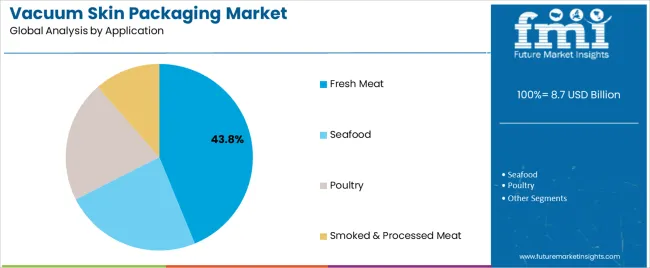
The Fresh Meat segment is projected to account for 43.8% of the vacuum skin packaging market revenue in 2025, making it the leading application area. Growth in this segment has been driven by the high perishability of meat products and the need for packaging that extends shelf life without compromising safety or quality.
Retailers and meat processors have increasingly turned to vacuum skin packaging to reduce purge, prevent spoilage, and improve visual appeal for consumers. Industry studies have shown that VSP significantly reduces oxygen exposure, slowing microbial growth and discoloration in fresh meat.
Additionally, clear skin films allow consumers to inspect the product while preserving its shape and texture. Cold chain logistics and e-commerce channels have further fueled the demand for secure, leak-proof packaging that ensures product integrity from production to consumption. As premium meat segments and portion-controlled offerings gain popularity, the Fresh Meat segment is expected to remain central to vacuum skin packaging adoption globally.
Key Market Highlights
Increasing Preference for Sustainable Solutions to Amplify Adoption
Increasing preference for sustainable and eco-friendly packaging solutions is driving the vacuum skin packaging market. With growing environmental consciousness among consumers and regulatory pressures to reduce plastic waste, there's a notable shift towards biodegradable and recyclable materials in packaging.
Vacuum skin packaging manufacturers are responding to this trend by developing innovative, sustainable alternatives that maintain the integrity and freshness of products while minimizing their environmental impact.
Busy Lifestyles and Urbanization to Push the Demand
Another notable trend is the rising demand for convenience and on-the-go consumption options. Busy lifestyles and changing consumer habits have led to an increased preference for packaged foods that offer convenience and portability.
Vacuum skin packaging provides an ideal solution for these products, offering superior protection and extended shelf life for items like pre-cooked meals, snacks, and ready-to-eat items. As a result, manufacturers are leveraging this trend to develop innovative packaging formats tailored to meet the needs of modern consumers.
Branding Opportunities to Enhance Market Presence and Consumer Engagement
There's also a growing emphasis on product differentiation and branding in the vacuum skin packaging market. With fierce competition among brands, companies are leveraging packaging as a strategic tool to stand out on the shelves and capture consumers' attention.
Vacuum skin packaging's ability to showcase the product and its freshness effectively makes it an attractive option for brands looking to create impactful packaging designs. As a result, manufacturers are investing in customized packaging solutions and eye-catching graphics to enhance brand visibility and consumer engagement.
Country-wise Insights
Demand for Sustainable Packaging Solutions in the United States to Drive Market Growth
In the United States, the vacuum skin packaging sector is expanding primarily due to the increasing focus on food safety and quality, coupled with the demand for sustainable packaging solutions. With growing concerns about foodborne illnesses and contamination, there's a heightened emphasis on implementing stringent packaging standards to ensure the safety of food products throughout the supply chain.
Vacuum skin packaging's ability to provide a hermetic seal and protect against external contaminants makes it a preferred choice for perishable goods, driving its adoption across various food segments. Additionally, the growing awareness of environmental issues fuels the demand for sustainable packaging alternatives, further propelling the market growth in the United States.
India’s Vacuum Skin Packaging Market to Benefit from its Expanding Retail Sector
In India, the vacuum skin packaging industry is witnessing significant growth due to the expanding retail sector and increasing consumer demand for packaged food products. With rapid urbanization and a rising middle class, there's a growing preference for convenience foods and ready-to-eat meals, driving the adoption of vacuum skin packaging.
Additionally, stringent food safety regulations and a focus on extending shelf life contribute to the market's expansion as manufacturers seek reliable packaging solutions to meet regulatory requirements and ensure product quality and integrity.
Booming E-commerce to Amplify the Adoption of Vacuum Skin Packaging in China
The vacuum skin packaging market in China is growing due to the booming e-commerce sector and changing consumer preferences. As more consumers shift towards online shopping, there's a rising demand for secure and visually appealing packaging to protect products during transit and enhance their presentation upon delivery.
Vacuum skin packaging offers superior protection against damage and tampering, making it an attractive option for e-commerce retailers looking to enhance customer satisfaction and brand perception. The growing popularity of fresh produce and premium goods further drives the adoption of vacuum skin packaging in China.
Category-wise Insights
Plastic Vacuum Skin Packaging Gains Prominence Due to their Versatility
Plastic vacuum skin packaging is gaining prominence due to its versatility, cost-effectiveness, and superior protective properties. Its ability to conform closely to the shape of the product, creating a tight seal, enhances product freshness and shelf life, particularly for perishable items.
Additionally, plastic vacuum skin packaging offers excellent visibility, allowing consumers to inspect the product easily, which enhances consumer confidence and trust. As a result, manufacturers across various industries are increasingly adopting plastic vacuum skin packaging to meet consumer demand for reliable and visually appealing packaging solutions.
Vacuum Bags are Highly Sought After Across Industries
Vacuum bags are highly sought after due to their ability to preserve and extend the shelf life of various perishable goods, including food items, textiles, and electronics. By removing excess air from the packaging, vacuum bags create a tight seal around the product, preventing exposure to oxygen and moisture, which are primary contributors to spoilage and degradation.
This preservation capability not only reduces food waste but also maintains product freshness, quality, and integrity, driving their adoption across industries seeking to optimize storage and transportation efficiency while ensuring product longevity.
Competitive Landscape
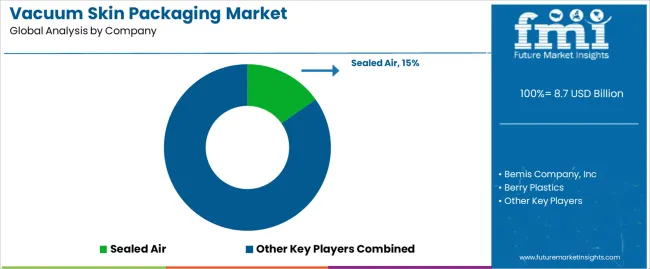
The competitive landscape of the vacuum skin packaging market is characterized by intense rivalry among key players striving to innovate and differentiate their offerings. Major companies focus on expanding their product portfolios, enhancing manufacturing capabilities, and investing in research and development to stay ahead.
Partnerships, mergers, and acquisitions are common strategies to strengthen market position and expand global reach. Regional players also play a significant role, catering to local preferences and niche markets, contributing to a diverse and dynamic competitive environment.
Vacuum Skin Packaging Market Segmentation
By Product Type:
The global vacuum skin packaging market is segmented by product type into vacuum bags and vacuum trays.
By Material Type:
The vacuum skin packaging market is further categorized based on material type into plastic and glass options.
By Application:
In terms of application, the market is divided into segments such as fresh meat, seafood, poultry, and smoked and processed meat.
By Region:
North America, Latin America, Europe, Asia-Pacific, and the Middle East and Africa are included in the report.
Frequently Asked Questions
How big is the vacuum skin packaging market in 2025?
The global vacuum skin packaging market is estimated to be valued at USD 8.7 billion in 2025.
What will be the size of vacuum skin packaging market in 2035?
The market size for the vacuum skin packaging market is projected to reach USD 11.6 billion by 2035.
How much will be the vacuum skin packaging market growth between 2025 and 2035?
The vacuum skin packaging market is expected to grow at a 3.0% CAGR between 2025 and 2035.
What are the key product types in the vacuum skin packaging market?
The key product types in vacuum skin packaging market are vacuum trays and vacuum bag.
Which material type segment to contribute significant share in the vacuum skin packaging market in 2025?
In terms of material type, plastic segment to command 72.4% share in the vacuum skin packaging market in 2025.
Preview the report firsthand - request a free sample
Get SampleGet the brochure for pricing and purchase details.
Get PDFTable of Content
- Executive Summary
- Global Market Outlook
- Demand-side Trends
- Supply-side Trends
- Technology Roadmap Analysis
- Analysis and Recommendations
- Market Overview
- Market Coverage / Taxonomy
- Market Definition / Scope / Limitations
- Market Background
- Market Dynamics
- Drivers
- Restraints
- Opportunity
- Trends
- Scenario Forecast
- Demand in Optimistic Scenario
- Demand in Likely Scenario
- Demand in Conservative Scenario
- Opportunity Map Analysis
- Product Life Cycle Analysis
- Supply Chain Analysis
- Investment Feasibility Matrix
- Value Chain Analysis
- PESTLE and Porter’s Analysis
- Regulatory Landscape
- Regional Parent Market Outlook
- Production and Consumption Statistics
- Import and Export Statistics
- Market Dynamics
- Global Market Analysis 2020 to 2024 and Forecast, 2025 to 2035
- Historical Market Size Value (USD Million) Analysis, 2020 to 2024
- Current and Future Market Size Value (USD Million) Projections, 2025 to 2035
- Y-o-Y Growth Trend Analysis
- Absolute $ Opportunity Analysis
- Global Market Pricing Analysis 2020 to 2024 and Forecast 2025 to 2035
- Global Market Analysis 2020 to 2024 and Forecast 2025 to 2035, By Product Type
- Introduction / Key Findings
- Historical Market Size Value (USD Million) Analysis By Product Type , 2020 to 2024
- Current and Future Market Size Value (USD Million) Analysis and Forecast By Product Type , 2025 to 2035
- Vacuum Trays
- Vacuum Bag
- Y-o-Y Growth Trend Analysis By Product Type , 2020 to 2024
- Absolute $ Opportunity Analysis By Product Type , 2025 to 2035
- Global Market Analysis 2020 to 2024 and Forecast 2025 to 2035, By Material Type
- Introduction / Key Findings
- Historical Market Size Value (USD Million) Analysis By Material Type, 2020 to 2024
- Current and Future Market Size Value (USD Million) Analysis and Forecast By Material Type, 2025 to 2035
- Plastic
- Glass
- Y-o-Y Growth Trend Analysis By Material Type, 2020 to 2024
- Absolute $ Opportunity Analysis By Material Type, 2025 to 2035
- Global Market Analysis 2020 to 2024 and Forecast 2025 to 2035, By Application
- Introduction / Key Findings
- Historical Market Size Value (USD Million) Analysis By Application, 2020 to 2024
- Current and Future Market Size Value (USD Million) Analysis and Forecast By Application, 2025 to 2035
- Fresh Meat
- Seafood
- Poultry
- Smoked & Processed Meat
- Y-o-Y Growth Trend Analysis By Application, 2020 to 2024
- Absolute $ Opportunity Analysis By Application, 2025 to 2035
- Global Market Analysis 2020 to 2024 and Forecast 2025 to 2035, By Region
- Introduction
- Historical Market Size Value (USD Million) Analysis By Region, 2020 to 2024
- Current Market Size Value (USD Million) Analysis and Forecast By Region, 2025 to 2035
- North America
- Latin America
- Western Europe
- Eastern Europe
- East Asia
- South Asia and Pacific
- Middle East & Africa
- Market Attractiveness Analysis By Region
- North America Market Analysis 2020 to 2024 and Forecast 2025 to 2035, By Country
- Historical Market Size Value (USD Million) Trend Analysis By Market Taxonomy, 2020 to 2024
- Market Size Value (USD Million) Forecast By Market Taxonomy, 2025 to 2035
- By Country
- USA
- Canada
- Mexico
- By Product Type
- By Material Type
- By Application
- By Country
- Market Attractiveness Analysis
- By Country
- By Product Type
- By Material Type
- By Application
- Key Takeaways
- Latin America Market Analysis 2020 to 2024 and Forecast 2025 to 2035, By Country
- Historical Market Size Value (USD Million) Trend Analysis By Market Taxonomy, 2020 to 2024
- Market Size Value (USD Million) Forecast By Market Taxonomy, 2025 to 2035
- By Country
- Brazil
- Chile
- Rest of Latin America
- By Product Type
- By Material Type
- By Application
- By Country
- Market Attractiveness Analysis
- By Country
- By Product Type
- By Material Type
- By Application
- Key Takeaways
- Western Europe Market Analysis 2020 to 2024 and Forecast 2025 to 2035, By Country
- Historical Market Size Value (USD Million) Trend Analysis By Market Taxonomy, 2020 to 2024
- Market Size Value (USD Million) Forecast By Market Taxonomy, 2025 to 2035
- By Country
- Germany
- UK
- Italy
- Spain
- France
- Nordic
- BENELUX
- Rest of Western Europe
- By Product Type
- By Material Type
- By Application
- By Country
- Market Attractiveness Analysis
- By Country
- By Product Type
- By Material Type
- By Application
- Key Takeaways
- Eastern Europe Market Analysis 2020 to 2024 and Forecast 2025 to 2035, By Country
- Historical Market Size Value (USD Million) Trend Analysis By Market Taxonomy, 2020 to 2024
- Market Size Value (USD Million) Forecast By Market Taxonomy, 2025 to 2035
- By Country
- Russia
- Poland
- Hungary
- Balkan & Baltic
- Rest of Eastern Europe
- By Product Type
- By Material Type
- By Application
- By Country
- Market Attractiveness Analysis
- By Country
- By Product Type
- By Material Type
- By Application
- Key Takeaways
- East Asia Market Analysis 2020 to 2024 and Forecast 2025 to 2035, By Country
- Historical Market Size Value (USD Million) Trend Analysis By Market Taxonomy, 2020 to 2024
- Market Size Value (USD Million) Forecast By Market Taxonomy, 2025 to 2035
- By Country
- China
- Japan
- South Korea
- By Product Type
- By Material Type
- By Application
- By Country
- Market Attractiveness Analysis
- By Country
- By Product Type
- By Material Type
- By Application
- Key Takeaways
- South Asia and Pacific Market Analysis 2020 to 2024 and Forecast 2025 to 2035, By Country
- Historical Market Size Value (USD Million) Trend Analysis By Market Taxonomy, 2020 to 2024
- Market Size Value (USD Million) Forecast By Market Taxonomy, 2025 to 2035
- By Country
- India
- ASEAN
- Australia & New Zealand
- Rest of South Asia and Pacific
- By Product Type
- By Material Type
- By Application
- By Country
- Market Attractiveness Analysis
- By Country
- By Product Type
- By Material Type
- By Application
- Key Takeaways
- Middle East & Africa Market Analysis 2020 to 2024 and Forecast 2025 to 2035, By Country
- Historical Market Size Value (USD Million) Trend Analysis By Market Taxonomy, 2020 to 2024
- Market Size Value (USD Million) Forecast By Market Taxonomy, 2025 to 2035
- By Country
- Kingdom of Saudi Arabia
- Other GCC Countries
- Turkiye
- South Africa
- Other African Union
- Rest of Middle East & Africa
- By Product Type
- By Material Type
- By Application
- By Country
- Market Attractiveness Analysis
- By Country
- By Product Type
- By Material Type
- By Application
- Key Takeaways
- Key Countries Market Analysis
- USA
- Pricing Analysis
- Market Share Analysis, 2024
- By Product Type
- By Material Type
- By Application
- Canada
- Pricing Analysis
- Market Share Analysis, 2024
- By Product Type
- By Material Type
- By Application
- Mexico
- Pricing Analysis
- Market Share Analysis, 2024
- By Product Type
- By Material Type
- By Application
- Brazil
- Pricing Analysis
- Market Share Analysis, 2024
- By Product Type
- By Material Type
- By Application
- Chile
- Pricing Analysis
- Market Share Analysis, 2024
- By Product Type
- By Material Type
- By Application
- Germany
- Pricing Analysis
- Market Share Analysis, 2024
- By Product Type
- By Material Type
- By Application
- UK
- Pricing Analysis
- Market Share Analysis, 2024
- By Product Type
- By Material Type
- By Application
- Italy
- Pricing Analysis
- Market Share Analysis, 2024
- By Product Type
- By Material Type
- By Application
- Spain
- Pricing Analysis
- Market Share Analysis, 2024
- By Product Type
- By Material Type
- By Application
- France
- Pricing Analysis
- Market Share Analysis, 2024
- By Product Type
- By Material Type
- By Application
- India
- Pricing Analysis
- Market Share Analysis, 2024
- By Product Type
- By Material Type
- By Application
- ASEAN
- Pricing Analysis
- Market Share Analysis, 2024
- By Product Type
- By Material Type
- By Application
- Australia & New Zealand
- Pricing Analysis
- Market Share Analysis, 2024
- By Product Type
- By Material Type
- By Application
- China
- Pricing Analysis
- Market Share Analysis, 2024
- By Product Type
- By Material Type
- By Application
- Japan
- Pricing Analysis
- Market Share Analysis, 2024
- By Product Type
- By Material Type
- By Application
- South Korea
- Pricing Analysis
- Market Share Analysis, 2024
- By Product Type
- By Material Type
- By Application
- Russia
- Pricing Analysis
- Market Share Analysis, 2024
- By Product Type
- By Material Type
- By Application
- Poland
- Pricing Analysis
- Market Share Analysis, 2024
- By Product Type
- By Material Type
- By Application
- Hungary
- Pricing Analysis
- Market Share Analysis, 2024
- By Product Type
- By Material Type
- By Application
- Kingdom of Saudi Arabia
- Pricing Analysis
- Market Share Analysis, 2024
- By Product Type
- By Material Type
- By Application
- Turkiye
- Pricing Analysis
- Market Share Analysis, 2024
- By Product Type
- By Material Type
- By Application
- South Africa
- Pricing Analysis
- Market Share Analysis, 2024
- By Product Type
- By Material Type
- By Application
- USA
- Market Structure Analysis
- Competition Dashboard
- Competition Benchmarking
- Market Share Analysis of Top Players
- By Regional
- By Product Type
- By Material Type
- By Application
- Competition Analysis
- Competition Deep Dive
- Sealed Air
- Overview
- Product Portfolio
- Profitability by Market Segments (Product/Age /Sales Channel/Region)
- Sales Footprint
- Strategy Overview
- Marketing Strategy
- Product Strategy
- Channel Strategy
- Bemis Company, Inc
- Berry Plastics
- Clondalkin Group Holdings
- LINPAC Packaging
- Amcor Limited
- Winpak Ltd.
- Plastissimo Film Co., Ltd.
- Plastopil Hazorea Company Ltd
- Quinn Packaging Ltd.
- Sealed Air
- Competition Deep Dive
- Assumptions & Acronyms Used
- Research Methodology


