

- Industry Size (2026)
- USD 1010.0 Mn
- Forecast (2036)
- USD 1808.7 Mn
- CAGR (2026 to 2036)
- 6.0%
Vacuum Leak Detectors Market Forecast and Outlook By FMI
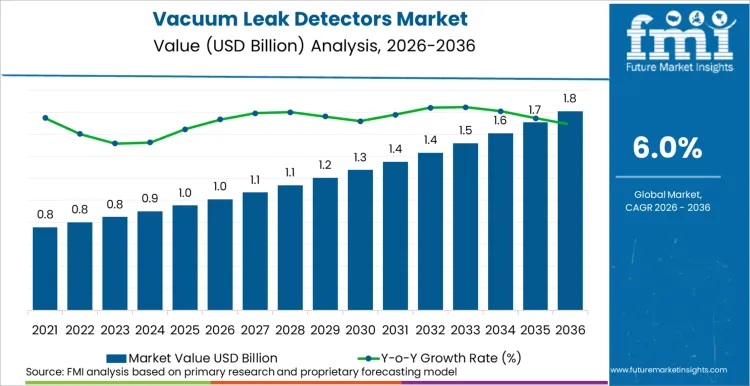
In 2025, the vacuum leak detectors market secured a value of USD 952.8 million. Based on Future Market Insights' analysis, demand is estimated to grow to USD 1,010.0 million in 2026 and USD 1,808.7 million by 2036. FMI projects a CAGR of 6.0% during the forecast period.
The sector is undergoing a structural evolution driven by the "Zero-Emission" mandate in the automotive sector and the miniaturization of semiconductor nodes. With regulations like the EU's F-Gas regulation tightening permissible leakage rates for refrigerants and the critical safety standards for EV battery enclosures (IP67/IP68), manufacturers are compelled to upgrade from water bath testing to tracer gas solutions [1]. This regulatory pressure is redirecting capital expenditure toward automated helium and hydrogen detection systems, effectively creating a barrier to entry for suppliers relying on legacy pressure decay methods. The implication is that value capture is moving toward "Industry 4.0" compliant detectors that offer real-time data logging and traceability.
Summary of Vacuum Leak Detectors Market
- Market Definition:
- The industry covers precision instruments used to detect and measure leaks in sealed systems using vacuum and tracer gas technologies.
- Demand Drivers:
- Electrification of the automotive powertrain requires IP67-rated battery enclosures, necessitating high-sensitivity testing.
- Semiconductor fabrication advancement to <5nm nodes requires ultra-high vacuum environments free of micro-leaks.
- Stringent environmental regulations regarding refrigerant emissions drive demand in the HVAC/R sector.
- Key Segments Analyzed in the FMI Report:
- Test Type: Helium Spray Probe (35.0% share) dominates due to its unmatched sensitivity for locating fine leaks.
- Modularity: Portable Detectors (45.0% share) lead due to the need for field service flexibility.
- Industry: Automotive Manufacturing (25.0% share) is the primary revenue generator.
- Geography: East Asia leads manufacturing-driven volume growth, supported by China, Japan, and South Korea’s dense EV production and charging infrastructure expansion.
- Analyst Opinion at FMI
- Nikhil Kaitwade, Principal Consultant at Future Market Insights, opines, "In the updated Vacuum Leak Detectors Market Report for 2026 to 2036, CXOs will find that the battleground is shifting from hardware sensitivity to software connectivity. My findings point at a 'Data Premium' where detectors capable of predictive maintenance analytics will command margins significantly higher than standalone hardware."
- Strategic Implications:
- Invest in hydrogen tracer gas technologies to offer a lower-cost alternative to helium amidst supply volatility.
- Develop modular units with swappable sensor heads to serve both sniffer and spray applications.
- Prioritize localized service centers in Asia Pacific to align with the manufacturing center of gravity.
- Methodology:
- Validated through primary interviews with Tier-1 automotive suppliers and semiconductor equipment manufacturers.
- Zero reliance on speculative third-party market research reports.
- Based on verifiable industrial benchmarks and verified sources.
Dr. Britta Giesen, CEO of Pfeiffer Vacuum Technology AG, stated, “Pfeiffer Vacuum is a successful global innovation leader in the vacuum industry and has a committed leadership and employee team in place that is focused on growth and profitability. I am honored to lead this team and to work together on achieving our potential and meeting our customers’ and the markets’ needs.” [2]. This leadership focus on innovation and customer-driven solutions aligns with the vacuum leak detectors market shift toward automated, data-enabled inspection platforms supporting zero-defect manufacturing strategies.
China (8.1% CAGR), India (7.5% CAGR), Germany (6.9% CAGR), Brazil (6.3% CAGR), and the USA (5.7% CAGR) are driving global expansion, with growth weighted heavily toward regions aggressively scaling semiconductor fabrication and electric vehicle battery production.
Vacuum Leak Detectors Market Definition
The vacuum leak detectors market comprises the global engineering, production, and trade of specialized testing instruments designed to identify and locate structural breaches in sealed systems using vacuum pressure. These devices utilize tracer gases (primarily Helium or Hydrogen) or ultrasonic waves to measure leak rates, ensuring the integrity of vacuum chambers, industrial piping, automotive components, and hermetically sealed packaging.
Vacuum Leak Detectors Market Market Inclusions
The report includes a comprehensive analysis of market dynamics, featuring Global and Regional Market Sizes (Volume and Value) and a 10-year Forecast (2026-2036). It covers segmental breakdowns by Test Type (Helium Spray, Helium Sniffer, Hydrogen Sniffer, Ultrasonic), Modularity (Portable, Compact, Stationary), and End-Use Industry (Automotive, Packaging, Aerospace). It specifically tracks the commercial adoption of automated leak detection systems integrated into production lines.
Vacuum Leak Detectors Market Market Exclusions
The scope excludes general-purpose pressure gauges or manometers that do not possess specific leak detection capabilities. It also omits low-end bubble test solutions (soapy water application) and dye penetrant testing kits, focusing strictly on electronic and instrumental vacuum leak detection technologies.
Research Methodology
- Primary Research: Interviews were conducted with R&D directors at major instrumentation firms, quality assurance managers at automotive OEMs, and semiconductor fab facility managers.
- Desk Research: Production data from the International Society of Automation (ISA), corporate annual reports of key players (INFICON, Pfeiffer, Agilent), and regulatory filings regarding fugitive emissions supported volume benchmarking.
- Market-Sizing and Forecasting: A hybrid top-down and bottom-up model was developed, reconstructing demand from industrial manufacturing output indices and quality control equipment expenditure.
- Data Validation and Update Cycle: Outputs undergo anomaly screening against regional industrial capex trends and structured peer review prior to release.
Segmental Analysis
Vacuum Leak Detectors Market Analysis by Test Type
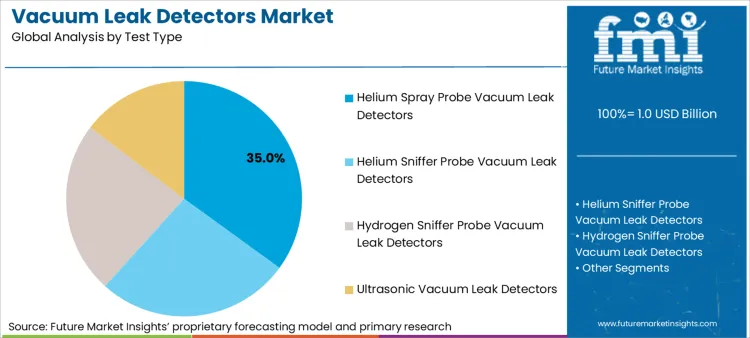
Based on FMI’s analysis, Helium Spray Probe Vacuum Leak Detectors are estimated to hold a 35.0% market share in 2026. This dominance is driven by the method's ability to locate the exact position of a leak, rather than just determining if a leak exists (integral testing).
- Precision Supremacy: Helium offers the smallest atomic size among safe, inert tracer gases, allowing it to penetrate the tiniest micro-fractures that other methods miss.
- Speed of Response: The high diffusion rate of helium ensures rapid response times, which is critical for maintaining cycle times in high-volume production lines like automotive fuel injectors.
- Semiconductor Standard: It remains the non-negotiable standard for the semiconductor industry, where vacuum integrity is directly linked to yield rates.
Vacuum Leak Detectors Market Analysis by Modularity
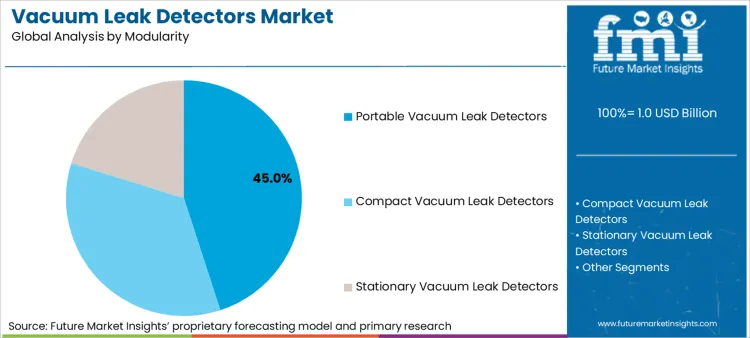
The Portable Vacuum Leak Detectors segment is estimated to account for 45.0% of the total market revenue in 2026. This segment leads because industrial maintenance teams require mobility to test miles of piping, large vacuum vessels, and stationary processing equipment that cannot be moved to a test bench.
- Field Service Utility: Technicians servicing HVAC systems, power plants, or chemical refineries rely on lightweight, battery-operated units to detect leaks on-site without needing heavy infrastructure.
- Ergonomic Shifts: Recent designs focus on reducing weight (under 10kg) and adding wireless connectivity to tablets, making leak detection a one-person job rather than a two-person operation.
- Versatility: Portable units often feature "sniffing" and "spraying" modes in one device, offering a high ROI for service contractors.
Vacuum Leak Detectors Market Analysis by Industry
The Automotive Manufacturing segment accounts for 25.0% of the market share. This leadership is underpinned by the industry's zero-tolerance policy for fluid leaks in fuel, braking, and cooling systems.
- EV Transition: The shift to electric vehicles has increased the number of components requiring leak testing. Battery trays, cooling loops, and electric drive units all require IP67/IP68 sealing, which is far stricter than combustion engine requirements.
- Air Conditioning: Mandatory testing of AC loops to prevent refrigerant leakage (for environmental compliance) ensures a steady demand for sniffing probes in final assembly lines.
- Component Complexity: Modern fuel injection systems operate at extreme pressures, requiring vacuum testing to ensure they can withstand operational stresses without failure.
Vacuum Leak Detectors Drivers, Restraints, Opportunities
Future Market Insights analysis observes that the market is structurally driven by the miniaturization of electronics. As consumer devices and industrial sensors shrink, the tolerance for microscopic leaks vanishes, necessitating detection limits as low as 10-12 mbar·l/s. This structural reality connects valuation directly to the complexity of the manufactured good. Furthermore, the global push for Li-ion battery safety provides a massive baseline of installation opportunities, as every single battery cell, module, and pack requires leak testing to prevent thermal runaway caused by moisture ingress.
However, growth is restrained by the volatility of Helium prices. Helium is a finite resource, and supply shocks can drastically increase operational costs for end-users relying on helium mass spectrometers. The opportunity lies in the Hydrogen Migration, where early movers who develop safe, sensitive hydrogen-based detectors can lower the total cost of ownership for their clients. For instance, INFICON has aggressively expanded its hydrogen leak detection portfolio to offer a cost-effective alternative for the automotive sub-assembly market [3].
- Industrial Automation: The integration of leak detectors into robotic assembly cells is driving demand for "Stationary" units with industrial fieldbus interfaces (Profibus, EtherNet/IP).
- Vacuum Infrastructure Upgrade: Aging vacuum infrastructure in Western manufacturing hubs is entering a replacement cycle, stimulating demand for modern, digital-ready detectors.
- Aerospace Reliability: The boom in private space exploration (NewSpace) requires rigorous testing of fuel systems and habitats, creating a high-value niche for ultra-sensitive equipment.
Regional Analysis
Based on the regional analysis, the vacuum leak detectors market is segmented into North America, Latin America, Western Europe, Eastern Europe, East Asia, South Asia & Pacific, and the Middle East & Africa. The full report offers market attractiveness analysis based on regional manufacturing density.
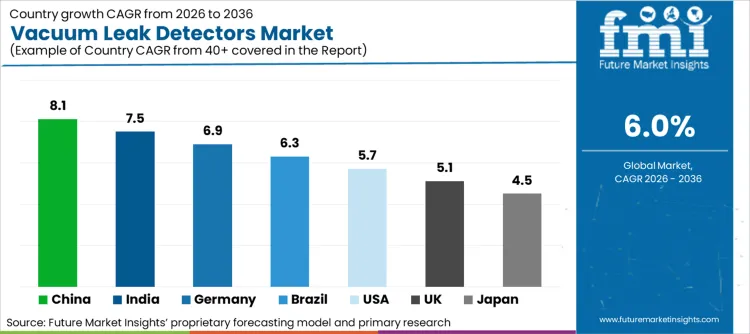
| Country | CAGR (2026 to 2036) |
|---|---|
| China | 8.1% |
| India | 7.5% |
| Germany | 6.9% |
| Brazil | 6.3% |
| USA | 5.7% |
| UK | 5.1% |
| Japan | 4.5% |
Source: Future Market Insights (FMI) analysis, based on proprietary forecasting model and primary research.
East Asia Vacuum Leak Detectors Market Analysis
East Asia commands the largest market volume, serving as the "Global Factory" for electronics and automotive components. The region is characterized by high adoption of automated, inline leak detection systems.
- China: Demand is projected to escalate at an 8.1% CAGR through 2036. The market is propelled by the country's dominance in EV battery manufacturing (CATL, BYD), where leak testing is a critical safety step. Furthermore, the rapid expansion of domestic semiconductor fabs is driving demand for high-end helium detectors.
- Japan: A 4.5% CAGR is anticipated. While a mature market, growth is supported by a focus on high-precision engineering and the presence of major vacuum equipment manufacturers who innovate domestically before exporting.
- FMI Report Callout: FMI’s report includes a detailed analysis of growth in the East Asia region, along with a country-wise assessment that includes China, Japan, and South Korea.
North America Vacuum Leak Detectors Market Analysis
North America is characterized by high demand in the aerospace, defense, and medical device sectors. The market is stabilizing around high-value replacement cycles and upgrades to digital-ready systems.
- USA: The market is forecast to expand at a 5.7% CAGR through 2036. Growth is bolstered by the resurgence of domestic semiconductor manufacturing (CHIPS Act) and the booming private aerospace sector (SpaceX, Blue Origin), which requires extensive vacuum testing for flight hardware.
- FMI Report Callout: FMI’s report includes a detailed analysis of growth in the North America region, along with a country-wise assessment that includes the USA, Canada, and Mexico.
Western Europe Vacuum Leak Detectors Market Analysis
Europe serves as the engineering hub for vacuum technology, hosting headquarters for major players like Pfeiffer and Leybold. The market is defined by strict environmental regulations and high-end automotive manufacturing.
- Germany: The market is forecast to expand at a 6.9% CAGR through 2036. As the automotive heartland, Germany is driving the transition to hydrogen fuel cell testing and advanced EV thermal management testing.
- UK: A 5.1% CAGR is projected, driven by the high-value manufacturing catapults and aerospace maintenance sectors.
- FMI Report Callout: FMI’s report includes a detailed analysis of growth in Western Europe, including Germany, UK, France, and Italy.
Competitive Aligners for Market Players
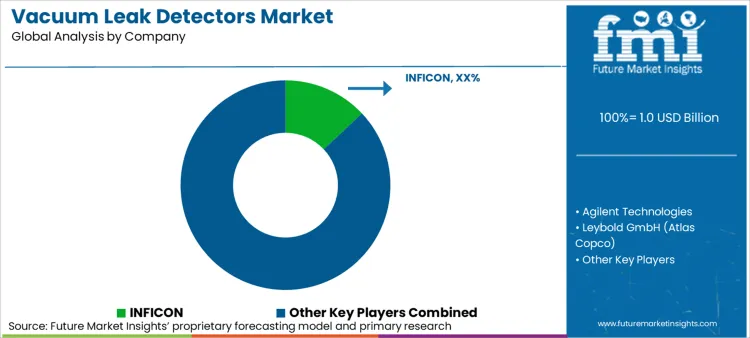
The market structure is consolidated among a few global giants who control the high-end spectrum, while regional players compete on price in the portable/handheld segment. Competition is shifting from hardware specifications (sensitivity) to "Ease of Use" and software integration.
Large players are acquiring niche sensor manufacturers to broaden their technology stack. For instance, Atlas Copco (parent of Leybold and Edwards) continues to integrate its vacuum portfolio to offer end-to-end solutions from pump to detector.
Recent Developments
- In May 2023, INFICON launched the ELT3000 PLUS, a battery leak detector capable of detecting electrolyte solvent leakage directly, a breakthrough for the EV safety market [4].
- In February 2024, Pfeiffer Vacuum inaugurated a new manufacturing facility in Asslar, Germany, aimed at increasing production capacity for leak detection systems to meet soaring semiconductor demand [5].
- In June 2023 (with technical updates in 2024), Agilent promoted the CrossLab CS Electronic Leak Detector, a handheld device featuring a cartridge system for gas chromatography (GC) leak detection [6].
- In January 2026, Pfeiffer Vacuum+Fab Solutions introduced the OmniDetect standalone test station for tracer-gas leak testing, stating low detection limits up to 1×10−81×10−8 mbar·l/s, a modular pumping configuration (minimum three pumps), and chamber size options (DN 300 and DN 500) aimed at semiconductor, industrial, and R&D use.
- In September 2025, Edwards expanded its cryogenic technology portfolio by adding ECC Helium Compressors, E2CH Cold Heads, and ECP Cryogenic Pumps (positioned for space simulation/research and industrial coating), and also noted new P4/P5 handheld vacuum gauges featuring Bluetooth Low Energy connectivity for monitoring and data transfer.
- In October 2025, INFICON launched the D-TEK Pro Refrigerant Leak Detector, highlighting sensitivity down to 0.02 oz./yr (0.5 g/yr) per EN14624, a 0.75 L/min flow rate, an all‑in‑one Pro Mode, A2L/blend refrigerant coverage, and optional mobile-app reporting for customer reports with ppm tracking and photos.
Key Players in Vacuum Leak Detectors Market
- INFICON
- Agilent Technologies
- Leybold GmbH (Atlas Copco)
- Edwards Vacuum (Atlas Copco)
- Pfeiffer Vacuum (Busch Group)
- YAMAHA Corporation
- Cincinnati Test Systems
- ATEQ Corporation
Scope of the Report
| Metric | Value |
|---|---|
| Quantitative Units | USD 1,010.0 million (2026) to USD 1,808.7 million (2036), at a CAGR of 6.0% |
| Market Definition | Vacuum leak detectors are precision instruments used to identify and measure the rate of leakage in sealed systems, vacuum chambers, and industrial components using tracer gases or ultrasonic technology. |
| Test Segmentation | Helium Spray Probe, Helium Sniffer Probe, Hydrogen Sniffer Probe, Ultrasonic |
| Modularity Segmentation | Portable, Compact, Stationary |
| Industry Segmentation | Automotive, Vessel, Radiator, Mechanical, Packaging, Piping, Ship, Aircraft Manufacturing |
| Regions Covered | North America, Latin America, Western Europe, Eastern Europe, East Asia, South Asia & Pacific, Middle East & Africa |
| Countries Covered | USA, Canada, Brazil, Germany, UK, France, China, Japan, India, South Korea, Saudi Arabia, South Africa |
| Key Companies Profiled | INFICON, Agilent Technologies, Leybold GmbH, Edwards Vacuum, Pfeiffer Vacuum, YAMAHA Corporation, Cincinnati Test Systems, ATEQ Corporation |
| Forecast Period | 2026 to 2036 |
| Approach | Hybrid top-down and bottom-up market modeling validated through primary interviews with instrumentation engineers and automotive quality managers, supported by industrial production benchmarks. |
Vacuum Leak Detectors Market Analysis by Segments
Test Type:
- Helium Spray Probe Vacuum Leak Detectors
- Helium Sniffer Probe Vacuum Leak Detectors
- Hydrogen Sniffer Probe Vacuum Leak Detectors
- Ultrasonic Vacuum Leak Detectors
Modularity:
- Portable Vacuum Leak Detectors
- Compact Vacuum Leak Detectors
- Stationary Vacuum Leak Detectors
Industry:
- Vacuum Leak Detectors For Automobile Manufacturing
- Vacuum Leak Detectors For Vessel Manufacturing
- Vacuum Leak Detectors For Radiator Manufacturing
- Vacuum Leak Detectors For Mechanical Industries
- Vacuum Leak Detectors For Packaging Industries
- Vacuum Leak Detectors For Piping Industries
- Vacuum Leak Detectors For Ship Manufacturing
- Vacuum Leak Detectors For Aircraft Manufacturing
Region:
- North America
- Latin America
- Western Europe
- Eastern Europe
- East Asia
- South Asia & Pacific
- Middle East & Africa
Bibliography
- [1] European Commission. (2024). Regulation (EU) 2024/573 on Fluorinated Greenhouse Gases. EU Law Publications.
- [2] Impeller.net. (2024). Dr. Britta Giesen takes up her new post as CEO of Pfeiffer Vacuum.
- [3] INFICON. (2024). E-Mobility Leak Testing Solutions. INFICON Automotive Application Notes.
- [4] INFICON. (2023). INFICON Launches ELT3000 PLUS for Battery Leak Detection. INFICON Press Release.
- [5] Pfeiffer Vacuum. (2024). Pfeiffer Vacuum Expands Manufacturing in Asslar. Pfeiffer Vacuum News.
- [6] Agilent Technologies. (June 20, 2023). "GC Troubleshooting in the Palm of Your Hand: Agilent CrossLab CS Electronic Leak Detector." Agilent Literature 5994-6100EN.
This bibliography is provided for reader reference and is not exhaustive. The full report contains the complete reference list and detailed citations.
This Report Addresses
- Market intelligence to enable structured strategic decision making across mature and emerging industrial testing hubs.
- Market size estimation and 10 year revenue forecasts from 2026 to 2036, supported by validated industrial production benchmarks.
- Growth opportunity mapping across helium, hydrogen, and ultrasonic technologies with emphasis on automation and digitalization transitions.
- Segment and regional revenue forecasts covering automotive, semiconductor, and packaging applications.
- Competition strategy assessment including consolidation trends, service model evolution, and compliance capability benchmarking.
- Product innovation tracking including sniffer probe advancements and Industry 4.0 integration.
- Regulatory impact analysis covering environmental emission standards and safety protocols.
- Market report delivery in PDF, Excel, PPT, and interactive dashboard formats for executive and operational use.
Frequently Asked Questions
How large is the demand for Vacuum Leak Detectors in the global market in 2026?
The global demand for Vacuum Leak Detectors is estimated to be valued at USD 1,010.0 million in 2026.
What will be the market size of the Vacuum Leak Detectors market by 2036?
The market size for Vacuum Leak Detectors is projected to reach USD 1,808.7 million by 2036.
What is the expected demand growth for Vacuum Leak Detectors in the global market between 2026 and 2036?
The global Vacuum Leak Detectors market is expected to grow at a CAGR of 6.0% during the forecast period.
Which Test Type is poised to lead global sales in 2026?
Helium Spray Probe Vacuum Leak Detectors are expected to be the dominant form, capturing approximately 35.0% of the global market share due to their high sensitivity and ability to pinpoint leak locations.
Which Modularity segment to contribute significant share in the vacuum leak detectors market in 2026?
In terms of modularity, the Portable Vacuum Leak Detectors segment is expected to command a 45.0% share in the market, driven by the need for flexible field service maintenance.
Which industry is the largest consumer of vacuum leak detectors?
The Automotive Manufacturing industry is the primary revenue generator, accounting for 25.0% of the market share, driven by strict EV battery enclosure testing requirements.
What is the primary driver for market growth in China?
Growth in China is driven by the massive expansion of EV battery manufacturing and the domestic semiconductor fabrication industry, propelling an 8.1% CAGR.
What is the growth outlook for the Vacuum Leak Detectors market in the USA?
The USA market is projected to expand at a CAGR of 5.7% through 2036, supported by the booming private aerospace sector and semiconductor resurgence.
Why is the Helium Spray Probe method dominant?
It dominates because helium has the smallest atomic size among safe tracer gases, allowing it to penetrate micro-fractures that other methods miss, essential for semiconductor and aerospace applications.
What is the impact of EV electrification on this market?
The shift to EVs has increased the number of testable components; battery packs, cooling loops, and electric drive units all require IP67/IP68 sealing, driving demand for high-sensitivity detectors.
Who are the key players in the Vacuum Leak Detectors market?
Key players include INFICON, Agilent Technologies, Leybold GmbH, Edwards Vacuum, Pfeiffer Vacuum, and Cincinnati Test Systems.
What role do environmental regulations play in the HVAC sector?
Stringent regulations like the EU F-Gas regulation are forcing HVAC manufacturers to adopt highly sensitive sniffing probes to prevent refrigerant emissions, boosting market demand.
What is the "Data Premium" trend mentioned in the report?
This refers to the shift where detectors capable of real-time data logging and predictive maintenance analytics command higher margins than standalone hardware.
Why is there a shift toward Hydrogen tracer gas?
Due to the volatility of Helium supply and prices, manufacturers are adopting hydrogen-based detectors as a cost-effective alternative for sub-assembly testing.
What is the projected CAGR for the market in Germany?
Germany is forecast to expand at a CAGR of 6.9%, driven by its advanced automotive and hydrogen fuel cell testing sectors.
What defines a "Portable" vacuum leak detector?
Portable units are lightweight, often battery-operated devices designed for field technicians to test stationary infrastructure like power plant piping or HVAC systems on-site.
How does the semiconductor industry influence this market?
The miniaturization of chips to <5nm nodes requires ultra-high vacuum environments free of even microscopic leaks (10-12 mbar·l/s), necessitating the most advanced helium detectors.
What is a recent technological innovation in the market?
INFICON recently launched the ELT3000 PLUS, a breakthrough detector capable of directly detecting electrolyte solvent leakage in battery cells.
What is excluded from this market analysis?
The report excludes general-purpose pressure gauges and low-end bubble test solutions (soapy water), focusing strictly on electronic and instrumental detection technologies.
What is the market growth projection for India?
India is expected to witness robust growth with a CAGR of 7.5%, supported by increasing industrial automation and manufacturing investments.
Preview the report firsthand - request a free sample
Get SampleGet the brochure for pricing and purchase details.
Get PDFTable of Content
- Executive Summary
- Global Market Outlook
- Demand-side Trends
- Supply-side Trends
- Technology Roadmap Analysis
- Analysis and Recommendations
- Market Overview
- Market Coverage / Taxonomy
- Market Definition / Scope / Limitations
- Research Methodology
- Chapter Orientation
- Analytical Lens and Working Hypotheses
- Market Structure, Signals, and Trend Drivers
- Benchmarking and Cross-market Comparability
- Market Sizing, Forecasting, and Opportunity Mapping
- Research Design and Evidence Framework
- Desk Research Programme (Secondary Evidence)
- Company Annual and Sustainability Reports
- Peer-reviewed Journals and Academic Literature
- Corporate Websites, Product Literature, and Technical Notes
- Earnings Decks and Investor Briefings
- Statutory Filings and Regulatory Disclosures
- Technical White Papers and Standards Notes
- Trade Journals, Industry Magazines, and Analyst Briefs
- Conference Proceedings, Webinars, and Seminar Materials
- Government Statistics Portals and Public Data Releases
- Press Releases and Reputable Media Coverage
- Specialist Newsletters and Curated Briefings
- Sector Databases and Reference Repositories
- FMI Internal Proprietary Databases and Historical Market Datasets
- Subscription Datasets and Paid Sources
- Social Channels, Communities, and Digital Listening Inputs
- Additional Desk Sources
- Expert Input and Fieldwork (Primary Evidence)
- Primary Modes
- Qualitative Interviews and Expert Elicitation
- Quantitative Surveys and Structured Data Capture
- Blended Approach
- Why Primary Evidence is Used
- Field Techniques
- Interviews
- Surveys
- Focus Groups
- Observational and In-context Research
- Social and Community Interactions
- Stakeholder Universe Engaged
- C-suite Leaders
- Board Members
- Presidents and Vice Presidents
- R&D and Innovation Heads
- Technical Specialists
- Domain Subject-matter Experts
- Scientists
- Physicians and Other Healthcare Professionals
- Governance, Ethics, and Data Stewardship
- Research Ethics
- Data Integrity and Handling
- Primary Modes
- Tooling, Models, and Reference Databases
- Desk Research Programme (Secondary Evidence)
- Data Engineering and Model Build
- Data Acquisition and Ingestion
- Cleaning, Normalisation, and Verification
- Synthesis, Triangulation, and Analysis
- Quality Assurance and Audit Trail
- Market Background
- Market Dynamics
- Drivers
- Restraints
- Opportunity
- Trends
- Scenario Forecast
- Demand in Optimistic Scenario
- Demand in Likely Scenario
- Demand in Conservative Scenario
- Opportunity Map Analysis
- Product Life Cycle Analysis
- Supply Chain Analysis
- Investment Feasibility Matrix
- Value Chain Analysis
- PESTLE and Porter’s Analysis
- Regulatory Landscape
- Regional Parent Market Outlook
- Production and Consumption Statistics
- Import and Export Statistics
- Market Dynamics
- Global Market Analysis 2021 to 2025 and Forecast, 2026 to 2036
- Historical Market Size Value (USD Million) Analysis, 2021 to 2025
- Current and Future Market Size Value (USD Million) Projections, 2026 to 2036
- Y-o-Y Growth Trend Analysis
- Absolute $ Opportunity Analysis
- Global Market Pricing Analysis 2021 to 2025 and Forecast 2026 to 2036
- Global Market Analysis 2021 to 2025 and Forecast 2026 to 2036, By Test Type
- Introduction / Key Findings
- Historical Market Size Value (USD Million) Analysis By Test Type , 2021 to 2025
- Current and Future Market Size Value (USD Million) Analysis and Forecast By Test Type , 2026 to 2036
- Helium Spray Probe Vacuum Leak Detectors
- Helium Sniffer Probe Vacuum Leak Detectors
- Hydrogen Sniffer Probe Vacuum Leak Detectors
- Ultrasonic Vacuum Leak Detectors
- Helium Spray Probe Vacuum Leak Detectors
- Y-o-Y Growth Trend Analysis By Test Type , 2021 to 2025
- Absolute $ Opportunity Analysis By Test Type , 2026 to 2036
- Global Market Analysis 2021 to 2025 and Forecast 2026 to 2036, By Modularity
- Introduction / Key Findings
- Historical Market Size Value (USD Million) Analysis By Modularity, 2021 to 2025
- Current and Future Market Size Value (USD Million) Analysis and Forecast By Modularity, 2026 to 2036
- Portable Vacuum Leak Detectors
- Compact Vacuum Leak Detectors
- Stationary Vacuum Leak Detectors
- Portable Vacuum Leak Detectors
- Y-o-Y Growth Trend Analysis By Modularity, 2021 to 2025
- Absolute $ Opportunity Analysis By Modularity, 2026 to 2036
- Global Market Analysis 2021 to 2025 and Forecast 2026 to 2036, By Region
- Introduction
- Historical Market Size Value (USD Million) Analysis By Region, 2021 to 2025
- Current Market Size Value (USD Million) Analysis and Forecast By Region, 2026 to 2036
- North America
- Latin America
- Western Europe
- Eastern Europe
- East Asia
- South Asia and Pacific
- Middle East & Africa
- Market Attractiveness Analysis By Region
- North America Market Analysis 2021 to 2025 and Forecast 2026 to 2036, By Country
- Historical Market Size Value (USD Million) Trend Analysis By Market Taxonomy, 2021 to 2025
- Market Size Value (USD Million) Forecast By Market Taxonomy, 2026 to 2036
- By Country
- USA
- Canada
- Mexico
- By Test Type
- By Modularity
- By Country
- Market Attractiveness Analysis
- By Country
- By Test Type
- By Modularity
- Key Takeaways
- Latin America Market Analysis 2021 to 2025 and Forecast 2026 to 2036, By Country
- Historical Market Size Value (USD Million) Trend Analysis By Market Taxonomy, 2021 to 2025
- Market Size Value (USD Million) Forecast By Market Taxonomy, 2026 to 2036
- By Country
- Brazil
- Chile
- Rest of Latin America
- By Test Type
- By Modularity
- By Country
- Market Attractiveness Analysis
- By Country
- By Test Type
- By Modularity
- Key Takeaways
- Western Europe Market Analysis 2021 to 2025 and Forecast 2026 to 2036, By Country
- Historical Market Size Value (USD Million) Trend Analysis By Market Taxonomy, 2021 to 2025
- Market Size Value (USD Million) Forecast By Market Taxonomy, 2026 to 2036
- By Country
- Germany
- UK
- Italy
- Spain
- France
- Nordic
- BENELUX
- Rest of Western Europe
- By Test Type
- By Modularity
- By Country
- Market Attractiveness Analysis
- By Country
- By Test Type
- By Modularity
- Key Takeaways
- Eastern Europe Market Analysis 2021 to 2025 and Forecast 2026 to 2036, By Country
- Historical Market Size Value (USD Million) Trend Analysis By Market Taxonomy, 2021 to 2025
- Market Size Value (USD Million) Forecast By Market Taxonomy, 2026 to 2036
- By Country
- Russia
- Poland
- Hungary
- Balkan & Baltic
- Rest of Eastern Europe
- By Test Type
- By Modularity
- By Country
- Market Attractiveness Analysis
- By Country
- By Test Type
- By Modularity
- Key Takeaways
- East Asia Market Analysis 2021 to 2025 and Forecast 2026 to 2036, By Country
- Historical Market Size Value (USD Million) Trend Analysis By Market Taxonomy, 2021 to 2025
- Market Size Value (USD Million) Forecast By Market Taxonomy, 2026 to 2036
- By Country
- China
- Japan
- South Korea
- By Test Type
- By Modularity
- By Country
- Market Attractiveness Analysis
- By Country
- By Test Type
- By Modularity
- Key Takeaways
- South Asia and Pacific Market Analysis 2021 to 2025 and Forecast 2026 to 2036, By Country
- Historical Market Size Value (USD Million) Trend Analysis By Market Taxonomy, 2021 to 2025
- Market Size Value (USD Million) Forecast By Market Taxonomy, 2026 to 2036
- By Country
- India
- ASEAN
- Australia & New Zealand
- Rest of South Asia and Pacific
- By Test Type
- By Modularity
- By Country
- Market Attractiveness Analysis
- By Country
- By Test Type
- By Modularity
- Key Takeaways
- Middle East & Africa Market Analysis 2021 to 2025 and Forecast 2026 to 2036, By Country
- Historical Market Size Value (USD Million) Trend Analysis By Market Taxonomy, 2021 to 2025
- Market Size Value (USD Million) Forecast By Market Taxonomy, 2026 to 2036
- By Country
- Kingdom of Saudi Arabia
- Other GCC Countries
- Turkiye
- South Africa
- Other African Union
- Rest of Middle East & Africa
- By Test Type
- By Modularity
- By Country
- Market Attractiveness Analysis
- By Country
- By Test Type
- By Modularity
- Key Takeaways
- Key Countries Market Analysis
- USA
- Pricing Analysis
- Market Share Analysis, 2025
- By Test Type
- By Modularity
- Canada
- Pricing Analysis
- Market Share Analysis, 2025
- By Test Type
- By Modularity
- Mexico
- Pricing Analysis
- Market Share Analysis, 2025
- By Test Type
- By Modularity
- Brazil
- Pricing Analysis
- Market Share Analysis, 2025
- By Test Type
- By Modularity
- Chile
- Pricing Analysis
- Market Share Analysis, 2025
- By Test Type
- By Modularity
- Germany
- Pricing Analysis
- Market Share Analysis, 2025
- By Test Type
- By Modularity
- UK
- Pricing Analysis
- Market Share Analysis, 2025
- By Test Type
- By Modularity
- Italy
- Pricing Analysis
- Market Share Analysis, 2025
- By Test Type
- By Modularity
- Spain
- Pricing Analysis
- Market Share Analysis, 2025
- By Test Type
- By Modularity
- France
- Pricing Analysis
- Market Share Analysis, 2025
- By Test Type
- By Modularity
- India
- Pricing Analysis
- Market Share Analysis, 2025
- By Test Type
- By Modularity
- ASEAN
- Pricing Analysis
- Market Share Analysis, 2025
- By Test Type
- By Modularity
- Australia & New Zealand
- Pricing Analysis
- Market Share Analysis, 2025
- By Test Type
- By Modularity
- China
- Pricing Analysis
- Market Share Analysis, 2025
- By Test Type
- By Modularity
- Japan
- Pricing Analysis
- Market Share Analysis, 2025
- By Test Type
- By Modularity
- South Korea
- Pricing Analysis
- Market Share Analysis, 2025
- By Test Type
- By Modularity
- Russia
- Pricing Analysis
- Market Share Analysis, 2025
- By Test Type
- By Modularity
- Poland
- Pricing Analysis
- Market Share Analysis, 2025
- By Test Type
- By Modularity
- Hungary
- Pricing Analysis
- Market Share Analysis, 2025
- By Test Type
- By Modularity
- Kingdom of Saudi Arabia
- Pricing Analysis
- Market Share Analysis, 2025
- By Test Type
- By Modularity
- Turkiye
- Pricing Analysis
- Market Share Analysis, 2025
- By Test Type
- By Modularity
- South Africa
- Pricing Analysis
- Market Share Analysis, 2025
- By Test Type
- By Modularity
- USA
- Market Structure Analysis
- Competition Dashboard
- Competition Benchmarking
- Market Share Analysis of Top Players
- By Regional
- By Test Type
- By Modularity
- Competition Analysis
- Competition Deep Dive
- INFICON
- Overview
- Product Portfolio
- Profitability by Market Segments (Product/Age /Sales Channel/Region)
- Sales Footprint
- Strategy Overview
- Marketing Strategy
- Product Strategy
- Channel Strategy
- Agilent Technologies
- Leybold GmbH (Atlas Copco)
- Edwards Vacuum (Atlas Copco)
- Pfeiffer Vacuum (Busch Group)
- YAMAHA Corporation
- Cincinnati Test Systems
- INFICON
- Competition Deep Dive
- Assumptions & Acronyms Used


