

- Industry Size (2026)
- USD 740 Mn
- Forecast (2036)
- USD 1880 Mn
- CAGR (2026 to 2036)
- 9.8%
Paperboard Cold Chain Cartons Market Forecast and Outlook 2026 to 2036
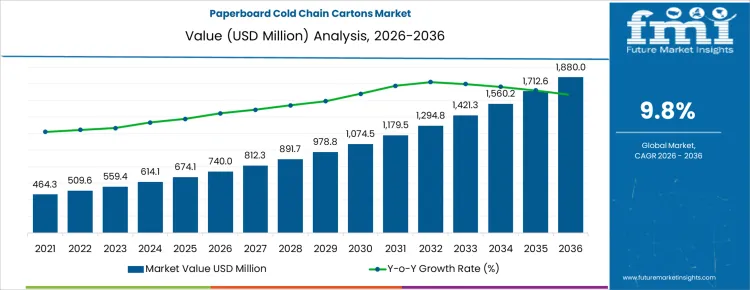
The global paperboard cold chain cartons market is set to grow from USD 740 million in 2026 to USD 1,880 million by 2036, achieving a CAGR of 9.8%. The market is largely driven by the increasing demand for eco-friendly, efficient packaging solutions in temperature-controlled logistics, particularly in fresh food & pharma logistics, which leads the market with a 40% share. The need for packaging that ensures product integrity during transit is expanding, especially in industries such as food, pharmaceuticals, and biologics. Insulated paperboard cartons dominate the market with a 45% share due to their superior thermal performance and lightweight nature, which supports cost-effective transportation.
Quick Stats for Paperboard Cold Chain Cartons Market
- Paperboard Cold Chain Cartons Market Value (2026): USD 740 million
- Paperboard Cold Chain Cartons Market Forecast Value (2036): USD 1,880 million
- Paperboard Cold Chain Cartons Market Forecast CAGR: 9.8%
- Leading Application in Paperboard Cold Chain Cartons Market: Fresh food & pharma logistics
- Top Packaging Format in Paperboard Cold Chain Cartons Market: Insulated paperboard cartons
- Key Growth Regions in Paperboard Cold Chain Cartons Market: Asia Pacific, North America, Europe
- Key Players in Paperboard Cold Chain Cartons Market: Sonoco, Mondi, Smurfit Kappa, Nine Dragons Paper, ITC Paperboards, Klabin, Oji Holdings
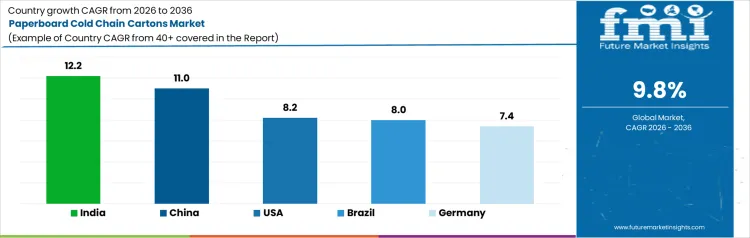
India leads with a 12.2% CAGR, driven by the rise in cold chain logistics for perishable goods and increasing demand for eco-friendly packaging solutions. China follows with an 11% CAGR, supported by its industrial growth and expansion in the cold-chain packaging industry. The USA grows at 8.2%, reflecting the demand for eco-friendly packaging in the food and pharmaceutical sectors. Germany and Brazil also show steady growth at 7.4% and 8%, respectively, driven by eco-consciousness initiatives and regulatory support for eco-friendly packaging solutions. As the demand for eco-friendly, efficient, and cost-effective cold chain packaging continues to rise, the market for paperboard cold chain cartons is expected to grow across these regions.
Paperboard Cold Chain Cartons Market Key Takeaways
| Metric | Value |
|---|---|
| Industry Value (2026) | USD 740 million |
| Forecast Value (2036) | USD 1,880 million |
| Forecast CAGR (2026–2036) | 9.8% |
How is the Global Paperboard Cold Chain Cartons Sector Advancing?
The global paperboard cold chain cartons market is expanding as demand rises for eco-friendly, efficient packaging solutions that support temperature-controlled logistics. Paperboard cold chain cartons are designed to maintain product integrity during transit by providing insulation and structural protection for perishable goods such as food, pharmaceuticals, and biologics. Traditional cold chain packaging often relies on plastics or foam materials that can be difficult to recycle. Paperboard cartons offer a recyclable and biodegradable alternative that aligns with environmental goals and regulatory pressures to reduce plastic waste.
Growth in e-commerce, especially for fresh and frozen foods and temperature-sensitive healthcare products, is driving the need for reliable cold chain packaging. Innovations in paperboard insulation technologies, including integration with eco-friendly insulating inserts and enhanced structural designs, have improved thermal performance without significantly increasing weight. This supports both eco-consciousness objectives and cost-effective transportation by reducing reliance on heavier traditional materials.
Challenges include ensuring consistent thermal protection across diverse climates and product types, and aligning paperboard carton solutions with stringent cold chain regulatory standards. Despite these challenges, the emphasis on recyclable packaging and robust cold chain integrity will sustain demand for paperboard cold chain cartons worldwide.
What is the Segment-Wise Analysis for the Global Paperboard Cold Chain Cartons Market?
The global paperboard cold chain cartons market is segmented by application and packaging format. Fresh food & pharma logistics lead the market with a 40% share, followed by dairy & chilled foods, fresh e-commerce, and vaccines & perishables. In terms of packaging format, insulated paperboard cartons dominate with a 45% share, followed by foldable cold cartons, corrugated cold boxes, and flat-pack cold cartons. This segmentation reflects the increasing need for eco-friendly, temperature-controlled packaging solutions, particularly in the food, pharmaceutical, and e-commerce sectors, where maintaining product integrity during transit is crucial.
How Do Fresh Food & Pharma Logistics Lead the Global Paperboard Cold Chain Cartons Market?
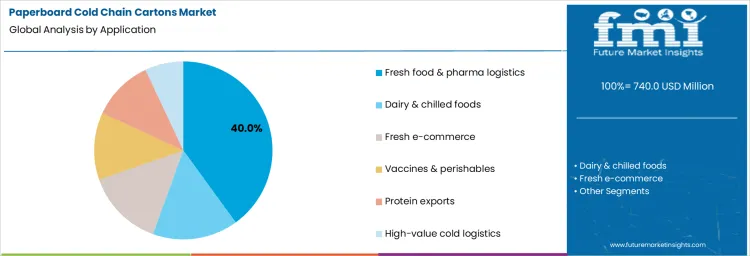
Fresh food & pharma logistics lead the global paperboard cold chain cartons market with a 40% share due to the growing need for reliable, temperature-sensitive packaging in the food and pharmaceutical industries. Both sectors depend on packaging solutions that maintain product integrity, quality, and safety during transportation, especially for perishable goods. Paperboard cartons, particularly insulated varieties, offer a cost-effective and eco-friendly option for this purpose. As consumer demand for eco-friendly packaging rises and the popularity of online shopping for perishable items grows, the adoption of paperboard cold chain cartons in these industries continues to expand, further driving the market.
Why Do Insulated Paperboard Cartons Hold the Largest Market Share in the Global Paperboard Cold Chain Cartons Market?

Insulated paperboard cartons hold the largest share of 45% in the global paperboard cold chain cartons market due to their superior thermal performance, ensuring effective temperature control during transportation. These cartons are essential for industries such as food and pharmaceuticals, where temperature-sensitive products need reliable protection. The lightweight nature of insulated paperboard cartons, combined with their ability to reduce heat transfer, makes them an efficient solution for cold chain logistics. Their eco-friendly design and cost-effectiveness make them the preferred choice, as they provide both eco-friendly and reliable protection for temperature-sensitive goods throughout the supply chain.
What are the Key Trends in Paperboard Cold Chain Cartons Market?
The paperboard cold chain cartons market is driven by expanding demand for temperature-controlled packaging across food, pharmaceuticals, and biologics. Global growth in fresh and frozen foods, meal kits, and direct-to-consumer cold chain deliveries has created pressure for insulated cartons that maintain required temperatures from processing to end use. Paperboard solutions offer an eco-friendly alternative to foam and plastic insulators, aligning with corporate eco-consciousness targets and recyclable packaging mandates. Stringent cold chain regulatory standards for vaccine and drug distribution drive adoption of durable, compliant cartons that protect sensitive products during long-haul and last-mile transit.
What Are the Key Restraints Affecting the Paperboard Cold Chain Cartons Market?
Restraints include performance limitations compared with traditional insulation materials and cost considerations. Paperboard, even when enhanced with inserts or liners, may offer lower thermal resistance than expanded polystyrene or polyurethane foams, potentially increasing the need for supplemental insulation or refrigeration energy. This performance gap can deter adoption for ultra-low temperature applications such as certain biologics or frozen foods. Higher manufacturing costs associated with reinforced paperboard structures and specialized treatments can also make paperboard cartons more expensive on a per-unit basis, limiting competitiveness where price sensitivity is high. Supply chain variability in recycled fiber quality further complicates consistent performance.
What Key Trends Are Shaping the Paperboard Cold Chain Cartons Market?
Key trends include the integration of advanced insulation materials such as eco-friendly aerogels, phase-change materials, and recyclable polymer liners into paperboard cartons to improve thermal performance while maintaining recyclability. There is growing use of modular and reusable carton systems that reduce waste and lifecycle costs in logistics networks. Digital enhancements like embedded temperature sensors and IoT monitoring are increasingly paired with cartons to enable real-time condition tracking and compliance documentation. Eco-friendly sourcing and certification for recycled content are also becoming differentiators, as brands respond to consumer demand for greener cold chain solutions and stricter environmental regulations.
What is the Growth Outlook for the Paperboard Cold Chain Cartons Market by Country?
| Country | CAGR (%) |
|---|---|
| USA | 8.2% |
| Germany | 7.4% |
| China | 11% |
| India | 12.2% |
| Brazil | 8% |
The paperboard cold chain cartons market is growing steadily, with India leading at a 12.2% CAGR, driven by the increasing demand for eco-friendly and efficient packaging solutions in the food and pharmaceutical sectors. China follows with 11%, supported by the growing need for eco-friendly packaging in its expanding cold-chain logistics industry. The USA’s market grows at 8.2%, fueled by the need for cost-effective and efficient cold chain solutions, particularly in the food and beverage industry. Germany’s market grows at 7.4%, driven by the demand for eco-friendly packaging solutions and regulatory support. Brazil’s market grows at 8%, supported by the country’s increasing focus on improving the cold chain and preserving food quality. As demand for environmentally responsible packaging solutions grows, the market for paperboard cold chain cartons is expected to continue expanding across these regions.
Why is India Leading in the Paperboard Cold Chain Cartons Market?
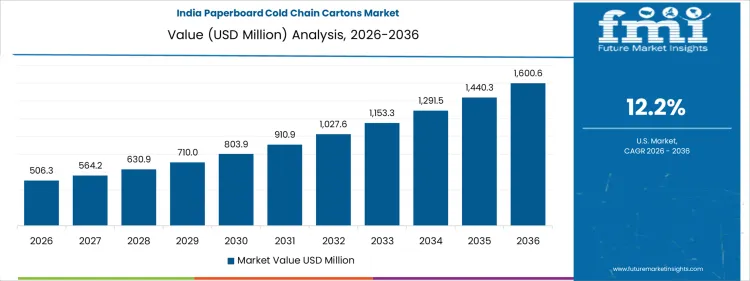
India’s paperboard cold chain cartons market is growing at 12.2%, driven by the rising demand for efficient, eco-friendly packaging solutions, particularly in the food and pharmaceutical sectors. As India’s economy continues to expand, there is a significant rise in cold chain logistics, especially for perishable goods. Paperboard cold chain cartons offer an eco-friendly and cost-effective solution for transporting temperature-sensitive products, helping to maintain quality and reduce waste. With increasing consumer awareness of environmental issues and a push for eco-friendlier packaging, India is embracing paperboard cartons over plastic alternatives. Government regulations promoting eco-friendly packaging practices are further driving market growth. As the country continues to modernize its logistics infrastructure and prioritize eco-consciousness, India is positioned to lead in the paperboard cold chain cartons market.
What is Driving the Growth of the Paperboard Cold Chain Cartons Market in China?
China’s paperboard cold chain cartons market is growing at 11%, supported by the country’s rapid industrialization and increasing demand for cold-chain logistics solutions. As China continues to expand its agricultural exports and processed food market, the need for effective and eco-friendly packaging solutions is rising. Paperboard cold chain cartons are increasingly preferred due to their environmental benefits and ability to maintain the integrity of temperature-sensitive products during transport. With China’s emphasis on improving food safety and product quality, the adoption of paperboard cartons is growing, particularly in the food and pharmaceutical sectors. Government policies promoting eco-friendly packaging are contributing to the market’s growth. As China modernizes its cold chain infrastructure and prioritizes eco-consciousness, the demand for paperboard cold chain cartons is expected to continue to rise.
How is the Paperboard Cold Chain Cartons Market Expanding in the USA?
The USA’s paperboard cold chain cartons market is growing at 8.2%, driven by the need for efficient and eco-friendly packaging solutions in the cold chain logistics industry. With the growing demand for fresh food, pharmaceuticals, and other temperature-sensitive products, the USA is increasingly adopting paperboard cartons as an alternative to plastic packaging. These cartons provide an eco-friendly solution for maintaining product integrity during transport while offering cost-effective, high-performance options for the cold chain. As eco-consciousness continues to be a key focus for both consumers and businesses, the adoption of paperboard cold chain cartons is rising. The market is also being supported by regulatory measures aimed at reducing plastic waste. As demand for environmentally responsible packaging grows, the market for paperboard cold chain cartons in the USA is expected to continue expanding.
What is Contributing to the Growth of the Paperboard Cold Chain Cartons Market in Germany?
Germany’s paperboard cold chain cartons market is growing at 7.4%, driven by the country’s strong emphasis on eco-consciousness and environmentally friendly packaging solutions. With Germany being a leader in eco-conscious manufacturing and packaging, the demand for paperboard cold chain cartons is increasing as businesses look for eco-friendlier options for transporting perishable goods. Paperboard cartons are preferred for their recyclability, biodegradability, and ability to maintain the temperature-sensitive products during transit, making them ideal for the food and pharmaceutical industries. As Germany continues to push for reducing plastic usage and enhancing eco-consciousness across industries, the market for paperboard cold chain cartons is expected to grow steadily. Furthermore, consumer demand for eco-friendly packaging is accelerating the shift toward paperboard solutions, ensuring continued market expansion.
What is Driving the Growth of the Paperboard Cold Chain Cartons Market in Brazil?
Brazil’s paperboard cold chain cartons market is growing at 8%, supported by the country’s increasing focus on improving its cold chain infrastructure and eco-friendly packaging solutions. As Brazil becomes a major player in the agricultural export market, particularly in fresh produce, seafood, and pharmaceuticals, the demand for temperature-controlled packaging is growing. Paperboard cold chain cartons offer an eco-friendly, cost-effective solution for packaging perishable goods during transportation. As eco-consciousness becomes a priority in Brazil’s packaging industry, more businesses are turning to paperboard solutions to meet both consumer expectations and regulatory demands. The increasing importance of maintaining food and pharmaceutical product quality is further driving the market for these packaging solutions. As Brazil continues to develop its cold chain logistics network, the adoption of paperboard cold chain cartons is expected to continue expanding.
What’s Shaping the Paperboard Cold Chain Cartons Market?
In the paperboard cold chain cartons market Sonoco, Mondi / Smurfit Kappa, Nine Dragons Paper, ITC Paperboards, Klabin, Oji Holdings, and others compete with product brochures that emphasize sustainable insulated solutions and protective performance for temperature‑sensitive goods. Sonoco materials are positioned with advanced cold‑chain cartons that combine paperboard strength and protective liners designed for long‑haul refrigerated or frozen shipments. These brochures underscore insulation performance and supply chain reliability backed by global packaging experience. Mondi / Smurfit Kappa collateral highlights customizable carton formats and sustainable fiber‑based options aligned with eco‑friendly mandates and recyclable design priorities shared across paperboard packaging leaders. Technical data and usage scenarios help specifiers match carton designs to cold chain requirements.
Nine Dragons Paper is featured with literature on high‑capacity recycled fiberboard suited for cold chain cartons that emphasize cost‑efficiency and stable performance in variable temperatures, with clear charts and sizing guidance. ITC Paperboards materials present food‑grade and durable carton solutions with environmental credentials and compatibility with cold chain handling protocols. Klabin brochures describe premium paperboard grades engineered for insulating carton use, often paired with moisture‑resistant layers to support chilled logistics. Oji Holdings literature focuses on balanced fiberboard performance, sustainable sourcing, and global supply integration for carton applications in cold chain distribution. Others in the segment include niche converters and regional producers offering tailored carton sizes and quick turnaround service for local cold chain logistics needs.
Key Players in Paperboard Cold Chain Cartons Market
- Sonoco
- Mondi, Smurfit Kappa
- Nine Dragons Paper
- ITC Paperboards
- Klabin
- Oji Holdings
Scope of Report
| Items | Values |
|---|---|
| Quantitative Units (2026) | USD million |
| End-use Application | Fresh food & pharma logistics, Dairy & chilled foods, Fresh e-commerce, Vaccines & perishables, Protein exports, High-value cold logistics |
| Packaging Format | Insulated paperboard cartons, Foldable cold cartons, Corrugated cold boxes, Flat-pack cold cartons |
| Regions Covered | Asia Pacific, Europe, North America, Latin America, Middle East & Africa |
| Countries Covered | USA, China, Japan, South Korea, India, Australia & New Zealand, ASEAN, Germany, UK, France, Italy, Spain, Nordic, BENELUX, Brazil, Chile, Mexico, Saudi Arabia, Other GCC Countries, Turkey, South Africa, Other African Union |
| Key Companies Profiled | Sonoco, Mondi, Smurfit Kappa, Nine Dragons Paper, ITC Paperboards, Klabin, Oji Holdings |
| Additional Attributes | Dollar sales by application, packaging format, and region; regional CAGR and growth outlook; distribution channels including food, pharma, and protein logistics; innovation trends in cold chain packaging; competitive positioning of global vs regional suppliers. |
Paperboard Cold Chain Cartons Market by Segments
Application
- Fresh food & pharma logistics
- Dairy & chilled foods
- Fresh e-commerce
- Vaccines & perishables
- Protein exports
- High-value cold logistics
Packaging Format
- Insulated paperboard cartons
- Foldable cold cartons
- Corrugated cold boxes
- Flat-pack cold cartons
Region
- Asia Pacific
- China
- Japan
- South Korea
- India
- Australia & New Zealand
- ASEAN
- Rest of Asia Pacific
- Europe
- Germany
- United Kingdom
- France
- Italy
- Spain
- Nordic
- BENELUX
- Rest of Europe
- North America
- United States
- Canada
- Mexico
- Latin America
- Brazil
- Chile
- Rest of Latin America
- Middle East & Africa
- Kingdom of Saudi Arabia
- Other GCC Countries
- Turkey
- South Africa
- Other African Union
- Rest of Middle East & Africa
Frequently Asked Questions
How big is the paperboard cold chain cartons market in 2026?
The global paperboard cold chain cartons market is estimated to be valued at USD 740.0 million in 2026.
What will be the size of paperboard cold chain cartons market in 2036?
The market size for the paperboard cold chain cartons market is projected to reach USD 1,880.0 million by 2036.
How much will be the paperboard cold chain cartons market growth between 2026 and 2036?
The paperboard cold chain cartons market is expected to grow at a 9.8% CAGR between 2026 and 2036.
What are the key product types in the paperboard cold chain cartons market?
The key product types in paperboard cold chain cartons market are fresh food & pharma logistics, dairy & chilled foods, fresh e-commerce, vaccines & perishables, protein exports and high-value cold logistics.
Which packaging format segment to contribute significant share in the paperboard cold chain cartons market in 2026?
In terms of packaging format, insulated paperboard cartons segment to command 45.0% share in the paperboard cold chain cartons market in 2026.
Preview the report firsthand - request a free sample
Get SampleGet the brochure for pricing and purchase details.
Get PDFTable of Content
- Executive Summary
- Global Market Outlook
- Demand-side Trends
- Supply-side Trends
- Technology Roadmap Analysis
- Analysis and Recommendations
- Market Overview
- Market Coverage / Taxonomy
- Market Definition / Scope / Limitations
- Market Background
- Market Dynamics
- Drivers
- Restraints
- Opportunity
- Trends
- Scenario Forecast
- Demand in Optimistic Scenario
- Demand in Likely Scenario
- Demand in Conservative Scenario
- Opportunity Map Analysis
- Product Life Cycle Analysis
- Supply Chain Analysis
- Investment Feasibility Matrix
- Value Chain Analysis
- PESTLE and Porter’s Analysis
- Regulatory Landscape
- Regional Parent Market Outlook
- Production and Consumption Statistics
- Import and Export Statistics
- Market Dynamics
- Global Market Analysis 2021 to 2025 and Forecast, 2026 to 2036
- Historical Market Size Value (USD Million) Analysis, 2021 to 2025
- Current and Future Market Size Value (USD Million) Projections, 2026 to 2036
- Y-o-Y Growth Trend Analysis
- Absolute $ Opportunity Analysis
- Global Market Pricing Analysis 2021 to 2025 and Forecast 2026 to 2036
- Global Market Analysis 2021 to 2025 and Forecast 2026 to 2036, By Application
- Introduction / Key Findings
- Historical Market Size Value (USD Million) Analysis By Application , 2021 to 2025
- Current and Future Market Size Value (USD Million) Analysis and Forecast By Application , 2026 to 2036
- Fresh food & pharma logistics
- Dairy & chilled foods
- Fresh e-commerce
- Vaccines & perishables
- Protein exports
- High-value cold logistics
- Y-o-Y Growth Trend Analysis By Application , 2021 to 2025
- Absolute $ Opportunity Analysis By Application , 2026 to 2036
- Global Market Analysis 2021 to 2025 and Forecast 2026 to 2036, By Packaging Format
- Introduction / Key Findings
- Historical Market Size Value (USD Million) Analysis By Packaging Format, 2021 to 2025
- Current and Future Market Size Value (USD Million) Analysis and Forecast By Packaging Format, 2026 to 2036
- Insulated paperboard cartons
- Foldable cold cartons
- Corrugated cold boxes
- Flat-pack cold cartons
- Y-o-Y Growth Trend Analysis By Packaging Format, 2021 to 2025
- Absolute $ Opportunity Analysis By Packaging Format, 2026 to 2036
- Global Market Analysis 2021 to 2025 and Forecast 2026 to 2036, By Region
- Introduction
- Historical Market Size Value (USD Million) Analysis By Region, 2021 to 2025
- Current Market Size Value (USD Million) Analysis and Forecast By Region, 2026 to 2036
- North America
- Latin America
- Western Europe
- Eastern Europe
- East Asia
- South Asia and Pacific
- Middle East & Africa
- Market Attractiveness Analysis By Region
- North America Market Analysis 2021 to 2025 and Forecast 2026 to 2036, By Country
- Historical Market Size Value (USD Million) Trend Analysis By Market Taxonomy, 2021 to 2025
- Market Size Value (USD Million) Forecast By Market Taxonomy, 2026 to 2036
- By Country
- USA
- Canada
- Mexico
- By Application
- By Packaging Format
- By Country
- Market Attractiveness Analysis
- By Country
- By Application
- By Packaging Format
- Key Takeaways
- Latin America Market Analysis 2021 to 2025 and Forecast 2026 to 2036, By Country
- Historical Market Size Value (USD Million) Trend Analysis By Market Taxonomy, 2021 to 2025
- Market Size Value (USD Million) Forecast By Market Taxonomy, 2026 to 2036
- By Country
- Brazil
- Chile
- Rest of Latin America
- By Application
- By Packaging Format
- By Country
- Market Attractiveness Analysis
- By Country
- By Application
- By Packaging Format
- Key Takeaways
- Western Europe Market Analysis 2021 to 2025 and Forecast 2026 to 2036, By Country
- Historical Market Size Value (USD Million) Trend Analysis By Market Taxonomy, 2021 to 2025
- Market Size Value (USD Million) Forecast By Market Taxonomy, 2026 to 2036
- By Country
- Germany
- UK
- Italy
- Spain
- France
- Nordic
- BENELUX
- Rest of Western Europe
- By Application
- By Packaging Format
- By Country
- Market Attractiveness Analysis
- By Country
- By Application
- By Packaging Format
- Key Takeaways
- Eastern Europe Market Analysis 2021 to 2025 and Forecast 2026 to 2036, By Country
- Historical Market Size Value (USD Million) Trend Analysis By Market Taxonomy, 2021 to 2025
- Market Size Value (USD Million) Forecast By Market Taxonomy, 2026 to 2036
- By Country
- Russia
- Poland
- Hungary
- Balkan & Baltic
- Rest of Eastern Europe
- By Application
- By Packaging Format
- By Country
- Market Attractiveness Analysis
- By Country
- By Application
- By Packaging Format
- Key Takeaways
- East Asia Market Analysis 2021 to 2025 and Forecast 2026 to 2036, By Country
- Historical Market Size Value (USD Million) Trend Analysis By Market Taxonomy, 2021 to 2025
- Market Size Value (USD Million) Forecast By Market Taxonomy, 2026 to 2036
- By Country
- China
- Japan
- South Korea
- By Application
- By Packaging Format
- By Country
- Market Attractiveness Analysis
- By Country
- By Application
- By Packaging Format
- Key Takeaways
- South Asia and Pacific Market Analysis 2021 to 2025 and Forecast 2026 to 2036, By Country
- Historical Market Size Value (USD Million) Trend Analysis By Market Taxonomy, 2021 to 2025
- Market Size Value (USD Million) Forecast By Market Taxonomy, 2026 to 2036
- By Country
- India
- ASEAN
- Australia & New Zealand
- Rest of South Asia and Pacific
- By Application
- By Packaging Format
- By Country
- Market Attractiveness Analysis
- By Country
- By Application
- By Packaging Format
- Key Takeaways
- Middle East & Africa Market Analysis 2021 to 2025 and Forecast 2026 to 2036, By Country
- Historical Market Size Value (USD Million) Trend Analysis By Market Taxonomy, 2021 to 2025
- Market Size Value (USD Million) Forecast By Market Taxonomy, 2026 to 2036
- By Country
- Kingdom of Saudi Arabia
- Other GCC Countries
- Turkiye
- South Africa
- Other African Union
- Rest of Middle East & Africa
- By Application
- By Packaging Format
- By Country
- Market Attractiveness Analysis
- By Country
- By Application
- By Packaging Format
- Key Takeaways
- Key Countries Market Analysis
- USA
- Pricing Analysis
- Market Share Analysis, 2025
- By Application
- By Packaging Format
- Canada
- Pricing Analysis
- Market Share Analysis, 2025
- By Application
- By Packaging Format
- Mexico
- Pricing Analysis
- Market Share Analysis, 2025
- By Application
- By Packaging Format
- Brazil
- Pricing Analysis
- Market Share Analysis, 2025
- By Application
- By Packaging Format
- Chile
- Pricing Analysis
- Market Share Analysis, 2025
- By Application
- By Packaging Format
- Germany
- Pricing Analysis
- Market Share Analysis, 2025
- By Application
- By Packaging Format
- UK
- Pricing Analysis
- Market Share Analysis, 2025
- By Application
- By Packaging Format
- Italy
- Pricing Analysis
- Market Share Analysis, 2025
- By Application
- By Packaging Format
- Spain
- Pricing Analysis
- Market Share Analysis, 2025
- By Application
- By Packaging Format
- France
- Pricing Analysis
- Market Share Analysis, 2025
- By Application
- By Packaging Format
- India
- Pricing Analysis
- Market Share Analysis, 2025
- By Application
- By Packaging Format
- ASEAN
- Pricing Analysis
- Market Share Analysis, 2025
- By Application
- By Packaging Format
- Australia & New Zealand
- Pricing Analysis
- Market Share Analysis, 2025
- By Application
- By Packaging Format
- China
- Pricing Analysis
- Market Share Analysis, 2025
- By Application
- By Packaging Format
- Japan
- Pricing Analysis
- Market Share Analysis, 2025
- By Application
- By Packaging Format
- South Korea
- Pricing Analysis
- Market Share Analysis, 2025
- By Application
- By Packaging Format
- Russia
- Pricing Analysis
- Market Share Analysis, 2025
- By Application
- By Packaging Format
- Poland
- Pricing Analysis
- Market Share Analysis, 2025
- By Application
- By Packaging Format
- Hungary
- Pricing Analysis
- Market Share Analysis, 2025
- By Application
- By Packaging Format
- Kingdom of Saudi Arabia
- Pricing Analysis
- Market Share Analysis, 2025
- By Application
- By Packaging Format
- Turkiye
- Pricing Analysis
- Market Share Analysis, 2025
- By Application
- By Packaging Format
- South Africa
- Pricing Analysis
- Market Share Analysis, 2025
- By Application
- By Packaging Format
- USA
- Market Structure Analysis
- Competition Dashboard
- Competition Benchmarking
- Market Share Analysis of Top Players
- By Regional
- By Application
- By Packaging Format
- Competition Analysis
- Competition Deep Dive
- Mondi, Smurfit Kappa
- Overview
- Product Portfolio
- Profitability by Market Segments (Product/Age /Sales Channel/Region)
- Sales Footprint
- Strategy Overview
- Marketing Strategy
- Product Strategy
- Channel Strategy
- Nine Dragons Paper
- ITC Paperboards
- Klabin
- Oji Holdings
- Mondi, Smurfit Kappa
- Competition Deep Dive
- Assumptions & Acronyms Used
- Research Methodology


