

- Industry Size (2026)
- USD 2901 Mn
- Forecast (2036)
- USD 4401 Mn
- CAGR (2026 to 2036)
- 4.3%
USA IBC Market Forecast and Outlook By FMI
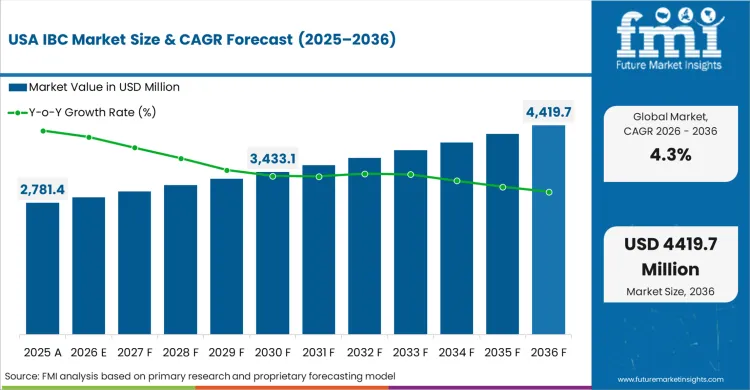
In 2026, the USA IBC market was valued at USD 2,901 million. Based on Future Market Insights' analysis, demand for intermediate bulk containers (IBCs) is estimated to grow to USD 3,026 million in 2027 and USD 4,401 million by 2036. FMI projects a CAGR of 4.3% during the forecast period.
The market is expected to generate an absolute dollar growth of USD 1,500 million between 2026 and 2036. This reflects steady industrial expansion rather than rapid structural transformation, as IBC demand closely tracks bulk liquid movement across chemicals, petroleum, agriculture, and specialty manufacturing sectors. Growth is supported by rising need for reusable, stackable, and regulation-compliant bulk transport solutions, while steel price volatility, hazardous goods compliance costs, and competition from alternative bulk packaging formats moderate acceleration.
Summary of USA IBC Market
- USA IBC Market Definition
- The USA IBC market comprises intermediate bulk containers used for safe storage and transportation of liquid and semi-liquid industrial materials across chemical, petroleum, food, pharmaceutical, and manufacturing sectors.
- Demand Drivers in the Market
- Rising bulk chemical production and hazardous material logistics are increasing demand for durable composite and steel IBCs with regulatory-compliant discharge systems.
- Expansion of reconditioning and pooling models is driving adoption of reusable IBC solutions to reduce lifecycle costs and improve sustainability metrics.
- Growth in food-grade liquid transport, including edible oils, syrups, and beverage ingredients, is strengthening demand for hygienic, stackable HDPE IBCs.
- Key Segments Analyzed in the FMI Report
- By Material: Composite IBCs (plastic bottle with steel cage) dominate the market due to structural strength, cost efficiency, and versatility across chemical and food applications.
- By Capacity: The 501-1,000 L segment represents the leading capacity range, favored for bulk transport efficiency and compatibility with palletized logistics systems.
- By Geography: Midwest and Gulf Coast industrial corridors drive major demand, supported by strong chemical manufacturing and petroleum refining activity.
- Analyst Opinion at FMI
- Ismail Sutaria, Principal Consultant for Packaging Industry at Future Market Insights, opines, ‘CXOs will find in this report strategic insights on how reusability models, compliance requirements, and industrial production cycles are shaping long-term growth in the USA IBC market.’
- Strategic Implications / Executive Takeaways
- Expand composite and stainless steel IBC offerings to address hazardous and high-value chemical transport requirements.
- Invest in leasing and pooling programs to secure recurring revenue streams and customer retention.
- Strengthen reconditioning infrastructure to capitalize on sustainability-driven procurement policies.
- Methodology
- Market estimates were validated through interviews with IBC manufacturers, leasing providers, and industrial buyers.
- Secondary research included chemical production statistics and trade data analysis.
- Forecasts were developed using bulk liquid demand modeling and industrial output trends.
“Sustainability is defined in our company’s guiding principles, The Greif Way, as using financial, natural and human resources wisely without compromising the ability of future generations to meet their needs,” said Pete Watson, Greif’s President and Chief Executive Officer. “As a leader in industrial packaging and manufacturing, we are uniquely positioned to impact sustainability throughout our global supply and value chains through innovating our own products, collaborating with our customers to reduce the impact of their packaging or expanding our end-of-life solutions and capabilities. We saw great advancements in 2019 towards implementing the circular economy principles that are core to our business strategy.”
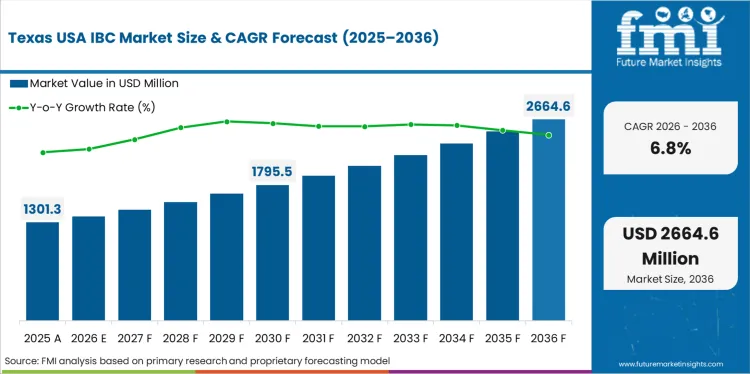
Texas (6.8%) is projected to record the fastest growth, driven by petrochemical expansion and energy-related logistics. Louisiana (6.5%) follows, supported by refinery and chemical processing activity. California (6.2%) benefits from agricultural chemicals and food ingredient transport demand. Ohio (5.9%) and Georgia (5.7%) reflect growth linked to manufacturing and distribution hubs. Mature industrial regions generate largely replacement-driven demand, constrained by established infrastructure and incremental capacity expansion rather than greenfield industrial growth.
USA IBC Market Definition
The USA IBC (Intermediate Bulk Container) market refers to the production, sale, leasing, and reconditioning of large-capacity containers used for storing and transporting bulk liquids and semi-liquids. IBCs are typically manufactured from high-density polyethylene (HDPE), composite plastic bottle with steel cage structures, or carbon and stainless steel. These containers are designed for safe handling, stacking, and efficient transport of industrial chemicals, petroleum products, pharmaceuticals, food ingredients, agrochemicals, and other liquid materials. Their primary function is to enable secure bulk storage and logistics while complying with safety and hazardous material regulations. End users include chemical manufacturers, petroleum refiners, food processors, pharmaceutical firms, and agricultural suppliers across the United States.
USA IBC Market Inclusions
The report covers USA market size estimates for 2025, 2026, and forecasts through 2036, including CAGR analysis. It includes segmentation by material type, capacity range, supply chain model, design, reusability category, end use industry, and regional state clusters. The study provides value-based market sizing, demand projections, regulatory considerations, trade flow patterns, and analysis of leasing, pooling, and reconditioning services.
USA IBC Market Exclusions
The scope excludes small plastic drums below IBC capacity thresholds and large fixed industrial storage tanks exceeding portable IBC specifications. It omits rigid packaging formats such as metal barrels, flexible intermediate bulk containers (FIBCs), and non-liquid bulk containers. Finished transported goods such as chemicals, fuels, or food products are excluded, as the study focuses strictly on intermediate bulk container manufacturing, distribution, and service models within the USA market.
USA IBC Market Research Methodology
- Primary Research: Interviews were conducted with IBC manufacturers, HDPE resin suppliers, steel fabricators, leasing and pooling operators, reconditioning service providers, and end users across chemical, petroleum, and food sectors. Material suppliers clarified HDPE and steel price volatility, while leasing operators validated pooling demand and container lifecycle economics.
- Desk Research: USA trade statistics, Department of Transportation (DOT) hazardous materials regulations, company annual reports, and industry association publications were analyzed to benchmark production volumes and compliance-driven demand.
- Market: Sizing and Forecasting- A hybrid top-down and bottom-up model was developed. Demand was reconstructed from bulk liquid output across industrial sectors and validated against manufacturer capacity and leasing fleet size.
- Data Validation and Update Cycle: Outputs undergo cross-verification with regulatory filings, trade datasets, and structured expert review prior to release.
Segmental Analysis
USA IBC Market Analysis by Material
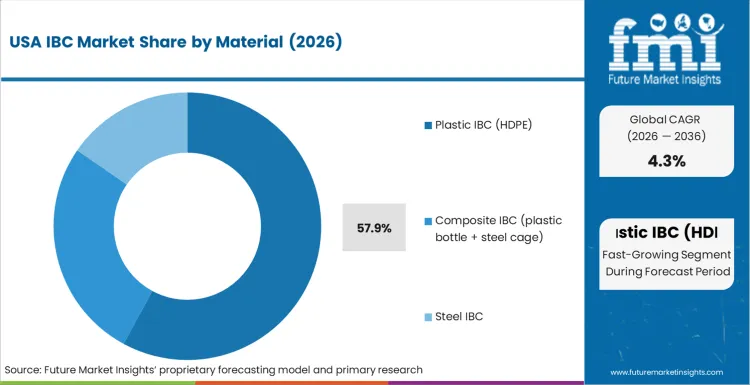
Based on FMI's USA IBC market report, consumption of Steel IBCs is estimated to hold 57.9% share in 2026. Steel IBCs dominate due to their superior structural strength, durability, and suitability for hazardous and high-value liquid transport. They address critical buyer challenges related to chemical compatibility, pressure resistance, fire safety, and regulatory compliance for industrial and petroleum applications. Steel IBCs are particularly preferred in bulk chemical manufacturing, petrochemicals, and hazardous material logistics where container integrity is paramount.
- Hazardous Compliance: Steel IBCs meet stringent USA Department of Transportation (DOT) and UN certification requirements for hazardous liquid transport, reinforcing their dominance in regulated industries.
- Longevity & Reusability: High durability allows multiple reuse cycles, reducing total cost of ownership for chemical and lubricant manufacturers.
- Industrial Reliability: Carbon and stainless steel variants offer compatibility with corrosive chemicals and high-temperature liquids, strengthening adoption in petrochemical and specialty chemical supply chains.
USA IBC Market Analysis by End Use
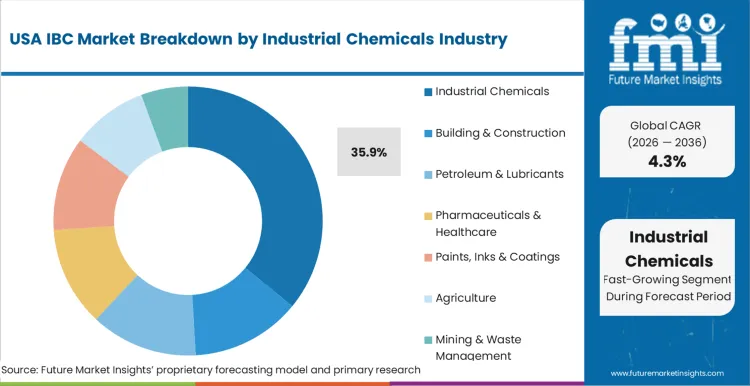
Based on FMI's USA IBC market report, consumption of Food & Beverage is estimated to hold 35.9% share in 2026. This segment leads due to large-scale bulk transport requirements for edible oils, syrups, liquid dairy ingredients, beverages, and food additives. IBCs solve key buyer priorities including hygienic storage, contamination prevention, stackability, and efficient long-distance transport across domestic distribution networks.
- Food-Grade Standards: FDA-compliant HDPE and stainless steel IBCs are widely used for liquid food ingredients requiring sanitary handling and traceability.
- Bulk Efficiency: IBCs reduce intermediate handling compared to drums, optimizing warehouse storage and improving logistics cost efficiency for beverage and ingredient manufacturers.
- Supply Chain Consolidation: Growth in centralized food processing and co-manufacturing facilities is increasing demand for high-capacity bulk liquid transport solutions across interstate supply chains.
USA IBC Market Drivers, Restraints, and Opportunities
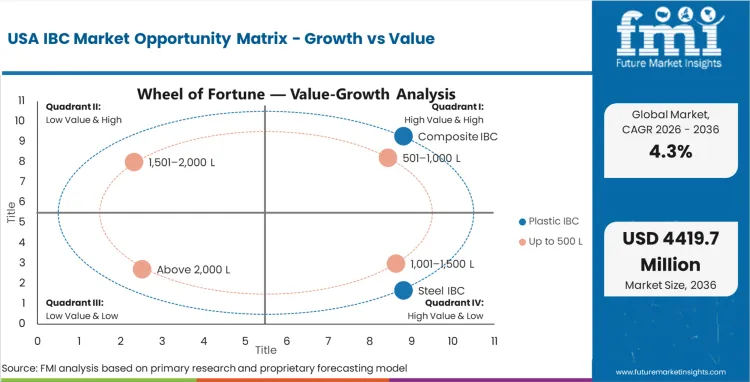
Future Market Insights analysis indicates that the USA Intermediate Bulk Container (IBC) market is structurally anchored to bulk liquid handling across chemicals, food ingredients, pharmaceuticals, and petrochemicals. The market exists at its current scale because IBCs offer a standardized, reusable, and space-efficient solution for transporting and storing hazardous and non-hazardous liquids in volumes typically ranging from 275 to 330 gallons. Growth has historically tracked industrial production, chemical output, and agricultural input demand, reinforcing IBCs as a core logistics asset within USA manufacturing and distribution networks.
FMI analysts observe a transition underway from traditional single-use containers and drums toward reusable composite and stainless-steel IBC systems. While steel drums continue to serve certain applications, composite IBCs with HDPE inner bottles and metal cages are gaining share due to stackability, reconditioning potential, and lower handling costs per gallon. Reconditioned and rebottled IBCs offer cost advantages, yet require inspection and certification investments. Higher upfront unit pricing for reusable IBCs is offset by lifecycle cost savings and compliance benefits, resulting in steady value growth even where shipment volumes fluctuate with industrial cycles.
- Hazardous Materials Compliance: USA Department of Transportation (DOT) regulations under 49 CFR Parts 171-180 govern the manufacture, testing, and reuse of IBCs for hazardous materials. These standards mandate performance testing, periodic inspection, and marking requirements, reinforcing demand for certified, compliant container systems.
- Industrial Production Cycles: Demand closely follows USA chemical manufacturing, agriculture, and oil & gas activity. Periods of industrial expansion drive higher bulk liquid movement, directly increasing IBC turnover rates.
- Reconditioning & Reuse Growth: Expansion of certified IBC reconditioning services supports cost control and sustainability objectives. Lifecycle extension models are gaining traction among chemical distributors seeking lower total cost of ownership.
Regional Analysis
The USA intermediate bulk container (IBC) market is analyzed at the state level, covering Texas, Louisiana, California, Ohio, and Georgia. Growth differentials reflect petrochemical concentration, hazardous material handling regulations, industrial output, and logistics infrastructure. The full report offers detailed state-wise market attractiveness analysis.
.webp "Top Country Growth Comparison Usa Ibc Market Cagr (2026 2036)")
| State | CAGR (2026-2036) |
|---|---|
| Texas | 6.8% |
| Louisiana | 6.5% |
| California | 6.2% |
| Ohio | 5.9% |
| Georgia | 5.7% |
Source: Future Market Insights (FMI) analysis, based on proprietary forecasting model and primary research
Gulf Coast-The Petrochemical Handling Epicenter
The Gulf Coast functions as the petrochemical handling epicenter, anchored by large-scale chemical manufacturing and export infrastructure. Key players such as Greif, Inc., Mauser Packaging Solutions, and Hoover Container Solutions, Inc. maintain strong reconditioning and industrial IBC operations in the region. Competitive positioning is shaped by hazardous material transport compliance, refinery-linked demand, and export-oriented bulk liquid handling requirements.
- Texas: Demand for IBCs in Texas is projected to rise at 6.8% CAGR through 2036. Growth is strongly linked to Texas’ petrochemical and refinery concentration along the Gulf Coast. The Texas Commission on Environmental Quality (TCEQ) continues enforcement of hazardous waste storage and transport regulations, reinforcing demand for UN-certified IBCs. In 2024, expansion projects along the Houston Ship Channel increased bulk chemical export capacity, indirectly supporting industrial container demand. Additionally, USA Department of Transportation (DOT) Hazardous Materials Regulations remain central to IBC specification compliance, particularly for flammable and corrosive liquids. Texas’ dominance in oilfield chemical distribution and specialty chemical manufacturing further drives recurring demand for composite and stainless-steel IBCs. Growth is supported by infrastructure investment and continued industrial expansion.
- Louisiana: Demand for IBCs in Louisiana is projected to rise at 6.5% CAGR through 2036. The state’s strong petrochemical base along the Mississippi River corridor drives bulk liquid handling demand. The Louisiana Department of Environmental Quality (LDEQ) enforces hazardous material containment and waste handling standards, reinforcing demand for compliant intermediate bulk containers. In 2024, announced expansions in petrochemical production facilities along the Gulf region strengthened downstream storage and logistics requirements. Port of South Louisiana activity continues to support export-oriented chemical transport, increasing IBC turnover and reconditioning demand. Industrial safety compliance and environmental reporting requirements further support structured container usage across chemical and fertilizer sectors.
FMI's analysis of USA IBC market in the Gulf Coast consists of state-wise assessment that includes Texas and Louisiana. Readers can find insights on petrochemical expansion, hazardous material regulation impact, and export-driven container demand.
West Coast - The Environmental Compliance-Driven Market
The West Coast operates as the environmental compliance-driven market, where sustainability regulations and chemical distribution shape demand. Companies such as SCHÜTZ GmbH & Co. KGaA and Snyder Industries, Inc. maintain strong industrial packaging operations serving chemical and agricultural markets.
- California: Demand for IBCs in California is projected to rise at 6.2% CAGR through 2036. Growth is influenced by stringent environmental oversight under the California Environmental Protection Agency (CalEPA) and hazardous waste transport regulations. In 2024, California continued implementation of stricter chemical storage and hazardous waste container compliance rules under state environmental statutes, reinforcing use of certified IBC systems. Additionally, California’s agricultural chemical distribution sector supports demand for bulk liquid containers used in fertilizers and crop protection chemicals. Sustainability-driven corporate commitments in 2024 also increased demand for reconditioned and reusable IBCs to reduce packaging waste. While regulatory costs are higher, compliance-driven container demand remains strong.
FMI's analysis of USA IBC market in the West Coast consists of state-wise assessment that includes California. Readers can find insights on environmental regulation, agricultural chemical handling, and reconditioned container demand.
Midwest & Southeast - The Industrial Distribution Backbone
The Midwest and Southeast represent the industrial distribution backbone, supported by manufacturing, automotive supply chains, and food processing industries. Companies such as Greif, Inc. and C.L. Smith operate container manufacturing and reconditioning facilities serving these regions.
- Ohio: Demand for IBCs in Ohio is projected to rise at 5.9% CAGR through 2036. Growth is driven by Ohio’s diversified manufacturing base and chemical distribution networks. The Ohio Environmental Protection Agency (Ohio EPA) enforces hazardous material storage compliance, reinforcing demand for certified IBC systems. In 2024, regional manufacturing investments in specialty chemicals and coatings increased demand for bulk liquid transport containers. Additionally, expansion of logistics hubs across the Midwest has strengthened reconditioning and reuse services for IBC fleets. Automotive and industrial supply chains further support steady container demand across lubricants and process chemicals.
- Georgia: Demand for IBCs in Georgia is projected to rise at 5.7% CAGR through 2036. The state’s strong logistics and distribution infrastructure, particularly around the Port of Savannah, supports bulk chemical and food ingredient transport. Georgia Environmental Protection Division (EPD) compliance standards reinforce hazardous material storage requirements. In 2024, continued port expansion initiatives increased throughput capacity, supporting industrial liquid transport and container demand. Growth in food processing and agricultural chemical distribution further contributes to composite IBC adoption. While demand growth is moderate compared to Gulf states, Georgia’s logistics expansion underpins consistent container usage.
FMI's analysis of USA IBC market in the Midwest & Southeast consists of state-wise assessment that includes Ohio and Georgia. Readers can find insights on manufacturing base expansion, logistics infrastructure growth, and regulatory compliance impact.
Competitive Aligners for Market Players USA IBC Market
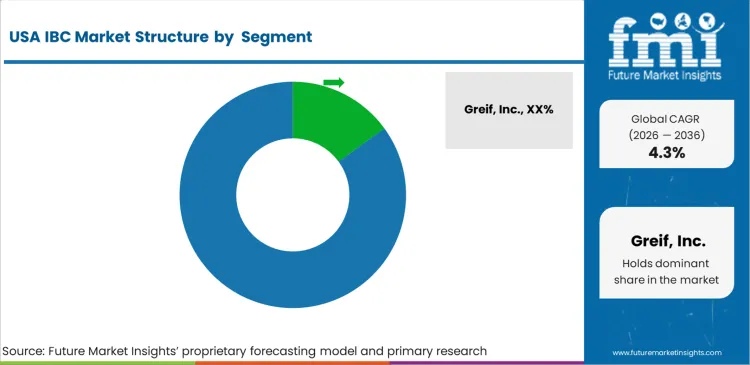
The USA intermediate bulk container (IBC) market is moderately consolidated, with a core group of established industrial packaging manufacturers accounting for a substantial share of national supply, alongside regional reconditioners and niche container specialists. Companies such as Greif, Inc., Mauser Packaging Solutions, SCHÜTZ GmbH & Co. KGaA, Snyder Industries, Time Technoplast Ltd., Hoover Container Solutions, and Thielmann dominate large-volume industrial, chemical, food, and pharmaceutical applications. The primary competitive variable in this market is durability and compliance with hazardous material (HAZMAT) transport regulations, followed by reconditioning capability, nationwide distribution reach, and lifecycle service offerings.
Structural advantages are strongest among players with vertically integrated blow-molding, steel drum, and cage manufacturing operations, as well as established container reconditioning networks. Companies such as Greif, Mauser Packaging Solutions, and SCHÜTZ benefit from closed-loop collection and refurbishment systems, enabling cost competitiveness and sustainability alignment. Firms with nationwide depot networks and fleet-based rental models, such as Hoover Container Solutions, gain operational leverage by providing IBC pooling and reconditioning services. Vertical integration in resin processing and steel fabrication further strengthens cost control and supply reliability, especially during raw material volatility.
Buyer behavior in the USA IBC market is influenced by consolidation across chemical, petrochemical, food processing, and industrial manufacturing sectors. Large customers often negotiate multi-year contracts tied to resin and steel price indices and increasingly prioritize sustainability metrics such as reusability and recyclability. Dual sourcing is common for bulk transport packaging to mitigate supply chain disruptions. While buyers exert meaningful leverage in standardized 275-330 gallon IBC formats, suppliers offering certified reconditioning, hazardous materials compliance expertise, and integrated fleet management retain stronger pricing stability and long-term customer retention.
Recent Developments
- In March 2024, Greif completed the acquisition of Ipackchem Group, a global leader in rigid plastic packaging for agrochemical and specialty chemical markets, expanding its intermediate bulk and industrial packaging portfolio.
- In August 2025, SCHÜTZ, a leader in industrial packaging, has announced the opening of a new state-of-the-art production facility in Kenosha, Wisconsin in the US, marking a significant step in its ongoing expansion strategy across North America. Strategically positioned between the economic hubs of Chicago and Milwaukee, the new plant spans over 370,000 square feet and will produce Intermediate Bulk Containers (IBCs) and plastic drums, reinforcing SCHÜTZ’s commitment to serving its customers in the Midwest with enhanced efficiency and sustainability.
Key Players
- Greif, Inc.
- HCS Group
- Hoover Container Solutions, Inc.
- Mauser Packaging Solutions
- SCHÜTZ GmbH & Co. KGaA
- Snyder Industries, Inc.
- Thielmann - The Container Company
- Time Technoplast Ltd
- Plymouth Industries
- C.L. Smith
- Rikutec Group
Scope of Report
| Metric | Value |
|---|---|
| Quantitative Units | USD 2,774 million (2025); USD 2,901 million (2026) to USD 4,401 million (2036), at a CAGR of 4.3% |
| Market Definition | The USA IBC market comprises the production, distribution, leasing, and reconditioning of intermediate bulk containers used for the storage and transportation of bulk liquids and semi-liquids across industrial, chemical, food, pharmaceutical, and hazardous material applications, ensuring durability, regulatory compliance, and safe logistics performance. |
| Form Segmentation | Plastic IBC (HDPE); Composite IBC; Steel IBC (Carbon Steel; Stainless Steel) |
| End Use Segmentation | Industrial Chemicals; Building & Construction; Petroleum & Lubricants; Pharmaceuticals & Healthcare; Paints, Inks & Coatings; Agriculture; Mining & Waste Management; Food & Beverage; Other Industrial Applications |
| Application Coverage | Bulk Chemical Handling; Hazardous & Corrosive Logistics; Cementitious & Construction Additives; Lubricants & Petrochemical Feedstocks; APIs & Diagnostic Reagents; Agro-Chemicals & Crop Protection Liquids; Mineral Slurries & Waste Liquids; Dairy & Edible Oils; Industrial Fluids & Semiconductor Chemicals |
| Regions Covered | United States |
| Countries Covered | United States |
| Key Companies Profiled | Greif, Inc.; Mauser Packaging Solutions; SCHÜTZ GmbH & Co. KGaA; Hoover Container Solutions, Inc.; Snyder Industries, Inc.; Others |
| Forecast Period | 2026 to 2036 |
| Approach | Hybrid top-down and bottom-up market modeling validated through primary interviews with IBC manufacturers, reconditioning service providers, leasing operators, and bulk chemical producers, supported by trade flow analysis, plant-level capacity assessment, regulatory benchmarking (DOT, UN certification), and state-level demand evaluation across USA industrial corridors. |
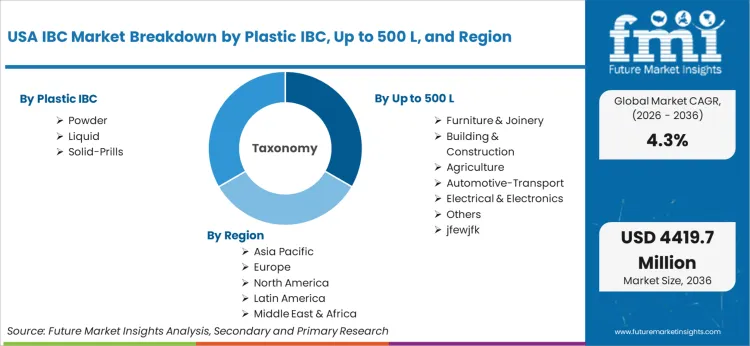
USA IBC Market Analysis by Segments
By Material
- Plastic IBC (HDPE)
- Composite IBC (plastic bottle + steel cage)
- Steel IBC
- Carbon Steel
- Stainless Steel
By Capacity
- Up to 500 L
- 501-1,000 L
- 1,001-1,500 L
- 1,501-2,000 L
- Above 2,000 L
By Supply Chain Model
- New Sales
- Leasing / Pooling Services
- Reconditioning / Reseller
By Design
- Top-Fill IBCs
- Bottom-Discharge IBCs
- Stackable IBCs
- Collapsible IBCs
- Square / Rectangular IBCs
- Cylindrical IBCs
By Reusability
- Single-use IBCs
- Reusable IBCs
- Reconditioned IBCs
By End Use
- Industrial Chemicals
- Bulk Chemical Manufacturing
- Specialty & Fine Chemicals
- Acids, Alkalis, and Solvents Handling
- Industrial Cleaning Agents
- Resins & Additives Transport
- Hazardous / Corrosive Chemical Logistics
- Building & Construction
- Cementitious Additives & Slurries
- Concrete Admixtures
- Sealants & Coatings
- Petroleum & Lubricants
- Crude Oil & Refinery Products
- Lubricant Oils & Additives
- Greases & Fuel Blends
- Petrochemical Feedstock Transport
- Used Oil & Reclaim Operations
- Pharmaceuticals & Healthcare
- Active Pharmaceutical Ingredients (API)
- Solvents & Sterile Liquid Media
- Diagnostic Reagents & Culture Media
- Nutraceutical & Supplement Manufacturing
- Paints, Inks & Coatings
- Decorative Paints & Emulsions
- Industrial Coatings & Adhesives
- Pigments, Dyes & Varnishes
- Printing Inks & Solvent Blends
- Agriculture
- Agro-Chemicals
- Crop Protection Liquids
- Liquid Nutrients & Growth Regulators
- Agricultural Additives / Soil Enhancers
- Mining & Waste Management
- Mineral Manufacturing Chemicals
- Slurries & Tailings Handling
- Wastewater Treatment Liquids
- Industrial Waste & Hazardous Sludge Transport
- Other Industrial Uses
- Utilities & Power Generation Chemicals
- Textile Manufacturing & Dyeing Liquids
- Pulp & Paper Additives
- Automotive & Metalworking Fluids
- Electronics & Semiconductor Chemicals
- Food & Beverage
- Dairy & Liquid Ingredients
- Edible Oils & Syrups
- Alcoholic & Non-Alcoholic Beverages
- Flavorings, Colorants & Food Additives
- Processed Food Pastes & Concentrates
- Water Treatment & Beverage Logistics
By States
- Northeast States
- Southeast States
- Midwest States
- Southwest States
- West States
Bibliography
- USA Department of Transportation (DOT), Pipeline and Hazardous Materials Safety Administration (PHMSA), Hazardous Materials Regulations-Intermediate Bulk Containers (49 CFR Parts 171-180), January 2024.
- USA Environmental Protection Agency (EPA), Standards Applicable to Generators of Hazardous Waste-Container Management Requirements (40 CFR Part 262), January 2024.
- International Organization for Standardization (ISO), ISO 16106:2020-Transport Packages for Dangerous Goods-Dangerous Goods Packagings, Intermediate Bulk Containers (IBCs) and Large Packagings-Guidelines for the Application of ISO 9001, Confirmed 2023 Review.
- ASTM International, ASTM D6055-19: Standard Test Methods for Mechanical Handling of Unitized Loads and Large Shipping Cases and Crates, Active Edition 2024.
- Reusable Industrial Packaging Association (RIPA), IBC Reconditioning and Reuse Industry Overview, March 2024.
- Industrial Packaging Alliance of North America (IPANA), Guidelines for the Safe Manufacture and Reconditioning of Intermediate Bulk Containers, June 2023.
- USA Occupational Safety and Health Administration (OSHA), Hazard Communication Standard (29 CFR 1910.1200), January 2024.
- International Safe Transit Association (ISTA), ISTA 3E: Testing Protocol for Unitized Loads and Bulk Containers, January 2024.
This Report Addresses
- Market intelligence enabling structured strategic decision making across USA bulk liquid logistics and hazardous material handling ecosystems.
- Market size estimation and 10 year revenue forecasts from 2026 to 2036, validated through fleet capacity and industrial output benchmarking.
- Growth opportunity mapping across HDPE plastic, composite, and steel IBC formats with emphasis on reusable and pooling models.
- Segment and state-level revenue forecasts across capacities, supply chain models, design configurations, reusability categories, and end uses.
- Competition strategy assessment covering reconditioning networks, leasing integration models, compliance capability benchmarking, and cost survivability positioning.
- Regulatory compliance tracking aligned with DOT 49 CFR hazardous materials rules, EPA container standards, and UN certification protocols.
- Regulatory impact analysis addressing hazardous waste handling mandates, inspection cycles, transport testing standards, and lifecycle documentation requirements.
- Market report delivery in PDF, Excel, PPT, and interactive dashboard formats for executive, logistics, and procurement planning use.
Frequently Asked Questions
How large is the USA IBC Market in 2026?
The USA IBC Market is valued at 2,901 in 2026.
What was the market size of the USA IBC Market in 2025?
The market was valued at 2,774 in 2025.
What will the market size be for the USA IBC Market by 2036?
The market is projected to reach 4,401 by 2036.
What is the expected CAGR of the USA IBC Market during the forecast period?
The USA IBC Market is expected to grow at a CAGR of 4.3%.
Which material type is poised to lead the USA IBC Market?
Plastic IBCs (HDPE) and composite IBCs (plastic bottle with steel cage) are widely adopted due to durability, chemical compatibility, and cost efficiency.
How significant is the industrial chemicals segment in driving IBC demand?
Industrial chemicals represent a primary end-use segment, including bulk chemical manufacturing, specialty chemicals, acids, solvents, and hazardous material logistics.
Which capacity range sees strong demand in the USA IBC Market?
The 501–1,000 L capacity segment sees strong demand due to its suitability for bulk liquid handling across chemical, lubricant, and food industries.
How important are leasing and reconditioning models in the USA IBC Market?
Leasing, pooling services, and reconditioning models play a significant role in optimizing cost efficiency and improving sustainability in industrial supply chains.
Which design configurations are commonly used in the USA IBC Market?
Top-fill, bottom-discharge, stackable, collapsible, and square/rectangular IBC designs are commonly used to enhance handling efficiency and storage optimization.
Which regions within the United States are covered in this report?
The report covers Northeast, Southeast, Midwest, Southwest, and West states.
Which companies are operating in the USA IBC Market?
Key companies include Greif, Inc., Mauser Packaging Solutions, SCHÜTZ GmbH & Co. KGaA, Hoover Container Solutions, Snyder Industries, Thielmann, Time Technoplast Ltd, Pact Group, and others.
Preview the report firsthand - request a free sample
Get SampleGet the brochure for pricing and purchase details.
Get PDFTable of Content
- Executive Summary
- Global Market Outlook
- Demand-side Trends
- Supply-side Trends
- Technology Roadmap Analysis
- Analysis and Recommendations
- Market Overview
- Market Coverage / Taxonomy
- Market Definition / Scope / Limitations
- Research Methodology
- Chapter Orientation
- Analytical Lens and Working Hypotheses
- Market Structure, Signals, and Trend Drivers
- Benchmarking and Cross-market Comparability
- Market Sizing, Forecasting, and Opportunity Mapping
- Research Design and Evidence Framework
- Desk Research Programme (Secondary Evidence)
- Company Annual and Sustainability Reports
- Peer-reviewed Journals and Academic Literature
- Corporate Websites, Product Literature, and Technical Notes
- Earnings Decks and Investor Briefings
- Statutory Filings and Regulatory Disclosures
- Technical White Papers and Standards Notes
- Trade Journals, Industry Magazines, and Analyst Briefs
- Conference Proceedings, Webinars, and Seminar Materials
- Government Statistics Portals and Public Data Releases
- Press Releases and Reputable Media Coverage
- Specialist Newsletters and Curated Briefings
- Sector Databases and Reference Repositories
- FMI Internal Proprietary Databases and Historical Market Datasets
- Subscription Datasets and Paid Sources
- Social Channels, Communities, and Digital Listening Inputs
- Additional Desk Sources
- Expert Input and Fieldwork (Primary Evidence)
- Primary Modes
- Qualitative Interviews and Expert Elicitation
- Quantitative Surveys and Structured Data Capture
- Blended Approach
- Why Primary Evidence is Used
- Field Techniques
- Interviews
- Surveys
- Focus Groups
- Observational and In-context Research
- Social and Community Interactions
- Stakeholder Universe Engaged
- C-suite Leaders
- Board Members
- Presidents and Vice Presidents
- R&D and Innovation Heads
- Technical Specialists
- Domain Subject-matter Experts
- Scientists
- Physicians and Other Healthcare Professionals
- Governance, Ethics, and Data Stewardship
- Research Ethics
- Data Integrity and Handling
- Primary Modes
- Tooling, Models, and Reference Databases
- Desk Research Programme (Secondary Evidence)
- Data Engineering and Model Build
- Data Acquisition and Ingestion
- Cleaning, Normalisation, and Verification
- Synthesis, Triangulation, and Analysis
- Quality Assurance and Audit Trail
- Market Background
- Market Dynamics
- Drivers
- Restraints
- Opportunity
- Trends
- Scenario Forecast
- Demand in Optimistic Scenario
- Demand in Likely Scenario
- Demand in Conservative Scenario
- Opportunity Map Analysis
- Product Life Cycle Analysis
- Supply Chain Analysis
- Investment Feasibility Matrix
- Value Chain Analysis
- PESTLE and Porter’s Analysis
- Regulatory Landscape
- Regional Parent Market Outlook
- Production and Consumption Statistics
- Import and Export Statistics
- Market Dynamics
- Global Market Analysis 2021 to 2025 and Forecast, 2026 to 2036
- Historical Market Size Value (USD Million) Analysis, 2021 to 2025
- Current and Future Market Size Value (USD Million) Projections, 2026 to 2036
- Y-o-Y Growth Trend Analysis
- Absolute $ Opportunity Analysis
- Global Market Pricing Analysis 2021 to 2025 and Forecast 2026 to 2036
- Global Market Analysis 2021 to 2025 and Forecast 2026 to 2036, By Plastic IBC
- Introduction / Key Findings
- Historical Market Size Value (USD Million) Analysis By Plastic IBC , 2021 to 2025
- Current and Future Market Size Value (USD Million) Analysis and Forecast By Plastic IBC , 2026 to 2036
- Composite IBC
- Steel IBC
- Composite IBC
- Y-o-Y Growth Trend Analysis By Plastic IBC , 2021 to 2025
- Absolute $ Opportunity Analysis By Plastic IBC , 2026 to 2036
- Global Market Analysis 2021 to 2025 and Forecast 2026 to 2036, By Up to 500 L
- Introduction / Key Findings
- Historical Market Size Value (USD Million) Analysis By Up to 500 L, 2021 to 2025
- Current and Future Market Size Value (USD Million) Analysis and Forecast By Up to 500 L, 2026 to 2036
- 501-1,000 L
- 1,001-1,500 L
- 1,501-2,000 L
- Above 2,000 L
- 501-1,000 L
- Y-o-Y Growth Trend Analysis By Up to 500 L, 2021 to 2025
- Absolute $ Opportunity Analysis By Up to 500 L, 2026 to 2036
- Global Market Analysis 2021 to 2025 and Forecast 2026 to 2036, By Industrial Chemicals
- Introduction / Key Findings
- Historical Market Size Value (USD Million) Analysis By Industrial Chemicals, 2021 to 2025
- Current and Future Market Size Value (USD Million) Analysis and Forecast By Industrial Chemicals, 2026 to 2036
- Building & Construction
- Petroleum & Lubricants
- Pharmaceuticals & Healthcare
- Paints, Inks & Coatings
- Agriculture
- Mining & Waste Management
- Other Industrial Uses
- Food & Beverage
- Building & Construction
- Y-o-Y Growth Trend Analysis By Industrial Chemicals, 2021 to 2025
- Absolute $ Opportunity Analysis By Industrial Chemicals, 2026 to 2036
- Global Market Analysis 2021 to 2025 and Forecast 2026 to 2036, By Region
- Introduction
- Historical Market Size Value (USD Million) Analysis By Region, 2021 to 2025
- Current Market Size Value (USD Million) Analysis and Forecast By Region, 2026 to 2036
- North America
- Latin America
- Western Europe
- Eastern Europe
- East Asia
- South Asia and Pacific
- Middle East & Africa
- Market Attractiveness Analysis By Region
- North America Market Analysis 2021 to 2025 and Forecast 2026 to 2036, By Country
- Historical Market Size Value (USD Million) Trend Analysis By Market Taxonomy, 2021 to 2025
- Market Size Value (USD Million) Forecast By Market Taxonomy, 2026 to 2036
- By Country
- USA
- Canada
- Mexico
- By Plastic IBC
- By Up to 500 L
- By Industrial Chemicals
- By Country
- Market Attractiveness Analysis
- By Country
- By Plastic IBC
- By Up to 500 L
- By Industrial Chemicals
- Key Takeaways
- Latin America Market Analysis 2021 to 2025 and Forecast 2026 to 2036, By Country
- Historical Market Size Value (USD Million) Trend Analysis By Market Taxonomy, 2021 to 2025
- Market Size Value (USD Million) Forecast By Market Taxonomy, 2026 to 2036
- By Country
- Brazil
- Chile
- Rest of Latin America
- By Plastic IBC
- By Up to 500 L
- By Industrial Chemicals
- By Country
- Market Attractiveness Analysis
- By Country
- By Plastic IBC
- By Up to 500 L
- By Industrial Chemicals
- Key Takeaways
- Western Europe Market Analysis 2021 to 2025 and Forecast 2026 to 2036, By Country
- Historical Market Size Value (USD Million) Trend Analysis By Market Taxonomy, 2021 to 2025
- Market Size Value (USD Million) Forecast By Market Taxonomy, 2026 to 2036
- By Country
- Germany
- UK
- Italy
- Spain
- France
- Nordic
- BENELUX
- Rest of Western Europe
- By Plastic IBC
- By Up to 500 L
- By Industrial Chemicals
- By Country
- Market Attractiveness Analysis
- By Country
- By Plastic IBC
- By Up to 500 L
- By Industrial Chemicals
- Key Takeaways
- Eastern Europe Market Analysis 2021 to 2025 and Forecast 2026 to 2036, By Country
- Historical Market Size Value (USD Million) Trend Analysis By Market Taxonomy, 2021 to 2025
- Market Size Value (USD Million) Forecast By Market Taxonomy, 2026 to 2036
- By Country
- Russia
- Poland
- Hungary
- Balkan & Baltic
- Rest of Eastern Europe
- By Plastic IBC
- By Up to 500 L
- By Industrial Chemicals
- By Country
- Market Attractiveness Analysis
- By Country
- By Plastic IBC
- By Up to 500 L
- By Industrial Chemicals
- Key Takeaways
- East Asia Market Analysis 2021 to 2025 and Forecast 2026 to 2036, By Country
- Historical Market Size Value (USD Million) Trend Analysis By Market Taxonomy, 2021 to 2025
- Market Size Value (USD Million) Forecast By Market Taxonomy, 2026 to 2036
- By Country
- China
- Japan
- South Korea
- By Plastic IBC
- By Up to 500 L
- By Industrial Chemicals
- By Country
- Market Attractiveness Analysis
- By Country
- By Plastic IBC
- By Up to 500 L
- By Industrial Chemicals
- Key Takeaways
- South Asia and Pacific Market Analysis 2021 to 2025 and Forecast 2026 to 2036, By Country
- Historical Market Size Value (USD Million) Trend Analysis By Market Taxonomy, 2021 to 2025
- Market Size Value (USD Million) Forecast By Market Taxonomy, 2026 to 2036
- By Country
- India
- ASEAN
- Australia & New Zealand
- Rest of South Asia and Pacific
- By Plastic IBC
- By Up to 500 L
- By Industrial Chemicals
- By Country
- Market Attractiveness Analysis
- By Country
- By Plastic IBC
- By Up to 500 L
- By Industrial Chemicals
- Key Takeaways
- Middle East & Africa Market Analysis 2021 to 2025 and Forecast 2026 to 2036, By Country
- Historical Market Size Value (USD Million) Trend Analysis By Market Taxonomy, 2021 to 2025
- Market Size Value (USD Million) Forecast By Market Taxonomy, 2026 to 2036
- By Country
- Kingdom of Saudi Arabia
- Other GCC Countries
- Turkiye
- South Africa
- Other African Union
- Rest of Middle East & Africa
- By Plastic IBC
- By Up to 500 L
- By Industrial Chemicals
- By Country
- Market Attractiveness Analysis
- By Country
- By Plastic IBC
- By Up to 500 L
- By Industrial Chemicals
- Key Takeaways
- Key Countries Market Analysis
- USA
- Pricing Analysis
- Market Share Analysis, 2025
- By Plastic IBC
- By Up to 500 L
- By Industrial Chemicals
- Canada
- Pricing Analysis
- Market Share Analysis, 2025
- By Plastic IBC
- By Up to 500 L
- By Industrial Chemicals
- Mexico
- Pricing Analysis
- Market Share Analysis, 2025
- By Plastic IBC
- By Up to 500 L
- By Industrial Chemicals
- Brazil
- Pricing Analysis
- Market Share Analysis, 2025
- By Plastic IBC
- By Up to 500 L
- By Industrial Chemicals
- Chile
- Pricing Analysis
- Market Share Analysis, 2025
- By Plastic IBC
- By Up to 500 L
- By Industrial Chemicals
- Germany
- Pricing Analysis
- Market Share Analysis, 2025
- By Plastic IBC
- By Up to 500 L
- By Industrial Chemicals
- UK
- Pricing Analysis
- Market Share Analysis, 2025
- By Plastic IBC
- By Up to 500 L
- By Industrial Chemicals
- Italy
- Pricing Analysis
- Market Share Analysis, 2025
- By Plastic IBC
- By Up to 500 L
- By Industrial Chemicals
- Spain
- Pricing Analysis
- Market Share Analysis, 2025
- By Plastic IBC
- By Up to 500 L
- By Industrial Chemicals
- France
- Pricing Analysis
- Market Share Analysis, 2025
- By Plastic IBC
- By Up to 500 L
- By Industrial Chemicals
- India
- Pricing Analysis
- Market Share Analysis, 2025
- By Plastic IBC
- By Up to 500 L
- By Industrial Chemicals
- ASEAN
- Pricing Analysis
- Market Share Analysis, 2025
- By Plastic IBC
- By Up to 500 L
- By Industrial Chemicals
- Australia & New Zealand
- Pricing Analysis
- Market Share Analysis, 2025
- By Plastic IBC
- By Up to 500 L
- By Industrial Chemicals
- China
- Pricing Analysis
- Market Share Analysis, 2025
- By Plastic IBC
- By Up to 500 L
- By Industrial Chemicals
- Japan
- Pricing Analysis
- Market Share Analysis, 2025
- By Plastic IBC
- By Up to 500 L
- By Industrial Chemicals
- South Korea
- Pricing Analysis
- Market Share Analysis, 2025
- By Plastic IBC
- By Up to 500 L
- By Industrial Chemicals
- Russia
- Pricing Analysis
- Market Share Analysis, 2025
- By Plastic IBC
- By Up to 500 L
- By Industrial Chemicals
- Poland
- Pricing Analysis
- Market Share Analysis, 2025
- By Plastic IBC
- By Up to 500 L
- By Industrial Chemicals
- Hungary
- Pricing Analysis
- Market Share Analysis, 2025
- By Plastic IBC
- By Up to 500 L
- By Industrial Chemicals
- Kingdom of Saudi Arabia
- Pricing Analysis
- Market Share Analysis, 2025
- By Plastic IBC
- By Up to 500 L
- By Industrial Chemicals
- Turkiye
- Pricing Analysis
- Market Share Analysis, 2025
- By Plastic IBC
- By Up to 500 L
- By Industrial Chemicals
- South Africa
- Pricing Analysis
- Market Share Analysis, 2025
- By Plastic IBC
- By Up to 500 L
- By Industrial Chemicals
- USA
- Market Structure Analysis
- Competition Dashboard
- Competition Benchmarking
- Market Share Analysis of Top Players
- By Regional
- By Plastic IBC
- By Up to 500 L
- By Industrial Chemicals
- Competition Analysis
- Competition Deep Dive
- Greif, Inc.
- Overview
- Product Portfolio
- Profitability by Market Segments (Product/Age /Sales Channel/Region)
- Sales Footprint
- Strategy Overview
- Marketing Strategy
- Product Strategy
- Channel Strategy
- HCS Group
- Hoover Container Solutions, Inc.
- Mauser Packaging Solutions
- Titan IBC
- Greif, Inc.
- Competition Deep Dive
- Assumptions & Acronyms Used


