

- Industry Size (2026)
- USD 0.9 Bn
- Forecast (2036)
- USD 2.7 Bn
- CAGR (2026 to 2036)
- 11.2%
IoT-Tracked Reusable IBC Fleet Market Size, Market Forecast and Outlook By FMI
The IoT‑tracked reusable IBC fleet market stood at USD 0.8 billion in 2025. It is expected to surpass USD 0.9 billion in 2026, registering a CAGR of 11.2% over the assessment horizon. Market expansion elevates overall demand to USD 2.7 billion by 2036, driven by the cost crossover favoring connected pooling architectures over passive packaging procurement.
The transition from passive containers to connected asset networks forces industrial shippers to fundamentally alter their logistics procurement strategies. This architectural shift requires logistics providers to embed long-life battery tracking nodes into the physical exoskeleton of their container inventory. Facilities that delay adopting sensor-integrated fleets face compounding losses from container hoarding, unrecorded contamination events, and delayed detention billing. Supply chain directors who previously evaluated intermediate bulk containers purely on material cost now require continuous locational and environmental data streams.
Summary of IoT-Tracked Reusable IBC Fleet Market
- IoT-Tracked Reusable IBC Fleet Market Definition
- The market comprises intelligent bulk packaging hardware and the associated telemetry platforms used to orchestrate returnable asset loops. It represents the structural convergence of industrial packaging hardware and active network communication.
- Demand Drivers in the Market
- Strict regulatory frameworks for hazardous material transport force chemical producers to specify active location monitoring for all bulk liquid shipments.
- Unpredictable multimodal transit delays compel supply chain directors to deploy real-time condition monitoring to prevent product spoilage in pharmaceutical supply chains.
- Fleet operators facing high annual container loss rates adopt cellular tracking modules to enforce accurate detention billing and recover stranded assets.
- Key Segments Analyzed in the FMI Report
- Rigid IBCs: 65.4% share in 2026, driven by high durability requirements in continuous closed-loop chemical transport.
- LPWAN/LoRaWAN: 42.1% share in 2026, reflecting the absolute requirement for multi-year battery life in unpowered transit scenarios.
- India: 14.5% CAGR, anchored by specialty chemical exporters modernizing reverse logistics networks.
- Analyst Opinion at FMI
- Ismail Sutaria, Principal Consultant for Packaging, opines, "In my analysis, I have observed that the true operational bottleneck is not the physical tracking hardware, but the integration of telemetry data into legacy enterprise resource planning systems. Facilities attempting to run connected container networks through manual spreadsheet reconciliation face data silos that obscure actual cycle times. Fleet pooling directors who continue patching passive barcode systems will find themselves unable to meet the real-time visibility thresholds demanded by Tier-1 pharmaceutical and chemical shippers by 2028."
- Strategic Implications / Executive Takeaways
- Asset managers must transition from capital expenditure purchasing models to unified managed pooling contracts that guarantee data delivery alongside physical hardware.
- Logistics procurement directors should mandate API-level integration capabilities in all new smart container fleet tenders to ensure automated detention tracking.
- Hardware component engineers must prioritize battery optimization and ruggedized form factors to survive harsh chemical washdown cycles.
- Market Research Methodology
- Primary Research: Analysts engaged with fleet pooling operators, chemical supply chain directors, and industrial packaging procurement leads.
- Desk Research: The data collection phase aggregated compliance roadmaps from global chemical transport authorities and pooling financial disclosures.
- Market-Sizing and Forecasting: The baseline value derives from a bottom-up aggregation of connected container deployments.
- Data Validation and Update Cycle: Projections are rigorously tested against publicly reported capital expenditure guidance from packaging conglomerates.
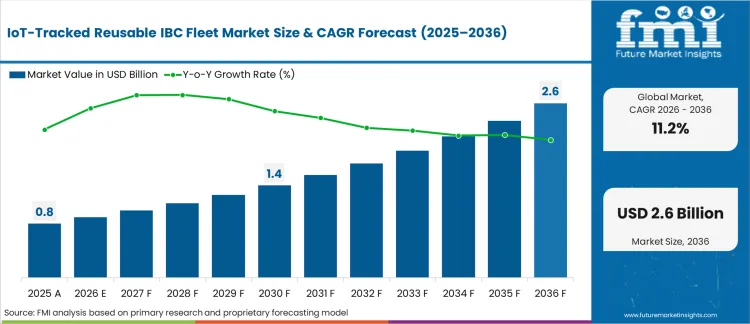
The critical inflection point occurs when network density enables predictive empty-repositioning algorithms rather than simple loss-prevention tracking. Fleet pooling operators must achieve geographic sensor saturation before the 2028 reporting cycle to monetize demurrage optimization services fully. Operators failing to extract actionable cycle-time analytics from their hardware will find their capital stranded in idle container buffer stocks.
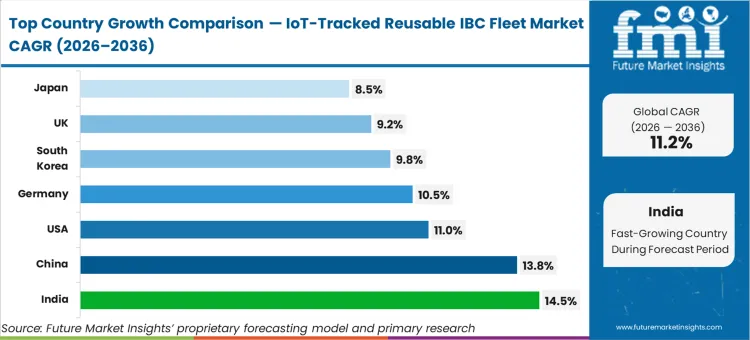
India advances at a 14.5% CAGR as specialty chemical exporters implement unified digital ledgers for reverse logistics. China tracks at a 13.8% pace driven by stringent hazardous chemical transport visibility regulations. The United States grows at an 11.0% trajectory anchored by aggressive pharmaceutical supply chain security mandates. Germany registers a 10.5% expansion, South Korea follows at 9.8%, the UK posts 9.2%, and Japan expands at 8.5%. This geographic dispersion reflects distinct regional regulatory pressures pushing industrial asset owners toward connected pooling architectures.
IoT-Tracked Reusable IBC Fleet Market Definition
The IoT-Tracked Reusable IBC Fleet market encompasses industrial liquid and bulk storage containers equipped with integrated telemetry sensors that transmit real-time location, temperature, and status data. This market specifically focuses on the hardware, software, and managed services required to operate closed-loop container networks.
IoT-Tracked Reusable IBC Fleet Market Inclusions
The scope incorporates smart rigid plastic containers, connected stainless steel vessels, embedded LPWAN/cellular tracking nodes, and cloud-based asset orchestration platforms. Managed pooling services utilizing active asset tracking infrastructure for intermediate bulk container fleets are fully included.
IoT-Tracked Reusable IBC Fleet Market Exclusions
Standard passive intermediate bulk containers lacking native telemetry integration are explicitly excluded. Disposable flexible liquid liners, pure consumer parcel tracking tags, and standalone warehouse management systems that do not manage physical container hardware fall outside the defined analytical boundary.
IoT-Tracked Reusable IBC Fleet Market Research Methodology
- Primary Research: Analysts engaged with fleet pooling operators, chemical supply chain directors, and industrial packaging procurement leads to validate telemetry adoption timelines.
- Desk Research: The data collection phase aggregated compliance roadmaps from global chemical transport authorities, container pooling financial disclosures, and FMI packaging intelligence reports.
- Market-Sizing and Forecasting: The baseline value derives from a bottom-up aggregation of connected container deployments, applying region-specific serialization curves to project future adoption velocity.
- Data Validation and Update Cycle: Projections are rigorously tested against publicly reported capital expenditure guidance from the leading global industrial packaging conglomerates.
Segmental Analysis
IoT-Tracked Reusable IBC Fleet Market Analysis by IBC Type
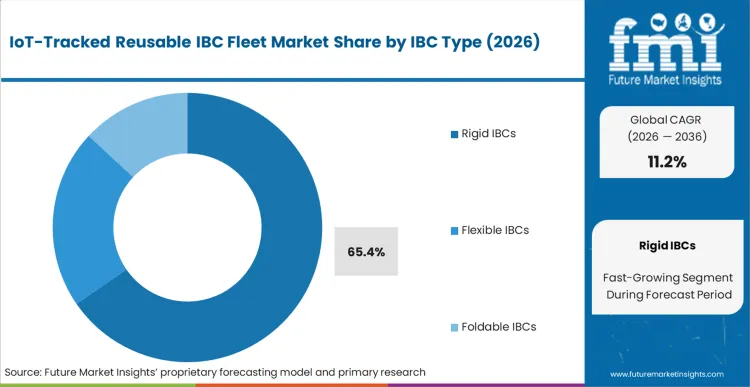
Fleet operators failing to deploy integrated rigid hardware risk immediate exclusion from the next wave of closed-loop industrial supply contracts. FMI analysts opine that integrating tracking modules directly into high-density polyethylene structures protects delicate silicon from aggressive chemical washdown processes. This structural shielding eliminates the need for external secondary enclosures that interfere with automated handling equipment. Supply chain architects specifying these connected rigid units streamline their reverse logistics topologies and significantly reduce overall asset shrinkage. Rigid IBCs command a dominant 65.4% share in 2026, reflecting the absolute requirement for physical durability during complex multimodal transit cycles. Industrial chemical producers standardizing on returnable packaging assets execute full-scale hardware replacement programs to eliminate single-use container waste.
- Durability Thresholds: High-impact polymer construction guarantees long-term survival in harsh operational environments, maximizing the return on integrated sensor investments.
- Washdown Resistance: Flush-mounted telemetry nodes survive intensive chemical cleaning cycles, allowing continuous asset rotation without hardware degradation.
- Stacking Optimization: Standardized rigid footprints enable safe vertical storage in automated warehouses, optimizing floor space for distribution managers.
IoT-Tracked Reusable IBC Fleet Market Analysis by Tracking Technology
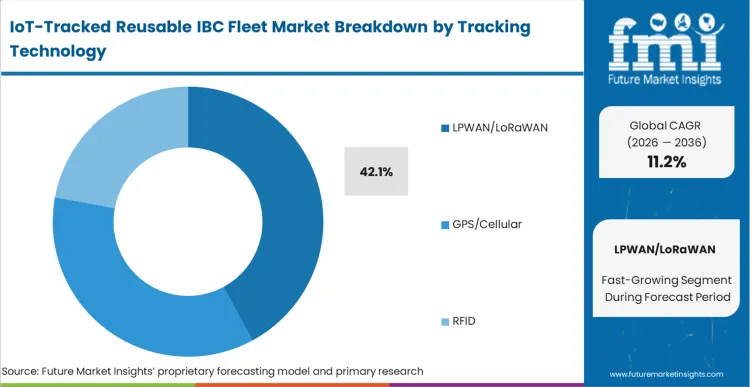
Logistics providers unable to supply multi-year tracking capabilities face severe disqualification windows during pharmaceutical vendor selection events. The unique constraints of unpowered multi-year transit cycles force logistics engineers to reject high-drain cellular modules in favor of optimized telemetry. LPWAN/LoRaWAN establishes a commanding 42.1% share in 2026 as low-power architectures solve the fundamental battery life limitation of connected fleets. Network operators deploying these wide-area nodes directly into container fleets capture continuous locational data without demanding frequent manual recharging cycles. As per FMI's projection, this energy-efficient topology enables complete supply chain visibility across geographically expansive distribution networks. Asset managers specifying these low-power endpoints realize measurable reductions in manual maintenance interventions.
- Battery Conservation: Minimal data packet transmissions extend operational node life to match the physical lifespan of the container hardware.
- Gateway Density: Industrial facility operators install localized receiving antennas to capture precise container inventory counts without relying on external cellular networks.
- Cost Efficiency: Low component costs allow fleet managers to instrument entire container inventories rather than just tracking high-value sub-segments.
IoT-Tracked Reusable IBC Fleet Market Analysis by Fleet Operating Model
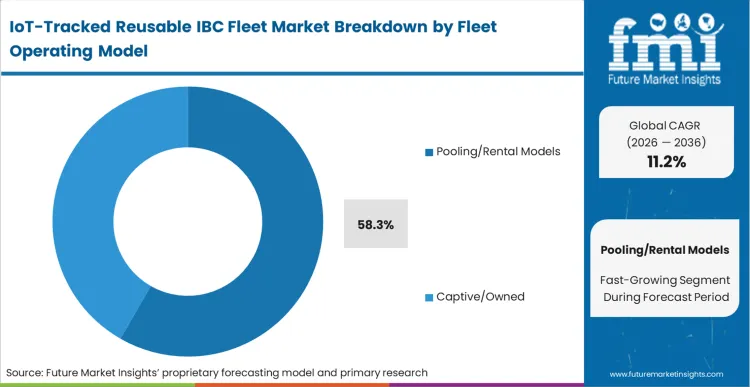
Capital projects directors executing supply chain modernizations increasingly reject the financial burden of owning and maintaining proprietary container networks. Pooling/Rental models account for an estimated 58.3% share in 2026, as the packaging-as-a-service framework shifts telemetry hardware costs from capital expenditures to operational budgets. Third-party logistics operators managing these massive connected fleets aggregate data across multiple client networks to optimize empty container repositioning. Based on FMI's assessment, this shared-resource architecture drastically reduces the carbon footprint associated with transporting empty vessels back to production facilities. Supply chain directors utilizing these managed services avoid the complex engineering hours required to build internal sensor dashboards. Chemical manufacturers attempting to build captive tracking networks face immense scaling challenges when managing international reverse logistics routes.
- Capital Shifting: Subscription-based pricing allows industrial producers to access advanced telemetry capabilities without massive upfront hardware investments.
- Repositioning Efficiency: Aggregated network data allows pooling operators to route empty containers to the nearest demand node rather than returning them to origin points.
- Maintenance Offloading: Third-party providers absorb the operational burden of repairing damaged tracking nodes and replacing depleted batteries.
IoT-Tracked Reusable IBC Fleet Market Analysis by End Use
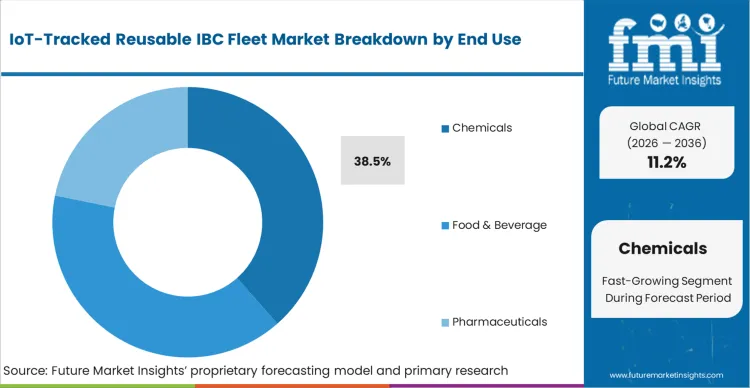
FMI's analysis indicates that linking telemetry data directly to digital safety data sheets accelerates customs clearance processes at international borders. Facilities operating without this foundational tracking layer face systemic detention delays and heightened insurance premiums. Chemical distribution managers lacking verified connected logistics capabilities forfeit priority status in Tier-1 supplier procurement cycles. Strict regulatory compliance timelines for hazardous material transport compel control system engineers to deploy active monitoring architectures. Chemicals end use represents a leading 38.5% share in 2026 as producers transition entirely away from unmonitored passive transit. Process safety directors managing volatile liquid shipments mandate real-time condition alerts to prevent catastrophic thermal runaway events during maritime transport.
- Thermal Monitoring: Integrated temperature sensors trigger automated alerts when sensitive chemical payloads breach safe storage thresholds during transit.
- Custody Verification: Immutable digital location logs provide regulatory bodies with verifiable proof of safe hazardous material handling across all transfer nodes.
- Demurrage Control: Accurate timestamping of delivery and pickup events allows chemical suppliers to automatically invoice clients for excessive container detention periods.
IoT-Tracked Reusable IBC Fleet Market Drivers, Restraints, and Opportunities
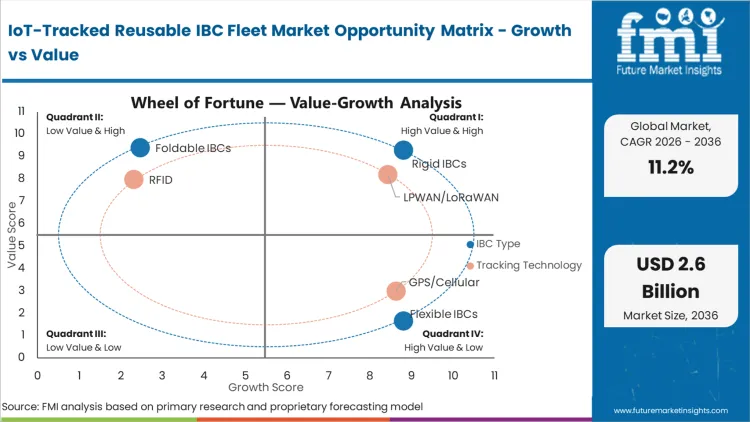
The convergence of sustainability mandates and supply chain digitization forces industrial packaging leads to abandon single-use plastic transit vessels entirely. Chemical and pharmaceutical shippers facing strict carbon reduction targets must transition to managed circular fleet models to achieve their scope three emissions goals. Transitioning to a unified connected backbone provides the exact utilization metrics required to prove continuous asset rotation and environmental compliance. Logistics directors who ignore these digitization requirements risk losing access to large-scale enterprise contracts that explicitly mandate measurable sustainable transport practices.
The complex software integration required to merge raw telemetry feeds into legacy enterprise resource planning platforms creates immense operational friction for mid-tier logistics providers. Processing millions of localized ping events into actionable billing logic demands specialized data architecture expertise that most regional fleet operators lack internally. To mitigate this integration barrier, supply chain architects increasingly rely on middleware platforms that translate raw location coordinates into automated workflow triggers.
Opportunities in the IoT-Tracked Reusable IBC Fleet Market
- Predictive Contamination Modeling: Advanced sensor arrays enable quality control directors to detect trace chemical residues within empty containers before they reach filling stations. This capability prevents catastrophic cross-contamination events in sensitive food and beverage supply chains.
- Dynamic Route Optimization: Real-time container density maps allow logistics planners to reroute delivery vehicles dynamically to sweep up empty vessels. This aggregation strategy drastically reduces the fuel consumed during reverse logistics operations.
- Automated Detention Billing: Geofencing integration allows finance controllers to trigger smart contracts the moment an asset enters a customer facility. This financial linkage eliminates manual invoice disputes and accelerates cash flow for fleet operators.
Regional Analysis
The IoT-Tracked Reusable IBC Fleet market is segmented across 40 plus countries into North America, Latin America, Europe, East Asia, South Asia, Oceania, and the Middle East & Africa, based on the regional analysis.
.webp "Top Country Growth Comparison Iot Tracked Reusable Ibc Fleet Market Cagr (2026 2036)")
| Country | CAGR (2026 to 2036) |
|---|---|
| India | 14.5% |
| China | 13.8% |
| USA | 11.0% |
| Germany | 10.5% |
| South Korea | 9.8% |
| UK | 9.2% |
| Japan | 8.5% |
Source: Future Market Insights (FMI) analysis, based on proprietary forecasting model and primary research
Asia Pacific IoT-Tracked Reusable IBC Fleet Market Analysis
FMI analysts opine that entirely bypassing the costly retrofit phase found in older manufacturing centers is made possible by this clean-slate approach. Across the Asia Pacific region, the rapid development of greenfield logistics infrastructure accelerates the abandonment of legacy manual tracking constraints. Regional asset owners establish highly flexible production environments capable of rapid geographic scaling by building native synchronization capabilities directly into the supply chain foundation. In their initial site blueprints, capital projects directors constructing new chemical production facilities now mandate unified connected packaging architectures.
- India: Anchoring India's 14.5% CAGR through to 2036 is the immense regulatory compliance pressure surrounding hazardous material transit. Without data loss, process engineers are now required to deploy control networks capable of guaranteeing critical transit data delivery to centralized dashboards. Disqualification from major chemical facility tenders faces any fleet operators failing to provide hardware equipped with built-in data integrity mechanisms. Immutable location records for all bulk shipments are demanded by the stringent international tracking frameworks governing India's specialty chemical export sector. Prioritizing unified, secure communication backbones, a wave of reverse logistics upgrades is currently being triggered by the national push toward chemical manufacturing self-sufficiency.
- China: To monitor the exact position of millions of active transit vessels across the eastern industrial corridor, localized LPWAN architectures must be deployed by supply chain planners. Lucrative state-backed logistics projects are quickly lost by network providers unable to demonstrate verified high-bandwidth tracking capabilities. Driven by continuous safety mandates, China tracks at a 13.8% pace across the forecast period. China's rapid shift toward digitized bulk packaging is fundamentally defined by stringent hazardous chemical transport visibility regulations. A massive installed base of interoperable tracking infrastructure is simultaneously established by the sheer volume of new domestic chemical production.
- South Korea: Ensuring high-purity solvent deliveries arrive without thermal or shock degradation requires plant automation leads to mandate connected sensor architectures. Before entering the approved vendor list, flawless environmental tracking must be proven by container suppliers targeting the next fab expansion cycle. Real-time environmental monitoring is demanded by South Korea's advanced semiconductor fabrication complex, which operates to ultra-pure chemical handling tolerances. To maximize production yield rates, the heavy concentration of logic foundries necessitates continuous investment in active transit monitoring. As this zero-tolerance standard becomes the universal procurement baseline, South Korea's market expands at a 9.8% CAGR.
- Japan: For connected packaging upgrades, this continuous qualification constraint ultimately sustains an 8.5% CAGR value. Before receiving authorization for series production integration, location timing compliance must be validated by every new transit architecture. Critical automotive supply routes are immediately forfeited by component suppliers lacking verified interoperable testing records. To maintain a global competitive advantage in high-performance delivery, precision telemetry is embedded directly into container fleets by the domestic logistics sector. Synchronized just-in-time delivery sequences are used to enforce strict component qualification across Japan's automotive chemical supply chain.
FMI's report includes extensive coverage of the Asia Pacific connected packaging landscape. It incorporates detailed analysis of Taiwan, Indonesia, Australia, and the broader ASEAN region. A primary trend shaping these nations involves the rapid localization of chemical component blending, forcing regional contract manufacturers to deploy unified network architectures to satisfy stringent global brand traceability requirements and eliminate supply chain blind spots.
North America IoT-Tracked Reusable IBC Fleet Market Analysis
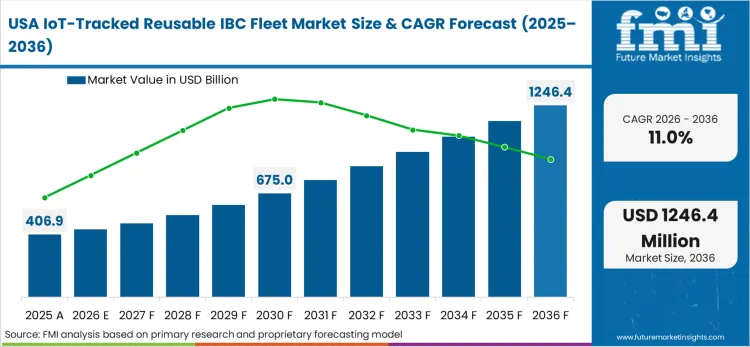
Advanced predictive inventory algorithms can be deployed without compromising physical security when facilities implement a standardized connected backbone. Strict directives to unify disparate transit domains under a single manageable digital architecture are faced by logistics systems engineers leading critical infrastructure overhauls. The systematic eradication of opaque, unmonitored supply chain networks is the primary target of industrial modernization mandates across North America. To secure critical material flows against sophisticated intrusion and theft attempts, the pharmaceutical manufacturing sectors actively drive this consolidation, in FMI's view.
- USA: The replacement of vulnerable legacy packaging with standardized, connected asset fleets is actively funded by federal supply chain resilience initiatives. Active architectures capable of supporting both real-time temperature verification and secure locational telemetry must be deployed by network specification leads replacing aging passive container systems. As discrete manufacturers successfully unify their logical transit topologies, the United States advances at an 11.0% of CAGR. Immediate exclusion from defense-adjacent logistics contracts confronts any hardware vendors lacking documented compliance with rigorous industrial data security standards. Across its entire multi-tier supply ecosystem, strict cold-chain visibility mandates are enforced by the United States pharmaceutical manufacturing sector.
FMI's report includes comprehensive evaluation of the North American smart logistics sector. It features specific analysis of the Canadian and Mexican industrial markets. A defining dynamic in these countries involves the integration of cross-border automotive and chemical supply chains, which requires standardized tracking protocols to coordinate just-in-time delivery sequences and maintain synchronized production schedules across multiple international facilities.
Europe IoT-Tracked Reusable IBC Fleet Market Analysis
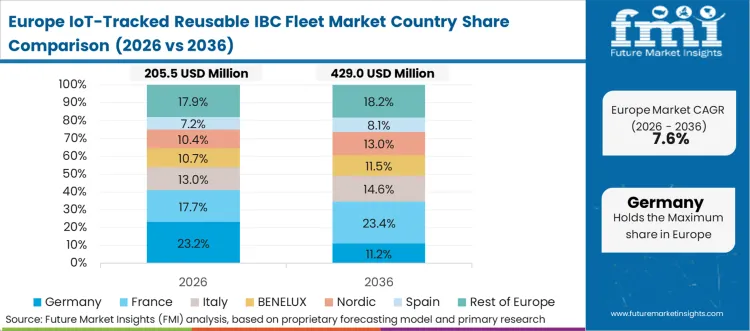
Continuous carbon tracking data alongside critical location signals must be integrated by supply chain architects who are redesigning legacy distribution lines. FMI's research confirms that supporting advanced sustainable manufacturing practices is made possible because upgrading the core physical infrastructure provides the necessary telemetry precision. The continued operation of highly wasteful, single-use chemical transit packaging is actively penalized by European industrial policy. Guaranteeing asset recovery while proving environmental compliance forces the rapid adoption of connected circular pooling models through this dual-purpose reporting requirement.
- Germany: Before receiving authorization to integrate new container fleets, flawless execution of location reporting flows must be demonstrated by logistics control engineers. Prior to capital procurement budget finalizations, minute-level location accuracy must be guaranteed by packaging infrastructure providers targeting domestic chemical plant retooling projects. Accelerating smart hardware adoption, a recurring compliance cycle is created because the national chemical production sector operates under rigorous environmental safety certifications that mandate unified tracking layers. Stringent validation criteria for hazardous material transit across dense multi-modal rail networks are dictated by Germany's advanced chemical export supply chain. Driven entirely by these systemic qualification pressures, Germany registers a 10.5% expansion.
- UK: Positioning the UK at a 9.2% CAGR value through to 2036, this critical infrastructure transition reshapes distribution networks. Sensor architectures capable of sub-degree temperature delivery reporting across distributed geographic assets are mandated by supply network planners deploying advanced tracking systems. Qualification for national retail distribution projects is forfeited by systems integrators unable to demonstrate absolute tracking determinism under severe transit conditions. In favor of highly resilient, connected container networks, wholesale operators are forced to abandon legacy passive tracking protocols due to the shift toward stringent food safety compliance. Catastrophic cross-contamination incidents are prevented because the United Kingdom's food and beverage safety modernization programs require precise custody measurement data.
FMI's report includes thorough investigation of the European industrial tracking framework. The analysis encompasses Italy, France, Spain, the Nordics, and the Benelux region. A prevailing structural condition across these nations is the mandatory compliance with strict circular economy packaging directives, forcing asset owners to specify connected networks that can reliably transport fail-safe retrieval signals alongside standard operational data to avoid hefty regulatory fines.
Competitive Aligners for Market Players
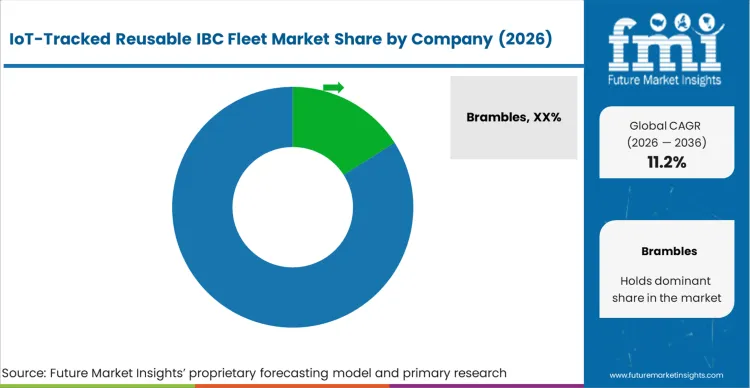
The IoT-Tracked Reusable IBC Fleet market exhibits a moderately consolidated structure at the global tier, though it remains highly competitive among regional specialists. This concentration is driven by the immense capital expenditure required to physically instrument thousands of transit vessels with military-grade telemetry hardware. Global pooling titans such as Brambles and Schoeller Allibert dominate high-volume chemical corridors by deploying massive balance sheets to absorb these initial hardware costs, while specialized providers like Hoover CS carve out highly profitable niches in stringent hazardous liquid transport. For procurement teams evaluating these suppliers, the primary competitive variable has shifted entirely from unit rental pricing to software API maturity, as industrial buyers now demand flawless data integration directly into their legacy enterprise resource planning systems.
Vendors that successfully embed high-capacity battery technologies and low-power communication protocols directly into the physical edge devices gain a significant structural advantage. Companies including Goodpack and ORBIS Corporation deploy proprietary ruggedized smart packaging enclosures that shield sensitive silicon from extreme physical shock and aggressive chemical washdown cycles. This structural integration fundamentally alters the unit economics of container pooling, extending the useful life of the sensor module to match the outer shell while eliminating the maintenance burden of externally strapped tags. Challengers like Advanced Logistics Company attempting to replicate this advantage must invest heavily in applied material science, as competing with off-the-shelf, externally mounted tracking nodes results in recurring replacement costs that quickly erode service margins.
Large industrial shippers actively prevent proprietary lock-in by enforcing strict multi-vendor qualification mandates and demanding adherence to open data communication standards. This aggressive buyer behavior structurally limits the pricing power of dominant pooling operators, empowering agile regional disruptors like Metano IBC Services to win lucrative enterprise contracts simply by offering frictionless, open-architecture telemetry feeds. The fundamental tension in the market lies between legacy pooling operators attempting to monetize closed data analytics platforms and chemical producers demanding raw, unfiltered location access to train their internal machine learning models. Over the forecast period, the competitive landscape will decisively favor vendors who provide open software integration over those attempting to trap industrial asset owners within isolated digital ecosystems.
Recent Developments
- Brambles launched a next-generation diagnostic tracking module designed specifically to survive continuous automated chemical washdown cycles without compromising signal integrity.
- Hoover CS expanded its managed pooling fleet capacity across the North American chemical corridor by deploying ten thousand new LPWAN-equipped rigid containers.
- Schoeller Allibert initiated a rigorous third-party interoperability testing program to guarantee its smart packaging telemetry feeds directly integrate with dominant ERP platforms.
- Goodpack introduced an advanced predictive repositioning algorithm that leverages machine learning to route empty connected containers to high-demand agricultural export zones.
Key Players in IoT-Tracked Reusable IBC Fleet Market
- Brambles
- Schoeller Allibert
- Hoover CS
- Goodpack
- ORBIS Corporation
- Metano IBC Services
- Advanced Logistics Company
Scope of the Report
| Metric | Value |
|---|---|
| Quantitative Units | USD 0.9 billion to USD 2.7 billion, at a CAGR of 11.2% |
| Market Definition | The IoT-Tracked Reusable IBC Fleet market encompasses industrial liquid and bulk storage containers equipped with integrated telemetry sensors that transmit real-time location, temperature, and status data. |
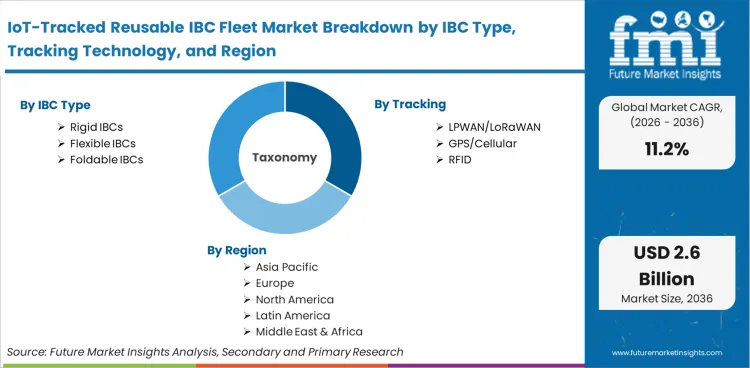
| IBC Type Segmentation | Rigid IBCs, Flexible IBCs, Foldable IBCs |
| Tracking Technology Segmentation | GPS/Cellular, RFID, LPWAN/LoRaWAN, BLE |
| Fleet Operating Model Segmentation | Pooling/Rental, Captive/Owned |
| End Use Segmentation | Chemicals, Food & Beverage, Pharmaceuticals, Paints & Coatings, Others |
| Regions Covered | North America, Latin America, Europe, East Asia, South Asia, Oceania, Middle East & Africa |
| Countries Covered | India, China, USA, Germany, South Korea, UK, Japan, and 40 plus countries |
| Key Companies Profiled | Brambles, Schoeller Allibert, Hoover CS, Goodpack, ORBIS Corporation, Metano IBC Services, Advanced Logistics Company |
| Forecast Period | 2026 to 2036 |
| Approach | The baseline value derives from a bottom-up aggregation of connected container deployments, applying region-specific serialization curves to project future adoption velocity. Projections are rigorously tested against publicly reported capital expenditure guidance. |
Source: Future Market Insights (FMI) analysis, based on proprietary forecasting model and primary research
Segments
IBC Type:
- Rigid IBCs
- Flexible IBCs
- Foldable IBCs
Tracking Technology:
- GPS/Cellular
- RFID
- LPWAN/LoRaWAN
- BLE
Fleet Operating Model:
- Pooling/Rental
- Captive/Owned
End Use:
- Chemicals
- Food & Beverage
- Pharmaceuticals
- Paints & Coatings
- Others
Regions:
- North America
- USA
- Canada
- Mexico
- Latin America
- Brazil
- Argentina
- Chile
- Rest of Latin America
- Europe
- Germany
- France
- Italy
- Spain
- United Kingdom
- Nordics
- Benelux
- Rest of Europe
- East Asia
- China
- Japan
- South Korea
- South Asia
- India
- Thailand
- Vietnam
- Rest of South Asia
- Oceania
- Australia
- New Zealand
- Middle East & Africa
- South Africa
- GCC Countries
- Rest of MEA
Bibliography
- USA Department of Transportation. (2024, May 12). Hazardous materials tracking and supply chain visibility protocols. Pipeline and Hazardous Materials Safety Administration.
- European Chemicals Agency. (2025, February 04). Digital product passports and bulk transport traceability mandates. ECHA Transport Guidelines.
- National Institute of Standards and Technology. (2024, August 21). Supply chain telemetry data structures for industrial packaging. NIST Interagency Report 8421.
- Reusable Packaging Association. (2024, October 15). State of the connected returnable transport packaging industry. RPA Annual Outlook.
- Industrial Packaging Alliance of North America. (2025, January 10). Integration standards for smart rigid intermediate bulk containers. IPANA Technical Bulletins.
- Brambles. (2024, November 08). Supply chain digitization and connected asset network expansion strategy. Brambles Investor Relations.
- Hoover CS. (2025, March 01). Fleet sustainability metrics and active tracking deployment roadmap. Hoover CS Sustainability Report.
- LoRa Alliance. (2024, September 30). LPWAN deployment parameters for unpowered logistics assets. LoRa Technical Committee Updates.
- GS1 Global. (2024, July 22). EPCIS standards for returnable asset tracking and event data sharing. GS1 Logistics Framework.
- USA Food and Drug Administration. (2024, December 05). Food Safety Modernization Act Section 204 traceability rule enforcement for bulk transport. FDA Compliance Documentation.
This bibliography is provided for reader reference. The full FMI report contains the complete reference list with primary source documentation.
This Report Addresses
- Market intelligence to support strategic decision‑making across the organized IoT‑tracked reusable IBC fleet ecosystem, including connected rigid, flexible, and foldable container architectures
- Market size estimation and 10‑year telemetry adoption forecasts from 2026 to 2036, supported by bottom‑up fleet deployment modeling and validated primary interviews with pooling operators and industrial shippers
- Growth opportunity mapping across IBC types, tracking technologies, and fleet operating models, with emphasis on durability engineering, battery‑optimized telemetry nodes, and long‑life connected hardware design
- Segment and regional revenue forecasts spanning GPS/Cellular, RFID, LPWAN/LoRaWAN, and BLE tracking formats, aligned with compliance‑driven adoption patterns across major chemical and pharmaceutical corridors
- Competitive strategy assessment including API‑level integration maturity, ruggedized smart‑packaging differentiation, multi‑vendor qualification alignment, and telemetry‑enabled service model innovation
- Technology and product‑layer evolution tracking, including flush‑mounted sensors, multi‑year battery systems, gateway density upgrades, predictive repositioning algorithms, and geofenced detention automation
- Market access analysis covering chemical, pharmaceutical, food & beverage, and coatings supply chains, along with cross‑regional logistics modernization programs and digital visibility compliance frameworks
- Market report delivery in PDF, Excel, PPT, and dashboard‑ready formats to support executive strategy, category planning, procurement optimization, and operational benchmarking
Frequently Asked Questions
How large is the IoT-Tracked Reusable IBC Fleet market in 2026?
The IoT-Tracked Reusable IBC Fleet market is estimated to be valued at USD 0.9 billion in 2026. This initial valuation reflects the rapid deployment of tracking hardware mandated by chemical producers.
What will the IoT-Tracked Reusable IBC Fleet market be valued at by 2036?
The IoT-Tracked Reusable IBC Fleet market is projected to reach USD 2.7 billion by 2036. This long-term expansion is driven by the total digitization of global industrial packaging networks.
What CAGR is projected for the IoT-Tracked Reusable IBC Fleet market from 2026 to 2036?
The IoT-Tracked Reusable IBC Fleet market is expected to grow at a CAGR of 11.2% from 2026 to 2036. This sustained rate relies on the economic crossover point where sensor-equipped pooling undercuts disposable packaging.
Which IBC Type commands the market share?
Rigid IBCs hold a 65.4% share in 2026. This dominance stems from the critical need for extreme physical durability during harsh chemical washdown cycles.
What Tracking Technology leads adoption rates?
LPWAN/LoRaWAN accounts for 42.1% of the segment share in 2026. Logistics operators favor this architecture because it solves the multi-year battery life limitation inherent to unpowered transit.
Which Fleet Operating Model dominates deployment?
Pooling/Rental models capture a 58.3% share in 2026. Asset managers prefer this framework as it shifts telemetry hardware expenses from capital to operational budgets.
What End Use relies most on connected fleets?
Chemicals represent 38.5% of the market share in 2026. Strict regulatory compliance regarding hazardous material location reporting forces this rapid segment adoption.
What prevents smaller fleet operators from digitizing their assets?
The complex software integration required to merge raw location data into legacy enterprise platforms creates a severe operational barrier. Processing massive volumes of telemetry signals requires specialized architecture that mid-tier companies lack.
How does the market overcome this software barrier?
Supply chain architects deploy specialized middleware platforms to automate the data translation. This technological bridge converts raw geographic coordinates directly into usable billing triggers.
What capability allows pooling networks to optimize fuel consumption?
Real-time container density mapping empowers logistics planners to execute dynamic route optimization. Vehicles are efficiently routed to sweep up empty vessels based on actual geographic accumulation.
What transforms detention billing in this market?
Geofencing integration enables automated financial smart contracts the moment a container crosses a facility boundary. This eliminates manual auditing and instantly accelerates cash flow for fleet operators.
What policy framework accelerates India's digital packaging rollout?
Stringent international tracking frameworks for the specialty chemical export sector require immutable location records for all bulk shipments. This compliance pressure anchors India's 14.5% CAGR value.
How does China enforce tracking adoption?
Strict hazardous chemical transport visibility regulations demand localized monitoring across the entire eastern industrial corridor. This massive state-backed compliance push drives a 13.8% CAGR value.
Why is the United States experiencing rapid connected packaging growth?
Aggressive cold-chain visibility mandates within the pharmaceutical sector force the deployment of active temperature and location tracking. This resilience push supports an 11.0% CAGR value.
What mechanism drives Germany's fleet modernization?
Rigid environmental safety certifications for hazardous rail transport require flawlessly executed location reporting flows. These systemic qualification pressures fuel a 10.5% growth rate.
How does South Korea differ from broader regional trends?
South Korea's advanced semiconductor complex requires ultra-pure solvent handling with zero tolerance for thermal degradation. This specific logic-foundry requirement drives a 9.8% CAGR value.
What sustains tracking demand in the UK logistics sector?
Rigorous food safety modernization programs require highly accurate custody measurement data to prevent cross-contamination. This structural shift toward continuous digital auditing drives a 9.2% rate.
What characterizes Japan's approach to smart packaging?
The automotive supply chain enforces precision timing compliance through synchronized just-in-time delivery sequences. This exact timing requirement sustains an 8.5% CAGR trajectory.
What defines the boundary of the IoT-Tracked Reusable IBC Fleet market?
The market encompasses industrial bulk storage containers equipped with integrated telemetry sensors that transmit location and status data. It focuses heavily on hardware, software, and managed pooling services.
What specific equipment is excluded from this analysis?
Standard passive containers, disposable flexible liners, and pure consumer parcel tags are explicitly excluded. Products lacking native telemetry integration fall outside the analytical scope.
How does FMI project future adoption velocity?
The baseline valuation uses a bottom-up aggregation of connected container deployments. This is rigorously cross-checked against public capital expenditure guidance from top packaging conglomerates.
What strategic action must packaging procurement directors take?
Logistics procurement leads must mandate API-level integration capabilities in all new smart container fleet tenders. This ensures automated detention tracking integrates directly into their financial systems.
Preview the report firsthand - request a free sample
Get SampleGet the brochure for pricing and purchase details.
Get PDFTable of Content
- Key Takeaways
- Market Size and CAGR
- Top Growth Driver
- Fastest Growing Segment
- Leading Region
- Key Companies
- Emerging Opportunities
- Executive Summary
- Global Market Outlook
- Demand-side Trends
- Supply-side Trends
- Technology Roadmap Analysis
- Analysis and Recommendations
- Analyst Perspective (What is happening? Why now? What should investors know?)
- Key Questions Answered
- How large is the market?
- What is the CAGR?
- What are key trends?
- Which region dominates?
- Who are the leaders?
- Market Overview
- Market Coverage / Taxonomy
- Market Definition / Scope / Limitations
- Research Methodology
- Chapter Orientation
- Analytical Lens and Working Hypotheses
- Market Structure, Signals, and Trend Drivers
- Benchmarking and Cross-market Comparability
- Market Sizing, Forecasting, and Opportunity Mapping
- Research Design and Evidence Framework
- Desk Research Programme (Secondary Evidence)
- Expert Input and Fieldwork (Primary Evidence)
- Tooling, Models, and Reference Databases
- Data Engineering and Model Build
- Quality Assurance and Audit Trail
- Market Background
- Market Dynamics (Drivers, Restraints, Opportunity, Trends)
- Scenario Forecast (Optimistic, Likely, Conservative)
- Impact Analysis
- AI Impact
- Sustainability Impact
- Regulatory Impact
- Technology Impact
- Consumer / Buyer Analysis
- Purchase Drivers
- Adoption Barriers
- Buyer Journey
- Opportunity Map Analysis
- Product Life Cycle Analysis
- Supply Chain Analysis
- Investment Feasibility Matrix
- Value Chain Analysis
- PESTLE and Porter's Analysis
- Regulatory Landscape
- Regional Parent Market Outlook
- Production and Consumption Statistics
- Import and Export Statistics
- Global Market Analysis and Forecast, 2021 to 2036
- Historical Market Size Value (USD Billion) & Volume (Unit) Analysis, 2021 to 2025
- Current and Future Market Size Value (USD Billion) & Volume (Unit) Projections, 2026 to 2036
- Y-o-Y Growth Trend Analysis
- Absolute $ Opportunity Analysis
- Global Market Pricing Analysis, 2021 to 2036
- Global Market Analysis and Forecast, By IBC Type, 2021 to 2036
- Introduction / Key Findings
- Historical Market Size Value (USD Billion) & Volume (Unit) Analysis By IBC Type, 2021 to 2025
- Current and Future Market Size Value (USD Billion) & Volume (Unit) Analysis and Forecast By IBC Type, 2026 to 2036
- Rigid IBCs
- Flexible IBCs
- Foldable IBCs
- Rigid IBCs
- Y-o-Y Growth Trend Analysis By IBC Type, 2021 to 2025
- Absolute $ Opportunity Analysis By IBC Type, 2026 to 2036
- Global Market Analysis and Forecast, By Tracking Technology, 2021 to 2036
- Introduction / Key Findings
- Historical Market Size Value (USD Billion) & Volume (Unit) Analysis By Tracking Technology, 2021 to 2025
- Current and Future Market Size Value (USD Billion) & Volume (Unit) Analysis and Forecast By Tracking Technology, 2026 to 2036
- LPWAN/LoRaWAN
- BLE
- GPS/Cellular
- RFID
- LPWAN/LoRaWAN
- Y-o-Y Growth Trend Analysis By Tracking Technology, 2021 to 2025
- Absolute $ Opportunity Analysis By Tracking Technology, 2026 to 2036
- Global Market Analysis and Forecast, By Fleet Operating Model, 2021 to 2036
- Introduction / Key Findings
- Historical Market Size Value (USD Billion) & Volume (Unit) Analysis By Fleet Operating Model, 2021 to 2025
- Current and Future Market Size Value (USD Billion) & Volume (Unit) Analysis and Forecast By Fleet Operating Model, 2026 to 2036
- Pooling/Rental
- Captive/Owned
- Pooling/Rental
- Y-o-Y Growth Trend Analysis By Fleet Operating Model, 2021 to 2025
- Absolute $ Opportunity Analysis By Fleet Operating Model, 2026 to 2036
- Global Market Analysis and Forecast, By End Use, 2021 to 2036
- Introduction / Key Findings
- Historical Market Size Value (USD Billion) & Volume (Unit) Analysis By End Use, 2021 to 2025
- Current and Future Market Size Value (USD Billion) & Volume (Unit) Analysis and Forecast By End Use, 2026 to 2036
- Chemicals
- Food & Beverage
- Pharmaceuticals
- Paints & Coatings
- Others
- Chemicals
- Y-o-Y Growth Trend Analysis By End Use, 2021 to 2025
- Absolute $ Opportunity Analysis By End Use, 2026 to 2036
- Global Market Analysis and Forecast, By Region, 2021 to 2036
- Introduction
- Historical Market Size Value (USD Billion) & Volume (Unit) Analysis By Region, 2021 to 2025
- Current Market Size Value (USD Billion) & Volume (Unit) Analysis and Forecast By Region, 2026 to 2036
- North America
- Latin America
- Western Europe
- Eastern Europe
- East Asia
- South Asia and Pacific
- Middle East & Africa
- Market Attractiveness Analysis By Region
- North America Market Analysis and Forecast, By Country, 2021 to 2036
- Historical Market Size Value (USD Billion) & Volume (Unit) Trend Analysis By Market Taxonomy, 2021 to 2025
- Market Size Value (USD Billion) & Volume (Unit) Forecast By Market Taxonomy, 2026 to 2036
- By Country
- USA
- Canada
- Mexico
- By IBC Type
- By Tracking Technology
- By Fleet Operating Model
- By End Use
- By Country
- Market Attractiveness Analysis
- By Country
- By IBC Type
- By Tracking Technology
- By Fleet Operating Model
- By End Use
- Key Takeaways
- Latin America Market Analysis and Forecast, By Country
- Historical Market Size Value (USD Billion) & Volume (Unit) Trend Analysis By Market Taxonomy, 2021 to 2025
- Market Size Value (USD Billion) & Volume (Unit) Forecast By Market Taxonomy, 2026 to 2036
- By Country
- Brazil
- Chile
- Rest of Latin America
- By IBC Type
- By Tracking Technology
- By Fleet Operating Model
- By End Use
- By Country
- Market Attractiveness Analysis
- By Country
- By IBC Type
- By Tracking Technology
- By Fleet Operating Model
- By End Use
- Key Takeaways
- Western Europe Market Analysis and Forecast, By Country
- Historical Market Size Value (USD Billion) & Volume (Unit) Trend Analysis By Market Taxonomy, 2021 to 2025
- Market Size Value (USD Billion) & Volume (Unit) Forecast By Market Taxonomy, 2026 to 2036
- By Country
- Germany
- UK
- Italy
- Spain
- France
- Nordic
- BENELUX
- Rest of Western Europe
- By IBC Type
- By Tracking Technology
- By Fleet Operating Model
- By End Use
- By Country
- Market Attractiveness Analysis
- By Country
- By IBC Type
- By Tracking Technology
- By Fleet Operating Model
- By End Use
- Key Takeaways
- Eastern Europe Market Analysis and Forecast, By Country
- Historical Market Size Value (USD Billion) & Volume (Unit) Trend Analysis By Market Taxonomy, 2021 to 2025
- Market Size Value (USD Billion) & Volume (Unit) Forecast By Market Taxonomy, 2026 to 2036
- By Country
- Russia
- Poland
- Hungary
- Balkan & Baltic
- Rest of Eastern Europe
- By IBC Type
- By Tracking Technology
- By Fleet Operating Model
- By End Use
- By Country
- Market Attractiveness Analysis
- By Country
- By IBC Type
- By Tracking Technology
- By Fleet Operating Model
- By End Use
- Key Takeaways
- East Asia Market Analysis and Forecast, By Country
- Historical Market Size Value (USD Billion) & Volume (Unit) Trend Analysis By Market Taxonomy, 2021 to 2025
- Market Size Value (USD Billion) & Volume (Unit) Forecast By Market Taxonomy, 2026 to 2036
- By Country
- China
- Japan
- South Korea
- By IBC Type
- By Tracking Technology
- By Fleet Operating Model
- By End Use
- By Country
- Market Attractiveness Analysis
- By Country
- By IBC Type
- By Tracking Technology
- By Fleet Operating Model
- By End Use
- Key Takeaways
- South Asia and Pacific Market Analysis and Forecast, By Country
- Historical Market Size Value (USD Billion) & Volume (Unit) Trend Analysis By Market Taxonomy, 2021 to 2025
- Market Size Value (USD Billion) & Volume (Unit) Forecast By Market Taxonomy, 2026 to 2036
- By Country
- India
- ASEAN
- Australia & New Zealand
- Rest of South Asia and Pacific
- By IBC Type
- By Tracking Technology
- By Fleet Operating Model
- By End Use
- By Country
- Market Attractiveness Analysis
- By Country
- By IBC Type
- By Tracking Technology
- By Fleet Operating Model
- By End Use
- Key Takeaways
- Middle East & Africa Market Analysis and Forecast, By Country
- Historical Market Size Value (USD Billion) & Volume (Unit) Trend Analysis By Market Taxonomy, 2021 to 2025
- Market Size Value (USD Billion) & Volume (Unit) Forecast By Market Taxonomy, 2026 to 2036
- By Country
- Kingdom of Saudi Arabia
- Other GCC Countries
- Türkiye
- South Africa
- Other African Union
- Rest of Middle East & Africa
- By IBC Type
- By Tracking Technology
- By Fleet Operating Model
- By End Use
- By Country
- Market Attractiveness Analysis
- By Country
- By IBC Type
- By Tracking Technology
- By Fleet Operating Model
- By End Use
- Key Takeaways
- Key Countries Market Analysis
- USA
- Pricing Analysis
- Market Share Analysis, 2025
- By IBC Type
- By Tracking Technology
- By Fleet Operating Model
- By End Use
- Canada
- Pricing Analysis
- Market Share Analysis, 2025
- By IBC Type
- By Tracking Technology
- By Fleet Operating Model
- By End Use
- Mexico
- Pricing Analysis
- Market Share Analysis, 2025
- By IBC Type
- By Tracking Technology
- By Fleet Operating Model
- By End Use
- Brazil
- Pricing Analysis
- Market Share Analysis, 2025
- By IBC Type
- By Tracking Technology
- By Fleet Operating Model
- By End Use
- Chile
- Pricing Analysis
- Market Share Analysis, 2025
- By IBC Type
- By Tracking Technology
- By Fleet Operating Model
- By End Use
- Germany
- Pricing Analysis
- Market Share Analysis, 2025
- By IBC Type
- By Tracking Technology
- By Fleet Operating Model
- By End Use
- UK
- Pricing Analysis
- Market Share Analysis, 2025
- By IBC Type
- By Tracking Technology
- By Fleet Operating Model
- By End Use
- Italy
- Pricing Analysis
- Market Share Analysis, 2025
- By IBC Type
- By Tracking Technology
- By Fleet Operating Model
- By End Use
- Spain
- Pricing Analysis
- Market Share Analysis, 2025
- By IBC Type
- By Tracking Technology
- By Fleet Operating Model
- By End Use
- France
- Pricing Analysis
- Market Share Analysis, 2025
- By IBC Type
- By Tracking Technology
- By Fleet Operating Model
- By End Use
- India
- Pricing Analysis
- Market Share Analysis, 2025
- By IBC Type
- By Tracking Technology
- By Fleet Operating Model
- By End Use
- ASEAN
- Pricing Analysis
- Market Share Analysis, 2025
- By IBC Type
- By Tracking Technology
- By Fleet Operating Model
- By End Use
- Australia & New Zealand
- Pricing Analysis
- Market Share Analysis, 2025
- By IBC Type
- By Tracking Technology
- By Fleet Operating Model
- By End Use
- China
- Pricing Analysis
- Market Share Analysis, 2025
- By IBC Type
- By Tracking Technology
- By Fleet Operating Model
- By End Use
- Japan
- Pricing Analysis
- Market Share Analysis, 2025
- By IBC Type
- By Tracking Technology
- By Fleet Operating Model
- By End Use
- South Korea
- Pricing Analysis
- Market Share Analysis, 2025
- By IBC Type
- By Tracking Technology
- By Fleet Operating Model
- By End Use
- Russia
- Pricing Analysis
- Market Share Analysis, 2025
- By IBC Type
- By Tracking Technology
- By Fleet Operating Model
- By End Use
- Poland
- Pricing Analysis
- Market Share Analysis, 2025
- By IBC Type
- By Tracking Technology
- By Fleet Operating Model
- By End Use
- Hungary
- Pricing Analysis
- Market Share Analysis, 2025
- By IBC Type
- By Tracking Technology
- By Fleet Operating Model
- By End Use
- Kingdom of Saudi Arabia
- Pricing Analysis
- Market Share Analysis, 2025
- By IBC Type
- By Tracking Technology
- By Fleet Operating Model
- By End Use
- Türkiye
- Pricing Analysis
- Market Share Analysis, 2025
- By IBC Type
- By Tracking Technology
- By Fleet Operating Model
- By End Use
- South Africa
- Pricing Analysis
- Market Share Analysis, 2025
- By IBC Type
- By Tracking Technology
- By Fleet Operating Model
- By End Use
- USA
- Market Structure Analysis
- Competition Dashboard
- Competition Benchmarking
- Market Share Analysis of Top Players
- By Regional
- By IBC Type
- By Tracking Technology
- By Fleet Operating Model
- By End Use
- Emerging Startups
- Innovation Benchmarking
- Competition Analysis
- Competition Deep Dive
- Brambles
- Overview
- Product Portfolio
- Profitability by Market Segments (Product/Region/Sales Channel)
- Sales Footprint
- Strategy Overview
- Marketing Strategy
- Product Strategy
- Channel Strategy
- Schoeller Allibert
- Hoover CS
- Goodpack
- ORBIS Corporation
- Metano IBC Services
- Advanced Logistics Company
- Brambles
- Case Studies
- Success Stories
- Recent Developments
- Competition Deep Dive
- Assumptions & Acronyms Used


