

- Market Size (2026)
- USD 0.9 Bn
- Forecast (2036)
- USD 2.1 Bn
- CAGR (2026 to 2036)
- 8.8%
Fleet Over-the-Air Software Update Validation Test Platforms Market Size, Market Forecast and Outlook By FMI
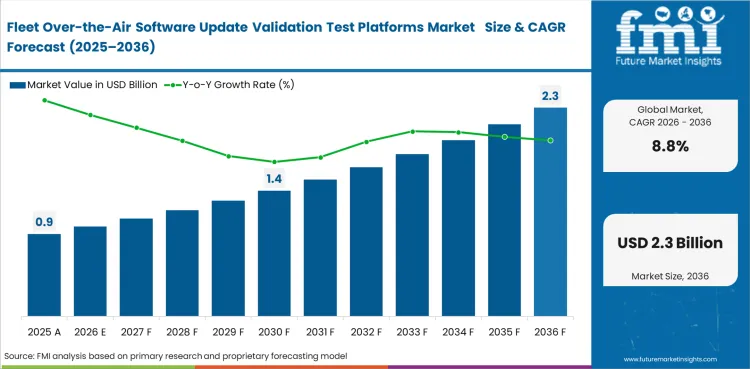
The fleet over-the-air software update validation test platforms market was valued at USD 0.6 billion in 2025 and is estimated at USD 0.9 billion by 2026-end. It is projected to reach USD 2.1 billion by 2036, advancing at a CAGR of 8.8% during 2026 to 2036. HIL benches are expected to lead with a 34.0% share, while commercial fleets are set to account for 41.0% of demand in 2026.
Summary of the Fleet Over-the-Air Software Update Validation Test Platforms Market
- Demand and Growth Drivers
- Rising software content in vehicles is pushing automakers and fleet operators to test updates more carefully before release. This is improving demand for fleet OTA validation platforms.
- Compliance pressure and cybersecurity review are increasing demand across this market. Manufacturers now want proof that update packages install correctly and recover safely if faults appear during deployment.
- Product and Segment View
- HIL benches are likely to lead the platform type, supported by their ability to test update behavior under controlled but realistic hardware and network conditions.
- OEMs are likely to stay the largest end-user group. Direct sales continue to lead since developers often need integration support and workflow setup alignment with existing vehicle software operations environments.
- Geography and Competitive Outlook
- China and India are likely to stay the faster-growth markets as connected vehicle programs widen and validation depth rises across electric and software-rich fleet platforms.
- Competition is likely to stay moderately concentrated. Leading suppliers gaining ground through broad validation coverage across hardware, protocol testing, and workflow integration.
- Analyst Opinion
- Nikhil Kaitwade, Principal Consultant at FMI, says, “Fleet OTA validation is moving into a more important spending category as software-defined vehicle programs push OEMs and fleet software teams to prove update quality before field deployment. Suppliers with strong HIL and mixed physical-virtual validation capability, along with the ability to support regression, rollback, connectivity, and cybersecurity checks in one workflow, are likely to strengthen their market position over the forecast period.”
- Fleet Over-the-Air Software Update Validation Test Platforms Market Value Analysis
- The market is moving from a narrow testing function into a more defined software validation layer within vehicle engineering budgets. As vehicle software operations become more structured, OTA release validation is gaining a clearer spending position across fleet programs.
- Adoption is supported by higher software content in connected vehicles and by the wider shift toward software-defined vehicle programs that require repeatable pre-release checks before updates move into active fleets.
- The market is benefiting from the growing need to test network behavior and rollback performance together with automotive OTA cybersecurity stress test equipment in one validation workflow.
- Demand is supported by engineering teams looking for validation environments that can balance release speed. Automotive ethernet and SDV network conformance test solutions add more depth to update-readiness testing.
Key Takeaways
- The fleet over-the-air software update validation test platforms market was valued at USD 0.6 billion in 2025, supported by deeper spending on software-defined vehicle programs and structured release testing.
- By 2036, the Fleet Over-the-Air Software Update Validation Test Platforms Market is projected to reach USD 2.1 billion.
- From 2026 to 2036, the market is expected to grow at a CAGR of 8.8%.
- The market is likely to generate an incremental opportunity of USD 1.2 billion over the forecast period.
- In 2026, commercial fleets are estimated to account for 41.0% of the vehicle and fleet type segment.
- China (9.8%) and India (9.3%) are projected to be the fastest growing markets.
Fleet Over-the-air Software Update Validation Test Platforms Market Definition
This market covers the hardware, software, and integrated test environments used to validate over-the-air software updates before release into active vehicle fleets. Scope includes benches and platforms that verify package integrity, campaign sequencing, network behavior, rollback routines, software regression, cybersecurity checks, and post-update functional stability across connected vehicles.
Fleet Over-the-air Software Update Validation Test Platforms Market Inclusions
Included in scope are HIL benches, SIL environments, cloud-connected validation stacks, update orchestration simulators, network emulators, protocol test tools, cybersecurity validation benches, and services tied directly to OTA release readiness.
Fleet Over-the-air Software Update Validation Test Platforms Market Exclusions
Excluded from scope are generic telecom testing tools sold without automotive update workflows, broad vehicle diagnostics that do not validate OTA release sequences, and in-use fleet management software that only monitors vehicle health after deployment.
Fleet Over-the-air Software Update Validation Test Platforms Market Research Methodology
- Primary Research: The market model was built from public non-commercial transport and vehicle statistics, official company product and press materials, and analyst review of how OTA validation demand sits inside broader automotive software and test budgets.
- Desk Research: Desk research relied on OICA, IEA, FHWA, ACEA, SMMT, SIAM, JAMA, and official supplier announcements that described current software-defined vehicle, validation, networking, or cybersecurity activity.
- Market Sizing and Forecasting: Sizing uses a top-down penetration model tied to connected and software-intensive vehicle programs, then cross-checks the result against observed supplier positioning and realistic industrial test-spend intensity.
- Data Validation and Update Cycle: Figures were checked for mathematical consistency between base year, forecast year, and CAGR, then reviewed against 2024 and 2025 mobility data to ensure the revenue path stayed inside a realistic industrial equipment range.
Why is the Fleet Over-the-air Software Update Validation Test Platforms Market Growing?
- Vehicle software content keeps rising, which raises the volume of update packages that need bench validation before release.
- Regulatory and security scrutiny is lifting the need for traceable evidence that update campaigns install safely and can recover from faults.
- Fleet operators want fewer field failures, which increases demand for repeatable release testing across mixed vehicle configurations.
Regulatory and cybersecurity pressure is also widening the test scope around update campaigns. Keysight announced in May 2024 that its Riscure unit had been designated a technical service provider for UN automotive cybersecurity and software regulations, highlighting how compliance work is becoming more tightly linked to practical type-approval validation. With automotive cybersecurity suppliers, it also lifts demand for benches that can verify installation sequencing, rollback handling, and communication integrity under conditions that resemble live fleet updates.
dSPACE showed at CES 2025 that end-to-end SIL and HIL validation had become a prominent showcase area for software-defined vehicle development, while Emerson promoted HIL software workflow acceleration for embedded software teams in 2025. That mix reflects a broader shift toward software-defined vehicles and automotive ethernet conformance test solutions where physical and virtual validation are used together to compress release cycles without raising field risk.
Market Segmentation Analysis
- HIL benches hold 34.0% of the market share, and these platforms are used to validate update behavior under controlled hardware and network conditions before release.
- Commercial fleets account for the largest share of demand at 41.0%, with delivery, service, and uptime-sensitive vehicle programs needing stronger rollback, regression, and connectivity validation.
- Direct sales lead distribution with 61.0% share, which reflects the way this market depends on integration support, workflow setup, and long-cycle technical engagement.
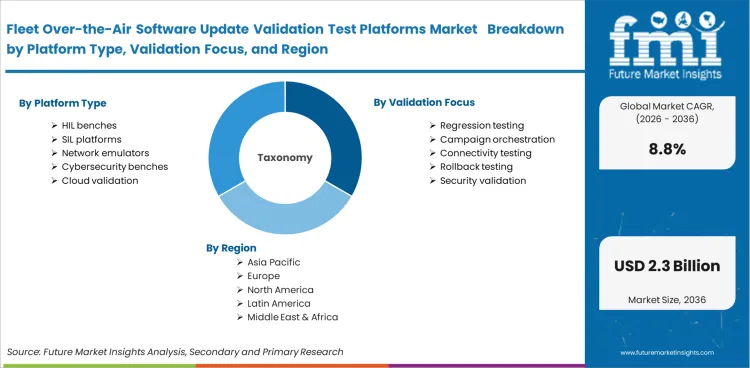
The market for fleet over-the-air software update validation test platforms is divided into groups based on platform type, validation focus, vehicle or fleet type, end user, sales channel, and region. There are HIL benches, SIL platforms, network emulators, cybersecurity benches, and cloud validation platforms. By validation focus, the market includes regression testing, campaign orchestration, connectivity testing, rollback testing, and security validation. By vehicle or fleet type, the market covers commercial fleets, passenger fleets, mixed fleets, and heavy-duty fleets. By end user, it includes OEMs, Tier 1 suppliers, fleet operators, and test labs. By sales channel, the market is segmented into direct sales, channel partners, and service contracts.
Insights into the platform type segment
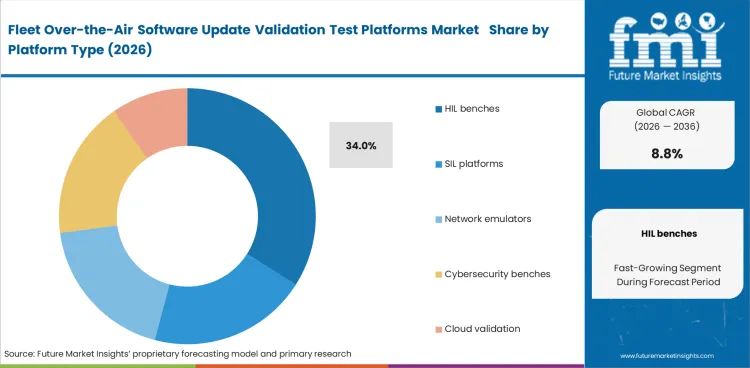
- Bench architecture IS the first buying decision because engineering teams must decide how much real hardware they need in the loop before any update package can be signed off for release.
- HIL benches are expected to account for 34% share in 2026 because they let validation groups observe update behavior under realistic gateway and network conditions while keeping the environment repeatable.
Insights into the validation focus segment
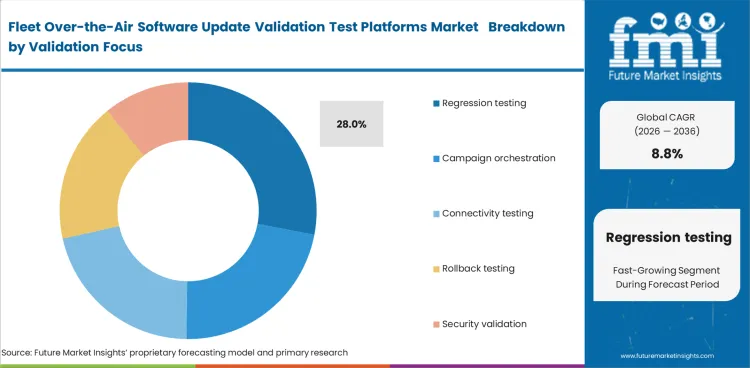
- Validation focus is widening from simple install success toward a broader view of deployment behavior. Regression testing is projected to contribute 28% of total market share in 2026.
- Release groups need confidence that new packages preserve existing functions across infotainment and telematics systems.
Insights into the vehicle or fleet type segment
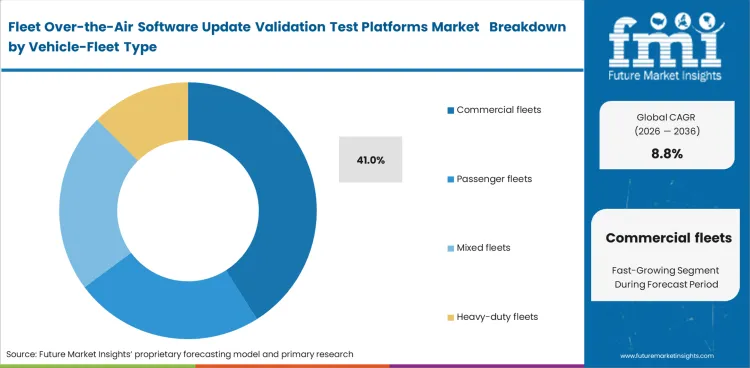
- Commercial fleets lead because failed updates carry more visible cost when vehicles are tied to delivery schedules and uptime guarantees.
- Commercial fleets are anticipated to represent 41% of the market in 2026, supported by their heavy use of telematics and centralized software control.
Insights into the end user segment
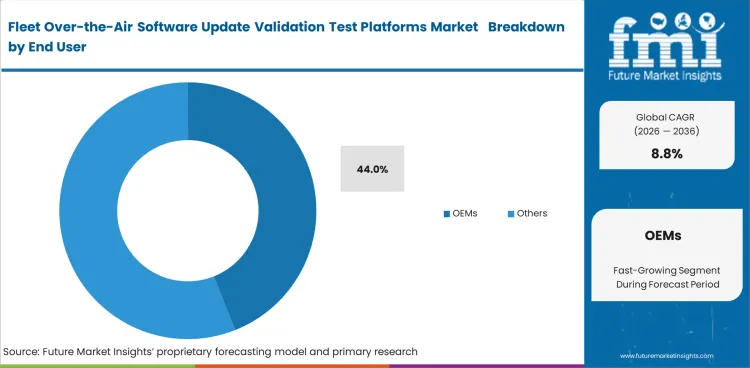
- End-user demand is concentrated among organizations that control software release quality and validation budgets across vehicle programs.
- OEMs are projected to account for 44% of total market share in 2026 because they carry primary responsibility for update performance and field reliability once software reaches active fleets.
Insights into the sales channel segment
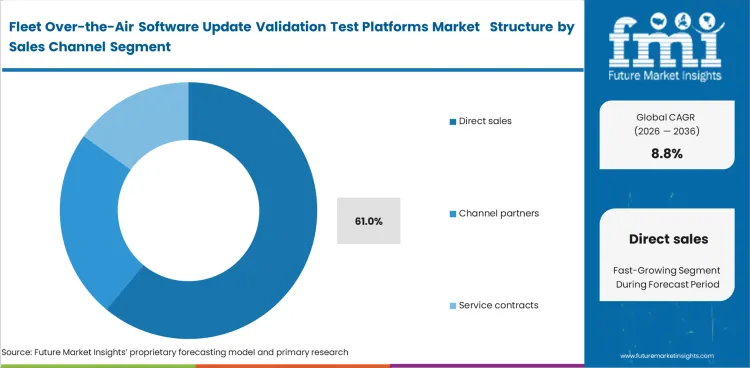
- Sales channel structure reflects the technical complexity of the platforms and the level of support required during deployment.
- Direct sales are estimated to hold 61% of market share in 2026 because developers often need supplier involvement for workflow setup and ongoing technical support.
Fleet Over-the-air Software Update Validation Test Platforms Market Drivers, Restraints, and Opportunities
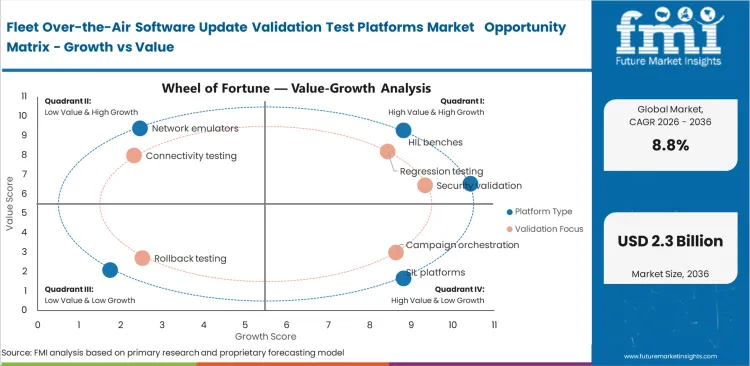
- Higher software release frequency is increasing the number of update campaigns that need pre-deployment proof.
- Many programs still depend on broader automotive test budgets, which slows purchases when capex cycles tighten.
- Validation is shifting toward hybrid stacks that combine physical benches, virtual ECUs, and cloud-based orchestration.
OTA validation demand is clearly supported by software-defined vehicle programs, wider use of connected fleet services, and greater pressure to document release readiness. Budgets are controlled by larger vehicle software and test organizations, which means suppliers must show how their platforms reduce campaign risk, lower engineering rework, and shorten validation cycles. The strongest demand sits where the platform can connect release management, protocol testing, cybersecurity checks, and rollback evidence in one repeatable workflow.
Input cost pressure
Hardware-heavy benches face uneven demand because OEM programs often spread spending across networking, cybersecurity, and vehicle integration tasks rather than funding a single OTA line item. That makes HIL and network emulation suppliers work harder to prove why a dedicated release validation stack should be purchased now instead of absorbed into a broader lab refresh. The segment is driven by rising vehicle network complexity and the need to test distributed software interactions instead of single ECU flashes.
Certification burden
Software update governance is becoming more formal, which increases the value of traceable validation evidence. Vector and Synopsys announced a strategic collaboration in March 2025 to support shift-left software-defined vehicle development, and that matters because early validation and documentation are becoming more important before release campaigns reach full vehicle integration. The segment therefore gains from platforms that generate structured test evidence, manage version interactions, and show whether update dependencies and fail-safe paths behave correctly across different software states.
Analysis of Fleet Over-the-air Software Update Validation Test Platforms Market by Key Countries
.webp "Top Country Growth Comparison Fleet Over The Air Software Update Validation Test Platforms Market Cagr (2026 2036)")
| Country | CAGR |
|---|---|
| China | 9.8% |
| India | 9.3% |
| United States | 8.7% |
| United Kingdom | 8.5% |
| Germany | 8.1% |
| Japan | 7.4% |
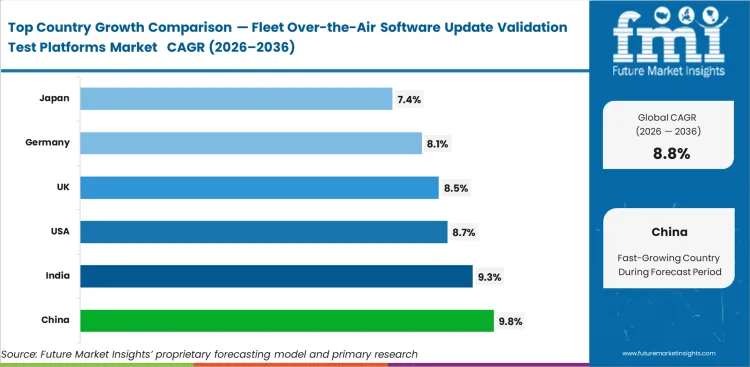
Source: FMI analysis based on primary research and proprietary forecasting model
Fleet Over-the-air Software Update Validation Test Platforms Market By Country
- China leads at 9.8% CAGR and India follows at 9.3%, supported by rapid connected vehicle and software validation expansion.
- The United States grows at 8.7% CAGR and the United Kingdom at 8.5%, backed by fleet digitization and stronger release testing needs.
- Germany records 8.1% CAGR, while Japan at 7.4%, reflecting steady compliance-led validation demand.
- The global Fleet Over-the-Air Software Update Validation Test Platforms Market is projected to expand at a CAGR of 8.8% through 2036.
Demand Outlook for Fleet Over-the-Air Software Update Validation Test Platforms Market in the United States
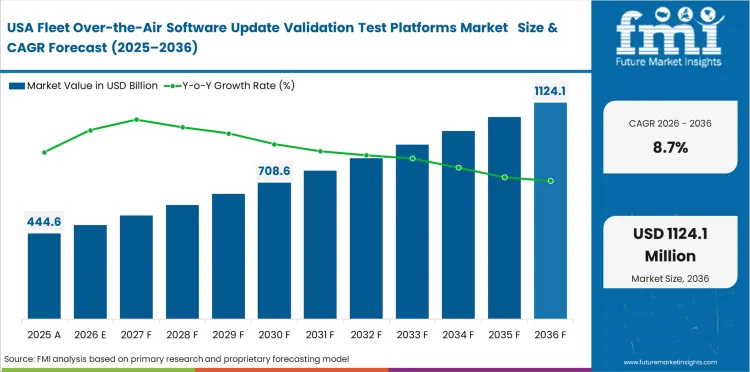
The United States market is projected to expand at a CAGR of 8.7% through 2036. Demand stays firm because large fleet operators and OEM software groups are pulling more release testing into structured workflows. Broader vehicle software operations adoption is raising the need for repeatable update validation before deployment.
- Large fleet volumes support recurring validation demand across active vehicle programs.
- Telematics-heavy operations raise the cost of failed software releases.
- OEM software teams need stronger rollback and regression testing discipline.
Future Outlook for Fleet Over-the-Air Software Update Validation Test Platforms Market in the United Kingdom
The United Kingdom market is expected to grow at a CAGR of 8.5% through 2036, supported by connected fleet activity and engineering service depth. Demand is helped by wider use of connected vehicle technology, which is increasing the importance of controlled update testing before field rollout.
- Connected fleet programs keep demand linked to practical service reliability.
- Electric vehicle growth adds software checks around charging and battery functions.
- Engineering support capability helps specialist labs and integration partners.
Opportunity Analysis of Fleet Over-the-Air Software Update Validation Test Platforms Market in Germany
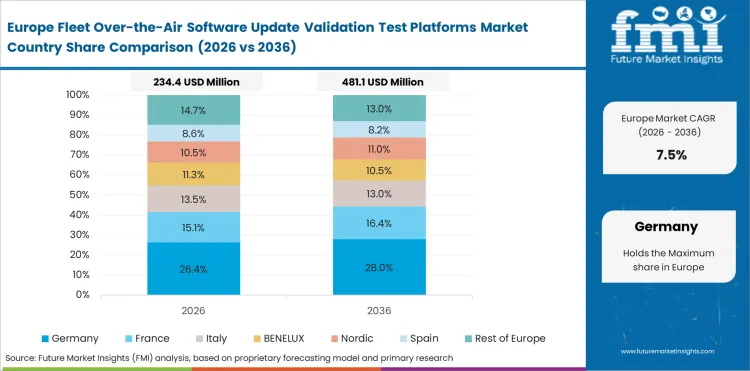
Germany is projected to record a CAGR of 8.1% through 2036. The market benefits from premium OEM engineering, strong supplier participation, and stricter release discipline across software-intensive vehicle platforms. Validation spending gains support from rising work around automotive cybersecurity homologation, especially where compliance and software update readiness are evaluated together.
- Premium vehicle programs support higher validation depth per platform.
- Supplier concentration improves adoption of advanced benches and workflows.
- Compliance discipline keeps structured test evidence important in software releases.
In-depth Analysis of Fleet Over-the-Air Software Update Validation Test Platforms Market in Japan
Japan is expected to grow at a CAGR of 7.4% through 2036. Demand stays steady due to its large installed vehicle base, strong manufacturing depth, and measured shift toward more software-centric vehicle architectures. Interest in automotive network testing is supporting this market, as engineering teams look for reliable validation around connectivity, update quality, and system interaction.
- Large installed vehicle volumes support stable validation demand over time.
- Manufacturing depth favors repeatable engineering and long supplier relationships.
- Gradual architecture change keeps growth steady rather than abrupt.
Sales Analysis of Fleet Over-the-Air Software Update Validation Test Platforms Market in China
China is projected to grow at a CAGR of 9.8% through 2036, making it the fastest-growing country in the study. Demand is rising because connected and electric vehicle programs are broadening quickly, while local OEMs are increasing validation depth around update reliability. Growth is closely linked with the rise of software-defined vehicle programs across domestic platforms.
- Large EV volume increases the number of software-bearing vehicles in service.
- Domestic OEM release speed supports scalable SIL, HIL, and cloud workflows.
- Platform complexity raises spend on rollback and sequencing checks.
In-depth Analysis of Fleet Over-the-Air Software Update Validation Test Platforms Market in India
India is expected to expand at a CAGR of 9.3% through 2036. Growth is supported by rising vehicle software content, broader engineering activity, and growing need for reusable validation benches across domestic and export-linked programs. Demand is being lifted by greater use of automotive ethernet and SDV network conformance test solutions, which strengthen protocol and interface testing depth.
- Engineering growth supports broader validation budgets across vehicle programs.
- Export-linked development work needs repeatable release evidence across variants.
- Higher software content improves demand for reusable lab environments.
Competitive landscape of Fleet Over-the-air Software Update Validation Test Platforms Market
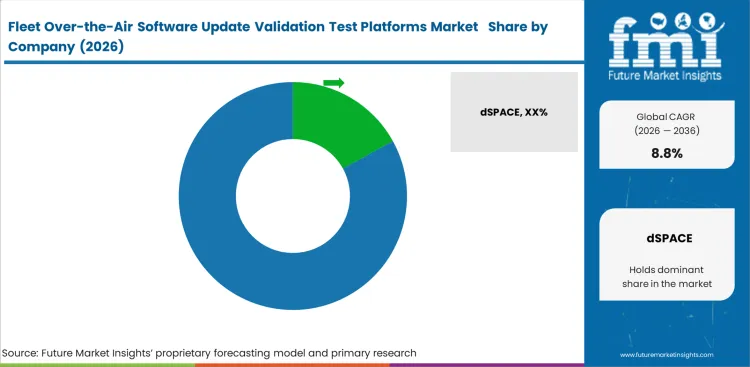
- Competition is moderately concentrated because a limited set of suppliers can cover hardware, software, integration, and protocol depth together.
- Leading vendors win through installed lab presence, protocol knowledge, automation breadth, and support for physical plus virtual validation.
- Specialists still have space where OTA testing overlaps with cybersecurity, automotive Ethernet, or fleet software release services.
Suppliers need to show that they can validate package integrity, install flow, network behavior, rollback recovery, and software regression across mixed vehicle configurations. dSPACE, Vector, Keysight, and Emerson hold visible positions because they can combine automation with physical or virtual validation assets. This makes them useful to OEM programs that want one supplier relationship covering more than a narrow protocol test task.
Incumbents gain an edge when their tools already sit inside vehicle software, network, or HIL workflows. Rohde & Schwarz benefits from strength in wireless and connectivity testing, while Spirent gains relevance where automotive Ethernet, positioning, and network assurance overlap with update delivery conditions. Vector and Synopsys also strengthened the shift-left theme in 2025 through their collaboration on software-defined vehicle development.
Major Industry Players
The supplier base splits into global test platform vendors, automotive software tool specialists, and focused network or security validation providers.
- dSPACE, Keysight Technologies, Emerson Test & Measurement, and Rohde & Schwarz fit this group because they combine broad hardware and software portfolios with international support coverage and long automotive relationships.
- Vector Informatik and ETAS fit the regional strength category because their automotive software, network, and validation depth is especially strong in Europe even though both serve customers globally through established engineering channels.
- Spirent Communications and targeted security or virtual validation specialists remain important because OTA readiness increasingly depends on network assurance, protocol detail, and software-centric release workflows rather than only traditional bench hardware.
Competitive benchmarking: Fleet Over-the-Air Software Update Validation Test Platforms Market Market
| Company | OTA Validation Depth | Network & Protocol Coverage | Workflow Integration | Geographic Footprint |
|---|---|---|---|---|
| dSPACE | High | Medium | Strong | Global |
| Vector Informatik | High | High | Strong | Global |
| Keysight Technologies | High | Medium | Strong | Global |
| Emerson Test & Measurement | High | Medium | Moderate | Global |
| Rohde & Schwarz | Medium | High | Moderate | Global |
| ETAS | Medium | Medium | Moderate | Europe / Global |
| Spirent Communications | Medium | High | Moderate | Global |
| Synopsys | Medium | Medium | Moderate | Global |
| Anritsu | Low | High | Low | Asia / Global |
| Siemens Digital Industries Software | Medium | Medium | Strong | Global |
Source: Future Market Insights competitive analysis, 2026.
Key developments in Fleet Over-the-Air Software Update Validation Test Platforms Market
- In December 2024, dSPACE said it would present end-to-end SIL and HIL validation at CES 2025 for electric, autonomous, and software-defined vehicles.
- In March 2025, Vector Informatik and Synopsys announced a strategic collaboration to advance software-defined vehicle development through shift-left methods.
Key players in the Fleet Over-the-Air Software Update Validation Test Platforms Market
Major global players
- dSPACE
- Keysight Technologies
- Emerson Test & Measurement
- Rohde & Schwarz
- Spirent Communications
Key emerging players/startups
- Vector Informatik
- ETAS
- Synopsys
- Anritsu
- Siemens Digital Industries Software
Scope of the Report
| Metric | Value |
|---|---|
| Quantitative Units | USD Billion for market value and CAGR for 2026 to 2036 |
| Market Definition | Validation platforms and services used to test OTA software updates before fleet deployment |
| Regions Covered | North America, Europe, Asia Pacific, Rest of World |
| Countries Covered | China, India, United States, United Kingdom, Germany, Japan |
| Key Companies Profiled | dSPACE, Vector Informatik, Keysight Technologies, Emerson Test & Measurement, Rohde & Schwarz, ETAS, Spirent Communications |
| Forecast Period | 2026 to 2036 |
| Approach | Top-down penetration model using non-commercial vehicle and mobility data with supplier and workflow cross-checks |
Fleet Over-the-Air Software Update Validation Test Platforms Market by Segments
Fleet Over-the-Air Software Update Validation Test Platforms Market segmented as Platform Type
- HIL benches
- SIL platforms
- Network emulators
- Cybersecurity benches
- Cloud validation
Fleet Over-the-Air Software Update Validation Test Platforms Market classified by Validation Focus
- Regression testing
- Campaign orchestration
- Connectivity testing
- Rollback testing
- Security validation
Fleet Over-the-Air Software Update Validation Test Platforms Market analysed by Vehicle / Fleet Type
- Commercial fleets
- Passenger fleets
- Mixed fleets
- Heavy-duty fleets
Fleet Over-the-Air Software Update Validation Test Platforms Market classified by Sales Channel
- Direct sales
- Channel partners
- Service contracts
Fleet Over-the-Air Software Update Validation Test Platforms Market by Region and Country
- North America
- USA
- Canada
- Mexico
- Latin America
- Brazil
- Chile
- Rest of Latin America
- Western Europe
- Germany
- UK
- Italy
- Spain
- France
- Nordic
- BENELUX
- Rest of Western Europe
- Eastern Europe
- Russia
- Poland
- Hungary
- Balkan & Baltic
- Rest of Eastern Europe
- East Asia
- China
- Japan
- South Korea
- South Asia and Pacific
- India
- ASEAN
- Australia & New Zealand
- Rest of South Asia and Pacific
- Middle East & Africa
- Kingdom of Saudi Arabia
- Other GCC Countries
- Turkiye
- South Africa
- Other African Union
- Rest of Middle East & Africa
Bibliography
- dSPACE. (2024, December 12). dSPACE at CES 2025: How seamless SIL/HIL validation accelerates automotive software development.
- Vector Informatik. (2025, March 10). Vector Informatik and Synopsys announce strategic collaboration to advance software-defined vehicle development.
- Emerson. (2025, July 9). Emerson and Tata Technologies partner to advance testing solutions for next-gen mobility.
- Anritsu. (2025, January 9). Anritsu and AUTOCRYPT sign MOU at CES 2025 to advance automotive security testing through simulated 5G networks.
- European Automobile Manufacturers’ Association. (2025, January 28). New commercial vehicle registrations: vans +8.3%, trucks -6.3%, buses +9.2% in 2024.
The bibliography is provided for reader reference and reflects the public sources used in the data pack.
This Report Addresses
- Market sizing for 2025, 2026, and 2036 with a consistent CAGR and incremental opportunity view.
- Segment structure by platform type, validation focus, fleet type, end user, and sales channel.
- Country comparison across China, India, United States, United Kingdom, Germany, and Japan.
- Competitive assessment covering major suppliers, specialist positioning, and benchmarking criteria.
- Regulatory and cybersecurity pressure that is widening the need for traceable OTA release validation.
- Investment whitespace linked to hybrid physical and virtual validation workflows.
- Supply chain and workflow scope from software release control through rollback and network verification.
- Deliverables that include a formatted article and a transparent data and checklist record.
Frequently Asked Questions
What is the estimated market size in 2026?
The market is estimated at USD 0.9 billion in 2026.
What is the expected value by 2036?
The market is forecast to reach USD 2.1 billion by 2036.
What CAGR is assumed for 2026 to 2036?
The forecast uses an 8.8% CAGR for the assessment period.
Which segment leads the platform split?
HIL benches lead platform type with an estimated 34% share in 2026.
Which fleet type leads demand?
Commercial fleets lead demand with an estimated 41% share in 2026.
Which country is growing fastest?
China is projected as the fastest large national market with a 9.8% CAGR through 2036.
Preview the report firsthand - request a free sample
Get SampleGet the brochure for pricing and purchase details.
Get PDFTable of Content
- Executive Summary
- Global Market Outlook
- Demand-side Trends
- Supply-side Trends
- Technology Roadmap Analysis
- Analysis and Recommendations
- Market Overview
- Market Coverage / Taxonomy
- Market Definition / Scope / Limitations
- Research Methodology
- Chapter Orientation
- Analytical Lens and Working Hypotheses
- Market Structure, Signals, and Trend Drivers
- Benchmarking and Cross-market Comparability
- Market Sizing, Forecasting, and Opportunity Mapping
- Research Design and Evidence Framework
- Desk Research Programme (Secondary Evidence)
- Company Annual and Sustainability Reports
- Peer-reviewed Journals and Academic Literature
- Corporate Websites, Product Literature, and Technical Notes
- Earnings Decks and Investor Briefings
- Statutory Filings and Regulatory Disclosures
- Technical White Papers and Standards Notes
- Trade Journals, Industry Magazines, and Analyst Briefs
- Conference Proceedings, Webinars, and Seminar Materials
- Government Statistics Portals and Public Data Releases
- Press Releases and Reputable Media Coverage
- Specialist Newsletters and Curated Briefings
- Sector Databases and Reference Repositories
- FMI Internal Proprietary Databases and Historical Market Datasets
- Subscription Datasets and Paid Sources
- Social Channels, Communities, and Digital Listening Inputs
- Additional Desk Sources
- Expert Input and Fieldwork (Primary Evidence)
- Primary Modes
- Qualitative Interviews and Expert Elicitation
- Quantitative Surveys and Structured Data Capture
- Blended Approach
- Why Primary Evidence is Used
- Field Techniques
- Interviews
- Surveys
- Focus Groups
- Observational and In-context Research
- Social and Community Interactions
- Stakeholder Universe Engaged
- C-suite Leaders
- Board Members
- Presidents and Vice Presidents
- R&D and Innovation Heads
- Technical Specialists
- Domain Subject-matter Experts
- Scientists
- Physicians and Other Healthcare Professionals
- Governance, Ethics, and Data Stewardship
- Research Ethics
- Data Integrity and Handling
- Primary Modes
- Tooling, Models, and Reference Databases
- Desk Research Programme (Secondary Evidence)
- Data Engineering and Model Build
- Data Acquisition and Ingestion
- Cleaning, Normalisation, and Verification
- Synthesis, Triangulation, and Analysis
- Quality Assurance and Audit Trail
- Market Background
- Market Dynamics
- Drivers
- Restraints
- Opportunity
- Trends
- Scenario Forecast
- Demand in Optimistic Scenario
- Demand in Likely Scenario
- Demand in Conservative Scenario
- Opportunity Map Analysis
- Product Life Cycle Analysis
- Historical Market Size Value (USD Million) Analysis, 2021 to 2025
- Current and Future Market Size Value (USD Million) Projections, 2026 to 2036
- Y-o-Y Growth Trend Analysis
- Absolute $ Opportunity Analysis
- Market Dynamics
- Global Market Pricing Analysis 2021 to 2025 and Forecast 2026 to 2036
- Global Market Analysis 2021 to 2025 and Forecast 2026 to 2036, By Platform Type
- Introduction / Key Findings
- Historical Market Size Value (USD Million) Analysis By Platform Type , 2021 to 2025
- Current and Future Market Size Value (USD Million) Analysis and Forecast By Platform Type , 2026 to 2036
- HIL benches
- SIL platforms
- Network emulators
- Cybersecurity benches
- Cloud validation
- HIL benches
- Y-o-Y Growth Trend Analysis By Platform Type , 2021 to 2025
- Absolute $ Opportunity Analysis By Platform Type , 2026 to 2036
- Global Market Analysis 2021 to 2025 and Forecast 2026 to 2036, By Validation Focus
- Introduction / Key Findings
- Historical Market Size Value (USD Million) Analysis By Validation Focus, 2021 to 2025
- Current and Future Market Size Value (USD Million) Analysis and Forecast By Validation Focus, 2026 to 2036
- Regression testing
- Campaign orchestration
- Connectivity testing
- Rollback testing
- Security validation
- Regression testing
- Y-o-Y Growth Trend Analysis By Validation Focus, 2021 to 2025
- Absolute $ Opportunity Analysis By Validation Focus, 2026 to 2036
- Global Market Analysis 2021 to 2025 and Forecast 2026 to 2036, By Vehicle-Fleet Type
- Introduction / Key Findings
- Historical Market Size Value (USD Million) Analysis By Vehicle-Fleet Type, 2021 to 2025
- Current and Future Market Size Value (USD Million) Analysis and Forecast By Vehicle-Fleet Type, 2026 to 2036
- Commercial fleets
- Passenger fleets
- Mixed fleets
- Heavy-duty fleets
- Commercial fleets
- Y-o-Y Growth Trend Analysis By Vehicle-Fleet Type, 2021 to 2025
- Absolute $ Opportunity Analysis By Vehicle-Fleet Type, 2026 to 2036
- Global Market Analysis 2021 to 2025 and Forecast 2026 to 2036, By End User
- Introduction / Key Findings
- Historical Market Size Value (USD Million) Analysis By End User, 2021 to 2025
- Current and Future Market Size Value (USD Million) Analysis and Forecast By End User, 2026 to 2036
- OEMs
- Others
- OEMs
- Y-o-Y Growth Trend Analysis By End User, 2021 to 2025
- Absolute $ Opportunity Analysis By End User, 2026 to 2036
- Global Market Analysis 2021 to 2025 and Forecast 2026 to 2036, By Sales Channel
- Introduction / Key Findings
- Historical Market Size Value (USD Million) Analysis By Sales Channel, 2021 to 2025
- Current and Future Market Size Value (USD Million) Analysis and Forecast By Sales Channel, 2026 to 2036
- Direct sales
- Channel partners
- Service contracts
- Direct sales
- Y-o-Y Growth Trend Analysis By Sales Channel, 2021 to 2025
- Absolute $ Opportunity Analysis By Sales Channel, 2026 to 2036
- Global Market Analysis 2021 to 2025 and Forecast 2026 to 2036, By Region
- Introduction
- Historical Market Size Value (USD Million) Analysis By Region, 2021 to 2025
- Current Market Size Value (USD Million) Analysis and Forecast By Region, 2026 to 2036
- North America
- Latin America
- Western Europe
- Eastern Europe
- East Asia
- South Asia and Pacific
- Middle East & Africa
- Market Attractiveness Analysis By Region
- North America Market Analysis 2021 to 2025 and Forecast 2026 to 2036, By Country
- Historical Market Size Value (USD Million) Trend Analysis By Market Taxonomy, 2021 to 2025
- Market Size Value (USD Million) Forecast By Market Taxonomy, 2026 to 2036
- By Country
- USA
- Canada
- Mexico
- By Platform Type
- By Validation Focus
- By Vehicle-Fleet Type
- By End User
- By Sales Channel
- By Country
- Market Attractiveness Analysis
- By Country
- By Platform Type
- By Validation Focus
- By Vehicle-Fleet Type
- By End User
- By Sales Channel
- Key Takeaways
- Latin America Market Analysis 2021 to 2025 and Forecast 2026 to 2036, By Country
- Historical Market Size Value (USD Million) Trend Analysis By Market Taxonomy, 2021 to 2025
- Market Size Value (USD Million) Forecast By Market Taxonomy, 2026 to 2036
- By Country
- Brazil
- Chile
- Rest of Latin America
- By Platform Type
- By Validation Focus
- By Vehicle-Fleet Type
- By End User
- By Sales Channel
- By Country
- Market Attractiveness Analysis
- By Country
- By Platform Type
- By Validation Focus
- By Vehicle-Fleet Type
- By End User
- By Sales Channel
- Key Takeaways
- Western Europe Market Analysis 2021 to 2025 and Forecast 2026 to 2036, By Country
- Historical Market Size Value (USD Million) Trend Analysis By Market Taxonomy, 2021 to 2025
- Market Size Value (USD Million) Forecast By Market Taxonomy, 2026 to 2036
- By Country
- Germany
- UK
- Italy
- Spain
- France
- Nordic
- BENELUX
- Rest of Western Europe
- By Platform Type
- By Validation Focus
- By Vehicle-Fleet Type
- By End User
- By Sales Channel
- By Country
- Market Attractiveness Analysis
- By Country
- By Platform Type
- By Validation Focus
- By Vehicle-Fleet Type
- By End User
- By Sales Channel
- Key Takeaways
- Eastern Europe Market Analysis 2021 to 2025 and Forecast 2026 to 2036, By Country
- Historical Market Size Value (USD Million) Trend Analysis By Market Taxonomy, 2021 to 2025
- Market Size Value (USD Million) Forecast By Market Taxonomy, 2026 to 2036
- By Country
- Russia
- Poland
- Hungary
- Balkan & Baltic
- Rest of Eastern Europe
- By Platform Type
- By Validation Focus
- By Vehicle-Fleet Type
- By End User
- By Sales Channel
- By Country
- Market Attractiveness Analysis
- By Country
- By Platform Type
- By Validation Focus
- By Vehicle-Fleet Type
- By End User
- By Sales Channel
- Key Takeaways
- East Asia Market Analysis 2021 to 2025 and Forecast 2026 to 2036, By Country
- Historical Market Size Value (USD Million) Trend Analysis By Market Taxonomy, 2021 to 2025
- Market Size Value (USD Million) Forecast By Market Taxonomy, 2026 to 2036
- By Country
- China
- Japan
- South Korea
- By Platform Type
- By Validation Focus
- By Vehicle-Fleet Type
- By End User
- By Sales Channel
- By Country
- Market Attractiveness Analysis
- By Country
- By Platform Type
- By Validation Focus
- By Vehicle-Fleet Type
- By End User
- By Sales Channel
- Key Takeaways
- South Asia and Pacific Market Analysis 2021 to 2025 and Forecast 2026 to 2036, By Country
- Historical Market Size Value (USD Million) Trend Analysis By Market Taxonomy, 2021 to 2025
- Market Size Value (USD Million) Forecast By Market Taxonomy, 2026 to 2036
- By Country
- India
- ASEAN
- Australia & New Zealand
- Rest of South Asia and Pacific
- By Platform Type
- By Validation Focus
- By Vehicle-Fleet Type
- By End User
- By Sales Channel
- By Country
- Market Attractiveness Analysis
- By Country
- By Platform Type
- By Validation Focus
- By Vehicle-Fleet Type
- By End User
- By Sales Channel
- Key Takeaways
- Middle East & Africa Market Analysis 2021 to 2025 and Forecast 2026 to 2036, By Country
- Historical Market Size Value (USD Million) Trend Analysis By Market Taxonomy, 2021 to 2025
- Market Size Value (USD Million) Forecast By Market Taxonomy, 2026 to 2036
- By Country
- Kingdom of Saudi Arabia
- Other GCC Countries
- Turkiye
- South Africa
- Other African Union
- Rest of Middle East & Africa
- By Platform Type
- By Validation Focus
- By Vehicle-Fleet Type
- By End User
- By Sales Channel
- By Country
- Market Attractiveness Analysis
- By Country
- By Platform Type
- By Validation Focus
- By Vehicle-Fleet Type
- By End User
- By Sales Channel
- Key Takeaways
- Key Countries Market Analysis
- USA
- Pricing Analysis
- Market Share Analysis, 2025
- By Platform Type
- By Validation Focus
- By Vehicle-Fleet Type
- By End User
- By Sales Channel
- Canada
- Pricing Analysis
- Market Share Analysis, 2025
- By Platform Type
- By Validation Focus
- By Vehicle-Fleet Type
- By End User
- By Sales Channel
- Mexico
- Pricing Analysis
- Market Share Analysis, 2025
- By Platform Type
- By Validation Focus
- By Vehicle-Fleet Type
- By End User
- By Sales Channel
- Brazil
- Pricing Analysis
- Market Share Analysis, 2025
- By Platform Type
- By Validation Focus
- By Vehicle-Fleet Type
- By End User
- By Sales Channel
- Chile
- Pricing Analysis
- Market Share Analysis, 2025
- By Platform Type
- By Validation Focus
- By Vehicle-Fleet Type
- By End User
- By Sales Channel
- Germany
- Pricing Analysis
- Market Share Analysis, 2025
- By Platform Type
- By Validation Focus
- By Vehicle-Fleet Type
- By End User
- By Sales Channel
- UK
- Pricing Analysis
- Market Share Analysis, 2025
- By Platform Type
- By Validation Focus
- By Vehicle-Fleet Type
- By End User
- By Sales Channel
- Italy
- Pricing Analysis
- Market Share Analysis, 2025
- By Platform Type
- By Validation Focus
- By Vehicle-Fleet Type
- By End User
- By Sales Channel
- Spain
- Pricing Analysis
- Market Share Analysis, 2025
- By Platform Type
- By Validation Focus
- By Vehicle-Fleet Type
- By End User
- By Sales Channel
- France
- Pricing Analysis
- Market Share Analysis, 2025
- By Platform Type
- By Validation Focus
- By Vehicle-Fleet Type
- By End User
- By Sales Channel
- India
- Pricing Analysis
- Market Share Analysis, 2025
- By Platform Type
- By Validation Focus
- By Vehicle-Fleet Type
- By End User
- By Sales Channel
- ASEAN
- Pricing Analysis
- Market Share Analysis, 2025
- By Platform Type
- By Validation Focus
- By Vehicle-Fleet Type
- By End User
- By Sales Channel
- Australia & New Zealand
- Pricing Analysis
- Market Share Analysis, 2025
- By Platform Type
- By Validation Focus
- By Vehicle-Fleet Type
- By End User
- By Sales Channel
- China
- Pricing Analysis
- Market Share Analysis, 2025
- By Platform Type
- By Validation Focus
- By Vehicle-Fleet Type
- By End User
- By Sales Channel
- Japan
- Pricing Analysis
- Market Share Analysis, 2025
- By Platform Type
- By Validation Focus
- By Vehicle-Fleet Type
- By End User
- By Sales Channel
- South Korea
- Pricing Analysis
- Market Share Analysis, 2025
- By Platform Type
- By Validation Focus
- By Vehicle-Fleet Type
- By End User
- By Sales Channel
- Russia
- Pricing Analysis
- Market Share Analysis, 2025
- By Platform Type
- By Validation Focus
- By Vehicle-Fleet Type
- By End User
- By Sales Channel
- Poland
- Pricing Analysis
- Market Share Analysis, 2025
- By Platform Type
- By Validation Focus
- By Vehicle-Fleet Type
- By End User
- By Sales Channel
- Hungary
- Pricing Analysis
- Market Share Analysis, 2025
- By Platform Type
- By Validation Focus
- By Vehicle-Fleet Type
- By End User
- By Sales Channel
- Kingdom of Saudi Arabia
- Pricing Analysis
- Market Share Analysis, 2025
- By Platform Type
- By Validation Focus
- By Vehicle-Fleet Type
- By End User
- By Sales Channel
- Turkiye
- Pricing Analysis
- Market Share Analysis, 2025
- By Platform Type
- By Validation Focus
- By Vehicle-Fleet Type
- By End User
- By Sales Channel
- South Africa
- Pricing Analysis
- Market Share Analysis, 2025
- By Platform Type
- By Validation Focus
- By Vehicle-Fleet Type
- By End User
- By Sales Channel
- USA
- Market Structure Analysis
- Competition Dashboard
- Competition Benchmarking
- Market Share Analysis of Top Players
- By Regional
- By Platform Type
- By Validation Focus
- By Vehicle-Fleet Type
- By End User
- By Sales Channel
- Competition Analysis
- Competition Deep Dive
- dSPACE
- Overview
- Product Portfolio
- Profitability by Market Segments (Product/Age /Sales Channel/Region)
- Sales Footprint
- Strategy Overview
- Marketing Strategy
- Product Strategy
- Channel Strategy
- Keysight Technologies
- Emerson Test & Measurement
- Rohde & Schwarz
- Spirent Communications
- Vector Informatik
- ETAS
- Synopsys
- Anritsu
- Siemens Digital Industries Software
- dSPACE
- Competition Deep Dive
- Assumptions & Acronyms Used


