

- Industry Size (2026)
- at USD 21.8 Bn
- Forecast (2036)
- USD 62.8 Bn
- CAGR (2026 to 2036)
- 11.10%
Vehicle Software Operations Market Size, Market Forecast and Outlook By FMI
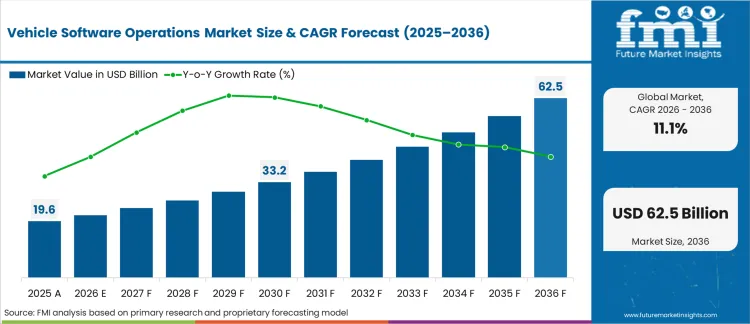
In 2025, the vehicle software operations market was valued at USD 19.8 billion and is projected to reach USD 21.8 billion in 2026 and USD 62.8 billion by 2036, reflecting an 11.10% CAGR as Tier-1 integrators decouple hardware supply chains from centralized compute architectures to manage continuous feature updates. Manufacturers are pivoting from static code injection during assembly to dynamic lifecycle management platforms. The transition forces original equipment manufacturers to adopt enterprise-grade development, security, and operations pipelines to monetize post-sale cabin features and autonomy upgrades without triggering massive recall liabilities.
Continuous delivery platforms now dictate vehicle launch cycles as automakers treat over-the-air deployment capability as a core product rather than an aftermarket service. Plant managers interpret this shift as a permanent recalibration of integration testing, meaning assembly lines must guarantee digital handshake verification before vehicles exit the factory floor.
Anshuman Saxena, VP & GM, ADAS & Robotics at Qualcomm, opined: “We are pleased to deepen our longstanding collaboration in advancing ADAS innovation with ZF. By combining our strengths in high-performance automotive computing, perception, and computer vision, we’re enabling automakers to deliver intelligent, safer, and more cost-effective driver assistance systems across their vehicle portfolios. Our relationship reflects our shared commitment to accelerating the future of mobility through scalable, software-defined solutions that truly matter to consumers and the industry alike.” [2]
Original equipment manufacturers must lock in flexible silicon and middleware architectures long before the first vehicle enters physical production. Suppliers presenting closed, non-updatable controller ecosystems face immediate disqualification from next-generation platform tenders, accelerating the consolidation of integration partners.
Summary of Vehicle Software Operations Market
- Vehicle Software Operations Market Definition
- A comprehensive suite of development tools, middleware, and lifecycle management platforms utilized by automotive manufacturers to design, deploy, and secure embedded vehicle code and cloud-to-car telematics.
- Demand Drivers in the Market
- Strict cybersecurity compliance deadlines mandate continuous vulnerability patching for connected vehicle architectures.
- The shift toward software-defined vehicle designs requires decoupled hardware and application layers to enable subscription-based features.
- Surging electronic control unit complexity forces consolidation into centralized domain controllers requiring advanced operating systems.
- Key Segments Analyzed in the FMI Report
- Application Software: 47% share driven by localized infotainment customization and expanding digital cockpit interface requirements.
- Embedded/Onboard: 70% share anchored by mission-critical safety systems demanding zero-latency localized processing.
- High-growth Asia-Pacific: Rapid integration of connected features in mass-market electric vehicles accelerates adoption.
- Analyst Opinion at FMI
- Nikhil Kaitwade, Principal Consultant for Automotive, opines, “From a consulting standpoint, the message is clear: the era of standalone microcontrollers is over. Automakers need cohesive lifecycle platforms that manage development, deployment, and updates in a single, orchestrated flow. The brands that commit to full‑stack integration partners will protect themselves from the volatility and inefficiencies that are increasingly punishing teams still dependent on outdated, fragmented codebases.”
- Strategic Implications / Executive Takeaways
- Centralize software supply chain monitoring to avoid integration bottlenecks during mid-cycle vehicle updates.
- Prioritize memory-safe programming languages in powertrain modules to preempt costly compliance audits.
- Establish dedicated cybersecurity operations centers to maintain mandated vulnerability response times across fleet lifecycles.
- Methodology
- Validated through direct capacity and deployment data provided by Tier-1 software engineering directors and automotive software leads.
- Zero reliance on speculative secondary estimates; built directly from verifiable corporate update schedules and official regulatory filings.
- Anchored by industrial benchmarks for lines of code, integration milestones, and cybersecurity incidence rates.
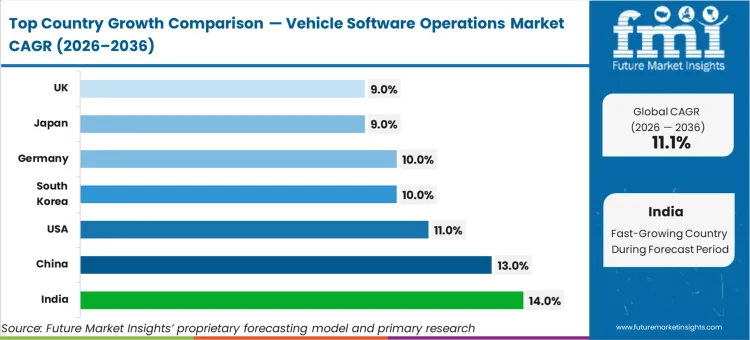
India's 14% growth outpaces China's 13% expansion as localized developer hubs become critical validation nodes for global platforms. The United States follows at 11%, driven by over-the-air commercialization, while Germany and South Korea match at 10% through rigorous mixed-criticality stack engineering. Japan and the United Kingdom track at 9%, anchoring on semiconductor alignment and open-source tooling integration, respectively.
Vehicle Software Operations Market Definition
The vehicle software operations market encompasses the specialized development environments, middleware frameworks, and cloud-to-edge deployment systems required to write, test, deliver, and maintain code within automotive architectures. Processors utilize continuous integration pipelines to manage logic governing powertrain execution, cabin experience, and autonomous navigation. This includes standardized containerization tools that allow engineers to push security patches remotely without altering foundational hardware.
Vehicle Software Operations Market Inclusions
The category includes commercial operating systems, hypervisors, diagnostic data platforms, and over-the-air update management consoles designed explicitly for automotive use. It covers integration software for both advanced driver-assistance systems and foundational battery management algorithms. A cloud-based orchestration tool validating update packages before transmission to a specific electric vehicle fleet is strictly included based on its direct functional role in operations.
Vehicle Software Operations Market Exclusions
The scope excludes general-purpose enterprise IT software used for internal corporate accounting or human resources at automotive firms. It does not include raw semiconductor hardware or physical display screens. Basic consumer-facing smartphone navigation apps operating independently of the vehicle's core operating system are excluded, as they do not constitute deep operational architecture.
Vehicle Software Operations Market Research Methodology
- Primary Research: Direct interviews with connected vehicle platform architects, Tier-1 software directors, and cybersecurity compliance officers provided baseline update cadence and investment metrics.
- Desk Research: Custom procurement datasets from national transportation ministries, official vulnerability disclosure logs, and corporate partnership announcements substantiated regional integration models.
- Market-Sizing and Forecasting: Analysts developed a bottom-up adoption model starting from regional electric vehicle volumes, applying historical code volume ratios to project software integration expenditures.
- Data Validation and Update Cycle: Findings underwent cross-verification against official vehicle recall databases and peer-reviewed automotive engineering journals before final forecast integration.
Segmental Analysis
What does zero reliance on speculative third-party market research mean here?
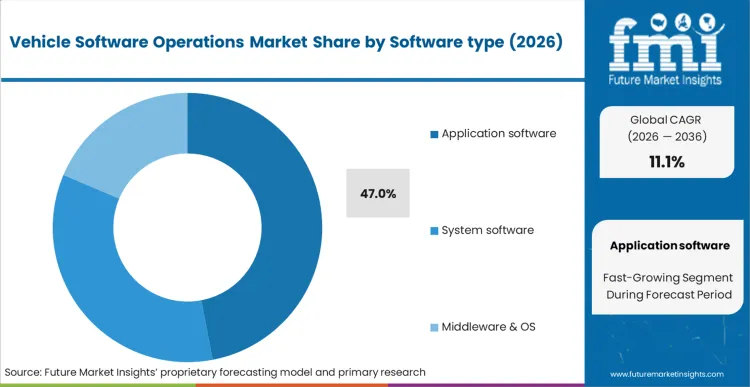
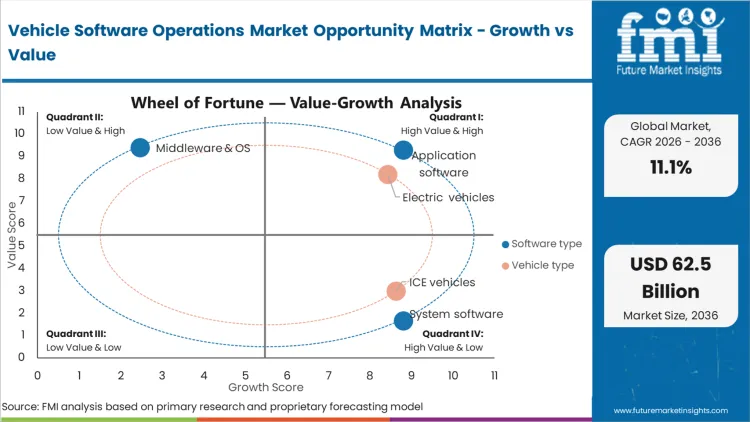
Industry architectures prioritize automotive software frameworks that allow manufacturers to decouple infotainment experiences from core driving functions. Application software commands a 47% share in 2026 as consumer demands for digital cockpit personalization force original equipment manufacturers to expand interface capabilities. FMI analysts opine that integration teams require standardized environments to handle the sheer volume of code without compromising critical safety functions. Developers who fail to adopt modular architectures face insurmountable integration delays during complex vehicle platform launches.
- Technical Validation: Independent containerization prevents non-critical cabin applications from interfering with powertrain logic.
- Process Compatibility: Engineering teams standardize on Linux-based systems to leverage broader developer talent pools.
- Supplier Positioning: Improves as modular design allows component vendors to ship pre-certified software blocks directly to assembly lines.
Vehicle Software Operations Market Analysis by Vehicle type
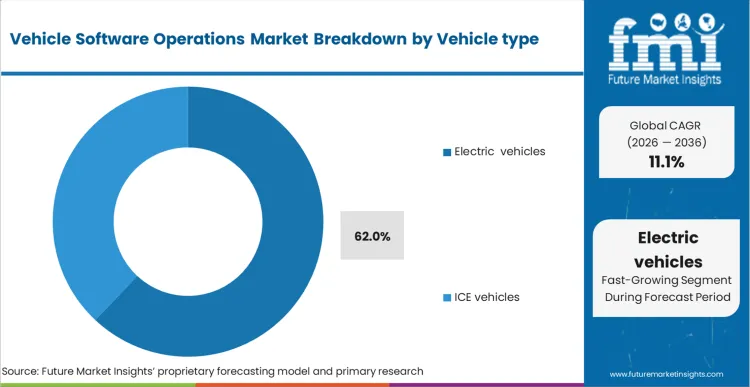
Electric vehicle platforms naturally integrate these capabilities from inception, but the sheer volume of ICE production demands parallel engineering focus. ICE vehicles account for 62% of segment share in 2026, reflecting the massive installed base undergoing aggressive digitization. As demand for software defined vehicle architectures scales, legacy internal combustion platforms require comprehensive digital bridges to support modern connected features. Procurement teams specify cross-platform middleware to ensure feature parity across their entire portfolio regardless of the propulsion method.
- Requalification Cycles: Lengthen as legacy mechanical components require complex digital abstraction layers.
- Volume Concentration: Narrows to specialized suppliers capable of harmonizing disparate electronic control units into single domain architectures.
- Adoption Acceleration: Emissions compliance algorithms demand real-time cloud connectivity for reporting.
Vehicle Software Operations Market Analysis by Application
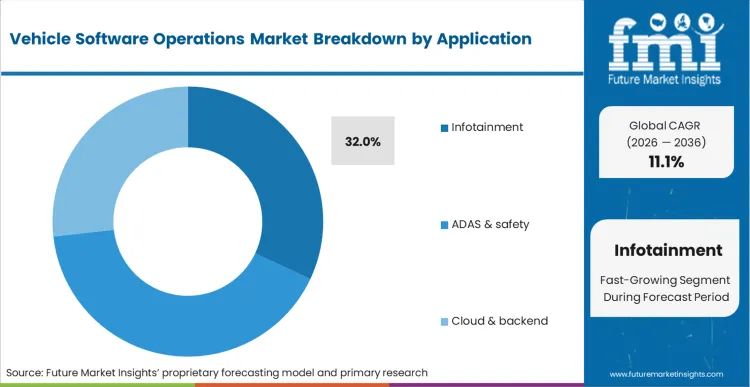
Infotainment dominates this dimension with a 32% share as manufacturers transform the cabin into a distinct digital environment. Advanced car OS platforms process complex media, navigation, and voice commands while maintaining strict isolation from vehicle control systems. Consumers evaluate new models primarily on the responsiveness and ecosystem compatibility of these digital interfaces. Integrators must guarantee seamless functionality across diverse geographic regions to secure global platform contracts.
- Product Innovation: Manufacturers deploy android automotive OS AAOS to leverage existing smartphone application ecosystems directly within the dashboard.
- Dietary Compliance: Strict regulatory guidelines for driver distraction enforce rigid testing protocols for all new user interface layouts.
- Logistics Advantage: Over-the-air updates allow brands to deploy new interface features globally without requiring dealer visits.
Vehicle Software Operations Market Analysis by Deployment
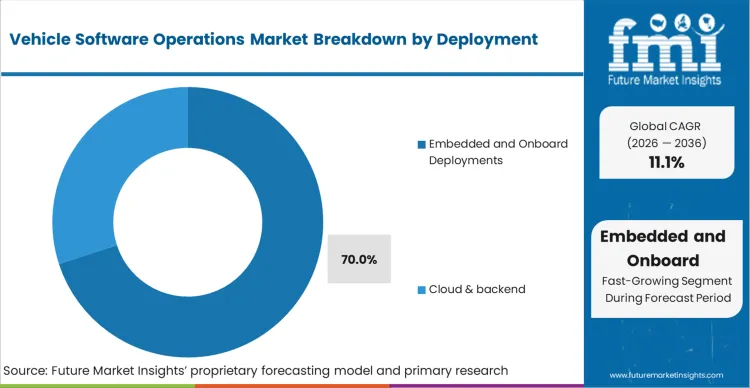
Embedded and onboard deployments secure 70% of the volume as localized processing remains mandatory for zero-latency safety systems. Automotive data management solutions must process gigabytes of sensor input directly at the edge to execute split-second braking and steering commands. Original equipment manufacturers deploy high-performance compute nodes within the vehicle chassis to prevent connectivity blind spots from disabling critical functions. Qualcomm expanded its decade-long collaboration with Google specifically to simplify Android Auto updates directly within vehicle architectures [6], ensuring localized experiences remain seamless even in disconnected environments. The balance between cloud offloading and edge processing determines the ultimate viability of autonomous driving features.
- Procurement Shifts: Localized compute demands high-grade silicon that withstands extreme thermal environments.
- Cost Structures: Tighten when manufacturers attempt to backport advanced edge analytics into legacy electrical architectures.
- Shelf Stability: Hardened onboard software ensures vehicles remain fully functional for decades after cloud support horizons end.
Vehicle Software Operations Market Drivers, Restraints, and Opportunities
Aggressive regulatory scrutiny regarding vehicle safety defects actively forces manufacturers to adopt rapid automotive remote diagnostic capabilities. NHTSA processed 1,000 recalls involving over 39 million vehicles and equipment items in 2023 [7], establishing software failure as a primary liability vector. Brands lacking the infrastructure to deploy corrective patches remotely face catastrophic recall logistics costs and severe brand degradation, compelling immediate investment in robust delivery pipelines.
Complex security integration processes restrict development velocity across fragmented engineering teams. The OWASP Top 10 for 2025 reported that 100% of tested applications exhibited some form of security misconfiguration [8], exposing critical vehicle networks to exploitation. Original equipment manufacturers mitigate this by consolidating automotive logistics management software into unified verification platforms that automate compliance checks prior to deployment.
- Automated Validation Pipelines: Integrators who deploy closed-loop testing environments secure dominance in the automotive dealer management system sector. Magna partnered with NVIDIA to advance a working demo platform targeting automated driving capabilities by late 2025. [9]
- Mixed-Criticality Hypervisors: Isolation layers enable automotive ADAS autonomy MLOPS and model lifecycle management on shared processors. Bosch will integrate NVIDIA DRIVE AGX Thor into future vehicle architectures to centralize compute power securely. [10]
- Digital Cockpit Partnerships: Shared ecosystem development reduces time-to-market for vehicle networking platforms. ECARX deepened its partnership with Volkswagen Group to supply comprehensive digital cockpit solutions across upcoming fleets. [11]
Regional Analysis
.webp "Top Country Growth Comparison Vehicle Software Operations Market Cagr (2026 2036)")
Based on the regional analysis, the Vehicle Software Operations market is segmented into North America, Latin America, Europe, East Asia, South Asia, Oceania and Middle East & Africa across 40+ countries. The full report also offers market attractiveness analysis based on regional trends.
| Country | CAGR (2026 to 2036) |
|---|---|
| India | 14.0% |
| China | 13.0% |
| USA | 11.0% |
| South Korea | 10.0% |
| Germany | 10.0% |
| Japan | 9.0% |
| UK | 9.0% |
Source: Future Market Insights (FMI) analysis, based on proprietary forecasting model and primary research
Asia Pacific Vehicle Software Operations Market Analysis
Asia Pacific's commercialization pace is intensely driven by regional automakers aggressively expanding connected cabin features to capture young, tech-centric demographics. Instead of relying on legacy Western software stacks, domestic brands are developing proprietary automotive connectivity control unit platforms to tightly control the user experience. This structural shift reflects a broader opportunity to establish software as the primary competitive differentiator in crowded domestic markets. Hyundai Motor Group launched its mobility software brand Pleos to centralize these efforts in March 2025 [12], signaling that regional leaders view software competence as vital to brand survival. The focus on rapid feature iteration creates immense pressure to build robust validation and deployment pipelines.
- India: The country aggressively transitions into a global hub for automotive code validation, pushing vehicle software operations to an estimated 14.0% CAGR through 2036. Qualcomm’s Snapdragon Digital Chassis solutions were selected to power Mahindra’s electric-origin SUV range [13]. Engineering firms must establish comprehensive testing facilities locally or lose contracts to integrated technology parks.
- China: China sold more than 11 million electric cars in 2024 [4], forcing manufacturers to deploy massive cloud infrastructures to manage fleet telematics. In response to this intense platform competition prioritizing rapid over-the-air updates for autonomous features, the domestic software operations sector is poised to expand at a CAGR of 13.0%. Automakers that fail to maintain continuous integration pipelines will rapidly lose share to more agile domestic competitors.
- Japan: Suppliers must align software stacks directly with domestic semiconductor roadmaps to penetrate established tier-1 supply chains. This pressure follows legacy hardware giants slowly pivoting toward software-defined architectures, driving an expected 9.0% annual CAGR through 2036. DENSO signed an agreement with MediaTek to co-develop a custom SoC for integrated mobility computers [14], confirming the critical shift toward localized processing.
- South Korea: A CAGR of 10.0% is projected for software operations in South Korea through 2036, anchored by ultra-fast cabin and display iteration cycles. HERE showcased AI-powered mapping data directly integrated with Snapdragon platforms at a major regional exhibition [5]. Developers must provide low-latency interfaces capable of handling massive infotainment data streams to secure contracts with major Korean conglomerates.
FMI's report includes detailed analysis and country-wise assessment of Taiwan, Indonesia, and Thailand. In these markets, the expansion of localized two-wheeler telematics dictates integration complexity, compelling software providers to optimize middleware specifically for low-power, lightweight microcontrollers.
North America Vehicle Software Operations Market Analysis
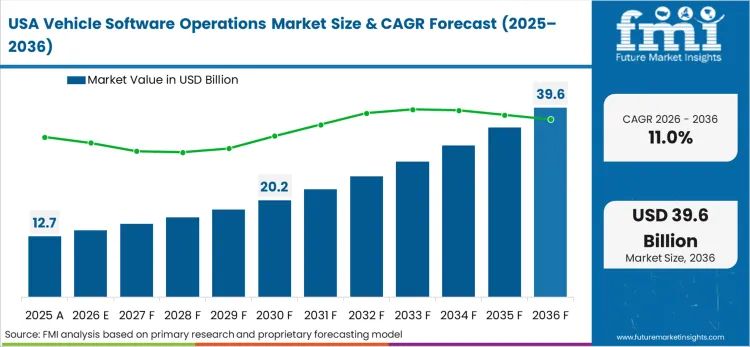
North America's software landscape relies heavily on regulatory momentum pushing stringent cybersecurity and data privacy mandates onto the automotive electronics ecosystem. Federal agencies are actively formalizing guidelines for connected vehicles, creating rigid compliance structures that integrators must navigate. The USA DOT allocated USD 11 million to NHTSA's Vehicle Electronics and Cybersecurity program for FY2024-2025 [15], validating the institutional priority placed on securing automotive code. This regulatory focus transforms software lifecycle management from an engineering convenience into a mandatory liability shield. Automakers must deploy comprehensive fleet update platforms to manage compliance risk across millions of distributed vehicles.
- United States: Unlike markets focused merely on localized integration, American manufacturers weaponize over-the-air deployment to monetize post-sale feature subscriptions. Volvo Cars successfully pushed its UX update to roughly 2.5 million vehicles globally from centralized operations [1]. Driven by this recurring revenue model, the domestic software sector is set to grow at an 11.0% CAGR through 2036, penalizing brands operating without enterprise-grade deployment orchestration.
FMI's report includes comprehensive tracking of Canada and Mexico. Cross-border autonomous freight testing mandates standardized multi-region connectivity protocols, requiring integrators to design platforms capable of seamless network handoffs across national telematics grids.
Europe Vehicle Software Operations Market Analysis
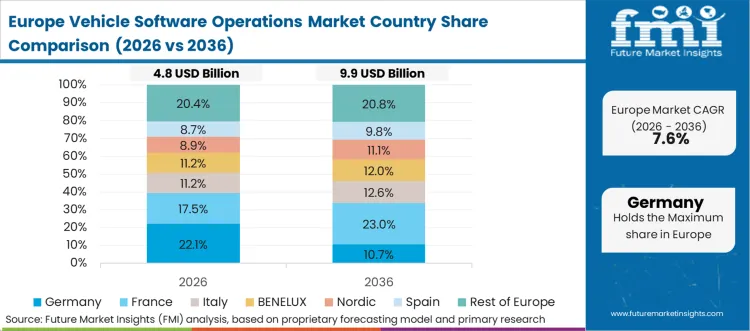
Europe functions as a technical proving ground for advanced isolation methods under strict safety standards governing smart vehicle architecture. Regulatory scrutiny compels manufacturers to adopt mixed-criticality platforms that guarantee infotainment failures cannot compromise steering or braking execution. FMI analysts opine that European automakers are deliberately slowing adoption cycles to ensure exhaustive security validation before deployment. This environment establishes rigorous testing and certification as the primary barrier to entry for new software vendors.
- Germany: Premium automakers mandate uncompromised code security for high-speed autonomy features, setting software operations for a 10.0% CAGR over the forecast period. The ZF and Qualcomm collaboration emphasizes building scalable ADAS solutions explicitly tailored for stringent European safety ratings [16]. Tier-1 integrators must provide verifiable, hardware-agnostic isolation architectures to secure approval from domestic safety regulators.
- United Kingdom: In 2025, 39% of organizations in the automotive sector reported actively contributing back to open-source projects [3], reflecting deep investments in collaborative DevOps tooling expertise. Driven by this structural integration approach, the UK's automotive software sector is poised to expand at a 9.0% CAGR. Development teams must maintain active participation in consortium standards to remain viable candidates for domestic system integration tenders.
FMI's report includes granular tracking of France, Italy, and the Nordics. The rapid deployment of grid-integrated electric vehicle charging algorithms across these countries requires manufacturers to implement highly secure, bi-directional communication software that strictly isolates vehicle powertrain data from public utility networks.
Latin America Vehicle Software Operations Market Analysis
Cost physics and local telecommunications infrastructure determine Latin American adoption curves for SBOM management and software supply chain compliance. Processors evaluate platform switching strictly on a cost-per-vehicle basis, favoring lightweight middleware that functions reliably over inconsistent cellular networks. Regional economic pressures force manufacturers to optimize existing electronic control units rather than demanding next-generation central compute nodes immediately. As fleet operators transition to digitized logistics, telematics providers must prioritize data compression and resilient update mechanisms. The structural push toward delayed integration creates a unique market for backward-compatible software solutions.
FMI's report includes detailed analysis of Brazil, Argentina, and Chile. The expansion of heavy-duty agricultural telematics in these nations dictates rigid offline-first software architectures, requiring developers to build platforms that execute complex diagnostics locally before syncing when connectivity is restored.
Competitive Aligners for Market Players
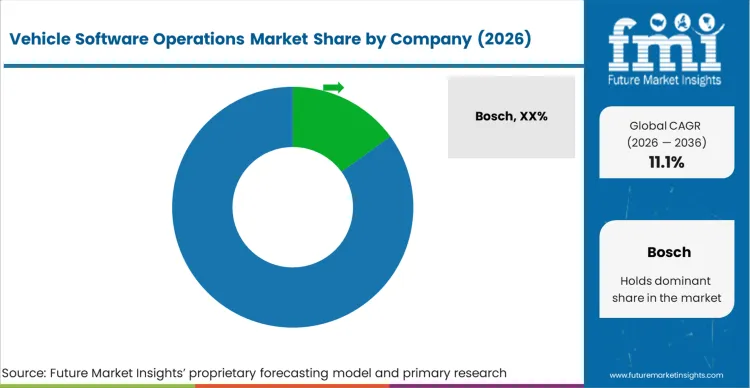
Strategic partnerships and alliances accelerate commercialization timelines for emerging players navigating complex automotive cybersecurity mandates. HARMAN unveiled comprehensive enhancements to its Ready portfolio at CES 2025 to streamline software-defined vehicle cabin development [17], reducing the integration burden for automakers. Suppliers offering pre-validated, modular code blocks significantly shorten development cycles for original equipment manufacturers. Integrators failing to provide compliant, plug-and-play solutions face immediate exclusion from aggressive model launch schedules.
Technological capability differentiates premium suppliers from bulk vehicle to everything v2x cybersecurity providers. NVIDIA announced a strategic partnership with Uber to support the global expansion of autonomous mobility platforms [18], proving that scalable compute architectures are critical for fleet-level deployment. Companies holding advanced simulation environments capture higher margins by allowing automakers to test software virtually before hardware exists. Developers lacking digital twin capabilities cannot meet the safety validation requirements demanded by major mobility networks.
Market structure relies heavily on open-source consortium participation to standardize fleet OTA update test platforms. The Linux Foundation reported DevOps adoption within automotive open-source environments reaching 43% to 46% [19], confirming that continuous delivery practices are becoming institutionalized. Processors leverage these shared frameworks to avoid redundant development costs. Procurement directors must specify compliance with these open standards to prevent vendor lock-in on critical infrastructure components.
Recent Developments
The report includes full coverage of key trends from competitive benchmarking. Some of the recent developments covered in the reports:
- In January 2026, HARMAN announced new upgrades across its Ready portfolio and SDV suite to deliver holistic in-cabin experiences. [20]
- In February 2025, Volvo Cars stated its refreshed XC60 infotainment system operates more than twice as fast due to integration with Snapdragon platforms. [21]
- In January 2025, Aurora announced a partnership with Continental and NVIDIA to deploy driverless trucking technologies in Texas. [22]
Key Players in Vehicle Software Operations Market
- Bosch
- Continental
- Aptiv
- Harman (Samsung)
- NVIDIA
- Qualcomm
- Google (Android Automotive)
Scope of the Report
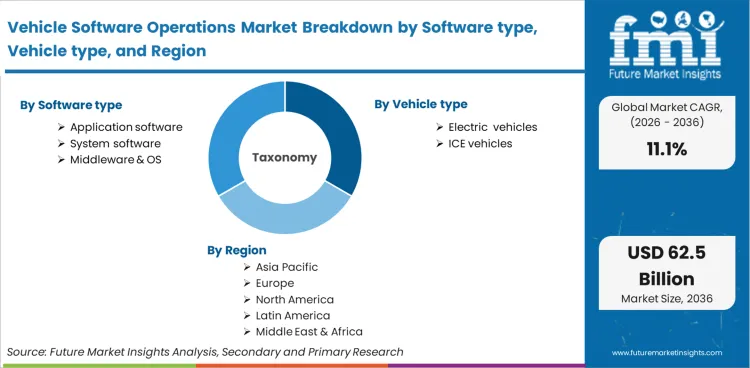
| Metric | Value |
|---|---|
| Quantitative Units | USD 21.8 billion (2026) to USD 62.8 billion (2036), at a CAGR of 11.10% |
| Market Definition | A comprehensive suite of development tools, middleware, and lifecycle management platforms utilized by automotive manufacturers to design, deploy, and secure embedded vehicle code and cloud-to-car telematics. |
| Software type Segmentation | Application software, System software, Middleware & OS |
| Vehicle type Segmentation | ICE vehicles, Electric vehicles |
| Application Segmentation | Infotainment, ADAS & safety, Cloud & backend, Powertrain & battery mgmt, Connectivity/V2X |
| Deployment Segmentation | Embedded/onboard, Cloud & backend |
| Regions Covered | North America, Latin America, Europe, East Asia, South Asia, Oceania, Middle East & Africa |
| Countries Covered | United States, Canada, Mexico, Brazil, Argentina, Germany, France, United Kingdom, Italy, Spain, China, India, Japan, South Korea, Indonesia, Australia and 40 plus countries |
| Key Companies Profiled | Bosch, Continental, Aptiv, Harman (Samsung), NVIDIA, Qualcomm, Google (Android Automotive) |
| Forecast Period | 2026 to 2036 |
| Approach | Hybrid top-down and bottom-up market modeling validated through primary interviews with connected vehicle platform architects and cybersecurity compliance officers, supported by trade data benchmarking |
Source: Future Market Insights (FMI) analysis, based on proprietary forecasting model and primary research
Segmental Analysis
Software Type:
- Application software
- System software
- Middleware & OS
Vehicle Type:
- ICE vehicles
- Electric vehicles
Application:
- Infotainment
- ADAS & safety
- Cloud & backend
- Powertrain & battery mgmt
- Connectivity/V2X
Deployment:
- Embedded/onboard
- Cloud & backend
Region:
- Asia Pacific
- India
- China
- Japan
- South Korea
- Indonesia
- Australia & New Zealand
- ASEAN
- Rest of Asia Pacific
- Europe
- Germany
- Italy
- France
- United Kingdom
- Spain
- Benelux
- Nordics
- Central & Eastern Europe
- Rest of Europe
- North America
- United States
- Canada
- Mexico
- Latin America
- Brazil
- Argentina
- Chile
- Rest of Latin America
- Middle East & Africa
- Kingdom of Saudi Arabia
- United Arab Emirates
- South Africa
- Turkey
- Rest of Middle East & Africa
Bibliography
- [1] Volvo Cars. (2026). Volvo Cars kicks off largest over-the-air car software update in history with comprehensive user experience upgrade (Press release).
- [2] ZF. (2026, January 05). ZF and Qualcomm Collaborate to Deliver Scalable ADAS Solution Powered by New ZF ProAI Supercomputer and Snapdragon Ride Platform (Press release).
- [3] Eclipse Foundation. (2025, February). 2025 State of Automotive Software Development (Industry report).
- [4] International Energy Agency (IEA). (2025, February). Trends in Electric Car Markets – Global EV Outlook 2025 (Industry report).
- [5] HERE Technologies. (2026, January 05). HERE Showcases AI-Powered Map Data with Snapdragon Ride at CES 2026 (Press release).
- [6] Qualcomm. (2026, January 05). Qualcomm Expands Decade-Long Collaboration with Google for Automotive Innovation and AI-Powered Mobility (Press release).
- [7] USA National Highway Traffic Safety Administration. (2025, January). Report on Vehicle Safety Recall Completion Rates (Government report).
- [8] OWASP. (2025, February). OWASP Top 10 for 2025 – Security Misconfiguration (Industry report).
- [9] Magna. (2025, March 18). Magna Teams with NVIDIA to Advance Automated Driving Demo Platform (Press release).
- [10] Bosch. (2025, September 30). Bosch Integrates NVIDIA DRIVE AGX Thor into Future Vehicle Architectures (Press release).
- [11] ECARX. (2025, November 13). ECARX Deepens Partnership with Volkswagen Group for Digital Cockpit Solutions (Press release).
- [12] Hyundai Motor Group. (2025, March 27). Hyundai Launches Pleos Mobility Software Brand (Press release).
- [13] Qualcomm. (2025, January 06). Snapdragon Digital Chassis Selected to Power Mahindra Electric-Origin SUV Range (Press release).
- [14] DENSO. (2025, December 26). DENSO Signs Agreement with MediaTek to Co-Develop Custom SoC for Integrated Mobility Computers (Press release).
- [15] USA Department of Transportation. (2025, June). AMRP FY2024-2025 NHTSA Final Report (Government report).
- [16] ZF. (2026, January 06). ZF and Qualcomm Collaborate on Scalable ADAS Solutions for European Safety Ratings (Press release).
- [17] HARMAN. (2025, January 06). HARMAN Redefines In-Cabin Experiences with Ready Portfolio Enhancements at CES 2025 (Press release).
- [18] NVIDIA. (2025, October 28). NVIDIA Partners with Uber to Support Global Expansion of Autonomous Mobility Platforms (Press release).
- [19] Linux Foundation. (2025, February). The State of Global Open Source 2025 (Industry report).
- [20] HARMAN. (2026, January 13). HARMAN Accelerates Road-Ready Products with New Upgrades to Ready Portfolio and SDV Suite (Press release).
- [21] Volvo Cars. (2025, February 18). Volvo Cars Infotainment Upgrade: Refreshed XC60 System Operates More Than Twice as Fast (Press release).
- [22] Aurora. (2025, January 06). Aurora Partners with Continental and NVIDIA to Deploy Driverless Trucking Technologies in Texas (Press release).
This bibliography is provided for reader reference and is not exhaustive. The full report contains the complete reference list and detailed citations.
This Report Addresses
- Market size estimation and revenue forecasts from 2026 to 2036, supported by validated corporate deployment benchmarks across major engineering hubs.
- Growth opportunity mapping across application and system software formats with emphasis on open-source supply chain transitions.
- Segment and regional revenue forecasts covering critical applications like infotainment, ADAS, and cloud backend processing.
- Competition strategy assessment including integration models, cybersecurity survivability positioning, and process capability benchmarking.
- Product reformulation tracking covering key metrics such as deployment latency, cloud offloading, and autonomous software reliability.
- Regulatory impact analysis evaluating strict vehicle safety mandates, vulnerability disclosure protocols, and over-the-air compliance guidelines.
- Market report delivery in PDF, Excel, PPT, and interactive dashboard formats for executive and operational use.
Frequently Asked Questions
How large is the demand for Vehicle Software Operations in the global market in 2026?
Demand for Vehicle Software Operations in the global market is estimated to be valued at USD 21.8 billion in 2026.
What will be the market size of Vehicle Software Operations in the global market by 2036?
Market size for Vehicle Software Operations is projected to reach USD 62.8 billion by 2036.
What is the expected demand growth for Vehicle Software Operations in the global market between 2026 and 2036?
Demand for Vehicle Software Operations is expected to grow at a CAGR of 11.10% between 2026 and 2036.
Which Software type is poised to lead global sales by 2026?
Application software commands 47% in 2026 as manufacturers prioritize localized infotainment customization and modular design architectures.
How significant is the role of Infotainment in driving Vehicle Software Operations adoption in 2026?
Infotainment represents 32% of segment share as brands deploy complex media and navigation interfaces isolated from critical driving controls.
What is driving demand in India?
Aggressive transition into a global hub for automotive code validation and robust local developer ecosystems drive integration demand.
What compliance standards or regulations are referenced for India?
Global connected vehicle protocols and localized automotive data residency standards directly influence testing behavior.
What is the India growth outlook in this report?
India is projected to grow at a CAGR of 14.0% during 2026 to 2036.
Why is North America described as a priority region in this report?
Stringent federal cybersecurity regulations and massive investments in over-the-air commercialization networks establish it as a primary software market.
What type of demand dominates in North America?
Compliance-led verification platforms and autonomous fleet tracking systems dominate regional formulation demand.
What is China's growth outlook in this report?
China is projected to expand at a CAGR of 13.0% during 2026 to 2036.
Does the report cover United States in its regional analysis?
Yes, United States is included within North America under the regional scope of analysis.
What are the sources referred to for analyzing United States?
Official funding data from the U.S. DOT and corporate deployment announcements form the analytical basis.
What is the main demand theme linked to United States in its region coverage?
Monetization of post-sale feature subscriptions through synchronized over-the-air platform rollouts shapes continuous engineering demand.
Does the report cover United Kingdom in its regional analysis?
Yes, United Kingdom is included within Europe under the regional coverage framework.
What is the main United Kingdom related demand theme in its region coverage?
Open-source consortium participation and DevOps tooling expertise dominate regional development behavior.
Which product formats or configurations are strategically important for Asia Pacific supply chains?
Lightweight middleware tailored for rapid infotainment iterations and seamless connected cabin experiences hold immense strategic importance.
What is Vehicle Software Operations and what is it mainly used for?
It is a comprehensive suite of development tools and platforms utilized primarily to design, test, and deploy code within modern connected vehicles.
What does Vehicle Software Operations mean in this report?
The market refers to the global development environments, middleware frameworks, and cloud orchestration systems supporting automotive architectures.
What is included in the scope of this Vehicle Software Operations report?
Scope includes commercial operating systems, diagnostic data platforms, and over-the-air update management consoles designed explicitly for automotive use.
What is excluded from the scope of this report?
General-purpose enterprise IT software, raw semiconductor hardware, and independent consumer smartphone apps are strictly excluded.
What does market forecast mean on this page?
The market forecast represents a model-based projection built on defined technology and adoption assumptions for strategic planning purposes.
How does FMI build and validate the Vehicle Software Operations forecast?
Forecasts combine top-down electric vehicle volumes with bottom-up software integration expenditures, validated by primary platform architect interviews.
What does zero reliance on speculative third-party market research mean here?
Primary interviews, verified regulatory filings, and official corporate update announcements are used exclusively instead of unverified syndicated estimates.
Preview the report firsthand - request a free sample
Get SampleGet the brochure for pricing and purchase details.
Get PDFTable of Content
- Executive Summary
- Global Market Outlook
- Demand-side Trends
- Supply-side Trends
- Technology Roadmap Analysis
- Analysis and Recommendations
- Market Overview
- Market Coverage / Taxonomy
- Market Definition / Scope / Limitations
- Research Methodology
- Chapter Orientation
- Analytical Lens and Working Hypotheses
- Market Structure, Signals, and Trend Drivers
- Benchmarking and Cross-market Comparability
- Market Sizing, Forecasting, and Opportunity Mapping
- Research Design and Evidence Framework
- Desk Research Programme (Secondary Evidence)
- Company Annual and Sustainability Reports
- Peer-reviewed Journals and Academic Literature
- Corporate Websites, Product Literature, and Technical Notes
- Earnings Decks and Investor Briefings
- Statutory Filings and Regulatory Disclosures
- Technical White Papers and Standards Notes
- Trade Journals, Industry Magazines, and Analyst Briefs
- Conference Proceedings, Webinars, and Seminar Materials
- Government Statistics Portals and Public Data Releases
- Press Releases and Reputable Media Coverage
- Specialist Newsletters and Curated Briefings
- Sector Databases and Reference Repositories
- FMI Internal Proprietary Databases and Historical Market Datasets
- Subscription Datasets and Paid Sources
- Social Channels, Communities, and Digital Listening Inputs
- Additional Desk Sources
- Expert Input and Fieldwork (Primary Evidence)
- Primary Modes
- Qualitative Interviews and Expert Elicitation
- Quantitative Surveys and Structured Data Capture
- Blended Approach
- Why Primary Evidence is Used
- Observational and In-context Research
- Social and Community Interactions
- Primary Modes
- Stakeholder Universe Engaged
- C-suite Leaders
- Board Members
- Presidents and Vice Presidents
- R&D and Innovation Heads
- Technical Specialists
- Domain Subject-matter Experts
- Scientists
- Physicians and Other Healthcare Professionals
- Governance, Ethics, and Data Stewardship
- Research Ethics
- Data Integrity and Handling
- Desk Research Programme (Secondary Evidence)
- Tooling, Models, and Reference Databases
- Data Engineering and Model Build
- Data Acquisition and Ingestion
- Cleaning, Normalisation, and Verification
- Synthesis, Triangulation, and Analysis
- Quality Assurance and Audit Trail
- Market Background
- Market Dynamics
- Drivers
- Restraints
- Opportunity
- Trends
- Scenario Forecast
- Demand in Optimistic Scenario
- Demand in Likely Scenario
- Demand in Conservative Scenario
- Opportunity Map Analysis
- Product Life Cycle Analysis
- Supply Chain Analysis
- Investment Feasibility Matrix
- Value Chain Analysis
- PESTLE and Porter’s Analysis
- Regulatory Landscape
- Regional Parent Market Outlook
- Production and Consumption Statistics
- Import and Export Statistics
- Market Dynamics
- Global Market Analysis 2021 to 2025 and Forecast, 2026 to 2036
- Historical Market Size Value (USD Million) Analysis, 2021 to 2025
- Current and Future Market Size Value (USD Million) Projections, 2026 to 2036
- Y-o-Y Growth Trend Analysis
- Absolute $ Opportunity Analysis
- Global Market Pricing Analysis 2021 to 2025 and Forecast 2026 to 2036
- Global Market Analysis 2021 to 2025 and Forecast 2026 to 2036, By Software type
- Introduction / Key Findings
- Historical Market Size Value (USD Million) Analysis By Software type , 2021 to 2025
- Current and Future Market Size Value (USD Million) Analysis and Forecast By Software type , 2026 to 2036
- Application software
- System software
- Middleware & OS
- Application software
- Y-o-Y Growth Trend Analysis By Software type , 2021 to 2025
- Absolute $ Opportunity Analysis By Software type , 2026 to 2036
- Global Market Analysis 2021 to 2025 and Forecast 2026 to 2036, By Vehicle type
- Introduction / Key Findings
- Historical Market Size Value (USD Million) Analysis By Vehicle type, 2021 to 2025
- Current and Future Market Size Value (USD Million) Analysis and Forecast By Vehicle type, 2026 to 2036
- Electric vehicles
- ICE vehicles
- Electric vehicles
- Y-o-Y Growth Trend Analysis By Vehicle type, 2021 to 2025
- Absolute $ Opportunity Analysis By Vehicle type, 2026 to 2036
- Global Market Analysis 2021 to 2025 and Forecast 2026 to 2036, By Application
- Introduction / Key Findings
- Historical Market Size Value (USD Million) Analysis By Application, 2021 to 2025
- Current and Future Market Size Value (USD Million) Analysis and Forecast By Application, 2026 to 2036
- Infotainment
- ADAS & safety
- Cloud & backend
- Infotainment
- Y-o-Y Growth Trend Analysis By Application, 2021 to 2025
- Absolute $ Opportunity Analysis By Application, 2026 to 2036
- Global Market Analysis 2021 to 2025 and Forecast 2026 to 2036, By Deployment
- Introduction / Key Findings
- Historical Market Size Value (USD Million) Analysis By Deployment, 2021 to 2025
- Current and Future Market Size Value (USD Million) Analysis and Forecast By Deployment, 2026 to 2036
- Embedded and Onboard Deployments
- Cloud & backend
- Embedded and Onboard Deployments
- Y-o-Y Growth Trend Analysis By Deployment, 2021 to 2025
- Absolute $ Opportunity Analysis By Deployment, 2026 to 2036
- Global Market Analysis 2021 to 2025 and Forecast 2026 to 2036, By Region
- Introduction
- Historical Market Size Value (USD Million) Analysis By Region, 2021 to 2025
- Current Market Size Value (USD Million) Analysis and Forecast By Region, 2026 to 2036
- North America
- Latin America
- Western Europe
- Eastern Europe
- East Asia
- South Asia and Pacific
- Middle East & Africa
- Market Attractiveness Analysis By Region
- North America Market Analysis 2021 to 2025 and Forecast 2026 to 2036, By Country
- Historical Market Size Value (USD Million) Trend Analysis By Market Taxonomy, 2021 to 2025
- Market Size Value (USD Million) Forecast By Market Taxonomy, 2026 to 2036
- By Country
- USA
- Canada
- Mexico
- By Software type
- By Vehicle type
- By Application
- By Deployment
- By Country
- Market Attractiveness Analysis
- By Country
- By Software type
- By Vehicle type
- By Application
- By Deployment
- Key Takeaways
- Latin America Market Analysis 2021 to 2025 and Forecast 2026 to 2036, By Country
- Historical Market Size Value (USD Million) Trend Analysis By Market Taxonomy, 2021 to 2025
- Market Size Value (USD Million) Forecast By Market Taxonomy, 2026 to 2036
- By Country
- Brazil
- Chile
- Rest of Latin America
- By Software type
- By Vehicle type
- By Application
- By Deployment
- By Country
- Market Attractiveness Analysis
- By Country
- By Software type
- By Vehicle type
- By Application
- By Deployment
- Key Takeaways
- Western Europe Market Analysis 2021 to 2025 and Forecast 2026 to 2036, By Country
- Historical Market Size Value (USD Million) Trend Analysis By Market Taxonomy, 2021 to 2025
- Market Size Value (USD Million) Forecast By Market Taxonomy, 2026 to 2036
- By Country
- Germany
- UK
- Italy
- Spain
- France
- Nordic
- BENELUX
- Rest of Western Europe
- By Software type
- By Vehicle type
- By Application
- By Deployment
- By Country
- Market Attractiveness Analysis
- By Country
- By Software type
- By Vehicle type
- By Application
- By Deployment
- Key Takeaways
- Eastern Europe Market Analysis 2021 to 2025 and Forecast 2026 to 2036, By Country
- Historical Market Size Value (USD Million) Trend Analysis By Market Taxonomy, 2021 to 2025
- Market Size Value (USD Million) Forecast By Market Taxonomy, 2026 to 2036
- By Country
- Russia
- Poland
- Hungary
- Balkan & Baltic
- Rest of Eastern Europe
- By Software type
- By Vehicle type
- By Application
- By Deployment
- By Country
- Market Attractiveness Analysis
- By Country
- By Software type
- By Vehicle type
- By Application
- By Deployment
- Key Takeaways
- East Asia Market Analysis 2021 to 2025 and Forecast 2026 to 2036, By Country
- Historical Market Size Value (USD Million) Trend Analysis By Market Taxonomy, 2021 to 2025
- Market Size Value (USD Million) Forecast By Market Taxonomy, 2026 to 2036
- By Country
- China
- Japan
- South Korea
- By Software type
- By Vehicle type
- By Application
- By Deployment
- By Country
- Market Attractiveness Analysis
- By Country
- By Software type
- By Vehicle type
- By Application
- By Deployment
- Key Takeaways
- South Asia and Pacific Market Analysis 2021 to 2025 and Forecast 2026 to 2036, By Country
- Historical Market Size Value (USD Million) Trend Analysis By Market Taxonomy, 2021 to 2025
- Market Size Value (USD Million) Forecast By Market Taxonomy, 2026 to 2036
- By Country
- India
- ASEAN
- Australia & New Zealand
- Rest of South Asia and Pacific
- By Software type
- By Vehicle type
- By Application
- By Deployment
- By Country
- Market Attractiveness Analysis
- By Country
- By Software type
- By Vehicle type
- By Application
- By Deployment
- Key Takeaways
- Middle East & Africa Market Analysis 2021 to 2025 and Forecast 2026 to 2036, By Country
- Historical Market Size Value (USD Million) Trend Analysis By Market Taxonomy, 2021 to 2025
- Market Size Value (USD Million) Forecast By Market Taxonomy, 2026 to 2036
- By Country
- Kingdom of Saudi Arabia
- Other GCC Countries
- Turkiye
- South Africa
- Other African Union
- Rest of Middle East & Africa
- By Software type
- By Vehicle type
- By Application
- By Deployment
- By Country
- Market Attractiveness Analysis
- By Country
- By Software type
- By Vehicle type
- By Application
- By Deployment
- Key Takeaways
- Key Countries Market Analysis
- USA
- Pricing Analysis
- Market Share Analysis, 2025
- By Software type
- By Vehicle type
- By Application
- By Deployment
- Canada
- Pricing Analysis
- Market Share Analysis, 2025
- By Software type
- By Vehicle type
- By Application
- By Deployment
- Mexico
- Pricing Analysis
- Market Share Analysis, 2025
- By Software type
- By Vehicle type
- By Application
- By Deployment
- Brazil
- Pricing Analysis
- Market Share Analysis, 2025
- By Software type
- By Vehicle type
- By Application
- By Deployment
- Chile
- Pricing Analysis
- Market Share Analysis, 2025
- By Software type
- By Vehicle type
- By Application
- By Deployment
- Germany
- Pricing Analysis
- Market Share Analysis, 2025
- By Software type
- By Vehicle type
- By Application
- By Deployment
- UK
- Pricing Analysis
- Market Share Analysis, 2025
- By Software type
- By Vehicle type
- By Application
- By Deployment
- Italy
- Pricing Analysis
- Market Share Analysis, 2025
- By Software type
- By Vehicle type
- By Application
- By Deployment
- Spain
- Pricing Analysis
- Market Share Analysis, 2025
- By Software type
- By Vehicle type
- By Application
- By Deployment
- France
- Pricing Analysis
- Market Share Analysis, 2025
- By Software type
- By Vehicle type
- By Application
- By Deployment
- India
- Pricing Analysis
- Market Share Analysis, 2025
- By Software type
- By Vehicle type
- By Application
- By Deployment
- ASEAN
- Pricing Analysis
- Market Share Analysis, 2025
- By Software type
- By Vehicle type
- By Application
- By Deployment
- Australia & New Zealand
- Pricing Analysis
- Market Share Analysis, 2025
- By Software type
- By Vehicle type
- By Application
- By Deployment
- China
- Pricing Analysis
- Market Share Analysis, 2025
- By Software type
- By Vehicle type
- By Application
- By Deployment
- Japan
- Pricing Analysis
- Market Share Analysis, 2025
- By Software type
- By Vehicle type
- By Application
- By Deployment
- South Korea
- Pricing Analysis
- Market Share Analysis, 2025
- By Software type
- By Vehicle type
- By Application
- By Deployment
- Russia
- Pricing Analysis
- Market Share Analysis, 2025
- By Software type
- By Vehicle type
- By Application
- By Deployment
- Poland
- Pricing Analysis
- Market Share Analysis, 2025
- By Software type
- By Vehicle type
- By Application
- By Deployment
- Hungary
- Pricing Analysis
- Market Share Analysis, 2025
- By Software type
- By Vehicle type
- By Application
- By Deployment
- Kingdom of Saudi Arabia
- Pricing Analysis
- Market Share Analysis, 2025
- By Software type
- By Vehicle type
- By Application
- By Deployment
- Turkiye
- Pricing Analysis
- Market Share Analysis, 2025
- By Software type
- By Vehicle type
- By Application
- By Deployment
- South Africa
- Pricing Analysis
- Market Share Analysis, 2025
- By Software type
- By Vehicle type
- By Application
- By Deployment
- USA
- Market Structure Analysis
- Competition Dashboard
- Competition Benchmarking
- Market Share Analysis of Top Players
- By Regional
- By Software type
- By Vehicle type
- By Application
- By Deployment
- Competition Analysis
- Competition Deep Dive
- Bosch
- Overview
- Product Portfolio
- Profitability by Market Segments (Product/Age /Sales Channel/Region)
- Sales Footprint
- Strategy Overview
- Marketing Strategy
- Product Strategy
- Channel Strategy
- Continental
- Aptiv
- Harman (Samsung)
- NVIDIA
- Qualcomm
- Google (Android Automotive)
- Bosch
- Competition Deep Dive
- Assumptions & Acronyms Used


