

- Industry Size (2026)
- USD 5.4 Bn
- Forecast (2036)
- USD 17.9 Bn
- CAGR (2026 to 2036)
- 12.8%
Vehicle Cybersecurity Management Market Size, Market Forecast and Outlook By FMI
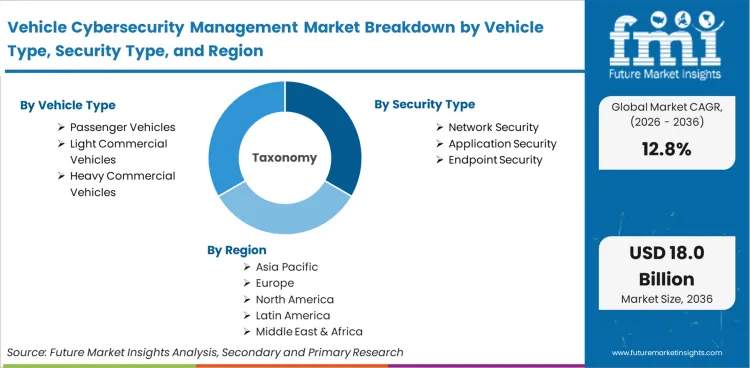
Valued at USD 4.8 billion in 2025, the vehicle cybersecurity management market is projected to attain USD 5.4 billion in 2026 and expand to USD 17.9 billion by 2036. The market is forecast to grow at a CAGR of 12.8% during the assessment period.
Growth in the vehicle cybersecurity management market is linked with the rapid digitalization of modern vehicles. Automakers are embedding connected services, telematics platforms, cloud-based diagnostics, and over-the-air software updates into passenger and commercial vehicles. These digital features improve navigation, infotainment, fleet monitoring, and remote vehicle management. Each connected function introduces new entry points for cyber threats targeting vehicle networks and electronic control units. Automotive manufacturers are prioritizing cybersecurity management frameworks that continuously monitor vulnerabilities, authenticate software updates, and protect in-vehicle communication systems. Expansion of software-defined vehicle architecture is further strengthening the need for integrated cybersecurity management platforms capable of securing vehicle data exchanges across internal networks and external communication channels.
Regulatory mandates across major automotive markets are accelerating adoption of vehicle cybersecurity management systems. Governments and automotive regulatory bodies are introducing strict security requirements to ensure safety of connected mobility ecosystems. Automotive manufacturers must comply with cybersecurity standards that require risk assessment procedures, threat detection protocols, and lifecycle monitoring of vehicle software systems. Compliance frameworks encourage continuous monitoring of electronic control units, encryption of vehicle data communication, and secure management of software updates. Automotive companies are integrating cybersecurity management platforms into vehicle development programs to meet regulatory approval requirements. Growing collaboration between automakers, cybersecurity technology providers, and regulatory institutions is strengthening development of standardized security management frameworks within the global automotive industry.
Summary of Vehicle Cybersecurity Management Market
- Vehicle Cybersecurity Management Market Definition
- The industry comprises integrated cybersecurity solutions designed to secure connected automotive environments including passenger vehicles, commercial fleets, and autonomous driving platforms.
- Demand Drivers in the Market
- Growth in connected vehicle integration accelerates procurement of cybersecurity systems safeguarding networked automotive platforms.
- Compliance obligations drive adoption of vehicle cybersecurity solutions aligned with regulatory certification standards.
- Advancements in cyber threat monitoring enhance detection efficiency without affecting vehicle operational stability.
- Key Segments Analyzed in the Report
- Vehicle Type: Passenger Vehicles (61%) versus commercial vehicle platforms and specialized automotive applications.
- Security Type: Network Security (38%) versus application protection and endpoint security frameworks.
- Geography: High-growth Asia Pacific versus mature North American and European markets.
- Analyst Opinion at FMI
- Nikhil Kaitwade, Senior Consultant for Automotive at Future Market Insights, states, "The updated Vehicle Cybersecurity Management Market Report for 2026 to 2036 highlights the growing requirement for multi-layered vehicle protection frameworks that integrate directly with electronic control unit architectures. My assessment suggests that security protocol standardization plays a decisive role in development timelines, while compliance testing requirements may limit entry opportunities for vendors serving cost-sensitive automotive manufacturers."
- Strategic Implications/Executive Takeaways
- Move emphasis toward unified vehicle cybersecurity ecosystems replacing isolated protection modules.
- Utilize strategic collaboration with automotive manufacturers as the primary access channel to the market.
- Develop robust over-the-air update frameworks to maintain ongoing protection and minimize security gaps over time.
- Methodology
- Validated through direct automotive procurement data and connected vehicle deployment surveys.
- Zero reliance on speculative automotive technology trend forecasting.
- Based on verifiable manufacturer integration metrics and verified regulatory compliance timelines.
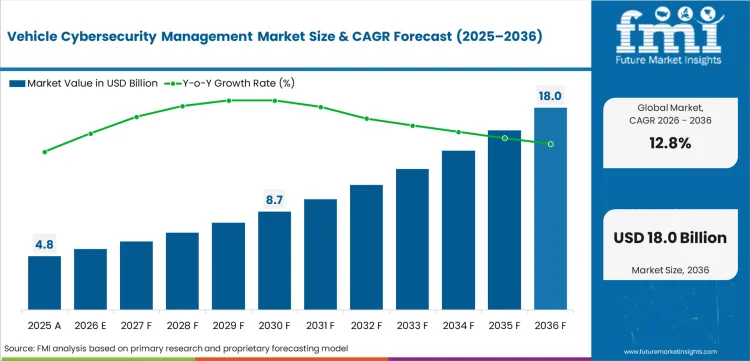
Growth of autonomous driving technologies and advanced driver assistance systems is strengthening demand for vehicle cybersecurity management solutions. Vehicles increasingly rely on sensors, radar modules, cameras, and artificial intelligence software to enable automated decision making and driving assistance features. These technologies generate large volumes of operational data and require secure communication between vehicle systems, cloud infrastructure, and roadside digital networks. Cybersecurity management platforms support threat monitoring, anomaly detection, and real time system protection to maintain reliability of automated vehicle functions. Prominent companies are focusing on launching enhanced capabilities of products for a better in-vehicle connectivity experience and vulnerability management. [1]
Vehicle Cybersecurity Management Market Key Takeaways
| Metric | Value |
|---|---|
| Market Value (2026) | USD 5.4 billion |
| Market Forecast Value (2036) | USD 17.9 billion |
| Forecast CAGR (2026-2036) | 12.8% |
Source: FMI analysis based on proprietary forecasting model and primary research
Vehicle Cybersecurity Management Market Definition
Vehicle cybersecurity management represents a core security framework designed to safeguard connected automotive systems, covering technologies that support threat monitoring and response across passenger and commercial vehicles. The vehicle cybersecurity management market includes the global design, manufacturing, and implementation of security solutions that protect vehicle networks, electronic control units, and wireless communication interfaces from unauthorized intrusion and cyber threats.
Vehicle Cybersecurity Management Market Inclusions
The study delivers an in-depth assessment of market dynamics, outlining global and regional market size estimates in volume and value along with a forecast period covering 2026 to 2036. The report analyzes the market across several segments including offering such as hardware, software, and services. Security categories evaluated include network, application, endpoint, and cloud security. Deployment models include in-vehicle cybersecurity and external cloud cybersecurity, while operational approaches cover intrusion detection systems and vehicle SOC environments. The report further examines vehicle type, propulsion system, vehicle autonomy levels, and application areas including ADAS, infotainment, telematics, communication, powertrain, and body control systems.
Vehicle Cybersecurity Management Market Exclusions
This study excludes independent cybersecurity consulting services, broad IT security platforms, and embedded protection technologies developed outside the automotive sector. Industrial cybersecurity frameworks and training-focused security programs are not included in the market scope. Providers of generic encryption software and network hardware infrastructure are excluded from the analysis. The report concentrates only on automotive-grade cybersecurity technologies developed for vehicle systems and their direct deployment use cases. Cybersecurity insurance solutions and experimental vehicle hacking tools with minimal commercial adoption remain outside the coverage.
Vehicle Cybersecurity Management Market Research Methodology
- Primary Research: Interviews were conducted with automotive original equipment manufacturers, cybersecurity technology providers, tier-1 automotive suppliers, fleet management operators, and automotive cybersecurity standards organizations across major markets. Vehicle security consultants clarified threat landscape evolution and regulatory compliance requirements.
- Desk Research: Vehicle production data from automotive industry analytics platforms, connected vehicle adoption rates from technology surveys, and cybersecurity incident statistics from industry associations supported market benchmarking.
- Market-Sizing and Forecasting: A hybrid top-down and bottom-up model was developed. Demand was reconstructed from automotive manufacturer procurement figures, tier-1 supplier integration volumes, and aftermarket security solution installations, then validated against connected vehicle deployment statistics and regulatory implementation timelines.
- Data Validation and Update Cycle: Outputs undergo variance checks across automotive and technology sector datasets, cross-verification with automotive cybersecurity regulatory bodies, and structured expert review prior to release.
Segmental Analysis
Vehicle Cybersecurity Management Market Analysis by Vehicle Type
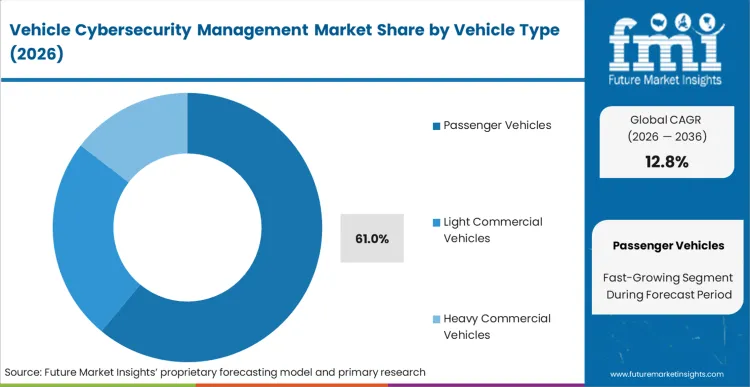
The passenger vehicles segment is estimated to capture 61% share in 2026. Demand for cybersecurity in passenger vehicles is increasing due to the growing number of connected features integrated into modern cars. Infotainment systems, smartphone connectivity, navigation services, passenger vehicle telematics units, and remote vehicle access applications are now standard in many passenger vehicles. These features rely on wireless communication technologies such as Bluetooth, Wi-Fi, and cellular networks. Each connection point creates potential entry paths for unauthorized access. Automakers are investing in cybersecurity systems that protect in-vehicle networks, encrypt communication channels, and prevent external manipulation of vehicle functions.
- • Infotainment Platform Security: Manufacturers are deploying application-layer protection mechanisms supported by encrypted communication channels, limiting unauthorized system access through authentication frameworks while addressing data privacy concerns that shape buyer preferences in premium and mid-range vehicle categories.
- • Telematics Information Protection: The solution framework enables continuous monitoring by combining location data safeguards with encrypted remote diagnostics, lowering breach exposure while strengthening value creation through software integration compatible with both OEM and aftermarket deployment environments.
Vehicle Cybersecurity Management Market Analysis by Security Type
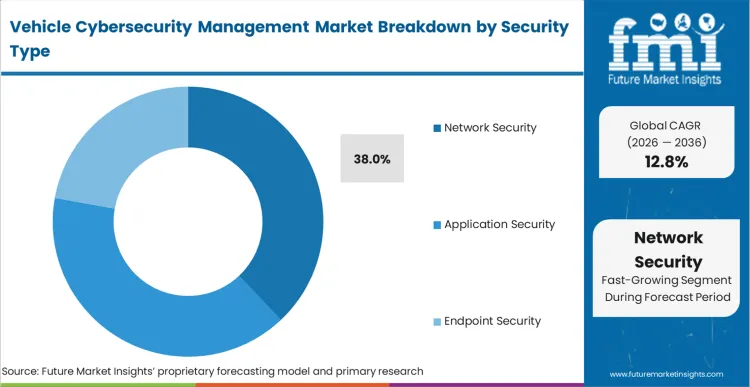
The network security segment is slated to hold a 38% market share in 2026. The expansion of advanced driver assistance systems and autonomous driving technologies is strengthening the need for network security within vehicles. Sensors, cameras, radar modules, and artificial intelligence software depend on continuous high speed data transmission between vehicle subsystems. Reliable communication is necessary for real time decision making and safe vehicle operation. Network security solutions ensure that data exchanged between these systems remains authentic and protected from manipulation. Automotive manufacturers are integrating secure gateways, intrusion detection systems, and encrypted network architectures to safeguard internal vehicle communication.
- • Secure Gateway Integration: Automakers are embedding centralized gateway controllers that regulate communication between external interfaces and in-vehicle networks. These gateways filter incoming data, verify command authenticity, and prevent unauthorized signals from reaching safety-critical systems. This approach improves control over data flow between infotainment modules, telematics units, and vehicle control systems, ensuring that internal networks remain protected from malicious commands.
- • Encrypted Vehicle Communication: Cybersecurity platforms are strengthening protection of in-vehicle data exchange through encryption protocols and authentication frameworks. These technologies ensure that information transmitted between electronic control units, cloud platforms, and external digital services remains confidential and tamper-proof.
Vehicle Cybersecurity Management Market Drivers, Restraints, and Opportunities
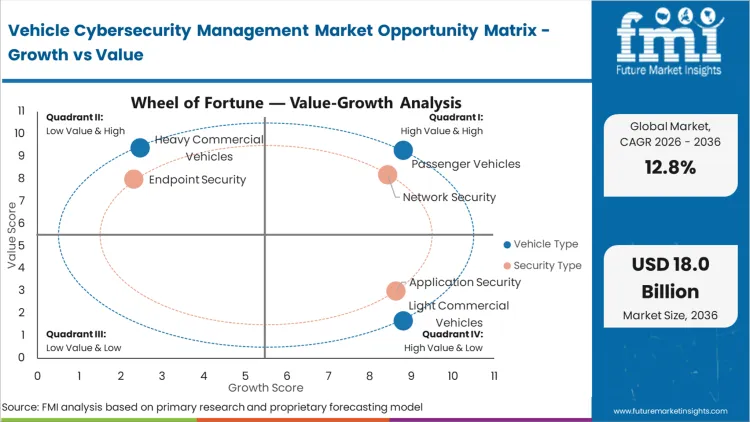
Rising adoption of over the air software update systems is strengthening demand for vehicle cybersecurity management platforms. Automakers increasingly rely on remote software updates to improve vehicle performance, add new digital features, and correct system vulnerabilities after vehicles enter the market. These updates are delivered through wireless communication networks connecting vehicles with cloud based software management platforms. Secure update delivery requires authentication protocols, encrypted communication channels, and monitoring systems that prevent unauthorized software installation. Vehicle cybersecurity management solutions verify update integrity, monitor system activity during installation, and protect electronic control units from malicious code. Expanding deployment of software defined vehicles is increasing reliance on secure update infrastructure across the automotive industry.
High implementation cost is a key restraint affecting adoption of vehicle cybersecurity management systems. Integration of cybersecurity solutions requires specialized software platforms, secure hardware modules, and continuous system monitoring capabilities. Automakers must invest in threat detection technologies, encryption infrastructure, and cybersecurity testing during vehicle development stages. These investments increase overall production costs, particularly for entry level vehicle segments where price sensitivity remains high. Automotive manufacturers must balance security integration with vehicle affordability and production efficiency. Limited availability of skilled cybersecurity professionals with automotive expertise further slows large scale deployment of advanced security management platforms across global vehicle production programs.
Expansion of autonomous driving and advanced driver assistance technologies presents strong opportunities for the vehicle cybersecurity management market. Automated driving systems rely on continuous communication between sensors, cameras, radar modules, and artificial intelligence software platforms. These systems process real time driving data and require secure digital infrastructure to maintain operational reliability. Cybersecurity management platforms support threat monitoring, system authentication, and secure data transmission across vehicle networks. Growth of connected mobility services, shared vehicle fleets, and cloud based vehicle management platforms is creating demand for advanced cybersecurity frameworks. Technology companies and automakers are increasing collaboration to develop scalable vehicle cybersecurity management solutions.
Regional Analysis
Based on regional analysis, the vehicle cybersecurity management market is segmented into North America, Latin America, Europe, East Asia, South Asia, Oceania and Middle East & Africa across 40 countries. The full report also offers market attractiveness analysis based on regional trends.
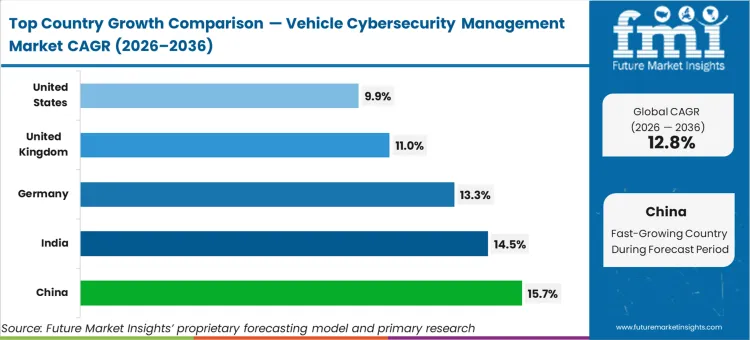
.webp "Top Country Growth Comparison Vehicle Cybersecurity Management Market Cagr (2026 2036)")
| Country | CAGR (2026 to 2036) |
|---|---|
| China | 15.7% |
| India | 14.5% |
| Germany | 13.3% |
| United Kingdom | 11.0% |
| United States | 9.9% |
Source: Market analysis based on proprietary forecasting model and primary research
North America Vehicle Cybersecurity Management Market Analysis
The North America vehicle cybersecurity management market is expanding due to the strong presence of connected vehicle technologies and advanced automotive software development across the United States and Canada. Automakers operating in the region are rapidly integrating telematics platforms, cloud connectivity, digital key systems, and mobile vehicle management applications into new vehicles. These digital services require secure communication between vehicles and external networks. Automotive companies are investing in cybersecurity management platforms that monitor vulnerabilities, detect unauthorized network activity, and protect vehicle data systems.
- United States: Demand for vehicle cybersecurity management in the United States is projected to grow at 9.9% CAGR from 2026 to 2036. Regulatory frameworks and cybersecurity standards in the United States are supporting adoption of vehicle cybersecurity technologies. Government agencies and automotive safety organizations are promoting cybersecurity guidelines that encourage risk assessment, threat monitoring, and secure software management throughout the vehicle lifecycle. Government investments in transformative technology projects is further strengthening market outlook. [2] Automakers are required to integrate cybersecurity strategies during vehicle design, testing, and post production monitoring stages.
The report provides an extensive evaluation of growth patterns across North America, supported by country-level analysis covering the United States and Canada. It highlights connected vehicle adoption developments, regulatory framework progression, and market expansion across various cybersecurity categories and deployment models.
Asia Pacific Vehicle Cybersecurity Management Market Analysis
Government initiatives supporting connected mobility and smart transportation infrastructure are accelerating adoption of vehicle cybersecurity management solutions in Asia Pacific. [3] Several countries are promoting development of intelligent transportation systems, vehicle to infrastructure communication, and digital traffic management networks. These systems depend on reliable and secure communication between vehicles and roadside infrastructure. Cybersecurity management platforms play an important role in protecting these networks from cyber threats and maintaining data integrity.
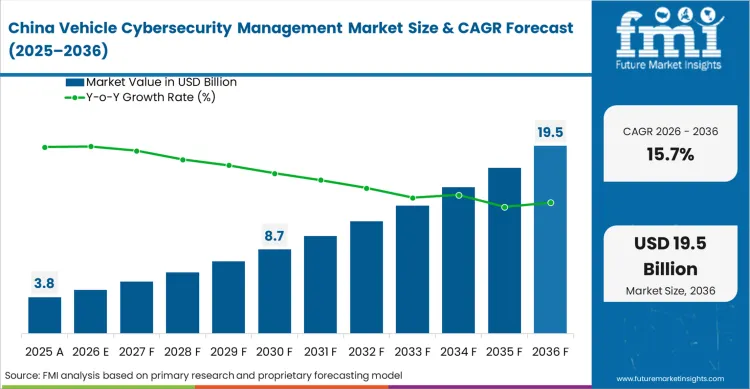
- China: The Chinese vehicle cybersecurity market is poised to grow at 15.7% CAGR during the forecast period. Expansion of electric vehicles and autonomous driving development in China is driving demand for vehicle cybersecurity management solutions. Many Chinese automakers are investing heavily in advanced driver assistance systems, automated driving software, and cloud connected vehicle platforms. These technologies depend on continuous communication between sensors, vehicle systems, and external digital networks. Cybersecurity management solutions help protect these communication channels, verify software integrity, and monitor network activity.
- India: Sales of vehicle cybersecurity solutions in India are estimated to expand at 14.5% CAGR during the study period. Growth of smart fleet management platforms is strengthening demand for vehicle cybersecurity management solutions. Logistics companies, mobility service providers, and commercial fleet operators are deploying telematics systems that monitor vehicle location, driver behavior, fuel consumption, and maintenance status in real time. These systems rely on continuous communication between vehicles, cloud platforms, and fleet control centers. Protection of fleet data and vehicle control systems has become essential as cyber threats targeting connected fleet infrastructure increase.
The comprehensive study analyzes the vehicle cybersecurity management market across East and South Asia from 2021 to 2036. It examines patterns of connected vehicle integration, security implementation strategies, and evolving regulatory compliance requirements in China, Japan, South Korea, India, Singapore, and Australia. The report highlights cybersecurity framework adoption that supports regional market penetration.
Europe Vehicle Cybersecurity Management Market Analysis
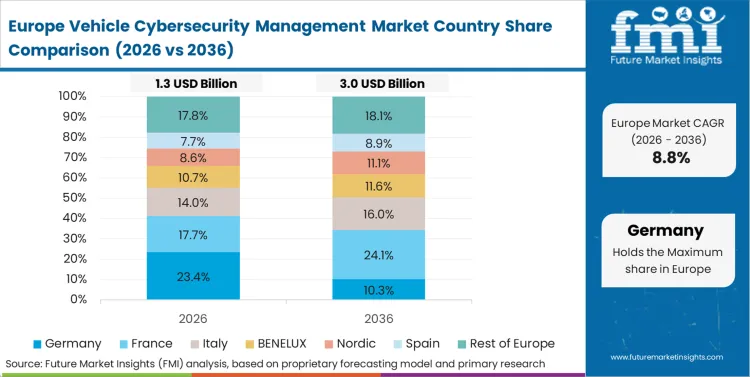
Strict regulatory frameworks across Europe are strengthening demand for vehicle cybersecurity management solutions. Automotive regulatory bodies require manufacturers to implement cybersecurity risk management systems throughout the vehicle lifecycle. Compliance requirements encourage automakers to conduct cybersecurity assessments, monitor potential threats, and secure software update processes. Vehicle manufacturers are integrating cybersecurity management platforms during vehicle development to meet regulatory standards and maintain safety compliance. The growing demand for electric vehicles featuring high-end in-vehicle connectivity is also working in favor of market growth. [4]
- Germany: The German vehicle cybersecurity management market is poised to grow at 13.3% CAGR during the study period. The market is expanding due to the strong presence of major automotive manufacturers such as Bosch, Mercedes-Benz Group AG, Volkswagen AG, and Audi AG. These companies are leading development of connected vehicles, software driven vehicle platforms, and digital mobility technologies. Modern vehicles produced by these manufacturers include advanced infotainment systems, cloud connected services, digital key access, and remote vehicle management platforms.
The European vehicle cybersecurity management market assessment includes country-specific evaluation covering the United Kingdom, Germany, France, Italy, Spain, the Netherlands, and Scandinavia. Readers gain access to regulatory policy analysis and trends influencing adoption of automotive cybersecurity solutions throughout the European region.
Competitive Landscape for Vehicle Cybersecurity Management Market Players
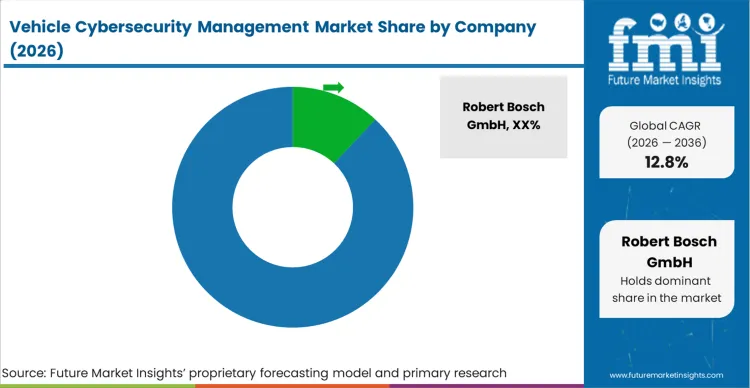
The vehicle cybersecurity management market is characterized by strong participation from automotive technology suppliers, cybersecurity software developers, and specialized mobility security firms. Companies in this sector focus on protecting vehicle networks, electronic control units, and cloud connected vehicle platforms from cyber threats. Market participants are investing in advanced threat detection platforms, intrusion monitoring systems, and secure communication technologies designed specifically for automotive environments. Integration of artificial intelligence driven monitoring tools and real time network protection systems is becoming a key strategy among cybersecurity solution providers serving automotive manufacturers.
Strategic collaboration between automakers and cybersecurity technology companies is shaping competition in the market. Automotive manufacturers are partnering with security software developers to integrate cybersecurity management systems directly into vehicle architecture during development stages. These partnerships help ensure secure over the air software updates, encrypted vehicle communication systems, and continuous monitoring of digital vehicle networks. Technology firms are focusing on scalable cybersecurity platforms capable of protecting large connected vehicle fleets and cloud based mobility services.
Companies are expanding research and development activities to strengthen automotive specific cybersecurity capabilities. Development efforts focus on secure gateway technologies, anomaly detection platforms, and cloud based vehicle security monitoring systems. Market players are investing in cybersecurity testing laboratories and simulation platforms that evaluate potential vulnerabilities in connected vehicle systems. Continuous innovation in vehicle software security, data encryption technologies, and digital threat intelligence is intensifying competition within the global vehicle cybersecurity management market.
Key Players in Vehicle Cybersecurity Management Market
- Robert Bosch GmbH
- Continental AG
- Aptiv PLC
- DENSO Corporation
- Harman International
- Upstream Security Ltd.
- Karamba Security
- FPT Software
Scope of the Report
| Metric | Value |
|---|---|
| Quantitative Units | USD 5.4 billion (2026) to USD 17.9 billion (2036), at a CAGR of 12.8% |
| Market Definition | The vehicle cybersecurity management market comprises the global development, production, and deployment of security technologies protecting vehicle networks, electronic control units, and wireless communication channels including connected passenger vehicles, commercial fleets, and autonomous platforms designed for automotive cybersecurity operations across manufacturing and aftermarket applications. |
| Offering Segmentation | Hardware, Software, Services |
| Security Type Coverage | Network Security, Application Security, Endpoint Security, Cloud Security |
| Deployment Segmentation | In-Vehicle Cybersecurity, External Cloud Cybersecurity |
| Approach Coverage | Intrusion Detection System (IDS), Security Operations Center (SOC) / Vehicle SOC |
| Vehicle Type Segmentation | Passenger Vehicles, Light Commercial Vehicles, Heavy Commercial Vehicles |
| Propulsion Type Coverage | Internal Combustion Engine (ICE) Vehicles, Electric Vehicles (EVs) |
| Vehicle Autonomy Segmentation | Non-Autonomous Vehicles, Semi-Autonomous Vehicles, Autonomous Vehicles |
| Application Coverage | ADAS & Safety Systems, Infotainment Systems, Body Control & Comfort Systems, Telematics, Powertrain Systems, Communication Systems |
| Regions Covered | North America, Latin America, Europe, East Asia, South Asia, Oceania, Middle East and Africa |
| Countries Covered | United States, Canada, United Kingdom, Germany, France, China, Japan, India, Brazil, UAE and 40 countries |
| Key Companies Profiled | Robert Bosch GmbH, Continental AG, Aptiv PLC, DENSO Corporation, Harman International, Upstream Security Ltd., Karamba Security, FPT Software |
| Forecast Period | 2026 to 2036 |
| Approach | Hybrid top down and bottom up market modeling validated through automotive procurement tracking and connected vehicle deployment surveys, supported by regulatory compliance verification and security incident analysis |
Vehicle Cybersecurity Management Market Analysis by Segments
Offering
- Hardware
- Software
- Services
Security Type
- Network Security
- Application Security
- Endpoint Security
- Cloud Security
Deployment
- In-Vehicle Cybersecurity
- External Cloud Cybersecurity
Approach
- Intrusion Detection System (IDS)
- Security Operations Center (SOC) / Vehicle SOC
Vehicle Type
- Passenger Vehicles
- Light Commercial Vehicles
- Heavy Commercial Vehicles
Propulsion Type
- Internal Combustion Engine (ICE) Vehicles
- Electric Vehicles (EVs)
Vehicle Autonomy
- Non-Autonomous Vehicles
- Semi-Autonomous Vehicles
- Autonomous Vehicles
Application
- ADAS & Safety Systems
- Infotainment Systems
- Body Control & Comfort Systems
- Telematics
- Powertrain Systems
- Communication Systems
Region
- Asia Pacific
- China
- Japan
- South Korea
- India
- Australia
- Singapore
- Thailand
- Rest of Asia Pacific
- Europe
- United Kingdom
- Germany
- France
- Italy
- Spain
- Netherlands
- Scandinavia
- Switzerland
- Rest of Europe
- North America
- United States
- Canada
- Latin America
- Brazil
- Mexico
- Argentina
- Rest of Latin America
- Middle East & Africa
- United Arab Emirates
- Saudi Arabia
- South Africa
- Israel
- Rest of Middle East & Africa
Bibliography
- [1] Karamba Security. (2023, September 4). Karamba and Upstream partner to deliver an end-to-end automotive threat & vulnerability management (TVM) solution.
- [2] USA Department of Transportation. (2024, March 14). Biden-Harris administration announces investments in innovative transportation technology projects.
- [3] Invest India. (n.d.). Electric mobility.
- [4] European Environment Agency. (2025, November 6). New registrations of electric cars in Europe.
- [5] FPT Software. (2023). FPT and Cymotive form strategic alliance to advance automotive cybersecurity innovation.
- [6] Upstream Security. (2023). Upstream Security and Otorio partner to strengthen cybersecurity posture.
This bibliography is provided for reader reference and is not exhaustive. The full report contains the complete reference list and detailed citations.
This Report Addresses
- Market intelligence to enable strategic decision making across established and emerging automotive cybersecurity markets
- Market size estimation and 10-year revenue forecasts from 2026 to 2036, supported by validated automotive procurement data and connected vehicle deployment surveys
- Growth opportunity mapping across security types and vehicle segments with emphasis on threat protection optimization
- Segment and regional revenue forecasts covering network security, application protection frameworks, endpoint defense systems, and automotive supplier integration networks
- Competition strategy assessment including original equipment manufacturer partnership requirements, automotive-grade certification positioning, and regulatory compliance standard adoption
- Product development tracking including intrusion detection innovations, artificial intelligence integration trends, and over-the-air update capabilities
- Market access analysis covering automotive manufacturer agreements, tier-1 supplier partnerships, and aftermarket security solution programs
- Market report delivery in PDF, Excel, PPT, and interactive dashboard formats for executive and operational use
Frequently Asked Questions
How large is the demand for Vehicle Cybersecurity Management in the global market in 2026?
Demand for Vehicle Cybersecurity Management in the global market is estimated to be valued at USD 5.4 billion in 2026.
What will be the market size of Vehicle Cybersecurity Management in the global market by 2036?
Market size for Vehicle Cybersecurity Management is projected to reach USD 17.9 billion by 2036.
What is the expected demand growth for Vehicle Cybersecurity Management in the global market between 2026 and 2036?
Demand for Vehicle Cybersecurity Management in the global market is expected to grow at a CAGR of 12.8% between 2026 and 2036.
Which Vehicle Type is poised to lead global sales by 2026?
Passenger Vehicles is expected to be the dominant vehicle type, capturing approximately 61.0% of global market share in 2026 due to infotainment system protection requirements and telematics security capabilities.
How significant is the role of Network Security in driving Vehicle Cybersecurity Management adoption in 2026?
Network security represents a primary security type, projected to hold approximately 38% share of the total market in 2026 as protocol-level filtering capabilities and broader attack surface coverage maintain foundational protection relevance.
What is Driving Vehicle Cybersecurity Management Demand in the United States?
Connected vehicle infrastructure expansion and increased security protocol requirements across automotive production categories are driving growth.
What Consumer Trends are Referenced for the United States?
Connected vehicle adoption patterns and regulatory security standard enforcement programs are referenced as key manufacturer behavior shifts.
What is the United States Growth Outlook in this Report?
The United States is projected to grow at a CAGR of 9.9% during 2026 to 2036.
Why is Europe described as Important for Automotive Cybersecurity Development in this Report?
Growth is driven by UNECE WP.29 regulation compliance and vehicle type approval requirements that establish standardized security specifications.
What Type of Product Development Dominates in Europe?
Automotive-grade security solutions with regulatory compliance frameworks and certification-ready protection systems dominates regional market segments.
What is Germany Growth Outlook in this Report?
Germany is projected to expand at a CAGR of 13.3% during 2026 to 2036.
Does the Report Cover China in its Regional Analysis?
China is included within East Asia under the regional scope of analysis.
What are the Sources referred to for analyzing the Market in China?
Connected vehicle adoption data, electric vehicle platform statistics, and automotive cybersecurity implementation tracking covering deployment patterns, regulatory compliance analysis, and security preference evolution are cited as primary reference sources.
What is the Main Development Theme Linked to China in Asia Coverage?
Asia Pacific development is associated with domestic electric vehicle platform growth enabling security standardization across automotive production centers.
Does the Report Cover India in its Regional Analysis?
India is included within South Asia under the regional coverage framework.
What is the Main India Related Development Theme in Asia Coverage?
Rising automotive production capacity creating foundation for connected vehicle security adoption and local manufacturing using cost-effective implementation methods is emphasized.
Which Deployment Strategies are Strategically Important for Asia Pacific Market Entry?
Automotive manufacturer partnerships and tier-1 supplier integration programs are prioritized for cost-effective market penetration across regional automotive sectors.
What is Vehicle Cybersecurity Management and What is It Mainly Used For?
Vehicle cybersecurity management involves integrated security solutions primarily used for protecting connected vehicle systems including passenger cars, commercial fleets, and autonomous vehicle platforms.
What does Vehicle Cybersecurity Management Market Mean in this Report?
Vehicle cybersecurity management market refers to global development, manufacturing, and deployment of automotive security technologies across various vehicle categories and application segments.
What is Included in the Scope of this Vehicle Cybersecurity Management Market Report?
Scope covers security solutions by offering type, key security categories such as network protection and application security, and vehicle segments including passenger vehicles, commercial fleets, and autonomous platforms.
What is Excluded from the Scope of this Report?
Standalone cybersecurity consulting services, general IT security platforms, non-automotive embedded security solutions, and industrial control system protection frameworks are excluded unless part of automotive cybersecurity offerings.
What does Market Forecast Mean on this Page?
Market forecast represents model-based projections built on automotive procurement trends and connected vehicle deployment assumptions for strategic planning purposes.
How is the Vehicle Cybersecurity Management Market Forecast Built and Validated?
Forecast is developed using hybrid modeling validated through automotive manufacturer procurement data, connected vehicle deployment surveys, and regulatory compliance verification.
What does Zero Reliance on Speculative Third Party Market Research Mean Here?
Market analysis is based on verifiable automotive integration figures, connected vehicle deployment data, and regulatory implementation patterns rather than speculative automotive technology trend predictions.
Preview the report firsthand - request a free sample
Get SampleGet the brochure for pricing and purchase details.
Get PDF

