

- Industry Size (2026)
- USD 2.8 Bn
- Forecast (2036)
- USD 4.7 Bn
- CAGR (2026 to 2036)
- 5.3%
In-Vehicle Intrusion Detection & Forensics Platforms for Connected Fleets Market Forecast and Outlook 2026 to 2036
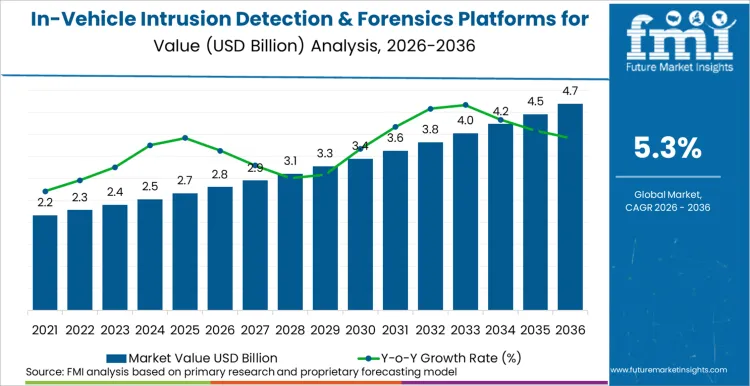
The global in-vehicle intrusion detection and forensics platforms market is forecasted to reach USD 2.8 billion in 2026 and expand to USD 4.7 billion by 2036, advancing at a CAGR of 5.3%. As per FMI, this outlook shows a transformation in automotive cybersecurity toward multi-layered defense systems, where traditional signature-based detection methods are evolving toward behavior-based monitoring platforms. Expansion is driven by the rising number of connected vehicles and increasing cyber threats targeting fleet management systems, with automotive manufacturers and fleet operators implementing specialized security frameworks across commercial and passenger vehicle categories globally.
By leveraging advanced machine learning algorithms and real-time data analytics, security providers can now develop platforms that offer continuous monitoring capabilities and automated incident response through improved threat correlation systems and forensic analysis tools. This technological advancement allows for the creation of comprehensive security ecosystems with enhanced threat intelligence and reduced false positive rates, effectively addressing fleet operator demands for proactive cybersecurity measures while maintaining operational continuity throughout extended deployment cycles.
Companies are investing significantly in cybersecurity innovation to enhance fleet protection capabilities. In January 2026, Palo Alto Networks acquired Chronosphere, unifying observability and security for the AI era. "Enterprises today are looking for fewer vendors, deeper partnerships, and platforms they can rely on for mission-critical security and operations. Chronosphere accelerates our vision to be the indispensable platform for securing and operating the cloud and AI. We believe that great security starts with deep visibility into all your data, and Chronosphere provides that foundation for our customers."- Nikesh Arora, Chairman and CEO, Palo Alto Networks
The industry's value proposition is shifting from basic threat detection functionality toward comprehensive security operations centers that address specific fleet vulnerability requirements. Advanced security providers are integrating behavioral analytics, automated response systems, and compliance reporting tools to reduce security gaps while improving incident response times. Specialized cybersecurity vendors are gaining preference among fleet operators, enabling direct integration partnerships and customized threat detection solutions across commercial transportation, logistics, and emergency services sectors.
Summary of In-Vehicle Intrusion Detection & Forensics Platforms for Connected Fleets Market
What is the growth outlook on the in-vehicle intrusion detection and forensics platforms market?
Future Market Insights projects the market to grow at a 5.3% CAGR from 2026 to 2036, expanding from USD 2.8 billion to USD 4.7 billion.
FMI research approach: Bottom-up cybersecurity revenue modeling, threat landscape analysis, fleet operator security spending assessment, and detection platform performance evaluation.
How do FMI analysts perceive the in-vehicle intrusion detection and forensics platforms market to evolve?
The market is expected to move from signature-based detection toward advanced behavioral analytics integrating AI-driven threat correlation and automated incident response features.
FMI research approach: Cybersecurity technology trend analysis, threat detection integration mapping, fleet security demand assessment, and platform effectiveness benchmarking.
Which country holds the largest share in the in-vehicle intrusion detection and forensics platforms market?
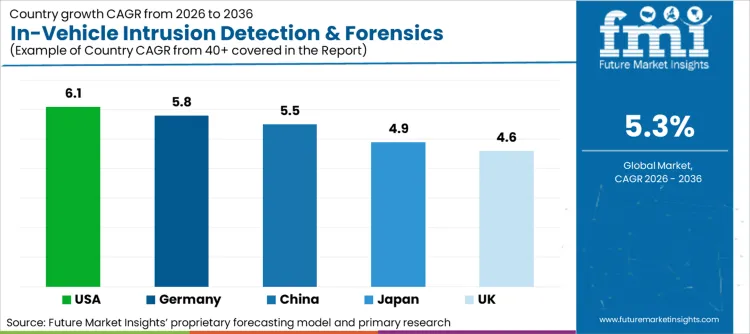
United States accounts for the largest global value share with a projected CAGR of 6.1%.
FMI research approach: Country-level cybersecurity investment modeling, fleet density analysis, regulatory compliance evaluation, and threat intelligence capacity assessment.
How large will the in-vehicle intrusion detection and forensics platforms market be by 2036?
The global market is forecast to reach USD 4.7 billion by 2036.
FMI research approach: Long-term forecasting by deployment model and application focus, security spending scaling analysis, regional adoption validation, and historical threat patterns.
What is the market definition of in-vehicle intrusion detection and forensics platforms?
It covers cybersecurity solutions designed for real-time threat detection and incident investigation within connected vehicle systems across commercial and passenger fleet applications.
FMI research approach: Security taxonomy validation, threat scope mapping, platform classification by deployment category, and detection mechanism functionality assessment.
What globally unique trends are shaping the in-vehicle intrusion detection and forensics platforms market?
Key trends include AI integration advancement, behavioral analytics adoption, and regulatory compliance enhancement for critical infrastructure protection.
FMI research approach: Technology adoption tracking, machine learning development analysis, regulatory requirement monitoring, and competitive innovation assessment.
In-Vehicle Intrusion Detection & Forensics Platforms for Connected Fleets Market Key Takeaways
| Metric | Value |
|---|---|
| Market Value (2026) | USD 2.8 billion |
| Market Forecast Value (2036) | USD 4.7 billion |
| Forecast CAGR (2026 to 2036) | 5.3% |
Source: Future Market Insights (FMI) analysis, based on proprietary forecasting model and primary research
What is Driving the Demand for In-Vehicle Intrusion Detection & Forensics Platforms?
Demand for in-vehicle intrusion detection and forensics platforms is being propelled by the exponential growth in connected vehicle deployments and the corresponding increase in cyber attack vectors targeting automotive systems. The escalating complexity of vehicle communication networks, including V2V, V2I, and cloud connectivity, has amplified demand for comprehensive cybersecurity solutions that provide real-time threat monitoring and automated incident response capabilities across entire fleet operations.
The regulatory momentum toward automotive cybersecurity standards, exemplified by updated UNECE WP.29 regulations for automotive cybersecurity management systems, is driving widespread adoption of certified intrusion detection platforms and compliance-focused forensics capabilities in commercial fleet workflows. Manufacturers are responding to these requirements through specialized security architectures that integrate threat intelligence without compromising vehicle performance. The expanding autonomous vehicle deployment in logistics and transportation sectors is shifting security focus toward predictive threat detection solutions, underscoring a sustained demand trajectory rooted in operational continuity and regulatory compliance requirements.
How is the In-Vehicle Intrusion Detection & Forensics Platforms Market Segmented?
The in-vehicle intrusion detection and forensics platforms market has been segmented based on component type, deployment model, and application. In terms of component type, the market is divided into hardware, software, and services. By deployment model, the market includes on-premises, cloud-based, and hybrid configurations. By application, the market is segmented into commercial fleets, passenger vehicles, emergency services, and logistics operations. Regionally, the market spans North America, Europe, Asia Pacific, Latin America, and Middle East and Africa.
Why Do Software Components Dominate the In-Vehicle Intrusion Detection & Forensics Platforms Market?
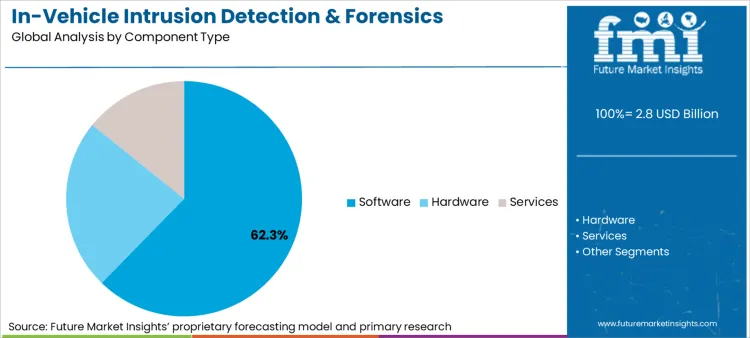
Software components continue to lead the market, accounting for 62.3% of the share, driven by their scalability in deployment processes, cost-effectiveness, and adaptability to various vehicle architectures. This component type offers the flexibility needed for complex threat detection algorithms while maintaining performance across different hardware configurations, making it essential for commercial fleet, passenger vehicle, and emergency services applications. Software platforms provide security teams with customization capabilities for threat signatures and behavioral analytics while supporting large-scale fleet monitoring requirements.
Hardware components capture a smaller but significant portion of the market, supporting specialized deployment scenarios where dedicated processing power and network isolation are critical factors. Services remain popular for specific implementations requiring ongoing threat intelligence and incident response support, particularly in commercial fleet and critical infrastructure segments where operational expertise and regulatory compliance justify higher service costs.
How Do Application Requirements Influence In-Vehicle Intrusion Detection Platform Selection?
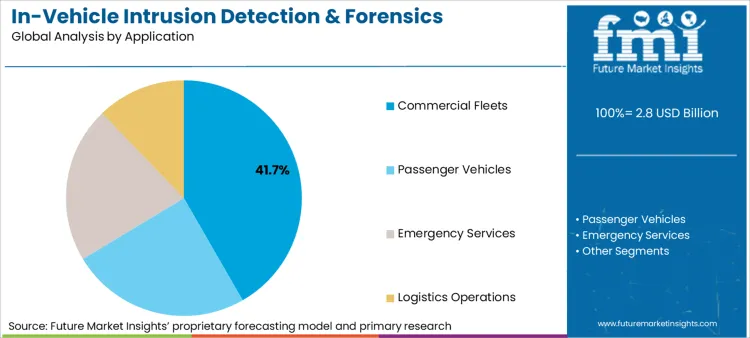
Commercial fleet applications stand as the dominant segment, commanding 41.7% of the market share. In-vehicle intrusion detection platforms remain centered on fleet applications due to the exceptional threat visibility these systems offer in asset protection and operational continuity. Commercial fleets often require comprehensive monitoring capabilities and centralized threat management, making behavioral analytics ideal for proactive threat detection while maintaining operational efficiency throughout extended deployment periods.
The market is shaped by the development of fleet-specific security protocols and enhanced threat correlation technologies that require rigorous testing to establish operational reliability and regulatory compliance. Emergency services applications demand specialized platforms that integrate priority-based alerting and rapid incident response mechanisms to prevent service disruption while ensuring critical communication security. Companies are expanding their capabilities to address these specialized requirements. Advanced validation protocols help developers optimize detection accuracy and ensure consistent performance across different operational environments, making these testing services essential for regulatory approval and operational acceptance.
How Is Technological Evolution Reshaping In-Vehicle Intrusion Detection & Forensics Platforms?
The in-vehicle connectivity, intrusion detection, and forensics platforms sector is shifting from traditional signature-based detection to integrated AI-driven platforms that combine behavioral analytics, predictive threat modeling, and automated incident response. Strategic partnerships between cybersecurity specialists and automotive manufacturers are accelerating this transition toward more sophisticated threat detection solutions. This evolution brings intrusion detection platforms closer to enterprise-grade standards by enabling more accurate threat identification and enhanced forensic capabilities using advanced machine learning and behavioral analysis innovations.
Improved algorithmic design reduces false positive rates during threat detection cycles and enhances security team efficiency through automated correlation and consistent threat prioritization. The ability to customize detection parameters and incorporate threat intelligence feeds is reshaping security strategy decisions, allowing fleet operators to address specific threat landscapes while maintaining operational performance and regulatory compliance requirements.
How Is the In-Vehicle Intrusion Detection & Forensics Platforms Market Evolving Globally?
Global demand for in-vehicle intrusion detection and forensics platforms is increasing as fleet operators expand connected vehicle deployments while addressing cybersecurity requirements, threat detection specifications, and regulatory compliance across commercial transportation, passenger vehicle, and emergency services applications. Growth demonstrates rising adoption of AI-driven security systems, application-specific threat modeling, and performance-optimized detection mechanisms across automotive manufacturers, fleet management companies, and cybersecurity specialists. Platform selection focuses on detection accuracy, operational efficiency, and regulatory compliance under various deployment scenarios.
United States records 6.1% CAGR, Germany records 5.8% CAGR, China records 5.5% CAGR, Japan records 4.9% CAGR, and United Kingdom records 4.6% CAGR. Adoption remains driven by cybersecurity requirements and regulatory compliance rather than fleet expansion alone.
| Country | CAGR (2026-2036) |
|---|---|
| United States | 6.1% |
| Germany | 5.8% |
| China | 5.5% |
| Japan | 4.9% |
| United Kingdom | 4.6% |
Source: FMI historical analysis and forecast data
United States: How is Regulatory Framework Development Driving Market Growth?
The primary driver in the United States is the significant advancement of federal cybersecurity regulations and connected vehicle security standards. With the growth of autonomous vehicle testing and commercial fleet digitization, American transportation sectors are experiencing substantial increases in cybersecurity platform demand, making traditional perimeter security methods insufficient for current threat landscapes. This has promoted advanced detection technology adoption for commercial fleet operations to ensure operational continuity and regulatory compliance.
Driven by this national scale of connected vehicle expansion, the American in-vehicle intrusion detection and forensics platforms market is set to grow at a 6.1% CAGR during the study period, led by massive demand in commercial fleet and emergency services sectors. Over the next five years, the most significant opportunity lies in the integration of AI-driven threat detection with automated incident response systems. As the United States targets leadership in autonomous vehicle deployment, there is growing demand for comprehensive security solutions that support complex threat landscapes and high-availability operational requirements.
Germany: Is Automotive Industry Innovation Bolstering Cybersecurity Standards?
In Germany, the market is dominated by the evolution toward integrated cybersecurity architectures and precision-engineered security solutions. This technology-first approach is essential for German automotive manufacturers competing in global connected vehicle markets. The German in-vehicle intrusion detection and forensics platforms market is projected to grow at a 5.8% CAGR during the study period.
Over the next five years, the expansion of Industry 4.0 integration and manufacturing digitization will necessitate advanced cybersecurity solutions for automotive production and fleet management systems. Germany's leadership role in automotive engineering creates opportunities for comprehensive security platforms that meet international cybersecurity standards while addressing European regulatory requirements and operational efficiency specifications.
China: Will Connected Vehicle Infrastructure Drive Security Platform Adoption?
China's in-vehicle intrusion detection and forensics platforms market is shaped by massive connected vehicle infrastructure development and smart city integration capabilities. Chinese manufacturers are adopting advanced cybersecurity technologies that integrate scalability assurance with innovative threat detection features for domestic market leadership. The Chinese in-vehicle intrusion detection and forensics platforms market is expected to grow at a 5.5% CAGR during the study period.
Over the next five years, opportunities exist in developing specialized platforms for electric vehicle fleets and autonomous transportation systems. As Chinese companies maintain leadership in electric vehicle production, there is significant demand for security solutions that integrate advanced threat detection, regulatory compliance, and operational efficiency to serve both domestic and export markets effectively.
Japan: How is Automotive Technology Leadership Reinforcing Security Innovation?
The growth of the in-vehicle intrusion detection and forensics platforms market in Japan is primarily driven by automotive technology advancement and precision manufacturing integration. Japanese automotive companies are developing next-generation security architectures that combine traditional reliability engineering with advanced cybersecurity capabilities. As Japanese manufacturers maintain leadership in automotive innovation, companies are implementing comprehensive security frameworks that address both domestic regulatory requirements and international cybersecurity standards.
The market is being propelled by the integration of connected vehicle technologies with existing automotive safety systems, creating demand for security platforms that can protect complex vehicle networks without compromising performance. Advanced threat detection systems are becoming essential for maintaining competitive advantage in global automotive markets, where cybersecurity capabilities directly influence consumer confidence and regulatory approval processes.
United Kingdom: How is Commercial Fleet Digitization Shaping Security Requirements?
The United Kingdom market focuses on commercial fleet security and specialized applications for logistics and emergency services operations. This approach emphasizes regulatory compliance and operational continuity while maintaining competitive positioning in European markets. The United Kingdom in-vehicle intrusion detection and forensics platforms market is set to grow at a 4.6% CAGR during the study period.
Over the next five years, opportunities lie in developing specialized platforms for critical infrastructure protection and emergency response systems. As regulatory requirements become more stringent for commercial fleet operations, there is growing demand for security solutions that integrate comprehensive threat detection, incident response capabilities, and compliance reporting functionality while maintaining operational efficiency and service reliability.
Who are the Major Players Active in the In-Vehicle Intrusion Detection & Forensics Platforms Market?
With connected vehicle deployments becoming more complex and cybersecurity threats being more sophisticated, major players like CrowdStrike Holdings Inc, Palo Alto Networks Inc, and FireEye Inc are competing on their ability to offer comprehensive cybersecurity solutions that integrate threat detection precision with incident response automation. These industry leaders are investing in advanced AI technologies and threat intelligence capabilities to provide seamless integration solutions, allowing fleet operators to focus on operational efficiency while outsourcing specialized cybersecurity requirements.
The market is observing distinct regional specialization in competitive strategy. While North American firms like Symantec Corporation and McAfee LLC maintain leadership through regulatory expertise and proximity to major automotive manufacturers, European players like Kaspersky Lab and ESET are advancing behavioral analytics and automated response capabilities. This has created an innovation cycle where cybersecurity providers are diversifying into specialized applications such as autonomous vehicle protection and critical infrastructure security to address the complex requirements of commercial fleet and emergency services sectors.
Key Industry Developments:
- In January 2026, CrowdStrike announced to acquire SGNL, a leader in Continuous Identity. This acquisition will accelerate CrowdStrike’s leadership in Next-Gen Identity Security, enabling access for human, non-human (NHI), and AI identities to be continuously granted and revoked based on real-time risk.
- In September 2025, Check Point® Software Technologies Ltd., a pioneer and global leader of cyber security solutions, announced it has entered into an agreement to acquire Lakera, one of the world’s leading AI-native security platforms for Agentic AI applications.
Key Players in the In-Vehicle Intrusion Detection & Forensics Platforms Market
- CrowdStrike Holdings Inc
- Palo Alto Networks Inc
- FireEye Inc
- Symantec Corporation
- McAfee LLC
- Kaspersky Lab
- ESET
- Trend Micro Inc
- Check Point Software Technologies Ltd
Market Definition
The in-vehicle intrusion detection and forensics platforms market refers to the global cybersecurity applications of specialized threat detection systems designed to support real-time monitoring and incident investigation within connected vehicle networks through automated analysis capabilities. It includes both standard and AI-enhanced detection offerings, with segments that cater to various deployment requirements such as commercial fleets, passenger vehicles, and emergency services. The market size is measured in USD billion and analyzed over the 2026 to 2036 period.
The in-vehicle intrusion detection and forensics platforms market includes cybersecurity systems categorized by component type, deployment model, and application category, utilized through fleet management operations and automotive manufacturing applications. The market is expanding due to growing demand for proactive threat detection, cybersecurity compliance requirements, and evolving threat landscapes targeting connected vehicle infrastructure and operational continuity capabilities.
Market Inclusion
Included in the in-vehicle intrusion detection and forensics platforms market scope are cybersecurity systems categorized by component type (hardware, software, services), deployment model (on-premises, cloud-based, hybrid), and application (commercial fleets, passenger vehicles, emergency services, logistics operations). The scope includes detection platforms with focus on real-time monitoring, automated incident response, and regulatory compliance, particularly those marketed through cybersecurity specialists, automotive manufacturers, and fleet management companies.
Geographically, the market encompasses key regions such as North America, Europe, Asia Pacific, Latin America, and the Middle East and Africa, with country-level analysis for significant markets like United States, Germany, China, Japan, United Kingdom, France, and Canada.
Market Exclusion
Excluded from the in-vehicle intrusion detection and forensics platforms market scope are general cybersecurity solutions and systems not designed for automotive applications, such as enterprise network security, consumer endpoint protection, and generic threat detection platforms. Additionally, systems not intended for vehicle-specific threat detection are not included.
The market excludes non-automotive cybersecurity products, as well as detection systems that are not marketed as vehicle-integrated platforms, such as perimeter security or facility-based monitoring systems. Products with non-compliant security specifications or those that do not meet automotive cybersecurity standards for connected vehicle applications are outside the market's defined scope.
Scope of the Report
| Items | Values |
|---|---|
| Quantitative Units | USD 2.8 billion |
| Component Type | Hardware; Software; Services |
| Deployment Model | On-premises; Cloud-based; Hybrid |
| Application | Commercial Fleets; Passenger Vehicles; Emergency Services; Logistics Operations |
| Regions Covered | North America, Europe, Asia Pacific, Latin America, Middle East & Africa |
| Countries Covered | United States, Germany, China, Japan, United Kingdom, France, Canada, and 35+ countries |
| Key Companies Profiled | CrowdStrike Holdings Inc; Palo Alto Networks Inc; FireEye Inc; Symantec Corporation; McAfee LLC; Others |
| Additional Attributes | Revenue analysis by component type and application; performance in threat detection and incident response across fleet operators, automotive manufacturers, and cybersecurity specialists; detection accuracy enhancement, response time optimization, and platform reliability under various deployment scenarios; impact on operational security, threat mitigation, and cybersecurity compliance during implementation processes; compatibility with vehicle architectures and fleet management systems; procurement dynamics driven by security positioning, regulatory compliance programs, and long-term protection partnerships. |
In-Vehicle Intrusion Detection & Forensics Platforms Market by Segment
Component Type:
- Hardware
- Software
- Services
Deployment Model:
- On-premises
- Cloud-based
- Hybrid
Application:
- Commercial Fleets
- Passenger Vehicles
- Emergency Services
- Logistics Operations
Region:
- Asia Pacific
- China
- Japan
- India
- South Korea
- Australia
- Southeast Asia
- Rest of Asia Pacific
- Europe
- Germany
- United Kingdom
- France
- Italy
- Spain
- Netherlands
- Nordic
- Rest of Europe
- North America
- United States
- Canada
- Mexico
- Latin America
- Brazil
- Argentina
- Chile
- Colombia
- Rest of Latin America
- Middle East & Africa
- Kingdom of Saudi Arabia
- United Arab Emirates
- Turkey
- South Africa
- Other GCC Countries
- Rest of Middle East & Africa
Bibliography
- National Institute of Standards and Technology. (2023). Cybersecurity framework for connected and automated vehicles (NIST SP 1800-32). USA Department of Commerce. https://www.nccoe.nist.gov/projects/building-blocks/cybersecurity-framework-connected-and-automated-vehicles
- European Union Agency for Cybersecurity. (2024). Good practices for the security of smart cars. ENISA. https://www.enisa.europa.eu/publications/good-practices-for-the-security-of-smart-cars
- UNECE. (2022). UN Regulation No. 155: Cyber security and cyber security management system. United Nations Economic Commission for Europe.
Frequently Asked Questions
How big is the in-vehicle intrusion detection & forensics platforms for connected fleets market in 2026?
The global in-vehicle intrusion detection & forensics platforms for connected fleets market is estimated to be valued at USD 2.8 billion in 2026.
What will be the size of in-vehicle intrusion detection & forensics platforms for connected fleets market in 2036?
The market size for the in-vehicle intrusion detection & forensics platforms for connected fleets market is projected to reach USD 4.7 billion by 2036.
How much will be the in-vehicle intrusion detection & forensics platforms for connected fleets market growth between 2026 and 2036?
The in-vehicle intrusion detection & forensics platforms for connected fleets market is expected to grow at a 5.3% CAGR between 2026 and 2036.
What are the key product types in the in-vehicle intrusion detection & forensics platforms for connected fleets market?
The key product types in in-vehicle intrusion detection & forensics platforms for connected fleets market are software, hardware and services.
Which application segment to contribute significant share in the in-vehicle intrusion detection & forensics platforms for connected fleets market in 2026?
In terms of application, commercial fleets segment to command 41.7% share in the in-vehicle intrusion detection & forensics platforms for connected fleets market in 2026.
Preview the report firsthand - request a free sample
Get SampleGet the brochure for pricing and purchase details.
Get PDFTable of Content
- Global Market Outlook
- Demand-side Trends
- Supply-side Trends
- Market Overview
- Market Coverage / Taxonomy
- Market Definition / Scope / Limitations
- Research Methodology
- Chapter Orientation
- Analytical Lens and Working Hypotheses
- Market Structure, Signals, and Trend Drivers
- Benchmarking and Cross-market Comparability
- Market Sizing, Forecasting, and Opportunity Mapping
- Research Design and Evidence Framework
- Desk Research Programme (Secondary Evidence)
- Company Annual and Sustainability Reports
- Peer-reviewed Journals and Academic Literature
- Corporate Websites, Product Literature, and Technical Notes
- Earnings Decks and Investor Briefings
- Statutory Filings and Regulatory Disclosures
- Technical White Papers and Standards Notes
- Expert Input and Fieldwork (Primary Evidence)
- Primary Modes
- Qualitative Interviews and Expert Elicitation
- Quantitative Surveys and Structured Data Capture
- Blended Approach
- Why Primary Evidence is Used
- Field Techniques
- Interviews
- Surveys
- Focus Groups
- Observational and In-context Research
- Social and Community Interactions
- Stakeholder Universe Engaged
- C-suite Leaders
- Board Members
- Presidents and Vice Presidents
- R&D and Innovation Heads
- Technical Specialists
- Domain Subject-matter Experts
- Scientists
- Physicians and Other Healthcare Professionals
- Governance, Ethics, and Data Stewardship
- Research Ethics
- Data Integrity and Handling
- Primary Modes
- Tooling, Models, and Reference Databases
- Data Engineering and Model Build
- Data Acquisition and Ingestion
- Cleaning, Normalisation, and Verification
- Synthesis, Triangulation, and Analysis
- Quality Assurance and Audit Trail
- Desk Research Programme (Secondary Evidence)
- Market Background
- Market Dynamics
- Drivers
- Restraints
- Opportunity
- Trends
- Scenario Forecast
- Demand in Optimistic Scenario
- Demand in Likely Scenario
- Demand in Conservative Scenario
- Opportunity Map Analysis
- Product Life Cycle Analysis
- Supply Chain Analysis
- Investment Feasibility Matrix
- Value Chain Analysis
- PESTLE and Porter’s Analysis
- Regulatory Landscape
- Regional Parent Market Outlook
- Production and Consumption Statistics
- Import and Export Statistics
- Market Dynamics
- Global Market Analysis 2021 to 2025 and Forecast, 2026 to 2036
- Historical Market Size Value (USD Million) Analysis, 2021 to 2025
- Current and Future Market Size Value (USD Million) Projections, 2026 to 2036
- Y-o-Y Growth Trend Analysis
- Absolute $ Opportunity Analysis
- Global Market Pricing Analysis 2021 to 2025 and Forecast 2026 to 2036
- Global Market Analysis 2021 to 2025 and Forecast 2026 to 2036, By Component Type
- Introduction / Key Findings
- Historical Market Size Value (USD Million) Analysis By Component Type , 2021 to 2025
- Current and Future Market Size Value (USD Million) Analysis and Forecast By Component Type , 2026 to 2036
- Software
- Hardware
- Services
- Software
- Y-o-Y Growth Trend Analysis By Component Type , 2021 to 2025
- Absolute $ Opportunity Analysis By Component Type , 2026 to 2036
- Global Market Analysis 2021 to 2025 and Forecast 2026 to 2036, By Application
- Introduction / Key Findings
- Historical Market Size Value (USD Million) Analysis By Application, 2021 to 2025
- Current and Future Market Size Value (USD Million) Analysis and Forecast By Application, 2026 to 2036
- Commercial Fleets
- Passenger Vehicles
- Emergency Services
- Logistics Operations
- Commercial Fleets
- Y-o-Y Growth Trend Analysis By Application, 2021 to 2025
- Absolute $ Opportunity Analysis By Application, 2026 to 2036
- Global Market Analysis 2021 to 2025 and Forecast 2026 to 2036, By Region
- Introduction
- Historical Market Size Value (USD Million) Analysis By Region, 2021 to 2025
- Current Market Size Value (USD Million) Analysis and Forecast By Region, 2026 to 2036
- North America
- Latin America
- Western Europe
- Eastern Europe
- East Asia
- South Asia and Pacific
- Middle East & Africa
- Market Attractiveness Analysis By Region
- North America Market Analysis 2021 to 2025 and Forecast 2026 to 2036, By Country
- Historical Market Size Value (USD Million) Trend Analysis By Market Taxonomy, 2021 to 2025
- Market Size Value (USD Million) Forecast By Market Taxonomy, 2026 to 2036
- By Country
- USA
- Canada
- Mexico
- By Component Type
- By Application
- By Country
- Market Attractiveness Analysis
- By Country
- By Component Type
- By Application
- Key Takeaways
- Latin America Market Analysis 2021 to 2025 and Forecast 2026 to 2036, By Country
- Historical Market Size Value (USD Million) Trend Analysis By Market Taxonomy, 2021 to 2025
- Market Size Value (USD Million) Forecast By Market Taxonomy, 2026 to 2036
- By Country
- Brazil
- Chile
- Rest of Latin America
- By Component Type
- By Application
- By Country
- Market Attractiveness Analysis
- By Country
- By Component Type
- By Application
- Key Takeaways
- Western Europe Market Analysis 2021 to 2025 and Forecast 2026 to 2036, By Country
- Historical Market Size Value (USD Million) Trend Analysis By Market Taxonomy, 2021 to 2025
- Market Size Value (USD Million) Forecast By Market Taxonomy, 2026 to 2036
- By Country
- Germany
- UK
- Italy
- Spain
- France
- Nordic
- BENELUX
- Rest of Western Europe
- By Component Type
- By Application
- By Country
- Market Attractiveness Analysis
- By Country
- By Component Type
- By Application
- Key Takeaways
- Eastern Europe Market Analysis 2021 to 2025 and Forecast 2026 to 2036, By Country
- Historical Market Size Value (USD Million) Trend Analysis By Market Taxonomy, 2021 to 2025
- Market Size Value (USD Million) Forecast By Market Taxonomy, 2026 to 2036
- By Country
- Russia
- Poland
- Hungary
- Balkan & Baltic
- Rest of Eastern Europe
- By Component Type
- By Application
- By Country
- Market Attractiveness Analysis
- By Country
- By Component Type
- By Application
- Key Takeaways
- East Asia Market Analysis 2021 to 2025 and Forecast 2026 to 2036, By Country
- Historical Market Size Value (USD Million) Trend Analysis By Market Taxonomy, 2021 to 2025
- Market Size Value (USD Million) Forecast By Market Taxonomy, 2026 to 2036
- By Country
- China
- Japan
- South Korea
- By Component Type
- By Application
- By Country
- Market Attractiveness Analysis
- By Country
- By Component Type
- By Application
- Key Takeaways
- South Asia and Pacific Market Analysis 2021 to 2025 and Forecast 2026 to 2036, By Country
- Historical Market Size Value (USD Million) Trend Analysis By Market Taxonomy, 2021 to 2025
- Market Size Value (USD Million) Forecast By Market Taxonomy, 2026 to 2036
- By Country
- India
- ASEAN
- Australia & New Zealand
- Rest of South Asia and Pacific
- By Component Type
- By Application
- By Country
- Market Attractiveness Analysis
- By Country
- By Component Type
- By Application
- Key Takeaways
- Middle East & Africa Market Analysis 2021 to 2025 and Forecast 2026 to 2036, By Country
- Historical Market Size Value (USD Million) Trend Analysis By Market Taxonomy, 2021 to 2025
- Market Size Value (USD Million) Forecast By Market Taxonomy, 2026 to 2036
- By Country
- Kingdom of Saudi Arabia
- Other GCC Countries
- Turkiye
- South Africa
- Other African Union
- Rest of Middle East & Africa
- By Component Type
- By Application
- By Country
- Market Attractiveness Analysis
- By Country
- By Component Type
- By Application
- Key Takeaways
- Key Countries Market Analysis
- USA
- Pricing Analysis
- Market Share Analysis, 2025
- By Component Type
- By Application
- Canada
- Pricing Analysis
- Market Share Analysis, 2025
- By Component Type
- By Application
- Mexico
- Pricing Analysis
- Market Share Analysis, 2025
- By Component Type
- By Application
- Brazil
- Pricing Analysis
- Market Share Analysis, 2025
- By Component Type
- By Application
- Chile
- Pricing Analysis
- Market Share Analysis, 2025
- By Component Type
- By Application
- Germany
- Pricing Analysis
- Market Share Analysis, 2025
- By Component Type
- By Application
- UK
- Pricing Analysis
- Market Share Analysis, 2025
- By Component Type
- By Application
- Italy
- Pricing Analysis
- Market Share Analysis, 2025
- By Component Type
- By Application
- Spain
- Pricing Analysis
- Market Share Analysis, 2025
- By Component Type
- By Application
- France
- Pricing Analysis
- Market Share Analysis, 2025
- By Component Type
- By Application
- India
- Pricing Analysis
- Market Share Analysis, 2025
- By Component Type
- By Application
- ASEAN
- Pricing Analysis
- Market Share Analysis, 2025
- By Component Type
- By Application
- Australia & New Zealand
- Pricing Analysis
- Market Share Analysis, 2025
- By Component Type
- By Application
- China
- Pricing Analysis
- Market Share Analysis, 2025
- By Component Type
- By Application
- Japan
- Pricing Analysis
- Market Share Analysis, 2025
- By Component Type
- By Application
- South Korea
- Pricing Analysis
- Market Share Analysis, 2025
- By Component Type
- By Application
- Russia
- Pricing Analysis
- Market Share Analysis, 2025
- By Component Type
- By Application
- Poland
- Pricing Analysis
- Market Share Analysis, 2025
- By Component Type
- By Application
- Hungary
- Pricing Analysis
- Market Share Analysis, 2025
- By Component Type
- By Application
- Kingdom of Saudi Arabia
- Pricing Analysis
- Market Share Analysis, 2025
- By Component Type
- By Application
- Turkiye
- Pricing Analysis
- Market Share Analysis, 2025
- By Component Type
- By Application
- South Africa
- Pricing Analysis
- Market Share Analysis, 2025
- By Component Type
- By Application
- USA
- Market Structure Analysis
- Competition Dashboard
- Competition Benchmarking
- Market Share Analysis of Top Players
- By Regional
- By Component Type
- By Application
- Competition Analysis
- Competition Deep Dive
- CrowdStrike Holdings Inc
- Overview
- Product Portfolio
- Profitability by Market Segments (Product/Age /Sales Channel/Region)
- Sales Footprint
- Strategy Overview
- Marketing Strategy
- Product Strategy
- Channel Strategy
- Palo Alto Networks Inc
- FireEye Inc
- Symantec Corporation
- McAfee LLC
- Kaspersky Lab
- ESET
- Trend Micro Inc
- Check Point Software Technologies Ltd
- CrowdStrike Holdings Inc
- Competition Deep Dive
- Assumptions & Acronyms Used


