

- Market Size (2026)
- USD 119.78 Bn
- Forecast (2036)
- USD 90.43 Bn
- CAGR (2026 to 2036)
- 15.1%
Connected Game Console Market Size, Market Forecast and Outlook By FMI
Summary of the Connected Game Console Market
- Demand and Growth Drivers
- Transition from physical game distribution to digital storefronts and subscription services is expanding recurring revenue models and increasing the value of connected console ecosystems.
- Growth of competitive esports and online multiplayer gaming is driving consumer demand for connected consoles with high-performance networking and streaming capabilities.
- Expansion of cloud gaming services is enabling console-quality gaming experiences without dedicated hardware upgrades, broadening market access in price-sensitive segments.
- Product and Segment View
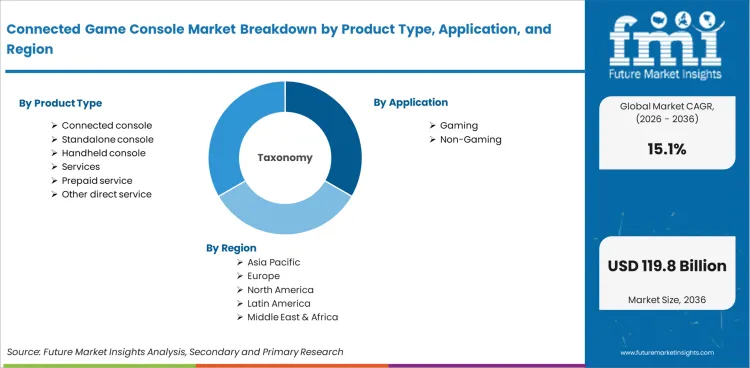
- Connected consoles are expected to hold 57.0% of the product type segment in 2026, driven by consumer preference for online gaming, digital game libraries, and integrated entertainment features.
- Gaming applications account for 78.0% of the application segment, reflecting the core entertainment function of console hardware and the growing role of digital content ecosystems.
- Residential users represent 81.0% of the end use segment, with consumer purchasing decisions shaped by exclusive game titles, online service quality, and hardware performance.
- Geography and Competitive Outlook
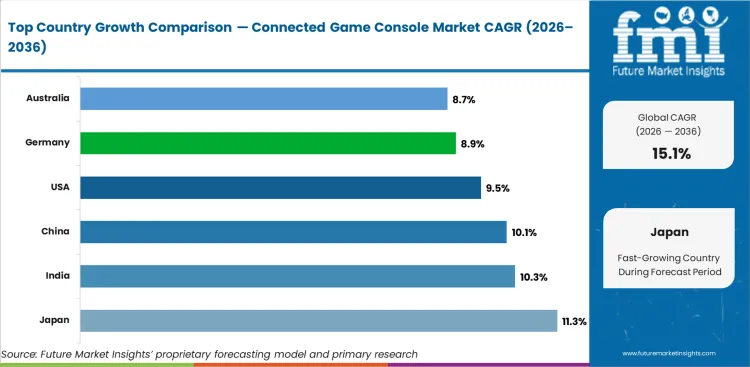
- Japan leads at 11.3% CAGR through 2036, reflecting strong domestic console culture, presence of major console manufacturers, and rapid adoption of next generation hardware.
- India at 10.3% and China at 10.1% are shaped by expanding middle class gaming populations and growing digital entertainment spending.
- Sony and Microsoft maintain competitive leadership through established console ecosystems, exclusive game title portfolios, and subscription service platforms.
- Analyst Opinion
- The connected game console market is transitioning from hardware-centric business models toward recurring revenue platforms built on digital game sales, subscription services, and cloud gaming delivery.
- Adoption is increasing due to the convergence of gaming consoles with broader entertainment platforms, where connected consoles serve as central home entertainment devices for streaming, social interaction, and content consumption.
- Demand is also shaped by the growing investment in exclusive game content, where first-party studio acquisitions and exclusive title agreements create ecosystem lock-in effects that influence hardware purchasing decisions.
- Companies that can build integrated ecosystems combining hardware, digital storefronts, subscription services, and cloud gaming delivery are positioned to capture the highest share of consumer entertainment spending. The shift toward services-based revenue models is structurally more valuable than hardware-only positioning.
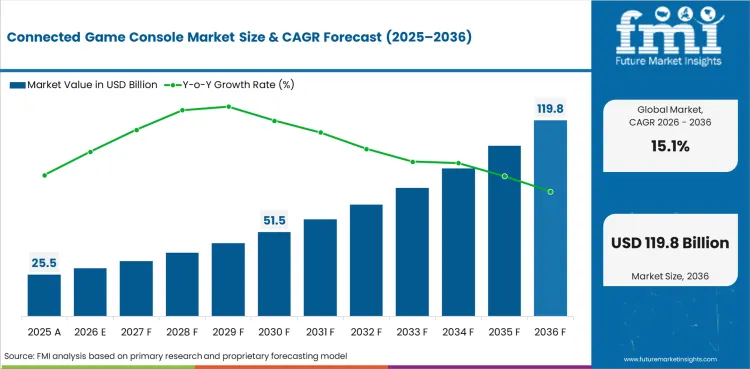
Key Takeaways
- The connected game console market was valued at USD 25.50 billion in 2025.
- By 2036, the Connected Game Console Market is expected to be worth USD 119.78 billion.
- From 2026 to 2036, the market is projected to expand at a CAGR of 15.1%.
- The market is projected to create an incremental opportunity of USD 90.43 billion between 2026 and 2036.
- In 2026, connected consoles is expected to account for 57.0% of the product type segment, driven by increasing consumer preference for online multiplayer, digital game distribution, and cloud gaming integration.
- Japan (11.3%) and India (10.3%) are two of the fastest growing markets in the world.
Connected Game Console Market Definition
The connected game console market encompasses internet-enabled gaming hardware and associated digital services that support online multiplayer gaming, digital game distribution, cloud gaming, and interactive entertainment. This includes connected home consoles, standalone consoles, handheld consoles, and subscription-based gaming services used by residential users, gaming cafes, and entertainment centers.
Connected Game Console Market Inclusions
Market scope covers all commercially traded connected game console products and services categorized by product type (connected console, standalone console, handheld console, services, prepaid service, other direct service), application (gaming, non-gaming), end use (residential users, gaming cafes, entertainment centers), and deployment (standalone consoles, cloud connected consoles, hybrid consoles). Revenue is tracked from 2026 to 2036.
Connected Game Console Market Exclusions
The scope does not include PC gaming hardware, mobile gaming on smartphones and tablets, arcade gaming machines, or VR-only headset platforms without console integration.
Connected Game Console Market Research Methodology
- Primary Research: Interviews with industry practitioners, product specialists, and procurement managers across key markets.
- Desk Research: Compilation of regulatory filings, industry association data, and manufacturer disclosures.
- Market Sizing and Forecasting: Bottom-up aggregation across segments and regions with adoption curve modeling.
- Data Validation: Quarterly reconciliation against industry production data and manufacturer reported figures.
Why is the Connected Game Console Market Growing?
- Digital game distribution and subscription service adoption are shifting console business models from one-time hardware sales toward recurring revenue platforms.
- Esports growth and online multiplayer gaming are increasing the importance of network infrastructure, online services, and connected features in console purchasing decisions.
- Cloud gaming technology maturation is enabling console-quality gaming experiences on lower-specification hardware, expanding the addressable consumer base.
Growth reflects the structural transformation of the gaming industry from physical media distribution toward digital-first, service-oriented business models. Connected game consoles, which account for 57.0% of the product type segment, serve as both gaming hardware and digital content delivery platforms. The integration of digital storefronts, subscription services, and cloud gaming capabilities has increased the lifetime revenue per console unit, making the connected console ecosystem more commercially valuable than standalone hardware sales alone.
Adoption is increasing due to the maturation of subscription gaming services. Platforms that offer access to libraries of games for a monthly fee are reshaping consumer purchasing behavior, shifting spending from individual game purchases toward service subscriptions. This model increases consumer engagement, extends console lifecycle value, and creates predictable recurring revenue for platform operators. The competitive intensity between major console ecosystem operators has driven significant investment in exclusive game content and first-party studio development.
The competitive landscape is concentrated among three major console hardware manufacturers, with software publishers and cloud gaming providers competing for ecosystem influence. Sony and Microsoft operate the largest connected console ecosystems, competing on exclusive game titles, online service quality, and hardware performance. Nintendo competes through a differentiated hardware approach and exclusive franchise-based content. Cloud gaming platforms from multiple providers are introducing new competitive dynamics that could reduce consumer dependency on dedicated console hardware over the forecast period.
Market Segmentation Analysis
- Connected Console leads the product type segment with 57.0% share in 2026.
- Gaming leads the application segment at 78.0%,reflecting concentrated demand in this category.
The connected game console market is segmented by product type (Connected Console, Standalone Console, Handheld Console, Services, Prepaid Service, Other Direct Service); application (Gaming, Non-Gaming); end use (Residential Users, Gaming Cafes, Entertainment Centers); deployment (Standalone Consoles, Cloud Connected Consoles, Hybrid Consoles).
Insights into the Connected Console product Type Segment
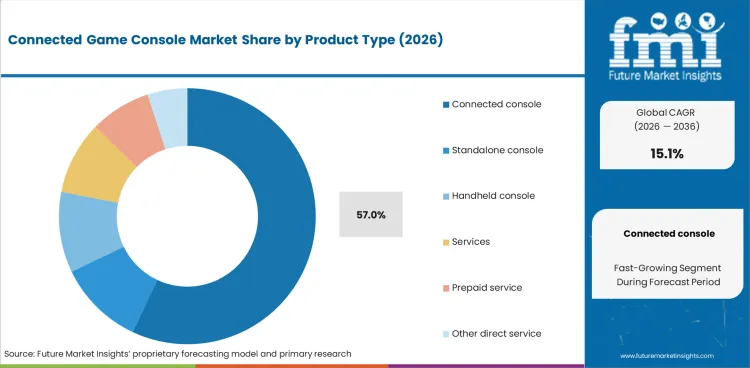
In 2026, connected console is expected to lead the product type segment. Demand is shaped by increasing consumer preference for online multiplayer, digital game distribution, and cloud gaming integration. This segment maintains its position through established procurement channels and performance requirements aligned with end user operational standards.
Insights into the Gaming application Segment
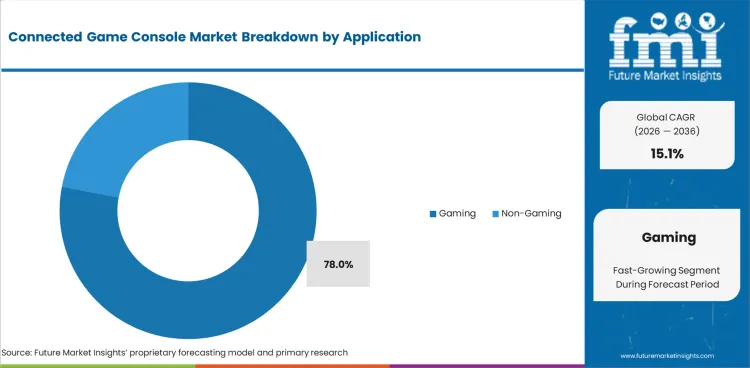
Gaming leads the application segment with 78.0% share in 2026. Adoption in this segment reflects concentration of demand across established verticals where product performance, regulatory compliance, and procurement scale influence purchasing decisions.
Connected Game Console Market Drivers, Restraints, and Opportunities
- Digital content distribution and subscription services are increasing per-console lifetime revenue and creating recurring revenue models for connected console platforms.
- Hardware development costs and semiconductor supply chain constraints influence console pricing, availability, and generation transition timing.
- Cloud gaming services are creating a potential disruption vector that could reduce consumer dependency on dedicated console hardware in the medium term.
The connected game console market is shaped by the transition from hardware-centric to service-oriented business models, competitive dynamics among major ecosystem operators, and the emergence of cloud gaming as a complementary and potentially disruptive delivery mechanism.
Digital Distribution and Subscription Model Shift
Demand is shaped by the transition from physical game disc sales to digital storefronts and subscription services. Digital distribution eliminates manufacturing and retail distribution costs while subscription models create predictable recurring revenue. This structural shift is increasing the commercial value of connected console ecosystems relative to standalone hardware.
Hardware Cost and Supply Chain Dynamics
Adoption is influenced by console hardware pricing and semiconductor supply availability. Custom system-on-chip designs for next-generation consoles require advanced fabrication nodes, creating supply allocation dependencies. Console pricing decisions balance margin requirements, competitive positioning, and the importance of installed base growth for ecosystem revenue generation.
Cloud Gaming as an Emerging Distribution Channel
Growth reflects investment in cloud gaming infrastructure that enables console-quality gaming through streaming delivery. Cloud gaming can expand market access to consumers who cannot afford premium console hardware, but depends on broadband infrastructure quality and latency performance that varies significantly across markets.
Analysis of Connected Game Console Market By Key Countries
.webp "Top Country Growth Comparison Connected Game Console Market Cagr (2026 2036)")
| Country | CAGR |
|---|---|
| Japan | 11.3% |
| India | 10.3% |
| China | 10.1% |
| USA | 9.5% |
| Germany | 8.9% |
| Australia | 8.7% |
- Japan leads at 11.3% CAGR through 2036, reflecting strong domestic console gaming culture, presence of major manufacturers, and early adoption of next generation platforms.
- India at 10.3% and China at 10.1% are shaped by expanding middle class consumer populations, increasing digital entertainment spending, and growing broadband infrastructure.
- The USA at 9.5% reflects the largest established console gaming market with high digital content spending and subscription service adoption.
- Germany at 8.9% and Australia at 8.7% maintain growth through established gaming communities and adoption of connected entertainment services.
The global connected game console market is projected to expand at a CAGR of 15.1% from 2026 to 2036. Growth variation across regions reflects differences in gaming culture maturity, consumer spending capacity, and digital infrastructure development.
Demand Outlook for Connected Game Console Market in Japan
Japan is projected to grow at 11.3% CAGR through 2036, driven by strong domestic console gaming culture, presence of Sony and Nintendo headquarters, and rapid consumer adoption of next generation console hardware and services.
- Strong console gaming culture supports sustained consumer demand for hardware and digital content.
- Presence of major console manufacturers drives early access to next generation platforms.
- Digital content and subscription service spending per consumer is among the highest globally.
Future Outlook for Connected Game Console Market in India
India is expected to grow at 10.3% CAGR through 2036, supported by expanding middle class gaming population, increasing broadband penetration, and growing consumer interest in connected entertainment platforms.
- Expanding middle class consumer base is increasing addressable market for console hardware.
- Broadband infrastructure improvement is enabling online gaming and digital content delivery.
- Growing esports participation is driving consumer interest in connected console platforms.
Opportunity Analysis of Connected Game Console Market in China
China is projected to register 10.1% CAGR through 2036, reflecting the large gaming population, expanding console market access following regulatory adjustments, and domestic cloud gaming service development.
- Large gaming population provides a substantial addressable consumer base for console platforms.
- Regulatory environment adjustments are supporting broader console market access.
- Domestic cloud gaming service development by Tencent and others is creating alternative delivery channels.
In-depth Analysis of Connected Game Console Market in the United States
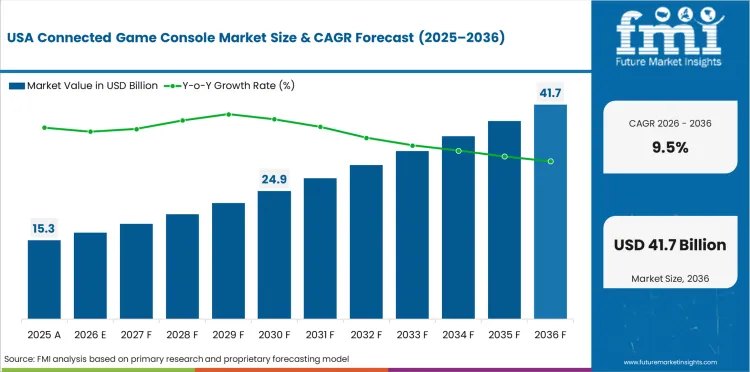
The USA is expected to grow at 9.5% CAGR through 2036, reflecting the largest established console gaming market with high digital content spending, strong subscription service adoption, and competitive ecosystem dynamics between Sony and Microsoft.
- High digital content spending per consumer supports ecosystem revenue generation.
- Strong subscription service adoption creates recurring revenue for platform operators.
- Competitive dynamics between major ecosystems drive investment in exclusive content and service quality.
Sales Analysis of Connected Game Console Market in Germany
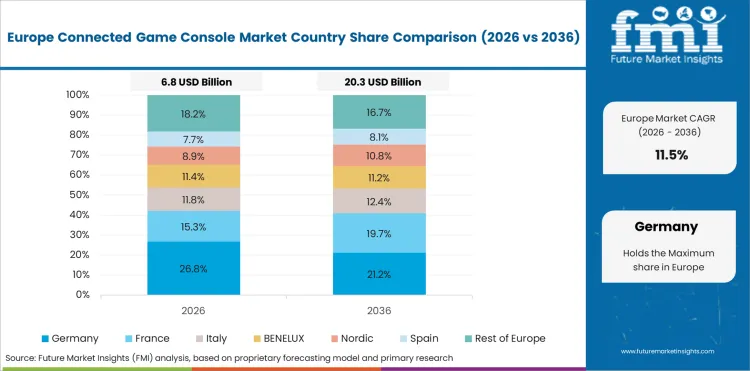
Germany is projected to register 8.9% CAGR through 2036, supported by a large established gaming community, strong broadband infrastructure, and growing adoption of digital game distribution and subscription services.
- Large gaming community supports sustained console hardware and content demand.
- Strong broadband infrastructure enables cloud gaming and digital distribution services.
- Growing subscription service adoption is increasing per-consumer digital entertainment spending.
Competitive Landscape and Strategic Positioning
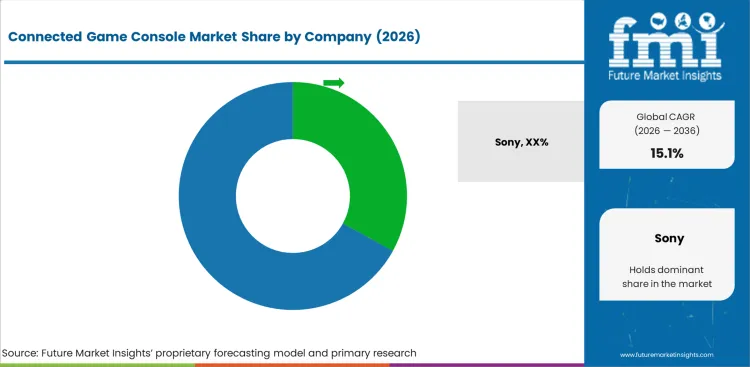
- Sony and Microsoft dominate through established console ecosystems, extensive exclusive game content portfolios, and integrated digital subscription service platforms.
- Nintendo competes through a differentiated hardware strategy and exclusive franchise content that appeals to a broad demographic, including family and casual gaming segments.
- Cloud gaming providers including NVIDIA GeForce Now and Tencent are emerging as ecosystem participants that could reshape hardware dependency.
Sony maintains leadership through its PlayStation ecosystem, which combines hardware, digital storefront, subscription services, and exclusive first-party game content. The company's investment in first-party studio development and exclusive content agreements creates ecosystem lock-in that drives hardware purchasing decisions.
Microsoft competes through its Xbox ecosystem with a strong focus on subscription services and cloud gaming delivery. The company's Game Pass subscription platform and cloud gaming infrastructure represent a strategic investment in service-based revenue models that complement hardware sales.
Nintendo occupies a differentiated position through its hybrid console approach and exclusive franchise content. The company's hardware design philosophy emphasizes accessible gameplay and family-oriented entertainment, creating a distinct consumer segment.
Entry barriers include the capital intensity of console hardware development, the critical mass of exclusive game content required for ecosystem viability, established digital distribution infrastructure, and the difficulty of building a sufficient installed base to attract third-party developer support.
Key Companies in the Connected Game Console Market
Key global companies leading the connected game console market include:
- Sony (Japan), Microsoft (USA), Nintendo (Japan) lead the market through broad product portfolios, established customer relationships, and global manufacturing and distribution capabilities.
- Tencent Holdings Ltd. (China), Valve Corporation (USA), NVIDIA GeForce (USA) maintain strong regional positions through specialized expertise and localized service capabilities.
- Activision Blizzard Inc. (USA), Sega Games Co. Ltd. (Japan), Square Enix Holdings Co. Ltd. (Japan), Capcom Company Ltd. (Japan) are gaining traction through focused product innovation and targeted market positioning.
Competitive Benchmarking: Connected Game Console Market
| Company | Console Hardware Portfolio | Digital Content Ecosystem | Cloud Gaming Capability | Geographic Footprint |
|---|---|---|---|---|
| Sony | High | Strong | Strong | Global |
| Microsoft | High | Strong | Strong | Global |
| Nintendo | High | Strong | Medium | Global |
| Tencent Holdings Ltd. | Medium | Strong | Strong | Asia, Global |
| Valve Corporation | Medium | Strong | Strong | Global |
| NVIDIA GeForce | Low | Medium | Strong | Global |
| Activision Blizzard Inc. | Low | Strong | Medium | Global |
| Sega Games Co. Ltd. | Low | Strong | Low | Asia, Global |
| Square Enix Holdings Co. Ltd. | Low | Strong | Low | Asia, Global |
| Capcom Company Ltd. | Low | Strong | Low | Asia, Global |
Source: Future Market Insights competitive analysis, 2026.
Key Players in the Connected Game Console Market
Major Global Players
- Sony
- Microsoft
- Nintendo
- Tencent Holdings Ltd.
- Valve Corporation
- NVIDIA GeForce
- Activision Blizzard Inc.
Emerging Players/Startups
- Rockstar Games
- Sega Games Co. Ltd.
- Square Enix Holdings Co. Ltd.
- Capcom Company Ltd.
Report Scope and Coverage
| Parameter | Details |
|---|---|
| Quantitative Units | USD 29.35 billion to USD 119.78 billion, at a CAGR of 15.1% |
| Market Definition | The connected game console market encompasses internet-enabled gaming hardware and associated digital services that support online multiplayer gaming, digital game distribution, cloud gaming, and interactive entertainment. This includes connected home consoles, standalone consoles, handheld consoles, and subscription-based gaming services used by residential users, gaming cafes, and entertainment centers. |
| Regions Covered | North America, Latin America, Europe, East Asia, South Asia and Pacific, Middle East and Africa |
| Countries Covered | Japan, India, China, USA, Germany, Australia, 30 plus countries |
| Key Companies Profiled | Sony, Microsoft, Nintendo, Tencent Holdings Ltd., Valve Corporation, NVIDIA GeForce, Activision Blizzard Inc., Rockstar Games, Sega Games Co. Ltd., Square Enix Holdings Co. Ltd., Capcom Company Ltd. |
| Forecast Period | 2026 to 2036 |
| Approach | Hybrid bottom-up and top-down methodology starting with verified transaction data, projecting adoption velocity across segments and regions. |
Market Segmentation Analysis
Connected Game Console Market Segmented by Product Type:
- Connected console
- Standalone console
- Handheld console
- Services
- Prepaid service
- Other direct service
Connected Game Console Market Segmented by Application:
- Gaming
- Non-Gaming
Connected Game Console Market Segmented by End Use:
- Residential Users
- Gaming Cafes
- Entertainment Centers
Connected Game Console Market Segmented by Deployment:
- Standalone Consoles
- Cloud Connected Consoles
- Hybrid Consoles
Connected Game Console Market by Region:
- North America
- USA
- Canada
- Mexico
- Latin America
- Brazil
- Chile
- Rest of Latin America
- Western Europe
- Germany
- UK
- Italy
- Spain
- France
- Nordic
- BENELUX
- Rest of Western Europe
- Eastern Europe
- Russia
- Poland
- Hungary
- Balkan & Baltic
- Rest of Eastern Europe
- East Asia
- China
- Japan
- South Korea
- South Asia and Pacific
- India
- ASEAN
- Australia & New Zealand
- Rest of South Asia and Pacific
- Middle East & Africa
- Kingdom of Saudi Arabia
- Other GCC Countries
- Turkiye
- South Africa
- Other African Union
- Rest of Middle East & Africa
Research Sources and Bibliography
- 1. Entertainment Software Association. (2025). ESA Annual Report on the State of the Video Game Industry. ESA.
- 2. International Data Corporation. (2025). IDC Worldwide Gaming Console Market Tracker. IDC.
- 3. World Bank. (2025). World Bank Digital Infrastructure Development Report: Broadband Access Statistics. World Bank.
- 4. Japan External Trade Organization. (2025). JETRO Report on Japanese Gaming Industry Exports and Market Trends. JETRO.
- 5. European Commission. (2024). EU Digital Markets Act: Impact Assessment on Digital Content Platforms. EC.
This bibliography is provided for reader reference.
This Report Answers
- Estimating the size of the market and revenue projections from 2026 to 2036.
- Segmentation analysis across all product, application, and end use categories.
- Regional and country level insights covering more than 30 markets.
- Technology analysis across key product and process categories.
- Competitive landscape assessment and company benchmarking.
- Investment opportunity identification across high-growth segments and regions.
- Supply chain and distribution channel analysis.
- Data delivery in PDF and Excel formats.
Frequently Asked Questions
What is the global market demand for Connected Game Console in 2026?
In 2026, the global connected game console market is expected to be worth USD 29.35 billion.
How big will the Connected Game Console Market be in 2036?
By 2036, the connected game console market is expected to be worth USD 119.78 billion.
How much is demand for Connected Game Console expected to grow between 2026 and 2036?
Between 2026 and 2036, the demand for connected game console is expected to grow at a CAGR of 15.1%.
Which product type segment is likely to lead in 2026?
Connected consoles is expected to account for 57.0% of the product type segment in 2026, reflecting increasing consumer preference for online multiplayer, digital game distribution, and cloud gaming integration.
What is causing demand to rise in Japan?
Japan is projected to grow at 11.3% CAGR through 2036, reflecting strong sector investment and regulatory support for market adoption.
What is causing demand to rise in India?
India is projected to grow at 10.3% CAGR through 2036, supported by industry expansion and increasing adoption across key application segments.
What does this report mean by 'Connected Game Console Market definition'?
The connected game console market encompasses internet-enabled gaming hardware and associated digital services that support online multiplayer gaming, digital game distribution, cloud gaming, and interactive entertainment. This includes connected home consoles, standalone consoles, handheld consoles, and subscription-based gaming services used by residential users, gaming cafes, and entertainment centers.
How does FMI make the Connected Game Console forecast and validate it?
Forecasting models use a hybrid bottom-up and top-down approach, starting with verified transaction data and checking it against industry production statistics and manufacturer disclosures.
Preview the report firsthand - request a free sample
Get SampleGet the brochure for pricing and purchase details.
Get PDFTable of Content
- Executive Summary
- Global Market Outlook
- Demand-side Trends
- Supply-side Trends
- Technology Roadmap Analysis
- Analysis and Recommendations
- Market Overview
- Market Coverage / Taxonomy
- Market Definition / Scope / Limitations
- Research Methodology
- Chapter Orientation
- Analytical Lens and Working Hypotheses
- Market Structure, Signals, and Trend Drivers
- Benchmarking and Cross-market Comparability
- Market Sizing, Forecasting, and Opportunity Mapping
- Research Design and Evidence Framework
- Desk Research Programme (Secondary Evidence)
- Company Annual and Sustainability Reports
- Peer-reviewed Journals and Academic Literature
- Corporate Websites, Product Literature, and Technical Notes
- Earnings Decks and Investor Briefings
- Statutory Filings and Regulatory Disclosures
- Technical White Papers and Standards Notes
- Trade Journals, Industry Magazines, and Analyst Briefs
- Conference Proceedings, Webinars, and Seminar Materials
- Government Statistics Portals and Public Data Releases
- Press Releases and Reputable Media Coverage
- Specialist Newsletters and Curated Briefings
- Sector Databases and Reference Repositories
- FMI Internal Proprietary Databases and Historical Market Datasets
- Subscription Datasets and Paid Sources
- Social Channels, Communities, and Digital Listening Inputs
- Additional Desk Sources
- Expert Input and Fieldwork (Primary Evidence)
- Primary Modes
- Qualitative Interviews and Expert Elicitation
- Quantitative Surveys and Structured Data Capture
- Blended Approach
- Why Primary Evidence is Used
- Field Techniques
- Interviews
- Surveys
- Focus Groups
- Observational and In-context Research
- Social and Community Interactions
- Stakeholder Universe Engaged
- C-suite Leaders
- Board Members
- Presidents and Vice Presidents
- R&D and Innovation Heads
- Technical Specialists
- Domain Subject-matter Experts
- Scientists
- Physicians and Other Healthcare Professionals
- Governance, Ethics, and Data Stewardship
- Research Ethics
- Data Integrity and Handling
- Primary Modes
- Tooling, Models, and Reference Databases
- Desk Research Programme (Secondary Evidence)
- Data Engineering and Model Build
- Data Acquisition and Ingestion
- Cleaning, Normalisation, and Verification
- Synthesis, Triangulation, and Analysis
- Quality Assurance and Audit Trail
- Market Background
- Market Dynamics
- Drivers
- Restraints
- Opportunity
- Trends
- Scenario Forecast
- Demand in Optimistic Scenario
- Demand in Likely Scenario
- Demand in Conservative Scenario
- Opportunity Map Analysis
- Product Life Cycle Analysis
- Supply Chain Analysis
- Investment Feasibility Matrix
- Value Chain Analysis
- PESTLE and Porter’s Analysis
- Regulatory Landscape
- Regional Parent Market Outlook
- Production and Consumption Statistics
- Import and Export Statistics
- Market Dynamics
- Global Market Analysis 2021 to 2025 and Forecast, 2026 to 2036
- Historical Market Size Value (USD Million) Analysis, 2021 to 2025
- Current and Future Market Size Value (USD Million) Projections, 2026 to 2036
- Y-o-Y Growth Trend Analysis
- Absolute $ Opportunity Analysis
- Global Market Pricing Analysis 2021 to 2025 and Forecast 2026 to 2036
- Global Market Analysis 2021 to 2025 and Forecast 2026 to 2036, By Product Type
- Introduction / Key Findings
- Historical Market Size Value (USD Million) Analysis By Product Type , 2021 to 2025
- Current and Future Market Size Value (USD Million) Analysis and Forecast By Product Type , 2026 to 2036
- Connected console
- Standalone console
- Handheld console
- Services
- Prepaid service
- Other direct service
- Connected console
- Y-o-Y Growth Trend Analysis By Product Type , 2021 to 2025
- Absolute $ Opportunity Analysis By Product Type , 2026 to 2036
- Global Market Analysis 2021 to 2025 and Forecast 2026 to 2036, By Application
- Introduction / Key Findings
- Historical Market Size Value (USD Million) Analysis By Application, 2021 to 2025
- Current and Future Market Size Value (USD Million) Analysis and Forecast By Application, 2026 to 2036
- Gaming
- Non-Gaming
- Gaming
- Y-o-Y Growth Trend Analysis By Application, 2021 to 2025
- Absolute $ Opportunity Analysis By Application, 2026 to 2036
- Global Market Analysis 2021 to 2025 and Forecast 2026 to 2036, By End Use
- Introduction / Key Findings
- Historical Market Size Value (USD Million) Analysis By End Use, 2021 to 2025
- Current and Future Market Size Value (USD Million) Analysis and Forecast By End Use, 2026 to 2036
- Residential Users
- Gaming Cafes
- Entertainment Centers
- Residential Users
- Y-o-Y Growth Trend Analysis By End Use, 2021 to 2025
- Absolute $ Opportunity Analysis By End Use, 2026 to 2036
- Global Market Analysis 2021 to 2025 and Forecast 2026 to 2036, By Deployment
- Introduction / Key Findings
- Historical Market Size Value (USD Million) Analysis By Deployment, 2021 to 2025
- Current and Future Market Size Value (USD Million) Analysis and Forecast By Deployment, 2026 to 2036
- Standalone Consoles
- Cloud Connected Consoles
- Hybrid Consoles
- Standalone Consoles
- Y-o-Y Growth Trend Analysis By Deployment, 2021 to 2025
- Absolute $ Opportunity Analysis By Deployment, 2026 to 2036
- Global Market Analysis 2021 to 2025 and Forecast 2026 to 2036, By Region
- Introduction
- Historical Market Size Value (USD Million) Analysis By Region, 2021 to 2025
- Current Market Size Value (USD Million) Analysis and Forecast By Region, 2026 to 2036
- North America
- Latin America
- Western Europe
- Eastern Europe
- East Asia
- South Asia and Pacific
- Middle East & Africa
- Market Attractiveness Analysis By Region
- North America Market Analysis 2021 to 2025 and Forecast 2026 to 2036, By Country
- Historical Market Size Value (USD Million) Trend Analysis By Market Taxonomy, 2021 to 2025
- Market Size Value (USD Million) Forecast By Market Taxonomy, 2026 to 2036
- By Country
- USA
- Canada
- Mexico
- By Product Type
- By Application
- By End Use
- By Deployment
- By Country
- Market Attractiveness Analysis
- By Country
- By Product Type
- By Application
- By End Use
- By Deployment
- Key Takeaways
- Latin America Market Analysis 2021 to 2025 and Forecast 2026 to 2036, By Country
- Historical Market Size Value (USD Million) Trend Analysis By Market Taxonomy, 2021 to 2025
- Market Size Value (USD Million) Forecast By Market Taxonomy, 2026 to 2036
- By Country
- Brazil
- Chile
- Rest of Latin America
- By Product Type
- By Application
- By End Use
- By Deployment
- By Country
- Market Attractiveness Analysis
- By Country
- By Product Type
- By Application
- By End Use
- By Deployment
- Key Takeaways
- Western Europe Market Analysis 2021 to 2025 and Forecast 2026 to 2036, By Country
- Historical Market Size Value (USD Million) Trend Analysis By Market Taxonomy, 2021 to 2025
- Market Size Value (USD Million) Forecast By Market Taxonomy, 2026 to 2036
- By Country
- Germany
- UK
- Italy
- Spain
- France
- Nordic
- BENELUX
- Rest of Western Europe
- By Product Type
- By Application
- By End Use
- By Deployment
- By Country
- Market Attractiveness Analysis
- By Country
- By Product Type
- By Application
- By End Use
- By Deployment
- Key Takeaways
- Eastern Europe Market Analysis 2021 to 2025 and Forecast 2026 to 2036, By Country
- Historical Market Size Value (USD Million) Trend Analysis By Market Taxonomy, 2021 to 2025
- Market Size Value (USD Million) Forecast By Market Taxonomy, 2026 to 2036
- By Country
- Russia
- Poland
- Hungary
- Balkan & Baltic
- Rest of Eastern Europe
- By Product Type
- By Application
- By End Use
- By Deployment
- By Country
- Market Attractiveness Analysis
- By Country
- By Product Type
- By Application
- By End Use
- By Deployment
- Key Takeaways
- East Asia Market Analysis 2021 to 2025 and Forecast 2026 to 2036, By Country
- Historical Market Size Value (USD Million) Trend Analysis By Market Taxonomy, 2021 to 2025
- Market Size Value (USD Million) Forecast By Market Taxonomy, 2026 to 2036
- By Country
- China
- Japan
- South Korea
- By Product Type
- By Application
- By End Use
- By Deployment
- By Country
- Market Attractiveness Analysis
- By Country
- By Product Type
- By Application
- By End Use
- By Deployment
- Key Takeaways
- South Asia and Pacific Market Analysis 2021 to 2025 and Forecast 2026 to 2036, By Country
- Historical Market Size Value (USD Million) Trend Analysis By Market Taxonomy, 2021 to 2025
- Market Size Value (USD Million) Forecast By Market Taxonomy, 2026 to 2036
- By Country
- India
- ASEAN
- Australia & New Zealand
- Rest of South Asia and Pacific
- By Product Type
- By Application
- By End Use
- By Deployment
- By Country
- Market Attractiveness Analysis
- By Country
- By Product Type
- By Application
- By End Use
- By Deployment
- Key Takeaways
- Middle East & Africa Market Analysis 2021 to 2025 and Forecast 2026 to 2036, By Country
- Historical Market Size Value (USD Million) Trend Analysis By Market Taxonomy, 2021 to 2025
- Market Size Value (USD Million) Forecast By Market Taxonomy, 2026 to 2036
- By Country
- Kingdom of Saudi Arabia
- Other GCC Countries
- Turkiye
- South Africa
- Other African Union
- Rest of Middle East & Africa
- By Product Type
- By Application
- By End Use
- By Deployment
- By Country
- Market Attractiveness Analysis
- By Country
- By Product Type
- By Application
- By End Use
- By Deployment
- Key Takeaways
- Key Countries Market Analysis
- USA
- Pricing Analysis
- Market Share Analysis, 2025
- By Product Type
- By Application
- By End Use
- By Deployment
- Canada
- Pricing Analysis
- Market Share Analysis, 2025
- By Product Type
- By Application
- By End Use
- By Deployment
- Mexico
- Pricing Analysis
- Market Share Analysis, 2025
- By Product Type
- By Application
- By End Use
- By Deployment
- Brazil
- Pricing Analysis
- Market Share Analysis, 2025
- By Product Type
- By Application
- By End Use
- By Deployment
- Chile
- Pricing Analysis
- Market Share Analysis, 2025
- By Product Type
- By Application
- By End Use
- By Deployment
- Germany
- Pricing Analysis
- Market Share Analysis, 2025
- By Product Type
- By Application
- By End Use
- By Deployment
- UK
- Pricing Analysis
- Market Share Analysis, 2025
- By Product Type
- By Application
- By End Use
- By Deployment
- Italy
- Pricing Analysis
- Market Share Analysis, 2025
- By Product Type
- By Application
- By End Use
- By Deployment
- Spain
- Pricing Analysis
- Market Share Analysis, 2025
- By Product Type
- By Application
- By End Use
- By Deployment
- France
- Pricing Analysis
- Market Share Analysis, 2025
- By Product Type
- By Application
- By End Use
- By Deployment
- India
- Pricing Analysis
- Market Share Analysis, 2025
- By Product Type
- By Application
- By End Use
- By Deployment
- ASEAN
- Pricing Analysis
- Market Share Analysis, 2025
- By Product Type
- By Application
- By End Use
- By Deployment
- Australia & New Zealand
- Pricing Analysis
- Market Share Analysis, 2025
- By Product Type
- By Application
- By End Use
- By Deployment
- China
- Pricing Analysis
- Market Share Analysis, 2025
- By Product Type
- By Application
- By End Use
- By Deployment
- Japan
- Pricing Analysis
- Market Share Analysis, 2025
- By Product Type
- By Application
- By End Use
- By Deployment
- South Korea
- Pricing Analysis
- Market Share Analysis, 2025
- By Product Type
- By Application
- By End Use
- By Deployment
- Russia
- Pricing Analysis
- Market Share Analysis, 2025
- By Product Type
- By Application
- By End Use
- By Deployment
- Poland
- Pricing Analysis
- Market Share Analysis, 2025
- By Product Type
- By Application
- By End Use
- By Deployment
- Hungary
- Pricing Analysis
- Market Share Analysis, 2025
- By Product Type
- By Application
- By End Use
- By Deployment
- Kingdom of Saudi Arabia
- Pricing Analysis
- Market Share Analysis, 2025
- By Product Type
- By Application
- By End Use
- By Deployment
- Turkiye
- Pricing Analysis
- Market Share Analysis, 2025
- By Product Type
- By Application
- By End Use
- By Deployment
- South Africa
- Pricing Analysis
- Market Share Analysis, 2025
- By Product Type
- By Application
- By End Use
- By Deployment
- USA
- Market Structure Analysis
- Competition Dashboard
- Competition Benchmarking
- Market Share Analysis of Top Players
- By Regional
- By Product Type
- By Application
- By End Use
- By Deployment
- Competition Analysis
- Competition Deep Dive
- Sony
- Overview
- Product Portfolio
- Profitability by Market Segments (Product/Age /Sales Channel/Region)
- Sales Footprint
- Strategy Overview
- Marketing Strategy
- Product Strategy
- Channel Strategy
- Microsoft
- Nintendo
- Google Stadia
- NVIDIA GeForce
- Tencent Holdings Ltd.
- Activision Blizzard, Inc.
- Valve Corporation
- Rockstar Games
- Sega Games Co. Ltd
- Square Enix Holdings Co. Ltd
- Capcom Company Ltd
- Sony
- Competition Deep Dive
- Assumptions & Acronyms Used


