

- Industry Size (2026)
- USD 16978.4 Mn
- Forecast (2036)
- USD 60110.2 Mn
- CAGR (2026 to 2036)
- 13.5%
Connected TVs Market Size, Market Forecast and Outlook By FMI
The connected TVs market is expected to expand from USD 16,978.4 million in 2026 to USD 60,110.2 million by 2036. The market is anticipated to register a 13.5% CAGR during the forecast period. Smart TVs are likely to lead device type with 62.5% share in 2026, while OLED technology is projected to record the fastest technology-level expansion at 45.0% CAGR through 2036.
Summary of the Connected TVs Market
- Demand and Growth Drivers
- Streaming-first viewing habits are expected to support connected TV adoption across residential entertainment systems.
- Programmatic advertising is likely to increase platform value as TV operating systems become monetization gateways.
- On-device AI processing is anticipated to improve content discovery and video upscaling in premium connected TVs.
- Product and Segment View
- Smart TVs are expected to lead device type because integrated operating systems reduce dependence on external streaming devices.
- OLED TVs are likely to expand quickly as premium buyers prioritize sharper contrast and better display quality.
- LED and QLED formats are anticipated to remain important across mass-market and mid-range connected TV portfolios.
- Geography and Competitive Outlook
- India is expected to lead listed country-level growth due to affordable internet access and wider regional content availability.
- China is likely to remain a major volume center as domestic brands scale connected TV manufacturing and smart-home integration.
- Companies with stronger proprietary operating systems are anticipated to gain advantage in advertising and content partnerships.
- Analyst Opinion
- Sudip saha Co-founder at Future Market Insights, suggests, “The connected TVs market is shifting from a hardware-led category into a platform-led business. Manufacturers with control over operating systems and ad technology are likely to capture more recurring value as streaming households move deeper into app-based viewing.”
- Connected TVs Market Value Analysis
- The connected TVs market is moving from basic internet-enabled television sales toward a platform economy shaped by operating systems.
- Demand is likely to rise as streaming platforms, gaming use, and smart-home connectivity become routine household expectations.
- Adoption is expected to gain support from affordable smart TV models that bring app-based viewing into wider income groups.
- Spending is anticipated to be backed by display upgrades, AI-enabled features, and advertising-linked platform monetization.
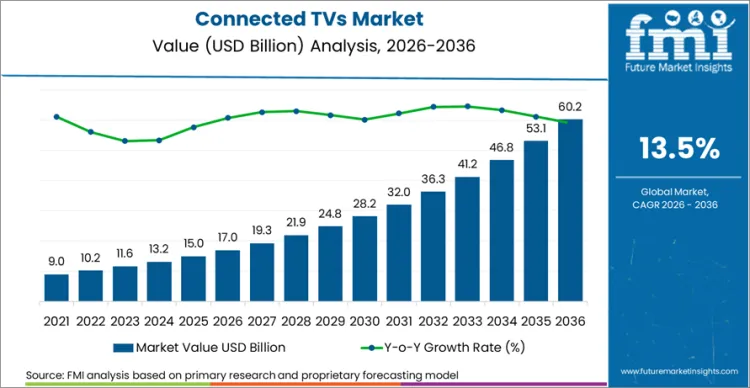
Key Takeaways, Market Size, and Forecast
- The connected TVs market is expected to reach USD 16,978.4 million in 2026.
- By 2036, the connected TVs market is projected to reach USD 60,110.2 million.
- From 2026 to 2036, the market is anticipated to expand at a 13.5% CAGR.
- Smart TVs are likely to account for 62.5% share of the device type segment in 2026.
- OLED technology is expected to record the fastest technology-level expansion at 45.0% CAGR during the forecast period.
- India is projected to record the fastest listed country-level expansion at 15.9% CAGR through 2036.
Summary of Connected TVs Market
What Is Growth Outlook for Connected TVs Market as per Future Market Insights Projection?
Future Market Insights projects the connected tvs market to expand at a CAGR of 13.5% from 2026 to 2036, increasing from USD 16,978.4 Million in 2026 to USD 60,110.2 Million by 2036.
FMI Research Approach: FMI proprietary forecasting model based on household penetration curves and CTV advertising revenue correlation.
How Do FMI Analysts Perceive Connected TVs Market to Evolve?
FMI analysts perceive the market evolving toward a platform-driven structure where the TV operating system becomes the primary commercial asset, enabling manufacturers to capture recurring advertising and subscription revenue beyond the one-time hardware sale through AI-powered content personalization.
FMI Research Approach: Connected TV advertising spend analysis and OS market share tracking.
Which Country Holds Largest Share in Global Connected TVs Market?
The United States holds a significant share of the global connected TVs market by value, supported by the highest programmatic CTV advertising spend globally and deep penetration of streaming-first households.
FMI Research Approach: FMI country-level revenue modelling by household penetration and advertising spend per connected device.
How Large Will Connected TVs Market Be by 2036?
The global connected tvs market is projected to reach USD 60,110.2 Million by 2036.
FMI Research Approach: FMI long-term revenue forecast derived from display technology replacement cycles and streaming adoption projections.
What Is Definition of Connected TVs Market?
The connected TVs market includes revenue generated from the production and sale of internet-enabled television sets with integrated smart operating systems, covering LED, OLED, QLED, and Mini LED display technologies across residential and commercial segments.
FMI Research Approach: FMI market taxonomy and inclusion-exclusion framework.
What Are Globally Unique Trends Shaping Connected TVs Market?
Globally unique trends include the integration of on-device generative AI for real-time content upscaling, the contest between proprietary and licensed TV operating systems for advertising control, and the consolidation of CTV ad-measurement infrastructure through acquisitions.
FMI Research Approach: CES product launch tracking and CTV advertising ecosystem analysis.
Connected TVs Market Key Takeaways
| Metric | Details |
|---|---|
| Industry Size (2026) | USD 16,978.4 Million |
| Industry Value (2036) | USD 60,110.2 Million |
| CAGR (2026 to 2036) | 13.5% |
Source: Future Market Insights (FMI) analysis, based on proprietary forecasting model and primary research
Key Industry Highlights
Growing Consumer Shift Toward Streaming Platforms and On-Demand Content
The shift from traditional cable and satellite TV to streaming platforms has dramatically changed the face of the entertainment industry and is now one of the major reasons contributing to the growth of the connected TV market.
Modern consumers are into convenience and flexibility, gravitating toward the freedom to watch their favorite content whenever they choose. Streaming services like Netflix, Hulu, Disney+, and Amazon Prime Video have tapped into this demand by offering vast libraries of movies, TV series, and exclusive original programming.
At the forefront of this transformation are connected TVs and streaming service options on one device, requiring no additional devices to manage multiple platforms. The relatively inexpensive subscription fees for services in comparison to traditional cable packages have also pushed streaming services into popularity, especially among the younger, tech-savvy audiences.
Meanwhile, improvements in broadband have made high-speed internet more accessible to a wide swath of consumers, smoothing out hiccups in streaming both in and outside of urban areas. Whereas at first CTVs included just regional content, it later made headways by allowing content in many different languages.
Besides streaming and consuming on-demand entertainment on home screens, these rising demands illustrate a high extent of participation in CTV use, thus suggesting the vital future of CTVs in modern home-viewing behavior.
Advanced Advertising Capabilities Driving Revenue for Advertisers
One of the most crucial advantages of connected TVs is the effectiveness they bring to advertising. Traditional TV ads are still based on general demographic assumptions, but CTV platforms draw from data analytics to ensure that ads are personalized to users' behaviors, preferences, and location. It is this data-driven approach that helps advertisers get in touch with the required audience segments through personalized messages for better engagement and higher conversion rates.
Another major reason for CTV adoption is because of programmatic advertising, which lets automated and optimized ad placements in real time be relevant and effective. Because of how programmatic changed ad delivery, CTV turned into a must-have tool in the locker of marketers.
The ability to measure ad performance through metrics such as impressions, clicks, and view-through rates will also provide valuable insights for advertisers to refine their strategies for better ROI. As more firms adopt digital-first approaches to marketing, this increasing trend is likely to be matched in the future with further market growth driven by increased functionality within CTV platforms.
Fragmentation in Device Ecosystem and Compatibility Issues
The connected TV market has a big problem with ecosystem fragmentation. These devices like smart TVs, streaming sticks and gaming consoles run on different operating systems like Roku, Android TV, Amazon Fire TV and proprietary platforms like Samsung’s Tizen OS and LG’s webOS. This diversity means app developers, content providers and users have compatibility issues as not all platforms support the same apps or features.
For example, a service may be available on one platform but not another and the user is frustrated. Advertisers also have a hard time scaling campaigns across different CTV ecosystems as each platform requires different integration and optimisation.
The lack of standardisation not only drives up development costs for app creators but also restricts consumer choice and slows down the market. Collaboration or industry wide standards could be key to solving these compatibility issues and unlocking the full potential of the CTV market.
2021 to 2025 Global Connected TVs Sales Outlook Compared to Demand Forecasts from 2026 to 2036
The industry showcased a CAGR of 12.7% during the period between 2021 and 2025. The industry reached a value of USD 15,057.8 million in 2025 from USD 9,326.9 million in 2021.
Between 2021 and 2025, the CTV market exploded as consumer behavior changed and technology advanced. COVID-19 accelerated this change when governments locked people in the house and entertainment demand went through the roof.
On the other hand, the market is estimated to grow at a CAGR of 13.5% during the forecasted period between 2026 and 2036. The market is expected to grow swiftly as it has a potential to reach a value of USD 60,110.2 Million by 2036 from USD 16,978.4 Million in 2026.
From 2026 to 2036, the connected TV market will grow further as AI, 5G and IoT ecosystems evolve. As the tech advances CTVs will move from being entertainment centers to being the hub of the smart home, connecting to other devices seamlessly. Other new features are trending or will trend: real time voice translation, AR integration, ultra high definition streaming etc. which will make it even more immersive and interactive.
Market Concentration
Tier 1 is a category comprising leading vendors, well-known brands, including Samsung, LG Electronics, Sony, and Amazon with its line of Fire TVs. This leading position by these industry giants is due to the great extent of research and development potential, an extremely wide range of product offerings, and vast distribution networks.
The technologies most of their products boast are UHD displays, AI-driven content recommendations, and seamless integration into smart home systems. With high brand recognition and economies of scale, such leaders enjoy a competitive advantage in the market and are often the ones to beat on issues of innovation. These vendors capture around 35%-40% share in the market.
Tier 2 companies include Vizio, TCL, Hisense, and Roku. These companies target value-driven consumers by providing connected TVs that balance affordability with quality and functionality. Many Tier 2 players excel in specific markets by leveraging regional manufacturing strengths and forming localized content partnerships.
They are also very responsive to market trends, such as ad-supported streaming (AVOD) and gaming-focused features, which puts them in a good position to adapt to consumer demands quickly. As such, Tier 2 would constitute about 15%-20% concerning the capture of market size.
Tier 3 companies include emerging players and smaller brands serving niche markets or specialized features. This would include manufacturers that focus on differentiated offerings such as privacy-enhancing technologies, energy efficiency, or integration with particular ecosystems.
Examples include startups innovating in the areas of streaming or gaming TVs, and smaller manufacturers that serve regional markets. Several Tier 3 companies manufacture white-label TVs for retailers while others compete on price and localized features in developing regions. About 25% - 30% would be the share of Tier 3 vendors in the total market size.
Country-wise Insights
The section highlights the CAGRs of countries experiencing growth in the connected TVs market, along with the latest advancements contributing to overall market development. Based on current estimates USA, India and China are expected to see steady growth during the forecast period.
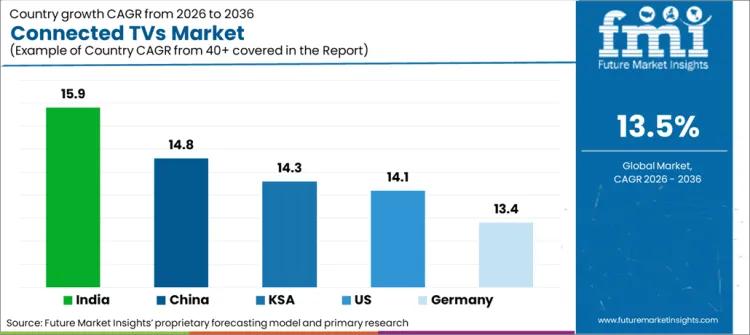
| Countries | CAGR from 2026 to 2036 |
|---|---|
| India | 15.9% |
| China | 14.8% |
| Germany | 13.4% |
| KSA | 14.3% |
| United States | 14.1% |
Accelerating Adoption in India Fueled by Affordable Internet and Content Localization
The CTV market in India is growing rapidly, pushed by affordable internet access brought about by Jio's data revolution and the increasing penetration of smartphones. The needs of diverse regional audiences are being met with streaming platforms like Disney+ Hotstar, Zee5, and SonyLIV gaining traction with vernacular content. Global players, too, have contributed to the growth, starting with investments such as Netflix's commitment in 2020 to invest USD 400 million for production specifically targeted at India.
Xiaomi and OnePlus are the companies that are ruling the smart TV space, offering budget CTV devices for the price sensitive consumers. Besides, increasing disposable income and a young tech savvy population is driving the growth of CTV market, making India a key player in the global streaming and smart TV universe.
USA Dominates in Streaming Platforms and Advertising Innovation
The United States market remains the leader of the connected TV market, with its well-developed digital advertising ecosystem and great prevalence of big streaming players like Netflix, Hulu, and Amazon Prime Video. Strong streaming of content and investments in ad-supported platforms continue unabated-in 2023 alone, Roku invested USD 1 billion in content partnerships.
The US also has the added bonus of advanced broadband and high smart TV household penetration. Programmatic with CTV drove growth and CTV ad spend in the US is expected to reach USD 27 Billion by 2025. The combination of advanced tech and changing consumer habits makes the US a key growth market for connected TVs.
Expanding Consumer Base and Domestic Manufacturing Leadership in China
China’s connected TV market is growing fast, driven by large consumer base, strong local manufacturing and seamless integration with local ecosystems. Hisense, TCL and Xiaomi are the leading brands with government support for digital transformation.
Investment in AI TV platforms and 5G integration has also been a big factor, with Baidu and Alibaba investing heavily in smart home. China’s streaming platforms iQIYI and Tencent Video are major drivers of CTV adoption, with Tencent alone spending over USD 2 Billion a year on content. The growing middle class and urbanisation is accelerating CTV adoption, making China a key player in the global CTV market.
Category-wise Insights
The section provides detailed insights into key segments of the connected TVs market. This section analyzes the growth and market share in the Connected TVs market among key segments.
OLED TVs Segment is Expected to Grow Rapidly for the Forecasting Period
The OLED segment is growing fast in the connected TV market due to its amazing display, vibrant colours, deep blacks and great contrast. OLED panels are thinner, lighter and more energy efficient than traditional LED screens so it’s a popular choice for premium connected TVs. Manufacturing advancements have brought down the cost of production making OLED more affordable. Rising demand for HD content and innovative features like flexible and curved screens has further boosted adoption.
Top TV brands like LG, Sony and Samsung are pouring in a lot of investment in OLED technology to strengthen its hold in the market. Its appeal to techy and premium consumers will continue to drive growth in this segment.
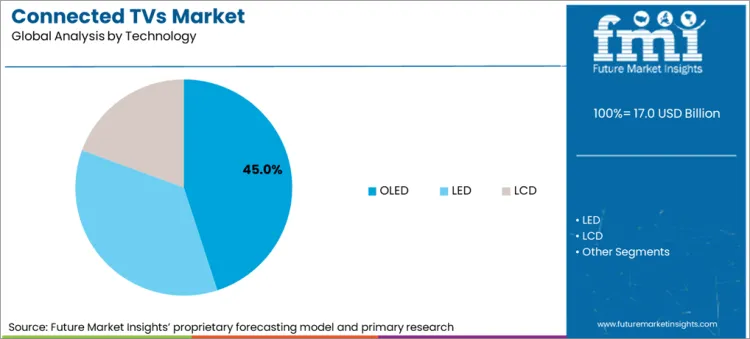
| Segment | CAGR (2026 to 2036) |
|---|---|
| OLED (Technology) | 45.0% |
Smart TVs Segment Leads the Connected TVs Market in terms of Share
The Smart TV segment leads in the connected TV market because of its fast integration of internet connectivity and advanced features, driven by the high demand for streaming and on-demand content. Smart TVs can provide built-in access to platforms like Netflix, YouTube, and Amazon Prime Video, besides others, without relying on peripheral devices.
Their affordability, added to features like voice control, app stores, and IoT compatibility, makes them attractive to a wide set of consumers. Further, the development relating to display technology has improved resolutions up to 4K and 8K, promoting the viewing experience. Global manufacturers focus on offering Smart TVs at different price levels, making them widely available and keeping Smart TVs as the leading product in the market.
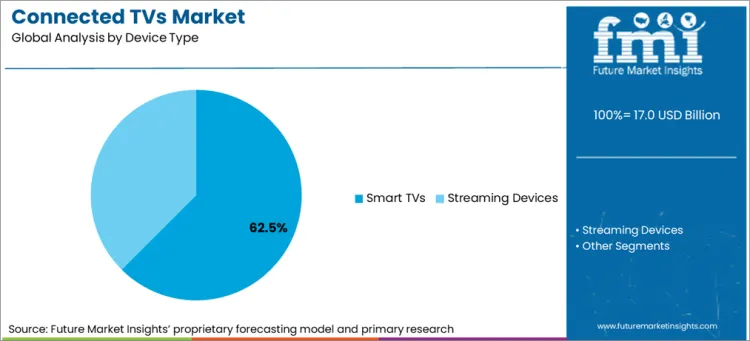
| Segment | Value Share (2026) |
|---|---|
| Smart TVs (Device Type) | 62.5% |
Competition Outlook
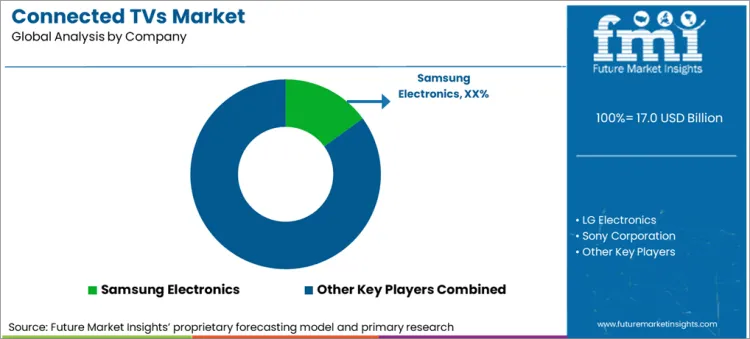
The connected TV market is a competitive space with rapid technological advancements, multiple product offerings and expansion into new geographies. Companies are trying to stand out by adding features like 4K and 8K, AI driven content recommendations and smart home compatibility. The market offers a wide range of options for consumers - premium and affordable to cater to different needs and budgets.
Partnerships with content providers and new advertising models like programmatic and targeted ads are fueling the competition. Regional players are challenging global leaders by using local content and cost advantage to target specific markets. Sustainability and energy efficient designs are becoming important, influencing consumer behavior and driving innovation in the industry. This is shaping the competitive landscape of the connected TVs market.
Recent Developments:
- In January 2026, Samsung Electronics unveiled its Companion to AI Living vision at CES, launching a 130-inch Micro RGB TV and the S99H OLED flagship with Tizen OS 10.0, which guarantees seven years of software updates and introduces on-device GenAI upscaling.
- In July 2025, LG Electronics introduced the 2025 OLED evo and QNED evo series with proprietary AI Picture Pro and AI Sound Pro technologies, and expanded its webOS Licensing Program to power third-party brands globally.
- In February 2025, Mediaocean acquired Innovid to consolidate the CTV advertising landscape, integrating advanced ad-measurement software across digital and linear TV platforms.
Key players in the Connected TVs Industry
- Samsung Electronics
- LG Electronics
- Sony Corporation
- TCL
- Vizio
- Hisense
- Panasonic
- Sharp
- Apple
- Xiaomi
Market Definition
The connected TVs market represents revenue generated from the production and sale of internet-enabled television sets equipped with integrated smart operating systems for content streaming, application access, and interactive services. The market measures the value of LED, OLED, QLED, Mini LED, and Micro LED connected TV units sold through retail, e-commerce, and direct procurement channels.
Inclusions cover smart TVs with built-in Wi-Fi or Ethernet connectivity running proprietary or licensed operating systems such as Tizen, webOS, Google TV, Fire TV, and Roku. It includes display sizes from 32 inches to above 100 inches across 4K, 8K, and standard HD resolutions. Integrated advertising technology and content delivery platforms embedded within the TV OS are also included.
Exclusions include non-smart TVs without internet connectivity, external streaming devices (set-top boxes, dongles, and sticks) sold separately, commercial digital signage displays, and projector systems. Content subscription fees, standalone streaming platform revenues, and broadcast infrastructure equipment are outside the scope.
Connected TVs Market Segmentation
By Device Type:
In terms of device type, the segment is divided into Smart TVs, Streaming Devices and Others.
By Technology:
In terms of technology, the segment is segregated into LED, LCD, OLED and QLED.
By End Use:
In terms of end use, the segment is segregated into Residential and Commercial.
By Region:
A regional analysis has been carried out in key countries of North America, Latin America, East Asia, South Asia & Pacific, Western Europe, Eastern Europe and Middle East and Africa (MEA).
Bibliography
- Samsung Electronics. (2026, January). Companion to AI Living vision and Micro RGB TV launch at CES 2026. Samsung global newsroom.
- LG Electronics. (2026, January). OLED evo W6 Wallpaper TV at CES 2026. LG global newsroom.
- TitanOS. (2025, December). EUR 50 million Series A funding announcement. EU-Startups.
- Mediaocean. (2025, February). Acquisition of Innovid for CTV advertising infrastructure. Mediaocean corporate disclosure.
- TCL. (2026, January). SQD-Mini LED technology debut at CES 2026. TCL global newsroom.
- VIDAA International. (2025, September). Partnership with Hisense and Deutsche Telekom MagentaTV. VIDAA corporate disclosure.
Frequently Asked Questions
What is the current global market size for the Connected TVs Market?
The market is valued at USD 16,978.4 Million in 2026, driven by the convergence of on-device AI processing with programmatic CTV advertising and accelerating streaming adoption.
What is the projected Compound Annual Growth Rate (CAGR) for the market over the next 10 years?
The market is projected to grow at a CAGR of 13.5% from 2026 to 2036.
Which regions are experiencing the fastest expansion?
Asia Pacific leads with the highest growth rate, driven by expanding middle-class TV replacement cycles in China and India, followed by North America and Europe.
What are the primary market drivers?
The integration of AI-powered content personalization into TV operating systems, the redirection of advertising budgets from linear cable to programmatic CTV platforms, and the expansion of premium display technologies into mass-market segments are the primary drivers of adoption.
Who are the leading companies in the industry?
Samsung, LG, TCL, and Hisense are key players, differentiating through proprietary operating systems, AI-powered display processing, and CTV advertising ecosystem control.
Preview the report firsthand - request a free sample
Get SampleGet the brochure for pricing and purchase details.
Get PDFTable of Content
- Executive Summary
- Global Market Outlook
- Demand-side Trends
- Supply-side Trends
- Technology Roadmap Analysis
- Analysis and Recommendations
- Market Overview
- Market Coverage / Taxonomy
- Market Definition / Scope / Limitations
- Research Methodology
- Chapter Orientation
- Analytical Lens and Working Hypotheses
- Market Structure, Signals, and Trend Drivers
- Benchmarking and Cross-market Comparability
- Market Sizing, Forecasting, and Opportunity Mapping
- Research Design and Evidence Framework
- Desk Research Programme (Secondary Evidence)
- Company Annual and Sustainability Reports
- Peer-reviewed Journals and Academic Literature
- Corporate Websites, Product Literature, and Technical Notes
- Earnings Decks and Investor Briefings
- Statutory Filings and Regulatory Disclosures
- Technical White Papers and Standards Notes
- Trade Journals, Industry Magazines, and Analyst Briefs
- Conference Proceedings, Webinars, and Seminar Materials
- Government Statistics Portals and Public Data Releases
- Press Releases and Reputable Media Coverage
- Specialist Newsletters and Curated Briefings
- Sector Databases and Reference Repositories
- FMI Internal Proprietary Databases and Historical Market Datasets
- Subscription Datasets and Paid Sources
- Social Channels, Communities, and Digital Listening Inputs
- Additional Desk Sources
- Expert Input and Fieldwork (Primary Evidence)
- Primary Modes
- Qualitative Interviews and Expert Elicitation
- Quantitative Surveys and Structured Data Capture
- Blended Approach
- Why Primary Evidence is Used
- Field Techniques
- Interviews
- Surveys
- Focus Groups
- Observational and In-context Research
- Social and Community Interactions
- Stakeholder Universe Engaged
- C-suite Leaders
- Board Members
- Presidents and Vice Presidents
- R&D and Innovation Heads
- Technical Specialists
- Domain Subject-matter Experts
- Scientists
- Physicians and Other Healthcare Professionals
- Governance, Ethics, and Data Stewardship
- Research Ethics
- Data Integrity and Handling
- Primary Modes
- Tooling, Models, and Reference Databases
- Desk Research Programme (Secondary Evidence)
- Data Engineering and Model Build
- Data Acquisition and Ingestion
- Cleaning, Normalisation, and Verification
- Synthesis, Triangulation, and Analysis
- Quality Assurance and Audit Trail
- Market Background
- Market Dynamics
- Drivers
- Restraints
- Opportunity
- Trends
- Scenario Forecast
- Demand in Optimistic Scenario
- Demand in Likely Scenario
- Demand in Conservative Scenario
- Opportunity Map Analysis
- Product Life Cycle Analysis
- Supply Chain Analysis
- Investment Feasibility Matrix
- Value Chain Analysis
- PESTLE and Porter’s Analysis
- Regulatory Landscape
- Regional Parent Market Outlook
- Production and Consumption Statistics
- Import and Export Statistics
- Market Dynamics
- Global Market Analysis 2021 to 2025 and Forecast, 2026 to 2036
- Historical Market Size Value (USD Million) Analysis, 2021 to 2025
- Current and Future Market Size Value (USD Million) Projections, 2026 to 2036
- Y-o-Y Growth Trend Analysis
- Absolute $ Opportunity Analysis
- Global Market Pricing Analysis 2021 to 2025 and Forecast 2026 to 2036
- Global Market Analysis 2021 to 2025 and Forecast 2026 to 2036, By Device Type
- Introduction / Key Findings
- Historical Market Size Value (USD Million) Analysis By Device Type , 2021 to 2025
- Current and Future Market Size Value (USD Million) Analysis and Forecast By Device Type , 2026 to 2036
- Smart TVs
- Streaming Devices
- Smart TVs
- Y-o-Y Growth Trend Analysis By Device Type , 2021 to 2025
- Absolute $ Opportunity Analysis By Device Type , 2026 to 2036
- Global Market Analysis 2021 to 2025 and Forecast 2026 to 2036, By Technology
- Introduction / Key Findings
- Historical Market Size Value (USD Million) Analysis By Technology, 2021 to 2025
- Current and Future Market Size Value (USD Million) Analysis and Forecast By Technology, 2026 to 2036
- OLED
- LED
- LCD
- OLED
- Y-o-Y Growth Trend Analysis By Technology, 2021 to 2025
- Absolute $ Opportunity Analysis By Technology, 2026 to 2036
- Global Market Analysis 2021 to 2025 and Forecast 2026 to 2036, By Region
- Introduction
- Historical Market Size Value (USD Million) Analysis By Region, 2021 to 2025
- Current Market Size Value (USD Million) Analysis and Forecast By Region, 2026 to 2036
- North America
- Latin America
- Western Europe
- Eastern Europe
- East Asia
- South Asia and Pacific
- Middle East & Africa
- Market Attractiveness Analysis By Region
- North America Market Analysis 2021 to 2025 and Forecast 2026 to 2036, By Country
- Historical Market Size Value (USD Million) Trend Analysis By Market Taxonomy, 2021 to 2025
- Market Size Value (USD Million) Forecast By Market Taxonomy, 2026 to 2036
- By Country
- USA
- Canada
- Mexico
- By Device Type
- By Technology
- By Country
- Market Attractiveness Analysis
- By Country
- By Device Type
- By Technology
- Key Takeaways
- Latin America Market Analysis 2021 to 2025 and Forecast 2026 to 2036, By Country
- Historical Market Size Value (USD Million) Trend Analysis By Market Taxonomy, 2021 to 2025
- Market Size Value (USD Million) Forecast By Market Taxonomy, 2026 to 2036
- By Country
- Brazil
- Chile
- Rest of Latin America
- By Device Type
- By Technology
- By Country
- Market Attractiveness Analysis
- By Country
- By Device Type
- By Technology
- Key Takeaways
- Western Europe Market Analysis 2021 to 2025 and Forecast 2026 to 2036, By Country
- Historical Market Size Value (USD Million) Trend Analysis By Market Taxonomy, 2021 to 2025
- Market Size Value (USD Million) Forecast By Market Taxonomy, 2026 to 2036
- By Country
- Germany
- UK
- Italy
- Spain
- France
- Nordic
- BENELUX
- Rest of Western Europe
- By Device Type
- By Technology
- By Country
- Market Attractiveness Analysis
- By Country
- By Device Type
- By Technology
- Key Takeaways
- Eastern Europe Market Analysis 2021 to 2025 and Forecast 2026 to 2036, By Country
- Historical Market Size Value (USD Million) Trend Analysis By Market Taxonomy, 2021 to 2025
- Market Size Value (USD Million) Forecast By Market Taxonomy, 2026 to 2036
- By Country
- Russia
- Poland
- Hungary
- Balkan & Baltic
- Rest of Eastern Europe
- By Device Type
- By Technology
- By Country
- Market Attractiveness Analysis
- By Country
- By Device Type
- By Technology
- Key Takeaways
- East Asia Market Analysis 2021 to 2025 and Forecast 2026 to 2036, By Country
- Historical Market Size Value (USD Million) Trend Analysis By Market Taxonomy, 2021 to 2025
- Market Size Value (USD Million) Forecast By Market Taxonomy, 2026 to 2036
- By Country
- China
- Japan
- South Korea
- By Device Type
- By Technology
- By Country
- Market Attractiveness Analysis
- By Country
- By Device Type
- By Technology
- Key Takeaways
- South Asia and Pacific Market Analysis 2021 to 2025 and Forecast 2026 to 2036, By Country
- Historical Market Size Value (USD Million) Trend Analysis By Market Taxonomy, 2021 to 2025
- Market Size Value (USD Million) Forecast By Market Taxonomy, 2026 to 2036
- By Country
- India
- ASEAN
- Australia & New Zealand
- Rest of South Asia and Pacific
- By Device Type
- By Technology
- By Country
- Market Attractiveness Analysis
- By Country
- By Device Type
- By Technology
- Key Takeaways
- Middle East & Africa Market Analysis 2021 to 2025 and Forecast 2026 to 2036, By Country
- Historical Market Size Value (USD Million) Trend Analysis By Market Taxonomy, 2021 to 2025
- Market Size Value (USD Million) Forecast By Market Taxonomy, 2026 to 2036
- By Country
- Kingdom of Saudi Arabia
- Other GCC Countries
- Turkiye
- South Africa
- Other African Union
- Rest of Middle East & Africa
- By Device Type
- By Technology
- By Country
- Market Attractiveness Analysis
- By Country
- By Device Type
- By Technology
- Key Takeaways
- Key Countries Market Analysis
- USA
- Pricing Analysis
- Market Share Analysis, 2025
- By Device Type
- By Technology
- Canada
- Pricing Analysis
- Market Share Analysis, 2025
- By Device Type
- By Technology
- Mexico
- Pricing Analysis
- Market Share Analysis, 2025
- By Device Type
- By Technology
- Brazil
- Pricing Analysis
- Market Share Analysis, 2025
- By Device Type
- By Technology
- Chile
- Pricing Analysis
- Market Share Analysis, 2025
- By Device Type
- By Technology
- Germany
- Pricing Analysis
- Market Share Analysis, 2025
- By Device Type
- By Technology
- UK
- Pricing Analysis
- Market Share Analysis, 2025
- By Device Type
- By Technology
- Italy
- Pricing Analysis
- Market Share Analysis, 2025
- By Device Type
- By Technology
- Spain
- Pricing Analysis
- Market Share Analysis, 2025
- By Device Type
- By Technology
- France
- Pricing Analysis
- Market Share Analysis, 2025
- By Device Type
- By Technology
- India
- Pricing Analysis
- Market Share Analysis, 2025
- By Device Type
- By Technology
- ASEAN
- Pricing Analysis
- Market Share Analysis, 2025
- By Device Type
- By Technology
- Australia & New Zealand
- Pricing Analysis
- Market Share Analysis, 2025
- By Device Type
- By Technology
- China
- Pricing Analysis
- Market Share Analysis, 2025
- By Device Type
- By Technology
- Japan
- Pricing Analysis
- Market Share Analysis, 2025
- By Device Type
- By Technology
- South Korea
- Pricing Analysis
- Market Share Analysis, 2025
- By Device Type
- By Technology
- Russia
- Pricing Analysis
- Market Share Analysis, 2025
- By Device Type
- By Technology
- Poland
- Pricing Analysis
- Market Share Analysis, 2025
- By Device Type
- By Technology
- Hungary
- Pricing Analysis
- Market Share Analysis, 2025
- By Device Type
- By Technology
- Kingdom of Saudi Arabia
- Pricing Analysis
- Market Share Analysis, 2025
- By Device Type
- By Technology
- Turkiye
- Pricing Analysis
- Market Share Analysis, 2025
- By Device Type
- By Technology
- South Africa
- Pricing Analysis
- Market Share Analysis, 2025
- By Device Type
- By Technology
- USA
- Market Structure Analysis
- Competition Dashboard
- Competition Benchmarking
- Market Share Analysis of Top Players
- By Regional
- By Device Type
- By Technology
- Competition Analysis
- Competition Deep Dive
- Samsung Electronics
- Overview
- Product Portfolio
- Profitability by Market Segments (Product/Age /Sales Channel/Region)
- Sales Footprint
- Strategy Overview
- Marketing Strategy
- Product Strategy
- Channel Strategy
- LG Electronics
- Sony Corporation
- TCL
- Vizio
- Hisense
- Panasonic
- Samsung Electronics
- Competition Deep Dive
- Assumptions & Acronyms Used


