

- Market Size (2026)
- USD 2.5 Bn
- Forecast (2036)
- USD 7.5 Bn
- CAGR (2026 to 2036)
- 11.5%
Cloud-Connected Aircraft Safety Data Management Platforms Market Size, Market Forecast and Outlook By FMI
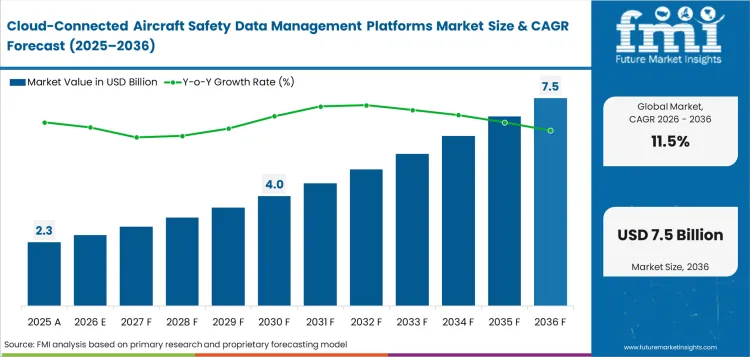
Cloud-connected aircraft safety data management platforms market was valued at USD 2.3 billion in 2025 and is projected to reach USD 2.5 billion in 2026. Industry value is forecast to reach USD 7.5 billion by 2036 at 11.5% CAGR from 2026 to 2036. Flight Data Monitoring is projected to account for 34.0% of platform type in 2026 and QAR Data is expected to represent 29.0% of data source segment.
Summary of the Cloud-Connected Aircraft Safety Data Management Platforms Market
- Demand and Growth Drivers
- Airline safety teams are shifting from periodic event checks to continuous flight data review as fleets generate more digital records.
- SMS compliance needs are pushing operators toward platforms that connect hazards and corrective actions with audit evidence.
- Pilot coaching demand is growing as carriers use de-identified flight trends to improve procedures without creating a punitive review culture.
- Product and Segment View
- Flight Data Monitoring holds the clearest Platform Type role as airlines need automated event detection and fleet trend review.
- QAR Data leads the Data Source view because recorder downloads give safety teams a consistent base for FOQA analysis.
- Cloud Hosted platforms gain preference as multi-site safety teams need shared dashboards and faster access to reviewed events.
- Geography and Competitive Outlook
- India shows faster demand development as airline fleet growth increases safety data volume across domestic networks. The United States holds a major revenue base as FAA SMS rules increase formal safety evidence needs.
- Suppliers with aircraft data decoding depth and pilot privacy controls can build stronger airline confidence.
- Analyst Opinion
- Nikhil Kaitwade, Principal Consultant at FMI says, “Airline and aircraft operators are treating safety data platforms as a control layer for flight risk review. Suppliers with aircraft data handling depth and secure cloud workflows will gain preference as operators connect safety reporting with operational evidence.”
- Cloud-Connected Aircraft Safety Data Management Platforms Market Value Analysis
- Aircraft safety platforms create value by turning flight records and safety reports into daily risk review workflows.
- Flight Data Monitoring gives the clearest value as airlines can identify repeat events before audit or incident review.
- Commercial airlines spend on these platforms to manage fleet scale and protect pilot coaching records.
- Cloud Hosted delivery works well for safety departments that need shared dashboards and controlled access.
- Supplier pricing depends on data decoding depth and cyber assurance because older fleets need careful migration work.
Key Takeaways
- Cloud-connected aircraft safety data management platforms were valued at USD 2.3 billion in 2025 based on airline safety software spending and active fleet use.
- Industry value is projected to reach USD 7.5 billion by 2036 as airlines connect flight data with safety assurance workflows.
- Demand is forecast to expand at 11.5% CAGR from 2026 to 2036 across airline SMS and flight data review programs.
- Incremental opportunity is projected at USD 5.0 billion between 2026 and 2036 as platform use spreads across regional operators.
- Flight Data Monitoring is projected to hold 34.0% of Platform Type demand in 2026 as airlines need event detection and trend review.
- QAR Data is expected to represent 29.0% of Data Source demand in 2026 as quick-access recorder feeds support structured safety review.
- India is forecast at 14.2% CAGR through 2036 as airline fleet growth raises the need for standardized safety data workflows.
Airline safety teams need faster ways to convert flight data into repeatable risk decisions. GE Aerospace stated in February 2024 that ASL Aviation Holdings adopted Safety Insight and FlightPulse across its airlines. Groupwide deployment supports shared safety practices across multiple operators. GE Aerospace stated in March 2024 that Air India selected Safety Insight, Fuel Insight and FlightPulse for its operations. The same release said FlightPulse would support more than 5,000 flight crew with personalized flight data. Pilot-facing access makes safety analytics more practical during daily operations. GE Aerospace stated in October 2024 that FlightPulse had topped 40,000 pilot users across 25 airlines and 20 corporate operators. Adoption at that scale supports buyer confidence in cloud-connected aviation analytics. EASA stated in January 2024 that EPAS added 35 new safety issues and removed 19 after review. Platforms that help airlines prioritize risks are likely to gain stronger operational relevance.
Cloud-Connected Aircraft Safety Data Management Platforms Market Definition
The cloud-connected aircraft safety data management platforms market includes software platforms used to collect, process, store, and analyze aircraft safety data through secure cloud or hybrid cloud systems.
Cloud-Connected Aircraft Safety Data Management Platforms Market Inclusions
Market scope includes cloud-hosted safety platforms, hybrid safety data systems, flight data monitoring tools, FOQA dashboards, SMS compliance modules, risk analytics engines, pilot review portals, airline safety workflows, and regional demand across North America, Latin America, Europe, East Asia, South Asia and Pacific, Middle East and Africa. Stakeholders include commercial airlines, business aviation operators, cargo carriers, MRO providers, aircraft OEMs, aviation regulators, safety managers, flight operations departments, maintenance safety departments, software integrators, and cloud security providers.
Cloud-Connected Aircraft Safety Data Management Platforms Market Exclusions
The scope excludes physical flight recorders, standalone aircraft sensors, airport operations software, generic enterprise safety tools, passenger experience apps, and maintenance software without safety data management capability.
Cloud-Connected Aircraft Safety Data Management Platforms Market Research Methodology
- Primary Research: FMI analysts reviewed airline safety managers, flight operations heads, aviation software suppliers, business jet operators, MRO data users, and OEM digital service groups. Interviews focused on platform selection, contract structure, data handling needs, and migration pain points.
- Desk Research: Research used civil aviation rules, safety management requirements, airline traffic data, company platform updates, and official aviation safety publications. FAA SMS rules and EASA Data4Safety guidance helped define platform demand linked to safety assurance.
- Market Sizing and Forecasting: Market sizing combined airline fleet counts, platform subscription pricing, flight data monitoring penetration, and regional SMS compliance activity. Forecasting used country traffic growth, safety reporting volume, and software migration rates.
- Data Validation: Forecasts were checked against aircraft utilization patterns, airline digital spending, official safety reporting trends, and supplier platform adoption. Final values were rounded in USD billion across all years.
Why is the Cloud-Connected Aircraft Safety Data Management Platforms Market Growing?
- FAA SMS expansion is increasing demand for formal safety data evidence across more operator groups.
- Flight data monitoring is moving into daily safety review as airlines need event trend checks after routine flights.
- EASA Data4Safety reinforces the shift toward shared risk intelligence at the regional and industry levels.
- Airline network growth increases the volume of flight data that safety departments must process.
Regulatory pressure gives safety data platforms a clearer spending case. The FAA’s April 2024 SMS final rule extends SMS requirements to Part 135 certificate holders and commercial air tour operators. The rule raises the need for documented safety assurance and traceable risk review. Platform vendors gain as operators need one system to connect hazards with corrective actions and proof of review. Airline operators benefit when SMS evidence can be checked without rebuilding records across separate tools.
Flight data volume creates a second demand path for cloud platforms. IATA reported an all-accident rate of 1.32 per million sectors in 2025. The figure indicates that safety teams need automated event sorting and trend monitoring after routine flights. Cloud workflows help operators compare events across fleets with fewer delays. Suppliers with secure data handling and pilot-facing review tools are better placed for longer airline contracts.
Market Segmentation Analysis
- By 2026, Flight Data Monitoring is forecast at 34.0% of Platform Type demand because airlines need automated event capture after routine flights.
- QAR Data reaches 29.0% of Data Source demand by 2026 since downloaded flight records give FOQA programs a reliable review base.
- A 52.0% share places Commercial Airlines ahead in End Use for 2026, with fleet scale creating larger safety data volumes.
- Cloud Hosted platforms are forecast to form 58.0% of Deployment Mode in 2026 as safety users need shared dashboards across locations.
- Within Application, SMS Compliance is projected at 31.0% by 2026 because audit evidence needs cleaner structure and easier review.
The Cloud-Connected Aircraft Safety Data Management Platforms Market is segmented by Platform Type, Data Source, End Use, Deployment Mode and Application. Platform Type includes Flight Data Monitoring, Safety Reporting, Risk Analytics and Maintenance Safety. Data Source includes QAR Data, ACARS Data, EFB Data and Sensor Data. End Use includes Commercial Airlines, Business Aviation, Cargo Operators and MRO Providers. Deployment Mode includes Cloud Hosted, Hybrid Cloud and Private Cloud. Application includes SMS Compliance, FOQA Programs, Event Review and Pilot Coaching.
Insights into the Platform Type Segment
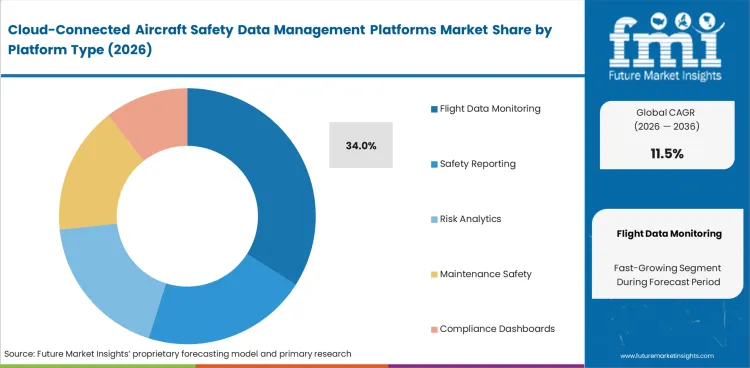
- Flight Data Monitoring is forecast at 34.0% of Platform Type demand for 2026. Airlines use this platform type to identify repeat events and review flight trends before they become operational risks.
- Safety Reporting stays important for operators that need structured hazard records and corrective action tracking.
- Risk Analytics gains value when safety teams need pattern detection across routes and aircraft families. Maintenance Safety serves operators that want flight event data to inform component review and reliability checks.
Insights into the Data Source Segment
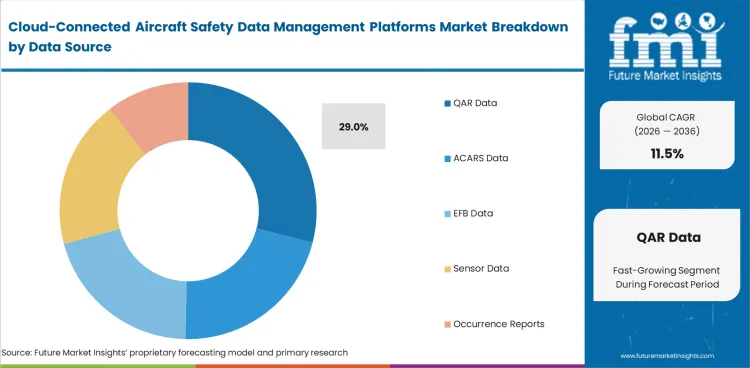
- Within Data Source, QAR Data is projected at 29.0% by 2026. Quick-access recorder files give safety teams a consistent base for FOQA review and event reconstruction.
- ACARS Data supports faster communication but does not replace deeper flight record analysis.
- EFB Data gains use as airlines connect pilot workflow tools with safety records. Occurrence Reports hold value for hazard narratives that cannot be captured through aircraft data alone.
Insights into the End Use Segment
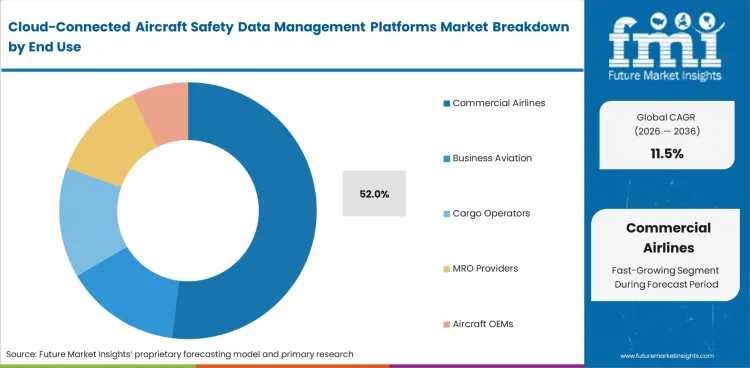
- Commercial Airlines lead End Use during the 2026 assessment with 52.0% share. Large fleet operations create high data volume and require repeatable review across aircraft types. Business Aviation uses these platforms for smaller fleets that need safety oversight without a large internal analytics function.
- Cargo Operators form a practical secondary base because night flying and tight turnaround schedules increase event review needs. MRO Providers use safety data to support component checks and maintenance-related risk review.
Insights into the Deployment Mode Segment
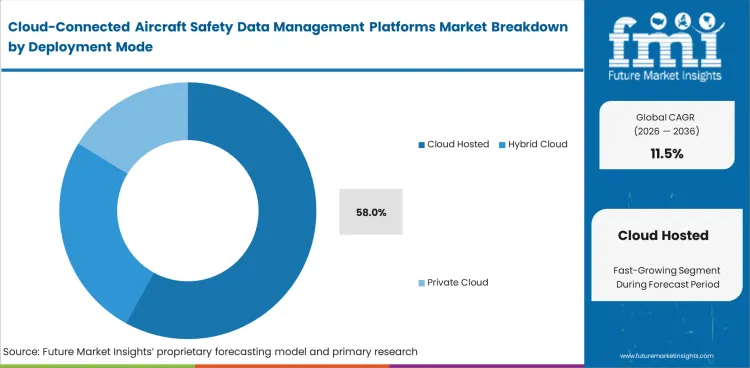
- A 58.0% share places Cloud Hosted ahead in Deployment Mode for 2026. Airline safety teams prefer shared dashboards because flight operations and safety departments often work across different locations. Hybrid Cloud keeps demand in carriers with strict internal data controls.
- Private Cloud serves operators with higher security review needs and national data policies. Cloud Hosted delivery still leads as platform updates and user access can be managed with less internal IT load.
Insights into the Application Segment
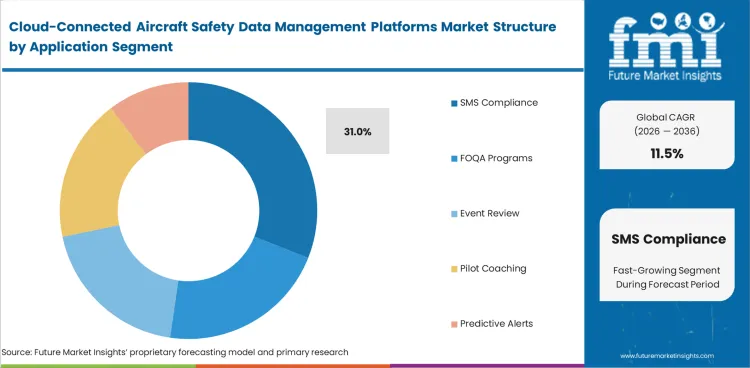
- SMS Compliance is expected to form the largest Application base at 31.0% in 2026. Operators need proof of hazard review and corrective action closure during audits. FOQA Programs follow as airlines use flight data to review operational trends and pilot behavior.
- Pilot Coaching adds a practical use case because de-identified flight trends can improve training without creating a punitive culture.
- Predictive Alerts gain value when airlines want earlier signals from repeated event patterns.
Cloud-Connected Aircraft Safety Data Management Platforms Market Drivers, Restraints, and Opportunities
- SMS evidence rules are raising demand for connected safety workflows across airline and business aviation operations.
- Cloud migration faces resistance from cyber teams that need proof of data separation and access control.
- Pilot coaching tools open an opportunity as airlines shift flight data review toward self-learning formats.
- Data decoding gaps limit platform use in mixed fleets with older aircraft and varied recorder formats.
SMS Evidence Expansion
Safety management now needs documented proof across hazards and corrective actions. The FAA’s April 2024 SMS final rule extends SMS requirements to certain Part 21 organizations, Part 135 operators and Part 91.147 commercial air tour operators. EASA said its Data4Safety program expanded in October 2024 to include nine more Member States and its first eight airport members. The expansion indicates that regulators and operators need shared safety intelligence instead of separate records. Cloud platforms help airlines connect flight data with occurrence reports and action tracking in one review process. Suppliers that can support regulator-facing evidence gain a practical advantage over generic analytics vendors.
Flight Event Data Volume
Aircraft operations create more digital records as fleets add connected avionics and electronic flight tools. GE Aerospace said FlightPulse reached 60,000 pilot users in October 2025 across commercial and business aviation. That user base shows flight data review is moving closer to pilots and not staying only inside safety offices. Platform providers create value when data is secure and practical for training review. Airlines gain better safety culture when pilots can review their own trends without fear of misuse.
Analysis of Cloud-Connected Aircraft Safety Data Management Platforms Market By Key Countries
.webp "Top Country Growth Comparison Cloud Connected Aircraft Safety Data Management Platforms Market Cagr (2026 2036)")
| Country | CAGR |
|---|---|
| India | 14.2% |
| China | 13.4% |
| UAE | 12.7% |
| United States | 11.9% |
| Singapore | 11.8% |
| United Kingdom | 10.6% |
| Germany | 10.1% |
Source: FMI analysis based on primary research and proprietary forecasting model.
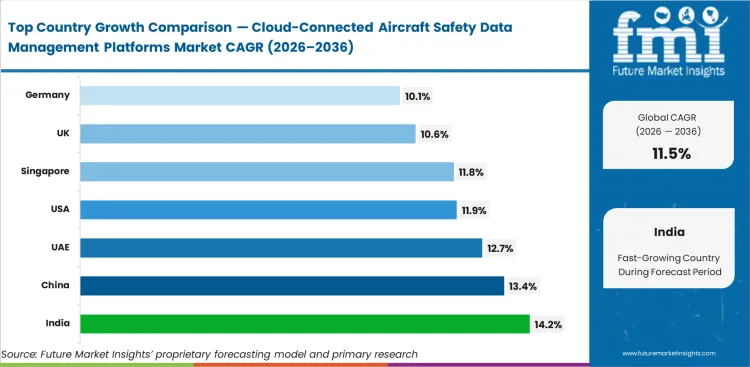
Cloud-Connected Aircraft Safety Data Management Platforms Market CAGR Analysis By Country
- India’s cloud-connected aircraft safety data management platform demand is assessed at 14.2% CAGR as fleet additions raise safety data volume.
- China records 13.4% CAGR over the forecast period, reflecting airport traffic growth and aviation digitization programs.
- A 12.7% CAGR places UAE among faster markets by 2036 because hub carriers need real-time safety oversight.
- United States demand is forecast at 11.9% CAGR as FAA SMS rules expand formal safety evidence needs.
- Singapore reaches 11.8% CAGR across the same period, shaped by Changi hub complexity and controlled data sharing needs.
- United Kingdom demand is assessed at 10.6% CAGR as occurrence reporting practice supports safety analytics.
- Germany records 10.1% CAGR by 2036 as airline engineering discipline favors structured safety review.
- Country growth varies by traffic scale and regulatory pressure. India and China outpace the global 11.5% CAGR as airline networks add aircraft and safety data volume.
Demand Outlook for Cloud-Connected Aircraft Safety Data Management Platforms Market in India
India has a fast-scaling airline base that creates heavier safety data loads. DGCA oversight and busy Delhi-Mumbai corridors increase the number of events that safety teams must review. At 14.2% CAGR through 2036, demand reflects fleet additions and wider regional route coverage. Platform vendors with local support and mixed-fleet decoding depth can gain better access to airline safety departments.
- Delhi and Mumbai routes create frequent flight cycles that increase event review needs for narrow-body fleets.
- DGCA safety oversight keeps documented flight risk review important for scheduled domestic operators.
- Bengaluru and Hyderabad add aviation software talent that can support cloud platform configuration.
Sales Analysis of Cloud-Connected Aircraft Safety Data Management Platforms Market in China
China’s aviation system is shaped by large state airline groups and expanding airport networks. CAAC policy direction keeps safety oversight tied to data control and aviation modernization. By 2036, wider airline digitization supports a 13.4% CAGR outlook for China. Suppliers need local hosting options and Chinese aircraft data workflow support to compete with domestic platforms.
- Beijing Capital and Daxing create complex traffic patterns that increase the need for event trend review.
- CAAC modernization priorities support connected safety data workflows across carriers and airports.
- Shanghai and Guangzhou hubs create large recorder data volumes across narrow-body and wide-body fleets.
Demand Analysis of Cloud-Connected Aircraft Safety Data Management Platforms Market in UAE
UAE demand is shaped by hub carriers and long-haul fleet complexity. Dubai and Abu Dhabi create high aircraft movement intensity across international routes. The country is assessed at 12.7% CAGR through 2036 because operators need faster safety review across wide-body fleets. Platform suppliers can gain preference through cyber assurance and global service support.
- Dubai International creates dense aircraft movements that raise demand for faster event detection.
- Abu Dhabi’s Zayed International Airport supports long-haul operations that need structured safety workflows.
- GCAA oversight keeps SMS evidence important for operators serving global route networks.
Opportunity Analysis of Cloud-Connected Aircraft Safety Data Management Platforms Market in the United States
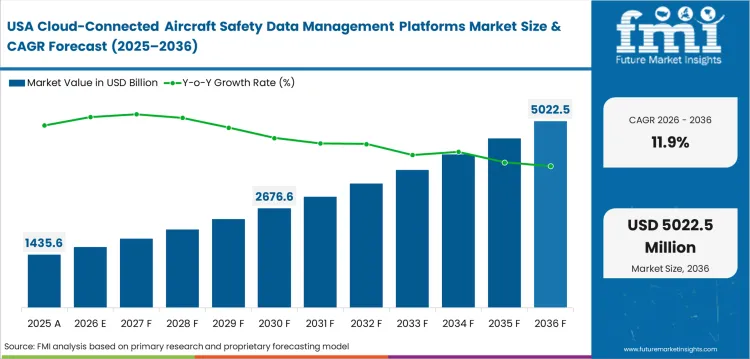
United States operators face deeper SMS documentation needs across airline and charter operations. FAA Part 5 requirements make safety assurance records more important for carriers and business aviation. Through 2036, demand is assessed at 11.9% CAGR with wider use of flight data and corrective action tracking. Vendors with FAA-aware workflows and secure cloud controls will be better placed in airline evaluations.
- Dallas-Fort Worth and Atlanta create large fleet data volumes for airline safety review.
- FAA Part 5 SMS rules raise demand for documented hazard tracking and corrective action records.
- Texas and Florida business aviation activity supports modular safety dashboards for smaller operators.
Future Outlook for Cloud-Connected Aircraft Safety Data Management Platforms Market in Singapore
Singapore has a smaller aircraft base but a high-value aviation hub role. Changi Airport creates complex operations that need clean safety data exchange across airlines and airport systems. An 11.8% CAGR outlook from 2026 to 2036 reflects the country’s focus on digital tools for hub efficiency. Platform suppliers can use Singapore as a regional base for aviation safety analytics.
- Changi Airport transfer traffic creates safety data needs across short-haul and long-haul operations.
- CAAS digital aviation programs support airline interest in flight efficiency and safety analytics.
- Terminal 5 planning raises future operational scale and related safety data requirements.
Demand Outlook for Cloud-Connected Aircraft Safety Data Management Platforms Market in the United Kingdom
United Kingdom demand is shaped by disciplined occurrence reporting and established airline safety practice. Heathrow and Gatwick create high-volume international operations that require structured event review. The United Kingdom reaches 10.6% CAGR through 2036 as operators continue to refine safety assurance workflows. Suppliers that reduce manual report sorting can gain value in airline safety departments.
- Heathrow’s international network creates high event volumes that require structured safety review.
- UK CAA occurrence reporting practice supports formal safety data intake across operators.
- Gatwick and Manchester operations increase demand for dashboards that help review disruption-linked events.
In-depth Analysis of Cloud-Connected Aircraft Safety Data Management Platforms Market in Germany
Germany’s aviation sector values engineering discipline and structured safety evidence. Frankfurt and Munich support complex airline operations that require reliable flight event review. Demand reaches 10.1% CAGR by 2036 through airline and MRO safety data use. Vendors that connect maintenance safety with flight event data can improve account depth across German operators.
- Frankfurt Airport creates dense international traffic that supports flight event review demand.
- Munich operations require clean data workflows across airline safety and maintenance functions.
- Lufthansa Technik’s MRO ecosystem increases demand for aircraft data workflows tied to safety.
Competitive Landscape and Strategic Positioning
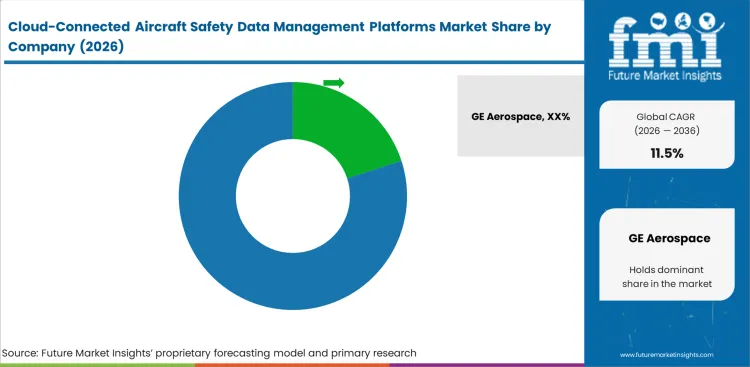
- Market concentration is moderate as large aerospace suppliers compete with specialist flight data analytics firms.
- GE Aerospace has a clear position through FlightPulse and airline pilot data access.
- Collins Aerospace and Boeing compete through fleet health analytics and aircraft data depth.
- Smaller suppliers compete through outsourced FOQA support and faster platform configuration.
- Entry barriers come from aircraft data decoding, cyber review and airline safety trust.
Airlines need platforms that decode flight records correctly and protect pilot identity. GE Aerospace said FlightPulse reached 60,000 pilot users in October 2025 across commercial and business aviation. User scale at that level shows why pilot-facing analytics need secure data handling and clear privacy controls. Operators evaluating suppliers will look for proof that flight data supports coaching instead of punitive review.
Established aerospace suppliers gain from aircraft system knowledge and fleet data experience. Collins Aerospace, an RTX business launched Ascentia Repeaters with Republic Airways in April 2025 for Embraer E-Jets. The official release states that the application uses natural language processing to clean and organize maintenance-log text. That capability brings safety data platforms closer to maintenance health and daily fleet decisions. Smaller software providers can still compete through faster FOQA setup and analyst support.
Aviation software assets drew buyer interest as airlines treat software as part of flight operations. Boeing said it closed the sale of portions of its Digital Aviation Solutions business to Thoma Bravo for USD 10.55 billion. The official statement says Boeing retained Digital Services capabilities tied to fleet operations and diagnostics. The deal indicates how aviation software is separating into planning tools and aircraft data intelligence. Platform suppliers with fleet data depth can defend stronger positions in airline safety systems.
Key Companies in the Cloud-Connected Aircraft Safety Data Management Platforms Market
- Aerospace Software Leaders: GE Aerospace, Collins Aerospace, Boeing, Honeywell Aerospace, and Airbus hold an advantage through aircraft data knowledge and airline relationships.
- Flight Operations Platforms: NAVBLUE and SITA compete through flight operations software and airline workflow tools. NAVBLUE’s Nsight platform supports flight data analysis and dashboards.
- Specialist Safety Data Providers: Acron Aviation, Teledyne Controls, and L3Harris support flight data acquisition, decoding, and outsourced analysis.
Competitive Benchmarking: Cloud-Connected Aircraft Safety Data Management Platforms Market
| Company | Flight Data Decoding Depth | SMS Workflow Coverage | Pilot Data Governance | Geographic Footprint |
|---|---|---|---|---|
| GE Aerospace | High | High | Strong | Global |
| Collins Aerospace | High | Medium | Strong | Global |
| Boeing | High | High | Strong | Global |
| Honeywell Aerospace | Medium | Medium | Moderate | Global |
| Airbus | High | Medium | Strong | Global |
| NAVBLUE | High | High | Strong | Global |
| SITA | Medium | Medium | Moderate | Global |
| Acron Aviation | High | High | Moderate | Multi-region |
| Teledyne Controls | High | Medium | Moderate | Global |
| L3Harris | Medium | Medium | Moderate | North America |
Source: Future Market Insights competitive analysis, 2026. Ratings reflect relative positioning based on flight data decoding depth, SMS workflow coverage, and pilot data governance.
Key Developments in Cloud-Connected Aircraft Safety Data Management Platforms Market
- In September 2025, SITA said Air India Group deployed SITA OptiFlight and SITA eWAS across Airbus A320 and Boeing 737 fleets. The rollout strengthens flight-optimization workflows and pilot decision support.
- In April 2026, Airbus launched Skywise as a wholly owned subsidiary by merging Navblue solutions and Skywise Digital solutions.
Key Players in the Cloud-Connected Aircraft Safety Data Management Platforms Market
Aerospace Software Leaders
- GE Aerospace
- Collins Aerospace
- Boeing
- Honeywell Aerospace
- Airbus
Flight Operations Platforms
- NAVBLUE
- SITA
Specialist Safety Data Providers
- Acron Aviation
- Teledyne Controls
- L3Harris
Report Scope and Coverage
| Parameter | Details |
|---|---|
| Quantitative Units | USD 2.5 billion in 2026 to USD 7.5 billion by 2036 at 11.5% CAGR |
| Market Definition | Software platforms used to collect, process, store, and analyze aircraft safety data through secure cloud or hybrid systems |
| Regions Covered | North America, Latin America, Europe, East Asia, South Asia and Pacific, Middle East and Africa |
| Countries Covered | India, China, UAE, United States, Singapore, United Kingdom, Germany, 30+ countries |
| Key Companies Profiled | GE Aerospace, Collins Aerospace, Boeing, Honeywell Aerospace, Airbus, NAVBLUE, SITA |
| Forecast Period | 2026 to 2036 |
| Approach | Hybrid bottom-up and top-down methodology starting with verified airline safety software spending and platform penetration checks |
Cloud-Connected Aircraft Safety Data Management Platforms Market by Segments
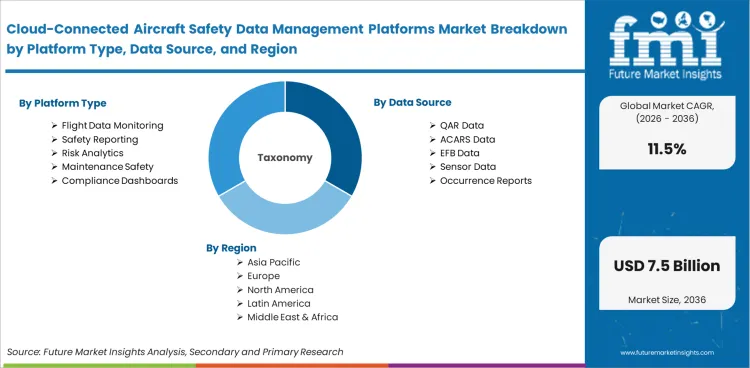
Cloud-Connected Aircraft Safety Data Management Platforms Market Segmented by Platform Type:
- Flight Data Monitoring
- Safety Reporting
- Risk Analytics
- Maintenance Safety
- Compliance Dashboards
Cloud-Connected Aircraft Safety Data Management Platforms Market Segmented by Data Source:
- QAR Data
- ACARS Data
- EFB Data
- Sensor Data
- Occurrence Reports
Cloud-Connected Aircraft Safety Data Management Platforms Market Segmented by End Use:
- Commercial Airlines
- Business Aviation
- Cargo Operators
- MRO Providers
- Aircraft OEMs
Cloud-Connected Aircraft Safety Data Management Platforms Market Segmented by Deployment Mode:
- Cloud Hosted
- Hybrid Cloud
- Private Cloud
Cloud-Connected Aircraft Safety Data Management Platforms Market Segmented by Application:
- SMS Compliance
- FOQA Programs
- Event Review
- Pilot Coaching
- Predictive Alerts
Cloud-Connected Aircraft Safety Data Management Platforms Market by Region:
- North America
- United States
- Canada
- Mexico
- Latin America
- Brazil
- Chile
- Rest of Latin America
- Western Europe
- Germany
- UK
- Italy
- Spain
- France
- Nordic
- BENELUX
- Rest of Western Europe
- Eastern Europe
- Russia
- Poland
- Hungary
- Balkan & Baltic
- Rest of Eastern Europe
- East Asia
- China
- Japan
- South Korea
- South Asia and Pacific
- India
- ASEAN
- Australia & New Zealand
- Rest of South Asia and Pacific
- Middle East & Africa
- Kingdom of Saudi Arabia
- Other GCC Countries
- Turkiye
- South Africa
- Other African Union
- Rest of Middle East & Africa
Research Sources and Bibliography
- Federal Aviation Administration. (2024, May 9). Safety Management System. U.S. Department of Transportation.
- European Union Aviation Safety Agency. (2024, October 1). Additional Member States and first airports join EASA’s award-winning Data4Safety programme. EASA.
- GE Aerospace. (2025, October 9). GE Aerospace’s FlightPulse app soars to 60,000 pilot users. GE Aerospace.
- RTX. (2025, April 9). RTX’s Collins Aerospace launches Ascentia Repeaters with Republic Airways.
- Boeing. (2025, November 3). Statement about sale of portions of Boeing’s Digital Aviation Solutions business.
- SITA. (2025, September 12). Air India Group tackles flight efficiency and emissions with advanced data-driven tech.
- Skywise. (2026, April 1). Airbus unveils Skywise subsidiary, integrating Navblue and Skywise Digital solutions.
Bibliography is provided for reader reference and uses official regulatory, aviation authority, industry body, and company sources.
This Report Answers
- How large is the cloud-connected aircraft safety data management platforms market in 2026 and by 2036?
- What CAGR is forecast for cloud-connected aircraft safety data management platforms from 2026 to 2036?
- Which platform type is projected to lead aircraft safety data management demand in 2026?
- Why does QAR Data hold the clearest data source position for safety review workflows?
- How do FAA SMS rules affect platform demand across airlines and business aviation operators?
- Why are India and China forecast to outpace the global growth rate through 2036?
- Which supplier capabilities help vendors win airline safety data platform contracts?
- How do cloud hosting and pilot data governance affect supplier selection?
- What research method supports the market size and country CAGR estimates?
Frequently Asked Questions
What is the global market demand for cloud-connected aircraft safety data management platforms in 2026?
In 2026, the global cloud-connected aircraft safety data management platforms market is expected to be worth USD 2.5 billion.
How big will the cloud-connected aircraft safety data management platforms market be in 2036?
By 2036, the market is forecast to reach USD 7.5 billion as airline safety workflows become more data-based.
How fast is demand expected to grow between 2026 and 2036?
Demand is projected to expand at 11.5% CAGR from 2026 to 2036 across airline and business aviation users.
Which platform type is projected to lead demand in 2026?
Flight Data Monitoring is projected to account for 34.0% of Platform Type demand in 2026 due to event review needs.
Which data source is expected to lead in 2026?
QAR Data is expected to represent 29.0% of Data Source demand in 2026 as it supports structured flight review.
What is driving demand growth in India?
India is forecast at 14.2% CAGR through 2036 as airline fleet expansion increases safety data volume.
What does this market include?
The market includes cloud and hybrid platforms for flight data monitoring, safety reporting, SMS compliance and pilot coaching.
How does FMI estimate the forecast?
FMI uses airline platform spending, fleet activity, safety workflow adoption and country-level regulatory pressure to validate the forecast.
Preview the report firsthand - request a free sample
Get SampleGet the brochure for pricing and purchase details.
Get PDFTable of Content
- Key Takeaways
- Market Size and CAGR
- Top Growth Driver
- Fastest Growing Segment
- Leading Region
- Key Companies
- Emerging Opportunities
- Executive Summary
- Global Market Outlook
- Demand-side Trends
- Supply-side Trends
- Technology Roadmap Analysis
- Analysis and Recommendations
- Analyst Perspective (What is happening? Why now? What should investors know?)
- Key Questions Answered
- How large is the market?
- What is the CAGR?
- What are key trends?
- Which region dominates?
- Who are the leaders?
- Market Overview
- Market Coverage / Taxonomy
- Market Definition / Scope / Limitations
- Research Methodology
- Chapter Orientation
- Analytical Lens and Working Hypotheses
- Market Structure, Signals, and Trend Drivers
- Benchmarking and Cross-market Comparability
- Market Sizing, Forecasting, and Opportunity Mapping
- Research Design and Evidence Framework
- Desk Research Programme (Secondary Evidence)
- Expert Input and Fieldwork (Primary Evidence)
- Tooling, Models, and Reference Databases
- Data Engineering and Model Build
- Quality Assurance and Audit Trail
- Market Background
- Market Dynamics (Drivers, Restraints, Opportunity, Trends)
- Scenario Forecast (Optimistic, Likely, Conservative)
- Impact Analysis
- AI Impact
- Sustainability Impact
- Regulatory Impact
- Technology Impact
- Consumer / Buyer Analysis
- Purchase Drivers
- Adoption Barriers
- Buyer Journey
- Opportunity Map Analysis
- Product Life Cycle Analysis
- Supply Chain Analysis
- Investment Feasibility Matrix
- Value Chain Analysis
- PESTLE and Porter's Analysis
- Regulatory Landscape
- Regional Parent Market Outlook
- Production and Consumption Statistics
- Import and Export Statistics
- Global Market Analysis and Forecast, 2021 to 2036
- Historical Market Size Value (USD Billion) & Volume (Unit) Analysis, 2021 to 2025
- Current and Future Market Size Value (USD Billion) & Volume (Unit) Projections, 2026 to 2036
- Y-o-Y Growth Trend Analysis
- Absolute $ Opportunity Analysis
- Global Market Pricing Analysis, 2021 to 2036
- Global Market Analysis and Forecast, By Platform Type , 2021 to 2036
- Introduction / Key Findings
- Historical Market Size Value (USD Billion) & Volume (Unit) Analysis By Platform Type , 2021 to 2025
- Current and Future Market Size Value (USD Billion) & Volume (Unit) Analysis and Forecast By Platform Type , 2026 to 2036
- Flight Data Monitoring
- Safety Reporting
- Risk Analytics
- Maintenance Safety
- Compliance Dashboards
- Flight Data Monitoring
- Y-o-Y Growth Trend Analysis By Platform Type , 2021 to 2025
- Absolute $ Opportunity Analysis By Platform Type , 2026 to 2036
- Global Market Analysis and Forecast, By Data Source, 2021 to 2036
- Introduction / Key Findings
- Historical Market Size Value (USD Billion) & Volume (Unit) Analysis By Data Source, 2021 to 2025
- Current and Future Market Size Value (USD Billion) & Volume (Unit) Analysis and Forecast By Data Source, 2026 to 2036
- QAR Data
- ACARS Data
- EFB Data
- Sensor Data
- Occurrence Reports
- QAR Data
- Y-o-Y Growth Trend Analysis By Data Source, 2021 to 2025
- Absolute $ Opportunity Analysis By Data Source, 2026 to 2036
- Global Market Analysis and Forecast, By End Use, 2021 to 2036
- Introduction / Key Findings
- Historical Market Size Value (USD Billion) & Volume (Unit) Analysis By End Use, 2021 to 2025
- Current and Future Market Size Value (USD Billion) & Volume (Unit) Analysis and Forecast By End Use, 2026 to 2036
- Commercial Airlines
- Business Aviation
- Cargo Operators
- MRO Providers
- Aircraft OEMs
- Commercial Airlines
- Y-o-Y Growth Trend Analysis By End Use, 2021 to 2025
- Absolute $ Opportunity Analysis By End Use, 2026 to 2036
- Global Market Analysis and Forecast, By Deployment Mode, 2021 to 2036
- Introduction / Key Findings
- Historical Market Size Value (USD Billion) & Volume (Unit) Analysis By Deployment Mode, 2021 to 2025
- Current and Future Market Size Value (USD Billion) & Volume (Unit) Analysis and Forecast By Deployment Mode, 2026 to 2036
- Cloud Hosted
- Hybrid Cloud
- Private Cloud
- Cloud Hosted
- Y-o-Y Growth Trend Analysis By Deployment Mode, 2021 to 2025
- Absolute $ Opportunity Analysis By Deployment Mode, 2026 to 2036
- Global Market Analysis and Forecast, By Application, 2021 to 2036
- Introduction / Key Findings
- Historical Market Size Value (USD Billion) & Volume (Unit) Analysis By Application, 2021 to 2025
- Current and Future Market Size Value (USD Billion) & Volume (Unit) Analysis and Forecast By Application, 2026 to 2036
- SMS Compliance
- FOQA Programs
- Event Review
- Pilot Coaching
- Predictive Alerts
- SMS Compliance
- Y-o-Y Growth Trend Analysis By Application, 2021 to 2025
- Absolute $ Opportunity Analysis By Application, 2026 to 2036
- Global Market Analysis and Forecast, By Region , 2021 to 2036
- Introduction
- Historical Market Size Value (USD Billion) & Volume (Unit) Analysis By Region, 2021 to 2025
- Current Market Size Value (USD Billion) & Volume (Unit) Analysis and Forecast By Region, 2026 to 2036
- North America
- Latin America
- Western Europe
- Eastern Europe
- East Asia
- South Asia and Pacific
- Middle East & Africa
- Market Attractiveness Analysis By Region
- North America Market Analysis and Forecast, By Country , 2021 to 2036
- Historical Market Size Value (USD Billion) & Volume (Unit) Trend Analysis By Market Taxonomy, 2021 to 2025
- Market Size Value (USD Billion) & Volume (Unit) Forecast By Market Taxonomy, 2026 to 2036
- By Country
- USA
- Canada
- Mexico
- By Platform Type
- By Data Source
- By End Use
- By Deployment Mode
- By Application
- By Country
- Market Attractiveness Analysis
- By Country
- By Platform Type
- By Data Source
- By End Use
- By Deployment Mode
- By Application
- Key Takeaways
- Latin America Market Analysis and Forecast, By Country
- Historical Market Size Value (USD Billion) & Volume (Unit) Trend Analysis By Market Taxonomy, 2021 to 2025
- Market Size Value (USD Billion) & Volume (Unit) Forecast By Market Taxonomy, 2026 to 2036
- By Country
- Brazil
- Chile
- Rest of Latin America
- By Platform Type
- By Data Source
- By End Use
- By Deployment Mode
- By Application
- By Country
- Market Attractiveness Analysis
- By Country
- By Platform Type
- By Data Source
- By End Use
- By Deployment Mode
- By Application
- Key Takeaways
- Western Europe Market Analysis and Forecast, By Country
- Historical Market Size Value (USD Billion) & Volume (Unit) Trend Analysis By Market Taxonomy, 2021 to 2025
- Market Size Value (USD Billion) & Volume (Unit) Forecast By Market Taxonomy, 2026 to 2036
- By Country
- Germany
- UK
- Italy
- Spain
- France
- Nordic
- BENELUX
- Rest of Western Europe
- By Platform Type
- By Data Source
- By End Use
- By Deployment Mode
- By Application
- By Country
- Market Attractiveness Analysis
- By Country
- By Platform Type
- By Data Source
- By End Use
- By Deployment Mode
- By Application
- Key Takeaways
- Eastern Europe Market Analysis and Forecast, By Country
- Historical Market Size Value (USD Billion) & Volume (Unit) Trend Analysis By Market Taxonomy, 2021 to 2025
- Market Size Value (USD Billion) & Volume (Unit) Forecast By Market Taxonomy, 2026 to 2036
- By Country
- Russia
- Poland
- Hungary
- Balkan & Baltic
- Rest of Eastern Europe
- By Platform Type
- By Data Source
- By End Use
- By Deployment Mode
- By Application
- By Country
- Market Attractiveness Analysis
- By Country
- By Platform Type
- By Data Source
- By End Use
- By Deployment Mode
- By Application
- Key Takeaways
- East Asia Market Analysis and Forecast, By Country
- Historical Market Size Value (USD Billion) & Volume (Unit) Trend Analysis By Market Taxonomy, 2021 to 2025
- Market Size Value (USD Billion) & Volume (Unit) Forecast By Market Taxonomy, 2026 to 2036
- By Country
- China
- Japan
- South Korea
- By Platform Type
- By Data Source
- By End Use
- By Deployment Mode
- By Application
- By Country
- Market Attractiveness Analysis
- By Country
- By Platform Type
- By Data Source
- By End Use
- By Deployment Mode
- By Application
- Key Takeaways
- South Asia and Pacific Market Analysis and Forecast, By Country
- Historical Market Size Value (USD Billion) & Volume (Unit) Trend Analysis By Market Taxonomy, 2021 to 2025
- Market Size Value (USD Billion) & Volume (Unit) Forecast By Market Taxonomy, 2026 to 2036
- By Country
- India
- ASEAN
- Australia & New Zealand
- Rest of South Asia and Pacific
- By Platform Type
- By Data Source
- By End Use
- By Deployment Mode
- By Application
- By Country
- Market Attractiveness Analysis
- By Country
- By Platform Type
- By Data Source
- By End Use
- By Deployment Mode
- By Application
- Key Takeaways
- Middle East & Africa Market Analysis and Forecast, By Country
- Historical Market Size Value (USD Billion) & Volume (Unit) Trend Analysis By Market Taxonomy, 2021 to 2025
- Market Size Value (USD Billion) & Volume (Unit) Forecast By Market Taxonomy, 2026 to 2036
- By Country
- Kingdom of Saudi Arabia
- Other GCC Countries
- Türkiye
- South Africa
- Other African Union
- Rest of Middle East & Africa
- By Platform Type
- By Data Source
- By End Use
- By Deployment Mode
- By Application
- By Country
- Market Attractiveness Analysis
- By Country
- By Platform Type
- By Data Source
- By End Use
- By Deployment Mode
- By Application
- Key Takeaways
- Key Countries Market Analysis
- USA
- Pricing Analysis
- Market Share Analysis, 2025
- By Platform Type
- By Data Source
- By End Use
- By Deployment Mode
- By Application
- Canada
- Pricing Analysis
- Market Share Analysis, 2025
- By Platform Type
- By Data Source
- By End Use
- By Deployment Mode
- By Application
- Mexico
- Pricing Analysis
- Market Share Analysis, 2025
- By Platform Type
- By Data Source
- By End Use
- By Deployment Mode
- By Application
- Brazil
- Pricing Analysis
- Market Share Analysis, 2025
- By Platform Type
- By Data Source
- By End Use
- By Deployment Mode
- By Application
- Chile
- Pricing Analysis
- Market Share Analysis, 2025
- By Platform Type
- By Data Source
- By End Use
- By Deployment Mode
- By Application
- Germany
- Pricing Analysis
- Market Share Analysis, 2025
- By Platform Type
- By Data Source
- By End Use
- By Deployment Mode
- By Application
- UK
- Pricing Analysis
- Market Share Analysis, 2025
- By Platform Type
- By Data Source
- By End Use
- By Deployment Mode
- By Application
- Italy
- Pricing Analysis
- Market Share Analysis, 2025
- By Platform Type
- By Data Source
- By End Use
- By Deployment Mode
- By Application
- Spain
- Pricing Analysis
- Market Share Analysis, 2025
- By Platform Type
- By Data Source
- By End Use
- By Deployment Mode
- By Application
- France
- Pricing Analysis
- Market Share Analysis, 2025
- By Platform Type
- By Data Source
- By End Use
- By Deployment Mode
- By Application
- India
- Pricing Analysis
- Market Share Analysis, 2025
- By Platform Type
- By Data Source
- By End Use
- By Deployment Mode
- By Application
- ASEAN
- Pricing Analysis
- Market Share Analysis, 2025
- By Platform Type
- By Data Source
- By End Use
- By Deployment Mode
- By Application
- Australia & New Zealand
- Pricing Analysis
- Market Share Analysis, 2025
- By Platform Type
- By Data Source
- By End Use
- By Deployment Mode
- By Application
- China
- Pricing Analysis
- Market Share Analysis, 2025
- By Platform Type
- By Data Source
- By End Use
- By Deployment Mode
- By Application
- Japan
- Pricing Analysis
- Market Share Analysis, 2025
- By Platform Type
- By Data Source
- By End Use
- By Deployment Mode
- By Application
- South Korea
- Pricing Analysis
- Market Share Analysis, 2025
- By Platform Type
- By Data Source
- By End Use
- By Deployment Mode
- By Application
- Russia
- Pricing Analysis
- Market Share Analysis, 2025
- By Platform Type
- By Data Source
- By End Use
- By Deployment Mode
- By Application
- Poland
- Pricing Analysis
- Market Share Analysis, 2025
- By Platform Type
- By Data Source
- By End Use
- By Deployment Mode
- By Application
- Hungary
- Pricing Analysis
- Market Share Analysis, 2025
- By Platform Type
- By Data Source
- By End Use
- By Deployment Mode
- By Application
- Kingdom of Saudi Arabia
- Pricing Analysis
- Market Share Analysis, 2025
- By Platform Type
- By Data Source
- By End Use
- By Deployment Mode
- By Application
- Türkiye
- Pricing Analysis
- Market Share Analysis, 2025
- By Platform Type
- By Data Source
- By End Use
- By Deployment Mode
- By Application
- South Africa
- Pricing Analysis
- Market Share Analysis, 2025
- By Platform Type
- By Data Source
- By End Use
- By Deployment Mode
- By Application
- USA
- Market Structure Analysis
- Competition Dashboard
- Competition Benchmarking
- Market Share Analysis of Top Players
- By Regional
- By Platform Type
- By Data Source
- By End Use
- By Deployment Mode
- By Application
- Emerging Startups
- Innovation Benchmarking
- Competition Analysis
- Competition Deep Dive
- GE Aerospace
- Overview
- Product Portfolio
- Profitability by Market Segments (Product/Region/Sales Channel)
- Sales Footprint
- Strategy Overview
- Marketing Strategy
- Product Strategy
- Channel Strategy
- Collins Aerospace
- Boeing
- Honeywell Aerospace
- Airbus
- NAVBLUE
- SITA
- Acron Aviation
- Teledyne Controls
- L3Harris
- GE Aerospace
- Case Studies
- Success Stories
- Recent Developments
- Competition Deep Dive
- Assumptions & Acronyms Used


