

- Industry Size (2026)
- USD 318.5 Mn
- Forecast (2036)
- USD 965.2 Mn
- CAGR (2026 to 2036)
- 11.72%
Clinical Data Provenance Management Market Size, Market Forecast and Outlook By FMI
The clinical data provenance management market was valued at USD 285.4 million in 2025. The sector is set to reach USD 318.5 million in 2026 at a CAGR of 11.72% during the forecast period. Sustained investment propels the total opportunity to USD 965.2 million through 2036 as automated cryptographic tracking of real-world evidence transformations becomes a hard prerequisite for FDA regulatory submissions.
Replacing fragmented proprietary audit logs with standardized W3C PROV-based metadata ledgers forces biopharma trial sponsors to completely overhaul their evidence pipelines. Sponsors who delay this implementation lose multi-million-dollar trial approval timelines when regulatory bodies question the integrity of sourced claims data. While observers frequently focus on securing the initial point of data capture, the actual regulatory failure point occurs during intermediate transformations applied by third-party aggregators, requiring sophisticated clinical interoperability engines to maintain unbroken custody chains.
Summary of Clinical Data Provenance Management Market
- Clinical Data Provenance Management Market Definition
- This market provides the software and protocols that cryptographically trace the origin, movement, and alteration of health data, ensuring structural integrity and regulatory compliance from the patient source to final clinical trial submission.
- Demand Drivers in the Market
- FDA 21 CFR Part 11 and recent real-world data guidances force biopharma trial sponsors to mathematically prove the integrity of external data sources.
- Sponsor Service Level Agreements compel Contract Research Organizations to implement API-based provenance engines for multi-site data integration.
- The commercial monetization of de-identified patient data drives hospital networks to deploy automated tagging tools to validate their data's origin for licensing.
- Key Segments Analyzed in the FMI Report
- Software: 62.4% share in 2026, driven by the structural necessity for scalable, automated metadata ledgers that function independently of human data entry.
- Cloud: 71.3% share in 2026, anchored by the fundamental requirement to track data across multiple institutional boundaries simultaneously.
- Pharma & Biotech Companies: 48.1% share in 2026, as these entities bear the ultimate financial and regulatory liability for drug approval submissions.
- India: 14.5% compound growth, propelled by local mandates requiring digital audit trails for local participation in global trial networks.
- Analyst Opinion at FMI
- Sabyasachi Ghosh, Principal Analyst, Healthcare Market Intelligence, opines, "The true regulatory bottleneck lies in intermediate data transformation tracking, not point-of-care capture. Actors who fail to map the lineage of data passing through external aggregators will face total rejection of real-world evidence packages by regulatory bodies."
- Strategic Implications / Executive Takeaways
- Biopharma sponsors must integrate end-to-end cryptographic tracking across their entire vendor network before the 2028 operational cutoff for advanced trial designs.
- Contract Research Organizations should transition from manual audit logging to automated API provenance engines to secure next-generation enterprise trial contracts.
- Hospital IT directors must implement verifiable data lineage protocols or face the total exclusion of their patient datasets from lucrative commercial research markets.
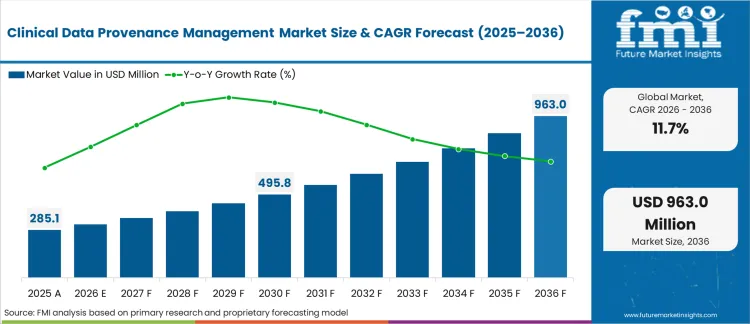
Clinical Data Provenance Management Market Key Takeaways
| Metric | Details |
|---|---|
| Industry Size (2026) | USD 318.5 million |
| Industry Value (2036) | USD 965.2 million |
| CAGR (2026-2036) | 11.72% |
Source: Future Market Insights (FMI) analysis, based on proprietary forecasting model and primary research
Biopharma trial sponsors mandating cryptographic data lineage proofs from all tier-2 Contract Research Organizations before the 2028 operational cutoff forms the primary market inflection. CROs must embed automated data tracking directly into their clinical workflows to retain sponsor contracts, initiating a self-sustaining cycle of provenance standardization across the entire life sciences supply chain.
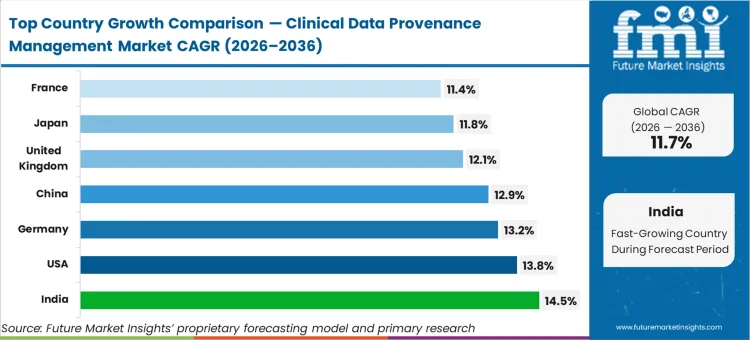
India tracks a 14.5% compound rate, followed by the United States expanding at 13.8%, Germany at 13.2%, China at 12.9%, the United Kingdom at 12.1%, Japan at 11.8%, and France recording 11.4%. The Central Drugs Standard Control Organisation, enforcing strict digital audit trail prerequisites for local sites attempting to participate in global multi-regional clinical trials, accelerates India's adoption relative to established Western markets. This spread exists because emerging regions are leapfrogging legacy systems to deploy modern cryptographic tracking as a baseline qualification for international trial revenue.
Clinical Data Provenance Management Market Definition
The Clinical Data Provenance Management Market encompasses the software platforms and integration services designed to mathematically and chronologically track the origin, ownership, and transformation history of healthcare data. This market distinguishes itself from standard cybersecurity or access control by focusing strictly on the unbroken chain of custody and lineage validation of medical information as it moves between disparate institutional silos, aggregators, and regulatory bodies.
Clinical Data Provenance Management Market Inclusions
Scope includes cryptographic metadata tracking engines, W3C PROV-compliant lineage visualization tools, blockchain-anchored audit software, and API connectors designed to link electronic data capture systems with regulatory submission portals. Implementation consulting, system validation services aligned with 21 CFR Part 11, and managed provenance-as-a-service platforms targeting trial sponsors and CROs are formally incorporated within the boundary of this market.
Clinical Data Provenance Management Market Exclusions
General hospital information systems, basic electronic health records devoid of cryptographic lineage tracking, and perimeter cybersecurity tools like firewalls and endpoint protection are explicitly excluded. These adjacent technologies manage daily clinical workflows or defend network perimeters but lack the specific mathematical proof-of-transformation capabilities required to validate data integrity for formal regulatory evidence submissions.
Clinical Data Provenance Management Market Research Methodology
- Primary Research: FMI analysts engaged with Clinical Data Managers, Directors of Real-World Evidence, and Biopharma IT Compliance Officers to map the adoption friction of lineage tracking.
- Desk Research: Aggregated FDA 21 CFR Part 11 guidance frameworks, EMA data quality directives, and HL7 FHIR implementation registries to establish the regulatory pacing of the market.
- Market-Sizing and Forecasting: Baseline volume derives from the annual number of registered global trials, applying penetration curves based on mandatory regulatory transition deadlines.
- Data Validation and Update Cycle: Projections were cross-validated against enterprise software licensing contracts announced by top-tier biopharma sponsors and major healthcare data aggregators.
Segmental Analysis
Clinical Data Provenance Management Market Analysis by Component
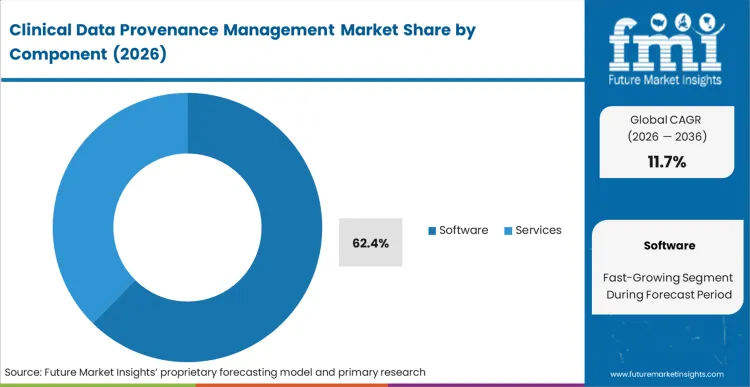
Replacing manual compliance reviews with algorithmic auditing tools exposes the severe scalability limits of service-based consulting. Software holds a dominant 62.4% share in 2026 because the sheer velocity of data transformations in modern trials physically exceeds human auditing capacity. According to FMI's estimates, biopharma data managers mandate standalone software engines to guarantee continuous, immutable tracking without constant consulting intervention. Service providers are increasingly pivoting to integration and validation support, acknowledging that the core tracking mechanism must be programmatically embedded via healthcare api integration rather than manually applied. Trial sponsors utilizing legacy consulting-led audits face unacceptable regulatory delays when attempting to map millions of concurrent data transformation events.
- Algorithmic tracking: Rules-based software automates the generation of metadata tags at every transition point. Clinical IT directors deploying these platforms eliminate human error from the regulatory chain of custody.
- Interoperability layers: Out-of-the-box connectors link disparate electronic data capture systems seamlessly. System integrators utilizing these APIs slash the time required to harmonize trial data across multiple global sites.
- Consulting pivot: Integration services transition toward validating the software rather than manually checking the data. Compliance officers utilizing these specialized services ensure their software implementation meets strict FDA 21 CFR Part 11 parameters.
Clinical Data Provenance Management Market Analysis by Deployment
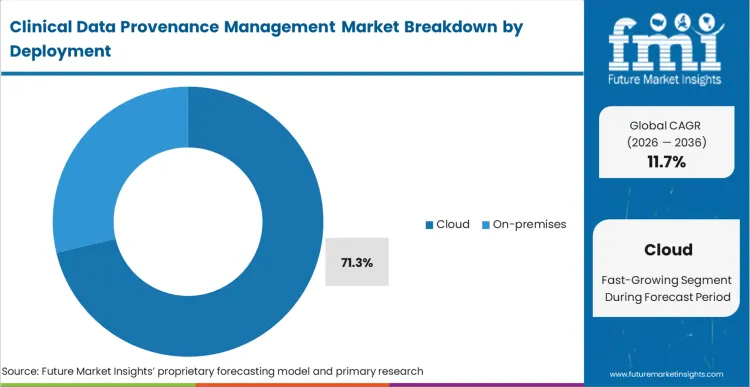
Cloud deployment holds a 71.3% share in 2026, fundamentally driven by the multi-institutional reality of modern clinical research. The necessity to securely track assets moving from hospital networks to CROs and ultimately to sponsors makes localized healthcare cloud infrastructure highly efficient for cross-boundary lineage tracking. Based on FMI's assessment, CRO IT directors prioritise cloud-native provenance engines because they provide a centralized, immutable ledger accessible to all authorised trial participants simultaneously. Organizations resisting cloud-based lineage tracking encounter massive friction when attempting to synchronize audit trails with external trial partners, jeopardizing timeline deliverables.
- Distributed ledgers: Cloud architectures provide the necessary decentralized environment for cross-institutional cryptographic tracking. Network architects implementing these models ensure no single entity can retroactively alter the trial data history.
- Latency reduction: Cloud platforms synchronize metadata tagging in real-time across geographically dispersed trial sites. Clinical operations managers leveraging this speed detect protocol deviations immediately rather than during post-trial reviews.
- Sovereignty bridging: Advanced cloud deployments use localized zones to manage regional compliance while maintaining a global audit overview. Multiregional trial directors using these zones comply with local privacy laws without fracturing the master provenance record.
Clinical Data Provenance Management Market Analysis by End User
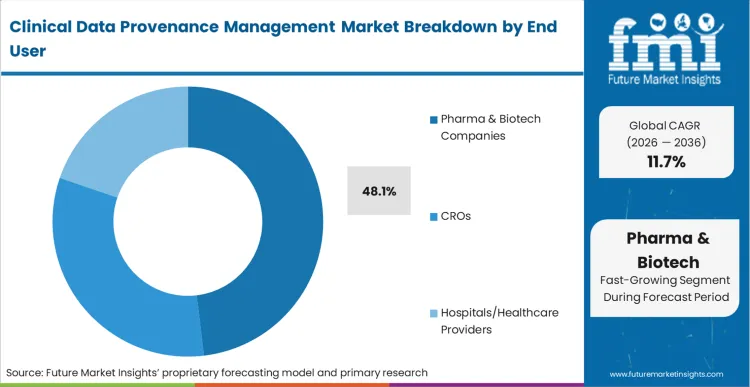
The regulatory burden of final drug approval submissions forces Pharma & Biotech Companies to assume ultimate liability for data integrity. This liability dynamic secures their position as the leading end user with 48.1% share in 2026. As the FDA increases scrutiny on clinical trial management utilizing real-world evidence, sponsor-level compliance directors cannot offshore the risk of data contamination to their vendors.
In FMI's view, sponsors must enforce provenance tracking from the top down, purchasing enterprise-wide software licenses that they require all subordinate CROs to utilize. Sponsors failing to implement sponsor-controlled lineage platforms risk catastrophic regulatory rejections if an outsourced vendor alters data without a verifiable audit trail.
- Sponsor mandates: Biopharma companies dictate the technology stack used by all downstream vendors. Procurement leads issuing these mandates guarantee uniform data formatting for the final regulatory dossier.
- CRO compliance: Contract research organizations purchase integration engines to fulfill sponsor demands. CRO executives adopting these systems protect their enterprise vendor status and win larger trial contracts.
- Hospital monetization: Healthcare providers deploy tagging software to validate the origin of their patient data. Medical informatics directors utilizing these tools legally license their real-world datasets to biopharma companies at premium rates.
Clinical Data Provenance Management Market Drivers, Restraints, and Opportunities
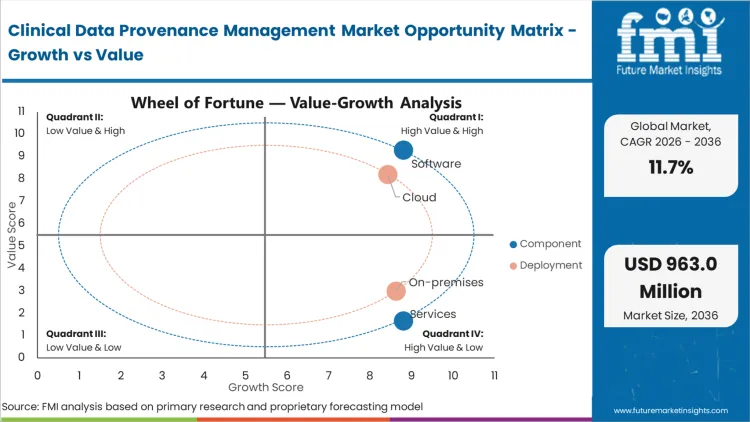
The FDA enforcement of 21 CFR Part 11 and its finalizing of guidance for Real-World Data usage mandate mathematical proof of data integrity for regulatory submissions. Biopharma trial sponsors are forced to implement unbroken custody chains to prove that observational data extracted from hospital records has not been manipulated during aggregation. This direct regulatory pressure drives rapid market expansion as legacy, siloed audit logs fail to meet the new cross-institutional tracking standards. Sponsors who fail to upgrade their provenance infrastructure will see their clinical trial submissions outright rejected due to unverifiable evidence sources.
The primary operational friction involves integrating modern cryptographic ledgers with decades-old, proprietary hospital Electronic Health Record systems that lack native API export capabilities. Data engineers face massive technical debt when attempting to pull clean, time-stamped metadata from these legacy environments. While middleware workarounds are emerging, these temporary patches have structural limits regarding scalability and latency, creating significant integration bottlenecks for multiregional trial rollouts.
Opportunities in the Clinical Data Provenance Management Market
- Zero-Knowledge Proof Integration: Advanced cryptographic protocols allow data to be verified without exposing the underlying Protected Health Information. Cybersecurity vendors deploying blockchain in healthcare secure massive contracts by enabling trial sponsors to audit data origins without violating HIPAA privacy constraints.
- Self-Describing Data Assets: Engineering data payloads to carry their own immutable metadata history eliminates the need for parallel audit databases. Software developers building these autonomous data packets drastically reduce the computational overhead required for continuous lineage tracking.
- Automated Aggregator Mapping: Building specific connectors for major third-party real-world data aggregators bridges the largest gap in the current evidence pipeline. System integrators prioritizing these specific aggregator APIs capture immediate market share by solving the most critical FDA submission bottleneck.
Regional Analysis
Based on the regional analysis, the Clinical Data Provenance Management market is segmented into North America, Latin America, Europe, East Asia, South Asia & Pacific, and Middle East & Africa across 40 plus countries.
.webp "Top Country Growth Comparison Clinical Data Provenance Management Market Cagr (2026 2036)")
| Country | CAGR (2026 to 2036) |
|---|---|
| India | 14.5% |
| United States | 13.8% |
| Germany | 13.2% |
| China | 12.9% |
| United Kingdom | 12.1% |
| Japan | 11.8% |
| France | 11.4% |
Source: Future Market Insights (FMI) analysis, based on proprietary forecasting model and primary research
Asia Pacific Clinical Data Provenance Management Market Analysis
Specific cost structure pressures and the desire to capture high-margin international clinical trial revenue drive the Asia Pacific transition. The region is aggressively modernizing its clinical infrastructure to present itself as a compliant, cost-effective destination for global biopharma sponsors. By leapfrogging legacy systems and immediately deploying advanced cryptographic tracking, these markets are removing the primary barrier to Western trial investment, which relies entirely on verifiable data trust. As per FMI's projection, eclinical platform deployments across this region are structurally different because they are built explicitly to satisfy foreign FDA/EMA audits rather than internal domestic requirements.
- India: The Central Drugs Standard Control Organisation enforces strict digital audit trail prerequisites for local sites attempting to participate in multi-regional clinical trials. This regulatory pressure forces Indian CROs to rapidly upgrade their data infrastructure to secure international contracts. Widespread adoption of these standards confirms the country's pivot toward high-quality data generation. The market is advancing at 14.5% compound between 2026 and 2036. Trial facility directors who ignore these audit requirements face total exclusion from lucrative Western trial networks.
- China: China's aggressive push to harmonize its National Medical Products Administration standards with ICH guidelines accelerates the local adoption of provenance software. This alignment requires local biopharma companies to prove data lineage for both domestic approvals and export applications. Evidence of rapid enterprise software licensing among Chinese CROs validates this shift. Tracking 12.9% annual growth to 2036. Regulatory affairs leads who fail to map this lineage will see their novel therapeutics blocked from entering Western markets.
- Japan: Stringent domestic data localization laws in Japan force international sponsors to utilize localized, highly secure provenance nodes. This constraint enables local system integrators to build specialized, compliant tracking environments. High investment in bespoke trial networks demonstrates this unique requirement. Projected at 11.8% compound growth over the forecast period. Network operators who cannot bridge Japanese privacy standards with global audit ledgers lose access to major trial partnerships.
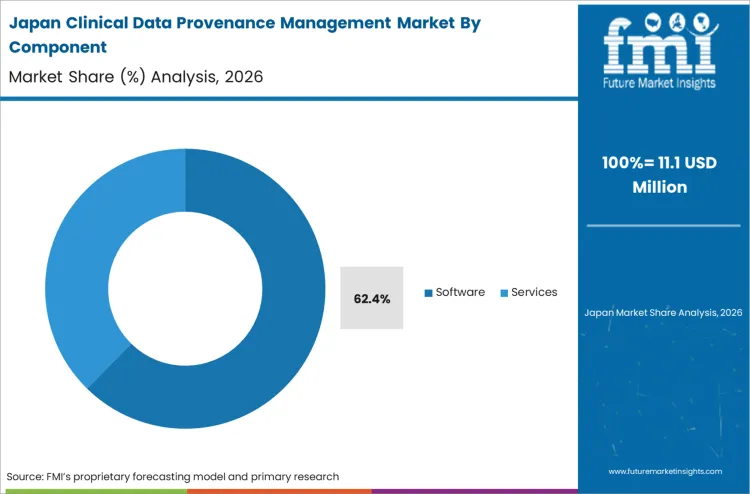
FMI's report includes comprehensive evaluation of South Korea, Australia, and the broader ASEAN region. These markets exhibit a rapid consolidation of clinical IT vendors as smaller players fail to meet the new international data standards.
North America Clinical Data Provenance Management Market Analysis
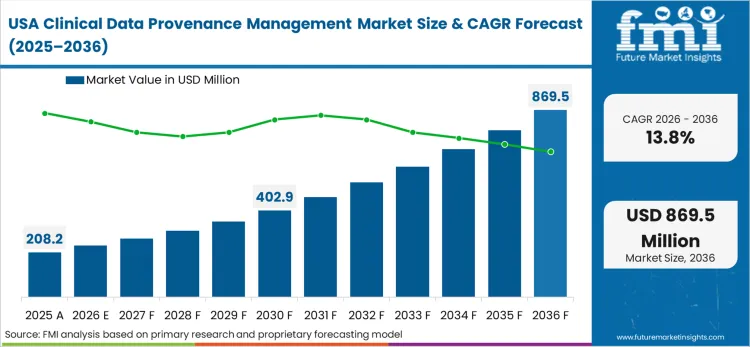
The FDA explicit guidance on Real-World Data acts as the primary forcing function in North America, completely redefining how observational evidence is evaluated. This policy-led environment shifts the burden of proof entirely onto the biopharma sponsors, demanding mathematical certainty regarding the origin and handling of every data point. FMI analysts opine that North America leads in overall volume because the majority of Tier-1 trial sponsors are headquartered here, dictating the technology standards for their global operations.
- United States: The FDA stringent enforcement of 21 CFR Part 11 across decentralized trial formats drives massive procurement of automated metadata tracking. This policy forces domestic biopharma sponsors to abandon manual compliance checks in favour of algorithmic ledgers. High vendor revenue concentration in the country confirms this aggressive procurement cycle. Anchored to a 13.8% annual expansion through the decade. Compliance officers who delay these implementations face immediate, costly holds on their regulatory evidence submissions.
FMI's report includes detailed analysis of Canada. Canadian provincial health networks are increasingly deploying provenance tools to safely monetise their centralized patient databases for cross-border research.
Europe Clinical Data Provenance Management Market Analysis
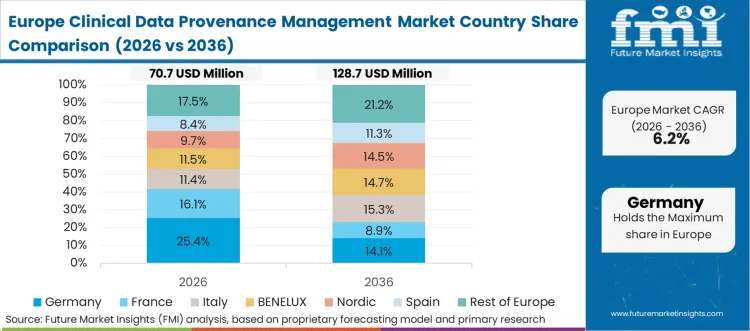
Specific physical and digital infrastructure constraints, namely the highly fragmented nature of European national health systems overlaid with strict GDPR requirements, mandate complex cross-border tracking solutions. The infrastructure must simultaneously prove data integrity for the European Medicines Agency while strictly masking patient identity across sovereign borders. Based on FMI's assessment, Europe's dynamic is heavily focused on privacy-preserving provenance protocols rather than raw data integration speed.
- Germany: Germany's localized health data infrastructure requires highly specific cryptographic tools to connect regional hospital clusters without centralizing the data physically. Sustaining a 13.2% CAGR to 2036. This structural constraint enables specialized software vendors to dominate the local procurement cycle. Rapid rollout of regional health data spaces confirms this localized approach. System architects who attempt to force centralized tracking architectures into Germany face severe legal and operational roadblocks.
- United Kingdom: The NHS centralized push to leverage its massive patient database for commercial research compels the adoption of robust lineage validation. This infrastructure program forces research partners to utilize specific, pre-approved tracking APIs. Major contracts awarded to specialized data linkage firms highlight this momentum. Expanding at 12.1% between 2026 and 2036. Procurement specification leads who cannot integrate with the chosen tracking standards forfeit access to this critical data pool.
- France: France's Health Data Hub initiative requires strict, verifiable proof of consent and data origin before researchers can access the national repository. Ongoing government investment in the Hub solidifies this requirement. At a 11.4% compound annual rate through 2036. This centralised gatekeeping forces domestic CROs to standardize their provenance formatting. Clinical project directors failing to meet these strict formatting rules are entirely locked out of the national research infrastructure.
FMI's report includes coverage of Italy, Spain, and the Nordics. The Nordic region specifically leads in integrating national civic registries directly with clinical trial tracking platforms.
Competitive Aligners for Market Players
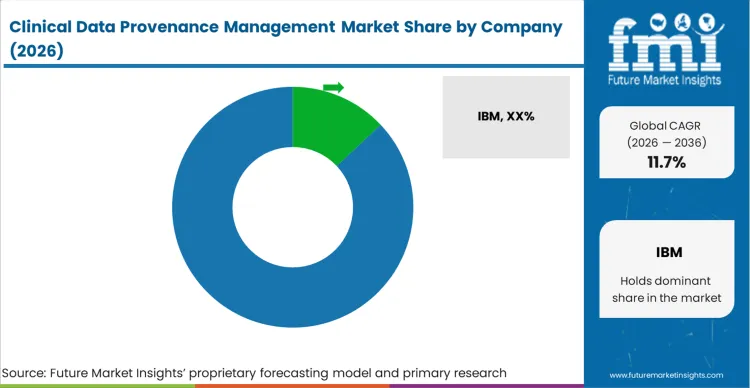
The clinical data provenance management market is highly concentrated among a few major life sciences technology providers. This consolidation exists because Tier-1 biopharma sponsors require global scalability and deeply validated, pre-built connectors to existing Electronic Data Capture systems. Leading companies like Medidata and Oracle leverage their massive installed base of trial software to upsell provenance modules directly into existing workflows. Buyers utilize the breadth of a vendor's out-of-the-box API library as the primary competitive variable to distinguish qualified enterprise platforms from niche tracking startups.
Companies like Datavant and IQVIA possess distinct structural advantages due to their massive pre-existing networks of institutional data partnerships. A challenger attempting to replicate this advantage must spend years negotiating individual data-sharing and validation agreements with thousands of disparate hospital networks. Innovators embedding zero-knowledge proof verification into digital health records offer a technical edge, but challengers must partner with established data aggregators rather than attempt a direct rip-and-replace of incumbent EDC systems.
To prevent vendor lock-in, large biopharma buyers increasingly mandate adherence to open standards like HL7 FHIR and W3C PROV. This structural tension limits the pricing power of dominant vendors, as buyers refuse to store their critical regulatory audit trails in proprietary, closed-loop formats. As the market approaches 2036, the competitive trajectory points toward slight fragmentation in the aggregation layer, as specialised, standard-compliant interoperability startups carve out profitable niches linking legacy hospital systems to the major trial platforms.
Key Players in Clinical Data Provenance Management Market
- IBM
- Oracle
- Veeva Systems
- Medidata (Dassault Systemes)
- IQVIA
- Datavant
- BurstIQ
- Guardtime
Scope of the Report
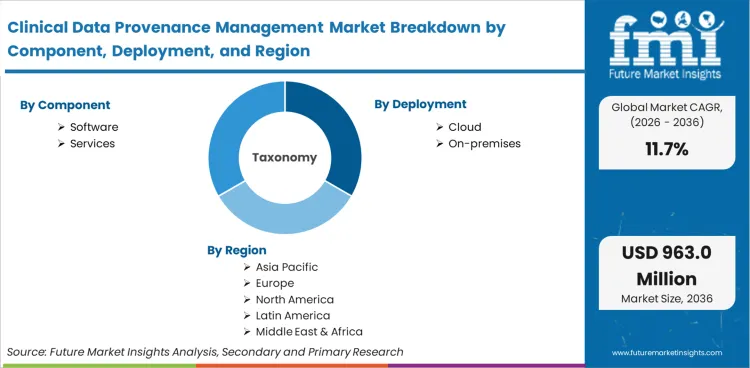
| Metric | Value |
|---|---|
| Quantitative Units | USD 318.5 million to USD 965.2 million, at a CAGR of 11.72% |
| Market Definition | Software platforms and integration services designed to mathematically and chronologically track the origin, ownership, and transformation history of healthcare data for regulatory validation. |
| Component Segmentation | Software, Services |
| Deployment Segmentation | Cloud, On-premises |
| End User Segmentation | Pharma & Biotech Companies, CROs, Hospitals/Healthcare Providers |
| Regions Covered | North America, Latin America, Europe, East Asia, South Asia & Pacific, Middle East & Africa |
| Countries Covered | India, United States, Germany, China, United Kingdom, Japan, France, and 40 plus countries |
| Key Companies Profiled | IBM, Oracle, Veeva Systems, Medidata (Dassault Systemes), IQVIA, Datavant, BurstIQ, Guardtime |
| Forecast Period | 2026 to 2036 |
| Approach | Primary interviews with Clinical Data Managers and Biopharma IT Compliance Officers. Baseline volumes derived from global trial registrations. Financial projections validated through enterprise vendor licensing disclosures. |
Source: Future Market Insights (FMI) analysis, based on proprietary forecasting model and primary research
Clinical Data Provenance Management Market Analysis by Segments
Component:
- Software
- Services
Deployment:
- Cloud
- On-premises
End User:
- Pharma & Biotech Companies
- CROs
- Hospitals/Healthcare Providers
Region:
- North America
- United States
- Canada
- Latin America
- Brazil
- Mexico
- Europe
- Germany
- United Kingdom
- France
- Italy
- Spain
- East Asia
- China
- Japan
- South Korea
- South Asia & Pacific
- India
- ASEAN
- Australia
- Middle East & Africa
- GCC Countries
- South Africa
Bibliography
- USA Food and Drug Administration. (2024, October). Electronic systems, electronic records, and electronic signatures in clinical investigations: Questions and answers.
- European Medicines Agency. (2025, January 23). ICH E6(R3) guideline on good clinical practice (GCP): Step 5.
- National Institute of Standards and Technology. (2024, December). Second public draft: Genomic data cybersecurity and privacy frameworks community profile (NIST IR 8467, 2nd public draft).
- Gierend, K., Krüger, F., Genehr, S., Hartmann, F., Siegel, F., Waltemath, D., Ganslandt, T., & Zeleke, A. A. (2024). Provenance information for biomedical data and workflows: Scoping review. Journal of Medical Internet Research, 26, e51297.
- Johns, M., Baum, L., & Prasser, F. (2025). Tracking provenance in clinical data warehouses for quality management. International Journal of Medical Informatics, 193, 105690.
- O’Sullivan, K., Markovic, M., Dymiter, J., Scheliga, B., Odo, C., & Wilde, K. (2025). Semi-automated data provenance tracking for transparent data production and linkage to enhance auditing and quality assurance in Trusted Research Environments. International Journal of Population Data Science, 10(2), 18.
- Mahajan, A., & Powell, D. (2025). Improving authenticity and provenance in digital biomarkers: The case for digital watermarking. npj Digital Medicine, 8(1), 31.
This bibliography is provided for reader reference. The full FMI report contains the complete reference list with primary source documentation.
This Report Addresses
- Market intelligence to support strategic decision making across specific W3C PROV-compliant lineage visualization tools and cryptographic metadata tracking engines unique to this market
- Market size estimation and 10-year revenue forecasts from 2026 to 2036, supported by baseline volume derived from global Multi-Regional Clinical Trial registrations and enterprise vendor contract analysis
- Growth opportunity mapping across Component and Deployment categories with emphasis on biopharma trial sponsors mandating cryptographic data lineage proofs from all tier-2 CROs before the 2028 operational cutoff
- Segment and regional revenue forecasts covering on-premises versus cloud deployments across stringent regulatory environments governed by FDA 21 CFR Part 11 and EMA frameworks
- Competition strategy assessment including the breadth of pre-built EDC connectors, adherence to HL7 FHIR standards, and massive pre-existing networks of institutional data partnerships
- Technology capability development tracking including Zero-Knowledge Proof Integration, W3C PROV metadata ledgers, and self-describing data payload advancements discussed in this article
- Market access analysis covering CDSCO digital audit prerequisites in India, NHS data linkage mandates in the United Kingdom, and French Health Data Hub formatting requirements
- Market report delivery in PDF, Excel, PPT, and interactive dashboard formats for executive strategy, biopharma regulatory compliance planning, and operational benchmarking use
Frequently Asked Questions
How large is the Clinical Data Provenance Management Market in 2026?
Industry size is projected to reach USD 318.5 million in 2026, driven by biopharma trial sponsors moving away from manual audit logs to meet stringent FDA 21 CFR Part 11 requirements.
What will it be valued at by 2036?
The valuation is expected to reach USD 965.2 million by 2036 as automated cryptographic tracking of real-world evidence transformations becomes a hard prerequisite for FDA regulatory submissions.
What CAGR is projected?
A CAGR of 11.72% is projected, which remains defensible due to the structural liability trial sponsors face regarding data contamination from third-party aggregators.
Which Component segment leads?
Software holds a dominant 62.4% share in 2026 because the sheer velocity of data transformations in modern trials physically exceeds human auditing capacity, demanding algorithmic tracking tools.
Which Deployment segment leads?
Cloud deployment captures 71.3% share because cross-institutional lineage tracking fundamentally requires decentralized, multi-party access to an immutable master ledger.
Which End User segment leads?
Pharma & Biotech Companies maintain 48.1% share as these entities bear the ultimate financial and regulatory liability for final drug approval submissions, forcing them to dictate technology standards top-down.
What drives rapid growth?
FDA real-world data guidances force trial sponsors to mathematically prove the integrity of external data, while hospital networks deploy tagging tools to legally monetize their de-identified patient data.
What is the primary restraint?
Integrating modern cryptographic ledgers with legacy, proprietary hospital electronic health records that lack native API export capabilities creates massive technical debt and slows multiregional trial deployments.
Which country grows fastest?
India tracks a 14.5% compound rate as the Central Drugs Standard Control Organisation enforces strict digital audit trail prerequisites for local sites attempting to participate in lucrative international trials.
How does FDA 21 CFR Part 11 impact vendor selection?
The regulation requires biopharma IT compliance officers to strictly evaluate vendors based on their ability to provide irrefutable, time-stamped, and tamper-evident digital records without human intervention.
Why are fragmented audit logs failing?
Legacy, siloed audit logs lose visibility the moment data crosses an institutional boundary, failing to track the intermediate transformations applied by third-party data aggregators before regulatory submission.
How do Medidata and Oracle maintain market dominance?
Top incumbents compete heavily on their massive installed base of trial software, upselling provenance modules directly into existing workflows using highly validated, pre-built API connectors.
How does the UK NHS infrastructure program affect local deployment?
The NHS centralized push to leverage patient databases for commercial research compels all downstream research partners to utilize specific, pre-approved tracking APIs to access the data.
Why is Germany's growth structurally different?
Germany's localized health data infrastructure requires highly specific cryptographic tools to connect regional hospital clusters without centralizing the data physically, favoring specialized regional software vendors.
What is the role of CROs in the adoption curve?
Contract research organizations act as the implementation layer, purchasing API-based provenance engines primarily to fulfill sponsor SLA demands and secure enterprise trial contracts.
How do self-describing data assets change the operational model?
Engineering data payloads to carry their own immutable metadata history eliminates the need for parallel audit databases, drastically reducing the computational overhead required for continuous lineage tracking.
What commercial risk do hospitals face if they ignore provenance standards?
Medical informatics directors who fail to deploy verifiable data lineage protocols face the total exclusion of their patient datasets from lucrative commercial real-world evidence licensing markets.
How does China NMPA alignment impact software procurement?
China's push to align NMPA standards with ICH guidelines requires local biopharma companies to prove data lineage for export applications, driving rapid enterprise software licensing among Chinese CROs.
Why are open standards like HL7 FHIR critical to buyers?
Large biopharma buyers increasingly mandate adherence to open standards to prevent vendor lock-in, refusing to store their critical regulatory audit trails in proprietary, closed-loop formats.
How do zero-knowledge proofs function in this space?
Advanced cryptographic protocols allow data transformation history to be verified by regulatory bodies without exposing the underlying Protected Health Information to unauthorized external auditors.
What role does consulting play in the future market?
Service providers are rapidly pivoting away from manual compliance reviews toward specialized integration and system validation support, ensuring the deployed software meets regulatory parameters.
Why is on-premises deployment losing share?
On-premises solutions struggle to securely synchronize metadata tracking across multiple external institutional boundaries, limiting their use to highly isolated, single-facility biobanks with extreme data sovereignty constraints.
How is the market validated by FMI?
Revenue models are built upon software-as-a-service pricing tiers mapped against global trial volumes, cross-referenced against enterprise software licensing contracts announced by top-tier biopharma sponsors.
Are perimeter cybersecurity tools included in this report?
General hospital information systems and perimeter cybersecurity tools like firewalls are explicitly excluded, as they lack the specific mathematical proof-of-transformation capabilities required for formal regulatory evidence.
Preview the report firsthand - request a free sample
Get SampleGet the brochure for pricing and purchase details.
Get PDFTable of Content
- Executive Summary
- Global Market Outlook
- Demand-side Trends
- Supply-side Trends
- Technology Roadmap Analysis
- Analysis and Recommendations
- Market Overview
- Market Coverage / Taxonomy
- Market Definition / Scope / Limitations
- Research Methodology
- Chapter Orientation
- Analytical Lens and Working Hypotheses
- Market Structure, Signals, and Trend Drivers
- Benchmarking and Cross-market Comparability
- Market Sizing, Forecasting, and Opportunity Mapping
- Research Design and Evidence Framework
- Desk Research Programme (Secondary Evidence)
- Company Annual and Sustainability Reports
- Peer-reviewed Journals and Academic Literature
- Corporate Websites, Product Literature, and Technical Notes
- Earnings Decks and Investor Briefings
- Statutory Filings and Regulatory Disclosures
- Technical White Papers and Standards Notes
- Trade Journals, Industry Magazines, and Analyst Briefs
- Conference Proceedings, Webinars, and Seminar Materials
- Government Statistics Portals and Public Data Releases
- Sector Databases and Reference Repositories
- FMI Internal Proprietary Databases and Historical Market Datasets
- Subscription Datasets and Paid Sources
- Social Channels, Communities, and Digital Listening Inputs
- Additional Desk Sources
- Expert Input and Fieldwork (Primary Evidence)
- Primary Modes
- Qualitative Interviews and Expert Elicitation
- Quantitative Surveys and Structured Data Capture
- Blended Approach
- Why Primary Evidence is Used
- Field Techniques
- Interviews
- Surveys
- Focus Groups
- Observational and In-context Research
- Social and Community Interactions
- Stakeholder Universe Engaged
- C-suite Leaders
- Board Members
- Presidents and Vice Presidents
- R&D and Innovation Heads
- Technical Specialists
- Domain Subject-matter Experts
- Scientists
- Physicians and Other Healthcare Professionals
- Governance, Ethics, and Data Stewardship
- Research Ethics
- Data Integrity and Handling
- Primary Modes
- Tooling, Models, and Reference Databases
- Desk Research Programme (Secondary Evidence)
- Data Engineering and Model Build
- Data Acquisition and Ingestion
- Cleaning, Normalisation, and Verification
- Synthesis, Triangulation, and Analysis
- Quality Assurance and Audit Trail
- Market Background
- Market Dynamics
- Drivers
- Restraints
- Opportunity
- Trends
- Scenario Forecast
- Demand in Optimistic Scenario
- Demand in Likely Scenario
- Demand in Conservative Scenario
- Opportunity Map Analysis
- Product Life Cycle Analysis
- Supply Chain Analysis
- Investment Feasibility Matrix
- Value Chain Analysis
- PESTLE and Porter’s Analysis
- Regulatory Landscape
- Regional Parent Market Outlook
- Production and Consumption Statistics
- Import and Export Statistics
- Market Dynamics
- Global Market Analysis 2021 to 2025 and Forecast, 2026 to 2036
- Historical Market Size Value (USD Million) Analysis, 2021 to 2025
- Current and Future Market Size Value (USD Million) Projections, 2026 to 2036
- Y-o-Y Growth Trend Analysis
- Absolute $ Opportunity Analysis
- Global Market Pricing Analysis 2021 to 2025 and Forecast 2026 to 2036
- Global Market Analysis 2021 to 2025 and Forecast 2026 to 2036, By Component
- Introduction / Key Findings
- Historical Market Size Value (USD Million) Analysis By Component , 2021 to 2025
- Current and Future Market Size Value (USD Million) Analysis and Forecast By Component , 2026 to 2036
- Software
- Services
- Software
- Y-o-Y Growth Trend Analysis By Component , 2021 to 2025
- Absolute $ Opportunity Analysis By Component , 2026 to 2036
- Global Market Analysis 2021 to 2025 and Forecast 2026 to 2036, By Deployment
- Introduction / Key Findings
- Historical Market Size Value (USD Million) Analysis By Deployment, 2021 to 2025
- Current and Future Market Size Value (USD Million) Analysis and Forecast By Deployment, 2026 to 2036
- Cloud
- On-premises
- Cloud
- Y-o-Y Growth Trend Analysis By Deployment, 2021 to 2025
- Absolute $ Opportunity Analysis By Deployment, 2026 to 2036
- Global Market Analysis 2021 to 2025 and Forecast 2026 to 2036, By End User
- Introduction / Key Findings
- Historical Market Size Value (USD Million) Analysis By End User, 2021 to 2025
- Current and Future Market Size Value (USD Million) Analysis and Forecast By End User, 2026 to 2036
- Pharma & Biotech Companies
- CROs
- Hospitals/Healthcare Providers
- Pharma & Biotech Companies
- Y-o-Y Growth Trend Analysis By End User, 2021 to 2025
- Absolute $ Opportunity Analysis By End User, 2026 to 2036
- Global Market Analysis 2021 to 2025 and Forecast 2026 to 2036, By Region
- Introduction
- Historical Market Size Value (USD Million) Analysis By Region, 2021 to 2025
- Current Market Size Value (USD Million) Analysis and Forecast By Region, 2026 to 2036
- North America
- Latin America
- Western Europe
- Eastern Europe
- East Asia
- South Asia and Pacific
- Middle East & Africa
- Market Attractiveness Analysis By Region
- North America Market Analysis 2021 to 2025 and Forecast 2026 to 2036, By Country
- Historical Market Size Value (USD Million) Trend Analysis By Market Taxonomy, 2021 to 2025
- Market Size Value (USD Million) Forecast By Market Taxonomy, 2026 to 2036
- By Country
- USA
- Canada
- Mexico
- By Component
- By Deployment
- By End User
- By Country
- Market Attractiveness Analysis
- By Country
- By Component
- By Deployment
- By End User
- Key Takeaways
- Latin America Market Analysis 2021 to 2025 and Forecast 2026 to 2036, By Country
- Historical Market Size Value (USD Million) Trend Analysis By Market Taxonomy, 2021 to 2025
- Market Size Value (USD Million) Forecast By Market Taxonomy, 2026 to 2036
- By Country
- Brazil
- Chile
- Rest of Latin America
- By Component
- By Deployment
- By End User
- By Country
- Market Attractiveness Analysis
- By Country
- By Component
- By Deployment
- By End User
- Key Takeaways
- Western Europe Market Analysis 2021 to 2025 and Forecast 2026 to 2036, By Country
- Historical Market Size Value (USD Million) Trend Analysis By Market Taxonomy, 2021 to 2025
- Market Size Value (USD Million) Forecast By Market Taxonomy, 2026 to 2036
- By Country
- Germany
- UK
- Italy
- Spain
- France
- Nordic
- BENELUX
- Rest of Western Europe
- By Component
- By Deployment
- By End User
- By Country
- Market Attractiveness Analysis
- By Country
- By Component
- By Deployment
- By End User
- Key Takeaways
- Eastern Europe Market Analysis 2021 to 2025 and Forecast 2026 to 2036, By Country
- Historical Market Size Value (USD Million) Trend Analysis By Market Taxonomy, 2021 to 2025
- Market Size Value (USD Million) Forecast By Market Taxonomy, 2026 to 2036
- By Country
- Russia
- Poland
- Hungary
- Balkan & Baltic
- Rest of Eastern Europe
- By Component
- By Deployment
- By End User
- By Country
- Market Attractiveness Analysis
- By Country
- By Component
- By Deployment
- By End User
- Key Takeaways
- East Asia Market Analysis 2021 to 2025 and Forecast 2026 to 2036, By Country
- Historical Market Size Value (USD Million) Trend Analysis By Market Taxonomy, 2021 to 2025
- Market Size Value (USD Million) Forecast By Market Taxonomy, 2026 to 2036
- By Country
- China
- Japan
- South Korea
- By Component
- By Deployment
- By End User
- By Country
- Market Attractiveness Analysis
- By Country
- By Component
- By Deployment
- By End User
- Key Takeaways
- South Asia and Pacific Market Analysis 2021 to 2025 and Forecast 2026 to 2036, By Country
- Historical Market Size Value (USD Million) Trend Analysis By Market Taxonomy, 2021 to 2025
- Market Size Value (USD Million) Forecast By Market Taxonomy, 2026 to 2036
- By Country
- India
- ASEAN
- Australia & New Zealand
- Rest of South Asia and Pacific
- By Component
- By Deployment
- By End User
- By Country
- Market Attractiveness Analysis
- By Country
- By Component
- By Deployment
- By End User
- Key Takeaways
- Middle East & Africa Market Analysis 2021 to 2025 and Forecast 2026 to 2036, By Country
- Historical Market Size Value (USD Million) Trend Analysis By Market Taxonomy, 2021 to 2025
- Market Size Value (USD Million) Forecast By Market Taxonomy, 2026 to 2036
- By Country
- Kingdom of Saudi Arabia
- Other GCC Countries
- Turkiye
- South Africa
- Other African Union
- Rest of Middle East & Africa
- By Component
- By Deployment
- By End User
- By Country
- Market Attractiveness Analysis
- By Country
- By Component
- By Deployment
- By End User
- Key Takeaways
- Key Countries Market Analysis
- USA
- Pricing Analysis
- Market Share Analysis, 2025
- By Component
- By Deployment
- By End User
- Canada
- Pricing Analysis
- Market Share Analysis, 2025
- By Component
- By Deployment
- By End User
- Mexico
- Pricing Analysis
- Market Share Analysis, 2025
- By Component
- By Deployment
- By End User
- Brazil
- Pricing Analysis
- Market Share Analysis, 2025
- By Component
- By Deployment
- By End User
- Chile
- Pricing Analysis
- Market Share Analysis, 2025
- By Component
- By Deployment
- By End User
- Germany
- Pricing Analysis
- Market Share Analysis, 2025
- By Component
- By Deployment
- By End User
- UK
- Pricing Analysis
- Market Share Analysis, 2025
- By Component
- By Deployment
- By End User
- Italy
- Pricing Analysis
- Market Share Analysis, 2025
- By Component
- By Deployment
- By End User
- Spain
- Pricing Analysis
- Market Share Analysis, 2025
- By Component
- By Deployment
- By End User
- France
- Pricing Analysis
- Market Share Analysis, 2025
- By Component
- By Deployment
- By End User
- India
- Pricing Analysis
- Market Share Analysis, 2025
- By Component
- By Deployment
- By End User
- ASEAN
- Pricing Analysis
- Market Share Analysis, 2025
- By Component
- By Deployment
- By End User
- Australia & New Zealand
- Pricing Analysis
- Market Share Analysis, 2025
- By Component
- By Deployment
- By End User
- China
- Pricing Analysis
- Market Share Analysis, 2025
- By Component
- By Deployment
- By End User
- Japan
- Pricing Analysis
- Market Share Analysis, 2025
- By Component
- By Deployment
- By End User
- South Korea
- Pricing Analysis
- Market Share Analysis, 2025
- By Component
- By Deployment
- By End User
- Russia
- Pricing Analysis
- Market Share Analysis, 2025
- By Component
- By Deployment
- By End User
- Poland
- Pricing Analysis
- Market Share Analysis, 2025
- By Component
- By Deployment
- By End User
- Hungary
- Pricing Analysis
- Market Share Analysis, 2025
- By Component
- By Deployment
- By End User
- Kingdom of Saudi Arabia
- Pricing Analysis
- Market Share Analysis, 2025
- By Component
- By Deployment
- By End User
- Turkiye
- Pricing Analysis
- Market Share Analysis, 2025
- By Component
- By Deployment
- By End User
- South Africa
- Pricing Analysis
- Market Share Analysis, 2025
- By Component
- By Deployment
- By End User
- USA
- Market Structure Analysis
- Competition Dashboard
- Competition Benchmarking
- Market Share Analysis of Top Players
- By Regional
- By Component
- By Deployment
- By End User
- Competition Analysis
- Competition Deep Dive
- IBM
- Overview
- Product Portfolio
- Profitability by Market Segments (Product/Age /Sales Channel/Region)
- Sales Footprint
- Strategy Overview
- Marketing Strategy
- Product Strategy
- Channel Strategy
- Oracle
- Veeva Systems
- Medidata (Dassault Systemes)
- IQVIA
- Datavant
- BurstIQ
- IBM
- Competition Deep Dive
- Assumptions & Acronyms Used


