

- Market Size (2026)
- USD 2.7 Bn
- Forecast (2036)
- USD 8.9 Bn
- CAGR (2026 to 2036)
- 12.7%
In-Cabin Occupant Detection Sensor Platforms Market Size, Market Forecast and Outlook By FMI
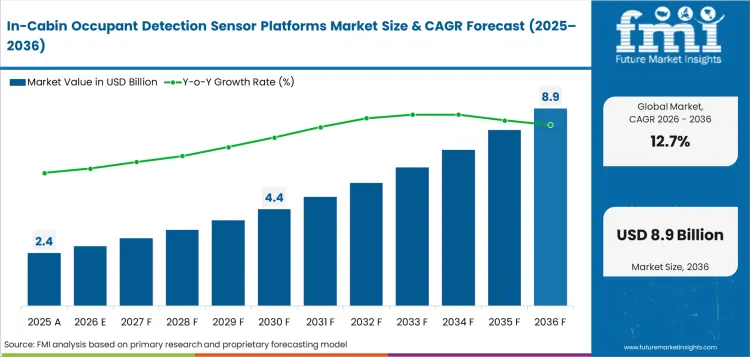
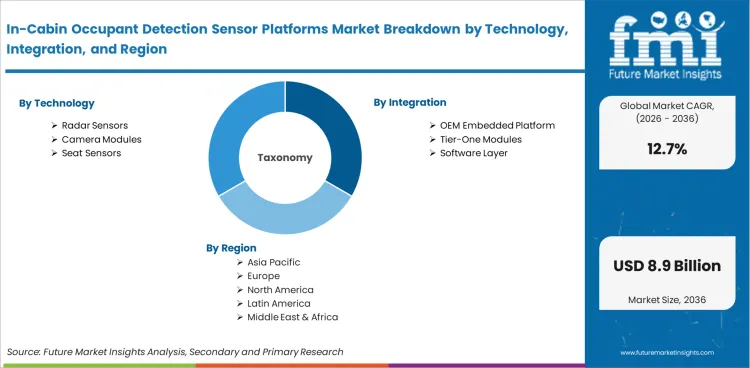
The in-cabin occupant detection sensor platforms market value stood at USD 2.4 billion in 2025. Industry revenue is anticipated to reach USD 2.7 billion in 2026 and rise to USD 8.9 billion by 2036 at 12.7% CAGR. OEM embedded platforms are expected to hold 71.0% share of platform integration demand in 2026. Passenger cars are projected to account for 67.5% share of vehicle type in 2026.
Summary of the In-Cabin Occupant Detection Sensor Platforms Market
- Demand and Growth Drivers
- European safety rules applying from July 2024 support driver attention warnings and cabin sensing content in new vehicles.
- Euro NCAP child occupant protocols now list child presence detection as a distinct safety assessment area for tested vehicles.
- Single-chip radar launches in 2025 are lowering sensor count by combining seatbelt reminder and child presence functions.
- Product and Segment View
- OEM embedded platforms are projected to account for 71.0% share in 2026 as factory validation and software access needs.
- Passenger cars are expected to secure 67.5% share in 2026 as safety features move from premium trims into family models.
- Multi-sensor fusion is forecast to represent 44.0% share in 2026 since OEMs link cabin cameras with radar and restraint data.
- Geography and Competitive Outlook
- China is projected to record 14.1% CAGR by 2036 as local OEMs expand camera-rich cabin electronics and intelligent vehicle programs.
- India is expected to expand at 13.8% CAGR by 2036 as vehicle output rises and driver alert rules begin with commercial vehicles.
- Bosch and Continental hold established positions through cabin sensing portfolios and integration access with global OEMs.
- Analyst Opinion
- Nikhil Kaitwade, Principal Analyst for Automotive and Transportation at FMI, observes, “Occupant detection is becoming a vehicle safety architecture decision. OEMs will buy platforms proving who is in each seat and whether a living passenger remains inside after lock. Radar is likely to gain share since it works without light and can read breathing movements. Camera systems are expected to stay important as software connects occupant state with driver attention and restraint control.”
- In-Cabin Occupant Detection Sensor Platforms Market Value Analysis
- In-cabin occupant detection sensor platforms are shifting from optional warning features to safety content across new passenger vehicle programs.
- Automakers are expected to raise sensor spending as Euro NCAP child presence detection requirements push direct cabin sensing into platform planning.
- OEM embedded platforms are preferred as buyer teams need tested software links with restraint electronics and seatbelt alerts.
- Demand is supported by child presence detection and driver attention functions sharing cameras, radar and processing chips across the same cabin electronics stack.
Key Takeaways
- In-cabin occupant detection sensor platforms market was valued at USD 2.4 billion in 2025.
- Industry revenue is projected to reach USD 8.9 billion by 2036 as OEMs add direct sensing to cabin safety platforms.
- Sector demand is expected to expand at 12.7% CAGR from 2026 to 2036 across safety and comfort functions.
- The industry is projected to create an incremental revenue opportunity of USD 6.2 billion between 2026 and 2036.
- OEM embedded platforms are forecast to account for 71.0% share in 2026 as factory integration keeps validation and warranty control inside vehicle programs.
- Passenger cars are expected to hold 67.5% share in 2026 as higher model launches and broader safety-rating pressure.
- China at 14.1% CAGR and India at 13.8% CAGR are projected to record a prominent pace by 2036.
Vehicle interiors now need to detect who is present, where they are seated and whether safety alerts are valid. Euro NCAP’s Child Presence Detection Test and Assessment Protocol v1.3 makes child detection a structured rating issue rather than an optional comfort feature. Sensor suppliers therefore need platforms that match assessment language. Texas Instruments’ January 2025 AWRL6844 radar example shows the commercial direction because one 60 GHz mmWave sensor can combine three in-cabin features and cut implementation cost by an average of USD 20 per vehicle. That matters for OEMs trying to avoid multiple sensors in the roof, seats and pillars. Regulation is also widening the sensing need. NHTSA’s December 2024 FMVSS No. 208 final rule requires rear-seat belt warning systems. Reliable occupant classification becomes necessary to avoid false reminders. Suppliers with direct sensing and multi-feature radar platforms are likely to gain stronger design-in opportunities.
In-Cabin Occupant Detection Sensor Platforms Market Definition
Market scope covers sensor platforms that detect and classify people inside vehicle cabins. Covered systems include radar sensors and camera modules. Ultrasonic units and seat sensors complete the sensing boundary. Software that converts sensor input into child presence alerts and occupant classification is included. Revenue scope includes factory-installed hardware and embedded software sold to automotive OEMs. Aftermarket reminders are included only if they use direct sensing. Automotive MEMS sensors are counted only if used inside cabin detection modules. Standard infotainment cameras without occupant safety functions are excluded from the counted revenue.
In-Cabin Occupant Detection Sensor Platforms Market Inclusions
Market scope covers all commercially traded in-cabin occupant detection sensor platforms categorized by sensor technology and platform integration. Sensor technology includes camera-based sensors and radar sensors while platform integration includes OEM embedded systems and aftermarket units. Vehicle type covers passenger cars and commercial vehicles while detection function includes child presence detection and seat occupancy sensing. System architecture includes standalone modules and integrated cabin platforms. Revenue scope covers 2026 to 2036. Market participants include sensor platform manufacturers, automotive OEMs and Tier-1 suppliers. Software providers, semiconductor firms and regulatory bodies complete the stakeholder network.
In-Cabin Occupant Detection Sensor Platforms Market Exclusions
Study scope excludes exterior radar and driver assistance sensors not used for cabin detection. Standard airbag control units are excluded unless sold with occupant sensing inputs. Seat foam and mechanical seat hardware are outside the revenue scope.
In-Cabin Occupant Detection Sensor Platforms Market Research Methodology
- Primary Research: FMI analysts reviewed cabin sensor suppliers and vehicle electronics buyers. Interviews focused on OEM validation needs and false-alert tolerance.
- Desk Research: Desk review used safety regulator updates and Euro NCAP protocol material. Company actions after January 2024 were checked against official product announcements.
- Market Sizing and Forecasting: Forecast work combined vehicle production volumes with expected sensor fitment rates and average platform content per vehicle.
- Data Validation: Segment shares were checked against sensor function overlap and OEM integration needs. ADAS safety content was compared with country output and regulation signals.
Why is the In-Cabin Occupant Detection Sensor Platforms Market Growing?
- In-cabin monitoring systems are expected to grow as safety ratings reward direct child presence detection and occupant classification.
- Automotive OEMs are expected to use cabin radar sensors as radar can detect small breathing movements under low light and visual obstruction.
- Camera-based monitoring is moving beyond driver attention as automotive camera links occupant posture with seatbelt reminders and airbag control.
Regulatory pressure creates a clearer buying case for cabin sensing. European Commission guidance from July 2024 states that general safety rules apply to all new motor vehicles sold in the European Union. New vehicles need attention warnings for driver drowsiness and reversing detection using cameras or sensors. The practical result is a buyer shift toward integrated automotive sensors supporting safety alerts and occupant awareness in the same control path.
Safety-rating work is making child presence detection into a product specification. Euro NCAP lists a dedicated child presence detection test and assessment protocol within its child occupant protection material. Texas Instruments introduced the AWRL6844 60GHz radar in January 2025 for occupancy monitoring and unattended child detection. Single-chip radar supports system consolidation because one device can cover seatbelt reminder and intrusion detection. Suppliers with stable software and low false alarm rates are likely to gain earlier platform slots.
Market Segmentation Analysis
- Radar sensors are projected to account for 38.5% share in 2026 as breathing detection and covered-child sensing suit parked-vehicle safety use.
- OEM embedded platforms are forecast to hold 71.0% share in 2026 with automakers favoring factory software links and warranty-controlled validation.
- Passenger cars are expected to represent 67.5% share in 2026 due to family vehicles carrying stronger child safety and cabin comfort expectations.
- Child presence detection is anticipated to secure 36.0% share in 2026 since NCAP scoring turns rear-cabin sensing into a model planning item.
- Multi-sensor fusion is projected to reach 44.0% share in 2026, led by radar and camera data improving occupant classification for safety electronics.
Market segmentation reflects how automakers buy cabin safety content. Sensor technology covers radar sensors and camera modules. Platform integration separates OEM embedded platforms from tier-one modules and aftermarket units. Vehicle type tracks passenger cars and commercial vehicles. Detection function covers child presence and occupant classification. System architecture shows how much value shifts from hardware toward driver monitoring systems. OEM embedded platforms hold a strong share because automakers want validation control and data links with restraint electronics.
Insights into the Radar Sensors Technology Segment
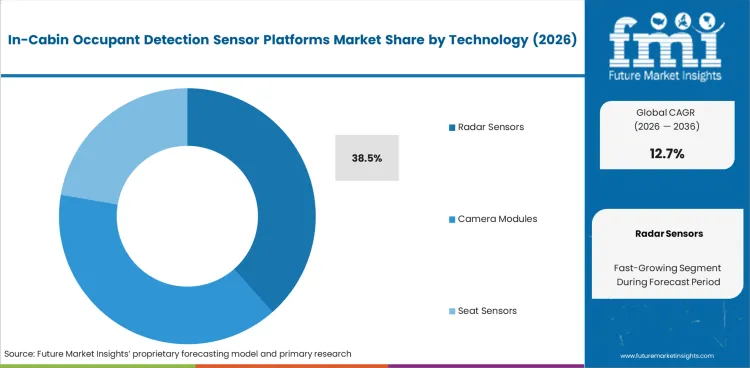
- Radar sensors are expected to account for 38.5% share in 2026, led by millimeter-wave devices detecting breathing and motion without cabin light, providing OEMs a stronger proof route for child presence and seat occupancy alerts.
- Camera modules retain a broad role in driver monitoring and occupant posture recognition as image-based software can classify head position and seating behavior inside the same cabin safety stack.
Insights into the OEM Embedded Platform Integration Segment
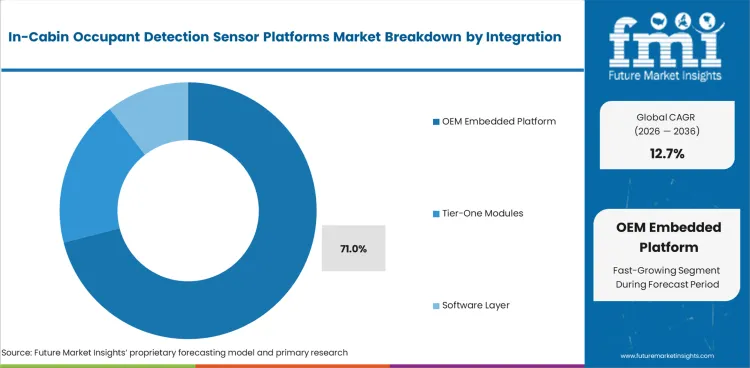
- OEM embedded platforms are projected to account for 71.0% share in 2026 as automakers need factory-tested sensor placement along with cybersecure software and direct links with restraint systems before cabin safety functions reach mass models.
- Tier-one modules remain important for buyers requiring packaged hardware and software support without building every sensing function inside the vehicle control team.
Insights into the Passenger Cars Vehicle Type Segment
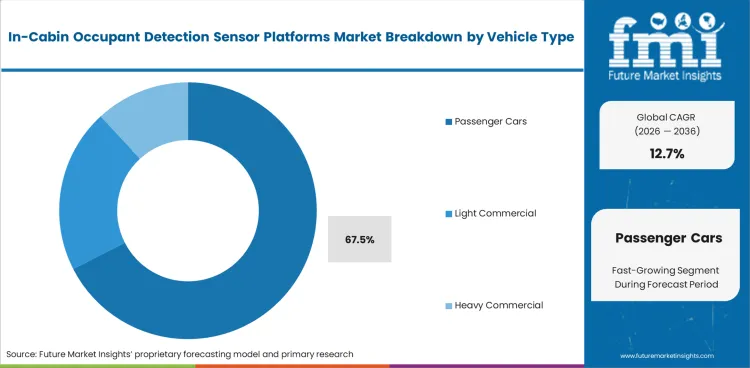
- Passenger cars are anticipated to account for 67.5% share in 2026 due to family safety ratings and high model launch volumes making cabin sensing a broader content priority across sedans and SUVs.
- Light commercial vehicles should gain later as driver alert rules and fleet safety scoring push cabin cameras and radar into vans used for delivery work.
Insights into the Child Presence Detection Function Segment
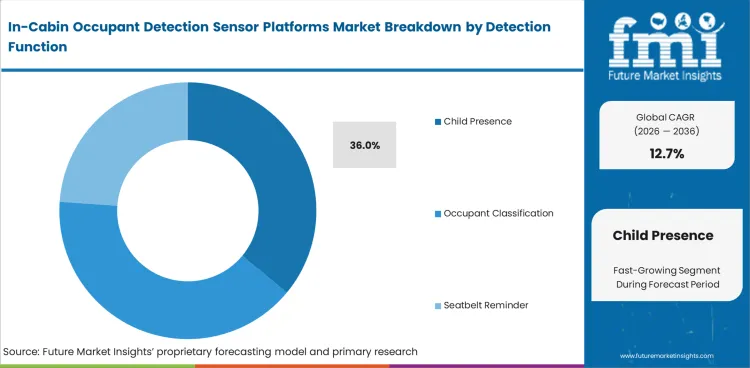
- Child presence detection is expected to represent 36.0% share in 2026 since direct sensing helps OEMs prove a living occupant remains inside a locked vehicle, improving warning accuracy over door-cycle reminders.
- Occupant classification is likely to expand as restraint suppliers use seating position and body-size inputs to adjust seatbelt force and airbag behavior.
Insights into the Multi-Sensor Fusion Architecture Segment
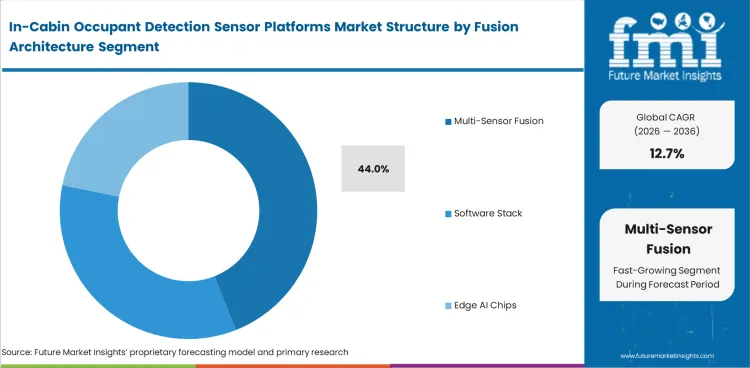
- Multi-sensor fusion is forecast to hold 44.0% share in 2026, driven by cabin radar and interior cameras reducing blind spots and giving OEMs better evidence for seatbelt warnings and adaptive restraint decisions.
- Edge AI chips are likely to gain share as vehicle programs need local processing able to reduce data movement and limit privacy concerns around cabin images.
In-Cabin Occupant Detection Sensor Platforms Market Drivers, Restraints, and Opportunities
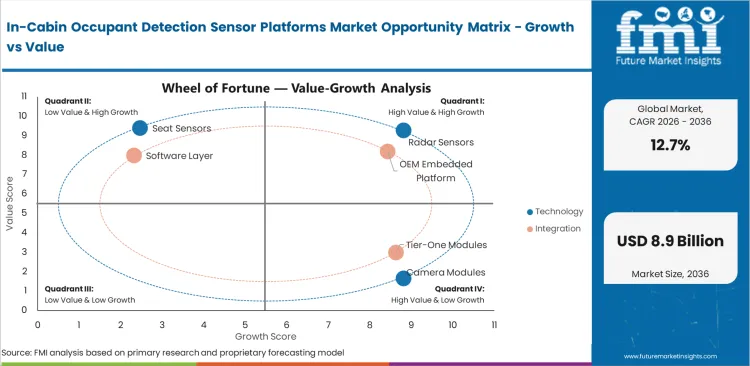
- Child presence detection scoring is expected to raise sensor fitment as OEMs need direct cabin confirmation before warning cycles start.
- Privacy reviews are anticipated to slow camera-only systems as continuous cabin images need strict storage and processing controls.
- Radar-and-camera integration are likely to create opportunities as suppliers combine automotive radar sensors with cabin software for wider safety coverage.
Rating and regulation pressure will likely act as the first growth filter for in-cabin monitoring systems. Euro NCAP protocol listings include child presence detection within child occupant protection, and European Union safety rules require new motor vehicles to include driver drowsiness attention warnings. As per FMI, such signals make cabin detection less discretionary for OEMs seeking safety scores and compliance readiness across shared vehicle platforms. Buyer teams are expected to favor suppliers with reusable validation files and clear fail-safe behavior. Cost and privacy are likely to shape the restraint side of the outlook. Camera systems can recognize posture and eye movement. Cabin images raise data handling concerns for OEM legal teams. Radar sensors can detect breathing without visible images. Texas Instruments said its 2025 AWRL6844 radar can replace multiple sensor technologies and lower implementation cost by an average USD 20 per vehicle. Cost evidence should support combined automotive sensors and edge software platforms during the forecast period.
After-sales Service and Lifecycle Cost Analysis
Lifecycle cost is expected to depend on calibration quality and software support across the vehicle warranty period. In-cabin sensors need stable mounting and clear field diagnostics as false warnings can raise dealer service visits. Radar sensors could reduce lens blockage concerns compared with visible cameras. Software updates will need careful validation after each vehicle program change. Suppliers able to provide test data and service tools should lower warranty risk for OEMs. Dealer networks will need simple fault codes for sensor blockage and module replacement.
Regulatory Compliance and Operating Standards Analysis
Compliance work is expected to focus on safety scoring and privacy-safe data handling. EU general safety rules from July 2024 require new motor vehicles to include driver drowsiness attention warnings. Euro NCAP child occupant protocols give OEMs a second reason to add direct detection systems. Driver monitoring evaluation will shape validation needs for cabin safety electronics. Buyers are expected to prefer platforms that meet rating rules without moving personal cabin images outside the vehicle.
Regional Analysis
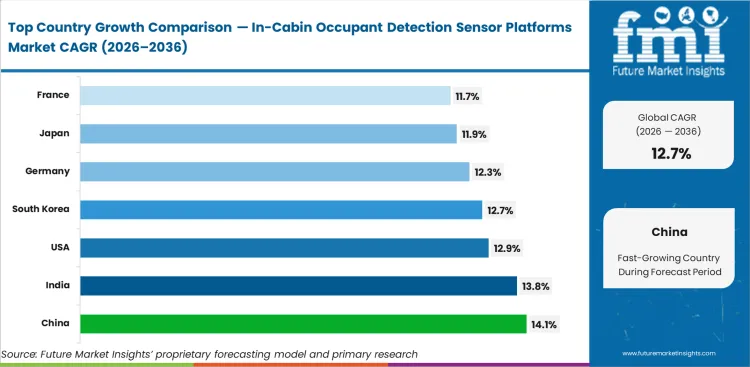
.webp "Top Country Growth Comparison In Cabin Occupant Detection Sensor Platforms Market Cagr (2026 2036)")
| Country | CAGR 2026 to 2036 |
|---|---|
| China | 14.1% |
| India | 13.8% |
| United States | 12.9% |
| South Korea | 12.7% |
| Germany | 12.3% |
| Japan | 11.9% |
| France | 11.7% |
Source: Future Market Insights analysis, 2026.
Analysis of In-Cabin Occupant Detection Sensor Platforms Market by Key Countries
- China is projected to record 14.1% CAGR by 2036 as local OEMs expand intelligent cabins and software-defined vehicle electronics.
- India is expected to expand at 13.8% CAGR by 2036 since vehicle output rises and commercial vehicle safety rules raise driver alert content.
- United States is forecast to grow at 12.9% CAGR by 2036 due to child safety attention and broad ADAS electronics content.
- South Korea is expected to advance at 12.7% CAGR by 2036 with Hyundai-Kia platforms and electronics depth supporting earlier cabin sensing trials.
- Germany at 12.3% CAGR and Japan at 11.9% CAGR expand through safety engineering depth. France follows at 11.7% CAGR through European supplier activity and NCAP alignment.
Country performance differs by vehicle production scale and safety content readiness. China records above the global pace due to high vehicle output and fast digital cockpit investment. India follows as production growth and driver alert rules start with heavier vehicles. United States demand reflects child safety attention and premium ADAS fitment. Germany and Japan progress through engineering discipline and supplier integration. France benefits from European safety alignment and strong tier-one programs.
Demand Outlook for In-Cabin Occupant Detection Sensor Platforms in China
Market growth in China is projected at a 14.1% CAGR by 2036, led by vehicle production scale supporting faster cabin electronics rollouts. OICA data published in October 2025 counted 31,281,592 vehicles produced in China during 2024. Large model volumes allow OEMs to spread sensor validation cost across many platforms. Local brands treat intelligent cabins as a sales feature in electric vehicles. Suppliers with integrated radar and camera software convert faster compared to component-only vendors.
- Domestic vehicle output gives sensor suppliers a broad launch path across sedans and electric SUVs.
- Intelligent cockpit programs increase buyer interest in automotive radar-on-chip technology as sensor hardware moves closer to cabin processors.
- Local OEMs value suppliers able to tune algorithms for family vehicles without adding extra control units.
Demand Outlook for In-Cabin Occupant Detection Sensor Platforms in India
Demand in India is expected to expand at 13.8% CAGR by 2036 as vehicle output and safety content both rise. OICA counted 6,014,691 vehicles produced in India during 2024 in its October 2025 production update. Commercial vehicle safety rules around driver drowsiness creates an early reference point for cabin monitoring. Passenger vehicle platforms are likely to adopt occupant detection as export and family safety needs grow.
- Rising vehicle output gives OEMs a larger pool for factory-installed occupant sensors and integrated cabin electronics.
- Commercial vehicle alert rules create a technical bridge from driver monitoring toward occupant detection functions.
- Cost-sensitive platforms favor compact radar modules and 60GHz radar evaluation kit shortening local engineering trials.
In-Depth Analysis of In-Cabin Occupant Detection Sensor Platforms in United States
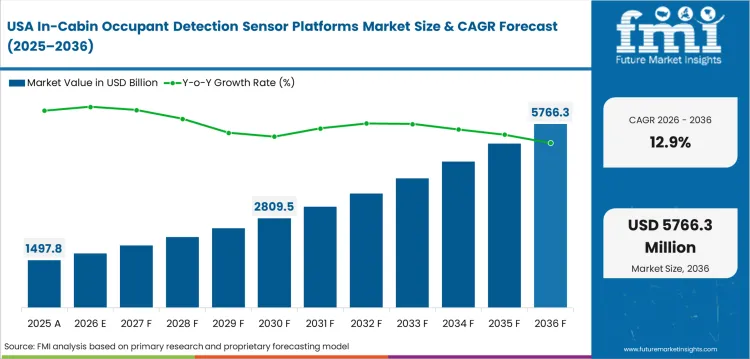
The market in United States is forecast to grow at 12.9% CAGR by 2036 since child heatstroke awareness and ADAS content influence model planning. OICA recorded 10,562,188 vehicles produced in the United States during 2024. Large pickup and SUV volumes make rear-cabin monitoring commercially important for family buyers. Sensor platforms should gain from OEM interest in unified driver and occupant monitoring features.
- NHTSA child safety communication keeps public attention on unattended child risk inside locked vehicles.
- Mobileye secured a 2026 production program for driver monitoring with a leading U.S. automaker, supporting combined cabin software interest.
- Premium trucks and SUVs give suppliers a higher content entry point before broader mass-model placement.
Sales Analysis of In-Cabin Occupant Detection Sensor Platforms in South Korea
Industry in South Korea is expected to advance at 12.7% CAGR by 2036, driven by electronics depth promoting sensor fusion and cabin software trials. Vehicle production reached 4,127,252 units in 2024 according to OICA data released in October 2025. Hyundai and Kia platform scale creates a direct route for camera and radar validation. Domestic component suppliers benefit from tight links between semiconductors and automotive electronics.
- Export-oriented vehicle programs raise pressure to meet European and North American cabin safety expectations.
- Electronics manufacturing depth supports faster tuning of automotive camera and radar processors for cabin use.
- Regional suppliers gain by providing low-power modules integrating in compact vehicle interiors.
Demand Outlook for In-Cabin Occupant Detection Sensor Platforms in Germany
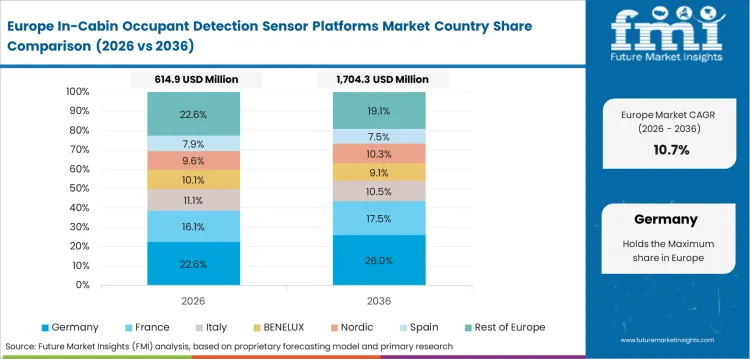
Demand in Germany is projected to rise at 12.3% CAGR by 2036, reflected by premium OEMs treating cabin sensing as part of safety differentiation. OICA reported 4,069,222 cars produced in Germany during 2024. Engineering teams are likely to link occupant sensing with restraint control and driver monitoring. Suppliers with validated systems gain as buyers demand reliability across colder climates and complex seat layouts.
- Premium vehicle mix supports early fitment of cabin radar and camera systems with richer software features.
- ZF LIFETEC's work on adaptive restraint control shows how occupant data moves into airbag and seatbelt decisions.
- German buyers should favor suppliers with traceable test files and vehicle security sensors integration experience.
Opportunity Analysis of In-Cabin Occupant Detection Sensor Platforms in Japan
Demand expansion in Japan is forecast at 11.9% CAGR by 2036 as safety-led engineering and compact vehicle programs support steady sensor adoption. Japan produced 8,234,681 vehicles in 2024 according to OICA. Domestic OEMs tend to move carefully from premium trims toward high-volume platforms after validation confidence improves. Practical opportunity is likely to center on low-power sensors and durable cabin modules.
- Careful quality controls favor suppliers with stable algorithms and long testing records across child seats and occupant sizes.
- Compact cars require low-profile modules integrating in limited cabin space without changing interior design.
- Hybrid and electric platforms create room for shared processors across cabin safety and electric vehicle sensors.
Opportunity Analysis of In-Cabin Occupant Detection Sensor Platforms in France
Market in France is expected to post 11.7% CAGR by 2036 as European safety scoring and local supplier activity support in-cabin monitoring. OICA counted 1,357,701 cars and light commercial vehicles produced in France during 2024. Valeo’s partnership with Seeing Machines provides French supply chains a direct in-cabin monitoring reference. Adoption is expected to improve as OEMs align child presence detection with driver attention monitoring.
- European safety protocols support French OEM interest in child presence and occupant classification functions.
- Valeo’s in-cabin monitoring work provides buyers a local source for integrated hardware and perception software.
- Shared platforms across Europe create a route for automotive cabin air quality sensors and occupant sensors to align inside broader comfort electronics.
Competitive Landscape and Strategic Positioning
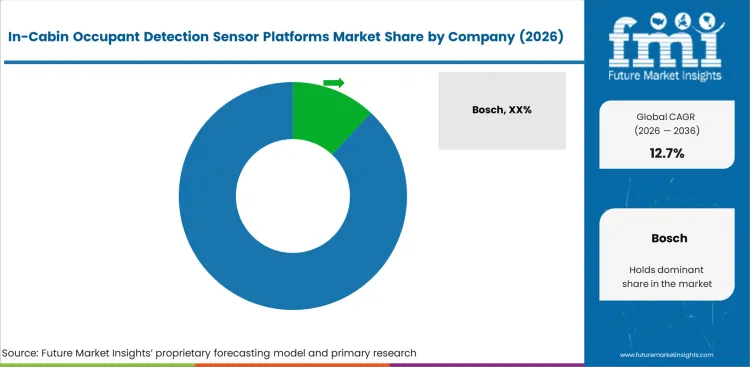
- Bosch and Continental hold established positions through cabin sensing portfolios that combine radar and camera sensing with driver attention functions.
- Valeo and Magna compete through integrated driver and occupant monitoring systems tied to OEM program work.
- Texas Instruments and NXP gain by supplying processing chips and radar components that reduce sensor count and software cost.
- Entry barriers are high as suppliers need low false-alarm data, privacy controls and OEM validation across many seat layouts.
Competition is expected to focus on suppliers able to support full cabin sensing programs for automakers. Bosch and Continental compete through broader cabin sensing portfolios while Valeo and Magna focus on integrated driver and occupant monitoring systems. Semiconductor suppliers such as Texas Instruments and NXP serve a separate role by lowering hardware complexity through radar and processing components. OEMs are expected to judge suppliers on sensing accuracy and validation across different seat layouts.
Continental presented an invisible biometrics sensing display in November 2024 tracking passenger vital parameters through a display-mounted optical setup. Magna presented integrated interior sensing in July 2025 by combining cameras and radar for driver and passenger monitoring. Supplier activity indicates cabin sensing moving toward combined hardware and software packages instead of isolated components.
Specialist semiconductor suppliers can capture value before OEMs finalize platform awards. Texas Instruments launched an edge AI radar device in January 2025 for seatbelt reminder and child presence detection. NXP introduced the i.MX 952 applications processor in October 2025 for AI-powered vision and in-cabin sensing. Suppliers linking interior air quality monitoring with occupant awareness may gain share in comfort-focused trims. Competitive advantage is likely to favor suppliers combining proven sensor accuracy and OEM-ready validation support.
Key Companies in the In-Cabin Occupant Detection Sensor Platforms Market
Competition spans tier-one system suppliers, semiconductor vendors and cabin software specialists serving automotive OEM programs.
- System integrators: Bosch, Continental, Valeo and Magna compete through camera-radar combinations, OEM access and cabin safety application depth. Bosch connects interior sensing with driver attention and child detection. Continental adds display-based biometric sensing. Valeo uses Seeing Machines software for driver and occupant functions. Magna integrates monitoring into mirror and cabin sensing packages.
- Semiconductor suppliers: Texas Instruments, NXP and Infineon build positions in radar chips, edge processing and low-power cabin electronics. Texas Instruments supports three in-cabin sensing applications through one radar chip. NXP adds sensor fusion processing for cameras and UWB inputs. Infineon supports 60GHz radar functions for full-cabin child presence detection.
- Safety and restraint specialists: ZF LIFETEC, Denso and Vayyar Imaging gain share through occupant classification, driver status monitoring and radar-based presence detection. ZF LIFETEC links occupant recognition with airbag and seatbelt adaptation. Denso adds camera-based driver monitoring strength. Vayyar brings in-cabin radar experience for child presence and passenger detection.
Competitive Benchmarking: In-Cabin Occupant Detection Sensor Platforms Market
| Company | Cabin Radar Depth | Sensor Fusion Software | OEM Program Integration | Footprint |
|---|---|---|---|---|
| Bosch | High | High | Strong | Global |
| Continental | Strong | High | Strong | Global |
| Valeo | High | High | Strong | Global |
| Magna | Strong | Medium | Strong | Global |
| ZF LIFETEC | Medium | High | Strong | Europe and North America |
| Texas Instruments | High | Medium | Medium | Global |
| NXP | Strong | High | Medium | Global |
| Infineon | Strong | Medium | Medium | Global |
| Mobileye | Low | High | Strong | Global |
| Denso | Medium | Medium | Strong | Japan and global |
Source: Future Market Insights competitive analysis, 2026. Ratings reflect relative positioning based on cabin radar depth, sensor fusion software and OEM program integration.
Key Developments in the In-Cabin Occupant Detection Sensor Platforms Market
- • In January 2025, Texas Instruments introduced the AWRL6844 60GHz radar sensor for occupant detection and child presence monitoring.
- • In July 2025, Magna presented its integrated interior sensing system with cameras and radar.
- • In March 2026, Mobileye announced a large DMS production program with a leading U.S. automaker.
Key Players in the In-Cabin Occupant Detection Sensor Platforms Market
Tier-one system suppliers
- Bosch
- Continental
- Valeo
- Magna
- ZF LIFETEC
- Denso
Semiconductor and sensing suppliers
- Texas Instruments
- NXP
- Infineon Technologies
- STMicroelectronics
- Vayyar Imaging
- NOVELDA
Software and monitoring specialists
- Mobileye
- Seeing Machines
- Smart Eye
- Cipia
- Tobii D3 Embedded
Report Scope and Coverage
| Item | Value |
|---|---|
| Market value in 2025 | USD 2.4 billion |
| Market value in 2026 | USD 2.7 billion |
| Market value in 2036 | USD 8.9 billion |
| CAGR from 2026 to 2036 | 12.7% |
| Quantitative Units | USD billion and percentage share |
| Market Definition | Factory and aftermarket sensor platforms used to detect and classify occupants inside vehicle cabins |
| Sensor Technology | Radar sensors, camera modules, ultrasonic sensors, seat sensors and infrared sensors |
| Platform Integration | OEM embedded, tier-one modules, software layer and aftermarket units |
| Vehicle Type | Passenger cars, light commercial, heavy commercial and shuttles |
| Detection Function | Child presence, occupant classification, seatbelt reminder, vital signs and intrusion alert |
| System Architecture | Multi-sensor fusion, single-sensor modules, software stack and edge AI chips |
| Regions Covered | North America, Latin America, Western Europe, Eastern Europe, East Asia, South Asia and Pacific, Middle East and Africa |
| Countries Covered | China, India, United States, South Korea, Germany, Japan and France |
| Key Companies Profiled | Bosch, Continental, Valeo, Magna, ZF LIFETEC, Texas Instruments, NXP, Infineon Technologies, Mobileye and Denso |
| Forecast Period | 2026 to 2036 |
| Approach | Bottom-up fitment modeling checked against vehicle production and company product evidence |
Source: Future Market Insights analysis, 2026.
In-Cabin Occupant Detection Sensor Platforms Market Breakdown by Sensor Technology, Platform Integration, Vehicle Type, Detection Function, System Architecture, and Region
In-Cabin Occupant Detection Sensor Platforms Market Segmented by Sensor Technology
- Radar Sensors
- Camera Modules
- Ultrasonic Sensors
- Seat Sensors
- Infrared Sensors
In-Cabin Occupant Detection Sensor Platforms Market Segmented by Platform Integration
- OEM Embedded
- Tier-One Modules
- Software Layer
- Aftermarket Units
In-Cabin Occupant Detection Sensor Platforms Market Segmented by Vehicle Type
- Passenger Cars
- Light Commercial
- Heavy Commercial
- Shuttles
In-Cabin Occupant Detection Sensor Platforms Market Segmented by Detection Function
- Child Presence
- Occupant Classification
- Seatbelt Reminder
- Vital Signs
- Intrusion Alert
In-Cabin Occupant Detection Sensor Platforms Market Segmented by System Architecture
- Multi-Sensor Fusion
- Single-Sensor Modules
- Software Stack
- Edge AI Chips
In-Cabin Occupant Detection Sensor Platforms Market by Region
- North America
- United States
- Canada
- Mexico
- Latin America
- Brazil
- Rest of Latin America
- Western Europe
- Germany
- United Kingdom
- France
- Italy
- Spain
- BENELUX
- Rest of Western Europe
- Eastern Europe
- Poland
- Hungary
- Rest of Eastern Europe
- East Asia
- China
- Japan
- South Korea
- South Asia and Pacific
- India
- ASEAN
- Australia and New Zealand
- Rest of South Asia and Pacific
- Middle East and Africa
- Kingdom of Saudi Arabia
- Other GCC Countries
- Turkiye
- South Africa
- Rest of Middle East and Africa
Research Sources and Bibliography
- European Commission. (2024, July 5). Mandatory drivers assistance systems expected to help save over 25,000 lives by 2038.
- European New Car Assessment Programme. (2024, September 23). Test and assessment protocol: Child presence detection (Version 1.3).
- International Organization of Motor Vehicle Manufacturers. (2025, October). World motor vehicle production by country/region and type 2024.
- Texas Instruments. (2025, January 6). New edge AI-enabled radar sensor and automotive audio processors from TI empower automakers to reimagine in-cabin experiences.
- Continental AG. (2024, November 20). Transparent tech: Invisible biometrics sensing display monitors passengers’ vital parameters.
- Magna International Inc. (2025, July 29). Magna advances vehicle safety innovation with integrated interior sensing systems.
- Valeo. (2026, January 5). Valeo unveils safety-enhancing advanced monitoring applications powered by Seeing Machines at CES 2026.
- Mobileye. (2026, March 23). Mobileye secures major DMS production program with leading U.S. automaker.
- NXP Semiconductors. (2025, October 21). NXP’s AI-enabled i.MX 952 applications processor advances automotive HMIs and in-cabin sensing.
- ZF LIFETEC. (2025, October 6). Adaptive restraint systems through intelligent occupant monitoring.
Bibliography uses primary government, official trade body, safety protocol or official company publications.
This Report Answers
- What is the current and future value of the in-cabin occupant detection sensor platforms market from 2026 to 2036?
- What CAGR is expected for the in-cabin occupant detection sensor platforms market during the forecast period?
- Which sensor technology is projected to hold a strong share in in-cabin occupant detection sensor platforms in 2026?
- Which platform integration segment is expected to account for a leading share in in-cabin occupant detection sensor platforms?
- What factors are driving adoption of in-cabin occupant detection sensor platforms across passenger cars?
- How do safety regulations and Euro NCAP protocols affect supplier selection in this sector?
- Which countries are expected to grow faster in in-cabin occupant detection sensor platforms?
- Which companies are positioned across radar, camera and cabin software integration?
- How does FMI define the in-cabin occupant detection sensor platforms revenue scope?
- What forecasting approach was used to estimate in-cabin occupant detection sensor platform demand from 2026 to 2036?
Frequently Asked Questions
What is the global market demand for in-cabin occupant detection sensor platforms market in 2026?
The in-cabin occupant detection sensor platforms market value is expected to reach USD 2.7 billion in 2026 as OEM cabin safety content expands.
How big will the in-cabin occupant detection sensor platforms market be by 2036?
Industry revenue is projected to scale USD 8.9 billion by 2036 as occupant detection links with safety ratings and cabin software.
What is the expected CAGR for in-cabin occupant detection sensor platforms market?
In-cabin occupant detection sensor platforms sector is expected to expand at 12.7% CAGR from 2026 to 2036 across factory-installed vehicle programs.
Which sensor technology leads in-cabin occupant detection sensor platforms market in 2026?
Radar sensors are projected to account for 38.5% share in 2026 because breathing detection and covered-child sensing capability.
Which platform integration type leads in-cabin occupant detection sensor platforms market in 2026?
OEM embedded platforms are forecast to account for 71.0% share in 2026 as vehicle programs need factory validation and warranty control.
Which vehicle type leads in-cabin occupant detection sensor platforms market in 2026?
Passenger cars are expected to hold 67.5% share in 2026 since family safety ratings push broader cabin sensing fitment.
Which country grows fastest in in-cabin occupant detection sensor platforms market?
China is projected to record 14.1% CAGR by 2036 as local OEMs expand intelligent cabin electronics across high-volume platforms.
What does in-cabin occupant detection sensor platforms market include?
Scope includes radar, camera, ultrasonic, seat and infrared sensor platforms used to detect occupants and support safety alerts.
How was in-cabin occupant detection sensor platforms market forecast prepared?
Forecast work used vehicle production, sensor fitment assumptions, average platform content and validation checks against safety rules and company evidence.
Preview the report firsthand - request a free sample
Get SampleGet the brochure for pricing and purchase details.
Get PDFTable of Content
- Key Takeaways
- Market Size and CAGR
- Top Growth Driver
- Fastest Growing Segment
- Leading Region
- Key Companies
- Emerging Opportunities
- Executive Summary
- Global Market Outlook
- Demand-side Trends
- Supply-side Trends
- Technology Roadmap Analysis
- Analysis and Recommendations
- Analyst Perspective (What is happening? Why now? What should investors know?)
- Key Questions Answered
- How large is the market?
- What is the CAGR?
- What are key trends?
- Which region dominates?
- Who are the leaders?
- Market Overview
- Market Coverage / Taxonomy
- Market Definition / Scope / Limitations
- Research Methodology
- Chapter Orientation
- Analytical Lens and Working Hypotheses
- Market Structure, Signals, and Trend Drivers
- Benchmarking and Cross-market Comparability
- Market Sizing, Forecasting, and Opportunity Mapping
- Research Design and Evidence Framework
- Desk Research Programme (Secondary Evidence)
- Expert Input and Fieldwork (Primary Evidence)
- Tooling, Models, and Reference Databases
- Data Engineering and Model Build
- Quality Assurance and Audit Trail
- Market Background
- Market Dynamics (Drivers, Restraints, Opportunity, Trends)
- Scenario Forecast (Optimistic, Likely, Conservative)
- Impact Analysis
- AI Impact
- Sustainability Impact
- Regulatory Impact
- Technology Impact
- Consumer / Buyer Analysis
- Purchase Drivers
- Adoption Barriers
- Buyer Journey
- Opportunity Map Analysis
- Product Life Cycle Analysis
- Supply Chain Analysis
- Investment Feasibility Matrix
- Value Chain Analysis
- PESTLE and Porter's Analysis
- Regulatory Landscape
- Regional Parent Market Outlook
- Production and Consumption Statistics
- Import and Export Statistics
- Global Market Analysis and Forecast, 2021 to 2036
- Historical Market Size Value (USD Billion) & Volume (Unit) Analysis, 2021 to 2025
- Current and Future Market Size Value (USD Billion) & Volume (Unit) Projections, 2026 to 2036
- Y-o-Y Growth Trend Analysis
- Absolute $ Opportunity Analysis
- Global Market Pricing Analysis, 2021 to 2036
- Global Market Analysis and Forecast, By Sensor Technology, 2021 to 2036
- Introduction / Key Findings
- Historical Market Size Value (USD Billion) & Volume (Unit) Analysis By Sensor Technology, 2021 to 2025
- Current and Future Market Size Value (USD Billion) & Volume (Unit) Analysis and Forecast By Sensor Technology, 2026 to 2036
- Radar Sensors
- Camera Modules
- Ultrasonic Sensors
- Seat Sensors
- Infrared Sensors
- Radar Sensors
- Y-o-Y Growth Trend Analysis By Sensor Technology, 2021 to 2025
- Absolute $ Opportunity Analysis By Sensor Technology, 2026 to 2036
- Global Market Analysis and Forecast, By Platform Integration, 2021 to 2036
- Introduction / Key Findings
- Historical Market Size Value (USD Billion) & Volume (Unit) Analysis By Platform Integration, 2021 to 2025
- Current and Future Market Size Value (USD Billion) & Volume (Unit) Analysis and Forecast By Platform Integration, 2026 to 2036
- OEM Embedded
- Tier-One Modules
- Software Layer
- Aftermarket Value (USD Billion) & Volume (Unit)s
- OEM Embedded
- Y-o-Y Growth Trend Analysis By Platform Integration, 2021 to 2025
- Absolute $ Opportunity Analysis By Platform Integration, 2026 to 2036
- Global Market Analysis and Forecast, By Vehicle Type, 2021 to 2036
- Introduction / Key Findings
- Historical Market Size Value (USD Billion) & Volume (Unit) Analysis By Vehicle Type, 2021 to 2025
- Current and Future Market Size Value (USD Billion) & Volume (Unit) Analysis and Forecast By Vehicle Type, 2026 to 2036
- Passenger Cars
- Light Commercial
- Heavy Commercial
- Shuttles
- Passenger Cars
- Y-o-Y Growth Trend Analysis By Vehicle Type, 2021 to 2025
- Absolute $ Opportunity Analysis By Vehicle Type, 2026 to 2036
- Global Market Analysis and Forecast, By Detection Function, 2021 to 2036
- Introduction / Key Findings
- Historical Market Size Value (USD Billion) & Volume (Unit) Analysis By Detection Function, 2021 to 2025
- Current and Future Market Size Value (USD Billion) & Volume (Unit) Analysis and Forecast By Detection Function, 2026 to 2036
- Child Presence
- Occupant Classification
- Seatbelt Reminder
- Vital Signs
- Intrusion Alert
- Child Presence
- Y-o-Y Growth Trend Analysis By Detection Function, 2021 to 2025
- Absolute $ Opportunity Analysis By Detection Function, 2026 to 2036
- Global Market Analysis and Forecast, By System Architecture, 2021 to 2036
- Introduction / Key Findings
- Historical Market Size Value (USD Billion) & Volume (Unit) Analysis By System Architecture, 2021 to 2025
- Current and Future Market Size Value (USD Billion) & Volume (Unit) Analysis and Forecast By System Architecture, 2026 to 2036
- Multi-Sensor Fusion
- Single-Sensor Modules
- Software Stack
- Edge AI Chips
- Multi-Sensor Fusion
- Y-o-Y Growth Trend Analysis By System Architecture, 2021 to 2025
- Absolute $ Opportunity Analysis By System Architecture, 2026 to 2036
- Global Market Analysis and Forecast, By Region, 2021 to 2036
- Introduction
- Historical Market Size Value (USD Billion) & Volume (Unit) Analysis By Region, 2021 to 2025
- Current Market Size Value (USD Billion) & Volume (Unit) Analysis and Forecast By Region, 2026 to 2036
- North America
- Latin America
- Western Europe
- Eastern Europe
- East Asia
- South Asia and Pacific
- Middle East & Africa
- Market Attractiveness Analysis By Region
- North America Market Analysis and Forecast, By Country, 2021 to 2036
- Historical Market Size Value (USD Billion) & Volume (Unit) Trend Analysis By Market Taxonomy, 2021 to 2025
- Market Size Value (USD Billion) & Volume (Unit) Forecast By Market Taxonomy, 2026 to 2036
- By Country
- USA
- Canada
- Mexico
- By Sensor Technology
- By Platform Integration
- By Vehicle Type
- By Detection Function
- By System Architecture
- By Country
- Market Attractiveness Analysis
- By Country
- By Sensor Technology
- By Platform Integration
- By Vehicle Type
- By Detection Function
- By System Architecture
- Key Takeaways
- Latin America Market Analysis and Forecast, By Country
- Historical Market Size Value (USD Billion) & Volume (Unit) Trend Analysis By Market Taxonomy, 2021 to 2025
- Market Size Value (USD Billion) & Volume (Unit) Forecast By Market Taxonomy, 2026 to 2036
- By Country
- Brazil
- Chile
- Rest of Latin America
- By Sensor Technology
- By Platform Integration
- By Vehicle Type
- By Detection Function
- By System Architecture
- By Country
- Market Attractiveness Analysis
- By Country
- By Sensor Technology
- By Platform Integration
- By Vehicle Type
- By Detection Function
- By System Architecture
- Key Takeaways
- Western Europe Market Analysis and Forecast, By Country
- Historical Market Size Value (USD Billion) & Volume (Unit) Trend Analysis By Market Taxonomy, 2021 to 2025
- Market Size Value (USD Billion) & Volume (Unit) Forecast By Market Taxonomy, 2026 to 2036
- By Country
- Germany
- UK
- Italy
- Spain
- France
- Nordic
- BENELUX
- Rest of Western Europe
- By Sensor Technology
- By Platform Integration
- By Vehicle Type
- By Detection Function
- By System Architecture
- By Country
- Market Attractiveness Analysis
- By Country
- By Sensor Technology
- By Platform Integration
- By Vehicle Type
- By Detection Function
- By System Architecture
- Key Takeaways
- Eastern Europe Market Analysis and Forecast, By Country
- Historical Market Size Value (USD Billion) & Volume (Unit) Trend Analysis By Market Taxonomy, 2021 to 2025
- Market Size Value (USD Billion) & Volume (Unit) Forecast By Market Taxonomy, 2026 to 2036
- By Country
- Russia
- Poland
- Hungary
- Balkan & Baltic
- Rest of Eastern Europe
- By Sensor Technology
- By Platform Integration
- By Vehicle Type
- By Detection Function
- By System Architecture
- By Country
- Market Attractiveness Analysis
- By Country
- By Sensor Technology
- By Platform Integration
- By Vehicle Type
- By Detection Function
- By System Architecture
- Key Takeaways
- East Asia Market Analysis and Forecast, By Country
- Historical Market Size Value (USD Billion) & Volume (Unit) Trend Analysis By Market Taxonomy, 2021 to 2025
- Market Size Value (USD Billion) & Volume (Unit) Forecast By Market Taxonomy, 2026 to 2036
- By Country
- China
- Japan
- South Korea
- By Sensor Technology
- By Platform Integration
- By Vehicle Type
- By Detection Function
- By System Architecture
- By Country
- Market Attractiveness Analysis
- By Country
- By Sensor Technology
- By Platform Integration
- By Vehicle Type
- By Detection Function
- By System Architecture
- Key Takeaways
- South Asia and Pacific Market Analysis and Forecast, By Country
- Historical Market Size Value (USD Billion) & Volume (Unit) Trend Analysis By Market Taxonomy, 2021 to 2025
- Market Size Value (USD Billion) & Volume (Unit) Forecast By Market Taxonomy, 2026 to 2036
- By Country
- India
- ASEAN
- Australia & New Zealand
- Rest of South Asia and Pacific
- By Sensor Technology
- By Platform Integration
- By Vehicle Type
- By Detection Function
- By System Architecture
- By Country
- Market Attractiveness Analysis
- By Country
- By Sensor Technology
- By Platform Integration
- By Vehicle Type
- By Detection Function
- By System Architecture
- Key Takeaways
- Middle East & Africa Market Analysis and Forecast, By Country
- Historical Market Size Value (USD Billion) & Volume (Unit) Trend Analysis By Market Taxonomy, 2021 to 2025
- Market Size Value (USD Billion) & Volume (Unit) Forecast By Market Taxonomy, 2026 to 2036
- By Country
- Kingdom of Saudi Arabia
- Other GCC Countries
- Türkiye
- South Africa
- Other African Union
- Rest of Middle East & Africa
- By Sensor Technology
- By Platform Integration
- By Vehicle Type
- By Detection Function
- By System Architecture
- By Country
- Market Attractiveness Analysis
- By Country
- By Sensor Technology
- By Platform Integration
- By Vehicle Type
- By Detection Function
- By System Architecture
- Key Takeaways
- Key Countries Market Analysis
- USA
- Pricing Analysis
- Market Share Analysis, 2025
- By Sensor Technology
- By Platform Integration
- By Vehicle Type
- By Detection Function
- By System Architecture
- Canada
- Pricing Analysis
- Market Share Analysis, 2025
- By Sensor Technology
- By Platform Integration
- By Vehicle Type
- By Detection Function
- By System Architecture
- Mexico
- Pricing Analysis
- Market Share Analysis, 2025
- By Sensor Technology
- By Platform Integration
- By Vehicle Type
- By Detection Function
- By System Architecture
- Brazil
- Pricing Analysis
- Market Share Analysis, 2025
- By Sensor Technology
- By Platform Integration
- By Vehicle Type
- By Detection Function
- By System Architecture
- Chile
- Pricing Analysis
- Market Share Analysis, 2025
- By Sensor Technology
- By Platform Integration
- By Vehicle Type
- By Detection Function
- By System Architecture
- Germany
- Pricing Analysis
- Market Share Analysis, 2025
- By Sensor Technology
- By Platform Integration
- By Vehicle Type
- By Detection Function
- By System Architecture
- UK
- Pricing Analysis
- Market Share Analysis, 2025
- By Sensor Technology
- By Platform Integration
- By Vehicle Type
- By Detection Function
- By System Architecture
- Italy
- Pricing Analysis
- Market Share Analysis, 2025
- By Sensor Technology
- By Platform Integration
- By Vehicle Type
- By Detection Function
- By System Architecture
- Spain
- Pricing Analysis
- Market Share Analysis, 2025
- By Sensor Technology
- By Platform Integration
- By Vehicle Type
- By Detection Function
- By System Architecture
- France
- Pricing Analysis
- Market Share Analysis, 2025
- By Sensor Technology
- By Platform Integration
- By Vehicle Type
- By Detection Function
- By System Architecture
- India
- Pricing Analysis
- Market Share Analysis, 2025
- By Sensor Technology
- By Platform Integration
- By Vehicle Type
- By Detection Function
- By System Architecture
- ASEAN
- Pricing Analysis
- Market Share Analysis, 2025
- By Sensor Technology
- By Platform Integration
- By Vehicle Type
- By Detection Function
- By System Architecture
- Australia & New Zealand
- Pricing Analysis
- Market Share Analysis, 2025
- By Sensor Technology
- By Platform Integration
- By Vehicle Type
- By Detection Function
- By System Architecture
- China
- Pricing Analysis
- Market Share Analysis, 2025
- By Sensor Technology
- By Platform Integration
- By Vehicle Type
- By Detection Function
- By System Architecture
- Japan
- Pricing Analysis
- Market Share Analysis, 2025
- By Sensor Technology
- By Platform Integration
- By Vehicle Type
- By Detection Function
- By System Architecture
- South Korea
- Pricing Analysis
- Market Share Analysis, 2025
- By Sensor Technology
- By Platform Integration
- By Vehicle Type
- By Detection Function
- By System Architecture
- Russia
- Pricing Analysis
- Market Share Analysis, 2025
- By Sensor Technology
- By Platform Integration
- By Vehicle Type
- By Detection Function
- By System Architecture
- Poland
- Pricing Analysis
- Market Share Analysis, 2025
- By Sensor Technology
- By Platform Integration
- By Vehicle Type
- By Detection Function
- By System Architecture
- Hungary
- Pricing Analysis
- Market Share Analysis, 2025
- By Sensor Technology
- By Platform Integration
- By Vehicle Type
- By Detection Function
- By System Architecture
- Kingdom of Saudi Arabia
- Pricing Analysis
- Market Share Analysis, 2025
- By Sensor Technology
- By Platform Integration
- By Vehicle Type
- By Detection Function
- By System Architecture
- Türkiye
- Pricing Analysis
- Market Share Analysis, 2025
- By Sensor Technology
- By Platform Integration
- By Vehicle Type
- By Detection Function
- By System Architecture
- South Africa
- Pricing Analysis
- Market Share Analysis, 2025
- By Sensor Technology
- By Platform Integration
- By Vehicle Type
- By Detection Function
- By System Architecture
- USA
- Market Structure Analysis
- Competition Dashboard
- Competition Benchmarking
- Market Share Analysis of Top Players
- By Regional
- By Sensor Technology
- By Platform Integration
- By Vehicle Type
- By Detection Function
- By System Architecture
- Emerging Startups
- Innovation Benchmarking
- Competition Analysis
- Competition Deep Dive
- Bosch
- Overview
- Product Portfolio
- Profitability by Market Segments (Product/Region/Sales Channel)
- Sales Footprint
- Strategy Overview
- Marketing Strategy
- Product Strategy
- Channel Strategy
- Continental
- Valeo
- Magna
- ZF LIFETEC
- Denso
- Texas Instruments
- NXP
- Infineon Technologies
- STMicroelectronics
- Vayyar Imaging
- NOVELDA
- Mobileye
- Seeing Machines
- Smart Eye
- Cipia
- Tobii D3 Embedded
- Bosch
- Case Studies
- Success Stories
- Recent Developments
- Competition Deep Dive
- Assumptions & Acronyms Used


