

- Industry Size (2026)
- USD 111.30 Mn
- Forecast (2036)
- USD 199.32 Mn
- CAGR (2026 to 2036)
- 6%
60GHz Radar Evaluation Kit Market Size, Market Forecast and Outlook By FMI
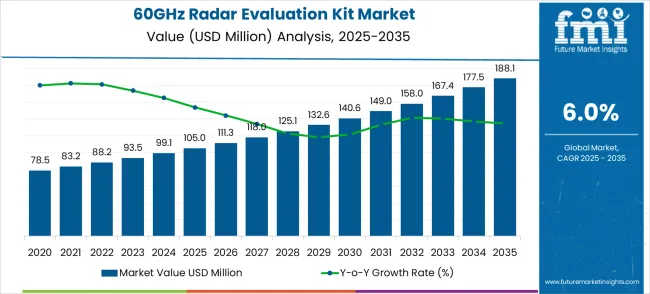
The 60GHz Radar Evaluation Kit market was valued at USD 105.00 million in 2025, projected to reach USD 111.30 million in 2026, and is forecast to expand to USD 199.32 million by 2036 at a 6% CAGR. As per FMI, the absolute dollar opportunity across the forecast period amounts to USD 88.02 million, reflecting steady conversion of latent demand into measurable procurement activity across end-use buyer segments.
FMI is of the opinion that the building automation and smart home sectors' adoption of 60GHz radar for occupancy sensing and gesture control is the primary demand catalyst for evaluation kits in this frequency band. Design engineers at system integrators and OEMs require pre-certified evaluation platforms to validate radar detection algorithms before committing to custom antenna and baseband layouts. As per FMI, the healthcare vertical's exploration of contactless vital sign monitoring using 60GHz continuous-wave radar is adding a high-value development kit procurement channel. Industrial presence detection for safety zone enforcement in collaborative robot cells and automated guided vehicle corridors represents the highest-volume evaluation kit application, where Texas Instruments and Infineon reference designs dominate design-win pipelines.
Summary of 60GHz Radar Evaluation Kit Market
- Market Snapshot
- The market is valued at USD 105.00 million in 2025 and is projected to reach USD 199.32 million by 2036.
- The industry is expected to grow at a 6% CAGR from 2026 to 2036, creating an incremental opportunity of USD 88.02 million.
- The market remains a specification-driven category where product purity, regulatory compliance, and supply chain reliability define competitive positioning.
- Demand and Growth Drivers
- Demand is rising as end-use sectors face tightening performance specifications and regulatory compliance requirements that favour qualified product sources.
- Technology upgrade cycles and capacity expansion programmes across primary verticals are accelerating procurement schedules.
- Growth is further supported by expanding manufacturing and research infrastructure in Asia Pacific and policy incentive frameworks in North America and Europe.
- Among key countries, China at 8.1%, India at 7.5%, Germany at 6.9%, Brazil at 6.3%, USA at 5.7%, UK at 5.1%, Japan at 4.5%.
- Product and Segment View
- The market includes 60ghz radar evaluation kits are pre-assembled hardware platforms containing 60ghz radar transceiver ics, antenna arrays, signal processing firmware, and software development tools that enable design engineers to prototype and validate radar sensing applications.
- Presence Detection Kits leads by Kit Types with 35% share in 2026.
- Industrial leads by Application with 40% share in 2026.
- Scope includes market scope includes global and regional revenue sizing for 60ghz radar evaluation kits segmented by kit type and application.
- Geography and Competitive Outlook
- China and India are the fastest-growing markets, while mature economies sustain high-value demand through established procurement channels.
- Competition is shaped by product specification compliance, distribution network breadth, and supplier qualification track records.
- Key players include Texas Instruments, Acconeer, Nisshinbo Micro Devices Inc, Socionext, Analog Devices, Vayyar, Infineon.
- Analyst Opinion at FMI
- Sudip saha, Principal Consultant at Future Market Insights, opines: 'In my analysis, I have observed that the 60GHz Radar Evaluation Kit market is transitioning from commodity-grade procurement to specification-driven sourcing structures. Buyers who delay alignment with updated product qualification frameworks risk supply disruptions as certified suppliers prioritize long-term contract holders. Capital allocation toward qualified manufacturing capacity and regional distribution infrastructure will define competitive positioning through the forecast period.'
- Strategic Implications / Executive Takeaways
- Suppliers must secure product qualification certifications ahead of procurement cycle deadlines to qualify for multi-year contract awards in primary end-use segments.
- Capital project directors should prioritize capacity expansion in high-growth geographies where regulatory incentive frameworks and demand density reduce payback periods.
- Product development teams must invest in next-generation specification compliance capabilities to maintain competitiveness against incumbents and new entrants.
60GHz Radar Evaluation Kit Market Key Takeaways
| Metric | Details |
|---|---|
| Industry Size (2026) | USD 111.30 million |
| Industry Value (2036) | USD 199.32 million |
| CAGR (2026-2036) | 6% |
Source: Future Market Insights, 2026
All tracked country markets reflect differentiated growth trajectories. China leads at 8.1% CAGR, propelled by smart building automation mandates and domestic semiconductor design house 60GHz radar SoC development. India leads at 7.5% CAGR, supported by smart city infrastructure programmes and growing industrial automation radar integration activity. Germany leads at 6.9% CAGR, driven by automotive radar development programmes and Fraunhofer-linked 60GHz sensing research procurement.
Brazil leads at 6.3% CAGR, backed by industrial safety automation upgrades and growing smart building technology adoption. USA leads at 5.7% CAGR, anchored by TI and Infineon reference design ecosystem penetration and commercial building automation radar adoption. UK leads at 5.1% CAGR, sustained by NHS contactless vital sign monitoring pilots and smart building occupancy sensing deployments. Japan registers a 4.5% pace, driven by Socionext domestic 60GHz IC development and factory automation presence detection procurement.
60GHz Radar Evaluation Kit Market Definition
60GHz radar evaluation kits are pre-assembled hardware platforms containing 60GHz radar transceiver ICs, antenna arrays, signal processing firmware, and software development tools that enable design engineers to prototype and validate radar sensing applications. The market covers presence detection, gesture recognition, vital sign monitoring, and general-purpose radar development kits. Primary applications span industrial occupancy sensing, consumer electronics gesture control, automotive cabin monitoring, and healthcare contactless vital sign measurement.
60GHz Radar Evaluation Kit Market Inclusions
Market scope includes global and regional revenue sizing for 60GHz radar evaluation kits segmented by kit type and application. Coverage spans presence detection, gesture recognition, vital sign monitoring, industrial, consumer, and automotive development platforms with a 2026 to 2036 forecast period and country-level analysis.
60GHz Radar Evaluation Kit Market Exclusions
The scope excludes production-ready 60GHz radar modules sold for OEM integration, standalone 60GHz communication modules without radar sensing capability, and general-purpose microcontroller evaluation boards. Complete radar sensor systems and 77GHz automotive radar kits are excluded from this specific valuation.
60GHz Radar Evaluation Kit Market Research Methodology
- Primary Research: Analysts engaged with procurement leads, product specification engineers, and supply chain managers to map purchase decision triggers and qualification requirements.
- Desk Research: Data collection phases aggregated regulatory standards documentation, industry association publications, and company disclosure filings.
- Market-Sizing and Forecasting: Baseline values derive from a bottom-up aggregation of product shipments and contract values, applying region-specific adoption curves to project demand velocity.
- Data Validation and Update Cycle: Projections are tested against publicly reported revenue guidance from leading suppliers and cross-referenced with trade association production data.
Why is the 60GHz Radar Evaluation Kit Market Growing?
Market expansion is being supported by the increasing global adoption of smart sensing technologies and the corresponding need for advanced development tools that can accelerate product innovation, enable rapid prototyping, and support comprehensive application development across various IoT, automotive, and industrial sensing applications. Modern electronics engineers and product developers are increasingly focused on implementing development solutions that can reduce time-to-market, enable innovative sensing applications, and provide comprehensive evaluation capabilities for complex radar-based systems. 60GHz radar evaluation kits' proven ability to deliver rapid prototyping support, enable application validation, and accelerate product development makes them essential tools for contemporary radar technology development and sensing innovation.
The growing emphasis on contactless sensing and automation technologies is driving demand for 60GHz radar evaluation kits that can support innovative application development, enable comprehensive system evaluation, and facilitate integration with existing platforms and technologies. Technology developers' preference for development tools that combine comprehensive functionality with ease of use and robust technical support is creating opportunities for innovative 60GHz radar evaluation kit implementations. The rising influence of IoT connectivity and edge computing is also contributing to increased adoption of 60GHz radar evaluation kits that can provide advanced sensing capabilities without compromising system integration or development efficiency.
Segmental Analysis
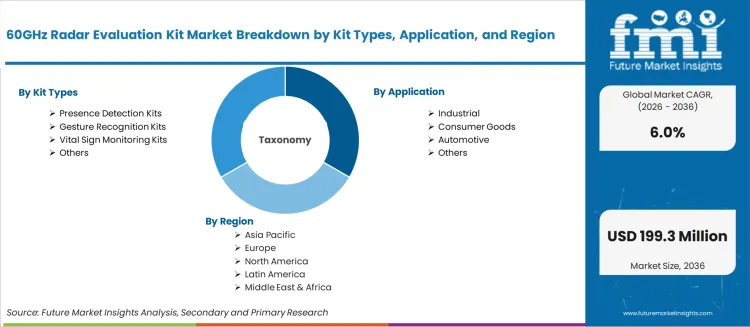
The market is segmented by kit types, application, and region. By kit types, the market is divided into presence detection kits, gesture recognition kits, vital sign monitoring kits, and others. Based on application, the market is categorized into industrial, consumer goods, automotive, and others. Regionally, the market is divided into Asia Pacific, North America, Europe, Latin America, and the Middle East & Africa.
By Kit Types, the Presence Detection Kits Segment Leads the Market
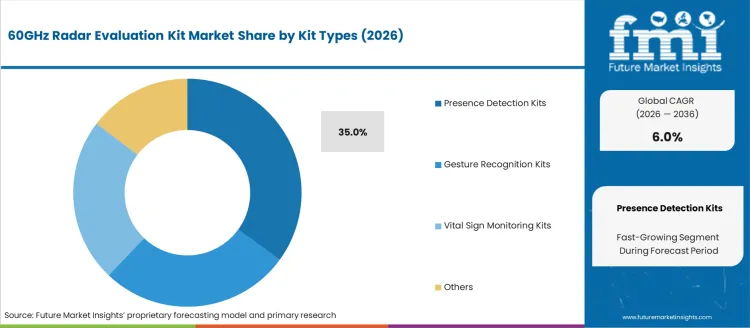
The presence detection kits segment is projected to maintain its leading position in the 60GHz radar evaluation kit market in 2026, reaffirming its role as the preferred development platform category for occupancy sensing and motion detection applications. Electronics engineers and product developers increasingly utilize presence detection evaluation kits for their versatile application capabilities, comprehensive sensing functionality, and proven performance in various indoor and outdoor environments. Presence detection kit technology's established effectiveness and broad applicability directly address the development requirements for reliable motion sensing and occupancy detection in diverse IoT and smart building applications.
This kit type segment forms the foundation of modern radar sensing development, as it represents the evaluation platform with the greatest application versatility and established performance record across multiple sensing scenarios and development projects. Developer investments in presence detection evaluation systems continue to strengthen adoption among engineers and technology teams. With radar sensing applications requiring reliable motion detection and occupancy sensing capabilities, presence detection kits align with both development effectiveness objectives and application requirements, making them the central component of comprehensive radar development strategies.
By Application, the Industrial Segment Dominates Market Demand
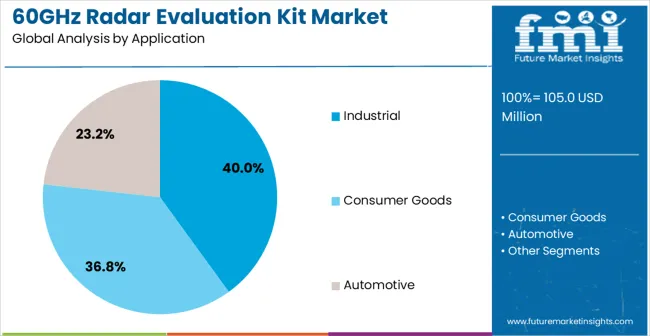
The industrial application segment is projected to represent the largest share of 60GHz radar evaluation kit demand in 2026, underscoring its critical role as the primary driver for evaluation kit adoption across manufacturing automation, process monitoring, and industrial IoT development applications. Industrial technology developers prefer 60GHz radar evaluation kits for industrial applications due to their robust sensing capabilities, industrial-grade performance requirements, and ability to support complex sensing applications while enabling system integration and automation development. Positioned as essential development tools for modern industrial sensing applications, 60GHz radar evaluation kits offer both functionality advantages and development benefits.
The segment is supported by continuous innovation in industrial automation technologies and the growing availability of specialized radar development platforms that enable comprehensive industrial sensing applications with enhanced reliability and system integration capabilities. Additionally, industrial technology developers are investing in comprehensive evaluation programs to support large-scale deployment requirements and industrial application development. As industrial automation becomes more sophisticated and sensing requirements increase, the industrial application will continue to dominate the market while supporting advanced evaluation, utilization and sensing innovation strategies.
What are the Drivers, Restraints, and Key Trends of the 60GHz Radar Evaluation Kit Market?
The 60GHz radar evaluation kit market is experiencing strong demand driven by the rise in automotive safety systems, industrial automation, and wireless communication technologies. Opportunities are expanding in IoT devices, smart cities, and consumer electronics. Key trends include the adoption of radar for enhanced precision in distance measurement, collision avoidance, and gesture recognition. However, challenges around high costs, complex integration, and regulatory compliance continue to impact market growth. Companies need to address these issues to fully capitalize on the potential of 60GHz radar technology.
Key Trends Toward Integration with Wireless Communication and Wearables
The 60GHz radar evaluation kit market is witnessing significant trends, particularly the integration of radar technology with wireless communication systems and wearable devices. Radar kits are being integrated into communication technologies like 5G to enhance connectivity and reduce latency, making them crucial for next-gen wireless systems. In opinion, wearables, such as fitness trackers and health-monitoring devices, are adopting radar solutions to enable accurate movement tracking, fall detection, and gesture recognition. These trends suggest that radar technology will continue to evolve alongside wireless and wearable tech, pushing the market toward greater versatility and utility. Overall, these integration trends indicate a shift towards smarter, more connected environments.
Challenges in Cost, Integration Complexity, and Regulatory Standards
The 60GHz radar evaluation kit market faces notable challenges related to high costs, complex integration, and regulatory compliance. In opinion, the initial investment required for radar-based systems and their components remains a barrier for smaller companies and new entrants. Additionally, integrating radar kits into existing infrastructure can be technically challenging, requiring specialized knowledge and systems compatibility. Regulatory hurdles also persist, with compliance requirements differing across regions, particularly in automotive and medical sectors. These factors make it difficult for companies to scale operations quickly. Overcoming these challenges will require more cost-effective solutions and smoother integration tools to increase adoption rates.
Analysis of the 60GHz Radar Evaluation Kit Market by Key Countries
.webp "Top Country Growth Comparison 60ghz Radar Evaluation Kit Market Cagr (2026 2036)")
| Country | CAGR (2026-2036) |
|---|---|
| China | 8.1% |
| India | 7.5% |
| Germany | 6.9% |
| Brazil | 6.3% |
| United States | 5.7% |
| United Kingdom | 5.1% |
| Japan | 4.5% |
Source: FMI analysis based on primary research and proprietary forecasting model
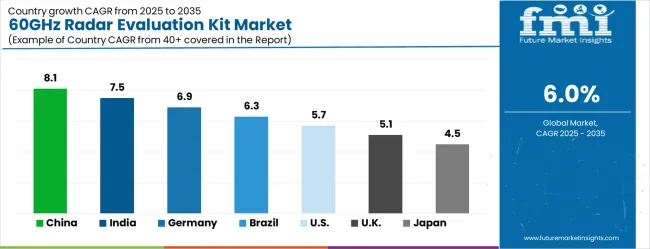
The 60GHz radar evaluation kit market is experiencing solid growth globally, with China leading at an 8.1% CAGR through 2036, driven by the expanding electronics manufacturing sector, growing IoT development activities, and significant investment in radar technology development and smart device innovation. India follows at 7.5%, supported by rapid technology sector growth, increasing electronics development capabilities, and growing adoption of advanced sensing technologies in consumer and industrial applications. Germany shows growth at 6.9%, emphasizing precision engineering and advanced sensor technology development. Brazil records 6.3%, focusing on technology infrastructure development and electronics innovation initiatives. The United States demonstrates 5.7% growth, supported by an established technology development ecosystem and an emphasis on sensing innovation. The United Kingdom exhibits 5.1% growth, emphasizing technology excellence and advanced development capabilities. Japan shows 4.5% growth, supported by advanced electronics technologies and precision sensor development. The report covers an in-depth analysis of 40+ countries; the top-performing countries are highlighted below.
Demand Assessment for 60GHz Radar Evaluation Kit Market in China
The 60GHz radar evaluation kit market in China is expanding at a CAGR of 8.1%, supported by the country’s booming electronics, automotive, and industrial sectors. China’s increasing adoption of radar technology in applications such as advanced driver-assistance systems (ADAS), automation, and smart devices is driving the demand for radar evaluation kits. The government’s push towards the development of smart cities and advancements in transportation infrastructure further accelerates the growth of radar systems. China’s rapidly expanding technology ecosystem and industrial base continue to contribute to the growth of the 60GHz radar evaluation kit market.
- China’s adoption of ADAS and automation technologies drives market growth.
- Smart city development and transportation infrastructure investments accelerate radar tech integration.
- Rapid industrial growth and technology ecosystem expansion fuel demand for radar evaluation kits in China.
Opportunity Analysis for 60GHz Radar Evaluation Kit Market in India
The 60GHz radar evaluation kit market in India is projected to grow at a CAGR of 7.5%, driven by increasing investments in the automotive, telecommunications, and industrial sectors. India’s growing focus on integrating advanced technologies, including radar systems for automotive safety and IoT applications, is accelerating demand for radar evaluation kits. The government’s push for digital infrastructure, coupled with the rise of smart devices and the automotive industry’s growth, is further contributing to market expansion. Additionally, India’s increasing adoption of radar technologies in healthcare and industrial automation also supports this market’s growth.
- Growing automotive and telecommunications sectors in India drive radar kit adoption.
- Government investment in digital infrastructure accelerates the integration of radar technologies.
- Rise in IoT devices and industrial automation applications supports market growth in India.
Market Assessment for 60GHz Radar Evaluation Kit Market in Germany
The 60GHz radar evaluation kit market in Germany is growing at a CAGR of 6.9%, driven by the country’s strong industrial base and demand for radar technologies in automotive, industrial automation, and IoT applications. Germany’s automotive industry, a key adopter of radar for ADAS systems, plays a significant role in driving the growth of the market. Additionally, the country’s commitment to smart manufacturing, smart infrastructure, and Industry 4.0 further supports the integration of radar systems in industrial and automotive applications. Germany’s focus on sustainability and energy efficiency also enhances the demand for radar-based solutions.
- Germany’s automotive and industrial automation sectors accelerate radar technology adoption.
- Industry 4.0 and smart manufacturing boost market growth for radar kits in Germany.
- Sustainability and energy efficiency trends support the demand for radar evaluation kits in Germany.
Growth Outlook for 60GHz Radar Evaluation Kit Market in Brazil
The 60GHz radar evaluation kit market in Brazil is projected to grow at a CAGR of 6.3%, driven by expanding applications of radar systems in automotive, smart devices, and industrial automation. Brazil’s growing interest in advanced safety technologies for the automotive industry and its investments in digital infrastructure are propelling the adoption of radar technologies. Additionally, Brazil’s increasing focus on smart agriculture, IoT, and automation in industrial processes supports the demand for 60GHz radar evaluation kits. As the country continues to modernize its infrastructure and industries, radar technology becomes increasingly vital.
- Brazil’s automotive industry and digital infrastructure investments drive radar kit demand.Smart agriculture and IoT adoption enhance market growth in Brazil.
- Industrial automation and infrastructure modernization support radar technology adoption.
In-depth Review of 60GHz Radar Evaluation Kit Market in the United States
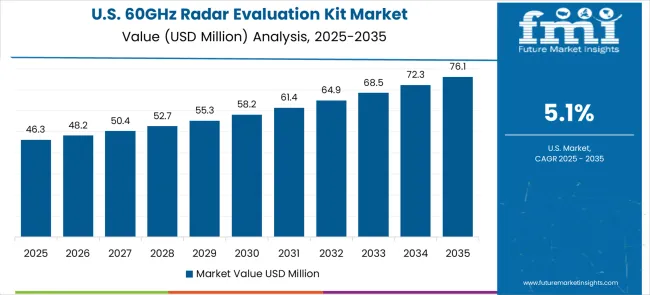
The 60GHz radar evaluation kit market in the United States is expanding at a CAGR of 5.1%, with the demand for radar technologies growing in automotive, healthcare, and industrial applications. The USA is a global leader in ADAS and autonomous vehicle technology, which significantly contributes to the adoption of radar systems. Furthermore, the country’s focus on innovation in smart cities, industrial automation, and IoT is driving the need for radar-based solutions. Investments in connected devices, healthcare wearables, and smart infrastructure also support the growth of the radar evaluation kit market.
- USA ADAS and autonomous vehicle developments drive radar kit demand.
- Smart cities, IoT, and healthcare applications accelerate radar technology adoption.
- Investments in connected devices and smart infrastructure support market growth.
Market Penetration Analysis for 60GHz Radar Evaluation Kit Market in the United Kingdom
The 60GHz radar evaluation kit market in the United Kingdom is growing at a CAGR of 5.1%, supported by the demand for radar technologies in automotive, healthcare, and smart city applications. The UK is increasingly adopting radar for safety features in vehicles and automation in industrial applications. The government’s initiatives in creating smart cities and advancing digital infrastructure continue to enhance the demand for radar solutions. Additionally, the growing interest in IoT technologies and connected devices in the UK supports market expansion for radar evaluation kits.
- UK automotive safety and industrial automation sectors drive market growth.
- Smart city development and digital infrastructure initiatives accelerate radar adoption.
- Rising interest in IoT and connected devices fuels demand for radar technologies in the UK
Sales Forecast for 60GHz Radar Evaluation Kit Market in Japan
The 60GHz radar evaluation kit market in Japan is expanding at a CAGR of 4.5%, with the automotive industry being a key adopter of radar technologies for safety and autonomous driving applications. Japan’s technological advancements in smart manufacturing and IoT further drive the adoption of radar systems. Additionally, the country’s efforts in developing smart cities and improving transportation infrastructure continue to enhance the market for radar evaluation kits. Although the growth rate is slower than in emerging markets, Japan’s commitment to innovation and technological advancements ensures steady demand for radar solutions.
- Japan’s automotive safety and autonomous driving technologies boost radar kit adoption.
- Smart manufacturing and IoT technologies fuel radar system demand.
- Smart city and transportation infrastructure development support market growth in Japan.
Europe Market Split by Countries
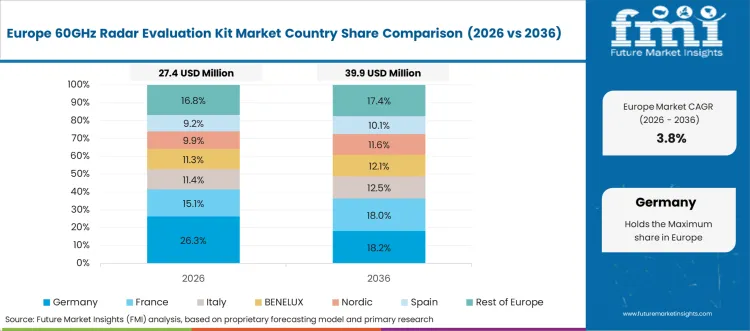
The 60GHz radar evaluation kit market in Europe is projected to grow from USD 38.4 million in 2026 to USD 65.8 million by 2036, registering a CAGR of 5.5% over the forecast period. Germany is expected to maintain its leadership position with a 28.0% market share in 2026, moderating slightly to 27.8% by 2036, supported by its strong automotive sector, advanced sensor technology industry, and comprehensive radar development infrastructure serving major European markets.
The United Kingdom follows with 22.0% in 2026, projected to reach 21.8% by 2036, driven by established technology excellence, a comprehensive innovation framework, and advanced sensing technology development programs. France holds 18.0% in 2026, rising to 18.2% by 2036, supported by automotive technology leadership and growing adoption of advanced radar development platforms. Italy commands 13.0% in 2026, projected to reach 13.1% by 2036, while Spain accounts for 8.5% in 2026, expected to reach 8.6% by 2036. The Netherlands maintains a 4.0% share in 2026, growing to 4.1% by 2036. The Rest of Europe region, including Nordic countries, Eastern Europe, and other markets, is anticipated to maintain its position, holding its collective share at 6.5% by 2036, attributed to increasing technology infrastructure modernization and growing radar development adoption across emerging technology markets implementing advanced sensing standards.
Competitive Landscape of the 60GHz Radar Evaluation Kit Market
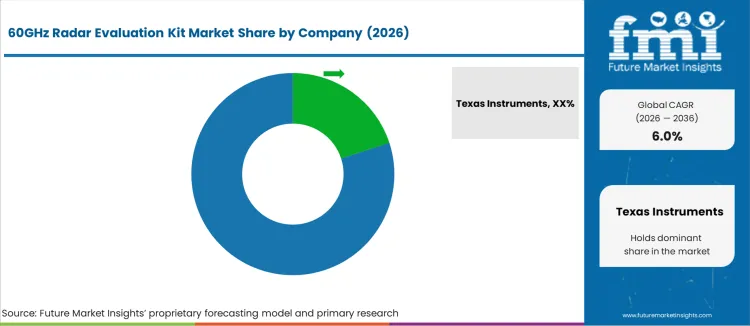
The 60GHz radar evaluation kit market is characterized by competition among established semiconductor companies, specialized radar technology manufacturers, and integrated sensing solution providers. Companies are investing in advanced radar technology research, development platform innovation, technical support excellence, and comprehensive product portfolios to deliver effective, user-friendly, and technically advanced 60GHz radar evaluation kit solutions. Innovation in AI integration, edge computing capabilities, and extensive development support is central to strengthening market position and competitive advantage.
Texas Instruments leads the market with comprehensive semiconductor solutions, offering advanced 60GHz radar evaluation kits with a focus on development support and innovative radar technologies across diverse sensing applications. Acconeer provides specialized radar sensor solutions with an emphasis on low-power applications and comprehensive development platforms. Nisshinbo Micro Devices Inc. delivers innovative semiconductor products with a focus on radar applications and precision sensing technologies. Socionext specializes in system-on-chip solutions with emphasis on advanced processing and radar integration. Analog Devices focuses on signal processing and sensing technologies with emphasis on performance and reliability. Vayyar offers comprehensive radar solutions with emphasis on multi-application platforms and development support.
Key Players in the 60GHz Radar Evaluation Kit Market
- Texas Instruments
- Acconeer
- Nisshinbo Micro Devices Inc
- Socionext
- Analog Devices
- Vayyar
- Infineon
Scope of the Report
| Metric | Value |
|---|---|
| Quantitative Units | USD 111.30 million to USD 199.32 million, at a CAGR of 6% |
| Market Definition | 60GHz radar evaluation kits are pre-assembled hardware platforms containing 60GHz radar transceiver ICs, antenna arrays, signal processing firmware, and software development tools that enable design engineers to prototype and validate radar sensing applications. The market covers presence detection, gesture recognition, vital sign monitoring, and general-purpose radar development kits. |
| Segmentation | Kit Types: Presence Detection Kits, Gesture Recognition Kits, Vital Sign Monitoring Kits, Others; Application: Industrial, Consumer Goods, Automotive, Others |
| Regions Covered | North America, Latin America, Europe, East Asia, South Asia, Oceania, Middle East & Africa |
| Countries Covered | China, India, Germany, Brazil, USA, UK, Japan, and 40 plus countries |
| Key Companies Profiled | Texas Instruments, Acconeer, Nisshinbo Micro Devices Inc, Socionext, Analog Devices, Vayyar, Infineon |
| Forecast Period | 2026 to 2036 |
| Approach | Forecasting models apply a bottom-up methodology starting with global installed base and consumption metrics, projecting conversion rates to advanced product specifications. |
60GHz Radar Evaluation Kit Market by Segments
Kit Types:
- Presence Detection Kits
- Gesture Recognition Kits
- Vital Sign Monitoring Kits
- Others
Application:
- Industrial
- Consumer Goods
- Automotive
- Others
Region:
- Asia Pacific
- China
- India
- Japan
- South Korea
- ASEAN
- Australia & New Zealand
- Rest of Asia Pacific
- North America
- United States
- Canada
- Mexico
- Europe
- Germany
- United Kingdom
- France
- Italy
- Spain
- Nordic
- BENELUX
- Rest of Europe
- Latin America
- Brazil
- Chile
- Argentina
- Rest of Latin America
- Middle East & Africa
- Kingdom of Saudi Arabia
- Other GCC Countries
- Turkey
- South Africa
- Other African Union
- Rest of Middle East & Africa
Bibliography
- 1. Federal Communications Commission. (2024). 47 CFR Part 15.255: Operation within the band 57-71 GHz. FCC.
- 2. European Telecommunications Standards Institute. (2024). ETSI EN 305 550: Short range devices using 60 GHz. ETSI.
- 3. Texas Instruments. (2025). Annual Report 2024: Embedded processing and radar sensor portfolio review. Texas Instruments.
- 4. International Electrotechnical Commission. (2024). IEC 62471: Photobiological safety of lamps and lamp systems, radar sensor safety annex. IEC.
- 5. Infineon Technologies AG. (2025). Annual Report 2024: Radar sensor IC and evaluation platform segment. Infineon.
This bibliography is provided for reader reference. The full Future Market Insights report contains the complete reference list with primary research documentation.
Frequently Asked Questions
How large is the demand for 60GHz Radar Evaluation Kit in the global market in 2026?
Demand for 60GHz Radar Evaluation Kit in the global market is estimated to be valued at USD 111.30 million in 2026.
What will be the market size of 60GHz Radar Evaluation Kit in the global market by 2036?
Market size for 60GHz Radar Evaluation Kit is projected to reach USD 199.32 million by 2036.
What is the expected demand growth for 60GHz Radar Evaluation Kit in the global market between 2026 and 2036?
Demand for 60GHz Radar Evaluation Kit is expected to grow at a CAGR of 6% between 2026 and 2036.
Which Kit Types is poised to lead global sales by 2026?
Presence Detection Kits accounts for 35% in 2026 based on established procurement patterns and installed base requirements across primary end-use sectors.
What is driving demand in China?
China leads with a 8.1% CAGR through 2036, driven by expanding capacity, policy support frameworks, and growing end-user adoption across commercial and institutional buyer segments.
What is the India growth outlook in this report?
India is projected to grow at a CAGR of 7.5% during 2026 to 2036.
What is 60GHz Radar Evaluation Kit and what is it mainly used for?
60GHz radar evaluation kits are pre-assembled hardware platforms containing 60GHz radar transceiver ICs, antenna arrays, signal processing firmware, and software development tools that enable design engineers to prototype and validate radar sensing applications. The market covers presence detection, gesture recognition, vital sign monitoring, and general-purpose radar development kits.
How does FMI build and validate the 60GHz Radar Evaluation Kit forecast?
Forecasting models apply a bottom-up methodology starting with global installed base metrics and cross-validate projections against quarterly industry revenue volumes and primary research inputs.
Preview the report firsthand - request a free sample
Get SampleGet the brochure for pricing and purchase details.
Get PDFTable of Content
- Executive Summary
- Global Market Outlook
- Demand-side Trends
- Supply-side Trends
- Technology Roadmap Analysis
- Analysis and Recommendations
- Market Overview
- Market Coverage / Taxonomy
- Market Definition / Scope / Limitations
- Research Methodology
- Chapter Orientation
- Analytical Lens and Working Hypotheses
- Market Structure, Signals, and Trend Drivers
- Benchmarking and Cross-market Comparability
- Market Sizing, Forecasting, and Opportunity Mapping
- Research Design and Evidence Framework
- Desk Research Programme (Secondary Evidence)
- Company Annual and Sustainability Reports
- Peer-reviewed Journals and Academic Literature
- Corporate Websites, Product Literature, and Technical Notes
- Earnings Decks and Investor Briefings
- Statutory Filings and Regulatory Disclosures
- Technical White Papers and Standards Notes
- Trade Journals, Industry Magazines, and Analyst Briefs
- Conference Proceedings, Webinars, and Seminar Materials
- Government Statistics Portals and Public Data Releases
- Press Releases and Reputable Media Coverage
- Specialist Newsletters and Curated Briefings
- Sector Databases and Reference Repositories
- FMI Internal Proprietary Databases and Historical Market Datasets
- Subscription Datasets and Paid Sources
- Social Channels, Communities, and Digital Listening Inputs
- Additional Desk Sources
- C-suite Leaders
- Board Members
- Presidents and Vice Presidents
- R&D and Innovation Heads
- Technical Specialists
- Domain Subject-matter Experts
- Scientists
- Physicians and Other Healthcare Professionals
- Desk Research Programme (Secondary Evidence)
- Governance, Ethics, and Data Stewardship
- Research Ethics
- Data Integrity and Handling
- Tooling, Models, and Reference Databases
- Data Engineering and Model Build
- Data Acquisition and Ingestion
- Cleaning, Normalisation, and Verification
- Synthesis, Triangulation, and Analysis
- Quality Assurance and Audit Trail
- Market Background
- Market Dynamics
- Drivers
- Restraints
- Opportunity
- Trends
- Scenario Forecast
- Demand in Optimistic Scenario
- Demand in Likely Scenario
- Demand in Conservative Scenario
- Opportunity Map Analysis
- Product Life Cycle Analysis
- Supply Chain Analysis
- Investment Feasibility Matrix
- Value Chain Analysis
- PESTLE and Porter’s Analysis
- Regulatory Landscape
- Regional Parent Market Outlook
- Production and Consumption Statistics
- Import and Export Statistics
- Market Dynamics
- Global Market Analysis 2021 to 2025 and Forecast, 2026 to 2036
- Historical Market Size Value (USD Million) Analysis, 2021 to 2025
- Current and Future Market Size Value (USD Million) Projections, 2026 to 2036
- Y-o-Y Growth Trend Analysis
- Absolute $ Opportunity Analysis
- Global Market Pricing Analysis 2021 to 2025 and Forecast 2026 to 2036
- Global Market Analysis 2021 to 2025 and Forecast 2026 to 2036, By Kit Types
- Introduction / Key Findings
- Historical Market Size Value (USD Million) Analysis By Kit Types , 2021 to 2025
- Current and Future Market Size Value (USD Million) Analysis and Forecast By Kit Types , 2026 to 2036
- Presence Detection Kits
- Gesture Recognition Kits
- Vital Sign Monitoring Kits
- Others
- Presence Detection Kits
- Y-o-Y Growth Trend Analysis By Kit Types , 2021 to 2025
- Absolute $ Opportunity Analysis By Kit Types , 2026 to 2036
- Global Market Analysis 2021 to 2025 and Forecast 2026 to 2036, By Application
- Introduction / Key Findings
- Historical Market Size Value (USD Million) Analysis By Application, 2021 to 2025
- Current and Future Market Size Value (USD Million) Analysis and Forecast By Application, 2026 to 2036
- Industrial
- Consumer Goods
- Automotive
- Others
- Industrial
- Y-o-Y Growth Trend Analysis By Application, 2021 to 2025
- Absolute $ Opportunity Analysis By Application, 2026 to 2036
- Global Market Analysis 2021 to 2025 and Forecast 2026 to 2036, By Region
- Introduction
- Historical Market Size Value (USD Million) Analysis By Region, 2021 to 2025
- Current Market Size Value (USD Million) Analysis and Forecast By Region, 2026 to 2036
- North America
- Latin America
- Western Europe
- Eastern Europe
- East Asia
- South Asia and Pacific
- Middle East & Africa
- Market Attractiveness Analysis By Region
- North America Market Analysis 2021 to 2025 and Forecast 2026 to 2036, By Country
- Historical Market Size Value (USD Million) Trend Analysis By Market Taxonomy, 2021 to 2025
- Market Size Value (USD Million) Forecast By Market Taxonomy, 2026 to 2036
- By Country
- USA
- Canada
- Mexico
- By Kit Types
- By Application
- By Country
- Market Attractiveness Analysis
- By Country
- By Kit Types
- By Application
- Key Takeaways
- Latin America Market Analysis 2021 to 2025 and Forecast 2026 to 2036, By Country
- Historical Market Size Value (USD Million) Trend Analysis By Market Taxonomy, 2021 to 2025
- Market Size Value (USD Million) Forecast By Market Taxonomy, 2026 to 2036
- By Country
- Brazil
- Chile
- Rest of Latin America
- By Kit Types
- By Application
- By Country
- Market Attractiveness Analysis
- By Country
- By Kit Types
- By Application
- Key Takeaways
- Western Europe Market Analysis 2021 to 2025 and Forecast 2026 to 2036, By Country
- Historical Market Size Value (USD Million) Trend Analysis By Market Taxonomy, 2021 to 2025
- Market Size Value (USD Million) Forecast By Market Taxonomy, 2026 to 2036
- By Country
- Germany
- UK
- Italy
- Spain
- France
- Nordic
- BENELUX
- Rest of Western Europe
- By Kit Types
- By Application
- By Country
- Market Attractiveness Analysis
- By Country
- By Kit Types
- By Application
- Key Takeaways
- Eastern Europe Market Analysis 2021 to 2025 and Forecast 2026 to 2036, By Country
- Historical Market Size Value (USD Million) Trend Analysis By Market Taxonomy, 2021 to 2025
- Market Size Value (USD Million) Forecast By Market Taxonomy, 2026 to 2036
- By Country
- Russia
- Poland
- Hungary
- Balkan & Baltic
- Rest of Eastern Europe
- By Kit Types
- By Application
- By Country
- Market Attractiveness Analysis
- By Country
- By Kit Types
- By Application
- Key Takeaways
- East Asia Market Analysis 2021 to 2025 and Forecast 2026 to 2036, By Country
- Historical Market Size Value (USD Million) Trend Analysis By Market Taxonomy, 2021 to 2025
- Market Size Value (USD Million) Forecast By Market Taxonomy, 2026 to 2036
- By Country
- China
- Japan
- South Korea
- By Kit Types
- By Application
- By Country
- Market Attractiveness Analysis
- By Country
- By Kit Types
- By Application
- Key Takeaways
- South Asia and Pacific Market Analysis 2021 to 2025 and Forecast 2026 to 2036, By Country
- Historical Market Size Value (USD Million) Trend Analysis By Market Taxonomy, 2021 to 2025
- Market Size Value (USD Million) Forecast By Market Taxonomy, 2026 to 2036
- By Country
- India
- ASEAN
- Australia & New Zealand
- Rest of South Asia and Pacific
- By Kit Types
- By Application
- By Country
- Market Attractiveness Analysis
- By Country
- By Kit Types
- By Application
- Key Takeaways
- Middle East & Africa Market Analysis 2021 to 2025 and Forecast 2026 to 2036, By Country
- Historical Market Size Value (USD Million) Trend Analysis By Market Taxonomy, 2021 to 2025
- Market Size Value (USD Million) Forecast By Market Taxonomy, 2026 to 2036
- By Country
- Kingdom of Saudi Arabia
- Other GCC Countries
- Turkiye
- South Africa
- Other African Union
- Rest of Middle East & Africa
- By Kit Types
- By Application
- By Country
- Market Attractiveness Analysis
- By Country
- By Kit Types
- By Application
- Key Takeaways
- Key Countries Market Analysis
- USA
- Pricing Analysis
- Market Share Analysis, 2025
- By Kit Types
- By Application
- Canada
- Pricing Analysis
- Market Share Analysis, 2025
- By Kit Types
- By Application
- Mexico
- Pricing Analysis
- Market Share Analysis, 2025
- By Kit Types
- By Application
- Brazil
- Pricing Analysis
- Market Share Analysis, 2025
- By Kit Types
- By Application
- Chile
- Pricing Analysis
- Market Share Analysis, 2025
- By Kit Types
- By Application
- Germany
- Pricing Analysis
- Market Share Analysis, 2025
- By Kit Types
- By Application
- UK
- Pricing Analysis
- Market Share Analysis, 2025
- By Kit Types
- By Application
- Italy
- Pricing Analysis
- Market Share Analysis, 2025
- By Kit Types
- By Application
- Spain
- Pricing Analysis
- Market Share Analysis, 2025
- By Kit Types
- By Application
- France
- Pricing Analysis
- Market Share Analysis, 2025
- By Kit Types
- By Application
- India
- Pricing Analysis
- Market Share Analysis, 2025
- By Kit Types
- By Application
- ASEAN
- Pricing Analysis
- Market Share Analysis, 2025
- By Kit Types
- By Application
- Australia & New Zealand
- Pricing Analysis
- Market Share Analysis, 2025
- By Kit Types
- By Application
- China
- Pricing Analysis
- Market Share Analysis, 2025
- By Kit Types
- By Application
- Japan
- Pricing Analysis
- Market Share Analysis, 2025
- By Kit Types
- By Application
- South Korea
- Pricing Analysis
- Market Share Analysis, 2025
- By Kit Types
- By Application
- Russia
- Pricing Analysis
- Market Share Analysis, 2025
- By Kit Types
- By Application
- Poland
- Pricing Analysis
- Market Share Analysis, 2025
- By Kit Types
- By Application
- Hungary
- Pricing Analysis
- Market Share Analysis, 2025
- By Kit Types
- By Application
- Kingdom of Saudi Arabia
- Pricing Analysis
- Market Share Analysis, 2025
- By Kit Types
- By Application
- Turkiye
- Pricing Analysis
- Market Share Analysis, 2025
- By Kit Types
- By Application
- South Africa
- Pricing Analysis
- Market Share Analysis, 2025
- By Kit Types
- By Application
- USA
- Market Structure Analysis
- Competition Dashboard
- Competition Benchmarking
- Market Share Analysis of Top Players
- By Regional
- By Kit Types
- By Application
- Competition Analysis
- Competition Deep Dive
- Texas Instruments
- Overview
- Product Portfolio
- Profitability by Market Segments (Product/Age /Sales Channel/Region)
- Sales Footprint
- Strategy Overview
- Marketing Strategy
- Product Strategy
- Channel Strategy
- Acconeer
- Nisshinbo Micro Devices Inc
- Socionext
- Analog Devices
- Vayyar
- Infineon
- Texas Instruments
- Competition Deep Dive
- Assumptions & Acronyms Used


