

- Industry Size (2026)
- USD 449.0 Mn
- Forecast (2036)
- USD 876.6 Mn
- CAGR (2026 to 2036)
- 6.9%
Edge Computing Enclosure Environmental Test Market Forecast and Outlook 2026 to 2036
The edge computing enclosure environmental test market is valued at USD 449.0 million in 2026 and is forecast to reach USD 876.6 million by 2036, expanding at a CAGR of 6.9%. Growth is driven by rapid deployment of edge infrastructure supporting low-latency computing, 5G networks, and distributed data processing. Outdoor and semi-controlled installations expose enclosures to temperature variation, humidity, dust, and mechanical stress, increasing reliance on structured environmental validation before field deployment.
Humidity cycling represents leading test type globally due to sensitivity of edge electronics to moisture ingress, condensation, and corrosion-related failure. Repeated humidity transitions simulate real-world outdoor operating conditions and support long-term reliability assessment. Outdoor micro-data centers account for leading enclosure class, reflecting rising use of containerized and cabinet-based edge nodes deployed near population centers and industrial zones. Test focus centers on ingress protection integrity, thermal stability, and material durability under continuous operation.
China, Brazil, South Korea, USA, and Germany rank among fastest-growing countries, supported by edge rollout across telecom, smart city, and industrial automation programs. Competitive landscape is led by ESPEC, Weiss Technik, Thermotron, Cincinnati Sub-Zero, and Binder. Market structure reflects sustained emphasis on durability validation aligned with distributed, unattended edge deployments.
Quick Stats for Edge Computing Enclosure Environmental Test Market
- Edge Computing Enclosure Environmental Test Market Value (2026): USD 449.0 million
- Edge Computing Enclosure Environmental Test Market Forecast Value (2036): USD 876.6 million
- Edge Computing Enclosure Environmental Test Market Forecast CAGR (2026 to 2036): 6.9%
- Leading Test Type in Global Demand: Humidity Cycling
- Leading Enclosure Class in Global Demand: Outdoor Micro-Data Centers
- Fastest-Growing Countries: China, Brazil, South Korea, USA, Germany
- Top Players in Global Demand: ESPEC, Weiss Technik, Thermotron, Cincinnati Sub-Zero (CSZ), Binder, Memmert, Angelantoni Test Technologies, ETS Solutions, Instron, TÜV SÜD
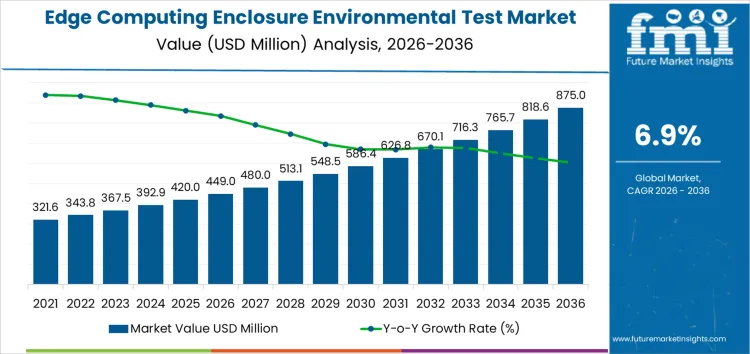
Edge Computing Enclosure Environmental Test Market Key Takeaways
| Metric | Value |
|---|---|
| Market Value (2026) | USD 449.0 million |
| Market Forecast Value (2036) | USD 876.6 million |
| Forecast CAGR (2026 to 2036) | 6.9% |
Why is the Demand for Edge Computing Enclosure Environmental Test Market Growing?
Demand for edge computing enclosure environmental test solutions is growing globally due to expanding deployment of edge infrastructure across telecommunications, industrial automation, transportation, and smart cities. Edge computing systems operate in diverse and often harsh environments, which increases the need for rigorous validation of enclosures against temperature extremes, vibration, humidity, dust ingress, and shock conditions before deployment. Telecommunications providers and network equipment manufacturers adopt environmental test platforms to verify reliability and durability for outdoor base stations, remote cabinets, and roadside computing nodes. Industrial automation and manufacturing sectors require enclosures that withstand thermal cycling, particulate exposure, and mechanical disturbance on factory floors.
Growth in autonomous vehicles, rail systems, and aerospace edge nodes strengthens demand for test capabilities that ensure operational continuity under dynamic environmental stressors. Standardization efforts across regions encourage consistent testing protocols tied to industry specific criteria. Test equipment suppliers develop scalable, modular systems that simulate real world conditions while supporting repeatable measurement and data logging. Academic and research institutions expand use for studying materials, thermal management techniques, and resilient design principles. Global emphasis on network resilience, uptime, and lifecycle performance reinforces the importance of structured edge computing enclosure environmental testing across varied applications.
How Are the Segments Classified in the Edge Computing Enclosure Environmental Test Market?
Demand for edge computing enclosure environmental testing globally is shaped by distributed infrastructure deployment, exposure to harsh operating conditions, and uptime assurance requirements. Stakeholders evaluate enclosure resilience against moisture, dust ingress, mechanical stress, and corrosion. Adoption patterns reflect increasing placement of edge systems in outdoor, industrial, and transport environments where environmental qualification is critical for operational continuity.
Which Test Type Accounts for the Largest Share of Global Demand?
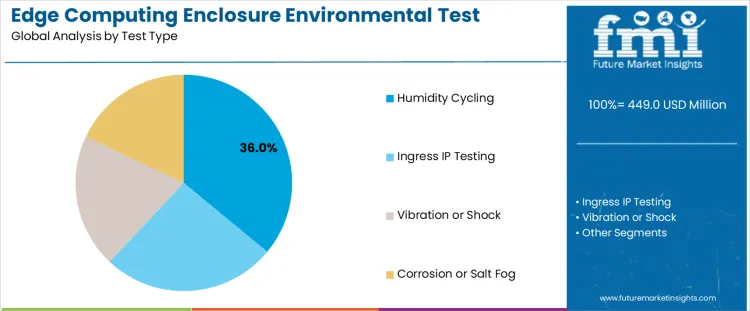
Humidity cycling tests hold 36.0%, accounting for the largest share of global demand. These tests validate enclosure resistance to condensation, temperature-driven moisture variation, and long-term humidity exposure. Ingress IP testing holds 26.0%, ensuring protection against dust and water penetration under standardized conditions. Vibration or shock testing accounts for 20.0%, supporting validation for transport and industrial deployment scenarios. Corrosion or salt fog testing holds 18.0%, addressing exposure to corrosive environments. Test-type distribution reflects priority for moisture-related failure prevention in distributed edge installations.
Key Points:
- Humidity cycling leads due to condensation risk mitigation.
- IP testing ensures dust and water ingress protection.
- Mechanical and corrosion tests address deployment stresses.
Which Enclosure Class Represents the Largest Share of Global Testing Demand?
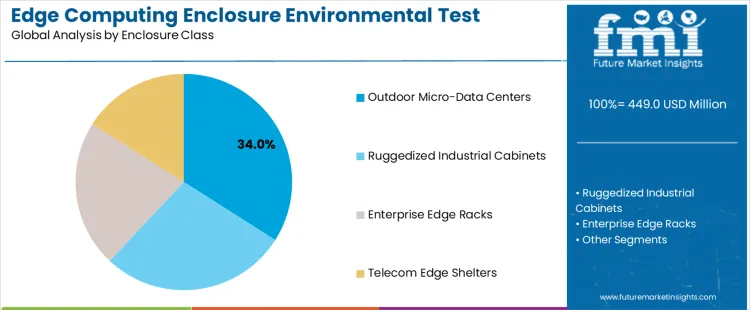
Outdoor micro-data centers hold 34.0%, representing the largest enclosure-class share globally. These enclosures operate in uncontrolled environments requiring extensive environmental validation. Ruggedized industrial cabinets hold 28.0%, supporting deployment in manufacturing and energy sites with vibration and contaminant exposure. Enterprise edge racks account for 22.0%, used in semi-controlled environments requiring moderate testing. Telecom edge shelters hold 16.0%, supporting network infrastructure placement. Enclosure-class distribution reflects expansion of outdoor and industrial edge computing deployments.
Key Points:
- Outdoor micro-data centers lead due to environmental exposure.
- Industrial cabinets require ruggedization validation.
- Enterprise and telecom enclosures support controlled deployments.
Which End-Use Sector Drives the Highest Global Demand?

Telecom holds 38.0%, driving the highest global demand for enclosure environmental testing. Telecom operators deploy edge systems across outdoor and roadside locations requiring strict environmental qualification. Industrial and energy sectors hold 24.0%, supporting edge analytics in harsh operational settings. Smart city and transport applications account for 20.0%, requiring resilient enclosures for urban infrastructure. Retail and enterprise uses hold 18.0%, reflecting indoor and semi-outdoor deployments. End-use distribution reflects dominance of telecom-led edge infrastructure expansion.
Key Points:
- Telecom leads due to widespread outdoor edge deployment.
- Industrial and energy applications require rugged testing.
- Smart city deployments drive resilient enclosure demand.
What are the Key Dynamics in the Edge Computing Enclosure Environmental Test Market?
Global demand rises as enterprises, telecom operators, and industrial end users deploy edge computing systems in distributed, often harsh environments requiring robust enclosure qualification. Environmental test solutions assess effects of temperature extremes, vibration, humidity, dust ingress, and electromagnetic compatibility on edge enclosures. Adoption aligns with rapid rollout of 5G infrastructure, industrial IoT applications, and autonomous systems across multiple regions. Usage spans data center integrators, equipment manufacturers, and independent test facilities supporting diverse deployment scenarios.
How do distributed deployment needs and environmental performance requirements shape global demand?
Edge computing enclosures operate outside controlled data center environments, exposing hardware to temperature swings, airborne particulates, moisture, and mechanical stress. Test labs employ thermal chambers, shock/vibration rigs, and ingress protection simulations to validate enclosure durability and thermal management effectiveness. Telecommunications providers install edge nodes at street cabinets, rooftops, and substations, requiring qualification against environmental stressors. Industrial automation and smart manufacturing deployments place edge systems in factory floors and outdoor yards where dust, humidity, and thermal cycling are pronounced. Regulatory requirements for electromagnetic compatibility add further validation needs. Test outcomes inform design refinement and reliability assurance before field deployment across diverse global edge scenarios.
How do capital investment, test complexity, and regional infrastructure influence market scalability?
Environmental test platforms for edge enclosures involve substantial investment in multi-factor chambers, vibration tables, and custom fixtures to replicate real-world stresses. Integration of thermal, mechanical, and electrical test subsystems increases setup complexity and operational expertise requirements. Test service availability varies by region, concentrating advanced capability in established industrial hubs while emerging markets rely on outsourcing or shared facilities. Standardization of test protocols across industries and geographies remains uneven, leading to customized test sequences and longer qualification cycles. Skilled personnel are essential to design and execute comprehensive test plans that cover interdependent environmental effects. Global growth depends on scalable, modular test solutions and harmonized testing frameworks that support consistent qualification practices across international edge computing deployments.
How Is Demand for Edge Computing Enclosure Environmental Test Systems Evolving?
Demand for edge computing enclosure environmental test systems is increasing globally due to deployment of edge infrastructure in harsh operating environments and reliability requirements. China leads with an 8.2% CAGR, supported by large-scale edge rollout across telecom and industrial sectors. Brazil follows at 8.0%, driven by distributed computing adoption and climate-related validation needs. South Korea records a 6.9% CAGR, shaped by electronics density and compact enclosure testing. USA posts 6.8%, reflecting retrofit validation and lifecycle testing of deployed assets. Germany records 6.6%, supported by industrial edge use and compliance-driven qualification. Growth reflects need for thermal, ingress, vibration, and corrosion validation worldwide.
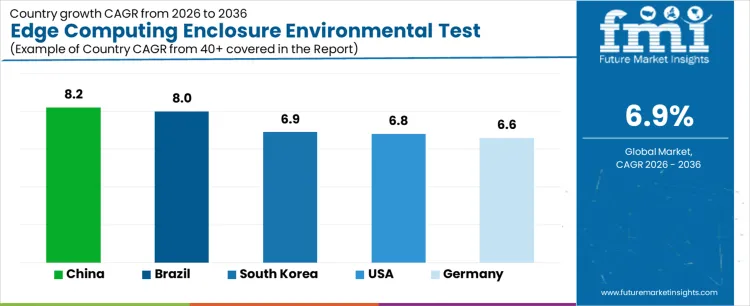
| Country | CAGR (%) |
|---|---|
| China | 8.2% |
| Brazil | 8.0% |
| South Korea | 6.9% |
| USA | 6.8% |
| Germany | 6.6% |
What factors are accelerating enclosure environmental testing adoption in China?
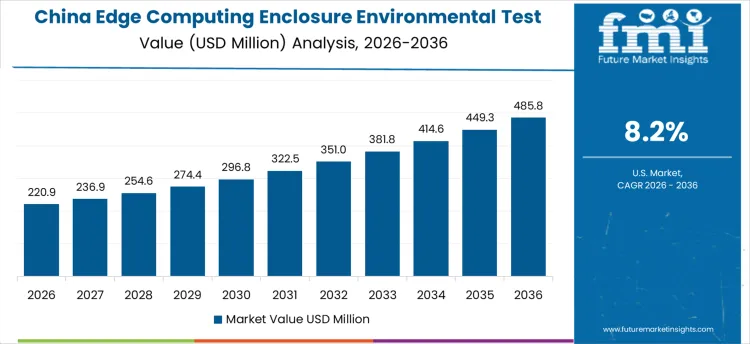
China drives demand through rapid deployment of edge nodes across telecom, smart manufacturing, and transportation infrastructure. Country’s CAGR of 8.2% reflects extensive testing of enclosures for thermal cycling, dust ingress, humidity, and vibration. Operators validate outdoor cabinets and micro data centers deployed in diverse climates. In-house testing capacity reduces deployment risk and accelerates rollout schedules. Test platforms emphasize multi-stress capability and automation. Government-backed digital infrastructure programs expand testing volumes. Growth remains scale-driven and rollout-aligned, supported by nationwide edge expansion and stringent uptime expectations.
- Nationwide edge infrastructure deployment
- Multi-stress environmental validation needs
- In-house testing to accelerate rollout
- Government-supported digital infrastructure programs
Why is Brazil showing strong growth in enclosure environmental testing demand?
Brazil demand is shaped by expansion of edge computing in utilities, retail, and logistics, combined with challenging climate conditions. Country’s CAGR of 8.0% reflects need to validate enclosures against heat, humidity, and corrosion. Distributed deployments increase reliance on standardized testing to ensure field reliability. Shared laboratories enable cost-efficient access for operators and integrators. Collaboration with global vendors supports adoption of international test standards. Demand favors modular chambers adaptable to varied enclosure sizes. Growth remains capability-building focused, aligned with gradual scaling of edge infrastructure.
- Hot and humid climate validation requirements
- Distributed edge deployment across sectors
- Shared laboratory testing models
- Modular environmental test chambers
How does South Korea’s electronics density influence testing demand?
South Korea demand reflects high electronics integration, compact enclosure designs, and dense urban deployments. Country’s CAGR of 6.9% is supported by testing for thermal dissipation, EMI robustness, and vibration resistance. Edge systems support telecom, smart city, and industrial automation use cases. Manufacturers emphasize precision control and repeatability. Government-backed initiatives promote standardized qualification. Facilities prioritize compact, high-accuracy test systems suitable for space-constrained labs. Growth remains technology-driven, aligned with dense electronics packaging and reliability expectations.
- Compact enclosure and electronics validation
- Thermal and vibration performance testing
- Standardized qualification initiatives
- Space-efficient test system requirements
What dynamics sustain steady growth of enclosure testing in the USA?
USA demand is driven by large installed base of edge assets requiring validation, upgrades, and replacement testing. Country’s CAGR of 6.8% reflects lifecycle testing for thermal management, ingress protection, and shock resistance. Operators validate enclosures for outdoor and industrial settings. Test platforms integrate data logging and correlation with field telemetry. Procurement emphasizes throughput and standards compliance. Growth remains lifecycle-driven, aligned with phased upgrades and reliability assurance of deployed edge infrastructure.
- Installed base lifecycle validation
- Outdoor and industrial enclosure testing
- Telemetry-correlated test workflows
- Standards-aligned qualification
How is Germany positioned within the global enclosure test ecosystem?
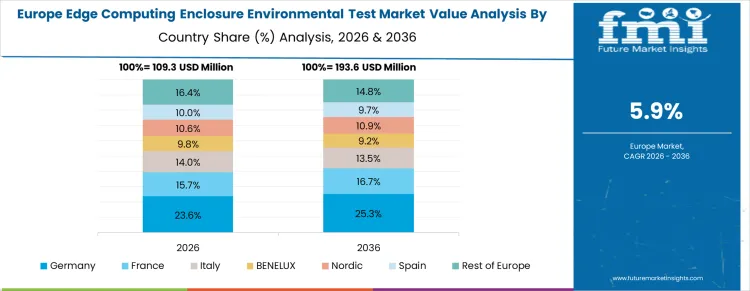
Germany demand reflects industrial edge adoption, automotive manufacturing, and strong compliance culture. Country’s CAGR of 6.6% is supported by testing enclosures for vibration, temperature extremes, and ingress in factory environments. Shared research institutes expand access to environmental testing. Procurement favors documentation, traceability, and repeatability. Demand aligns with IEC and automotive standards. Growth remains engineering-led, aligned with durability and compliance requirements across industrial edge deployments.
- Industrial and automotive edge applications
- Vibration and ingress protection testing
- Strong standards and documentation focus
- Shared research and industry laboratories
What is the competitive landscape of demand for edge computing enclosure environmental test systems?
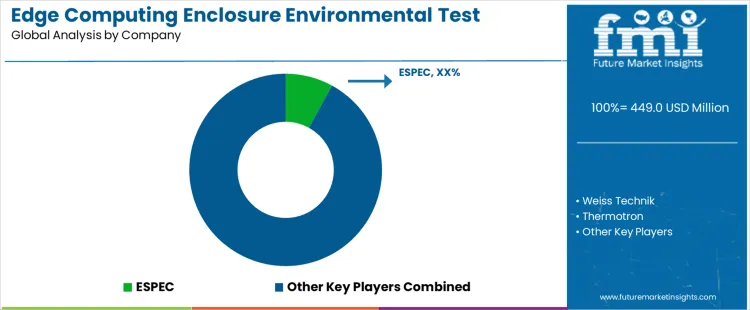
Demand for edge computing enclosure environmental test systems is driven by deployment of edge data centers, industrial edge nodes, and outdoor telecom infrastructure. Testing programs focus on validating thermal performance, ingress protection, humidity resistance, vibration tolerance, and long-term reliability under harsh operating conditions. Buyers require chambers and test rigs capable of simulating wide temperature ranges, cyclic humidity, dust exposure, and mechanical stress aligned with IEC and telecom standards. Procurement teams evaluate chamber uniformity, load capacity, automation capability, and ability to accommodate fully assembled enclosures with active electronics. Trend in the global market reflects increased edge deployment in remote and urban environments, higher power densities within compact enclosures, and stricter qualification expectations for uptime and durability.
ESPEC, Weiss Technik, and Thermotron maintain strong positioning through environmental chambers widely used for electronics and enclosure qualification testing. Cincinnati Sub-Zero and Binder support testing with configurable temperature and humidity systems suited for rack-scale and cabinet-level validation. Memmert supplies precision thermal chambers used in component and subsystem testing phases. Angelantoni Test Technologies and ETS Solutions contribute customized environmental systems tailored to edge infrastructure requirements. Instron supports mechanical and structural testing relevant to enclosure integrity under vibration and load conditions. TÜV SÜD operates as a global testing and certification provider, offering third-party environmental qualification and compliance validation services. Competitive differentiation depends on chamber scalability, test accuracy, automation readiness, and ability to support combined environmental and mechanical stress testing.
Key Players in the Edge Computing Enclosure Environmental Test Market
- ESPEC
- Weiss Technik
- Thermotron
- Cincinnati Sub-Zero (CSZ)
- Binder
- Memmert
- Angelantoni Test Technologies
- ETS Solutions
- Instron
- TÜV SÜD
Scope of the Report
| Items | Values |
|---|---|
| Quantitative Units | USD million |
| Test Type | Humidity Cycling; Ingress IP Testing; Vibration or Shock Testing; Corrosion or Salt Fog Testing |
| Enclosure Class | Outdoor Micro-Data Centers; Ruggedized Industrial Cabinets; Enterprise Edge Racks; Telecom Edge Shelters |
| End Use | Telecom Infrastructure; Industrial or Energy Systems; Smart City or Transport Deployments; Retail or Enterprise Edge Computing |
| Regions Covered | Asia Pacific; Europe; North America; Latin America; Middle East & Africa |
| Countries Covered | China; USA; Germany; Brazil; South Korea; and 40+ countries |
| Key Companies Profiled | ESPEC; Weiss Technik; Thermotron; Cincinnati Sub-Zero; Binder; Memmert; Angelantoni Test Technologies; ETS Solutions; Instron; TÜV SÜD |
| Additional Attributes | Dollar sales by test type and enclosure class; regional CAGR trends across telecom and industrial edge deployments; qualification demand for outdoor and ruggedized enclosures; compliance with IP, vibration, and corrosion standards; rising adoption of combined environmental stress screening for edge computing infrastructure reliability. |
Edge Computing Enclosure Environmental Test Market by Segment
By Test Type:
- Humidity Cycling
- Ingress IP Testing
- Vibration or Shock
- Corrosion or Salt Fog
By Enclosure Class:
- Outdoor Micro-Data Centers
- Ruggedized Industrial Cabinets
- Enterprise Edge Racks
- Telecom Edge Shelters
By End Use:
- Telecom
- Industrial or Energy
- Smart City or Transport
- Retail or Enterprise
By Region:
- Asia Pacific
- China
- Japan
- South Korea
- India
- Australia & New Zealand
- ASEAN
- Rest of Asia Pacific
- Europe
- Germany
- United Kingdom
- France
- Italy
- Spain
- Nordic
- BENELUX
- Rest of Europe
- North America
- United States
- Canada
- Mexico
- Latin America
- Brazil
- Chile
- Rest of Latin America
- Middle East & Africa
- Kingdom of Saudi Arabia
- Other GCC Countries
- Turkey
- South Africa
- Other African Union
- Rest of Middle East & Africa
Frequently Asked Questions
How big is the edge computing enclosure environmental test market in 2026?
The global edge computing enclosure environmental test market is estimated to be valued at USD 449.0 million in 2026.
What will be the size of edge computing enclosure environmental test market in 2036?
The market size for the edge computing enclosure environmental test market is projected to reach USD 875.0 million by 2036.
How much will be the edge computing enclosure environmental test market growth between 2026 and 2036?
The edge computing enclosure environmental test market is expected to grow at a 6.9% CAGR between 2026 and 2036.
What are the key product types in the edge computing enclosure environmental test market?
The key product types in edge computing enclosure environmental test market are humidity cycling, ingress ip testing, vibration or shock and corrosion or salt fog.
Which enclosure class segment to contribute significant share in the edge computing enclosure environmental test market in 2026?
In terms of enclosure class, outdoor micro-data centers segment to command 34.0% share in the edge computing enclosure environmental test market in 2026.
Preview the report firsthand - request a free sample
Get SampleGet the brochure for pricing and purchase details.
Get PDFTable of Content
- Executive Summary
- Global Market Outlook
- Demand-side Trends
- Supply-side Trends
- Technology Roadmap Analysis
- Analysis and Recommendations
- Market Overview
- Market Coverage / Taxonomy
- Market Definition / Scope / Limitations
- Market Background
- Market Dynamics
- Drivers
- Restraints
- Opportunity
- Trends
- Scenario Forecast
- Demand in Optimistic Scenario
- Demand in Likely Scenario
- Demand in Conservative Scenario
- Opportunity Map Analysis
- Product Life Cycle Analysis
- Supply Chain Analysis
- Investment Feasibility Matrix
- Value Chain Analysis
- PESTLE and Porter’s Analysis
- Regulatory Landscape
- Regional Parent Market Outlook
- Production and Consumption Statistics
- Import and Export Statistics
- Market Dynamics
- Global Market Analysis 2021 to 2025 and Forecast, 2026 to 2036
- Historical Market Size Value (USD Million) Analysis, 2021 to 2025
- Current and Future Market Size Value (USD Million) Projections, 2026 to 2036
- Y-o-Y Growth Trend Analysis
- Absolute $ Opportunity Analysis
- Global Market Pricing Analysis 2021 to 2025 and Forecast 2026 to 2036
- Global Market Analysis 2021 to 2025 and Forecast 2026 to 2036, By Test Type
- Introduction / Key Findings
- Historical Market Size Value (USD Million) Analysis By Test Type , 2021 to 2025
- Current and Future Market Size Value (USD Million) Analysis and Forecast By Test Type , 2026 to 2036
- Humidity Cycling
- Ingress IP Testing
- Vibration or Shock
- Corrosion or Salt Fog
- Humidity Cycling
- Y-o-Y Growth Trend Analysis By Test Type , 2021 to 2025
- Absolute $ Opportunity Analysis By Test Type , 2026 to 2036
- Global Market Analysis 2021 to 2025 and Forecast 2026 to 2036, By Enclosure Class
- Introduction / Key Findings
- Historical Market Size Value (USD Million) Analysis By Enclosure Class, 2021 to 2025
- Current and Future Market Size Value (USD Million) Analysis and Forecast By Enclosure Class, 2026 to 2036
- Outdoor Micro-Data Centers
- Ruggedized Industrial Cabinets
- Enterprise Edge Racks
- Telecom Edge Shelters
- Outdoor Micro-Data Centers
- Y-o-Y Growth Trend Analysis By Enclosure Class, 2021 to 2025
- Absolute $ Opportunity Analysis By Enclosure Class, 2026 to 2036
- Global Market Analysis 2021 to 2025 and Forecast 2026 to 2036, By End Use
- Introduction / Key Findings
- Historical Market Size Value (USD Million) Analysis By End Use, 2021 to 2025
- Current and Future Market Size Value (USD Million) Analysis and Forecast By End Use, 2026 to 2036
- Telecom
- Industrial or Energy
- Smart City or Transport
- Retail or Enterprise
- Telecom
- Y-o-Y Growth Trend Analysis By End Use, 2021 to 2025
- Absolute $ Opportunity Analysis By End Use, 2026 to 2036
- Global Market Analysis 2021 to 2025 and Forecast 2026 to 2036, By Region
- Introduction
- Historical Market Size Value (USD Million) Analysis By Region, 2021 to 2025
- Current Market Size Value (USD Million) Analysis and Forecast By Region, 2026 to 2036
- North America
- Latin America
- Western Europe
- Eastern Europe
- East Asia
- South Asia and Pacific
- Middle East & Africa
- Market Attractiveness Analysis By Region
- North America Market Analysis 2021 to 2025 and Forecast 2026 to 2036, By Country
- Historical Market Size Value (USD Million) Trend Analysis By Market Taxonomy, 2021 to 2025
- Market Size Value (USD Million) Forecast By Market Taxonomy, 2026 to 2036
- By Country
- USA
- Canada
- Mexico
- By Test Type
- By Enclosure Class
- By End Use
- By Country
- Market Attractiveness Analysis
- By Country
- By Test Type
- By Enclosure Class
- By End Use
- Key Takeaways
- Latin America Market Analysis 2021 to 2025 and Forecast 2026 to 2036, By Country
- Historical Market Size Value (USD Million) Trend Analysis By Market Taxonomy, 2021 to 2025
- Market Size Value (USD Million) Forecast By Market Taxonomy, 2026 to 2036
- By Country
- Brazil
- Chile
- Rest of Latin America
- By Test Type
- By Enclosure Class
- By End Use
- By Country
- Market Attractiveness Analysis
- By Country
- By Test Type
- By Enclosure Class
- By End Use
- Key Takeaways
- Western Europe Market Analysis 2021 to 2025 and Forecast 2026 to 2036, By Country
- Historical Market Size Value (USD Million) Trend Analysis By Market Taxonomy, 2021 to 2025
- Market Size Value (USD Million) Forecast By Market Taxonomy, 2026 to 2036
- By Country
- Germany
- UK
- Italy
- Spain
- France
- Nordic
- BENELUX
- Rest of Western Europe
- By Test Type
- By Enclosure Class
- By End Use
- By Country
- Market Attractiveness Analysis
- By Country
- By Test Type
- By Enclosure Class
- By End Use
- Key Takeaways
- Eastern Europe Market Analysis 2021 to 2025 and Forecast 2026 to 2036, By Country
- Historical Market Size Value (USD Million) Trend Analysis By Market Taxonomy, 2021 to 2025
- Market Size Value (USD Million) Forecast By Market Taxonomy, 2026 to 2036
- By Country
- Russia
- Poland
- Hungary
- Balkan & Baltic
- Rest of Eastern Europe
- By Test Type
- By Enclosure Class
- By End Use
- By Country
- Market Attractiveness Analysis
- By Country
- By Test Type
- By Enclosure Class
- By End Use
- Key Takeaways
- East Asia Market Analysis 2021 to 2025 and Forecast 2026 to 2036, By Country
- Historical Market Size Value (USD Million) Trend Analysis By Market Taxonomy, 2021 to 2025
- Market Size Value (USD Million) Forecast By Market Taxonomy, 2026 to 2036
- By Country
- China
- Japan
- South Korea
- By Test Type
- By Enclosure Class
- By End Use
- By Country
- Market Attractiveness Analysis
- By Country
- By Test Type
- By Enclosure Class
- By End Use
- Key Takeaways
- South Asia and Pacific Market Analysis 2021 to 2025 and Forecast 2026 to 2036, By Country
- Historical Market Size Value (USD Million) Trend Analysis By Market Taxonomy, 2021 to 2025
- Market Size Value (USD Million) Forecast By Market Taxonomy, 2026 to 2036
- By Country
- India
- ASEAN
- Australia & New Zealand
- Rest of South Asia and Pacific
- By Test Type
- By Enclosure Class
- By End Use
- By Country
- Market Attractiveness Analysis
- By Country
- By Test Type
- By Enclosure Class
- By End Use
- Key Takeaways
- Middle East & Africa Market Analysis 2021 to 2025 and Forecast 2026 to 2036, By Country
- Historical Market Size Value (USD Million) Trend Analysis By Market Taxonomy, 2021 to 2025
- Market Size Value (USD Million) Forecast By Market Taxonomy, 2026 to 2036
- By Country
- Kingdom of Saudi Arabia
- Other GCC Countries
- Turkiye
- South Africa
- Other African Union
- Rest of Middle East & Africa
- By Test Type
- By Enclosure Class
- By End Use
- By Country
- Market Attractiveness Analysis
- By Country
- By Test Type
- By Enclosure Class
- By End Use
- Key Takeaways
- Key Countries Market Analysis
- USA
- Pricing Analysis
- Market Share Analysis, 2025
- By Test Type
- By Enclosure Class
- By End Use
- Canada
- Pricing Analysis
- Market Share Analysis, 2025
- By Test Type
- By Enclosure Class
- By End Use
- Mexico
- Pricing Analysis
- Market Share Analysis, 2025
- By Test Type
- By Enclosure Class
- By End Use
- Brazil
- Pricing Analysis
- Market Share Analysis, 2025
- By Test Type
- By Enclosure Class
- By End Use
- Chile
- Pricing Analysis
- Market Share Analysis, 2025
- By Test Type
- By Enclosure Class
- By End Use
- Germany
- Pricing Analysis
- Market Share Analysis, 2025
- By Test Type
- By Enclosure Class
- By End Use
- UK
- Pricing Analysis
- Market Share Analysis, 2025
- By Test Type
- By Enclosure Class
- By End Use
- Italy
- Pricing Analysis
- Market Share Analysis, 2025
- By Test Type
- By Enclosure Class
- By End Use
- Spain
- Pricing Analysis
- Market Share Analysis, 2025
- By Test Type
- By Enclosure Class
- By End Use
- France
- Pricing Analysis
- Market Share Analysis, 2025
- By Test Type
- By Enclosure Class
- By End Use
- India
- Pricing Analysis
- Market Share Analysis, 2025
- By Test Type
- By Enclosure Class
- By End Use
- ASEAN
- Pricing Analysis
- Market Share Analysis, 2025
- By Test Type
- By Enclosure Class
- By End Use
- Australia & New Zealand
- Pricing Analysis
- Market Share Analysis, 2025
- By Test Type
- By Enclosure Class
- By End Use
- China
- Pricing Analysis
- Market Share Analysis, 2025
- By Test Type
- By Enclosure Class
- By End Use
- Japan
- Pricing Analysis
- Market Share Analysis, 2025
- By Test Type
- By Enclosure Class
- By End Use
- South Korea
- Pricing Analysis
- Market Share Analysis, 2025
- By Test Type
- By Enclosure Class
- By End Use
- Russia
- Pricing Analysis
- Market Share Analysis, 2025
- By Test Type
- By Enclosure Class
- By End Use
- Poland
- Pricing Analysis
- Market Share Analysis, 2025
- By Test Type
- By Enclosure Class
- By End Use
- Hungary
- Pricing Analysis
- Market Share Analysis, 2025
- By Test Type
- By Enclosure Class
- By End Use
- Kingdom of Saudi Arabia
- Pricing Analysis
- Market Share Analysis, 2025
- By Test Type
- By Enclosure Class
- By End Use
- Turkiye
- Pricing Analysis
- Market Share Analysis, 2025
- By Test Type
- By Enclosure Class
- By End Use
- South Africa
- Pricing Analysis
- Market Share Analysis, 2025
- By Test Type
- By Enclosure Class
- By End Use
- USA
- Market Structure Analysis
- Competition Dashboard
- Competition Benchmarking
- Market Share Analysis of Top Players
- By Regional
- By Test Type
- By Enclosure Class
- By End Use
- Competition Analysis
- Competition Deep Dive
- ESPEC
- Overview
- Product Portfolio
- Profitability by Market Segments (Product/Age /Sales Channel/Region)
- Sales Footprint
- Strategy Overview
- Marketing Strategy
- Product Strategy
- Channel Strategy
- Weiss Technik
- Thermotron
- Cincinnati Sub-Zero (CSZ)
- Binder
- Memmert
- Angelantoni Test Technologies
- ETS Solutions
- Instron
- TÜV SÜD
- ESPEC
- Competition Deep Dive
- Assumptions & Acronyms Used
- Research Methodology


