

- Industry Size (2026)
- USD 1.1 Bn
- Forecast (2036)
- USD 6.3 Bn
- CAGR (2026 to 2036)
- 18.90%
Edge AI Continuous Vital Signs Patch Market Size, Market Forecast and Outlook By FMI
The edge AI continuous vital signs patch market was valued at USD 0.9 billion in 2025. The sector is poised to surpass USD 1.1 billion in 2026 at a CAGR of 18.90% during the forecast period. Ongoing investment supports the rise in valuation to USD 6.3 billion through 2036 as localised computational capacity embedded directly within the hardware eliminates latency bottlenecks associated with continuous telemetry streaming.
Hospital administrators and decentralised trial operators are moving away from data-logging hardware toward processing-capable nodes. This transition forces procurement teams to evaluate devices based on their onboard inferencing capability rather than just sensor fidelity. Providers failing to secure platforms with edge-level triage algorithms risk overwhelming their central monitoring stations with raw data streams that require extensive manual review. FMI notes that this operational bottleneck elevates the commercial value of systems that transmit actionable alerts instead of continuous waveforms. Incorporating robust sensor patches allows health networks to deploy these solutions without expanding backend review personnel. Buyers are actively migrating toward architectures supported by sensor arrays that minimise false positives at the source.
Summary of Edge AI Continuous Vital Signs Patch Market
- Edge AI Continuous Vital Signs Patch Market Definition
- This category covers clinical-grade, skin-adhered sensors executing localized algorithmic analysis on physiological data streams. It is structurally bounded by the requirement for on-device edge computing, eliminating systems that strictly function as passive data loggers or simple transmission conduits.
- Demand Drivers in the Market
- Bed capacity constraints require hospital administrators to move lower-acuity patients to virtual ward environments reliant on autonomous alerting.
- Data transmission costs compel digital health platform architects to filter raw telemetry at the patient level before cloud ingestion.
- Decentralized trial protocols push clinical research directors to standardize continuous data collection without burdening participants with complex hardware hubs.
- Key Segments Analyzed in the FMI Report
- Single-use adhesive biosensor patches: Single-use adhesive biosensor patches are projected to hold 46.0% share in 2026, driven by infection control mandates that strictly limit reusable component crossover between patients.
- ECG + respiration + temperature multimodal patches: ECG + respiration + temperature multimodal patches are anticipated to grab 41.0% share in 2026 due to their ability to satisfy standard early warning score requirements with a single footprint.
- Edge-inference assisted patches: Edge-inference assisted patches are poised to account for 58.0% share in 2026 as bandwidth limitations force computation closer to the sensor origin.
- Hospital-to-home / remote patient monitoring: Hospital-to-home / remote patient monitoring is estimated to record 39.0% share in 2026 based on extensive reimbursement framework expansions.
- Hospitals and integrated delivery networks: Hospitals and integrated delivery networks lead with 44.0% share in 2026, functioning as the primary distribution node for acute step-down programs.
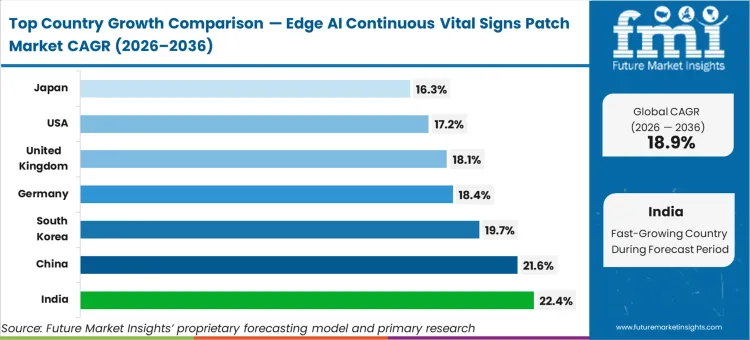
- India: 22.4% compound growth, reflecting a rapid leapfrog dynamic where greenfield digital health initiatives bypass legacy wired telemetry entirely.
- Analyst Opinion at FMI
- Sabyasachi Ghosh, Principal Analyst, Healthcare, at FMI, says, "The general consensus assumes sensor accuracy is the primary barrier to adoption. In reality, the critical friction is alarm fatigue at the central station. Edge processing is not about computing power, it is about data suppression. Systems that successfully filter out motion artifacts and benign anomalies locally are winning enterprise contracts, even if their raw sensor specifications merely match, rather than exceed, legacy alternatives."
- Strategic Implications / Executive Takeaways
- Clinical informatics directors must prioritize algorithms trained on ambulatory patient data rather than resting clinical datasets to reduce false positive rates.
- Procurement teams should structure contracts around edge software update frequency to prevent rapid hardware obsolescence.
- Product development engineers face power envelope constraints requiring novel low-draw microcontroller architectures to maintain multi-day battery life.
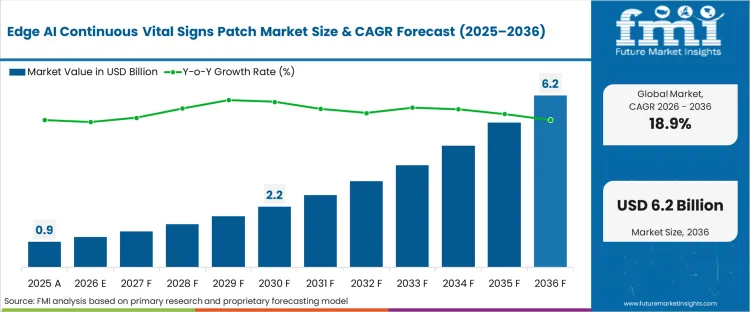
Edge AI Continuous Vital Signs Patch Market Key Takeaways
| Metric | Details |
|---|---|
| Industry Size (2026) | USD 1.1 billion |
| Industry Value (2036) | USD 6.3 billion |
| CAGR (2026 to 2036) | 18.90% |
Source: FMI analysis based on primary research and proprietary forecasting model
The key change occurs when clinical protocols accept device-level algorithmic triage as a substitute for raw telemetry transmission. Clinical integration teams trigger this transition by validating that onboard edge processing matches the central server's diagnostic accuracy. Once this validation barrier falls, scaling remote continuous surveillance becomes purely a hardware logistics challenge rather than a data architecture limitation.
India is expected to track at 22.4% as expansive care-access gaps make wireless patch surveillance highly effective for decentralized population management. China follows closely at 21.6%, driven by massive digital-health scaling initiatives across provincial hospital networks. South Korea is poised to expand at 19.7%, leveraging intense domestic investment in smart hospital infrastructure. Germany is projected to advance at 18.4% and the United Kingdom at 18.1%, with both reflecting systemic transitions toward virtual ward configurations. The United States is estimated to record 17.2% as mature early adoption phases yield to steady enterprise-wide replacements. Japan is anticipated to grow at 16.3%, constrained by conservative qualification cycles despite robust technical readiness. The structural divergence across these geographies stems entirely from the ratio of new decentralized care models versus legacy telemetry replacement cycles.
Edge AI Continuous Vital Signs Patch Market Definition
The industry encompasses wearable, skin-adhered devices that continuously capture physiological metrics and utilize onboard machine learning algorithms to process data locally before transmission. This category is defined by the integration of edge computing capabilities directly at the sensor level, functionally distinguishing it from basic Bluetooth transmitters that rely entirely on cloud or smartphone processors for diagnostic inferencing.
Edge AI Continuous Vital Signs Patch Market Inclusions
Scope includes multimodal adhesive patches, single-metric smart patches, hybrid reusable-disposable modular systems, and specialty neonatal epidermal sensors equipped with local processing microcontrollers. The sector explicitly covers systems utilizing optical biosensor variants alongside edge-capable gateways that function as immediate processing nodes within the patient's immediate vicinity.
Edge AI Continuous Vital Signs Patch Market Exclusions
The boundary specifically excludes smartwatches, fitness bands, and consumer wellness wearables because they lack medical-grade adhesive coupling necessary for continuous clinical telemetry. Traditional Holter monitors and non-patch tethered wearable systems are also omitted as their legacy architectures do not align with the frictionless, skin-integrated form factor defining modern ambulatory surveillance.
Edge AI Continuous Vital Signs Patch Market Research Methodology
- Primary Research: Chief Medical Information Officers, Directors of Remote Patient Monitoring, and Clinical Trial Technology Leads were interviewed to assess edge validation protocols.
- Desk Research: Technical clearance registries, clinical trial device manifests, and smart hospital procurement guidelines were aggregated to track key changes.
- Market-Sizing and Forecasting: The baseline anchors directly to documented hospital-at-home expansion targets and decentralized trial adoption rates across mature healthcare networks.
- Data Validation and Update Cycle: Forecast models were cross-validated against parallel deployment metrics for virtual ward infrastructure platforms.
Segmental Analysis
Edge AI Continuous Vital Signs Patch Market Analysis by Patch modality
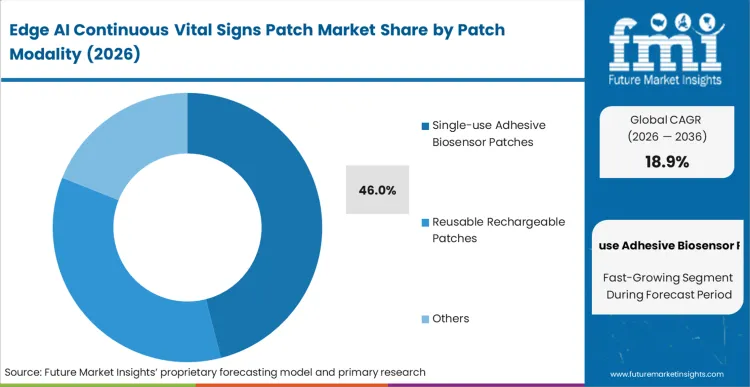
Infection control protocols dictating single-patient contact limits establish the foundation for this segment. Single-use adhesive biosensor patches control 46.0% of the market because cross-contamination liabilities outweigh the unit economics of sterilization cycles. Hospital administrators evaluate wearable healthcare devices strictly against their impact on workflow, prioritizing form factors that eliminate the need for equipment retrieval and cleaning post-discharge.
Based on FMI's assessment, the disposable architecture allows virtual ward operators to mail patches directly to patients without managing reverse logistics. The integration of high-density batteries within flexible substrates enables these single-use models to function autonomously for standard clinical durations. Health systems delaying the switch to fully disposable wearable healthcare platforms endure hidden operational costs associated with tracking and sanitizing hybrid transmitters across sprawling outpatient networks.
- Sterilization bypass: Disposable construction eliminates reverse logistics for equipment retrieval. Virtual ward managers optimize staffing by removing device cleaning from the operational pathway.
- Form factor integration: Fused battery and sensor layers reduce the physical profile against the skin. Patients achieve higher compliance rates during sleep and daily activities.
- Inventory scaling: Standardized single-use units allow rapid deployment without pairing components. Procurement teams simplify supply chains for decentralized care programs.
Edge AI Continuous Vital Signs Patch Market Analysis by Sensor stack
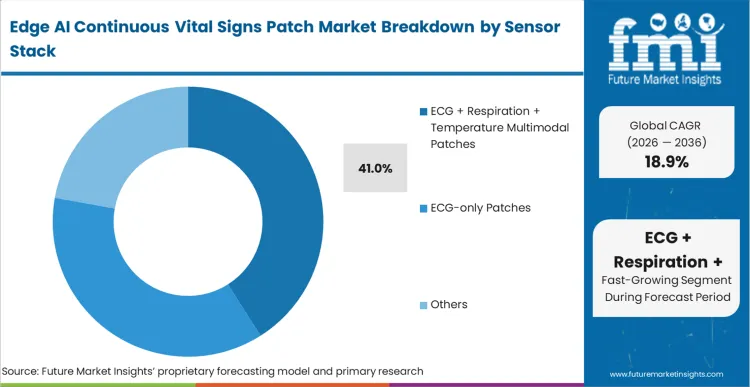
The necessity to calculate comprehensive deterioration scores from a single origin point drives integration efforts here. ECG + respiration + temperature multimodal patches capture 41.0% of demand by fulfilling the complete physiological matrix required by standard clinical algorithms. Care providers rely on body worn temperature sensors alongside cardiac metrics to differentiate localized anomalies from systemic changes.
FMI analysts opine that standalone sensors force clinicians to aggregate data manually, breaking the automated alert chain that makes continuous monitoring viable. The consolidation of multiple signal inputs into one adhesive footprint drastically reduces the skin real estate required for pediatric and geriatric populations. Vendors providing single-metric systems face rapid commoditization as enterprise buyers standardize on comprehensive body worn thermals capable of feeding complex predictive models.
- Multiparameter calculation: Synchronized data capture enables accurate early warning score generation. Clinical informatics teams deploy predictive deterioration models with higher confidence.
- Adhesive footprint consolidation: Combining sensors reduces the total area of skin subjected to medical adhesives. Dermatology and geriatric care units minimize contact dermatitis complications.
- Signal synchronization: Capturing diverse metrics from the exact same physical location improves correlation accuracy. Data scientists utilize highly aligned datasets for algorithm refinement.
Edge AI Continuous Vital Signs Patch Market Analysis by AI deployment architecture
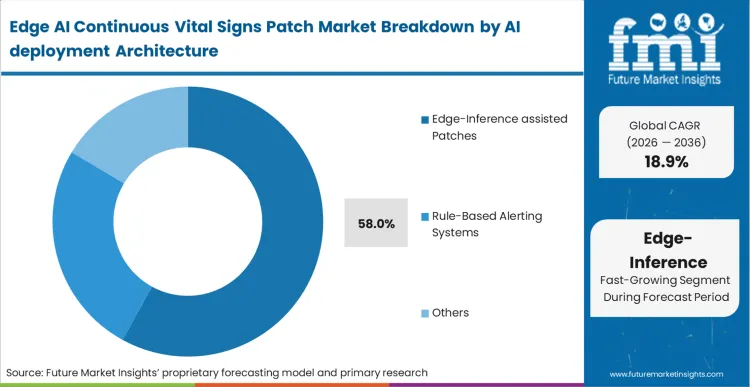
Bandwidth limitations in rural and residential environments force computational tasks closer to the patient. Edge-inference assisted patches dominate with a 58.0% share because they resolve the central vulnerability of remote care: connectivity loss. The reliance on wearable medical devices executing local analysis ensures that critical alerts generate even when cloud connections sever temporarily.
According to FMI's estimates, systems reliant on continuous cloud processing drain patch batteries excessively through constant radio transmission. By filtering benign data and transmitting only validated anomalies, edge models radically extend device lifecycle and reduce network burden. Engineering teams that fail to embed robust inference capabilities directly onto wearable medical systems produce hardware structurally unsuited for scalable hospital-at-home deployments.
- Latency elimination: Local processing analyzes waveforms the millisecond they are captured. Critical care teams receive actionable alerts without the delay of cloud round-tripping.
- Bandwidth conservation: Transmitting only anomalies reduces data payloads significantly. Network architects scale remote monitoring programs across variable cellular environments.
- Power optimization: Reducing radio transmission frequency preserves onboard energy reserves. Product engineers achieve multi-week operational lifespans from standard coin cell equivalent power sources.
Edge AI Continuous Vital Signs Patch Market Analysis by Care setting
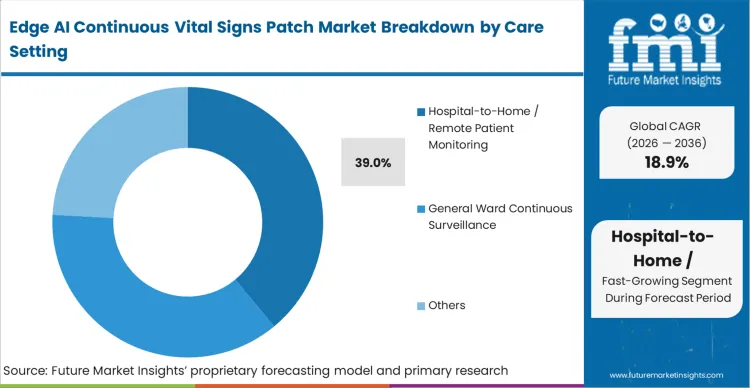
Reimbursement mechanisms structured around 30-day readmission penalties dictate spending patterns in this category. Hospital-to-home / remote patient monitoring leads with 39.0% share as health networks actively change post-acute recovery out of high-cost facilities. Remote patient monitoring devices serve as the foundational infrastructure enabling this geographical transition.
As per FMI's projection, administrators utilizing these platforms drastically expand their functional bed capacity without pouring capital into physical real estate. The ability to maintain ICU-grade surveillance in a residential setting fundamentally alters how discharge timing is calculated. Facilities clinging to inpatient-only recovery models absorb severe margin pressure as competitors leverage remote patient networks to optimize their acute bed turnover rates.
- Discharge acceleration: Continuous residential surveillance provides clinical confidence to release patients earlier. Hospital administrators maximize acute bed availability without compromising care standards.
- Readmission interception: Edge algorithms detect physiological degradation days before symptomatic crisis. Care coordinators intervene preemptively, securing associated reimbursement incentives.
- Geographic decoupling: Patients recover in optimal domestic environments while maintaining clinical oversight. Health systems expand their functional service radius beyond physical facility limits.
Edge AI Continuous Vital Signs Patch Market Analysis by End user
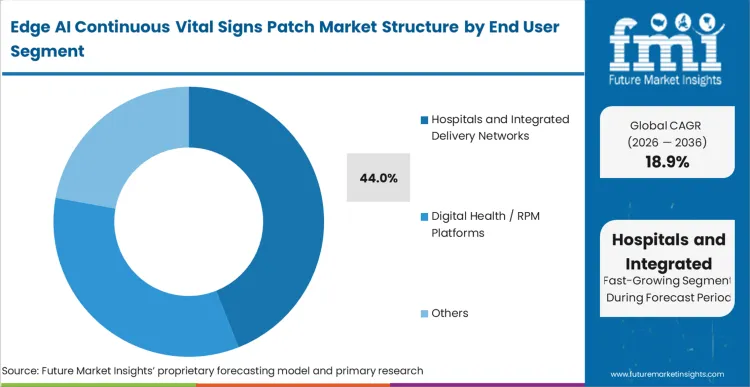
The concentration of acute care responsibility positions large medical networks at the center of the procurement ecosystem. Hospitals and integrated delivery networks command 44.0% share by acting as the primary specifiers for continuous surveillance standards. They evaluate patient monitoring devices based on interoperability with existing electronic health records rather than standalone consumer appeal.
In FMI's view, these institutions possess the necessary clinical informatics depth to safely integrate edge-processed alerts into their centralized command centers. Virtual ward subsidiaries established by these networks drive the bulk volume purchasing required to offset development costs for hardware manufacturers. Vendors targeting niche applications without securing enterprise-wide validation from major patient surveillance devices networks struggle to achieve sustainable commercial scale.
- EHR integration mandate: Enterprise systems require seamless data flow into centralized patient records. IT directors disqualify platforms lacking standardized interoperability protocols.
- Command center centralization: Massive data streams converge into specialized monitoring hubs. Staffing coordinators optimize personnel ratios by leveraging AI-triaged alert feeds.
- Procurement consolidation: Large networks leverage volume purchasing to negotiate comprehensive service agreements. Manufacturers secure reliable revenue streams by navigating complex enterprise vendor qualifications.
Edge AI Continuous Vital Signs Patch Market Drivers, Restraints, and Opportunities
Capacity constraints force hospital administrators to transition mid-acuity patients to virtual wards. This pressure compels informatics directors to deploy autonomous surveillance tools capable of triaging patients without manual oversight. They utilize wireless patient monitoring to maintain clinical visibility without expanding physical bed counts. Delaying this exposes health networks to severe bottlenecks during seasonal admission surges, directly impacting their commercial viability and patient throughput metrics.
The necessity to balance complex onboard computation against severe power limitations creates a basic engineering friction. Microcontroller power draw restricts the sophistication of edge algorithms, limiting the depth of localized analysis possible on flexible, skin-adhered substrates. While emerging ultra-low-power silicon architectures provide partial relief, energy density constraints remain a hard boundary for product developers aiming to extend wear duration while simultaneously increasing sampling rates.
Opportunities in the Edge AI Continuous Vital Signs Patch Market
- Decentralized clinical trials: Biopharma sponsors seek continuous real-world data collection to validate novel therapeutics. Clinical trial operators deploy arrhythmia assessment tools to capture granular physiological responses outside controlled clinical environments.
- Neonatal intensive care: Miniaturization enables non-invasive monitoring for highly fragile patient demographics. Specialized pediatric units adopt these platforms to reduce handling stress and avoid adhesive-related skin trauma.
- Ambulatory oncology support: Chemotherapy regimens require close monitoring for acute systemic reactions. Care coordinators utilise continuous tracking to manage outpatient toxicity responses safely.
Regional Analysis
The market’s regional segmentation covers North America, Europe, and Asia Pacific, extending across more than 40 countries.
.webp "Top Country Growth Comparison Edge Ai Continuous Vital Signs Patch Market Cagr (2026 2036)")
| Country | CAGR (2026 to 2036) |
|---|---|
| India | 22.4% |
| China | 21.6% |
| South Korea | 19.7% |
| Germany | 18.4% |
| United Kingdom | 18.1% |
| United States | 17.2% |
| Japan | 16.3% |
North America Edge AI Continuous Vital Signs Patch Market Analysis
Reimbursement architecture shapes buyer behaviour heavily in this region. Health networks evaluate edge platforms based on their alignment with specific billing codes designed for remote therapeutic monitoring. FMI analysts estimate that systems capable of generating compliant documentation automatically secure rapid enterprise approval. The deployment of digital health platforms relies on the ability to demonstrate consistent patient engagement metrics required for reimbursement validation. The region serves as the primary proving ground for complex remote patient architecture models before global export.
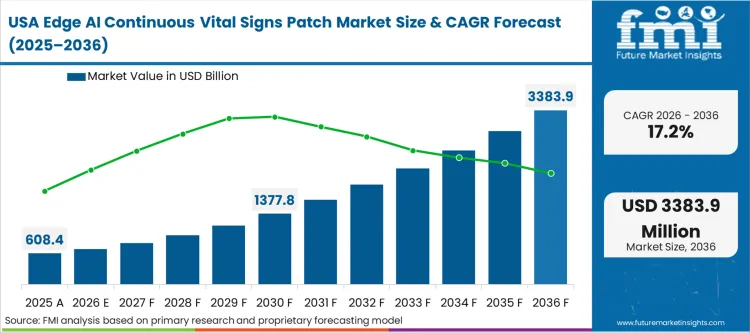
- United States: The United States' mature value-based care frameworks require concrete outcome data to justify capitated payments. Hospital administrators must deploy systems that demonstrably prevent costly 30-day readmissions. Demand for continuous vital signs patches in the United States is set to grow at 17.2%. Networks that optimize their post-acute tracking capture significant margin improvements under shared-savings contract models.
FMI's report includes detailed analysis of Canadian procurement trends. Provincial health authorities focus intensely on platforms capable of bridging massive geographical distances between specialized care centers and remote rural populations.
Europe Edge AI Continuous Vital Signs Patch Market Analysis
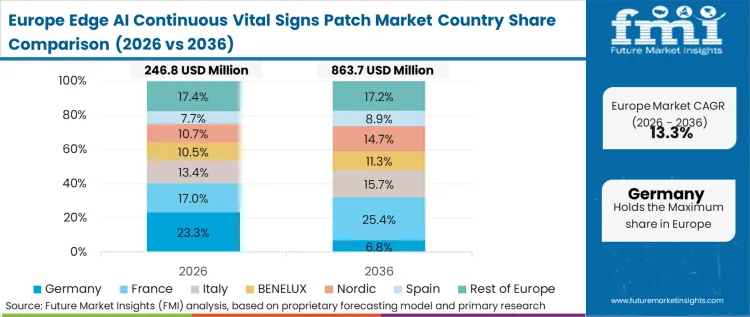
Data sovereignty directives control the architectural decisions of health networks operating within this zone. Procurement directors reject systems that rely on external cloud processing due to stringent privacy compliance requirements. According to FMI's estimates, this environment heavily favours vendors offering pure edge-processing capabilities where raw waveforms never leave the device. The emphasis on localized connected healthcare tracking creates distinct technical barriers for imported platforms reliant on centralized server analysis.
- Germany: The market for continuous vital signs patches in Germany is forecast to register a CAGR of 18.4%. Germany's updated digital health application (DiGA) framework provides a direct pathway for prescription-based digital therapeutics. Specialised RPM platform developers must structure their clinical evidence to meet rigorous federal assessment standards. Securing DiGA listing positions vendors to access universal reimbursement across statutory health insurance funds.
- United Kingdom: A CAGR of 18.1% is expected for continuous vital signs patches in the United Kingdom over the forecast period. Procurement centralization defines the United Kingdom's trajectory in virtual ward expansion. National health system mandates that regional trusts to adopt standardised continuous surveillance protocols. Standardization streamlines training protocols and allows nursing pools to float seamlessly between different remote monitoring deployments.
FMI's report includes examination of Nordic regional integration strategies. These highly digitized health systems are leveraging their unified electronic health records to rapidly scale predictive analytics models across their entire population base.
Asia Pacific Edge AI Continuous Vital Signs Patch Market Analysis
Infrastructure leapfrogging defines the regional adoption curve here. Major networks bypass legacy wired telemetry installations entirely, moving straight to wireless edge networks. As per FMI's projection, this dynamic eliminates the switching costs that slow adoption in mature markets. High patient-to-nurse ratios force facilities to rely heavily on automated triage generated by electronic skin patch systems. The deployment of next generation telehealth initiatives depends directly on hardware capable of functioning reliably across highly variable cellular networks.
- India: India's severe deficit in critical care bed capacity enables rapid acceptance of hospital-at-home models. Private hospital operators must utilize remote surveillance to manage high patient volumes without massive real estate expansion. India is expected to see its continuous vital signs patch sector grow at a compound annual rate of 22.4%. Early movers establish dominance in the rapidly expanding middle-class private healthcare sector.
- China: FMI estimates the continuous vital signs patch market in China to expand at an annual growth rate of 21.6%. Massive provincial digital transformation mandates drive China's implementation of automated patient surveillance. Medical informatics teams are integrating AI-driven alerts directly into centralised municipal health grids. Facilities leveraging these automated systems significantly reduce clinical workforce burnout in densely populated urban centres.
- South Korea: South Korea's advanced domestic semiconductor and telecommunications infrastructure enables seamless integration of high-bandwidth medical networks. Over the forecast period, continuous vital signs patches in South Korea are set for a CAGR of 19.7%. Smart hospital architects demand latency-free alert systems utilising next-generation connectivity standards. This environment functions as an ideal incubator for highly complex multimodal sensor arrays.
- Japan: Stringent clinical validation constraints dictate Japan's trajectory in advanced medical wearables. Procurement directors operate under highly conservative evaluation cycles, demanding extensive domestic trial data before enterprise deployment. The Japanese market for continuous vital signs patches is likely to post a CAGR of 16.3%. Vendors navigating these regulatory pathways secure exceptionally loyal customer bases resistant to rapid displacement.
FMI's report includes evaluation of Southeast Asian digital health scaling. Markets across the ASEAN block are increasingly adopting remote monitoring frameworks to mitigate chronic disease burdens across geographically dispersed archipelagos.
Competitive Aligners for Market Players
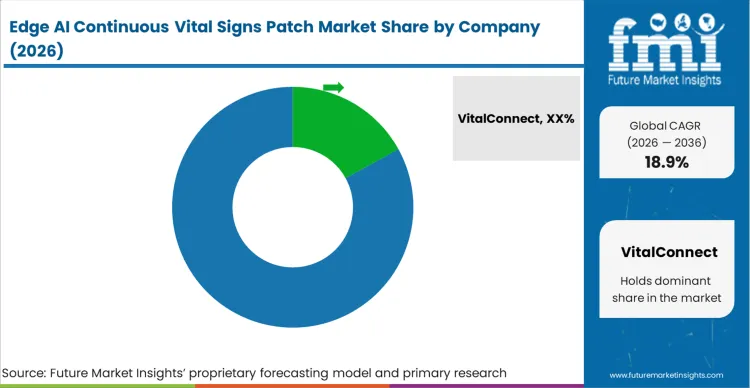
The concentration of the industry stems from the immense clinical validation burden required to achieve regulatory clearance. VitalConnect, BioIntelliSense, and Royal Philips leverage massive clinical datasets to train their edge algorithms, creating a barrier that pure hardware manufacturers cannot easily cross. Hospital procurement teams evaluate vendors based on their false-positive reduction rates rather than basic sensor accuracy.
Incumbents maintain their advantage by securing deep integration with dominant electronic health record platforms. Current Health and Sibel Health possess established application programming interfaces that seamlessly inject triaged alerts into existing clinical workflows. Challengers must build enterprise-grade software integration capabilities, not just accurate hardware. Constructing frictionless remote systems requires a sophisticated understanding of hospital IT security architectures.
Large health networks actively resist lock-in by mandating adherence to open data standards. This tension forces vendors to ensure their hardware can communicate with third-party analytics dashboards. Through 2036, the sector consolidates around platform providers capable of managing the entire data lifecycle from skin contact to clinical command center, displacing niche hardware-only suppliers.
Key Players in Edge AI Continuous Vital Signs Patch Market
- VitalConnect
- BioIntelliSense
- Royal Philips
- Vivalink
- Current Health
- Isansys Lifecare
- Sibel Health
Scope of the Report
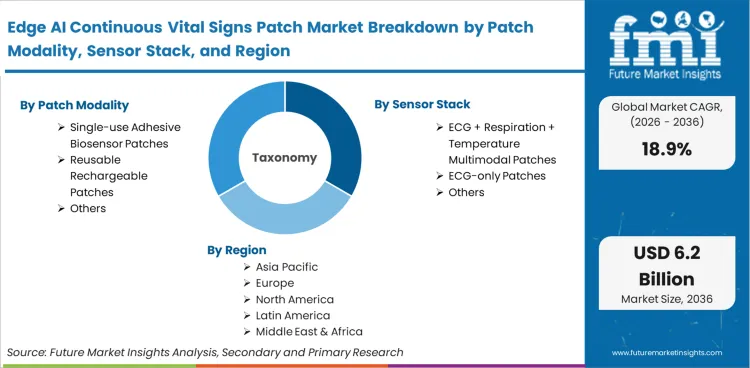
| Metric | Value |
|---|---|
| Quantitative Units | USD 1.1 billion to USD 6.3 billion, at a CAGR of 18.90% |
| Market Definition | This category covers clinical-grade, skin-adhered sensors executing localized algorithmic analysis on physiological data streams. It encompasses systems utilizing edge computing to triage alerts before transmission. |
| Patch modality Segmentation | Single-use adhesive biosensor patches, Reusable rechargeable patches, Hybrid disposable patch + reusable transmitter systems, Neonatal / specialty skin-integrated patches |
| Sensor stack Segmentation | ECG + respiration + temperature multimodal patches, ECG-only patches, PPG-based vital-sign patches, Multi-sensor patches with SpO2 and motion inputs |
| AI deployment architecture Segmentation | Edge-inference assisted patches, Cloud-analytics dominant systems, Rule-based alerting systems, Hybrid edge + cloud monitoring systems |
| Care setting Segmentation | Hospital-to-home / remote patient monitoring, General ward continuous surveillance, Ambulatory cardiac monitoring, Clinical research / decentralized trials |
| Regions Covered | North America, Europe, Asia Pacific |
| Countries Covered | United States, Germany, United Kingdom, China, India, Japan, South Korea, and 40 plus countries |
| Key Companies Profiled | VitalConnect, BioIntelliSense, Royal Philips, Vivalink, Current Health, Isansys Lifecare, Sibel Health |
| Forecast Period | 2026 to 2036 |
| Approach | Primary interviews targeted clinical informatics and virtual ward directors to assess architectural shifts. Baselines were anchored to active decentralized trial volumes and hospital-at-home bed counts. Forecasts were cross-validated against enterprise telemetry networking deployments. |
Edge AI Continuous Vital Signs Patch Market Analysis by Segments
Patch modality:
- Single-use adhesive biosensor patches
- Reusable rechargeable patches
- Hybrid disposable patch + reusable transmitter systems
- Neonatal / specialty skin-integrated patches
Sensor stack:
- ECG + respiration + temperature multimodal patches
- ECG-only patches
- PPG-based vital-sign patches
- Multi-sensor patches with SpO2 and motion inputs
AI deployment architecture:
- Edge-inference assisted patches
- Cloud-analytics dominant systems
- Rule-based alerting systems
- Hybrid edge + cloud monitoring systems
Care setting:
- Hospital-to-home / remote patient monitoring
- General ward continuous surveillance
- Ambulatory cardiac monitoring
- Clinical research / decentralized trials
End user:
- Hospitals and integrated delivery networks
- Home-care and virtual ward providers
- Digital health / RPM platforms
- Biopharma and clinical-trial operators
Region:
- North America
- United States
- Canada
- Europe
- Germany
- United Kingdom
- France
- Italy
- Spain
- Asia Pacific
- China
- Japan
- South Korea
- Taiwan
- Singapore
- Latin America
- Brazil
- Mexico
- Argentina
- Middle East & Africa
- GCC Countries
- South Africa
Bibliography
- Vo, D. K., Nguyen, T. H., Nguyen, T. T., & colleagues. (2024). Advances in wearable biosensors for healthcare: Current trends, applications, and future perspectives. PMC.
- Taherdoost, H. (2024). Wearable healthcare and continuous vital sign monitoring with IoT integration. Computers, Materials & Continua.
- Patel, R., Thornton-Swan, T. D., Armitage, L. C., Vollam, S., Tarassenko, L., Lasserson, D. S., & Farmer, A. J. (2024). Remote vital sign monitoring in admission avoidance hospital at home: A systematic review. Journal of the American Medical Directors Association.
- Bignami, E. G., and colleagues. (2025). Wearable devices in healthcare beyond the one-size-fits all paradigm. Sensors.
- iRhythm Technologies, Inc. (2024, February 19). iRhythm Holdings announces fourth quarter and full year 2023 financial results. iRhythm Technologies.
- Sibel Health, Inc. (2024). K240251 510(k) summary: ANNE Chest. U.S. Food and Drug Administration.
- USA Food and Drug Administration. (2025). 2024 device approvals. U.S. Food and Drug Administration.
This bibliography is provided for reader reference. The full FMI report contains the complete reference list with primary source documentation.
Frequently Asked Questions
How large is the Edge AI Continuous Vital Signs Patch Market in 2026?
The industry reaches a valuation of USD 1.1 billion in 2026. This figure signals the transition of virtual ward programs from pilot initiatives into standardized operational frameworks within major health systems.
What will it be valued at by 2036?
The sector advances to USD 6.3 billion by 2036. This scale reflects the wholesale migration away from legacy wired telemetry toward frictionless, edge-processed tracking arrays.
What CAGR is projected?
A compound annual growth rate of 18.90% is anticipated. This pace is dictated by the rate at which clinical teams validate localized algorithmic triage against central station accuracy benchmarks.
Which Patch modality segment leads?
Single-use adhesive biosensor patches hold 46.0% share in 2026. Hospital networks mandate fully disposable platforms to completely bypass the reverse logistics and sterilization costs associated with reusable transmitters.
Which Sensor stack segment leads?
ECG + respiration + temperature multimodal patches capture 41.0% share. These unified platforms generate comprehensive early warning scores from a single adhesive footprint, eliminating the need to sync disparate devices.
Which AI deployment architecture segment leads?
Edge-inference assisted patches control 58.0% of the market. Shifting computation directly to the hardware eliminates the latency and bandwidth vulnerabilities inherent to continuous cloud-streaming architectures.
What drives rapid growth?
Severe acute bed capacity constraints compel hospital administrators to expand hospital-to-home initiatives. They require autonomous, reliable tracking nodes to maintain clinical visibility over decentralized patient populations.
What is the primary restraint?
The energy demands of localized processing create severe power envelope limitations. Product engineers struggle to balance complex machine learning algorithms against the constrained battery capacities of flexible skin patches.
Which country grows fastest?
India expands at 22.4%, sharply outpacing China's 21.6%. India's severe deficit in legacy telemetry infrastructure allows private networks to leapfrog directly into wireless, AI-driven surveillance models without displacing existing capital equipment.
How do European data privacy laws impact architecture?
Stringent data sovereignty directives heavily favor edge-inference systems. Procurement teams reject cloud-dominant platforms to ensure raw physiological waveforms never traverse external networks.
Why are single-use models dominating reusable systems?
Infection control mandates create hidden operational costs for reusable platforms. Eliminating device sanitization and retrieval workflows streamlines logistics for sprawling decentralized care networks.
Why is electronic health record integration critical?
Major hospital networks centralize their command centers around unified digital records. IT directors disqualify surveillance platforms that cannot seamlessly inject triaged alerts directly into established clinical interfaces.
How do decentralized clinical trials utilize these platforms?
Biopharma sponsors deploy edge-capable patches to capture continuous real-world data without burdening participants. Localized processing ensures reliable data collection even in environments with intermittent cellular connectivity.
What role do digital health applications play in Germany?
The DiGA framework provides a structured reimbursement pathway for prescription digital therapeutics. Vendors securing this listing gain immediate access to statutory health insurance funding, accelerating national deployment.
How does latency impact ambulatory cardiac monitoring?
Cloud-reliant systems experience transmission delays that degrade response times. Edge processing analyzes waveforms instantaneously, delivering critical alerts to clinical teams without network round-tripping.
Why are neonatal units adopting patch platforms?
Miniaturized wireless sensors eliminate the tethered wires that cause skin trauma and limit parental bonding. Specialized pediatric wards utilize these tools to maintain rigorous oversight while reducing handling stress.
How do virtual ward providers optimize staffing?
By relying on patches that filter benign data locally, care coordinators avoid alarm fatigue. This allows a single central station nurse to monitor significantly larger patient cohorts safely.
What prevents pure hardware manufacturers from dominating?
The massive clinical datasets required to train accurate edge algorithms create a formidable barrier to entry. Hardware must be paired with extensively validated software to pass hospital procurement standards.
How do value-based care models influence procurement?
United States health networks operate under structures penalizing 30-day readmissions. Administrators invest in continuous tracking infrastructure to preemptively identify patient deterioration and secure shared-savings margins.
What dictates the adoption rate in Japan?
Highly conservative clinical qualification cycles extend the time required for enterprise deployment. Procurement directors demand extensive domestic trial validation before authorizing broad integration of advanced medical wearables.
Why are dynamic glucose monitoring patch models influencing vital sign designs?
The commercial success of continuous glucose platforms established the viability of long-wear skin adhesives. Vital signs manufacturers leverage these material science breakthroughs to extend the operational duration of their own multimodal arrays.
How do skin sensors mitigate contact dermatitis?
Consolidating multiple physiological tracking metrics into a single device significantly reduces the total adhesive area required. This architectural efficiency protects compromised skin structures in geriatric and oncology populations.
Preview the report firsthand - request a free sample
Get SampleGet the brochure for pricing and purchase details.
Get PDFTable of Content
- Executive Summary
- Global Market Outlook
- Demand-side Trends
- Supply-side Trends
- Technology Roadmap Analysis
- Analysis and Recommendations
- Market Overview
- Market Coverage / Taxonomy
- Market Definition / Scope / Limitations
- Research Methodology
- Chapter Orientation
- Analytical Lens and Working Hypotheses
- Market Structure, Signals, and Trend Drivers
- Benchmarking and Cross-market Comparability
- Market Sizing, Forecasting, and Opportunity Mapping
- Research Design and Evidence Framework
- Desk Research Programme (Secondary Evidence)
- Company Annual and Sustainability Reports
- Peer-reviewed Journals and Academic Literature
- Corporate Websites, Product Literature, and Technical Notes
- Earnings Decks and Investor Briefings
- Statutory Filings and Regulatory Disclosures
- Technical White Papers and Standards Notes
- Trade Journals, Industry Magazines, and Analyst Briefs
- Conference Proceedings, Webinars, and Seminar Materials
- Government Statistics Portals and Public Data Releases
- Press Releases and Reputable Media Coverage
- Specialist Newsletters and Curated Briefings
- Sector Databases and Reference Repositories
- FMI Internal Proprietary Databases and Historical Market Datasets
- Subscription Datasets and Paid Sources
- Social Channels, Communities, and Digital Listening Inputs
- Additional Desk Sources
- Expert Input and Fieldwork (Primary Evidence)
- Primary Modes
- Qualitative Interviews and Expert Elicitation
- Quantitative Surveys and Structured Data Capture
- Blended Approach
- Why Primary Evidence is Used
- Field Techniques
- Interviews
- Surveys
- Focus Groups
- Observational and In-context Research
- Social and Community Interactions
- Stakeholder Universe Engaged
- C-suite Leaders
- Board Members
- Presidents and Vice Presidents
- R&D and Innovation Heads
- Technical Specialists
- Domain Subject-matter Experts
- Scientists
- Physicians and Other Healthcare Professionals
- Governance, Ethics, and Data Stewardship
- Research Ethics
- Data Integrity and Handling
- Primary Modes
- Tooling, Models, and Reference Databases
- Desk Research Programme (Secondary Evidence)
- Data Engineering and Model Build
- Data Acquisition and Ingestion
- Cleaning, Normalisation, and Verification
- Synthesis, Triangulation, and Analysis
- Quality Assurance and Audit Trail
- Market Background
- Market Dynamics
- Drivers
- Restraints
- Opportunity
- Trends
- Scenario Forecast
- Demand in Optimistic Scenario
- Demand in Likely Scenario
- Demand in Conservative Scenario
- Opportunity Map Analysis
- Product Life Cycle Analysis
- Supply Chain Analysis
- Investment Feasibility Matrix
- Value Chain Analysis
- PESTLE and Porter’s Analysis
- Regulatory Landscape
- Regional Parent Market Outlook
- Production and Consumption Statistics
- Import and Export Statistics
- Market Dynamics
- Global Market Analysis 2021 to 2025 and Forecast, 2026 to 2036
- Historical Market Size Value (USD Million) Analysis, 2021 to 2025
- Current and Future Market Size Value (USD Million) Projections, 2026 to 2036
- Y-o-Y Growth Trend Analysis
- Absolute $ Opportunity Analysis
- Global Market Pricing Analysis 2021 to 2025 and Forecast 2026 to 2036
- Global Market Analysis 2021 to 2025 and Forecast 2026 to 2036, By Patch Modality
- Introduction / Key Findings
- Historical Market Size Value (USD Million) Analysis By Patch Modality , 2021 to 2025
- Current and Future Market Size Value (USD Million) Analysis and Forecast By Patch Modality , 2026 to 2036
- Single-use Adhesive Biosensor Patches
- Reusable Rechargeable Patches
- Others
- Single-use Adhesive Biosensor Patches
- Y-o-Y Growth Trend Analysis By Patch Modality , 2021 to 2025
- Absolute $ Opportunity Analysis By Patch Modality , 2026 to 2036
- Global Market Analysis 2021 to 2025 and Forecast 2026 to 2036, By Sensor Stack
- Introduction / Key Findings
- Historical Market Size Value (USD Million) Analysis By Sensor Stack, 2021 to 2025
- Current and Future Market Size Value (USD Million) Analysis and Forecast By Sensor Stack, 2026 to 2036
- ECG + Respiration + Temperature Multimodal Patches
- ECG-only Patches
- Others
- ECG + Respiration + Temperature Multimodal Patches
- Y-o-Y Growth Trend Analysis By Sensor Stack, 2021 to 2025
- Absolute $ Opportunity Analysis By Sensor Stack, 2026 to 2036
- Global Market Analysis 2021 to 2025 and Forecast 2026 to 2036, By AI deployment Architecture
- Introduction / Key Findings
- Historical Market Size Value (USD Million) Analysis By AI deployment Architecture, 2021 to 2025
- Current and Future Market Size Value (USD Million) Analysis and Forecast By AI deployment Architecture, 2026 to 2036
- Edge-Inference assisted Patches
- Rule-Based Alerting Systems
- Others
- Edge-Inference assisted Patches
- Y-o-Y Growth Trend Analysis By AI deployment Architecture, 2021 to 2025
- Absolute $ Opportunity Analysis By AI deployment Architecture, 2026 to 2036
- Global Market Analysis 2021 to 2025 and Forecast 2026 to 2036, By Care Setting
- Introduction / Key Findings
- Historical Market Size Value (USD Million) Analysis By Care Setting, 2021 to 2025
- Current and Future Market Size Value (USD Million) Analysis and Forecast By Care Setting, 2026 to 2036
- Hospital-to-Home / Remote Patient Monitoring
- General Ward Continuous Surveillance
- Others
- Hospital-to-Home / Remote Patient Monitoring
- Y-o-Y Growth Trend Analysis By Care Setting, 2021 to 2025
- Absolute $ Opportunity Analysis By Care Setting, 2026 to 2036
- Global Market Analysis 2021 to 2025 and Forecast 2026 to 2036, By End User
- Introduction / Key Findings
- Historical Market Size Value (USD Million) Analysis By End User, 2021 to 2025
- Current and Future Market Size Value (USD Million) Analysis and Forecast By End User, 2026 to 2036
- Hospitals and Integrated Delivery Networks
- Digital Health / RPM Platforms
- Others
- Hospitals and Integrated Delivery Networks
- Y-o-Y Growth Trend Analysis By End User, 2021 to 2025
- Absolute $ Opportunity Analysis By End User, 2026 to 2036
- Global Market Analysis 2021 to 2025 and Forecast 2026 to 2036, By Region
- Introduction
- Historical Market Size Value (USD Million) Analysis By Region, 2021 to 2025
- Current Market Size Value (USD Million) Analysis and Forecast By Region, 2026 to 2036
- North America
- Latin America
- Western Europe
- Eastern Europe
- East Asia
- South Asia and Pacific
- Middle East & Africa
- Market Attractiveness Analysis By Region
- North America Market Analysis 2021 to 2025 and Forecast 2026 to 2036, By Country
- Historical Market Size Value (USD Million) Trend Analysis By Market Taxonomy, 2021 to 2025
- Market Size Value (USD Million) Forecast By Market Taxonomy, 2026 to 2036
- By Country
- USA
- Canada
- Mexico
- By Patch Modality
- By Sensor Stack
- By AI deployment Architecture
- By Care Setting
- By End User
- By Country
- Market Attractiveness Analysis
- By Country
- By Patch Modality
- By Sensor Stack
- By AI deployment Architecture
- By Care Setting
- By End User
- Key Takeaways
- Latin America Market Analysis 2021 to 2025 and Forecast 2026 to 2036, By Country
- Historical Market Size Value (USD Million) Trend Analysis By Market Taxonomy, 2021 to 2025
- Market Size Value (USD Million) Forecast By Market Taxonomy, 2026 to 2036
- By Country
- Brazil
- Chile
- Rest of Latin America
- By Patch Modality
- By Sensor Stack
- By AI deployment Architecture
- By Care Setting
- By End User
- By Country
- Market Attractiveness Analysis
- By Country
- By Patch Modality
- By Sensor Stack
- By AI deployment Architecture
- By Care Setting
- By End User
- Key Takeaways
- Western Europe Market Analysis 2021 to 2025 and Forecast 2026 to 2036, By Country
- Historical Market Size Value (USD Million) Trend Analysis By Market Taxonomy, 2021 to 2025
- Market Size Value (USD Million) Forecast By Market Taxonomy, 2026 to 2036
- By Country
- Germany
- UK
- Italy
- Spain
- France
- Nordic
- BENELUX
- Rest of Western Europe
- By Patch Modality
- By Sensor Stack
- By AI deployment Architecture
- By Care Setting
- By End User
- By Country
- Market Attractiveness Analysis
- By Country
- By Patch Modality
- By Sensor Stack
- By AI deployment Architecture
- By Care Setting
- By End User
- Key Takeaways
- Eastern Europe Market Analysis 2021 to 2025 and Forecast 2026 to 2036, By Country
- Historical Market Size Value (USD Million) Trend Analysis By Market Taxonomy, 2021 to 2025
- Market Size Value (USD Million) Forecast By Market Taxonomy, 2026 to 2036
- By Country
- Russia
- Poland
- Hungary
- Balkan & Baltic
- Rest of Eastern Europe
- By Patch Modality
- By Sensor Stack
- By AI deployment Architecture
- By Care Setting
- By End User
- By Country
- Market Attractiveness Analysis
- By Country
- By Patch Modality
- By Sensor Stack
- By AI deployment Architecture
- By Care Setting
- By End User
- Key Takeaways
- East Asia Market Analysis 2021 to 2025 and Forecast 2026 to 2036, By Country
- Historical Market Size Value (USD Million) Trend Analysis By Market Taxonomy, 2021 to 2025
- Market Size Value (USD Million) Forecast By Market Taxonomy, 2026 to 2036
- By Country
- China
- Japan
- South Korea
- By Patch Modality
- By Sensor Stack
- By AI deployment Architecture
- By Care Setting
- By End User
- By Country
- Market Attractiveness Analysis
- By Country
- By Patch Modality
- By Sensor Stack
- By AI deployment Architecture
- By Care Setting
- By End User
- Key Takeaways
- South Asia and Pacific Market Analysis 2021 to 2025 and Forecast 2026 to 2036, By Country
- Historical Market Size Value (USD Million) Trend Analysis By Market Taxonomy, 2021 to 2025
- Market Size Value (USD Million) Forecast By Market Taxonomy, 2026 to 2036
- By Country
- India
- ASEAN
- Australia & New Zealand
- Rest of South Asia and Pacific
- By Patch Modality
- By Sensor Stack
- By AI deployment Architecture
- By Care Setting
- By End User
- By Country
- Market Attractiveness Analysis
- By Country
- By Patch Modality
- By Sensor Stack
- By AI deployment Architecture
- By Care Setting
- By End User
- Key Takeaways
- Middle East & Africa Market Analysis 2021 to 2025 and Forecast 2026 to 2036, By Country
- Historical Market Size Value (USD Million) Trend Analysis By Market Taxonomy, 2021 to 2025
- Market Size Value (USD Million) Forecast By Market Taxonomy, 2026 to 2036
- By Country
- Kingdom of Saudi Arabia
- Other GCC Countries
- Turkiye
- South Africa
- Other African Union
- Rest of Middle East & Africa
- By Patch Modality
- By Sensor Stack
- By AI deployment Architecture
- By Care Setting
- By End User
- By Country
- Market Attractiveness Analysis
- By Country
- By Patch Modality
- By Sensor Stack
- By AI deployment Architecture
- By Care Setting
- By End User
- Key Takeaways
- Key Countries Market Analysis
- USA
- Pricing Analysis
- Market Share Analysis, 2025
- By Patch Modality
- By Sensor Stack
- By AI deployment Architecture
- By Care Setting
- By End User
- Canada
- Pricing Analysis
- Market Share Analysis, 2025
- By Patch Modality
- By Sensor Stack
- By AI deployment Architecture
- By Care Setting
- By End User
- Mexico
- Pricing Analysis
- Market Share Analysis, 2025
- By Patch Modality
- By Sensor Stack
- By AI deployment Architecture
- By Care Setting
- By End User
- Brazil
- Pricing Analysis
- Market Share Analysis, 2025
- By Patch Modality
- By Sensor Stack
- By AI deployment Architecture
- By Care Setting
- By End User
- Chile
- Pricing Analysis
- Market Share Analysis, 2025
- By Patch Modality
- By Sensor Stack
- By AI deployment Architecture
- By Care Setting
- By End User
- Germany
- Pricing Analysis
- Market Share Analysis, 2025
- By Patch Modality
- By Sensor Stack
- By AI deployment Architecture
- By Care Setting
- By End User
- UK
- Pricing Analysis
- Market Share Analysis, 2025
- By Patch Modality
- By Sensor Stack
- By AI deployment Architecture
- By Care Setting
- By End User
- Italy
- Pricing Analysis
- Market Share Analysis, 2025
- By Patch Modality
- By Sensor Stack
- By AI deployment Architecture
- By Care Setting
- By End User
- Spain
- Pricing Analysis
- Market Share Analysis, 2025
- By Patch Modality
- By Sensor Stack
- By AI deployment Architecture
- By Care Setting
- By End User
- France
- Pricing Analysis
- Market Share Analysis, 2025
- By Patch Modality
- By Sensor Stack
- By AI deployment Architecture
- By Care Setting
- By End User
- India
- Pricing Analysis
- Market Share Analysis, 2025
- By Patch Modality
- By Sensor Stack
- By AI deployment Architecture
- By Care Setting
- By End User
- ASEAN
- Pricing Analysis
- Market Share Analysis, 2025
- By Patch Modality
- By Sensor Stack
- By AI deployment Architecture
- By Care Setting
- By End User
- Australia & New Zealand
- Pricing Analysis
- Market Share Analysis, 2025
- By Patch Modality
- By Sensor Stack
- By AI deployment Architecture
- By Care Setting
- By End User
- China
- Pricing Analysis
- Market Share Analysis, 2025
- By Patch Modality
- By Sensor Stack
- By AI deployment Architecture
- By Care Setting
- By End User
- Japan
- Pricing Analysis
- Market Share Analysis, 2025
- By Patch Modality
- By Sensor Stack
- By AI deployment Architecture
- By Care Setting
- By End User
- South Korea
- Pricing Analysis
- Market Share Analysis, 2025
- By Patch Modality
- By Sensor Stack
- By AI deployment Architecture
- By Care Setting
- By End User
- Russia
- Pricing Analysis
- Market Share Analysis, 2025
- By Patch Modality
- By Sensor Stack
- By AI deployment Architecture
- By Care Setting
- By End User
- Poland
- Pricing Analysis
- Market Share Analysis, 2025
- By Patch Modality
- By Sensor Stack
- By AI deployment Architecture
- By Care Setting
- By End User
- Hungary
- Pricing Analysis
- Market Share Analysis, 2025
- By Patch Modality
- By Sensor Stack
- By AI deployment Architecture
- By Care Setting
- By End User
- Kingdom of Saudi Arabia
- Pricing Analysis
- Market Share Analysis, 2025
- By Patch Modality
- By Sensor Stack
- By AI deployment Architecture
- By Care Setting
- By End User
- Turkiye
- Pricing Analysis
- Market Share Analysis, 2025
- By Patch Modality
- By Sensor Stack
- By AI deployment Architecture
- By Care Setting
- By End User
- South Africa
- Pricing Analysis
- Market Share Analysis, 2025
- By Patch Modality
- By Sensor Stack
- By AI deployment Architecture
- By Care Setting
- By End User
- USA
- Market Structure Analysis
- Competition Dashboard
- Competition Benchmarking
- Market Share Analysis of Top Players
- By Regional
- By Patch Modality
- By Sensor Stack
- By AI deployment Architecture
- By Care Setting
- By End User
- Competition Analysis
- Competition Deep Dive
- VitalConnect
- Overview
- Product Portfolio
- Profitability by Market Segments (Product/Age /Sales Channel/Region)
- Sales Footprint
- Strategy Overview
- Marketing Strategy
- Product Strategy
- Channel Strategy
- BioIntelliSense
- Royal Philips
- Vivalink
- Current Health
- Isansys Lifecare
- VitalConnect
- Competition Deep Dive
- Assumptions & Acronyms Used


