

- Industry Size (2026)
- USD 1.9 Bn
- Forecast (2036)
- USD 3.8 Bn
- CAGR (2026 to 2036)
- 7.2%
Radiology Drainage Catheters Market Forecast and Outlook 2026 to 2036
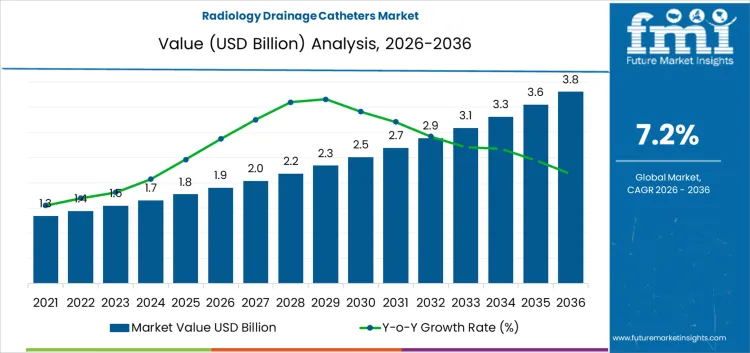
The radiology drainage catheters market rises from USD 1.9 billion in 2026 to USD 3.8 billion by 2036, representing a CAGR of 7.20%. Demand is concentrated in health systems with high procedural volumes and strong interventional radiology coverage, while adoption remains uneven where imaging guided care is limited. Regulatory oversight shapes vendor positioning because device classification, sterility validation, and post market surveillance obligations differ by region. Compliance cost and documentation depth influence portfolio breadth, which favors suppliers able to support audits and traceability. Purchasing decisions are often protocol driven, with hospitals aligning product choice to approved procedure pathways and reimbursement coding rules.
Over the period, growth patterns diverge based on hospital capital cycles and the organization of acute care networks rather than on population trends alone. Regions expanding day procedure and minimally invasive treatment capacity add volume faster than systems centered on surgical admission models. Import rules, local testing requirements, and tender structures affect how quickly new designs are introduced. Training availability and stocking practices also shape usage density. Distribution remains tied to clinical support coverage and service contracts. The category expands through procedural mix shifts and network level procurement, not through uniform increases in device usage across all care settings.
Quick Stats of the Radiology Drainage Catheters Market
- Radiology Drainage Catheters Market Value (2026): USD 1.9 billion
- Radiology Drainage Catheters Forecast Value (2036): USD 3.8 billion
- Radiology Drainage Catheters Forecast CAGR 2026 to 2036: 7.2%
- Leading Product in Radiology Drainage Catheters Market: Percutaneous Drainage Catheters (45 % share)
- Leading Application in Radiology Drainage Catheters Market: Abscess Drainage (38 % share)
- Key Growth Regions in Radiology Drainage Catheters Market: India, China, Brazil, USA, UK
- Top Players in Radiology Drainage Catheters Market: BD (Becton Dickinson), Cook Medical, Teleflex (AngioDynamics), Boston Scientific, Smith’s Medical, Merit Medical Systems, Medtronic
What is the Growth Forecast for Radiology Drainage Catheters Market through 2036?
Between 2026 and 2031, the radiology drainage catheters market is projected to expand from USD 1.9 billion along a trajectory consistent with a 7.2% CAGR, shaped by the steady shift of fluid management procedures from surgical theaters to interventional radiology suites. Drainage is increasingly performed as a planned, image-guided intervention rather than as an emergency adjunct to surgery. This changes utilization patterns from sporadic to protocol-driven across abscess, biliary, nephrostomy, and pleural applications. Growth in this phase is tied to procedure volume and hospital workflow redesign, not to changes in catheter design alone. Purchasing decisions emphasize predictability of placement, kink resistance, and compatibility with imaging guidance tools. Hospitals focus on standardizing kits and procedural trays, which stabilizes demand and favors suppliers with consistent quality and broad portfolio coverage.
From 2031 to 2036, the market is expected to reach USD 3.8 billion, with expansion driven by wider clinical reliance on minimally invasive drainage as a first-line intervention. As patient populations age and comorbidities increase, clinicians prefer image-guided drainage over surgical approaches whenever feasible, raising procedure counts across both acute and chronic care settings. The category benefits from protocol expansion in oncology, sepsis management, and post-operative care rather than from pricing leverage. Value growth follows utilization intensity and care pathway integration. Procurement increasingly sits within interventional radiology departments rather than general surgery budgets. Competitive positioning depends on clinical reliability, ease of use, and supply continuity, as hospitals prioritize outcome consistency over incremental device feature variation.
Radiology Drainage Catheters Market Key Takeaways
| Metric | Value |
|---|---|
| Market Value (2026) | USD 1.9 billion |
| Forecast Value (2036) | USD 3.8 billion |
| Forecast CAGR 2026 to 2036 | 7.2% |
How Is the Radiology Drainage Catheters Market Advancing Minimally Invasive Care?
Drainage catheters are increasingly adopted to manage fluid accumulation, abscesses, and post-surgical drainage through image-guided minimally invasive procedures. Historically, fluid management relied on open surgical drainage, which carried higher complication rates, longer recovery times, and increased hospital stays. Modern catheters incorporate radiopaque materials, flexible shafts, and self-retaining designs to enable precise placement under ultrasound, CT, or fluoroscopy guidance while minimizing patient discomfort. Hospitals, interventional radiology centers, and healthcare providers prioritize catheter reliability, biocompatibility, and ease of placement. Early adoption focused on tertiary care and specialty hospitals, while current demand spans general hospitals, outpatient surgical centers, and oncology units, driven by minimally invasive procedure trends, shorter hospitalization needs, and improved patient outcomes. Material flexibility, radiopacity, and drainage efficiency influence supplier selection.
Rising preference for image-guided interventions, demand for minimally invasive procedures, and improved patient safety are shaping market growth. Compared with traditional surgical drainage, modern radiology catheters emphasize precise placement, reduced trauma, and enhanced fluid evacuation. Cost structures depend on material quality, design complexity, and regulatory compliance, concentrating margins among suppliers capable of providing certified, high-performance catheters. Healthcare providers adopt these catheters to reduce procedure time, minimize complications, and optimize post-procedural care. By 2036, radiology drainage catheters are expected to become standard in interventional radiology and surgical care, supporting minimally invasive treatment, patient safety, and clinical efficiency.
What Factors Are Shaping the Demand for Radiology Drainage Catheters by Device Design and Clinical Application in 2026?
The radiology drainage catheters market in 2026 is segmented by product type and by clinical application. By device design, demand is divided into percutaneous drainage catheters, pigtail drainage catheters, multipurpose drainage catheters, and ureteral stents, each serving different access routes, anchoring needs, and fluid management tasks. By application, demand is organized around abscess drainage, pleural and thoracic drainage, biliary drainage, and urinary tract drainage, which differ in urgency, procedure complexity, and post procedure management. These segments reflect how interventional radiology practices allocate procedure time, manage complication risk, and select devices based on imaging guidance requirements and expected indwelling duration.
Why Do Percutaneous Drainage Catheters Account for the Largest Share of Device Demand?

Percutaneous drainage catheters account for about 45% of demand in 2026, reflecting their central role in image guided fluid evacuation across many anatomical sites. These devices are used in liver, abdominal, pelvic, and retroperitoneal collections, which makes them applicable to a wide range of clinical scenarios. Their designs support controlled placement, secure fixation, and predictable drainage, which reduces the need for repeat interventions. Hospitals and radiology departments rely on these catheters to manage infections and postoperative complications without open surgery. Procedure volumes remain high because percutaneous drainage is often the first line response to fluid collections detected on imaging. This broad procedural relevance sustains their leading position among drainage catheter types.
Pigtail and multipurpose catheters address more specific handling and anchoring needs. Pigtail designs reduce the risk of accidental dislodgement in mobile or superficial collections, while multipurpose catheters support departments that prefer to limit inventory variety. Ureteral stents serve a different function tied to urinary tract patency rather than simple fluid evacuation. Their use follows urology driven protocols and scheduling rather than interventional radiology case flow alone. These categories are essential, yet their indications are narrower. This limits their aggregate volumes compared with percutaneous drainage catheters, which remain the default tool for a wide range of image guided drainage procedures in routine hospital practice.
Why Does Abscess Drainage Represent the Largest Application Segment?
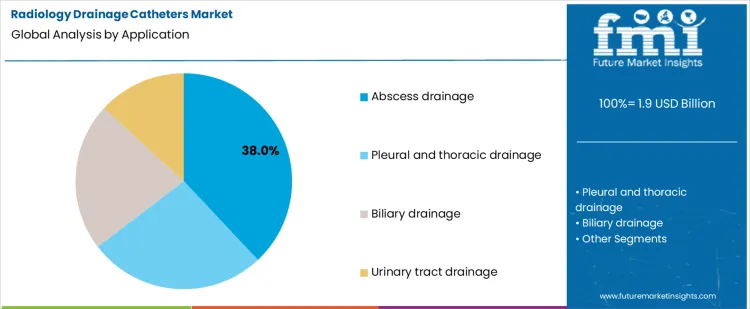
Abscess drainage represents about 38% of demand in 2026 because it is one of the most frequent indications for image guided catheter placement. Intra-abdominal, postoperative, and soft tissue abscesses are common complications in both surgical and medical patients. Radiology guided drainage allows rapid infection control while avoiding repeat surgery, which shortens hospital stays and reduces overall treatment burden. Many care pathways now assume percutaneous drainage as a standard step before considering more invasive options. These procedures also often require catheters to remain in place for several days, which increases device utilization per case. This combination of high case frequency and multi day use makes abscess drainage the largest single application area.
Pleural, biliary, and urinary tract drainage follow different clinical rhythms. Pleural drainage volumes depend on cardiopulmonary case mix and trauma incidence. Biliary drainage is tied to oncology and hepatobiliary disease management, which involves more planned and selective interventions. Urinary tract drainage through stents follows urology workflows rather than acute infection management.
Why Are Procedure Mix Shifts and Image Guided Intervention Pathways Driving the Radiology Drainage Catheters Market through 2036?
Demand is being pulled by how hospitals manage complications rather than by elective volumes. Image guided drainage has become a first response for abscesses, post-surgical collections, and malignant effusions because it shortens length of stay and avoids open procedures. As oncology and complex abdominal surgery volumes rise, so does the incidence of fluid management events that require percutaneous access. Multidisciplinary pathways now specify interventional radiology earlier, which standardizes catheter use across case types. Once a hospital commits to minimally invasive protocols, drainage supplies become routine consumables tied to case flow, not discretionary tools ordered only for exceptional situations.
What Cost Controls, Standardization, and Training Requirements Are Constraining Faster Uptake and Product Differentiation?
Limits come from hospital economics and practice patterns. Catheters are treated as commodity disposables in many procurement systems, with tenders emphasizing price and standard sizes over feature variation. Switching costs appear low, so suppliers face frequent rebidding pressure. Clinical outcomes depend heavily on placement skill and follow up care, which reduces appetite for paying more for incremental design changes. Training and credentialing also influence usage, since some units restrict procedures to a small group of operators. Inventory simplification policies further narrow approved ranges. These factors keep volumes aligned with procedure growth but restrain value expansion and slow the spread of specialized designs.
How Are Care Pathway Integration and Supply Chain Models Reshaping This Category?
The category is being reorganized around workflow rather than around individual devices. Hospitals increasingly bundle drainage catheters with access kits, guidewires, and imaging disposables to simplify procedure preparation and billing. Standard procedure packs reduce variability and support faster room turnover. At the same time, centralized purchasing groups prefer suppliers that can cover broad portfolios across interventional radiology. Outpatient and ambulatory settings also gain importance, which shifts demand toward easy to handle, predictable products. The result is a move away from single item selection toward system based sourcing, where catheters are specified as part of repeatable, protocol driven intervention pathways.
What is the Demand for Radiology Drainage Catheters by Country?

| Country | CAGR (%) |
|---|---|
| USA | 6.8% |
| UK | 6.5% |
| China | 7.8% |
| India | 8.2% |
| Brazil | 7.0% |
Demand for radiology drainage catheters is rising as healthcare providers adopt minimally invasive procedures for fluid drainage, enhanced patient outcomes, and reduced hospital stays. India leads with an 8.2% CAGR, driven by expanding healthcare infrastructure, rising prevalence of chronic and post-surgical conditions, and adoption of advanced interventional radiology techniques. China follows at 7.8%, supported by growing medical facilities, increasing healthcare expenditure, and rising diagnostic and interventional procedures. Brazil records 7.0% growth, shaped by expanding hospital networks and adoption of advanced catheter technologies. The USA grows at 6.8%, influenced by established interventional radiology practices and replacement demand. The UK shows 6.5% CAGR, reflecting steady adoption in diagnostic and therapeutic procedures.
How is the United States experiencing growth in the radiology drainage catheters market?
United States is experiencing growth at a CAGR of 6.8%, driven by increasing demand for minimally invasive procedures, expanding hospital infrastructure, and adoption of advanced interventional radiology techniques. Radiology drainage catheters are used for fluid management, abscess drainage, and post-surgical care, optimized for biocompatibility, flexibility, and imaging visibility. Demand is concentrated in metropolitan medical hubs such as Boston, Houston, and New York, where specialty hospitals and interventional radiology centers are abundant. Investments focus on device reliability, patient safety, and compliance with FDA and medical device regulations. Growth reflects rising procedural volume, technology adoption, and focus on minimally invasive patient care.
- Minimally invasive procedures drive adoption.
- Catheters optimize flexibility and imaging visibility.
- Specialty hospitals concentrate demand.
- Device reliability and regulatory compliance guide investment.
How is the United Kingdom witnessing growth in the radiology drainage catheters market?
United Kingdom is witnessing growth at a CAGR of 6.5%, fueled by NHS initiatives for improved interventional radiology services and rising adoption of minimally invasive procedures. Radiology drainage catheters are used in fluid management, abscess treatment, and postoperative care, optimized for precision, biocompatibility, and imaging compatibility. Demand is concentrated in London, Manchester, and Birmingham, where tertiary hospitals and diagnostic centers are prominent. Investments prioritize device performance, patient safety, and adherence to NHS and UK medical device standards. Growth reflects increasing procedural volumes, hospital upgrades, and expansion of interventional radiology capabilities.
- Interventional radiology initiatives drive adoption.
- Catheters enhance precision and imaging compatibility.
- Major hospitals concentrate demand.
- Device performance and regulatory compliance guide investment.
How is China experiencing growth in the radiology drainage catheters market?
China is experiencing growth at a CAGR of 7.8%, supported by rapid expansion of hospital infrastructure, growing interventional radiology departments, and rising demand for minimally invasive procedures in urban centers such as Beijing, Shanghai, and Guangzhou. Radiology drainage catheters are optimized for biocompatibility, durability, and imaging visibility. Demand is concentrated in tertiary hospitals, private clinics, and specialty surgical centers. Investments focus on device reliability, local manufacturing quality standards, and adherence to national medical regulations. Growth reflects increasing procedural volume, urban healthcare development, and rising awareness of minimally invasive treatment options.
- Urban healthcare expansion drives adoption.
- Catheters optimize biocompatibility and imaging visibility.
- Tertiary hospitals and clinics concentrate demand.
- Device reliability and national compliance guide investment.
How is India witnessing growth in the radiology drainage catheters market?
India is witnessing growth at a CAGR of 8.2%, fueled by expansion of private and tertiary hospitals in metro cities such as Mumbai, Delhi, and Bengaluru, coupled with rising demand for minimally invasive procedures. Radiology drainage catheters are used in fluid management, abscess drainage, and postoperative care, optimized for safety, imaging visibility, and operational reliability. Demand is concentrated in large hospitals, specialty clinics, and diagnostic centers. Investments prioritize device quality, biocompatibility, and adherence to national medical device regulations. Growth reflects increasing procedural volumes, hospital modernization, and adoption of advanced interventional radiology techniques.
- Private hospital expansion drives adoption.
- Catheters enhance safety and imaging visibility.
- Metro hospitals and clinics concentrate demand.
- Device quality and regulatory compliance guide investment.
How is Brazil experiencing growth in the radiology drainage catheters market?
Brazil is experiencing growth at a CAGR of 7%, supported by urban healthcare infrastructure expansion and rising demand for minimally invasive interventional procedures. Radiology drainage catheters are optimized for biocompatibility, imaging visibility, and procedural reliability. Demand is concentrated in São Paulo, Rio de Janeiro, and Brasília, where private hospitals and specialty centers handle high patient volumes. Investments focus on material durability, device performance, and compliance with national healthcare and medical device standards. Growth reflects increasing procedural volumes, modernization of hospital facilities, and adoption of advanced interventional radiology technologies.
- Minimally invasive procedures drive adoption.
- Catheters optimize biocompatibility and imaging visibility.
- Private hospitals concentrate demand.
- Device durability and compliance guide investment.
Who Are the Key Competitors in the Radiology Drainage Catheters Market and How Do They Differ?
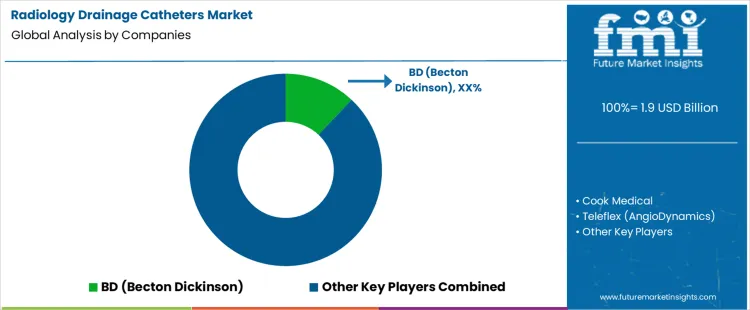
Competition in the radiology drainage catheters market is determined by product range, clinical support, and compatibility with imaging modalities used in interventional radiology. BD (Becton Dickinson) supplies a portfolio of drainage catheters designed for percutaneous procedures, emphasising consistent lumen integrity and material biocompatibility. Cook Medical offers a broad range of drainage systems with variants in tip design and flexibility suited for different anatomical sites. Teleflex, through its AngioDynamics division, provides catheters engineered for imaging guidance compatibility and secure placement. Boston Scientific delivers drainage solutions integrated with ancillary devices for procedural efficiency. Smith’s Medical supplies catheters with attention to ease of insertion and radiopaque markers for imaging visibility. Merit Medical Systems offers a range of sizes and drainage configurations, supporting diverse clinical needs. Medtronic develops drainage products designed for critical care and interventional applications where dependable fluid egress is required. Other regional manufacturers supply drainage catheters meeting local regulatory standards.
Market participants differentiate through design innovation, procedural support, and evidence of clinical performance. BD (Becton Dickinson) focuses on drainage catheters with consistent manufacturing quality and global regulatory approvals. Cook Medical’s range includes specialized tips and variable stiffness profiles that aid navigation under imaging. Teleflex (AngioDynamics) emphasises compatibility with ultrasound and fluoroscopy, and provides procedural training resources for clinicians. Boston Scientific integrates drainage catheters into broader interventional portfolios, supporting workflows where multiple device classes are used. Smiths Medical’s products are designed for ease of use in acute care and radiology suites. Merit Medical Systems develops drainage systems with a range of accessories to facilitate procedural customization. Medtronic’s offerings align with safety and infection control standards in hospital settings. Other suppliers may focus on cost competitive solutions, rapid delivery, or customization options.
Key Players in the Radiology Drainage Catheters Market
- BD (Becton Dickinson)
- Cook Medical
- Teleflex (AngioDynamics)
- Boston Scientific
- Smith’s Medical
- Merit Medical Systems
- Medtronic
Scope of the Report
| Items | Values |
|---|---|
| Quantitative Units (2026) | USD billion |
| Product Type | Percutaneous Drainage Catheters, Pigtail Drainage Catheters, Multipurpose Drainage Catheters, Ureteral Stents |
| Application | Abscess Drainage, Pleural and Thoracic Drainage, Biliary Drainage, Urinary Tract Drainage |
| Regions Covered | Asia Pacific, Europe, North America, Latin America, Middle East & Africa |
| Countries Covered | China, Japan, South Korea, India, Australia & New Zealand, ASEAN, Germany, United Kingdom, France, Italy, Spain, Nordic, BENELUX, United States, Canada, Mexico, Brazil, Chile, Saudi Arabia, Turkey, South Africa, and other regional markets |
| Key Companies Profiled | BD (Becton Dickinson), Cook Medical, Teleflex (AngioDynamics), Boston Scientific, Smith’s Medical, Merit Medical Systems, Medtronic |
| Additional Attributes | Dollar sales by product type and application, percutaneous drainage catheters forming the largest device category due to broad use across image guided procedures, abscess drainage representing the largest application segment because of high case frequency and multi day catheter dwell times, market growth driven by the shift of fluid management from surgery to interventional radiology, strong influence of hospital protocols, tenders, and reimbursement coding on product selection, demand tied to procedure volume and care pathway design rather than device innovation alone, increasing use of standardized procedure kits and trays, procurement concentrated at department or network level, and competitive positioning based on clinical reliability, ease of placement, imaging compatibility, regulatory compliance, and supply continuity rather than feature differentiation. |
Radiology Drainage Catheters Market Segmentation
Product Type:
- Percutaneous drainage catheters
- Pigtail drainage catheters
- Multipurpose drainage catheters
- Ureteral stents
Application:
- Abscess drainage
- Pleural and thoracic drainage
- Biliary drainage
- Urinary tract drainage
Region:
- Asia Pacific
- China
- Japan
- South Korea
- India
- Australia & New Zealand
- ASEAN
- Rest of Asia Pacific
- Europe
- Germany
- United Kingdom
- France
- Italy
- Spain
- Nordic
- BENELUX
- Rest of Europe
- North America
- United States
- Canada
- Mexico
- Latin America
- Brazil
- Chile
- Rest of Latin America
- Middle East & Africa
- Kingdom of Saudi Arabia
- Other GCC Countries
- Turkey
- South Africa
- Other African Union
- Rest of Middle East & Africa
Bibliography
- World Health Organization. (2024). Medical devices: Key facts and regulatory overview.
- World Health Organization. (2023). WHO global model regulatory framework for medical devices including IVDs.
- USA Food and Drug Administration. (2024). Classification of medical devices and regulatory controls.
- National Institute of Biomedical Imaging and Bioengineering. (2025). Image-guided interventions.
- National Institutes of Health. (2024). Interventional radiology: Minimally invasive image-guided procedures.
Frequently Asked Questions
How big is the radiology drainage catheters market in 2026?
The global radiology drainage catheters market is estimated to be valued at USD 1.9 billion in 2026.
What will be the size of radiology drainage catheters market in 2036?
The market size for the radiology drainage catheters market is projected to reach USD 3.8 billion by 2036.
How much will be the radiology drainage catheters market growth between 2026 and 2036?
The radiology drainage catheters market is expected to grow at a 7.2% CAGR between 2026 and 2036.
What are the key product types in the radiology drainage catheters market?
The key product types in radiology drainage catheters market are percutaneous drainage catheters, pigtail drainage catheters, multipurpose drainage catheters and ureteral stents.
Which application segment to contribute significant share in the radiology drainage catheters market in 2026?
In terms of application, abscess drainage segment to command 38.0% share in the radiology drainage catheters market in 2026.
Preview the report firsthand - request a free sample
Get SampleGet the brochure for pricing and purchase details.
Get PDFTable of Content
- Executive Summary
- Global Market Outlook
- Demand-side Trends
- Supply-side Trends
- Technology Roadmap Analysis
- Analysis and Recommendations
- Market Overview
- Market Coverage / Taxonomy
- Market Definition / Scope / Limitations
- Market Background
- Market Dynamics
- Drivers
- Restraints
- Opportunity
- Trends
- Scenario Forecast
- Demand in Optimistic Scenario
- Demand in Likely Scenario
- Demand in Conservative Scenario
- Opportunity Map Analysis
- Product Life Cycle Analysis
- Supply Chain Analysis
- Investment Feasibility Matrix
- Value Chain Analysis
- PESTLE and Porter’s Analysis
- Regulatory Landscape
- Regional Parent Market Outlook
- Production and Consumption Statistics
- Import and Export Statistics
- Market Dynamics
- Global Market Analysis 2021 to 2025 and Forecast, 2026 to 2036
- Historical Market Size Value (USD Million) Analysis, 2021 to 2025
- Current and Future Market Size Value (USD Million) Projections, 2026 to 2036
- Y-o-Y Growth Trend Analysis
- Absolute $ Opportunity Analysis
- Global Market Pricing Analysis 2021 to 2025 and Forecast 2026 to 2036
- Global Market Analysis 2021 to 2025 and Forecast 2026 to 2036, By Product Type
- Introduction / Key Findings
- Historical Market Size Value (USD Million) Analysis By Product Type, 2021 to 2025
- Current and Future Market Size Value (USD Million) Analysis and Forecast By Product Type, 2026 to 2036
- Percutaneous drainage catheters
- Pigtail drainage catheters
- Multipurpose drainage catheters
- Ureteral stents
- Percutaneous drainage catheters
- Y-o-Y Growth Trend Analysis By Product Type, 2021 to 2025
- Absolute $ Opportunity Analysis By Product Type, 2026 to 2036
- Global Market Analysis 2021 to 2025 and Forecast 2026 to 2036, By Application
- Introduction / Key Findings
- Historical Market Size Value (USD Million) Analysis By Application, 2021 to 2025
- Current and Future Market Size Value (USD Million) Analysis and Forecast By Application, 2026 to 2036
- Abscess drainage
- Pleural and thoracic drainage
- Biliary drainage
- Urinary tract drainage
- Abscess drainage
- Y-o-Y Growth Trend Analysis By Application, 2021 to 2025
- Absolute $ Opportunity Analysis By Application, 2026 to 2036
- Global Market Analysis 2021 to 2025 and Forecast 2026 to 2036, By Region
- Introduction
- Historical Market Size Value (USD Million) Analysis By Region, 2021 to 2025
- Current Market Size Value (USD Million) Analysis and Forecast By Region, 2026 to 2036
- North America
- Latin America
- Western Europe
- Eastern Europe
- East Asia
- South Asia and Pacific
- Middle East & Africa
- Market Attractiveness Analysis By Region
- North America Market Analysis 2021 to 2025 and Forecast 2026 to 2036, By Country
- Historical Market Size Value (USD Million) Trend Analysis By Market Taxonomy, 2021 to 2025
- Market Size Value (USD Million) Forecast By Market Taxonomy, 2026 to 2036
- By Country
- USA
- Canada
- Mexico
- By Product Type
- By Application
- By Country
- Market Attractiveness Analysis
- By Country
- By Product Type
- By Application
- Key Takeaways
- Latin America Market Analysis 2021 to 2025 and Forecast 2026 to 2036, By Country
- Historical Market Size Value (USD Million) Trend Analysis By Market Taxonomy, 2021 to 2025
- Market Size Value (USD Million) Forecast By Market Taxonomy, 2026 to 2036
- By Country
- Brazil
- Chile
- Rest of Latin America
- By Product Type
- By Application
- By Country
- Market Attractiveness Analysis
- By Country
- By Product Type
- By Application
- Key Takeaways
- Western Europe Market Analysis 2021 to 2025 and Forecast 2026 to 2036, By Country
- Historical Market Size Value (USD Million) Trend Analysis By Market Taxonomy, 2021 to 2025
- Market Size Value (USD Million) Forecast By Market Taxonomy, 2026 to 2036
- By Country
- Germany
- UK
- Italy
- Spain
- France
- Nordic
- BENELUX
- Rest of Western Europe
- By Product Type
- By Application
- By Country
- Market Attractiveness Analysis
- By Country
- By Product Type
- By Application
- Key Takeaways
- Eastern Europe Market Analysis 2021 to 2025 and Forecast 2026 to 2036, By Country
- Historical Market Size Value (USD Million) Trend Analysis By Market Taxonomy, 2021 to 2025
- Market Size Value (USD Million) Forecast By Market Taxonomy, 2026 to 2036
- By Country
- Russia
- Poland
- Hungary
- Balkan & Baltic
- Rest of Eastern Europe
- By Product Type
- By Application
- By Country
- Market Attractiveness Analysis
- By Country
- By Product Type
- By Application
- Key Takeaways
- East Asia Market Analysis 2021 to 2025 and Forecast 2026 to 2036, By Country
- Historical Market Size Value (USD Million) Trend Analysis By Market Taxonomy, 2021 to 2025
- Market Size Value (USD Million) Forecast By Market Taxonomy, 2026 to 2036
- By Country
- China
- Japan
- South Korea
- By Product Type
- By Application
- By Country
- Market Attractiveness Analysis
- By Country
- By Product Type
- By Application
- Key Takeaways
- South Asia and Pacific Market Analysis 2021 to 2025 and Forecast 2026 to 2036, By Country
- Historical Market Size Value (USD Million) Trend Analysis By Market Taxonomy, 2021 to 2025
- Market Size Value (USD Million) Forecast By Market Taxonomy, 2026 to 2036
- By Country
- India
- ASEAN
- Australia & New Zealand
- Rest of South Asia and Pacific
- By Product Type
- By Application
- By Country
- Market Attractiveness Analysis
- By Country
- By Product Type
- By Application
- Key Takeaways
- Middle East & Africa Market Analysis 2021 to 2025 and Forecast 2026 to 2036, By Country
- Historical Market Size Value (USD Million) Trend Analysis By Market Taxonomy, 2021 to 2025
- Market Size Value (USD Million) Forecast By Market Taxonomy, 2026 to 2036
- By Country
- Kingdom of Saudi Arabia
- Other GCC Countries
- Turkiye
- South Africa
- Other African Union
- Rest of Middle East & Africa
- By Product Type
- By Application
- By Country
- Market Attractiveness Analysis
- By Country
- By Product Type
- By Application
- Key Takeaways
- Key Countries Market Analysis
- USA
- Pricing Analysis
- Market Share Analysis, 2025
- By Product Type
- By Application
- Canada
- Pricing Analysis
- Market Share Analysis, 2025
- By Product Type
- By Application
- Mexico
- Pricing Analysis
- Market Share Analysis, 2025
- By Product Type
- By Application
- Brazil
- Pricing Analysis
- Market Share Analysis, 2025
- By Product Type
- By Application
- Chile
- Pricing Analysis
- Market Share Analysis, 2025
- By Product Type
- By Application
- Germany
- Pricing Analysis
- Market Share Analysis, 2025
- By Product Type
- By Application
- UK
- Pricing Analysis
- Market Share Analysis, 2025
- By Product Type
- By Application
- Italy
- Pricing Analysis
- Market Share Analysis, 2025
- By Product Type
- By Application
- Spain
- Pricing Analysis
- Market Share Analysis, 2025
- By Product Type
- By Application
- France
- Pricing Analysis
- Market Share Analysis, 2025
- By Product Type
- By Application
- India
- Pricing Analysis
- Market Share Analysis, 2025
- By Product Type
- By Application
- ASEAN
- Pricing Analysis
- Market Share Analysis, 2025
- By Product Type
- By Application
- Australia & New Zealand
- Pricing Analysis
- Market Share Analysis, 2025
- By Product Type
- By Application
- China
- Pricing Analysis
- Market Share Analysis, 2025
- By Product Type
- By Application
- Japan
- Pricing Analysis
- Market Share Analysis, 2025
- By Product Type
- By Application
- South Korea
- Pricing Analysis
- Market Share Analysis, 2025
- By Product Type
- By Application
- Russia
- Pricing Analysis
- Market Share Analysis, 2025
- By Product Type
- By Application
- Poland
- Pricing Analysis
- Market Share Analysis, 2025
- By Product Type
- By Application
- Hungary
- Pricing Analysis
- Market Share Analysis, 2025
- By Product Type
- By Application
- Kingdom of Saudi Arabia
- Pricing Analysis
- Market Share Analysis, 2025
- By Product Type
- By Application
- Turkiye
- Pricing Analysis
- Market Share Analysis, 2025
- By Product Type
- By Application
- South Africa
- Pricing Analysis
- Market Share Analysis, 2025
- By Product Type
- By Application
- USA
- Market Structure Analysis
- Competition Dashboard
- Competition Benchmarking
- Market Share Analysis of Top Players
- By Regional
- By Product Type
- By Application
- Competition Analysis
- Competition Deep Dive
- BD (Becton Dickinson)
- Overview
- Product Portfolio
- Profitability by Market Segments (Product/Age /Sales Channel/Region)
- Sales Footprint
- Strategy Overview
- Marketing Strategy
- Product Strategy
- Channel Strategy
- Cook Medical
- Teleflex (AngioDynamics)
- Boston Scientific
- Smiths Medical
- Merit Medical Systems
- Medtronic
- BD (Becton Dickinson)
- Competition Deep Dive
- Assumptions & Acronyms Used
- Research Methodology


