

- Industry Size (2026)
- USD 1.2 Bn
- Forecast (2036)
- USD 3.5 Bn
- CAGR (2026 to 2036)
- 11.30%
Radiology Structured Reporting Automation Market Size, Market Forecast and Outlook By FMI
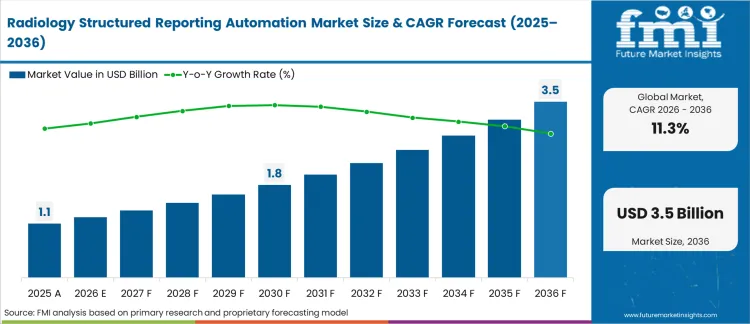
The radiology structured reporting automation market was valued at USD 1.1 billion in 2025. The sector is set to reach USD 1.2 billion in 2026 at a CAGR of 11.30% during the forecast period. Demand outlook carries the valuation to USD 3.5 billion through 2036 as mandatory discrete data extraction for algorithmic billing compliance forces imaging centers to abandon free-text dictation.
The transition to rigid semantic categorisation fundamentally alters how diagnostic findings are documented. Large health systems face an immediate capability gap as algorithmic claim scrubbers increasingly reject unstructured narrative reports. Directors who delay upgrading their reporting engines lose substantial reimbursement revenue due to technical denials under the latest Medicare Physician Fee Schedule. Insiders understand that the true bottleneck is not voice recognition accuracy, but rather the bidirectional ontological mapping between a radiologist's preferred narrative sequence and the rigid discrete data fields required by hospital billing engines. This pressure accelerates the integration of intelligent healthcare documentation systems that automate lexicon alignment.
Summary of Radiology Structured Reporting Automation Market
- Radiology Structured Reporting Automation Market Definition:
- The radiology structured reporting automation market encompasses intelligent software that converts radiological image interpretations into standardized, computable data formats, allowing healthcare networks to extract discrete diagnostic data for billing and quality tracking.
- Demand Drivers in the Market:
- The 2024 Medicare Physician Fee Schedule enforcing specific structured data elements, forces large health systems to overhaul their entire diagnostic documentation workflow.
- Severe radiologist burnout and stagnant RVU productivity limits compel private radiology groups to adopt auto-templating engines to reduce turnaround times.
- The necessity for cross-network data homogenization drives teleradiology providers to implement API-first drafting algorithms to standardize output across heterogeneous hospital PACS environments.
- Key Segments Analyzed in the FMI Report:
- Software Platforms: 68.5% share in 2026, driven by the shift toward cloud-based, subscription-driven continuous ontology updates.
- CT: 35.2% share in 2026, dominated by the high volume of complex oncology and trauma scans requiring intricate, multi-organ staging templates.
- Hospitals: 55.4% share in 2026, necessitated by enterprise-wide mandates to prevent technical claim denials in high-throughput departments.
- United States: 12.5% compound growth, accelerated by strict MACRA value-based care reporting requirements.
- Analyst Opinion at FMI:
- Sabyasachi Ghosh, Principal Healthcare Analyst, opines, "The true bottleneck is not voice recognition accuracy, but the bidirectional mapping between a radiologist's narrative flow and the rigid data fields required by downstream billing engines. Vendors failing to resolve this semantic translation will face severe deployment stalls in high-volume trauma centers."
- Strategic Implications / Executive Takeaways:
- Hospital Chief Information Officers must fully deprecate legacy free-text RIS modules before the FY2028 reimbursement penalty phase begins to protect revenue streams.
- Platform developers should engineer zero-click EHR integration to displace incumbents currently reliant on manual macro selection.
- Teleradiology network administrators must standardize their drafting APIs or face significant operational delays when interfacing with disparate health system archives.
Critical mass in this sector hinges on the complete phase-out of legacy dictation macros within enterprise imaging networks. Hospital Chief Information Officers must fully deprecate legacy free-text RIS modules before the FY2028 reimbursement penalty phase begins. Crossing this threshold converts report generation into a fully computable, zero-click process.
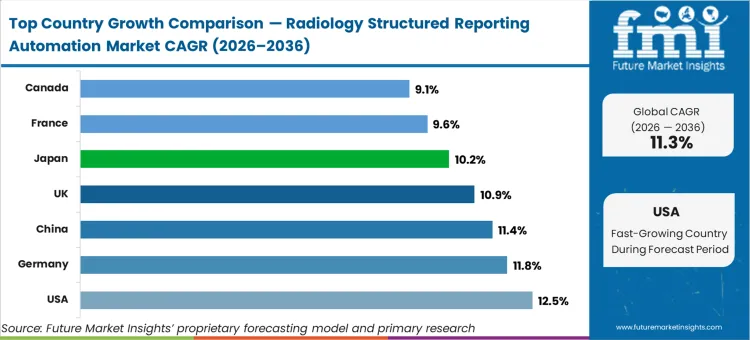
The United States records a 12.5% CAGR, driven by the transition to value-based care models under MACRA that strictly penalize practices failing to report discrete quality metrics. Germany advances at 11.8%, while China expands at 11.4%. The United Kingdom grows at 10.9%, Japan follows at 10.2%, France tracks at 9.6%, and Canada posts 9.1%. This regional growth spread exists structurally because distinct national healthcare systems digitize their central radiology archives and enforce algorithmic billing audits at completely different infrastructural cadences.
Radiology Structured Reporting Automation Market Key Takeaways
| Metric | Details |
|---|---|
| Industry Size (2026) | USD 1.2 billion |
| Industry Value (2036) | USD 3.5 billion |
| CAGR (2026-2036) | 11.30% |
Source: Future Market Insights (FMI) analysis, based on proprietary forecasting model and primary research
Radiology Structured Reporting Automation Market Definition
The radiology structured reporting automation market encompasses intelligent software and semantic mapping tools that convert radiological image interpretations into standardized, computable data formats. Unlike basic speech-to-text dictation, these solutions automatically apply recognized medical ontologies, such as BI-RADS or RadLex, to clinical narratives. This allows healthcare networks to extract discrete diagnostic data for billing, quality tracking, and downstream clinical decision support.
Radiology Structured Reporting Automation Market Inclusions
This scope covers AI-driven reporting platforms, contextual language understanding modules, template auto-population engines, and bidirectional EHR integration software. It also includes the implementation and API configuration services required to deploy these medical imaging analytics within complex hospital networks.
Radiology Structured Reporting Automation Market Exclusions
Basic medical transcription services, standalone voice recognition software without structured mapping capabilities, and primary diagnostic imaging hardware (such as the MRI or CT scanners themselves) are strictly excluded. The focus remains explicitly on the software layer responsible for formatting and structuring the diagnostic output, not the hardware acquiring the images.
Radiology Structured Reporting Automation Market Research Methodology
- Primary Research: FMI analysts engaged directly with Chief Medical Information Officers, enterprise PACS administrators, and lead diagnostic radiologists operating within Tier-1 health systems.
- Desk Research: The baseline derives from aggregating compliance roadmaps published by the American College of Radiology, HL7 FHIR documentation, and technical integration standards from the IHE Radiology domain.
- Market-Sizing and Forecasting: The valuation baseline relies on assessing the installed base of legacy RIS applications across regional hospital networks, applying replacement cycle curves dictated by upcoming value-based care penalty deadlines.
- Data Validation and Update Cycle: Projections were cross validated by comparing software vendor deployment announcements against actual Medicare quality reporting compliance data from selected regional hospital networks.
Segmental Analysis
Radiology Structured Reporting Automation Market Analysis by Component
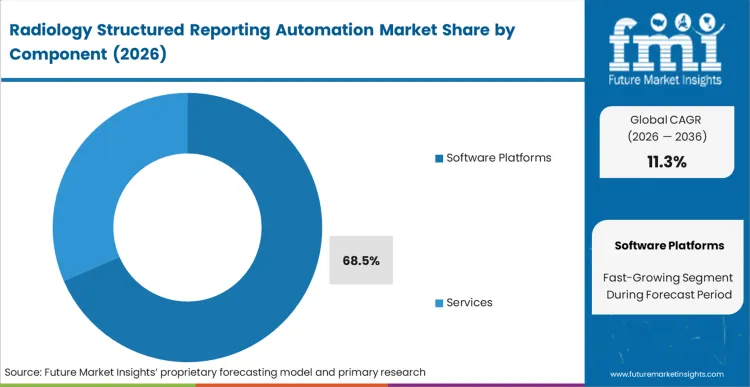
Software Platforms hold a dominant 68.5% share in 2026 due to the fundamental necessity for continuous, cloud-based ontology updates to match changing clinical guidelines. Enterprise PACS administrators strictly dictate the procurement of these core engines to ensure that shifting BI-RADS or PI-RADS classifications are instantly available across all workstations.
According to FMI's estimates, the reliance on outdated, static software creates unacceptable clinical and financial risk. Health IT procurement directors who fail to deploy dynamic software platforms face immediate compliance auditing failures when national imaging standards update.
- Algorithmic updates: Cloud-native architecture allows developers to push lexicon modifications instantaneously without local server downtime. Facility managers utilizing this architecture eliminate costly weekend IT maintenance windows.
- Semantic mapping: Context-aware natural language processing translates colloquial dictation into discrete clinical variables. Radiology group directors deploying these algorithms reduce post-read addendum requests from referring physicians.
- Implementation support: Complex data migrations require dedicated clinical workflow analysts to map historical templates to new computable formats. Operations leads securing these services prevent catastrophic report delays during the initial go-live phase.
Radiology Structured Reporting Automation Market Analysis by Modality
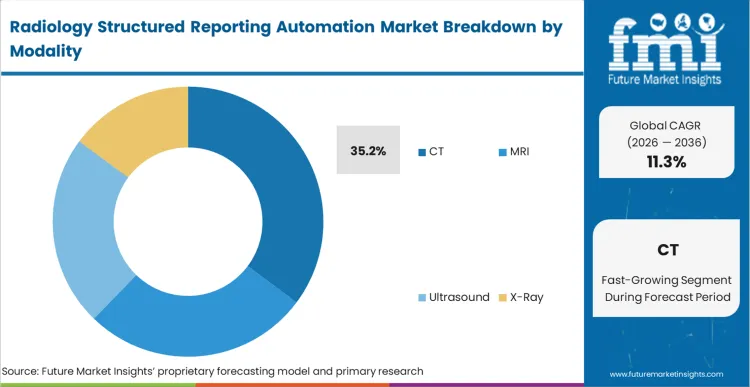
The multi-organ staging requirements of advanced oncology tracking create a massive documentation burden that CT-specific automation explicitly resolves. Oncological radiologists reading these complex volumetric scans must meticulously categorise tumour dimensions against prior baseline measurements. FMI analysts opine that CT dominates this dimension with a 35.2% share in 2026 because the manual dictation of these comparative metrics is highly prone to transcription errors. Clinical directors who implement automated measurement extraction for CT scans drastically cut report turnaround times and avoid critical delays in patient treatment pathways.
- Volumetric extraction: Direct integration with 3D imaging workstations pulls linear measurements directly into the reporting template. Diagnostic radiologists utilising this linkage eliminate the risk of manual transposition errors.
- Protocol compliance: Standardized stroke and trauma templates ensure all required anatomical checkpoints are documented within emergency timeframes. Emergency department chiefs mandating these templates reduce liability exposure during critical care handoffs.
- Contrast tracking: Automated capture of contrast media volume and flow rates standardizes kidney function correlation. Quality assurance officers tracking these variables prevent adverse event reporting failures.
Radiology Structured Reporting Automation Market Analysis by End User
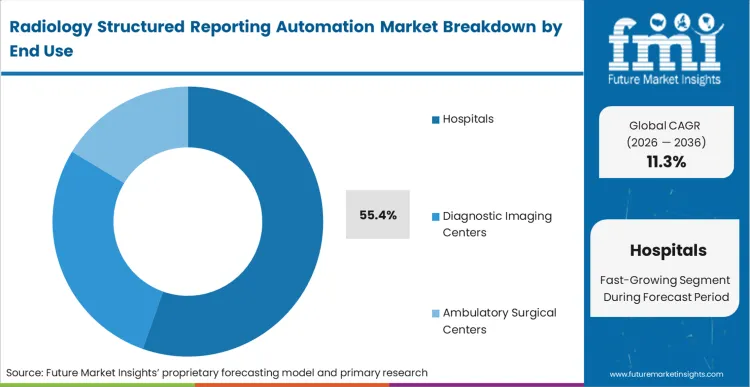
Strict technical claim scrubber protocols enforced by large commercial payers force the adoption of enterprise-grade documentation tools. High-volume hospital networks, controlling a 55.4% share in 2026, face severe financial penalties if their diagnostic reports lack the discrete data fields required to justify complex billing codes. Based on FMI's assessment, the sheer volume of daily reads makes manual compliance checking impossible without software intervention. Revenue cycle vice presidents must integrate automated clinical coding workflows or forfeit millions in denied claims.
- Enterprise scalability: Multi-site health systems demand unified reporting frameworks that function seamlessly across disparate geographic locations. Network CIOs standardizing these frameworks consolidate their software licensing costs.
- Outpatient efficiency: Standalone diagnostic centers utilize automated templating to maximize the daily scan volume processed per radiologist. Center administrators deploying these tools protect their tight profit margins against declining reimbursement rates.
- Surgical alignment: Ambulatory surgical centers require preoperative imaging reports to follow strict, predictable formats for rapid surgical clearance. Surgical directors enforcing this alignment eliminate day-of-surgery cancellations caused by ambiguous diagnostic narratives.
Radiology Structured Reporting Automation Market Drivers, Restraints, and Opportunities
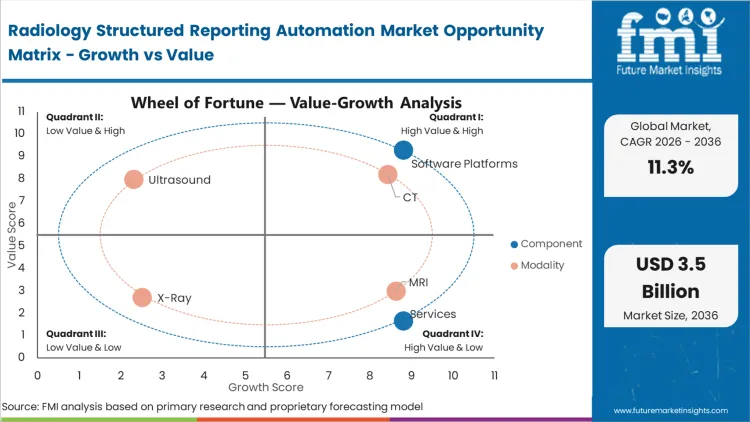
The government mandates specific structured data elements for advanced diagnostic imaging, serving as the primary structural force propelling the sector. Large health systems face an immediate mandate to embed discrete Appropriate Use Criteria directly into their reports. This regulatory trigger forces hospital CIOs to abandon legacy dictation tools in favour of intelligent drafting engines, fueling massive market expansion. Directors who fail to adopt these compliance-driven automation platforms will suffer catastrophic reimbursement denials and lose access to top-tier commercial payer networks.
Deep interoperability friction between cutting-edge reporting algorithms and legacy, on-premises Radiology Information Systems severely constrains deployment speed. Many regional hospitals operate on heavily customised, decade-old IT infrastructure that simply cannot process modern HL7 FHIR data streams. While middleware data brokers are emerging as a workaround, they introduce latency into the radiologist's workflow, which defeats the efficiency purpose of the automation. This structural technical debt limits the immediate addressable market to facilities with modernised, cloud-ready enterprise architectures.
Opportunities in the Radiology Structured Reporting Automation Market
.webp "Top Country Growth Comparison Radiology Structured Reporting Automation Market Cagr (2026 2036)")
- Real-Time Lesion Tracking: Advanced software architectures enable engines to automatically compare current tumor dimensions against historical PACS data without manual query. Oncology informatics leads deploying this capability secure exclusive diagnostic contracts with major cancer research institutions.
- Ambient Voice Generation: Next-generation multimodal models permit the system to generate structured electronic health records by simply listening to the radiologist's real-time consultation with referring physicians. Technology vendors licensing this ambient listening capability capture massive market share by eliminating the dictation step.
- Automated Priority Escalation: Intelligent parsers detect critical findings within the drafted text and autonomously trigger secure alerts to emergency response teams. Teleradiology network operators implementing this escalation protocol drastically reduce their malpractice liability profile.
Regional Analysis
Based on the regional analysis, the Radiology Structured Reporting Automation market is segmented into North America, Europe, East Asia, South Asia & Pacific, Middle East & Africa, and Latin America across 40-plus countries.
| Country | CAGR (2026 to 2036) |
|---|---|
| United States | 12.5% |
| Germany | 11.8% |
| China | 11.4% |
| United Kingdom | 10.9% |
| Japan | 10.2% |
| France | 9.6% |
| Canada | 9.1% |
Source: Future Market Insights (FMI) analysis, based on a proprietary forecasting model and primary research
North America Radiology Structured Reporting Automation Market Analysis
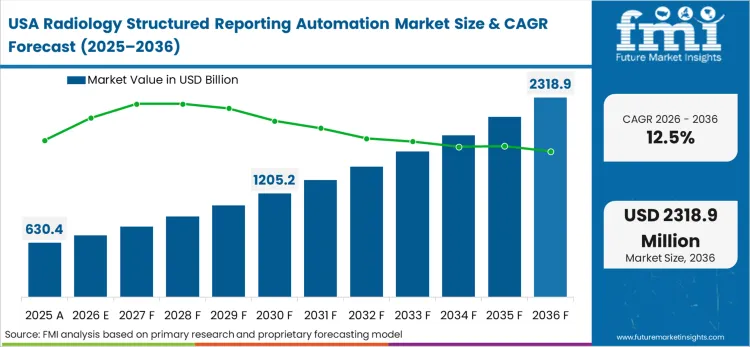
Strict federal value-based care mandates and specific MACRA quality reporting requirements govern the modernisation of diagnostic workflows. The transition from fee-for-service to outcome-based reimbursement places immense pressure on imaging departments to produce quantifiable, computable diagnostic data. As per FMI's projection, this regulatory environment makes basic narrative dictation commercially unviable for high-volume networks. The sheer complexity of algorithmic claim scrubbing requires enterprise systems to adopt sophisticated medical billing automation integrations to maintain financial stability.
- United States: The United States' aggressive shift toward Medicare's Appropriate Use Criteria forces Tier-1 health systems to embed clinical decision support mechanisms directly into the reporting software. This strict compliance threshold drives rapid adoption, expanding at 12.5% between 2026 and 2036. Revenue cycle vice presidents who ignore these value-based data mandates face devastating, automatic claim rejections on high-margin diagnostic procedures.
- Canada: Provincial health authorities in Canada demand standardized cross-network interoperability to facilitate seamless teleradiology sharing between urban hubs and rural clinics. Tracking a 9.1% annual growth to 2036, this infrastructure requirement dictates procurement. Regional informatics directors must deploy API-compliant platforms or face severe workflow bottlenecks during inter-hospital patient transfers.
FMI's report includes a comprehensive evaluation of Mexico and other Central American territories. The ongoing consolidation of private imaging networks across these secondary regions accelerates the demand for unified, multi-tenant reporting architectures.
Europe Radiology Structured Reporting Automation Market Analysis
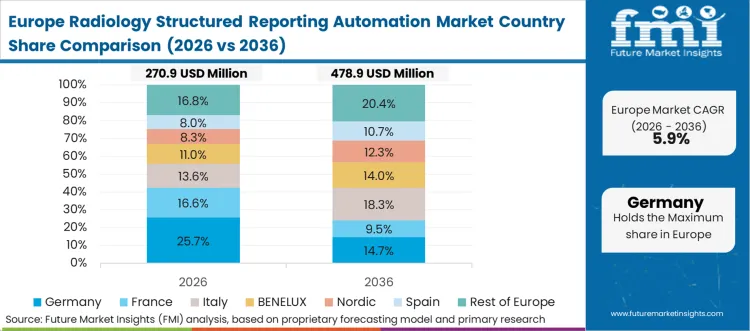
The highly fragmented nature of cross-border health data exchanges under the emerging European Health Data Space dictates the architectural requirements for reporting vendors. Standardizing diagnostic output across disparate national health systems requires robust, multi-lingual ontology mapping capabilities. FMI analysts opine that vendors must engineer deep semantic interoperability to function within these rigid public health networks. The demand for harmonized clinical registries drives the displacement of siloed, localised dictation tools.
- Germany: Sustaining an 11.8% CAGR to 2036, this capital injection forces rapid modernization. Germany's heavily subsidized Hospital Future Act explicitly funds the digitization of clinical documentation, accelerating the replacement of antiquated RIS modules. Chief Medical Information Officers deploying these state-funded upgrades secure a massive operational advantage in radiologist recruitment.
- United Kingdom: NHS Trusts in the United Kingdom face unprecedented imaging backlogs, forcing procurement teams to prioritize auto-templating engines that drastically reduce per-scan reporting times. Projected at 10.9% compound growth over the forecast period, this capacity crisis defines the market. Trust administrators must implement these efficiency tools to avoid catastrophic breaches of the national two-week cancer referral targets.
- France: Strict sovereign data localisation mandates in France require cloud‑based reporting platforms to operate exclusively within certified domestic data centers. This security requirement limits vendor entry, and system integrators that successfully navigate this compliance gate secure highly lucrative, long‑term contracts with regional public hospital groups, advancing at a 9.6% compound rate between 2026 and 2036.
FMI's report includes a detailed analysis of Italy, Spain, and the Nordics. The rapid expansion of centralized, government-funded teleradiology command centers across these countries necessitates the procurement of highly standardized reporting suites.
East Asia Radiology Structured Reporting Automation Market Analysis
Immense margin pressure within newly established, hyper-scale diagnostic imaging centers drives a massive volume-based approach to radiology. These greenfield facilities operate on incredibly tight per-scan margins, requiring absolute maximum throughput from their clinical staff to achieve profitability. In FMI's view, this economic reality renders traditional, time-consuming voice dictation entirely obsolete. facility operators rely on AI-generated, zero-click templates to maintain their aggressive operational cadence and justify heavy capital investments in diagnostic hardware.
- China: Anchored to an 11.4% annual expansion through the decade, hyperscale greenfield hospital projects in China bypass legacy dictation infrastructure entirely and adopt native, AI‑driven structured reporting within newly built enterprise imaging architectures. This leapfrog dynamic dominates the sector, as capital project directors equipping these mega‑hospitals eliminate downstream integration costs by enforcing strict semantic standards from day one.
- Japan: Severe demographic shifts and a critical shortage of board-certified radiologists in Japan require diagnostic networks to maximize the RVU output of their remaining specialists. At a 10.2% compound annual rate through 2036, this labour constraint drives deep automation. Technology vendors embedding ambient drafting algorithms directly into the imaging workstation capture a dominant market share among private diagnostic groups.
FMI's report includes coverage of South Korea and Taiwan. The heavy concentration of advanced medical hardware manufacturers in these territories fosters tight, native integration between local reporting software and domestic diagnostic imaging equipment.
Competitive Aligners for Market Players
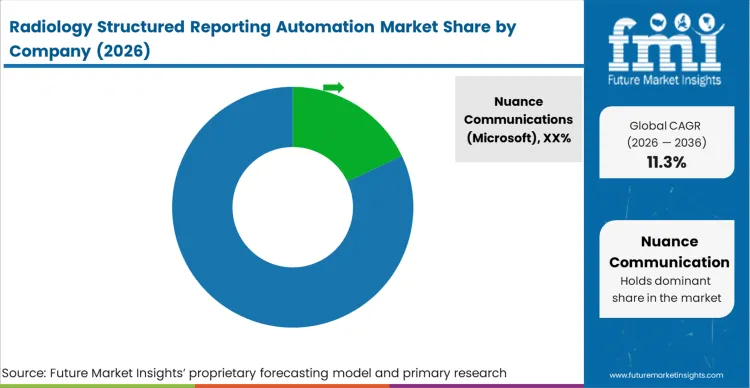
The market structure is highly concentrated, governed by the immense capital required to build and maintain vast, proprietary medical ontologies and secure native integration with dominant EHR systems. Key players such as Nuance Communications, Siemens Healthineers, and M*Modal leverage their massive installed bases to dictate interoperability standards. Buyers in this space evaluate vendors primarily on their proven ability to seamlessly bidirectionally sync with Epic or Cerner without triggering disruptive IT helpdesk tickets.
Companies like Smart Reporting GmbH and Rad AI maintain a distinct structural advantage by engineering API-first, vendor-neutral architectures that sit effortlessly on top of heterogeneous legacy PACS environments. This decoupling allows them to deploy rapidly without waiting for hospital-wide IT overhauls. Challengers attempting to displace these incumbents must specifically build zero-click EHR integration and superior artificial intelligence in healthcare mapping capabilities to overcome the high switching costs associated with retraining radiologists.
Massive health networks deliberately combat vendor lock-in by enforcing strict adherence to HL7 FHIR standards and demanding modular API connectivity during the procurement process. This ongoing structural tension between buyers seeking interoperable flexibility and dominant vendors pushing closed ecosystems severely limits predatory pricing power. Looking toward 2036, the sector is becoming moderately more consolidated as enterprise EHR providers aggressively acquire specialized, standalone reporting platforms to offer comprehensive, end-to-end clinical workflow suites.
Key Players in Radiology Structured Reporting Automation Market
- Nuance Communications (Microsoft)
- Solventum
- Philips Healthcare
- Siemens Healthineers
- GE HealthCare
- Oracle Health
- Smart Reporting GmbH
- Rad AI
- Merative
- Agfa HealthCare
Scope of the Report
| Metric | Value |
|---|---|
| Quantitative Units | USD 1.2 billion to USD 3.5 billion, at a CAGR of 11.30% |
| Market Definition | The radiology structured reporting automation market encompasses intelligent software that converts radiological image interpretations into standardized, computable data formats. These solutions apply recognized medical ontologies to clinical narratives, allowing healthcare networks to extract discrete diagnostic data for billing and quality tracking. |
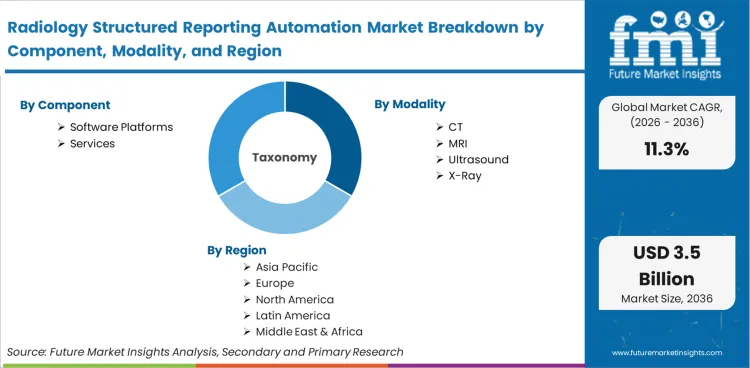
| Component Segmentation | Software Platforms, Services |
| Modality Segmentation | CT, MRI, Ultrasound, X-Ray |
| End User Segmentation | Hospitals, Diagnostic Imaging Centers, Ambulatory Surgical Centers |
| Regions Covered | North America, Europe, East Asia, South Asia & Pacific, Middle East & Africa, Latin America |
| Countries Covered | United States, Germany, China, United Kingdom, Japan, France, Canada, and 40 plus countries |
| Key Companies Profiled | Nuance Communications (Microsoft), Solventum, Philips Healthcare, Siemens Healthineers, GE HealthCare, Oracle Health, Smart Reporting GmbH, Rad AI |
| Forecast Period | 2026 to 2036 |
| Approach | FMI strategists interviewed CMIOs, enterprise PACS administrators, and lead diagnostic radiologists. The forecast relies on adoption curves tied to impending Medicare value-based care reporting penalties and EHR interoperability standards. Forecasts were cross-validated against enterprise software contract volumes. |
Source: Future Market Insights (FMI) analysis, based on proprietary forecasting model and primary research
Radiology Structured Reporting Automation Market Analysis by Segments
Component:
- Software Platforms
- Services
Modality:
- CT
- MRI
- Ultrasound
- X-Ray
End User:
- Hospitals
- Diagnostic Imaging Centers
- Ambulatory Surgical Centers
Region:
- North America
- Europe
- East Asia
- South Asia & Pacific
- Middle East & Africa
- Latin America
Bibliography
- American College of Radiology. (2024, July 26). AI in brief: Radiology reports reimagined.
- Jorg, T., Halfmann, M. C., Stoehr, F., Arnhold, G., Theobald, A., Mildenberger, P., & Müller, L. (2024). A novel reporting workflow for automated integration of artificial intelligence results into structured radiology reports. Insights into Imaging, 15, Article 80.
- Wu, Q., Li, H., Wang, Y., Bai, Y., Wu, Y., Yu, X., Li, X., Dong, P., Xue, J., Shen, D., & Wang, M. (2024). Evaluating large language models for automated Reporting and Data Systems categorization: Cross-sectional study. JMIR Medical Informatics, 12, e55799.
- Sacoransky, E., Kwan, B. Y. M., & Soboleski, D. (2024). ChatGPT and assistive AI in structured radiology reporting: A systematic review. Current Problems in Diagnostic Radiology, 53(6), 728-737.
This bibliography is provided for reader reference. The full FMI report contains the complete reference list with primary source documentation.
This Report Addresses
- Market intelligence to support strategic decision making across enterprise clinical documentation, intelligent template mapping, and zero-click diagnostic software categories
- Market size estimation and 10-year revenue forecasts from 2026 to 2036, supported by value-based care penalty modeling and installed-base RIS replacement tracking
- Growth opportunity mapping across CT, MRI, and Software Platform categories with emphasis on the transition from post-read dictation to concurrent contextual generation
- Segment and regional revenue forecasts covering cloud-based ontology engines across large commercial hospital networks and hyperscale greenfield imaging centers
- Competition strategy assessment including proprietary medical ontology depth, HL7 FHIR interoperability execution, and EHR integration latency
- Platform capability development tracking including ambient voice generation, automated lesion tracking, and BI-RADS semantic mapping frameworks
- Market access analysis covering European Health Data Space compliance channels, MACRA procurement pathways, and regional government digitization subsidies
- Market report delivery in PDF, Excel, PPT, and interactive dashboard formats for executive strategy, hospital IT procurement, and clinical informatics benchmarking use
Frequently Asked Questions
How large is the Radiology Structured Reporting Automation market in 2026?
The market is valued at USD 1.2 billion in 2026, driven directly by large health systems scrambling to comply with new algorithmic claim scrubbing protocols.
What will it be valued at by 2036?
The cumulative valuation reaches USD 3.5 billion by 2036 as mandatory discrete data extraction permanently eliminates legacy free-text dictation across the enterprise.
What CAGR is projected?
A 11.30% CAGR is projected, a structurally defensible rate given the looming reimbursement penalties tied to unstructured diagnostic data.
Which Component segment leads?
Software Platforms command a 68.5% share in 2026 because maintaining clinical compliance requires continuous, cloud-pushed updates to medical ontologies.
Which Modality segment leads?
CT dominates due to the immense manual burden of extracting and transposing volumetric tumor measurements during complex oncology staging.
Which End User segment leads?
Hospitals lead because enterprise-wide risk management protocols strictly mandate standardized reporting to prevent technical billing denials.
What drives rapid growth?
The 2024 Medicare Physician Fee Schedule enforces specific, discrete data fields, forcing large health systems to overhaul their entire diagnostic workflow to secure reimbursement.
What is the primary restraint?
Deep interoperability friction between modern reporting algorithms and a decade-old, highly customised on-premise RIS architecture severely delays deployment.
Which country grows fastest?
The United States expands at a 12.5% compound rate, propelled by aggressive MACRA value-based care penalties that strictly audit diagnostic documentation formatting.
How does the European Health Data Space impact procurement?
Strict cross-border harmonisation directives force European public health networks to mandate robust, multi-lingual ontology mapping in all new reporting vendor contracts.
Why is zero-click EHR integration critical?
Unstructured dictation and basic macro selection are failing because they cannot bidirectionally map complex diagnostic logic back into the rigid fields required by Epic or Cerner without heavy manual correction.
What competitive advantage do challenger brands hold?
Emerging players utilize API-first, vendor-neutral architectures that sit effortlessly atop heterogeneous legacy PACS, allowing them to bypass complete hospital IT overhauls.
How do ambulatory surgical centers utilize this software?
These fast-paced facilities require highly predictable, standardized preoperative imaging output to accelerate surgical clearance and avoid costly day-of-surgery cancellations.
Why is CT scanning so heavily automated?
Advanced trauma and stroke protocols require strict anatomical checklists that must be completed within narrow emergency timeframes, making automated templating a liability necessity.
How does ambient voice generation alter the workflow?
Next-generation models actively listen to physician consultations and compile the structured report in the background, entirely removing the discrete dictation step.
What forces German hospitals to upgrade their systems?
The heavily subsidized Hospital Future Act provides targeted capital injections specifically for the digitization of clinical documentation, driving immediate RIS replacements.
How do teleradiology providers benefit from these platforms?
Standardized API tools allow remote reading networks to homogenize their output across dozens of different client hospital systems without rewriting templates manually.
Why are legacy voice recognition tools obsolete?
Basic speech-to-text lacks the semantic awareness to accurately place clinical findings into computable data fields, requiring radiologists to spend excessive time formatting text.
What role do cloud platforms play in this market?
Cloud-native architecture allows software developers to instantaneously push critical updates to BI-RADS or PI-RADS classifications across thousands of endpoints simultaneously.
How does the UK NHS capacity crisis impact adoption?
Severe imaging backlogs compel trust administrators to prioritize tools that shave minutes off per-scan reporting times, ensuring compliance with strict national referral targets.
What happens to hospitals that delay implementation?
Institutions that fail to deploy computable documentation engines face escalating technical denials from commercial payers who rely on algorithmic claim scrubbers.
How are volumetric measurements handled by these platforms?
Direct integration with 3D workstations automatically pulls linear tumor dimensions directly into the staging template, eliminating transcription errors.
Preview the report firsthand - request a free sample
Get SampleGet the brochure for pricing and purchase details.
Get PDFTable of Content
- Executive Summary
- Global Market Outlook
- Demand-side Trends
- Supply-side Trends
- Technology Roadmap Analysis
- Analysis and Recommendations
- Market Overview
- Market Coverage / Taxonomy
- Market Definition / Scope / Limitations
- Research Methodology
- Chapter Orientation
- Analytical Lens and Working Hypotheses
- Market Structure, Signals, and Trend Drivers
- Benchmarking and Cross-market Comparability
- Market Sizing, Forecasting, and Opportunity Mapping
- Research Design and Evidence Framework
- Desk Research Programme (Secondary Evidence)
- Company Annual and Sustainability Reports
- Peer-reviewed Journals and Academic Literature
- Corporate Websites, Product Literature, and Technical Notes
- Earnings Decks and Investor Briefings
- Statutory Filings and Regulatory Disclosures
- Technical White Papers and Standards Notes
- Trade Journals, Industry Magazines, and Analyst Briefs
- Conference Proceedings, Webinars, and Seminar Materials
- Government Statistics Portals and Public Data Releases
- Press Releases and Reputable Media Coverage
- Specialist Newsletters and Curated Briefings
- Sector Databases and Reference Repositories
- FMI Internal Proprietary Databases and Historical Market Datasets
- Subscription Datasets and Paid Sources
- Social Channels, Communities, and Digital Listening Inputs
- Additional Desk Sources
- Expert Input and Fieldwork (Primary Evidence)
- Primary Modes
- Qualitative Interviews and Expert Elicitation
- Quantitative Surveys and Structured Data Capture
- Blended Approach
- Why Primary Evidence is Used
- Field Techniques
- Interviews
- Surveys
- Focus Groups
- Observational and In-context Research
- Social and Community Interactions
- Stakeholder Universe Engaged
- C-suite Leaders
- Board Members
- Presidents and Vice Presidents
- R&D and Innovation Heads
- Technical Specialists
- Domain Subject-matter Experts
- Scientists
- Physicians and Other Healthcare Professionals
- Governance, Ethics, and Data Stewardship
- Research Ethics
- Data Integrity and Handling
- Primary Modes
- Tooling, Models, and Reference Databases
- Desk Research Programme (Secondary Evidence)
- Data Engineering and Model Build
- Data Acquisition and Ingestion
- Cleaning, Normalisation, and Verification
- Synthesis, Triangulation, and Analysis
- Quality Assurance and Audit Trail
- Market Background
- Market Dynamics
- Drivers
- Restraints
- Opportunity
- Trends
- Scenario Forecast
- Demand in Optimistic Scenario
- Demand in Likely Scenario
- Demand in Conservative Scenario
- Opportunity Map Analysis
- Product Life Cycle Analysis
- Supply Chain Analysis
- Investment Feasibility Matrix
- Value Chain Analysis
- PESTLE and Porter’s Analysis
- Regulatory Landscape
- Regional Parent Market Outlook
- Production and Consumption Statistics
- Import and Export Statistics
- Market Dynamics
- Global Market Analysis 2021 to 2025 and Forecast, 2026 to 2036
- Historical Market Size Value (USD Million) Analysis, 2021 to 2025
- Current and Future Market Size Value (USD Million) Projections, 2026 to 2036
- Y-o-Y Growth Trend Analysis
- Absolute $ Opportunity Analysis
- Global Market Pricing Analysis 2021 to 2025 and Forecast 2026 to 2036
- Global Market Analysis 2021 to 2025 and Forecast 2026 to 2036, By Component
- Introduction / Key Findings
- Historical Market Size Value (USD Million) Analysis By Component , 2021 to 2025
- Current and Future Market Size Value (USD Million) Analysis and Forecast By Component , 2026 to 2036
- Software Platforms
- Services
- Software Platforms
- Y-o-Y Growth Trend Analysis By Component , 2021 to 2025
- Absolute $ Opportunity Analysis By Component , 2026 to 2036
- Global Market Analysis 2021 to 2025 and Forecast 2026 to 2036, By Modality
- Introduction / Key Findings
- Historical Market Size Value (USD Million) Analysis By Modality, 2021 to 2025
- Current and Future Market Size Value (USD Million) Analysis and Forecast By Modality, 2026 to 2036
- CT
- MRI
- Ultrasound
- X-Ray
- CT
- Y-o-Y Growth Trend Analysis By Modality, 2021 to 2025
- Absolute $ Opportunity Analysis By Modality, 2026 to 2036
- Global Market Analysis 2021 to 2025 and Forecast 2026 to 2036, By End Use
- Introduction / Key Findings
- Historical Market Size Value (USD Million) Analysis By End Use, 2021 to 2025
- Current and Future Market Size Value (USD Million) Analysis and Forecast By End Use, 2026 to 2036
- Hospitals
- Diagnostic Imaging Centers
- Ambulatory Surgical Centers
- Hospitals
- Y-o-Y Growth Trend Analysis By End Use, 2021 to 2025
- Absolute $ Opportunity Analysis By End Use, 2026 to 2036
- Global Market Analysis 2021 to 2025 and Forecast 2026 to 2036, By Region
- Introduction
- Historical Market Size Value (USD Million) Analysis By Region, 2021 to 2025
- Current Market Size Value (USD Million) Analysis and Forecast By Region, 2026 to 2036
- North America
- Latin America
- Western Europe
- Eastern Europe
- East Asia
- South Asia and Pacific
- Middle East & Africa
- Market Attractiveness Analysis By Region
- North America Market Analysis 2021 to 2025 and Forecast 2026 to 2036, By Country
- Historical Market Size Value (USD Million) Trend Analysis By Market Taxonomy, 2021 to 2025
- Market Size Value (USD Million) Forecast By Market Taxonomy, 2026 to 2036
- By Country
- USA
- Canada
- Mexico
- By Component
- By Modality
- By End Use
- By Country
- Market Attractiveness Analysis
- By Country
- By Component
- By Modality
- By End Use
- Key Takeaways
- Latin America Market Analysis 2021 to 2025 and Forecast 2026 to 2036, By Country
- Historical Market Size Value (USD Million) Trend Analysis By Market Taxonomy, 2021 to 2025
- Market Size Value (USD Million) Forecast By Market Taxonomy, 2026 to 2036
- By Country
- Brazil
- Chile
- Rest of Latin America
- By Component
- By Modality
- By End Use
- By Country
- Market Attractiveness Analysis
- By Country
- By Component
- By Modality
- By End Use
- Key Takeaways
- Western Europe Market Analysis 2021 to 2025 and Forecast 2026 to 2036, By Country
- Historical Market Size Value (USD Million) Trend Analysis By Market Taxonomy, 2021 to 2025
- Market Size Value (USD Million) Forecast By Market Taxonomy, 2026 to 2036
- By Country
- Germany
- UK
- Italy
- Spain
- France
- Nordic
- BENELUX
- Rest of Western Europe
- By Component
- By Modality
- By End Use
- By Country
- Market Attractiveness Analysis
- By Country
- By Component
- By Modality
- By End Use
- Key Takeaways
- Eastern Europe Market Analysis 2021 to 2025 and Forecast 2026 to 2036, By Country
- Historical Market Size Value (USD Million) Trend Analysis By Market Taxonomy, 2021 to 2025
- Market Size Value (USD Million) Forecast By Market Taxonomy, 2026 to 2036
- By Country
- Russia
- Poland
- Hungary
- Balkan & Baltic
- Rest of Eastern Europe
- By Component
- By Modality
- By End Use
- By Country
- Market Attractiveness Analysis
- By Country
- By Component
- By Modality
- By End Use
- Key Takeaways
- East Asia Market Analysis 2021 to 2025 and Forecast 2026 to 2036, By Country
- Historical Market Size Value (USD Million) Trend Analysis By Market Taxonomy, 2021 to 2025
- Market Size Value (USD Million) Forecast By Market Taxonomy, 2026 to 2036
- By Country
- China
- Japan
- South Korea
- By Component
- By Modality
- By End Use
- By Country
- Market Attractiveness Analysis
- By Country
- By Component
- By Modality
- By End Use
- Key Takeaways
- South Asia and Pacific Market Analysis 2021 to 2025 and Forecast 2026 to 2036, By Country
- Historical Market Size Value (USD Million) Trend Analysis By Market Taxonomy, 2021 to 2025
- Market Size Value (USD Million) Forecast By Market Taxonomy, 2026 to 2036
- By Country
- India
- ASEAN
- Australia & New Zealand
- Rest of South Asia and Pacific
- By Component
- By Modality
- By End Use
- By Country
- Market Attractiveness Analysis
- By Country
- By Component
- By Modality
- By End Use
- Key Takeaways
- Middle East & Africa Market Analysis 2021 to 2025 and Forecast 2026 to 2036, By Country
- Historical Market Size Value (USD Million) Trend Analysis By Market Taxonomy, 2021 to 2025
- Market Size Value (USD Million) Forecast By Market Taxonomy, 2026 to 2036
- By Country
- Kingdom of Saudi Arabia
- Other GCC Countries
- Turkiye
- South Africa
- Other African Union
- Rest of Middle East & Africa
- By Component
- By Modality
- By End Use
- By Country
- Market Attractiveness Analysis
- By Country
- By Component
- By Modality
- By End Use
- Key Takeaways
- Key Countries Market Analysis
- USA
- Pricing Analysis
- Market Share Analysis, 2025
- By Component
- By Modality
- By End Use
- Canada
- Pricing Analysis
- Market Share Analysis, 2025
- By Component
- By Modality
- By End Use
- Mexico
- Pricing Analysis
- Market Share Analysis, 2025
- By Component
- By Modality
- By End Use
- Brazil
- Pricing Analysis
- Market Share Analysis, 2025
- By Component
- By Modality
- By End Use
- Chile
- Pricing Analysis
- Market Share Analysis, 2025
- By Component
- By Modality
- By End Use
- Germany
- Pricing Analysis
- Market Share Analysis, 2025
- By Component
- By Modality
- By End Use
- UK
- Pricing Analysis
- Market Share Analysis, 2025
- By Component
- By Modality
- By End Use
- Italy
- Pricing Analysis
- Market Share Analysis, 2025
- By Component
- By Modality
- By End Use
- Spain
- Pricing Analysis
- Market Share Analysis, 2025
- By Component
- By Modality
- By End Use
- France
- Pricing Analysis
- Market Share Analysis, 2025
- By Component
- By Modality
- By End Use
- India
- Pricing Analysis
- Market Share Analysis, 2025
- By Component
- By Modality
- By End Use
- ASEAN
- Pricing Analysis
- Market Share Analysis, 2025
- By Component
- By Modality
- By End Use
- Australia & New Zealand
- Pricing Analysis
- Market Share Analysis, 2025
- By Component
- By Modality
- By End Use
- China
- Pricing Analysis
- Market Share Analysis, 2025
- By Component
- By Modality
- By End Use
- Japan
- Pricing Analysis
- Market Share Analysis, 2025
- By Component
- By Modality
- By End Use
- South Korea
- Pricing Analysis
- Market Share Analysis, 2025
- By Component
- By Modality
- By End Use
- Russia
- Pricing Analysis
- Market Share Analysis, 2025
- By Component
- By Modality
- By End Use
- Poland
- Pricing Analysis
- Market Share Analysis, 2025
- By Component
- By Modality
- By End Use
- Hungary
- Pricing Analysis
- Market Share Analysis, 2025
- By Component
- By Modality
- By End Use
- Kingdom of Saudi Arabia
- Pricing Analysis
- Market Share Analysis, 2025
- By Component
- By Modality
- By End Use
- Turkiye
- Pricing Analysis
- Market Share Analysis, 2025
- By Component
- By Modality
- By End Use
- South Africa
- Pricing Analysis
- Market Share Analysis, 2025
- By Component
- By Modality
- By End Use
- USA
- Market Structure Analysis
- Competition Dashboard
- Competition Benchmarking
- Market Share Analysis of Top Players
- By Regional
- By Component
- By Modality
- By End Use
- Competition Analysis
- Competition Deep Dive
- Nuance Communications (Microsoft)
- Overview
- Product Portfolio
- Profitability by Market Segments (Product/Age /Sales Channel/Region)
- Sales Footprint
- Strategy Overview
- Marketing Strategy
- Product Strategy
- Channel Strategy
- Solventum
- Philips Healthcare
- Siemens Healthineers
- GE HealthCare
- Oracle Health
- Smart Reporting GmbH
- Rad AI
- Merative
- Agfa HealthCare
- Nuance Communications (Microsoft)
- Competition Deep Dive
- Assumptions & Acronyms Used


