

- Industry Size (2026)
- USD 95 Mn
- Forecast (2036)
- USD 274.6 Mn
- CAGR (2026 to 2036)
- 11.2%
Hospital Network-Based Collection Systems for Medical Plastic Waste Market Forecast and Outlook 2026 to 2036
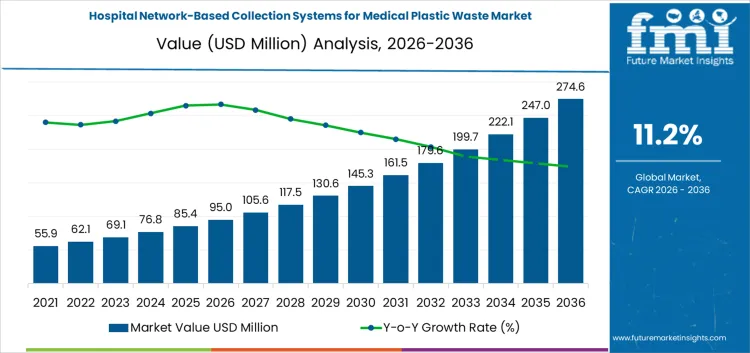
The hospital network-based collection systems for medical plastic waste market is valued at USD 95 million in 2026 and is projected to reach USD 274.6 million by 2036, reflecting a CAGR of 11.2%. Growth is driven by adoption of structured collection models across hospital networks, including on-site segregation, centralized regional hubs, mobile units, and third-party logistics services. Cost structures are shaped by infrastructure deployment, compliance protocols, and operational coordination across multiple facilities. Margin concentration favors operators providing validated, traceable collection solutions rather than high-volume but unverified waste handling. Pricing leverage aligns with service reliability, regulatory adherence, and integration with downstream recycling processes.
Between 2026 and 2036, adoption varies regionally depending on hospital density, waste management infrastructure, and local regulatory mandates. Operators achieving efficient routing, collection standardization, and high compliance capture disproportionate value. Leading companies, including Veolia, Stericycle, Suez, Clean Harbors, Republic Services, Waste Management, and REMONDIS SE, combine scale with operational expertise to maintain higher margins. Strategic differentiation reflects integration across collection, logistics, and certified downstream processing. Facilities lacking standardized systems or multi-facility coverage face slower returns, while operators providing end-to-end compliant collection secure long-term value and consistent cash flow throughout the forecast period.
Quick Stats of the Hospital Network-Based Collection Systems for Medical Plastic Waste Market
- Hospital Network-Based Collection Systems for Medical Plastic Waste Market Value (2026): USD 95 million
- Hospital Network-Based Collection Systems for Medical Plastic Waste Market Forecast Value (2036): USD 274.6 million
- Hospital Network-Based Collection Systems for Medical Plastic Waste Market Forecast CAGR (2026–2036): 11.2%
- Hospital Network-Based Collection Systems for Medical Plastic Waste Market Leading Collection Model: On site hospital segregation systems
- Hospital Network-Based Collection Systems for Medical Plastic Waste Market Key Growth Regions: India, China, USA, Brazil, UK
- Hospital Network-Based Collection Systems for Medical Plastic Waste Market Top Players: Veolia, Stericycle, Suez, Clean Harbors, Republic Services, Waste Management, REMONDIS SE
What is the Growth Forecast for Hospital Network-Based Collection Systems for Medical Plastic Waste Market through 2036?
Between 2026 and 2031, the hospital network-based collection systems for medical plastic waste market is projected to grow from USD 95 million to USD 160 million, generating an absolute increase of USD 65 million and accounting for roughly 36% of total decade growth. Early-stage growth is driven by hospitals implementing standardized collection systems, rising regulatory pressure on medical waste management, and investment in logistics and pre-processing infrastructure. Cost structures are influenced by segregation, transport, and preliminary decontamination processes. Value capture favors operators offering reliable, compliant collection services rather than those focusing solely on volume throughput.
From 2031 to 2036, the market is expected to expand from USD 160 million to USD 274.6 million, adding USD 114.6 million and representing roughly 64% of decade growth. Growth accelerates as collection systems scale across hospital networks and feedstock reliability becomes critical for recycling programs. Margins increasingly favor operators controlling logistics, traceability, and regulatory compliance. Competitive advantage shifts to firms providing integrated collection-to-processing solutions, while late entrants focus on operational efficiency and standardized protocols to capture incremental market share.
Hospital Network Based Collection Systems for Medical Plastic Waste Market Key Takeaways
| Metric | Value |
|---|---|
| Market Value (2026) | USD 95 million |
| Forecast Value (2036) | USD 274.6 million |
| Forecast CAGR (2026–2036) | 11.2% |
How Are Hospital Network-Based Collection Systems Transforming Medical Plastic Waste Management?
Hospital network-based collection systems for medical plastic waste are increasingly adopted to streamline segregation, improve traceability, and enable recycling of high-value polymers. Historically, medical plastics from multiple facilities were managed individually, leading to inconsistent handling, contamination risk, and limited material recovery. Network-based systems centralize collection across hospitals, integrating sterilization, transport, and feedstock consolidation before delivery to specialized recyclers. Value is captured through reduced operational complexity, compliance with healthcare regulations, and reliable material quality for downstream reuse. Early implementations focused on pilot programs and single-site trials, while current adoption emphasizes scalability, process standardization, and integration with hospital logistics, enhancing both efficiency and regulatory adherence across multi-facility networks.
Future growth is shaped by regulatory enforcement, sustainability targets, and operational cost reduction rather than voluntary initiatives alone. Compared with earlier decentralized approaches, network systems provide standardized protocols for segregation, decontamination, and documentation, ensuring traceable chain of custody. Cost structures depend on transportation logistics, sterilization energy, and yield optimization, concentrating margins among operators managing multiple facilities efficiently. Hospitals prioritize systems that maintain consistent polymer quality, reduce liability, and support circularity initiatives. By 2036, hospital network-based collection systems are expected to form an essential component of clinical waste management strategies, enabling safe, compliant, and efficient recycling of medical plastics across regional healthcare networks.
What Factors Are Shaping the Demand for Hospital Network Based Collection Systems for Medical Plastic Waste in Terms of Collection Model and Waste Type?
The demand for hospital network based collection systems for medical plastic waste is segmented by collection model and waste type. Collection models include on site hospital segregation systems, centralized regional hubs, mobile collection units, and third party logistics services. Waste types cover rigid medical plastics, flexible polymer disposables, composite device plastics, and sterile packaging polymers. Segment adoption is shaped by regulatory compliance, operational efficiency, and the need for traceable material streams. Hospitals and healthcare networks prioritize systems that ensure safe handling, minimize contamination risk, and support downstream recycling. Demand is influenced more by safety and regulatory alignment than cost optimization or speed alone.
What Is Driving the Dominance of On Site Hospital Segregation Systems in Medical Plastic Waste Collection?
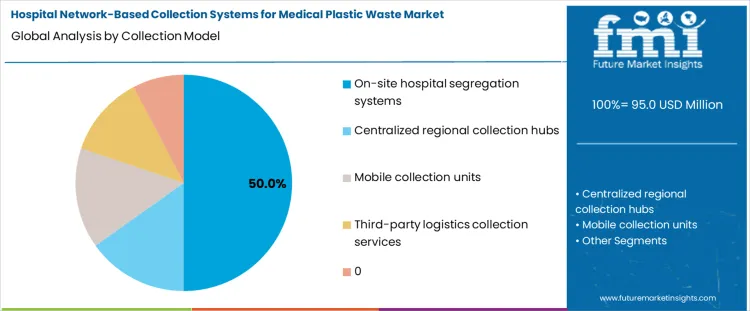
On site hospital segregation systems account for approximately 50% of total collection model adoption, making them the leading system. This share reflects their ability to separate medical plastic waste at the point of generation, reducing cross contamination and improving material quality for recycling. Hospitals implement dedicated bins, labeling, and staff protocols to sort rigid, flexible, and composite plastics. Segregation facilitates downstream processing, including mechanical, chemical, or solvent based recycling, while maintaining compliance with medical waste regulations.
Demand for on-site segregation systems is driven by operational control and regulatory compliance. Hospitals can maintain traceability, document handling procedures, and ensure material quality for recycling or safe disposal. Segregation reduces downstream processing complexity and enhances safety for logistics and recycling operators. The segment maintains leadership because it combines efficiency, regulatory assurance, and material preservation, supporting high quality recovery of medical plastics from hospital networks.
Why Do Rigid Medical Plastics Represent the Largest Waste Type in Hospital Network Based Collection Systems?

Rigid medical plastics account for approximately 47% of total waste, making them the largest category. This reflects the high volume of rigid items such as trays, housings, and procedural components generated in hospitals. Their consistent geometry and material composition facilitate sorting, storage, and recycling while meeting regulatory standards. Recyclers prefer rigid plastics due to predictable mechanical properties and reduced contamination risk.
Demand for rigid medical plastics is driven by collection efficiency, process compatibility, and regulatory requirements. Hospitals and waste management operators prioritize rigid streams for segregation and transport. Rigid polymers allow mechanical or chemical recycling with minimal additional processing. The segment leads because volume, material uniformity, and compliance alignment converge, making rigid medical plastics the primary focus for hospital network collection initiatives.
What Is Driving the Demand for Hospital Network-Based Collection Systems for Medical Plastic Waste Market?
Hospital network-based collection systems for medical plastic waste are increasingly implemented to improve segregation, traceability, and compliance with local healthcare regulations. Adoption focuses on centralized collection across multiple facilities within a network, enabling standardized handling of high-risk polymers such as syringes, IV components, and diagnostic disposables. Systems prioritize infection control, audit readiness, and process reliability. Growth is strongest in regions with strict enforcement of medical waste handling and disposal protocols. Investment is guided by operational efficiency, regulatory alignment, and risk reduction rather than waste volume alone. Consistent and traceable collection drives participation across hospital networks.
Why Do Local Regulatory Frameworks and Hospital Accreditation Requirements Drive Centralized Collection Adoption?
Demand is influenced by country-specific regulations mandating proper handling, sterilization, and documentation of medical plastics. Hospital networks adopt centralized collection systems to maintain audit-ready records and ensure compliance across multiple facilities. Standardized protocols simplify training, reduce contamination risk, and improve feedstock quality for downstream recycling or disposal. Funding programs or internal sustainability initiatives accelerate deployment where compliance and cost savings intersect. The driver is regulatory certainty and operational control rather than financial optimization. Hospitals with established collection systems benefit from consistent handling practices, simplified audits, and improved alignment with regional medical waste management standards.
How Are Operational and Logistical Challenges Limiting Hospital Network-Based Collection Systems?
Challenges include coordinating multiple facilities with varying capacities, maintaining proper segregation of high-risk polymers, and ensuring timely transport to recycling or disposal sites. Staff training and adherence to infection control protocols are critical to prevent contamination. Capital investment in collection infrastructure, including secure storage and transport equipment, can be significant. Variability in waste composition affects downstream recycling efficiency. Smaller or decentralized hospitals may struggle to integrate with network-wide systems. These factors slow adoption and concentrate early deployment in well-resourced networks with technical expertise and strong administrative coordination, especially in regions with strict regulatory oversight.
How Are System Design and Collaboration Strategies Influencing Hospital Network Collection Efficiency?
Trends show the integration of modular, scalable collection units with digital tracking and sterilization verification. Partnerships between hospitals, waste management providers, and recyclers secure reliable feedstock and facilitate regulatory compliance. Pilot programs are increasingly used to optimize logistics and staff protocols before full network deployment. Real-time monitoring ensures batch traceability and supports audit readiness. Focus is on operational consistency, compliance, and safety rather than throughput or cost reduction. Success depends on collaboration, process standardization, and the ability to maintain traceable, validated medical plastic collection across multiple facilities within a hospital network.
What is the Demand for Hospital Network-Based Collection Systems for Medical Plastic Waste by Country?
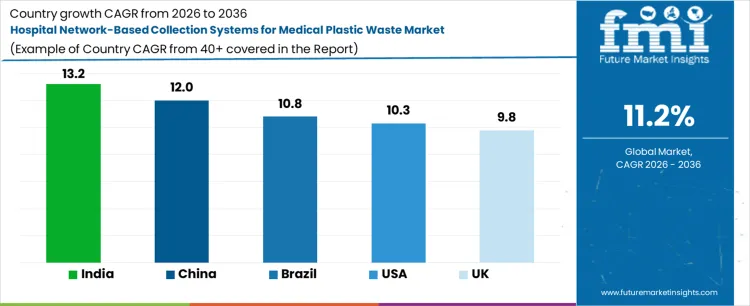
| Country | CAGR (%) |
|---|---|
| USA | 10.3 |
| UK | 9.8 |
| China | 12.0 |
| India | 13.2 |
| Brazil | 10.8 |
Demand for hospital network-based collection systems for medical plastic waste is increasing as healthcare facilities implement structured waste segregation and recycling initiatives. India leads with a 13.2% CAGR, driven by expansion of hospital networks, growing volumes of single-use polymer devices, and government-backed collection programs to streamline material recovery. China follows at 12.0%, supported by centralized hospital waste management initiatives, integration of recyclable medical plastics, and regulatory compliance measures. Brazil records 10.8% growth, reflecting adoption of systematic collection networks in private and public hospitals. The USA grows at 10.3%, shaped by partnerships between hospital systems and certified recycling providers. The UK shows 9.8% CAGR, supported by incremental adoption of standardized collection programs and compliance with medical waste management protocols.
How Are Hospital Sustainability Initiatives Driving Medical Plastic Waste Collection Systems in the United States?
In the United States, the hospital network-based collection systems for medical plastic waste market is expanding at a CAGR of 10.3%, supported by hospital programs aimed at reducing single-use plastic waste and promoting circular healthcare practices. Networks are implementing centralized collection, segregation, and storage systems to ensure consistent feedstock for recycling operations. Demand is concentrated among large hospital systems, contract recyclers, and certified waste management providers. Investments focus on process standardization, contamination control, and traceability rather than rapid expansion. Growth reflects strategic integration of collection systems to support recycling initiatives and compliance with environmental regulations.
- Hospital sustainability programs drive adoption of centralized collection systems.
- Segregation and storage protocols ensure feedstock quality and safety.
- Large hospital networks and certified recyclers dominate early adoption.
- Traceability supports compliance and documentation requirements.
Why Is Regulatory Guidance Supporting Collection Systems in the United Kingdom?
In the United Kingdom, the hospital network-based collection systems for medical plastic waste market is growing at a CAGR of 9.8%, supported by healthcare regulations and environmental policies promoting safe segregation and recycling. Hospitals and recyclers implement standardized collection, sorting, and temporary storage procedures to recover medical plastics effectively. Demand is concentrated among certified hospital networks and waste management operators. Investments prioritize operational consistency, traceability, and compliance documentation rather than scaling volume rapidly. Growth reflects structured adoption of collection systems aligned with sustainability and regulatory objectives.
- Regulatory frameworks incentivize adoption of collection systems.
- Standardized segregation and storage processes ensure material compliance.
- Certified hospital networks lead implementation.
- Traceability systems support reporting and regulatory adherence.
How Is Export-Oriented Healthcare Infrastructure Accelerating Collection in China?
China is witnessing strong growth in hospital network-based collection systems for medical plastic waste, with a CAGR of 12.0%, fueled by hospitals and recyclers aligning with international compliance and circular economy expectations. Networks implement centralized collection and segregation systems to provide high-quality feedstock for recycling. Demand is concentrated in urban healthcare clusters and large hospital networks. Investments emphasize process reliability, standardization, and traceable material flows. Growth is shaped by global sustainability requirements and environmental regulations in addition to domestic policies.
- Urban hospital clusters concentrate collection demand.
- Centralized segregation and storage improve feedstock quality.
- Process standardization enhances reliability and traceability.
- International compliance requirements accelerate adoption.
Why Is Hospital Expansion Driving Collection System Adoption in India?
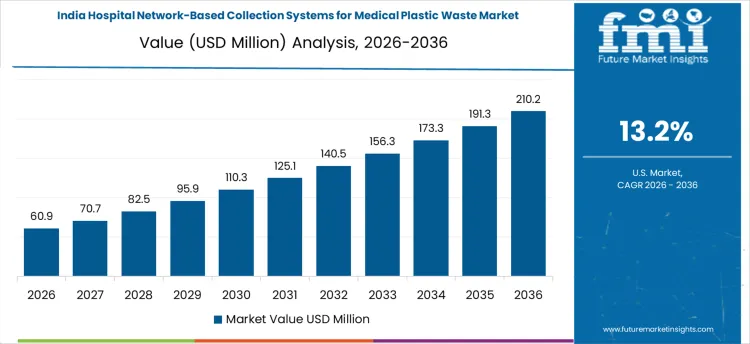
India shows the fastest growth in hospital network-based collection systems for medical plastic waste, expanding at a CAGR of 13.2%, driven by rising hospital capacity and increasing consumption of single-use medical devices. Recycling operators are collaborating with hospital networks to implement collection, segregation, and temporary storage systems that enable high-quality feedstock recovery. Demand is concentrated among organized recyclers and large healthcare networks engaged in compliance and sustainability initiatives. Investments focus on operational reliability, contamination control, and traceable documentation. Growth reflects both increasing medical plastic volumes and integration into circular healthcare supply chains.
- Rising hospital and device volumes increase feedstock availability.
- Segregation and storage systems ensure material quality and safety.
- Partnerships with organized recyclers support implementation.
- Compliance and sustainability initiatives guide adoption priorities.
How Is Medical Waste Infrastructure Supporting Collection Systems in Brazil?
Brazil is recording steady growth in hospital network-based collection systems for medical plastic waste at a CAGR of 10.8%, supported by improvements in hospital waste management infrastructure and environmental regulation enforcement. Networks are implementing standardized collection, segregation, and storage procedures to recover plastics suitable for recycling. Demand is concentrated in urban hospital networks and certified recyclers. Investments emphasize process standardization, contamination control, and traceable documentation rather than rapid capacity expansion. Growth reflects gradual integration of collection systems into existing hospital waste management operations.
- Hospital infrastructure improvements increase feedstock availability.
- Standardized segregation and storage protocols ensure quality and safety.
- Urban hospital networks and certified recyclers lead adoption.
- Process standardization and traceability support regulatory compliance.
Who Competes in Hospital Network-Based Collection Systems for Medical Plastic Waste and How Do They Differ?
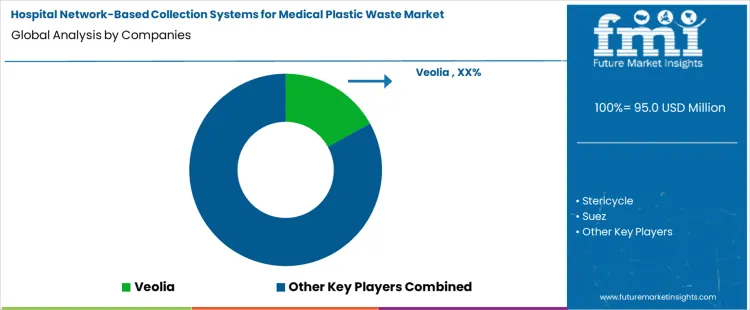
Competition in hospital network based collection systems for medical plastic waste is shaped by firms’ capabilities in regulated waste handling, logistics coordination, and integration with recycling or treatment pathways. Veolia operates through comprehensive environmental services that link hospital waste segregation with secure transport and downstream processing, ensuring compliance with healthcare regulatory frameworks. Stericycle focuses on regulated clinical waste collection services tailored to hospital needs, developing collection protocols that align with infection control requirements and feed recycling or disposal partners. Suez competes by offering centralized collection hubs and route optimization across multi facility health systems, emphasizing data reporting and audit support that meet compliance obligations.
Other participants differentiate through scale, geography, and service breadth. CleanHarbors integrates decontamination logistics with collection systems, enabling hospitals to manage plastics and other regulated waste within a unified service agreement. Republic Services and Waste Management bring broad waste collection networks that can be configured for hospital plastics streams alongside municipal services, often bundling offerings with recycling pathways or energy recovery options. REMONDIS SE operates in European markets with hospital partnerships that leverage regional sorting and processing infrastructure. Competitive positioning varies by service integration, data transparency for compliance records, and the ability to tailor collection systems to diverse hospital sizes and regulatory environments, enabling facilities to manage plastic waste securely and efficiently across networks.
Key Players in the Hospital Network-Based Collection Systems for Medical Plastic Waste Market
- Veolia
- Stericycle
- Suez
- Clean Harbors
- Republic Services
- Waste Management
- REMONDIS SE
Scope of the Report
| Items | Values |
|---|---|
| Quantitative Units (2026) | USD million |
| Collection Model | On-site hospital segregation systems, Centralized regional collection hubs, Mobile collection units, Third-party logistics collection services |
| Waste Type | Rigid medical plastics, Flexible polymer disposables, Composite device plastics, Sterile packaging polymers |
| Region | Asia Pacific, Europe, North America, Latin America, Middle East & Africa |
| Key Countries Covered | China, Japan, South Korea, India, Australia & New Zealand, Germany, United Kingdom, France, Italy, Spain, Nordic, BENELUX, United States, Canada, Mexico, Brazil, Chile, Kingdom of Saudi Arabia, Other GCC Countries, Turkey, South Africa, Other African Union |
| Key Companies Profiled | Veolia, Stericycle, Suez, Clean Harbors, Republic Services, Waste Management, REMONDIS SE |
| Additional Attributes | Dollar sales by collection model and waste type, regulatory compliance metrics, audit-ready traceability, feedstock standardization, integration with downstream recycling or processing, operational efficiency, logistics optimization, compliance with hospital and national waste regulations |
Hospital Network-Based Collection Systems for Medical Plastic Waste Market Segmentation
Collection Model:
- On-site hospital segregation systems
- Centralized regional collection hubs
- Mobile collection units
- Third-party logistics collection services
Waste Type:
- Rigid medical plastics
- Flexible polymer disposables
- Composite device plastics
- Sterile packaging polymers
Region
Asia Pacific
- China
- Japan
- South Korea
- India
- Australia & New Zealand
- ASEAN
- Rest of Asia Pacific
Europe
- Germany
- United Kingdom
- France
- Italy
- Spain
- Nordic
- BENELUX
- Rest of Europe
North America
- United States
- Canada
- Mexico
Latin America
- Brazil
- Chile
- Rest of Latin America
Middle East & Africa
- Kingdom of Saudi Arabia
- Other GCC Countries
- Turkey
- South Africa
- Other African Union
- Rest of Middle East & Africa
Frequently Asked Questions
How big is the hospital network-based collection systems for medical plastic waste market in 2026?
The global hospital network-based collection systems for medical plastic waste market is estimated to be valued at USD 95.0 million in 2026.
What will be the size of hospital network-based collection systems for medical plastic waste market in 2036?
The market size for the hospital network-based collection systems for medical plastic waste market is projected to reach USD 274.6 million by 2036.
How much will be the hospital network-based collection systems for medical plastic waste market growth between 2026 and 2036?
The hospital network-based collection systems for medical plastic waste market is expected to grow at a 11.2% CAGR between 2026 and 2036.
What are the key product types in the hospital network-based collection systems for medical plastic waste market?
The key product types in hospital network-based collection systems for medical plastic waste market are on‑site hospital segregation systems , centralized regional collection hubs, mobile collection units, third‑party logistics collection services and recycling technology.
Which waste type segment to contribute significant share in the hospital network-based collection systems for medical plastic waste market in 2026?
In terms of waste type, rigid medical plastics segment to command 47.0% share in the hospital network-based collection systems for medical plastic waste market in 2026.
Preview the report firsthand - request a free sample
Get SampleGet the brochure for pricing and purchase details.
Get PDFTable of Content
- Executive Summary
- Global Market Outlook
- Demand-side Trends
- Supply-side Trends
- Technology Roadmap Analysis
- Analysis and Recommendations
- Market Overview
- Market Coverage / Taxonomy
- Market Definition / Scope / Limitations
- Market Background
- Market Dynamics
- Drivers
- Restraints
- Opportunity
- Trends
- Scenario Forecast
- Demand in Optimistic Scenario
- Demand in Likely Scenario
- Demand in Conservative Scenario
- Opportunity Map Analysis
- Product Life Cycle Analysis
- Supply Chain Analysis
- Investment Feasibility Matrix
- Value Chain Analysis
- PESTLE and Porter’s Analysis
- Regulatory Landscape
- Regional Parent Market Outlook
- Production and Consumption Statistics
- Import and Export Statistics
- Market Dynamics
- Global Market Analysis 2021 to 2025 and Forecast, 2026 to 2036
- Historical Market Size Value (USD Million) Analysis, 2021 to 2025
- Current and Future Market Size Value (USD Million) Projections, 2026 to 2036
- Y-o-Y Growth Trend Analysis
- Absolute $ Opportunity Analysis
- Global Market Pricing Analysis 2021 to 2025 and Forecast 2026 to 2036
- Global Market Analysis 2021 to 2025 and Forecast 2026 to 2036, By Collection Model
- Introduction / Key Findings
- Historical Market Size Value (USD Million) Analysis By Collection Model , 2021 to 2025
- Current and Future Market Size Value (USD Million) Analysis and Forecast By Collection Model , 2026 to 2036
- On‑site hospital segregation systems
- Centralized regional collection hubs
- Mobile collection units
- Third‑party logistics collection services
- On‑site hospital segregation systems
- Y-o-Y Growth Trend Analysis By Collection Model , 2021 to 2025
- Absolute $ Opportunity Analysis By Collection Model , 2026 to 2036
- Global Market Analysis 2021 to 2025 and Forecast 2026 to 2036, By Waste Type
- Introduction / Key Findings
- Historical Market Size Value (USD Million) Analysis By Waste Type, 2021 to 2025
- Current and Future Market Size Value (USD Million) Analysis and Forecast By Waste Type, 2026 to 2036
- Rigid medical plastics
- Flexible polymer disposables
- Composite device plastics
- Sterile packaging polymers
- Rigid medical plastics
- Y-o-Y Growth Trend Analysis By Waste Type, 2021 to 2025
- Absolute $ Opportunity Analysis By Waste Type, 2026 to 2036
- Global Market Analysis 2021 to 2025 and Forecast 2026 to 2036, By Region
- Introduction
- Historical Market Size Value (USD Million) Analysis By Region, 2021 to 2025
- Current Market Size Value (USD Million) Analysis and Forecast By Region, 2026 to 2036
- North America
- Latin America
- Western Europe
- Eastern Europe
- East Asia
- South Asia and Pacific
- Middle East & Africa
- Market Attractiveness Analysis By Region
- North America Market Analysis 2021 to 2025 and Forecast 2026 to 2036, By Country
- Historical Market Size Value (USD Million) Trend Analysis By Market Taxonomy, 2021 to 2025
- Market Size Value (USD Million) Forecast By Market Taxonomy, 2026 to 2036
- By Country
- USA
- Canada
- Mexico
- By Collection Model
- By Waste Type
- By Country
- Market Attractiveness Analysis
- By Country
- By Collection Model
- By Waste Type
- Key Takeaways
- Latin America Market Analysis 2021 to 2025 and Forecast 2026 to 2036, By Country
- Historical Market Size Value (USD Million) Trend Analysis By Market Taxonomy, 2021 to 2025
- Market Size Value (USD Million) Forecast By Market Taxonomy, 2026 to 2036
- By Country
- Brazil
- Chile
- Rest of Latin America
- By Collection Model
- By Waste Type
- By Country
- Market Attractiveness Analysis
- By Country
- By Collection Model
- By Waste Type
- Key Takeaways
- Western Europe Market Analysis 2021 to 2025 and Forecast 2026 to 2036, By Country
- Historical Market Size Value (USD Million) Trend Analysis By Market Taxonomy, 2021 to 2025
- Market Size Value (USD Million) Forecast By Market Taxonomy, 2026 to 2036
- By Country
- Germany
- UK
- Italy
- Spain
- France
- Nordic
- BENELUX
- Rest of Western Europe
- By Collection Model
- By Waste Type
- By Country
- Market Attractiveness Analysis
- By Country
- By Collection Model
- By Waste Type
- Key Takeaways
- Eastern Europe Market Analysis 2021 to 2025 and Forecast 2026 to 2036, By Country
- Historical Market Size Value (USD Million) Trend Analysis By Market Taxonomy, 2021 to 2025
- Market Size Value (USD Million) Forecast By Market Taxonomy, 2026 to 2036
- By Country
- Russia
- Poland
- Hungary
- Balkan & Baltic
- Rest of Eastern Europe
- By Collection Model
- By Waste Type
- By Country
- Market Attractiveness Analysis
- By Country
- By Collection Model
- By Waste Type
- Key Takeaways
- East Asia Market Analysis 2021 to 2025 and Forecast 2026 to 2036, By Country
- Historical Market Size Value (USD Million) Trend Analysis By Market Taxonomy, 2021 to 2025
- Market Size Value (USD Million) Forecast By Market Taxonomy, 2026 to 2036
- By Country
- China
- Japan
- South Korea
- By Collection Model
- By Waste Type
- By Country
- Market Attractiveness Analysis
- By Country
- By Collection Model
- By Waste Type
- Key Takeaways
- South Asia and Pacific Market Analysis 2021 to 2025 and Forecast 2026 to 2036, By Country
- Historical Market Size Value (USD Million) Trend Analysis By Market Taxonomy, 2021 to 2025
- Market Size Value (USD Million) Forecast By Market Taxonomy, 2026 to 2036
- By Country
- India
- ASEAN
- Australia & New Zealand
- Rest of South Asia and Pacific
- By Collection Model
- By Waste Type
- By Country
- Market Attractiveness Analysis
- By Country
- By Collection Model
- By Waste Type
- Key Takeaways
- Middle East & Africa Market Analysis 2021 to 2025 and Forecast 2026 to 2036, By Country
- Historical Market Size Value (USD Million) Trend Analysis By Market Taxonomy, 2021 to 2025
- Market Size Value (USD Million) Forecast By Market Taxonomy, 2026 to 2036
- By Country
- Kingdom of Saudi Arabia
- Other GCC Countries
- Turkiye
- South Africa
- Other African Union
- Rest of Middle East & Africa
- By Collection Model
- By Waste Type
- By Country
- Market Attractiveness Analysis
- By Country
- By Collection Model
- By Waste Type
- Key Takeaways
- Key Countries Market Analysis
- USA
- Pricing Analysis
- Market Share Analysis, 2025
- By Collection Model
- By Waste Type
- Canada
- Pricing Analysis
- Market Share Analysis, 2025
- By Collection Model
- By Waste Type
- Mexico
- Pricing Analysis
- Market Share Analysis, 2025
- By Collection Model
- By Waste Type
- Brazil
- Pricing Analysis
- Market Share Analysis, 2025
- By Collection Model
- By Waste Type
- Chile
- Pricing Analysis
- Market Share Analysis, 2025
- By Collection Model
- By Waste Type
- Germany
- Pricing Analysis
- Market Share Analysis, 2025
- By Collection Model
- By Waste Type
- UK
- Pricing Analysis
- Market Share Analysis, 2025
- By Collection Model
- By Waste Type
- Italy
- Pricing Analysis
- Market Share Analysis, 2025
- By Collection Model
- By Waste Type
- Spain
- Pricing Analysis
- Market Share Analysis, 2025
- By Collection Model
- By Waste Type
- France
- Pricing Analysis
- Market Share Analysis, 2025
- By Collection Model
- By Waste Type
- India
- Pricing Analysis
- Market Share Analysis, 2025
- By Collection Model
- By Waste Type
- ASEAN
- Pricing Analysis
- Market Share Analysis, 2025
- By Collection Model
- By Waste Type
- Australia & New Zealand
- Pricing Analysis
- Market Share Analysis, 2025
- By Collection Model
- By Waste Type
- China
- Pricing Analysis
- Market Share Analysis, 2025
- By Collection Model
- By Waste Type
- Japan
- Pricing Analysis
- Market Share Analysis, 2025
- By Collection Model
- By Waste Type
- South Korea
- Pricing Analysis
- Market Share Analysis, 2025
- By Collection Model
- By Waste Type
- Russia
- Pricing Analysis
- Market Share Analysis, 2025
- By Collection Model
- By Waste Type
- Poland
- Pricing Analysis
- Market Share Analysis, 2025
- By Collection Model
- By Waste Type
- Hungary
- Pricing Analysis
- Market Share Analysis, 2025
- By Collection Model
- By Waste Type
- Kingdom of Saudi Arabia
- Pricing Analysis
- Market Share Analysis, 2025
- By Collection Model
- By Waste Type
- Turkiye
- Pricing Analysis
- Market Share Analysis, 2025
- By Collection Model
- By Waste Type
- South Africa
- Pricing Analysis
- Market Share Analysis, 2025
- By Collection Model
- By Waste Type
- USA
- Market Structure Analysis
- Competition Dashboard
- Competition Benchmarking
- Market Share Analysis of Top Players
- By Regional
- By Collection Model
- By Waste Type
- Competition Analysis
- Competition Deep Dive
- Veolia
- Overview
- Product Portfolio
- Profitability by Market Segments (Product/Age /Sales Channel/Region)
- Sales Footprint
- Strategy Overview
- Marketing Strategy
- Product Strategy
- Channel Strategy
- Stericycle
- Suez
- Clean Harbors
- Republic Services
- Waste Management
- REMONDIS SE
- Veolia
- Competition Deep Dive
- Assumptions & Acronyms Used
- Research Methodology


