

- Industry Size (2026)
- USD 610.0 Mn
- Forecast (2036)
- USD 1611.2 Mn
- CAGR (2026 to 2036)
- 10.2%
Microplastics-Compliant Encapsulated Pigment Systems for Leave-On Makeup Market Forecast and Outlook (2026-2036)
The microplastics-compliant encapsulated pigment systems for leave-on makeup market is valued at USD 610.0 million in 2026 and is projected to reach USD 1,611.2 million by 2036, registering a CAGR of 10.2%. Performance over this period is driven by regulatory exposure and reformulation depth rather than incremental growth in color cosmetics consumption. Leave-on makeup products face higher scrutiny because pigments remain in prolonged contact with skin and contribute directly to environmental release during product use and removal. Foundations, skin tints, and concealers anchor demand since they combine extended wear expectations with the highest compliance risk under emerging microplastics restrictions. Value concentrates in pigment systems specified early in formulation pipelines to avoid late-stage reformulation, relabeling, or regional market exclusions.
Adoption patterns reflect application criticality and regulatory geography. Complexion products dominate usage because they rely on encapsulation for dispersion stability, skin feel, and visual uniformity across long wear cycles. Cream-based blushes and bronzers follow, supported by shifts toward hybrid makeup-skincare formats that emphasize sensory performance without restricted polymers. Highlighters and illuminators adopt compliant systems selectively, where optical effects depend on shell integrity and particle control. Demand stability remains strongest in products sold through regulated retail environments, pharmacies, and premium beauty channels, where documentation and ingredient compliance influence shelf access. Growth quality remains highest where compliant encapsulated pigments are embedded into core complexion platforms with continuous reformulation cycles tied to regulatory timelines, rather than seasonal shade launches or short-run trend products.
Quick Stats for Microplastics-Compliant Encapsulated Pigment Systems for Leave-On Makeup Market
- Microplastics-Compliant Encapsulated Pigment Systems for Leave-On Makeup Market Value (2026): USD 610.0 million
- Microplastics-Compliant Encapsulated Pigment Systems for Leave-On Makeup Market Forecast Value (2036): USD 1,611.2 million
- Forecast CAGR (2026–2036): 10.2%
- Leading Pigment System Type in Global Demand: Polymer-Free Encapsulated Pigments
- Fastest-Growing Countries: Germany, France, Italy, China, India
- Key Players in Global Demand: Sensient Technologies, Clariant AG, DSM-Firmenich, Sun Chemical, BASF SE
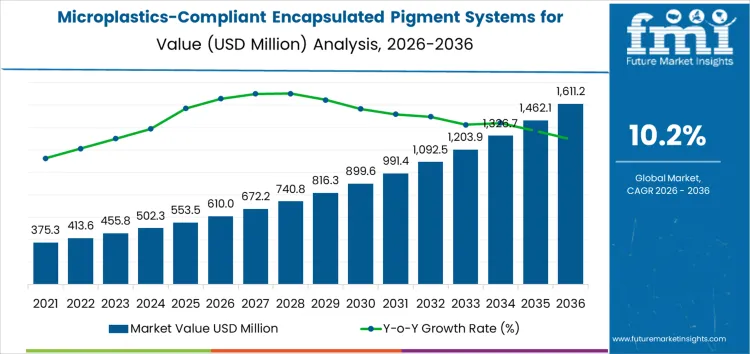
Microplastics-Compliant Encapsulated Pigment Systems for Leave-On Makeup Market Key Takeaways
| Metric | Value |
|---|---|
| Market Value (2026) | USD 610.0 million |
| Market Forecast Value (2036) | USD 1,611.2 million |
| Forecast CAGR (2026-2036) | 10.2% |
Why is the Demand for Microplastics-Compliant Encapsulated Pigment Systems for Leave-On Makeup Market Growing?
Demand for microplastics-compliant encapsulated pigment systems for leave-on makeup is growing globally due to increasing regulatory action and consumer demand for environmentally responsible cosmetic ingredients. Many jurisdictions are restricting intentionally added microplastics and solid polymer particles in personal care products, which motivates cosmetic manufacturers to reformulate encapsulated pigment systems using biodegradable, bio-based, or water-dispersible materials that meet compliance criteria. Leave-on makeup products such as foundations, blushes, highlighters, and tinted primers rely on encapsulation technology to improve pigment stability, color delivery, and skin feel; compliant systems maintain these performance attributes while aligning with environmental standards.
Retailers and global brands expand product assortments that reflect ingredient transparency and reduced ecological impact to meet evolving shopper expectations. Regulatory frameworks in Europe, North America, and parts of Asia set limits on microplastic content, which strengthens procurement of compliant encapsulated pigments with traceable supply chains. Advances in encapsulation chemistry improve film forming, dispersibility, and compatibility with diverse formulation bases. Certifications and eco-labels reinforce credibility for compliant systems and support marketing to sustainability-oriented consumers. Continued focus on environmental stewardship and compliance motivates broad adoption of microplastics-compliant encapsulated pigment systems in global leave-on makeup portfolios.
How Is the Microplastics-Compliant Encapsulated Pigment Systems for Leave-On Makeup Market Structured?
Demand for microplastics-compliant encapsulated pigment systems in leave-on makeup is shaped by tightening global regulations on intentionally added microplastics, reformulation mandates in the EU and other regions, and rising scrutiny of polymer-based cosmetic ingredients. Cosmetic brands prioritize pigment systems that deliver color stability, skin feel, and wear performance without contributing to persistent microplastic residues. Segment structure reflects how encapsulation chemistry, shell technology, and application format determine compliance, performance consistency, and consumer safety in leave-on cosmetic products.
Which Pigment System Type Accounts for the Largest Share of Global Demand?
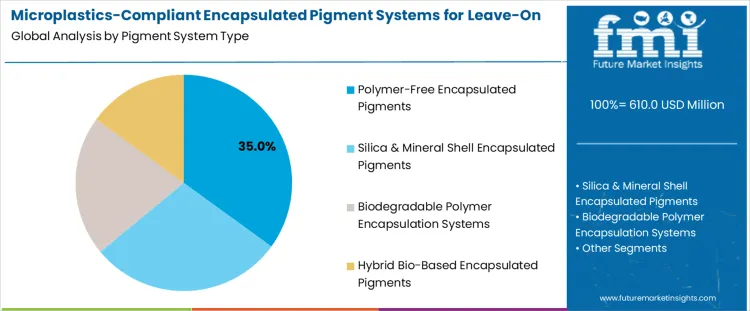
Polymer-free encapsulated pigments hold 35.0%, representing the largest share of global demand. These systems eliminate synthetic polymer shells while maintaining pigment protection and dispersion stability, making them highly compatible with emerging microplastics regulations. Silica and mineral shell encapsulated pigments follow at 29.0%, supported by inorganic shell stability and low environmental persistence. Biodegradable polymer encapsulation systems account for 21.0%, reflecting adoption of certified degradable materials that meet regulatory definitions. Hybrid bio-based encapsulated pigments represent 15.0%, combining natural polymers and mineral components to balance performance and sustainability.
Segment Insights
- Polymer-free systems lead due to direct regulatory alignment
- Mineral shells provide durability with low environmental risk
- Biodegradable systems support transitional compliance strategies
Which Encapsulation Technology Is Most Widely Used Globally?
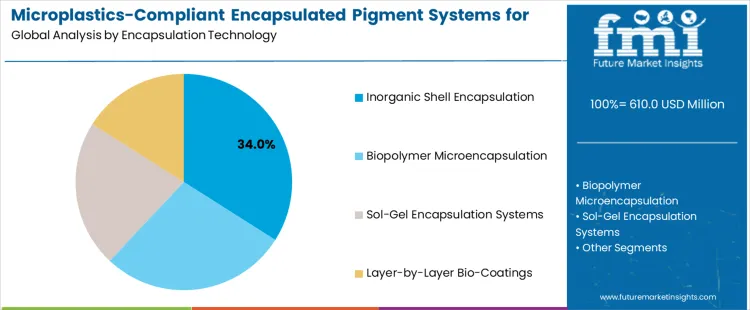
Inorganic shell encapsulation leads with a 34.0% share, making it the most widely used technology globally. This approach offers strong pigment protection, thermal stability, and resistance to oxidation without polymer dependency. Biopolymer microencapsulation follows at 28.0%, driven by advances in plant-derived and fermentation-based encapsulants. Sol-gel encapsulation systems account for 22.0%, valued for uniform shell formation and controlled release properties. Layer-by-layer bio-coatings represent 16.0%, used in premium formulations requiring precise surface modification and skin interaction control.
Segment Insights
- Inorganic shells dominate due to durability and compliance clarity
- Biopolymer methods support biodegradable positioning
- Sol-gel systems enable uniform and controlled encapsulation
Which Application Segment Generates the Highest Global Demand?
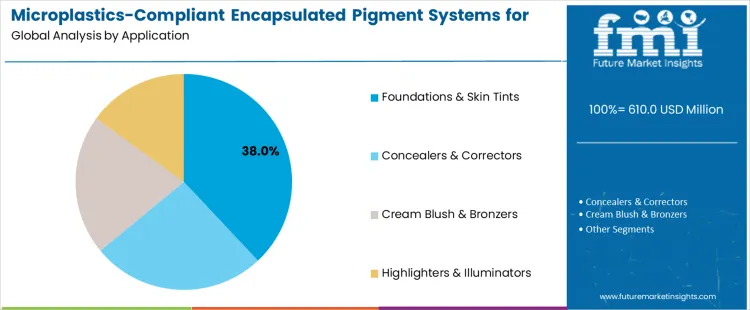
Foundations and skin tints account for 38.0%, making them the largest application segment globally. These products require prolonged skin contact, uniform dispersion, and regulatory-safe formulations, driving adoption of compliant encapsulated pigments. Concealers and correctors follow at 26.0%, where opacity and color precision are critical. Cream blush and bronzers hold 21.0%, supported by growth in cream-based complexion products. Highlighters and illuminators represent 15.0%, relying on encapsulation for light diffusion and surface stability.
Segment Insights
- Foundations lead due to extended wear and skin-contact exposure
- Concealers require encapsulation for color accuracy
- Cream-based products benefit from controlled pigment dispersion
What are the Key Dynamics in the Microplastics-Compliant Encapsulated Pigment Systems for Leave-On Makeup Market?
Global demand rises as cosmetic brands and formulators adopt microplastics-compliant encapsulated pigment systems to meet tightening regulatory restrictions and sustainability commitments related to microplastic use. Encapsulated pigments provide controlled dispersion, enhanced wear, and improved skin feel without persistent polymer particles associated with environmental concern. Adoption aligns with evolving legislation, cosmetic safety expectations, and consumer preference for environmentally responsible leave-on makeup. Usage spans foundations, blushes, eye shadows, and tinted skincare products positioned for broad appeal in global markets.
How do regulatory restrictions and sustainability expectations shape adoption?
Regulators across Europe, North America, Asia-Pacific, and other regions implement or evaluate restrictions on microplastic ingredients in cosmetics due to environmental persistence and aquatic impact. Brands replace traditional encapsulation polymers with compliant alternatives such as biodegradable or water-soluble carriers that meet defined environmental criteria and avoid classification as microplastics. Cosmetic formulators integrate these encapsulated pigment systems to deliver color performance, dispersion stability, and sensory attributes sought in leave-on makeup products. Retailers and certification programs emphasize ingredient transparency and eco-friendly formulations, reinforcing consumer trust. Meeting microplastics guidelines becomes a competitive consideration for global brands seeking consistent compliance and market access.
How do performance expectations, material cost, and supply variability influence market scalability?
Encapsulated pigment systems must deliver opacity, durability, and skin adhesion comparable to legacy products while complying with microplastics criteria and maintaining formulation stability. Alternative encapsulation chemistries may present cost premiums relative to conventional polymer systems and require tailored processing methods to achieve desired particle size and distribution. Raw material availability for compliant carriers varies by region, affecting supply chain planning and price stability. Integration into existing manufacturing lines may require reformulation effort and validation testing to preserve end-product performance. Regulatory definitions and enforcement of microplastics compliance differ across jurisdictions, creating complexity for global rollout strategies. Market growth depends on continued innovation in high-performance, compliant encapsulated pigments and harmonized standards that support sustainable leave-on makeup development worldwide.
How Is Demand for Microplastics-Compliant Encapsulated Pigment Systems for Leave-On Makeup Evolving?
Demand for microplastics-compliant encapsulated pigment systems for leave-on makeup is increasing globally due to regulatory bans, environmental labeling requirements, and reformulation of long-wear cosmetics. Germany leads with a 10.8% CAGR, supported by early enforcement of microplastics restrictions and compliance-led innovation. France follows at 10.5%, driven by sustainable cosmetics policy and dermocosmetic reformulation. Italy records 10.3%, reflecting premium makeup production and EU regulatory alignment. China posts 10.1%, shaped by export-oriented manufacturing and compliance with European standards. India records 9.9%, supported by rising clean beauty adoption and export-focused formulation upgrades. Growth reflects structural transition toward encapsulated pigments meeting performance needs without restricted microplastic materials.
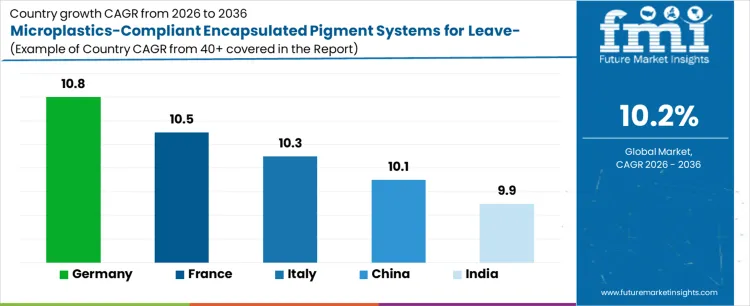
| Country | CAGR (%) |
|---|---|
| Germany | 10.8% |
| France | 10.5% |
| Italy | 10.3% |
| China | 10.1% |
| India | 9.9% |
What factors are driving strong adoption of microplastics-compliant encapsulated pigments in Germany?
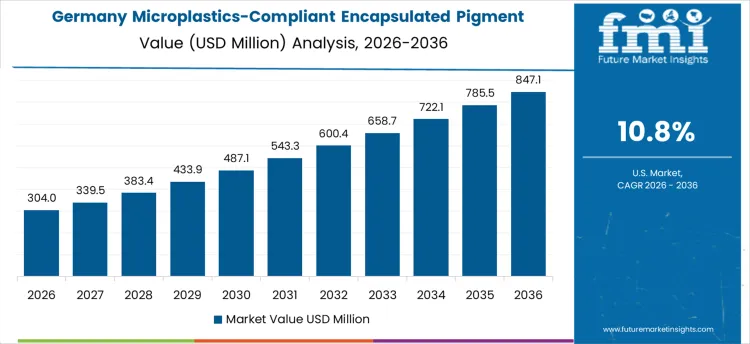
Germany demand is driven by strict interpretation of EU microplastics regulations and early adoption of compliance frameworks. CAGR of 10.8% reflects reformulation of leave-on makeup to replace polymeric microbeads with biodegradable or mineral-based encapsulation systems. Manufacturers prioritize pigments offering controlled release, skin adhesion, and color stability without environmental persistence. Certification and documentation requirements influence supplier selection. Pharmacy and premium retail channels enforce compliance rigorously. Growth remains regulation-led and quality-focused, aligned with precautionary consumer protection and environmental stewardship standards.
- Early enforcement of microplastics restrictions
- Replacement of polymeric microbeads in makeup
- Emphasis on biodegradable or mineral encapsulation
- Strong certification and documentation requirements
How is France sustaining high growth in compliant encapsulated pigment usage?
France demand reflects leadership in sustainable cosmetics policy and dermocosmetic formulation. CAGR of 10.5% is supported by adoption of microplastics-compliant encapsulated pigments in foundations, concealers, and lip products. Brands emphasize skin safety, sensory performance, and environmental compatibility. Regulatory alignment and voluntary eco-labels guide reformulation decisions. Export-oriented brands require compliant pigments to maintain EU and international market access. Growth remains standards-led and formulation-driven, aligned with France’s role in global cosmetic innovation.
- Sustainable cosmetics policy influence
- Reformulation of leave-on complexion products
- Alignment with eco-label and regulatory standards
- Export-driven compliance requirements
What supports Italy’s strong growth in encapsulated pigment systems?
Italy demand reflects concentration of premium color cosmetics manufacturing and rapid adaptation to EU regulatory change. CAGR of 10.3% is supported by use of encapsulated pigments enabling smooth application and long wear without restricted microplastics. Manufacturers balance luxury aesthetics with compliance needs. Contract manufacturers invest in compliant dispersion and encapsulation technologies. Brand portfolios transition toward environmentally aligned formulations. Growth remains manufacturing-led and compliance-focused, aligned with Italy’s position in high-end makeup production.
- Premium color cosmetics manufacturing base
- Need for long-wear performance without microplastics
- Investment in compliant encapsulation technologies
- Rapid reformulation across brand portfolios
How is China advancing adoption of microplastics-compliant pigment systems?
China demand is shaped by export manufacturing for EU brands and rising domestic clean beauty awareness. CAGR of 10.1% reflects reformulation of leave-on makeup to meet European microplastics compliance. Manufacturers adopt encapsulated pigments to ensure regulatory acceptance and performance consistency. Large-scale production benefits from standardized compliant inputs. Domestic suppliers expand development of alternative encapsulation materials. Growth remains scale-driven and compliance-aligned, supported by China’s role in global cosmetic supply chains.
- Export compliance with EU microplastics rules
- Standardized adoption in large-scale manufacturing
- Expansion of alternative encapsulation materials
- Rising domestic clean beauty expectations
Why is India showing steady growth in compliant encapsulated pigment demand?
India demand reflects increasing participation in global cosmetic manufacturing and growth of clean beauty consumption. CAGR of 9.9% is supported by adoption of microplastics-compliant pigments for export-oriented makeup products. Brands reformulate to meet international retailer and regulatory requirements. Domestic consumers show rising awareness of environmentally responsible cosmetics. Cost-effective compliant systems compatible with existing processes are favored. Growth remains export-led and gradually consumption-driven, aligned with evolving regulatory awareness and formulation capability.
- Export-oriented reformulation for compliance
- Rising domestic clean beauty awareness
- Preference for cost-effective compliant systems
- Alignment with international retailer requirements
What is the competitive landscape of demand for microplastics-compliant encapsulated pigment systems for leave-on makeup?
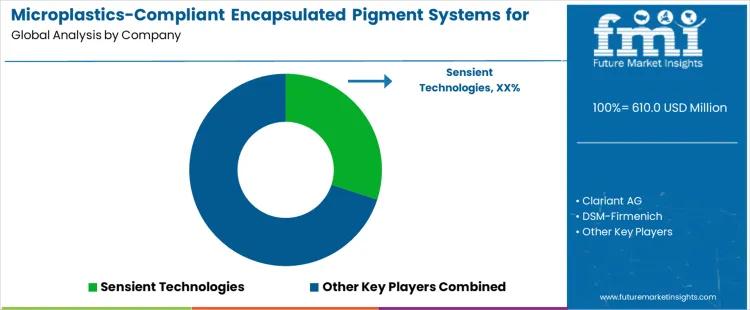
Demand for microplastics-compliant encapsulated pigment systems for leave-on makeup is driven by regulatory restrictions on intentionally added microplastics and reformulation mandates from global beauty brands. Leave-on products such as foundations, lipsticks, blushes, and concealers require encapsulated pigments that deliver color stability, controlled release, and skin comfort while meeting biodegradability and polymer compliance criteria. Buyers evaluate encapsulation integrity, particle size control, pigment protection against oxidation, sensory neutrality, and compatibility with oils, waxes, and emulsion systems. Procurement teams prioritize suppliers with verified microplastics compliance, documented biodegradability testing, and global regulatory support across Europe, North America, and Asia.
Sensient Technologies holds leading positioning through compliant encapsulated pigment and dispersion systems supported by extensive cosmetic application laboratories. Clariant AG supplies microplastics-compliant pigment technologies and encapsulation platforms aligned with regulatory and performance requirements. DSM-Firmenich contributes biotechnology-driven encapsulation and delivery systems focused on safety and sustainability validation. Sun Chemical, part of DIC Group, provides large-scale encapsulated pigment dispersions with strong batch consistency for multinational brand launches. BASF SE supports demand through polymer science and encapsulation know-how enabling compliant film-forming and pigment protection solutions. Competitive differentiation depends on encapsulation durability, regulatory documentation depth, formulation support, and ability to scale supply for global leave-on makeup portfolios.
Key Players in the Microplastics-Compliant Encapsulated Pigment Systems for Leave-On Makeup Market
- Sensient Technologies
- Clariant AG
- DSM-Firmenich
- Sun Chemical (DIC Group)
- BASF SE
Scope of the Report
| Items | Values |
|---|---|
| Quantitative Units | USD million |
| Pigment System Type | Polymer-Free Encapsulated Pigments; Silica & Mineral Shell Encapsulated Pigments; Biodegradable Polymer Encapsulation Systems; Hybrid Bio-Based Encapsulated Pigments |
| Encapsulation Technology | Inorganic Shell Encapsulation; Biopolymer Microencapsulation; Sol-Gel Encapsulation Systems; Layer-by-Layer Bio-Coatings |
| Application | Foundations & Skin Tints; Concealers & Correctors; Cream Blush & Bronzers; Highlighters & Illuminators |
| Regions Covered | Asia Pacific, Europe, North America, Latin America, Middle East & Africa |
| Countries Covered | Germany, France, Italy, China, India, and 40+ countries |
| Key Companies Profiled | Sensient Technologies; Clariant AG; DSM-Firmenich; Sun Chemical (DIC Group); BASF SE |
| Additional Attributes | Dollar sales by pigment system type and encapsulation technology; adoption trends for microplastics-compliant and polymer-free pigment encapsulation in leave-on makeup; shell integrity, release control, and color stability performance metrics; compatibility with silicone-free, water-based, and hybrid cosmetic formulations; biodegradability, particle size distribution, and regulatory conformity considerations; compliance with microplastics restrictions and cosmetic safety standards influencing encapsulated pigment selection. |
Microplastics-Compliant Encapsulated Pigment Systems for Leave-On Makeup Market by Segment
Pigment System Type:
- Polymer-Free Encapsulated Pigments
- Silica & Mineral Shell Encapsulated Pigments
- Biodegradable Polymer Encapsulation Systems
- Hybrid Bio-Based Encapsulated Pigments
Encapsulation Technology:
- Inorganic Shell Encapsulation
- Biopolymer Microencapsulation
- Sol-Gel Encapsulation Systems
- Layer-by-Layer Bio-Coatings
Application:
- Foundations & Skin Tints
- Concealers & Correctors
- Cream Blush & Bronzers
- Highlighters & Illuminators
Region:
- Asia Pacific
- China
- Japan
- South Korea
- India
- Australia & New Zealand
- ASEAN
- Rest of Asia Pacific
- Europe
- Germany
- United Kingdom
- France
- Italy
- Spain
- Nordic
- BENELUX
- Rest of Europe
- North America
- United States
- Canada
- Mexico
- Latin America
- Brazil
- Chile
- Rest of Latin America
- Middle East & Africa
- Kingdom of Saudi Arabia
- Other GCC Countries
- Turkey
- South Africa
- Other African Union
- Rest of Middle East & Africa
Frequently Asked Questions
How big is the microplastics-compliant encapsulated pigment systems for leave-on makeup market in 2026?
The global microplastics-compliant encapsulated pigment systems for leave-on makeup market is estimated to be valued at USD 610.0 million in 2026.
What will be the size of microplastics-compliant encapsulated pigment systems for leave-on makeup market in 2036?
The market size for the microplastics-compliant encapsulated pigment systems for leave-on makeup market is projected to reach USD 1,611.2 million by 2036.
How much will be the microplastics-compliant encapsulated pigment systems for leave-on makeup market growth between 2026 and 2036?
The microplastics-compliant encapsulated pigment systems for leave-on makeup market is expected to grow at a 10.2% CAGR between 2026 and 2036.
What are the key product types in the microplastics-compliant encapsulated pigment systems for leave-on makeup market?
The key product types in microplastics-compliant encapsulated pigment systems for leave-on makeup market are polymer-free encapsulated pigments, silica & mineral shell encapsulated pigments, biodegradable polymer encapsulation systems and hybrid bio-based encapsulated pigments.
Which encapsulation technology segment to contribute significant share in the microplastics-compliant encapsulated pigment systems for leave-on makeup market in 2026?
In terms of encapsulation technology, inorganic shell encapsulation segment to command 34.0% share in the microplastics-compliant encapsulated pigment systems for leave-on makeup market in 2026.
Preview the report firsthand - request a free sample
Get SampleGet the brochure for pricing and purchase details.
Get PDFTable of Content
- Executive Summary
- Global Market Outlook
- Demand-side Trends
- Supply-side Trends
- Technology Roadmap Analysis
- Analysis and Recommendations
- Market Overview
- Market Coverage / Taxonomy
- Market Definition / Scope / Limitations
- Market Background
- Market Dynamics
- Drivers
- Restraints
- Opportunity
- Trends
- Scenario Forecast
- Demand in Optimistic Scenario
- Demand in Likely Scenario
- Demand in Conservative Scenario
- Opportunity Map Analysis
- Product Life Cycle Analysis
- Supply Chain Analysis
- Investment Feasibility Matrix
- Value Chain Analysis
- PESTLE and Porter’s Analysis
- Regulatory Landscape
- Regional Parent Market Outlook
- Production and Consumption Statistics
- Import and Export Statistics
- Market Dynamics
- Global Market Analysis 2021 to 2025 and Forecast, 2026 to 2036
- Historical Market Size Value (USD Million) Analysis, 2021 to 2025
- Current and Future Market Size Value (USD Million) Projections, 2026 to 2036
- Y-o-Y Growth Trend Analysis
- Absolute $ Opportunity Analysis
- Global Market Pricing Analysis 2021 to 2025 and Forecast 2026 to 2036
- Global Market Analysis 2021 to 2025 and Forecast 2026 to 2036, By Pigment System Type
- Introduction / Key Findings
- Historical Market Size Value (USD Million) Analysis By Pigment System Type , 2021 to 2025
- Current and Future Market Size Value (USD Million) Analysis and Forecast By Pigment System Type , 2026 to 2036
- Polymer-Free Encapsulated Pigments
- Silica & Mineral Shell Encapsulated Pigments
- Biodegradable Polymer Encapsulation Systems
- Hybrid Bio-Based Encapsulated Pigments
- Polymer-Free Encapsulated Pigments
- Y-o-Y Growth Trend Analysis By Pigment System Type , 2021 to 2025
- Absolute $ Opportunity Analysis By Pigment System Type , 2026 to 2036
- Global Market Analysis 2021 to 2025 and Forecast 2026 to 2036, By Encapsulation Technology
- Introduction / Key Findings
- Historical Market Size Value (USD Million) Analysis By Encapsulation Technology, 2021 to 2025
- Current and Future Market Size Value (USD Million) Analysis and Forecast By Encapsulation Technology, 2026 to 2036
- Inorganic Shell Encapsulation
- Biopolymer Microencapsulation
- Sol-Gel Encapsulation Systems
- Layer-by-Layer Bio-Coatings
- Inorganic Shell Encapsulation
- Y-o-Y Growth Trend Analysis By Encapsulation Technology, 2021 to 2025
- Absolute $ Opportunity Analysis By Encapsulation Technology, 2026 to 2036
- Global Market Analysis 2021 to 2025 and Forecast 2026 to 2036, By Application
- Introduction / Key Findings
- Historical Market Size Value (USD Million) Analysis By Application, 2021 to 2025
- Current and Future Market Size Value (USD Million) Analysis and Forecast By Application, 2026 to 2036
- Foundations & Skin Tints
- Concealers & Correctors
- Cream Blush & Bronzers
- Highlighters & Illuminators
- Foundations & Skin Tints
- Y-o-Y Growth Trend Analysis By Application, 2021 to 2025
- Absolute $ Opportunity Analysis By Application, 2026 to 2036
- Global Market Analysis 2021 to 2025 and Forecast 2026 to 2036, By Region
- Introduction
- Historical Market Size Value (USD Million) Analysis By Region, 2021 to 2025
- Current Market Size Value (USD Million) Analysis and Forecast By Region, 2026 to 2036
- North America
- Latin America
- Western Europe
- Eastern Europe
- East Asia
- South Asia and Pacific
- Middle East & Africa
- Market Attractiveness Analysis By Region
- North America Market Analysis 2021 to 2025 and Forecast 2026 to 2036, By Country
- Historical Market Size Value (USD Million) Trend Analysis By Market Taxonomy, 2021 to 2025
- Market Size Value (USD Million) Forecast By Market Taxonomy, 2026 to 2036
- By Country
- USA
- Canada
- Mexico
- By Pigment System Type
- By Encapsulation Technology
- By Application
- By Country
- Market Attractiveness Analysis
- By Country
- By Pigment System Type
- By Encapsulation Technology
- By Application
- Key Takeaways
- Latin America Market Analysis 2021 to 2025 and Forecast 2026 to 2036, By Country
- Historical Market Size Value (USD Million) Trend Analysis By Market Taxonomy, 2021 to 2025
- Market Size Value (USD Million) Forecast By Market Taxonomy, 2026 to 2036
- By Country
- Brazil
- Chile
- Rest of Latin America
- By Pigment System Type
- By Encapsulation Technology
- By Application
- By Country
- Market Attractiveness Analysis
- By Country
- By Pigment System Type
- By Encapsulation Technology
- By Application
- Key Takeaways
- Western Europe Market Analysis 2021 to 2025 and Forecast 2026 to 2036, By Country
- Historical Market Size Value (USD Million) Trend Analysis By Market Taxonomy, 2021 to 2025
- Market Size Value (USD Million) Forecast By Market Taxonomy, 2026 to 2036
- By Country
- Germany
- UK
- Italy
- Spain
- France
- Nordic
- BENELUX
- Rest of Western Europe
- By Pigment System Type
- By Encapsulation Technology
- By Application
- By Country
- Market Attractiveness Analysis
- By Country
- By Pigment System Type
- By Encapsulation Technology
- By Application
- Key Takeaways
- Eastern Europe Market Analysis 2021 to 2025 and Forecast 2026 to 2036, By Country
- Historical Market Size Value (USD Million) Trend Analysis By Market Taxonomy, 2021 to 2025
- Market Size Value (USD Million) Forecast By Market Taxonomy, 2026 to 2036
- By Country
- Russia
- Poland
- Hungary
- Balkan & Baltic
- Rest of Eastern Europe
- By Pigment System Type
- By Encapsulation Technology
- By Application
- By Country
- Market Attractiveness Analysis
- By Country
- By Pigment System Type
- By Encapsulation Technology
- By Application
- Key Takeaways
- East Asia Market Analysis 2021 to 2025 and Forecast 2026 to 2036, By Country
- Historical Market Size Value (USD Million) Trend Analysis By Market Taxonomy, 2021 to 2025
- Market Size Value (USD Million) Forecast By Market Taxonomy, 2026 to 2036
- By Country
- China
- Japan
- South Korea
- By Pigment System Type
- By Encapsulation Technology
- By Application
- By Country
- Market Attractiveness Analysis
- By Country
- By Pigment System Type
- By Encapsulation Technology
- By Application
- Key Takeaways
- South Asia and Pacific Market Analysis 2021 to 2025 and Forecast 2026 to 2036, By Country
- Historical Market Size Value (USD Million) Trend Analysis By Market Taxonomy, 2021 to 2025
- Market Size Value (USD Million) Forecast By Market Taxonomy, 2026 to 2036
- By Country
- India
- ASEAN
- Australia & New Zealand
- Rest of South Asia and Pacific
- By Pigment System Type
- By Encapsulation Technology
- By Application
- By Country
- Market Attractiveness Analysis
- By Country
- By Pigment System Type
- By Encapsulation Technology
- By Application
- Key Takeaways
- Middle East & Africa Market Analysis 2021 to 2025 and Forecast 2026 to 2036, By Country
- Historical Market Size Value (USD Million) Trend Analysis By Market Taxonomy, 2021 to 2025
- Market Size Value (USD Million) Forecast By Market Taxonomy, 2026 to 2036
- By Country
- Kingdom of Saudi Arabia
- Other GCC Countries
- Turkiye
- South Africa
- Other African Union
- Rest of Middle East & Africa
- By Pigment System Type
- By Encapsulation Technology
- By Application
- By Country
- Market Attractiveness Analysis
- By Country
- By Pigment System Type
- By Encapsulation Technology
- By Application
- Key Takeaways
- Key Countries Market Analysis
- USA
- Pricing Analysis
- Market Share Analysis, 2025
- By Pigment System Type
- By Encapsulation Technology
- By Application
- Canada
- Pricing Analysis
- Market Share Analysis, 2025
- By Pigment System Type
- By Encapsulation Technology
- By Application
- Mexico
- Pricing Analysis
- Market Share Analysis, 2025
- By Pigment System Type
- By Encapsulation Technology
- By Application
- Brazil
- Pricing Analysis
- Market Share Analysis, 2025
- By Pigment System Type
- By Encapsulation Technology
- By Application
- Chile
- Pricing Analysis
- Market Share Analysis, 2025
- By Pigment System Type
- By Encapsulation Technology
- By Application
- Germany
- Pricing Analysis
- Market Share Analysis, 2025
- By Pigment System Type
- By Encapsulation Technology
- By Application
- UK
- Pricing Analysis
- Market Share Analysis, 2025
- By Pigment System Type
- By Encapsulation Technology
- By Application
- Italy
- Pricing Analysis
- Market Share Analysis, 2025
- By Pigment System Type
- By Encapsulation Technology
- By Application
- Spain
- Pricing Analysis
- Market Share Analysis, 2025
- By Pigment System Type
- By Encapsulation Technology
- By Application
- France
- Pricing Analysis
- Market Share Analysis, 2025
- By Pigment System Type
- By Encapsulation Technology
- By Application
- India
- Pricing Analysis
- Market Share Analysis, 2025
- By Pigment System Type
- By Encapsulation Technology
- By Application
- ASEAN
- Pricing Analysis
- Market Share Analysis, 2025
- By Pigment System Type
- By Encapsulation Technology
- By Application
- Australia & New Zealand
- Pricing Analysis
- Market Share Analysis, 2025
- By Pigment System Type
- By Encapsulation Technology
- By Application
- China
- Pricing Analysis
- Market Share Analysis, 2025
- By Pigment System Type
- By Encapsulation Technology
- By Application
- Japan
- Pricing Analysis
- Market Share Analysis, 2025
- By Pigment System Type
- By Encapsulation Technology
- By Application
- South Korea
- Pricing Analysis
- Market Share Analysis, 2025
- By Pigment System Type
- By Encapsulation Technology
- By Application
- Russia
- Pricing Analysis
- Market Share Analysis, 2025
- By Pigment System Type
- By Encapsulation Technology
- By Application
- Poland
- Pricing Analysis
- Market Share Analysis, 2025
- By Pigment System Type
- By Encapsulation Technology
- By Application
- Hungary
- Pricing Analysis
- Market Share Analysis, 2025
- By Pigment System Type
- By Encapsulation Technology
- By Application
- Kingdom of Saudi Arabia
- Pricing Analysis
- Market Share Analysis, 2025
- By Pigment System Type
- By Encapsulation Technology
- By Application
- Turkiye
- Pricing Analysis
- Market Share Analysis, 2025
- By Pigment System Type
- By Encapsulation Technology
- By Application
- South Africa
- Pricing Analysis
- Market Share Analysis, 2025
- By Pigment System Type
- By Encapsulation Technology
- By Application
- USA
- Market Structure Analysis
- Competition Dashboard
- Competition Benchmarking
- Market Share Analysis of Top Players
- By Regional
- By Pigment System Type
- By Encapsulation Technology
- By Application
- Competition Analysis
- Competition Deep Dive
- Sensient Technologies
- Overview
- Product Portfolio
- Profitability by Market Segments (Product/Age /Sales Channel/Region)
- Sales Footprint
- Strategy Overview
- Marketing Strategy
- Product Strategy
- Channel Strategy
- Clariant AG
- DSM-Firmenich
- Sun Chemical (DIC Group)
- BASF SE
- Sensient Technologies
- Competition Deep Dive
- Assumptions & Acronyms Used
- Research Methodology


