

- Industry Size (2026)
- USD 196 Mn
- Forecast (2036)
- USD 464.0 Mn
- CAGR (2026 to 2036)
- 9.0%
High-Coverage Pigment Systems for Complexion and Eye Makeup Market Forecast and Outlook 2026 to 2036
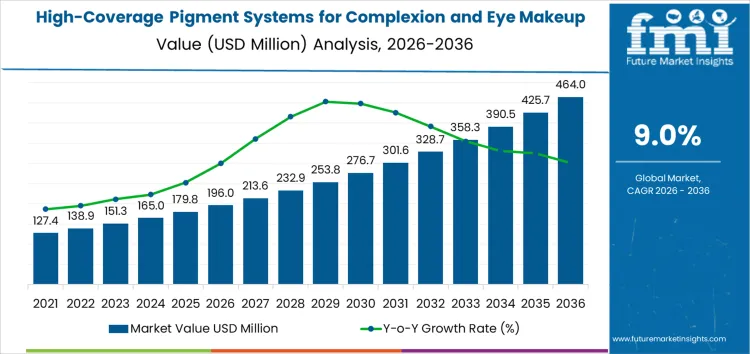
The high-coverage pigment systems for complexion and eye makeup market is valued at USD 196 million in 2026 and is projected to reach USD 464.0 million by 2036, reflecting a CAGR of 9.00%. Demand during this period is shaped by shade intensity requirements, dispersion stability, and sensory performance expectations in finished formulations. Cost structures are influenced by pigment treatment processes, particle size control, and consistency across production batches. Performance is evaluated on opacity, blendability, and wear under varied skin conditions. Suppliers delivering predictable color strength and low variability retain pricing stability. Purchasing decisions emphasize formulation reliability rather than pigment volume usage.
Between 2026 and 2036, market outcomes are influenced by brand risk management and formulation approval inertia. Cosmetic manufacturers favor pigment systems with proven compatibility across emulsions, powders, and hybrid formats. Once qualified, systems remain specified due to reformulation cost and product relaunch risk. Switching costs increase where shade matching and regulatory documentation are involved. Entry barriers persist through testing requirements and performance benchmarking against incumbent systems. Strategic trade-offs arise between maximizing coverage and maintaining natural finish characteristics. Competitive positioning depends on integration into long-term product portfolios rather than short-term pricing leverage.
Quick Stats for High Coverage Pigment Systems for Complexion and Eye Makeup Market
- High Coverage Pigment Systems for Complexion and Eye Makeup Market Value (2026): USD 196 million
- High Coverage Pigment Systems for Complexion and Eye Makeup Market Forecast Value (2036): USD 464.0 million
- High Coverage Pigment Systems for Complexion and Eye Makeup Market Forecast CAGR (2026 to 2036): 9.0%
- Leading Product Type in High Coverage Pigment Systems for Complexion and Eye Makeup Market: Iron oxides
- Key Growth Regions in High Coverage Pigment Systems for Complexion and Eye Makeup Market: Asia Pacific, North America, Europe
- Top Players in High Coverage Pigment Systems for Complexion and Eye Makeup Market: BASF SE, Clariant AG, Merck KGaA, DIC Corporation (including Sun Chemical), Sensient Technologies Corporation
What Is the Growth Forecast for High Coverage Pigment Systems for Complexion and Eye Makeup Market through 2036?
Shade uniformity requirements and formulation stability define the early growth phase of the high coverage pigment systems for complexion and eye makeup market between 2026 and 2031. During this period, the market expands from USD 196 million to USD 274 million, adding USD 78 million in value. Annual progression from USD 120 million to USD 196 million reflects rising use of high pigment load formulations in foundations, concealers, and eye products where opacity and color consistency are critical. Historical growth was constrained by dispersion challenges and texture tradeoffs at higher pigment concentrations. Forward expansion in this phase is supported by improved milling techniques, better pigment surface treatments, and wider adoption across mass and premium cosmetic product lines.
Product differentiation intensity and portfolio expansion drive growth from 2031 to 2036. Over this period, the market increases from USD 274 million to USD 467 million, adding USD 193 million and representing the stronger expansion window. Annual values rise from USD 297 million to USD 464.0 million, indicating accelerating year over year momentum. Earlier demand focused on selective hero products, while future growth reflects broader application across full complexion ranges and eye makeup collections. Higher SKU turnover, longer wear expectations, and consistent shade reproduction across global markets support sustained expansion as high coverage pigment systems become core inputs in cosmetic formulation strategies.
High Coverage Pigment Systems for Complexion and Eye Makeup Market Key Takeaways
| Metric | Value |
|---|---|
| Market Value (2026) | USD 196 million |
| Forecast Value (2036) | USD 464.0 million |
| Forecast CAGR (2026 to 2036) | 9.0% |
What Is Driving Demand in the High-Coverage Pigment Systems for Complexion and Eye Makeup Market?
Demand for high-coverage pigment systems in complexion and eye makeup has grown from performance limitations observed in traditional formulations rather than general colour trends alone. Conventional pigments often required multiple layers to achieve opacity on varied skin tones, leading to heavier feels, patchiness, and inconsistent finish. Makeup artists and consumers seeking uniform coverage for concerns such as hyperpigmentation, discoloration, or blemish concealment identified these constraints during product trials and wear tests. This created demand for pigment systems with enhanced tinting strength, even dispersion, and lasting saturation without heaviness. Early adoption occurred in premium and professional lines where performance outcomes were directly measured by application results rather than by broad aesthetic preference.
Future growth will be shaped by evolving consumer expectations, inclusivity standards, and ingredient transparency rather than incremental colour range expansion alone. Consumers now demand products that deliver true-to-shade, full coverage across diverse skin tones while maintaining comfort, blendability, and long wear. Regulatory and safety frameworks are influencing pigment selection based on purity, allergen profiles, and photostability under varied conditions. Advances in pigment technology, including engineered particle size distribution and encapsulated colourants, improve coverage with minimal formula load and reduced risk of settling or creasing. Demand will align with documented performance criteria such as coverage uniformity, abrasion resistance, and margin for skin sensitivity rather than decorative trends alone, embedding high-coverage pigment systems into standard product specifications and consumer expectations for complexion and eye makeup.
What Factors Are Affecting the Demand for High Coverage Pigment Systems for Complexion and Eye Makeup Market in Terms of Product Type and Application Area?
The high coverage pigment systems market for complexion and eye makeup is driven by demand for long wearing performance, uniform skin tone correction, and visual consistency across shades. Demand centers on pigments that provide opacity, stability, and regulatory compliance while maintaining acceptable skin feel. Adoption depends on dispersion behavior, color accuracy, and compatibility with liquid, cream, and powder formulations. Market leadership reflects reliability, formulation flexibility, and proven performance rather than novelty of color effects.
What Is Driving Leadership by Product Type in the High Coverage Pigment Systems Market?
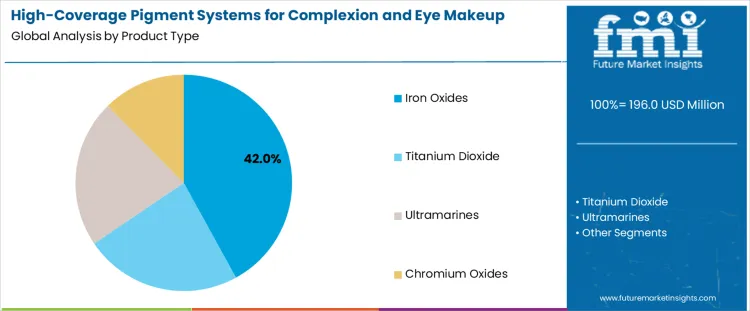
Iron oxides account for about 42% of demand because they provide strong opacity, color consistency, and broad shade versatility required for complexion products. These pigments are essential for creating natural skin tone ranges across foundations, concealers, and correctors. Iron oxides offer high tinting strength and excellent coverage at relatively low loadings, supporting efficient formulations with stable viscosity and spreadability. Their chemical stability under light, heat, and oxidation ensures long shelf life and consistent appearance during wear. Cosmetic formulators favor iron oxides due to predictable dispersion behavior in both water and oil based systems. Regulatory acceptance across global markets further reinforces their widespread use. Their ability to blend easily with other pigments allows fine tuning of undertones without compromising coverage. As inclusive shade ranges expand, reliance on iron oxide systems increases due to their role in achieving precise color matching at scale. These factors anchor iron oxides as the dominant product type in high coverage pigment systems.
Titanium dioxide, ultramarines, and chromium oxides serve complementary roles but remain secondary. Titanium dioxide contributes brightness and opacity but lacks chromatic depth. Ultramarines provide vivid hues but limited coverage alone. Chromium oxides offer niche correction tones. Product type leadership therefore reflects versatility, stability, and foundational role in complexion formulation rather than singular optical strength.
What Is Driving Leadership by Application Area in the High Coverage Pigment Systems Market?
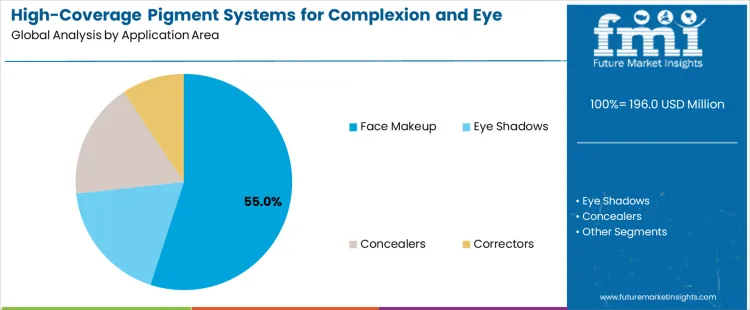
Face makeup represents about 55% of demand because complexion products require the highest level of coverage uniformity and shade accuracy. Foundations, powders, and face palettes rely on pigment systems that mask discoloration while maintaining a natural appearance. High consumer expectations for flawless coverage drive consistent demand for advanced pigment dispersions in this category. Face makeup also accounts for the largest product volumes and daily use frequency, reinforcing continuous pigment consumption. Product launches often focus on complexion ranges, increasing formulation activity and pigment demand.
Eye shadows, concealers, and correctors contribute secondary demand. Eye shadows emphasize color payoff but operate at lower volumes. Concealers and correctors require high coverage but are applied in smaller quantities. These segments adopt similar pigment systems but consume less material overall. Application leadership therefore reflects volume intensity, frequency of use, and central role of complexion products in cosmetic routines rather than diversity of makeup categories.
How Are High-Coverage Pigment Systems Being Applied Across Complexion and Eye Makeup Products?
Use appears in foundations, concealers, eyeshadows, and eyeliners where intense color payoff, uniform coverage, and long-lasting performance are critical. Manufacturers adopt high-coverage pigment systems to enhance opacity, blendability, and adherence on skin and eyelids while maintaining safe cosmetic formulations. Cosmetic brands integrate these pigments into liquid, cream, and powder products to achieve vibrant shades and consistent finish. These applications reflect operational and performance priorities rather than purely decorative objectives, with adoption driven by color intensity, formulation stability, and consumer satisfaction.
What Operational and Material Conditions Support Adoption of High-Coverage Pigment Systems?
Selection aligns with cosmetic formulations that require pigment dispersion, compatibility with oils, waxes, or polymers, and resistance to settling or fading. Pigments are optimized for particle size, refractive index, and surface treatment to ensure uniform application and skin safety. Manufacturing workflows monitor mixing, milling, and homogenization to maintain consistent color strength and texture. Quality control evaluates opacity, stability, adhesion, and regulatory compliance with cosmetic safety standards. These conditions emerge from operational reliability, formulation performance, and consumer safety priorities in structured makeup production workflows.
Which Practical Considerations Limit Wider Use of High-Coverage Pigment Systems?
Higher raw material cost and precise dispersion requirements may limit adoption in budget cosmetic lines. Pigment compatibility with other ingredients, including UV filters or emollients, must be validated. Long-term stability under light, temperature, and humidity exposure requires testing. Regulatory approvals for colorants and cosmetic safety differ by region. These factors lead to selective deployment where color intensity, product stability, and formulation safety justify incremental cost and process control in makeup manufacturing.
What is the Demand for High Coverage Pigment Systems for Complexion and Eye Makeup by Country?
| Country | CAGR (%) |
|---|---|
| USA | 8.0% |
| UK | 7.5% |
| China | 11.0% |
| India | 12.0% |
| Brazil | 9.5% |
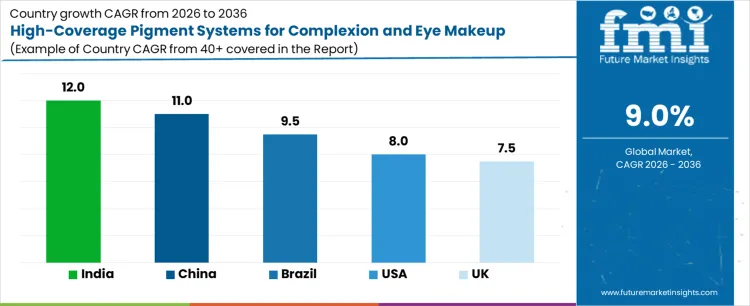
The demand for high coverage pigment systems for complexion and eye makeup varies across countries, driven by cosmetic industry growth, consumer demand for premium makeup products, and formulation innovation. India leads with a 12.0% CAGR, supported by rising beauty awareness, increasing cosmetic consumption, and expanding retail and e commerce channels. China follows at 11.0%, driven by large scale cosmetic manufacturing, rising middle class, and demand for high performance makeup products. Brazil records 9.5%, shaped by growing beauty industry and consumer preference for vibrant makeup. The USA grows at 8.0%, reflecting steady adoption in the premium and mass cosmetic segments. The UK posts 7.5%, supported by mature cosmetic markets and consistent product innovation.
How are high-coverage pigment systems expanding applications in complexion and eye makeup in the United States?
In the United States, the high-coverage pigment systems for complexion and eye makeup market is growing at a CAGR of 8% through 2036, driven by increasing consumer demand for long-wear and high-pigment cosmetic products, premium makeup launches, and the growth of e-commerce beauty sales. Manufacturers are integrating high-coverage pigments to enhance color intensity, improve blendability, and maintain skin safety compliance. Demand is concentrated in cosmetic production hubs, formulation laboratories, and packaging facilities. Compared to China, adoption emphasizes product quality, regulatory compliance, and premium brand positioning over high-volume production. Domestic suppliers provide high-performance, skin-safe pigments suitable for recurring formulation and packaging cycles.
- Cosmetic production hubs, formulation laboratories, and packaging facilities drive adoption
- Pigments enhance color intensity, blendability, and skin safety
- Domestic suppliers provide high-performance, skin-safe solutions
- Recurring formulation and packaging cycles sustain adoption
How are luxury cosmetic trends and e-commerce growth driving adoption in the United Kingdom?
In the United Kingdom, revenue is growing at a CAGR of 7.5% through 2036, supported by growing demand for premium makeup, online beauty retail, and consumer preference for high-coverage, versatile cosmetics. Manufacturers are adopting high-coverage pigment systems to improve opacity, texture, and product performance in complexion and eye makeup. Demand is concentrated in formulation labs, cosmetic production centers, and urban packaging hubs. Compared to India, adoption emphasizes product innovation, compliance with EU cosmetic regulations, and premium brand differentiation rather than large-scale volume. Domestic suppliers provide safe, high-quality pigments suitable for recurring formulation and production cycles.
- Formulation labs, cosmetic production centers, and urban packaging hubs drive adoption
- Pigments improve opacity, texture, and product performance
- Domestic suppliers provide safe, high-quality solutions
- Recurring formulation and production cycles sustain adoption
How are industrial cosmetics manufacturing and consumer trends driving growth in China?
In China, the market is expanding at a CAGR of 11% through 2036, fueled by rising makeup consumption, growing urban cosmetic retail, and the expansion of domestic and international beauty brands. Manufacturers are using high-coverage pigment systems to enhance color payoff, improve wearability, and maintain safety standards for sensitive skin. Demand is concentrated in industrial cosmetics hubs, formulation laboratories, and packaging facilities. Compared to the USA, adoption emphasizes large-scale industrial production and high-volume distribution. Domestic suppliers provide cost-effective, high-performance pigments suitable for recurring formulation, packaging, and quality control cycles.
- Industrial cosmetics hubs, formulation laboratories, and packaging facilities drive adoption
- Pigments enhance color payoff, wearability, and safety
- Domestic suppliers provide cost-effective, high-performance solutions
- Recurring formulation, packaging, and quality control cycles sustain adoption
How are premium beauty trends and manufacturing innovation driving adoption in India?
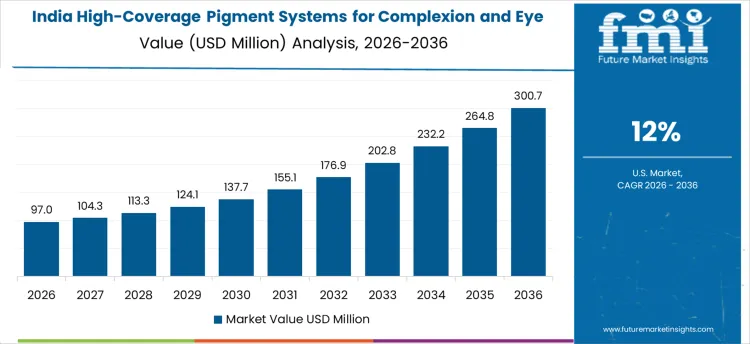
In India, the market is growing at a CAGR of 12% through 2036, supported by increasing demand for high-coverage makeup, rising urban consumer spending, and adoption of international cosmetic standards. Manufacturers are integrating pigment systems to improve opacity, blendability, and durability in complexion and eye makeup. Demand is concentrated in industrial cosmetic hubs, formulation labs, and packaging facilities. Compared to the UK, adoption emphasizes large-scale industrial production and high-volume distribution. Domestic suppliers provide high-performance, safe pigments suitable for recurring formulation, packaging, and quality inspection operations.
- Industrial cosmetic hubs, formulation labs, and packaging facilities drive adoption
- Pigments improve opacity, blendability, and durability
- Domestic suppliers provide high-performance, safe solutions
- Recurring formulation, packaging, and inspection operations sustain adoption
How are cosmetic consumption and industrial manufacturing driving growth in Brazil?
In Brazil, the market is expanding at a CAGR of 9.5% through 2036, driven by high demand for vibrant, long-wear makeup, growth of urban retail channels, and adoption of modern cosmetic production facilities. Manufacturers are using high-coverage pigment systems to enhance color intensity, durability, and product versatility for complexion and eye makeup. Demand is concentrated in formulation labs, industrial cosmetic hubs, and packaging facilities. Compared to China, adoption emphasizes mid-scale production with strong local brand integration. Domestic suppliers provide cost-effective, high-performance pigments suitable for recurring formulation, production, and packaging cycles.
- Formulation labs, industrial cosmetic hubs, and packaging facilities drive adoption
- Pigments enhance color intensity, durability, and versatility
- Domestic suppliers provide cost-effective, high-performance solutions
- Recurring formulation, production, and packaging cycles sustain adoption
Which Strategic Approaches Define Competition in the High Coverage Pigment Systems for Complexion and Eye Makeup Market?
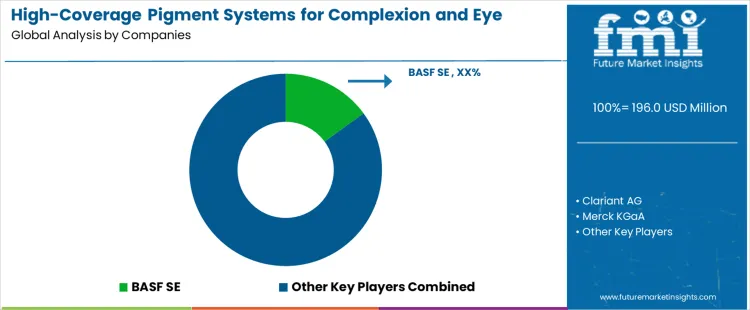
Competition in the high coverage pigment systems market is shaped by how effectively suppliers balance opacity, skin feel, and formulation stability across diverse cosmetic formats. BASF SE and Clariant AG approach this segment through pigment surface treatment and dispersion technologies designed to deliver uniform coverage without excessive loading that can compromise texture.
Their strategies emphasize consistency across batches, ease of incorporation into liquid, cream, and powder systems, and compatibility with global cosmetic regulations. Merck KGaA differentiates through effect pigments and hybrid systems that combine coverage with controlled light interaction, supporting premium eye and complexion products where visual depth matters. Product selection is driven by color strength, wear behavior, and stability under heat, light, and repeated application rather than raw pigment concentration.
A different competitive emphasis is evident among suppliers closely aligned with color cosmetics brands. DIC Corporation, including Sun Chemical, focuses on pigment systems optimized for high intensity color payoff and process reliability during large scale manufacturing.
Sensient Technologies Corporation competes through application specific pigment platforms tailored to foundations, concealers, and eye makeup, where shade accuracy and reproducibility are critical. Across the market, strategies prioritize formulation support, regulatory readiness, and sensory performance validation. Competitive advantage is built through long term collaboration with brand formulators, predictable performance across skin tones, and the ability to meet fast product development cycles without sacrificing quality or compliance.
Key Players in the High Coverage Pigment Systems for Complexion and Eye Makeup Market
- BASF SE
- Clariant AG
- Merck KGaA
- DIC Corporation (including Sun Chemical)
- Sensient Technologies Corporation
Scope of the Report
| Items | Values |
|---|---|
| Quantitative Units | USD million |
| Type | Iron oxides, titanium dioxide, ultramarines, chromium oxides |
| Application | Face makeup including foundations and powders, eye shadows, concealers, correctors |
| End User | Cosmetic brand owners, contract cosmetic manufacturers, formulation laboratories, professional and mass-market makeup producers |
| Regions Covered | Asia Pacific, Europe, North America, Latin America, Middle East & Africa |
| Countries Covered | India, China, USA, United Kingdom, Brazil, and other major cosmetic manufacturing and consumption markets |
| Key Companies Profiled | BASF SE, Clariant AG, Merck KGaA, DIC Corporation (including Sun Chemical), Sensient Technologies Corporation |
| Additional Attributes | Dollar sales by pigment type and application area, regional adoption trends linked to premium and inclusive makeup demand, competitive landscape based on opacity performance and dispersion stability, pigment surface treatment and particle size control requirements, formulation qualification and regulatory compliance considerations across global cosmetic markets |
High Coverage Pigment Systems for Complexion and Eye Makeup Market Segmentation
By Product Type:
- Iron Oxides
- Titanium Dioxide
- Ultramarines
- Chromium Oxides
By Application Area:
- Face Makeup
- Eye Shadows
- Concealers
- Correctors
By Region:
- Asia Pacific
- China
- Japan
- South Korea
- India
- Australia & New Zealand
- ASEAN
- Rest of Asia Pacific
- Europe
- Germany
- United Kingdom
- France
- Italy
- Spain
- Nordic
- BENELUX
- Rest of Europe
- North America
- United States
- Canada
- Mexico
- Latin America
- Brazil
- Chile
- Rest of Latin America
- Middle East & Africa
- Kingdom of Saudi Arabia
- Other GCC Countries
- Turkey
- South Africa
- Other African Union
- Rest of Middle East & Africa
Frequently Asked Questions
How big is the high-coverage pigment systems for complexion and eye makeup market in 2026?
The global high-coverage pigment systems for complexion and eye makeup market is estimated to be valued at USD 196.0 million in 2026.
What will be the size of high-coverage pigment systems for complexion and eye makeup market in 2036?
The market size for the high-coverage pigment systems for complexion and eye makeup market is projected to reach USD 464.0 million by 2036.
How much will be the high-coverage pigment systems for complexion and eye makeup market growth between 2026 and 2036?
The high-coverage pigment systems for complexion and eye makeup market is expected to grow at a 9.0% CAGR between 2026 and 2036.
What are the key product types in the high-coverage pigment systems for complexion and eye makeup market?
The key product types in high-coverage pigment systems for complexion and eye makeup market are iron oxides , titanium dioxide, ultramarines and chromium oxides.
Which application area segment to contribute significant share in the high-coverage pigment systems for complexion and eye makeup market in 2026?
In terms of application area, face makeup segment to command 55.0% share in the high-coverage pigment systems for complexion and eye makeup market in 2026.
Preview the report firsthand - request a free sample
Get SampleGet the brochure for pricing and purchase details.
Get PDFTable of Content
- Executive Summary
- Global Market Outlook
- Demand-side Trends
- Supply-side Trends
- Technology Roadmap Analysis
- Analysis and Recommendations
- Market Overview
- Market Coverage / Taxonomy
- Market Definition / Scope / Limitations
- Market Background
- Market Dynamics
- Drivers
- Restraints
- Opportunity
- Trends
- Scenario Forecast
- Demand in Optimistic Scenario
- Demand in Likely Scenario
- Demand in Conservative Scenario
- Opportunity Map Analysis
- Product Life Cycle Analysis
- Supply Chain Analysis
- Investment Feasibility Matrix
- Value Chain Analysis
- PESTLE and Porter’s Analysis
- Regulatory Landscape
- Regional Parent Market Outlook
- Production and Consumption Statistics
- Import and Export Statistics
- Market Dynamics
- Global Market Analysis 2021 to 2025 and Forecast, 2026 to 2036
- Historical Market Size Value (USD Million) Analysis, 2021 to 2025
- Current and Future Market Size Value (USD Million) Projections, 2026 to 2036
- Y-o-Y Growth Trend Analysis
- Absolute $ Opportunity Analysis
- Global Market Pricing Analysis 2021 to 2025 and Forecast 2026 to 2036
- Global Market Analysis 2021 to 2025 and Forecast 2026 to 2036, By Product Type
- Introduction / Key Findings
- Historical Market Size Value (USD Million) Analysis By Product Type , 2021 to 2025
- Current and Future Market Size Value (USD Million) Analysis and Forecast By Product Type , 2026 to 2036
- Iron Oxides
- Titanium Dioxide
- Ultramarines
- Chromium Oxides
- Iron Oxides
- Y-o-Y Growth Trend Analysis By Product Type , 2021 to 2025
- Absolute $ Opportunity Analysis By Product Type , 2026 to 2036
- Global Market Analysis 2021 to 2025 and Forecast 2026 to 2036, By Application Area
- Introduction / Key Findings
- Historical Market Size Value (USD Million) Analysis By Application Area, 2021 to 2025
- Current and Future Market Size Value (USD Million) Analysis and Forecast By Application Area, 2026 to 2036
- Face Makeup
- Eye Shadows
- Concealers
- Correctors
- Face Makeup
- Y-o-Y Growth Trend Analysis By Application Area, 2021 to 2025
- Absolute $ Opportunity Analysis By Application Area, 2026 to 2036
- Global Market Analysis 2021 to 2025 and Forecast 2026 to 2036, By Region
- Introduction
- Historical Market Size Value (USD Million) Analysis By Region, 2021 to 2025
- Current Market Size Value (USD Million) Analysis and Forecast By Region, 2026 to 2036
- North America
- Latin America
- Western Europe
- Eastern Europe
- East Asia
- South Asia and Pacific
- Middle East & Africa
- Market Attractiveness Analysis By Region
- North America Market Analysis 2021 to 2025 and Forecast 2026 to 2036, By Country
- Historical Market Size Value (USD Million) Trend Analysis By Market Taxonomy, 2021 to 2025
- Market Size Value (USD Million) Forecast By Market Taxonomy, 2026 to 2036
- By Country
- USA
- Canada
- Mexico
- By Product Type
- By Application Area
- By Country
- Market Attractiveness Analysis
- By Country
- By Product Type
- By Application Area
- Key Takeaways
- Latin America Market Analysis 2021 to 2025 and Forecast 2026 to 2036, By Country
- Historical Market Size Value (USD Million) Trend Analysis By Market Taxonomy, 2021 to 2025
- Market Size Value (USD Million) Forecast By Market Taxonomy, 2026 to 2036
- By Country
- Brazil
- Chile
- Rest of Latin America
- By Product Type
- By Application Area
- By Country
- Market Attractiveness Analysis
- By Country
- By Product Type
- By Application Area
- Key Takeaways
- Western Europe Market Analysis 2021 to 2025 and Forecast 2026 to 2036, By Country
- Historical Market Size Value (USD Million) Trend Analysis By Market Taxonomy, 2021 to 2025
- Market Size Value (USD Million) Forecast By Market Taxonomy, 2026 to 2036
- By Country
- Germany
- UK
- Italy
- Spain
- France
- Nordic
- BENELUX
- Rest of Western Europe
- By Product Type
- By Application Area
- By Country
- Market Attractiveness Analysis
- By Country
- By Product Type
- By Application Area
- Key Takeaways
- Eastern Europe Market Analysis 2021 to 2025 and Forecast 2026 to 2036, By Country
- Historical Market Size Value (USD Million) Trend Analysis By Market Taxonomy, 2021 to 2025
- Market Size Value (USD Million) Forecast By Market Taxonomy, 2026 to 2036
- By Country
- Russia
- Poland
- Hungary
- Balkan & Baltic
- Rest of Eastern Europe
- By Product Type
- By Application Area
- By Country
- Market Attractiveness Analysis
- By Country
- By Product Type
- By Application Area
- Key Takeaways
- East Asia Market Analysis 2021 to 2025 and Forecast 2026 to 2036, By Country
- Historical Market Size Value (USD Million) Trend Analysis By Market Taxonomy, 2021 to 2025
- Market Size Value (USD Million) Forecast By Market Taxonomy, 2026 to 2036
- By Country
- China
- Japan
- South Korea
- By Product Type
- By Application Area
- By Country
- Market Attractiveness Analysis
- By Country
- By Product Type
- By Application Area
- Key Takeaways
- South Asia and Pacific Market Analysis 2021 to 2025 and Forecast 2026 to 2036, By Country
- Historical Market Size Value (USD Million) Trend Analysis By Market Taxonomy, 2021 to 2025
- Market Size Value (USD Million) Forecast By Market Taxonomy, 2026 to 2036
- By Country
- India
- ASEAN
- Australia & New Zealand
- Rest of South Asia and Pacific
- By Product Type
- By Application Area
- By Country
- Market Attractiveness Analysis
- By Country
- By Product Type
- By Application Area
- Key Takeaways
- Middle East & Africa Market Analysis 2021 to 2025 and Forecast 2026 to 2036, By Country
- Historical Market Size Value (USD Million) Trend Analysis By Market Taxonomy, 2021 to 2025
- Market Size Value (USD Million) Forecast By Market Taxonomy, 2026 to 2036
- By Country
- Kingdom of Saudi Arabia
- Other GCC Countries
- Turkiye
- South Africa
- Other African Union
- Rest of Middle East & Africa
- By Product Type
- By Application Area
- By Country
- Market Attractiveness Analysis
- By Country
- By Product Type
- By Application Area
- Key Takeaways
- Key Countries Market Analysis
- USA
- Pricing Analysis
- Market Share Analysis, 2025
- By Product Type
- By Application Area
- Canada
- Pricing Analysis
- Market Share Analysis, 2025
- By Product Type
- By Application Area
- Mexico
- Pricing Analysis
- Market Share Analysis, 2025
- By Product Type
- By Application Area
- Brazil
- Pricing Analysis
- Market Share Analysis, 2025
- By Product Type
- By Application Area
- Chile
- Pricing Analysis
- Market Share Analysis, 2025
- By Product Type
- By Application Area
- Germany
- Pricing Analysis
- Market Share Analysis, 2025
- By Product Type
- By Application Area
- UK
- Pricing Analysis
- Market Share Analysis, 2025
- By Product Type
- By Application Area
- Italy
- Pricing Analysis
- Market Share Analysis, 2025
- By Product Type
- By Application Area
- Spain
- Pricing Analysis
- Market Share Analysis, 2025
- By Product Type
- By Application Area
- France
- Pricing Analysis
- Market Share Analysis, 2025
- By Product Type
- By Application Area
- India
- Pricing Analysis
- Market Share Analysis, 2025
- By Product Type
- By Application Area
- ASEAN
- Pricing Analysis
- Market Share Analysis, 2025
- By Product Type
- By Application Area
- Australia & New Zealand
- Pricing Analysis
- Market Share Analysis, 2025
- By Product Type
- By Application Area
- China
- Pricing Analysis
- Market Share Analysis, 2025
- By Product Type
- By Application Area
- Japan
- Pricing Analysis
- Market Share Analysis, 2025
- By Product Type
- By Application Area
- South Korea
- Pricing Analysis
- Market Share Analysis, 2025
- By Product Type
- By Application Area
- Russia
- Pricing Analysis
- Market Share Analysis, 2025
- By Product Type
- By Application Area
- Poland
- Pricing Analysis
- Market Share Analysis, 2025
- By Product Type
- By Application Area
- Hungary
- Pricing Analysis
- Market Share Analysis, 2025
- By Product Type
- By Application Area
- Kingdom of Saudi Arabia
- Pricing Analysis
- Market Share Analysis, 2025
- By Product Type
- By Application Area
- Turkiye
- Pricing Analysis
- Market Share Analysis, 2025
- By Product Type
- By Application Area
- South Africa
- Pricing Analysis
- Market Share Analysis, 2025
- By Product Type
- By Application Area
- USA
- Market Structure Analysis
- Competition Dashboard
- Competition Benchmarking
- Market Share Analysis of Top Players
- By Regional
- By Product Type
- By Application Area
- Competition Analysis
- Competition Deep Dive
- BASF SE
- Overview
- Product Portfolio
- Profitability by Market Segments (Product/Age /Sales Channel/Region)
- Sales Footprint
- Strategy Overview
- Marketing Strategy
- Product Strategy
- Channel Strategy
- Clariant AG
- Merck KGaA
- DIC Corporation (including Sun Chemical)
- Sensient Technologies Corporation
- BASF SE
- Competition Deep Dive
- Assumptions & Acronyms Used
- Research Methodology


