

- Industry Size (2026)
- USD 715.4 Mn
- Forecast (2036)
- USD 1530.2 Mn
- CAGR (2026 to 2036)
- 7.9%
Solvent Systems for Closed-Loop Plastics Recycling Market Forecast and Outlook 2026 to 2036
The global solvent systems for closed-loop plastics recycling market is expanding, with a market value of USD 715.4 million in 2026, projected to reach USD 1,530.2 million by 2036, growing at a CAGR of 7.9%. Key growth is driven by process flows and end-use recycled products. Dissolution-precipitation leads the market with a 55% share, valued for its efficient polymer recovery by dissolving, filtering, and precipitating materials, ensuring high-purity recycled products, especially for PET. This process is highly effective in recovering materials that meet stringent sustainability and quality standards, particularly for food-contact or bottle-grade re-polymer. Other significant process flows include solvent-antisolvent, temperature-swing crystallization, and solvometallurgical methods, which cater to complex and multi-material plastics. The food-contact/bottle-grade re-polymer (closed-loop PET) holds 36% of the market share, driven by increasing demand for sustainable packaging solutions, as companies focus on reducing plastic waste and adhering to circular economy principles.
Quick Stats for Solvent Systems for Closed-Loop Plastics Recycling Market
- Solvent Systems for Closed-Loop Plastics Recycling Market Value (2026): USD 715.4 million
- Solvent Systems for Closed-Loop Plastics Recycling Market Forecast Value (2036): USD 1,530.2 million
- Solvent Systems for Closed-Loop Plastics Recycling Market Forecast CAGR: 7.9%
- Leading Process Flow in Solvent Systems for Closed-Loop Plastics Recycling Market: Dissolution-precipitation
- Key Growth Regions in Solvent Systems for Closed-Loop Plastics Recycling Market: Asia Pacific, Europe, North America
- Top Players in Solvent Systems for Closed-Loop Plastics Recycling Market: APK, Polystyvert, Eastman, Polymateria
In terms of market segmentation, dedicated EV battery recyclers dominate, accounting for 42% of the market share, driven by the growing volume of EV batteries being recycled and the increasing focus on sustainability in the EV sector. The demand for eco-friendly recycling solutions is prompting advancements in solvent-based systems to enhance recycling efficiency and material recovery. Solvent systems play a crucial role in other sectors like automotive, textile, and flexible packaging. As the recycling industry continues to evolve, solvent systems are becoming integral in creating high-quality, reusable plastics that support a sustainable circular economy.
Solvent Systems for Closed-Loop Plastics Recycling Market Key Takeaways
| Metric | Value |
|---|---|
| Industry Value (2026) | USD 715.4 million |
| Forecast Value (2036) | USD 1,530.2 million |
| Forecast CAGR (2026-2036) | 7.9% |
How is the Global Solvent Systems for Closed-Loop Plastics Recycling Sector Advancing?
The global solvent systems for closed-loop plastics recycling market is growing due to the increasing emphasis on sustainability and the need for efficient recycling technologies. Closed-loop plastics recycling involves reprocessing used plastics into new products without significant degradation of quality, and solvent systems are critical in separating contaminants and enhancing the purity of the recycled material. Initially, traditional mechanical recycling methods dominated the market, but solvent-based systems have gained traction due to their ability to handle complex and multi-material plastics, which are often challenging to recycle using conventional methods.
The market for solvent systems will continue to grow as the demand for closed-loop recycling increases, driven by rising plastic waste, stricter environmental regulations, and the shift toward a circular economy. Innovations in solvent systems that improve efficiency, reduce energy consumption, and enable the recycling of a broader range of plastic types will drive further market expansion. However, challenges such as high operating costs, scalability of solvent-based technologies, and regulatory approval for certain solvents may affect market dynamics. As industries and governments focus on reducing plastic waste and promoting sustainable practices, solvent systems for closed-loop plastics recycling will play a vital role in ensuring more efficient and eco-friendly recycling solutions.
What Is the Segment-Wise Analysis for the Global Solvent Systems for Closed-Loop Plastics Recycling Market?
The global solvent systems for closed-loop plastics recycling market is driven by process flows and end-use/recycled products. Dissolution-precipitation (dissolve → filter → precipitate) leads the market with a 55% share due to its effectiveness in recycling plastics by dissolving and precipitating polymers. Other significant processes include solvent-antisolvent, temperature-swing/ selective crystallization, and solvometallurgical/non-aqueous solvent routes. In terms of end-use/recycled products, food-contact/bottle-grade re-polymer (closed-loop PET) leads with a 36% share, driven by the high demand for sustainable packaging.
How Does Dissolution-Precipitation Lead the Global Solvent Systems for Closed-Loop Plastics Recycling Market?
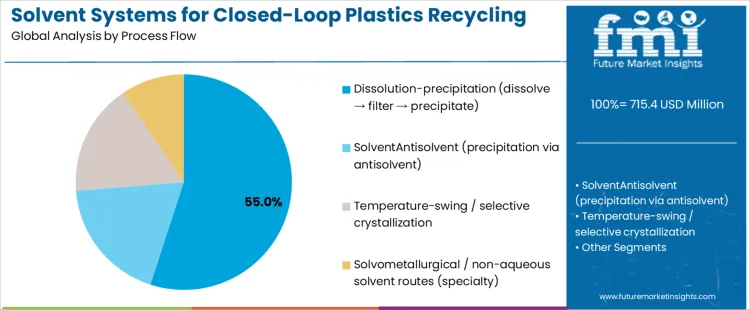
Dissolution-precipitation holds a 55% share in the global solvent systems for closed-loop plastics recycling market due to its highly efficient process of dissolving, filtering, and precipitating polymers to remove contaminants. This method ensures that the recycled polymers maintain high purity and can be reused in high-quality applications such as food-contact/bottle-grade re-polymer. Dissolution-precipitation is particularly effective for recycling PET and other plastics, as it allows the recovery of high-quality material with minimal waste. As the demand for sustainable recycling technologies increases, this process’s ability to provide high-purity, high-performance recycled plastics drives its market leadership in closed-loop systems.
Why Does Food-Contact / Bottle-Grade Re-Polymer Lead the Global Solvent Systems for Closed-Loop Plastics Recycling Market?
Food-contact/bottle-grade re-polymer (closed-loop PET) holds a 36% share in the global solvent systems for closed-loop plastics recycling market due to its vital role in sustainable packaging solutions. PET bottles are among the most commonly recycled plastics, and the demand for food-safe polymers derived from recycled PET has surged. The growing emphasis on sustainability and the circular economy, along with regulatory demands for food-safe materials, has increased the need for closed-loop PET recycling. This process not only reduces plastic waste but also ensures that the recycled plastic meets safety standards for food contact, making it the preferred choice for eco-friendly packaging solutions.
What is Driving the Solvent Systems for Closed Loop Plastics Recycling Market?
The solvent systems for closed loop plastics recycling market is being driven by the urgent need to improve recycling efficiency and material recovery rates. As global plastic waste volumes surge, manufacturers and recyclers are seeking advanced solvent systems that enable depolymerization and dissolution of polymers for high quality recovery. Closed loop recycling preserves polymer properties, making recycled material suitable for original or high value uses. Regulatory pressure to reduce plastic waste, alongside corporate commitments to sustainable packaging and circular economy goals, is pushing investment in solvent based recycling technologies.
What Challenges Are Limiting the Adoption of Solvent Systems for Closed Loop Plastics Recycling?
Adoption of solvent systems in closed loop plastics recycling faces challenges related to technology complexity, cost, and scalability. Advanced solvent based recycling processes often require significant capital investment in specialized equipment and solvent recovery systems, which can deter smaller recyclers. Some solvent systems may also pose safety or environmental concerns if not properly contained, requiring robust handling protocols and regulatory compliance. Variability in plastic waste streams, contamination, and mixed polymer types can complicate process efficiency. The lack of standardized recycling infrastructure in many regions limits widespread deployment of closed loop solvent systems.
How Are Innovations Transforming the Solvent Systems for Closed Loop Plastics Recycling Market?
Innovations are focused on developing safer, more selective, and reusable solvent chemistries that improve polymer dissolution without degrading material properties. Research is advancing solvent recovery and purification technologies that reduce energy consumption and lower operational costs. Hybrid systems that combine solvent recycling with catalytic or enzymatic depolymerization are emerging to tackle difficult to recycle plastics. Real time process monitoring technologies help optimize solvent usage and waste reduction. Partnerships between chemical suppliers, technology developers, and recyclers are accelerating commercialization of scalable, environmentally responsible solvent systems for industrial applications.
What is the Growth Outlook for the Solvent Systems for Closed-Loop Plastics Recycling Market by Country?
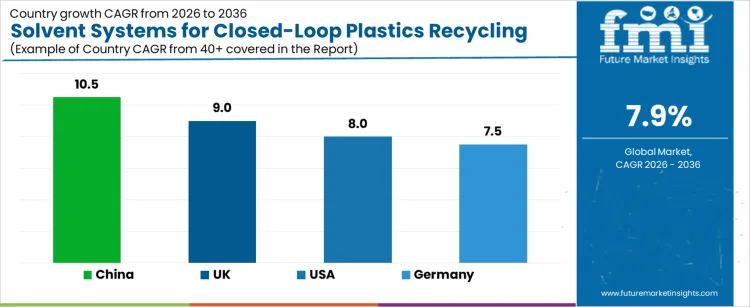
| Country | CAGR (%) |
|---|---|
| China | 10.5% |
| United States | 8.0% |
| Germany | 7.5% |
| United Kingdom | 9.0% |
The solvent systems for closed-loop plastics recycling market is growing steadily across key global markets, with China leading at a 10.5% CAGR, driven by its extensive manufacturing sector and strong focus on improving recycling efficiency. The United Kingdom follows with a 9.0% growth rate, supported by rising government initiatives to boost recycling and reduce plastic waste. The United States shows moderate growth at 8.0%, with increasing adoption of sustainable plastics recycling methods across industries. Germany’s market grows at 7.5%, driven by stringent environmental regulations and a strong commitment to sustainable resource management.
Why is China Leading in the Solvent Systems for Closed-Loop Plastics Recycling Market?
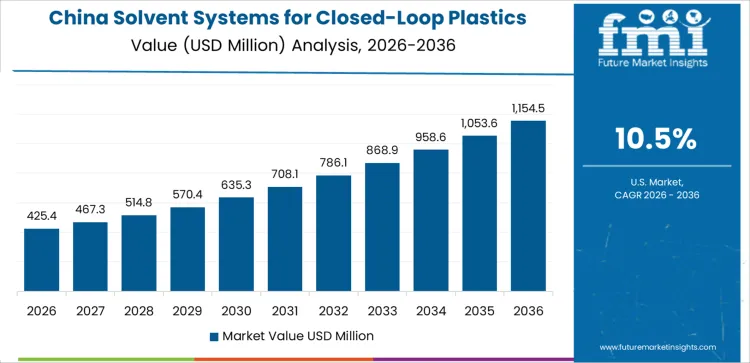
China’s solvent systems for closed-loop plastics recycling market is growing at 10.5%, fueled by the country's leadership in manufacturing and a strong push toward sustainability. As China continues to be a major producer of plastic products, it faces increasing pressure to address plastic waste and adopt sustainable recycling technologies. The government’s commitment to reducing plastic pollution and promoting circular economy principles is driving the demand for closed-loop plastics recycling solutions, including solvent systems. China’s manufacturing capabilities and investments in recycling infrastructure further support the adoption of solvent-based systems, which offer efficient methods for recycling plastics. As China scales up its efforts to become more environmentally responsible, the market for solvent systems in plastics recycling is expected to grow at a rapid pace.
What is Contributing to the Growth of the Solvent Systems for Closed-Loop Plastics Recycling Market in the United Kingdom?
The United Kingdom’s solvent systems for the closed-loop plastics recycling market is growing at 9.0%, driven by the country’s commitment to reducing plastic waste and improving recycling efficiency. The UK government has introduced policies to reduce plastic pollution and enhance recycling rates, which is fueling the demand for more sustainable recycling technologies. Solvent systems are increasingly adopted in closed-loop recycling processes due to their ability to effectively clean and separate plastics for reuse. With growing consumer demand for sustainable products and increased focus on circular economy practices, the UK’s market for solvent systems is set to continue growing. As more industries, including packaging and consumer goods, adopt closed-loop systems, the demand for these eco-friendly solutions is expected to remain strong.
How is the Solvent Systems for Closed-Loop Plastics Recycling Market Expanding in the United States?
The United States’ solvent systems for closed-loop plastics recycling market is growing at 8.0%, driven by rising consumer demand for sustainable solutions and a growing focus on reducing plastic waste. With increasing regulations around plastic pollution and the need for effective recycling methods, the demand for closed-loop recycling systems that use solvent technologies is rising. Solvent systems offer a viable way to efficiently recycle plastics and extend the life cycle of materials. In the United States, industries such as packaging, automotive, and electronics are increasingly adopting these systems to meet sustainability goals. As the demand for circular economy solutions grows, the US market for solvent systems is expected to continue expanding steadily.
What is Driving the Solvent Systems for Closed-Loop Plastics Recycling Market in Germany?
Germany’s solvent systems for closed-loop plastics recycling market is growing at 7.5%, fueled by the country’s strong commitment to sustainability and efficient resource management. Germany has been a leader in environmental policies and recycling practices, making it a key market for closed-loop plastics recycling solutions. The adoption of solvent systems in Germany is driven by the need to meet stringent recycling targets set by the government and the European Union. These systems are increasingly used to improve the efficiency of plastics recycling by separating valuable materials from waste plastics for reuse. As Germany continues to lead Europe in circular economy practices and strives for a more sustainable future, the demand for solvent-based systems in plastics recycling is expected to remain strong.
What Are the Competitive Strategies in the Solvent Systems for Closed‑Loop Plastics Recycling Market?
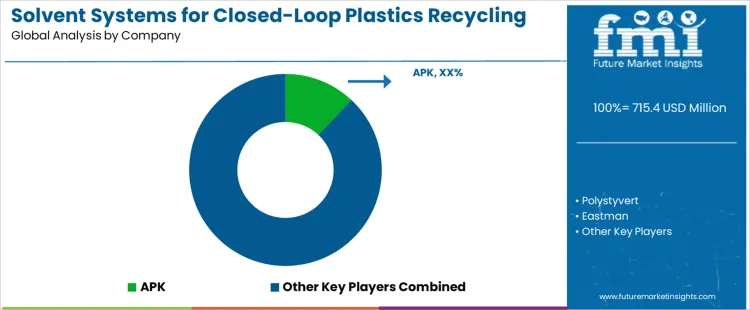
APK, Polystyvert, Eastman, and Polymateria each bring unique approaches to solvent systems for closed-loop plastics recycling, targeting higher quality recycling and the reduction of plastic waste. APK focuses on its proprietary Newcycling® solvent-based process, which separates polymers like PE and PP from mixed plastic waste to produce high-quality recyclates suitable for industrial reuse. Polystyvert specializes in solvent dissolution and recrystallization for polystyrene waste, delivering clean recycled resin with properties similar to virgin material, effectively enhancing polystyrene recycling.
Eastman differentiates itself by offering molecular and solvent-based recycling technologies that break down polymers into their building blocks, enabling infinite recyclability for materials that traditional mechanical recycling cannot handle. Polymateria, primarily known for biodegradable technology, also contributes to the market by promoting additives that support easier recycling and enhanced circularity. Across all companies, product offerings are marketed based on performance, solvent selectivity, and the quality of the recycled output. Key strategies involve leveraging solvent-based chemistry to provide higher purity recyclates, improving scalability, and supporting the circular economy through sustainable plastic waste recovery. These firms are competing by enhancing the efficiency of solvent systems and aligning their technologies with growing environmental standards and recycling demands.
Key Players in Solvent Systems for Closed-Loop Plastics Recycling Market
- APK
- Polystyvert
- Eastman
- Polymateria
Scope of Report
| Items | Values |
|---|---|
| Quantitative Units (2026) | USD million |
| End Use Application | Food-Contact / Bottle-Grade Re-Polymer (Closed-Loop PET), Film & Flexible Packaging (Reprocessed Films), Rigid Packaging & Consumer Goods (PS, PP Parts), Automotive & Industrial Quality Resins, Textile & Fiber Feedstock (Recycled Polymer for Fibers) |
| Process Flow | Dissolution-Precipitation (Dissolve → Filter → Precipitate), Solvent–Antisolvent (Precipitation via Antisolvent), Temperature-Swing / Selective Crystallization, Solvometallurgical / Non-Aqueous Solvent Routes (Specialty) |
| Regions Covered | Asia Pacific, Europe, North America, Latin America, Middle East & Africa |
| Countries Covered | USA, China, Japan, South Korea, India, Australia & New Zealand, ASEAN, Germany, UK, France, Italy, Spain, Nordic, BENELUX, Brazil, Chile, Mexico, Saudi Arabia, Other GCC Countries, Turkey, South Africa, Other African Union |
| Key Companies Profiled | APK, Polystyvert, Eastman, Polymateria |
| Additional Attributes | Dollar sales by process flow, end-use product, and recycled product; regional CAGR and growth outlook; distribution channels including direct sales, industrial suppliers, and recyclers; innovation trends in solvent-antisolvent processes and solvometallurgical routes; competitive positioning of global vs regional suppliers. |
Solvent Systems for Closed-Loop Plastics Recycling Market by Segments
Process Flow
- Dissolution-precipitation (dissolve → filter → precipitate)
- Solvent–Antisolvent (precipitation via antisolvent)
- Temperature-swing / selective crystallization
- Solvometallurgical / non-aqueous solvent routes (specialty)
End-Use / Recycled Product
- Food-contact / bottle-grade re-polymer (closed-loop PET)
- Film & flexible packaging (reprocessed films)
- Rigid packaging & consumer goods (PS, PP parts)
- Automotive & industrial quality resins
- Textile & fiber feedstock (recycled polymer for fibers)
Region
- Asia Pacific
- China
- Japan
- South Korea
- India
- Australia & New Zealand
- ASEAN
- Rest of Asia Pacific
- Europe
- Germany
- United Kingdom
- France
- Italy
- Spain
- Nordic
- BENELUX
- Rest of Europe
- North America
- United States
- Canada
- Mexico
- Latin America
- Brazil
- Chile
- Rest of Latin America
- Middle East & Africa
- Kingdom of Saudi Arabia
- Other GCC Countries
- Turkey
- South Africa
- Other African Union
- Rest of Middle East & Africa
Frequently Asked Questions
How big is the solvent systems for closed-loop plastics recycling market in 2026?
The global solvent systems for closed-loop plastics recycling market is estimated to be valued at USD 715.4 million in 2026.
What will be the size of solvent systems for closed-loop plastics recycling market in 2036?
The market size for the solvent systems for closed-loop plastics recycling market is projected to reach USD 2,230,740,243,789.8 million by 2036.
How much will be the solvent systems for closed-loop plastics recycling market growth between 2026 and 2036?
The solvent systems for closed-loop plastics recycling market is expected to grow at a 7.9% CAGR between 2026 and 2036.
What are the key product types in the solvent systems for closed-loop plastics recycling market?
The key product types in solvent systems for closed-loop plastics recycling market are dissolution-precipitation (dissolve → filter → precipitate), solventantisolvent (precipitation via antisolvent), temperature-swing / selective crystallization and solvometallurgical / non-aqueous solvent routes (specialty).
Which end-use / recycled product segment to contribute significant share in the solvent systems for closed-loop plastics recycling market in 2026?
In terms of end-use / recycled product, food-contact / bottle-grade re-polymer (closed-loop pet) segment to command 36.0% share in the solvent systems for closed-loop plastics recycling market in 2026.
Preview the report firsthand - request a free sample
Get SampleGet the brochure for pricing and purchase details.
Get PDFTable of Content
- Executive Summary
- Global Market Outlook
- Demand-side Trends
- Supply-side Trends
- Technology Roadmap Analysis
- Analysis and Recommendations
- Market Overview
- Market Coverage / Taxonomy
- Market Definition / Scope / Limitations
- Market Background
- Market Dynamics
- Drivers
- Restraints
- Opportunity
- Trends
- Scenario Forecast
- Demand in Optimistic Scenario
- Demand in Likely Scenario
- Demand in Conservative Scenario
- Opportunity Map Analysis
- Product Life Cycle Analysis
- Supply Chain Analysis
- Investment Feasibility Matrix
- Value Chain Analysis
- PESTLE and Porter’s Analysis
- Regulatory Landscape
- Regional Parent Market Outlook
- Production and Consumption Statistics
- Import and Export Statistics
- Market Dynamics
- Global Market Analysis 2021 to 2025 and Forecast, 2026 to 2036
- Historical Market Size Value (USD Million) Analysis, 2021 to 2025
- Current and Future Market Size Value (USD Million) Projections, 2026 to 2036
- Y-o-Y Growth Trend Analysis
- Absolute $ Opportunity Analysis
- Global Market Pricing Analysis 2021 to 2025 and Forecast 2026 to 2036
- Global Market Analysis 2021 to 2025 and Forecast 2026 to 2036, By Process Flow
- Introduction / Key Findings
- Historical Market Size Value (USD Million) Analysis By Process Flow , 2021 to 2025
- Current and Future Market Size Value (USD Million) Analysis and Forecast By Process Flow , 2026 to 2036
- Dissolution-precipitation (dissolve → filter → precipitate)
- SolventAntisolvent (precipitation via antisolvent)
- Temperature-swing / selective crystallization
- Solvometallurgical / non-aqueous solvent routes (specialty)
- Y-o-Y Growth Trend Analysis By Process Flow , 2021 to 2025
- Absolute $ Opportunity Analysis By Process Flow , 2026 to 2036
- Global Market Analysis 2021 to 2025 and Forecast 2026 to 2036, By End-Use / Recycled Product
- Introduction / Key Findings
- Historical Market Size Value (USD Million) Analysis By End-Use / Recycled Product, 2021 to 2025
- Current and Future Market Size Value (USD Million) Analysis and Forecast By End-Use / Recycled Product, 2026 to 2036
- Food-contact / bottle-grade re-polymer (closed-loop PET)
- Film & flexible packaging (reprocessed films)
- Rigid packaging & consumer goods (PS, PP parts)
- Automotive & industrial quality resins
- Textile & fiber feedstock (recycled polymer for fibers)
- Y-o-Y Growth Trend Analysis By End-Use / Recycled Product, 2021 to 2025
- Absolute $ Opportunity Analysis By End-Use / Recycled Product, 2026 to 2036
- Global Market Analysis 2021 to 2025 and Forecast 2026 to 2036, By Region
- Introduction
- Historical Market Size Value (USD Million) Analysis By Region, 2021 to 2025
- Current Market Size Value (USD Million) Analysis and Forecast By Region, 2026 to 2036
- North America
- Latin America
- Western Europe
- Eastern Europe
- East Asia
- South Asia and Pacific
- Middle East & Africa
- Market Attractiveness Analysis By Region
- North America Market Analysis 2021 to 2025 and Forecast 2026 to 2036, By Country
- Historical Market Size Value (USD Million) Trend Analysis By Market Taxonomy, 2021 to 2025
- Market Size Value (USD Million) Forecast By Market Taxonomy, 2026 to 2036
- By Country
- USA
- Canada
- Mexico
- By Process Flow
- By End-Use / Recycled Product
- By Country
- Market Attractiveness Analysis
- By Country
- By Process Flow
- By End-Use / Recycled Product
- Key Takeaways
- Latin America Market Analysis 2021 to 2025 and Forecast 2026 to 2036, By Country
- Historical Market Size Value (USD Million) Trend Analysis By Market Taxonomy, 2021 to 2025
- Market Size Value (USD Million) Forecast By Market Taxonomy, 2026 to 2036
- By Country
- Brazil
- Chile
- Rest of Latin America
- By Process Flow
- By End-Use / Recycled Product
- By Country
- Market Attractiveness Analysis
- By Country
- By Process Flow
- By End-Use / Recycled Product
- Key Takeaways
- Western Europe Market Analysis 2021 to 2025 and Forecast 2026 to 2036, By Country
- Historical Market Size Value (USD Million) Trend Analysis By Market Taxonomy, 2021 to 2025
- Market Size Value (USD Million) Forecast By Market Taxonomy, 2026 to 2036
- By Country
- Germany
- UK
- Italy
- Spain
- France
- Nordic
- BENELUX
- Rest of Western Europe
- By Process Flow
- By End-Use / Recycled Product
- By Country
- Market Attractiveness Analysis
- By Country
- By Process Flow
- By End-Use / Recycled Product
- Key Takeaways
- Eastern Europe Market Analysis 2021 to 2025 and Forecast 2026 to 2036, By Country
- Historical Market Size Value (USD Million) Trend Analysis By Market Taxonomy, 2021 to 2025
- Market Size Value (USD Million) Forecast By Market Taxonomy, 2026 to 2036
- By Country
- Russia
- Poland
- Hungary
- Balkan & Baltic
- Rest of Eastern Europe
- By Process Flow
- By End-Use / Recycled Product
- By Country
- Market Attractiveness Analysis
- By Country
- By Process Flow
- By End-Use / Recycled Product
- Key Takeaways
- East Asia Market Analysis 2021 to 2025 and Forecast 2026 to 2036, By Country
- Historical Market Size Value (USD Million) Trend Analysis By Market Taxonomy, 2021 to 2025
- Market Size Value (USD Million) Forecast By Market Taxonomy, 2026 to 2036
- By Country
- China
- Japan
- South Korea
- By Process Flow
- By End-Use / Recycled Product
- By Country
- Market Attractiveness Analysis
- By Country
- By Process Flow
- By End-Use / Recycled Product
- Key Takeaways
- South Asia and Pacific Market Analysis 2021 to 2025 and Forecast 2026 to 2036, By Country
- Historical Market Size Value (USD Million) Trend Analysis By Market Taxonomy, 2021 to 2025
- Market Size Value (USD Million) Forecast By Market Taxonomy, 2026 to 2036
- By Country
- India
- ASEAN
- Australia & New Zealand
- Rest of South Asia and Pacific
- By Process Flow
- By End-Use / Recycled Product
- By Country
- Market Attractiveness Analysis
- By Country
- By Process Flow
- By End-Use / Recycled Product
- Key Takeaways
- Middle East & Africa Market Analysis 2021 to 2025 and Forecast 2026 to 2036, By Country
- Historical Market Size Value (USD Million) Trend Analysis By Market Taxonomy, 2021 to 2025
- Market Size Value (USD Million) Forecast By Market Taxonomy, 2026 to 2036
- By Country
- Kingdom of Saudi Arabia
- Other GCC Countries
- Turkiye
- South Africa
- Other African Union
- Rest of Middle East & Africa
- By Process Flow
- By End-Use / Recycled Product
- By Country
- Market Attractiveness Analysis
- By Country
- By Process Flow
- By End-Use / Recycled Product
- Key Takeaways
- Key Countries Market Analysis
- USA
- Pricing Analysis
- Market Share Analysis, 2025
- By Process Flow
- By End-Use / Recycled Product
- Canada
- Pricing Analysis
- Market Share Analysis, 2025
- By Process Flow
- By End-Use / Recycled Product
- Mexico
- Pricing Analysis
- Market Share Analysis, 2025
- By Process Flow
- By End-Use / Recycled Product
- Brazil
- Pricing Analysis
- Market Share Analysis, 2025
- By Process Flow
- By End-Use / Recycled Product
- Chile
- Pricing Analysis
- Market Share Analysis, 2025
- By Process Flow
- By End-Use / Recycled Product
- Germany
- Pricing Analysis
- Market Share Analysis, 2025
- By Process Flow
- By End-Use / Recycled Product
- UK
- Pricing Analysis
- Market Share Analysis, 2025
- By Process Flow
- By End-Use / Recycled Product
- Italy
- Pricing Analysis
- Market Share Analysis, 2025
- By Process Flow
- By End-Use / Recycled Product
- Spain
- Pricing Analysis
- Market Share Analysis, 2025
- By Process Flow
- By End-Use / Recycled Product
- France
- Pricing Analysis
- Market Share Analysis, 2025
- By Process Flow
- By End-Use / Recycled Product
- India
- Pricing Analysis
- Market Share Analysis, 2025
- By Process Flow
- By End-Use / Recycled Product
- ASEAN
- Pricing Analysis
- Market Share Analysis, 2025
- By Process Flow
- By End-Use / Recycled Product
- Australia & New Zealand
- Pricing Analysis
- Market Share Analysis, 2025
- By Process Flow
- By End-Use / Recycled Product
- China
- Pricing Analysis
- Market Share Analysis, 2025
- By Process Flow
- By End-Use / Recycled Product
- Japan
- Pricing Analysis
- Market Share Analysis, 2025
- By Process Flow
- By End-Use / Recycled Product
- South Korea
- Pricing Analysis
- Market Share Analysis, 2025
- By Process Flow
- By End-Use / Recycled Product
- Russia
- Pricing Analysis
- Market Share Analysis, 2025
- By Process Flow
- By End-Use / Recycled Product
- Poland
- Pricing Analysis
- Market Share Analysis, 2025
- By Process Flow
- By End-Use / Recycled Product
- Hungary
- Pricing Analysis
- Market Share Analysis, 2025
- By Process Flow
- By End-Use / Recycled Product
- Kingdom of Saudi Arabia
- Pricing Analysis
- Market Share Analysis, 2025
- By Process Flow
- By End-Use / Recycled Product
- Turkiye
- Pricing Analysis
- Market Share Analysis, 2025
- By Process Flow
- By End-Use / Recycled Product
- South Africa
- Pricing Analysis
- Market Share Analysis, 2025
- By Process Flow
- By End-Use / Recycled Product
- USA
- Market Structure Analysis
- Competition Dashboard
- Competition Benchmarking
- Market Share Analysis of Top Players
- By Regional
- By Process Flow
- By End-Use / Recycled Product
- Competition Analysis
- Competition Deep Dive
- APK
- Overview
- Product Portfolio
- Profitability by Market Segments (Product/Age /Sales Channel/Region)
- Sales Footprint
- Strategy Overview
- Marketing Strategy
- Product Strategy
- Channel Strategy
- Polystyvert
- Eastman
- Polymateria
- APK
- Competition Deep Dive
- Assumptions & Acronyms Used
- Research Methodology


