

- Market Size (2026)
- USD 640.7 Mn
- Forecast (2036)
- USD 2099.1 Mn
- CAGR (2026 to 2036)
- 12.6%
How big is the magnet recycling chemicals market in 2026?
USD 640.7 million in 2026 and USD 2,099.1 million by 2036 at a 12.6% CAGR.
The magnet recycling chemicals market is expected to expand from USD 569.0 million in 2025 to USD 2,099.1 million by 2036. The market is moving from basic scrap treatment toward qualified recovery routes for rare earth metals used in electric motors and wind generators.
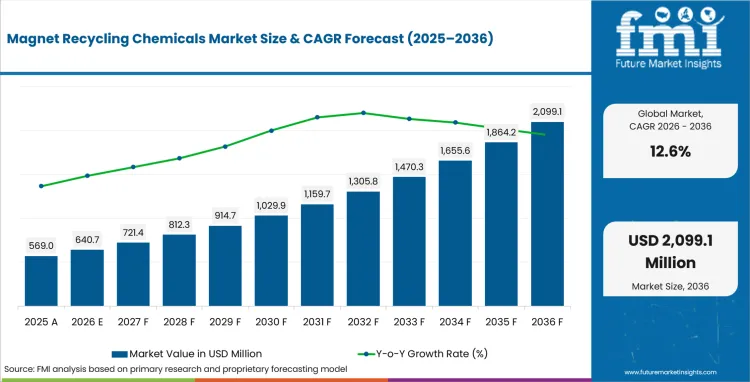
| Metric | Value |
|---|---|
| 2026 Market Size | USD 640.7 million |
| 2036 Market Size | USD 2,099.1 million |
| Forecast CAGR | 12.6% from 2026 to 2036 |
| Leading Chemical Type | Acid Leachants |
| Acid Leachants Share in 2026 | 43.0% |
| Leading Magnet Type | NdFeB Magnets |
| NdFeB Magnets Share in 2026 | 68.0% |
| Fastest-growing Country | China |
| China CAGR | 14.1% by 2036 |
Summary of the Magnet Recycling Chemicals Market
| Market Signal | Commercial Impact |
|---|---|
| Demand and Growth Drivers | Demand for magnet recycling chemicals is being driven by the need to recover valuable rare earth elements and strengthen supply security through circular resource strategies.
|
| Product and Segment View | Acid leachants, NdFeB magnets, neodymium and praseodymium recovery, and dedicated rare earth recyclers are expected to dominate their respective segments.
|
| Geography and Growth Outlook | China, India, and the United States are expected to remain the principal growth markets, supported by domestic rare earth initiatives and investments in recycling infrastructure.
|
| Competitive Landscape | Competition is increasingly focused on recovery efficiency, recycled oxide qualification, and advanced hydrometallurgical processing capabilities.
|
| Analyst Perspective | Magnet recycling chemical suppliers are increasingly evaluated on their ability to deliver high recovery yields while maintaining process transparency and environmental discipline.
- Nikhil Kaitwade, Principal Analyst at Future Market Insights |
Supply‑chain concentration is giving recycled magnet chemistry a clearer commercial role in permanent‑magnet manufacturing. The International Energy Agency reported in April 2026 that China accounted for 91.0% of refined magnet rare earth output in 2024, underscoring exposure to geopolitical and processing risk. In response, policy and investment signals are increasingly favoring recycling. The UK Critical Minerals Strategy, published in January 2026, set a 20.0% recycling target for total annual rare‑earth demand by 2035, while Cyclic Materials raised USD 75.0 million in January 2026 to scale rare‑earth recycling operations in the United States and Europe. These highlight why recycled feedstocks must deliver consistent yield control to support high performance permanent magnets supply.
Which factors support expansion in the magnet recycling chemicals market?
Recycled magnet oxide qualification is expected to support market value across hydrometallurgy routes.
- Acid leachants support market value by controlling dissolution before rare earth separation begins.
- Reagent intensity rises once recyclers process end-of-life magnets that contain coatings and adhesives.
- Solvent extractants gain relevance in plants that need separated NdPr and heavy rare earth outputs.
- Precipitation reagents help buyers meet impurity limits before oxide supply reaches magnet makers.
- Technology-bundled supply benefits from pilot data and commissioning support for new recovery lines.
Why is the magnet recycling chemicals market growing?
Magnet scrap is becoming a controlled feedstock for rare earth supply planning.
Permanent magnet demand gives recycling chemicals a clearer role in rare earth supply planning. The International Energy Agency reported in April 2026 that magnet rare earth demand had doubled since 2015. The same review projected demand to rise by more than 30.0% by 2030. Recyclers need reliable leaching and separation chemistry before this scrap can become qualified oxide. Recycling routes therefore need extraction reagents for leaching and precipitation. These chemicals become necessary once buyers request individual oxides instead of reusable powder.
Public funding is pushing recovery chemistry closer to commercial plant scale. The USA Department of Energy announced in December 2025 up to USD 134.0 million for rare earth recovery and refining from waste feedstocks. That funding favors processes that can document yield and residue control.
How is the magnet recycling chemicals market segmented?
The magnet recycling chemicals industry is segmented by chemical type, magnet type, target element, end use, and sales channel. Each segment reflects where chemistry enters the recovery route.
- Acid Leachants are projected to secure 43.0% share in 2026 due to controlled dissolution before separation begins.
- NdFeB Magnets are anticipated to hold 68.0% share in 2026 as recoverable NdPr value improves processing economics.
- Neodymium / Praseodymium is forecast to represent 52.0% share in 2026 supported by reuse in new magnet production.
- Rare Earth Recyclers are estimated to account for 41.0% share in 2026 as hydrometallurgy capacity creates reagent commitments.
- Direct sales are expected to hold 58.0% share in 2026 because supplier qualification remains process-specific.
Which chemical type category holds a notable share in the magnet recycling chemicals market?
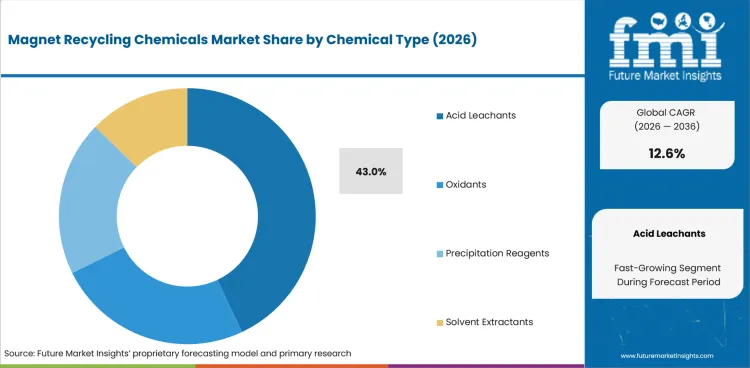
- Acid Leachants are projected to secure 43.0% share in 2026 due to their use at the first stage of magnet recovery.
- Oxidants gain relevance through recycling lines that need cleaner separation before valuable rare earth elements can be recovered.
How does the magnet type segment perform in the magnet recycling chemicals market?
- NdFeB Magnets are expected to represent 68.0% share in 2026 owing to neodymium and praseodymium content that improves recovery value.
- SmCo Magnets remain a specialized stream supported by demand for careful samarium and cobalt separation before practical reuse.
What drives demand across target element options in the magnet recycling chemicals market?
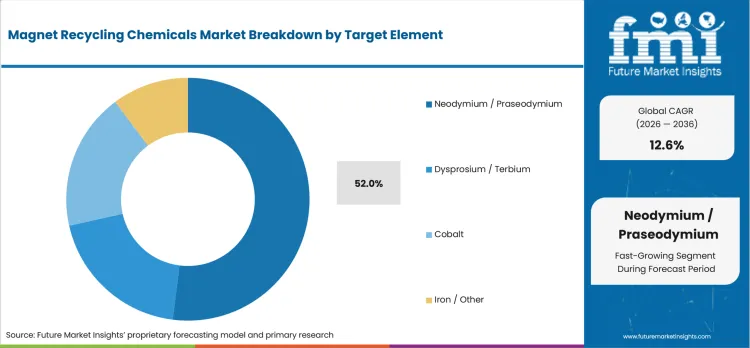
- Neodymium and Praseodymium are anticipated to hold 52.0% share in 2026 due to their importance in high-performance magnet manufacturing.
- Dysprosium and Terbium recovery gains attention as heat-resistant magnet scrap increases across motors and electronic systems.
Which end-use group shows a notable position in the magnet recycling chemicals market?
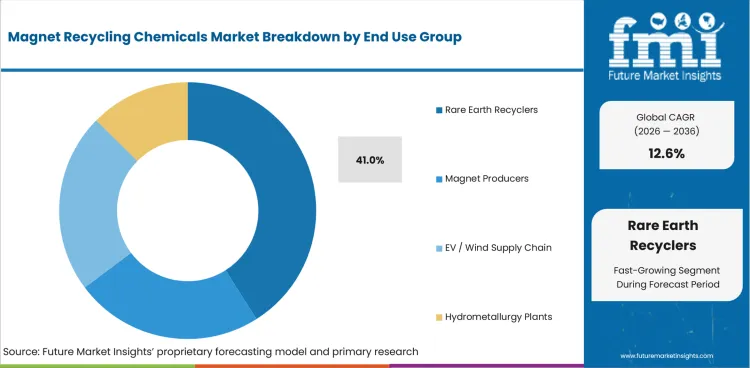
- Rare Earth Recyclers are estimated to account for 41.0% share in 2026 led by recurring chemical use in dedicated recovery lines.
- Magnet producers are expected to qualify recycling chemicals as internal scrap volumes become large enough to support reuse programs.
How are buyers selecting across sales channel options in the magnet recycling chemicals market?
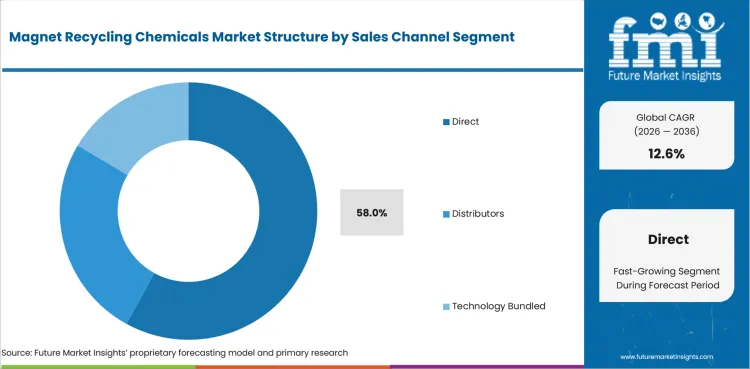
- Direct sales are expected to hold 58.0% share in 2026 because buyers need purity support and process guidance from suppliers.
- Distributors retain a role for standard acids and bulk reagents before buyers shift toward specialized rare earth recovery chemicals.
What are the drivers and restraints in the magnet recycling chemicals market?
Supply-security demand supports growth while permitting and residue handling still limit faster plant scale-up.
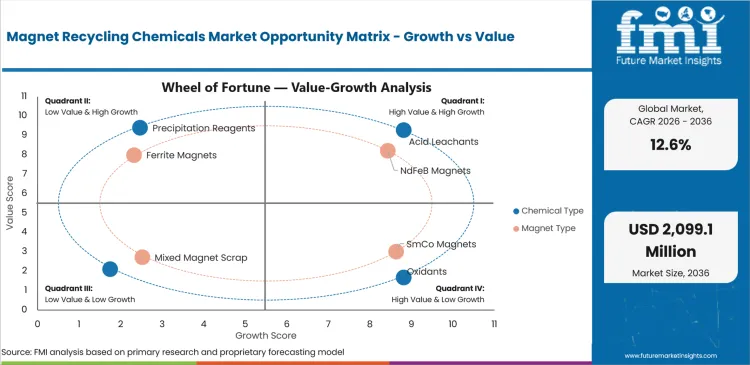
- Driver: Automakers and wind suppliers need non-primary rare earth sources that can pass recovered-oxide qualification.
- Restraint: Acid neutralization and impurity residues can slow permits for new long-loop recycling plants.
- Opportunity: Short-loop and long-loop recycling models create separate demand pools for process support chemicals.
Export-Control Recovery Pressure
Export-control pressure is raising demand for local recovery routes and related solvent separation. The International Energy Agency reported in April 2026 that China placed export controls on seven heavy rare earth elements and related magnets. That decision makes qualified dysprosium supply more valuable for buyers outside primary import channels.
Recovered Oxide Qualification
Recovered oxide qualification is moving reagent selection closer to customer approval work. Neo Performance Materials and Cyclic Materials signed a non-binding MOU in March 2026 for a trans-Atlantic circular rare earth supply chain. The agreement matters because usable oxide output must come before reagent packages can scale.
Feedstock Handling and Chemical Loss
Mixed scrap streams raise chemical-loss risk because coatings and binders change leach behavior. Cyclic Materials said in June 2025 that its Kingston Centre of Excellence was designed to convert 500 tonnes of magnet-rich feedstock each year into recycled mixed rare earth oxide. This makes reagent loss and impurity control part of scale-up economics.
Which countries are growing fastest in the magnet recycling chemicals market?
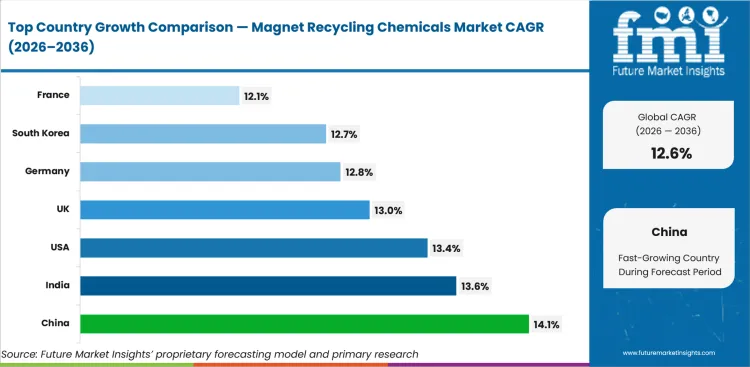
China 14.1% CAGR, India 13.6% CAGR, United States 13.4% CAGR, United Kingdom 13.0% CAGR, Germany 12.8% CAGR, South Korea 12.7% CAGR, France 12.1% CAGR, and Japan 11.8% CAGR through 2036.
.webp "Top Country Growth Comparison Magnet Recycling Chemicals Market Cagr (2026 2036)")
| Country | CAGR |
|---|---|
| China | 14.1% |
| India | 13.6% |
| United States | 13.4% |
| United Kingdom | 13.0% |
| Germany | 12.8% |
| South Korea | 12.7% |
| France | 12.1% |
| Japan | 11.8% |
Source: Future Market Insights, 2026.
How do country-level CAGRs compare in the magnet recycling chemicals market?
- China is expected to lead with a 15.1% CAGR by 2036, supported by deep PET production capacity and verified enzymatic biorecycling joint‑venture pathways.
- India is projected to expand at a 14.6% CAGR through 2036, as expanded EPR registration increases participation from formal recycling buyers.
- France is anticipated to grow at a 13.9% CAGR by 2036, driven by active PET biorecycling plant deployment and local ownership of core technologies.
- Germany is forecast to advance at a 13.6% CAGR through 2036, with chemical park infrastructure and broader European licensing activity supporting scale‑up.
- South Korea is expected to post a 13.2% CAGR by 2036, as petrochemical producers increasingly assess higher‑value chemical recycling routes.
- The United States is projected to record a 12.8% CAGR by 2036, supported by commercial molecular recycling initiatives and gaps in national packaging recovery.
- Japan is forecast to reach a 12.7% CAGR through 2036, as Rewind PET process validation progresses alongside cautious buyer qualification cycles.
- The United Kingdom is expected to grow at an 11.9% CAGR by 2036, with tax compliance requirements and limited domestic capacity influencing adoption speed
How fast is the magnet recycling chemicals market growing in the United States?
A 13.4% CAGR through 2036 reflects recovery funding and domestic rare earth magnet production activity.
Country Market Snapshot Table
| Parameter | Value |
|---|---|
| Market Size in 2025 (Value) | USD 79.4 million |
| Market Size in 2026 (Value) | USD 90.0 million |
| Market Forecast in 2036 (Value) | USD 316.5 million |
| CAGR (2026 to 2036) | 13.4% |
| Years Considered | 2021 to 2036 |
| Base Year | 2025 |
| Forecast Period | 2026 to 2036 |
| Units Considered | Value (USD million) |
| Leading Sub-Region | Texas and Midwest recycling corridors |
United States Magnet Recycling Chemicals Market Outlook
United States demand is driven by defense and EV buyers that want domestic rare earth inputs. Recycling chemicals become relevant once magnet scrap must become qualified oxide instead of mixed recovered material.
Smaller recovery companies also need process documentation before offtake approval. Texas magnet production and e-waste channels give reagent suppliers a clearer entry point.
Key Growth Drivers
- Domestic recovery funding is expected to move magnet scrap into qualified refining routes. The USA Department of Energy announced in December 2025 up to USD 134 million for rare earth supply chains. That support gives reagent suppliers a clearer path into pilot and refining work.
- Texas magnet output is likely to increase reagent trials around NdPr metal and process scrap. MP Materials' Independence facility covers 250,000 square feet in Fort Worth. That scale makes local scrap handling and oxide qualification more practical.
- End-of-life magnet channels support demand for low-waste solvent recovery. REEcycle's June 2026 overview reports 99.8% recovery efficiency for its recycling process. The figure gives buyers a reason to test chemistry that protects yield.
- Direct qualification work gains importance once recovered oxides need defense and motor-buyer documentation.
Key Restraints
- Import volatility still pressures local qualification timing. The USA Geological Survey reported in January 2026 that United States rare earth compound and metal imports rose by 169% in 2025. Recycling routes become more relevant when imported supply changes sharply.
- Variable coating and alloy mix can keep electronics scrap streams uneven during commercial scale-up.
- Approval requirements for recycled oxides lengthen customer trials before magnet makers change input sources.
What makes United States unique
The United States stands out for federal recovery funding and Texas-based magnet manufacturing investment.
Key Companies
- REEcycle
- HyProMag USA
- Noveon Magnetics
- MP Materials
Sales & Marketing Channels
- Direct sales
- Recycling partnerships
- Technology-bundled supply
- Specialty chemical distributors
- Pilot-line contracts
Country Segment Breakdown Table
| Segment | Sub-Segments |
|---|---|
| By Chemical Type | Acid Leachants · Oxidants · Precipitation Reagents · Solvent Extractants |
| By Magnet Type | NdFeB Magnets · SmCo Magnets · Ferrite Magnets · Mixed Magnet Scrap |
| By Target Element | Neodymium / Praseodymium · Dysprosium / Terbium · Cobalt · Iron / Other |
| By End Use | Rare Earth Recyclers · Magnet Producers · EV / Wind Supply Chain · Hydrometallurgy Plants |
| By Sales Channel | Direct · Distributors · Technology Bundled |
| Key Sub-Regions Covered, Manufacturing and recycling corridors | Texas and Midwest recycling corridors |
Frequently Asked Questions
How fast is United States magnet recycling chemicals market growing?
USA sales are projected to scale at 13.4% CAGR from 2026 to 2036.
Who leads United States magnet recycling chemicals market?
REEcycle, HyProMag USA, Noveon Magnetics, and MP Materials are the profiled companies in the United States market.
What supports United States magnet recycling chemicals demand?
Demand depends on magnet scrap recovery and oxide qualification. Direct supplier support helps customers approve new process routes.
What is the magnet recycling chemicals market outlook in the United Kingdom?
A 13.0% CAGR through 2036 reflects short-loop recycling assets and critical mineral recycling policy.
Country Market Snapshot Table
| Parameter | Value |
|---|---|
| Market Size in 2025 (Value) | USD 31.0 million |
| Market Size in 2026 (Value) | USD 35.0 million |
| Market Forecast in 2036 (Value) | USD 118.8 million |
| CAGR (2026 to 2036) | 13.0% |
| Years Considered | 2021 to 2036 |
| Base Year | 2025 |
| Forecast Period | 2026 to 2036 |
| Units Considered | Value (USD million) |
| Leading Sub-Region | Birmingham, Belfast, and Cheshire technology corridors |
United Kingdom Magnet Recycling Chemicals Market Outlook
United Kingdom demand is tied to Birmingham and Belfast recycling capabilities that process NdFeB scrap. Chemical demand is stronger in routes that produce separable rare earth oxides.
Channel access remains technical since customers need proof of yield and residue handling. UK alloy producers and recycling developers create a compact buyer network for qualified suppliers.
Key Growth Drivers
- National recycling policy is expected to support reagent planning for secondary critical minerals. The UK government said in November 2025 that it aims to meet 20% of critical mineral demand through recycling. That target gives buyers a clearer reason to qualify recovery chemistry.
- Short-loop magnet recycling gives suppliers a route into pilot and commissioning work. HyProMag lists reactor capacity of up to 5,000 kg of NdFeB. That capacity keeps technical reagent and residue discussions close to process design.
- Belfast hydrometallurgy activity supports oxide purification demand. Ionic Technologies states that its process can separate 99.9% plus magnet rare earth oxides. This creates a clearer buyer case for purification reagents and solvent control.
- Alloy production access should help recovered oxides move into metal and magnet supply chains.
Key Restraints
- Domestic scale remains smaller than Asian processing networks. Less Common Metals said in October 2024 that its Cheshire facility reached 67,000 square feet after the acquisition announcement. The scale supports local alloy work but does not match Asian processing depth.
- Dispersed magnets across electronics and motor scrap keep feedstock collection difficult.
- Short-loop routes may use fewer chemicals than oxide recovery. This can narrow addressable reagent volumes.
What makes United Kingdom unique
The United Kingdom stands out for HyProMag and Ionic Technologies. Alloy-making links add another local supply-chain route.
Key Companies
- HyProMag
- Ionic Technologies
- Less Common Metals
- Mkango Resources
Sales & Marketing Channels
- Direct sales
- Technology partnerships
- Pilot-line supply
- Alloy producer contracts
- Specialty distributors
Country Segment Breakdown Table
| Segment | Sub-Segments |
|---|---|
| By Chemical Type | Acid Leachants · Oxidants · Precipitation Reagents · Solvent Extractants |
| By Magnet Type | NdFeB Magnets · SmCo Magnets · Ferrite Magnets · Mixed Magnet Scrap |
| By Target Element | Neodymium / Praseodymium · Dysprosium / Terbium · Cobalt · Iron / Other |
| By End Use | Rare Earth Recyclers · Magnet Producers · EV / Wind Supply Chain · Hydrometallurgy Plants |
| By Sales Channel | Direct · Distributors · Technology Bundled |
| Key Sub-Regions Covered, Manufacturing and recycling corridors | Birmingham, Belfast, and Cheshire technology corridors |
Frequently Asked Questions
How fast is United Kingdom magnet recycling chemicals market growing?
UK sales are projected to scale at 13.0% CAGR from 2026 to 2036.
Who leads United Kingdom magnet recycling chemicals market?
HyProMag, Ionic Technologies, Less Common Metals, and Mkango Resources are the profiled companies in the United Kingdom market.
What supports United Kingdom magnet recycling chemicals demand?
Demand reflects short-loop recycling and oxide qualification. Technical supplier support remains central to process approval.
How is Germany performing in the magnet recycling chemicals market?
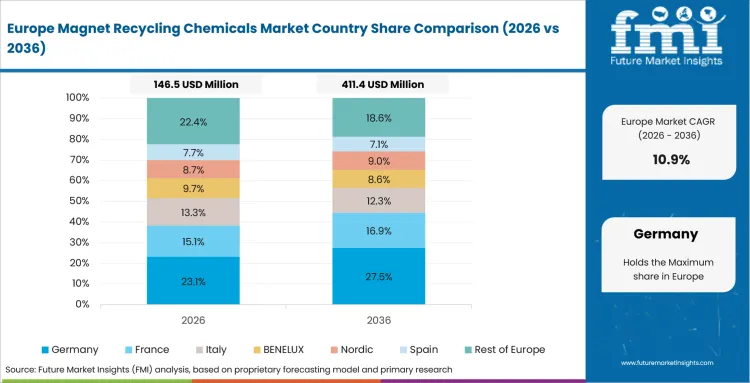
A 12.8% CAGR through 2036 reflects industrial magnet demand and newly commissioned recycling capacity.
Country Market Snapshot Table
| Parameter | Value |
|---|---|
| Market Size in 2025 (Value) | USD 48.8 million |
| Market Size in 2026 (Value) | USD 55.0 million |
| Market Forecast in 2036 (Value) | USD 183.4 million |
| CAGR (2026 to 2036) | 12.8% |
| Years Considered | 2021 to 2036 |
| Base Year | 2025 |
| Forecast Period | 2026 to 2036 |
| Units Considered | Value (USD million) |
| Leading Sub-Region | Pforzheim, Hanau, and Baden-Wuerttemberg industrial clusters |
Germany Magnet Recycling Chemicals Market Outlook
Germany demand is connected to automotive and industrial equipment users. Recycling chemicals are needed when recovered material moves beyond powder reuse into oxide qualification.
Supplier access depends on industrial trials and documentation. Local short-loop capacity can reduce full chemical demand while creating feedstock visibility for oxide routes.
Key Growth Drivers
- EU circularity rules support the business case for German recovery chemistry. The Critical Raw Materials Act sets a 25% recycling benchmark for strategic raw materials by 2030. This gives German projects a policy reason to qualify recycled rare earth output.
- Local recycling capacity gives reagent suppliers a visible route from pilot trials to commercial supply. HyProMag GmbH received approval for up to 750 tonnes per annum of NdFeB magnets and alloys. That approval can anchor process trials for leaching and residue control.
- Magnet manufacturing links support scrap-return programs for recovered rare earth inputs. VACUUMSCHMELZE joined work on 100% recycled rare earth magnets in October 2024. That participation gives suppliers a stronger connection to specification-led trials.
- Germany's specialty-chemical base gives suppliers a route into process trials with industrial customers.
Key Restraints
- Short-loop processing can limit acid and solvent demand during early ramp-up. HyProMag GmbH's first operating phase targets about 100 tonnes per annum. This means some recovery volume may bypass full oxide chemistry.
- Strict quality checks for recycled oxides slow automotive qualification cycles and supplier changes.
- Energy and permitting costs can affect hydrometallurgy projects that use acidic residue management.
What makes Germany unique
Germany stands out for the Pforzheim recycling plant and a strong industrial buyer base for qualified magnets.
Key Companies
- HyProMag GmbH
- VACUUMSCHMELZE
- BASF
- Neo Performance Materials
Sales & Marketing Channels
- Direct sales
- Automotive supplier contracts
- Technology-bundled supply
- Specialty distributors
- Industrial trials
Country Segment Breakdown Table
| Segment | Sub-Segments |
|---|---|
| By Chemical Type | Acid Leachants · Oxidants · Precipitation Reagents · Solvent Extractants |
| By Magnet Type | NdFeB Magnets · SmCo Magnets · Ferrite Magnets · Mixed Magnet Scrap |
| By Target Element | Neodymium / Praseodymium · Dysprosium / Terbium · Cobalt · Iron / Other |
| By End Use | Rare Earth Recyclers · Magnet Producers · EV / Wind Supply Chain · Hydrometallurgy Plants |
| By Sales Channel | Direct · Distributors · Technology Bundled |
| Key Sub-Regions Covered, Manufacturing and recycling corridors | Pforzheim, Hanau, and Baden-Wuerttemberg industrial clusters |
Frequently Asked Questions
How fast is Germany magnet recycling chemicals market growing?
German sales are projected to scale at 12.8% CAGR from 2026 to 2036.
Who leads Germany magnet recycling chemicals market?
HyProMag GmbH, VACUUMSCHMELZE, BASF, and Neo Performance Materials are the profiled companies in the Germany market.
What supports Germany magnet recycling chemicals demand?
Demand is tied to industrial magnet scrap and oxide qualification. Direct supplier support helps buyers move from trials toward approval.
What supports magnet recycling chemicals growth in France?
A 12.1% CAGR through 2036 reflects La Rochelle separation assets and domestic magnet recycling scale-up.
Country Market Snapshot Table
| Parameter | Value |
|---|---|
| Market Size in 2025 (Value) | USD 33.9 million |
| Market Size in 2026 (Value) | USD 38.0 million |
| Market Forecast in 2036 (Value) | USD 119.1 million |
| CAGR (2026 to 2036) | 12.1% |
| Years Considered | 2021 to 2036 |
| Base Year | 2025 |
| Forecast Period | 2026 to 2036 |
| Units Considered | Value (USD million) |
| Leading Sub-Region | La Rochelle and Auvergne-Rhone-Alpes recycling corridors |
France Magnet Recycling Chemicals Market Outlook
France demand is centered on separation and recycled magnet manufacturing activity. La Rochelle gives the market an established rare earth processing anchor.
Supplier routes are expected to depend on offtake alignment. Recovered mixed oxide needs separation before high-value use. French magnet recycling projects give chemical suppliers a clear test bed.
Key Growth Drivers
- Recycled oxide separation supports reagent demand around La Rochelle. Solvay signed a June 2024 supply agreement for recycled mixed rare earth oxide from Cyclic Materials. The agreement explains why purification chemistry matters after magnet scrap is processed.
- Domestic magnet recycling scale-up improves the local buyer base. MagREEsource received EUR 6 million for its Just Transition Fund project in February 2026. That funding can help qualify recovered magnet inputs for industrial customers.
- EU recycling benchmarks reinforce local circularity programs. The Critical Raw Materials Act sets a 25% recycling benchmark for strategic raw materials by 2030. French projects can use that policy signal to justify recycling chemistry trials.
- Regional project funding should help French recyclers qualify recovered magnet inputs for wind and mobility applications.
Key Restraints
- Offtake qualification can slow purchase commitments. Solvay's June 2024 agreement requires recycled mixed rare earth oxide to be separated and purified at La Rochelle. This means chemical demand follows output approval instead of scrap collection alone.
- Short-loop processes may use less acid chemistry than oxide recovery routes for selected magnet scrap.
- End-of-life magnet aggregation remains fragmented across vehicles and electronics. Wind equipment adds another recovery stream that requires planned collection before chemical processing can scale.
What makes France unique
France stands out for La Rochelle separation infrastructure and MagREEsource magnet-to-magnet activity.
Key Companies
- Solvay
- MagREEsource
- Cyclic Materials
- Less Common Metals
Sales & Marketing Channels
- Direct sales
- Recycler partnerships
- Processing offtake agreements
- Technology-bundled supply
- Regional distributors
Country Segment Breakdown Table
| Segment | Sub-Segments |
|---|---|
| By Chemical Type | Acid Leachants · Oxidants · Precipitation Reagents · Solvent Extractants |
| By Magnet Type | NdFeB Magnets · SmCo Magnets · Ferrite Magnets · Mixed Magnet Scrap |
| By Target Element | Neodymium / Praseodymium · Dysprosium / Terbium · Cobalt · Iron / Other |
| By End Use | Rare Earth Recyclers · Magnet Producers · EV / Wind Supply Chain · Hydrometallurgy Plants |
| By Sales Channel | Direct · Distributors · Technology Bundled |
| Key Sub-Regions Covered, Manufacturing and recycling corridors | La Rochelle and Auvergne-Rhone-Alpes recycling corridors |
Frequently Asked Questions
How fast is France magnet recycling chemicals market growing?
French sales are projected to scale at 12.1% CAGR from 2026 to 2036.
Who leads France magnet recycling chemicals market?
Solvay, MagREEsource, Cyclic Materials, and Less Common Metals are the profiled companies in the France market.
What supports France magnet recycling chemicals demand?
Demand is anchored in La Rochelle processing and oxide qualification. Direct supplier support helps projects convert mixed oxide into approved outputs.
What is shaping magnet recycling chemicals demand in Japan?
An 11.8% CAGR through 2036 reflects high magnet quality requirements and heavy rare earth supply exposure.
Country Market Snapshot Table
| Parameter | Value |
|---|---|
| Market Size in 2025 (Value) | USD 51.9 million |
| Market Size in 2026 (Value) | USD 58.0 million |
| Market Forecast in 2036 (Value) | USD 176.9 million |
| CAGR (2026 to 2036) | 11.8% |
| Years Considered | 2021 to 2036 |
| Base Year | 2025 |
| Forecast Period | 2026 to 2036 |
| Units Considered | Value (USD million) |
| Leading Sub-Region | Tokyo, Kumagaya, and Fukui manufacturing corridors |
Japan Magnet Recycling Chemicals Market Outlook
Japan demand is shaped by high-specification magnet production and heavy rare earth supply concerns. Chemical recyclers must meet tight purity expectations before recovered materials enter motor supply chains.
Local buyers are expected to prefer qualified suppliers that can document impurity control. Recycling chemistry remains tied to magnet makers that already operate strict material approval systems.
Key Growth Drivers
- Heavy rare earth exposure supports recovery interest in Japan. METI stated in May 2026 that Japan depends on China for 100% of heavy rare earth element imports. That exposure makes recycled dysprosium and terbium recovery more relevant for high-specification magnets.
- Recycling gains policy support in Japan's technology planning. NEDO listed rare earth elements within recycling innovation fields in July 2025. The listing helps position magnet recycling chemistry as a materials-security tool.
- High-performance magnet development encourages more efficient use of heavy rare earth inputs. Proterial introduced a heavy-rare-earth-free EV magnet in July 2025 with 1.42 T residual magnetic flux density. The development shows why impurity control and material substitution are both important.
- Integrated rare earth refining and magnet production gives suppliers a path into specification-led reagent trials.
Key Restraints
- Quality thresholds are high for traction-motor magnets. Proterial cited coercive force of at least 1830 kA/m for its newer EV magnet material in July 2025. Recycled oxide suppliers must meet similar evidence standards before customer approval.
- Domestic recyclers face limited feedstock aggregation compared with larger electronics processing networks in China.
- Strict powder and oxide consistency requirements keep customer approval cycles long.
What makes Japan unique
Japan stands out for high-specification magnet production and established rare earth materials expertise.
Key Companies
- Shin-Etsu Chemical
- Proterial
- Santoku Corporation
Sales & Marketing Channels
- Direct sales
- Magnet producer contracts
- Technical service supply
- Specialty distributors
- Pilot-line qualification
Country Segment Breakdown Table
| Segment | Sub-Segments |
|---|---|
| By Chemical Type | Acid Leachants · Oxidants · Precipitation Reagents · Solvent Extractants |
| By Magnet Type | NdFeB Magnets · SmCo Magnets · Ferrite Magnets · Mixed Magnet Scrap |
| By Target Element | Neodymium / Praseodymium · Dysprosium / Terbium · Cobalt · Iron / Other |
| By End Use | Rare Earth Recyclers · Magnet Producers · EV / Wind Supply Chain · Hydrometallurgy Plants |
| By Sales Channel | Direct · Distributors · Technology Bundled |
| Key Sub-Regions Covered, Manufacturing and recycling corridors | Tokyo, Kumagaya, and Fukui manufacturing corridors |
Frequently Asked Questions
How fast is Japan magnet recycling chemicals market growing?
Japanese sales are projected to scale at 11.8% CAGR from 2026 to 2036.
Who leads Japan magnet recycling chemicals market?
Shin-Etsu Chemical, Proterial, and Santoku Corporation are the profiled companies in the Japan market.
What supports Japan magnet recycling chemicals demand?
Demand follows high-specification magnet production and oxide qualification. Supplier support must prove impurity control before buyer approval.
How is the magnet recycling chemicals forecast developing in China?
A 14.1% CAGR through 2036 reflects deep rare earth processing capacity and large magnet production scale.
Country Market Snapshot Table
| Parameter | Value |
|---|---|
| Market Size in 2025 (Value) | USD 184.0 million |
| Market Size in 2026 (Value) | USD 210.0 million |
| Market Forecast in 2036 (Value) | USD 785.4 million |
| CAGR (2026 to 2036) | 14.1% |
| Years Considered | 2021 to 2036 |
| Base Year | 2025 |
| Forecast Period | 2026 to 2036 |
| Units Considered | Value (USD million) |
| Leading Sub-Region | Jiangxi, Baotou, and Jiangsu rare earth clusters |
China Magnet Recycling Chemicals Market Outlook
China demand is supported by rare earth separation depth and extensive NdFeB magnet manufacturing. Recycling chemicals benefit from large manufacturing scrap flows and established hydrometallurgy capacity.
Supplier access remains influenced by licensing and export control. Buyers can source standard reagents locally while reserving specialty packages for higher purity streams.
Key Growth Drivers
- Large EV production supports magnet scrap formation across motor supply chains. The International Energy Agency reported in April 2026 that China produced 12.4 million electric cars in 2024. That scale gives recycling chemistry a clear feedstock case.
- Local magnet manufacturing scale creates recurring recovery chemistry demand. JL MAG reported 40,000 tonnes per year of magnetic materials production capacity in June 2026. Such capacity can create steady process scrap streams for recovery.
- Rare earth recycling is already part of local magnet supply chains. JL MAG reported 5,000 tonnes per year of approved capacity for recovering single rare earth compounds in June 2026. That capacity supports reagent demand beyond one-off pilot work.
- Domestic separation expertise should keep reagent use above the global average for high-value oxide recovery.
Key Restraints
- Export-control complexity can alter buyer timing for heavy rare earth recovery. The International Energy Agency noted in April 2026 that China placed controls on seven heavy rare earth elements. Buyers may respond by qualifying recycled sources sooner.
- Local supply depth can reduce immediate demand for imported specialty chemicals in standard leachant categories.
- Environmental controls can raise treatment costs for acid residues and wastewater from hydrometallurgy circuits.
What makes China unique
China stands out for integrated rare earth separation and magnet production. Recycling capacity strengthens its local chemical demand.
Key Companies
- JL MAG Rare-Earth
- Golden Dragon Rare Earth
- Xiamen Tungsten
- China Northern Rare Earth
Sales & Marketing Channels
- Direct sales
- Integrated plant supply
- Chemical distributors
- Technology-bundled supply
- Industrial customer contracts
Country Segment Breakdown Table
| Segment | Sub-Segments |
|---|---|
| By Chemical Type | Acid Leachants · Oxidants · Precipitation Reagents · Solvent Extractants |
| By Magnet Type | NdFeB Magnets · SmCo Magnets · Ferrite Magnets · Mixed Magnet Scrap |
| By Target Element | Neodymium / Praseodymium · Dysprosium / Terbium · Cobalt · Iron / Other |
| By End Use | Rare Earth Recyclers · Magnet Producers · EV / Wind Supply Chain · Hydrometallurgy Plants |
| By Sales Channel | Direct · Distributors · Technology Bundled |
| Key Sub-Regions Covered, Manufacturing and recycling corridors | Jiangxi, Baotou, and Jiangsu rare earth clusters |
Frequently Asked Questions
How fast is China magnet recycling chemicals market growing?
Chinese sales are projected to scale at 14.1% CAGR from 2026 to 2036.
Who leads China magnet recycling chemicals market?
JL MAG Rare-Earth, Golden Dragon Rare Earth, Xiamen Tungsten, and China Northern Rare Earth are the profiled companies in the China market.
What supports China magnet recycling chemicals demand?
Demand reflects integrated processing and oxide qualification. Local reagent supply keeps standard inputs accessible.
How does South Korea compare in the magnet recycling chemicals market?
A 12.7% CAGR through 2036 reflects critical mineral recycling goals and regional rare earth magnet supply work.
Country Market Snapshot Table
| Parameter | Value |
|---|---|
| Market Size in 2025 (Value) | USD 39.9 million |
| Market Size in 2026 (Value) | USD 45.0 million |
| Market Forecast in 2036 (Value) | USD 148.7 million |
| CAGR (2026 to 2036) | 12.7% |
| Years Considered | 2021 to 2036 |
| Base Year | 2025 |
| Forecast Period | 2026 to 2036 |
| Units Considered | Value (USD million) |
| Leading Sub-Region | Ulsan, Seoul, and Pohang industrial corridors |
South Korea Magnet Recycling Chemicals Market Outlook
South Korea demand is tied to electronics and mobility supply chains that need critical mineral security. Magnet recycling chemicals can enter through resource-circulation partnerships.
Channel development is expected to favor large industrial groups and qualified technology partners. Buyers need proof that recovered oxides can support magnet and component supply requirements.
Key Growth Drivers
- Critical mineral recycling policy supports local recovery chemistry. MOTIE targeted a 20% recycling rate for ten strategic minerals in October 2025. That target gives industrial groups a reason to test rare earth recovery routes.
- Rare earth separation investment creates future reagent demand beyond local pilot work. POSCO International announced in May 2026 a USD 200 million United States separation and purification plant. The project signals interest in larger rare earth processing chains.
- Resource circulation expertise gives suppliers a base for industrial recovery projects. Korea Zinc reports recycling waste streams such as steel dust and e-waste in its June 2026 business overview. That expertise can support broader mineral recovery partnerships.
- Electronics and mobility supply chains are expected to support qualification trials for recovered rare earth inputs.
Key Restraints
- Local rare earth mineral supply remains limited. MOTIE described recycling as part of supply-chain stability measures in October 2025. That framing shows why recycling chemistry remains a security measure rather than a mature local supply base.
- Project economics can depend on overseas processing links while domestic magnet recycling scale remains early.
- Open-channel distributor demand can remain limited due to reagent approval concentrating around a few large industrial buyers.
What makes South Korea unique
South Korea stands out for large electronics and mobility supply chains connected to critical mineral recycling goals.
Key Companies
- Korea Zinc
- POSCO International
Sales & Marketing Channels
- Direct sales
- Industrial group partnerships
- Technology-bundled supply
- Specialty distributors
- Recycling project contracts
Country Segment Breakdown Table
| Segment | Sub-Segments |
|---|---|
| By Chemical Type | Acid Leachants · Oxidants · Precipitation Reagents · Solvent Extractants |
| By Magnet Type | NdFeB Magnets · SmCo Magnets · Ferrite Magnets · Mixed Magnet Scrap |
| By Target Element | Neodymium / Praseodymium · Dysprosium / Terbium · Cobalt · Iron / Other |
| By End Use | Rare Earth Recyclers · Magnet Producers · EV / Wind Supply Chain · Hydrometallurgy Plants |
| By Sales Channel | Direct · Distributors · Technology Bundled |
| Key Sub-Regions Covered, Manufacturing and recycling corridors | Ulsan, Seoul, and Pohang industrial corridors |
Frequently Asked Questions
How fast is South Korea magnet recycling chemicals market growing?
South Korean sales are projected to scale at 12.7% CAGR from 2026 to 2036.
Who leads South Korea magnet recycling chemicals market?
Korea Zinc and POSCO International are the profiled companies in the South Korea market.
What supports South Korea magnet recycling chemicals demand?
Demand is tied to industrial recycling goals and oxide qualification. Direct supplier support helps large buyers qualify recovered material.
What is the magnet recycling chemicals outlook in India?
A 13.6% CAGR through 2036 reflects rare earth permanent magnet localization and new processing corridors.
Country Market Snapshot Table
| Parameter | Value |
|---|---|
| Market Size in 2025 (Value) | USD 37.0 million |
| Market Size in 2026 (Value) | USD 42.0 million |
| Market Forecast in 2036 (Value) | USD 150.3 million |
| CAGR (2026 to 2036) | 13.6% |
| Years Considered | 2021 to 2036 |
| Base Year | 2025 |
| Forecast Period | 2026 to 2036 |
| Units Considered | Value (USD million) |
| Leading Sub-Region | Andhra Pradesh, Tamil Nadu, Odisha, and Kerala corridors |
India Magnet Recycling Chemicals Market Outlook
India demand is tied to domestic rare earth permanent magnet localization. Recycling chemicals gain relevance once magnet plants need scrap-return and oxide qualification options.
Supplier access is likely to develop through government-backed manufacturing programs and industrial corridors. Buyers need reagent packages that suit smaller pilot lines before full hydrometallurgy scale-up.
Key Growth Drivers
- Domestic magnet manufacturing policy supports future recycling chemistry. The Press Information Bureau said in November 2025 that India approved an INR 72.8 billion REPM scheme. The scheme creates a clearer route for chemical suppliers serving rare earth magnet plants.
- Planned magnet capacity creates a defined addressable base for reagent suppliers. The REPM scheme targets 6,000 MTPA of integrated manufacturing capacity. This gives recycling chemistry a future link to scrap-return and oxide qualification.
- Corridor planning can improve feedstock and processing coordination. The Press Information Bureau listed four dedicated rare earth corridors in February 2026. Those corridors can support supplier access once magnet and recycling projects become operational.
- Local magnet buyers are expected to require qualification support before recycled oxide can enter production routes.
Key Restraints
- Commercial recycling scale remains early in India. The Press Information Bureau opened bids for 6,000 MTPA of integrated REPM capacity in March 2026. The bid stage shows why reagent demand is still tied to future plant commissioning.
- Feedstock collection from motors and electronics is still fragmented across informal and formal recycling channels.
- Hydrometallurgy projects may need longer approval cycles for acid storage and effluent treatment.
What makes India unique
India stands out for government-backed rare earth magnet localization and dedicated rare earth corridor planning.
Key Companies
- IREL (India) Limited
- Proterial India
- BatX Energies
Sales & Marketing Channels
- Direct sales
- Government-backed tenders
- Technology-bundled supply
- Regional distributors
- Pilot-line contracts
Country Segment Breakdown Table
| Segment | Sub-Segments |
|---|---|
| By Chemical Type | Acid Leachants · Oxidants · Precipitation Reagents · Solvent Extractants |
| By Magnet Type | NdFeB Magnets · SmCo Magnets · Ferrite Magnets · Mixed Magnet Scrap |
| By Target Element | Neodymium / Praseodymium · Dysprosium / Terbium · Cobalt · Iron / Other |
| By End Use | Rare Earth Recyclers · Magnet Producers · EV / Wind Supply Chain · Hydrometallurgy Plants |
| By Sales Channel | Direct · Distributors · Technology Bundled |
| Key Sub-Regions Covered, Manufacturing and recycling corridors | Andhra Pradesh, Tamil Nadu, Odisha, and Kerala corridors |
Frequently Asked Questions
How fast is India magnet recycling chemicals market growing?
Indian sales are projected to scale at 13.6% CAGR from 2026 to 2036.
Who leads India magnet recycling chemicals market?
IREL (India) Limited, Proterial India, and BatX Energies are the profiled companies in the India market.
What supports India magnet recycling chemicals demand?
Demand is shaped by rare earth localization and oxide qualification. Direct supplier support helps pilot lines move toward commercial approval.
Who are the leading companies in the magnet recycling chemicals market?
Solvay, Cyclic Materials, Ionic Technologies, HyProMag, REEcycle, and VACUUMSCHMELZE are profiled in the market.
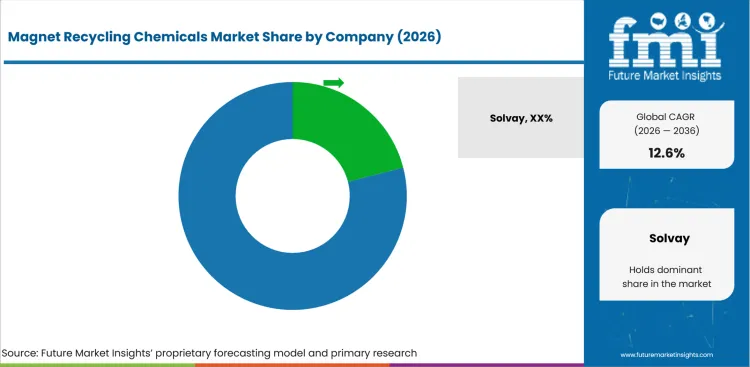
- Competition is shaped by leach control and solvent selectivity due to recovered oxide qualification support remaining central to account retention.
- Recyclers favor suppliers that can connect reagent selection to residue handling and offtake documentation.
- Short-loop companies compete on magnet-to-magnet recovery and long-loop providers compete on separated oxide output.
- Regional access matters when country programs require local feedstock handling and technical service support.
The competitive landscape spans specialty chemical suppliers, rare earth processors and magnet recyclers. Solvay contributes separation expertise, while Cyclic Materials and Ionic Technologies convert magnet scrap into recycled oxides for magnetic materials supply chains. Manufacturing access and project execution are becoming important. HyProMag is scaling short-loop recycling, whereas REEcycle and Noveon highlight USA routes linked to e-waste management and magnet reuse channels.
Companies with secured feedstock contracts and aligned offtake agreements are better positioned to scale. Chemical suppliers that pair recovery chemistry with green leaching agents and technical support can defend customer accounts as plants move beyond pilot operations.
How do top magnet recycling chemicals market companies compare?
Companies compare by recycling route and oxide output control. Account access and regional operating footprint also shape selection.
| Company | Portfolio / Focus | Account Access | Footprint / Service Reach |
|---|---|---|---|
| Solvay | La Rochelle purification and separation | Industrial offtake and processor accounts | Europe and global chemical network |
| Cyclic Materials | REEPure and recycled mixed rare earth oxide | OEM and processor agreements | Canada, United States, and Europe links |
| Ionic Technologies | Magnet scrap to high purity REO | Technology and project partners | United Kingdom and licensing route |
| HyProMag | HPMS-based recycled NdFeB magnets and alloys | Magnet and scrap customers | United Kingdom, Germany, and USA projects |
| REEcycle | Low-temperature solvent route | E-waste feedstock partners | United States |
Source: Future Market Insights, 2026.
Who are the key players in the magnet recycling chemicals market?
The market includes global chemical suppliers and magnet recyclers. Rare earth processors and magnet manufacturers also participate once recovered material returns to qualified supply chains.
Key global companies leading the magnet recycling chemicals market include:
- Solvay
- BASF
- Cyclic Materials
- Ionic Technologies
- HyProMag
- REEcycle
- VACUUMSCHMELZE
- Neo Performance Materials
- Less Common Metals
- MagREEsource
- JL MAG Rare-Earth
- Shin-Etsu Chemical
- Proterial
- Korea Zinc
- POSCO International
Key Developments in Magnet Recycling Chemicals Market
- In June 2024, Solvay and Cyclic Materials signed a supply agreement for recycled mixed rare earth oxide to support separation and purification at La Rochelle.
- In June 2025, Cyclic Materials committed USD 25 million to a Kingston Centre of Excellence designed for 500 tonnes of magnet-rich feedstock each year.
- In March 2026, Neo Performance Materials and Cyclic Materials formed a non-binding MOU aimed at a trans-Atlantic circular rare earth supply chain.
Key Players in the Magnet Recycling Chemicals Market
Chemical and Separation Companies
- Solvay
- BASF
- Neo Performance Materials
Recycling Technology Companies
- Cyclic Materials
- Ionic Technologies
- HyProMag
- REEcycle
- MagREEsource
Magnet and Alloy Companies
- VACUUMSCHMELZE
- Less Common Metals
- JL MAG Rare-Earth
- Shin-Etsu Chemical
- Proterial
What is included in the magnet recycling chemicals market report scope?
| Report Attribute | Details |
|---|---|
| Forecast period | 2026 to 2036 |
| Historical period | 2021 to 2025 |
| Quantitative unit | Value (USD million) |
| Segmentation rows | Chemical Type, Magnet Type, Target Element, End Use, Sales Channel, and Region |
| Regions covered | North America, Latin America, Western Europe, Eastern Europe, East Asia, South Asia and Pacific, and Middle East and Africa |
| Countries covered | United States, United Kingdom, Germany, France, Japan, China, South Korea, and India |
| Key companies profiled | Solvay, BASF, Cyclic Materials, Ionic Technologies, HyProMag, REEcycle, VACUUMSCHMELZE, and Neo Performance Materials |
| Approach | Bottom-up demand modeling with policy, company, and recycler validation |
Source: Future Market Insights, 2026.
What is the scope and definition of the magnet recycling chemicals market?
| Scope Element | Definition |
|---|---|
| Market Definition | Reagents used to recover rare earths and related metals from end-of-life magnets and magnet manufacturing scrap. |
| Functions Covered | Leaching, oxidation, solvent extraction, precipitation, neutralization support, and impurity control. |
| Applications Covered | NdFeB scrap recovery, mixed magnet scrap treatment, rare earth oxide production, and magnet remanufacturing support. |
| End-Use Industries | Rare earth recyclers, magnet producers, EV and wind supply chains, and hydrometallurgy plants. |
| Grades Covered | Commercial acids, oxidants, precipitation reagents, solvent extractants, and technology-bundled reagent packages. |
| Inclusions | Commercially traded chemicals and process-support packages used in magnet recycling workflows. |
| Exclusions | Physical sorting equipment, direct magnet reuse systems, virgin rare earth mining chemicals, and finished magnet sales. |
What research methodology is used for the magnet recycling chemicals market?
| Methodology Element | Approach |
|---|---|
| Primary Research | Analyst discussions reviewed recycler needs, magnet producer specifications, and reagent supplier support models. |
| Desk Research | Official policy sources, company updates, and hydrometallurgy product information were reviewed. |
| Market Sizing & Forecasting | The model combined reagent use per tonne of scrap, plant timing, country adoption, and supplier pricing. |
| Data Validation | Forecasts were reconciled against rare earth demand signals, policy targets, company facility timelines, and public funding. |
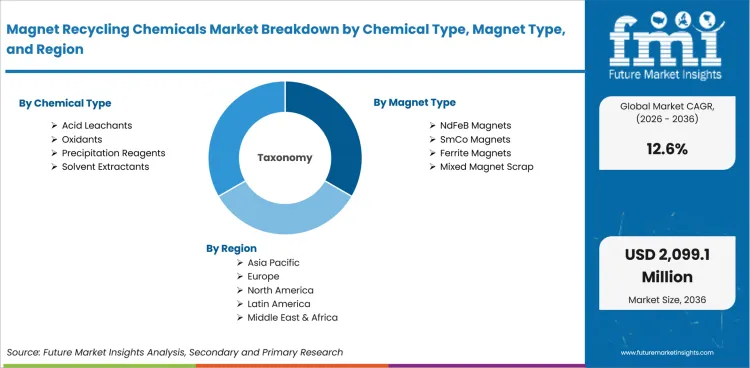
Magnet Recycling Chemicals Market Breakdown by Chemical Type, Magnet Type, Target Element, End Use, Sales Channel, and Region
Magnet Recycling Chemicals Market Segmented by Chemical Type
- Acid Leachants
- Oxidants
- Precipitation Reagents
- Solvent Extractants
Magnet Recycling Chemicals Market Segmented by Magnet Type
- NdFeB Magnets
- SmCo Magnets
- Ferrite Magnets
- Mixed Magnet Scrap
Magnet Recycling Chemicals Market Segmented by Target Element
- Neodymium / Praseodymium
- Dysprosium / Terbium
- Cobalt
- Iron / Other
Magnet Recycling Chemicals Market Segmented by End Use
- Rare Earth Recyclers
- Magnet Producers
- EV / Wind Supply Chain
- Hydrometallurgy Plants
Magnet Recycling Chemicals Market Segmented by Sales Channel
- Direct
- Distributors
- Technology Bundled
Magnet Recycling Chemicals Market by Region
- North America
- Latin America
- Western Europe
- Eastern Europe
- East Asia
- South Asia and Pacific
- Middle East and Africa
Bibliography
- European Commission. (2024, May). Critical Raw Materials Act. European Commission.
- International Energy Agency. (2026, April). Rare Earth Elements: Executive summary. International Energy Agency.
- International Energy Agency. (2025, April). Export controls on certain medium and heavy rare earth items. IEA Critical Minerals Policy Tracker.
- USA Department of Energy. (2025, December). Energy Department announces USD 134 million in funding to strengthen rare earth element supply chains. USA Department of Energy.
- USA Geological Survey. (2026, January). Mineral commodity summaries 2026: Rare earths. USA Geological Survey.
- Government of the United Kingdom. (2026, January). Vision 2035: Critical Minerals Strategy. Department for Business and Trade.
- Government of the United Kingdom. (2025, November). UK to end overreliance on imports of critical minerals. Department for Business and Trade.
- Ministry of Economy, Trade and Industry. (2026, May). White Paper on Manufacturing Industries 2026 summary. Government of Japan.
- New Energy and Industrial Technology Development Organization. (2025, July). Innovation Outlook Version 1.0. NEDO.
- Ministry of Trade, Industry and Energy. (2025, October). Korea to strengthen supply chain stability for rare earth magnets. Government of Korea.
- Press Information Bureau. (2025, November). Cabinet approves scheme to promote manufacturing of sintered rare earth permanent magnets. Government of India.
- Press Information Bureau. (2026, March). Ministry of Heavy Industries invites bids for integrated sintered rare earth permanent magnet facilities. Government of India.
- Solvay. (2024, June). Solvay and Cyclic Materials sign supply agreement for recycled mixed rare earth oxide. Solvay.
- Solvay. (2025, April). Solvay advances European rare earths production through capacity expansion. Solvay.
- Cyclic Materials. (2025, June). Cyclic Materials announces USD 25M investment to establish Centre of Excellence for Rare Earth Recycling in Kingston. Cyclic Materials.
- Cyclic Materials. (2026, January). Cyclic Materials secures USD 75M Series C funding to fast-track local and resilient rare earths supply at global scale. Cyclic Materials.
- Neo Performance Materials. (2026, March). Neo Performance Materials and Cyclic Materials sign non-binding MOU to advance trans-Atlantic circular rare earth supply chain. Neo Performance Materials.
- Mkango Resources. (2026, April). German Federal Ministry for Economic Affairs and Energy officially opens HyProMag plant in Pforzheim. Mkango Resources.
- Ionic Rare Earths. (2026, June). Ionic Technologies and rare earth magnet recycling overview. Ionic Rare Earths.
- Less Common Metals. (2024, October). Less Common Metals, Ionic Rare Earths and VACUUMSCHMELZE unite to develop 100% recycled rare earth magnets. Less Common Metals.
- REEcycle. (2026, June). Recovering rare earth elements from electronic waste. REEcycle.
- Noveon Magnetics. (2026, June). Noveon Magnetics company and recycling overview. Noveon Magnetics.
- MP Materials. (2026, February). MP Materials selects Northlake, Texas as the site of 10X. MP Materials.
- MagREEsource. (2026, February). Just Transition Fund project announcement. MagREEsource.
- Proterial. (2025, July). Heavy-rare-earth-free neodymium sintered magnet for electric vehicle driving motors. Proterial.
- Shin-Etsu Chemical. (2025, July). Sources of Our Competitiveness. Shin-Etsu Chemical.
- POSCO International. (2026, May). POSCO International to establish integrated rare earth magnet production complex in the United States. POSCO International.
- Korea Zinc. (2026, June). Resource circulation business overview. Korea Zinc.
- JL MAG Rare-Earth. (2026, June). Company profile and rare earth recycling overview. JL MAG Rare-Earth.
This Report Answers
- What is the current and future value of the magnet recycling chemicals market from 2026 to 2036?
- What CAGR is the magnet recycling chemicals market expected to record during the forecast period?
- Which chemical type is projected to lead demand in magnet recycling chemical use during 2026?
- Which magnet type is expected to account for the most visible share of chemical demand?
- How do acid leachants and solvent extractants support rare earth recovery from magnet scrap?
- Why are rare earth recyclers and magnet producers increasing qualification work for recovery chemicals?
- Which countries are expected to record notable growth due to rare earth recycling and magnet localization programs?
- Which companies are active across rare earth separation and magnet recycling technology supply chains?
- What materials and reagent types are included in the magnet recycling chemicals market definition?
- How does FMI forecast demand across acid leachants and oxidants plus precipitation reagents and solvent extractants?
Frequently Asked Questions
How large is the Magnet Recycling Chemicals Market expected to be in the near term?
The market is expanding as rare earth users increasingly treat recycled magnets as a strategic secondary supply source.
What is the long term outlook for the Magnet Recycling Chemicals Market?
The outlook remains strong as policy support and supply chain risk accelerate investment in magnet to oxide and magnet to magnet recycling routes.
How fast is the Magnet Recycling Chemicals Market expected to grow?
Growth is driven by rising demand for rare earth magnets in electric vehicles, wind turbines, and electronics alongside recycling mandates.
What is the main driver of magnet recycling chemicals demand?
Demand is driven by the need to recover neodymium, praseodymium, and heavy rare earths from end of life and manufacturing magnet scrap.
Which chemical type dominates the market?
Acid leachants dominate because controlled dissolution is the first critical step in magnet recycling and rare earth separation.
Which magnet type contributes most to demand?
NdFeB magnets lead demand due to their high neodymium and praseodymium content and widespread use in motors and generators.
Which sales channel is most widely used?
Direct sales dominate because buyers need process specific support, purity assurance, and documentation from chemical suppliers.
Which regions show strong adoption of magnet recycling chemicals?
East Asia, Europe, North America, and parts of South Asia show strong adoption due to magnet manufacturing scale and critical mineral policy.
Which countries are key markets for magnet recycling chemicals?
China, India, the United States, the United Kingdom, Germany, France, South Korea, and Japan are key markets.
What supports China’s leading growth momentum?
Integrated rare earth processing capacity and large magnet manufacturing volumes drive sustained demand for recycling chemistry.
Why is India an emerging growth market?
Government backed rare earth magnet localization and planned recycling corridors are creating early demand for recovery chemicals.
What drives demand in the United States?
Federal recovery funding and new domestic magnet projects increase the need for qualified recycling and separation chemistry.
What restrains faster growth in the magnet recycling chemicals market?
Permitting delays, residue handling requirements, and feedstock variability can slow large scale hydrometallurgy deployment.
Who are the leading companies in the Magnet Recycling Chemicals Market?
Leading companies include Solvay, Cyclic Materials, Ionic Technologies, HyProMag, REEcycle, and Neo Performance Materials.
Preview the report firsthand - request a free sample
Get SampleGet the brochure for pricing and purchase details.
Get PDFTable of Content
- Key Takeaways
- Market Size and CAGR
- Top Growth Driver
- Fastest Growing Segment
- Leading Region
- Key Companies
- Emerging Opportunities
- Executive Summary
- Global Market Outlook
- Demand-side Trends
- Supply-side Trends
- Technology Roadmap Analysis
- Analysis and Recommendations
- Analyst Perspective (What is happening? Why now? What should investors know?)
- Key Questions Answered
- How large is the market?
- What is the CAGR?
- What are key trends?
- Which region dominates?
- Who are the leaders?
- Market Overview
- Market Coverage / Taxonomy
- Market Definition / Scope / Limitations
- Research Methodology
- Chapter Orientation
- Analytical Lens and Working Hypotheses
- Market Structure, Signals, and Trend Drivers
- Benchmarking and Cross-market Comparability
- Market Sizing, Forecasting, and Opportunity Mapping
- Research Design and Evidence Framework
- Desk Research Programme (Secondary Evidence)
- Expert Input and Fieldwork (Primary Evidence)
- Tooling, Models, and Reference Databases
- Data Engineering and Model Build
- Quality Assurance and Audit Trail
- Market Background
- Market Dynamics (Drivers, Restraints, Opportunity, Trends)
- Scenario Forecast (Optimistic, Likely, Conservative)
- Impact Analysis
- AI Impact
- Sustainability Impact
- Regulatory Impact
- Technology Impact
- Consumer / Buyer Analysis
- Purchase Drivers
- Adoption Barriers
- Buyer Journey
- Opportunity Map Analysis
- Product Life Cycle Analysis
- Supply Chain Analysis
- Investment Feasibility Matrix
- Value Chain Analysis
- PESTLE and Porter's Analysis
- Regulatory Landscape
- Regional Parent Market Outlook
- Production and Consumption Statistics
- Import and Export Statistics
- Global Market Analysis and Forecast, 2021 to 2036
- Historical Market Size Value (USD Million) & Volume (Unit) Analysis, 2021 to 2025
- Current and Future Market Size Value (USD Million) & Volume (Unit) Projections, 2026 to 2036
- Y-o-Y Growth Trend Analysis
- Absolute $ Opportunity Analysis
- Global Market Pricing Analysis, 2021 to 2036
- Global Market Analysis and Forecast, By Chemical Type, 2021 to 2036
- Introduction / Key Findings
- Historical Market Size Value (USD Million) & Volume (Unit) Analysis By Chemical Type, 2021 to 2025
- Current and Future Market Size Value (USD Million) & Volume (Unit) Analysis and Forecast By Chemical Type, 2026 to 2036
- Acid Leachants
- Oxidants
- Precipitation Reagents
- Solvent Extractants
- Acid Leachants
- Y-o-Y Growth Trend Analysis By Chemical Type, 2021 to 2025
- Absolute $ Opportunity Analysis By Chemical Type, 2026 to 2036
- Global Market Analysis and Forecast, By Magnet Type, 2021 to 2036
- Introduction / Key Findings
- Historical Market Size Value (USD Million) & Volume (Unit) Analysis By Magnet Type, 2021 to 2025
- Current and Future Market Size Value (USD Million) & Volume (Unit) Analysis and Forecast By Magnet Type, 2026 to 2036
- NdFeB Magnets
- SmCo Magnets
- Ferrite Magnets
- Mixed Magnet Scrap
- NdFeB Magnets
- Y-o-Y Growth Trend Analysis By Magnet Type, 2021 to 2025
- Absolute $ Opportunity Analysis By Magnet Type, 2026 to 2036
- Global Market Analysis and Forecast, By Target Element, 2021 to 2036
- Introduction / Key Findings
- Historical Market Size Value (USD Million) & Volume (Unit) Analysis By Target Element, 2021 to 2025
- Current and Future Market Size Value (USD Million) & Volume (Unit) Analysis and Forecast By Target Element, 2026 to 2036
- Neodymium / Praseodymium
- Dysprosium / Terbium
- Cobalt
- Iron / Other
- Neodymium / Praseodymium
- Y-o-Y Growth Trend Analysis By Target Element, 2021 to 2025
- Absolute $ Opportunity Analysis By Target Element, 2026 to 2036
- Global Market Analysis and Forecast, By End Use Group, 2021 to 2036
- Introduction / Key Findings
- Historical Market Size Value (USD Million) & Volume (Unit) Analysis By End Use Group, 2021 to 2025
- Current and Future Market Size Value (USD Million) & Volume (Unit) Analysis and Forecast By End Use Group, 2026 to 2036
- Rare Earth Recyclers
- Magnet Producers
- EV / Wind Supply Chain
- Hydrometallurgy Plants
- Rare Earth Recyclers
- Y-o-Y Growth Trend Analysis By End Use Group, 2021 to 2025
- Absolute $ Opportunity Analysis By End Use Group, 2026 to 2036
- Global Market Analysis and Forecast, By Sales Channel, 2021 to 2036
- Introduction / Key Findings
- Historical Market Size Value (USD Million) & Volume (Unit) Analysis By Sales Channel, 2021 to 2025
- Current and Future Market Size Value (USD Million) & Volume (Unit) Analysis and Forecast By Sales Channel, 2026 to 2036
- Direct
- Distributors
- Technology Bundled
- Direct
- Y-o-Y Growth Trend Analysis By Sales Channel, 2021 to 2025
- Absolute $ Opportunity Analysis By Sales Channel, 2026 to 2036
- Global Market Analysis and Forecast, By Region, 2021 to 2036
- Introduction
- Historical Market Size Value (USD Million) & Volume (Unit) Analysis By Region, 2021 to 2025
- Current Market Size Value (USD Million) & Volume (Unit) Analysis and Forecast By Region, 2026 to 2036
- North America
- Latin America
- Western Europe
- Eastern Europe
- East Asia
- South Asia and Pacific
- Middle East & Africa
- Market Attractiveness Analysis By Region
- North America Market Analysis and Forecast, By Country, 2021 to 2036
- Historical Market Size Value (USD Million) & Volume (Unit) Trend Analysis By Market Taxonomy, 2021 to 2025
- Market Size Value (USD Million) & Volume (Unit) Forecast By Market Taxonomy, 2026 to 2036
- By Country
- USA
- Canada
- Mexico
- By Chemical Type
- By Magnet Type
- By Target Element
- By End Use Group
- By Sales Channel
- By Country
- Market Attractiveness Analysis
- By Country
- By Chemical Type
- By Magnet Type
- By Target Element
- By End Use Group
- By Sales Channel
- Key Takeaways
- Latin America Market Analysis and Forecast, By Country
- Historical Market Size Value (USD Million) & Volume (Unit) Trend Analysis By Market Taxonomy, 2021 to 2025
- Market Size Value (USD Million) & Volume (Unit) Forecast By Market Taxonomy, 2026 to 2036
- By Country
- Brazil
- Chile
- Rest of Latin America
- By Chemical Type
- By Magnet Type
- By Target Element
- By End Use Group
- By Sales Channel
- By Country
- Market Attractiveness Analysis
- By Country
- By Chemical Type
- By Magnet Type
- By Target Element
- By End Use Group
- By Sales Channel
- Key Takeaways
- Western Europe Market Analysis and Forecast, By Country
- Historical Market Size Value (USD Million) & Volume (Unit) Trend Analysis By Market Taxonomy, 2021 to 2025
- Market Size Value (USD Million) & Volume (Unit) Forecast By Market Taxonomy, 2026 to 2036
- By Country
- Germany
- UK
- Italy
- Spain
- France
- Nordic
- BENELUX
- Rest of Western Europe
- By Chemical Type
- By Magnet Type
- By Target Element
- By End Use Group
- By Sales Channel
- By Country
- Market Attractiveness Analysis
- By Country
- By Chemical Type
- By Magnet Type
- By Target Element
- By End Use Group
- By Sales Channel
- Key Takeaways
- Eastern Europe Market Analysis and Forecast, By Country
- Historical Market Size Value (USD Million) & Volume (Unit) Trend Analysis By Market Taxonomy, 2021 to 2025
- Market Size Value (USD Million) & Volume (Unit) Forecast By Market Taxonomy, 2026 to 2036
- By Country
- Russia
- Poland
- Hungary
- Balkan & Baltic
- Rest of Eastern Europe
- By Chemical Type
- By Magnet Type
- By Target Element
- By End Use Group
- By Sales Channel
- By Country
- Market Attractiveness Analysis
- By Country
- By Chemical Type
- By Magnet Type
- By Target Element
- By End Use Group
- By Sales Channel
- Key Takeaways
- East Asia Market Analysis and Forecast, By Country
- Historical Market Size Value (USD Million) & Volume (Unit) Trend Analysis By Market Taxonomy, 2021 to 2025
- Market Size Value (USD Million) & Volume (Unit) Forecast By Market Taxonomy, 2026 to 2036
- By Country
- China
- Japan
- South Korea
- By Chemical Type
- By Magnet Type
- By Target Element
- By End Use Group
- By Sales Channel
- By Country
- Market Attractiveness Analysis
- By Country
- By Chemical Type
- By Magnet Type
- By Target Element
- By End Use Group
- By Sales Channel
- Key Takeaways
- South Asia and Pacific Market Analysis and Forecast, By Country
- Historical Market Size Value (USD Million) & Volume (Unit) Trend Analysis By Market Taxonomy, 2021 to 2025
- Market Size Value (USD Million) & Volume (Unit) Forecast By Market Taxonomy, 2026 to 2036
- By Country
- India
- ASEAN
- Australia & New Zealand
- Rest of South Asia and Pacific
- By Chemical Type
- By Magnet Type
- By Target Element
- By End Use Group
- By Sales Channel
- By Country
- Market Attractiveness Analysis
- By Country
- By Chemical Type
- By Magnet Type
- By Target Element
- By End Use Group
- By Sales Channel
- Key Takeaways
- Middle East & Africa Market Analysis and Forecast, By Country
- Historical Market Size Value (USD Million) & Volume (Unit) Trend Analysis By Market Taxonomy, 2021 to 2025
- Market Size Value (USD Million) & Volume (Unit) Forecast By Market Taxonomy, 2026 to 2036
- By Country
- Kingdom of Saudi Arabia
- Other GCC Countries
- Türkiye
- South Africa
- Other African Union
- Rest of Middle East & Africa
- By Chemical Type
- By Magnet Type
- By Target Element
- By End Use Group
- By Sales Channel
- By Country
- Market Attractiveness Analysis
- By Country
- By Chemical Type
- By Magnet Type
- By Target Element
- By End Use Group
- By Sales Channel
- Key Takeaways
- Key Countries Market Analysis
- USA
- Pricing Analysis
- Market Share Analysis, 2025
- By Chemical Type
- By Magnet Type
- By Target Element
- By End Use Group
- By Sales Channel
- Canada
- Pricing Analysis
- Market Share Analysis, 2025
- By Chemical Type
- By Magnet Type
- By Target Element
- By End Use Group
- By Sales Channel
- Mexico
- Pricing Analysis
- Market Share Analysis, 2025
- By Chemical Type
- By Magnet Type
- By Target Element
- By End Use Group
- By Sales Channel
- Brazil
- Pricing Analysis
- Market Share Analysis, 2025
- By Chemical Type
- By Magnet Type
- By Target Element
- By End Use Group
- By Sales Channel
- Chile
- Pricing Analysis
- Market Share Analysis, 2025
- By Chemical Type
- By Magnet Type
- By Target Element
- By End Use Group
- By Sales Channel
- Germany
- Pricing Analysis
- Market Share Analysis, 2025
- By Chemical Type
- By Magnet Type
- By Target Element
- By End Use Group
- By Sales Channel
- UK
- Pricing Analysis
- Market Share Analysis, 2025
- By Chemical Type
- By Magnet Type
- By Target Element
- By End Use Group
- By Sales Channel
- Italy
- Pricing Analysis
- Market Share Analysis, 2025
- By Chemical Type
- By Magnet Type
- By Target Element
- By End Use Group
- By Sales Channel
- Spain
- Pricing Analysis
- Market Share Analysis, 2025
- By Chemical Type
- By Magnet Type
- By Target Element
- By End Use Group
- By Sales Channel
- France
- Pricing Analysis
- Market Share Analysis, 2025
- By Chemical Type
- By Magnet Type
- By Target Element
- By End Use Group
- By Sales Channel
- India
- Pricing Analysis
- Market Share Analysis, 2025
- By Chemical Type
- By Magnet Type
- By Target Element
- By End Use Group
- By Sales Channel
- ASEAN
- Pricing Analysis
- Market Share Analysis, 2025
- By Chemical Type
- By Magnet Type
- By Target Element
- By End Use Group
- By Sales Channel
- Australia & New Zealand
- Pricing Analysis
- Market Share Analysis, 2025
- By Chemical Type
- By Magnet Type
- By Target Element
- By End Use Group
- By Sales Channel
- China
- Pricing Analysis
- Market Share Analysis, 2025
- By Chemical Type
- By Magnet Type
- By Target Element
- By End Use Group
- By Sales Channel
- Japan
- Pricing Analysis
- Market Share Analysis, 2025
- By Chemical Type
- By Magnet Type
- By Target Element
- By End Use Group
- By Sales Channel
- South Korea
- Pricing Analysis
- Market Share Analysis, 2025
- By Chemical Type
- By Magnet Type
- By Target Element
- By End Use Group
- By Sales Channel
- Russia
- Pricing Analysis
- Market Share Analysis, 2025
- By Chemical Type
- By Magnet Type
- By Target Element
- By End Use Group
- By Sales Channel
- Poland
- Pricing Analysis
- Market Share Analysis, 2025
- By Chemical Type
- By Magnet Type
- By Target Element
- By End Use Group
- By Sales Channel
- Hungary
- Pricing Analysis
- Market Share Analysis, 2025
- By Chemical Type
- By Magnet Type
- By Target Element
- By End Use Group
- By Sales Channel
- Kingdom of Saudi Arabia
- Pricing Analysis
- Market Share Analysis, 2025
- By Chemical Type
- By Magnet Type
- By Target Element
- By End Use Group
- By Sales Channel
- Türkiye
- Pricing Analysis
- Market Share Analysis, 2025
- By Chemical Type
- By Magnet Type
- By Target Element
- By End Use Group
- By Sales Channel
- South Africa
- Pricing Analysis
- Market Share Analysis, 2025
- By Chemical Type
- By Magnet Type
- By Target Element
- By End Use Group
- By Sales Channel
- USA
- Market Structure Analysis
- Competition Dashboard
- Competition Benchmarking
- Market Share Analysis of Top Players
- By Regional
- By Chemical Type
- By Magnet Type
- By Target Element
- By End Use Group
- By Sales Channel
- Emerging Startups
- Innovation Benchmarking
- Competition Analysis
- Competition Deep Dive
- Solvay
- Overview
- Product Portfolio
- Profitability by Market Segments (Product/Region/Sales Channel)
- Sales Footprint
- Strategy Overview
- Marketing Strategy
- Product Strategy
- Channel Strategy
- Cyclic Materials
- Ionic Technologies
- HyProMag
- REEcycle
- Solvay
- Case Studies
- Success Stories
- Recent Developments
- Competition Deep Dive
- Assumptions & Acronyms Used


