

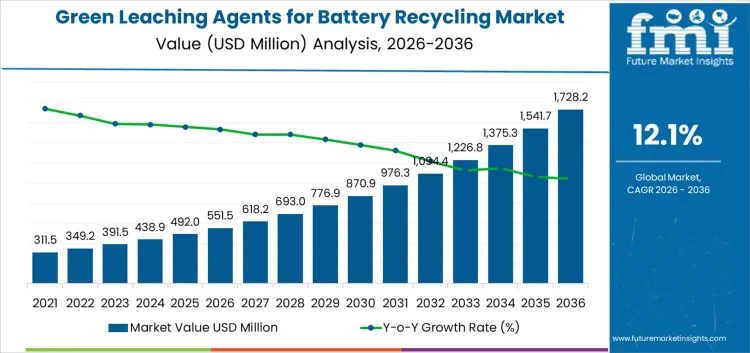
- Industry Size (2026)
- USD 551.5 Mn
- Forecast (2036)
- USD 1728.3 Mn
- CAGR (2026 to 2036)
- 12.1%
Green Leaching Agents for Battery Recycling Market Forecast and Outlook 2026 to 2036
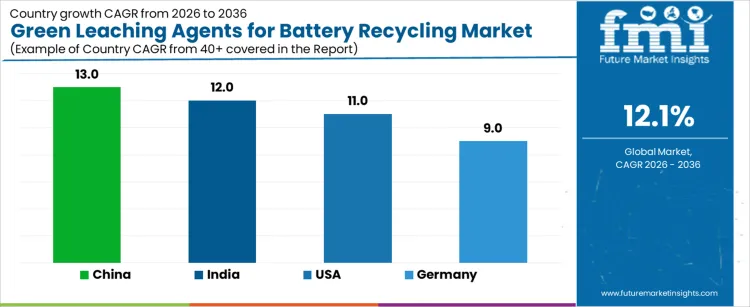
The global green leaching agents for battery recycling market is experiencing significant growth, driven by increasing demand for sustainable recycling methods across the world. China leads the market with a 13.0% CAGR, driven by its dominance in global battery production and recycling efforts. The country's large-scale investments in electric vehicle (EV) infrastructure, coupled with government policies promoting sustainable recycling, are accelerating the adoption of green leaching agents. India follows with a 12.0% growth rate, fueled by the rise in EV adoption and government incentives supporting eco-friendly technologies. The growing focus on sustainable battery recycling solutions is driving demand for green leaching agents in the country.
Quick Stats for Green Leaching Agents for Battery Recycling Market
- Green Leaching Agents for Battery Recycling Market Value (2026): USD 551.5 million
- Green Leaching Agents for Battery Recycling Market Forecast Value (2036): USD 1,728.3 million
- Green Leaching Agents for Battery Recycling Market Forecast CAGR (2026-2036): 12.1%
- Leading Process Type in Green Leaching Agents for Battery Recycling Market: Hydrometallurgy with green solvents (DES/IL + water blends)
- Key Growth Regions in Green Leaching Agents for Battery Recycling Market: Asia Pacific, Europe, North America
- Top Players in Green Leaching Agents for Battery Recycling Market: Solvomet, BASF, Umicore
The United States shows strong growth at 11.0%, supported by increasing demand for efficient and environmentally friendly recycling methods in the EV sector. Regulatory efforts, including government incentives for clean energy and EV adoption, further enhance the need for green leaching agents. Germany's market grows at 9.0%, driven by its commitment to sustainability and stringent environmental regulations. As the country advances in clean energy and recycling practices, the demand for eco-friendly leaching agents remains steady. These key markets are all pivotal in driving the widespread adoption of green leaching agents in battery recycling, contributing to the market's overall expansion.
Green Leaching Agents for Battery Recycling Market Key Takeaways
| Metric | Value |
|---|---|
| Industry Value (2026) | USD 551.5 million |
| Forecast Value (2036) | USD 1,728.3 million |
| Forecast CAGR (2026-2036) | 12.1% |
How is the Global Green Leaching Agents for Battery Recycling Sector Advancing?
The global green leaching agents for battery recycling market is growing rapidly as demand for sustainable and efficient methods of recycling batteries increases. Leaching agents play a crucial role in the recovery of valuable metals, such as lithium, cobalt, and nickel, from used batteries. Traditional methods often involve toxic chemicals that can harm the environment. However, green leaching agents are designed to be more environmentally friendly, using less harmful chemicals and offering more sustainable alternatives for metal recovery. The shift toward greener methods in battery recycling is driven by the growing need for ethical sourcing of materials and the increased focus on reducing environmental harm from battery disposal.
The market for green leaching agents is expected to expand significantly, supported by global efforts to promote circular economy practices and enhance battery recycling efficiency. With stricter environmental regulations and the need for more sustainable recycling processes, the demand for green leaching agents will continue to rise. Innovations in leaching technology, which improve metal recovery rates while reducing environmental impact, will further boost market growth. However, challenges such as high production costs, technological advancements in leaching processes, and ensuring wide adoption across the recycling industry will influence the market’s trajectory. As battery recycling becomes more crucial to supply chains in the EV and renewable energy sectors, green leaching agents will play a key role in ensuring sustainable and efficient recycling practices.
What Is the Segment-Wise Analysis for the Global Green Leaching Agents for Battery Recycling Market?
The global green leaching agents for battery recycling market is driven by process types and end-users. Hydrometallurgy with green solvents (DES/IL + water blends) leads the market with a 45% share due to its efficient and environmentally friendly method of extracting valuable metals from batteries. Other significant processes include bioleaching/biological routes, solvometallurgy with non-aqueous solvents, electro-assisted leaching, and hybrid flows that combine thermal and green chemical leaching. In terms of end-users, dedicated EV battery recyclers account for 42% of the market, driven by the growing demand for sustainable recycling solutions in the EV industry.
How Does Hydrometallurgy with Green Solvents Lead the Green Leaching Agents Market?
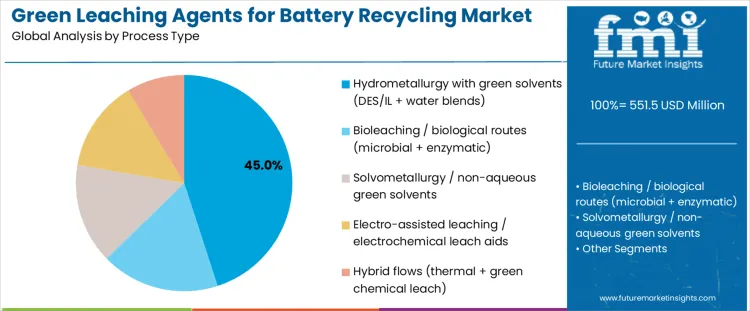
Hydrometallurgy with green solvents (DES/IL + water blends) holds a 45% share of the global green leaching agents for battery recycling market due to its effectiveness in extracting valuable metals from batteries in an environmentally sustainable way. This method employs green solvents, such as deep eutectic solvents (DES) and ionic liquids (IL), combined with water, to replace traditional acid-based techniques. As the demand for environmentally safe practices increases, especially in the electric vehicle (EV) sector, hydrometallurgy offers a solution that minimizes toxic waste while enhancing metal recovery. It allows recyclers to recover precious metals like lithium, cobalt, and nickel with minimal environmental impact. The growing focus on sustainability and resource recovery further strengthens the position of hydrometallurgy in the battery recycling market, establishing it as the preferred method for green leaching.
Why Do Dedicated EV Battery Recyclers Hold the Largest Share in the Global Green Leaching Agents Market?
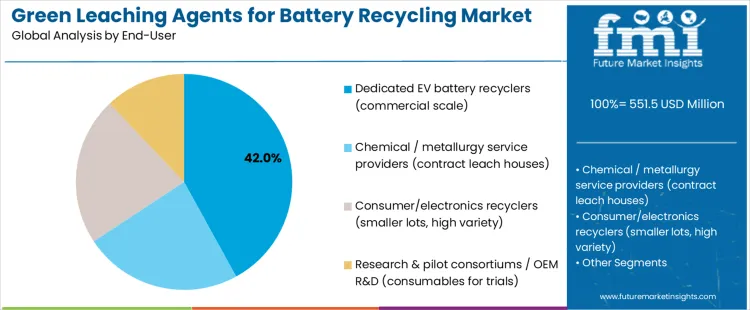
Dedicated EV battery recyclers account for 42% of the global green leaching agents for battery recycling market due to the rising volume of batteries being recycled from electric vehicles. With the EV industry expanding, the need for efficient, eco-friendly recycling solutions has intensified. Dedicated recyclers are crucial in recovering valuable metals like lithium, cobalt, and nickel from spent EV batteries using sustainable methods such as hydrometallurgy and bioleaching. These green leaching agents ensure high recovery rates while minimizing environmental harm. As governments and industries prioritize sustainability and recycling, dedicated EV battery recyclers are vital in meeting the increasing demand for environmentally responsible battery disposal and resource recovery, positioning them as the dominant force in the market for green leaching agents.
What is Driving the Growth of the Green Leaching Agents for Battery Recycling Market?
The green leaching agents for battery recycling market is driven by the rapid expansion of battery usage in electric vehicles, consumer electronics, and energy storage systems. As spent batteries accumulate, there is rising pressure to recover valuable metals like lithium, cobalt, and nickel in environmentally responsible ways. Traditional leaching methods often use harsh acids that pose environmental and safety concerns. Green leaching agents, such as organic acids, bio based solvents, and biodegradable chelating agents, offer safer and more sustainable alternatives. Increasing regulatory emphasis on circular economy practices and reduced hazardous waste disposal is further boosting market adoption.
What Challenges are Limiting the Adoption of Green Leaching Agents in Battery Recycling?
Adoption of green leaching agents faces challenges related to performance, cost, and technology readiness. While sustainable agents reduce environmental impact, some may not yet match the extraction efficiency or speed of traditional acidic processes, affecting overall metal recovery yields. Higher costs of bio based and eco friendly chemicals can deter recycling operators, especially in regions with lower regulatory pressure. Scaling laboratory proven green leaching technologies to industrial volumes can require significant investment and process adjustments. Lack of standardized protocols and limited awareness among smaller recycling facilities also slow widespread adoption.
How are Innovations Transforming the Green Leaching Agents for Battery Recycling Market?
Innovations in green leaching agents are focused on improving efficiency, selectivity, and sustainability. Research is advancing bio hydrometallurgical approaches that use organic acids, amino acids, and microbial leaching to recover metals at ambient conditions with minimal environmental impact. Development of tailored chelating agents enhances selective extraction of specific metals, reducing processing steps and waste. Integration of advanced process controls and real time monitoring enhances leaching performance and reduces chemical usage. Collaboration between chemical producers, battery recyclers, and research institutions is accelerating the commercialization of sustainable leaching technologies.
What is the Growth Outlook for the Green Leaching Agents for Battery Recycling Market by Country?
| Country | CAGR (%) |
|---|---|
| China | 13.0% |
| United States | 11.0% |
| Germany | 9.0% |
| India | 12.0% |
The green leaching agents for battery recycling market is experiencing significant growth, with China leading at a 13.0% CAGR, driven by the country's dominance in battery production and the push for sustainable recycling solutions. India follows closely at 12.0%, supported by the growing adoption of electric vehicles and the need for efficient battery recycling. The United States shows strong growth at 11.0%, fueled by increasing demand for eco-friendly recycling methods and the growth of the EV market. Germany's market grows at 9.0%, driven by stringent environmental regulations and the focus on clean, sustainable recycling processes.
Why is China Leading in the Green Leaching Agents for Battery Recycling Market?
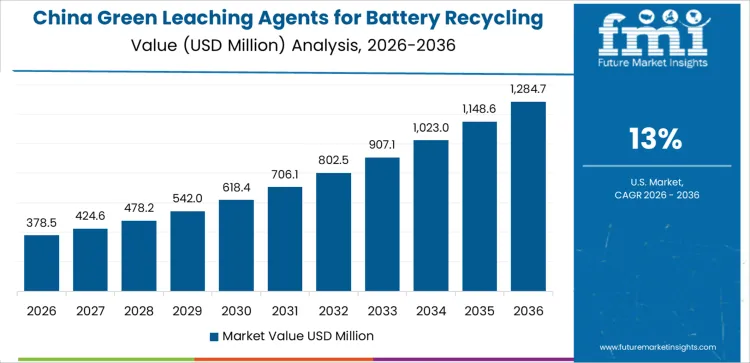
China’s green leaching agents for battery recycling market is growing at 13.0%, driven by its dominant role in global battery production and recycling. As the world’s largest producer and consumer of batteries, especially in the electric vehicle (EV) and energy storage sectors, China is increasingly focusing on sustainable battery recycling processes. Green leaching agents, which offer environmentally friendly and efficient methods for extracting valuable materials from used batteries, are gaining popularity in China as the government pushes for better recycling practices and resource recovery. China’s strong investments in clean energy, EV infrastructure, and recycling technologies are accelerating the adoption of green leaching agents. With the continued growth of China’s battery production and recycling industries, the demand for eco-friendly leaching agents is expected to maintain strong growth.
What is Contributing to the Growth of the Green Leaching Agents for Battery Recycling Market in India?
India’s green leaching agents for battery recycling market is growing at 12.0%, driven by the rapid expansion of the electric vehicle (EV) market and the country’s increasing focus on sustainable recycling methods. As India’s EV adoption rises, the need for effective and eco-friendly battery recycling solutions is growing, pushing demand for green leaching agents. The government’s push for clean energy and initiatives to improve waste management and recycling infrastructure are contributing to market growth. India’s rising awareness of environmental issues and the importance of recycling valuable materials from used batteries are driving the adoption of sustainable recycling solutions. As India continues to invest in green technologies and sustainability, the market for green leaching agents in battery recycling is expected to grow rapidly.
How is the Green Leaching Agents for Battery Recycling Market Expanding in the United States?
The United States’ green leaching agents for battery recycling market is growing at 11.0%, fueled by the increasing demand for environmentally friendly recycling methods in the growing electric vehicle (EV) sector. As the EV market expands, there is a growing need for sustainable battery recycling technologies that reduce environmental impact while maximizing resource recovery. The US government’s focus on promoting clean energy, sustainability, and recycling solutions is accelerating the demand for green leaching agents, which offer efficient and eco-friendly extraction processes. With heightened environmental regulations and consumer demand for sustainable solutions, the market for green leaching agents in the United States is expected to continue growing at a steady pace as battery recycling becomes increasingly important.
What is Driving the Green Leaching Agents for Battery Recycling Market in Germany?
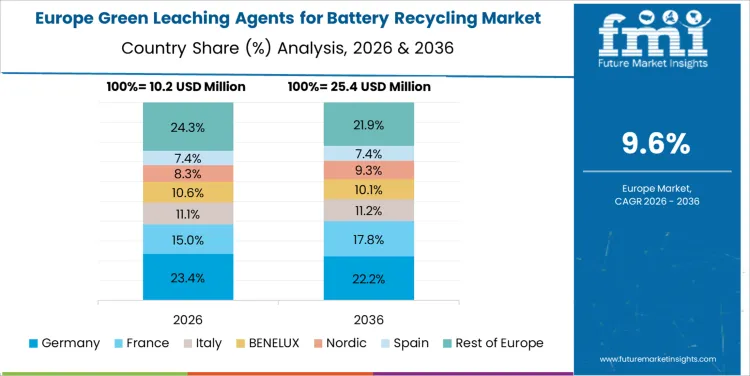
Germany’s green leaching agents for battery recycling market is growing at 9.0%, driven by the country’s strong commitment to sustainability and circular economy practices. As Germany’s electric vehicle market grows, there is increasing demand for sustainable recycling methods to recover valuable materials from used batteries. The country’s stringent environmental regulations and emphasis on clean energy are encouraging the adoption of eco-friendly battery recycling solutions, including green leaching agents. Germany’s well-established recycling infrastructure, combined with growing consumer demand for environmentally responsible solutions, is contributing to the growth of this market. As the country continues to prioritize sustainability and renewable energy solutions, the demand for green leaching agents in battery recycling is expected to increase steadily.
How Are Companies Competing in the Green Leaching Agents for Battery Recycling Market?
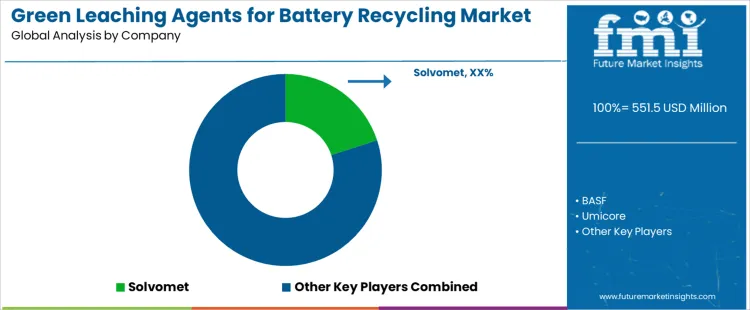
In the green leaching agents for battery recycling market Solvomet, BASF, and Umicore are positioned with distinct product brochures that emphasize eco‑friendly chemistries designed to recover valuable metals from spent cells. Solvomet materials present low‑impact leaching solutions based on alternative solvents that minimize hazardous waste and reduce energy use. Technical attributes such as metal selectivity and process efficiency are highlighted with laboratory and pilot data. BASF brochures focus on tailored reagent systems engineered for scalable recycling workflows with reduced environmental burden. Performance metrics such as enhanced extraction rates and lower solvent consumption are detailed alongside regulatory compliance claims. Umicore positions its green leaching agents within an integrated recycling offering that pairs chemistry with engineered processes to maximize recovery of cobalt, nickel, and lithium with minimal ecological footprint.
Across all firms product collateral underscores sustainability credentials and the ability of green agents to meet evolving regulatory standards for circular battery supply chains. Emphasis is placed on compatibility with existing hydrometallurgical infrastructure and ease of integration into recycling operations. Competitive strategies are shaped by differentiation in solvent technology innovation, clarity of performance data, and global support networks that address recycler needs. Messaging is crafted to influence specification by highlighting reduced environmental impact, process reliability, and contribution to responsible resource recovery.
Key Players in Green Leaching Agents for Battery Recycling Market
- Solvomet
- BASF
- Umicore
Scope of Report
| Items | Values |
|---|---|
| Quantitative Units (2026) | USD million |
| End Use Application | Dedicated EV Battery Recyclers (Commercial Scale), Chemical / Metallurgy Service Providers (Contract Leach Houses), Consumer/Electronics Recyclers (Smaller Lots, High Variety), Research & Pilot Consortiums / OEM R&D (Consumables for Trials) |
| Process Type / Approach | Hydrometallurgy with Green Solvents (DES/IL + Water Blends), Bioleaching / Biological Routes (Microbial + Enzymatic) |
| Regions Covered | Asia Pacific, Europe, North America, Latin America, Middle East & Africa |
| Countries Covered | USA, China, Japan, South Korea, India, Australia & New Zealand, ASEAN, Germany, UK, France, Italy, Spain, Nordic, BENELUX, Brazil, Chile, Mexico, Saudi Arabia, Other GCC Countries, Turkey, South Africa, Other African Union |
| Key Companies Profiled | Solvomet, BASF, Umicore |
| Additional Attributes | Dollar sales by process type, application, and approach; regional CAGR and growth outlook; distribution channels including commercial recyclers, service providers, and research consortiums; innovation trends in hydrometallurgy and bioleaching; competitive positioning of global vs regional suppliers. |
Green Leaching Agents for Battery Recycling Market by Segments
Process Type / Approach
- Hydrometallurgy with green solvents (DES/IL + water blends)
- Bioleaching / biological routes (microbial + enzymatic)
- Solvometallurgy / non-aqueous green solvents
- Electro-assisted leaching / electrochemical leach aids
- Hybrid flows (thermal + green chemical leach)
End-User / Customer
- Dedicated EV battery recyclers (commercial scale)
- Chemical / metallurgy service providers (contract leach houses)
- Consumer/electronics recyclers (smaller lots, high variety)
- Research & pilot consortiums / OEM R&D (consumables for trials)
Region
- Asia Pacific
- China
- Japan
- South Korea
- India
- Australia & New Zealand
- ASEAN
- Rest of Asia Pacific
- Europe
- Germany
- United Kingdom
- France
- Italy
- Spain
- Nordic
- BENELUX
- Rest of Europe
- North America
- United States
- Canada
- Mexico
- Latin America
- Brazil
- Chile
- Rest of Latin America
- Middle East & Africa
- Kingdom of Saudi Arabia
- Other GCC Countries
- Turkey
- South Africa
- Other African Union
- Rest of Middle East & Africa
Frequently Asked Questions
How big is the green leaching agents for battery recycling market in 2026?
The global green leaching agents for battery recycling market is estimated to be valued at USD 551.5 million in 2026.
What will be the size of green leaching agents for battery recycling market in 2036?
The market size for the green leaching agents for battery recycling market is projected to reach USD 82,083,992,748,498.6 million by 2036.
How much will be the green leaching agents for battery recycling market growth between 2026 and 2036?
The green leaching agents for battery recycling market is expected to grow at a 12.1% CAGR between 2026 and 2036.
What are the key product types in the green leaching agents for battery recycling market?
The key product types in green leaching agents for battery recycling market are hydrometallurgy with green solvents (des/il + water blends), bioleaching / biological routes (microbial + enzymatic), solvometallurgy / non-aqueous green solvents, electro-assisted leaching / electrochemical leach aids and hybrid flows (thermal + green chemical leach).
Which end-user / customer segment to contribute significant share in the green leaching agents for battery recycling market in 2026?
In terms of end-user / customer, dedicated EV battery recyclers (commercial scale) segment to command 42.0% share in the green leaching agents for battery recycling market in 2026.
Preview the report firsthand - request a free sample
Get SampleGet the brochure for pricing and purchase details.
Get PDFTable of Content
- Executive Summary
- Global Market Outlook
- Demand-side Trends
- Supply-side Trends
- Technology Roadmap Analysis
- Analysis and Recommendations
- Market Overview
- Market Coverage / Taxonomy
- Market Definition / Scope / Limitations
- Market Background
- Market Dynamics
- Drivers
- Restraints
- Opportunity
- Trends
- Scenario Forecast
- Demand in Optimistic Scenario
- Demand in Likely Scenario
- Demand in Conservative Scenario
- Opportunity Map Analysis
- Product Life Cycle Analysis
- Supply Chain Analysis
- Investment Feasibility Matrix
- Value Chain Analysis
- PESTLE and Porter’s Analysis
- Regulatory Landscape
- Regional Parent Market Outlook
- Production and Consumption Statistics
- Import and Export Statistics
- Market Dynamics
- Global Market Analysis 2021 to 2025 and Forecast, 2026 to 2036
- Historical Market Size Value (USD Million) Analysis, 2021 to 2025
- Current and Future Market Size Value (USD Million) Projections, 2026 to 2036
- Y-o-Y Growth Trend Analysis
- Absolute $ Opportunity Analysis
- Global Market Pricing Analysis 2021 to 2025 and Forecast 2026 to 2036
- Global Market Analysis 2021 to 2025 and Forecast 2026 to 2036, By Process Type / Approach
- Introduction / Key Findings
- Historical Market Size Value (USD Million) Analysis By Process Type / Approach , 2021 to 2025
- Current and Future Market Size Value (USD Million) Analysis and Forecast By Process Type / Approach , 2026 to 2036
- Hydrometallurgy with green solvents (DES/IL + water blends)
- Bioleaching / biological routes (microbial + enzymatic)
- Solvometallurgy / non-aqueous green solvents
- Electro-assisted leaching / electrochemical leach aids
- Hybrid flows (thermal + green chemical leach)
- Y-o-Y Growth Trend Analysis By Process Type / Approach , 2021 to 2025
- Absolute $ Opportunity Analysis By Process Type / Approach , 2026 to 2036
- Global Market Analysis 2021 to 2025 and Forecast 2026 to 2036, By End-User / Customer
- Introduction / Key Findings
- Historical Market Size Value (USD Million) Analysis By End-User / Customer, 2021 to 2025
- Current and Future Market Size Value (USD Million) Analysis and Forecast By End-User / Customer, 2026 to 2036
- Dedicated EV battery recyclers (commercial scale)
- Chemical / metallurgy service providers (contract leach houses)
- Consumer/electronics recyclers (smaller lots, high variety)
- Research & pilot consortiums / OEM R&D (consumables for trials)
- Y-o-Y Growth Trend Analysis By End-User / Customer, 2021 to 2025
- Absolute $ Opportunity Analysis By End-User / Customer, 2026 to 2036
- Global Market Analysis 2021 to 2025 and Forecast 2026 to 2036, By Region
- Introduction
- Historical Market Size Value (USD Million) Analysis By Region, 2021 to 2025
- Current Market Size Value (USD Million) Analysis and Forecast By Region, 2026 to 2036
- North America
- Latin America
- Western Europe
- Eastern Europe
- East Asia
- South Asia and Pacific
- Middle East & Africa
- Market Attractiveness Analysis By Region
- North America Market Analysis 2021 to 2025 and Forecast 2026 to 2036, By Country
- Historical Market Size Value (USD Million) Trend Analysis By Market Taxonomy, 2021 to 2025
- Market Size Value (USD Million) Forecast By Market Taxonomy, 2026 to 2036
- By Country
- USA
- Canada
- Mexico
- By Process Type / Approach
- By End-User / Customer
- By Country
- Market Attractiveness Analysis
- By Country
- By Process Type / Approach
- By End-User / Customer
- Key Takeaways
- Latin America Market Analysis 2021 to 2025 and Forecast 2026 to 2036, By Country
- Historical Market Size Value (USD Million) Trend Analysis By Market Taxonomy, 2021 to 2025
- Market Size Value (USD Million) Forecast By Market Taxonomy, 2026 to 2036
- By Country
- Brazil
- Chile
- Rest of Latin America
- By Process Type / Approach
- By End-User / Customer
- By Country
- Market Attractiveness Analysis
- By Country
- By Process Type / Approach
- By End-User / Customer
- Key Takeaways
- Western Europe Market Analysis 2021 to 2025 and Forecast 2026 to 2036, By Country
- Historical Market Size Value (USD Million) Trend Analysis By Market Taxonomy, 2021 to 2025
- Market Size Value (USD Million) Forecast By Market Taxonomy, 2026 to 2036
- By Country
- Germany
- UK
- Italy
- Spain
- France
- Nordic
- BENELUX
- Rest of Western Europe
- By Process Type / Approach
- By End-User / Customer
- By Country
- Market Attractiveness Analysis
- By Country
- By Process Type / Approach
- By End-User / Customer
- Key Takeaways
- Eastern Europe Market Analysis 2021 to 2025 and Forecast 2026 to 2036, By Country
- Historical Market Size Value (USD Million) Trend Analysis By Market Taxonomy, 2021 to 2025
- Market Size Value (USD Million) Forecast By Market Taxonomy, 2026 to 2036
- By Country
- Russia
- Poland
- Hungary
- Balkan & Baltic
- Rest of Eastern Europe
- By Process Type / Approach
- By End-User / Customer
- By Country
- Market Attractiveness Analysis
- By Country
- By Process Type / Approach
- By End-User / Customer
- Key Takeaways
- East Asia Market Analysis 2021 to 2025 and Forecast 2026 to 2036, By Country
- Historical Market Size Value (USD Million) Trend Analysis By Market Taxonomy, 2021 to 2025
- Market Size Value (USD Million) Forecast By Market Taxonomy, 2026 to 2036
- By Country
- China
- Japan
- South Korea
- By Process Type / Approach
- By End-User / Customer
- By Country
- Market Attractiveness Analysis
- By Country
- By Process Type / Approach
- By End-User / Customer
- Key Takeaways
- South Asia and Pacific Market Analysis 2021 to 2025 and Forecast 2026 to 2036, By Country
- Historical Market Size Value (USD Million) Trend Analysis By Market Taxonomy, 2021 to 2025
- Market Size Value (USD Million) Forecast By Market Taxonomy, 2026 to 2036
- By Country
- India
- ASEAN
- Australia & New Zealand
- Rest of South Asia and Pacific
- By Process Type / Approach
- By End-User / Customer
- By Country
- Market Attractiveness Analysis
- By Country
- By Process Type / Approach
- By End-User / Customer
- Key Takeaways
- Middle East & Africa Market Analysis 2021 to 2025 and Forecast 2026 to 2036, By Country
- Historical Market Size Value (USD Million) Trend Analysis By Market Taxonomy, 2021 to 2025
- Market Size Value (USD Million) Forecast By Market Taxonomy, 2026 to 2036
- By Country
- Kingdom of Saudi Arabia
- Other GCC Countries
- Turkiye
- South Africa
- Other African Union
- Rest of Middle East & Africa
- By Process Type / Approach
- By End-User / Customer
- By Country
- Market Attractiveness Analysis
- By Country
- By Process Type / Approach
- By End-User / Customer
- Key Takeaways
- Key Countries Market Analysis
- USA
- Pricing Analysis
- Market Share Analysis, 2025
- By Process Type / Approach
- By End-User / Customer
- Canada
- Pricing Analysis
- Market Share Analysis, 2025
- By Process Type / Approach
- By End-User / Customer
- Mexico
- Pricing Analysis
- Market Share Analysis, 2025
- By Process Type / Approach
- By End-User / Customer
- Brazil
- Pricing Analysis
- Market Share Analysis, 2025
- By Process Type / Approach
- By End-User / Customer
- Chile
- Pricing Analysis
- Market Share Analysis, 2025
- By Process Type / Approach
- By End-User / Customer
- Germany
- Pricing Analysis
- Market Share Analysis, 2025
- By Process Type / Approach
- By End-User / Customer
- UK
- Pricing Analysis
- Market Share Analysis, 2025
- By Process Type / Approach
- By End-User / Customer
- Italy
- Pricing Analysis
- Market Share Analysis, 2025
- By Process Type / Approach
- By End-User / Customer
- Spain
- Pricing Analysis
- Market Share Analysis, 2025
- By Process Type / Approach
- By End-User / Customer
- France
- Pricing Analysis
- Market Share Analysis, 2025
- By Process Type / Approach
- By End-User / Customer
- India
- Pricing Analysis
- Market Share Analysis, 2025
- By Process Type / Approach
- By End-User / Customer
- ASEAN
- Pricing Analysis
- Market Share Analysis, 2025
- By Process Type / Approach
- By End-User / Customer
- Australia & New Zealand
- Pricing Analysis
- Market Share Analysis, 2025
- By Process Type / Approach
- By End-User / Customer
- China
- Pricing Analysis
- Market Share Analysis, 2025
- By Process Type / Approach
- By End-User / Customer
- Japan
- Pricing Analysis
- Market Share Analysis, 2025
- By Process Type / Approach
- By End-User / Customer
- South Korea
- Pricing Analysis
- Market Share Analysis, 2025
- By Process Type / Approach
- By End-User / Customer
- Russia
- Pricing Analysis
- Market Share Analysis, 2025
- By Process Type / Approach
- By End-User / Customer
- Poland
- Pricing Analysis
- Market Share Analysis, 2025
- By Process Type / Approach
- By End-User / Customer
- Hungary
- Pricing Analysis
- Market Share Analysis, 2025
- By Process Type / Approach
- By End-User / Customer
- Kingdom of Saudi Arabia
- Pricing Analysis
- Market Share Analysis, 2025
- By Process Type / Approach
- By End-User / Customer
- Turkiye
- Pricing Analysis
- Market Share Analysis, 2025
- By Process Type / Approach
- By End-User / Customer
- South Africa
- Pricing Analysis
- Market Share Analysis, 2025
- By Process Type / Approach
- By End-User / Customer
- USA
- Market Structure Analysis
- Competition Dashboard
- Competition Benchmarking
- Market Share Analysis of Top Players
- By Regional
- By Process Type / Approach
- By End-User / Customer
- Competition Analysis
- Competition Deep Dive
- Solvomet
- Overview
- Product Portfolio
- Profitability by Market Segments (Product/Age /Sales Channel/Region)
- Sales Footprint
- Strategy Overview
- Marketing Strategy
- Product Strategy
- Channel Strategy
- BASF
- Umicore
- Solvomet
- Competition Deep Dive
- Assumptions & Acronyms Used
- Research Methodology


