

- Market Size (2026)
- USD 4320.8 Mn
- Forecast (2036)
- USD 8659.9 Mn
- CAGR (2026 to 2036)
- 7.2%
How big is the extraction reagents market in 2026?
USD 4,320.8 million in 2026 and USD 8,659.9 million by 2036 at a 7.2% CAGR.
The extraction reagents industry value is forecast to grow from USD 4,030.6 million in 2025 to USD 8,659.9 million by 2036 at 7.2% CAGR. Growth is supported by selective separation needs in copper, rare earth, battery metal, and industrial water circuits. Solvent Extractants are projected to represent 38.0% share in 2026 because copper and battery metal hydrometallurgy rely on liquid-liquid phase transfer. Metals Refining is expected to hold 35.0% share in 2026 as buyers prioritize impurity control and saleable metal quality.
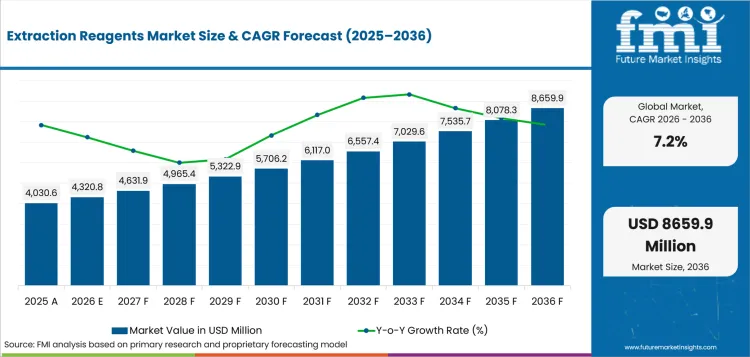
Extraction Reagents Market Overview: Size and Forecast
- 2025 Market Size: USD 4,030.6 million
- 2026 Market Size: USD 4,320.8 million
- 2036 Market Size: USD 8,659.9 million
- Forecast CAGR: 7.2% from 2026 to 2036
- Leading End Use: Mining & Metals
- Mining & Metals Share in 2026: 56.0%
- Leading Sales Channel: Direct Sales
- Direct Sales Share in 2026: 67.0%
- Leading Country by CAGR: China
- China CAGR: 8.4% by 2036
Summary of the Extraction Reagents Market
- Demand and Growth Drivers
- Rising sales of molecular diagnostics and next-generation sequencing (NGS) kits are driving higher consumption of extraction reagents across clinical laboratories and research institutions.
- Growing adoption of automated sample preparation and extraction workflows is increasing reagent procurement volumes in hospitals, diagnostic centers, and biopharmaceutical facilities.
- Expanding pharmaceutical and biotechnology R&D activities are generating sustained demand for high-purity extraction reagents used in genomics, proteomics, and drug discovery applications.
- Increasing testing volumes for infectious diseases, oncology, and precision medicine are supporting recurring reagent purchases, contributing to steady market revenue growth worldwide.
- Product and Segment View
- Solvent Extractants are projected to lead Reagent Type demand with 38.0% share as copper and battery metal circuits need selective phase transfer.
- Metals Refining is expected to lead Application demand with 35.0% share as electrolyte quality and recovery remain central buying needs.
- Mining & Metals is anticipated to lead End Use demand with 56.0% share as ore leaching and refinery operations consume recurring reagent packages.
- Hydrocarbon Diluents are projected to lead Solvent System demand with 52.0% share as organic phases require predictable behavior.
- Direct sales are expected to lead Sales Channel demand with 67.0% share as plant-level support affects reagent switching decisions.
- Geography and Competitive Outlook
- China is projected to record an 8.4% CAGR through 2036 due to rare earth separation controls and battery metal refining activity.
- India is expected to expand at 8.1% CAGR through 2036 as critical mineral auctions widen the future project pipeline.
- The United States is projected to record a 7.1% CAGR through 2036 as copper and rare earth supply security programs support domestic processing.
- BASF, LANXESS, Ecolab Purolite, Mitsubishi Chemical, Solvay, and Clariant compete through chemistry depth and application support.
- Specialist players gain room in resin, chelation, and impurity removal niches where plant chemistry differs across ore bodies.
- Analyst Opinion
- Nikhil Kaitwade, Principal Consultant at Future Market Insights for the chemicals domain, says, “Extraction reagents are moving from a commodity input into a performance control point. Buyers now test whether a reagent keeps selectivity when feed quality changes. Copper hydrometallurgy, rare earth separation, and battery metal refining are the clearest demand paths. Suppliers with field chemists, formulation flexibility, and regional stock should hold the strongest position.”
The recovery-stability outlook for copper processing reagents remains favorable. According to the USA Geological Survey (February 2026), USA refined copper production declined by an estimated 9% in 2025 due to planned maintenance at both primary smelters, alongside concentrator shutdowns and lower ore grades at several mines. As copper supply tightens, maximizing metal recovery and maintaining consistent plant performance become increasingly important for producers. This is expected to support demand for flotation and processing reagents that enhance recovery rates, minimize operational variability, and improve process control across concentrator operations.
Which factors support expansion in the extraction reagents market?
Finished extraction reagent revenue is supported by metal recovery value, impurity control, and plant-level technical service in large processing accounts.
- Market value is supported by reagent revenue used in metals refining before water and industrial extraction add incremental sales.
- Supplier pricing reflects selectivity, solvent loss control, crud behavior, and field support rather than chemical price alone.
- Revenue improves when plants convert more complex ore and recycled streams into saleable metal outputs.
- Buyer trust rises when suppliers document safety, handling, and performance data for each plant circuit.
Why is the extraction reagents market growing?
Copper and battery metal circuits need selective extraction as lower ore grades raise the value of better recovery per tonne processed.
Metals refining is the clearest demand anchor because reagent spending affects saleable output and impurity penalties. The USA Geological Survey reported in February 2026 that USA domestic refined copper output decreased by an estimated 9% in 2025. That signal shows why refiners focus on recovery stability and cathode quality. Mineral processing chemistry remains connected to the mining flotation chemicals market because both categories support ore upgrading and recovery control.
Rare earth processing creates a different demand mechanism because neighboring elements are difficult to separate cleanly. The USA Geological Survey reported in February 2026 that China produced an estimated 270,000 tonnes of rare earths in 2025. That scale keeps solvent extractant and ion exchange qualification active across separation circuits. Industrial extraction demand overlaps with the water and wastewater treatment chemicals market when plants recover metals or remove targeted ions from process water.
How is the extraction reagents market segmented?
The extraction reagents industry is segmented by reagent type, application, end use, solvent system, sales channel, and region.
- Solvent Extractants are projected to secure 38.0% share in 2026 because copper, lithium, cobalt, and rare earth circuits need liquid-phase selectivity.
- Metals Refining is anticipated to hold 35.0% share in 2026 due to impurity control and recovery needs.
- Mining & Metals is expected to account for 56.0% share in 2026 with ore processing and refinery operations as core uses.
- Hydrocarbon Diluents are forecast to represent 52.0% share in 2026 since many circuits need stable organic phases.
- Direct sales are projected to hold 67.0% share in 2026 as large plants value supplier support and troubleshooting.
Why do Solvent Extractants lead the extraction reagents market?
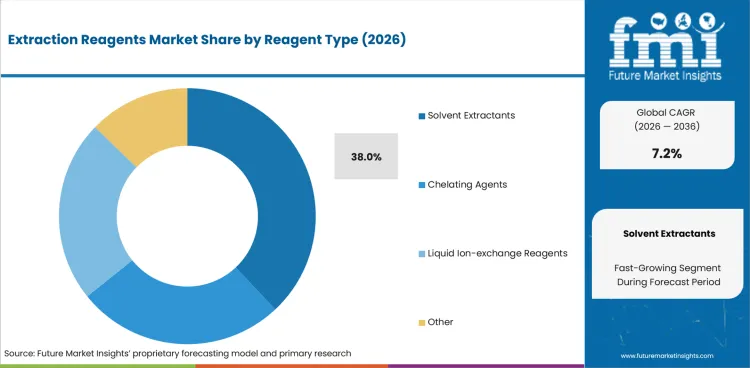
- Solvent Extractants are projected to account for 38.0% share in 2026, influenced by copper and battery metal phase separation needs.
- Buyers compare extractants by phase disengagement, crud resistance, and organic loss since these factors affect plant uptime.
Which application leads the extraction reagents market?
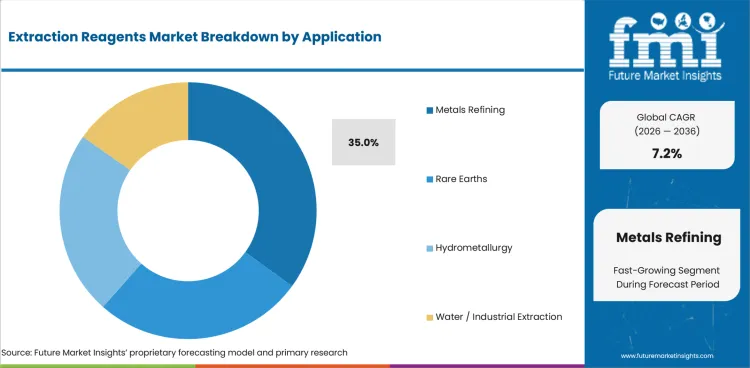
- Metals Refining is expected to account for 35.0% share in 2026 through electrolyte quality and recovery stability needs.
- Refinery buyers often require plant trials because impurity behavior differs between copper, cobalt, nickel, and rare earth streams.
Which end use leads the extraction reagents market?
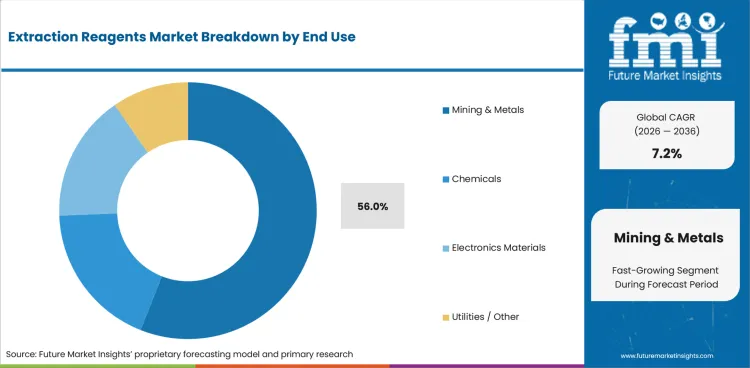
- Mining & Metals is anticipated to hold 56.0% share in 2026 as leach and refinery circuits consume recurring reagent volumes.
- Mine operators often prefer suppliers with field chemists because reagent failure can interrupt solvent extraction schedules.
Which solvent system leads the extraction reagents market?
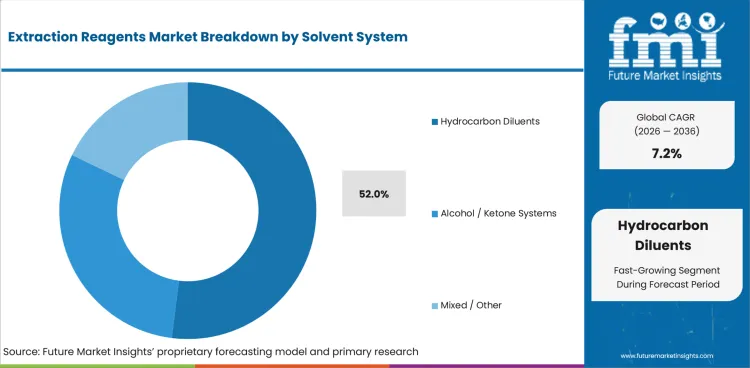
- Hydrocarbon Diluents are projected to account for 52.0% share in 2026 as circuits need predictable organic phase behavior.
- Diluent choice affects flash point, viscosity, phase separation, and extractant loading in plant safety decisions.
Which sales channel leads the extraction reagents market?
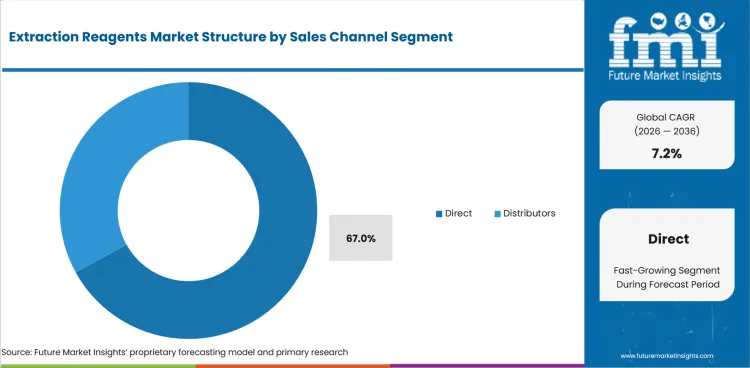
- Direct sales are expected to account for 67.0% share in 2026 as large plants buy reagent packages with technical service.
- Distributors remain important for smaller industrial users where purchase volumes do not justify direct field support.
What are the drivers, restraints, and opportunities in the extraction reagents market?
Critical mineral processing supports demand while feed variability and chemical qualification rules limit faster switching.
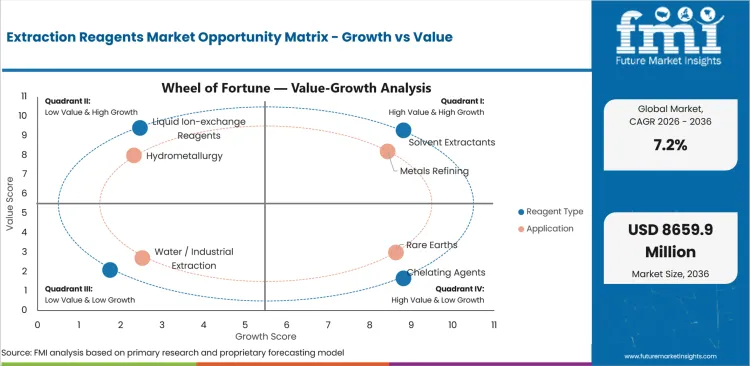
- Driver: Copper refinery purity pressure supports higher reagent spending because impurity carryover can lower cathode quality and saleable value.
- Driver: Rare earth separation complexity creates opportunity for selective extractants and resins that handle chemically similar elements.
- Restraint: Feedstock variability restrains adoption because reagent performance can change when ore chemistry or impurity levels shift.
- Opportunity: Battery metal recycling expands reagent use where nickel, cobalt, lithium, and copper must be recovered from mixed streams.
- Opportunity: Local processing policy creates room for suppliers with regional technical service and compliant chemical documentation.
Extraction Reagents Market Demand Outlook
Demand is moving toward higher-selectivity extraction reagent packages because mines and refineries need recovery stability before full-circuit adoption. In February 2026, the USA Geological Survey reported that USA refined copper output decreased by an estimated 9% in 2025. It also noted concentrator shutdowns and lower ore grades at multiple USA mines. That matters because constrained copper output raises the value of reagents that protect recovery from variable ore and processing conditions. BASF’s May 2025 copper hydrometallurgy update supports this shift because the company said it would intensify work on next-generation leaching aids and solvent extraction support. LANXESS adds a second route through battery materials because its August 2025 WBE update positioned Lewatit ion exchange products for lithium, nickel, cobalt and copper purification. Supplier selection is therefore likely to favor chemistry that proves recovery, impurity control and feed flexibility before price.
Buyer Channel and Qualification Analysis
Large mines, refineries and battery-metal processors form the main purchasing group because reagent performance affects output and maintenance planning. These buyers usually begin with laboratory testing before pilot trials and plant approval. Direct supplier contact is preferred when a circuit has high throughput or unusual impurities because process risk cannot be handed off to a distributor. BASF’s copper solvent extraction portfolio shows why buyers need technical fit because it includes ketoximes, aldoximes and modified blends for specific copper applications. Smaller industrial extraction users behave differently because they often buy through distributors. These accounts give more weight to delivery reliability, handling support and price stability because they have less tolerance for long customization cycles.
Recovery Proof and Operating-risk Decision Analysis
Plant managers evaluate extraction reagents through recovery rate, phase separation, impurity carryover and reagent loss. Procurement teams then compare the technical result against supply assurance and service response. BASF’s LixTRA leaching page shows the operating logic because it positions the additive around higher metal recovery and improved copper heap and dump leach performance. That matters because continuous circuits cannot treat reagent shortages or performance drift as routine purchasing issues. Safety documentation and local stock are therefore becoming stronger decision drivers. Suppliers with regional warehouses and field chemists should keep stronger renewal positions because they help plants reduce downtime risk after approval.
Which countries are growing fastest in the extraction reagents market?
China 8.4% CAGR, India 8.1% CAGR, South Korea 7.6% CAGR, United States 7.1% CAGR, Japan 6.8% CAGR, Germany 6.5% CAGR, France 6.2% CAGR, and United Kingdom 5.9% CAGR through 2036.
.webp "Top Country Growth Comparison Extraction Reagents Market Cagr (2026 2036)")
Country CAGR
| Country | CAGR |
|---|---|
| China | 8.4% |
| India | 8.1% |
| South Korea | 7.6% |
| United States | 7.1% |
| Japan | 6.8% |
| Germany | 6.5% |
| France | 6.2% |
| United Kingdom | 5.9% |
Source: Future Market Insights, 2026.
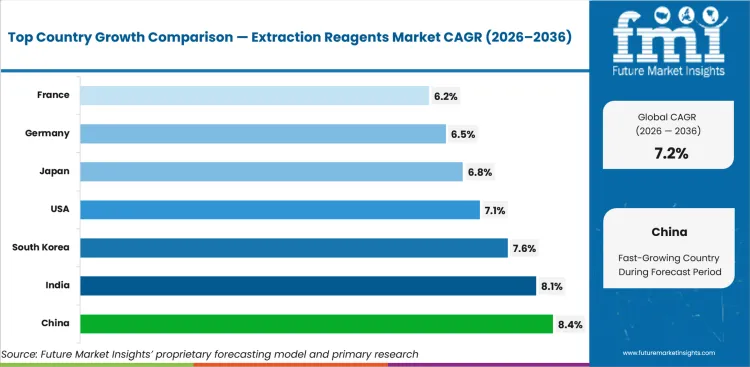
How do country-level CAGRs compare in the extraction reagents market?
China leads country growth while the United Kingdom records the most cautious expansion outlook among profiled markets.
- China is forecast to record 8.4% CAGR through 2036 as rare earth separation scale and battery processing lift reagent demand.
- India is expected to expand at 8.1% CAGR through 2036 as mineral auctions and early processing projects widen reagent demand.
- South Korea is projected to grow at 7.6% CAGR through 2036 as battery and electronics materials create high-purity separation needs.
- The United States is estimated to advance at 7.1% CAGR through 2036 as copper and rare earth supply security support processing activity.
- Japan is forecast to rise at 6.8% CAGR through 2036 as electronics and magnet supply chains favor precision purification.
- Germany is projected to post 6.5% CAGR through 2036 as EU critical raw material policy supports refining and recycling chemistry.
- France is expected to grow at 6.2% CAGR through 2036 as rare earth experience and recycling targets support specialty separation demand.
- The United Kingdom is forecast to record 5.9% CAGR through 2036 as midstream and recycling projects shape service-led demand.
How fast is the extraction reagents market growing in China?
A 8.4% CAGR through 2036 reflects rare earth separation scale and battery materials processing create the deepest reagent qualification base among profiled countries.
Country Market Snapshot Table
| Parameter | Value |
|---|---|
| Market Size in 2025 (Value) | USD 828.3 million |
| Market Size in 2026 (Value) | USD 897.8 million |
| Market Forecast in 2036 (Value) | USD 2,012.0 million |
| CAGR (2026 to 2036) | 8.4% |
| Years Considered | 2021 to 2036 |
| Base Year | 2025 |
| Forecast Period | 2026 to 2036 |
| Units Considered | Value (USD million) |
| Leading Sub-Region | Yangtze River Delta and Inner Mongolia rare earth corridors |
China Extraction Reagents Market Outlook
China extraction reagent demand is shaped by rare earth separation scale and battery material refining. Local processors need solvent extractants and ion exchange systems that can handle impurity control across large production networks.
Suppliers are expected to compete on technical service, documentation, and regional stock. Policy controls around rare earths make compliance-ready reagent programs more important for processors.
Key Growth Drivers
- Rare earth separation scale supports solvent extractant qualification. The USA Geological Survey reported China mine production at 270,000 tonnes of REO equivalent in 2025.
- Export-control documentation is reinforcing compliant reagent programs. MOFCOM added seven medium and heavy rare earth items to export control on April 4, 2025.
- Battery material refining expands chelating and ion-exchange demand across cobalt, nickel, and lithium impurity-control streams.
- Local technical service gains weight because processors need rapid trial support when feed chemistry changes.
Key Restraints
- Single-country exposure can slow overseas buyer approvals. The European Commission sets a 65% ceiling for dependency on one third country by 2030.
- Domestic suppliers can pressure imported reagent pricing when applications do not require high-selectivity chemistry.
- Policy sensitivity can extend qualification timelines because designated processors may delay reagent changes.
What makes China unique
China is unique because rare earth separation scale and battery materials processing create the deepest reagent qualification base among profiled countries.
Key Companies
- Sinochem Holdings Corporation Ltd.
- China Northern Rare Earth Group High-Tech Co., Ltd.
- China Minmetals Corporation
- Chinalco Rare Earth & Metals Co., Ltd.
- Jiangsu Huachang Chemical Co., Ltd.
- Zhejiang Jiuzhou Pharmaceutical Co., Ltd.
Sales & Marketing Channels
- Direct supplier sales
- State-linked procurement programs
- Regional chemical distributors
- Battery material processors
- Mining and refining procurement teams
- Technical service contracts
Country Segment Breakdown Table
| Segment | Sub-Segments |
|---|---|
| By Reagent Type | Solvent Extractants, Chelating Agents, Liquid Ion-exchange Reagents, Other |
| By Application | Metals Refining, Rare Earths, Hydrometallurgy, Water / Industrial Extraction |
| By End Use | Mining & Metals, Chemicals, Electronics Materials, Utilities / Other |
| By Solvent System | Hydrocarbon Diluents, Alcohol / Ketone Systems, Mixed / Other |
| By Sales Channel | Direct, Distributors |
| Key Sub-Regions Covered, Industrial Processing and Mineral Corridors | Shanghai, Jiangsu, Zhejiang, Inner Mongolia, Sichuan, Guangdong |
Frequently Asked Questions
How fast is China extraction reagents market growing?
Sales in China are forecast to expand at 8.4% CAGR from 2026 to 2036.
What makes China important for extraction reagent suppliers?
China is unique because rare earth separation scale and battery materials processing create the deepest reagent qualification base among profiled countries.
Which channels matter most in China?
Direct technical sales and specialty distributors matter most because buyers need documented performance before switching reagent systems.
How fast is the extraction reagents market growing in India?
A 8.1% CAGR through 2036 reflects policy-led mineral auctions create a visible project pipeline before large-scale reagent consumption becomes recurring.
Country Market Snapshot Table
| Parameter | Value |
|---|---|
| Market Size in 2025 (Value) | USD 214.6 million |
| Market Size in 2026 (Value) | USD 232.0 million |
| Market Forecast in 2036 (Value) | USD 505.6 million |
| CAGR (2026 to 2036) | 8.1% |
| Years Considered | 2021 to 2036 |
| Base Year | 2025 |
| Forecast Period | 2026 to 2036 |
| Units Considered | Value (USD million) |
| Leading Sub-Region | Odisha, Rajasthan, Karnataka, and Andhra Pradesh mineral corridors |
India Extraction Reagents Market Outlook
India extraction reagent demand is moving with critical mineral auctions and battery material ambitions. The near-term opportunity is tied to pilot projects before larger recurring volumes emerge.
Suppliers that can support early testing should gain better access to mining and refining accounts. Distributor networks remain important because many projects are still moving from exploration into commercial planning.
Key Growth Drivers
- Auction activity is widening future reagent demand. The Press Information Bureau reported 19 critical and strategic mineral blocks in the seventh tranche in March 2026.
- Mission funding supports processing and recovery investment. The Government of India approved Rs.16,300 crore for the National Critical Mineral Mission in January 2025.
- Battery and electronics ambitions support demand for purified metal intermediates that require selective extraction.
- Distributor and direct supplier networks can enter early through pilot testing with new mineral block developers.
Key Restraints
- Long mine-development timelines can delay recurring reagent volumes. The Ministry of Mines copper vision expects mine production to grow only 2.3% CAGR by 2050.
- Price-sensitive buyers can postpone premium reagents until plant trials prove recovery gains.
- Auctioned mineral blocks need development time before they create recurring solvent extractant consumption.
What makes India unique
India is unique because policy-led mineral auctions create a visible project pipeline before large-scale reagent consumption becomes recurring.
Key Companies
- Tata Chemicals Limited
- Gujarat Alkalies and Chemicals Limited
- Aarti Industries Limited
- Deepak Nitrite Limited
- Atul Ltd.
- Hindustan Zinc Limited
Sales & Marketing Channels
- Direct technical sales
- Industrial chemical distributors
- Mining company procurement
- Public-sector tender channels
- Pilot plant supply contracts
- Battery material processors
Country Segment Breakdown Table
| Segment | Sub-Segments |
|---|---|
| By Reagent Type | Solvent Extractants, Chelating Agents, Liquid Ion-exchange Reagents, Other |
| By Application | Metals Refining, Rare Earths, Hydrometallurgy, Water / Industrial Extraction |
| By End Use | Mining & Metals, Chemicals, Electronics Materials, Utilities / Other |
| By Solvent System | Hydrocarbon Diluents, Alcohol / Ketone Systems, Mixed / Other |
| By Sales Channel | Direct, Distributors |
| Key Sub-Regions Covered, Industrial Processing and Mineral Corridors | Odisha, Rajasthan, Karnataka, Andhra Pradesh, Gujarat, Jharkhand |
Frequently Asked Questions
How fast is India extraction reagents market growing?
Sales in India are forecast to expand at 8.1% CAGR from 2026 to 2036.
What makes India important for extraction reagent suppliers?
India is unique because policy-led mineral auctions create a visible project pipeline before large-scale reagent consumption becomes recurring.
Which channels matter most in India?
Direct technical sales and specialty distributors matter most because buyers need documented performance before switching reagent systems.
How fast is the extraction reagents market growing in South Korea?
A 7.6% CAGR through 2036 reflects battery and electronics users require high-purity separation chemistry with strict qualification discipline.
Country Market Snapshot Table
| Parameter | Value |
|---|---|
| Market Size in 2025 (Value) | USD 139.5 million |
| Market Size in 2026 (Value) | USD 150.1 million |
| Market Forecast in 2036 (Value) | USD 312.2 million |
| CAGR (2026 to 2036) | 7.6% |
| Years Considered | 2021 to 2036 |
| Base Year | 2025 |
| Forecast Period | 2026 to 2036 |
| Units Considered | Value (USD million) |
| Leading Sub-Region | Ulsan, Pohang, and battery materials manufacturing clusters |
South Korea Extraction Reagents Market Outlook
South Korea extraction reagent demand is tied to battery, electronics, and critical mineral partnership programs. Customers need purification chemistry that can support high-purity cathode and electronic material supply chains.
Direct technical sales are expected to remain important because buyers require documentation, qualification data, and fast service response. Imported feedstock exposure keeps supply assurance central to supplier selection.
Key Growth Drivers
- Semiconductor exports support high-purity separation demand. MOTIR reported semiconductor exports at USD 32.8 billion in March 2026.
- Battery material demand supports purification chemistry. MOTIR reported secondary battery exports at USD 0.9 billion in March 2026.
- Critical mineral cooperation improves future sourcing visibility after the first Japan-ROK high-level dialogue in February 2025.
- Direct technical sales gain ground because suppliers must support traceability and impurity-control testing.
Key Restraints
- Import exposure can disrupt reagent planning. MOTIR reported non-energy imports at USD 51.0 billion in March 2026.
- Long qualification programs can slow entry for smaller suppliers that lack battery-grade reference data.
- Overseas feedstock reliance can make project timing sensitive to mining and recycling partnerships.
What makes South Korea unique
South Korea is unique because battery and electronics users require high-purity separation chemistry with strict qualification discipline.
Key Companies
- Lotte Chemical Corporation
- LG Chem Ltd.
- OCI Company Ltd.
- Korea Zinc Co., Ltd.
- SK Innovation Co., Ltd.
- Posco Future M Co., Ltd.
Sales & Marketing Channels
- Direct supplier programs
- Battery material procurement
- Electronics materials distributors
- Technical service agreements
- Recycling project channels
- Specialty chemical importers
Country Segment Breakdown Table
| Segment | Sub-Segments |
|---|---|
| By Reagent Type | Solvent Extractants, Chelating Agents, Liquid Ion-exchange Reagents, Other |
| By Application | Metals Refining, Rare Earths, Hydrometallurgy, Water / Industrial Extraction |
| By End Use | Mining & Metals, Chemicals, Electronics Materials, Utilities / Other |
| By Solvent System | Hydrocarbon Diluents, Alcohol / Ketone Systems, Mixed / Other |
| By Sales Channel | Direct, Distributors |
| Key Sub-Regions Covered, Industrial Processing and Mineral Corridors | Ulsan, Pohang, Gumi, Cheongju, Seoul Capital Area, Incheon |
Frequently Asked Questions
How fast is South Korea extraction reagents market growing?
Sales in South Korea are forecast to expand at 7.6% CAGR from 2026 to 2036.
What makes South Korea important for extraction reagent suppliers?
South Korea is unique because battery and electronics users require high-purity separation chemistry with strict qualification discipline.
Which channels matter most in South Korea?
Direct technical sales and specialty distributors matter most because buyers need documented performance before switching reagent systems.
How fast is the extraction reagents market growing in United States?
A 7.1% CAGR through 2036 reflects copper and rare earth security policy supports domestic processing while technical qualification remains strict.
Country Market Snapshot Table
| Parameter | Value |
|---|---|
| Market Size in 2025 (Value) | USD 540.0 million |
| Market Size in 2026 (Value) | USD 578.3 million |
| Market Forecast in 2036 (Value) | USD 1,146.6 million |
| CAGR (2026 to 2036) | 7.1% |
| Years Considered | 2021 to 2036 |
| Base Year | 2025 |
| Forecast Period | 2026 to 2036 |
| Units Considered | Value (USD million) |
| Leading Sub-Region | Arizona, Nevada, Utah, Texas, and Gulf Coast chemical corridors |
United States Extraction Reagents Market Outlook
United States extraction reagent demand is supported by copper, rare earth, and critical mineral supply-security programs. Domestic processors need selective chemistry that can protect recovery and impurity control.
Suppliers with field service and validated plant data should hold better positions with refineries and mines. Procurement remains cautious where permitting or feedstock timing delays commercial operation.
Key Growth Drivers
- Mineral output value supports plant-level reagent demand. The USA Geological Survey reported USA nonfuel mineral production at USD 112 billion in 2025.
- Copper policy relevance improved after the final minerals list. The USA Department of the Interior added 10 minerals including copper in November 2025.
- Rare earth processing ambition supports selective separation chemistry as domestic concentrate output remains strategically visible.
- Direct supplier support is favored because refinery and mine operators need field trials before approving reagent changes.
Key Restraints
- Refinery maintenance can tighten evaluation budgets and operating schedules. The USA Geological Survey reported refined copper output fell an estimated 9% in 2025.
- Permitting and community review can delay hydrometallurgy projects before recurring reagent procurement begins.
- Feed variability across copper and rare earth streams raises plant-trial risk for new reagent packages.
What makes United States unique
The United States is unique because copper and rare earth security policy supports domestic processing while technical qualification remains strict.
Key Companies
- BASF Corporation
- Solvay USA Inc.
- Ecolab Inc.
- Dow Inc.
- Huntsman Corporation
- Innospec Inc.
- Cytec Industries Inc.
Sales & Marketing Channels
- Direct mine and refinery sales
- Specialty chemical distributors
- Copper refinery procurement
- Critical mineral project teams
- Industrial water contractors
- Technical service contracts
Country Segment Breakdown Table
| Segment | Sub-Segments |
|---|---|
| By Reagent Type | Solvent Extractants, Chelating Agents, Liquid Ion-exchange Reagents, Other |
| By Application | Metals Refining, Rare Earths, Hydrometallurgy, Water / Industrial Extraction |
| By End Use | Mining & Metals, Chemicals, Electronics Materials, Utilities / Other |
| By Solvent System | Hydrocarbon Diluents, Alcohol / Ketone Systems, Mixed / Other |
| By Sales Channel | Direct, Distributors |
| Key Sub-Regions Covered, Industrial Processing and Mineral Corridors | Arizona, Nevada, Utah, Texas, Louisiana, California |
Frequently Asked Questions
How fast is United States extraction reagents market growing?
Sales in United States are forecast to expand at 7.1% CAGR from 2026 to 2036.
What makes United States important for extraction reagent suppliers?
The United States is unique because copper and rare earth security policy supports domestic processing while technical qualification remains strict.
Which channels matter most in United States?
Direct technical sales and specialty distributors matter most because buyers need documented performance before switching reagent systems.
How fast is the extraction reagents market growing in Japan?
A 6.8% CAGR through 2036 reflects electronics and magnet supply chains favor precision purification over high-volume mine-site reagent demand.
Country Market Snapshot Table
| Parameter | Value |
|---|---|
| Market Size in 2025 (Value) | USD 169.1 million |
| Market Size in 2026 (Value) | USD 180.6 million |
| Market Forecast in 2036 (Value) | USD 349.1 million |
| CAGR (2026 to 2036) | 6.8% |
| Years Considered | 2021 to 2036 |
| Base Year | 2025 |
| Forecast Period | 2026 to 2036 |
| Units Considered | Value (USD million) |
| Leading Sub-Region | Kanto, Kansai, and Kyushu electronics material corridors |
Japan Extraction Reagents Market Outlook
Japan extraction reagent demand is linked to electronics materials, battery materials, and critical mineral cooperation. Buyers require reliable purity control rather than broad commodity chemical supply.
Qualification cycles are expected to remain long because customers need stable impurity data before changing reagent systems. Overseas project partnerships will influence domestic volume visibility.
Key Growth Drivers
- Bilateral mineral policy supports overseas-linked extraction demand. METI reported Japan-USA mineral project cooperation after a March 14, 2026 ministerial meeting.
- Alternative sourcing supports specialty reagent demand. METI reported two heavy rare earth supply projects through JOGMEC investment measures.
- Electronics and magnet producers create demand for high-purity processing reagents.
- Mitsubishi Chemical and global suppliers can serve qualification-heavy accounts through technical documentation.
Key Restraints
- China-linked supply exposure can slow domestic reagent planning. METI stated heavy rare earth imports were 100% dependent on China in 2026 manufacturing evidence.
- Long customer qualification periods can delay supplier switching in electronics materials.
- Limited domestic mining keeps Japan more dependent on overseas project links than local bulk processing demand.
What makes Japan unique
Japan is unique because electronics and magnet supply chains favor precision purification over high-volume mine-site reagent demand.
Key Companies
- Mitsubishi Chemical Group Corporation
- Sumitomo Chemical Co., Ltd.
- Tosoh Corporation
- DIC Corporation
- Nippon Chemical Industrial Co., Ltd.
- ADEKA Corporation
Sales & Marketing Channels
- Direct technical sales
- Electronics material procurement
- Battery material processors
- Specialty distributors
- Trading houses
- Pilot plant qualification contracts
Country Segment Breakdown Table
| Segment | Sub-Segments |
|---|---|
| By Reagent Type | Solvent Extractants, Chelating Agents, Liquid Ion-exchange Reagents, Other |
| By Application | Metals Refining, Rare Earths, Hydrometallurgy, Water / Industrial Extraction |
| By End Use | Mining & Metals, Chemicals, Electronics Materials, Utilities / Other |
| By Solvent System | Hydrocarbon Diluents, Alcohol / Ketone Systems, Mixed / Other |
| By Sales Channel | Direct, Distributors |
| Key Sub-Regions Covered, Industrial Processing and Mineral Corridors | Kanto, Kansai, Kyushu, Chubu, Tohoku, Hokkaido |
Frequently Asked Questions
How fast is Japan extraction reagents market growing?
Sales in Japan are forecast to expand at 6.8% CAGR from 2026 to 2036.
What makes Japan important for extraction reagent suppliers?
Japan is unique because electronics and magnet supply chains favor precision purification over high-volume mine-site reagent demand.
Which channels matter most in Japan?
Direct technical sales and specialty distributors matter most because buyers need documented performance before switching reagent systems.
How fast is the extraction reagents market growing in Germany?
A 6.5% CAGR through 2036 reflects local specialty chemical suppliers can pair eu policy demand with field support and compliance documentation.
Country Market Snapshot Table
| Parameter | Value |
|---|---|
| Market Size in 2025 (Value) | USD 218.8 million |
| Market Size in 2026 (Value) | USD 233.0 million |
| Market Forecast in 2036 (Value) | USD 437.4 million |
| CAGR (2026 to 2036) | 6.5% |
| Years Considered | 2021 to 2036 |
| Base Year | 2025 |
| Forecast Period | 2026 to 2036 |
| Units Considered | Value (USD million) |
| Leading Sub-Region | North Rhine-Westphalia, Saxony, Bavaria, and chemical park clusters |
Germany Extraction Reagents Market Outlook
Germany extraction reagent demand is shaped by EU critical raw material policy and a strong specialty chemical base. Reagent suppliers can support battery materials, industrial water, and metals recycling applications.
Buyers are expected to favor documented performance and compliance-ready chemistry. Cost pressure and qualification length can slow switching even when local technical capability is strong.
Key Growth Drivers
- EU processing targets support German refining and recycling chemistry. The European Commission targets 40% EU processing capacity for strategic raw materials by 2030.
- Strategic project selection increases demand visibility. The European Commission selected 47 strategic raw material projects in March 2025.
- LANXESS and BASF provide local specialty chemical depth for ion exchange support.
- Battery materials and industrial water users create demand for selective separation systems.
Key Restraints
- Cost pressure can restrain domestic processing economics. Destatis reported producer prices were 2.2% higher in May 2026 than in May 2025.
- Buyers often need extended validation before switching reagents because plant chemistry differs across streams.
- EU chemical compliance requirements can raise documentation and testing costs for smaller reagent suppliers.
What makes Germany unique
Germany is unique because local specialty chemical suppliers can pair EU policy demand with field support and compliance documentation.
Key Companies
- BASF SE
- LANXESS AG
- Evonik Industries AG
- Heraeus Group
- Wacker Chemie AG
- SGL Carbon SE
Sales & Marketing Channels
- Direct chemical supplier sales
- Mining technology integrators
- Industrial water contractors
- Battery material processors
- Chemical park procurement
- Specialty distributors
Country Segment Breakdown Table
| Segment | Sub-Segments |
|---|---|
| By Reagent Type | Solvent Extractants, Chelating Agents, Liquid Ion-exchange Reagents, Other |
| By Application | Metals Refining, Rare Earths, Hydrometallurgy, Water / Industrial Extraction |
| By End Use | Mining & Metals, Chemicals, Electronics Materials, Utilities / Other |
| By Solvent System | Hydrocarbon Diluents, Alcohol / Ketone Systems, Mixed / Other |
| By Sales Channel | Direct, Distributors |
| Key Sub-Regions Covered, Industrial Processing and Mineral Corridors | North Rhine-Westphalia, Saxony, Bavaria, Baden-Württemberg, Hesse, Lower Saxony |
Frequently Asked Questions
How fast is Germany extraction reagents market growing?
Sales in Germany are forecast to expand at 6.5% CAGR from 2026 to 2036.
What makes Germany important for extraction reagent suppliers?
Germany is unique because local specialty chemical suppliers can pair EU policy demand with field support and compliance documentation.
Which channels matter most in Germany?
Direct technical sales and specialty distributors matter most because buyers need documented performance before switching reagent systems.
How fast is the extraction reagents market growing in France?
A 6.2% CAGR through 2036 reflects rare earth separation experience and eu recycling targets make specialty extraction chemistry commercially relevant.
Country Market Snapshot Table
| Parameter | Value |
|---|---|
| Market Size in 2025 (Value) | USD 170.2 million |
| Market Size in 2026 (Value) | USD 180.7 million |
| Market Forecast in 2036 (Value) | USD 329.9 million |
| CAGR (2026 to 2036) | 6.2% |
| Years Considered | 2021 to 2036 |
| Base Year | 2025 |
| Forecast Period | 2026 to 2036 |
| Units Considered | Value (USD million) |
| Leading Sub-Region | Auvergne-Rhone-Alpes, Nouvelle-Aquitaine, and Grand Est processing corridors |
France Extraction Reagents Market Outlook
France extraction reagent demand is supported by EU raw material policy and specialty chemical capability. Rare earth, recycling, and industrial water applications create the most relevant buying routes.
Commercial gains are expected to depend on feedstock security and environmental review timelines. Suppliers with clear safety documents and application testing should be preferred.
Key Growth Drivers
- EU recycling targets support French separation projects. The European Commission targets 25% EU recycling capacity for strategic raw materials by 2030.
- Project approvals support reagent visibility. The European Commission selected 47 strategic raw material projects across 13 member states in March 2025.
- Rare earth processing around La Rochelle supports demand for selective extractants.
- Electronics and magnet supply chains reinforce demand for high-purity separation outputs.
Key Restraints
- Feedstock dependence can limit plant utilization when secondary streams are not secured. The EU target limits third-country dependency to 65% by 2030.
- Chemical-intensive separation projects can face longer environmental approval and public consultation timelines.
- Energy and input-cost volatility can narrow margins for European routes that compete with lower-cost imports.
What makes France unique
France is unique because rare earth separation experience and EU recycling targets make specialty extraction chemistry commercially relevant.
Key Companies
- Solvay France SAS
- Arkema S.A.
- Eramet S.A.
- Orano SA
- Veolia Water Technologies
- SNF Group
Sales & Marketing Channels
- Direct specialty chemical sales
- Rare earth processing channels
- Recycling project procurement
- Industrial water contractors
- Mining technology integrators
- Technical service agreements
Country Segment Breakdown Table
| Segment | Sub-Segments |
|---|---|
| By Reagent Type | Solvent Extractants, Chelating Agents, Liquid Ion-exchange Reagents, Other |
| By Application | Metals Refining, Rare Earths, Hydrometallurgy, Water / Industrial Extraction |
| By End Use | Mining & Metals, Chemicals, Electronics Materials, Utilities / Other |
| By Solvent System | Hydrocarbon Diluents, Alcohol / Ketone Systems, Mixed / Other |
| By Sales Channel | Direct, Distributors |
| Key Sub-Regions Covered, Industrial Processing and Mineral Corridors | Auvergne-Rhone-Alpes, Nouvelle-Aquitaine, Grand Est, Ile-de-France, Normandy, Occitanie |
Frequently Asked Questions
How fast is France extraction reagents market growing?
Sales in France are forecast to expand at 6.2% CAGR from 2026 to 2036.
What makes France important for extraction reagent suppliers?
France is unique because rare earth separation experience and EU recycling targets make specialty extraction chemistry commercially relevant.
Which channels matter most in France?
Direct technical sales and specialty distributors matter most because buyers need documented performance before switching reagent systems.
How fast is the extraction reagents market growing in United Kingdom?
A 5.9% CAGR through 2036 reflects midstream and recycling capability creates service-led reagent demand before bulk domestic processing matures.
Country Market Snapshot Table
| Parameter | Value |
|---|---|
| Market Size in 2025 (Value) | USD 130.9 million |
| Market Size in 2026 (Value) | USD 138.6 million |
| Market Forecast in 2036 (Value) | USD 246.1 million |
| CAGR (2026 to 2036) | 5.9% |
| Years Considered | 2021 to 2036 |
| Base Year | 2025 |
| Forecast Period | 2026 to 2036 |
| Units Considered | Value (USD million) |
| Leading Sub-Region | Cornwall, North East England, Midlands, and industrial recycling corridors |
United Kingdom Extraction Reagents Market Outlook
United Kingdom extraction reagent demand is centered on midstream processing, recycling, and overseas-linked mineral projects. The domestic market is more service-led than mine-site volume-led.
Suppliers are expected to gain through pilot work, analytical support, and recycling routes. Domestic feedstock limits can delay broad reagent consumption until projects scale.
Key Growth Drivers
- Domestic mineral ambition supports future midstream reagent demand. GOV.UK targets 10% of annual UK critical mineral demand from domestic production by 2035.
- Recycling ambition supports extraction chemistry for secondary materials. GOV.UK targets 20% of annual UK critical mineral demand through recycling by 2035.
- The 2025 capability assessment identified midstream processing and recycling as the main UK opportunity areas.
- Engineering consultancies and pilot plants can influence reagent specifications for overseas mining and recycling projects.
Key Restraints
- Limited mining depth restrains local bulk reagent volume. The 2025 capability assessment reported three of eight planned UK mining sites had reached pilot stage.
- Smaller buyers can face higher per-tonne service costs when shipments need safety data and compliance support.
- Project scale-up can take longer when domestic feedstock availability trails policy goals.
What makes United Kingdom unique
The United Kingdom is unique because midstream and recycling capability creates service-led reagent demand before bulk domestic processing matures.
Key Companies
- Johnson Matthey Plc
- Croda International Plc
- Victrex Plc
- Cornish Lithium Plc
- Veolia Water Technologies UK
- Altilium Metals Ltd.
Sales & Marketing Channels
- Pilot project procurement
- Specialty chemical distributors
- Recycling project channels
- Engineering consultancy channels
- Industrial water contractors
- Direct technical service
Country Segment Breakdown Table
| Segment | Sub-Segments |
|---|---|
| By Reagent Type | Solvent Extractants, Chelating Agents, Liquid Ion-exchange Reagents, Other |
| By Application | Metals Refining, Rare Earths, Hydrometallurgy, Water / Industrial Extraction |
| By End Use | Mining & Metals, Chemicals, Electronics Materials, Utilities / Other |
| By Solvent System | Hydrocarbon Diluents, Alcohol / Ketone Systems, Mixed / Other |
| By Sales Channel | Direct, Distributors |
| Key Sub-Regions Covered, Industrial Processing and Mineral Corridors | Cornwall, North East England, Midlands, Wales, Scotland, Greater Manchester |
Frequently Asked Questions
How fast is United Kingdom extraction reagents market growing?
Sales in United Kingdom are forecast to expand at 5.9% CAGR from 2026 to 2036.
What makes United Kingdom important for extraction reagent suppliers?
The United Kingdom is unique because midstream and recycling capability creates service-led reagent demand before bulk domestic processing matures.
Which channels matter most in United Kingdom?
Direct technical sales and specialty distributors matter most because buyers need documented performance before switching reagent systems.
Who are the leading companies in the extraction reagents market?
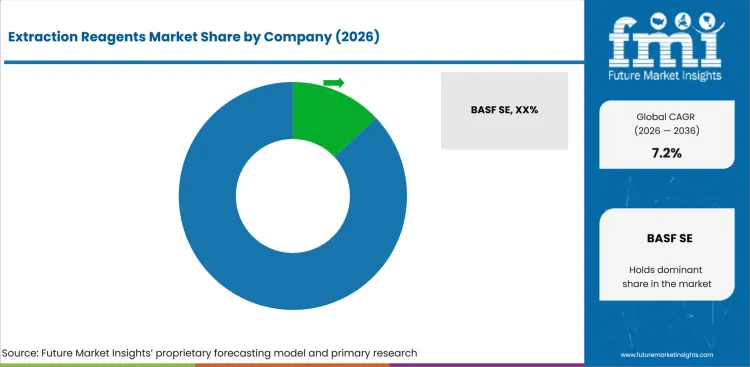
BASF SE, LANXESS AG, Ecolab Purolite, Mitsubishi Chemical Group Corporation, Solvay SA, Clariant AG, Dow Inc., Huntsman Corporation, Arkema S.A., and Tosoh Corporation are key companies in the extraction reagents market.
- Specialty chemical suppliers compete through reagent selectivity, solvent extraction support, and plant troubleshooting.
- Resin producers compete through ion exchange performance, metals removal, and high-purity separation capability.
- Mining chemical groups gain relevance where customers need leaching support, impurity control, and circuit-level process advice.
- Regional distributors remain important because local stock, safety documentation, and technical response time affect plant continuity.
The extraction reagents market is led by specialty chemical suppliers, resin producers, mining chemical groups, and regional distributors. Competition is based on selectivity, reagent loss control, impurity removal, plant troubleshooting, local availability, and safety documentation. Suppliers with field chemists and regional inventory are better positioned because reagent failure can disrupt solvent extraction circuits and downstream purification.
BASF competes through copper hydrometallurgy and leaching support after its May 2025 R&D direction emphasized copper processing chemistry. LANXESS competes through Lewatit ion exchange resins for battery metal and high-purity processing applications. Ecolab Purolite serves metals removal and hydrometallurgy purification needs, while Mitsubishi Chemical supports electronics and industrial separation customers through ion exchange materials. Solvay and Clariant compete through specialty chemical portfolios and application support across mining and metals processing.
How do top extraction reagents companies compare?
BASF and LANXESS score strongest on mining chemistry and ion exchange visibility, while Ecolab Purolite and Mitsubishi Chemical strengthen the market through purification and specialty separation materials.
| Company | Core Strength | Market Relevance | Positioning |
|---|---|---|---|
| BASF SE | Copper hydrometallurgy and mining chemistry support | Supports solvent extraction and leaching programs in copper circuits | Mining chemistry specialist |
| LANXESS AG | Ion exchange resin portfolio | Addresses battery metal and high-purity separation applications | Resin and purification specialist |
| Ecolab Purolite | Chelation and resin systems | Serves metals removal and hydrometallurgy purification needs | High-purity resin supplier |
| Mitsubishi Chemical Group Corporation | Ion exchange and specialty materials | Supports electronics and industrial separation customers | Specialty separation materials supplier |
| Solvay SA | Specialty extraction chemistry heritage | Serves complex mineral processing and separation accounts | Specialty chemical supplier |
| Clariant AG | Mining chemical application support | Works across mineral processing and reagent support programs | Mining process chemical supplier |
| Dow Inc. | Separation materials and industrial chemistry | Supports selected ion exchange and process chemical applications | Industrial materials supplier |
| Huntsman Corporation | Specialty chemical capability | Supports processing chemical and formulation needs | Specialty chemical producer |
| Arkema S.A. | Specialty chemicals and materials | Supports industrial separation and process chemistry applications | Specialty materials supplier |
| Tosoh Corporation | Ion exchange and specialty materials | Supports high-purity industrial and electronics-linked separation needs | Specialty resin and materials supplier |
Source: Future Market Insights competitive analysis, 2026.
Key Developments in Extraction Reagents Market
- In May 2025, BASF announced a strategic shift in copper hydrometallurgy and flotation research, with work focused on LixTRA leaching aids and solvent extraction support. The update strengthens BASF’s position in copper processing chemistry.
- In August 2025, LANXESS presented Lewatit ion exchange resin products for high-purity battery metals such as lithium, nickel, cobalt, and copper at WBE 2025. The development supports its role in battery metal purification.
Who are the key players in the extraction reagents market?
Key companies participating in the extraction reagents market include:
Specialty Mining Chemical Suppliers
- BASF SE
- Solvay SA
- Clariant AG
- Huntsman Corporation
- Arkema S.A.
Ion Exchange and Resin Specialists
- LANXESS AG
- Ecolab Purolite
- Mitsubishi Chemical Group Corporation
- Tosoh Corporation
- Dow Inc.
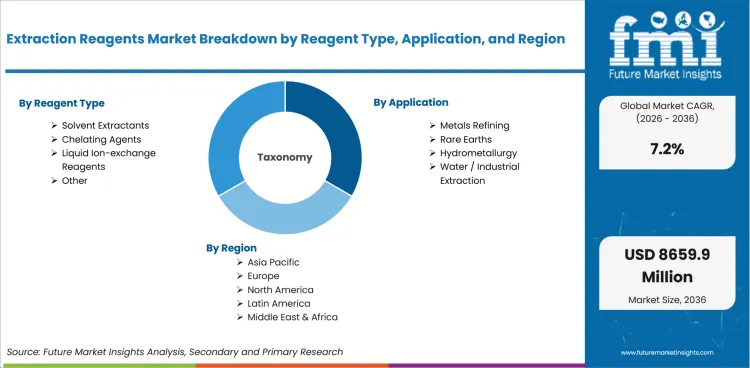
Extraction Reagents Market - Report Scope
| Parameter | Details |
|---|---|
| Forecast period | 2026 to 2036 |
| Historical period | 2021 to 2025 |
| Quantitative unit | Revenue in USD million |
| By reagent type | Solvent extractants, chelating agents, liquid ion-exchange reagents, other |
| By application | Metals refining, rare earths, hydrometallurgy, water / industrial extraction |
| By end use | Mining & metals, chemicals, electronics materials, utilities / other |
| By solvent system | Hydrocarbon diluents, alcohol / ketone systems, mixed / other |
| By sales channel | Direct, distributors |
| Regions covered | North America, Latin America, Europe, East Asia, South Asia and Pacific, Middle East and Africa |
| Countries covered | China, India, South Korea, United States, Japan, Germany, France, United Kingdom |
| Key companies profiled | BASF, LANXESS, Ecolab Purolite, Mitsubishi Chemical Group, Solvay, Clariant, Dow, Huntsman |
| Approach | Bottom-up product-boundary approach using reagent consumption, country-level processing activity, application mix, and technical service intensity |
Source: Future Market Insights, 2026.
Extraction Reagents Market - Scope & Definition
| Attribute | Detail |
|---|---|
| Market Definition | Specialty reagents used to separate, recover, concentrate, or purify target metals and industrial compounds from aqueous or organic process streams. |
| Functions Covered | Phase transfer, selective extraction, chelation, ion exchange, impurity removal, organic phase stability, and recovery support. |
| Applications Covered | Metals refining, rare earth separation, hydrometallurgy, water treatment, and industrial extraction circuits. |
| End-Use Industries | Mining and metals, chemicals, electronics materials, utilities, industrial water processors, and selected recycling operations. |
| Grades Covered | Solvent extractants, chelating agents, liquid ion-exchange reagents, hydrocarbon diluents, alcohol or ketone systems, and mixed solvent systems. |
| Inclusions | Extraction chemicals sold for separation performance across reagent type, application, end use, solvent system, sales channel, and geography. |
| Exclusions | Bulk commodity solvents without separation intent, commodity acids used only for leaching, explosives, generic flotation products, analytical laboratory kits, and biological extraction kits. |
Extraction Reagents Market - Research Methodology
| Method | Description |
|---|---|
| Primary Research | FMI analyst interviews with mining companies, refinery operators, specialty chemical buyers, industrial water processors, and channel partners across selected markets. |
| Desk Research | Review of company product literature, hydrometallurgy references, critical mineral policies, mining reagent portfolios, and regulatory evidence linked to mineral processing. |
| Market Sizing & Forecasting | Bottom-up model using reagent consumption by application, country-level processing activity, estimated price bands, and end-use intensity across target segments. |
| Data Validation | Cross-verification using critical minerals activity, company disclosures, mining chemical evidence, policy signals, and buyer behavior checks. |
Extraction Reagents Market Breakdown by Reagent Type, Application, End Use, Solvent System, Sales Channel, and Region
Extraction Reagents Market Segmented by Reagent Type
- Solvent Extractants
- Chelating Agents
- Liquid Ion-exchange Reagents
- Other
Extraction Reagents Market Segmented by Application
- Metals Refining
- Rare Earths
- Hydrometallurgy
- Water / Industrial Extraction
Extraction Reagents Market Segmented by End Use
- Mining & Metals
- Chemicals
- Electronics Materials
- Utilities / Other
Extraction Reagents Market Segmented by Solvent System
- Hydrocarbon Diluents
- Alcohol / Ketone Systems
- Mixed / Other
Extraction Reagents Market Segmented by Sales Channel
- Direct
- Distributors
Extraction Reagents Market by Region
- North America
- Latin America
- Europe
- East Asia
- South Asia and Pacific
- Middle East and Africa
Research Sources and Bibliography
- BASF. (2025, May 20). BASF Mining Solutions announces strategic shift in copper hydrometallurgy and flotation R&D.
- Destatis. (2026, June 19). Producer prices in May 2026: +2.2% on May 2025.
- Department for Business and Trade. (2025, April 2). UK critical minerals midstream and recycling capability report.
- European Commission. (2025, March 25). Commission selects 47 strategic projects to secure and diversify access to raw materials in the EU.
- European Commission. (2025, March). Critical Raw Materials Act.
- GOV.UK. (2025, November 22). From smartphones to fridges: UK to end overreliance on imports of critical minerals.
- GOV.UK. (2026, January 23). Vision 2035: Critical Minerals Strategy.
- Ministry of Commerce of the People’s Republic of China. (2025, April 4). Announcement No. 18 of 2025.
- Ministry of Economy, Trade and Industry, Japan. (2025, October 21). Press conference by Minister Muto.
- Ministry of Economy, Trade and Industry, Japan. (2026, March 20). Minister Akazawa attends Japan-USA summit meeting.
- Ministry of Economy, Trade and Industry, Japan. (2026, May 29). White Paper on Manufacturing Industries 2026 summary.
- Ministry of Economy, Trade and Resources, Republic of Korea. (2026, April 1). March 2026 exports reach record USD 86.1 billion.
- Ministry of Mines, Government of India. (2025, July 3). Vision document on copper sector.
- Press Information Bureau, Government of India. (2025, January 29). Cabinet approves National Critical Mineral Mission.
- Press Information Bureau, Government of India. (2026, March 22). Ministry of Mines to launch seventh tranche of auction of critical and strategic minerals.
- USA Department of the Interior. (2025, November 7). Interior Department releases final 2025 list of critical minerals.
- USA Geological Survey. (2026, February). Mineral Commodity Summaries 2026: Copper.
- USA Geological Survey. (2026, February). Mineral Commodity Summaries 2026: Rare Earths.
- USA Geological Survey. (2026, February 6). Value of USA mineral production rose last year.
- USA Trade Representative. (2026, March 19). United States-Japan Action Plan for Critical Minerals Supply Chain Resilience.
This Report Answers
- Market size estimates for 2026 and forecasts through 2036 for the extraction reagents market.
- Insights across regional and country-level markets where mining, refining, and recycling shape reagent consumption.
- Analysis of demand drivers, application trends, reagent selection criteria, and purchasing behavior.
- Evaluation of reagent type, application, end-use, solvent system, and sales channel segments.
- Assessment of critical mineral policy, rare earth separation demand, and hydrometallurgy project development.
- Identification of growth opportunities across solvent extractants, chelating agents, and ion exchange systems.
- Evaluation of supply chain dynamics, technical service models, and distributor participation.
- Country-level growth analysis covering China, India, South Korea, United States, Japan, Germany, France, and United Kingdom.
- Assessment of the competitive landscape, including specialty chemical suppliers and resin producers.
- Delivery of market data, forecasts, and supporting analysis in PDF and Excel formats.
Frequently Asked Questions
What is the growth prospect for extraction reagents?
Demand for extraction reagents is forecast to rise as metals refining, rare earth separation, and battery material processing require selective purification chemistry.
Which companies are expected to shape the extraction reagents market?
BASF, LANXESS, Ecolab Purolite, Mitsubishi Chemical Group, Solvay, Clariant, Dow, and Huntsman are expected to shape competition through chemistry depth and technical service.
Why are mining and metals buyers investing in extraction reagents?
Mining and metals buyers are investing in extraction reagents to improve recovery, impurity control, and circuit stability across complex feed streams.
Why is direct technical service important in the extraction reagents market?
Direct technical service supports plant trials, troubleshooting, and reagent change approval when feed chemistry varies between ore bodies.
Which reagent formats are gaining attention?
Solvent extractants, chelating agents, and ion exchange reagents are gaining attention where high-purity separation is required.
How do regulations influence extraction reagent demand?
Critical mineral policies influence demand by supporting local processing, recycling, and strategic raw material supply chains.
Why is field validation important for extraction reagents?
Field validation is important because reagent performance depends on phase behavior, impurity levels, and recovery targets inside each circuit.
Preview the report firsthand - request a free sample
Get SampleGet the brochure for pricing and purchase details.
Get PDFTable of Content
- Executive Summary
- Global Market Outlook
- Demand-side Trends
- Supply-side Trends
- Technology Roadmap Analysis
- Analysis and Recommendations
- Market Overview
- Market Coverage / Taxonomy
- Market Definition / Scope / Limitations
- Research Methodology
- Research Design
- Primary Research
- Desk Research
- Market Sizing and Forecasting
- Data Validation
- Global Market Analysis 2021 to 2025 and Forecast, 2026 to 2036
- Historical Market Size Value (USD Million) Analysis, 2021 to 2025
- Current and Future Market Size Value (USD Million) Projections, 2026 to 2036
- Y-o-Y Growth Trend Analysis
- Absolute $ Opportunity Analysis
- Global Market Pricing Analysis 2021 to 2025 and Forecast 2026 to 2036
- Global Market Analysis 2021 to 2025 and Forecast 2026 to 2036, By Reagent Type
- Introduction / Key Findings
- Historical Market Size Value (USD Million) Analysis By Reagent Type, 2021 to 2025
- Current and Future Market Size Value (USD Million) Analysis By Reagent Type, 2026 to 2036
- Global Market Analysis 2021 to 2025 and Forecast 2026 to 2036, By Application
- Introduction / Key Findings
- Historical Market Size Value (USD Million) Analysis By Application, 2021 to 2025
- Current and Future Market Size Value (USD Million) Analysis By Application, 2026 to 2036
- Global Market Analysis 2021 to 2025 and Forecast 2026 to 2036, By End Use
- Introduction / Key Findings
- Historical Market Size Value (USD Million) Analysis By End Use, 2021 to 2025
- Current and Future Market Size Value (USD Million) Analysis By End Use, 2026 to 2036
- Global Market Analysis 2021 to 2025 and Forecast 2026 to 2036, By Solvent System
- Introduction / Key Findings
- Historical Market Size Value (USD Million) Analysis By Solvent System, 2021 to 2025
- Current and Future Market Size Value (USD Million) Analysis By Solvent System, 2026 to 2036
- Global Market Analysis 2021 to 2025 and Forecast 2026 to 2036, By Sales Channel
- Introduction / Key Findings
- Historical Market Size Value (USD Million) Analysis By Sales Channel, 2021 to 2025
- Current and Future Market Size Value (USD Million) Analysis By Sales Channel, 2026 to 2036
- Global Market Analysis 2021 to 2025 and Forecast 2026 to 2036, By Region
- Introduction / Key Findings
- Historical Market Size Value (USD Million) Analysis By Region, 2021 to 2025
- Current and Future Market Size Value (USD Million) Analysis By Region, 2026 to 2036
- North America Market Analysis 2021 to 2025 and Forecast 2026 to 2036
- Pricing Analysis
- Market Share Analysis, 2025
- By Country
- By Reagent Type
- By Application
- By End Use
- By Solvent System
- By Sales Channel
- Country-level Analysis
- United States
- Canada
- Latin America Market Analysis 2021 to 2025 and Forecast 2026 to 2036
- Pricing Analysis
- Market Share Analysis, 2025
- By Country
- By Reagent Type
- By Application
- By End Use
- By Solvent System
- By Sales Channel
- Country-level Analysis
- Brazil
- Mexico
- Rest of Latin America
- Western Europe Market Analysis 2021 to 2025 and Forecast 2026 to 2036
- Pricing Analysis
- Market Share Analysis, 2025
- By Country
- By Reagent Type
- By Application
- By End Use
- By Solvent System
- By Sales Channel
- Country-level Analysis
- Germany
- France
- United Kingdom
- Italy
- Spain
- BENELUX
- Nordics
- Rest of Western Europe
- Eastern Europe Market Analysis 2021 to 2025 and Forecast 2026 to 2036
- Pricing Analysis
- Market Share Analysis, 2025
- By Country
- By Reagent Type
- By Application
- By End Use
- By Solvent System
- By Sales Channel
- Country-level Analysis
- Russia
- Poland
- Rest of Eastern Europe
- East Asia Market Analysis 2021 to 2025 and Forecast 2026 to 2036
- Pricing Analysis
- Market Share Analysis, 2025
- By Country
- By Reagent Type
- By Application
- By End Use
- By Solvent System
- By Sales Channel
- Country-level Analysis
- China
- Japan
- South Korea
- South Asia and Pacific Market Analysis 2021 to 2025 and Forecast 2026 to 2036
- Pricing Analysis
- Market Share Analysis, 2025
- By Country
- By Reagent Type
- By Application
- By End Use
- By Solvent System
- By Sales Channel
- Country-level Analysis
- India
- ASEAN
- Australia & New Zealand
- Rest of South Asia and Pacific
- Middle East & Africa Market Analysis 2021 to 2025 and Forecast 2026 to 2036
- Pricing Analysis
- Market Share Analysis, 2025
- By Country
- By Reagent Type
- By Application
- By End Use
- By Solvent System
- By Sales Channel
- Country-level Analysis
- GCC Countries
- South Africa
- Turkey
- Rest of Middle East & Africa
- Market Structure Analysis
- Competition Dashboard
- Competition Benchmarking
- Market Share Analysis of Top Players
- By Region
- By Reagent Type
- By Application
- By End Use
- By Solvent System
- By Sales Channel
- Emerging Startups
- Innovation Benchmarking
- Competition Analysis
- Competition Deep Dive
- Company Profiles
- Case Studies
- Success Stories
- Recent Developments
- Assumptions & Acronyms Used
- List of Tables: Extraction Reagents Market
- List of Figures: Extraction Reagents Market


