

- Market Size (2026)
- USD 720.6 Mn
- Forecast (2036)
- USD 1162.7 Mn
- CAGR (2026 to 2036)
- 4.9%
How big is Solvent Extraction Stripping Agents Market in 2026?
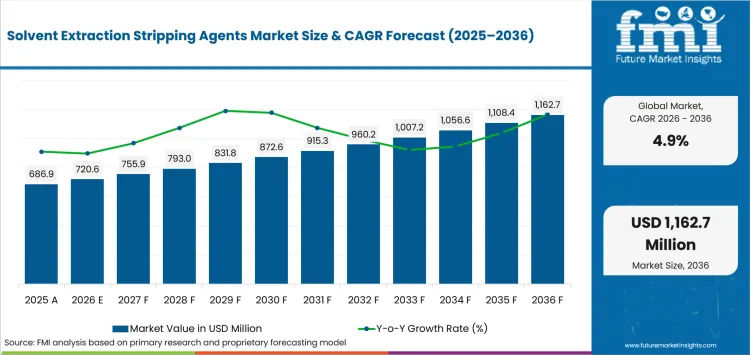
USD 720.6 Million in 2026 and USD 1,162.7 Million by 2036 at a 4.9% CAGR.
Demand for solvent extraction stripping agents is projected to expand at 4.9% CAGR between 2026 and 2036, lifting valuation from USD 720.6 million in 2026 to USD 1,162.7 million by 2036. Revenue advances as operators commission new hydrometallurgical capacity and keep existing solvent extraction circuits chemically balanced. Stripping agents sit at the point where metal moves from loaded organic into an aqueous strip liquor or electrolyte. This makes consumption tied to circuit throughput rather than to discretionary plant maintenance alone. BASF reported in May 2025 that it was decentralizing technical and analytical support for solvent extraction and electrowinning. The action shows how copper hydrometallurgy demand is pulling technical capability closer to operating customers. The commercial effect is a larger installed base of metal-bearing organic that must be stripped repeatedly. Buyers therefore evaluate acid strength and impurity control as operating inputs. Materials compatibility and security of supply are separate approval tests. Suppliers that can stabilize specification and delivery across continuous campaigns are better placed to convert metallurgical demand into recurring chemical orders.
Purchase behavior differs by circuit maturity and metal mix. Chile combines a large copper SX-EW operating base with formal multi-division chemical procurement. Codelco published an SX-EW chemical supplies process in July 2026. Peru is adding future demand through Tia Maria. Southern Copper reported in 2026 that the Arequipa project will use SX-EW technology and was 32.5% complete at the end of March. Norway has a refinery-led profile that centers more on nickel and cobalt processing. Australia also brings nickel-cobalt hydrometallurgy into the demand mix. Japan places more emphasis on precision separation and process footprint. NEDO is funding alternatives to conventional mixer-settler solvent extraction for heavy rare earths. Across these markets, interest turns into a purchase when chemistry clears site safety controls and delivers stable transfer without disrupting downstream product quality.
Key Takeaways
- Stripping demand rises with solvent-extraction throughput because the loaded organic phase must be regenerated continuously before metal recovery can proceed.
- Sulfuric acid stripping agents account for 41.0% of the market in 2026. Their position reflects established compatibility with copper SX-EW electrolyte loops and large-volume site supply.
- Copper holds a 39.0% share in 2026. Its lead is supported by the scale of established SX-EW operations and recurrent stripping of copper-loaded organic.
- Loaded organic stripping represents 42.0% of the market in 2026. It leads because it is the direct metal-release operation required to regenerate organic for reuse.
- SX-EW plants hold a 45.0% share in 2026. Their lead reflects direct coupling between stripping chemistry, electrolyte circulation, and electrowinning output.
- Direct chemical supply accounts for 46.0% of the market in 2026. Its lead reflects the importance of bulk logistics, site qualification, and continuous replenishment for corrosive process chemicals.
- Corrosive handling, impurity control and reagent logistics raise qualification costs, while complex feeds create space for more tailored stripping and scrubbing chemistry.
- Mining-chemistry and supply participants include BASF, Solvay, Orica, LANXESS, Brenntag, and Univar Solutions.
Analyst Perspective
“Strip chemistry is judged inside the full solvent-extraction circuit. A supplier that understands extractant behavior, electrolyte quality and impurity movement can protect recovery and plant stability in a way that commodity chemical supply alone cannot.”
- Nikhil Kaitwade, Principal Consultant, Future Market Insights
How is the Solvent Extraction Stripping Agents Market segmented?
The market is analyzed by Agent Type, Metal Circuit, Operation, End Use, and Sales Channel.
Agent Type separates the aqueous chemistry used to release or condition metals during strip service. Metal Circuit separates copper flowsheets from other metal systems. Cobalt and nickel circuits can require different acidity or selectivity. Rare-earth and uranium circuits add further separation requirements. Operation identifies whether chemistry is consumed in the direct strip step or in supporting solution control. End Use separates integrated SX-EW sites from other hydrometallurgical and refining environments. Sales Channel captures how sites buy and replenish chemistry. Direct contracts compete with distributors, technical service arrangements, and regional inventory models. These axes matter because purchase frequency and qualification burden change with circuit design and site logistics.
Why do SX-EW plants lead the End Use category?
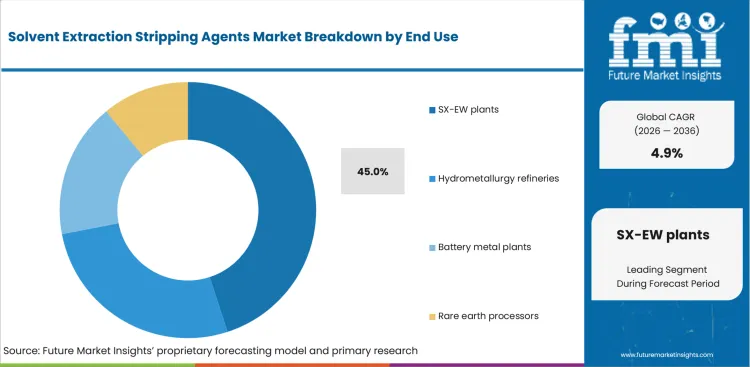
SX-EW plants couple stripping directly to an electrowinning electrolyte loop. The strip solution accepts metal from the organic phase and then becomes the feed that supports cathode production. This physical linkage creates a clear operating reason to control acid concentration and solution purity. Reagent shortages or off-spec chemistry can restrict transfer before the electrowinning stage. The effect is a recurring need for qualified chemistry and predictable replenishment rather than occasional project-only demand. Hydrometallurgy refineries and battery-metal plants can require more specialized strip systems. Their flowsheets vary more widely by feed and target product than the copper SX-EW configuration. Battery-metal circuits extend this logic into battery leaching systems, where qualified chemistry and inventory continuity protect operating time.
- SX-EW plants hold a 45.0% share in 2026. Their lead reflects direct coupling between stripping chemistry, electrolyte circulation, and electrowinning output.
- Southern Copper reported in 2026 that the Tia Maria project in Peru will use SX-EW technology. The planned circuit adds a future site where strip chemistry is integral to the production route.
Why do Sulfuric acid stripping agents lead the Agent Type category?
Sulfuric acid is embedded in the standard chemistry of many copper SX-EW strip circuits. A 2022 Mine Water and the Environment study found sulfuric acid was the most efficient of the stripping agents tested in its copper system. The loaded organic is contacted with an acidic aqueous phase so hydrogen ions displace copper from the extractant and return it to electrolyte. That loop makes sulfuric acid demand closely linked to metal transfer and electrolyte balance. It also favors established bulk supply because operators design dedicated infrastructure around strong acid service. Tanks and pumps must remain compatible with the selected chemistry. Alternative agents can fit selected metal systems or impurity conditions. They face a higher switching burden when the plant is engineered around sulfuric electrolyte and downstream electrowinning requirements. The purchasing decision sits within the broader sulfuric acid market, where mine sites qualify bulk supply around ore chemistry and operating continuity.
- Sulfuric acid stripping agents account for 41.0% of the market in 2026. Their position reflects established compatibility with copper SX-EW electrolyte loops and large-volume site supply.
- A 2022 Mine Water and the Environment study used sulfuric acid to strip copper from the loaded organic phase before downstream recovery. The work illustrates why acid concentration and phase-transfer performance are central qualification variables.
Why does Copper lead the Metal Circuit category?
Copper leads because solvent extraction and electrowinning are already industrialized at large operating sites. Every pass through the circuit creates loaded organic that must be stripped before the organic phase can return to extraction. This creates a repeat-use chemical requirement that scales with solution flow and copper transfer rather than with a one-time equipment sale. A 2022 peer-reviewed study used sulfuric acid to strip copper from loaded organic before electrochemical recovery. Codelco's July 2026 SX-EW chemical-supplies process also shows continuing procurement across operating copper circuits. Cobalt and nickel are important growth circuits, but their installed solvent-extraction base is less uniform across producers. Circuit expansion raises consumption of extraction reagents across hydrometallurgical flowsheets that move metal from leach solution into a recoverable product.
- Copper holds a 39.0% share in 2026. Its lead is supported by the scale of established SX-EW operations and recurrent stripping of copper-loaded organic.
- Codelco published a multi-division SX-EW chemical-supplies procurement process on July 1, 2026. The notice demonstrates direct chemical purchasing around Chilean copper SX-EW operations.
Why does Loaded organic stripping lead the Operation category?
Loaded organic stripping is the core transfer step in a solvent-extraction cycle. Extraction moves the target metal into the organic phase. Stripping then reverses that transfer into an aqueous solution that can feed electrowinning or a later refining step. The chemistry therefore acts directly on the metal-bearing organic rather than supporting the circuit from the side. Operating discipline focuses on acidity and organic-to-aqueous ratio. Temperature and entrainment also matter because poor control can reduce metal transfer or contaminate downstream solution. Impurity behavior adds another control requirement. Scrubbing support and impurity control remain valuable, yet their use depends more heavily on feed composition and site-specific troubleshooting. Upstream beneficiation reagents and downstream strip chemistry serve different process stages, but both must fit the ore-specific flowsheet.
- Loaded organic stripping represents 42.0% of the market in 2026. It leads because it is the direct metal-release operation required to regenerate organic for reuse.
- A published SX-EW pilot flowsheet describes loaded organic contacting spent electrowinning electrolyte in the strip stage before the stronger electrolyte returns to electrowinning. This sequence illustrates why the strip operation is structurally recurring.
Why does Direct chemical supply lead the Sales Channel category?
Direct supply is favored when stripping chemistry is consumed in bulk and must meet plant-specific specifications. Concentrated acids require controlled transport, compatible storage, and documented handling. Mine and refinery operators also place value on continuity because a delivery disruption can constrain a process that runs around the clock. Direct contracts give larger sites a route to negotiate specification and replenishment as one operating package. Delivery windows and technical support can then be aligned with the same site plan. Distributors and regional depots remain important where shipment sizes are smaller or geography is fragmented. Technical service contracts become more valuable when complex feeds require frequent adjustment rather than standard bulk replenishment. Impurity control creates room for higher-value metal recovery chemistry when commodity acid alone does not solve circuit behavior.
- Direct chemical supply accounts for 46.0% of the market in 2026. Its lead reflects the importance of bulk logistics, site qualification, and continuous replenishment for corrosive process chemicals.
- Codelco’s July 2026 SX-EW chemical procurement covered multi-division requirements through a formal supplier process. The structure illustrates how large operators can consolidate direct site demand.
What are the drivers, restraints and opportunities in the Solvent Extraction Stripping Agents Market?
Hydrometallurgical circuit additions support recurring strip chemistry demand, while corrosive handling raises qualification costs and complex feeds create room for higher-value technical service.
- Driver: Expansion and sustained operation of SX-EW and other hydrometallurgical circuits increase recurring stripping requirements.
- Restraint: Corrosivity, materials compatibility, and site safety controls raise switching costs and complicate logistics.
- Opportunity: Complex copper and critical-mineral feeds create demand for tailored strip conditions, impurity control, and service contracts.
The primary demand mechanism is more metal-bearing solution moving through solvent extraction. Codelco published a multi-division SX-EW chemical procurement process in July 2026. Southern Copper is also advancing Tia Maria with SX-EW in Peru. Each operating circuit requires loaded organic to be regenerated through stripping before it returns to extraction. That creates a recurring consumption pattern for acid or other strip chemistry. The most pronounced commercial demand appears where plant throughput rises and reagent purchasing becomes part of regular production planning rather than a commissioning-only expense.
The main restraint sits at chemical handling and plant qualification. NIOSH identifies sulfuric acid as corrosive to metals and hazardous through inhalation or contact exposure. For operators, this translates into compatible tanks and piping plus controlled transfer procedures. It also raises the cost of changing concentration or supplier without validation. The restraint does not remove demand because stripping remains necessary. It instead favors incumbency and secure logistics. Suppliers must demonstrate specification consistency and support safe storage. Smaller buyers can face more difficulty when minimum shipment economics or regional inventory do not match their consumption profile.
The most credible opportunity is to attach technical service and impurity control to base strip chemistry. BASF said in May 2025 that it was bringing solvent-extraction and electrowinning technical capabilities closer to customers. That move reflects the commercial value of faster circuit analysis and troubleshooting. Battery-metal and rare-earth circuits add another opening because product purity targets can be stringent. Suppliers with hydrometallurgical application teams can capture more value when they connect chemical supply with solution analysis and operating recommendations. The requirement is evidence that those interventions improve transfer stability without creating downstream contamination.
Which country CAGRs are profiled in the Solvent Extraction Stripping Agents Market?
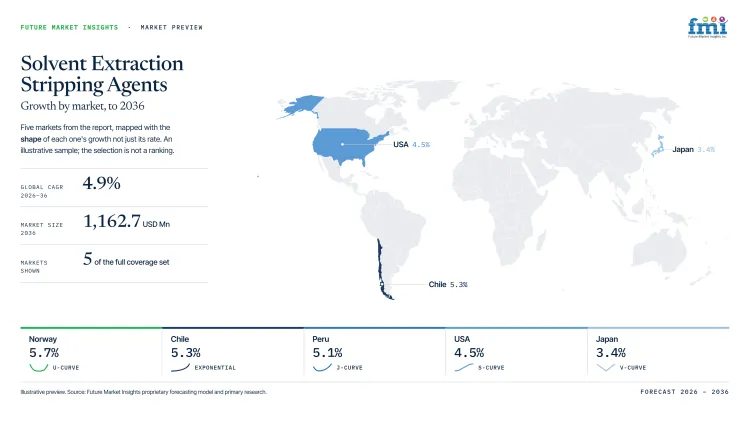
| Country | CAGR (2026-2036) |
|---|---|
| Norway | 5.7% |
| USA | 4.5% |
| Japan | 3.4% |
| Chile | 5.3% |
| Peru | 5.1% |
| Canada | 4.6% |
| Australia | 4.8% |
How do country-level CAGRs compare in the Solvent Extraction Stripping Agents Market?
The seven profiled markets span a 2.3 percentage-point range between Norway at 5.7% and Japan at 3.4% from 2026 to 2036. Norway, Chile, and Peru form the faster group at 5.1% or above. Australia, Canada, and USA sit in a middle band between 4.5% and 4.8%. Japan is lower at 3.4%. The pattern reflects different mixes of new SX-EW projects, established refinery demand, and technology substitution. These growth rates describe pace rather than absolute market size. A mature large market can grow more slowly than a smaller market adding new capacity.
- A 5.7% CAGR places Norway within the profiled set, but purchasing hinges on a specific condition: Buyers are concentrated around high-purity nickel, cobalt, and copper refining where continuity of feed and process chemistry is critical.
- USA's 4.5% outlook is shaped by execution conditions. Large copper operators buy against mature leaching and SX-EW infrastructure, which favors repeat bulk supply and plant-specific qualification.
- For Japan, the forecast reaches 3.4% CAGR. Procurement is oriented toward high-purity refining and separation performance, with buyers placing weight on footprint and processing efficiency.
- Large copper sites procure chemicals through formal contracts that can aggregate requirements across operations. That gives Chile a distinct Solvent Extraction Stripping Agents path within its 5.3% CAGR forecast.
- Peru carries a 5.1% CAGR through 2036, with conversion tied to this market reality: Purchasing is increasingly influenced by project commissioning as new copper capacity moves toward operation.
- At 4.6% CAGR, Canada remains commercially distinct. Refinery demand is linked to nickel and cobalt value chains as well as copper by-products, so purity and downstream compatibility matter alongside volume.
- Australia is forecast at 4.8% CAGR. Integrated nickel-cobalt hydrometallurgy creates demand beyond the conventional copper SX-EW model.
CAGR should be read alongside circuit scale and purchasing structure. Direct chemical demand is shaped by how much loaded organic is processed, which agents a site qualifies, and whether local storage supports continuous replenishment. Project schedules can create step changes that a single growth rate cannot show. Mature refineries can also produce recurring demand without headline capacity additions. The wider report therefore evaluates segment mix and process role alongside supplier access. Local operating friction is considered with the country growth outlook.
Country-wise Analysis
- Norway: Buyers are concentrated around high-purity nickel, cobalt, and copper refining where continuity of feed and process chemistry is critical. Solvent Extraction Stripping Agents sales in Norway are expected to grow at 5.7% CAGR over 2026 to 2036. Glencore reported on April 30, 2026 that a 2025 Sudbury furnace disruption affected matte shipment lead times to Norway. That exposure makes refinery supply chains sensitive to upstream interruptions. Chemical suppliers can differentiate through reliable Nordic inventory, controlled acid delivery, and responsive technical support when feed composition changes.
- USA: Large copper operators buy against mature leaching and SX-EW infrastructure, which favors repeat bulk supply and plant-specific qualification. A 4.5% CAGR is projected for Solvent Extraction Stripping Agents in USA between 2026 and 2036. BASF's May 2025 support model brought solvent extraction and electrowinning technical capabilities closer to customers, reinforcing the importance of plant-level circuit support. One persistent challenge is maintaining chemistry and logistics across dispersed mine sites. Market entrants need reliable bulk delivery plus circuit support that fits established operator standards.
- Japan: Procurement is oriented toward high-purity refining and separation performance, with buyers placing weight on footprint and processing efficiency. Through 2036, the market for Solvent Extraction Stripping Agents in Japan is set to register a 3.4% CAGR. NEDO’s heavy rare-earth separation program was last updated on June 20, 2025 and targets new methods that improve on conventional mixer-settler solvent extraction. The central purchase barrier is substitution where alternative separation technologies meet purity targets with smaller facilities. Suppliers must prove process-specific value in nickel, cobalt, or rare-earth circuits rather than rely on conventional copper practice.
- Chile: Large copper sites procure chemicals through formal contracts that can aggregate requirements across operations. Growth in Solvent Extraction Stripping Agents across Chile is projected at 5.3% CAGR from 2026 to 2036. Codelco published a multi-division SX-EW chemical-supplies process on July 1, 2026. What slows conversion is the need to serve remote sites with reliable specifications and transport for hazardous bulk chemicals. Suppliers that combine regional stock, contract discipline, and field metallurgical support are better positioned to convert Chile’s installed SX-EW base into repeat orders.
- Peru: Purchasing is increasingly influenced by project commissioning as new copper capacity moves toward operation. The ten-year forecast for Solvent Extraction Stripping Agents in Peru reaches 5.1% CAGR. Southern Copper reported in April 2026 that Tia Maria in Arequipa will use SX-EW technology and had reached 32.5% project progress at the end of March. The harder operating issue is timing supply qualification with construction and ramp-up. Reagent suppliers need early technical engagement so storage, concentration, and delivery standards are approved before wet commissioning.
- Canada: Refinery demand is linked to nickel and cobalt value chains as well as copper by-products, so purity and downstream compatibility matter alongside volume. Between 2026 and 2036, sales of Solvent Extraction Stripping Agents in Canada are expected to rise at 4.6% CAGR. Glencore reported on April 30, 2026 that a 2025 furnace disruption at Sudbury reduced nickel output and affected matte shipment lead times to Norway. A local constraint comes from dispersed operations and cold-weather logistics. Suppliers can compete through regional warehousing and bulk acid capability. Technical support also matters when hydrometallurgical feed quality changes.
- Australia: Integrated nickel-cobalt hydrometallurgy creates demand beyond the conventional copper SX-EW model. The Solvent Extraction Stripping Agents outlook for Australia points to a 4.8% CAGR from 2026 to 2036. A Glencore Murrin Murrin process-engineering posting updated on May 28, 2025 listed solvent extraction among key extractive-metallurgy areas at the integrated nickel-cobalt operation. The main commercial hurdle is remote-site logistics combined with complex process control. Vendors need dependable site delivery and technical depth in solvent extraction. Acid systems and impurity management add further service requirements.
Who are the notable companies in the Solvent Extraction Stripping Agents Market?
BASF, Solvay, Orica, LANXESS, Brenntag, and Univar Solutions.
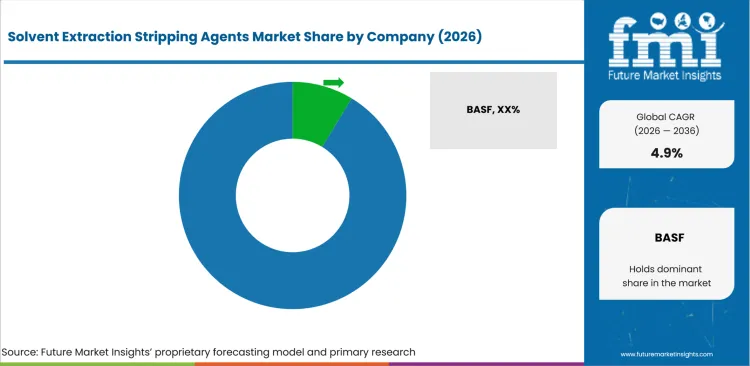
Competition is split between circuit-chemistry specialists and distribution networks that keep high-volume reagents available at site. BASF and Solvay bring hydrometallurgy and separation-chemistry expertise. Orica and LANXESS add broader mining and industrial-chemistry platforms, while Brenntag and Univar Solutions compete through bulk chemical access, storage, and logistics. Buyers should distinguish direct strip-circuit support from wider site-chemistry portfolios when comparing offers.
- Hydrometallurgy chemistry: BASF and Solvay compete through separation expertise and circuit-facing technical support.
- Broader mining and industrial platforms: Orica and LANXESS enter buyer comparisons through mine-site relationships, acid handling, chelation, and specialty chemistry.
- Bulk chemical distribution: Brenntag and Univar Solutions support site continuity through storage, transport and access to industrial reagents.
Competitive Benchmarking: Solvent Extraction Stripping Agents Market
| Company | Commercial Role | Relevant Chemistry Position | Supply Model | Geographic Reach |
|---|---|---|---|---|
| BASF | Mining and specialty chemicals | Hydrometallurgy and mineral-processing chemistry | Technical account support | Global |
| Solvay | Mining chemicals | Solvent-extraction and mineral-processing chemistry | Technical support and chemical supply | Global |
| Orica | Mining services and chemicals | Mine-site specialty-chemical capability | Mine-site supply and technical service | Global mining regions |
| LANXESS | Industrial and specialty chemicals | Acid, chelation and specialty chemistry platform | Manufacturing plus distribution | Global |
| Brenntag | Chemical distributor | Bulk stripping-chemistry access | Distribution, storage and logistics | Global |
| Univar Solutions | Chemical distributor | Bulk industrial and mining chemical access | Distribution and logistics | North America and international |
The matrix separates circuit-facing chemistry expertise from bulk supply capability, then considers site logistics and reach into hydrometallurgical operations.
Key Developments in the Solvent Extraction Stripping Agents Market
- In May 2025, BASF announced a strategic shift in its copper hydrometallurgy business and said it was decentralizing technical and analytical capabilities for solvent extraction and electrowinning. LIX and LixMS customers were identified as beneficiaries of enhanced support. The move can shorten troubleshooting loops around SX-EW customers and increase the importance of technical service alongside reagent supply in competitive account coverage.
- In April 2025, Solvay inaugurated a rare-earth production line at La Rochelle, France, expanding separation, purification, and formulation capacity for magnet materials. The development broadens the commercial base for high-purity separation chemistry and reinforces demand for tightly controlled separation and refining conditions in complex metal circuits.
- In February 2026, Brenntag completed its acquisition of Airedale Group, adding blending, formulation, and dilution capabilities to its UK chemical distribution network. For bulk stripping chemistry, the added service base strengthens the ability to pair reliable supply with site-specific concentration and handling requirements.
Key Players in the Solvent Extraction Stripping Agents Market
Hydrometallurgy and Mining Chemistry
- BASF
- Solvay
- Orica
Industrial Chemistry Platform
- LANXESS
Chemical Distribution
- Brenntag
- Univar Solutions
Solvent Extraction Stripping Agents Market - Report Scope
| Coverage field | Report scope |
|---|---|
| Market breakdown | Agent Type, Metal Circuit, Operation, End Use, and Sales Channel |
| Quantitative Units | USD Million |
| Market Definition | Revenue includes stripping agents and strip-solution chemistry sold for loaded organic stripping, scrubbing support, pregnant strip solution preparation, and impurity control within the specified metal circuits and end uses. Revenue from finished metals, solvent extractants, diluents, leaching-only reagents, and other adjacent or substitute categories is excluded. |
| Regions Covered | North America; Latin America; Western Europe; Eastern Europe; East Asia; South Asia and Pacific; Middle East and Africa |
| Countries Covered | Norway, USA, Japan, Chile, Peru, Canada, Australia, and more than twenty-five additional countries in the full report |
| Key Companies Profiled | BASF; Solvay; Orica; LANXESS; Brenntag; Univar Solutions |
| Forecast Period | 2026 to 2036 |
| Approach | Market sizing applies a hybrid bottom-up and top-down approach that reconciles circuit demand, chemical use patterns, supplier activity, and country-level operating conditions without double-counting adjacent categories. |
Solvent Extraction Stripping Agents Market - Research Methodology
| Method | Approach |
|---|---|
| Primary Research | FMI validates market structure through discussions with chemical manufacturers, distributors, mine and refinery users, procurement functions, and subject-matter specialists. Interviews focus on product qualification, consumption patterns, purchasing criteria, channel structure, and operating frictions. |
| Desk Research | FMI reviews government and regulator material, company filings, official procurement notices, technical literature, company product documentation, and trade or operating disclosures. Sources are included when they directly support the defined revenue boundary or explain a relevant operating mechanism. |
| Market Sizing and Forecasting | The sizing framework considers installed and planned solvent-extraction capacity, circuit throughput, strip-chemistry intensity, agent mix, end-use composition, channel structure, and country operating conditions. Forecast assumptions reflect project development, refinery utilization, technology substitution, and reagent qualification dynamics. |
| Data Validation | Findings are cross-checked across independent and first-party evidence. Validation excludes downstream finished-product revenue, solvent extractants and diluents, leaching-only reagents, flotation chemicals, and other adjacent categories. Unsupported numerical company shares and double-counted chemical use are excluded. |
Solvent Extraction Stripping Agents Market by Segments
Solvent Extraction Stripping Agents Market segmented by Agent Type:
- Sulfuric acid stripping agents
- Hydrochloric acid stripping agents
- Ammonia/ammonium agents
- Carbonate stripping agents
- Specialty stripping modifiers
Solvent Extraction Stripping Agents Market segmented by Metal Circuit:
- Copper
- Cobalt
- Nickel
- Rare earths
- Uranium
Solvent Extraction Stripping Agents Market segmented by Operation:
- Loaded organic stripping
- Scrubbing support
- Pregnant strip solution preparation
- Impurity control
Solvent Extraction Stripping Agents Market segmented by End Use:
- SX-EW plants
- Hydrometallurgy refineries
- Battery metal plants
- Rare earth processors
Solvent Extraction Stripping Agents Market segmented by Sales Channel:
- Direct chemical supply
- Mining reagent distributors
- Technical service contracts
- Regional depots
Solvent Extraction Stripping Agents Market by Region:
- North America
- United States
- Canada
- Latin America
- Brazil
- Mexico
- Argentina
- Chile
- Western Europe
- Germany
- France
- United Kingdom
- Italy
- Spain
- Benelux
- Nordics
- Eastern Europe
- Poland
- Czech Republic
- Romania
- Hungary
- East Asia
- China
- Japan
- South Korea
- South Asia and Pacific
- India
- ASEAN
- Australia and New Zealand
- Middle East and Africa
- GCC Countries
- South Africa
- Türkiye
- Israel
Research Sources and Bibliography
- BASF (2025, May 20). BASF mining solutions strengthens commitment to copper hydrometallurgy and flotation research and development.
- Solvay (2025, April 8). Solvay advances European rare earths production through capacity expansion.
- Orica (2026, April 17). Orica expands portfolio into copper chemistry with Danafloat acquisition.
- Lanxess (2025, March 6). Refining high-purity battery metals with Lewatit MK51 from LANXESS.
- Codelco (2026, July 1). Suministros Quimicos - SX-EW.
- Southern Copper Corporation (2026, April 28). First-quarter 2026 results and Tia Maria project update.
- NEDO (2025, June 20). Development of Technologies for Separation and Refinement of Heavy Rare Earths.
- Glencore (2026, April 30). First Quarter 2026 Production Report.
- Glencore (2025, May 28). Principal Process Engineer - Murrin Murrin.
- National Institute for Occupational Safety and Health (n.d.). Sulfuric acid - NIOSH Pocket Guide to Chemical Hazards.
- Nobahar, A., Melka, A. B., Pusta, A., et al. (2022, March 7). A New Application of Solvent Extraction to Separate Copper from Extreme Acid Mine Drainage Producing Solutions for Electrochemical and Biological Recovery Processes.
- Brenntag (2025, December 16; updated 2026, April 1). Brenntag acquires Airedale Group in the UK.
- Univar Solutions (n.d.). Bulk Chemical Distribution.
- Brenntag (n.d.). Products and value-added services for the mining industry.
This Report Answers
- How is demand for the Solvent Extraction Stripping Agents Market expected to evolve through 2036?
- Which hydrometallurgical and operating pressures support recurring demand for stripping agents?
- Why do sulfuric acid stripping agents hold the leading position within Agent Type?
- How does the copper Metal Circuit shape downstream stripping-agent demand?
- Why does loaded organic stripping lead the Operation category?
- How do growth rates differ across Norway, USA, Japan, Chile, Peru, Canada, and Australia?
- Which companies provide circuit chemistry, technical support, or bulk stripping-chemical distribution?
- How do corrosive handling and site qualification constrain adoption and supplier switching?
- What should mine and refinery procurement teams evaluate before purchasing stripping chemistry?
Frequently Asked Questions
What is driving growth in the Solvent Extraction Stripping Agents Market?
Growth is driven by higher throughput and new capacity in SX-EW and other hydrometallurgical circuits that repeatedly regenerate loaded organic. The most pronounced demand follows operating sites where strip chemistry is consumed as part of routine metal transfer rather than as a one-time commissioning input.
Who are the key players in the Solvent Extraction Stripping Agents Market?
Key players include BASF, Solvay, Orica, LANXESS, Brenntag and Univar Solutions. Their roles span circuit-facing specialty chemistry, industrial-chemical platforms and bulk site logistics.
What is a notable restraint in the Solvent Extraction Stripping Agents Market?
Corrosive handling and materials compatibility are a major restraint because strong acids require qualified storage, transfer equipment, and operating controls. Those requirements raise switching costs and can slow approval of new suppliers even when the underlying strip chemistry is commercially available.
Why should executives track the Solvent Extraction Stripping Agents Market?
Stripping chemistry is a recurring operating input that can constrain solvent-extraction throughput when specification or supply fails. Executives should track it because project growth, reagent logistics, and technical-service capability influence production continuity and chemical procurement economics across hydrometallurgical assets.
What business problem does the Solvent Extraction Stripping Agents Market address?
The market supplies chemistry that releases target metals from loaded organic and prepares an aqueous solution for downstream recovery or refining. It also supports scrubbing, impurity control, and solution conditioning when feed variability threatens transfer efficiency or final product quality.
What should mine and refinery procurement teams evaluate in the Solvent Extraction Stripping Agents Market?
Procurement teams should assess reagent purity, acid or base strength, and materials compatibility against the site’s approved equipment. They should also evaluate storage and delivery reliability, then test downstream solution quality and technical support for feed-related operating adjustments.
What limits return on investment in the Solvent Extraction Stripping Agents Market?
Return is reduced when reagent choice causes unstable transfer, impurity carryover, or excessive consumption. Remote-site inventory and hazardous-material storage can also materially add working capital and handling cost even when the chemical price is competitive.
What supports long-term commercial confidence in the Solvent Extraction Stripping Agents Market?
Long-term confidence comes from the installed base of solvent-extraction circuits and a pipeline of copper and critical-mineral hydrometallurgical projects. Demand is reinforced by repeat stripping cycles, while suppliers can increase value through reliable bulk supply and technical service for changing feed chemistry.
Preview the report firsthand - request a free sample
Get SampleGet the brochure for pricing and purchase details.
Get PDFTable of Content
- Key Takeaways
- Market Size and CAGR
- Top Growth Driver
- Fastest Growing Segment
- Leading Region
- Key Companies
- Emerging Opportunities
- Executive Summary
- Global Market Outlook
- Demand-side Trends
- Supply-side Trends
- Technology Roadmap Analysis
- Analysis and Recommendations
- Analyst Perspective (What is happening? Why now? What should investors know?)
- Key Questions Answered
- How large is the market?
- What is the CAGR?
- What are key trends?
- Which region dominates?
- Who are the leaders?
- Market Overview
- Market Coverage / Taxonomy
- Market Definition / Scope / Limitations
- Research Methodology
- Chapter Orientation
- Analytical Lens and Working Hypotheses
- Market Structure, Signals, and Trend Drivers
- Benchmarking and Cross-market Comparability
- Market Sizing, Forecasting, and Opportunity Mapping
- Research Design and Evidence Framework
- Desk Research Programme (Secondary Evidence)
- Expert Input and Fieldwork (Primary Evidence)
- Tooling, Models, and Reference Databases
- Data Engineering and Model Build
- Quality Assurance and Audit Trail
- Market Background
- Market Dynamics (Drivers, Restraints, Opportunity, Trends)
- Scenario Forecast (Optimistic, Likely, Conservative)
- Impact Analysis
- AI Impact
- Sustainability Impact
- Regulatory Impact
- Technology Impact
- Consumer / Buyer Analysis
- Purchase Drivers
- Adoption Barriers
- Buyer Journey
- Opportunity Map Analysis
- Product Life Cycle Analysis
- Supply Chain Analysis
- Investment Feasibility Matrix
- Value Chain Analysis
- PESTLE and Porter's Analysis
- Regulatory Landscape
- Regional Parent Market Outlook
- Production and Consumption Statistics
- Import and Export Statistics
- Global Market Analysis and Forecast, 2021 to 2036
- Historical Market Size Value (USD Million) Analysis, 2021 to 2025
- Current and Future Market Size Value (USD Million) Projections, 2026 to 2036
- Y-o-Y Growth Trend Analysis
- Absolute $ Opportunity Analysis
- Global Market Pricing Analysis, 2021 to 2036
- Global Market Analysis and Forecast, By Agent Type, 2021 to 2036
- Introduction / Key Findings
- Historical Market Size Value (USD Million) Analysis By Agent Type, 2021 to 2025
- Current and Future Market Size Value (USD Million) Analysis and Forecast By Agent Type, 2026 to 2036
- Sulfuric acid stripping agents
- Hydrochloric acid stripping agents
- Ammonia/ammonium agents
- Carbonate stripping agents
- Specialty stripping modifiers
- Sulfuric acid stripping agents
- Y-o-Y Growth Trend Analysis By Agent Type, 2021 to 2025
- Absolute $ Opportunity Analysis By Agent Type, 2026 to 2036
- Global Market Analysis and Forecast, By Metal Circuit, 2021 to 2036
- Introduction / Key Findings
- Historical Market Size Value (USD Million) Analysis By Metal Circuit, 2021 to 2025
- Current and Future Market Size Value (USD Million) Analysis and Forecast By Metal Circuit, 2026 to 2036
- Copper
- Cobalt
- Nickel
- Rare earths
- Uranium
- Copper
- Y-o-Y Growth Trend Analysis By Metal Circuit, 2021 to 2025
- Absolute $ Opportunity Analysis By Metal Circuit, 2026 to 2036
- Global Market Analysis and Forecast, By Operation, 2021 to 2036
- Introduction / Key Findings
- Historical Market Size Value (USD Million) Analysis By Operation, 2021 to 2025
- Current and Future Market Size Value (USD Million) Analysis and Forecast By Operation, 2026 to 2036
- Loaded organic stripping
- Scrubbing support
- Pregnant strip solution preparation
- Impurity control
- Loaded organic stripping
- Y-o-Y Growth Trend Analysis By Operation, 2021 to 2025
- Absolute $ Opportunity Analysis By Operation, 2026 to 2036
- Global Market Analysis and Forecast, By End Use, 2021 to 2036
- Introduction / Key Findings
- Historical Market Size Value (USD Million) Analysis By End Use, 2021 to 2025
- Current and Future Market Size Value (USD Million) Analysis and Forecast By End Use, 2026 to 2036
- SX-EW plants
- Hydrometallurgy refineries
- Battery metal plants
- Rare earth processors
- SX-EW plants
- Y-o-Y Growth Trend Analysis By End Use, 2021 to 2025
- Absolute $ Opportunity Analysis By End Use, 2026 to 2036
- Global Market Analysis and Forecast, By Sales Channel, 2021 to 2036
- Introduction / Key Findings
- Historical Market Size Value (USD Million) Analysis By Sales Channel, 2021 to 2025
- Current and Future Market Size Value (USD Million) Analysis and Forecast By Sales Channel, 2026 to 2036
- Direct chemical supply
- Mining reagent distributors
- Technical service contracts
- Regional depots
- Direct chemical supply
- Y-o-Y Growth Trend Analysis By Sales Channel, 2021 to 2025
- Absolute $ Opportunity Analysis By Sales Channel, 2026 to 2036
- Global Market Analysis and Forecast, By Region, 2021 to 2036
- Introduction
- Historical Market Size Value (USD Million) Analysis By Region, 2021 to 2025
- Current Market Size Value (USD Million) Analysis and Forecast By Region, 2026 to 2036
- North America
- Latin America
- Western Europe
- Eastern Europe
- East Asia
- South Asia and Pacific
- Middle East & Africa
- Market Attractiveness Analysis By Region
- North America Market Analysis and Forecast, By Country, 2021 to 2036
- Historical Market Size Value (USD Million) Trend Analysis By Market Taxonomy, 2021 to 2025
- Market Size Value (USD Million) Forecast By Market Taxonomy, 2026 to 2036
- By Country
- USA
- Canada
- By Agent Type
- By Metal Circuit
- By Operation
- By End Use
- By Sales Channel
- By Country
- Market Attractiveness Analysis
- By Country
- By Agent Type
- By Metal Circuit
- By Operation
- By End Use
- By Sales Channel
- Key Takeaways
- Latin America Market Analysis and Forecast, By Country
- Historical Market Size Value (USD Million) Trend Analysis By Market Taxonomy, 2021 to 2025
- Market Size Value (USD Million) Forecast By Market Taxonomy, 2026 to 2036
- By Country
- Brazil
- Mexico
- Chile
- Rest of Latin America
- By Agent Type
- By Metal Circuit
- By Operation
- By End Use
- By Sales Channel
- By Country
- Market Attractiveness Analysis
- By Country
- By Agent Type
- By Metal Circuit
- By Operation
- By End Use
- By Sales Channel
- Key Takeaways
- Western Europe Market Analysis and Forecast, By Country
- Historical Market Size Value (USD Million) Trend Analysis By Market Taxonomy, 2021 to 2025
- Market Size Value (USD Million) Forecast By Market Taxonomy, 2026 to 2036
- By Country
- Germany
- UK
- Italy
- Spain
- France
- Nordic
- BENELUX
- Rest of Western Europe
- By Agent Type
- By Metal Circuit
- By Operation
- By End Use
- By Sales Channel
- By Country
- Market Attractiveness Analysis
- By Country
- By Agent Type
- By Metal Circuit
- By Operation
- By End Use
- By Sales Channel
- Key Takeaways
- Eastern Europe Market Analysis and Forecast, By Country
- Historical Market Size Value (USD Million) Trend Analysis By Market Taxonomy, 2021 to 2025
- Market Size Value (USD Million) Forecast By Market Taxonomy, 2026 to 2036
- By Country
- Russia
- Poland
- Hungary
- Balkan & Baltic
- Rest of Eastern Europe
- By Agent Type
- By Metal Circuit
- By Operation
- By End Use
- By Sales Channel
- By Country
- Market Attractiveness Analysis
- By Country
- By Agent Type
- By Metal Circuit
- By Operation
- By End Use
- By Sales Channel
- Key Takeaways
- East Asia Market Analysis and Forecast, By Country
- Historical Market Size Value (USD Million) Trend Analysis By Market Taxonomy, 2021 to 2025
- Market Size Value (USD Million) Forecast By Market Taxonomy, 2026 to 2036
- By Country
- China
- Japan
- South Korea
- By Agent Type
- By Metal Circuit
- By Operation
- By End Use
- By Sales Channel
- By Country
- Market Attractiveness Analysis
- By Country
- By Agent Type
- By Metal Circuit
- By Operation
- By End Use
- By Sales Channel
- Key Takeaways
- South Asia and Pacific Market Analysis and Forecast, By Country
- Historical Market Size Value (USD Million) Trend Analysis By Market Taxonomy, 2021 to 2025
- Market Size Value (USD Million) Forecast By Market Taxonomy, 2026 to 2036
- By Country
- India
- ASEAN
- Australia & New Zealand
- Rest of South Asia and Pacific
- By Agent Type
- By Metal Circuit
- By Operation
- By End Use
- By Sales Channel
- By Country
- Market Attractiveness Analysis
- By Country
- By Agent Type
- By Metal Circuit
- By Operation
- By End Use
- By Sales Channel
- Key Takeaways
- Middle East & Africa Market Analysis and Forecast, By Country
- Historical Market Size Value (USD Million) Trend Analysis By Market Taxonomy, 2021 to 2025
- Market Size Value (USD Million) Forecast By Market Taxonomy, 2026 to 2036
- By Country
- Kingdom of Saudi Arabia
- Other GCC Countries
- Türkiye
- South Africa
- Other African Union
- Rest of Middle East & Africa
- By Agent Type
- By Metal Circuit
- By Operation
- By End Use
- By Sales Channel
- By Country
- Market Attractiveness Analysis
- By Country
- By Agent Type
- By Metal Circuit
- By Operation
- By End Use
- By Sales Channel
- Key Takeaways
- Key Countries Market Analysis
- USA
- Pricing Analysis
- Market Share Analysis, 2025
- By Agent Type
- By Metal Circuit
- By Operation
- By End Use
- By Sales Channel
- Canada
- Pricing Analysis
- Market Share Analysis, 2025
- By Agent Type
- By Metal Circuit
- By Operation
- By End Use
- By Sales Channel
- Mexico
- Pricing Analysis
- Market Share Analysis, 2025
- By Agent Type
- By Metal Circuit
- By Operation
- By End Use
- By Sales Channel
- Brazil
- Pricing Analysis
- Market Share Analysis, 2025
- By Agent Type
- By Metal Circuit
- By Operation
- By End Use
- By Sales Channel
- Chile
- Pricing Analysis
- Market Share Analysis, 2025
- By Agent Type
- By Metal Circuit
- By Operation
- By End Use
- By Sales Channel
- Germany
- Pricing Analysis
- Market Share Analysis, 2025
- By Agent Type
- By Metal Circuit
- By Operation
- By End Use
- By Sales Channel
- UK
- Pricing Analysis
- Market Share Analysis, 2025
- By Agent Type
- By Metal Circuit
- By Operation
- By End Use
- By Sales Channel
- Italy
- Pricing Analysis
- Market Share Analysis, 2025
- By Agent Type
- By Metal Circuit
- By Operation
- By End Use
- By Sales Channel
- Spain
- Pricing Analysis
- Market Share Analysis, 2025
- By Agent Type
- By Metal Circuit
- By Operation
- By End Use
- By Sales Channel
- France
- Pricing Analysis
- Market Share Analysis, 2025
- By Agent Type
- By Metal Circuit
- By Operation
- By End Use
- By Sales Channel
- India
- Pricing Analysis
- Market Share Analysis, 2025
- By Agent Type
- By Metal Circuit
- By Operation
- By End Use
- By Sales Channel
- ASEAN
- Pricing Analysis
- Market Share Analysis, 2025
- By Agent Type
- By Metal Circuit
- By Operation
- By End Use
- By Sales Channel
- Australia & New Zealand
- Pricing Analysis
- Market Share Analysis, 2025
- By Agent Type
- By Metal Circuit
- By Operation
- By End Use
- By Sales Channel
- China
- Pricing Analysis
- Market Share Analysis, 2025
- By Agent Type
- By Metal Circuit
- By Operation
- By End Use
- By Sales Channel
- Japan
- Pricing Analysis
- Market Share Analysis, 2025
- By Agent Type
- By Metal Circuit
- By Operation
- By End Use
- By Sales Channel
- South Korea
- Pricing Analysis
- Market Share Analysis, 2025
- By Agent Type
- By Metal Circuit
- By Operation
- By End Use
- By Sales Channel
- Russia
- Pricing Analysis
- Market Share Analysis, 2025
- By Agent Type
- By Metal Circuit
- By Operation
- By End Use
- By Sales Channel
- Poland
- Pricing Analysis
- Market Share Analysis, 2025
- By Agent Type
- By Metal Circuit
- By Operation
- By End Use
- By Sales Channel
- Hungary
- Pricing Analysis
- Market Share Analysis, 2025
- By Agent Type
- By Metal Circuit
- By Operation
- By End Use
- By Sales Channel
- Kingdom of Saudi Arabia
- Pricing Analysis
- Market Share Analysis, 2025
- By Agent Type
- By Metal Circuit
- By Operation
- By End Use
- By Sales Channel
- Türkiye
- Pricing Analysis
- Market Share Analysis, 2025
- By Agent Type
- By Metal Circuit
- By Operation
- By End Use
- By Sales Channel
- South Africa
- Pricing Analysis
- Market Share Analysis, 2025
- By Agent Type
- By Metal Circuit
- By Operation
- By End Use
- By Sales Channel
- USA
- Market Structure Analysis
- Competition Dashboard
- Competition Benchmarking
- Market Share Analysis of Top Players
- By Regional
- By Agent Type
- By Metal Circuit
- By Operation
- By End Use
- By Sales Channel
- Emerging Startups
- Innovation Benchmarking
- Competition Analysis
- Competition Deep Dive
- BASF
- Overview
- Product Portfolio
- Profitability by Market Segments
- Sales Footprint
- Strategy Overview
- Marketing Strategy
- Product Strategy
- Channel Strategy
- Solvay
- Clariant
- Nouryon
- Dow
- Orica
- Lanxess
- Chevron Phillips Chemical
- Brenntag
- Univar Solutions
- BASF
- Case Studies
- Success Stories
- Recent Developments
- Competition Deep Dive
- Assumptions & Acronyms Used


