

- Market Size (2026)
- USD 1.8 Bn
- Forecast (2036)
- USD 6.2 Bn
- CAGR (2026 to 2036)
- 12.8%
How big is the Battery Leaching Reagents Market in 2026?
USD 1.8 billion in 2026 and USD 6.2 billion by 2036 at a 12.8% CAGR.
The battery leaching reagent industry value is expected to grow from USD 1.6 billion in 2025 to USD 6.2 billion by 2036 at 12.8% CAGR, influenced by hydrometallurgical recyclers moving black mass into repeat metal recovery. Direct bulk supply is projected to secure 57.0% share in 2026, guided by tank logistics and repeat dosing needs. Sulfuric acid is expected to hold 51.5% share in 2026, driven by high-volume black mass dissolution across commercial leach circuits.
Battery recycling demand is moving from trial lots toward industrial leach circuits. IEA reported in 2026, global lithium-ion battery nameplate capacity reached more than 4 TWh by end-2025, up roughly 30% compared with 2024. IEA also reported in 2025, EV battery demand is expected to exceed 3 TWh by 2030 under stated policies, up from about 1 TWh in 2024. European Commission rules published in July 2025 set 31 December 2027 material recovery targets at 90% for cobalt and nickel and 50% for lithium, which raises demand for controlled leaching chemistry.
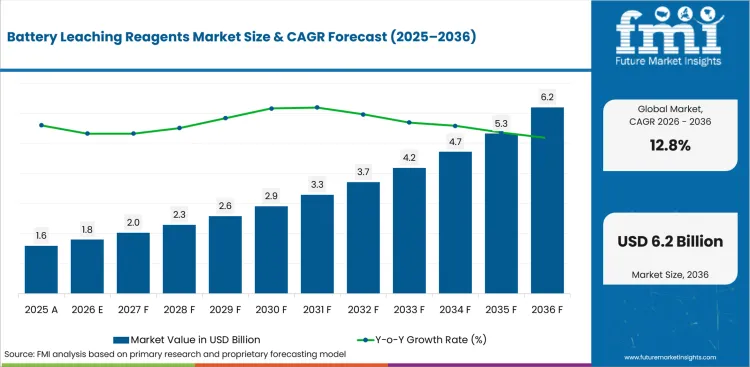
| Metric | Value |
|---|---|
| 2026 Market Size | USD 1.8 billion |
| 2036 Market Size | USD 6.2 billion |
| Forecast CAGR | 12.8% from 2026 to 2036 |
| Leading Sales Channel | Direct Bulk Supply |
| Direct Bulk Supply Share in 2026 | 57.0% |
| Leading Reagent Type | Sulfuric Acid |
| Sulfuric Acid Share in 2026 | 51.5% |
| Leading CAGR Country | India |
| India CAGR | 14.1% by 2036 |
Summary of the Battery Leaching Reagents Market
| Market Signal | Commercial Impact |
|---|---|
| Demand and Growth Drivers | Demand for battery leaching reagents is increasing as hydrometallurgical recycling expands and black mass processing requires consistent, high-purity chemical inputs for efficient metal recovery.
|
| Product and Segment View | Direct bulk supply, sulfuric acid, and battery recycling applications continue to represent the leading commercial opportunities across the market.
|
| Geography and Growth Outlook | Asia continues to dominate market expansion as battery recycling infrastructure and circular economy initiatives accelerate.
|
| Competitive Landscape | Competition increasingly focuses on recovery process chemistry, specialty reagents, and reliable bulk chemical supply.
|
| Analyst Perspective | Battery leaching reagents are evolving beyond commodity chemicals into critical process-control inputs that directly influence metal recovery efficiency, operating costs, and recycling profitability.
- Nikhil Kaitwade, Principal Consultant at Future Market Insights |
Which factors support expansion in the Battery Leaching Reagents Market?
Commercial black mass refining and stricter recovered-metal documentation support market value across battery recycling hubs.
- Market value rises as leach tanks need repeatable acid purity and impurity control before recovered salt production.
- NMC-rich scrap improves reagent economics as nickel and cobalt recovery can support deeper chemical processing.
- LFP battery volumes create lithium-focused opportunities for lower-cost leaching systems and selective recovery steps.
- OEM-backed recycling loops support demand for audited chemical inputs and documented recovery pathways.
Why is the Battery Leaching Reagents Market growing?
Commercial recyclers are moving from black mass collection into controlled metal recovery, which raises demand for leach acids and reducing agents.
Battery leaching reagent buyers need chemistry protecting metal yield as critical mineral demand expands. IEA reported in May 2025, lithium demand rose by nearly 30% in 2024, while nickel and rare earth demand increased by 6% to 8%. Recyclers use leaching reagents to turn black mass into recoverable lithium and manganese streams. Suppliers able to combine purity control and wastewater support gain stronger acceptance across hydrometallurgical plants.
How is the Battery Leaching Reagents Market segmented?
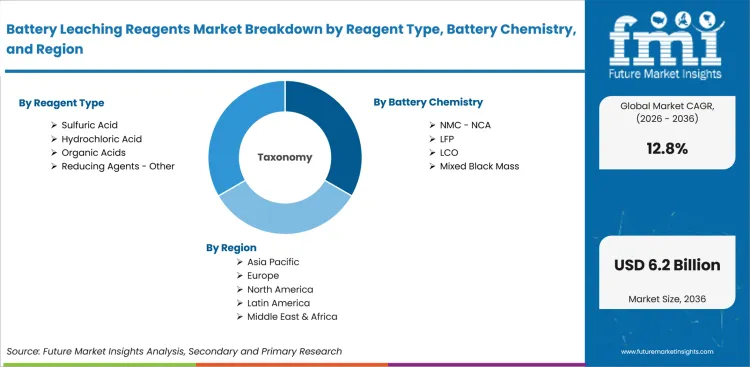
Battery Leaching Reagents Market is segmented by reagent type, battery chemistry, process step, end use, and sales channel.
- Sulfuric acid is anticipated to represent 51.5% share in 2026, driven by broad compatibility with NMC and mixed black mass dissolution.
- NMC / NCA is likely to account for 43.0% share in 2026, supported by nickel and cobalt recovery values improving leach economics.
- Primary leaching is projected to hold 46.0% share in 2026, guided by the main acid-consuming stage before separation and precipitation.
- Battery recyclers are expected to secure 48.0% share in 2026, linked to dedicated processors buying acids and reducers for black mass campaigns.
- Direct bulk supply is predicted to garner 57.0% share in 2026, reinforced by tanker delivery, storage planning, and repeat quality documentation.
Why does sulfuric acid dominate the Battery Leaching Reagents Market by reagent type?
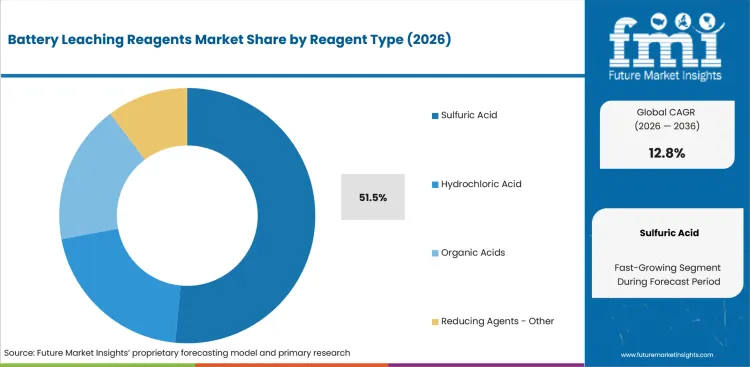
- Sulfuric acid is projected to account for 51.5% share in 2026, driven by high-volume black mass dissolution across commercial hydrometallurgical lines.
- Organic acids gain attention in lower-hazard trials, though cost and reaction speed limit use in high-throughput plants.
Which battery chemistry leads the Battery Leaching Reagents Market?
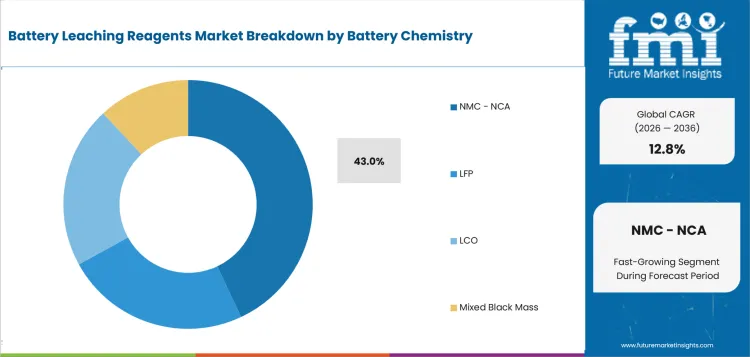
- NMC / NCA is expected to hold 43.0% share in 2026, shaped by nickel and cobalt recovery economics across production scrap and end-of-life packs.
- LFP streams add lithium recovery opportunities, yet lower cobalt value changes reagent intensity and process economics.
Which process step leads the Battery Leaching Reagents Market?
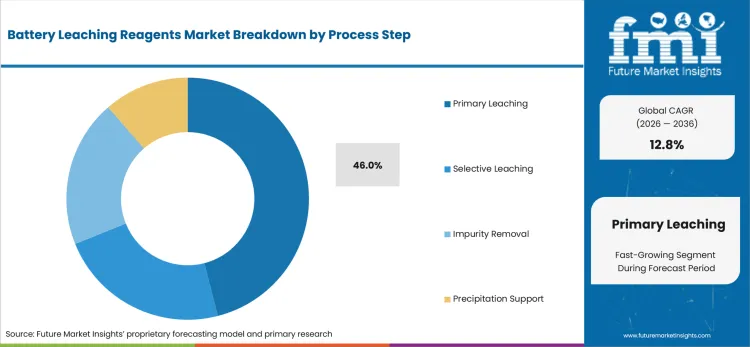
- Primary leaching is projected to hold 46.0% share in 2026, led by the main dissolution load in black mass recovery circuits.
- Selective leaching and impurity removal gain use as plants pursue higher purity recovered materials.
Which end use leads the Battery Leaching Reagents Market?
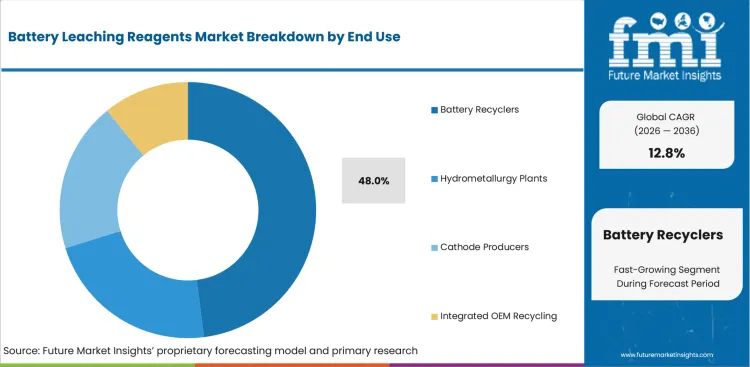
- Battery recyclers are anticipated to account for 48.0% share in 2026, driven by dedicated black mass processors buying reagents directly.
- Cathode producers create added demand as recovered metals move closer to precursor and battery material routes.
Which sales channel leads the Battery Leaching Reagents Market?
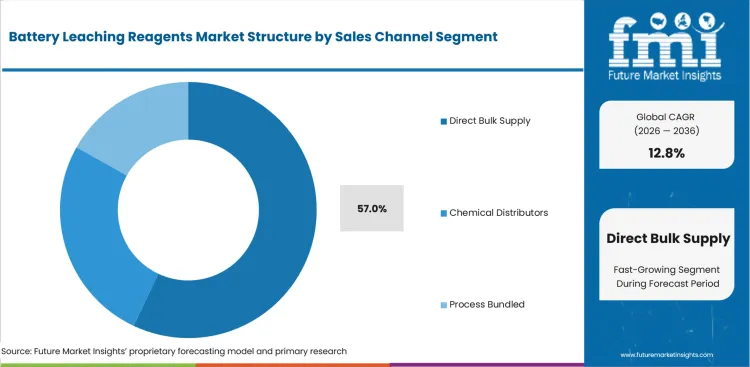
- Direct bulk supply is expected to represent 57.0% share in 2026, guided by safety planning and delivery scheduling.
- Chemical distributors remain active across pilot plants and smaller recyclers needing flexible volume commitments.
What are the drivers, restraints, and opportunities in the Battery Leaching Reagents Market?
Commercial hydrometallurgical recycling and documented recovery pathways are shaping battery leaching reagent buying decisions.
- Driver: Black mass refining scale requires reliable leach chemistry before recoverable salts can be produced.
- Restraint: Mixed battery chemistry can raise dosing complexity and reduce margin during weak metal price cycles.
- Opportunity: Compliance-grade recovery programs can lift renewal rates for suppliers providing documentation and application support.
Black Mass Plant Scale Strengthens Reagent Demand
Commercial black mass operations create a clear reason for repeat reagent contracts. BASF started commercial operation of its Schwarzheide black mass plant in June 2025 with annual processing capacity of up to 15,000 tons of end-of-life lithium-ion batteries and production scrap. Such plants convert mechanical recycling output into chemical recovery demand. Acid suppliers gain scope as refineries align storage and dosing support with recovery campaigns.
Mixed Chemistry Burden Limits Simple Acid Buying
Mixed battery feedstock complicates reagent selection as LFP and storage batteries carry different recovery economics. IEA reported in 2025, recycling could reduce new mine development needs by 25% for lithium and nickel and by 40% for copper and cobalt by 2050 under announced pledges, yet the benefit relies on better collection and processing discipline. Reagent suppliers need application labs and wastewater guidance to reduce wasted acid use.
Compliance-Grade Recovery Creates Expansion
Regulated battery value chains need technical, auditable recovery routes. European Commission rules published in July 2025 raise 31 December 2031 material recovery targets to 95% for cobalt and nickel and 80% for lithium. Reagent suppliers supporting batch records and impurity limits can gain repeat accounts as recovered metals move toward battery-grade salts or precursor materials.
Which countries are growing in the Battery Leaching Reagents Market?
India 14.1% CAGR, China 13.7% CAGR, United States 13.2% CAGR, Germany 12.9% CAGR, South Korea 12.6% CAGR, France 12.2% CAGR, Japan 11.8% CAGR, and United Kingdom 11.4% CAGR through 2036.
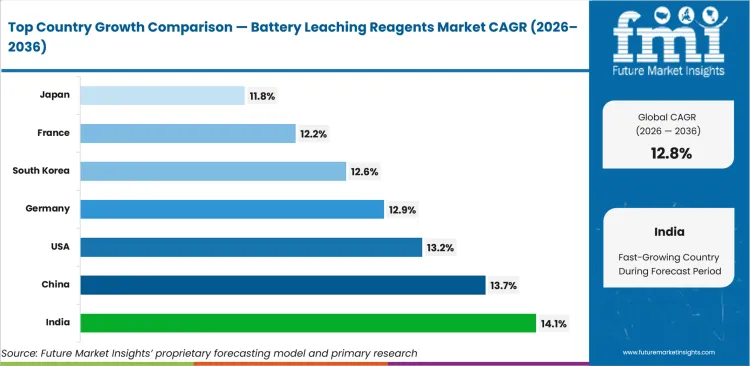
| Country | CAGR |
|---|---|
| India | 14.1% |
| China | 13.7% |
| United States | 13.2% |
| Germany | 12.9% |
| South Korea | 12.6% |
| France | 12.2% |
| Japan | 11.8% |
| United Kingdom | 11.4% |
Source: Future Market Insights, 2026.
How do country-level CAGRs compare in the Battery Leaching Reagents Market?
India leads country expansion while United Kingdom records the most cautious pace among profiled markets.
- India is forecast to record 14.1% CAGR by 2036, driven by EPR-backed battery channels and electric two-wheeler returns entering licensed recycling networks.
- China is forecast to record 13.7% CAGR by 2036, underpinned by cathode-material clusters and lithium carbonate recovery programs.
- United States is expected to post 13.2% CAGR by 2036, backed by gigafactory scrap and domestic lithium recovery lines.
- Germany is expected to post 12.9% CAGR by 2036, guided by co-located black mass assets and EU recovery documentation needs.
- South Korea is expected to post 12.6% CAGR by 2036, supported by cathode-quality recycled material needs and used-battery tracking policy.
- France is expected to post 12.2% CAGR by 2036, linked to automaker circularity systems and EU material recovery obligations.
- Japan is expected to post 11.8% CAGR by 2036, strengthened by J-Cycle’s black mass plan and trading-company coordination.
- United Kingdom is expected to post 11.4% CAGR by 2036, tempered by pilot-scale capacity while critical-mineral recycling targets support future reagent demand.
How fast is the Battery Leaching Reagents Market growing in India?
A 14.1% CAGR through 2036 reflects EPR-backed battery channels and electric two-wheeler returns entering licensed recycling networks.
Country Market Snapshot Table
| Parameter | Value |
|---|---|
| Market Size in 2025 (Value) | USD 113.9 million |
| Market Size in 2026 (Value) | USD 130.0 million |
| Market Forecast in 2036 (Value) | USD 486.2 million |
| CAGR (2026 to 2036) | 14.1% |
| Years Considered | 2021 to 2036 |
| Base Year | 2025 |
| Forecast Period | 2026 to 2036 |
| Units Considered | Value (USD million) |
| Leading Sub-Region | Gujarat, Maharashtra, Telangana, Karnataka, Tamil Nadu, Delhi-NCR |
India Battery Leaching Reagents Market Outlook
India demand for battery leaching reagents is advancing through formal waste-battery rules and electric two-wheeler return streams. Licensed recyclers need low-cost acids and wastewater control for mixed lithium-ion feedstock.
Suppliers are expected to win through local tank logistics and technical support. Recyclers serving two-wheeler and portable battery channels will need practical leach chemistry suited to variable pack quality.
Key Growth Drivers
- Licensed recyclers need dependable leach feedstock from electric mobility channels, supported by Ministry of Heavy Industries reporting 11,49,334 electric 2-wheelers sold in FY 2024-25 at 21% annual rise.
- Formal collection channels are expanding across battery producers and recyclers, reinforced by India Press Information Bureau reporting 3,664 producers and 442 recyclers registered on the battery EPR portal by August 2025.
- Two-wheeler battery returns require cost-controlled sulfuric acid recipes suitable for smaller packs and varied chemistries.
- Domestic chemical distributors gain scope as recyclers need local supply and dosing advice.
Key Restraints
- Informal collection can weaken traceability and reduce black mass consistency for hydrometallurgical buyers.
- Imported black mass may compete with domestic scrap sourcing during early plant ramp-up, documented in a 2025 environment ministry decision covering a 10,000 MT lithium-ion black mass import application.
- Higher-cost organic acid systems may face slower acceptance among price-sensitive recyclers.
What makes India unique
India stands out for a wide electric two-wheeler base and recyclers balancing low reagent cost with safer recovery operations.
Key Companies
- Attero
- Lohum
- Tata Chemicals
- Gravita India
- Ecoreco
- Neogen Chemicals
- Rubamin
Sales & Marketing Channels
- Domestic industrial acid distributors
- Direct sales to licensed recyclers
- Producer responsibility channels
- Two-wheeler OEM return networks
- Regional battery waste aggregators
- Recycling park supply agreements
Country Segment Breakdown Table
| Segment | Sub-Segments |
|---|---|
| By Reagent Type | Sulfuric Acid, Hydrochloric Acid, Organic Acids, Reducing Agents / Other |
| By Battery Chemistry | NMC / NCA, LFP, LCO, Mixed Black Mass |
| By Process Step | Primary Leaching, Selective Leaching, Impurity Removal, Precipitation Support |
| By End Use | Battery Recyclers, Hydrometallurgy Plants, Cathode Producers, Integrated OEM Recycling |
| By Sales Channel | Direct Bulk Supply, Chemical Distributors, Process Bundled |
| Key Sub-Regions Covered, Industrial Corridors | Gujarat, Maharashtra, Telangana, Karnataka, Tamil Nadu, Delhi-NCR |
Frequently Asked Questions
How fast is India Battery Leaching Reagents Market growing?
India is expected to grow at 14.1% CAGR through 2036 as registered battery-waste channels and two-wheeler pack returns build a wider recovery base.
Who leads India Battery Leaching Reagents Market?
Attero leads India Battery Leaching Reagents Market, supported by Lohum and Tata Chemicals across local recycling, material recovery, and chemical supply services.
What is driving adoption in India Battery Leaching Reagents Market?
Demand is driven by licensed recyclers seeking affordable leach chemistry for mixed two-wheeler, and stationary storage battery streams.
How fast is the Battery Leaching Reagents Market growing in China?
A 13.7% CAGR through 2036 reflects cathode-material clusters and lithium carbonate recovery programs.
Country Market Snapshot Table
| Parameter | Value |
|---|---|
| Market Size in 2025 (Value) | USD 422.2 million |
| Market Size in 2026 (Value) | USD 480.0 million |
| Market Forecast in 2036 (Value) | USD 1,733.2 million |
| CAGR (2026 to 2036) | 13.7% |
| Years Considered | 2021 to 2036 |
| Base Year | 2025 |
| Forecast Period | 2026 to 2036 |
| Units Considered | Value (USD million) |
| Leading Sub-Region | Guangdong, Jiangsu, Zhejiang, Hubei, Jiangxi, Sichuan |
China Battery Leaching Reagents Market Outlook
China demand reflects integrated battery recycling and cathode-material clusters operating near cell producers. Buyers favor low-cost sulfuric acid systems and reducing-agent programs that protect lithium and manganese recovery.
Reagent suppliers compete on delivery reliability and application support. High LFP and NMC flows keep process recipes varied across large recycling parks.
Key Growth Drivers
- Integrated recyclers require repeat acid supply for higher black mass throughput, shown by GEM reporting 27,454 tons of power battery recycling and dismantling in 2024 at 57.49% annual rise.
- Cathode-material clusters lift demand for recovered metals close to battery plants, evidenced by IEA reporting China held 70% of electric car production and over 80% of battery cell production in 2025.
- High LFP volumes support lithium-focused leach design and lower-cost acid programs.
- Recycling parks shorten delivery routes for bulk acid and precipitation support chemicals.
Key Restraints
- Recovered-material standards raise process-control pressure for leach operators, indicated by China’s revised scrapped-battery standards requiring at least 90% lithium recovery and 98% powdered electrode recovery.
- Battery material price cycles can reduce reagent spending discipline during weaker recovery margins.
- Mixed e-bike, storage, and EV battery streams add sorting burden before chemical leaching begins.
What makes China unique
China differs through co-located recycling parks and dense battery manufacturing scrap flows.
Key Companies
- GEM Co.
- Brunp Recycling
- Ganfeng Lithium Recycling
- Huayou Recycling
- Miracle Automation
- Hunan Bangpu
- Guangdong Guanghua Sci-Tech
Sales & Marketing Channels
- Direct supply to integrated recyclers
- Provincial chemical distributor routes
- Cathode producer purchasing groups
- OEM battery return channels
- Recycling park supply agreements
- Captive reagent supply planning
Country Segment Breakdown Table
| Segment | Sub-Segments |
|---|---|
| By Reagent Type | Sulfuric Acid, Hydrochloric Acid, Organic Acids, Reducing Agents / Other |
| By Battery Chemistry | NMC / NCA, LFP, LCO, Mixed Black Mass |
| By Process Step | Primary Leaching, Selective Leaching, Impurity Removal, Precipitation Support |
| By End Use | Battery Recyclers, Hydrometallurgy Plants, Cathode Producers, Integrated OEM Recycling |
| By Sales Channel | Direct Bulk Supply, Chemical Distributors, Process Bundled |
| Key Sub-Regions Covered, Industrial Corridors | Guangdong, Jiangsu, Zhejiang, Hubei, Jiangxi, Sichuan |
Frequently Asked Questions
How fast is China Battery Leaching Reagents Market growing?
China is expected to grow at 13.7% CAGR through 2036 as integrated recycling parks and cathode-material plants convert larger scrap flows into reagent demand.
Who leads China Battery Leaching Reagents Market?
GEM Co. leads China Battery Leaching Reagents Market, supported by Brunp Recycling and Ganfeng Lithium Recycling across recovery and black mass processing.
What is driving adoption in China Battery Leaching Reagents Market?
Adoption is driven by recyclers linking lithium carbonate recovery, and cathode precursor supply within nearby industrial clusters.
How fast is the Battery Leaching Reagents Market growing in United States?
A 13.2% CAGR through 2036 reflects gigafactory scrap and domestic lithium recovery lines.
Country Market Snapshot Table
| Parameter | Value |
|---|---|
| Market Size in 2025 (Value) | USD 295.9 million |
| Market Size in 2026 (Value) | USD 335.0 million |
| Market Forecast in 2036 (Value) | USD 1,157.5 million |
| CAGR (2026 to 2036) | 13.2% |
| Years Considered | 2021 to 2036 |
| Base Year | 2025 |
| Forecast Period | 2026 to 2036 |
| Units Considered | Value (USD million) |
| Leading Sub-Region | Nevada, Georgia, Ohio, Tennessee, South Carolina, Michigan |
United States Battery Leaching Reagents Market Outlook
United States buyers are scaling reagent programs around domestic critical-mineral security and specialist recycling campuses. Bulk acid supply and documented lithium recovery shape supplier selection.
Recyclers are expected to prioritize contracts that combine delivery reliability and application support. Battery material producers will value reagent partners able to support quality records for recovered lithium carbonate and precursor inputs.
Key Growth Drivers
- Gigafactory scrap creates steady early feedstock for leach operations, backed by Redwood Materials reporting Ultium Cells’ two facilities expect more than 80 GWh of combined annual cell output with scrap routed to Redwood.
- Domestic lithium recovery improves the commercial case for reagent contracts, validated by Ascend Elements announcing up to 3,000 metric tons per year of recycled lithium carbonate output from Covington.
- OEM battery return agreements give acid suppliers better visibility into future recovery campaigns.
- Domestic mineral security programs support auditable recovery routes instead of landfill disposal.
Key Restraints
- Acid storage permits and hazardous-material handling raise site costs for smaller hydrometallurgy projects.
- Project qualification can slow supplier switching in plants with strict safety and purity requirements.
- Capital intensity remains a hurdle for new entrants, summarized by a 2024 U.S. energy department report noting over USD 5 billion in federal investments across 39 battery material and recycling projects.
What makes United States unique
United States separates itself through large gigafactory scrap streams and critical-mineral security programs linked to battery recycling.
Key Companies
- Redwood Materials
- Ascend Elements
- Aqua Metals
- Cirba Solutions
- Retriev Technologies
- Li Industries
- Nth Cycle
Sales & Marketing Channels
- Direct bulk contracts with recyclers
- Technical sales to hydrometallurgy plants
- OEM recycling partnerships
- Chemical distributor coverage for pilots
- Engineering purchasing links for new plants
- Tanker and storage service packages
Country Segment Breakdown Table
| Segment | Sub-Segments |
|---|---|
| By Reagent Type | Sulfuric Acid, Hydrochloric Acid, Organic Acids, Reducing Agents / Other |
| By Battery Chemistry | NMC / NCA, LFP, LCO, Mixed Black Mass |
| By Process Step | Primary Leaching, Selective Leaching, Impurity Removal, Precipitation Support |
| By End Use | Battery Recyclers, Hydrometallurgy Plants, Cathode Producers, Integrated OEM Recycling |
| By Sales Channel | Direct Bulk Supply, Chemical Distributors, Process Bundled |
| Key Sub-Regions Covered, Industrial Corridors | Nevada, Georgia, Ohio, Tennessee, South Carolina, Michigan |
Frequently Asked Questions
How fast is United States Battery Leaching Reagents Market growing?
United States demand is expected to rise at 13.2% CAGR as gigafactory scrap and recycled lithium carbonate projects create direct bulk acid needs.
Who leads United States Battery Leaching Reagents Market?
Redwood Materials leads United States Battery Leaching Reagents Market, supported by Ascend Elements and Aqua Metals across recycling and hydrometallurgy programs.
What is driving adoption in United States Battery Leaching Reagents Market?
Adoption is driven by plants seeking reliable acids and reducing agents for manufacturing scrap and domestic lithium recovery.
How fast is the Battery Leaching Reagents Market growing in Germany?
A 12.9% CAGR through 2036 reflects co-located black mass assets and EU recovery documentation needs.
Country Market Snapshot Table
| Parameter | Value |
|---|---|
| Market Size in 2025 (Value) | USD 150.6 million |
| Market Size in 2026 (Value) | USD 170.0 million |
| Market Forecast in 2036 (Value) | USD 572.0 million |
| CAGR (2026 to 2036) | 12.9% |
| Years Considered | 2021 to 2036 |
| Base Year | 2025 |
| Forecast Period | 2026 to 2036 |
| Units Considered | Value (USD million) |
| Leading Sub-Region | Schwarzheide, Thuringia, Saxony, North Rhine-Westphalia, Bavaria, Baden-Wurttemberg |
Germany Battery Leaching Reagents Market Outlook
Germany reagent demand centers on chemical-engineering control and co-located black mass facilities. Buyers require documentation and impurity limits aligned with battery-material production.
Suppliers with application labs and reliable bulk delivery will gain better account access. Premium buyers will emphasize recovery records and wastewater support more than low spot acid pricing.
Key Growth Drivers
- Commercial black mass capacity creates local reagent pull, illustrated by BASF starting Schwarzheide operations in June 2025 with annual processing capacity of up to 15,000 tons of end-of-life lithium-ion batteries and production scrap.
- EU recovery rules increase the need for controlled leaching chemistry, substantiated by European Commission 2025 rules setting 2027 material recovery targets of 90% for cobalt, copper, lead, and nickel and 50% for lithium.
- Automotive battery clusters create production scrap and future end-of-life volumes for NMC recovery.
- Chemical engineering depth supports specialized leach recipes and impurity-removal systems.
Key Restraints
- High energy and compliance costs can slow hydrometallurgy project economics.
- Strict permitting can extend timelines for wastewater treatment and hazardous material handling.
- Industrial softness can delay capital plans, marked by Germany’s federal statistics office reporting real industrial production down 2.4% month on month in December 2024.
What makes Germany unique
Germany’s position rests on Schwarzheide black mass activity and EU compliance pressure around recovered battery metals.
Key Companies
- BASF
- Duesenfeld
- Redux Recycling
- Accurec Recycling
- Erlos
- Alba Group
- Cronimet
Sales & Marketing Channels
- Direct industrial acid supply
- Process chemical contracts
- OEM-linked recycling programs
- Engineering purchasing routes
- Technical service partnerships
- EU compliance documentation support
Country Segment Breakdown Table
| Segment | Sub-Segments |
|---|---|
| By Reagent Type | Sulfuric Acid, Hydrochloric Acid, Organic Acids, Reducing Agents / Other |
| By Battery Chemistry | NMC / NCA, LFP, LCO, Mixed Black Mass |
| By Process Step | Primary Leaching, Selective Leaching, Impurity Removal, Precipitation Support |
| By End Use | Battery Recyclers, Hydrometallurgy Plants, Cathode Producers, Integrated OEM Recycling |
| By Sales Channel | Direct Bulk Supply, Chemical Distributors, Process Bundled |
| Key Sub-Regions Covered, Industrial Corridors | Schwarzheide, Thuringia, Saxony, North Rhine-Westphalia, Bavaria, Baden-Wurttemberg |
Frequently Asked Questions
How fast is Germany Battery Leaching Reagents Market growing?
Germany is expected to grow at 12.9% CAGR as black mass capacity and EU recovery calculations push recyclers toward qualified leach chemistry.
Who leads Germany Battery Leaching Reagents Market?
BASF leads Germany Battery Leaching Reagents Market, supported by Duesenfeld and Redux Recycling across black mass handling and recovery services.
What is driving adoption in Germany Battery Leaching Reagents Market?
Adoption is driven by EU-compliant recovery projects requiring reliable acids and documented chemical inputs.
How fast is the Battery Leaching Reagents Market growing in South Korea?
A 12.6% CAGR through 2036 reflects cathode-quality recycled material needs and used-battery tracking policy.
Country Market Snapshot Table
| Parameter | Value |
|---|---|
| Market Size in 2025 (Value) | USD 106.6 million |
| Market Size in 2026 (Value) | USD 120.0 million |
| Market Forecast in 2036 (Value) | USD 393.2 million |
| CAGR (2026 to 2036) | 12.6% |
| Years Considered | 2021 to 2036 |
| Base Year | 2025 |
| Forecast Period | 2026 to 2036 |
| Units Considered | Value (USD million) |
| Leading Sub-Region | Gunsan, Pohang, Ulsan, Cheongju, Gwangyang, Seoul capital area |
South Korea Battery Leaching Reagents Market Outlook
South Korea demand follows cathode-quality recycling needs and policy-led used-battery tracking. Qualified reagent suppliers must support purity control for recovered nickel and lithium streams.
Battery-material customers are expected to require strict documentation before switching reagent suppliers. Hydrometallurgy plants will favor partners able to assist with sampling and safety checks.
Key Growth Drivers
- Battery recycling firms need shared test infrastructure before expanding reagent recipes, with Korea’s climate ministry opening a 17,000㎡ Battery Circulation Cluster in Pohang for used-battery performance evaluation and valuable metal extraction.
- Cathode-quality recovery needs certified recycled mineral use, reinforced by Korea’s industry ministry setting four policy measures covering performance evaluation and recycled-material use promotion in 2026.
- NMC-rich manufacturing scrap supports higher reagent value through nickel and cobalt recovery.
- Cathode producers require cleaner leach recipes and tighter impurity limits for recovered material acceptance.
Key Restraints
- Limited public plant-level disclosure makes reagent demand estimation harder for new suppliers.
- Customer qualification requirements can slow switching from incumbent process chemical suppliers.
- Safety priorities can lengthen approval cycles for new leach suppliers, as Korea’s environment ministry plan adds pre-distribution and post-distribution safety inspections for used batteries before wider trading.
What makes South Korea unique
South Korea gains distinction from cathode-grade quality expectations and used-battery policy built around tracking and certification.
Key Companies
- SungEel HiTech
- POSCO HY Clean Metal
- EcoPro CnG
- SK tes
- Korea Zinc
- Young Poong
- SeAH Besteel
Sales & Marketing Channels
- Direct supply to battery recyclers
- Cathode producer purchasing teams
- Industrial chemical distributors
- OEM recycling partnerships
- Government-backed recycling pilots
- Quality-certified material programs
Country Segment Breakdown Table
| Segment | Sub-Segments |
|---|---|
| By Reagent Type | Sulfuric Acid, Hydrochloric Acid, Organic Acids, Reducing Agents / Other |
| By Battery Chemistry | NMC / NCA, LFP, LCO, Mixed Black Mass |
| By Process Step | Primary Leaching, Selective Leaching, Impurity Removal, Precipitation Support |
| By End Use | Battery Recyclers, Hydrometallurgy Plants, Cathode Producers, Integrated OEM Recycling |
| By Sales Channel | Direct Bulk Supply, Chemical Distributors, Process Bundled |
| Key Sub-Regions Covered, Industrial Corridors | Gunsan, Pohang, Ulsan, Cheongju, Gwangyang, Seoul capital area |
Frequently Asked Questions
How fast is South Korea Battery Leaching Reagents Market growing?
South Korea is expected to grow at 12.6% CAGR as battery-material producers require tighter recovery chemistry for cathode-grade recycled inputs.
Who leads South Korea Battery Leaching Reagents Market?
SungEel HiTech leads South Korea Battery Leaching Reagents Market, supported by POSCO HY Clean Metal and EcoPro CnG across recycling and recovered material pathways.
What is driving adoption in South Korea Battery Leaching Reagents Market?
Adoption is driven by used-battery tracking and battery-material plants needing predictable impurity control.
How fast is the Battery Leaching Reagents Market growing in France?
A 12.2% CAGR through 2036 reflects automaker circularity systems and EU material recovery obligations.
Country Market Snapshot Table
| Parameter | Value |
|---|---|
| Market Size in 2025 (Value) | USD 84.7 million |
| Market Size in 2026 (Value) | USD 95.0 million |
| Market Forecast in 2036 (Value) | USD 300.4 million |
| CAGR (2026 to 2036) | 12.2% |
| Years Considered | 2021 to 2036 |
| Base Year | 2025 |
| Forecast Period | 2026 to 2036 |
| Units Considered | Value (USD million) |
| Leading Sub-Region | Ile-de-France, Auvergne-Rhone-Alpes, Grand Est, Hauts-de-France, Normandy, Occitanie |
France Battery Leaching Reagents Market Outlook
France demand develops through automaker circularity programs and EU recovery rules. Reuse programs can delay black mass volumes, while regulated recycling builds later demand for qualified leaching inputs.
Industrial chemical suppliers will gain access through licensed battery handlers and OEM collection systems. Reagent demand will rise as repair-first pathways eventually send more packs into hydrometallurgical recovery.
Key Growth Drivers
- Automaker battery responsibility is strengthening recycling channels, as The Future Is NEUTRAL already manages end-of-life vehicle systems for 15 automotive brands in France and now handles EV battery end-of-life routes.
- EU material recovery requirements raise future reagent needs, quantified by Renault Group citing 50% lithium recovery by 2027, 80% by 2031, and up to 95% for cobalt and copper.
- Domestic environmental service firms create routes for reagent suppliers into licensed recovery projects.
- French OEM circularity programs support pack tracking before batteries enter chemical processing.
Key Restraints
- Repair and reuse can delay black mass availability for leaching campaigns.
- Limited public disclosure on reagent purchasing reduces account visibility for new suppliers.
- Battery repair pathways slow scrap conversion, highlighted by The Future Is NEUTRAL stating over 90% of defective batteries can be repaired and more than 18,000 batteries had been repaired by GAIA since 2012.
What makes France unique
France’s profile comes from repair-first EV battery circularity and EU recovery obligations influencing the timing of chemical demand.
Key Companies
- SNAM
- The Future Is NEUTRAL
- Veolia France
- Orano
- Eramet Ideas
- MTB Recycling
- Recupyl
Sales & Marketing Channels
- Industrial chemical distributors
- Automotive circularity partnerships
- Licensed battery waste processors
- EU compliance-based buying
- Direct sales to hydrometallurgy projects
- Battery repair-to-recycling networks
Country Segment Breakdown Table
| Segment | Sub-Segments |
|---|---|
| By Reagent Type | Sulfuric Acid, Hydrochloric Acid, Organic Acids, Reducing Agents / Other |
| By Battery Chemistry | NMC / NCA, LFP, LCO, Mixed Black Mass |
| By Process Step | Primary Leaching, Selective Leaching, Impurity Removal, Precipitation Support |
| By End Use | Battery Recyclers, Hydrometallurgy Plants, Cathode Producers, Integrated OEM Recycling |
| By Sales Channel | Direct Bulk Supply, Chemical Distributors, Process Bundled |
| Key Sub-Regions Covered, Industrial Corridors | Ile-de-France, Auvergne-Rhone-Alpes, Grand Est, Hauts-de-France, Normandy, Occitanie |
Frequently Asked Questions
How fast is France Battery Leaching Reagents Market growing?
France is expected to grow at 12.2% CAGR as OEM battery responsibility and EU recovery thresholds create a clearer path for leach chemistry demand.
Who leads France Battery Leaching Reagents Market?
SNAM leads France Battery Leaching Reagents Market, supported by The Future Is NEUTRAL and Veolia France across collection, repair, and recycling channels.
What is driving adoption in France Battery Leaching Reagents Market?
Adoption is driven by automaker-funded collection systems and gradual conversion of repaired packs into recycling feedstock.
How fast is the Battery Leaching Reagents Market growing in Japan?
A 11.8% CAGR through 2036 reflects J-Cycle’s black mass plan and trading-company coordination.
Country Market Snapshot Table
| Parameter | Value |
|---|---|
| Market Size in 2025 (Value) | USD 80.5 million |
| Market Size in 2026 (Value) | USD 90.0 million |
| Market Forecast in 2036 (Value) | USD 274.6 million |
| CAGR (2026 to 2036) | 11.8% |
| Years Considered | 2021 to 2036 |
| Base Year | 2025 |
| Forecast Period | 2026 to 2036 |
| Units Considered | Value (USD million) |
| Leading Sub-Region | Ibaraki, Shizuoka, Aichi, Osaka, Tokyo, Kyushu |
Japan Battery Leaching Reagents Market Outlook
Japan demand is led by trading-house-backed black mass projects and high safety expectations. Smaller batch variation favors suppliers offering stable packaging and technical support.
Reagent adoption will develop through recycling ventures and industrial chemical channels. Buyers will place value on safety records and recipe control before expanding bulk acid commitments.
Key Growth Drivers
- Black mass production is moving into domestic ventures, shown by Mitsui listing J-Cycle ownership at 51% by VOLTA, 27% by Miracle Eternal, and 22% by Mitsui for lithium-ion battery recycling.
- Recycling technology goals support reagent qualification, as NEDO’s 2026 program targets at least 70% lithium recovery and more than 95% recovery for both nickel and cobalt.
- Consumer electronics recycling experience improves sorting discipline before chemical leaching.
- Domestic battery security goals support safer black mass handling and recovered-metal routing.
Key Restraints
- High safety expectations raise acid storage and transport costs for smaller recyclers.
- Domestic EV pack returns remain measured compared with China and North America.
- Domestic feedstock formation may remain slower than larger EV hubs, while IEA reported China captured nearly 75% of global electric-car manufacturing and about 40% of related trade in 2025.
What makes Japan unique
Japan stands apart through trading-company coordination and safety-led reagent qualification practices.
Key Companies
- J-Cycle
- VOLTA
- Sumitomo Metal Mining
- DOWA Eco-System
- JX Metals
- Toyota Chemical Engineering
- Mitsui
Sales & Marketing Channels
- Trading company supply routes
- Direct sales to recycling ventures
- Specialty chemical distributors
- Electronics recycling networks
- OEM pack return programs
- Safety documentation channels
Country Segment Breakdown Table
| Segment | Sub-Segments |
|---|---|
| By Reagent Type | Sulfuric Acid, Hydrochloric Acid, Organic Acids, Reducing Agents / Other |
| By Battery Chemistry | NMC / NCA, LFP, LCO, Mixed Black Mass |
| By Process Step | Primary Leaching, Selective Leaching, Impurity Removal, Precipitation Support |
| By End Use | Battery Recyclers, Hydrometallurgy Plants, Cathode Producers, Integrated OEM Recycling |
| By Sales Channel | Direct Bulk Supply, Chemical Distributors, Process Bundled |
| Key Sub-Regions Covered, Industrial Corridors | Ibaraki, Shizuoka, Aichi, Osaka, Tokyo, Kyushu |
Frequently Asked Questions
How fast is Japan Battery Leaching Reagents Market growing?
Japan is expected to grow at 11.8% CAGR as new black mass ventures combine domestic recycling expertise with trading-company feedstock channels.
Who leads Japan Battery Leaching Reagents Market?
J-Cycle leads Japan Battery Leaching Reagents Market, supported by VOLTA and Sumitomo Metal Mining across local recycling, material handling, and metal recovery.
What is driving adoption in Japan Battery Leaching Reagents Market?
Adoption is driven by black mass production plans and safety-focused qualification for acid handling.
How fast is the Battery Leaching Reagents Market growing in United Kingdom?
A 11.4% CAGR through 2036 reflects pilot-scale capacity while critical-mineral recycling targets support future reagent demand.
Country Market Snapshot Table
| Parameter | Value |
|---|---|
| Market Size in 2025 (Value) | USD 67.3 million |
| Market Size in 2026 (Value) | USD 75.0 million |
| Market Forecast in 2036 (Value) | USD 220.8 million |
| CAGR (2026 to 2036) | 11.4% |
| Years Considered | 2021 to 2036 |
| Base Year | 2025 |
| Forecast Period | 2026 to 2036 |
| Units Considered | Value (USD million) |
| Leading Sub-Region | Teesside, Plymouth, Birmingham, Coventry, West Midlands, Cornwall |
United Kingdom Battery Leaching Reagents Market Outlook
United Kingdom demand remains strategy-led, with early reagent volumes tied to validation projects and specialist recyclers. Direct bulk demand relies on conversion from critical-mineral targets into commercial hydrometallurgy assets.
Suppliers serving pilots can build future accounts through documentation and mixed-chemistry support. Larger contracts are expected to follow projects that progress from black mass testing to continuous leach operations.
Key Growth Drivers
- Critical-mineral recycling targets support future leach chemistry demand, measured by Vision 2035 setting a goal for 20% of annual UK critical mineral demand to be met through recycling by 2035.
- Pilot hydrometallurgy projects need flexible reagent supply, backed by Altilium stating its ACT2 plant can recover lithium and other battery metals from 300 kg of black mass waste per day.
- University and test-center projects create smaller purchases before bulk acid contracts mature.
- Specialist recyclers and automotive battery programs create early buyer access for approved distributors.
Key Restraints
- Smaller domestic black mass refining capacity limits immediate direct bulk acid demand.
- Planning and waste handling requirements can slow new recycling site approvals.
- Domestic supply gaps remain a constraint, recorded in Vision 2035 through the target to meet 10% of annual critical mineral demand from domestic production by 2035.
What makes United Kingdom unique
United Kingdom is set apart by critical-mineral policy targets and specialist chemical supply channels ahead of large-scale reagent consumption.
Key Companies
- Altilium
- Recyclus Group
- Technology Minerals
- LiBatt Recycling
- Veolia UK
- Cawleys
- Fenix Battery Recycling
Sales & Marketing Channels
- Specialist chemical distributors
- Recycling technology pilots
- University and test-center purchasing
- Direct supply to licensed waste handlers
- OEM and fleet battery return programs
- Critical mineral project partnerships
Country Segment Breakdown Table
| Segment | Sub-Segments |
|---|---|
| By Reagent Type | Sulfuric Acid, Hydrochloric Acid, Organic Acids, Reducing Agents / Other |
| By Battery Chemistry | NMC / NCA, LFP, LCO, Mixed Black Mass |
| By Process Step | Primary Leaching, Selective Leaching, Impurity Removal, Precipitation Support |
| By End Use | Battery Recyclers, Hydrometallurgy Plants, Cathode Producers, Integrated OEM Recycling |
| By Sales Channel | Direct Bulk Supply, Chemical Distributors, Process Bundled |
| Key Sub-Regions Covered, Industrial Corridors | Teesside, Plymouth, Birmingham, Coventry, West Midlands, Cornwall |
Frequently Asked Questions
How fast is United Kingdom Battery Leaching Reagents Market growing?
United Kingdom demand is expected to rise at 11.4% CAGR as recycling targets and pilot plants create early specialist reagent needs.
Who leads United Kingdom Battery Leaching Reagents Market?
Altilium leads United Kingdom Battery Leaching Reagents Market, supported by Recyclus Group and Technology Minerals across pilot recycling and critical mineral recovery.
What is driving adoption in United Kingdom Battery Leaching Reagents Market?
Adoption is driven by LFP recycling trials and specialist recyclers preparing for mixed feedstock processing.
Who are the leading companies in the Battery Leaching Reagents Market?
BASF, GEM Co., Redwood Materials, Ascend Elements, Glencore, Ganfeng Lithium, Attero, Solvay, Umicore, and Li-Cycle under Glencore.
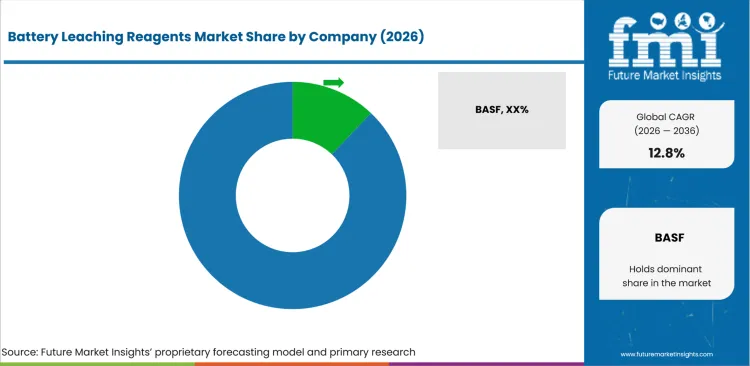
- Integrated recyclers hold an advantage based on black mass access and technical control over leach chemistry.
- Process-linked suppliers gain stronger acceptance by combining acids and documentation support.
- Regional recycling companies win in country markets through collection networks and local handling licenses.
- Service-ready reagent suppliers improve renewal chances led by safety planning and wastewater troubleshooting.
Battery recycling companies compete by combining feedstock access and hydrometallurgical recovery routes. BASF has a strong position through black mass and metal refinery activity in Germany. GEM Co. competes through integrated Chinese recycling and lithium recovery scale. Redwood Materials and Ascend Elements hold value across North American manufacturing scrap and recycled lithium carbonate routes.
Process chemistry and documentation depth have become stronger competitive separators as recyclers move beyond mechanical black mass sales. Glencore competes through battery recycling services after acquiring Li-Cycle. Ganfeng Lithium links lithium processing knowledge with recycling exposure. Solvay and Umicore strengthen competition through specialty chemistry and global technical support.
Regional suppliers can win through local battery waste channels and quicker field support. India, South Korea, Japan, France, and the United Kingdom create opportunities for companies operating approved collection and recovery programs. Suppliers proving stable metal recovery and lower impurity carryover should gain more durable recycler relationships.
How do top Battery Leaching Reagents Market companies compare?
BASF and GEM Co. score on integrated recovery depth while Redwood Materials and Ascend Elements lead through North American black mass and recycled lithium routes.
| Company | Link to Market Title | Leach Chemistry Depth | Black Mass Feedstock Access | Battery-Grade Recovery Link | Channel Reach | Geographic Footprint |
|---|---|---|---|---|---|---|
| BASF | Very High | Very Strong | Strong | Very Strong | Very Strong | Europe and global |
| GEM Co. | Very High | Very Strong | Very Strong | Very Strong | Strong | China and Asia |
| Redwood Materials | High | Strong | Very Strong | Strong | Strong | North America |
| Ascend Elements | High | Very Strong | Strong | Very Strong | Moderate | North America and Europe |
| Glencore | High | Strong | Very Strong | Strong | Very Strong | Global |
| Ganfeng Lithium | High | Moderate | Strong | Very Strong | Strong | China and global |
| Attero | Moderate to High | Moderate | Moderate | Strong | Strong | India and international |
| Solvay | Moderate | Strong | Low | Moderate | Very Strong | Global |
| Umicore | High | Strong | Moderate | Strong | Strong | Europe and global |
| Li-Cycle under Glencore | Moderate to High | Moderate | Strong | Moderate | Strong | North America and Europe |
Source: Future Market Insights competitive analysis, 2026.
Who are the key players in the Battery Leaching Reagents Market?
BASF, GEM Co. and Redwood Materials are listed with Ascend Elements and Glencore among other suppliers.
Key global companies leading the Battery Leaching Reagents Market include:
- BASF
- GEM Co.
- Redwood Materials
- Ascend Elements
- Glencore
- Ganfeng Lithium
- Attero
- Solvay
- Umicore
- Li-Cycle under Glencore
Key Developments in Battery Leaching Reagents Market
- In June 2025, BASF started commercial operation of its Schwarzheide black mass plant for battery recycling, with annual processing capacity of up to 15,000 tons.
- In December 2024, Ascend Elements announced a Covington lithium recovery line expected to produce up to 3,000 metric tons of recycled lithium carbonate per year.
- In August 2025, Glencore completed the acquisition of Li-Cycle and moved future services under Glencore Battery Recycling.
Key Players in the Battery Leaching Reagents Market
Integrated Battery Materials and Recycling Firms
- BASF
- Umicore
- Glencore
- GEM Co.
- Ganfeng Lithium
Specialist Recycling and Recovery Companies
- Redwood Materials
- Ascend Elements
- Attero
- Li-Cycle under Glencore
- SungEel HiTech
Chemical and Process Supply Participants
- BASF
- Solvay
- Regional industrial chemical distributors
- Sulfuric acid suppliers
- Specialty reagent distributors
Lithium and Black Mass Recovery Specialists
- GEM Co.
- Ascend Elements
- Redwood Materials
- J-Cycle
- Altilium
Battery Leaching Reagents Market - Scope & Definition
| Attribute | Detail |
|---|---|
| Market Definition | Chemicals used to dissolve and recover metals from lithium-ion battery black mass and related recycling intermediates |
| Functions Covered | Acid dissolution, reducing-agent support, selective leaching, impurity removal, precipitation support, safe dosing, and process documentation |
| Applications Covered | Black mass refining, production scrap recycling, end-of-life lithium-ion battery recovery, cathode-linked recovery routes, and recovered lithium processing |
| End Users Covered | Battery recyclers, hydrometallurgy plants, cathode producers, and integrated OEM recycling loops |
| Grades Covered | Industrial acid grades, controlled-purity leaching reagents, organic acids, and auxiliary reducing or precipitation chemicals |
| Inclusions | Commercially sold reagents used in lithium-ion battery black mass recovery across selected countries and regions |
| Exclusions | Lead-acid electrolyte recovery, general pickling acids not sold into battery recycling, mechanical shredding services, furnace-only recycling, and finished cathode materials |
Battery Leaching Reagents Market - Research Methodology
| Method | Description |
|---|---|
| Primary Research | FMI analyst interviews with battery recyclers, hydrometallurgy operators, chemical distributors, cathode material producers, OEM circularity teams, and process engineers across selected markets |
| Desk Research | Review of official battery recycling announcements, critical minerals policy material, company facility disclosures, regulator pages, and government or organization statistics published from 2024 onward |
| Market Sizing and Forecasting | Hybrid bottom-up and top-down model using black mass capacity signals, chemistry mix, reagent intensity, average industrial acid pricing, end-use purchasing route, and country maturity |
| Data Validation | Forecasts were checked against battery demand, recycled mineral targets, known recycling assets, and company activity in hydrometallurgical recovery |
| Limitations | Country-level reagent purchasing disclosure remains uneven, so estimates use triangulation across facility activity, recycling rules, and feedstock maturitya |
Battery Leaching Reagents Market - Report Scope
| Parameter | Details |
|---|---|
| Forecast period | 2026 to 2036 |
| Historical period | 2021 to 2025 |
| Quantitative unit | Revenue in USD million |
| By reagent type | Sulfuric Acid, Hydrochloric Acid, Organic Acids, Reducing Agents / Other |
| By battery chemistry | NMC / NCA, LFP, LCO, Mixed Black Mass |
| By process step | Primary Leaching, Selective Leaching, Impurity Removal, Precipitation Support |
| By end use | Battery Recyclers, Hydrometallurgy Plants, Cathode Producers, Integrated OEM Recycling |
| By sales channel | Direct Bulk Supply, Chemical Distributors, Process Bundled |
| Regions covered | North America, Latin America, Europe, East Asia, South Asia and Pacific, Middle East and Africa |
| Countries covered | India, China, United States, Germany, South Korea, France, Japan, United Kingdom |
| Key companies profiled | BASF, GEM Co., Redwood Materials, Ascend Elements, Glencore, Ganfeng Lithium, Attero, Solvay, Umicore, Li-Cycle under Glencore |
| Approach | Hybrid bottom-up and top-down methodology using plant capacity signals, reagent intensity, chemistry mix, and country-level recycling maturity |
Source: Future Market Insights competitive analysis, 2026.
Battery Leaching Reagents Market Breakdown by Reagent Type, Battery Chemistry, Process Step, End Use, Sales Channel, and Region
Battery Leaching Reagents Market Segmented by Reagent Type
- Sulfuric Acid
- Hydrochloric Acid
- Organic Acids
- Reducing Agents / Other
Battery Leaching Reagents Market Segmented by Battery Chemistry
- NMC / NCA
- LFP
- LCO
- Mixed Black Mass
Battery Leaching Reagents Market Segmented by Process Step
- Primary Leaching
- Selective Leaching
- Impurity Removal
- Precipitation Support
Battery Leaching Reagents Market Segmented by End Use
- Battery Recyclers
- Hydrometallurgy Plants
- Cathode Producers
- Integrated OEM Recycling
Battery Leaching Reagents Market Segmented by Sales Channel
- Direct Bulk Supply
- Chemical Distributors
- Process Bundled
Battery Leaching Reagents Market by Region
- North America
- Latin America
- Europe
- East Asia
- South Asia and Pacific
- Middle East and Africa
Research Sources and Bibliography
- Altilium. (2025, February 3). Altilium commences recycling of LFP EV batteries for global automotive OEM.
- Ascend Elements. (2024, December 10). Ascend Elements to increase USA production of lithium carbonate by 60% with start of new lithium recovery line in 2025.
- Ascend Elements. (2025, September 17). Ascend Elements produces recycled lithium carbonate at commercial scale.
- BASF. (2024, April 16). Recovering valuable metals in Schwarzheide: BASF has started prototype metal refinery for battery recycling.
- BASF Battery Materials. (2025, June 3). BASF starts commercial operation of black mass plant for battery recycling in Schwarzheide, Germany.
- Department for Business and Trade. (2026, January 23). Vision 2035: Critical Minerals Strategy.
- European Commission. (2025, July 4). New rules to boost recycling efficiency from waste batteries.
- GEM Co., Ltd. (2024, May 10). GEM held a 2023 full-year and 2024 Q1 performance briefing.
- German Federal Statistical Office. (2025, February 7). Production in December 2024.
- Glencore. (2025, August 8). Li-Cycle.
- India Press Information Bureau. (2025, April 1). The Ministry of Heavy Industries has successfully achieved sales of more than one million EVs in financial year 2024-25.
- India Press Information Bureau. (2025, August 11). Electronic waste management.
- India Press Information Bureau. (2025, August 21). Parliamentary question: Circular economy for batteries.
- India Press Information Bureau. (2026, January 27). NITI Aayog launched three reports on enhancing circular economy.
- International Energy Agency. (2025, May 21). Global Critical Minerals Outlook 2025.
- International Energy Agency. (2025). Electric vehicle batteries - Global EV Outlook 2025.
- International Energy Agency. (2026). Electric vehicle batteries - Global EV Outlook 2026.
- International Energy Agency. (2026). Manufacturing and trade - Global EV Outlook 2026.
- Japan Ministry of Economy, Trade and Industry. (2025, September 30). Conceptual roadmap on building an export-oriented industrial structure.
- Korea Ministry of Climate, Energy and Environment. (2025, November 4). Full-scale operation of battery recycling hub begins: Opening of the Korea Battery Circulation Cluster.
- Korea Ministry of Environment. (2024, July 10). Establishing an integrated management system for used batteries to support the formation of a new market.
- Korea Ministry of Trade, Industry and Resources. (2026, May 20). Korea to build circular battery ecosystem with used batteries.
- Mitsui & Co. (2024, May 15). Mitsui to invest in lithium-ion battery recycling plant in Japan.
- New Energy and Industrial Technology Development Organization. (2026, March 13). Recycling lithium-ion batteries: Toward mid-scale demonstration and validation.
- Redwood Materials. (2024, May 23). Redwood partners with Ultium Cells.
- Renault Group. (2025, September 26). The circular economy of electric vehicle batteries.
- State Council of the People’s Republic of China. (2025, January 2). Government policy moves from past week.
- The Future Is NEUTRAL. (2025, November 28). The Future Is NEUTRAL operates the first individual system in France for recycling electric vehicles batteries.
- United Nations Economic Commission for Europe. (2024, October 17). Battery management of EV in Korea.
- USA Department of Energy. (2024, December). Manufacturing and Energy Supply Chains Fiscal Year 2024 annual report.
This bibliography is provided for reader reference and is not exhaustive. The full report contains the complete reference list and detailed citations.
This Report Answers
- Market size estimates for 2026 and forecasts through 2036 for the Battery Leaching Reagents Market.
- Forecast CAGR analysis for battery leaching reagent demand from 2026 to 2036.
- Evaluation of reagent types, battery chemistries, process steps, end uses, and sales channels.
- Assessment of hydrometallurgical recycling plants and controlled leaching reagent requirements.
- Analysis of EU recovery rules and their effect on reagent buying and documentation.
- Country-level analysis covering India, China, United States, Germany, South Korea, France, Japan, and United Kingdom.
- Assessment of companies active across battery recycling and recovered material pathways.
- Definition of inclusions and exclusions for the Battery Leaching Reagents Market scope.
- Explanation of FMI’s forecast approach across chemistry mix and country maturity.
- Evaluation of direct bulk supply models and their role in leaching reagent purchasing.
- Regional outlooks across North America, Latin America, Europe, East Asia, South Asia and Pacific, and Middle East and Africa.
- Delivery of market data, forecasts, and supporting analysis in report-ready format.
Frequently Asked Questions
Which companies are expected to shape the battery leaching reagents market?
BASF, GEM Co., Redwood Materials, Ascend Elements, Glencore, Ganfeng Lithium, Attero, Solvay, Umicore, and Li-Cycle under Glencore are expected to shape competition.
Why are battery recyclers investing in controlled leaching reagents?
Battery recyclers are investing in controlled leaching reagents to improve metal recovery and reduce wastewater burden.
Why is direct bulk supply important in the battery leaching reagents market?
Direct bulk supply supports stable acid delivery and dosing reliability across commercial hydrometallurgical plants.
Which reagent types are gaining attention in battery leaching?
Sulfuric acid and selected organic acids are gaining attention as plants refine mixed chemistry black mass.
How does battery chemistry influence reagent demand?
Battery chemistry influences acid strength and recovery economics across NMC and mixed streams.
Why is end use important for battery leaching reagents?
End use is important as standalone recyclers and OEM loops require different delivery, documentation, and purity standards.
What role does Direct Bulk Supply play in adoption?
Direct Bulk Supply supports adoption by combining reagent availability and repeat delivery windows for leach tanks.
Preview the report firsthand - request a free sample
Get SampleGet the brochure for pricing and purchase details.
Get PDFTable of Content
- Key Takeaways
- Market Size and CAGR
- Top Growth Driver
- Fastest Growing Segment
- Leading Region
- Key Companies
- Emerging Opportunities
- Executive Summary
- Global Market Outlook
- Demand-side Trends
- Supply-side Trends
- Technology Roadmap Analysis
- Analysis and Recommendations
- Analyst Perspective (What is happening? Why now? What should investors know?)
- Key Questions Answered
- How large is the market?
- What is the CAGR?
- What are key trends?
- Which region dominates?
- Who are the leaders?
- Market Overview
- Market Coverage / Taxonomy
- Market Definition / Scope / Limitations
- Research Methodology
- Chapter Orientation
- Analytical Lens and Working Hypotheses
- Market Structure, Signals, and Trend Drivers
- Benchmarking and Cross-market Comparability
- Market Sizing, Forecasting, and Opportunity Mapping
- Research Design and Evidence Framework
- Desk Research Programme (Secondary Evidence)
- Expert Input and Fieldwork (Primary Evidence)
- Tooling, Models, and Reference Databases
- Data Engineering and Model Build
- Quality Assurance and Audit Trail
- Market Background
- Market Dynamics (Drivers, Restraints, Opportunity, Trends)
- Scenario Forecast (Optimistic, Likely, Conservative)
- Impact Analysis
- AI Impact
- Sustainability Impact
- Regulatory Impact
- Technology Impact
- Consumer / Buyer Analysis
- Purchase Drivers
- Adoption Barriers
- Buyer Journey
- Opportunity Map Analysis
- Product Life Cycle Analysis
- Supply Chain Analysis
- Investment Feasibility Matrix
- Value Chain Analysis
- PESTLE and Porter's Analysis
- Regulatory Landscape
- Regional Parent Market Outlook
- Production and Consumption Statistics
- Import and Export Statistics
- Global Market Analysis and Forecast, 2021 to 2036
- Historical Market Size Value (USD Billion) & Volume (Unit) Analysis, 2021 to 2025
- Current and Future Market Size Value (USD Billion) & Volume (Unit) Projections, 2026 to 2036
- Y-o-Y Growth Trend Analysis
- Absolute $ Opportunity Analysis
- Global Market Pricing Analysis, 2021 to 2036
- Global Market Analysis and Forecast, By Reagent Type, 2021 to 2036
- Introduction / Key Findings
- Historical Market Size Value (USD Billion) & Volume (Unit) Analysis By Reagent Type, 2021 to 2025
- Current and Future Market Size Value (USD Billion) & Volume (Unit) Analysis and Forecast By Reagent Type, 2026 to 2036
- Sulfuric Acid
- Hydrochloric Acid
- Organic Acids
- Reducing Agents - Other
- Sulfuric Acid
- Y-o-Y Growth Trend Analysis By Reagent Type, 2021 to 2025
- Absolute $ Opportunity Analysis By Reagent Type, 2026 to 2036
- Global Market Analysis and Forecast, By Battery Chemistry, 2021 to 2036
- Introduction / Key Findings
- Historical Market Size Value (USD Billion) & Volume (Unit) Analysis By Battery Chemistry, 2021 to 2025
- Current and Future Market Size Value (USD Billion) & Volume (Unit) Analysis and Forecast By Battery Chemistry, 2026 to 2036
- NMC - NCA
- LFP
- LCO
- Mixed Black Mass
- NMC - NCA
- Y-o-Y Growth Trend Analysis By Battery Chemistry, 2021 to 2025
- Absolute $ Opportunity Analysis By Battery Chemistry, 2026 to 2036
- Global Market Analysis and Forecast, By Process Step, 2021 to 2036
- Introduction / Key Findings
- Historical Market Size Value (USD Billion) & Volume (Unit) Analysis By Process Step, 2021 to 2025
- Current and Future Market Size Value (USD Billion) & Volume (Unit) Analysis and Forecast By Process Step, 2026 to 2036
- Primary Leaching
- Selective Leaching
- Impurity Removal
- Precipitation Support
- Primary Leaching
- Y-o-Y Growth Trend Analysis By Process Step, 2021 to 2025
- Absolute $ Opportunity Analysis By Process Step, 2026 to 2036
- Global Market Analysis and Forecast, By End Use, 2021 to 2036
- Introduction / Key Findings
- Historical Market Size Value (USD Billion) & Volume (Unit) Analysis By End Use, 2021 to 2025
- Current and Future Market Size Value (USD Billion) & Volume (Unit) Analysis and Forecast By End Use, 2026 to 2036
- Battery Recyclers
- Hydrometallurgy Plants
- Cathode Producers
- Integrated OEM Recycling
- Battery Recyclers
- Y-o-Y Growth Trend Analysis By End Use, 2021 to 2025
- Absolute $ Opportunity Analysis By End Use, 2026 to 2036
- Global Market Analysis and Forecast, By Sales Channel, 2021 to 2036
- Introduction / Key Findings
- Historical Market Size Value (USD Billion) & Volume (Unit) Analysis By Sales Channel, 2021 to 2025
- Current and Future Market Size Value (USD Billion) & Volume (Unit) Analysis and Forecast By Sales Channel, 2026 to 2036
- Direct Bulk Supply
- Chemical Distributors
- Process Bundled
- Direct Bulk Supply
- Y-o-Y Growth Trend Analysis By Sales Channel, 2021 to 2025
- Absolute $ Opportunity Analysis By Sales Channel, 2026 to 2036
- Global Market Analysis and Forecast, By Region, 2021 to 2036
- Introduction
- Historical Market Size Value (USD Billion) & Volume (Unit) Analysis By Region, 2021 to 2025
- Current Market Size Value (USD Billion) & Volume (Unit) Analysis and Forecast By Region, 2026 to 2036
- North America
- Latin America
- Western Europe
- Eastern Europe
- East Asia
- South Asia and Pacific
- Middle East & Africa
- Market Attractiveness Analysis By Region
- North America Market Analysis and Forecast, By Country, 2021 to 2036
- Historical Market Size Value (USD Billion) & Volume (Unit) Trend Analysis By Market Taxonomy, 2021 to 2025
- Market Size Value (USD Billion) & Volume (Unit) Forecast By Market Taxonomy, 2026 to 2036
- By Country
- USA
- Canada
- Mexico
- By Reagent Type
- By Battery Chemistry
- By Process Step
- By End Use
- By Sales Channel
- By Country
- Market Attractiveness Analysis
- By Country
- By Reagent Type
- By Battery Chemistry
- By Process Step
- By End Use
- By Sales Channel
- Key Takeaways
- Latin America Market Analysis and Forecast, By Country
- Historical Market Size Value (USD Billion) & Volume (Unit) Trend Analysis By Market Taxonomy, 2021 to 2025
- Market Size Value (USD Billion) & Volume (Unit) Forecast By Market Taxonomy, 2026 to 2036
- By Country
- Brazil
- Chile
- Rest of Latin America
- By Reagent Type
- By Battery Chemistry
- By Process Step
- By End Use
- By Sales Channel
- By Country
- Market Attractiveness Analysis
- By Country
- By Reagent Type
- By Battery Chemistry
- By Process Step
- By End Use
- By Sales Channel
- Key Takeaways
- Western Europe Market Analysis and Forecast, By Country
- Historical Market Size Value (USD Billion) & Volume (Unit) Trend Analysis By Market Taxonomy, 2021 to 2025
- Market Size Value (USD Billion) & Volume (Unit) Forecast By Market Taxonomy, 2026 to 2036
- By Country
- Germany
- UK
- Italy
- Spain
- France
- Nordic
- BENELUX
- Rest of Western Europe
- By Reagent Type
- By Battery Chemistry
- By Process Step
- By End Use
- By Sales Channel
- By Country
- Market Attractiveness Analysis
- By Country
- By Reagent Type
- By Battery Chemistry
- By Process Step
- By End Use
- By Sales Channel
- Key Takeaways
- Eastern Europe Market Analysis and Forecast, By Country
- Historical Market Size Value (USD Billion) & Volume (Unit) Trend Analysis By Market Taxonomy, 2021 to 2025
- Market Size Value (USD Billion) & Volume (Unit) Forecast By Market Taxonomy, 2026 to 2036
- By Country
- Russia
- Poland
- Hungary
- Balkan & Baltic
- Rest of Eastern Europe
- By Reagent Type
- By Battery Chemistry
- By Process Step
- By End Use
- By Sales Channel
- By Country
- Market Attractiveness Analysis
- By Country
- By Reagent Type
- By Battery Chemistry
- By Process Step
- By End Use
- By Sales Channel
- Key Takeaways
- East Asia Market Analysis and Forecast, By Country
- Historical Market Size Value (USD Billion) & Volume (Unit) Trend Analysis By Market Taxonomy, 2021 to 2025
- Market Size Value (USD Billion) & Volume (Unit) Forecast By Market Taxonomy, 2026 to 2036
- By Country
- China
- Japan
- South Korea
- By Reagent Type
- By Battery Chemistry
- By Process Step
- By End Use
- By Sales Channel
- By Country
- Market Attractiveness Analysis
- By Country
- By Reagent Type
- By Battery Chemistry
- By Process Step
- By End Use
- By Sales Channel
- Key Takeaways
- South Asia and Pacific Market Analysis and Forecast, By Country
- Historical Market Size Value (USD Billion) & Volume (Unit) Trend Analysis By Market Taxonomy, 2021 to 2025
- Market Size Value (USD Billion) & Volume (Unit) Forecast By Market Taxonomy, 2026 to 2036
- By Country
- India
- ASEAN
- Australia & New Zealand
- Rest of South Asia and Pacific
- By Reagent Type
- By Battery Chemistry
- By Process Step
- By End Use
- By Sales Channel
- By Country
- Market Attractiveness Analysis
- By Country
- By Reagent Type
- By Battery Chemistry
- By Process Step
- By End Use
- By Sales Channel
- Key Takeaways
- Middle East & Africa Market Analysis and Forecast, By Country
- Historical Market Size Value (USD Billion) & Volume (Unit) Trend Analysis By Market Taxonomy, 2021 to 2025
- Market Size Value (USD Billion) & Volume (Unit) Forecast By Market Taxonomy, 2026 to 2036
- By Country
- Kingdom of Saudi Arabia
- Other GCC Countries
- Türkiye
- South Africa
- Other African Union
- Rest of Middle East & Africa
- By Reagent Type
- By Battery Chemistry
- By Process Step
- By End Use
- By Sales Channel
- By Country
- Market Attractiveness Analysis
- By Country
- By Reagent Type
- By Battery Chemistry
- By Process Step
- By End Use
- By Sales Channel
- Key Takeaways
- Key Countries Market Analysis
- USA
- Pricing Analysis
- Market Share Analysis, 2025
- By Reagent Type
- By Battery Chemistry
- By Process Step
- By End Use
- By Sales Channel
- Canada
- Pricing Analysis
- Market Share Analysis, 2025
- By Reagent Type
- By Battery Chemistry
- By Process Step
- By End Use
- By Sales Channel
- Mexico
- Pricing Analysis
- Market Share Analysis, 2025
- By Reagent Type
- By Battery Chemistry
- By Process Step
- By End Use
- By Sales Channel
- Brazil
- Pricing Analysis
- Market Share Analysis, 2025
- By Reagent Type
- By Battery Chemistry
- By Process Step
- By End Use
- By Sales Channel
- Chile
- Pricing Analysis
- Market Share Analysis, 2025
- By Reagent Type
- By Battery Chemistry
- By Process Step
- By End Use
- By Sales Channel
- Germany
- Pricing Analysis
- Market Share Analysis, 2025
- By Reagent Type
- By Battery Chemistry
- By Process Step
- By End Use
- By Sales Channel
- UK
- Pricing Analysis
- Market Share Analysis, 2025
- By Reagent Type
- By Battery Chemistry
- By Process Step
- By End Use
- By Sales Channel
- Italy
- Pricing Analysis
- Market Share Analysis, 2025
- By Reagent Type
- By Battery Chemistry
- By Process Step
- By End Use
- By Sales Channel
- Spain
- Pricing Analysis
- Market Share Analysis, 2025
- By Reagent Type
- By Battery Chemistry
- By Process Step
- By End Use
- By Sales Channel
- France
- Pricing Analysis
- Market Share Analysis, 2025
- By Reagent Type
- By Battery Chemistry
- By Process Step
- By End Use
- By Sales Channel
- India
- Pricing Analysis
- Market Share Analysis, 2025
- By Reagent Type
- By Battery Chemistry
- By Process Step
- By End Use
- By Sales Channel
- ASEAN
- Pricing Analysis
- Market Share Analysis, 2025
- By Reagent Type
- By Battery Chemistry
- By Process Step
- By End Use
- By Sales Channel
- Australia & New Zealand
- Pricing Analysis
- Market Share Analysis, 2025
- By Reagent Type
- By Battery Chemistry
- By Process Step
- By End Use
- By Sales Channel
- China
- Pricing Analysis
- Market Share Analysis, 2025
- By Reagent Type
- By Battery Chemistry
- By Process Step
- By End Use
- By Sales Channel
- Japan
- Pricing Analysis
- Market Share Analysis, 2025
- By Reagent Type
- By Battery Chemistry
- By Process Step
- By End Use
- By Sales Channel
- South Korea
- Pricing Analysis
- Market Share Analysis, 2025
- By Reagent Type
- By Battery Chemistry
- By Process Step
- By End Use
- By Sales Channel
- Russia
- Pricing Analysis
- Market Share Analysis, 2025
- By Reagent Type
- By Battery Chemistry
- By Process Step
- By End Use
- By Sales Channel
- Poland
- Pricing Analysis
- Market Share Analysis, 2025
- By Reagent Type
- By Battery Chemistry
- By Process Step
- By End Use
- By Sales Channel
- Hungary
- Pricing Analysis
- Market Share Analysis, 2025
- By Reagent Type
- By Battery Chemistry
- By Process Step
- By End Use
- By Sales Channel
- Kingdom of Saudi Arabia
- Pricing Analysis
- Market Share Analysis, 2025
- By Reagent Type
- By Battery Chemistry
- By Process Step
- By End Use
- By Sales Channel
- Türkiye
- Pricing Analysis
- Market Share Analysis, 2025
- By Reagent Type
- By Battery Chemistry
- By Process Step
- By End Use
- By Sales Channel
- South Africa
- Pricing Analysis
- Market Share Analysis, 2025
- By Reagent Type
- By Battery Chemistry
- By Process Step
- By End Use
- By Sales Channel
- USA
- Market Structure Analysis
- Competition Dashboard
- Competition Benchmarking
- Market Share Analysis of Top Players
- By Regional
- By Reagent Type
- By Battery Chemistry
- By Process Step
- By End Use
- By Sales Channel
- Emerging Startups
- Innovation Benchmarking
- Competition Analysis
- Competition Deep Dive
- BASF
- Overview
- Product Portfolio
- Profitability by Market Segments (Product/Region/Sales Channel)
- Sales Footprint
- Strategy Overview
- Marketing Strategy
- Product Strategy
- Channel Strategy
- GEM Co.
- Redwood Materials
- Ascend Elements
- Glencore
- Ganfeng Lithium
- Attero
- Solvay
- Umicore
- Li-Cycle under Glencore
- BASF
- Case Studies
- Success Stories
- Recent Developments
- Competition Deep Dive
- Assumptions & Acronyms Used


