

- Industry Size (2026)
- USD 0.54 Bn
- Forecast (2036)
- USD 1.97 Bn
- CAGR (2026 to 2036)
- 13.90%
Black Mass Upgrading and Refining for Battery-Grade Materials Industry in Europe Size, Market Forecast and Outlook By FMI
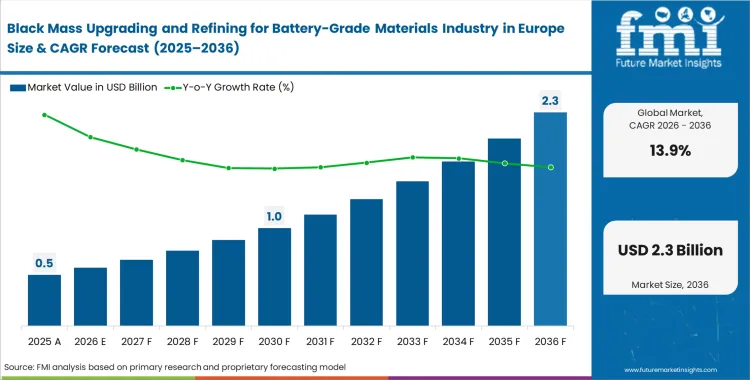
Black mass upgrading and refining for battery-grade materials industry in Europe valuation stood at USD 0.47 billion in 2025 and is estimated to rise to USD 0.54 billion in 2026. Industry outlook indicates expansion at a CAGR of 13.90% from 2026 to 2036, taking total valuation to USD 1.97 billion by 2036. This upward trajectory is supported by the rising requirement for localized precursor supply, as regional cell manufacturing increasingly depends on recycled inputs for new cathode production.
Summary of Black Mass Upgrading and Refining for Battery-Grade Materials Industry in Europe
- The market is estimated at USD 0.54 billion in 2026.
- The market is projected to reach USD 1.97 billion by 2036.
- The market is expected to grow at a CAGR of 13.9% from 2026 to 2036.
- The forecast period represents an incremental opportunity of USD 1.44 billion.
- Hydrometallurgy leads the process route segment with a 68% share.
- Production scrap dominates the feedstock segment with a 64% share.
- Mixed sulfates lead the output material segment with a 34% share.
- NMC chemistry dominates the segment with a 52% share.
- EV batteries lead the end-use segment with a 76% share.
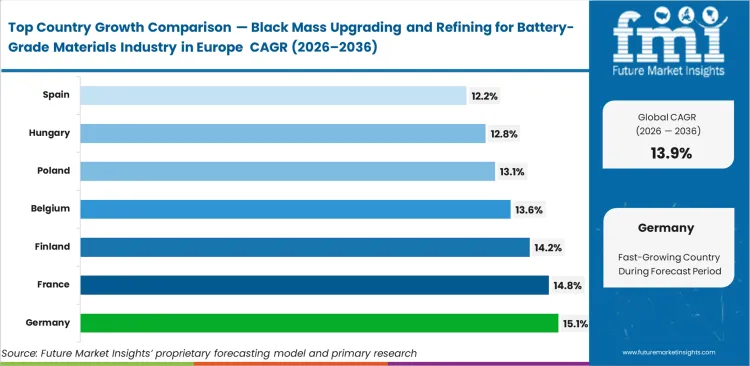
- Germany (15.1%), France (14.8%), and Finland (14.2%) are among the fastest-growing markets.
Black Mass Upgrading and Refining for Battery-Grade Materials Industry in Europe Key Takeaways
| Metric | Details |
|---|---|
| Industry Size (2026) | USD 0.54 billion |
| Industry Value (2036) | USD 1.97 billion |
| CAGR (2026 to 2036) | 13.90% |
Source: Future Market Insights (FMI) analysis, based on proprietary forecasting model and primary research
European battery recycling rules are increasing the need for domestic black mass refining capacity as gigafactory output expands across the region. Localized processing is becoming more important because recycled-content requirements and battery passport obligations will raise pressure on material traceability, recovery performance, and regional supply security. Industry participants are therefore placing greater emphasis on verified refining yields and consistent recovery performance rather than focusing only on raw waste availability. Dependence on imported primary metals leaves the sector more exposed where compliance requirements begin to tighten around recycled material use.
The industry outlook improves further as local recovery systems move closer to mandatory lithium and cobalt thresholds. Once refining output demonstrates stable extraction efficiency and battery-grade purity, cell manufacturing networks are more likely to integrate recycled inputs into cathode supply chains on a longer-term basis. Early qualification of refining output also reduces disruption risk in precursor and cathode production. Facilities with more consistent purity profiles are in a stronger position to secure multi-year offtake arrangements.
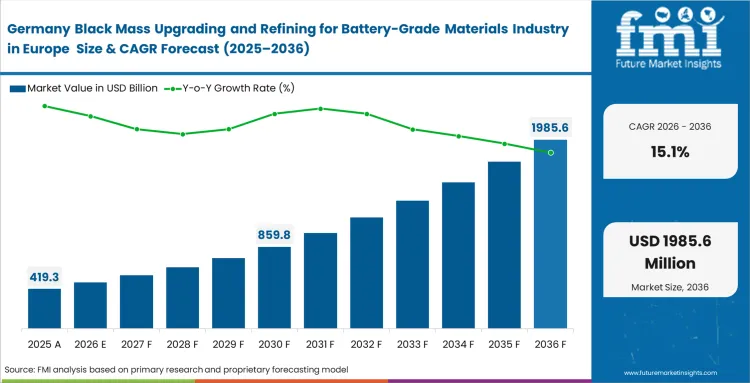
Germany is projected to expand at a CAGR of 15.1% through 2036 as gigafactory buildout continues to support regional refining demand. France follows at 14.8%, helped by public support for localized precursor and recycling capacity. Finland records 14.2%, supported by its established metallurgical base and stronger processing experience. Belgium rises at 13.6% as existing non-ferrous refining framework continues to support this industry. Poland is expected to advance at 13.1% through 2036, with cell assembly activity supporting a broader domestic recycling chain. Hungary registers 12.8% as battery manufacturing investment continues to build local processing requirements. Spain is likely to rise at 12.2%, supported by the automotive sector’s transition toward electrified production. Differences across Europe reflect the gap between countries with established metallurgical capability and those building new battery manufacturing clusters from a lower base.
Segmental Analysis
Black Mass Upgrading and Refining for Battery-Grade Materials Industry in Europe Analysis by Process route
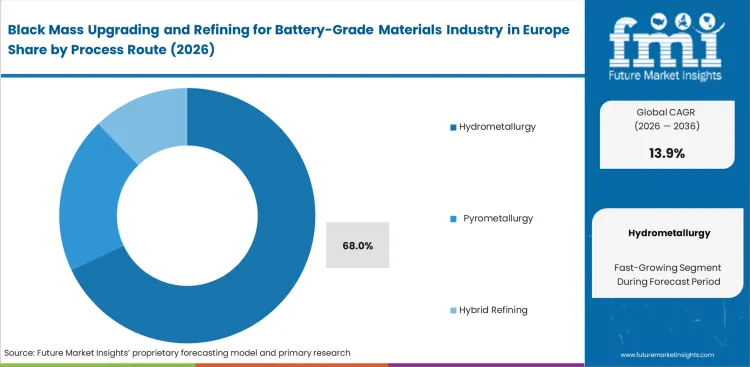
Hydrometallurgical refining is gaining preference across black mass upgrading because it allows more selective recovery of lithium, nickel, cobalt, and manganese from mixed battery feedstock. Hydrometallurgy is expected to account for 68.0% share of the process route segment in 2026, reflecting its stronger fit with battery-grade output requirements in Europe. Low-temperature liquid-phase processing gives refiners tighter control over metal separation and purity adjustment, which is increasingly important as output moves toward precursor and cathode applications. Process performance still depends heavily on feedstock consistency, impurity control, reagent balance, and effluent handling, so operating stability matters as much as nominal capacity. Circuits that manage trace contamination more effectively are better placed to maintain crystallization quality, reduce rework, and protect refining economics over longer campaigns.
- Yield maximization: Solvent extraction and selective precipitation help improve metal recovery while reducing the need for repeated downstream purification.
- Reagent consumption: Acid and chemical use remains closely tied to feed variability, making process control important for margin protection.
- Effluent management: Liquid waste treatment remains a core operating requirement because discharge compliance and water handling can materially affect refining cost.
Black Mass Upgrading and Refining for Battery-Grade Materials Industry in Europe Analysis by Feedstock source
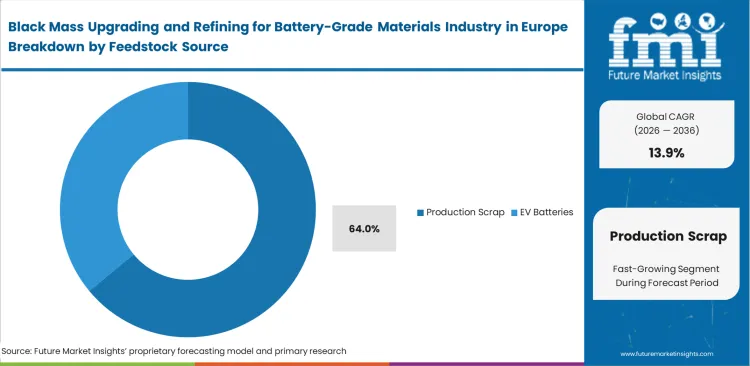
Production scrap remains the leading feedstock stream in EU black mass refining because gigafactory scale-up continues to generate meaningful volumes of off-spec cells, electrode trimmings, and process rejects. Production scrap is estimated to account for 64.0% share of the feedstock source segment in 2026, reflecting its stronger suitability for refining than mixed end-of-life battery waste. More consistent chemistry across factory offcuts reduces the need for extensive early-stage sorting and helps stabilize extraction conditions across continuous processing lines.
This gives refiners a clearer operating advantage because uniform feedstock supports better recovery control, lower impurity handling, and more reliable conversion into battery-grade outputs. Facilities with direct access to cleaner factory scrap are generally in a better position to protect throughput and refining margins than plants relying more heavily on irregular post-consumer material streams. Use of direct battery materials recycling channels also strengthens intake quality by limiting degradation during collection and transport.
- Supply predictability: Factory scrap offers a steadier flow of material, which supports higher plant utilization and more stable operating schedules.
- Chemistry uniformity: Cleaner and less mixed electrode material reduces separation complexity and supports stronger extraction efficiency.
- Logistics simplification: Direct factory-to-refinery movement lowers collection complexity and helps control transport-related handling losses.
Black Mass Upgrading and Refining for Battery-Grade Materials Industry in Europe Analysis by Output material
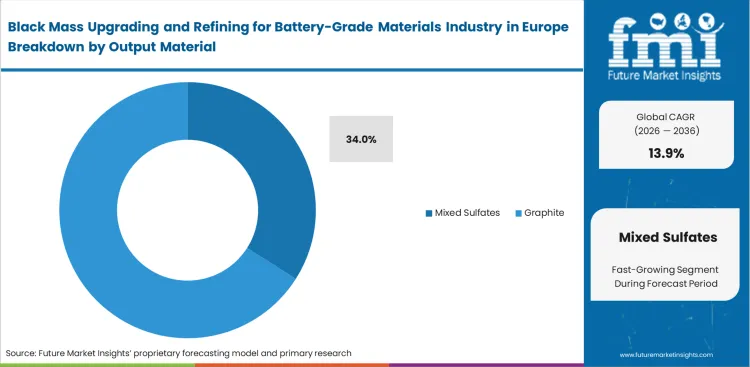
Mixed sulfates are gaining importance in EU black mass refining because cathode precursor production increasingly works with integrated metal-salt inputs rather than fully separated individual outputs. Mixed sulfates are projected to capture 34.0% share of the output material segment in 2026, reflecting their stronger fit with precursor manufacturing workflows. Pre-blended nickel, manganese, and cobalt solutions can reduce intermediate handling and limit avoidable re-dissolution steps during co-precipitation.
This makes the format more relevant where precursor lines are optimized around tighter composition control and faster conversion into cathode-active material inputs. Refining operations that can supply customized blended outputs at consistent specifications are better placed to stay aligned with higher-value regional supply chains, while isolated nickel sulfate and other single-salt streams remain relevant where customers prefer separate downstream blending. Liquid-format delivery also adds operational requirements around contamination control, storage, and timing, which keeps execution quality central to this segment.
- Integration efficiency: Direct supply of blended solutions can reduce crystallization load and lower processing energy within precursor manufacturing.
- Customization demands: Output ratios need to match target cathode chemistry closely, making formulation control important for qualification and repeatability.
- Storage constraints: Liquid formats require tighter handling, suitable containment, and better delivery coordination to avoid contamination or unnecessary dwell time.
Black Mass Upgrading and Refining for Battery-Grade Materials Industry in Europe Analysis by Chemistry focus
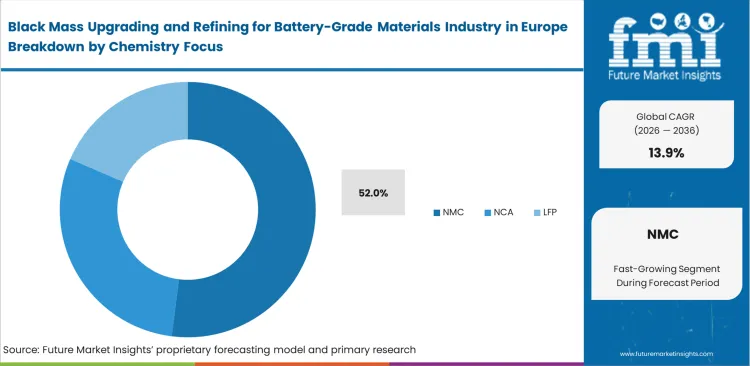
NMC remains the leading chemistry focus in EU black mass refining because it carries stronger recovery value than lower-value battery chemistries. NMC is expected to account for 52.0% share of the chemistry focus segment in 2026, supported by the continued importance of nickel cobalt manganese recovery in refining economics. Nickel and cobalt still anchor the value profile of hydrometallurgical processing, which makes chemistry mix a central factor in plant performance and output planning. This keeps refiners more focused on feedstock composition, recovery potential, and payable metal content rather than on throughput alone. Facilities handling better-characterized nickel cobalt manganese streams are generally in a stronger position to protect extraction efficiency, maintain margin discipline, and support battery-grade output qualification.
- Revenue generation: Recovery of cobalt and nickel remains central to value realization, particularly where refining economics depend on higher payable metal content.
- Extraction complexity: Separation of closely related transition metals requires tighter process control and more advanced solvent management across refining circuits.
- Market volatility: Changes in primary metal prices continue to influence secondary-material margins, making chemistry selection important for commercial stability.
Black Mass Upgrading and Refining for Battery-Grade Materials Industry in Europe Analysis by End use
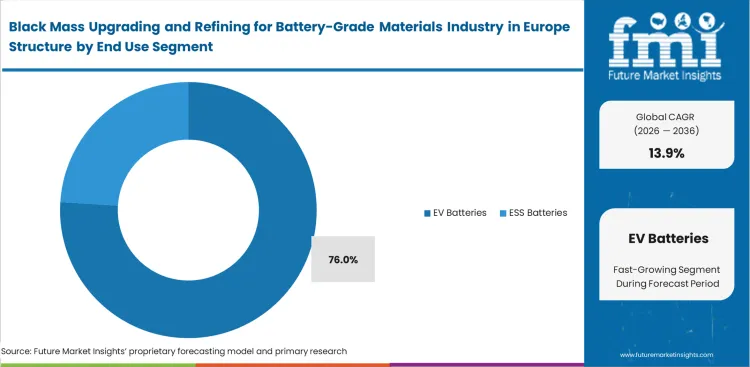
EV batteries remain the main end-use outlet for refined black mass in Europe because electrified vehicle production continues to absorb the largest share of qualified recycled materials. EV batteries are anticipated to represent 76.0% share of the end use segment in 2026, reflecting the region’s stronger pull from automotive battery manufacturing. Recycled inputs are becoming more relevant in this channel as battery passport requirements and recycled-content thresholds tighten across the European battery value chain.
Qualification standards also remain higher in vehicle applications, so refining output must meet stricter expectations on purity, consistency, and traceability before it can move into new cell production. This keeps automotive-linked demand analysis well ahead of other applications, while recovered lithium compound and other battery-grade materials remain more likely to flow first toward the highest-value and most tightly qualified battery programs.
- Qualification hurdles: Vehicle battery applications require tighter purity control, repeatability, and validation before refined materials can be accepted into production lines.
- Volume requirements: Gigafactory expansion continues to raise the scale of precursor and refined-material intake needed to support EV cell manufacturing.
- Traceability mandates: Material origin, process history, and compliance documentation remain important because automotive battery supply chains operate with stricter tracking requirements.
Black Mass Upgrading and Refining for Battery-Grade Materials Industry in Europe Drivers, Restraints, and Opportunities
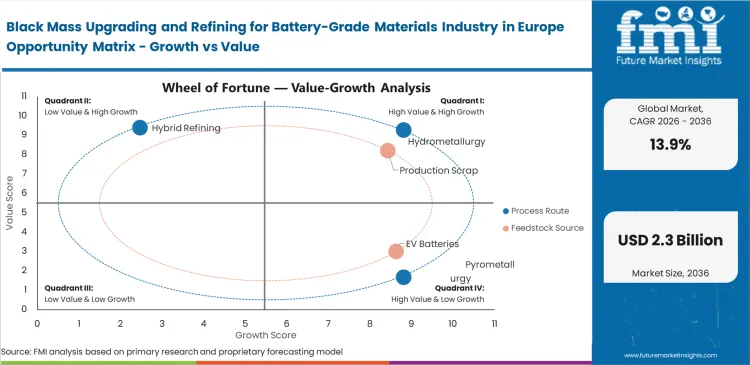
Mandatory recycled-content requirements are increasing the need for localized secondary metal supply across Europe’s battery chain. Greater dependence on imported primary materials leaves regional cell production more exposed where compliance, traceability, and supply continuity are becoming more important. Early alignment with hydrometallurgical refining capacity is therefore gaining relevance as precursor and cathode supply chains look for qualified regional inputs. Expansion of lithium hydroxide recovery capability also supports this shift by improving the availability of battery-grade material within Europe and reducing part of the region’s dependence on external refining routes.
A separate constraint comes from feedstock variability. Changes in lithium, nickel, and cobalt content across incoming black mass can affect extraction stability, purity control, and plant utilization, especially when end-of-life battery streams become more prominent. This keeps sorting, characterization, and feed blending central to operating performance because refining economics depend on maintaining more consistent circuit conditions over longer runs. Facilities that manage chemistry variation more effectively are in a better position to protect recovery rates and support stable battery-grade output.
Opportunities in the Black Mass Upgrading and Refining for Battery-Grade Materials Industry in Europe
- Direct regeneration integration: Restoring degraded cathode configures can reduce full elemental breakdown requirements and lower reagent intensity across part of the recycling flow.
- Graphite recovery optimization: Higher-purity anode-material recovery can add a parallel value stream alongside lithium, nickel, and cobalt refining.
- Low-cobalt chemistry adaptation: Refining circuits that adjust to LFP and higher-nickel feed mixes are likely to stay more relevant as battery chemistry profiles continue to evolve.
Regional Analysis
Based on regional analysis, black mass upgrading and refining for battery-grade materials industry in Europe is segmented into Germany, France, Finland, Belgium, Poland, Hungary, and Spain across 40 plus countries.
.webp "Top Country Growth Comparison Black Mass Upgrading And Refining For Battery Grade Materials Industry In Europe Cagr (2026 2036)")
| Country | CAGR (2026 to 2036) |
|---|---|
| Germany | 15.1% |
| France | 14.8% |
| Finland | 14.2% |
| Belgium | 13.6% |
| Poland | 13.1% |
| Hungary | 12.8% |
| Spain | 12.2% |
Source: Future Market Insights (FMI) analysis, based on proprietary forecasting model and primary research
Western Europe Black Mass Upgrading and Refining for Battery-Grade Materials Industry in Europe Analysis
Western Europe remains central to EU black mass upgrading and refining because battery manufacturing expansion and automotive electrification are increasing the need for localized recovered-material supply. Regional industry development is moving toward closer alignment between black mass processing, precursor conversion, and battery manufacturing, as shorter supply chains help reduce transport complexity and improve traceability.
Local refining capacity is also becoming more relevant because production scrap from new cell plants is rising, while cross-border movement of intermediate battery materials adds handling, compliance, and coordination costs. Integration with nearby low cobalt precursors production further improves the operating case where refiners and downstream material processors can work with tighter formulation control and shorter delivery cycles.
- Germany: Germany is projected to record a 15.1% CAGR in this market through 2036, supported by its dense automotive and battery manufacturing base. Localized recovery and refining are gaining ground because the country offers a stronger combination of industrial scale, scrap availability, and downstream battery-material demand. This keeps Germany in a leading position for regional loop formation between cell production, black mass treatment, and precursor supply.
- France: Public support for battery and automotive transition projects continues to strengthen the case for domestic refining capacity in France. The market in France is anticipated to expand at a 14.8% CAGR through 2036, with industry progress supported by improving alignment between metallurgical processing, precursor output, and cell manufacturing plans. Access to stable low-carbon power also supports refining economics in energy-intensive processing steps.
- Belgium: Belgium benefits from an established non-ferrous metals base, which gives the market a more experienced industrial platform for battery-material recovery and refining. Industry outlook in Belgium points to a 13.6% CAGR through 2036 as existing process knowledge and infrastructure continue to support entry into more advanced battery-recycling value streams. This keeps the country relevant as a stable refining location within Western Europe.
FMI's report includes detailed assessments of adjacent markets like the Netherlands and Austria. Intensive capital investments continue transforming legacy industrial sites into modern material recovery hubs.
Nordic Region Black Mass Upgrading and Refining for Battery-Grade Materials Industry in Europe Analysis
The Nordic region benefits from a stronger power-cost and emissions profile than many other parts of Europe, which improves the operating case for energy-intensive refining activity. This matters in black mass upgrading because recovery economics depend not only on metal yields, but also on power cost, process stability, and the carbon profile of refined outputs. Regional positioning is therefore improving as battery and materials supply chains place greater emphasis on lower-emission recovery pathways. Additional flexibility is likely to come from the ability to process a wider chemistry mix over time, including routes linked to lithium iron phosphate, where plants can adapt feed handling and recovery strategy to changing battery formats.
- Finland: Finland is expected to see this market advance at a 14.2% CAGR through 2036, supported by its long-standing metallurgical base and stronger process experience in complex material recovery. Existing industrial capability gives Finland an advantage in hydrometallurgical refining, impurity management, and downstream material control. This is likely to keep the country important in setting the technical benchmark for battery-grade recovery in the region.
FMI's report includes analysis of Sweden and Norway. Regional cooperation ensures steady flows of feedstock from distributed collection networks to centralized refining nodes.
Central and Southern Europe Black Mass Upgrading and Refining for Battery-Grade Materials Industry in Europe Analysis
Central and Southern Europe are becoming more important to this market as battery manufacturing investment increases across the region and generates a larger stream of production scrap. Local refining capacity is gaining relevance because nearby treatment of black mass can reduce transport complexity, improve material control, and support tighter coordination with cell manufacturing. This operating logic becomes more important where battery plants want better visibility over recovered-material quality and chemistry consistency. Development of domestic refining capability also matters for future alignment with next-generation battery materials, including inputs linked to solid state battery precursor free cathodes, where control over recovered output specifications is likely to carry more weight.
- Poland: Poland is likely to post a 13.1% CAGR in this market by 2036, supported by its growing concentration of battery assembly and component activity. Cleaner factory scrap and closer integration with manufacturing sites improve the case for localized refining and shorten the path back into battery-material supply chains. This keeps Poland well placed within the region’s production-scrap-driven recovery model.
- Hungary: Deep links with large battery manufacturing investments continue to shape the refining outlook in Hungary. The market for black mass upgrading and refining in Hungary is expected to grow at a 12.8% CAGR during the study period, with progress supported by the need to process battery manufacturing scrap closer to cell production sites. Adaptation to specific chemistry mixes will remain important as the country’s battery ecosystem expands.
- Spain: Automotive transition programs are improving the long-term case for domestic battery-material recovery and refining in Spain. Spain is forecast to record a 12.2% CAGR in this market through 2036 as new supply-chain buildout gradually supports more localized treatment, refining, and reuse of battery-derived materials. This keeps Spain on a positive trend, even though its refining base remains less established than that of the region’s earlier movers.FMI's report includes assessments of Italy and Czechia. Rapid deployment of advanced processing technologies continues displacing legacy mechanical separation operations.
FMI’s report includes assessments of Italy and Czechia. Regional progress continues to depend on how quickly new processing capacity can move from basic mechanical treatment toward more advanced refining and battery-grade output recovery.
Competitive Aligners for Market Players
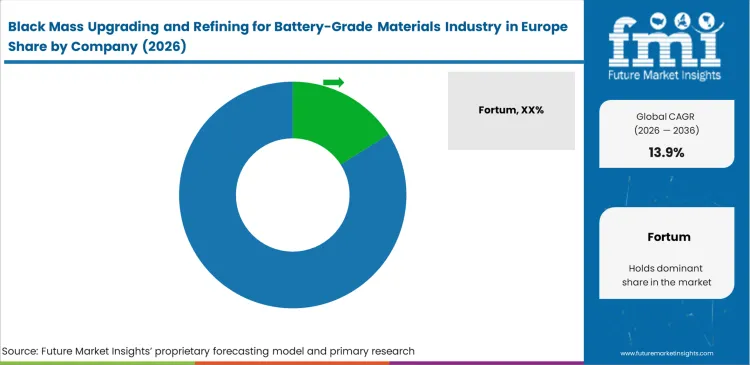
Early commercial deployment of hydrometallurgical refining capacity remains an important competitive advantage in this market because operating assets are more likely to secure feedstock agreements and downstream qualification earlier than pilot-stage projects. Fortum, Umicore, BASF, and Eramet remain well placed in this context because technical experience, process control, and scaling capability continue to matter in black mass refining economics. Recovery of graphite materials alongside transition metals can also improve value capture, particularly where refiners are trying to broaden output streams beyond nickel, cobalt, and lithium. This leaves smaller or earlier-stage operators under greater pressure where feedstock access, operating stability, and qualification timelines are less established.
Established metallurgical and chemical groups also benefit from stronger capability in handling variable feed chemistry, impurity control, reagent management, and environmental compliance. These factors matter because black mass refining performance depends on maintaining battery-grade output quality even when incoming material composition shifts across batches. Existing permitting, operating experience, and chemical-processing infrastructure can therefore support faster movement from initial commissioning to more stable commercial production. Newer entrants still have room to compete, but their position depends more heavily on proving consistency, recovery quality, and process reliability at scale.
The competitive landscape is still broad enough that cell producers are unlikely to rely on a single regional refining route. cylib and Hydrovolt remain relevant in this environment because localized processing and more specialized recovery capability can support a diversified regional supply base. Competitive positioning is also likely to depend increasingly on lower-energy refining pathways, chemistry flexibility, and the ability to adapt output to changing cathode formats. Refiners that respond more effectively to evolving feed composition and downstream material requirements are in a stronger position to retain relevance as the market expands.
Key Players in Black Mass Upgrading and Refining for Battery-Grade Materials Industry in Europe
- Fortum
- BASF
- Umicore
- cylib
- Eramet
- Hydrovolt
- Orano
Scope of the Report
| Metric | Value |
|---|---|
| Quantitative Units | USD 0.54 billion to USD 1.97 billion, at a CAGR of 13.90% |
| Market Definition | Extraction and purification of critical metals from shredded battery waste into specification-grade chemicals defines this sector. Operations focus on converting intermediate material into battery-ready precursors. Facilities handle complex workflows to isolate vital elements. |
| Segmentation | Process route, Feedstock source, Output material, Chemistry focus, End use, Region |
| Regions Covered | North America, Latin America, Europe, Asia Pacific, Middle East and Africa |
| Countries Covered | Germany, France, Finland, Belgium, Poland, Hungary, Spain |
| Key Companies Profiled | Fortum, BASF, Umicore, cylib, Eramet, Hydrovolt, Orano |
| Forecast Period | 2026 to 2036 |
| Approach | Installed refining capacity and active off-take agreements mapped against gigafactory production targets |
Source: Future Market Insights (FMI) analysis, based on proprietary forecasting model and primary research
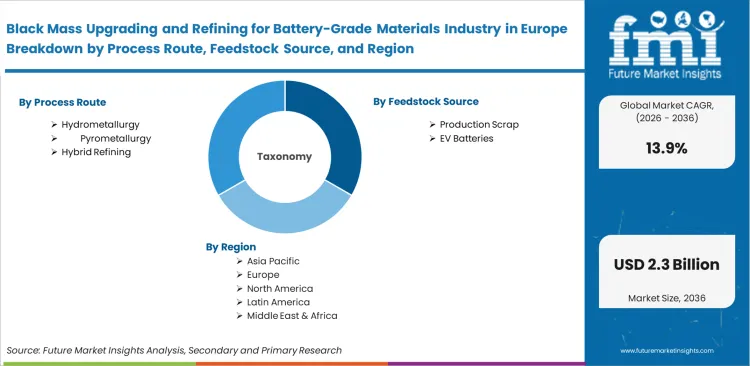
Black Mass Upgrading and Refining for Battery-Grade Materials Industry in Europe Analysis by Segments
Process route
- Hydrometallurgy
- Pyrometallurgy
- Direct regeneration
- Hybrid refining
Feedstock source
- Production scrap
- EV batteries
- Stationary batteries
- Consumer cells
Output material
- Mixed sulfates
- Lithium salts
- Cobalt salts
- Graphite
- Manganese salts
Chemistry focus
- NMC
- NCA
- LFP
- NMC-LFP mix
End use
- EV batteries
- ESS batteries
- Cathode precursors
- Specialty chemicals
Region
- North America
- Latin America
- Europe
- Asia Pacific
- Middle East and Africa
Bibliography
- Bobba, S., Carrara, S., Huisman, J., Mathieux, F., & Pavel, C. (2025). Deep dive: Raw materials for batteries in the EU supply chain. Publications Office of the European Union.
- European Commission. (2025, July 4). New rules to boost recycling efficiency from waste batteries.
- European Commission Joint Research Centre. (2024). Technical recommendations for the targeted amendment of the European List of Waste entries relevant to batteries. Publications Office of the European Union.
- International Energy Agency. (2024, October 22). EU sustainable batteries regulation.
- Kovačević, A., et al. (2024, August). Hydrometallurgical recovery of metals from spent lithium-ion batteries using ionic liquids and deep eutectic solvents: A review. Current Opinion in Green and Sustainable Chemistry, 48, 100978.
This bibliography is provided for reader reference. The full FMI report contains the complete reference list with primary source documentation.
This Report Addresses
- Regulatory impacts of EU battery passports on secondary metal sourcing operations.
- Operational constraints limiting high-yield lithium recovery from varied feedstocks.
- Economic viability of liquid-based extraction compared to legacy thermal methods.
- Chemical engineering requirements for producing customized mixed sulfate solutions.
- Commercial stakes for automakers securing localized precursor supply agreements.
- Hydrometallurgical capacity expansion tracking across Germany, France, and Finland.
- Qualification protocols demanded by gigafactories for integrating recycled cathode materials.
- Capital requirements for establishing commercial-scale direct regeneration circuits.
Frequently Asked Questions
What is black mass refining in the EU battery industry?
Upgrading crushed cells into high-purity chemical salts enables direct integration into new European cathode manufacturing lines.
How is black mass converted into battery-grade materials?
Facilities utilize complex hydrometallurgical solvent extraction circuits to isolate specific transition metals from raw shredded waste.
Why does hydrometallurgy lead EU black mass upgrading?
Liquid-based extraction maximizes critical lithium recovery rates while producing exact precursor formulations demanded by cathode manufacturers.
Which metals are most valuable in black mass refining?
Recovered nickel and cobalt provide the primary financial returns justifying capital expenditures for advanced recycling operations.
Why is manufacturing scrap driving the EU market before 2030?
Gigafactory offcuts offer highly uniform, uncontaminated feedstock allowing continuous extraction efficiency without complex pre-sorting.
Which companies are active in EU black mass refining?
Major operators include Fortum, BASF, Umicore, cylib, Eramet, Hydrovolt, and Orano establishing regional extraction capacities.
Which EU countries lead this market?
Germany, France, and Finland dominate capacity expansion due to automotive clusters and established metallurgical expertise.
How do EU recovery targets affect refining demand?
Mandatory recycled content quotas force cell manufacturers to secure localized secondary metal supplies immediately.
How large is the market in 2025, 2026, and 2036?
Sector valuation stands at USD 0.47 billion in 2025, reaching USD 0.54 billion in 2026 and USD 1.97 billion by 2036.
What is the difference between black mass pre-processing and post-treatment?
Pre-processing involves mechanical shredding, while post-treatment requires complex chemical engineering to yield specification-grade precursors.
How do gigafactories qualify recycled inputs?
Quality assurance directors test every delivered batch against exact molar specifications utilizing prussian blue cathode precursors pathways.
What limits hydrometallurgical plant utilization rates?
Trace impurities in incoming shredded material force continuous recalibration of solvent extraction circuits, lowering throughput efficiency.
Why do precursor manufacturers prefer mixed sulfates?
Direct delivery of blended metal salt solutions eliminates redundant re-dissolution steps at cathode synthesis facilities.
What commercial advantage does Finland hold?
Extensive legacy mining infrastructure translates directly into advanced hydrometallurgical processing capabilities and lowered energy costs.
Why are automakers investing directly in refineries?
Direct capital injection guarantees exclusive off-take rights, insulating vehicle manufacturers from severe compliance risks.
How do facilities handle low-value chemistry flows?
Refining operators charge substantial gate fees for inputs to offset lower intrinsic metal values during extraction.
What role does direct lithium extraction play?
Integrating specific direct lithium extraction dle circuits maximizes early-stage lithium isolation, preventing massive revenue losses.
Are pyrometallurgical methods becoming obsolete?
Thermal processing destroys valuable lithium entirely, failing European precursor specifications mandating precise hydrometallurgical purity levels.
How do battery passports affect recycling logistics?
Digital origin tracking requires processing facilities to maintain distinct separation and battery supply chain traceability continuously.
What is the primary barrier for direct regeneration?
Restoring degraded crystal lattices requires pristine incoming material; minor adhesive contamination immediately ruins regenerated outputs.
Why do cell manufacturers fragment their processing contracts?
Procurement teams deliberately qualify multiple regional operators to maintain competitive bidding dynamics for valuable factory scrap.
How does dry coating technology influence scrap processing?
Refining operators physically modify intake shredders to handle dense battery electrode dry coating materials without clogging.
What happens to recovered graphite?
New thermal purification techniques allow facilities to sell recovered anode material back into localized manufacturing chains.
How does silicon impact chemical extraction?
Waste from silicon anode lithium ion battery designs forces process engineers to deploy specialized fluoride-based precipitants.
Preview the report firsthand - request a free sample
Get SampleGet the brochure for pricing and purchase details.
Get PDFTable of Content
- Executive Summary
- Global Market Outlook
- Demand-side Trends
- Supply-side Trends
- Technology Roadmap Analysis
- Analysis and Recommendations
- Market Overview
- Market Coverage / Taxonomy
- Market Definition / Scope / Limitations
- Research Methodology
- Chapter Orientation
- Analytical Lens and Working Hypotheses
- Market Structure, Signals, and Trend Drivers
- Benchmarking and Cross-market Comparability
- Market Sizing, Forecasting, and Opportunity Mapping
- Research Design and Evidence Framework
- Desk Research Programme (Secondary Evidence)
- Company Annual and Sustainability Reports
- Peer-reviewed Journals and Academic Literature
- Corporate Websites, Product Literature, and Technical Notes
- Earnings Decks and Investor Briefings
- Statutory Filings and Regulatory Disclosures
- Technical White Papers and Standards Notes
- Trade Journals, Industry Magazines, and Analyst Briefs
- Conference Proceedings, Webinars, and Seminar Materials
- Government Statistics Portals and Public Data Releases
- Press Releases and Reputable Media Coverage
- Specialist Newsletters and Curated Briefings
- Sector Databases and Reference Repositories
- FMI Internal Proprietary Databases and Historical Market Datasets
- Subscription Datasets and Paid Sources
- Social Channels, Communities, and Digital Listening Inputs
- Additional Desk Sources
- Expert Input and Fieldwork (Primary Evidence)
- Primary Modes
- Qualitative Interviews and Expert Elicitation
- Quantitative Surveys and Structured Data Capture
- Blended Approach
- Why Primary Evidence is Used
- Field Techniques
- Interviews
- Surveys
- Focus Groups
- Observational and In-context Research
- Social and Community Interactions
- Stakeholder Universe Engaged
- C-suite Leaders
- Board Members
- Presidents and Vice Presidents
- R&D and Innovation Heads
- Technical Specialists
- Domain Subject-matter Experts
- Scientists
- Physicians and Other Healthcare Professionals
- Governance, Ethics, and Data Stewardship
- Research Ethics
- Data Integrity and Handling
- Primary Modes
- Tooling, Models, and Reference Databases
- Desk Research Programme (Secondary Evidence)
- Data Engineering and Model Build
- Data Acquisition and Ingestion
- Cleaning, Normalisation, and Verification
- Synthesis, Triangulation, and Analysis
- Quality Assurance and Audit Trail
- Market Background
- Market Dynamics
- Drivers
- Restraints
- Opportunity
- Trends
- Scenario Forecast
- Demand in Optimistic Scenario
- Demand in Likely Scenario
- Demand in Conservative Scenario
- Opportunity Map Analysis
- Product Life Cycle Analysis
- Supply Chain Analysis
- Investment Feasibility Matrix
- Value Chain Analysis
- PESTLE and Porter’s Analysis
- Regulatory Landscape
- Regional Parent Market Outlook
- Production and Consumption Statistics
- Import and Export Statistics
- Market Dynamics
- Global Market Analysis 2021 to 2025 and Forecast, 2026 to 2036
- Historical Market Size Value (USD Million) Analysis, 2021 to 2025
- Current and Future Market Size Value (USD Million) Projections, 2026 to 2036
- Y-o-Y Growth Trend Analysis
- Absolute $ Opportunity Analysis
- Global Market Pricing Analysis 2021 to 2025 and Forecast 2026 to 2036
- Global Market Analysis 2021 to 2025 and Forecast 2026 to 2036, By Process Route
- Introduction / Key Findings
- Historical Market Size Value (USD Million) Analysis By Process Route , 2021 to 2025
- Current and Future Market Size Value (USD Million) Analysis and Forecast By Process Route , 2026 to 2036
- Hydrometallurgy
- Pyrometallurgy
- Hybrid Refining
- Hydrometallurgy
- Y-o-Y Growth Trend Analysis By Process Route , 2021 to 2025
- Absolute $ Opportunity Analysis By Process Route , 2026 to 2036
- Global Market Analysis 2021 to 2025 and Forecast 2026 to 2036, By Feedstock Source
- Introduction / Key Findings
- Historical Market Size Value (USD Million) Analysis By Feedstock Source, 2021 to 2025
- Current and Future Market Size Value (USD Million) Analysis and Forecast By Feedstock Source, 2026 to 2036
- Production Scrap
- EV Batteries
- Production Scrap
- Y-o-Y Growth Trend Analysis By Feedstock Source, 2021 to 2025
- Absolute $ Opportunity Analysis By Feedstock Source, 2026 to 2036
- Global Market Analysis 2021 to 2025 and Forecast 2026 to 2036, By Output Material
- Introduction / Key Findings
- Historical Market Size Value (USD Million) Analysis By Output Material, 2021 to 2025
- Current and Future Market Size Value (USD Million) Analysis and Forecast By Output Material, 2026 to 2036
- Mixed Sulfates
- Graphite
- Mixed Sulfates
- Y-o-Y Growth Trend Analysis By Output Material, 2021 to 2025
- Absolute $ Opportunity Analysis By Output Material, 2026 to 2036
- Global Market Analysis 2021 to 2025 and Forecast 2026 to 2036, By Chemistry Focus
- Introduction / Key Findings
- Historical Market Size Value (USD Million) Analysis By Chemistry Focus, 2021 to 2025
- Current and Future Market Size Value (USD Million) Analysis and Forecast By Chemistry Focus, 2026 to 2036
- NMC
- NCA
- LFP
- NMC
- Y-o-Y Growth Trend Analysis By Chemistry Focus, 2021 to 2025
- Absolute $ Opportunity Analysis By Chemistry Focus, 2026 to 2036
- Global Market Analysis 2021 to 2025 and Forecast 2026 to 2036, By End Use
- Introduction / Key Findings
- Historical Market Size Value (USD Million) Analysis By End Use, 2021 to 2025
- Current and Future Market Size Value (USD Million) Analysis and Forecast By End Use, 2026 to 2036
- EV Batteries
- ESS Batteries
- EV Batteries
- Y-o-Y Growth Trend Analysis By End Use, 2021 to 2025
- Absolute $ Opportunity Analysis By End Use, 2026 to 2036
- Global Market Analysis 2021 to 2025 and Forecast 2026 to 2036, By Region
- Introduction
- Historical Market Size Value (USD Million) Analysis By Region, 2021 to 2025
- Current Market Size Value (USD Million) Analysis and Forecast By Region, 2026 to 2036
- North America
- Latin America
- Western Europe
- Eastern Europe
- East Asia
- South Asia and Pacific
- Middle East & Africa
- Market Attractiveness Analysis By Region
- North America Market Analysis 2021 to 2025 and Forecast 2026 to 2036, By Country
- Historical Market Size Value (USD Million) Trend Analysis By Market Taxonomy, 2021 to 2025
- Market Size Value (USD Million) Forecast By Market Taxonomy, 2026 to 2036
- By Country
- USA
- Canada
- Mexico
- By Process Route
- By Feedstock Source
- By Output Material
- By Chemistry Focus
- By End Use
- By Country
- Market Attractiveness Analysis
- By Country
- By Process Route
- By Feedstock Source
- By Output Material
- By Chemistry Focus
- By End Use
- Key Takeaways
- Latin America Market Analysis 2021 to 2025 and Forecast 2026 to 2036, By Country
- Historical Market Size Value (USD Million) Trend Analysis By Market Taxonomy, 2021 to 2025
- Market Size Value (USD Million) Forecast By Market Taxonomy, 2026 to 2036
- By Country
- Brazil
- Chile
- Rest of Latin America
- By Process Route
- By Feedstock Source
- By Output Material
- By Chemistry Focus
- By End Use
- By Country
- Market Attractiveness Analysis
- By Country
- By Process Route
- By Feedstock Source
- By Output Material
- By Chemistry Focus
- By End Use
- Key Takeaways
- Western Europe Market Analysis 2021 to 2025 and Forecast 2026 to 2036, By Country
- Historical Market Size Value (USD Million) Trend Analysis By Market Taxonomy, 2021 to 2025
- Market Size Value (USD Million) Forecast By Market Taxonomy, 2026 to 2036
- By Country
- Germany
- UK
- Italy
- Spain
- France
- Nordic
- BENELUX
- Rest of Western Europe
- By Process Route
- By Feedstock Source
- By Output Material
- By Chemistry Focus
- By End Use
- By Country
- Market Attractiveness Analysis
- By Country
- By Process Route
- By Feedstock Source
- By Output Material
- By Chemistry Focus
- By End Use
- Key Takeaways
- Eastern Europe Market Analysis 2021 to 2025 and Forecast 2026 to 2036, By Country
- Historical Market Size Value (USD Million) Trend Analysis By Market Taxonomy, 2021 to 2025
- Market Size Value (USD Million) Forecast By Market Taxonomy, 2026 to 2036
- By Country
- Russia
- Poland
- Hungary
- Balkan & Baltic
- Rest of Eastern Europe
- By Process Route
- By Feedstock Source
- By Output Material
- By Chemistry Focus
- By End Use
- By Country
- Market Attractiveness Analysis
- By Country
- By Process Route
- By Feedstock Source
- By Output Material
- By Chemistry Focus
- By End Use
- Key Takeaways
- East Asia Market Analysis 2021 to 2025 and Forecast 2026 to 2036, By Country
- Historical Market Size Value (USD Million) Trend Analysis By Market Taxonomy, 2021 to 2025
- Market Size Value (USD Million) Forecast By Market Taxonomy, 2026 to 2036
- By Country
- China
- Japan
- South Korea
- By Process Route
- By Feedstock Source
- By Output Material
- By Chemistry Focus
- By End Use
- By Country
- Market Attractiveness Analysis
- By Country
- By Process Route
- By Feedstock Source
- By Output Material
- By Chemistry Focus
- By End Use
- Key Takeaways
- South Asia and Pacific Market Analysis 2021 to 2025 and Forecast 2026 to 2036, By Country
- Historical Market Size Value (USD Million) Trend Analysis By Market Taxonomy, 2021 to 2025
- Market Size Value (USD Million) Forecast By Market Taxonomy, 2026 to 2036
- By Country
- India
- ASEAN
- Australia & New Zealand
- Rest of South Asia and Pacific
- By Process Route
- By Feedstock Source
- By Output Material
- By Chemistry Focus
- By End Use
- By Country
- Market Attractiveness Analysis
- By Country
- By Process Route
- By Feedstock Source
- By Output Material
- By Chemistry Focus
- By End Use
- Key Takeaways
- Middle East & Africa Market Analysis 2021 to 2025 and Forecast 2026 to 2036, By Country
- Historical Market Size Value (USD Million) Trend Analysis By Market Taxonomy, 2021 to 2025
- Market Size Value (USD Million) Forecast By Market Taxonomy, 2026 to 2036
- By Country
- Kingdom of Saudi Arabia
- Other GCC Countries
- Turkiye
- South Africa
- Other African Union
- Rest of Middle East & Africa
- By Process Route
- By Feedstock Source
- By Output Material
- By Chemistry Focus
- By End Use
- By Country
- Market Attractiveness Analysis
- By Country
- By Process Route
- By Feedstock Source
- By Output Material
- By Chemistry Focus
- By End Use
- Key Takeaways
- Key Countries Market Analysis
- USA
- Pricing Analysis
- Market Share Analysis, 2025
- By Process Route
- By Feedstock Source
- By Output Material
- By Chemistry Focus
- By End Use
- Canada
- Pricing Analysis
- Market Share Analysis, 2025
- By Process Route
- By Feedstock Source
- By Output Material
- By Chemistry Focus
- By End Use
- Mexico
- Pricing Analysis
- Market Share Analysis, 2025
- By Process Route
- By Feedstock Source
- By Output Material
- By Chemistry Focus
- By End Use
- Brazil
- Pricing Analysis
- Market Share Analysis, 2025
- By Process Route
- By Feedstock Source
- By Output Material
- By Chemistry Focus
- By End Use
- Chile
- Pricing Analysis
- Market Share Analysis, 2025
- By Process Route
- By Feedstock Source
- By Output Material
- By Chemistry Focus
- By End Use
- Germany
- Pricing Analysis
- Market Share Analysis, 2025
- By Process Route
- By Feedstock Source
- By Output Material
- By Chemistry Focus
- By End Use
- UK
- Pricing Analysis
- Market Share Analysis, 2025
- By Process Route
- By Feedstock Source
- By Output Material
- By Chemistry Focus
- By End Use
- Italy
- Pricing Analysis
- Market Share Analysis, 2025
- By Process Route
- By Feedstock Source
- By Output Material
- By Chemistry Focus
- By End Use
- Spain
- Pricing Analysis
- Market Share Analysis, 2025
- By Process Route
- By Feedstock Source
- By Output Material
- By Chemistry Focus
- By End Use
- France
- Pricing Analysis
- Market Share Analysis, 2025
- By Process Route
- By Feedstock Source
- By Output Material
- By Chemistry Focus
- By End Use
- India
- Pricing Analysis
- Market Share Analysis, 2025
- By Process Route
- By Feedstock Source
- By Output Material
- By Chemistry Focus
- By End Use
- ASEAN
- Pricing Analysis
- Market Share Analysis, 2025
- By Process Route
- By Feedstock Source
- By Output Material
- By Chemistry Focus
- By End Use
- Australia & New Zealand
- Pricing Analysis
- Market Share Analysis, 2025
- By Process Route
- By Feedstock Source
- By Output Material
- By Chemistry Focus
- By End Use
- China
- Pricing Analysis
- Market Share Analysis, 2025
- By Process Route
- By Feedstock Source
- By Output Material
- By Chemistry Focus
- By End Use
- Japan
- Pricing Analysis
- Market Share Analysis, 2025
- By Process Route
- By Feedstock Source
- By Output Material
- By Chemistry Focus
- By End Use
- South Korea
- Pricing Analysis
- Market Share Analysis, 2025
- By Process Route
- By Feedstock Source
- By Output Material
- By Chemistry Focus
- By End Use
- Russia
- Pricing Analysis
- Market Share Analysis, 2025
- By Process Route
- By Feedstock Source
- By Output Material
- By Chemistry Focus
- By End Use
- Poland
- Pricing Analysis
- Market Share Analysis, 2025
- By Process Route
- By Feedstock Source
- By Output Material
- By Chemistry Focus
- By End Use
- Hungary
- Pricing Analysis
- Market Share Analysis, 2025
- By Process Route
- By Feedstock Source
- By Output Material
- By Chemistry Focus
- By End Use
- Kingdom of Saudi Arabia
- Pricing Analysis
- Market Share Analysis, 2025
- By Process Route
- By Feedstock Source
- By Output Material
- By Chemistry Focus
- By End Use
- Turkiye
- Pricing Analysis
- Market Share Analysis, 2025
- By Process Route
- By Feedstock Source
- By Output Material
- By Chemistry Focus
- By End Use
- South Africa
- Pricing Analysis
- Market Share Analysis, 2025
- By Process Route
- By Feedstock Source
- By Output Material
- By Chemistry Focus
- By End Use
- USA
- Market Structure Analysis
- Competition Dashboard
- Competition Benchmarking
- Market Share Analysis of Top Players
- By Region
- By Process Route
- By Feedstock Source
- By Output Material
- By Chemistry Focus
- By End Use
- Competition Analysis
- Competition Deep Dive
- Fortum
- Overview
- Product Portfolio
- Profitability by Market Segments (Product/Age /Sales Channel/Region)
- Sales Footprint
- Strategy Overview
- Marketing Strategy
- Product Strategy
- Channel Strategy
- BASF
- Umicore
- cylib
- Eramet
- Hydrovolt
- Orano
- Fortum
- Competition Deep Dive
- Assumptions & Acronyms Used


