

- Industry Size (2026)
- USD 3200.0 Mn
- Forecast (2036)
- USD 8300.0 Mn
- CAGR: 10.0%
- (2026 to 2036)
Low-Cobalt Precursors Market Forecast and Outlook 2026 to 2036
The low-cobalt precursors market stands at the forefront of sustainable battery chemistry evolution, projected to surge from USD 3,200.0 million in 2026 to USD 8,300.0 million by 2036, achieving a robust compound annual growth rate of 10.0% throughout the forecast period. This market segment represents a critical transition in lithium-ion battery manufacturing, driven by the imperative to reduce dependency on cobalt a mineral plagued by supply chain vulnerabilities, price volatility, and ethical sourcing concerns.
Quick Stats for Low-Cobalt Precursors Market
- Low-Cobalt Precursors Market Value (2026): USD 3,200.0 million
- Low-Cobalt Precursors Market Forecast Value (2036): USD 8,300.0 million
- Low-Cobalt Precursors Market Forecast CAGR: 10.0%
- Leading Application in Low-Cobalt Precursors Market: Passenger EV (64%)
- Key Growth Countries in Low-Cobalt Precursors Market: China, Brazil, USA., U.K., Germany, South Korea, Japan
- Key Players in Low-Cobalt Precursors Market: Umicore, BASF, POSCO Future M, Huayou Cobalt, Zhejiang Huayou New Energy
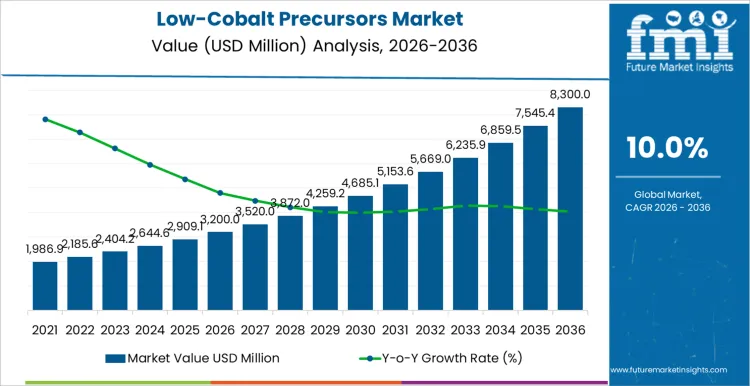
Market momentum is driven by the automotive industry's accelerating electrification timeline and the urgent need for cost-effective, ethically sourced battery materials that can support mass-market electric vehicle adoption. The development of nickel-rich cathode chemistries such as NMC 811 and NMC 955 represents a paradigm shift in battery materials science, enabling manufacturers to achieve higher energy densities while reducing material costs and supply chain risks. These advanced formulations require sophisticated precursor manufacturing capabilities that can control particle morphology, chemical homogeneity, and trace impurities at unprecedented precision levels.
The strategic importance of low-cobalt precursors extends beyond cost reduction to encompass thermal stability, cycling performance, and manufacturing scalability. Modern precursor synthesis involves complex co-precipitation processes that create uniform particle distributions essential for consistent cathode performance across millions of battery cells. Industry leaders are investing heavily in automated production facilities, advanced process control systems, and quality assurance technologies that enable the reliable manufacture of precursors meeting automotive-grade specifications. The market's growth trajectory reflects the successful commercialization of these technologies and their integration into global battery supply chains.
Low-Cobalt Precursors Market Key Takeaways
| Metric | Value |
|---|---|
| Market Value (2026) | USD 3,200.0 million |
| Market Forecast Value (2036) | USD 8,300.0 million |
| Forecast CAGR 2026 to 2036 | 10.0% |
Why Is the Cobalt Supply Crisis Accelerating Precursor Innovation?
The intensifying cobalt supply crisis is fundamentally reshaping precursor chemistry development as manufacturers confront the dual challenges of price volatility and ethical sourcing constraints. Cobalt's concentration in the Democratic Republic of Congo, which controls approximately 70% of global production, creates geopolitical supply risks that automotive manufacturers cannot accept for their long-term electrification strategies.
The technical complexity of low-cobalt precursor development cannot be understated, as cobalt traditionally serves multiple critical functions in cathode materials including structural stability, thermal management, and cycling performance optimization. Advanced precursor formulations must compensate for reduced cobalt content through precise control of nickel and manganese ratios, introduction of dopant elements, and optimization of particle morphology characteristics. These requirements have elevated precursor manufacturing from a commodity chemical process to a sophisticated materials engineering discipline requiring significant research and development investments.
How is the Market Structured across Battery Chemistry Applications?
The low-cobalt precursors market exhibits sophisticated segmentation patterns reflecting the diverse requirements of modern battery applications and the varying stages of technology maturity across different chemistry platforms. Market structure analysis reveals the emergence of distinct precursor categories optimized for specific energy density targets, cost constraints, and performance requirements. The segmentation encompasses chemistry classes that represent different approaches to cobalt reduction, from incremental improvements in traditional NMC formulations to revolutionary new compositions that virtually eliminate cobalt content.
Understanding market structure requires recognition that precursor specifications directly influence downstream cathode performance characteristics, including capacity retention, thermal runaway resistance, and manufacturing yield rates. Each chemistry class demands unique precursor properties related to particle size distribution, surface area, tap density, and chemical purity levels that affect the final cathode material's electrochemical behavior. The market's structural complexity reflects the intricate relationship between precursor chemistry, processing conditions, and battery performance outcomes that manufacturers must optimize simultaneously.
Which Chemistry Class Dominates the Market?
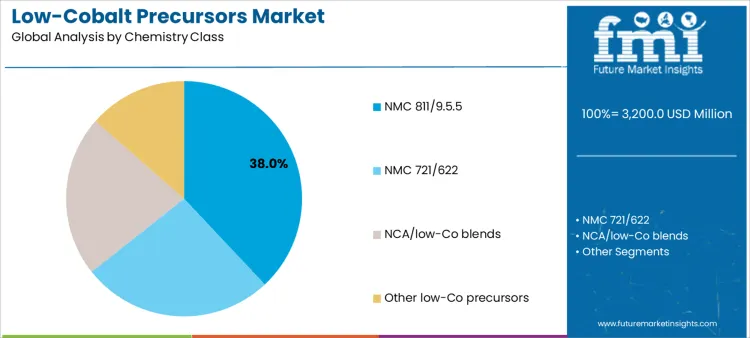
NMC 811 and NMC 955 chemistries command 38.0% market share, representing the largest segment due to their optimal balance of energy density, cost reduction, and technical feasibility for large-scale manufacturing. These formulations reduce cobalt content to 10% and 5% respectively while maintaining acceptable thermal stability and cycling performance for automotive applications. The dominance of these chemistries reflects their successful commercialization by leading battery manufacturers who have invested heavily in developing compatible manufacturing processes and quality control systems.
NMC 811 precursors require extraordinary precision in composition control, as small variations in nickel-to-manganese-to-cobalt ratios can significantly impact cathode performance and safety characteristics. The synthesis process typically involves controlled co-precipitation under inert atmospheres, followed by washing, filtering, and drying operations that must maintain chemical homogeneity across large production batches. Advanced process monitoring systems track pH levels, temperature profiles, and mixing parameters in real-time to ensure consistent precursor quality that meets automotive specification requirements.
Which Application Sector Generates the Highest Demand?
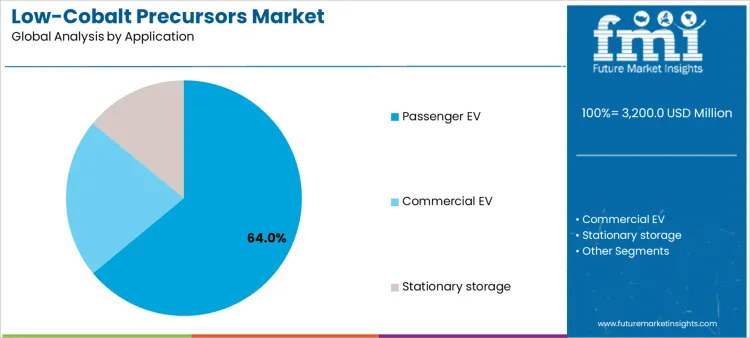
Passenger electric vehicles dominate with 64.0% market share, reflecting the automotive industry's transition toward electrification and the massive scale of global passenger vehicle production. Passenger EV applications demand precursors that enable high energy density cathodes while meeting stringent safety, durability, and cost requirements for mass-market adoption. The segment drives innovation toward precursor formulations that support fast-charging capabilities, extended driving ranges, and competitive pricing relative to internal combustion vehicles.
Automotive applications impose unique challenges on precursor manufacturers, including the need for consistent quality across multi-million unit production volumes, traceability systems that support warranty claims and safety investigations, and manufacturing processes that can scale rapidly to meet growing demand. Passenger EV precursors must also address diverse climate conditions, driving patterns, and charging infrastructure variations that affect battery performance requirements across global markets.
Which Supply Form Leads in Manufacturing Applications?
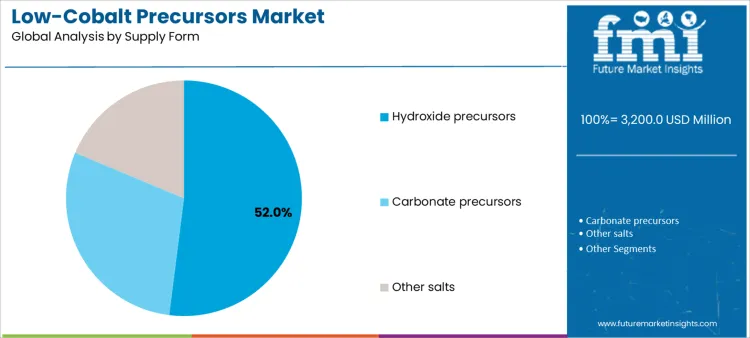
Hydroxide precursors hold 52.0% market share, representing the preferred form for high-performance cathode manufacturing due to their superior reactivity and processing characteristics during lithiation reactions. Metal hydroxide precursors offer advantages in mixing homogeneity, particle size control, and chemical purity that translate into improved cathode material properties. The hydroxide form enables precise control over cathode particle morphology and surface characteristics that affect electrochemical performance and manufacturing yield rates.
Hydroxide precursor production requires sophisticated pH control systems, controlled atmosphere processing, and advanced filtration technologies that ensure consistent chemical composition and physical properties. Manufacturing facilities typically incorporate automated batching systems, continuous monitoring equipment, and statistical process control methodologies to maintain the tight specifications required for automotive battery applications.
Which Producer Type Dominates Supply Chain Control?
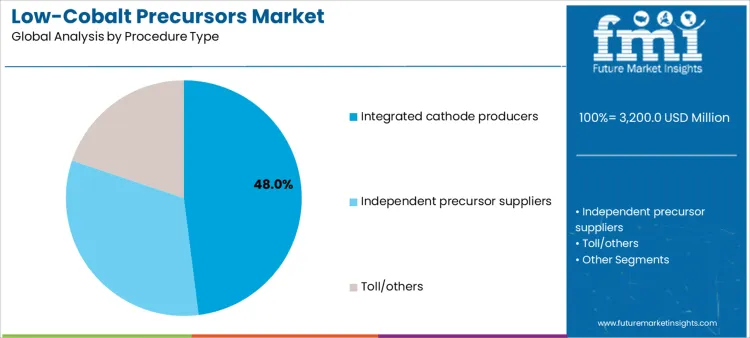
Integrated cathode producers command 48.0% market share, reflecting the strategic importance of controlling critical material specifications and the technical advantages of vertical integration in optimizing precursor-to-cathode processing compatibility. Integrated producers can customize precursor properties specifically for their cathode manufacturing processes, enabling tighter quality control and potentially superior performance characteristics compared to merchant market materials.
Vertical integration allows cathode manufacturers to respond rapidly to changing battery specifications, implement proprietary process improvements, and maintain competitive advantages through control of critical material properties. Integrated producers typically invest in dedicated precursor facilities located adjacent to cathode manufacturing plants, minimizing transportation costs and enabling just-in-time inventory management systems.
How is Advanced Process Control Reshaping Precursor Manufacturing?
The implementation of advanced process control systems is revolutionizing low-cobalt precursor manufacturing through real-time optimization of chemical reactions, particle formation kinetics, and quality parameters that determine cathode performance characteristics. Modern precursor facilities incorporate distributed control systems, advanced analytics platforms, and machine learning algorithms that continuously optimize production parameters based on downstream cathode performance feedback. This technological integration transforms precursor manufacturing from traditional batch chemistry to sophisticated continuous improvement processes that enhance product consistency and manufacturing efficiency.
Industry leaders are developing digital twin technologies that model complex co-precipitation reactions, enabling predictive control of particle size distributions, chemical homogeneity, and surface properties that affect cathode material performance. These systems integrate data from multiple process stages, including raw material characterization, reaction monitoring, and final product testing, creating comprehensive databases that support statistical process optimization and predictive maintenance programs. The convergence of process control technology and materials science creates competitive advantages for manufacturers who can consistently produce precursors meeting tight automotive specifications.
Do Intellectual Property Constraints Limit Market Development?
Intellectual property considerations present significant challenges for low-cobalt precursor development, as leading battery manufacturers and materials companies have established extensive patent portfolios covering critical aspects of low-cobalt chemistry and manufacturing processes. Patent landscapes surrounding NMC 811, NMC 955, and related formulations create barriers to entry for new suppliers while potentially limiting innovation pathways for existing manufacturers. Navigation of intellectual property constraints requires substantial legal expertise and often necessitates licensing agreements or collaborative development partnerships.
The complexity of precursor chemistry patents extends beyond basic compositions to encompass synthesis methods, processing conditions, dopant strategies, and particle engineering techniques that affect performance characteristics. Manufacturers must carefully evaluate freedom-to-operate considerations when developing new precursor formulations, often leading to the exploration of alternative chemistry approaches or innovative processing methods that circumvent existing patent claims. These intellectual property dynamics favor larger companies with extensive legal resources and established patent portfolios while potentially constraining smaller suppliers and new market entrants.
How do Raw Material Supply Constraints Create Market Opportunities?
Raw material supply constraints for high-purity nickel sulfate and manganese precursors create significant opportunities for precursor manufacturers who can establish secure, sustainable supply chains for critical input materials. The transition toward high-nickel, low-cobalt chemistries dramatically increases demand for battery-grade nickel while simultaneously requiring tight control over impurity levels that affect cathode performance and safety characteristics. Manufacturers are developing strategic partnerships with nickel producers, implementing advanced purification technologies, and exploring alternative raw material sources to ensure reliable access to high-quality inputs.
Supply chain security considerations extend beyond availability to encompass sustainability certifications, traceability systems, and environmental compliance standards that automotive manufacturers require for their supply chains. Precursor manufacturers who can demonstrate responsible sourcing practices, implement comprehensive quality assurance programs, and provide detailed supply chain documentation gain competitive advantages in serving automotive customers with stringent corporate responsibility requirements. These supply chain capabilities often require significant investments in supplier qualification, auditing systems, and documentation processes that create barriers to entry while rewarding established suppliers with strong operational capabilities.
How is the Low-Cobalt Precursors Market Expected to Evolve Across Major Nations?
The global low-cobalt precursors market demonstrates distinct regional development patterns that reflect varying approaches to battery supply chain development, automotive electrification strategies, and materials technology capabilities. Major manufacturing regions are implementing different strategies for securing precursor supply chains, with some focusing on domestic production capabilities while others emphasize strategic partnerships and import diversification. The regional evolution encompasses both established battery manufacturing centers and emerging markets seeking to capture value in the growing battery supply chain.
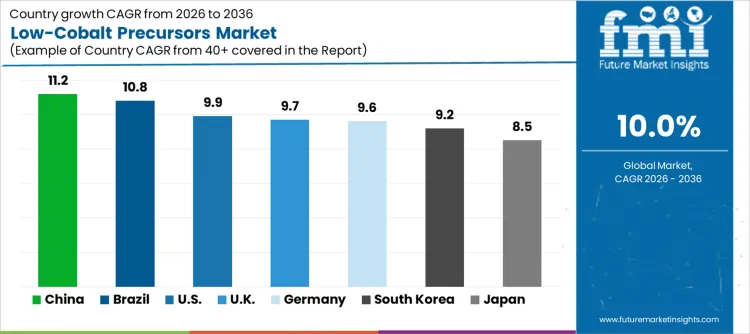
| Country | CAGR (%) |
|---|---|
| China | 11.2% |
| Brazil | 10.8% |
| USA. | 9.9% |
| U.K. | 9.7% |
| Germany | 9.6% |
| South Korea | 9.2% |
| Japan | 8.5% |
What drives China's Dominance in Precursor Innovation?
China's low-cobalt precursors market is projected to achieve a CAGR of 11.2%, representing the highest growth rate globally and reflecting the country's comprehensive approach to battery supply chain development and technological innovation. The market expansion is supported by massive investments in precursor manufacturing capacity from leading Chinese companies, including Huayou Cobalt, Zhejiang Huayou New Energy, and Ronbay Technology, who are scaling production to serve both domestic battery manufacturers and international customers. China's integrated approach to battery supply chain development enables close collaboration between precursor producers, cathode manufacturers, and battery companies to optimize material specifications and manufacturing processes.
The Chinese government's strategic support for new energy vehicle development, combined with substantial subsidies for battery technology research and manufacturing capacity expansion, creates favorable conditions for precursor industry growth. Chinese manufacturers benefit from access to domestic nickel and manganese processing capabilities, advanced chemical engineering expertise, and established relationships with global mining companies that supply critical raw materials. The integration of artificial intelligence and automation technologies in Chinese precursor facilities enables rapid process optimization and quality improvement initiatives that maintain competitive advantages in global markets.
Why is Brazil Emerging as a Strategic Precursor Hub?
Brazil's low-cobalt precursors market is expected to grow at a CAGR of 10.8%, driven by the country's abundant mineral resources, growing battery manufacturing sector, and strategic initiatives to develop integrated battery supply chains. The market benefits from Brazil's significant nickel reserves, established mining infrastructure, and government policies promoting value-added processing of mineral resources within the country. Brazilian companies are developing partnerships with international battery manufacturers and technology providers to establish precursor manufacturing capabilities that serve both domestic and export markets.
The establishment of electric vehicle manufacturing facilities by major automotive companies, combined with Brazil's growing renewable energy sector, creates domestic demand for battery materials that supports precursor industry development. Brazil's focus on sustainable mining practices and environmental stewardship aligns with automotive manufacturers' corporate responsibility requirements, creating opportunities for Brazilian suppliers to differentiate their products based on sustainability credentials. The country's strategic location provides logistical advantages for serving both North American and European markets while benefiting from preferential trade agreements.
How are US Policy Initiatives Shaping Domestic Precursor Capacity?
The United States low-cobalt precursors market is projected to record a CAGR of 9.9%, reflecting substantial government investments in domestic battery supply chain development through the Inflation Reduction Act, CHIPS Act, and other strategic initiatives aimed at reducing dependence on foreign battery materials. Market growth is supported by major capacity expansion projects from both domestic and international companies establishing US precursor manufacturing operations to serve the growing North American battery market. The emphasis on supply chain resilience and national security considerations creates opportunities for US-based precursor manufacturers who can provide reliable domestic sourcing for critical battery materials.
Government incentives for battery supply chain development, combined with automotive manufacturer requirements for domestic content in electric vehicles, drive investment in advanced precursor manufacturing technologies and facilities. US manufacturers focus on developing high-value precursor formulations that address automotive performance requirements while implementing advanced environmental controls and worker safety standards. Research partnerships between precursor companies, universities, and national laboratories accelerate development of innovative materials and manufacturing technologies that support next-generation battery systems.
What drives the UK's Focus on Sustainable Precursor Technologies?
The United Kingdom's low-cobalt precursors market is estimated to expand at a CAGR of 9.7%, supported by the country's strategic focus on sustainable battery technologies and commitment to achieving net-zero emissions across the transportation sector. Market development is driven by investments in battery research and development through government funding programs and partnerships between automotive manufacturers, chemical companies, and academic institutions developing advanced battery materials. The UK's emphasis on circular economy principles creates demand for precursor technologies that support battery recycling and material recovery initiatives.
Government support for electric vehicle adoption and battery manufacturing, including funding for battery gigafactory development, drives demand for precursor technologies that meet European environmental and safety standards. The UK's strong chemical industry heritage provides technological capabilities for developing sophisticated precursor formulations while established relationships with global automotive manufacturers create market opportunities for British suppliers. Brexit implications and supply chain security considerations motivate investment in domestic precursor capabilities that support energy independence and industrial competitiveness.
How does Germany's Chemical Expertise Drive Precursor Innovation?
Germany's low-cobalt precursors market is likely to rise at a CAGR of 9.6%, reflecting the country's leadership in chemical engineering and materials science capabilities that support advanced precursor development and manufacturing. Market growth is supported by major investments from German chemical companies, including BASF and other industry leaders, who are developing next-generation precursor technologies that address automotive performance requirements. Germany's strong automotive industry creates demand for precursor materials that meet stringent German engineering standards for quality, reliability, and performance consistency.
The country's focus on Industry 4.0 and digital manufacturing drives adoption of advanced process control technologies that enable precise optimization of precursor properties and manufacturing efficiency. German manufacturers prioritize precursor solutions that support long-term durability, environmental sustainability, and advanced safety characteristics required for European automotive applications. Research collaborations between German universities, chemical companies, and automotive manufacturers accelerate development of innovative precursor technologies that address next-generation battery requirements.
Why is South Korea's Integrated Approach Driving Market Growth?
South Korea's low-cobalt precursors market is projected to increase at a CAGR of 9.2%, driven by the country's integrated approach to battery supply chain development and established leadership in battery technology through companies like LG Chem and other major manufacturers. Market expansion reflects South Korea's strategic investments in precursor manufacturing capabilities that support both domestic battery production and international export opportunities. The country's semiconductor and advanced materials manufacturing expertise translates into sophisticated precursor synthesis technologies that enable precise control over material properties and performance characteristics.
Government support for battery industry development, combined with strong research and development capabilities in materials science and electrochemistry, drives innovation in advanced precursor technologies that address next-generation battery requirements. South Korean manufacturers focus on high-performance precursor formulations that enable superior energy density and cycle life characteristics while meeting international automotive standards. The country's export-oriented strategy creates opportunities for Korean precursor suppliers to serve global battery manufacturers while benefiting from economies of scale and technological expertise.
How does Japan's Quality Excellence Shape Precursor Development?
Japan's low-cobalt precursors market is likely to expand at a CAGR of 8.5%, reflecting the country's emphasis on precision manufacturing and quality excellence that supports development of premium precursor materials for demanding battery applications. Market growth is supported by Japanese companies' leadership in materials science and process engineering, with manufacturers developing advanced precursor technologies that address automotive safety and reliability requirements. Japan's focus on long-term research and development investments drives innovation in fundamental precursor chemistry and manufacturing science.
The Japanese automotive industry's transition toward electrification creates demand for precursor materials that meet traditional Japanese quality standards while supporting advanced battery performance characteristics. Japanese manufacturers prioritize precursor solutions that address safety considerations, manufacturing precision, and environmental sustainability requirements that align with corporate responsibility commitments. Research institutions and corporate laboratories in Japan continue to advance precursor science through fundamental research in materials chemistry and process optimization.
How are Manufacturers Securing Market Share?
Manufacturers secure share in low-cobalt precursors by doing three things well at the same time: proving the material performs in real cathode production, showing they can scale reliably, and staying closely tied to how cell designs are changing. The field is crowded with large chemical groups, specialist materials suppliers, and battery makers that are trying to pull more of the supply chain in-house. Buyers care about consistent precursor quality, tight impurity control, and predictable behavior in the cathode plant, so suppliers win when they can support customers with process guidance, troubleshooting, and fast iteration on specs.
Product development is moving quickly because the target keeps shifting toward lower cobalt content without giving up stability, cycle life, or power. That pace is pushing companies to invest in pilot lines and characterization tools so they can validate changes early and avoid surprises during scale-up. M&A is often about filling gaps, like gaining a specific synthesis route, adding capacity, or securing customer access. The strongest players bundle materials with technical service, quality systems, and regional supply support, so customers can qualify faster and run production with fewer disruptions.
Key Players in the Low-Cobalt Precursors Market
- Umicore
- BASF
- POSCO Future M
- Huayou Cobalt
- Zhejiang Huayou New Energy
- Ronbay Technology
- LG Chem
- ECOPRO BM
Scope of Report
| Items | Values |
|---|---|
| Quantitative Units | USD Million |
| Chemistry Class Segments | NMC 811/955; NMC 721/622; NCA/Low-Co Blends; Other Low-Co Precursors |
| Application Types | Passenger EV; Commercial EV; Stationary Storage |
| Supply Form Types | Hydroxide Precursors; Carbonate Precursors; Other Salts |
| Producer Type Categories | Integrated Cathode Producers; Independent Precursor Suppliers; Toll/Others |
| Regions Covered | North America, Europe, Asia Pacific, Latin America, Middle East & Africa |
| Key Countries | USA, Germany, China, Brazil, U.K., South Korea, Japan |
| Key Companies Profiled | Umicore, BASF, POSCO Future M, Huayou Cobalt, Zhejiang Huayou New Energy, and others |
Low-Cobalt Precursors Market by Segments
By Chemistry Class
- NMC 811/955
- NMC 721/622
- NCA/Low-Co Blends
- Other Low-Co Precursors
By Application
- Passenger EV
- Commercial EV
- Stationary Storage
By Supply Form
- Hydroxide Precursors
- Carbonate Precursors
- Other Salts
By Producer Type
- Integrated Cathode Producers
- Independent Precursor Suppliers
- Toll/Others
Bibliography
- USA. Department of Energy. (2024). 2024 critical materials assessment: Cobalt, nickel, and lithium in next generation batteries. Office of Energy Efficiency & Renewable Energy.
- National Renewable Energy Laboratory. (2024). Advanced battery materials and precursor cost modeling (NREL/TP 6A20 85833). USA. Department of Energy.
- USA. Geological Survey. (2024). Mineral commodity summaries: Cobalt. USA. Department of the Interior.
Frequently Asked Questions
How big is the low-cobalt precursors market in 2026?
The global low-cobalt precursors market is estimated to be valued at USD 3,200.0 million in 2026.
What will be the size of low-cobalt precursors market in 2036?
The market size for the low-cobalt precursors market is projected to reach USD 8,300.0 million by 2036.
How much will be the low-cobalt precursors market growth between 2026 and 2036?
The low-cobalt precursors market is expected to grow at a 10.0% CAGR between 2026 and 2036.
What are the key product types in the low-cobalt precursors market?
The key product types in low-cobalt precursors market are nmc 811/9.5.5, nmc 721/622, nca/low-co blends and other low-co precursors.
Which application segment to contribute significant share in the low-cobalt precursors market in 2026?
In terms of application, passenger ev segment to command 64.0% share in the low-cobalt precursors market in 2026.
Preview the report firsthand - request a free sample
Get SampleGet the brochure for pricing and purchase details.
Get PDFTable of Content
- Executive Summary
- Global Market Outlook
- Demand-side Trends
- Supply-side Trends
- Technology Roadmap Analysis
- Analysis and Recommendations
- Market Overview
- Market Coverage / Taxonomy
- Market Definition / Scope / Limitations
- Market Background
- Market Dynamics
- Drivers
- Restraints
- Opportunity
- Trends
- Scenario Forecast
- Demand in Optimistic Scenario
- Demand in Likely Scenario
- Demand in Conservative Scenario
- Opportunity Map Analysis
- Product Life Cycle Analysis
- Supply Chain Analysis
- Investment Feasibility Matrix
- Value Chain Analysis
- PESTLE and Porter’s Analysis
- Regulatory Landscape
- Regional Parent Market Outlook
- Production and Consumption Statistics
- Import and Export Statistics
- Market Dynamics
- Global Market Analysis 2021 to 2026 and Forecast, 2026 to 2036
- Historical Market Size Value (USD Million) Analysis, 2021 to 2026
- Current and Future Market Size Value (USD Million) Projections, 2026 to 2036
- Y-o-Y Growth Trend Analysis
- Absolute $ Opportunity Analysis
- Global Market Pricing Analysis 2021 to 2026 and Forecast 2026 to 2036
- Global Market Analysis 2021 to 2026 and Forecast 2026 to 2036, By Chemistry Class
- Introduction / Key Findings
- Historical Market Size Value (USD Million) Analysis By Chemistry Class , 2021 to 2026
- Current and Future Market Size Value (USD Million) Analysis and Forecast By Chemistry Class , 2026 to 2036
- NMC 811/9.5.5
- NMC 721/622
- NCA/low-Co blends
- Other low-Co precursors
- NMC 811/9.5.5
- Y-o-Y Growth Trend Analysis By Chemistry Class , 2021 to 2026
- Absolute $ Opportunity Analysis By Chemistry Class , 2026 to 2036
- Global Market Analysis 2021 to 2026 and Forecast 2026 to 2036, By Application
- Introduction / Key Findings
- Historical Market Size Value (USD Million) Analysis By Application, 2021 to 2026
- Current and Future Market Size Value (USD Million) Analysis and Forecast By Application, 2026 to 2036
- Passenger EV
- Commercial EV
- Stationary storage
- Passenger EV
- Y-o-Y Growth Trend Analysis By Application, 2021 to 2026
- Absolute $ Opportunity Analysis By Application, 2026 to 2036
- Global Market Analysis 2021 to 2026 and Forecast 2026 to 2036, By Supply Form
- Introduction / Key Findings
- Historical Market Size Value (USD Million) Analysis By Supply Form, 2021 to 2026
- Current and Future Market Size Value (USD Million) Analysis and Forecast By Supply Form, 2026 to 2036
- Hydroxide precursors
- Carbonate precursors
- Other salts
- Hydroxide precursors
- Y-o-Y Growth Trend Analysis By Supply Form, 2021 to 2026
- Absolute $ Opportunity Analysis By Supply Form, 2026 to 2036
- Global Market Analysis 2021 to 2026 and Forecast 2026 to 2036, By Procedure Type
- Introduction / Key Findings
- Historical Market Size Value (USD Million) Analysis By Procedure Type, 2021 to 2026
- Current and Future Market Size Value (USD Million) Analysis and Forecast By Procedure Type, 2026 to 2036
- Integrated cathode producers
- Independent precursor suppliers
- Toll/others
- Integrated cathode producers
- Y-o-Y Growth Trend Analysis By Procedure Type, 2021 to 2026
- Absolute $ Opportunity Analysis By Procedure Type, 2026 to 2036
- Global Market Analysis 2021 to 2026 and Forecast 2026 to 2036, By Region
- Introduction
- Historical Market Size Value (USD Million) Analysis By Region, 2021 to 2026
- Current Market Size Value (USD Million) Analysis and Forecast By Region, 2026 to 2036
- North America
- Latin America
- Western Europe
- Eastern Europe
- East Asia
- South Asia and Pacific
- Middle East & Africa
- Market Attractiveness Analysis By Region
- North America Market Analysis 2021 to 2026 and Forecast 2026 to 2036, By Country
- Historical Market Size Value (USD Million) Trend Analysis By Market Taxonomy, 2021 to 2026
- Market Size Value (USD Million) Forecast By Market Taxonomy, 2026 to 2036
- By Country
- USA
- Canada
- Mexico
- By Chemistry Class
- By Application
- By Supply Form
- By Procedure Type
- By Country
- Market Attractiveness Analysis
- By Country
- By Chemistry Class
- By Application
- By Supply Form
- By Procedure Type
- Key Takeaways
- Latin America Market Analysis 2021 to 2026 and Forecast 2026 to 2036, By Country
- Historical Market Size Value (USD Million) Trend Analysis By Market Taxonomy, 2021 to 2026
- Market Size Value (USD Million) Forecast By Market Taxonomy, 2026 to 2036
- By Country
- Brazil
- Chile
- Rest of Latin America
- By Chemistry Class
- By Application
- By Supply Form
- By Procedure Type
- By Country
- Market Attractiveness Analysis
- By Country
- By Chemistry Class
- By Application
- By Supply Form
- By Procedure Type
- Key Takeaways
- Western Europe Market Analysis 2021 to 2026 and Forecast 2026 to 2036, By Country
- Historical Market Size Value (USD Million) Trend Analysis By Market Taxonomy, 2021 to 2026
- Market Size Value (USD Million) Forecast By Market Taxonomy, 2026 to 2036
- By Country
- Germany
- UK
- Italy
- Spain
- France
- Nordic
- BENELUX
- Rest of Western Europe
- By Chemistry Class
- By Application
- By Supply Form
- By Procedure Type
- By Country
- Market Attractiveness Analysis
- By Country
- By Chemistry Class
- By Application
- By Supply Form
- By Procedure Type
- Key Takeaways
- Eastern Europe Market Analysis 2021 to 2026 and Forecast 2026 to 2036, By Country
- Historical Market Size Value (USD Million) Trend Analysis By Market Taxonomy, 2021 to 2026
- Market Size Value (USD Million) Forecast By Market Taxonomy, 2026 to 2036
- By Country
- Russia
- Poland
- Hungary
- Balkan & Baltic
- Rest of Eastern Europe
- By Chemistry Class
- By Application
- By Supply Form
- By Procedure Type
- By Country
- Market Attractiveness Analysis
- By Country
- By Chemistry Class
- By Application
- By Supply Form
- By Procedure Type
- Key Takeaways
- East Asia Market Analysis 2021 to 2026 and Forecast 2026 to 2036, By Country
- Historical Market Size Value (USD Million) Trend Analysis By Market Taxonomy, 2021 to 2026
- Market Size Value (USD Million) Forecast By Market Taxonomy, 2026 to 2036
- By Country
- China
- Japan
- South Korea
- By Chemistry Class
- By Application
- By Supply Form
- By Procedure Type
- By Country
- Market Attractiveness Analysis
- By Country
- By Chemistry Class
- By Application
- By Supply Form
- By Procedure Type
- Key Takeaways
- South Asia and Pacific Market Analysis 2021 to 2026 and Forecast 2026 to 2036, By Country
- Historical Market Size Value (USD Million) Trend Analysis By Market Taxonomy, 2021 to 2026
- Market Size Value (USD Million) Forecast By Market Taxonomy, 2026 to 2036
- By Country
- India
- ASEAN
- Australia & New Zealand
- Rest of South Asia and Pacific
- By Chemistry Class
- By Application
- By Supply Form
- By Procedure Type
- By Country
- Market Attractiveness Analysis
- By Country
- By Chemistry Class
- By Application
- By Supply Form
- By Procedure Type
- Key Takeaways
- Middle East & Africa Market Analysis 2021 to 2026 and Forecast 2026 to 2036, By Country
- Historical Market Size Value (USD Million) Trend Analysis By Market Taxonomy, 2021 to 2026
- Market Size Value (USD Million) Forecast By Market Taxonomy, 2026 to 2036
- By Country
- Kingdom of Saudi Arabia
- Other GCC Countries
- Turkiye
- South Africa
- Other African Union
- Rest of Middle East & Africa
- By Chemistry Class
- By Application
- By Supply Form
- By Procedure Type
- By Country
- Market Attractiveness Analysis
- By Country
- By Chemistry Class
- By Application
- By Supply Form
- By Procedure Type
- Key Takeaways
- Key Countries Market Analysis
- USA
- Pricing Analysis
- Market Share Analysis, 2026
- By Chemistry Class
- By Application
- By Supply Form
- By Procedure Type
- Canada
- Pricing Analysis
- Market Share Analysis, 2026
- By Chemistry Class
- By Application
- By Supply Form
- By Procedure Type
- Mexico
- Pricing Analysis
- Market Share Analysis, 2026
- By Chemistry Class
- By Application
- By Supply Form
- By Procedure Type
- Brazil
- Pricing Analysis
- Market Share Analysis, 2026
- By Chemistry Class
- By Application
- By Supply Form
- By Procedure Type
- Chile
- Pricing Analysis
- Market Share Analysis, 2026
- By Chemistry Class
- By Application
- By Supply Form
- By Procedure Type
- Germany
- Pricing Analysis
- Market Share Analysis, 2026
- By Chemistry Class
- By Application
- By Supply Form
- By Procedure Type
- UK
- Pricing Analysis
- Market Share Analysis, 2026
- By Chemistry Class
- By Application
- By Supply Form
- By Procedure Type
- Italy
- Pricing Analysis
- Market Share Analysis, 2026
- By Chemistry Class
- By Application
- By Supply Form
- By Procedure Type
- Spain
- Pricing Analysis
- Market Share Analysis, 2026
- By Chemistry Class
- By Application
- By Supply Form
- By Procedure Type
- France
- Pricing Analysis
- Market Share Analysis, 2026
- By Chemistry Class
- By Application
- By Supply Form
- By Procedure Type
- India
- Pricing Analysis
- Market Share Analysis, 2026
- By Chemistry Class
- By Application
- By Supply Form
- By Procedure Type
- ASEAN
- Pricing Analysis
- Market Share Analysis, 2026
- By Chemistry Class
- By Application
- By Supply Form
- By Procedure Type
- Australia & New Zealand
- Pricing Analysis
- Market Share Analysis, 2026
- By Chemistry Class
- By Application
- By Supply Form
- By Procedure Type
- China
- Pricing Analysis
- Market Share Analysis, 2026
- By Chemistry Class
- By Application
- By Supply Form
- By Procedure Type
- Japan
- Pricing Analysis
- Market Share Analysis, 2026
- By Chemistry Class
- By Application
- By Supply Form
- By Procedure Type
- South Korea
- Pricing Analysis
- Market Share Analysis, 2026
- By Chemistry Class
- By Application
- By Supply Form
- By Procedure Type
- Russia
- Pricing Analysis
- Market Share Analysis, 2026
- By Chemistry Class
- By Application
- By Supply Form
- By Procedure Type
- Poland
- Pricing Analysis
- Market Share Analysis, 2026
- By Chemistry Class
- By Application
- By Supply Form
- By Procedure Type
- Hungary
- Pricing Analysis
- Market Share Analysis, 2026
- By Chemistry Class
- By Application
- By Supply Form
- By Procedure Type
- Kingdom of Saudi Arabia
- Pricing Analysis
- Market Share Analysis, 2026
- By Chemistry Class
- By Application
- By Supply Form
- By Procedure Type
- Turkiye
- Pricing Analysis
- Market Share Analysis, 2026
- By Chemistry Class
- By Application
- By Supply Form
- By Procedure Type
- South Africa
- Pricing Analysis
- Market Share Analysis, 2026
- By Chemistry Class
- By Application
- By Supply Form
- By Procedure Type
- USA
- Market Structure Analysis
- Competition Dashboard
- Competition Benchmarking
- Market Share Analysis of Top Players
- By Regional
- By Chemistry Class
- By Application
- By Supply Form
- By Procedure Type
- Competition Analysis
- Competition Deep Dive
- Umicore
- Overview
- Product Portfolio
- Profitability by Market Segments (Product/Age /Sales Channel/Region)
- Sales Footprint
- Strategy Overview
- Marketing Strategy
- Product Strategy
- Channel Strategy
- BASF
- POSCO Future M
- Huayou Cobalt
- Zhejiang Huayou New Energy
- Ronbay Technology
- LG Chem
- ECOPRO BM
- Umicore
- Competition Deep Dive
- Assumptions & Acronyms Used
- Research Methodology


