

- Industry Size (2026):
- USD 832.7 Mn
- Forecast (2036):
- USD 3548.7 Mn
- CAGR (2026 to 2036)
- 15.6%
Solid-State Battery Precursor-Free Cathodes Market Forecast and Outlook 2026 to 2036
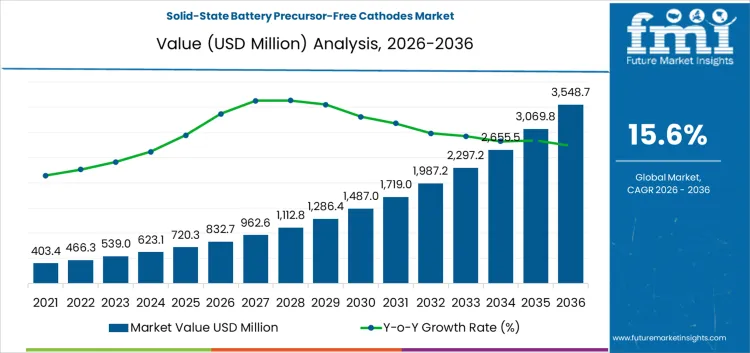
The solid-state battery precursor-free cathodes market is projected to grow significantly over the next decade, with the market value rising from USD 832.7 million in 2026 to USD 3,548.7 million by 2036, reflecting a compound annual growth rate (CAGR) of 15.6%. This growth is driven by the increasing demand for solid-state batteries, which are seen as a safer and more efficient alternative to traditional lithium-ion batteries. Precursor-free cathodes are a key innovation in the development of solid-state batteries, offering improved performance and sustainability. As the adoption of solid-state battery technology expands in sectors such as electric vehicles (EVs) and renewable energy storage, the precursor-free cathode market is set to experience substantial growth.
Quick Stats for the Solid-State Battery Precursor-Free Cathodes Market
- Solid-State Battery Precursor-Free Cathodes Market Value (2026): USD 832.7 million
- Solid-State Battery Precursor-Free Cathodes Market Forecast Value (2036): USD 3,548.7 million
- Solid-State Battery Precursor-Free Cathodes Market Global Forecast CAGR 2026 to 2036: 15.6%
- Solid-State Battery Precursor-Free Cathodes Market Leading Segment: EV OEMs (45%)
- Key Growth Regions in Solid-State Battery Precursor-Free Cathodes Market: China
- Top Players in Solid-State Battery Precursor-Free Cathodes Market: Toyota Central R&D Labs, Quantum Scape Corporation, Solid Power, Inc., Samsung SDI, Panasonic Energy
What is the Growth Forecast for the Solid-State Battery Precursor-Free Cathodes Market through 2036?
The solid-state battery precursor-free cathodes market is expected to experience both market share gain and erosion as the industry evolves. In the early years of the forecast period, the market will witness steady growth and market share gain as the demand for solid-state batteries, particularly in electric vehicles and energy storage, increases. By 2027, the market value will rise to USD 963.6 million, with continued expansion in the following years, reaching USD 1,115.6 million in 2028 and USD 1,289.8 million in 2029. This acceleration is expected to reflect strong market share gain as precursor-free cathodes offer unique advantages in terms of battery performance and cost-efficiency.
However, as more competitors enter the market and advancements in other battery technologies, such as lithium-ion and next-generation materials, progress, there could be a slight erosion in market share in the mid-2030s. The market is expected to reach USD 3,548.7 million by 2036. Despite this potential for market share erosion, the solid-state battery precursor-free cathodes market will continue to grow at a steady pace, driven by technological innovations, increased adoption in EVs, and the ongoing shift toward energy storage solutions.
Solid-State Battery Precursor-Free Cathodes Market Key Takeaways
| Metric | Value |
|---|---|
| Industry Sales Value (2026) | USD 832.7 million |
| Industry Forecast Value (2036) | USD 3,548.7 million |
| Industry Forecast CAGR 2026 to 2036 | 15.6% |
What Is Driving the Solid State Battery Precursor Free Cathodes Market?
Historically, the solid state battery precursor free cathodes market was shaped by limitations in conventional lithium ion battery materials and the drive for safer, higher energy storage solutions. Traditional cathode manufacturing involved precursor compounds that required complex processing steps, high temperature sintering, and careful phase control to achieve target electrochemical performance. These processes increased costs and introduced variability in material characteristics, particularly when integrated into emerging solid state battery architectures. Early solid state battery research focused on adapting conventional cathode chemistries to solid electrolytes, often encountering interfacial resistance and compatibility challenges. As academic and industrial research advanced, interest grew in precursor free cathodes that could simplify production, reduce processing steps, and enable direct integration with solid electrolytes. Initial efforts were concentrated in laboratory and pilot programs where material scientists evaluated alternative synthesis routes, including direct solid state reactions and scalable deposition techniques, to produce structurally stable cathodes for solid state cells. This phase established performance benchmarks, manufacturing feasibility, and integration pathways with existing cell architectures.
Future demand for solid state battery precursor free cathodes is expected to be driven by growth in electric vehicle adoption, energy storage applications, and the pursuit of next generation battery performance metrics. Manufacturers are anticipated to adopt precursor free cathode technologies that reduce manufacturing complexity and cost while improving cell safety by minimizing thermal runaway pathways. Advances in scalable synthesis methods, compatibility with diverse solid electrolytes, and enhanced cycle stability will broaden market prospects beyond niche applications. Growth factors will include the expanding solid state battery supply chain, increased capital investment in advanced manufacturing infrastructure, and regulatory pressures for higher energy efficiency and performance standards in transportation and stationary storage. Challenges remain, including establishing reliable large scale production processes, managing material costs, and validating long term performance under real world conditions. Long term market expansion will depend on demonstrated improvements in energy density, manufacturing yield, and integration into established battery manufacturing ecosystems.
What are the Key Segments in the Solid-State Battery Precursor-Free Cathodes Market?
The Solid-State Battery Precursor-Free Cathodes market is segmented into processes and end users. The process segments include dry electrode manufacturing, thin-film deposition methods, powder processing routes, and others, with dry electrode manufacturing holding the largest share at 42%. On the end-user side, electric vehicle (EV) OEMs represent the largest segment, accounting for 45% of the market share. Other end users include battery manufacturers, consumer electronics OEMs, and energy storage system integrators. The market growth is primarily driven by the demand for high-performance, safer, and more energy-dense solid-state batteries, especially in the automotive and consumer electronics sectors. The increasing focus on EVs and energy storage systems, along with advancements in solid-state battery technologies, is propelling the adoption of precursor-free cathodes. Key regions driving this market include North America, Europe, and Asia Pacific, where the electric vehicle and energy storage industries are experiencing significant expansion.
What is Driving Growth in the Dry Electrode Manufacturing Process?
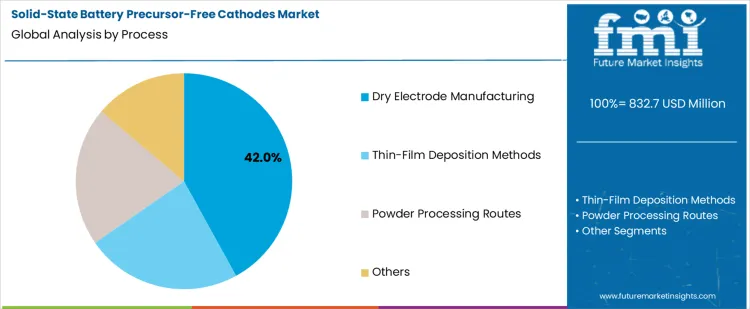
The dry electrode manufacturing process leads the process segment in the Solid-State Battery Precursor-Free Cathodes market, holding 42% of the market share. This growth is driven by the increasing demand for energy-efficient, scalable, and environmentally friendly production methods for solid-state batteries. Dry electrode manufacturing eliminates the need for solvents, making it a more sustainable and cost-effective process compared to traditional methods that rely on wet processing. The advantages of dry electrode manufacturing include improved energy density, faster production cycles, and a reduction in the environmental impact associated with solvent use. These benefits make the process particularly attractive to battery manufacturers and EV OEMs, who are increasingly seeking advanced manufacturing techniques to meet the growing demand for solid-state batteries with high performance and long lifespan. The dry electrode method is particularly well-suited for the production of precursor-free cathodes, which are crucial for enhancing the stability and safety of solid-state batteries. As the automotive and energy storage industries continue to focus on achieving longer battery life, improved efficiency, and faster charging times, dry electrode manufacturing is expected to see continued growth, particularly in regions such as North America and Asia Pacific.
What is Driving the Demand for EV OEMs in the Solid-State Battery Precursor-Free Cathodes Market?
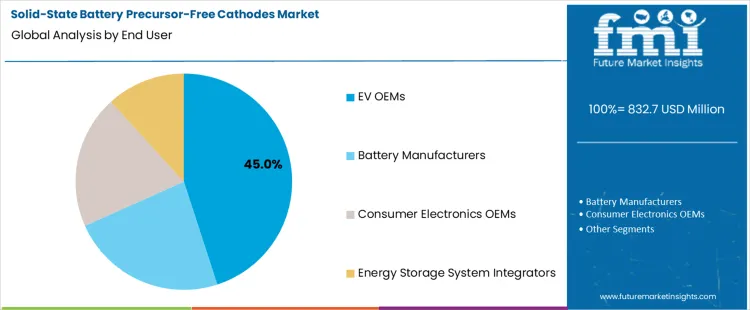
Electric vehicle (EV) OEMs represent the largest end-user segment in the Solid-State Battery Precursor-Free Cathodes market, with 45% of the market share. The demand for solid-state batteries in the EV sector is growing rapidly, as these batteries offer higher energy densities, enhanced safety, and longer lifespans compared to traditional lithium-ion batteries. Solid-state batteries are considered a key technology for the future of EVs, particularly for improving range, reducing charging times, and minimizing the risk of thermal runaway, making them highly attractive to EV OEMs. The adoption of precursor-free cathodes is particularly important, as they contribute to the improved performance and efficiency of solid-state batteries. EV manufacturers are increasingly investing in research and development of solid-state battery technologies to maintain competitiveness in the market and meet regulatory requirements for zero-emission vehicles. The rise in government incentives for electric vehicle adoption and growing consumer demand for more sustainable transportation solutions are also driving the shift towards solid-state batteries. As the EV market continues to expand globally, especially in regions like Europe, North America, and China, the demand for precursor-free cathodes in solid-state batteries is expected to accelerate, further solidifying the dominance of EV OEMs in this segment.
What are the Key Dynamics in the Solid-State Battery Precursor-Free Cathodes Market?
The solid-state battery precursor-free cathodes market is gaining momentum due to the increasing demand for high-performance, safer, and more energy-efficient energy storage solutions. Solid-state batteries (SSBs) are seen as a promising alternative to traditional lithium-ion batteries because they use a solid electrolyte rather than a liquid, offering greater energy density and safety features. Precursor-free cathodes, which eliminate the need for traditional chemical precursors, are a key innovation in this space, potentially reducing the cost, complexity, and environmental impact of solid-state batteries. The market is driven by advancements in materials science, specifically the development of new cathode materials that offer high conductivity, stability, and longevity. As the demand for electric vehicles (EVs) and renewable energy storage grows, the need for more efficient and sustainable energy storage technologies like solid-state batteries becomes increasingly critical.
What are the Key Drivers of Growth in the Solid-State Battery Precursor-Free Cathodes Market?
Several factors are driving the growth of the solid-state battery precursor-free cathodes market. The shift towards electric vehicles (EVs) and renewable energy systems, which require more efficient and safer energy storage technologies, is one of the primary drivers. Solid-state batteries, with their higher energy density and improved safety profiles, are considered a solution to the limitations of traditional lithium-ion batteries. Moreover, the development of precursor-free cathodes offers a more sustainable and cost-effective approach to manufacturing solid-state batteries. Reducing reliance on complex chemical processes in cathode production can lower material costs and reduce environmental impact, making solid-state batteries more attractive for large-scale applications. Ongoing research into novel materials and manufacturing processes is also improving the performance and scalability of solid-state batteries, further boosting the demand for precursor-free cathodes.
What are the Key Restraints in the Solid-State Battery Precursor-Free Cathodes Market?
The solid-state battery precursor-free cathodes market faces several challenges that could hinder its growth. One of the key restraints is the complexity and cost associated with developing and scaling up precursor-free cathode materials. While promising, these materials require further research to improve their performance, longevity, and manufacturability. The lack of established supply chains for precursor-free cathode materials also adds to the challenges, as sourcing and processing these materials can be more expensive and less efficient than traditional alternatives. Furthermore, the technology for manufacturing solid-state batteries at large scale is still in its nascent stages, and mass production techniques that can handle precursor-free cathodes effectively are yet to be fully developed. Finally, the competition from other battery technologies, such as lithium-ion and sodium-ion batteries, could limit the adoption of solid-state batteries, particularly if these alternatives continue to improve in terms of cost and performance.
What are the Key Trends in the Solid-State Battery Precursor-Free Cathodes Market?
Key trends in the solid-state battery precursor-free cathodes market include significant advancements in material science and manufacturing technologies aimed at improving the efficiency and scalability of solid-state batteries. Researchers are focusing on optimizing precursor-free cathode materials that offer higher energy densities, faster charge times, and longer lifespans compared to traditional cathodes. There is also a growing trend towards the development of hybrid manufacturing processes that combine the benefits of precursor-free materials with conventional cathode production methods to streamline production and reduce costs. The push for sustainability is driving innovation, with companies exploring eco-friendly materials and processes to minimize environmental impact. Additionally, the expansion of the electric vehicle market and the increasing adoption of renewable energy storage systems are fueling the demand for solid-state batteries, making the advancement of precursor-free cathodes a critical area of focus in the ongoing transition to cleaner energy solutions.
What is the Country-Wise Analysis of the Solid-State Battery Precursor-Free Cathodes Market?
The solid-state battery precursor-free cathodes market is witnessing robust growth globally, driven by the increasing demand for energy storage solutions in various industries such as electric vehicles (EVs), consumer electronics, and renewable energy systems. Solid-state batteries, known for their high energy density and safety advantages, are expected to play a crucial role in the future of energy storage. The precursor-free cathodes, which eliminate the need for traditional cathode materials, offer even greater improvements in performance and cost-efficiency. Key markets, including the USA, China, Germany, Japan, and India, are leading this transition, each experiencing growth influenced by technological advancements, policy support, and the need for better energy storage solutions.
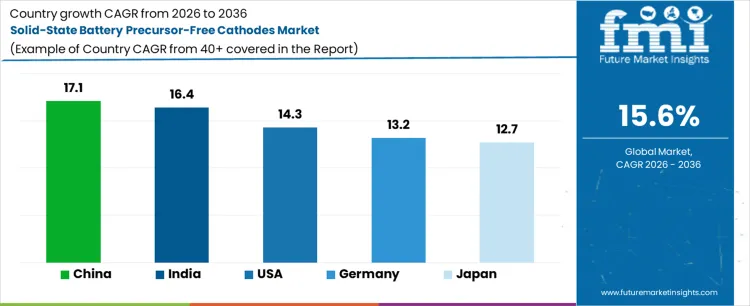
| Country | CAGR 2026 to 2036 |
|---|---|
| USA | 14.3% |
| China | 17.1% |
| Germany | 13.2% |
| Japan | 12.7% |
| India | 16.4% |
What is Driving the Growth of the Solid-State Battery Precursor-Free Cathodes Market in the USA?
The solid-state battery precursor-free cathodes market in the USA is growing at a CAGR of 14.3%. This growth is primarily driven by the increasing adoption of solid-state batteries in electric vehicles (EVs) and renewable energy storage. The USA has been a leader in developing and deploying EV technologies, and as the demand for EVs rises, so does the need for advanced battery solutions. Solid-state batteries, with their higher energy density and improved safety compared to traditional lithium-ion batteries, are gaining traction in the automotive and energy sectors. Additionally, the USA government’s support for clean energy technologies and the push towards carbon neutrality are creating a favorable environment for the development and adoption of precursor-free cathodes in solid-state batteries. As manufacturers continue to invest in next-generation battery technologies, the market for solid-state battery precursor-free cathodes in the USA is expected to grow steadily.
How is the Solid-State Battery Precursor-Free Cathodes Market Evolving in China?
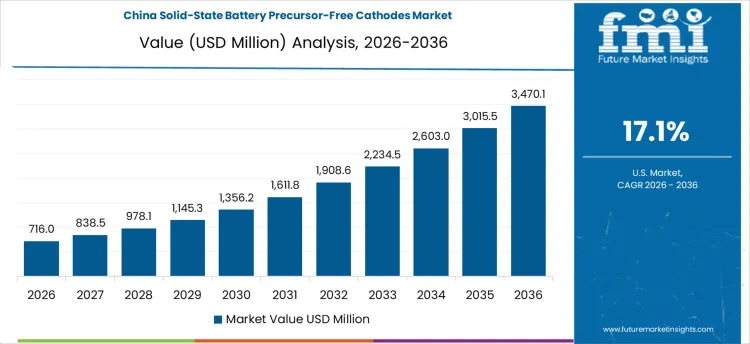
China’s solid-state battery precursor-free cathodes market is growing at a CAGR of 17.1%. As the world’s largest producer and consumer of electric vehicles, China is at the forefront of the transition to solid-state battery technologies. The Chinese government’s commitment to reducing carbon emissions and promoting green technologies has accelerated the development of solid-state batteries, particularly for use in EVs and energy storage systems. The market is also driven by China’s robust manufacturing capabilities and its focus on scaling up the production of solid-state batteries. Precursor-free cathodes, which offer improvements in battery performance and cost-efficiency, are expected to play a key role in meeting the growing demand for advanced energy storage solutions in China. As the country continues to lead the global electric vehicle market, the demand for precursor-free cathodes in solid-state batteries is set to rise significantly.
What Factors are Shaping the Solid-State Battery Precursor-Free Cathodes Market in Germany?
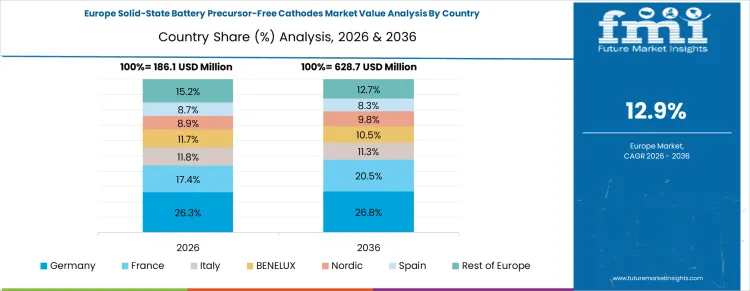
Germany’s solid-state battery precursor-free cathodes market is growing at a CAGR of 13.2%. Germany is a global leader in automotive technology and energy storage solutions, making it a key market for solid-state battery innovations. The increasing demand for electric vehicles and the country’s commitment to reducing its carbon footprint are driving the adoption of advanced battery technologies. Solid-state batteries, with their higher energy density and safety advantages, are being actively explored by German automakers and energy companies. The market is further supported by Germany’s focus on green technologies and its well-established research and development ecosystem. As the need for more efficient energy storage solutions grows, precursor-free cathodes are expected to play a significant role in enhancing the performance and cost-effectiveness of solid-state batteries in Germany.
How is the Solid-State Battery Precursor-Free Cathodes Market Performing in Japan?
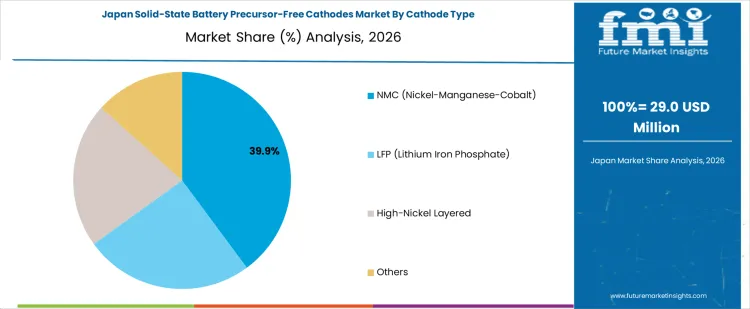
Japan’s solid-state battery precursor-free cathodes market is growing at a CAGR of 12.7%. Japan is known for its technological advancements and strong emphasis on innovation in energy storage technologies. The country’s automotive and consumer electronics industries are rapidly adopting solid-state batteries due to their higher energy density and safety features. Japan’s focus on sustainable development and the need for efficient energy storage systems are key drivers of the market. Solid-state batteries with precursor-free cathodes are particularly attractive in Japan’s EV sector, where manufacturers are looking for ways to improve battery performance and reduce the overall cost of energy storage. As Japan continues to invest in clean energy technologies, the demand for solid-state battery precursor-free cathodes is expected to grow.
What Factors Are Contributing to the Growth of the Solid-State Battery Precursor-Free Cathodes Market in India?
India’s solid-state battery precursor-free cathodes market is growing at a CAGR of 16.4%. India is witnessing rapid growth in the electric vehicle and renewable energy sectors, which is driving the demand for advanced energy storage solutions. The country’s focus on reducing carbon emissions and transitioning to sustainable energy sources is creating a favorable environment for the adoption of solid-state batteries. As India’s automotive industry shifts towards electric mobility, the demand for solid-state batteries with precursor-free cathodes is increasing. The cost-effectiveness and enhanced performance of these batteries make them an attractive option for India’s growing energy storage needs. As manufacturers in India continue to develop and scale solid-state battery technologies, the market for precursor-free cathodes is expected to expand.
What is the Competitive Landscape for the Solid-State Battery Precursor-Free Cathodes Market?
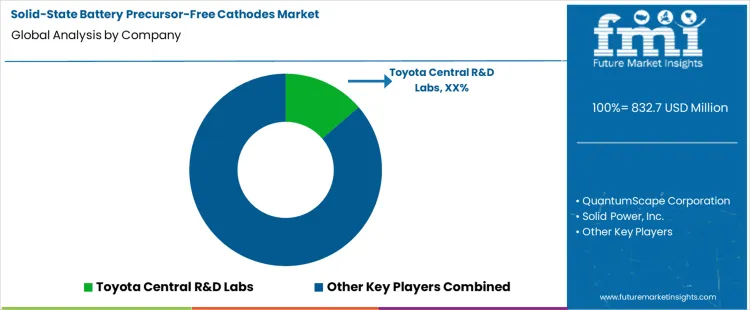
The solid-state battery precursor-free cathodes market is evolving rapidly, with key companies pushing the boundaries of innovation to offer advanced energy storage solutions. Toyota Central R&D Labs leads the market, pioneering the development of precursor-free cathodes for solid-state batteries, which are crucial for improving battery performance and safety in electric vehicles (EVs). Toyota’s continued investment in research and development, coupled with its leadership in solid-state battery technology, places it in a strong position to dominate the market. QuantumScape Corporation, another significant player, focuses on the development of solid-state batteries with improved energy density and faster charging capabilities, targeting the growing EV sector. Solid Power, Inc., alongside its strategic partnerships with major automotive manufacturers, is working on scalable solid-state battery solutions that offer increased efficiency and safety. Samsung SDI and Panasonic Energy, both leading players in the broader battery market, are also competing by integrating precursor-free cathode technologies into their solid-state battery offerings, seeking to capitalize on the demand for safer, longer-lasting batteries.
In this competitive market, companies employ various strategies to maintain their leadership. Toyota Central R&D Labs focuses on advancing its precursor-free cathode technologies, aiming to enhance battery performance and reduce production costs. QuantumScape Corporation has entered high-profile collaborations with automakers to commercialize its technology, ensuring its position as a leading innovator. Solid Power, Inc. is working towards scaling up production while ensuring that its solid-state batteries meet the necessary industry standards. Samsung SDI and Panasonic Energy are incorporating precursor-free cathode technologies into their existing battery manufacturing capabilities, improving energy density, and extending battery life. The focus on strategic partnerships, research advancements, and scaling production ensures that these companies remain competitive in the growing market for solid-state batteries, where performance and safety are of paramount importance.
Key Players of the Solid-State Battery Precursor-Free Cathodes Market
- Toyota Central R&D Labs
- QuantumScape Corporation
- Solid Power, Inc.
- Samsung SDI
- Panasonic Energy
- Others
Scope of the Report
| Items | Values |
|---|---|
| Quantitative Units (2026) | USD Million |
| Cathode Type | NMC (Nickel-Manganese-Cobalt), LFP (Lithium Iron Phosphate), High-Nickel Layered, Others |
| Process | Dry Electrode Manufacturing, Thin-Film Deposition Methods, Powder Processing Routes, Others |
| End User | EV OEMs, Battery Manufacturers, Consumer Electronics OEMs, Energy Storage System Integrators |
| Companies | Toyota Central R&D Labs, QuantumScape Corporation, Solid Power, Inc., Samsung SDI, Panasonic Energy, Others |
| Regions Covered | North America, Latin America, Western Europe, Eastern Europe, South Asia and Pacific, East Asia, Middle East & Africa |
| Countries Covered | United States, Canada, Mexico, Brazil, Argentina, Germany, France, United Kingdom, Italy, Spain, Netherlands, China, India, Japan, South Korea, ANZ, GCC Countries, South Africa |
| Additional Attributes | Dollar sales by cathode type, process, end user, and region. Includes market trends towards solid-state battery advancements, cost-effectiveness, energy efficiency, regulatory compliance, and the role of precursor-free cathodes in enhancing battery performance and safety. |
Solid-State Battery Precursor-Free Cathodes Market Segmentation
Cathode Type:
- NMC (Nickel-Manganese-Cobalt)
- LFP (Lithium Iron Phosphate)
- High-Nickel Layered
- Others
Process:
- Dry Electrode Manufacturing
- Thin-Film Deposition Methods
- Powder Processing Routes
- Others
End User:
- EV OEMs
- Battery Manufacturers
- Consumer Electronics OEMs
- Energy Storage System Integrators
- Others
Region:
- Asia Pacific
- China
- Japan
- India
- Australia & New Zealand
- ASEAN
- Rest of Asia Pacific
- Europe
- Germany
- United Kingdom
- France
- Italy
- Spain
- Nordic
- BENELUX
- Rest of Europe
- North America
- United States
- Canada
- Mexico
- Latin America
- Brazil
- Argentina
- Rest of Latin America
- Middle East & Africa
- Kingdom of Saudi Arabia
- Other GCC Countries
- South Africa
- Rest of Middle East & Africa
Bibliography
- International Energy Agency (IEA). (2023). Solid-state batteries: Advancing next-generation storage solutions for electric vehicles and energy systems. IEA Publications.
- USA Department of Energy (DOE). (2023). The future of battery technologies: Impact of precursor-free cathodes on solid-state battery performance. DOE Research Reports.
- European Commission. (2023). Regulatory frameworks and innovations in battery technologies: The role of precursor-free cathodes in sustainable energy storage. EC Publications.
- National Renewable Energy Laboratory (NREL). (2023). Solid-state battery advancements: Precursor-free cathodes for high-performance storage solutions. NREL Technical Briefs.
- USA National Institute of Standards and Technology (NIST). (2023). Battery materials innovation: Precursor-free cathodes in solid-state batteries for improved performance. NIST Technology Reports.
Frequently Asked Questions
How big is the solid-state battery precursor-free cathodes market in 2026?
The global solid-state battery precursor-free cathodes market is estimated to be valued at USD 832.7 million in 2026.
What will be the size of solid-state battery precursor-free cathodes market in 2036?
The market size for the solid-state battery precursor-free cathodes market is projected to reach USD 3,548.7 million by 2036.
How much will be the solid-state battery precursor-free cathodes market growth between 2026 and 2036?
The solid-state battery precursor-free cathodes market is expected to grow at a 15.6% CAGR between 2026 and 2036.
What are the key product types in the solid-state battery precursor-free cathodes market?
The key product types in solid-state battery precursor-free cathodes market are nmc (nickel-manganese-cobalt), lfp (lithium iron phosphate), high-nickel layered and others.
Which process segment to contribute significant share in the solid-state battery precursor-free cathodes market in 2026?
In terms of process, dry electrode manufacturing segment to command 42.0% share in the solid-state battery precursor-free cathodes market in 2026.
Preview the report firsthand - request a free sample
Get SampleGet the brochure for pricing and purchase details.
Get PDFTable of Content
- Executive Summary
- Global Market Outlook
- Demand-side Trends
- Supply-side Trends
- Technology Roadmap Analysis
- Analysis and Recommendations
- Market Overview
- Market Coverage / Taxonomy
- Market Definition / Scope / Limitations
- Market Background
- Market Dynamics
- Drivers
- Restraints
- Opportunity
- Trends
- Scenario Forecast
- Demand in Optimistic Scenario
- Demand in Likely Scenario
- Demand in Conservative Scenario
- Opportunity Map Analysis
- Product Life Cycle Analysis
- Supply Chain Analysis
- Investment Feasibility Matrix
- Value Chain Analysis
- PESTLE and Porter’s Analysis
- Regulatory Landscape
- Regional Parent Market Outlook
- Production and Consumption Statistics
- Import and Export Statistics
- Market Dynamics
- Global Market Analysis 2021 to 2025 and Forecast, 2026 to 2036
- Historical Market Size Value (USD Million) Analysis, 2021 to 2025
- Current and Future Market Size Value (USD Million) Projections, 2026 to 2036
- Y-o-Y Growth Trend Analysis
- Absolute $ Opportunity Analysis
- Global Market Pricing Analysis 2021 to 2025 and Forecast 2026 to 2036
- Global Market Analysis 2021 to 2025 and Forecast 2026 to 2036, By Cathode Type
- Introduction / Key Findings
- Historical Market Size Value (USD Million) Analysis By Cathode Type , 2021 to 2025
- Current and Future Market Size Value (USD Million) Analysis and Forecast By Cathode Type , 2026 to 2036
- NMC (Nickel-Manganese-Cobalt)
- LFP (Lithium Iron Phosphate)
- High-Nickel Layered
- Others
- NMC (Nickel-Manganese-Cobalt)
- Y-o-Y Growth Trend Analysis By Cathode Type , 2021 to 2025
- Absolute $ Opportunity Analysis By Cathode Type , 2026 to 2036
- Global Market Analysis 2021 to 2025 and Forecast 2026 to 2036, By Process
- Introduction / Key Findings
- Historical Market Size Value (USD Million) Analysis By Process, 2021 to 2025
- Current and Future Market Size Value (USD Million) Analysis and Forecast By Process, 2026 to 2036
- Dry Electrode Manufacturing
- Thin-Film Deposition Methods
- Powder Processing Routes
- Others
- Dry Electrode Manufacturing
- Y-o-Y Growth Trend Analysis By Process, 2021 to 2025
- Absolute $ Opportunity Analysis By Process, 2026 to 2036
- Global Market Analysis 2021 to 2025 and Forecast 2026 to 2036, By End User
- Introduction / Key Findings
- Historical Market Size Value (USD Million) Analysis By End User, 2021 to 2025
- Current and Future Market Size Value (USD Million) Analysis and Forecast By End User, 2026 to 2036
- EV OEMs
- Battery Manufacturers
- Consumer Electronics OEMs
- Energy Storage System Integrators
- EV OEMs
- Y-o-Y Growth Trend Analysis By End User, 2021 to 2025
- Absolute $ Opportunity Analysis By End User, 2026 to 2036
- Global Market Analysis 2021 to 2025 and Forecast 2026 to 2036, By Region
- Introduction
- Historical Market Size Value (USD Million) Analysis By Region, 2021 to 2025
- Current Market Size Value (USD Million) Analysis and Forecast By Region, 2026 to 2036
- North America
- Latin America
- Western Europe
- Eastern Europe
- East Asia
- South Asia and Pacific
- Middle East & Africa
- Market Attractiveness Analysis By Region
- North America Market Analysis 2021 to 2025 and Forecast 2026 to 2036, By Country
- Historical Market Size Value (USD Million) Trend Analysis By Market Taxonomy, 2021 to 2025
- Market Size Value (USD Million) Forecast By Market Taxonomy, 2026 to 2036
- By Country
- USA
- Canada
- Mexico
- By Cathode Type
- By Process
- By End User
- By Country
- Market Attractiveness Analysis
- By Country
- By Cathode Type
- By Process
- By End User
- Key Takeaways
- Latin America Market Analysis 2021 to 2025 and Forecast 2026 to 2036, By Country
- Historical Market Size Value (USD Million) Trend Analysis By Market Taxonomy, 2021 to 2025
- Market Size Value (USD Million) Forecast By Market Taxonomy, 2026 to 2036
- By Country
- Brazil
- Chile
- Rest of Latin America
- By Cathode Type
- By Process
- By End User
- By Country
- Market Attractiveness Analysis
- By Country
- By Cathode Type
- By Process
- By End User
- Key Takeaways
- Western Europe Market Analysis 2021 to 2025 and Forecast 2026 to 2036, By Country
- Historical Market Size Value (USD Million) Trend Analysis By Market Taxonomy, 2021 to 2025
- Market Size Value (USD Million) Forecast By Market Taxonomy, 2026 to 2036
- By Country
- Germany
- UK
- Italy
- Spain
- France
- Nordic
- BENELUX
- Rest of Western Europe
- By Cathode Type
- By Process
- By End User
- By Country
- Market Attractiveness Analysis
- By Country
- By Cathode Type
- By Process
- By End User
- Key Takeaways
- Eastern Europe Market Analysis 2021 to 2025 and Forecast 2026 to 2036, By Country
- Historical Market Size Value (USD Million) Trend Analysis By Market Taxonomy, 2021 to 2025
- Market Size Value (USD Million) Forecast By Market Taxonomy, 2026 to 2036
- By Country
- Russia
- Poland
- Hungary
- Balkan & Baltic
- Rest of Eastern Europe
- By Cathode Type
- By Process
- By End User
- By Country
- Market Attractiveness Analysis
- By Country
- By Cathode Type
- By Process
- By End User
- Key Takeaways
- East Asia Market Analysis 2021 to 2025 and Forecast 2026 to 2036, By Country
- Historical Market Size Value (USD Million) Trend Analysis By Market Taxonomy, 2021 to 2025
- Market Size Value (USD Million) Forecast By Market Taxonomy, 2026 to 2036
- By Country
- China
- Japan
- South Korea
- By Cathode Type
- By Process
- By End User
- By Country
- Market Attractiveness Analysis
- By Country
- By Cathode Type
- By Process
- By End User
- Key Takeaways
- South Asia and Pacific Market Analysis 2021 to 2025 and Forecast 2026 to 2036, By Country
- Historical Market Size Value (USD Million) Trend Analysis By Market Taxonomy, 2021 to 2025
- Market Size Value (USD Million) Forecast By Market Taxonomy, 2026 to 2036
- By Country
- India
- ASEAN
- Australia & New Zealand
- Rest of South Asia and Pacific
- By Cathode Type
- By Process
- By End User
- By Country
- Market Attractiveness Analysis
- By Country
- By Cathode Type
- By Process
- By End User
- Key Takeaways
- Middle East & Africa Market Analysis 2021 to 2025 and Forecast 2026 to 2036, By Country
- Historical Market Size Value (USD Million) Trend Analysis By Market Taxonomy, 2021 to 2025
- Market Size Value (USD Million) Forecast By Market Taxonomy, 2026 to 2036
- By Country
- Kingdom of Saudi Arabia
- Other GCC Countries
- Turkiye
- South Africa
- Other African Union
- Rest of Middle East & Africa
- By Cathode Type
- By Process
- By End User
- By Country
- Market Attractiveness Analysis
- By Country
- By Cathode Type
- By Process
- By End User
- Key Takeaways
- Key Countries Market Analysis
- USA
- Pricing Analysis
- Market Share Analysis, 2025
- By Cathode Type
- By Process
- By End User
- Canada
- Pricing Analysis
- Market Share Analysis, 2025
- By Cathode Type
- By Process
- By End User
- Mexico
- Pricing Analysis
- Market Share Analysis, 2025
- By Cathode Type
- By Process
- By End User
- Brazil
- Pricing Analysis
- Market Share Analysis, 2025
- By Cathode Type
- By Process
- By End User
- Chile
- Pricing Analysis
- Market Share Analysis, 2025
- By Cathode Type
- By Process
- By End User
- Germany
- Pricing Analysis
- Market Share Analysis, 2025
- By Cathode Type
- By Process
- By End User
- UK
- Pricing Analysis
- Market Share Analysis, 2025
- By Cathode Type
- By Process
- By End User
- Italy
- Pricing Analysis
- Market Share Analysis, 2025
- By Cathode Type
- By Process
- By End User
- Spain
- Pricing Analysis
- Market Share Analysis, 2025
- By Cathode Type
- By Process
- By End User
- France
- Pricing Analysis
- Market Share Analysis, 2025
- By Cathode Type
- By Process
- By End User
- India
- Pricing Analysis
- Market Share Analysis, 2025
- By Cathode Type
- By Process
- By End User
- ASEAN
- Pricing Analysis
- Market Share Analysis, 2025
- By Cathode Type
- By Process
- By End User
- Australia & New Zealand
- Pricing Analysis
- Market Share Analysis, 2025
- By Cathode Type
- By Process
- By End User
- China
- Pricing Analysis
- Market Share Analysis, 2025
- By Cathode Type
- By Process
- By End User
- Japan
- Pricing Analysis
- Market Share Analysis, 2025
- By Cathode Type
- By Process
- By End User
- South Korea
- Pricing Analysis
- Market Share Analysis, 2025
- By Cathode Type
- By Process
- By End User
- Russia
- Pricing Analysis
- Market Share Analysis, 2025
- By Cathode Type
- By Process
- By End User
- Poland
- Pricing Analysis
- Market Share Analysis, 2025
- By Cathode Type
- By Process
- By End User
- Hungary
- Pricing Analysis
- Market Share Analysis, 2025
- By Cathode Type
- By Process
- By End User
- Kingdom of Saudi Arabia
- Pricing Analysis
- Market Share Analysis, 2025
- By Cathode Type
- By Process
- By End User
- Turkiye
- Pricing Analysis
- Market Share Analysis, 2025
- By Cathode Type
- By Process
- By End User
- South Africa
- Pricing Analysis
- Market Share Analysis, 2025
- By Cathode Type
- By Process
- By End User
- USA
- Market Structure Analysis
- Competition Dashboard
- Competition Benchmarking
- Market Share Analysis of Top Players
- By Regional
- By Cathode Type
- By Process
- By End User
- Competition Analysis
- Competition Deep Dive
- Toyota Central R&D Labs
- Overview
- Product Portfolio
- Profitability by Market Segments (Product/Age /Sales Channel/Region)
- Sales Footprint
- Strategy Overview
- Marketing Strategy
- Product Strategy
- Channel Strategy
- QuantumScape Corporation
- Solid Power, Inc.
- Samsung SDI
- Panasonic Energy
- Others
- Toyota Central R&D Labs
- Competition Deep Dive
- Assumptions & Acronyms Used
- Research Methodology


