

- Industry Size (2026)
- USD 20.00 Bn
- Forecast (2036)
- USD 201.75 Bn
- CAGR (2026 to 2036)
- 26.0%
Battery Manufacturing Machines Market Size, Market Forecast and Outlook By FMI
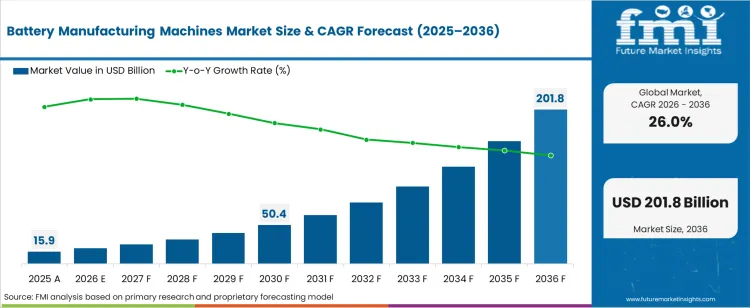
The battery manufacturing machines market was valued at USD 15.88 billion in 2025, projected to reach USD 20.00 billion in 2026, and is forecast to expand to USD 201.75 billion by 2036 at a 26.0% CAGR. Lithium-ion battery gigafactory construction programs across China, Europe, and North America are creating large-scale demand for electrode coating, cell assembly, formation, and testing equipment. The 26.0% CAGR reflects the capital equipment investment cycle required to bring announced battery manufacturing capacity online by committed production start dates. Equipment lead times of 12 to 24 months create procurement urgency for cell manufacturers racing to meet automaker supply commitments.
Summary of Battery Manufacturing Machines Market
- Market Snapshot
- The battery manufacturing machines market is valued at USD 15.88 billion in 2025 and is projected to reach USD 201.75 billion by 2036.
- The industry is expected to grow at a 26.0% CAGR from 2026 to 2036, creating an incremental opportunity of USD 181.75 billion.
- The market operates as a high-growth capital equipment category where gigafactory construction timelines, equipment lead times, and process technology capability determine competitive positioning among a concentrated set of global equipment suppliers.
- Demand and Growth Drivers
- Demand is driven by gigafactory construction commitments that require complete battery manufacturing equipment lines with lead times of 12 to 24 months, creating a procurement pipeline tied to announced production start dates.
- Dry electrode coating technology development is creating a parallel equipment demand channel for manufacturers investing in next-generation production processes that eliminate solvent processing.
- European and North American reshoring mandates are generating new equipment procurement outside China, expanding the addressable market for both Chinese and non-Chinese equipment suppliers.
- As per FMI, among countries tracked, China leads at 35.1% CAGR, followed by Germany at 29.9%, Brazil at 27.3%, USA at 24.7%, and UK at 22.1%.
- Product and Segment View
- The market covers electrode coating, calendering, slitting, cell assembly, electrolyte filling, formation, aging, and testing equipment for lithium-ion, sodium-ion, and solid-state battery production.
- Equipment serves cell manufacturers producing batteries for electric vehicles, grid-scale energy storage, consumer electronics, and industrial power applications.
- Based on FMI's battery manufacturing machines market report, Li-Ion leads by Battery Type with 41.6% share in 2026.
- Consumer electronics leads by End-use Industry with 38.9% share in 2026.
- The scope includes market scope includes battery manufacturing equipment across all process steps and battery chemistries. the analysis covers global and regional market. Excluded are battery raw material processing equipment such as mineral refiners and chemical precursor reactors is excluded.
- Geography and Competitive Outlook
- China and Germany are the fastest-growing markets, while Japan and UK remain mature demand bases with replacement-cycle purchasing patterns.
- Competition is shaped by manufacturing scale, distribution networks, and compliance capabilities, with key players including Wuxi lead intelligent equipments co., Yinghe Technology, Hirano Tecseed Co. Ltd., Hitachi High-Technologies, Manz.
- Analyst Opinion at FMI
- Nikhil Kaitwade, Principal Consultant for Industrial Equipment at FMI, opines: 'In my analysis, I have observed that battery manufacturing equipment is the strategic bottleneck in the global energy transition. Cell manufacturers who secure equipment procurement commitments 18 to 24 months ahead of planned production launches will meet automaker supply deadlines. Those who enter the equipment order queue late will face production delays that cascade through the entire EV supply chain. Equipment suppliers who expand manufacturing capacity and shorten lead times will capture disproportionate market share during this accelerated capital equipment cycle.'
- Strategic Implications / Executive Takeaways
- Cell manufacturers must place equipment orders 18 to 24 months ahead of planned production start dates to secure delivery slots during the peak gigafactory construction cycle.
- Equipment manufacturers should expand production capacity and component supply chains to reduce lead times and capture the growing share of non-Chinese gigafactory procurement.
- Automakers must monitor equipment delivery schedules at their battery cell suppliers to identify production launch risks that could affect vehicle manufacturing timelines.
Battery Manufacturing Machines Market Key Takeaways
| Metric | Details |
|---|---|
| Industry Size (2026) | USD 20.00 billion |
| Industry Value (2036) | USD 201.75 billion |
| CAGR (2026-2036) | 26.0% |
Source: Future Market Insights, 2026
As per FMI, the battery manufacturing machines market is transitioning from a China-dominated equipment procurement cycle toward a geographically diversified demand pattern as European and North American gigafactory programs enter their equipment purchasing phases. Chinese equipment manufacturers, led by Wuxi Lead and Yinghe Technology, have captured the majority of global battery equipment revenue through scale, cost advantage, and integration with Chinese cell manufacturers. European and Japanese equipment makers are competing for the growing share of non-Chinese gigafactory procurement through technology differentiation in precision coating, dry electrode processing, and formation cycling systems.
Country-level growth trajectories vary based on local regulatory frameworks and industrial maturity. China leads the expansion at 35.1% CAGR, followed by Germany at 29.9%, Brazil at 27.3%, USA at 24.7%, UK at 22.1%, Japan at 19.5%. Mature markets such as Japan and UK continue to generate steady replacement demand while China and Germany benefit from expanding capacity and industrial investment.
Battery Manufacturing Machines Market Key Takeaways
Power in the battery manufacturing machines value chain concentrates at the equipment manufacturer level, where a small number of Chinese, Japanese, and European companies control the engineering capability and production capacity for complete battery cell manufacturing lines. Cell manufacturers depend on these equipment suppliers for both initial line installation and ongoing process optimization support.
Pricing asymmetry separates Chinese-manufactured equipment, which offers 30% to 50% cost advantages over European and Japanese alternatives, from premium equipment that commands higher pricing through precision engineering, process yields, and integration with advanced manufacturing execution systems. Cell manufacturers evaluate total cost of ownership including yield rates, not just equipment purchase price.
Sourcing fragility exists in the concentration of battery equipment manufacturing capacity, where lead times have extended from 6 months to 18-24 months during peak ordering cycles. Equipment component supply chains, particularly for precision coating heads, high-speed winding mandrels, and formation power electronics, face capacity constraints shared across all equipment manufacturers.
Brand and compliance risks center on equipment performance guarantees. Cell manufacturers require equipment suppliers to guarantee throughput rates, yield levels, and uptime metrics that are contractually binding. Equipment that fails to meet guaranteed performance levels triggers penalty provisions and damages supplier reputation in a market where reference installations drive future orders.
Geographic leverage is shifting from China-centric to globally distributed. China remains the largest equipment market by installed base. Germany leads European demand through its automotive industry gigafactory pipeline. The United States is rapidly expanding through IRA-incentivized battery manufacturing investments. Japan maintains technology leadership in precision equipment categories.
For C-suite executives, battery manufacturing machines represent a strategic bottleneck in the energy transition supply chain. Equipment availability, not battery demand, is the binding constraint on how quickly global cell manufacturing capacity can scale. Companies that control equipment supply, whether through manufacturing or long-term procurement agreements, control the pace of the entire downstream value chain.
Battery Manufacturing Machines Market Definition
Battery manufacturing machines are capital equipment systems used in the production of rechargeable battery cells, including electrode mixing and coating machines, calendering systems, slitting and cutting equipment, cell stacking and winding systems, electrolyte filling machines, formation and aging chambers, and end-of-line testing systems. Equipment serves lithium-ion, sodium-ion, and solid-state battery production across automotive, energy storage, and consumer electronics end-use sectors.
Battery Manufacturing Machines Market Inclusions
Market scope includes battery manufacturing equipment across all process steps and battery chemistries. The analysis covers global and regional market sizes, forecast period 2026 to 2036, segmentation by battery type, end-use industry, sales channel, and geography.
Battery Manufacturing Machines Market Exclusions
Battery raw material processing equipment such as mineral refiners and chemical precursor reactors is excluded. Battery pack assembly and module integration equipment is omitted unless integrated into cell manufacturing lines. Recycling and second-life processing equipment falls outside the scope.
Battery Manufacturing Machines Market Research Methodology
- Primary Research: Analysts engaged with procurement managers, manufacturing engineers, and supply chain directors to map the decision triggers driving product upgrades and supplier qualification cycles in the battery manufacturing machines space.
- Desk Research: Data collection aggregated regulatory filings, trade statistics, industry standards ratification schedules, and publicly available financial disclosures from leading participants.
- Market-Sizing and Forecasting: Baseline values derive from a bottom-up aggregation of production volumes and trade flows, applying region-specific adoption curves to project future demand velocity.
- Data Validation and Update Cycle: Projections are tested against publicly reported capital expenditure guidance and production capacity announcements from leading industry participants.
Battery Manufacturing Machines Market Drivers, Restraints, Opportunities
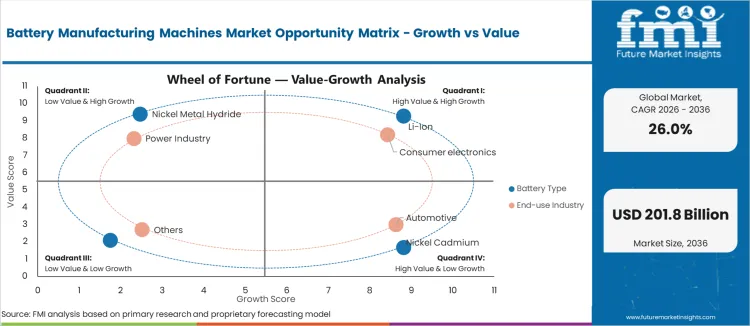
Future Market Insights analysis identifies the battery manufacturing machines market as the capital equipment backbone of the global energy transition, where the 26.0% CAGR reflects the exceptional scale and pace of battery factory construction. The market exists at its current valuation because every gigawatt-hour of battery cell production requires a complete set of specialized manufacturing equipment that cannot be substituted with general-purpose industrial machinery.
The tension in this market lies between the pace of gigafactory construction announcements and the capacity of equipment suppliers to manufacture and deliver complete production lines within committed timelines. Equipment bottlenecks have already delayed several high-profile gigafactory start-ups. Cell manufacturers that secure early equipment procurement commitments gain production schedule advantages, while those that enter the equipment order queue late face extended lead times that push back production launch dates.
- Gigafactory investment wave: Over 400 gigafactory projects have been announced globally through 2030, representing combined battery manufacturing capacity exceeding 8,000 GWh. Each gigawatt-hour of installed capacity requires approximately USD 50 million to USD 100 million in manufacturing equipment, creating a multi-hundred-billion-dollar equipment procurement pipeline over the forecast period.
- Equipment localization mandates: FMI is of the opinion that IRA production requirements in the United States and EU Battery Regulation local content provisions are creating equipment procurement preferences for regionally sourced or assembled manufacturing systems. Chinese equipment suppliers are establishing European and North American service and assembly operations to access these mandated procurement channels.
- Next-generation process equipment: Dry electrode coating, laser cutting, and high-speed stacking equipment represent technology upgrade cycles that create replacement and greenfield demand even in markets with existing wet-process manufacturing lines. As per FMI, cell manufacturers targeting next-generation process efficiency are willing to pay premiums for equipment that reduces production cost per kilowatt-hour.
Expected Growth Opportunities
- Increasing adoption of automation: The adoption of automation in battery manufacturing is increasing, and this presents an opportunity for manufacturers of battery manufacturing machines. Automation can help increase efficiency, reduce costs, and improve quality in the manufacturing process.
- Growing demand for portable power solutions: The demand for portable power solutions, such as portable chargers and power banks, is growing as more people rely on portable electronic devices. This presents an opportunity for battery manufacturing machine manufacturers to produce batteries for these application
- Increasing adoption of wearable devices: The demand for wearable devices, such as smartwatches and fitness trackers, is growing as people become more health-conscious. This presents an opportunity for battery manufacturing machine manufacturers to produce small, lightweight batteries for wearable devices.
Prevalent Market Trends
- Development of advanced manufacturing technologies: The development of new and advanced manufacturing technologies, such as additive manufacturing (3D printing), is driving the growth of the battery manufacturing machines market. These technologies can help reduce the cost and time required to manufacture batteries.
- Emergence of Solid-State Batteries: The emergence of solid-state batteries is also driving the growth of the Battery Manufacturing Machines Market. Solid-state batteries are safer and have higher energy density than traditional lithium-ion batteries, which makes them a more attractive option for use in EVs and other applications. However, the manufacturing process for solid-state batteries is more complex than traditional lithium-ion batteries, which is driving the need for new battery manufacturing machines that are designed specifically for the production of solid-state batteries. This trend is expected to continue in the coming years, as more companies invest in the development of solid-state batteries.
- Development of Battery Recycling Technology: The development of battery recycling technology presents an opportunity for the Battery Manufacturing Machines Market. As the demand for batteries increases, so does the need for battery recycling. Recycling can help reduce the environmental impact of battery production and extend the life of batteries, which can ultimately reduce costs. As battery recycling technology continues to develop, there will be a growing need for battery manufacturing machines that can produce recycled batteries.
Increasing E Mobility and enhanced application of electric devices for various industries is key demand factor for battery manufacturing machines. Increasing concern for reducing carbon footprint is anticipated to augment growth for this market.
What is Driving Demand for Battery Manufacturing Machines?
The rapid growing demand of batteries from automotive sector due to increasing popularity of electric vehicles and enhanced applications of battery in vehicle is boosting the market demand of battery manufacturing machines, also new innovations and growth of electric consumer appliances are enhancing sales of batteries.
The demand for li-ion battery based product has risen in past few years and the demand growth is anticipated to continue in upcoming period due to enhancing applications of Li-ion based batteries in various applications due to its safety and ability to work in different temperature conditions, Key manufacturers are also focusing on providing innovative and convenient to use manufacturing equipment.
Furthermore various initiatives taken by governments and various organizations to reduce the carbon foot print and E-waste is key factor the enhanced sales of the battery manufacturing machines in upcoming periods, battery manufacturing machines supports sustainable environment by producing and remanufacturing used batteries which is beneficial way to decrease the e-waste.
Automotive Industry to Boost the Demand for the Battery Manufacturing Machines in Upcoming Period
Automotive Industry is experiencing rapid growth due to innovations and rapid updating technologies, escalated sales of electric & hybrid vehicles are lifting automotive sector up, and the sales of electric and hybrid vehicles are expected to be raising higher in upcoming period, owing to that reason battery manufacturing machine sales are also expected to be higher since battery is key component of electric vehicle.
However, the demand from automotive industry was effected due COVID - 19 due to which production and sales of vehicles were highly impacted. Also manufacturing plants were closed and supply network was shut off, which impacted sales of Battery manufacturing machines negatively.
USA and Canada Battery Manufacturing Machines Market Outlook
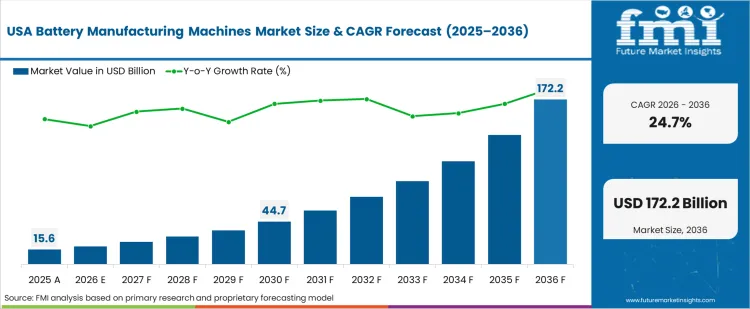
USA is expected to share the highest growth in terms of the sales due to raising applications of battery and electronic devices which is demanding high production of batteries as well as USA is one the largest manufacturers of electric vehicles which indicates its demand growth.
Canada is emerging market and it is expected to have a high demand share in upcoming period owing to enhancement in electric mobility as well as enhancement in applications for electronic devices in technologically advanced Industries.
Enhancement of new and electronic devices with enhanced applications will also help market to gain prominent sales figures. North America is one of the highest demanding battery manufacturing region which indicates the growth of the market in the region.
East Asia Demand Outlook for Battery Manufacturing Machines
In East Asia increasing environment concern and extensive implementation of regulation for reducing carbon foot print, electric mobility is growing rapidly. Governments are not only concerned about the battery production but also recycling and remanufacturing of battery is matter of focus for government to reduce the e-waste in such case the sales of the battery manufacturing machines is higher in the region.
Due to presence of technologically advanced nations like China and Japan sales of innovative electronic devices are more favorable and production rate is higher for electric equipment. Also East Asia is highest producer of battery manufacturing machines due to presence of many key manufacturers in the region.
Scope of the Report
| Metric | Value |
|---|---|
| Quantitative Units | USD 20.00 billion to USD 201.75 billion, at a CAGR of 26.0% |
| Market Definition | Battery manufacturing machines are capital equipment systems used in the production of rechargeable battery cells, including electrode mixing and coating machines, calendering systems, slitting and cutting equipment, cell stacking and winding systems, electrolyte filling machines, formation and aging chambers, and end-of-line testing systems. Equipment serves lithium-ion, sodium-ion, and solid-state battery production across automotive, energy storage, and consumer electronics end-use sectors. |
| Segmentation | Battery Type: Li-Ion, Nickel Cadmium, Nickel Metal Hydride, Others; End-use Industry: Consumer electronics, Automotive, Power Industry, Others; Sales Channel: OEM, After Market |
| Regions Covered | North America, Latin America, Europe, East Asia, South Asia, Oceania, Middle East & Africa |
| Countries Covered | China, Germany, Brazil, USA, UK, Japan, and 40 plus countries |
| Key Companies Profiled | Wuxi lead intelligent equipments co., Yinghe Technology, Hirano Tecseed Co. Ltd., Hitachi High-Technologies, Manz, CKD Co., Buhler Group Co., Katoaka SS Co., Foshan Golden Milky |
| Forecast Period | 2026 to 2036 |
| Approach | Forecasting models apply a bottom-up methodology starting with global installed base metrics and projecting conversion rates to specialized applications. Cross-validation uses publicly reported expenditure guidance from leading industry participants. |
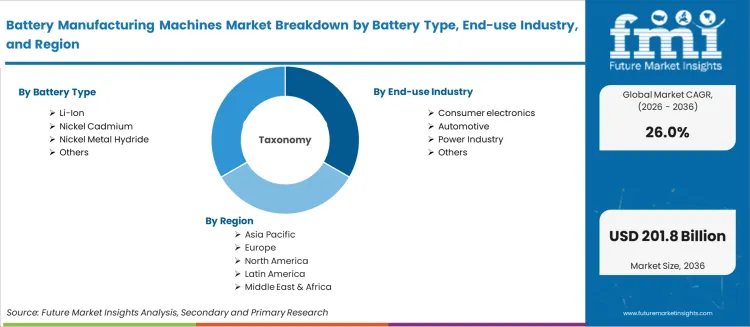
Key Segments of Battery Manufacturing Machines Market
By Battery Type:
- Li-Ion
- Nickel Cadmium
- Nickel Metal Hydride
- Others
By End-use Industry:
- Consumer electronics
- Automotive
- Power Industry
- Others.
By sales Channel:
- OEM
- After Market
By Region:
- North America
- USA
- Canada
- Latin America
- Brazil
- Mexico
- Europe
- Germany
- France
- Italy
- United Kingdom
- Spain
- BENELUX
- Russia
- Nordics
- East Asia
- China
- Japan
- South Korea
- South Asia & Pacific
- India
- ASEAN Countries
- Oceania
- Middle East and Africa
- GCC Countries
- Turkey
- North Africa
- South Africa
Bibliography
- 1. International Energy Agency. (2024). Global EV outlook 2024: Battery manufacturing capacity and investment. IEA.
- 2. European Commission. (2024). EU Battery Regulation: Manufacturing and sustainability requirements. European Commission.
- 3. United States Department of Energy. (2024). Battery manufacturing and recycling grants program update. DOE.
- 4. BloombergNEF. (2024). Global battery manufacturing capacity tracker. BNEF.
- 5. Organisation for Economic Co-operation and Development. (2024). Critical minerals and battery supply chain investment analysis. OECD.
- 6. International Organization for Standardization. (2023). ISO 12405-4:2023 Battery systems: Test specifications for manufacturing quality. ISO.
This bibliography is provided for reader reference. The full Future Market Insights report contains the complete reference list with primary research documentation.
Frequently Asked Questions
How large is the demand for Battery Manufacturing Machines in the global market in 2026?
Demand for battery manufacturing machines in the global market is estimated to be valued at USD 20.00 billion in 2026.
What will be the market size of Battery Manufacturing Machines in the global market by 2036?
Market size for battery manufacturing machines is projected to reach USD 201.75 billion by 2036.
What is the expected demand growth for Battery Manufacturing Machines in the global market between 2026 and 2036?
Demand for battery manufacturing machines is expected to grow at a CAGR of 26.0% between 2026 and 2036.
Which Battery Type is poised to lead global sales by 2026?
Li-Ion accounts for 41.6% in 2026 based on undefined.
How is the role of Consumer electronics in driving Battery Manufacturing Machines adoption in 2026?
Consumer electronics holds 38.9% of End-use Industry share in 2026, driven by undefined.
What is driving demand in China?
China leads growth at 35.1% CAGR, supported by world's largest battery manufacturing base with the most active gigafactory construction pipeline and dominant equipment manufacturing capacity.
What is Germany's growth outlook in this report?
Germany is projected to grow at a CAGR of 29.9% during 2026 to 2036.
What is Battery Manufacturing Machines Market and what is it mainly used for?
Battery manufacturing machines are capital equipment systems used in the production of rechargeable battery cells, including electrode mixing and coating machines, calendering systems, slitting and cutting equipment, cell stacking and winding systems, electrolyte filling machines, formation and aging chambers, and end-of-line testing systems. Equipment serves lithium-ion, sodium-ion, and solid-state battery production across automotive, energy storage, and consumer electronics end-use sectors.
Preview the report firsthand - request a free sample
Get SampleGet the brochure for pricing and purchase details.
Get PDFTable of Content
- Executive Summary
- Global Market Outlook
- Demand-side Trends
- Supply-side Trends
- Technology Roadmap Analysis
- Analysis and Recommendations
- Market Overview
- Market Coverage / Taxonomy
- Market Definition / Scope / Limitations
- Research Methodology
- Chapter Orientation
- Analytical Lens and Working Hypotheses
- Market Structure, Signals, and Trend Drivers
- Benchmarking and Cross-market Comparability
- Market Sizing, Forecasting, and Opportunity Mapping
- Research Design and Evidence Framework
- Desk Research Programme (Secondary Evidence)
- Company Annual and Sustainability Reports
- Peer-reviewed Journals and Academic Literature
- Corporate Websites, Product Literature, and Technical Notes
- Earnings Decks and Investor Briefings
- Statutory Filings and Regulatory Disclosures
- Technical White Papers and Standards Notes
- Trade Journals, Industry Magazines, and Analyst Briefs
- Conference Proceedings, Webinars, and Seminar Materials
- Government Statistics Portals and Public Data Releases
- Press Releases and Reputable Media Coverage
- Specialist Newsletters and Curated Briefings
- Sector Databases and Reference Repositories
- FMI Internal Proprietary Databases and Historical Market Datasets
- Subscription Datasets and Paid Sources
- Social Channels, Communities, and Digital Listening Inputs
- Additional Desk Sources
- Expert Input and Fieldwork (Primary Evidence)
- Primary Modes
- Qualitative Interviews and Expert Elicitation
- Quantitative Surveys and Structured Data Capture
- Blended Approach
- Why Primary Evidence is Used
- Field Techniques
- Interviews
- Surveys
- Focus Groups
- Observational and In-context Research
- Social and Community Interactions
- Stakeholder Universe Engaged
- C-suite Leaders
- Board Members
- Presidents and Vice Presidents
- R&D and Innovation Heads
- Technical Specialists
- Domain Subject-matter Experts
- Scientists
- Physicians and Other Healthcare Professionals
- Governance, Ethics, and Data Stewardship
- Research Ethics
- Data Integrity and Handling
- Primary Modes
- Tooling, Models, and Reference Databases
- Desk Research Programme (Secondary Evidence)
- Data Engineering and Model Build
- Data Acquisition and Ingestion
- Cleaning, Normalisation, and Verification
- Synthesis, Triangulation, and Analysis
- Quality Assurance and Audit Trail
- Market Background
- Market Dynamics
- Drivers
- Restraints
- Opportunity
- Trends
- Scenario Forecast
- Demand in Optimistic Scenario
- Demand in Likely Scenario
- Demand in Conservative Scenario
- Opportunity Map Analysis
- Product Life Cycle Analysis
- Supply Chain Analysis
- Investment Feasibility Matrix
- Value Chain Analysis
- PESTLE and Porter’s Analysis
- Regulatory Landscape
- Regional Parent Market Outlook
- Production and Consumption Statistics
- Import and Export Statistics
- Market Dynamics
- Global Market Analysis 2021 to 2025 and Forecast, 2026 to 2036
- Historical Market Size Value (USD Million) Analysis, 2021 to 2025
- Current and Future Market Size Value (USD Million) Projections, 2026 to 2036
- Y-o-Y Growth Trend Analysis
- Absolute $ Opportunity Analysis
- Global Market Pricing Analysis 2021 to 2025 and Forecast 2026 to 2036
- Global Market Analysis 2021 to 2025 and Forecast 2026 to 2036, By Battery Type
- Introduction / Key Findings
- Historical Market Size Value (USD Million) Analysis By Battery Type , 2021 to 2025
- Current and Future Market Size Value (USD Million) Analysis and Forecast By Battery Type , 2026 to 2036
- Li-Ion
- Nickel Cadmium
- Nickel Metal Hydride
- Others
- Li-Ion
- Y-o-Y Growth Trend Analysis By Battery Type , 2021 to 2025
- Absolute $ Opportunity Analysis By Battery Type , 2026 to 2036
- Global Market Analysis 2021 to 2025 and Forecast 2026 to 2036, By End-use Industry
- Introduction / Key Findings
- Historical Market Size Value (USD Million) Analysis By End-use Industry, 2021 to 2025
- Current and Future Market Size Value (USD Million) Analysis and Forecast By End-use Industry, 2026 to 2036
- Consumer electronics
- Automotive
- Power Industry
- Others
- Consumer electronics
- Y-o-Y Growth Trend Analysis By End-use Industry, 2021 to 2025
- Absolute $ Opportunity Analysis By End-use Industry, 2026 to 2036
- Global Market Analysis 2021 to 2025 and Forecast 2026 to 2036, By Sales Channel
- Introduction / Key Findings
- Historical Market Size Value (USD Million) Analysis By Sales Channel, 2021 to 2025
- Current and Future Market Size Value (USD Million) Analysis and Forecast By Sales Channel, 2026 to 2036
- OEM
- After Market
- OEM
- Y-o-Y Growth Trend Analysis By Sales Channel, 2021 to 2025
- Absolute $ Opportunity Analysis By Sales Channel, 2026 to 2036
- Global Market Analysis 2021 to 2025 and Forecast 2026 to 2036, By Region
- Introduction
- Historical Market Size Value (USD Million) Analysis By Region, 2021 to 2025
- Current Market Size Value (USD Million) Analysis and Forecast By Region, 2026 to 2036
- North America
- Latin America
- Western Europe
- Eastern Europe
- East Asia
- South Asia and Pacific
- Middle East & Africa
- Market Attractiveness Analysis By Region
- North America Market Analysis 2021 to 2025 and Forecast 2026 to 2036, By Country
- Historical Market Size Value (USD Million) Trend Analysis By Market Taxonomy, 2021 to 2025
- Market Size Value (USD Million) Forecast By Market Taxonomy, 2026 to 2036
- By Country
- USA
- Canada
- Mexico
- By Battery Type
- By End-use Industry
- By Sales Channel
- By Country
- Market Attractiveness Analysis
- By Country
- By Battery Type
- By End-use Industry
- By Sales Channel
- Key Takeaways
- Latin America Market Analysis 2021 to 2025 and Forecast 2026 to 2036, By Country
- Historical Market Size Value (USD Million) Trend Analysis By Market Taxonomy, 2021 to 2025
- Market Size Value (USD Million) Forecast By Market Taxonomy, 2026 to 2036
- By Country
- Brazil
- Chile
- Rest of Latin America
- By Battery Type
- By End-use Industry
- By Sales Channel
- By Country
- Market Attractiveness Analysis
- By Country
- By Battery Type
- By End-use Industry
- By Sales Channel
- Key Takeaways
- Western Europe Market Analysis 2021 to 2025 and Forecast 2026 to 2036, By Country
- Historical Market Size Value (USD Million) Trend Analysis By Market Taxonomy, 2021 to 2025
- Market Size Value (USD Million) Forecast By Market Taxonomy, 2026 to 2036
- By Country
- Germany
- UK
- Italy
- Spain
- France
- Nordic
- BENELUX
- Rest of Western Europe
- By Battery Type
- By End-use Industry
- By Sales Channel
- By Country
- Market Attractiveness Analysis
- By Country
- By Battery Type
- By End-use Industry
- By Sales Channel
- Key Takeaways
- Eastern Europe Market Analysis 2021 to 2025 and Forecast 2026 to 2036, By Country
- Historical Market Size Value (USD Million) Trend Analysis By Market Taxonomy, 2021 to 2025
- Market Size Value (USD Million) Forecast By Market Taxonomy, 2026 to 2036
- By Country
- Russia
- Poland
- Hungary
- Balkan & Baltic
- Rest of Eastern Europe
- By Battery Type
- By End-use Industry
- By Sales Channel
- By Country
- Market Attractiveness Analysis
- By Country
- By Battery Type
- By End-use Industry
- By Sales Channel
- Key Takeaways
- East Asia Market Analysis 2021 to 2025 and Forecast 2026 to 2036, By Country
- Historical Market Size Value (USD Million) Trend Analysis By Market Taxonomy, 2021 to 2025
- Market Size Value (USD Million) Forecast By Market Taxonomy, 2026 to 2036
- By Country
- China
- Japan
- South Korea
- By Battery Type
- By End-use Industry
- By Sales Channel
- By Country
- Market Attractiveness Analysis
- By Country
- By Battery Type
- By End-use Industry
- By Sales Channel
- Key Takeaways
- South Asia and Pacific Market Analysis 2021 to 2025 and Forecast 2026 to 2036, By Country
- Historical Market Size Value (USD Million) Trend Analysis By Market Taxonomy, 2021 to 2025
- Market Size Value (USD Million) Forecast By Market Taxonomy, 2026 to 2036
- By Country
- India
- ASEAN
- Australia & New Zealand
- Rest of South Asia and Pacific
- By Battery Type
- By End-use Industry
- By Sales Channel
- By Country
- Market Attractiveness Analysis
- By Country
- By Battery Type
- By End-use Industry
- By Sales Channel
- Key Takeaways
- Middle East & Africa Market Analysis 2021 to 2025 and Forecast 2026 to 2036, By Country
- Historical Market Size Value (USD Million) Trend Analysis By Market Taxonomy, 2021 to 2025
- Market Size Value (USD Million) Forecast By Market Taxonomy, 2026 to 2036
- By Country
- Kingdom of Saudi Arabia
- Other GCC Countries
- Turkiye
- South Africa
- Other African Union
- Rest of Middle East & Africa
- By Battery Type
- By End-use Industry
- By Sales Channel
- By Country
- Market Attractiveness Analysis
- By Country
- By Battery Type
- By End-use Industry
- By Sales Channel
- Key Takeaways
- Key Countries Market Analysis
- USA
- Pricing Analysis
- Market Share Analysis, 2025
- By Battery Type
- By End-use Industry
- By Sales Channel
- Canada
- Pricing Analysis
- Market Share Analysis, 2025
- By Battery Type
- By End-use Industry
- By Sales Channel
- Mexico
- Pricing Analysis
- Market Share Analysis, 2025
- By Battery Type
- By End-use Industry
- By Sales Channel
- Brazil
- Pricing Analysis
- Market Share Analysis, 2025
- By Battery Type
- By End-use Industry
- By Sales Channel
- Chile
- Pricing Analysis
- Market Share Analysis, 2025
- By Battery Type
- By End-use Industry
- By Sales Channel
- Germany
- Pricing Analysis
- Market Share Analysis, 2025
- By Battery Type
- By End-use Industry
- By Sales Channel
- UK
- Pricing Analysis
- Market Share Analysis, 2025
- By Battery Type
- By End-use Industry
- By Sales Channel
- Italy
- Pricing Analysis
- Market Share Analysis, 2025
- By Battery Type
- By End-use Industry
- By Sales Channel
- Spain
- Pricing Analysis
- Market Share Analysis, 2025
- By Battery Type
- By End-use Industry
- By Sales Channel
- France
- Pricing Analysis
- Market Share Analysis, 2025
- By Battery Type
- By End-use Industry
- By Sales Channel
- India
- Pricing Analysis
- Market Share Analysis, 2025
- By Battery Type
- By End-use Industry
- By Sales Channel
- ASEAN
- Pricing Analysis
- Market Share Analysis, 2025
- By Battery Type
- By End-use Industry
- By Sales Channel
- Australia & New Zealand
- Pricing Analysis
- Market Share Analysis, 2025
- By Battery Type
- By End-use Industry
- By Sales Channel
- China
- Pricing Analysis
- Market Share Analysis, 2025
- By Battery Type
- By End-use Industry
- By Sales Channel
- Japan
- Pricing Analysis
- Market Share Analysis, 2025
- By Battery Type
- By End-use Industry
- By Sales Channel
- South Korea
- Pricing Analysis
- Market Share Analysis, 2025
- By Battery Type
- By End-use Industry
- By Sales Channel
- Russia
- Pricing Analysis
- Market Share Analysis, 2025
- By Battery Type
- By End-use Industry
- By Sales Channel
- Poland
- Pricing Analysis
- Market Share Analysis, 2025
- By Battery Type
- By End-use Industry
- By Sales Channel
- Hungary
- Pricing Analysis
- Market Share Analysis, 2025
- By Battery Type
- By End-use Industry
- By Sales Channel
- Kingdom of Saudi Arabia
- Pricing Analysis
- Market Share Analysis, 2025
- By Battery Type
- By End-use Industry
- By Sales Channel
- Turkiye
- Pricing Analysis
- Market Share Analysis, 2025
- By Battery Type
- By End-use Industry
- By Sales Channel
- South Africa
- Pricing Analysis
- Market Share Analysis, 2025
- By Battery Type
- By End-use Industry
- By Sales Channel
- USA
- Market Structure Analysis
- Competition Dashboard
- Competition Benchmarking
- Market Share Analysis of Top Players
- By Regional
- By Battery Type
- By End-use Industry
- By Sales Channel
- Competition Analysis
- Competition Deep Dive
- Wuxi lead intelligent equipments co.
- Overview
- Product Portfolio
- Profitability by Market Segments (Product/Age /Sales Channel/Region)
- Sales Footprint
- Strategy Overview
- Marketing Strategy
- Product Strategy
- Channel Strategy
- Yinghe Technology
- Hirano Tecseed Co. Ltd.
- Hitachi High-Technologies
- Manz
- CKD Co.
- Buhler Group Co.
- Katoaka SS Co.
- Foshan Golden Milky
- Wuxi lead intelligent equipments co.
- Competition Deep Dive
- Assumptions & Acronyms Used


