

- Market Size (2026)
- USD 3.2 Bn
- Forecast (2036)
- USD 10.3 Bn
- CAGR (2026 to 2036)
- 12.4%
Battery Pack High-Voltage Wiring System Components Market Size, Market Forecast and Outlook By FMI
Summary of the Battery Pack High-Voltage Wiring System Components Market
- Demand and Growth Drivers
- EV battery pack output increases HV cables use because internal current paths need safer routing and tested insulation.
- Higher charging power raises demand for validated connectors as pack interfaces need stable contact resistance.
- Battery pack redesigns raise demand for compact busbars as manufacturers reduce assembly steps and pack space.
- Product and Segment View
- HV cables lead the component type segment with 34.0% share in 2026, due to flexible current routing inside packs.
- 400V systems lead the voltage class segment with 49.0% share in 2026, reflecting mainstream EV platform use.
- Module pack architecture carries broad demand because several vehicle programs use proven pack formats.
- Geography and Competitive Outlook
- China leads the country outlook at 15.8% CAGR by 2036, backed by large new energy vehicle output.
- India records 14.9% CAGR through 2036, as EV sales and local assembly deepen.
- Companies with pack design skill and high-voltage validation records can improve OEM access through 2036.
- Analyst Opinion
- Nikhil Kaitwade, Associate Vice President at FMI says, “Battery pack high-voltage wiring is becoming a safety and assembly control area for electric vehicles. Manufacturers need validated cables busbars connectors and HVIL parts before platform builds. Suppliers with proven routing skill and repeatable validation records can reduce launch risk.”
- Battery Pack High-Voltage Wiring System Components Market Value Analysis
- The battery pack high-voltage wiring system components market is moving from basic pack wiring into a qualified safety component base.
- EV pack production and rising electrical loads are increasing the use of high-voltage wiring parts across battery electric vehicle platforms.
- The market benefits from deeper use of electric vehicle battery connector systems across battery pack interfaces.
- Cable assemblies and busbars are gaining use as battery packs need safer current paths and stronger electrical protection.
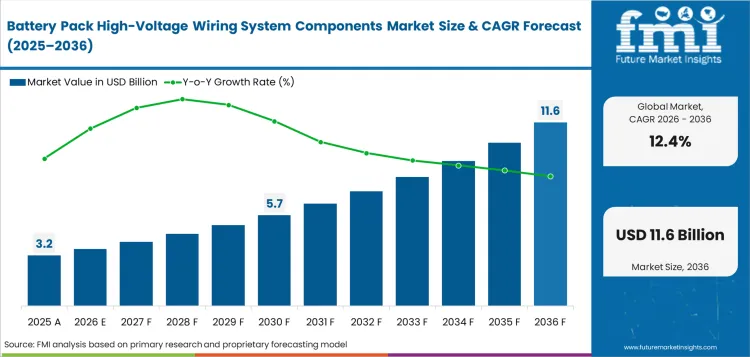
Key Takeaways, Market Size, and Forecast
- The battery pack high-voltage wiring system components market was valued at USD 2.8 billion in 2025.
- By 2036, the Battery Pack High-Voltage Wiring System Components Market is expected to be worth USD 10.3 billion.
- From 2026 to 2036, the market is projected to expand at a CAGR of 12.4%.
- The market is projected to create an incremental opportunity of USD 7.1 billion between 2026 and 2036.
- In 2026, OEM fitment is expected to account for 88.0% of sales channel demand.
- China at 15.8% and India at 14.9% are two of the faster expanding country markets.
Strategic Pointers: Battery Pack High-Voltage Wiring System Components Market
Battery pack high-voltage wiring system components are moving toward 1000 V validated connector platforms because ISO 21498-2:2024 defines tests for DC voltage class B terminals and Rosenberger lists HV connectors up to 1000 V and 450 A. The volume case is clear because the IEA reported more than 17 million electric cars sold globally in 2024 with more than 25% annual growth. TE Connectivity and Aptiv show that HVIL is now a sourcing gate because integrated internal HVIL and touch-safe sealing support safer assembly repair and service. Aptiv also says copper-to-aluminum HV cabling can cut mass and cost by as much as 50% while splice connectors reduce downstream wiring.
Busbar design is gaining pack-level value because Aptiv states busbars can be up to 70% shorter in height and support 15% more power than comparable cables. Gomes et al. reported about 750 N strength and 20-25 µΩ joint resistance for tube-fit cell-to-busbar joining in 2025. LG Energy Solution’s EP4531193A1 describes fire-resistant silicone and glass-fiber tape around HV busbars for battery packs. Suppliers that package 1000 V validation, HVIL protection, aluminum routing, busbar automation and fire-resistant insulation into one design offer can compete on launch risk reduction rather than piece price.
Battery Pack High-Voltage Wiring System Components Market Definition
The battery pack high-voltage wiring system components market includes parts used to transfer high-voltage power inside electric vehicle battery packs. These parts include HV cables, busbars, connectors, terminals, HVIL leads, and protective sleeves. Scope includes pack-level parts used in BEV, PHEV, and fuel cell vehicle battery systems. Charging station cables, complete battery packs, and low-voltage body harnesses are outside the scope.
Battery Pack High-Voltage Wiring System Components Market Inclusions
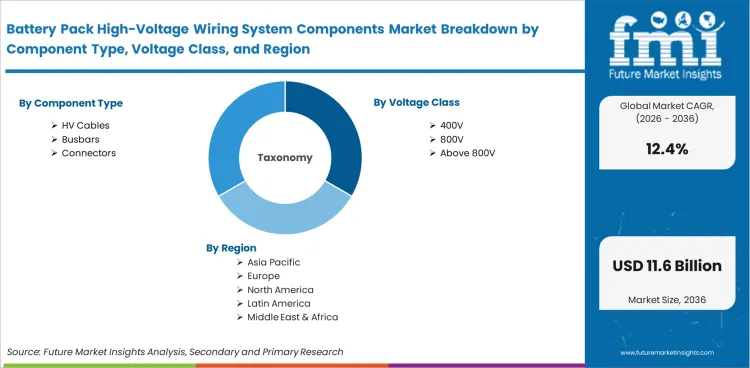
Market scope covers all commercially traded battery pack high-voltage wiring system components categorized by component type, including HV cables, busbars, connectors, terminals, HVIL leads, and sleeving; voltage class, including 400V, 800V, and above 800V systems; vehicle type, including battery electric vehicles, plug-in hybrid vehicles, and fuel cell vehicles; battery architecture, including module pack, cell-to-pack, cell-to-chassis, and swappable pack formats; and sales channel, including OEM fitment, replacement, and retrofit demand. Revenue scope covers 2026 to 2036. Key stakeholders include high-voltage wiring component manufacturers, automotive connector suppliers, cable and busbar producers, battery pack assemblers, electric vehicle manufacturers, tier-one electrical system suppliers, insulation material providers, testing and validation laboratories, distributors, service networks, and regulatory bodies.
Battery Pack High-Voltage Wiring System Components Market Exclusions
Scope does not include public charging cables, inverter modules, finished battery cells, complete battery packs, low-voltage harnesses, or grid-level high voltage cable products.
Battery Pack High-Voltage Wiring System Components Market Research Methodology
- Primary Research: FMI analysts talked to vehicle manufacturers, battery pack assemblers, high-voltage connector suppliers, and wiring system producers in important markets.
- Desk Research: Research combined data from EV production sources, safety rules, supplier product portfolios, and battery pack design references.
- Market sizing and forecasting: The model added vehicle output, pack wiring content, voltage class split, component pricing, and country demand patterns from the bottom up.
- Data validation: Forecasts were checked against EV sales, high-voltage safety needs, supplier coverage, and adjacent automotive wiring harness demand.
Why is the Battery Pack High-Voltage Wiring System Components Market Growing?
- Electric vehicle output is raising pack-level demand for HV cables and touch-safe connectors.
- Battery pack voltage increases are creating higher insulation and testing requirements.
- Compact pack layouts are raising demand for busbars and shorter connection paths.
Scale creates a larger installed production base for pack wiring parts and high-voltage connectors. Battery pack designers need parts with stable current transfer and repeatable assembly performance. Pack suppliers able to combine cable routing with high-voltage interlock loop wiring components can reduce validation gaps for vehicle makers.
The forecast raises the addressable volume for battery pack wiring assemblies across new model programs. Battery pack wiring parts need earlier design review as current loads and safety checks become stricter. Component suppliers with test records across 400V and 800V systems can secure repeat nominations.
Market Segmentation Analysis
- HV cables are estimated to contribute 34.0% of component type in 2026 with strong use across current transfer paths.
- 400V systems are expected to hold 49.0% of voltage class segment in 2026 with broad use across mainstream platforms.
- Battery electric vehicles are predicted to account for 66.0% of the vehicle type segment in 2026 with larger pack wiring needs.
- Module pack architecture is poised to account for 44.0% of battery architecture in 2026 with established pack production use.
- OEM fitment is expected to account for 88.0% of sales channel demand in 2026 with direct use across validated vehicle programs.
The market for battery pack high-voltage wiring system components is divided into five primary segment groups based on component type, voltage class, vehicle type, battery architecture, and sales channel. Component type includes HV Cables, Busbars, Connectors, Terminals, HVIL Leads, and Sleeving. Voltage class includes 400V, 800V, and Above 800V. Vehicle type includes Battery Electric Vehicles, Plug-in Hybrid Vehicles, and Fuel Cell Vehicles. Battery architecture includes Module Pack, Cell-to-Pack, Cell-to-Chassis, and Swappable Pack. Sales channel includes OEM Fitment, Replacement, and Retrofit.
Insights into the HV Cables Component Type Segment
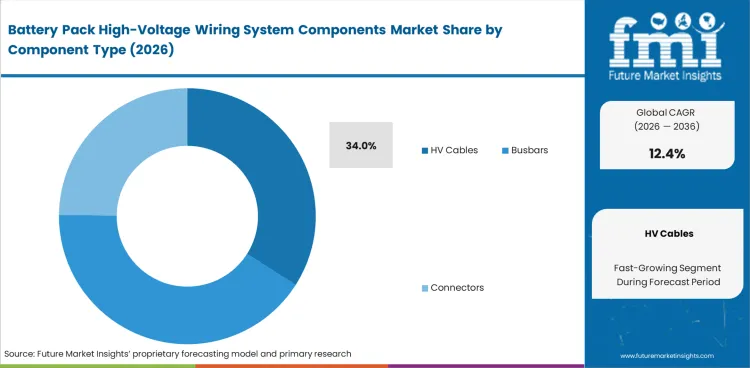
- In 2026, HV cables are expected to make up 34.0% of the component type segment. Flexible cable assemblies help pack designers manage current transfer across modules and battery junction interfaces.
- Busbars and connectors address defined connection points inside battery packs. Their value improves in compact layouts requiring lower assembly variation and stronger contact control.
Insights into the 400V Voltage Class Segment
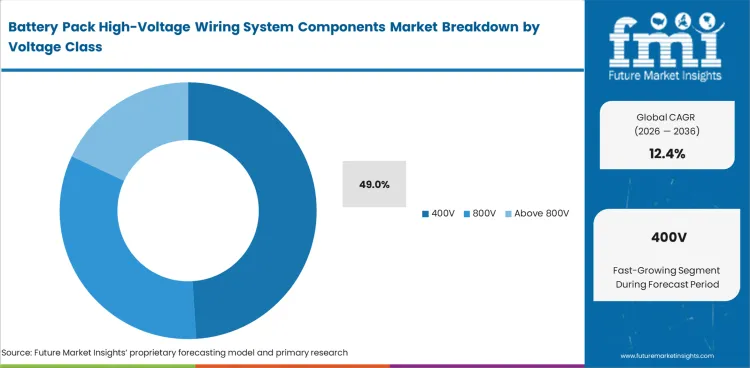
- 400V systems are projected to account for 49.0% of the voltage class segment in 2026. Mainstream electric vehicle platforms use this voltage class to balance pack performance with insulation cost.
- 800V systems serve faster-charging vehicle programs and higher-performance applications. Their demand improves as manufacturers need stronger thermal control and shorter charging cycles.
Insights into the Battery Electric Vehicle Type Segment
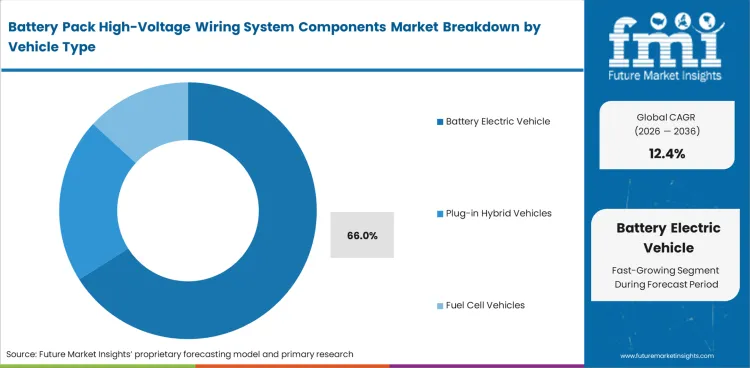
- Battery electric vehicles are estimated to account for 66.0% share in 2026. Full battery-powered platforms require larger wiring sets as traction power relies on pack output.
- Plug-in hybrid vehicles create selective demand for compact high-voltage wiring. Compact pack size keeps packaging control important across mixed powertrain layouts.
Insights into the Module Pack Battery Architecture Segment
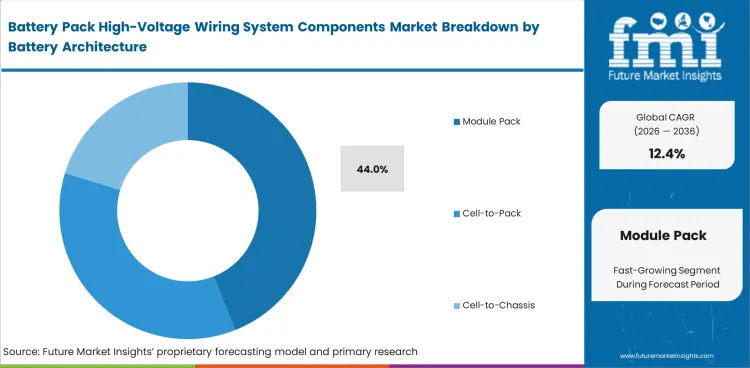
- Module pack architecture is poised to represent 44.0% share in 2026. Established pack formats create familiar wiring zones for assembly control and service access.
- Cell-to-pack formats are becoming more important in compact battery layouts. These designs place higher pressure on connection planning and internal routing discipline.
Insights into the OEM Fitment Sales Channel Segment
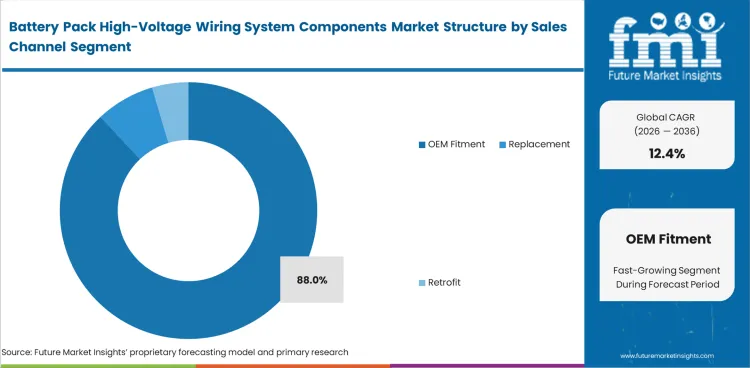
- OEM fitment is projected to hold 88.0% share in 2026. Vehicle manufacturers prefer approved pack wiring components during platform design to avoid repeat validation work.
- Replacement demand serves repair and service needs after vehicle launch. Retrofit use stays selective as battery pack wiring changes require strict safety checks.
Battery Pack High-Voltage Wiring System Components Market Drivers, Restraints, and Opportunities
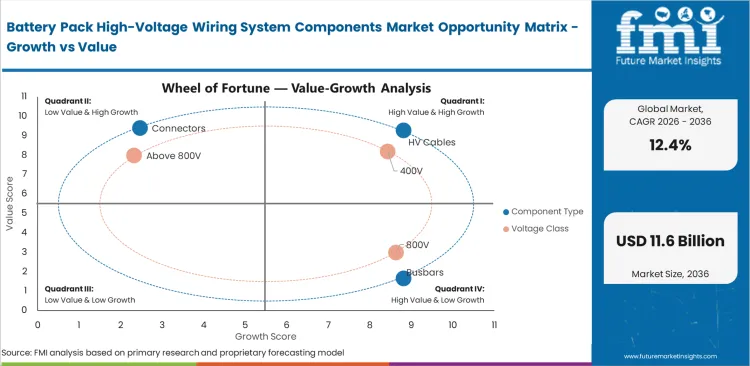
- High-voltage safety needs are creating structured demand for insulation-tested cables and sealed connectors.
- Copper use and shielding needs raise pricing pressure across cost-sensitive battery pack programs with skilled assembly requirements.
- Compact pack designs create opportunity through laminated busbar use and integrated connection layouts.
Battery pack high-voltage wiring system components keep growing as electric vehicles need safer current transfer and durable pack-level connections. Copper cost and longer validation cycles can slow supplier approval across price-sensitive platforms. Growth continues through higher-voltage battery systems and OEM fitment demand.
Copper Cathode Inflation Raises Harness Cost Floors
In the battery pack high-voltage wiring system components market, copper is the cost line that suppliers cannot easily engineer away because conductor cross-section and connector losses are safety-critical. The USA Geological Survey’s February 2026 copper summary shows USA producer cathode copper averaged 490 cents per pound in 2025, up from 431.8 cents in 2024, while COMEX high-grade copper moved from 421.6 cents to 480 cents. It also notes refined copper imports rose to 1.7 million tons in 2025 from 903,000 tons in 2024. For HV cable and busbar suppliers, this supports firmer quotation resets, shorter validity windows, and stronger metal-adjustment clauses in pack-level sourcing contracts.
Aluminum Substitution Is Losing Cost Cushion
Pack designers often use aluminum busbars or mixed-metal conductors to offset copper exposure, but 2026 pricing is narrowing that hedge. In April 2026, the World Bank reported that aluminum prices rose 13% in 2026Q1 to a multi-year high and are projected to rise about 22% in 2026 year over year. Copper prices also increased 15% in 2026Q1, reached an all-time high in January, and are forecast to rise about 21% in 2026. For high-voltage wiring systems, substitution cannot be treated as a simple savings lever. Pack designers need to compare total landed component cost beyond material swaps, with close checks on plating and crimp quality.
Analysis of Battery Pack High-Voltage Wiring System Components Market By Key Countries
.webp "Top Country Growth Comparison Battery Pack High Voltage Wiring System Components Market Cagr (2026 2036)")
| Country | CAGR |
|---|---|
| China | 15.8% |
| India | 14.9% |
| Germany | 12.8% |
| South Korea | 12.1% |
| USA | 11.7% |
| UK | 10.3% |
| Japan | 9.1% |
Source: Future Market Insights, 2026.
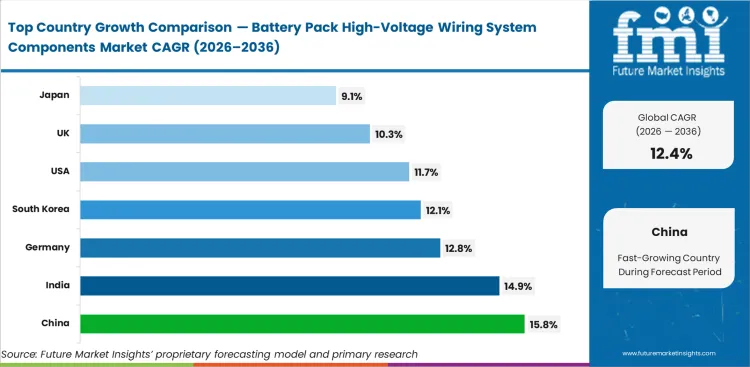
Battery Pack High-Voltage Wiring System Components Market CAGR Analysis Country
- China is projected to record the fastest country CAGR at 15.8% through 2036, driven by large new energy vehicle output and export-oriented EV programs.
- India is expected to expand at 14.9% CAGR during the forecast period as EV sales scale up and battery vehicle assembly deepens locally.
- Germany’s 12.8% CAGR by 2036 comes from strong electric passenger car production and higher-voltage premium vehicle platforms.
- South Korea is forecast to advance at 12.1% CAGR over the assessment period, with eco-friendly vehicle exports strengthening battery component demand.
- Electrified vehicle sales and high-voltage safety requirements place the USA at 11.7% CAGR during the forecast period.
- The UK is expected to post 10.3% CAGR by 2036 as zero-emission vehicle registrations guide model planning.
- Japan records a more measured 9.1% CAGR from 2026 to 2036 as hybrid-heavy platforms keep battery pack wiring demand selective.
Demand for battery pack high-voltage wiring system components is forecast to rise at 12.4% CAGR from 2026 to 2036. Country-level analysis covers the major markets contributing to this forecast, with the key markets listed below.
Demand Outlook for Battery Pack High-Voltage Wiring System Components Market in China
China’s battery pack high-voltage wiring system components industry is projected to record a CAGR of 15.8% by 2036. China’s large new energy vehicle production base keeps battery pack high-voltage wiring demand closely connected to local electric vehicle programs. Local platforms need compact cable sets and validated connectors as pack layouts move toward tighter assembly spaces. Domestic suppliers with battery routing experience are better placed to serve manufacturers seeking shorter development cycles.
- Large NEV output creates steady demand for pack cables and high-voltage terminals.
- Local EV platforms need validated energy storage high voltage connector designs for pack safety.
- Export models raise documentation needs as wiring systems face different market approval checks.
Sales Analysis of Battery Pack High-Voltage Wiring System Components Market in India
The battery pack high-voltage wiring system components sector in India is expected to expand at a CAGR of 14.9% during the assessment period. Local vehicle assembly growth supports demand for battery pack high voltage wiring system components in India. Manufacturers need cable assemblies and connector sets suited to cost sensitive EV programs.
- Local EV sales create demand for pack wiring across two-wheeler and passenger vehicle formats.
- Domestic assembly needs suppliers able to manage insulation and current rating discipline.
- India’s 2030 EV share goal creates long-term pull for localized battery components.
Demand Outlook for Battery Pack High-Voltage Wiring System Components Market in the United States
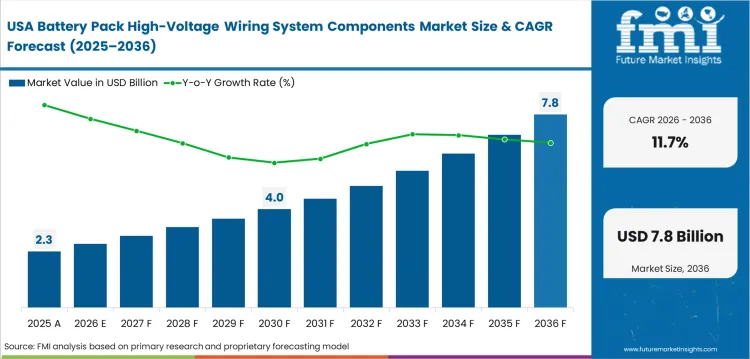
The USA battery pack high-voltage wiring system components industry is forecast to grow at a CAGR of 11.7% by 2036. About 22% of light-duty vehicles sold in 2025 were hybrid, battery electric, or plug-in hybrid vehicles. Electrified vehicle demand raises the need for USA battery pack high-voltage wiring system components across premium and mass-market programs. Suppliers need strong evidence packages for safety checks and platform approval.
- Electrified light-duty vehicle sales create demand for HV cables and sealed connectors.
- Battery electric vehicles require pack-level protection aligned with FMVSS electric shock rules.
- Luxury EV platforms increase demand for higher-current parts and stronger thermal validation.
Opportunity Analysis of Battery Pack High-Voltage Wiring System Components Market in Germany
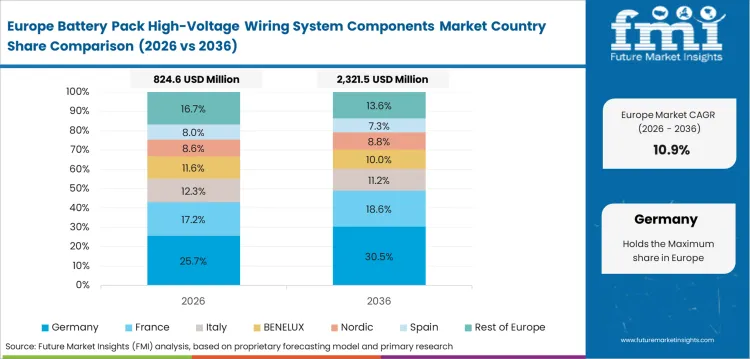
The battery pack high-voltage wiring system components segment in Germany is expected to advance at 12.8% CAGR over the forecast years. Germany produced 1.67 million electric passenger cars in 2025 and battery electric production reached 1.22 million units. Production scale supports demand for Germany battery pack high-voltage wiring system components across premium EV programs. Suppliers with validation skill can serve 400V and 800V platform needs.
- Electric passenger car output creates high demand for cable assemblies and busbars.
- Premium vehicle platforms use higher validation depth for insulation and contact quality.
- Local engineering programs increase demand for automotive inverter busbar laminates near battery power paths.
Future Outlook for Battery Pack High-Voltage Wiring System Components Market in South Korea
South Korea battery pack high-voltage wiring system components demand is expected to post 12.1% CAGR through 2036. Eco-friendly vehicle exports reached USD 25.8 billion in 2025 and domestic automobile production reached 4.1 million units. This export base creates demand for South Korea battery pack high-voltage wiring system components with strong quality control. Local suppliers can benefit from battery and vehicle platform depth.
- Eco-friendly vehicle exports require pack wiring parts approved for global vehicle programs.
- Domestic battery capability helps suppliers work closer to pack design teams.
- Export exposure raises the need for consistent sealing and current transfer records.
Demand Outlook for Battery Pack High-Voltage Wiring System Components Market in the UK
UK battery pack high-voltage wiring system components demand is projected to rise at 10.3% CAGR during the study period. The vehicle base supports demand for battery pack high voltage wiring system components in the UK across OEM and service channels. Suppliers need parts suited to zero emission vehicle programs and approved repair pathways.
- Zero-emission vehicle stock creates a growing pool for pack service and validated replacement parts.
- New registrations increase need for OEM-approved connector and cable systems.
- Mandate-driven sales planning gives suppliers better visibility on future platform demand.
In-depth Analysis of Battery Pack High-Voltage Wiring System Components Market in Japan
Japan’s battery pack high-voltage wiring system components industry is forecast at 9.1% CAGR through 2036. Japan has set a goal for all new passenger vehicle sales to be electrified vehicles by 2035. Hybrid-heavy demand keeps Japan battery pack high-voltage wiring system components focused on controlled voltage levels and precise packaging.
- Hybrid-heavy vehicle demand creates controlled demand for compact high-voltage wiring parts.
- Domestic automakers need precise connectors and cable routing for space-limited pack designs.
- Japan’s 2035 electrified sales goal strengthens long-term demand for pack electrical parts.
Competitive Landscape and Strategic Positioning
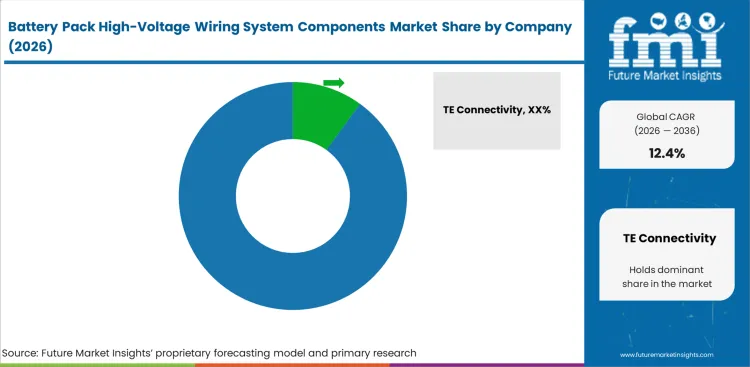
- TE Connectivity is a leading provider through broad high-voltage connector coverage and OEM platform access.
- Aptiv and Yazaki differentiate themselves through vehicle wiring systems and extensive global manufacturing capabilities.
- Specialist suppliers focus on pack connectors and busbar assemblies. They deliver design-specific validation.
TE Connectivity has strong positioning through high-voltage connector systems and vehicle electrification interfaces. Aptiv offers high-voltage electrical distribution systems and battery connection products through global vehicle programs. Yazaki and Sumitomo Electric are distinguished by their large-scale wiring harness capabilities and expertise in battery pack routing. Molex and Amphenol add connector depth across compact high-current applications. Barriers include validation cost and customer qualification time across battery pack programs. Suppliers with broader automotive connectors portfolios can reduce sourcing complexity for manufacturers.
Key Companies in the Battery Pack High-Voltage Wiring System Components Market
Key global companies leading the battery pack high-voltage wiring system components market include:
- TE Connectivity, Aptiv, and Yazaki have strong high-voltage wiring infrastructure for battery pack programs and global vehicle delivery.
- Sumitomo Electric, Lear, and Leoni serve manufacturers through wiring system coverage and platform-level electrical distribution experience.
- Molex, Amphenol, and HUBER+SUHNER hold specialist positions across high-voltage connectors and compact power interfaces.
Competitive Benchmarking: Battery Pack High-Voltage Wiring System Components Market
| Company | Pack Wiring Depth | Connector Portfolio | OEM Program Access | Geographic Footprint |
|---|---|---|---|---|
| TE Connectivity | High | High | Strong | Global |
| Aptiv | High | High | Strong | Global |
| Yazaki | High | Medium | Strong | Global |
| Sumitomo Electric | High | Medium | Strong | Global |
| Lear | Medium | Medium | Strong | North America, Europe, Asia |
| Leoni | High | Medium | Moderate | Europe, North Africa, Asia |
| Molex | Medium | High | Moderate | North America, Europe, Asia |
| Amphenol | Medium | High | Moderate | Global |
| HUBER+SUHNER | Medium | High | Moderate | Europe, North America, Asia |
Source: Future Market Insights, 2026.
Key Developments in Battery Pack High-Voltage Wiring System Components Market
- January 2026, TE Connectivity highlighted its role in the completed Next2OEM project for automated wiring harness production.
- March 2026, Lear described smart power distribution work across 12V and 48V architectures with functional safety focus.
Key Players in the Battery Pack High-Voltage Wiring System Components Market
Major Global Players:
- TE Connectivity
- Aptiv
- Yazaki
- Sumitomo Electric
- Lear
- Leoni
Specialist Players:
- Molex
- Amphenol
- HUBER+SUHNER
Report Scope and Coverage
| Parameter | Details |
|---|---|
| Quantitative Units | USD 3.2 billion to USD 10.3 billion, at a CAGR of 12.4% |
| Market Definition | The market covers pack-level high-voltage cables, busbars, connectors, terminals, HVIL leads, and sleeves used in EV battery systems. |
| Regions Covered | North America, Latin America, Europe, East Asia, South Asia and Pacific, Middle East and Africa |
| Countries Covered | USA, UK, Germany, China, India, Japan, South Korea, and 30 plus countries |
| Key Companies Profiled | TE Connectivity, Aptiv, Yazaki, Sumitomo Electric, Lear, Leoni, Molex, Amphenol, HUBER+SUHNER |
| Forecast Period | 2026 to 2036 |
| Approach | Hybrid bottom-up and top-down methodology starting with EV output and verified pack wiring content patterns. |
Source: Future Market Insights, 2026.
Battery Pack High-Voltage Wiring System Components Market by Segments
Battery Pack High-Voltage Wiring System Components Market Segmented by Component Type:
- HV Cables
- Busbars
- Connectors
- Terminals
- HVIL Leads
- Sleeving
Battery Pack High-Voltage Wiring System Components Market Segmented by Voltage Class:
- 400V
- 800V
- Above 800V
Battery Pack High-Voltage Wiring System Components Market Segmented by Vehicle Type:
- Battery Electric Vehicles
- Plug-in Hybrid Vehicles
- Fuel Cell Vehicles
Battery Pack High-Voltage Wiring System Components Market Segmented by Battery Architecture:
- Module Pack
- Cell-to-Pack
- Cell-to-Chassis
- Swappable Pack
Battery Pack High-Voltage Wiring System Components Market Segmented by Sales Channel:
- OEM Fitment
- Replacement
- Retrofit
Battery Pack High-Voltage Wiring System Components Market by Region:
- North America
- USA
- Canada
- Mexico
- Latin America
- Brazil
- Chile
- Rest of Latin America
- Europe
- Germany
- UK
- Italy
- Spain
- France
- Rest of Europe
- East Asia
- China
- Japan
- South Korea
- South Asia and Pacific
- India
- ASEAN
- Australia & New Zealand
- Rest of South Asia and Pacific
- Middle East and Africa
- Saudi Arabia
- Other GCC Countries
- South Africa
- Rest of Middle East and Africa
Research Sources and Bibliography
- International Energy Agency. (2025). Trends in electric car markets. IEA.
- NITI Aayog. (2025, August). Electric vehicles in India. Government of India.
- USA Energy Information Administration. (2026, February). Electric vehicle sales fell as hybrid vehicle sales continued to rise in 2025. EIA.
- German Association of the Automotive Industry. (2026, February). Production and market in January 2026. VDA.
- Invest Korea. (2026, January). S. Korea’s auto exports hit record USD 72 bn in 2025. KOTRA.
- Department for Transport. (2026, January). Vehicle licensing statistics, United Kingdom: July to September 2025. GOV.UK.
- Ministry of Economy, Trade and Industry. (2024, June). Subsidies upgraded for the purchase of clean energy vehicles toward the realization of GX in the automobile sector. METI.
- Molex. (2025, November). Molex extends eHV high-voltage connector portfolio. Molex.
- TE Connectivity. (2026, January). Next2OEM: TE Connectivity actively shaping the future of automated wiring harness production. TE Connectivity.
- Lear Corporation. (2026, March). Enabling the future: How Lear leads in smart power distribution. Lear Corporation.
- Leoni Group. (2025, December). Leoni expands its production network with two plants in Egypt. Leoni Group.
This bibliography is provided for reader reference and is not exhaustive. The full report contains the complete reference list and detailed citations.
This Report Answers
- What is the current and future size of the battery pack high-voltage wiring system components market?
- How fast is the battery pack high-voltage wiring system components market expected to expand between 2026 and 2036?
- Which component type is expected to lead the market by 2026?
- Which voltage class is expected to account for the highest demand by 2026?
- What factors are driving demand for battery pack high-voltage wiring system components globally?
- How are EV battery pack designs influencing cable and connector demand?
- Why is OEM fitment the main demand base for pack wiring components?
- How are higher-voltage platforms creating demand for specialized validation?
- Which countries are projected to record faster expansion through 2036?
- What is driving market expansion in China and India?
- Who are the key companies active in the battery pack high-voltage wiring system components market?
- How does FMI estimate and validate the market forecast?
Frequently Asked Questions
What is the global market demand for Battery Pack High-Voltage Wiring System Components in 2026?
In 2026, the global market for battery pack high-voltage wiring system components is expected to be worth USD 3.2 billion.
How big will the market for Battery Pack High-Voltage Wiring System Components be in 2036?
By 2036, the market for battery pack high-voltage wiring system components is expected to be worth USD 10.3 billion.
How much is demand for Battery Pack High-Voltage Wiring System Components expected to expand between 2026 and 2036?
Between 2026 and 2036, demand for battery pack high-voltage wiring system components is expected to expand at a CAGR of 12.4%.
Which component type segment is likely to be the best seller globally by 2026?
HV cables will make up 34.0% of the component type segment in 2026.
What is causing demand to rise in China?
The China battery pack high-voltage wiring system components market is projected to record 15.8% CAGR through 2036, backed by large NEV output.
What is causing demand to rise in India?
The India battery pack high-voltage wiring system components market is projected to expand at 14.9% CAGR through 2036, backed by EV sales and local assembly.
What does this report mean by Battery Pack High-Voltage Wiring System Components Market definition?
The market includes high-voltage cables, busbars, connectors, terminals, HVIL leads, and sleeves used inside EV battery packs.
How does FMI make the Battery Pack High-Voltage Wiring System Components forecast and check it?
Forecasting models use a hybrid bottom-up and top-down approach, starting with EV output and verified pack wiring content patterns.
Preview the report firsthand - request a free sample
Get SampleGet the brochure for pricing and purchase details.
Get PDFTable of Content
- Executive Summary
- Global Market Outlook
- Demand-side Trends
- Supply-side Trends
- Technology Roadmap Analysis
- Analysis and Recommendations
- Market Overview
- Market Coverage / Taxonomy
- Market Definition / Scope / Limitations
- Research Methodology
- Chapter Orientation
- Analytical Lens and Working Hypotheses
- Market Structure, Signals, and Trend Drivers
- Benchmarking and Cross-market Comparability
- Market Sizing, Forecasting, and Opportunity Mapping
- Research Design and Evidence Framework
- Desk Research Programme (Secondary Evidence)
- Company Annual and Sustainability Reports
- Peer-reviewed Journals and Academic Literature
- Corporate Websites, Product Literature, and Technical Notes
- Earnings Decks and Investor Briefings
- Statutory Filings and Regulatory Disclosures
- Technical White Papers and Standards Notes
- Trade Journals, Industry Magazines, and Analyst Briefs
- Conference Proceedings, Webinars, and Seminar Materials
- Government Statistics Portals and Public Data Releases
- Press Releases and Reputable Media Coverage
- Specialist Newsletters and Curated Briefings
- Sector Databases and Reference Repositories
- FMI Internal Proprietary Databases and Historical Market Datasets
- Subscription Datasets and Paid Sources
- Social Channels, Communities, and Digital Listening Inputs
- Additional Desk Sources
- Expert Input and Fieldwork (Primary Evidence)
- Primary Modes
- Qualitative Interviews and Expert Elicitation
- Quantitative Surveys and Structured Data Capture
- Blended Approach
- Why Primary Evidence is Used
- Field Techniques
- Interviews
- Surveys
- Focus Groups
- Observational and In-context Research
- Social and Community Interactions
- Stakeholder Universe Engaged
- C-suite Leaders
- Board Members
- Presidents and Vice Presidents
- R&D and Innovation Heads
- Technical Specialists
- Domain Subject-matter Experts
- Scientists
- Physicians and Other Healthcare Professionals
- Governance, Ethics, and Data Stewardship
- Research Ethics
- Data Integrity and Handling
- Primary Modes
- Tooling, Models, and Reference Databases
- Desk Research Programme (Secondary Evidence)
- Data Engineering and Model Build
- Data Acquisition and Ingestion
- Cleaning, Normalisation, and Verification
- Synthesis, Triangulation, and Analysis
- Quality Assurance and Audit Trail
- Market Background
- Market Dynamics
- Drivers
- Restraints
- Opportunity
- Trends
- Scenario Forecast
- Demand in Optimistic Scenario
- Demand in Likely Scenario
- Demand in Conservative Scenario
- Opportunity Map Analysis
- Product Life Cycle Analysis
- Supply Chain Analysis
- Investment Feasibility Matrix
- Value Chain Analysis
- PESTLE and Porter’s Analysis
- Regulatory Landscape
- Regional Parent Market Outlook
- Production and Consumption Statistics
- Import and Export Statistics
- Market Dynamics
- Global Market Analysis 2021 to 2025 and Forecast, 2026 to 2036
- Historical Market Size Value (USD Million) Analysis, 2021 to 2025
- Current and Future Market Size Value (USD Million) Projections, 2026 to 2036
- Y-o-Y Growth Trend Analysis
- Absolute $ Opportunity Analysis
- Global Market Pricing Analysis 2021 to 2025 and Forecast 2026 to 2036
- Global Market Analysis 2021 to 2025 and Forecast 2026 to 2036, By Component Type
- Introduction / Key Findings
- Historical Market Size Value (USD Million) Analysis By Component Type , 2021 to 2025
- Current and Future Market Size Value (USD Million) Analysis and Forecast By Component Type , 2026 to 2036
- HV Cables
- Busbars
- Connectors
- HV Cables
- Y-o-Y Growth Trend Analysis By Component Type , 2021 to 2025
- Absolute $ Opportunity Analysis By Component Type , 2026 to 2036
- Global Market Analysis 2021 to 2025 and Forecast 2026 to 2036, By Voltage Class
- Introduction / Key Findings
- Historical Market Size Value (USD Million) Analysis By Voltage Class, 2021 to 2025
- Current and Future Market Size Value (USD Million) Analysis and Forecast By Voltage Class, 2026 to 2036
- 400V
- 800V
- Above 800V
- 400V
- Y-o-Y Growth Trend Analysis By Voltage Class, 2021 to 2025
- Absolute $ Opportunity Analysis By Voltage Class, 2026 to 2036
- Global Market Analysis 2021 to 2025 and Forecast 2026 to 2036, By Vehicle Type
- Introduction / Key Findings
- Historical Market Size Value (USD Million) Analysis By Vehicle Type, 2021 to 2025
- Current and Future Market Size Value (USD Million) Analysis and Forecast By Vehicle Type, 2026 to 2036
- Battery Electric Vehicle
- Plug-in Hybrid Vehicles
- Fuel Cell Vehicles
- Battery Electric Vehicle
- Y-o-Y Growth Trend Analysis By Vehicle Type, 2021 to 2025
- Absolute $ Opportunity Analysis By Vehicle Type, 2026 to 2036
- Global Market Analysis 2021 to 2025 and Forecast 2026 to 2036, By Battery Architecture
- Introduction / Key Findings
- Historical Market Size Value (USD Million) Analysis By Battery Architecture, 2021 to 2025
- Current and Future Market Size Value (USD Million) Analysis and Forecast By Battery Architecture, 2026 to 2036
- Module Pack
- Cell-to-Pack
- Cell-to-Chassis
- Module Pack
- Y-o-Y Growth Trend Analysis By Battery Architecture, 2021 to 2025
- Absolute $ Opportunity Analysis By Battery Architecture, 2026 to 2036
- Global Market Analysis 2021 to 2025 and Forecast 2026 to 2036, By Sales Channel
- Introduction / Key Findings
- Historical Market Size Value (USD Million) Analysis By Sales Channel, 2021 to 2025
- Current and Future Market Size Value (USD Million) Analysis and Forecast By Sales Channel, 2026 to 2036
- OEM Fitment
- Replacement
- Retrofit
- OEM Fitment
- Y-o-Y Growth Trend Analysis By Sales Channel, 2021 to 2025
- Absolute $ Opportunity Analysis By Sales Channel, 2026 to 2036
- Global Market Analysis 2021 to 2025 and Forecast 2026 to 2036, By Region
- Introduction
- Historical Market Size Value (USD Million) Analysis By Region, 2021 to 2025
- Current Market Size Value (USD Million) Analysis and Forecast By Region, 2026 to 2036
- North America
- Latin America
- Western Europe
- Eastern Europe
- East Asia
- South Asia and Pacific
- Middle East & Africa
- Market Attractiveness Analysis By Region
- North America Market Analysis 2021 to 2025 and Forecast 2026 to 2036, By Country
- Historical Market Size Value (USD Million) Trend Analysis By Market Taxonomy, 2021 to 2025
- Market Size Value (USD Million) Forecast By Market Taxonomy, 2026 to 2036
- By Country
- USA
- Canada
- Mexico
- By Component Type
- By Voltage Class
- By Vehicle Type
- By Battery Architecture
- By Sales Channel
- By Country
- Market Attractiveness Analysis
- By Country
- By Component Type
- By Voltage Class
- By Vehicle Type
- By Battery Architecture
- By Sales Channel
- Key Takeaways
- Latin America Market Analysis 2021 to 2025 and Forecast 2026 to 2036, By Country
- Historical Market Size Value (USD Million) Trend Analysis By Market Taxonomy, 2021 to 2025
- Market Size Value (USD Million) Forecast By Market Taxonomy, 2026 to 2036
- By Country
- Brazil
- Chile
- Rest of Latin America
- By Component Type
- By Voltage Class
- By Vehicle Type
- By Battery Architecture
- By Sales Channel
- By Country
- Market Attractiveness Analysis
- By Country
- By Component Type
- By Voltage Class
- By Vehicle Type
- By Battery Architecture
- By Sales Channel
- Key Takeaways
- Western Europe Market Analysis 2021 to 2025 and Forecast 2026 to 2036, By Country
- Historical Market Size Value (USD Million) Trend Analysis By Market Taxonomy, 2021 to 2025
- Market Size Value (USD Million) Forecast By Market Taxonomy, 2026 to 2036
- By Country
- Germany
- UK
- Italy
- Spain
- France
- Nordic
- BENELUX
- Rest of Western Europe
- By Component Type
- By Voltage Class
- By Vehicle Type
- By Battery Architecture
- By Sales Channel
- By Country
- Market Attractiveness Analysis
- By Country
- By Component Type
- By Voltage Class
- By Vehicle Type
- By Battery Architecture
- By Sales Channel
- Key Takeaways
- Eastern Europe Market Analysis 2021 to 2025 and Forecast 2026 to 2036, By Country
- Historical Market Size Value (USD Million) Trend Analysis By Market Taxonomy, 2021 to 2025
- Market Size Value (USD Million) Forecast By Market Taxonomy, 2026 to 2036
- By Country
- Russia
- Poland
- Hungary
- Balkan & Baltic
- Rest of Eastern Europe
- By Component Type
- By Voltage Class
- By Vehicle Type
- By Battery Architecture
- By Sales Channel
- By Country
- Market Attractiveness Analysis
- By Country
- By Component Type
- By Voltage Class
- By Vehicle Type
- By Battery Architecture
- By Sales Channel
- Key Takeaways
- East Asia Market Analysis 2021 to 2025 and Forecast 2026 to 2036, By Country
- Historical Market Size Value (USD Million) Trend Analysis By Market Taxonomy, 2021 to 2025
- Market Size Value (USD Million) Forecast By Market Taxonomy, 2026 to 2036
- By Country
- China
- Japan
- South Korea
- By Component Type
- By Voltage Class
- By Vehicle Type
- By Battery Architecture
- By Sales Channel
- By Country
- Market Attractiveness Analysis
- By Country
- By Component Type
- By Voltage Class
- By Vehicle Type
- By Battery Architecture
- By Sales Channel
- Key Takeaways
- South Asia and Pacific Market Analysis 2021 to 2025 and Forecast 2026 to 2036, By Country
- Historical Market Size Value (USD Million) Trend Analysis By Market Taxonomy, 2021 to 2025
- Market Size Value (USD Million) Forecast By Market Taxonomy, 2026 to 2036
- By Country
- India
- ASEAN
- Australia & New Zealand
- Rest of South Asia and Pacific
- By Component Type
- By Voltage Class
- By Vehicle Type
- By Battery Architecture
- By Sales Channel
- By Country
- Market Attractiveness Analysis
- By Country
- By Component Type
- By Voltage Class
- By Vehicle Type
- By Battery Architecture
- By Sales Channel
- Key Takeaways
- Middle East & Africa Market Analysis 2021 to 2025 and Forecast 2026 to 2036, By Country
- Historical Market Size Value (USD Million) Trend Analysis By Market Taxonomy, 2021 to 2025
- Market Size Value (USD Million) Forecast By Market Taxonomy, 2026 to 2036
- By Country
- Kingdom of Saudi Arabia
- Other GCC Countries
- Turkiye
- South Africa
- Other African Union
- Rest of Middle East & Africa
- By Component Type
- By Voltage Class
- By Vehicle Type
- By Battery Architecture
- By Sales Channel
- By Country
- Market Attractiveness Analysis
- By Country
- By Component Type
- By Voltage Class
- By Vehicle Type
- By Battery Architecture
- By Sales Channel
- Key Takeaways
- Key Countries Market Analysis
- USA
- Pricing Analysis
- Market Share Analysis, 2025
- By Component Type
- By Voltage Class
- By Vehicle Type
- By Battery Architecture
- By Sales Channel
- Canada
- Pricing Analysis
- Market Share Analysis, 2025
- By Component Type
- By Voltage Class
- By Vehicle Type
- By Battery Architecture
- By Sales Channel
- Mexico
- Pricing Analysis
- Market Share Analysis, 2025
- By Component Type
- By Voltage Class
- By Vehicle Type
- By Battery Architecture
- By Sales Channel
- Brazil
- Pricing Analysis
- Market Share Analysis, 2025
- By Component Type
- By Voltage Class
- By Vehicle Type
- By Battery Architecture
- By Sales Channel
- Chile
- Pricing Analysis
- Market Share Analysis, 2025
- By Component Type
- By Voltage Class
- By Vehicle Type
- By Battery Architecture
- By Sales Channel
- Germany
- Pricing Analysis
- Market Share Analysis, 2025
- By Component Type
- By Voltage Class
- By Vehicle Type
- By Battery Architecture
- By Sales Channel
- UK
- Pricing Analysis
- Market Share Analysis, 2025
- By Component Type
- By Voltage Class
- By Vehicle Type
- By Battery Architecture
- By Sales Channel
- Italy
- Pricing Analysis
- Market Share Analysis, 2025
- By Component Type
- By Voltage Class
- By Vehicle Type
- By Battery Architecture
- By Sales Channel
- Spain
- Pricing Analysis
- Market Share Analysis, 2025
- By Component Type
- By Voltage Class
- By Vehicle Type
- By Battery Architecture
- By Sales Channel
- France
- Pricing Analysis
- Market Share Analysis, 2025
- By Component Type
- By Voltage Class
- By Vehicle Type
- By Battery Architecture
- By Sales Channel
- India
- Pricing Analysis
- Market Share Analysis, 2025
- By Component Type
- By Voltage Class
- By Vehicle Type
- By Battery Architecture
- By Sales Channel
- ASEAN
- Pricing Analysis
- Market Share Analysis, 2025
- By Component Type
- By Voltage Class
- By Vehicle Type
- By Battery Architecture
- By Sales Channel
- Australia & New Zealand
- Pricing Analysis
- Market Share Analysis, 2025
- By Component Type
- By Voltage Class
- By Vehicle Type
- By Battery Architecture
- By Sales Channel
- China
- Pricing Analysis
- Market Share Analysis, 2025
- By Component Type
- By Voltage Class
- By Vehicle Type
- By Battery Architecture
- By Sales Channel
- Japan
- Pricing Analysis
- Market Share Analysis, 2025
- By Component Type
- By Voltage Class
- By Vehicle Type
- By Battery Architecture
- By Sales Channel
- South Korea
- Pricing Analysis
- Market Share Analysis, 2025
- By Component Type
- By Voltage Class
- By Vehicle Type
- By Battery Architecture
- By Sales Channel
- Russia
- Pricing Analysis
- Market Share Analysis, 2025
- By Component Type
- By Voltage Class
- By Vehicle Type
- By Battery Architecture
- By Sales Channel
- Poland
- Pricing Analysis
- Market Share Analysis, 2025
- By Component Type
- By Voltage Class
- By Vehicle Type
- By Battery Architecture
- By Sales Channel
- Hungary
- Pricing Analysis
- Market Share Analysis, 2025
- By Component Type
- By Voltage Class
- By Vehicle Type
- By Battery Architecture
- By Sales Channel
- Kingdom of Saudi Arabia
- Pricing Analysis
- Market Share Analysis, 2025
- By Component Type
- By Voltage Class
- By Vehicle Type
- By Battery Architecture
- By Sales Channel
- Turkiye
- Pricing Analysis
- Market Share Analysis, 2025
- By Component Type
- By Voltage Class
- By Vehicle Type
- By Battery Architecture
- By Sales Channel
- South Africa
- Pricing Analysis
- Market Share Analysis, 2025
- By Component Type
- By Voltage Class
- By Vehicle Type
- By Battery Architecture
- By Sales Channel
- USA
- Market Structure Analysis
- Competition Dashboard
- Competition Benchmarking
- Market Share Analysis of Top Players
- By Regional
- By Component Type
- By Voltage Class
- By Vehicle Type
- By Battery Architecture
- By Sales Channel
- Competition Analysis
- Competition Deep Dive
- TE Connectivity
- Overview
- Product Portfolio
- Profitability by Market Segments (Product/Age /Sales Channel/Region)
- Sales Footprint
- Strategy Overview
- Marketing Strategy
- Product Strategy
- Channel Strategy
- Aptiv
- Yazaki
- Sumitomo Electric
- Lear
- Leoni
- TE Connectivity
- Competition Deep Dive
- Assumptions & Acronyms Used


