

- Industry Size (2026)
- USD 2.6 Bn
- Forecast (2036)
- USD 7.2 Bn
- CAGR (2026 to 2036)
- 10.7%
EV Battery Pack Thermal Interface Materials (TIM) Market Outlook and Forecast 2026 to 2036
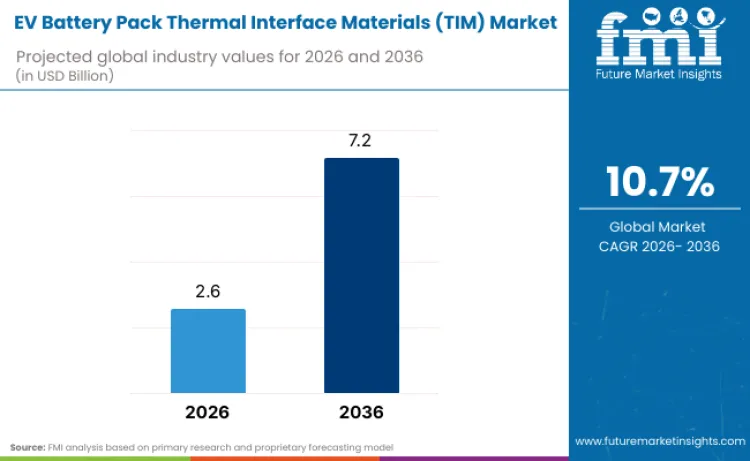
The global EV battery market is forecasted to total USD 2.6 billion in 2026, expected to reach USD 7.2 billion by 2036, advancing at a CAGR of 10.7%, according to FM’s analysis. The EV battery industry is undergoing a period of intense structural adjustment as demand scales toward the TWh threshold. In 2024, global battery demand across electric vehicle and storage applications reached approximately 1 TWh, with EV-specific demand growing by over 25% to 950 GWh.
This rapid expansion is driving a critical need for advanced TIMs to manage the heat generated by high-energy-density cells and rapid-charging architectures. Market leaders are responding with specialized product launches; for instance, Wacker Chemie introduced SEMICOSIL® 9649 TC, a gap filler offering 4 W/mK thermal conductivity designed for the extreme thermal stresses of modern EV electronics.
While regional players focus on scaling physical production capacity, global material science leaders are prioritizing the long-term reliability of these systems by developing adhesives that can withstand the diverse environmental and mechanical stresses of modern vehicle designs.
“As EV battery architectures evolve, WACKER's thermally conductive adhesives are designed to anticipate industry trends like new vehicle assembly methods, re-workability, and total value optimization. Our silicone-based adhesives have proven to maintain nearly constant mechanical performance after enduring thermal aging and thermal shock, ensuring reliability and safety for electric vehicles.”
- Peter Zorney, Senior Director of Electronics and Automotive at Wacker Chemical Corporation (October 2025) Source: WACKER Official Press Release
The supply landscape is shifting. While China remains the dominant source of demand, accounting for 60% in 2024, emerging markets like India are aggressively pursuing localized production through schemes such as the ₹18,100 crore Production Linked Incentive (PLI) for Advanced Chemistry Cells (ACC). However, implementation challenges persist, with only 1.4 GWh of capacity currently commissioned in India against significant long-term targets.
Major chemical and material players like Dow and Shin-Etsu are navigating a complex pricing environment. Despite volume growth in some sectors, segments such as Performance Materials & Coatings have faced sales declines due to local price compression and margin volatility. In response, companies are utilizing strategic acquisitions such as Parker Hannifin’s USD 1.0 billion purchase of Curtis Instruments to consolidate their positions in the electrification value chain. As battery pack prices fell by up to 30% in 2024, the TIM market is defined by the dual requirements of high-performance thermal conductivity and cost-effective, automated application methods to support the next generation of affordable electric mobility.
Summary of the EV Battery Thermal Interface Material (TIM) Market
What is the Growth Outlook for the EV Battery Pack Thermal Interface Materials (TIM) Market as per Future Market Insights?
Future Market Insights projects the EV battery pack thermal interface materials market to expand at a CAGR of 10.7% from 2026 to 2036, growing from USD 2.6 billion in 2026 to USD 7.2 billion by 2036. Growth is being driven by rapid scaling of high-energy-density battery architectures, stricter safety regulations, and rising adoption of fast-charging and high-voltage EV platforms that intensify thermal management requirements.
FMI Research Approach: FMI proprietary forecasting model based on EV production volumes, battery capacity scaling, and material penetration across battery pack architectures.
How do FMI Analysts View the Evolution of the EV Battery Pack Thermal Interface Materials Market?
FMI analysts view the market as moving from component-level heat management toward system-critical thermal and safety integration. Thermal interface materials are no longer treated as auxiliary fillers but as performance-critical materials that directly influence battery lifespan, safety compliance, and vehicle reliability. The shift toward Cell-to-Pack and Cell-to-Chassis designs is accelerating demand for multifunctional TIMs that combine thermal conductivity, dielectric protection, and mechanical stability.
FMI Research Approach: Analysis of battery architecture evolution, OEM safety requirements, and material qualification standards.
Which Regions and Countries are Driving Demand for EV Battery Pack Thermal Interface Materials?
Demand is being driven primarily by East Asia, North America, and Western Europe, reflecting the concentration of EV manufacturing and battery cell production. China remains the largest growth engine due to regulatory enforcement and production scale, while USA and Europe are shaping demand through domestic manufacturing incentives, safety regulations, and localization of battery supply chains. Emerging markets such as Brazil are gaining importance as regional EV production hubs.
FMI Research Approach: Country-level EV production analysis, battery manufacturing capacity tracking, and regulatory timeline assessment.
How Large Is the EV Battery Pack Thermal Interface Materials Market Expected to Be by 2036?
By 2036, the global EV battery pack thermal interface materials market is expected to reach USD 7.2 billion, supported by increasing battery pack sizes, higher thermal loads from fast-charging systems, and the integration of advanced thermal safety solutions across mass-market and premium electric vehicles.
FMI Research Approach: Long-term revenue modeling linked to battery pack complexity, TIM usage per vehicle, and technology substitution trends.
What Defines the EV Battery Pack Thermal Interface Materials Market?
The EV battery pack thermal interface materials market includes materials designed to facilitate efficient heat transfer between battery cells, modules, and cooling systems within electric vehicle battery packs. These materials include gap fillers, pastes, pads, and phase-change materials engineered to maintain thermal conductivity, electrical insulation, and mechanical integrity under prolonged thermal cycling and automotive operating conditions.
FMI Research Approach: FMI market taxonomy and inclusion-exclusion framework.
What are the Key Global Trends Shaping the EV Battery Pack Thermal Interface Materials Market?
Key global trends include the enforcement of stricter battery safety standards such as extended fire resistance requirements, the transition toward high-voltage and fast-charging architectures, and the integration of thermal management into structural battery designs. Innovation is focused on silicone-based and multifunctional materials that support automation, reworkability, and recyclability while meeting evolving safety and cost constraints.
FMI Research Approach: Regulatory analysis, OEM technology roadmaps, and material innovation tracking.
EV Battery Pack Thermal Interface Materials (TIM) Market Key Takeaways
| Metric | Value |
|---|---|
| Expected Value (2026E) | USD 2.6 billion |
| Projected Value (2036F) | USD 7.2 billion |
| CAGR (2026 to 2036) | 10.7% |
Source: FMI analysis based on primary research and proprietary forecasting model
Why is EV Battery Pack Thermal Interface Materials Demand Rising?
Large-scale capital investments and the establishment of regional manufacturing hubs increasingly define expansion of EV battery thermal interface materials market. A primary driver is the significant increase in global manufacturing capacity, which grew by nearly 30% in 2024 to reach 3.3 TWh, a volume more than triple the active demand for the year. This surplus is prompting major chemical suppliers to secure long-term positioning through domestic expansions.
Shin-Etsu Chemical announced an ¥83 billion investment in April 2024 to construct its first new domestic production base in Japan in over five decades, specifically targeting semiconductor and battery-related materials with a completion target of 2026. Similarly, the European market is seeing localized scaling as Sekisui Polymatech commenced mass production at a new facility in the Netherlands, capable of supplying thermal interface materials for approximately 500,000 electric vehicles annually.
Demand is expanding through strategic partnerships focused on emerging battery chemistries and advanced safety architectures. To address the rise of cost-efficient Lithium-iron-phosphate (LFP) batteries, which accounted for nearly half of the global market in 2024, POSCO Future M entered a joint venture with CNGR and FINO in late 2025 to construct a dedicated LFP cathode material plant in South Korea.
Innovation in safety is also driving market growth, as seen in the development of temperature-responsive SRL materials that act as thermal fuses to block electricity flow during early-stage overheating. Additionally, the shift toward next-generation solid-state technology is formalized through multi-national collaborations, such as the 2025 partnership between POSCO Future M and Factorial to co-develop materials that enhance energy density and safety for future EV platforms.
How is the EV Battery Thermal Interface Material Market Segmented?
The EV battery Thermal Interface Materials (TIM) market is characterized by distinct preferences in physical form and chemical composition, driven by the varying needs of diverse vehicle architectures and thermal management strategies.
Why do Gap Fillers and Pastes Command a Dominant Share?
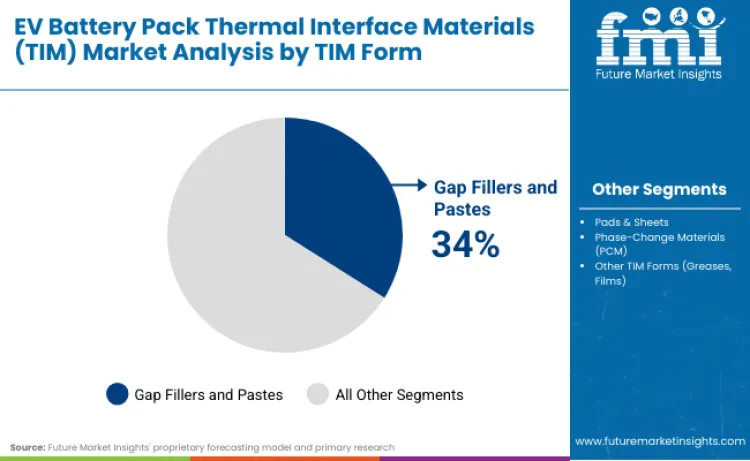
Gap fillers and pastes represent a 34% share of the market, primarily due to their ability to provide superior surface conformability in high-volume, automated manufacturing environments. Unlike pre-formed pads, these liquid or semi-liquid materials can be dispensed with extreme precision into irregular voids, effectively eliminating air pockets that would otherwise act as thermal insulators. This flexibility is particularly critical for the assembly of large-scale battery modules where tolerance stack-ups and surface roughness are inherent challenges.
Market activity in this segment is increasingly focused on high-throughput solutions to support the rapid scaling of EV production lines. For instance, global material leaders like Dow have expanded their portfolios with dedicated thermal gels and gap fillers specifically engineered for high productivity in automotive assembly. Additionally, companies like Indium Corporation have strengthened their market position by providing specialized thermal pastes and fluxes that cater to the evolving requirements of power electronics and battery interconnections. These developments underscore a strategic shift toward materials that not only manage heat but also enhance manufacturing efficiency through automated dispensing.
How has Silicone Chemistry Secured a Leading Share?
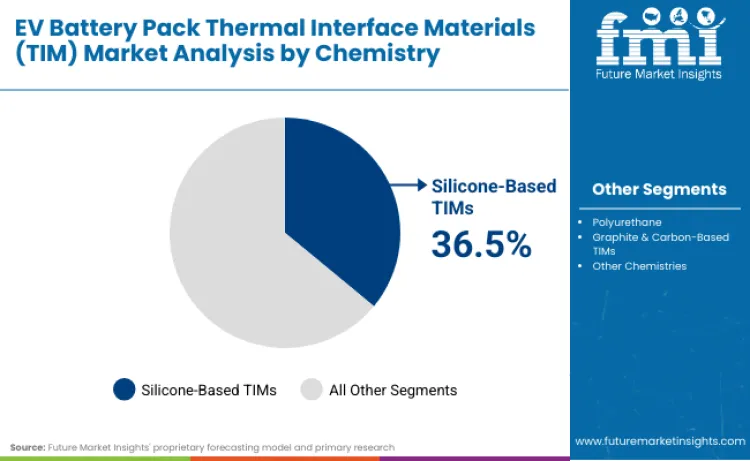
Silicone-based TIMs hold a dominant 36.5% share, favored for their inherent chemical stability and mechanical resilience across the wide temperature fluctuations experienced by electric vehicles. The material's natural flexibility allows it to maintain consistent contact between surfaces despite the vibrations and thermal cycling common in automotive operations. This reliability is a foundational requirement for long-term battery health, as any loss of thermal contact can lead to localized hotspots and accelerated cell degradation.
The industry is seeing significant strategic moves to consolidate and expand silicone-based material capabilities. In October 2024, Dow and Carbice established a first-of-its-kind partnership to integrate liquid silicones with carbon nanotube (CNT) technology, aiming to create high-performance pads that lower stress transfer in high-voltage environments. Momentive Performance Materials and Kitagawa Industries have focused on delivering silicone-based thermal pads and gap fillers that meet the stringent safety and dielectric requirements of modern battery packs. These investments highlight the industry's continued reliance on silicone chemistry as a proven, high-performance standard for managing the complex thermal loads of next-generation electric mobility.
What Drivers, Opportunities, Challenges and Trends Influence Growth in the EV Battery Thermal Interface Material (TIM) Landscape?
EV battery TIM demand is currently at a critical inflection point where regulatory compliance is the single most powerful driver of material innovation. With the July 2026 implementation of China’s GB 38031-2025 standard, thermal management is no longer just about efficiency; it is a mandatory safety threshold. This "no-fire" requirement for a full 120 minutes is accelerating the adoption of materials that offer dual-purpose insulation and thermal dissipation. Simultaneously, the rise of high-voltage (800V) systems and fast-charging targets is pushing heat dissipation requirements beyond the limits of traditional greases, creating a high-growth niche for advanced gap fillers and structural adhesives.
However, the market's expansion is tempered by severe cost and technical constraints. The significant price premium for advanced materials like liquid metals and phase-change materials (PCMs) remains a primary restraint, particularly in cost-sensitive markets like India and Southeast Asia. Furthermore, manufacturers are struggling with a performance paradox where materials with the highest thermal conductivity often lack the mechanical durability to withstand a vehicle’s 10-year lifecycle. These technical hurdles are compounded by a fragile global supply chain for critical raw minerals, which faces depletion risks in key regions like Vietnam and Indonesia.
The most transformative trend is the integration of thermal management into the structural tray of the battery. This CTP approach reduces part counts but requires a new generation of multifunctional structural adhesives. We are also seeing a rapid shift toward immersion cooling, where dielectric fluids replace solid TIMs entirely for ultra-high-performance vehicles. To stay competitive through 2026, material suppliers are increasingly utilizing AI-driven simulation to develop eco-friendly, bio-based polymers that meet both stringent safety requirements and escalating sustainability targets.
How is the EV Battery Thermal Interface Material Landscape Profiled in Key Countries?
| Country | CAGR (2026 to 2036) |
|---|---|
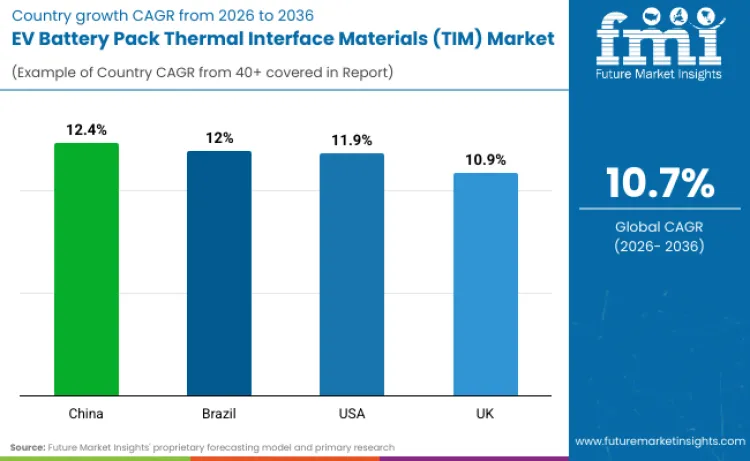
| China | 12.4% |
| Brazil | 12.0% |
| USA | 11.9% |
| UK | 10.9% |
Source: FMI analysis based on primary research and proprietary forecasting model
Can China Maintain Dominance Amidst Stricter Safety Thresholds?
China remains the undisputed leader in the EV battery landscape. The market is projected to grow at a robust CAGR of 12.4% from 2026 to 2036, a trajectory fueled by the overwhelming scale of domestic leaders like CATL and BYD. This growth is structurally supported by zero-tolerance safety regulations like GB 38031-2025, which marks the transition from voluntary safety measures to mandatory 2-hour fire resistance for all new vehicle type approvals.
The Chinese market is also evolving beyond simple Battery Electric Vehicles (BEVs) toward hybrid and Extended-Range (EREV) models, which saw a staggering 86% YoY growth in late 2024. This shift requires a new generation of thermal interface materials that can handle the unique heat profiles of internal combustion engines paired with large battery packs. Despite international tariffs, the domestic market’s cost competitiveness and the continued rollout of intelligent features like autonomous driving, pioneered by players like Huawei and Xiaomi, ensure that China’s TIM demand remains the most substantial globally.
Will Brazil Emerge as the Strategic EV Hub for Latin America?
Brazil is undergoing a transformative electrification phase, positioned to grow at a CAGR of 12.0% through 2036. This growth is anchored by the MOVER Program, which has successfully spurred over USD 26 billion in automaker investments by offering tax credits tied to R&D and lifecycle carbon measurements. A critical development is the localization of production; for example, BYD inaugurated its largest manufacturing facility outside Asia in October 2025 in Bahia, capable of producing 150,000 vehicles annually.
The Brazilian market is uniquely defined by its reliance on ethanol-hybrid technology. As legacy carmakers like Stellantis and Volkswagen ramp up local assembly in 2026, the focus is on mild-hybrid (MHEV) models that utilize ethanol-powered engines alongside electric components. This creates a high-growth segment for specialized TIMs optimized for LFP chemistries, which are preferred in the region for their safety and affordability. With EV sales projected to reach 600,000 units by year-end 2026, Brazil is rapidly evolving from an import-driven market to a regional manufacturing powerhouse.
How is USA’s Market Navigating the Transition to Post-IRA Policy?
USA’s market is entering a period of significant policy recalibration following the enactment of the One Big Beautiful Bill Act (OBBBA) in July 2025, yet it maintains a strong projected CAGR of 11.9%. While the repeal of federal EV tax credits by September 2025 introduces a cost-compression challenge, the "Made in America" momentum continues through enhanced domestic content requirements. The market is seeing a massive surge in local cell manufacturing capacity, with over 1.8 million units sold in 2024 and multi-billion-dollar investments from GM and Panasonic hitting operational maturity in 2025-2026.
The US market focus is heavily weighted toward high-capacity lthium-ion batteries that power the dominant passenger vehicle segment. There is an increasing trend toward 4680 cylindrical cell formats, which create concentrated heat zones requiring advanced radial-cooling TIM solutions. Despite the removal of certain residential energy incentives, the industrial shift toward fleet electrification and the build-out of a national fast-charging network continue to drive the technical necessity for high-performance thermal materials.
Can UK Accelerate Beyond the Midlands Automotive Cluster?
UK is projected to expand at a CAGR of 10.9%. This growth is largely mandated by the ZEV policy, which forces a steady decline in internal combustion sales in favor of electrified mobility. The Midlands region continues to dominate the domestic market due to its high concentration of automotive OEMs and battery research facilities, facilitating rapid collaboration between academia and industry.
Technological differentiation is a key trend in the UK, with significant investment in solid-state batteries and AI-integrated battery management systems. The UK’s commitment to a net-zero transition is reflected in the anticipated record of 570,000 BEV registrations in 2026, marking a milestone where nearly 40% of all new vehicles sold will be electrified. To meet these targets, the market is moving toward the use of recycled materials in TIM production and the integration of thermal management layers directly into vehicle chassis designs to optimize energy density.
How Competitive is the EV Battery Thermal Interface Material Landscape?
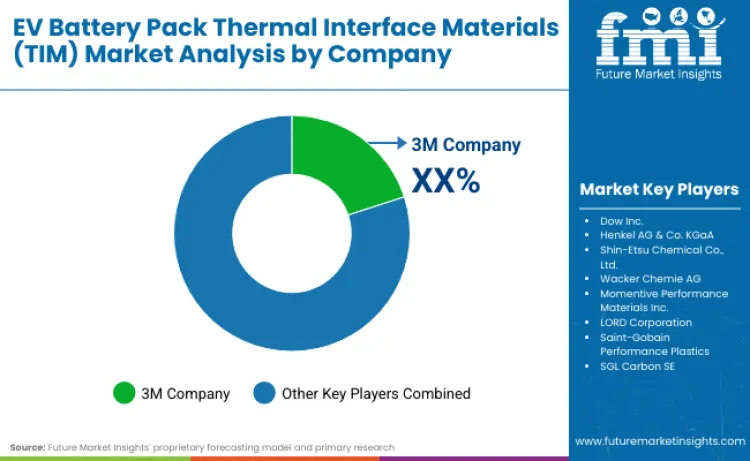
The competitive landscape of the EV battery Thermal Interface Materials (TIM) market is defined by intense competition and high barriers to entry, driven by the shift toward integrated battery architectures. As OEMs transition from modular designs to Cell-to-Pack (CTP) and Cell-to-Chassis (CTC) configurations, the industry is witnessing a trend where TIMs are no longer mere gap fillers but structural components. Top-tier players are increasingly focused on multi-functional materials that provide simultaneous thermal management, dielectric strength, and mechanical bonding.
The market is further polarized by the divergence in battery chemistries and power electronics. While the rise of cost-efficient LFP batteries in mass-market vehicles drives a demand for high-volume, automated dispensing of liquid gap fillers, the premium segment's shift toward Silicon Carbide (SiC) MOSFETs is pushing junction temperatures above 200°C. This creates a specialized demand for advanced sintering pastes and high-performance silicone elastomers that can maintain stability under extreme thermal cycling. To maintain a competitive edge, incumbents are investing heavily in localized manufacturing and rapid prototyping facilities, particularly in Europe and Asia, to shorten development cycles and align with the no-fire safety standards projected for 2026.
Recent Developments
- 3M Company (2025): 3M has accelerated its collaboration with automotive OEMs to deploy its Thermal Runaway Barrier 600 and 700 Series, which are ceramic fiber matrix mats designed to withstand temperatures up to 1,200°C. In early 2025, the company highlighted its Battery Enhancement Material (BEM) 1807S, a highly compressible, flame-resistant material that can reduce power draw for battery warming/cooling by up to 33%. This material is specifically targeted at filling irregular gaps between battery packs and lids to extend vehicle range by 10% to 20% in extreme climates.
- Henkel AG & Co. KGaA (Late 2024 to 2025): To address the growing need for high-speed assembly, Henkel expanded its portfolio with the Loctite TLB 9300 APSi, a two-component polyurethane thermally conductive adhesive. This product offers a thermal conductivity of 3 W/mK and is specifically engineered for gluing battery cells directly to modules or cooling systems in automated production lines. This development supports the industry's drive toward sustainable, room-temperature curing solutions that reduce energy consumption during manufacturing.
- Parker Hannifin - LORD Corporation (2024 to 2026): In late 2024, Parker's Chomerics division unveiled the THERM-A-GAP™ 80LO, a high-performance thermal gap pad with very low oil bleed, offering 8.0 W/m-K thermal conductivity. Moving into 2025, the Parker LORD division launched the CoolTherm SC-2000 RW, a specialized silicone gap filler designed for "reworkability," allowing for easier battery disassembly and end-of-life recycling, a key focus for 2026 sustainability targets. Additionally, the company established a state-of-the-art rapid sampling and prototyping facility in the Czech Republic to serve the European EV market.
Key Players Profiled
- 3M Company
- Dow Inc.
- Henkel AG & Co. KGaA
- Shin-Etsu Chemical Co., Ltd.
- Wacker Chemie AG
- Momentive Performance Materials Inc.
- LORD Corporation
- Saint-Gobain Performance Plastics
- SGL Carbon SE
Market Definition
The EV Battery Pack Thermal Interface Materials (TIM) market covers engineered materials used to transfer heat and maintain thermal stability within electric vehicle battery packs. These materials are applied between cells, modules, and cooling components to manage heat generated during operation and charging. As battery designs move toward higher energy density and integrated architectures, TIMs have become critical to battery safety, reliability, and lifespan.
The report includes automotive-grade TIMs used in EV traction batteries, such as gap fillers and pastes, pads and sheets, phase-change materials, greases, and films. It covers key material chemistries including silicone-based systems, polyurethanes, graphite and carbon-based materials, and other specialty formulations, with analysis across major EV-producing regions and battery pack architectures.
The scope excludes thermal management hardware such as cooling plates, liquid cooling systems, and battery management electronics. It also excludes non-automotive TIM applications, stationary energy storage uses, raw precursor materials, aftermarket repair products, and thermal solutions used solely in internal combustion or hybrid powertrains.
Scope of Report
| Items | Values |
|---|---|
| Quantitative Units (2026) | USD 2.6 billion |
| TIM Form | Gap Fillers & Pastes, Pads & Sheets, Phase-Change Materials (PCM), Other TIM Forms (Greases, Films) |
| Chemistry |
Silicone-Based TIMs, Polyurethane, Graphite & Carbon-Based TIMs, Other Chemistries |
| Regions Covered | North America, Western Europe, Eastern Europe, East Asia, South Asia & Pacific, Latin America, Middle East & Africa |
| Countries Covered | China, Brazil, USA, UK, and 40+ Countries |
| Companies Profiled | 3M Company, Dow Inc., Henkel AG & Co. KGaA, Shin-Etsu Chemical Co., Ltd., Wacker Chemie AG, Momentive Performance Materials Inc., LORD Corporation, Saint-Gobain Performance Plastics, SGL Carbon SE |
Source: Future Market Insights’ proprietary forecasting model and primary research
EV Battery Thermal Interface Material (TIM) Market by Key Segments
TIM Form
- Gap Fillers & Pastes
- Pads & Sheets
- Phase-Change Materials (PCM)
- Other TIM Forms (Greases, Films)
Chemistry
- Silicone-Based TIMs
- Polyurethane
- Graphite & Carbon-Based TIMs
- Other Chemistries
Region
- North America
- Western Europe
- Eastern Europe
- East Asia
- South Asia & Pacific
- Latin America
- Middle East & Africa
Bibliography
- International Energy Agency. (2024). Global EV outlook 2024: Trends in electric mobility and battery systems. Paris: IEA.
- SAE International. (2024). Thermal management challenges in high-energy-density electric vehicle battery packs. SAE Technical Paper Series.
- UL Solutions. (2025). Thermal runaway propagation and fire resistance requirements for lithium-ion battery systems. Northbrook, IL: UL Research.
- China Automotive Technology and Research Center. (2025). GB 38031-2025 implementation guidance for power battery safety requirements. Beijing: CATARC.
- Wacker Chemie AG. (2025). Thermally conductive silicones for electric vehicle battery and power electronics applications. Munich: Wacker Technical Documentation.
- Shin-Etsu Chemical Co., Ltd. (2024). Advanced silicone materials for EV battery thermal interface applications. Tokyo: Shin-Etsu Materials Technology Report.
- USA Department of Energy, Vehicle Technologies Office. (2024). Battery thermal management and safety roadmap for electric vehicles. Washington, DC: DOE.
Frequently Asked Questions
How large is the EV battery pack thermal interface materials market today?
The market is valued at around USD 2.6 billion in 2026, reflecting the growing material intensity of battery packs as EV platforms scale in size, voltage, and charging speed.
How is electrification reshaping demand for thermal interface materials in vehicles?
Electrification is pushing TIMs from auxiliary fillers to system-critical safety materials, as higher energy density, fast charging, and integrated pack architectures significantly raise thermal and fire-risk exposure.
Which vehicle architectures are driving the highest TIM consumption?
Cell-to-Pack and Cell-to-Chassis designs are the primary demand drivers, as they reduce tolerances, increase contact surfaces, and require TIMs that deliver thermal transfer, electrical insulation, and mechanical stability simultaneously.
How does regional automotive production influence TIM demand?
China leads due to EV production scale and mandatory battery safety standards, while the USA and Europe drive demand through localized battery manufacturing, fire-resistance regulations, and high-voltage platform adoption.
What are the main technical and commercial constraints in this market?
High material costs, trade-offs between thermal conductivity and long-term mechanical durability, and compatibility with automated assembly lines remain key constraints, especially for mass-market EV platforms.
Preview the report firsthand - request a free sample
Get SampleGet the brochure for pricing and purchase details.
Get PDFTable of Content
- Executive Summary
- Global Market Outlook
- Demand Side Trends
- Supply Side Trends
- Technology Roadmap Analysis
- Analysis and Recommendations
- Market Overview
- Market Coverage / Taxonomy
- Market Definition / Scope / Limitations
- Research Methodology
- Chapter Orientation
- Analytical Lens and Working Hypotheses
- Market Structure, Signals, and Trend Drivers
- Benchmarking and Cross-market Comparability
- Market Sizing, Forecasting, and Opportunity Mapping
- Research Design and Evidence Framework
- Desk Research Programme (Secondary Evidence)
- Company Annual and Sustainability Reports
- Peer-reviewed Journals and Academic Literature
- Corporate Websites, Product Literature, and Technical Notes
- Earnings Decks and Investor Briefings
- Statutory Filings and Regulatory Disclosures
- Technical White Papers and Standards Notes
- Trade Journals, Industry Magazines, and Analyst Briefs
- Conference Proceedings, Webinars, and Seminar Materials
- Government Statistics Portals and Public Data Releases
- Press Releases and Reputable Media Coverage
- Specialist Newsletters and Curated Briefings
- Sector Databases and Reference Repositories
- FMI Internal Knowledge Base and Historical Datasets
- Subscription Datasets and Paid Sources
- Social Channels, Communities, and Digital Listening Inputs
- Additional Desk Sources
- Expert Input and Fieldwork (Primary Evidence)
- Primary Modes
- Qualitative Interviews and Expert Elicitation
- Quantitative Surveys and Structured Data Capture
- Blended Approach
- Why Primary Evidence is Used
- Field Techniques
- Interviews
- Surveys
- Focus Groups
- Observational and In-context Research
- Social and Community Interactions
- Stakeholder Universe Engaged
- C-suite Leaders
- Board Members
- Presidents and Vice Presidents
- R&D and Innovation Heads
- Technical Specialists
- Domain Subject-matter Experts
- Scientists
- Physicians and Other Healthcare Professionals
- Governance, Ethics, and Data Stewardship
- Research Ethics
- Data Integrity and Handling
- Primary Modes
- Tooling, Models, and Reference Databases
- Desk Research Programme (Secondary Evidence)
- Data Engineering and Model Build
- Data Acquisition and Ingestion
- Cleaning, Normalisation, and Verification
- Synthesis, Triangulation, and Analysis
- Quality Assurance and Audit Trail
- Market Background
- Market Dynamics
- Drivers
- Restraints
- Opportunity
- Trends
- Scenario Forecast
- Demand in Optimistic Scenario
- Demand in Likely Scenario
- Demand in Conservative Scenario
- Opportunity Map Analysis
- Product Life Cycle Analysis
- Supply Chain Analysis
- Investment Feasibility Matrix
- Value Chain Analysis
- PESTLE and Porter's Analysis
- Regulatory Landscape
- Regional Parent Market Outlook
- Production and Consumption Statistics
- Import and Export Statistics
- Market Dynamics
- Global Market Analysis 2021 to 2025 and Forecast, 2026 to 2036
- Historical Market Size Value (USD Billion) Analysis, 2021 to 2025
- Current and Future Market Size Value (USD Billion) Projections, 2026 to 2036
- Y-o-Y Growth Trend Analysis
- Absolute $ Opportunity Analysis
- Global Market Pricing Analysis 2021 to 2025 and Forecast 2026 to 2036
- Y-o-Y Growth Trend Analysis 2021 to 2025
- Absolute $ Opportunity Analysis 2026 to 2036
- Global Market Analysis 2021 to 2025 and Forecast 2026 to 2036, By TIM Form
- Introduction / Key Findings
- Historical Market Size Value (USD Billion) Analysis By TIM Form, 2021 to 2025
- Current and Future Market Size Value (USD Billion) Analysis and Forecast By TIM Form, 2026 to 2036
- Gap Fillers & Pastes
- Pads & Sheets
- Phase-Change Materials (PCM)
- Other TIM Forms (Greases, Films)
- Y-o-Y Growth Trend Analysis By TIM Form, 2021 to 2025
- Absolute $ Opportunity Analysis By TIM Form, 2026 to 2036
- Global Market Analysis 2021 to 2025 and Forecast 2026 to 2036, By Chemistry
- Introduction / Key Findings
- Historical Market Size Value (USD Billion) Analysis By Chemistry, 2021 to 2025
- Current and Future Market Size Value (USD Billion) Analysis and Forecast By Chemistry, 2026 to 2036
- Silicone-Based TIMs
- Polyurethane
- Graphite & Carbon-Based TIMs
- Other Chemistries
- Y-o-Y Growth Trend Analysis By Chemistry, 2021 to 2025
- Absolute $ Opportunity Analysis By Chemistry, 2026 to 2036
- Global Market Analysis 2021 to 2025 and Forecast 2026 to 2036, By Region
- Introduction
- Historical Market Size Value (USD Billion) Analysis By Region, 2021 to 2025
- Current Market Size Value (USD Billion) Analysis and Forecast By Region, 2026 to 2036
- North America
- Latin America
- Western Europe
- Eastern Europe
- East Asia
- South Asia and Pacific
- Middle East & Africa
- Market Attractiveness Analysis By Region
- North America Market Analysis 2021 to 2025 and Forecast 2026 to 2036, By Country
- Historical Market Size Value (USD Billion) Trend Analysis By Market Taxonomy, 2021 to 2025
- Market Size Value (USD Billion) Forecast By Market Taxonomy, 2026 to 2036
- By Country
- USA
- Canada
- Mexico
- By TIM Form
- By Chemistry
- By Country
- Market Attractiveness Analysis
- By Country
- By TIM Form
- By Chemistry
- Key Takeaways
- Latin America Market Analysis 2021 to 2025 and Forecast 2026 to 2036, By Country
- Historical Market Size Value (USD Billion) Trend Analysis By Market Taxonomy, 2021 to 2025
- Market Size Value (USD Billion) Forecast By Market Taxonomy, 2026 to 2036
- By Country
- Brazil
- Chile
- Rest of Latin America
- By TIM Form
- By Chemistry
- By Country
- Market Attractiveness Analysis
- By Country
- By TIM Form
- By Chemistry
- Key Takeaways
- Western Europe Market Analysis 2021 to 2025 and Forecast 2026 to 2036, By Country
- Historical Market Size Value (USD Billion) Trend Analysis By Market Taxonomy, 2021 to 2025
- Market Size Value (USD Billion) Forecast By Market Taxonomy, 2026 to 2036
- By Country
- Germany
- UK
- Italy
- Spain
- France
- Nordic
- BENELUX
- Rest of Western Europe
- By TIM Form
- By Chemistry
- By Country
- Market Attractiveness Analysis
- By Country
- By TIM Form
- By Chemistry
- Key Takeaways
- Eastern Europe Market Analysis 2021 to 2025 and Forecast 2026 to 2036, By Country
- Historical Market Size Value (USD Billion) Trend Analysis By Market Taxonomy, 2021 to 2025
- Market Size Value (USD Billion) Forecast By Market Taxonomy, 2026 to 2036
- By Country
- Russia
- Poland
- Hungary
- Balkan & Baltic
- Rest of Eastern Europe
- By TIM Form
- By Chemistry
- By Country
- Market Attractiveness Analysis
- By Country
- By TIM Form
- By Chemistry
- Key Takeaways
- East Asia Market Analysis 2021 to 2025 and Forecast 2026 to 2036, By Country
- Historical Market Size Value (USD Billion) Trend Analysis By Market Taxonomy, 2021 to 2025
- Market Size Value (USD Billion) Forecast By Market Taxonomy, 2026 to 2036
- By Country
- China
- Japan
- South Korea
- By TIM Form
- By Chemistry
- By Country
- Market Attractiveness Analysis
- By Country
- By TIM Form
- By Chemistry
- Key Takeaways
- South Asia and Pacific Market Analysis 2021 to 2025 and Forecast 2026 to 2036, By Country
- Historical Market Size Value (USD Billion) Trend Analysis By Market Taxonomy, 2021 to 2025
- Market Size Value (USD Billion) Forecast By Market Taxonomy, 2026 to 2036
- By Country
- India
- ASEAN
- Australia & New Zealand
- Rest of South Asia and Pacific
- By TIM Form
- By Chemistry
- By Country
- Market Attractiveness Analysis
- By Country
- By TIM Form
- By Chemistry
- Key Takeaways
- Middle East & Africa Market Analysis 2021 to 2025 and Forecast 2026 to 2036, By Country
- Historical Market Size Value (USD Billion) Trend Analysis By Market Taxonomy, 2021 to 2025
- Market Size Value (USD Billion) Forecast By Market Taxonomy, 2026 to 2036
- By Country
- Kingdom of Saudi Arabia
- Other GCC Countries
- Turkiye
- South Africa
- Other African Union
- Rest of Middle East & Africa
- By TIM Form
- By Chemistry
- By Country
- Market Attractiveness Analysis
- By Country
- By TIM Form
- By Chemistry
- Key Takeaways
- Key Countries Market Analysis
- USA
- Pricing Analysis
- Market Share Analysis, 2025
- By TIM Form
- By Chemistry
- UK
- Pricing Analysis
- Market Share Analysis, 2025
- By TIM Form
- By Chemistry
- China
- Pricing Analysis
- Market Share Analysis, 2025
- By TIM Form
- By Chemistry
- Brazil
- Pricing Analysis
- Market Share Analysis, 2025
- By TIM Form
- By Chemistry
- USA
- Market Structure Analysis
- Competition Dashboard
- Competition Benchmarking
- Market Share Analysis of Top Players
- By Regional
- By TIM Form
- By Chemistry
- Competition Analysis
- Competition Deep Dive
- 3M Company
- Dow Inc.
- Henkel AG & Co. KGaA
- Shin-Etsu Chemical Co., Ltd.
- Wacker Chemie AG
- Momentive Performance Materials Inc.
- LORD Corporation
- Saint-Gobain Performance Plastics
- SGL Carbon SE
- Competition Deep Dive
- Assumptions & Acronyms Used


