

- Industry Size (2026)
- USD 34.0 Mn
- Forecast (2036)
- USD 460.0 Mn
- CAGR (2026 to 2036)
- 29.8%
End-of-Life EV Battery Pack Logistics and Collection Hubs in Europe Size, Market Forecast and Outlook By FMI
The end-of-life EV battery pack logistics and collection hubs industry in Europe was valued at USD 26.2 million in 2025. Sector valuation is projected to cross USD 34.0 million in 2026, registering a 29.8% CAGR during the forecast period. Industry expansion lifts total opportunity to USD 460.0 million through 2036 as OEM supply chain heads mandate closed-loop material tracking from point of vehicle retirement to final active material recovery.
Summary of End-of-Life EV Battery Pack Logistics and Collection Hubs Industry in Europe
- The market is estimated at USD 26.2 million in 2025.
- The market is projected to reach USD 460.0 million by 2036.
- The market is expected to grow at a CAGR of 29.8% from 2026 to 2036.
- The forecast period represents an incremental opportunity of USD 426.0 million.
- Regional hubs lead the hub type segment with a 36% share.
- Intact packs dominate the battery condition segment with a 54% share.
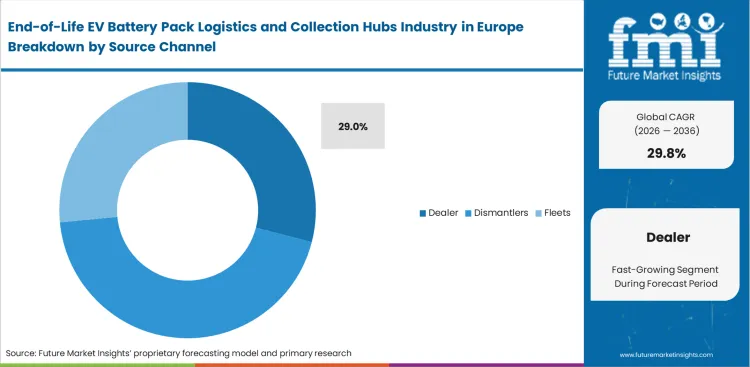
- Dealer channels lead the source segment with a 29% share.
- Road transport dominates the transport mode segment with a 69% share.
- Recycling leads the end route segment with a 58% share.
- Norway, Netherlands, and Germany are among the fastest-growing markets.
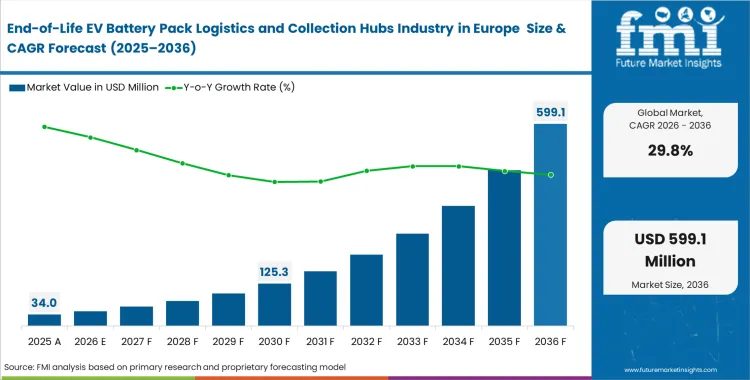
Key Takeaways
| Metric | Details |
|---|---|
| Industry Size (2026) | USD 34.0 million |
| Industry Value (2036) | USD 460.0 million |
| CAGR (2026 to 2036) | 29.8% |
Source: Future Market Insights (FMI) analysis, based on proprietary forecasting model and primary research
Compliance requirements around end-of-life battery handling are rising, and that is pushing automotive groups to formalize chain-of-custody procedures much earlier in the return cycle. Certified holding zones are becoming more important because degraded high-voltage units cannot move through standard transport networks without tighter control over storage, documentation, and onward routing. Localized staging reduces long-haul hazardous transport exposure and improves flow into final recovery channels, but permit timelines for those facilities often extend beyond physical site development. Early network planning therefore matters because processing queues are likely to tighten once larger cohorts of first-generation EVs move into retirement and battery removal volumes begin to rise more visibly.
Digital traceability is set to become a more important operating requirement as battery identification, recovery accountability, and routing discipline move closer to mandatory compliance standards across Europe. Local collection frameworks gain more value under that setup because faster diagnostics at the point of intake improve decisions on whether a returned unit should move toward second-life evaluation, quarantine, or shredding. Processing efficiency is on a positive trend when those interfaces are standardized, since local nodes can classify packs earlier and reduce avoidable delays deeper in the chain.
Norway is projected to record a 33.1% CAGR in the market through 2036, supported by a mature EV fleet that is beginning to generate more established battery return flows. Dense port-linked logistics support the Netherlands, where the industry is expected to expand at a 31.4% CAGR through 2036. Germany is likely to see 30.8% CAGR over the same period, with domestic vehicle production and battery-handling requirements keeping network buildout active.
Sweden is anticipated to advance at a 30.1% CAGR through 2036 as Nordic electrification and industrial recovery capacity continue to align. France is set to post 29.2% CAGR, reflecting a tighter regulatory push around circular battery handling. United Kingdom is projected to expand at 28.4% CAGR, while Italy is expected to register 27.1% CAGR through 2036. Different levels of diagnostic standardization and cross-border operating friction continue to shape how much collection density each national market requires.
Segmental Analysis
End-of-Life EV Battery Pack Logistics and Collection Hubs in Europe Analysis by Hub Type
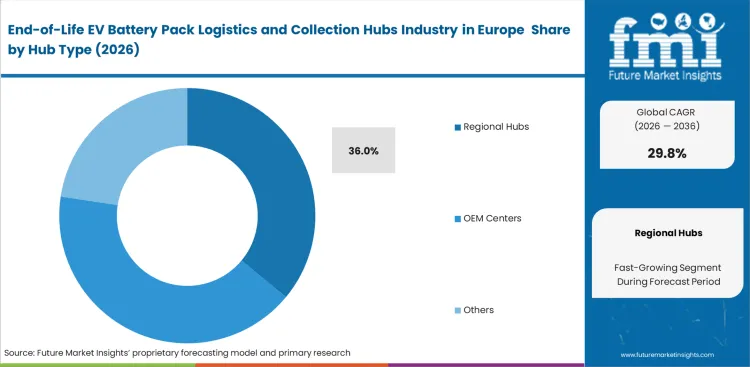
Consolidated testing capacity explains why a limited number of nodes shape network topology across Europe. Regional hubs are expected to account for 36.0% share in 2026, as they sit between local collection points and final processing facilities and carry out the triage work that smaller sites cannot absorb. High-voltage testing systems, diagnostic tools, and quarantine infrastructure require capital commitments that are difficult to justify at dealership level, which keeps assessment activity concentrated at regional hubs. Network efficiency also improves at these locations because battery volumes can be aggregated into shipment sizes that make onward transport to shredding or recycling destinations more practical.
- High-volume throughput: Centralized staging allows facility coordinators to process diagnostic evaluations continuously. Economies of scale reduce unit testing costs significantly.
- Distributed collection lag: Edge nodes struggle with irregular return volumes. Dealership service directors face prolonged storage times awaiting full shipment capacity.
- Quarantine qualification: Specialized immersion capabilities determine site licensing. Safety compliance officers mandate these setups before authorizing high-risk pack aggregation.
End-of-Life EV Battery Pack Logistics and Collection Hubs in Europe Analysis by Battery Condition
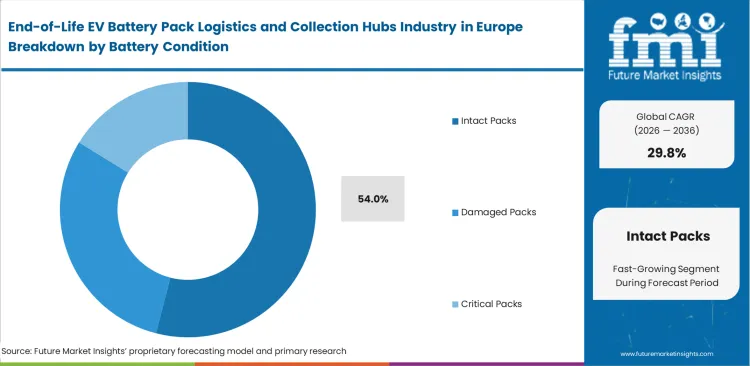
constant review once battery packs begin moving out of service. Within the Battery Condition segment, intact packs are projected to account for 54.0% share in 2026, largely because initial removal from the vehicle chassis rarely extends to immediate module-level extraction. Service teams at dealership locations often do not have the specialist training, tooling, or protected environments needed to open sealed enclosures safely. Operational simplicity, however, comes with a freight penalty because full-pack transport includes casing weight and unused internal volume along with the battery itself. That trade-off becomes more visible as intact units move through the wider industrial battery handling chain.
- Initial triage: Visual inspection determines immediate housing integrity. Dealership technicians isolate visibly damaged enclosures from standard transport streams.
- Diagnostic validation: State-of-health scans verify internal cell stability. Logistics managers require this documentation before authorizing road transit.
- Routing execution: Clear safety certifications unlock standard freight pathways. Operations directors secure lower transport rates for verifiably stable intact assemblies.
End-of-Life EV Battery Pack Logistics and Collection Hubs Industry in Europe Analysis by Source Channel
Fleet retirement flows keep transport economics at the center of battery-handling decisions, especially when operators weigh early disassembly against the cost and risk of moving larger units over longer distances. Keeping batteries intact reduces exposure to live high-voltage components and electrolyte-related hazards during collection and transfer, while also making classification and shipment procedures easier to manage than loose-module movements. Within the Battery Condition segment, intact packs are projected to secure 54.0% share in 2026 for that reason. Freight efficiency remains the main trade-off, since full-pack transport carries metal casing weight and unused volume along with the battery itself. Operations that delay module-level disassembly before long-haul movement therefore face higher freight cost per kilowatt-hour of recoverable material, even though the near-term handling process is operationally simpler.
- Franchise frontline: Warranty protocols force early returns through official networks. Service managers establish initial hazardous storage protocols.
- Fleet aggregation: Commercial operators retire vehicles in predictable batches. Fleet coordinators bypass dealers entirely, shipping directly to regional hubs.
- Dismantler integration: Independent salvage yards encounter crashed electric vehicles last. Yard operators eventually adopt OEM-approved handling protocols to monetize recovered units.
End-of-Life EV Battery Pack Logistics and Collection Hubs Industry in Europe Analysis by Transport Mode
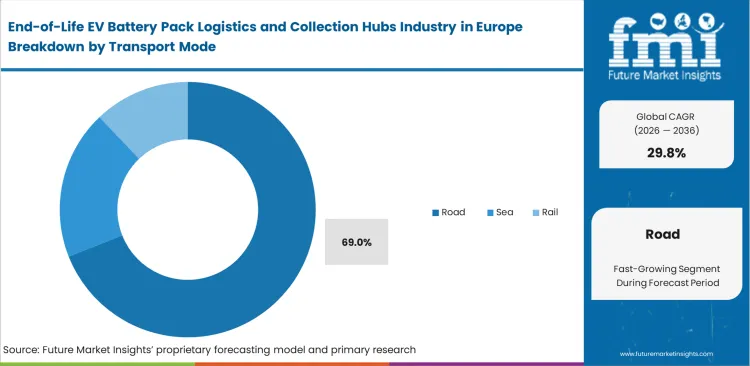
Warranty replacements and early leasing-cycle expirations route a steady flow of removed battery packs into franchised service centers, which keeps dealer locations central to the first stage of collection. Clear intake and storage procedures at this stage help establish custody records, condition status, and routing discipline before packs move deeper into the recovery chain. Insurance exposure adds another constraint because holding volatile units on site raises liability for franchise operators while they wait for transport, particularly as early-return volumes from battery leasing service models add to handling complexity.
Within the Source Channel segment, dealer locations are expected to account for 29.0% share in 2026, reflecting their role as the most established initial collection point for consumer vehicle battery removals. Sites without rapid-dispatch arrangements are more likely to accumulate risky inventory, which can disrupt replacement scheduling and slow workshop throughput.
- Specialized freight premiums: Certified hazardous goods carriers command premium rates. Logistics planners factor these inflated costs into total recovery economics.
- Thermal monitoring overhead: Active temperature tracking systems require constant power. Transport operators absorb significant maintenance costs for specialized trailer equipment.
- Payload density penalties: Heavy protective casings limit total units per truck. Route optimization specialists struggle to achieve profitable capacity utilization.
End-of-Life EV Battery Pack Logistics and Collection Hubs Industry in Europe Analysis by End Route
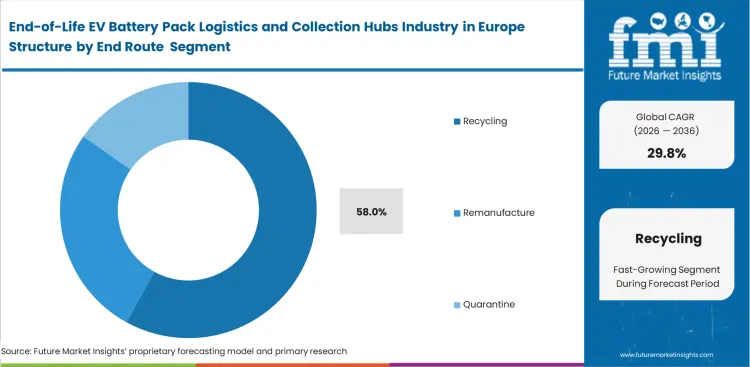
Recycling is projected to account for 58.0% share in 2026 within the End Route segment, as a large portion of retired packs does not meet the condition thresholds required for viable second-life use. Automakers may continue to assess repurposing potential, but actual routing decisions are still shaped more by degradation patterns, diagnostic clarity, and downstream processing economics. Material recovery remains the more practical path when returned units fail state-of-health tests or when uncertainty at pack level makes reuse decisions harder to justify. Processing economics also favor this route because recycling facilities need a stable flow of feedstock to support utilization of discharge, dismantling, and metallurgical assets.
- Black mass generation: Specialized shredders convert complex assemblies into intermediate powder. Facility coordinators manage constant throughput to satisfy downstream refinery contracts.
- Second-life qualification: Rigorous testing identifies modules suitable for stationary storage. Engineering leads divert healthy units away from destructive processing.
- Quarantine destruction: Critically damaged units require specialized thermal treatment. Safety managers incinerate unstable packs to neutralize immediate explosion risks.
End-of-Life EV Battery Pack Logistics and Collection Hubs Industry in Europe Drivers, Restraints, and Opportunities
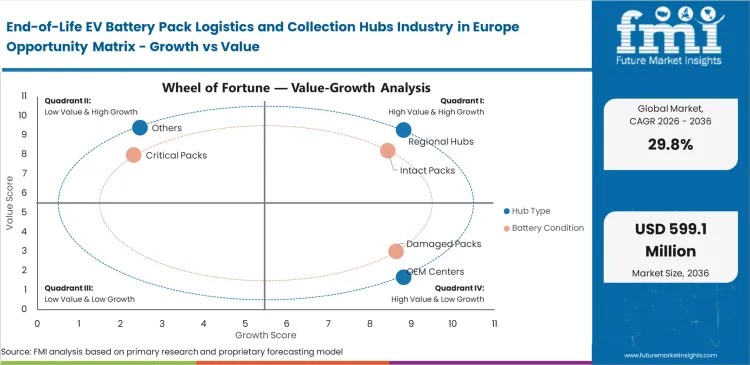
Early end-of-life volumes from the first major EV adoption cohorts are pushing battery-handling requirements higher across Europe’s collection network. Return flows at that point consist of large, heavy, and potentially unstable units that require controlled extraction, compliant storage, and rapid routing into the next handling stage. Conventional warehouse space is rarely suitable because fire-code requirements, isolation rules, and hazardous-material controls are tighter for high-voltage battery inventory. Delays in certified hub buildout leave automakers exposed to slower battery turnarounds and higher compliance risk, especially as routing into EV battery recycling and black mass processing and the wider automotive logistics chain becomes more time-sensitive.
Fragmented diagnostic communication remains another major constraint at the triage stage because routing decisions depend on fast and accurate pack-health assessment. Triage teams need to determine whether a returned unit should move toward recycling, quarantine, or a possible second-life path, yet battery-management data is often locked behind proprietary manufacturer software. Full visibility therefore depends on brand-specific tools that many independent regional hubs do not possess across all incoming vehicle platforms. Processing speed drops when technicians cannot access digital health data quickly and must fall back on slower manual voltage checks or partial visual assessment.
Opportunities in the End-of-Life EV Battery Pack Logistics and Collection Hubs Industry in Europe
- Mobile diagnostic deployment: Field service teams using universal testing hardware can complete state-of-health checks directly at dealership locations, which improves early sorting before units enter the wider collection chain. Faster triage reduces unnecessary movement of critically damaged packs and supports cleaner data capture for downstream routing, which aligns well with EV battery passport and EU battery passport solutions.
- Immersion transport vessels: Engineering specialists developing liquid-filled containment bins are well placed as thermal-risk controls become more important in long-haul battery movement. These vessels help contain unstable units during transit, improve handling confidence, and fit naturally within the broader requirement for safer battery packaging materials.
- Automated discharge stations: Robotics-led discharge systems are gaining relevance because they reduce manual exposure to high-voltage packs before onward processing. Faster and more controlled discharge also improves turnaround at consolidation hubs, especially where incoming batteries vary by pack architecture and handling complexity across different battery platforms.
Regional Analysis of end-of-life EV battery pack logistics and collection hubs in Europe
Aging EV fleets in Europe are moving the market from expected return volumes to active pack-handling requirements. Early subsidy-driven adoption created a concentrated base of older electric vehicles, and more of those units are now entering replacement, retirement, or failure-related battery removal cycles. Long transport distances between scattered population centers and centralized recycling framework make route planning, interim storage, and compliant handling more important in this region than in denser European markets. Winter operating conditions add another layer of complexity because battery temperature control during transit can tighten equipment requirements and reduce transport efficiency.
Based on regional analysis, end-of-life ev battery pack logistics and collection hubs industry in Europe is segmented into Norway, Netherlands, Germany, Sweden, France, United Kingdom, and Italy across 40 plus countries.
.webp "Top Country Growth Comparison End Of Life Ev Battery Pack Logistics And Collection Hubs Industry In Europe Cagr (2026 2036)")
| Country | CAGR (2026 to 2036) |
|---|---|
| Norway | 33.1% |
| Netherlands | 31.4% |
| Germany | 30.8% |
| Sweden | 30.1% |
| France | 29.2% |
| United Kingdom | 28.4% |
| Italy | 27.1% |
Source: Future Market Insights (FMI) analysis, based on proprietary forecasting model and primary research
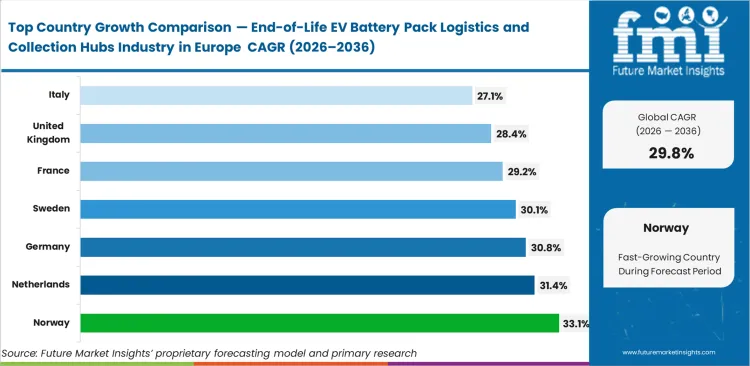
- Norway: High EV penetration is translating into a more established stream of returned battery packs, which gives the country an earlier operating base than most of Europe. Collection routes can be planned with better visibility because return patterns are beginning to reflect actual field experience rather than only future projections. Norway is projected to record a 33.1% CAGR in this market through 2036. Early control over collection density and handling capacity is likely to shape competitive positioning in the country.
- Sweden: Sweden is anticipated to record around 30.1% CAGR through 2036, supported by the country’s push to keep battery-related material flows closer to domestic industrial activity. Intermediate staging capacity is becoming more important where collection, testing, and onward movement need to align more closely with battery and metals processing baseline. Shorter distances between staging points and final treatment locations also help reduce hazardous transport exposure. That operating logic keeps localized network design central to Sweden’s industry outlook.
- Netherlands: Port infrastructure gives the Netherlands a strong position in battery intake, transit coordination, and onward movement into inland processing networks. Intermodal handling is especially important here because defective or retired packs often need to shift between maritime entry points and specialized road transport under tight compliance controls. Industry outlook in the Netherlands is expected to advance at a 31.4% CAGR through 2036. Strong execution in international waste-transfer procedures will keep local hubs relevant as continental gateway points.
- Germany: Germany’s large domestic vehicle base and manufacturing footprint are pushing the need for dedicated reverse-logistics networks with higher battery-handling discipline. Demand analysis in Germany is anticipated to rise at a 30.8% CAGR through 2036. Collection and transfer systems in the country need to manage both vehicle retirement flows and battery movements linked to production, testing, and early field failures. Municipal approvals for high-voltage storage and staging sites remain a practical constraint on how quickly network capacity can expand. Permit execution will remain closely tied to processing speed and network reliability.
- France: Traceability requirements carry more weight in France because pack removal, storage, transfer, and final recovery all need tighter documentation across the chain. Digital tracking, custody visibility, and controlled routing are therefore taking on a larger role in day-to-day battery logistics. France is likely to post a 29.2% CAGR through 2036, reflecting that compliance-heavy operating environment. Data-led routing discipline is expected to become more important as pack flows increase.
- United Kingdom: United Kingdom is expected to record a 28.4% CAGR through 2036, with ongoing cross‑border logistics friction reinforcing the importance of localized staging and interim storage capacity. Post-Brexit customs procedures add friction when intact packs need to move to continental recycling destinations, which increases the value of localized staging capacity inside the country. Buffer storage helps absorb delays in export timing and reduces disruption at initial collection points. Control over cross-channel battery movement is likely to remain a key differentiator in the UK industry outlook.
- Italy: Collection economics in Italy are less uniform because southern service demand is dispersed while much of the industrial processing base is concentrated in the north. Route planning becomes harder when individual defective units must be recovered from remote points without enough nearby volume to support efficient backhaul. The market for end-of-life EV battery pack logistics and collection hubs in Italy is expected to expand at a 27.1% CAGR through 2036. Aggregation at localized transit depots will remain important for improving shipment economics and keeping the network commercially workable.
FMI’s report includes detailed analysis of end-of-life EV battery pack logistics and collection hub development across Europe, with assessment of return-volume timing, regional staging requirements, transport compliance, and routing economics. Future Market Insights indicates that network performance across Europe will depend on the buildout of certified intermediate hubs, faster pack-level diagnostics, and tighter coordination between collection points, transit nodes, and final recovery infrastructure.
Competitive Aligners for Market Players
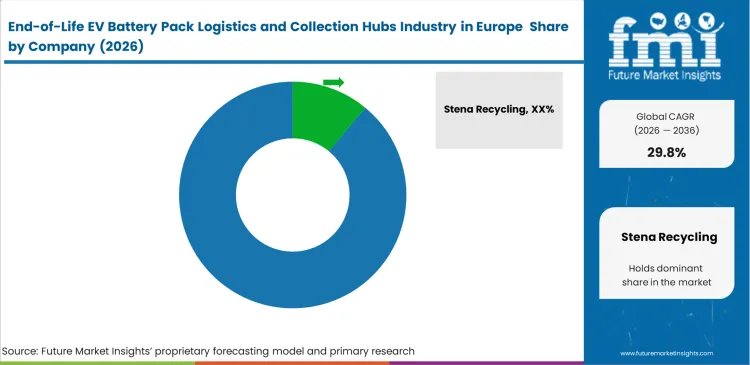
Specialized hazardous-material handling licenses keep entry barriers high in this market because standard freight capabilities do not translate easily into high-voltage battery logistics. Stena Recycling, Fortum Battery Recycling, and Ecobat remain well positioned through established ADR-compliant transport access and permitted storage infrastructure across key collection corridors. Contract allocation in this segment depends more on operating reliability, incident control, and regulatory compliance than on price alone. Market access is therefore harder to build for companies that lack approved handling networks, local permitting familiarity, and a proven record in battery-risk management.
Digital visibility during transit is becoming equally important because pack condition can change while units move between staging points and final processing sites. SK tes and Veolia benefit from broader monitoring and control capability across their battery-handling networks, which strengthens service credibility in higher-risk movements. Operators without comparable thermal tracking, pack-status visibility, and response procedures face a weaker position when they try to scale across multiple jurisdictions. Insurance costs also tend to rise for less established participants because limited in-transit visibility increases perceived operating risk.
Automotive groups are also avoiding excessive dependence on any one handling partner, which keeps the competitive structure relatively distributed despite high entry barriers. Redwood Materials, Duesenfeld, and other regional operators remain relevant because network redundancy matters when battery flows must continue without interruption across different collection zones. Capacity planning in this market increasingly depends on backup routing, secondary staging options, and the ability to redirect volumes quickly if one node faces disruption. Competitive strength therefore rests not only on licensed transport and storage capability, but also on how well each operator fits into a wider, interconnected handling network across Europe.
Key Players in End-of-Life EV Battery Pack Logistics and Collection Hubs Industry in Europe
- Stena Recycling
- Fortum Battery Recycling
- Ecobat
- SK tes
- Veolia
- Redwood Materials
- Duesenfeld
Scope of the Report
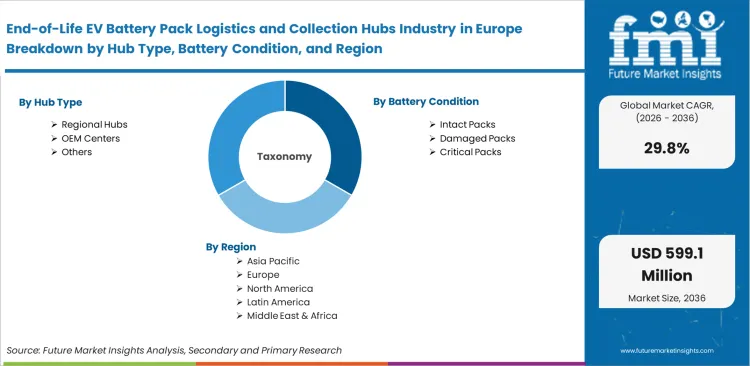
| Metric | Value |
|---|---|
| Quantitative Units | USD 34.0 million to USD 460.0 million, at a CAGR of 29.8% |
| Market Definition | Specialized physical nodes and transportation frameworks manage retired automotive lithium-ion and solid-state systems. Core functions encompass initial receiving, thermal runaway risk assessment, temporary hazardous goods storage, and specialized dispatch to final processing centers. |
| Segmentation | Hub Type, Battery Condition, Source Channel, Transport Mode, End Route |
| Regions Covered | North America, Latin America, Europe, Asia Pacific, Middle East and Africa |
| Countries Covered | Norway, Netherlands, Germany, Sweden, France, United Kingdom, Italy |
| Key Companies Profiled | Stena Recycling, Fortum Battery Recycling, Ecobat, SK tes, Veolia, Redwood Materials, Duesenfeld |
| Forecast Period | 2026 to 2036 |
| Approach | Total tonnage of registered electric vehicles reaching twelve-year operational limits across core European nations. |
Source: Future Market Insights (FMI) analysis, based on proprietary forecasting model and primary research
End-of-Life EV Battery Pack Logistics and Collection Hubs Industry in Europe Analysis by Segments
Hub Type
- Regional hubs
- Collection points
- OEM centers
- Transit depots
Battery Condition
- Intact packs
- Damaged packs
- Critical packs
- Recall packs
Source Channel
- Dealers
- Dismantlers
- Fleets
- Insurers
- OEMs
Transport Mode
- Road
- Sea
- Rail
- Intermodal
End Route
- Recycling
- Second life
- Remanufacture
- Quarantine
Countries
- Norway
- Netherlands
- Germany
- Sweden
- France
- United Kingdom
- Italy
Bibliography
- Association des Constructeurs Européens d'Automobiles. (2026, January 27). New car registrations: +1.8% in 2025; battery-electric 17.4% market share.
- Cattani, N. S., Weinert, C., Mussehl, V., Frieges, M., & Kampker, A. (2025, August). Economic and structural challenges of lithium-ion battery recycling in Europe: A stakeholder-based assessment. Waste Management, 205, 114962.
- European Commission. (2025, July 4). New rules to boost recycling efficiency from waste batteries.
- Fraunhofer Institute for Systems and Innovation Research ISI. (2025, July 24). Recycling capacities for lithium-ion batteries will exceed demand in Europe for the time being.
- Gianvincenzi, M., Mosconi, E. M., Marconi, M., & Tola, F. (2024, February 04). Battery waste management in Europe: Black mass hazardousness and recycling strategies in the light of an evolving competitive regulation. Recycling, 9(1), 13.
This bibliography is provided for reader reference. The full FMI report contains the complete reference list with primary source documentation.
This Report Addresses
- Regional hub testing capacity limits fundamentally shape collection node density, balancing localized staging against long-haul transport costs.
- Transport mode efficiency metrics actively govern intermodal shipping decisions, weighing road payload density penalties against rail flexibility limitations.
- Second-life qualification thresholds determine actual black mass generation volumes, compelling operators to integrate advanced state-of-health diagnostic software early.
- Immersion transport vessel deployment neutralizes thermal runaway risks, allowing carriers to secure lower insurance premiums while satisfying ADR mandates.
- Direct fleet volume routing allows operators to bypass dealer-level storage bottlenecks, shipping retired battery batches directly to centralized triage hubs.
- Automated discharge station integration accelerates safe pack dismantling procedures, eliminating manual high-voltage exposure while improving downstream refining turnaround times.
- Digital passport data exchange frameworks eliminate manual state-of-health verification, enabling seamless custody transfers between dealerships, carriers, and recovery facilities.
- Strict ADR hazardous goods compliance costs heavily impact long-haul profitability, forcing route optimization specialists to aggregate minimum viable shipment volumes.
Frequently Asked Questions
What is the projected value of this sector by 2036?
Sector valuation hits USD 460.0 million by 2036. This reflects a transition from pilot handling programs to industrial-scale reverse logistics networks.
What is the anticipated compound growth rate?
Industry valuation expands at 29.8% CAGR between 2026 and 2036. Fleet maturity curves force immediate investments in physical holding zones.
How large is the European sector today?
Initial valuations placed the sector at USD 26.2 million in 2025. Impending regulatory mandates compel automakers to secure future staging capacity.
Why do regional hubs lead the hub type segment?
Regional hubs capture 36.0% share by centralizing expensive high-voltage diagnostic equipment essential for sorting incoming units before shredding.
Why do intact packs dominate condition categories?
Intact packs hold 54.0% share as local mechanics lack training to open sealed high-voltage enclosures safely.
How does road transport maintain its majority share?
Road transport controls 69.0% share by offering point-to-point flexibility required for irregular battery collection from dispersed service locations.
Why does recycling outpace second-life applications?
Recycling accounts for 58.0% share because initial end-of-life cohorts exhibit severe cell degradation requiring immediate physical destruction.
What drives Norway's rapid compound growth?
Norway achieves 33.1% compound expansion based on actual battery failures from highly mature fleet aging curves.
How does the Netherlands compare to Germany operationally?
Netherlands leverages port networks for overseas defective packs. Germany relies on internal networks built for domestic factory reject flows.
What prevents faster adoption of second-life routing?
Proprietary battery management systems obscure cell-level data from independent handlers, forcing units into shredding pathways without accurate diagnostics.
How do cross-border regulations impact network efficiency?
Moving dangerous goods across European jurisdictions requires navigating conflicting national interpretations of ADR guidelines, causing border delays.
Why are automakers contracting multiple logistics providers?
Automakers actively resist single-vendor dependence to minimize extreme risk concentration regarding potential hub fire incidents.
What role do dealers play in the collection network?
Dealers act as the unavoidable frontline for consumer vehicle battery removal, executing early visual triage before transit authorization.
How do fleet coordinators bypass dealership bottlenecks?
Commercial operators retire vehicles in predictable batches, allowing fleet managers to ship directly to centralized regional triage hubs.
What defines a quarantine qualification for collection hubs?
Specialized immersion capabilities determine site licensing. Safety compliance officers mandate these setups before authorizing high-risk pack aggregation.
Why is payload density a penalty in battery transport?
Heavy protective casings and necessary thermal buffers limit total units per truck, impacting long-haul profitability.
How does field diagnostic deployment change collection efficiency?
Mobile service teams execute state-of-health checks directly at dealership lots, preventing unnecessary transport of critically damaged units.
What forces independent salvage yards into OEM-approved protocols?
Automaker-authorized networks provide guaranteed purchase rates for properly removed packs, forcing compliance from independent dismantlers.
Why do insurers act as a distinct source channel?
Insurance adjusters frequently declare electric vehicles total losses after minor impacts, generating unpredictable demands for specialized extraction.
How does Brexit impact UK battery logistics?
Post-Brexit customs barriers complicate exporting intact hazardous packs to continental recycling centers, forcing localized staging hub investments.
Why is Southern Europe a challenging collection environment?
Dispersed southern populations create severe collection imbalances, forcing reliance on localized transit depots for minimum shipment aggregation.
How do liquid-filled containment bins alter transport economics?
Standardized immersion vessels neutralize thermal runaway risks entirely during long-haul transit, lowering specialized insurance premiums considerably.
Preview the report firsthand - request a free sample
Get SampleGet the brochure for pricing and purchase details.
Get PDFTable of Content
- Executive Summary
- Global Market Outlook
- Demand-side Trends
- Supply-side Trends
- Technology Roadmap Analysis
- Analysis and Recommendations
- Market Overview
- Market Coverage / Taxonomy
- Market Definition / Scope / Limitations
- Research Methodology
- Chapter Orientation
- Analytical Lens and Working Hypotheses
- Market Structure, Signals, and Trend Drivers
- Benchmarking and Cross-market Comparability
- Market Sizing, Forecasting, and Opportunity Mapping
- Research Design and Evidence Framework
- Desk Research Programme (Secondary Evidence)
- Company Annual and Sustainability Reports
- Peer-reviewed Journals and Academic Literature
- Corporate Websites, Product Literature, and Technical Notes
- Earnings Decks and Investor Briefings
- Statutory Filings and Regulatory Disclosures
- Technical White Papers and Standards Notes
- Trade Journals, Industry Magazines, and Analyst Briefs
- Conference Proceedings, Webinars, and Seminar Materials
- Government Statistics Portals and Public Data Releases
- Press Releases and Reputable Media Coverage
- Specialist Newsletters and Curated Briefings
- Sector Databases and Reference Repositories
- FMI Internal Proprietary Databases and Historical Market Datasets
- Subscription Datasets and Paid Sources
- Social Channels, Communities, and Digital Listening Inputs
- Additional Desk Sources
- Expert Input and Fieldwork (Primary Evidence)
- Primary Modes
- Qualitative Interviews and Expert Elicitation
- Quantitative Surveys and Structured Data Capture
- Blended Approach
- Why Primary Evidence is Used
- Field Techniques
- Interviews
- Surveys
- Focus Groups
- Observational and In-context Research
- Social and Community Interactions
- Stakeholder Universe Engaged
- C-suite Leaders
- Board Members
- Presidents and Vice Presidents
- R&D and Innovation Heads
- Technical Specialists
- Domain Subject-matter Experts
- Scientists
- Physicians and Other Healthcare Professionals
- Governance, Ethics, and Data Stewardship
- Research Ethics
- Data Integrity and Handling
- Primary Modes
- Tooling, Models, and Reference Databases
- Desk Research Programme (Secondary Evidence)
- Data Engineering and Model Build
- Data Acquisition and Ingestion
- Cleaning, Normalisation, and Verification
- Synthesis, Triangulation, and Analysis
- Quality Assurance and Audit Trail
- Market Background
- Market Dynamics
- Drivers
- Restraints
- Opportunity
- Trends
- Scenario Forecast
- Demand in Optimistic Scenario
- Demand in Likely Scenario
- Demand in Conservative Scenario
- Opportunity Map Analysis
- Product Life Cycle Analysis
- Supply Chain Analysis
- Investment Feasibility Matrix
- Value Chain Analysis
- PESTLE and Porter’s Analysis
- Regulatory Landscape
- Regional Parent Market Outlook
- Production and Consumption Statistics
- Import and Export Statistics
- Market Dynamics
- Global Market Analysis 2021 to 2025 and Forecast, 2026 to 2036
- Historical Market Size Value (USD Million) Analysis, 2021 to 2025
- Current and Future Market Size Value (USD Million) Projections, 2026 to 2036
- Y-o-Y Growth Trend Analysis
- Absolute $ Opportunity Analysis
- Global Market Pricing Analysis 2021 to 2025 and Forecast 2026 to 2036
- Global Market Analysis 2021 to 2025 and Forecast 2026 to 2036, By Hub Type
- Introduction / Key Findings
- Historical Market Size Value (USD Million) Analysis By Hub Type , 2021 to 2025
- Current and Future Market Size Value (USD Million) Analysis and Forecast By Hub Type , 2026 to 2036
- Regional Hubs
- OEM Centers
- Others
- Regional Hubs
- Y-o-Y Growth Trend Analysis By Hub Type , 2021 to 2025
- Absolute $ Opportunity Analysis By Hub Type , 2026 to 2036
- Global Market Analysis 2021 to 2025 and Forecast 2026 to 2036, By Battery Condition
- Introduction / Key Findings
- Historical Market Size Value (USD Million) Analysis By Battery Condition, 2021 to 2025
- Current and Future Market Size Value (USD Million) Analysis and Forecast By Battery Condition, 2026 to 2036
- Intact Packs
- Damaged Packs
- Critical Packs
- Intact Packs
- Y-o-Y Growth Trend Analysis By Battery Condition, 2021 to 2025
- Absolute $ Opportunity Analysis By Battery Condition, 2026 to 2036
- Global Market Analysis 2021 to 2025 and Forecast 2026 to 2036, By Source Channel
- Introduction / Key Findings
- Historical Market Size Value (USD Million) Analysis By Source Channel, 2021 to 2025
- Current and Future Market Size Value (USD Million) Analysis and Forecast By Source Channel, 2026 to 2036
- Dealer
- Dismantlers
- Fleets
- Dealer
- Y-o-Y Growth Trend Analysis By Source Channel, 2021 to 2025
- Absolute $ Opportunity Analysis By Source Channel, 2026 to 2036
- Global Market Analysis 2021 to 2025 and Forecast 2026 to 2036, By Transport Mode
- Introduction / Key Findings
- Historical Market Size Value (USD Million) Analysis By Transport Mode, 2021 to 2025
- Current and Future Market Size Value (USD Million) Analysis and Forecast By Transport Mode, 2026 to 2036
- Road
- Sea
- Rail
- Road
- Y-o-Y Growth Trend Analysis By Transport Mode, 2021 to 2025
- Absolute $ Opportunity Analysis By Transport Mode, 2026 to 2036
- Global Market Analysis 2021 to 2025 and Forecast 2026 to 2036, By End Route
- Introduction / Key Findings
- Historical Market Size Value (USD Million) Analysis By End Route, 2021 to 2025
- Current and Future Market Size Value (USD Million) Analysis and Forecast By End Route, 2026 to 2036
- Recycling
- Remanufacture
- Quarantine
- Recycling
- Y-o-Y Growth Trend Analysis By End Route, 2021 to 2025
- Absolute $ Opportunity Analysis By End Route, 2026 to 2036
- Global Market Analysis 2021 to 2025 and Forecast 2026 to 2036, By Region
- Introduction
- Historical Market Size Value (USD Million) Analysis By Region, 2021 to 2025
- Current Market Size Value (USD Million) Analysis and Forecast By Region, 2026 to 2036
- North America
- Latin America
- Western Europe
- Eastern Europe
- East Asia
- South Asia and Pacific
- Middle East & Africa
- Market Attractiveness Analysis By Region
- North America Market Analysis 2021 to 2025 and Forecast 2026 to 2036, By Country
- Historical Market Size Value (USD Million) Trend Analysis By Market Taxonomy, 2021 to 2025
- Market Size Value (USD Million) Forecast By Market Taxonomy, 2026 to 2036
- By Country
- USA
- Canada
- Mexico
- By Hub Type
- By Battery Condition
- By Source Channel
- By Transport Mode
- By End Route
- By Country
- Market Attractiveness Analysis
- By Country
- By Hub Type
- By Battery Condition
- By Source Channel
- By Transport Mode
- By End Route
- Key Takeaways
- Latin America Market Analysis 2021 to 2025 and Forecast 2026 to 2036, By Country
- Historical Market Size Value (USD Million) Trend Analysis By Market Taxonomy, 2021 to 2025
- Market Size Value (USD Million) Forecast By Market Taxonomy, 2026 to 2036
- By Country
- Brazil
- Chile
- Rest of Latin America
- By Hub Type
- By Battery Condition
- By Source Channel
- By Transport Mode
- By End Route
- By Country
- Market Attractiveness Analysis
- By Country
- By Hub Type
- By Battery Condition
- By Source Channel
- By Transport Mode
- By End Route
- Key Takeaways
- Western Europe Market Analysis 2021 to 2025 and Forecast 2026 to 2036, By Country
- Historical Market Size Value (USD Million) Trend Analysis By Market Taxonomy, 2021 to 2025
- Market Size Value (USD Million) Forecast By Market Taxonomy, 2026 to 2036
- By Country
- Germany
- UK
- Italy
- Spain
- France
- Nordic
- BENELUX
- Rest of Western Europe
- By Hub Type
- By Battery Condition
- By Source Channel
- By Transport Mode
- By End Route
- By Country
- Market Attractiveness Analysis
- By Country
- By Hub Type
- By Battery Condition
- By Source Channel
- By Transport Mode
- By End Route
- Key Takeaways
- Eastern Europe Market Analysis 2021 to 2025 and Forecast 2026 to 2036, By Country
- Historical Market Size Value (USD Million) Trend Analysis By Market Taxonomy, 2021 to 2025
- Market Size Value (USD Million) Forecast By Market Taxonomy, 2026 to 2036
- By Country
- Russia
- Poland
- Hungary
- Balkan & Baltic
- Rest of Eastern Europe
- By Hub Type
- By Battery Condition
- By Source Channel
- By Transport Mode
- By End Route
- By Country
- Market Attractiveness Analysis
- By Country
- By Hub Type
- By Battery Condition
- By Source Channel
- By Transport Mode
- By End Route
- Key Takeaways
- East Asia Market Analysis 2021 to 2025 and Forecast 2026 to 2036, By Country
- Historical Market Size Value (USD Million) Trend Analysis By Market Taxonomy, 2021 to 2025
- Market Size Value (USD Million) Forecast By Market Taxonomy, 2026 to 2036
- By Country
- China
- Japan
- South Korea
- By Hub Type
- By Battery Condition
- By Source Channel
- By Transport Mode
- By End Route
- By Country
- Market Attractiveness Analysis
- By Country
- By Hub Type
- By Battery Condition
- By Source Channel
- By Transport Mode
- By End Route
- Key Takeaways
- South Asia and Pacific Market Analysis 2021 to 2025 and Forecast 2026 to 2036, By Country
- Historical Market Size Value (USD Million) Trend Analysis By Market Taxonomy, 2021 to 2025
- Market Size Value (USD Million) Forecast By Market Taxonomy, 2026 to 2036
- By Country
- India
- ASEAN
- Australia & New Zealand
- Rest of South Asia and Pacific
- By Hub Type
- By Battery Condition
- By Source Channel
- By Transport Mode
- By End Route
- By Country
- Market Attractiveness Analysis
- By Country
- By Hub Type
- By Battery Condition
- By Source Channel
- By Transport Mode
- By End Route
- Key Takeaways
- Middle East & Africa Market Analysis 2021 to 2025 and Forecast 2026 to 2036, By Country
- Historical Market Size Value (USD Million) Trend Analysis By Market Taxonomy, 2021 to 2025
- Market Size Value (USD Million) Forecast By Market Taxonomy, 2026 to 2036
- By Country
- Kingdom of Saudi Arabia
- Other GCC Countries
- Turkiye
- South Africa
- Other African Union
- Rest of Middle East & Africa
- By Hub Type
- By Battery Condition
- By Source Channel
- By Transport Mode
- By End Route
- By Country
- Market Attractiveness Analysis
- By Country
- By Hub Type
- By Battery Condition
- By Source Channel
- By Transport Mode
- By End Route
- Key Takeaways
- Key Countries Market Analysis
- USA
- Pricing Analysis
- Market Share Analysis, 2025
- By Hub Type
- By Battery Condition
- By Source Channel
- By Transport Mode
- By End Route
- Canada
- Pricing Analysis
- Market Share Analysis, 2025
- By Hub Type
- By Battery Condition
- By Source Channel
- By Transport Mode
- By End Route
- Mexico
- Pricing Analysis
- Market Share Analysis, 2025
- By Hub Type
- By Battery Condition
- By Source Channel
- By Transport Mode
- By End Route
- Brazil
- Pricing Analysis
- Market Share Analysis, 2025
- By Hub Type
- By Battery Condition
- By Source Channel
- By Transport Mode
- By End Route
- Chile
- Pricing Analysis
- Market Share Analysis, 2025
- By Hub Type
- By Battery Condition
- By Source Channel
- By Transport Mode
- By End Route
- Germany
- Pricing Analysis
- Market Share Analysis, 2025
- By Hub Type
- By Battery Condition
- By Source Channel
- By Transport Mode
- By End Route
- UK
- Pricing Analysis
- Market Share Analysis, 2025
- By Hub Type
- By Battery Condition
- By Source Channel
- By Transport Mode
- By End Route
- Italy
- Pricing Analysis
- Market Share Analysis, 2025
- By Hub Type
- By Battery Condition
- By Source Channel
- By Transport Mode
- By End Route
- Spain
- Pricing Analysis
- Market Share Analysis, 2025
- By Hub Type
- By Battery Condition
- By Source Channel
- By Transport Mode
- By End Route
- France
- Pricing Analysis
- Market Share Analysis, 2025
- By Hub Type
- By Battery Condition
- By Source Channel
- By Transport Mode
- By End Route
- India
- Pricing Analysis
- Market Share Analysis, 2025
- By Hub Type
- By Battery Condition
- By Source Channel
- By Transport Mode
- By End Route
- ASEAN
- Pricing Analysis
- Market Share Analysis, 2025
- By Hub Type
- By Battery Condition
- By Source Channel
- By Transport Mode
- By End Route
- Australia & New Zealand
- Pricing Analysis
- Market Share Analysis, 2025
- By Hub Type
- By Battery Condition
- By Source Channel
- By Transport Mode
- By End Route
- China
- Pricing Analysis
- Market Share Analysis, 2025
- By Hub Type
- By Battery Condition
- By Source Channel
- By Transport Mode
- By End Route
- Japan
- Pricing Analysis
- Market Share Analysis, 2025
- By Hub Type
- By Battery Condition
- By Source Channel
- By Transport Mode
- By End Route
- South Korea
- Pricing Analysis
- Market Share Analysis, 2025
- By Hub Type
- By Battery Condition
- By Source Channel
- By Transport Mode
- By End Route
- Russia
- Pricing Analysis
- Market Share Analysis, 2025
- By Hub Type
- By Battery Condition
- By Source Channel
- By Transport Mode
- By End Route
- Poland
- Pricing Analysis
- Market Share Analysis, 2025
- By Hub Type
- By Battery Condition
- By Source Channel
- By Transport Mode
- By End Route
- Hungary
- Pricing Analysis
- Market Share Analysis, 2025
- By Hub Type
- By Battery Condition
- By Source Channel
- By Transport Mode
- By End Route
- Kingdom of Saudi Arabia
- Pricing Analysis
- Market Share Analysis, 2025
- By Hub Type
- By Battery Condition
- By Source Channel
- By Transport Mode
- By End Route
- Turkiye
- Pricing Analysis
- Market Share Analysis, 2025
- By Hub Type
- By Battery Condition
- By Source Channel
- By Transport Mode
- By End Route
- South Africa
- Pricing Analysis
- Market Share Analysis, 2025
- By Hub Type
- By Battery Condition
- By Source Channel
- By Transport Mode
- By End Route
- USA
- Market Structure Analysis
- Competition Dashboard
- Competition Benchmarking
- Market Share Analysis of Top Players
- By Region
- By Hub Type
- By Battery Condition
- By Source Channel
- By Transport Mode
- By End Route
- Competition Analysis
- Competition Deep Dive
- Stena Recycling
- Overview
- Product Portfolio
- Profitability by Market Segments (Product/Age /Sales Channel/Region)
- Sales Footprint
- Strategy Overview
- Marketing Strategy
- Product Strategy
- Channel Strategy
- Fortum Battery Recycling
- Ecobat
- SK tes
- Veolia
- Redwood Materials
- Stena Recycling
- Competition Deep Dive
- Assumptions & Acronyms Used


