

- Industry Size (2026)
- USD 320.0 Mn
- Forecast (2036)
- USD 1750.0 Mn
- CAGR (2026 to 2036)
- 18.5%
Cross-Border EV Battery Recycling Corridors in Continental Europe Industry Size, Market Forecast and Outlook By FMI
The cross-border EV battery recycling corridors in continental Europe industry crossed a valuation of USD 270.0 million in 2025 and is estimated to reach USD 320.0 million in 2026. FMI estimates the industry will expand at a CAGR of 18.5% from 2026 to 2036, taking total valuation to USD 1,750.0 million by 2036. Market growth is being influenced by a clear operating divide. Reverse-logistics networks are becoming more centralized, while metallurgical recovery still depends on cross-border movement of battery materials until regional processing capacity reaches fuller scale.
Summary of Cross-Border EV Battery Recycling Corridors in Continental Europe Industry
- The market is forecast to reach USD 1,750.0 million by 2036.
- The market is expected to grow at a CAGR of 18.5% from 2026 to 2036.
- The market was estimated at USD 270.0 million in 2025.
- The forecast period represents an incremental opportunity of USD 1,430.0 million.
- This market covers compliant cross-border EV battery take-back, transport, discharge, pretreatment, and traceability services across mainland Europe.
- The industry is compliance-led, where regulatory adherence, safe battery handling, and documentation quality outweigh basic logistics pricing.
- Growth is supported by evolving EU waste-shipment regulations, with key provisions coming into effect from May 2026.
- Collection logistics leads the processing-stage segment with a 31% share, driven by value-added services such as packaging, storage, and shipment coordination.
- End-of-life batteries dominate the source stream with a 42% share as retirement volumes increase across EV fleets.
- NMC batteries lead the chemistry segment with a 49% share due to their prevalence in Europe’s EV battery base.
- Integrated service contracts hold a 38% share, reflecting OEM preference for single-network accountability and compliance assurance.
- DACH-Benelux is the leading corridor geography with a 27% share, supported by Germany’s OEM base and Belgium’s refining capacity.
- Poland, Spain, and Germany are the fastest-growing national markets, with Poland leading at a 20.4% CAGR.
- Umicore, Fortum Battery Recycling, Hydrovolt, Stena Recycling, Veolia, Ecobat, and cylib are key participants shaping the competitive landscape.
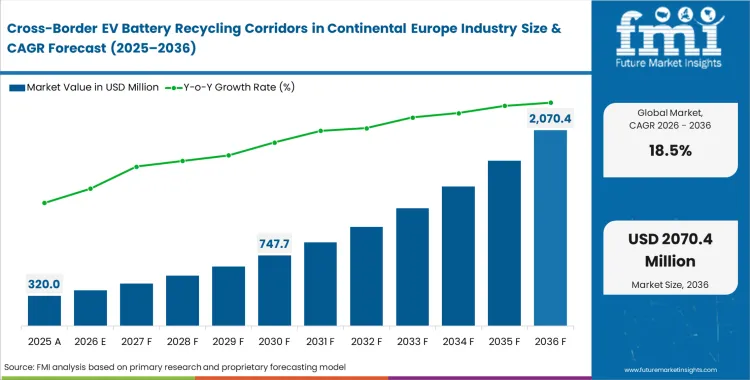
Cross-border movement remains one of the main operational pressure points in this industry. Local processing requirements do not always align with the commercial benefit of concentrating hydrometallurgical recovery in a smaller number of specialized hubs. Recycling rules, shipment approvals, and waste-transfer notifications still vary across Continental Europe, which slows movement of battery scrap from collection and pre-treatment sites to larger refining locations. Material may be discharged, dismantled, and mechanically processed locally, yet much of its value is realized only after downstream chemical recovery. In this setting, compliant EV battery recycling and black mass processing routes are becoming a meaningful advantage for operators that can coordinate movement across multiple jurisdictions while maintaining plant throughput.
Industry structure starts to shift once cross-border flows become more regular. Operators handling occasional spot shipments may clear material, though they do not create the volume certainty required for larger recovery networks to invest with confidence. Corridor systems with repeatable movement patterns give pre-treatment sites a more dependable outlet and give downstream refiners steadier feedstock visibility. This matters because mechanical capacity is easier to add than integrated recovery depth. Consistent corridor use is what turns fragmented battery flows into a more workable regional recycling system.
Poland is projected to witness 20.4% CAGR through 2036, supported by rising regional cell production and stronger inflows of manufacturing scrap. Spain is expected to grow at 19.8% as battery and automotive investment lifts corridor activity from a smaller installed base. Germany is likely to register 19.1% CAGR during the forecast period, helped by dense OEM presence and established industrial linkages across the battery value chain. France is estimated at 18.7%, with its position strengthened by better alignment between dismantling volumes and downstream treatment routes. Belgium is anticipated to expand at 17.9% as its logistics role continues to support material transit across nearby markets. Sweden is projected to record 17.4% CAGR, where battery-sector specialization is improving corridor economics. Italy is expected to post 17.2%, although fragmented collection and movement patterns still limit smoother scale-up. Differences across these markets reflect more than collection volume alone. Countries that connect scrap generation, pre-treatment, and refining through reliable cross-border channels are likely to move ahead faster than those still operating through disconnected national systems.
Segmental Analysis
Cross-Border EV Battery Recycling Corridors in Continental Europe Industry Analysis by Processing Stage
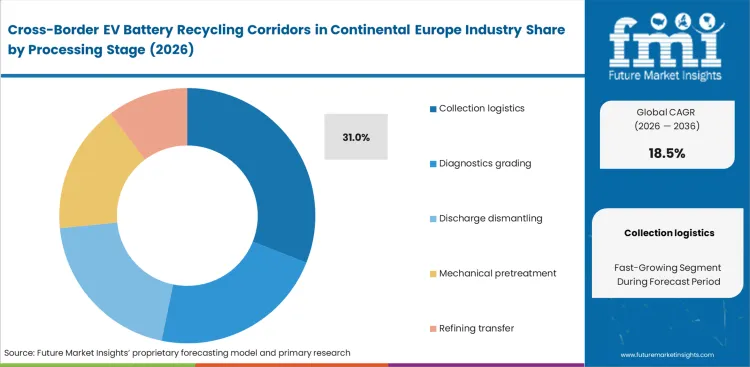
Cross-border battery recovery begins with movement, documentation, and packaging discipline long before dismantling starts. OEMs and recyclers first need compliant pickup, classification, and route planning across multiple jurisdictions, because weak logistics execution can block the entire recovery chain. Collection logistics is estimated to account for 31.0% share in 2026. FMI’s analysis indicates that service selection at this stage is shaped less by transport price alone and more by the ability to manage legal handoffs, route approvals, and packaging standards without delay. Border disruption can leave hazardous battery loads stranded, which then interrupts downstream recovery schedules and raises liability exposure. Early integration of battery supply chain traceability systems also matters because recyclers need auditable movement records to support recycled-content verification later in the chain.
- Packaging compliance: Specialized handlers prepare containment formats for damaged, unstable, and mixed-condition battery packs. This reduces transit disruption and helps maintain regulatory acceptance during the first movement stage.
- Route orchestration: Digital systems map approval paths across national jurisdictions before transport begins. Better route control shortens border idle time and improves the flow of material toward pretreatment sites.
- Liability transfer: Collection partners assume hazardous waste responsibility at the point of pickup. This limits legal exposure for battery owners during complex cross-border transport activity.
Cross-Border EV Battery Recycling Corridors in Continental Europe Industry Analysis by Source Stream
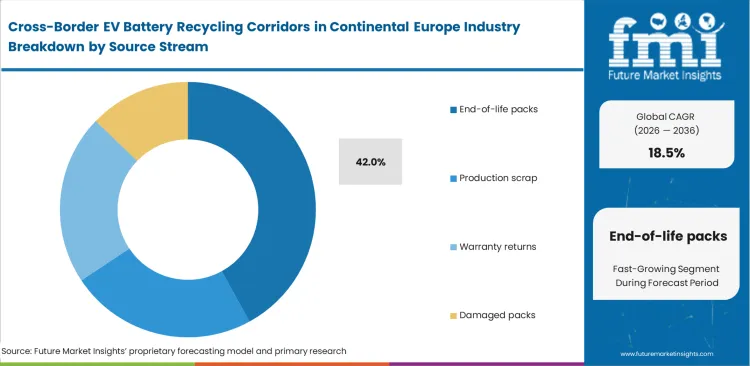
End-of-life battery packs remain the main long-term material source for recycling corridors across continental Europe. Their size, weight, and handling needs make this stream harder to manage than factory scrap, even though production scrap usually offers cleaner chemistry and simpler processing conditions. Dismantling networks still depend on these packs because they provide the steadier inflow needed to support treatment capacity, and end-of-life battery packs are estimated to account for 42.0% share in 2026. Managing this stream often requires added lifting systems, temporary storage arrangements, and screening steps that production scrap routes do not need to the same extent. Weak collection at this stage can reduce confidence in future feedstock commitments and make regional supply planning less secure. Safe transfer of damaged units also depends on early technical screening before cross-border movement is approved.
- Dealership consolidation: Handlers combine small-volume returns from dispersed service and retail points. This improves pickup efficiency and reduces unsafe battery buildup at local facilities.
- Hazardous storage: Interim sites maintain compliant holding conditions for unstable or damaged packs awaiting shipment. This lowers fire risk and supports controlled cross-border dispatch.
- Diagnostic screening: Operators assess pack condition and remaining utility before transport authorization. Units with residual value can then be redirected into secondary pathways instead of immediate recycling.
Cross-Border EV Battery Recycling Corridors in Continental Europe Industry Analysis by Chemistry
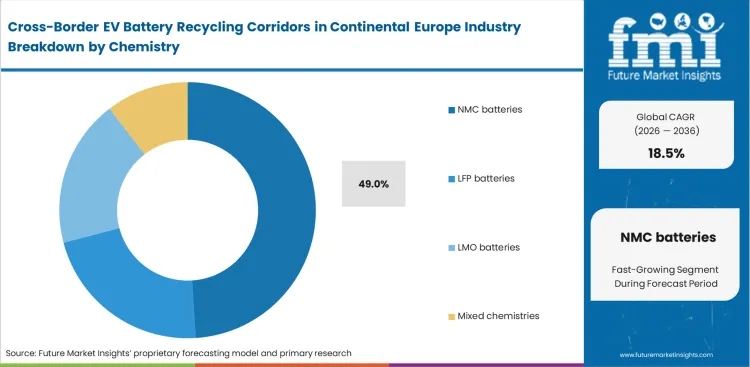
Chemistry mix continues to shape corridor economics because refining value remains closely tied to recoverable metal content. NMC packs remain important for recyclers that depend on nickel and cobalt recovery to support plant utilization and margin stability. Facilities configured around these output streams do not adjust easily to sharp chemistry shifts without affecting extraction economics. NMC batteries are estimated to account for 49.0% share in 2026, even as LFP use expands across new vehicle platforms. Corridor profitability still depends partly on the higher value density of NMC-derived output, which helps offset collection, storage, and cross-border transport costs. Refiners are also placing tighter control on intake ratios to keep processing conditions more stable across operating cycles.
- Value density: Nickel- and cobalt-rich output improves realized value per transported ton. This makes long-distance movement more defensible within cross-border recycling economics.
- Refining compatibility: Centralized processing hubs depend on controlled chemistry balance in incoming material. Irregular pack mix can reduce extraction efficiency and complicate plant operation.
- Economic subsidization: Higher-value NMC recovery helps support the transport burden tied to lower-value flows elsewhere in the system. This keeps broader corridor collection activity commercially workable.
Cross-Border EV Battery Recycling Corridors in Continental Europe Industry Analysis by Service Model
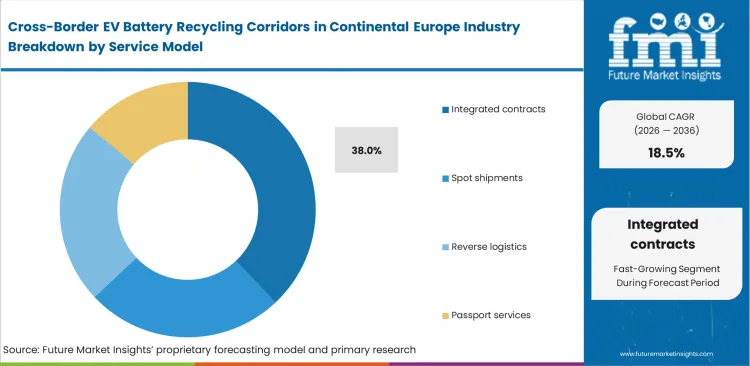
Large battery owners are showing stronger preference for a single accountable operator rather than multiple local vendors working across the same chain. Chain-of-custody risk can rise when collection, transport, pretreatment, and certification are divided across too many parties, especially in cross-border movements. Integrated contracts are estimated to account for 38.0% share in 2026, reflecting the need for smoother execution, fewer documentation gaps, and one responsible party overseeing the return process. Smaller recyclers without integrated capability often face a weaker position when buyers place more value on traceability, coordination, and accountability across the full operating sequence.
- Single-source accountability: One provider manages notifications, handoffs, and transport control across jurisdictions. This reduces execution gaps during hazardous battery movement.
- Volume guarantees: Service partners commit to defined removal capacity even when transport conditions tighten. This helps battery owners avoid operational disruption from accumulating returned material.
- Data transparency: Integrated systems connect collection records with recovery and certification outcomes. Auditable documentation becomes easier to maintain across multiple regulatory checkpoints.
Cross-Border EV Battery Recycling Corridors in Continental Europe Industry Analysis by Corridor Geography
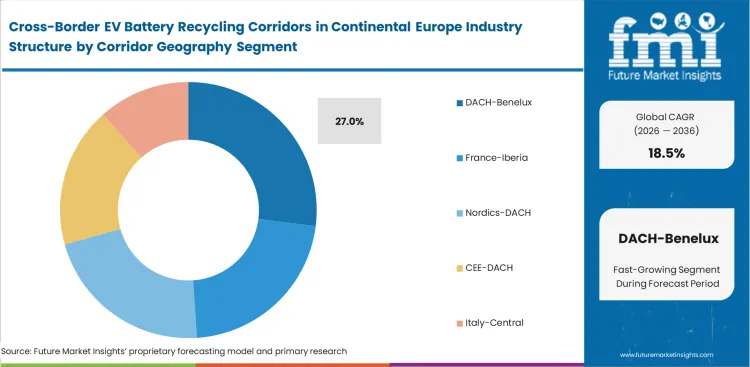
Geographic concentration remains a key factor in deciding which recycling routes can scale across continental Europe. DACH-Benelux stands out because high vehicle density, shorter transport distances, and established refining infrastructure support stronger corridor economics. This region is estimated to account for 27.0% share in 2026. Long-haul transport can weaken recovery economics for heavy hazardous battery loads, which leaves operators outside dense industrial corridors with higher inbound cost pressure. This gap becomes harder to offset when centrally located facilities can handle material more frequently and with fewer administrative delays. Participation in this route can also improve load optimization by supporting more coordinated movement of battery housing components alongside active battery materials. Shorter routes and stronger infrastructure keep this corridor more workable than fragmented alternatives.
- Transit proximity: Short movement distances between collection, dismantling, and refining sites reduce freight burden. This improves margin retention across the corridor.
- Regulatory alignment: Adjacent-country transfer procedures are more synchronized within this cluster. Fewer administrative interruptions help maintain shipment continuity.
- Infrastructure density: Concentrated availability of specialist carriers and handling services improves route flexibility. Operators can respond faster when intake conditions change across the corridor.
Cross-Border EV Battery Recycling Corridors in Continental Europe Industry Drivers, Restraints, and Opportunities
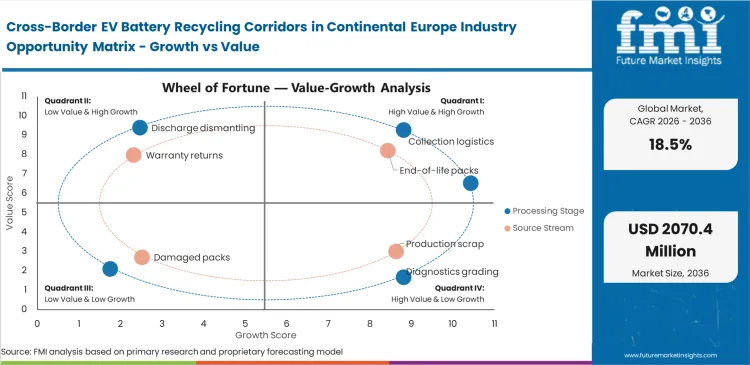
Extended producer responsibility mandates are increasing pressure on companies to secure material recovery at end of life. National processing capacity remains fragmented in many parts of Europe, which makes cross-border transport networks more necessary than purely local recovery routes. Manufacturers that delay building compliant movement channels may face added regulatory exposure and weaker control over battery material flows under tighter shipment rules. For this reason, compliant transit routes need to be established before dismantling capacity can scale in a meaningful way. Destination-site processing methods also carry weight because downstream treatment choices can affect broader compliance positioning across the recovery chain.
Hazardous waste classification remains a major source of operating friction across borders. One jurisdiction may treat black mass as a tradable product, while a neighboring market may classify the same output as hazardous waste requiring a longer notification process. This mismatch can slow border clearance, increase holding costs, and disrupt feed schedules for downstream metallurgical plants. Bilateral arrangements may ease movement on specific routes, though they do not create a consistent framework at the continental level. Regulatory alignment remains important because shipment reliability still depends on how each country interprets battery-derived material status.
Opportunities in the Cross-Border EV Battery Recycling Corridors in Continental Europe Industry
- Digital passport integration: Compliance software connecting physical transit data directly into the EU battery passport 2027 EV architecture. Companies monetize regulatory transparency.
- Dedicated rail freight: Establishing specialized rail corridors for heavy hazardous pack transport. Companies reduce carbon intensity compared to road freight.
- Modular pre-treatment: Deploying mobile discharge and dismantling units near border collection zones. Intermediate transport weights are optimized before international transit.
Regional Analysis
Based on regional analysis, cross-border EV battery recycling corridors in continental Europe is segmented into key national corridors across 40 plus countries.
.webp "Top Country Growth Comparison Cross Border Ev Battery Recycling Corridors In Continental Europe Industry Cagr (2026 2036)")
| Country | CAGR (2026 to 2036) |
|---|---|
| Poland | 20.4% |
| Spain | 19.8% |
| Germany | 19.1% |
| France | 18.7% |
| Belgium | 17.9% |
| Sweden | 17.4% |
| Italy | 17.2% |
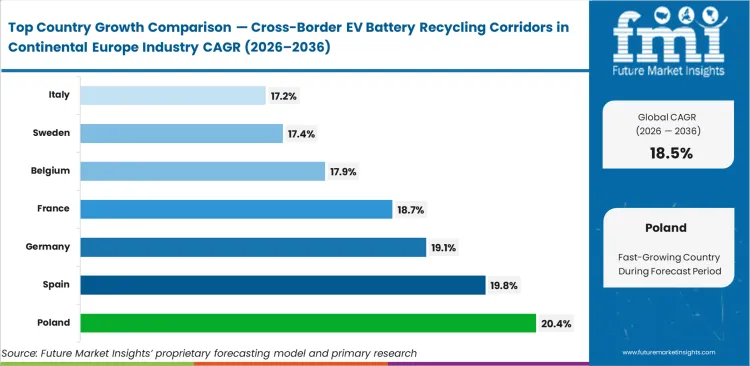
Source: Future Market Insights (FMI) analysis, based on proprietary forecasting model and primary research
Poland Cross-Border EV Battery Recycling Corridors in Continental Europe Industry Analysis
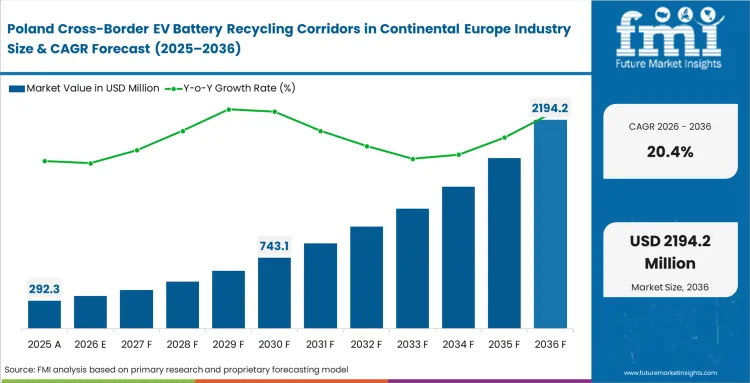
Rapid integration of localized cell production scrap into broader European refining networks dictates regional momentum. FMI's analysis indicates the Poland EV battery recycling corridor acts as a crucial export hub for intermediate battery materials flowing toward established hydrometallurgical centers in Western Europe. Local manufacturers prioritize immediate scrap evacuation to maintain production throughput. As domestic dismantling capacity lags cell manufacturing output, reliance on cross-border transit remains exceptionally high.
- Poland: Massive gigafactory investments generate unprecedented scrap volumes requiring immediate evacuation. Manufacturers must secure reliable cross-border transport to prevent facility saturation. Poland is anticipated to witness 20.4% CAGR during the forecast years. Establishing efficient transit links positions local operators to capture long-term processing contracts across broader CEE-DACH linkages.
Spain Cross-Border EV Battery Recycling Corridors in Continental Europe Industry Analysis
Building corridor intensity from a lower installed base defines Iberian strategy. Based on FMI's assessment, the Spain EV battery recycling corridor leverages expanding automotive investments to develop structured reverse logistics pathways into France and beyond. Companies face immediate pressures to consolidate end-of-life packs from widespread domestic dealership networks before initiating cross-border transfers. Creating efficient domestic aggregation hubs becomes a prerequisite for viable international shipment economics.
- Spain: Widespread vehicle deployment requires extensive domestic aggregation before international transport becomes economically viable. Stakeholders focus on optimizing initial collection routes. Demand for cross-border transit in Spain is poised to expand at 19.8% CAGR from 2026 to 2036. Operators resolving this domestic aggregation challenge secure critical leverage when negotiating downstream European processing terms.
Germany Cross-Border EV Battery Recycling Corridors in Continental Europe Industry Analysis
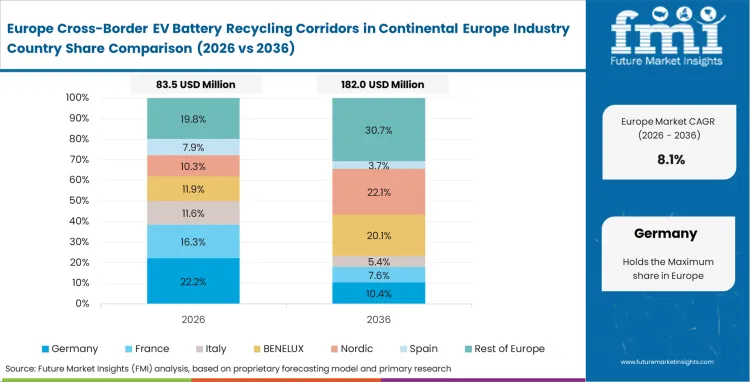
Deep industrial linkages and OEM concentration anchor central European recycling architecture. FMI observes that the Germany EV battery recycling corridor functions as both a primary collection source and a major destination for intermediate pre-treatment materials. Firms navigate high-density traffic networks to synchronize inbound end-of-life packs with outbound black mass shipments. Managing this dual-directional flow demands sophisticated orchestration capabilities that purely domestic operators cannot match.
- Germany: High concentrations of dismantling facilities require continuous intake streams to justify capital investments. Firms source material from adjacent nations to maintain baseload requirements. Germany is expected to grow at 19.1% CAGR during this assessment period. Specialized transport providers controlling these central European routes effectively dictate terms across wider continental supply chains.
FMI's report includes detailed analysis covering France, Belgium, Sweden, and Italy. Maturing infrastructure in these nations focuses heavily on optimizing specific material streams like ev battery recycled plastic casings alongside traditional metal recovery paths.
Competitive Aligners for Market Players
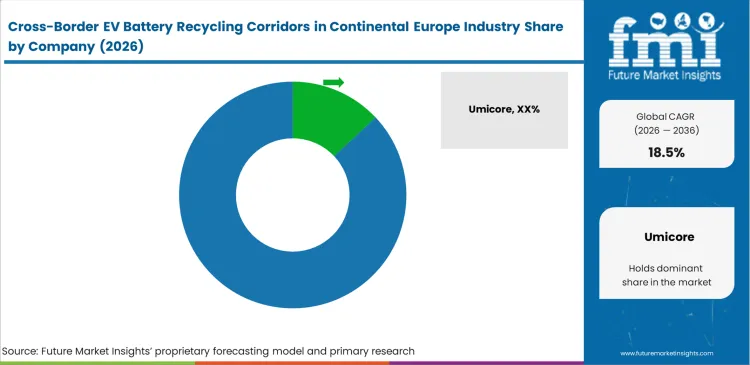
Border compliance can be harder to manage than physical dismantling capacity itself. Larger operators often hold an advantage because hazardous material movement across jurisdictions depends on regulatory depth that smaller transport providers may not have. Competition in the European EV battery recycling space is increasingly tied to who can secure dependable material volumes from automotive OEM streams. This requirement is pushing leading recyclers to offer pan-European collection capability rather than isolated local coverage. Vendor consolidation is also becoming more common as buyers look for cross-border transport partners that can reduce chain-of-custody risk. Return-volume forecasting gains strength when handlers can connect fleet data with expected recovery inflows.
Established operators also benefit from existing hazardous waste transfer permits and stronger familiarity with national approval systems. Integrated networks linking collection, pre-treatment, and refining can improve control over timing, documentation, and downstream feed movement. Poor data transparency can still delay border clearance and weaken shipment economics. Complex battery assemblies often require specialized dismantling before material can move legally as processed scrap across jurisdictions. This keeps operational readiness tied not only to transport access, but also to pre-movement treatment capability.
Large automotive manufacturers are trying to avoid vendor lock-in by keeping relationships with multiple regional corridor specialists. At the same time, fragmented waste-shipment administration is increasing buyer preference for single-source integrators. Evolving tracing requirements and digital passport structures are likely to push smaller transport operators toward closer alignment with larger recycling hubs. This points to a more consolidated logistics network built around tighter continental traceability. Transport protocols will also need to adjust as battery structures and cathode formats continue to change.
Key Players in Cross-Border EV Battery Recycling Corridors in Continental Europe Industry
- Umicore
- Fortum Battery Recycling
- Hydrovolt
- Stena Recycling
- Veolia
- Ecobat
- cylib
Scope of the Report
| Metric | Value |
|---|---|
| Quantitative Units | USD 320.0 million to USD 1,750.0 million, at a CAGR of 18.50% |
| Market Definition | Cross-border recycling corridors constitute logistical and regulatory infrastructure required to move end-of-life packs, scrap, and intermediate materials between distinct European nations for specialized processing. |
| Segmentation | By Processing Stage, By Source Stream, By Chemistry, By Service Model, By Corridor Geography, and Region |
| Regions Covered | North America, Latin America, Europe, Asia Pacific, Middle East and Africa |
| Countries Covered | Poland, Spain, Germany, France, Belgium, Sweden, Italy |
| Key Companies Profiled | Umicore, Fortum Battery Recycling, Hydrovolt, Stena Recycling, Veolia, Ecobat, cylib |
| Forecast Period | 2026 to 2036 |
| Approach | Tracked cross-border hazardous waste notification volumes mapped against regional battery dismantling capacity limits. |
Source: Future Market Insights (FMI) analysis, based on proprietary forecasting model and primary research
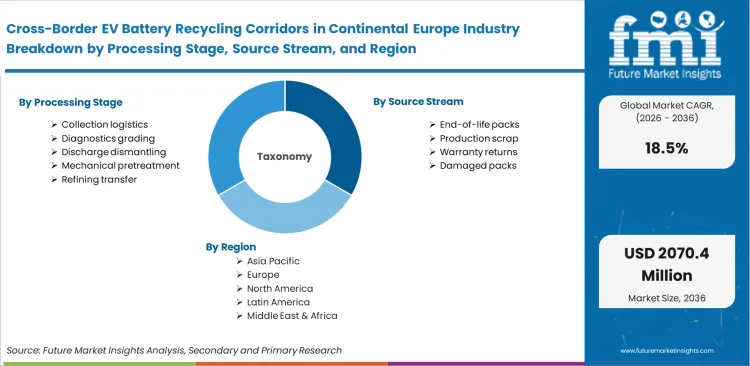
Cross-Border EV Battery Recycling Corridors in Continental Europe Industry Analysis by Segments
Processing Stage
- Collection logistics
- Diagnostics grading
- Discharge dismantling
- Mechanical pretreatment
- Refining transfer
Source Stream
- End-of-life packs
- Production scrap
- Warranty returns
- Damaged packs
Chemistry
- NMC batteries
- LFP batteries
- LMO batteries
- Mixed chemistries
Service Model
- Integrated contracts
- Spot shipments
- Reverse logistics
- Passport services
Corridor Geography
- DACH-Benelux
- France-Iberia
- Nordics-DACH
- CEE-DACH
- Italy-Central
Region
- CEE-DACH
- Poland
- France-Iberia
- France
- Spain
- DACH-Benelux
- Germany
- Belgium
- Nordics-DACH
- Sweden
- Italy-Central
- Italy
Bibliography
- European Parliament and Council of the European Union. (2024). Regulation (EU) 2024/1157 of the European Parliament and of the Council of 11 April 2024 on shipments of waste, amending Regulations (EU) No 1257/2013 and (EU) 2020/1056 and repealing Regulation (EC) No 1013/2006. EUR-Lex.
- Joint Research Centre. (2024). How old batteries can help power a more sustainable EU. European Commission.
- International Energy Agency. (2024). EU sustainable batteries regulation – Policies. IEA.
- Fraunhofer Institute for Systems and Innovation Research ISI. (2025). Recycling capacities for lithium-ion batteries will exceed demand in Europe for the time being. Fraunhofer ISI.
- Racu, A., & Poliscanova, J. (2024). From waste to value: Europe’s opportunity for self-sufficiency and a low-impact supply chain. Transport & Environment.
- Rizos, V., & Urban, P. (2024). Barriers and policy challenges in developing circularity approaches in the EU battery sector: An assessment. Resources, Conservation & Recycling, 209, 107800.
- Dong, Z., Hao, H., Sun, X., Liu, B., Dou, H., Zhao, F., & Liu, Z. (2026). The EU's recycled content targets for batteries cannot effectively drive domestic recycling without sufficient cathode production capacity. Sustainable Production and Consumption, 63, 75–85.
This bibliography is provided for reader reference. The full FMI report contains the complete reference list with primary source documentation.
This Report Addresses
- Regulatory fragmentation forcing compliance teams to seek integrated handlers capable of navigating multi-jurisdiction hazardous waste shipments.
- Hydrometallurgical capacity requiring reverse logistics teams to build continental collection networks to guarantee material supply.
- Gigafactory scrap volumes pushing waste operations directors to secure immediate cross-border evacuation routes to prevent saturation.
- Collection logistics capturing 31.0% share as route coordination commands premium margins before mechanical recovery begins.
- End-of-life packs representing 42.0% share reflecting historical electric vehicle deployment weighting across European nations.
- NMC batteries securing 49.0% share given historical chemistry dominance dictating immediate processing requirements.
- Integrated contracts holding 38.0% share driven by OEM preference for single-source accountability spanning all recovery stages.
- DACH-Benelux corridor obtaining 27.0% share anchoring dense industrial linkages between collection hubs and refining centers.
Frequently Asked Questions
What are cross-border EV battery recycling corridors in continental Europe?
Cross-border EV battery recycling corridors are the physical infrastructure, regulatory frameworks, and logistical networks that enable the compliant movement of end-of-life battery packs, production scrap, and processed black mass between distinct European nations for specialized dismantling and metallurgical refining.
How do EV battery recycling corridors work in Europe?
Corridors function by synchronizing local collection networks with centralized pre-treatment hubs and distant hydrometallurgical refiners. Handlers manage the complex hazardous waste shipment notifications across multiple national borders, ensuring that material flows continuously to prevent localized capacity bottlenecks.
Why do these corridors matter more after 2026?
The implementation of the EU battery recycling regulation 2026 standardizes strict material recovery targets and digital tracing mandates. Without established cross-border corridors, recyclers cannot aggregate enough compliant feedstock to justify the capital expenditures needed to meet these new efficiency thresholds.
Which countries lead this industry in Europe?
Germany serves as the primary orchestration hub due to dense OEM concentration and dismantling infrastructure. Poland and Spain represent the fastest-growing corridors, acting as crucial export nodes for rapidly expanding cell production scrap and early dealership returns, respectively.
How does the EU battery passport affect recyclers and transport partners?
The passport requires unbroken digital chain-of-custody documentation linking initial collection data to final material recovery outcomes. This forces transport partners to integrate their tracking software directly with recycling hubs, eliminating spot-market operators who cannot verify compliance.
What services are included in a cross-border EV battery recycling corridor?
Services span integrated reverse logistics, diagnostic grading of retiring packs, hazardous storage coordination, route planning, waste-transfer notification management, and intermediate material transfers for refining, forming a complete EV battery passport recycling corridor.
Which companies are active in this market?
Key operators controlling cross-border compliance and material flows include Umicore, Fortum Battery Recycling, Hydrovolt, Stena Recycling, Veolia, Ecobat, and emerging technology providers like cylib.
How large is the market in 2025, 2026, and 2036?
The sector records USD 270.0 million in 2025, scales to USD 320.0 million in 2026, and is projected to reach USD 1,750.0 million by 2036 as the volume of retiring electric vehicle fleets demands robust cross-border orchestration.
What are the main bottlenecks in moving EV batteries across borders?
Divergent national interpretations regarding hazardous waste classifications create the primary bottleneck. Administrative misalignments stall shipments at borders, increasing holding costs and disrupting the baseload feed schedules required by centralized metallurgical plants.
How do production scrap flows differ from end-of-life battery flows?
Production scrap offers pure, predictable chemistry from gigafactories but requires immediate evacuation to prevent manufacturing halts. End-of-life packs involve heavy, unstable units that require specialized diagnostic screening and extensive hazardous storage compliance before transit.
What is the difference between collection logistics and black mass processing?
Collection logistics involves the physical packaging, route orchestration, and regulatory compliance required to move raw or damaged packs across borders. Black mass processing is the subsequent metallurgical extraction of high-value metals like nickel and cobalt once the material reaches a centralized refining hub.
Preview the report firsthand - request a free sample
Get SampleGet the brochure for pricing and purchase details.
Get PDFTable of Content
- Executive Summary
- Global Market Outlook
- Demand-side Trends
- Supply-side Trends
- Technology Roadmap Analysis
- Analysis and Recommendations
- Market Overview
- Market Coverage / Taxonomy
- Market Definition / Scope / Limitations
- Research Methodology
- Chapter Orientation
- Analytical Lens and Working Hypotheses
- Market Structure, Signals, and Trend Drivers
- Benchmarking and Cross-market Comparability
- Market Sizing, Forecasting, and Opportunity Mapping
- Research Design and Evidence Framework
- Desk Research Programme (Secondary Evidence)
- Company Annual and Sustainability Reports
- Peer-reviewed Journals and Academic Literature
- Corporate Websites, Product Literature, and Technical Notes
- Earnings Decks and Investor Briefings
- Statutory Filings and Regulatory Disclosures
- Technical White Papers and Standards Notes
- Trade Journals, Industry Magazines, and Analyst Briefs
- Conference Proceedings, Webinars, and Seminar Materials
- Government Statistics Portals and Public Data Releases
- Press Releases and Reputable Media Coverage
- Specialist Newsletters and Curated Briefings
- Sector Databases and Reference Repositories
- FMI Internal Proprietary Databases and Historical Market Datasets
- Subscription Datasets and Paid Sources
- Social Channels, Communities, and Digital Listening Inputs
- Additional Desk Sources
- Expert Input and Fieldwork (Primary Evidence)
- Primary Modes
- Qualitative Interviews and Expert Elicitation
- Quantitative Surveys and Structured Data Capture
- Blended Approach
- Why Primary Evidence is Used
- Field Techniques
- Interviews
- Surveys
- Focus Groups
- Observational and In-context Research
- Social and Community Interactions
- Stakeholder Universe Engaged
- C-suite Leaders
- Board Members
- Presidents and Vice Presidents
- R&D and Innovation Heads
- Technical Specialists
- Domain Subject-matter Experts
- Scientists
- Physicians and Other Healthcare Professionals
- Governance, Ethics, and Data Stewardship
- Research Ethics
- Data Integrity and Handling
- Primary Modes
- Tooling, Models, and Reference Databases
- Desk Research Programme (Secondary Evidence)
- Data Engineering and Model Build
- Data Acquisition and Ingestion
- Cleaning, Normalisation, and Verification
- Synthesis, Triangulation, and Analysis
- Quality Assurance and Audit Trail
- Market Background
- Market Dynamics
- Drivers
- Restraints
- Opportunity
- Trends
- Scenario Forecast
- Demand in Optimistic Scenario
- Demand in Likely Scenario
- Demand in Conservative Scenario
- Opportunity Map Analysis
- Product Life Cycle Analysis
- Supply Chain Analysis
- Investment Feasibility Matrix
- Value Chain Analysis
- PESTLE and Porter’s Analysis
- Regulatory Landscape
- Regional Parent Market Outlook
- Production and Consumption Statistics
- Import and Export Statistics
- Market Dynamics
- Global Market Analysis 2021 to 2025 and Forecast, 2026 to 2036
- Historical Market Size Value (USD Million) Analysis, 2021 to 2025
- Current and Future Market Size Value (USD Million) Projections, 2026 to 2036
- Y-o-Y Growth Trend Analysis
- Absolute $ Opportunity Analysis
- Global Market Pricing Analysis 2021 to 2025 and Forecast 2026 to 2036
- Global Market Analysis 2021 to 2025 and Forecast 2026 to 2036, By Processing Stage
- Introduction / Key Findings
- Historical Market Size Value (USD Million) Analysis By Processing Stage , 2021 to 2025
- Current and Future Market Size Value (USD Million) Analysis and Forecast By Processing Stage , 2026 to 2036
- Collection logistics
- Diagnostics grading
- Discharge dismantling
- Mechanical pretreatment
- Refining transfer
- Collection logistics
- Y-o-Y Growth Trend Analysis By Processing Stage , 2021 to 2025
- Absolute $ Opportunity Analysis By Processing Stage , 2026 to 2036
- Global Market Analysis 2021 to 2025 and Forecast 2026 to 2036, By Source Stream
- Introduction / Key Findings
- Historical Market Size Value (USD Million) Analysis By Source Stream, 2021 to 2025
- Current and Future Market Size Value (USD Million) Analysis and Forecast By Source Stream, 2026 to 2036
- End-of-life packs
- Production scrap
- Warranty returns
- Damaged packs
- End-of-life packs
- Y-o-Y Growth Trend Analysis By Source Stream, 2021 to 2025
- Absolute $ Opportunity Analysis By Source Stream, 2026 to 2036
- Global Market Analysis 2021 to 2025 and Forecast 2026 to 2036, By Chemistry
- Introduction / Key Findings
- Historical Market Size Value (USD Million) Analysis By Chemistry, 2021 to 2025
- Current and Future Market Size Value (USD Million) Analysis and Forecast By Chemistry, 2026 to 2036
- NMC batteries
- LFP batteries
- LMO batteries
- Mixed chemistries
- NMC batteries
- Y-o-Y Growth Trend Analysis By Chemistry, 2021 to 2025
- Absolute $ Opportunity Analysis By Chemistry, 2026 to 2036
- Global Market Analysis 2021 to 2025 and Forecast 2026 to 2036, By Service Model
- Introduction / Key Findings
- Historical Market Size Value (USD Million) Analysis By Service Model, 2021 to 2025
- Current and Future Market Size Value (USD Million) Analysis and Forecast By Service Model, 2026 to 2036
- Integrated contracts
- Spot shipments
- Reverse logistics
- Passport services
- Integrated contracts
- Y-o-Y Growth Trend Analysis By Service Model, 2021 to 2025
- Absolute $ Opportunity Analysis By Service Model, 2026 to 2036
- Global Market Analysis 2021 to 2025 and Forecast 2026 to 2036, By Corridor Geography
- Introduction / Key Findings
- Historical Market Size Value (USD Million) Analysis By Corridor Geography, 2021 to 2025
- Current and Future Market Size Value (USD Million) Analysis and Forecast By Corridor Geography, 2026 to 2036
- DACH-Benelux
- France-Iberia
- Nordics-DACH
- CEE-DACH
- Italy-Central
- DACH-Benelux
- Y-o-Y Growth Trend Analysis By Corridor Geography, 2021 to 2025
- Absolute $ Opportunity Analysis By Corridor Geography, 2026 to 2036
- Global Market Analysis 2021 to 2025 and Forecast 2026 to 2036, By Region
- Introduction
- Historical Market Size Value (USD Million) Analysis By Region, 2021 to 2025
- Current Market Size Value (USD Million) Analysis and Forecast By Region, 2026 to 2036
- North America
- Latin America
- Western Europe
- Eastern Europe
- East Asia
- South Asia and Pacific
- Middle East & Africa
- Market Attractiveness Analysis By Region
- North America Market Analysis 2021 to 2025 and Forecast 2026 to 2036, By Country
- Historical Market Size Value (USD Million) Trend Analysis By Market Taxonomy, 2021 to 2025
- Market Size Value (USD Million) Forecast By Market Taxonomy, 2026 to 2036
- By Country
- USA
- Canada
- Mexico
- By Processing Stage
- By Source Stream
- By Chemistry
- By Service Model
- By Corridor Geography
- By Country
- Market Attractiveness Analysis
- By Country
- By Processing Stage
- By Source Stream
- By Chemistry
- By Service Model
- By Corridor Geography
- Key Takeaways
- Latin America Market Analysis 2021 to 2025 and Forecast 2026 to 2036, By Country
- Historical Market Size Value (USD Million) Trend Analysis By Market Taxonomy, 2021 to 2025
- Market Size Value (USD Million) Forecast By Market Taxonomy, 2026 to 2036
- By Country
- Brazil
- Chile
- Rest of Latin America
- By Processing Stage
- By Source Stream
- By Chemistry
- By Service Model
- By Corridor Geography
- By Country
- Market Attractiveness Analysis
- By Country
- By Processing Stage
- By Source Stream
- By Chemistry
- By Service Model
- By Corridor Geography
- Key Takeaways
- Western Europe Market Analysis 2021 to 2025 and Forecast 2026 to 2036, By Country
- Historical Market Size Value (USD Million) Trend Analysis By Market Taxonomy, 2021 to 2025
- Market Size Value (USD Million) Forecast By Market Taxonomy, 2026 to 2036
- By Country
- Germany
- UK
- Italy
- Spain
- France
- Nordic
- BENELUX
- Rest of Western Europe
- By Processing Stage
- By Source Stream
- By Chemistry
- By Service Model
- By Corridor Geography
- By Country
- Market Attractiveness Analysis
- By Country
- By Processing Stage
- By Source Stream
- By Chemistry
- By Service Model
- By Corridor Geography
- Key Takeaways
- Eastern Europe Market Analysis 2021 to 2025 and Forecast 2026 to 2036, By Country
- Historical Market Size Value (USD Million) Trend Analysis By Market Taxonomy, 2021 to 2025
- Market Size Value (USD Million) Forecast By Market Taxonomy, 2026 to 2036
- By Country
- Russia
- Poland
- Hungary
- Balkan & Baltic
- Rest of Eastern Europe
- By Processing Stage
- By Source Stream
- By Chemistry
- By Service Model
- By Corridor Geography
- By Country
- Market Attractiveness Analysis
- By Country
- By Processing Stage
- By Source Stream
- By Chemistry
- By Service Model
- By Corridor Geography
- Key Takeaways
- East Asia Market Analysis 2021 to 2025 and Forecast 2026 to 2036, By Country
- Historical Market Size Value (USD Million) Trend Analysis By Market Taxonomy, 2021 to 2025
- Market Size Value (USD Million) Forecast By Market Taxonomy, 2026 to 2036
- By Country
- China
- Japan
- South Korea
- By Processing Stage
- By Source Stream
- By Chemistry
- By Service Model
- By Corridor Geography
- By Country
- Market Attractiveness Analysis
- By Country
- By Processing Stage
- By Source Stream
- By Chemistry
- By Service Model
- By Corridor Geography
- Key Takeaways
- South Asia and Pacific Market Analysis 2021 to 2025 and Forecast 2026 to 2036, By Country
- Historical Market Size Value (USD Million) Trend Analysis By Market Taxonomy, 2021 to 2025
- Market Size Value (USD Million) Forecast By Market Taxonomy, 2026 to 2036
- By Country
- India
- ASEAN
- Australia & New Zealand
- Rest of South Asia and Pacific
- By Processing Stage
- By Source Stream
- By Chemistry
- By Service Model
- By Corridor Geography
- By Country
- Market Attractiveness Analysis
- By Country
- By Processing Stage
- By Source Stream
- By Chemistry
- By Service Model
- By Corridor Geography
- Key Takeaways
- Middle East & Africa Market Analysis 2021 to 2025 and Forecast 2026 to 2036, By Country
- Historical Market Size Value (USD Million) Trend Analysis By Market Taxonomy, 2021 to 2025
- Market Size Value (USD Million) Forecast By Market Taxonomy, 2026 to 2036
- By Country
- Kingdom of Saudi Arabia
- Other GCC Countries
- Turkiye
- South Africa
- Other African Union
- Rest of Middle East & Africa
- By Processing Stage
- By Source Stream
- By Chemistry
- By Service Model
- By Corridor Geography
- By Country
- Market Attractiveness Analysis
- By Country
- By Processing Stage
- By Source Stream
- By Chemistry
- By Service Model
- By Corridor Geography
- Key Takeaways
- Key Countries Market Analysis
- USA
- Pricing Analysis
- Market Share Analysis, 2025
- By Processing Stage
- By Source Stream
- By Chemistry
- By Service Model
- By Corridor Geography
- Canada
- Pricing Analysis
- Market Share Analysis, 2025
- By Processing Stage
- By Source Stream
- By Chemistry
- By Service Model
- By Corridor Geography
- Mexico
- Pricing Analysis
- Market Share Analysis, 2025
- By Processing Stage
- By Source Stream
- By Chemistry
- By Service Model
- By Corridor Geography
- Brazil
- Pricing Analysis
- Market Share Analysis, 2025
- By Processing Stage
- By Source Stream
- By Chemistry
- By Service Model
- By Corridor Geography
- Chile
- Pricing Analysis
- Market Share Analysis, 2025
- By Processing Stage
- By Source Stream
- By Chemistry
- By Service Model
- By Corridor Geography
- Germany
- Pricing Analysis
- Market Share Analysis, 2025
- By Processing Stage
- By Source Stream
- By Chemistry
- By Service Model
- By Corridor Geography
- UK
- Pricing Analysis
- Market Share Analysis, 2025
- By Processing Stage
- By Source Stream
- By Chemistry
- By Service Model
- By Corridor Geography
- Italy
- Pricing Analysis
- Market Share Analysis, 2025
- By Processing Stage
- By Source Stream
- By Chemistry
- By Service Model
- By Corridor Geography
- Spain
- Pricing Analysis
- Market Share Analysis, 2025
- By Processing Stage
- By Source Stream
- By Chemistry
- By Service Model
- By Corridor Geography
- France
- Pricing Analysis
- Market Share Analysis, 2025
- By Processing Stage
- By Source Stream
- By Chemistry
- By Service Model
- By Corridor Geography
- India
- Pricing Analysis
- Market Share Analysis, 2025
- By Processing Stage
- By Source Stream
- By Chemistry
- By Service Model
- By Corridor Geography
- ASEAN
- Pricing Analysis
- Market Share Analysis, 2025
- By Processing Stage
- By Source Stream
- By Chemistry
- By Service Model
- By Corridor Geography
- Australia & New Zealand
- Pricing Analysis
- Market Share Analysis, 2025
- By Processing Stage
- By Source Stream
- By Chemistry
- By Service Model
- By Corridor Geography
- China
- Pricing Analysis
- Market Share Analysis, 2025
- By Processing Stage
- By Source Stream
- By Chemistry
- By Service Model
- By Corridor Geography
- Japan
- Pricing Analysis
- Market Share Analysis, 2025
- By Processing Stage
- By Source Stream
- By Chemistry
- By Service Model
- By Corridor Geography
- South Korea
- Pricing Analysis
- Market Share Analysis, 2025
- By Processing Stage
- By Source Stream
- By Chemistry
- By Service Model
- By Corridor Geography
- Russia
- Pricing Analysis
- Market Share Analysis, 2025
- By Processing Stage
- By Source Stream
- By Chemistry
- By Service Model
- By Corridor Geography
- Poland
- Pricing Analysis
- Market Share Analysis, 2025
- By Processing Stage
- By Source Stream
- By Chemistry
- By Service Model
- By Corridor Geography
- Hungary
- Pricing Analysis
- Market Share Analysis, 2025
- By Processing Stage
- By Source Stream
- By Chemistry
- By Service Model
- By Corridor Geography
- Kingdom of Saudi Arabia
- Pricing Analysis
- Market Share Analysis, 2025
- By Processing Stage
- By Source Stream
- By Chemistry
- By Service Model
- By Corridor Geography
- Turkiye
- Pricing Analysis
- Market Share Analysis, 2025
- By Processing Stage
- By Source Stream
- By Chemistry
- By Service Model
- By Corridor Geography
- South Africa
- Pricing Analysis
- Market Share Analysis, 2025
- By Processing Stage
- By Source Stream
- By Chemistry
- By Service Model
- By Corridor Geography
- USA
- Market Structure Analysis
- Competition Dashboard
- Competition Benchmarking
- Market Share Analysis of Top Players
- By Region
- By Processing Stage
- By Source Stream
- By Chemistry
- By Service Model
- By Corridor Geography
- Competition Analysis
- Competition Deep Dive
- Umicore
- Overview
- Product Portfolio
- Profitability by Market Segments (Product/Age /Sales Channel/Region)
- Sales Footprint
- Strategy Overview
- Marketing Strategy
- Product Strategy
- Channel Strategy
- Fortum Battery Recycling
- Hydrovolt
- Stena Recycling
- Veolia
- Ecobat
- cylib
- Umicore
- Competition Deep Dive
- Assumptions & Acronyms Used


