

- Industry Size (2026)
- USD 350.0 Mn
- Forecast (2036)
- USD 2380.0 Mn
- CAGR (2026 to 2036)
- 21.1%
Industry Analysis of Lithium, Nickel and Cobalt Recovery from EV Batteries under Batteries Regulation in Europe Size, Market Forecast and Outlook By FMI
Industry Analysis of Lithium, Nickel and Cobalt Recovery from EV Batteries under Batteries Regulation in Europe suggested the valuation was at USD 290.0 million in 2025. Sector is projected to reach USD 350.0 million in 2026 and USD 2,380.0 million by 2036, reflecting a 21.1% CAGR from 2026 to 2036. Market expansion is being driven by recycling mandates that require tighter material collection, recovery, and compliance across the battery manufacturing chain.
Summary of Lithium, Nickel and Cobalt Recovery from EV Batteries under Batteries Regulation Market in Europe
- The market is estimated at USD 290.0 million in 2025.
- The market is projected to reach USD 2,380.0 million by 2036.
- The market is expected to grow at a CAGR of 21.1% from 2026 to 2036.
- The forecast period represents an incremental opportunity of USD 2,030.0 million.
- Hydrometallurgy leads the recovery route segment with a 61.0% share.
- Production scrap dominates the feedstock source segment with a 52.0% share.
- NMC leads the battery chemistry segment with a 58.0% share.
- Nickel compounds dominate the recovered material segment with a 41.0% share.
- Cathode precursors lead the end use segment with a 56.0% share.
- Germany (22.6%), Belgium (21.8%), and France (20.7%) are among the fastest-growing markets.
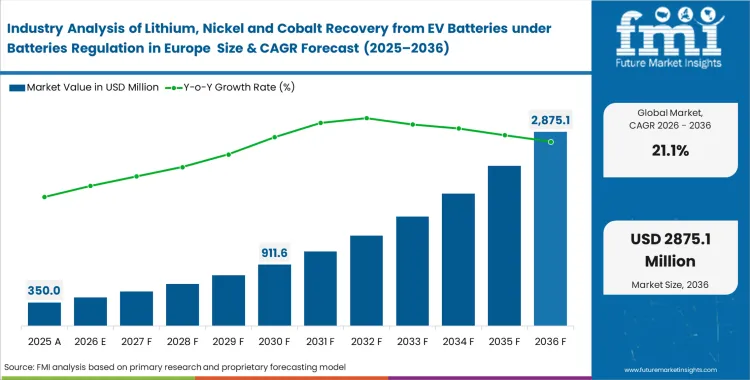
Industry Analysis of Lithium, Nickel and Cobalt Recovery from EV Batteries under Batteries Regulation in Europe Key Takeaways
| Metric | Details |
|---|---|
| Industry Size (2026) | USD 350.0 million |
| Industry Value (2036) | USD 2,380.0 million |
| CAGR (2026-2036) | 21.1% |
Source: Future Market Insights (FMI) analysis, based on proprietary forecasting model and primary research
Cell producers are under immediate pressure to incorporate recycled content into new battery packs as European compliance thresholds move closer. Access to secondary lithium, nickel, and cobalt is becoming a prerequisite for continued participation in the regional EV battery chain. Long-term agreements with recovery and refining partners are therefore moving higher on the operating agenda, since dependence on spot availability leaves supply chains exposed when recycled material requirements tighten. Elevated metal prices can temporarily soften that pressure, but they do not remove the underlying issue of weak economics in fragmented EV battery recycling feeds.
Closed-loop tracking is becoming more important because it links end-of-life battery streams with new cathode production in a form that can be verified for compliance. Origin traceability gives automakers clearer evidence that recovered material qualifies under regulatory rules, which helps move recycling from isolated pilot activity into repeatable industrial networks. Once chain-of-custody systems are established, integration of secondary metals into new battery output becomes easier to scale across the production cycle.
Germany is expected to remain the leading market, with the industry projected to expand at a 22.6% CAGR through 2036, supported by localized plant expansion and stronger domestic closed-loop returns. Belgium follows at 21.8% CAGR, backed by an established metallurgical base that is increasingly aligned with battery-grade refining. France is anticipated to record 20.7% CAGR as national industrial policy continues to support more sovereign battery material chains. Hungary is set to see the market rise at 20.4% CAGR, helped by the scale-up of cell manufacturing capacity. Sweden is likely to post 20.1% CAGR through 2036, where renewable power improves the case for energy-intensive hydrometallurgical processing. Poland is projected to advance at 19.9% CAGR as existing recycling capability adapts to automotive battery flows, while Finland is forecast to expand at 19.3% CAGR through integration of secondary black mass into established refining routes.
Segmental Analysis
Industry Analysis of Lithium, Nickel and Cobalt Recovery from EV Batteries under Batteries Regulation in Europe Analysis by Feedstock Source
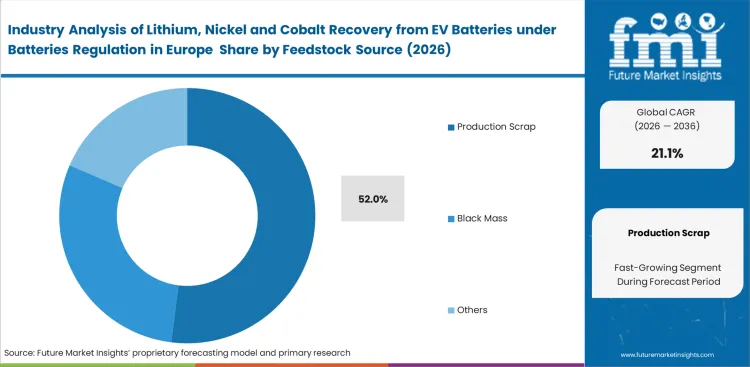
Production scrap remains the preferred feedstock because its uncycled chemical condition supports higher refining yields and more stable process control. Segment leadership also reflects the slower arrival profile of field-returned EV packs, which still face collection, testing, and dismantling constraints before entering recovery lines. Facilities focused on battery materials can source this scrap directly from gigafactories, avoiding much of the diagnostic work required for mixed end-of-life modules.
Chemical consistency in manufacturing rejects allows leaching circuits to run with fewer adjustments and better output predictability. Production scrap is estimated to account for 52.0% share in 2026, supported by immediate gigafactory scrap availability across Europe. Early capture of high-purity offcuts also helps operators build cash flow before larger vehicle-retirement volumes begin to enter the industry.
- Defect capture advantage: Placing shredding capacity close to cell manufacturing lines helps preserve material quality before outside contamination occurs. Higher chemical consistency reduces pre-sorting needs and supports better operating margins.
- Yield predictability metric: Known-chemistry scrap gives refiners a clearer view of expected metal recovery and allows process settings to remain more stable. Reliable input quality also helps maintain consistent output for precursor customers.
- Logistics bypass reality: Keeping defective cells close to the point of origin reduces transport complexity and lowers handling cost for unstable material. Onsite or near-site recovery also simplifies the early logistics chain for high-volume scrap streams.
Industry Analysis of Lithium, Nickel and Cobalt Recovery from EV Batteries under Batteries Regulation in Europe Analysis by Recovery Route
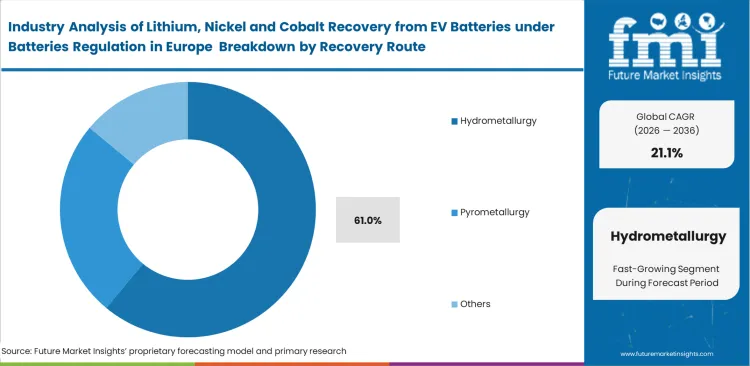
Hydrometallurgy is anticipated to capture a 61.0% share in 2026, reflecting its stronger fit with lithium recovery requirements under the EU regulatory framework. Hydrometallurgical processing remains the preferred route because thermal smelting makes lithium much harder to recover once it enters slag. Preference for this route is also being reinforced where operators need higher lithium yield rather than only stronger transition-metal concentration. Acid leaching and downstream separation still carry a heavier operating burden, since wastewater treatment, reagent control, and environmental approvals add time and cost to each project. Capacity expansion is less straightforward than in furnace-based systems because scaling hydrometallurgy requires tighter chemical engineering control across multiple purification stages, not just larger equipment.
- Lithium destruction prevention: Thermal treatment can trap lithium in slag, which reduces the scope for efficient downstream recovery. Chemical leaching remains more suitable where operators need to isolate lithium salts and align output with stricter recovery thresholds.
- Mixed chemistry sensitivity: Unstable black mass composition can upset finely balanced acid-leaching circuits and reduce process control. Poor upstream sorting increases the risk of off-spec batches, lower yields, and weaker operating efficiency.
- Wastewater management mandate: Acid leaching creates liquid waste streams that require specialized treatment and careful discharge control. Local permitting for wastewater handling remains one of the key factors shaping project timing and scale-up potential in electric vehicle battery recycling.
Industry Analysis of Lithium, Nickel and Cobalt Recovery from EV Batteries under Batteries Regulation in Europe Analysis by Battery Chemistry
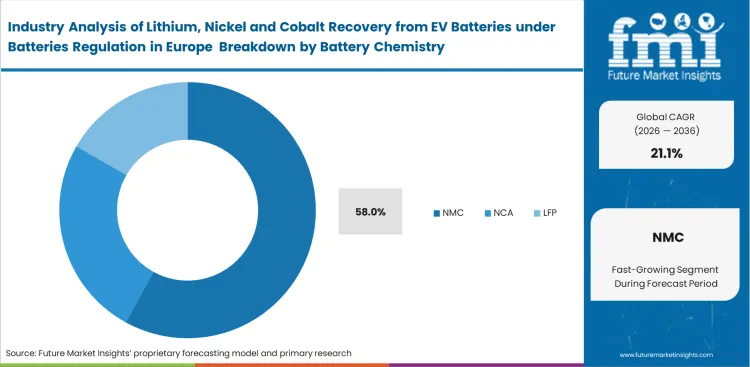
Battery chemistry remains one of the main drivers of recovery economics because value realization still depends heavily on nickel and cobalt content in the incoming feed. European recycling infrastructure was built around legacy high-energy-density chemistries used widely in earlier premium EV platforms, so extraction flowsheets are still optimized around transition-metal recovery. NMC chemistry is projected to account for 58.0% share in 2026, which keeps it at the center of current recovery economics.
Refining systems are often calibrated to recover nickel and cobalt first, while lithium has historically played a smaller role in total margin realization. Rising volumes of LFP lithium ion battery packs are beginning to change that equation because those chemistries contain no nickel or cobalt, which weakens the economics of plants built around high-value transition metals. Operators that delay adjustment toward lower-value chemistry mixes risk weaker asset utilization as feedstock composition shifts over time.
- Nickel value anchoring: Recovered nickel still provides much of the economic base for collection, dismantling, and refining activity. Off-take pricing remains closely tied to nickel benchmarks, which keeps transition-metal value central to plant profitability.
- Cobalt extraction priority: Refining circuits often isolate cobalt early because its scarcity and value justify tighter process control. pH management and solvent extraction discipline remain important where high-purity cobalt output is required.
- Chemistry transition risk: Rising adoption of cobalt-free chemistries is reducing the value concentration that many current plants were designed around. Long-term viability is becoming more dependent on stronger lithium recovery, better process flexibility, and alternative monetisation routes for lower-value feedstock.
Industry Analysis of Lithium, Nickel and Cobalt Recovery from EV Batteries under Batteries Regulation in Europe Analysis by Recovered Material
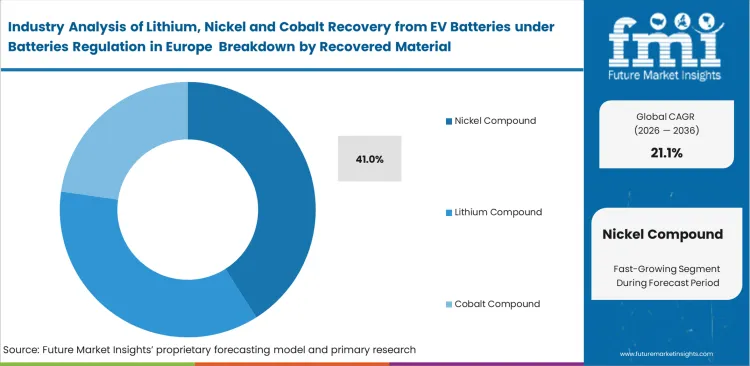
Nickel sulfate remains the main output priority across refining operations because it aligns directly with the requirements of regional precursor plants. Existing European nickel-processing capability gives refiners a practical base for adapting secondary feed into battery-grade output, though the commercial gap between technical-grade and battery-grade material remains wide. Nickel compounds are estimated to account for 41.0% share in 2026, reflecting nickel’s central role in current cathode recovery economics.
Producers often blend recovered nickel cobalt manganese salts with virgin inputs to maintain the atomic ratios required for new cathodes. Extra purification and crystallization stages are what determine margin in this segment, since 99.9% pure nickel sulfate requires tighter impurity removal than many early-stage recyclers can currently support. Processors without full purification capability are more likely to sell intermediate output at discounted prices to larger integrated refiners.
- Crystallization bottleneck reality: Battery-grade purity depends on high-cost fractional crystallization and tight process control. Trace copper and iron removal remains one of the key dividing lines between premium refiners and intermediate material suppliers.
- Precursor integration logic: Direct supply of recovered nickel into regional cathode production reduces reliance on imported material and improves supply-chain control. Local recovery networks are also becoming more relevant as carbon exposure and cross-border compliance costs rise.
- Discount penalty consequence: Selling mixed-metal precipitates without final purification lowers margin realization across the recovery chain. Margin loss becomes more pronounced when intermediate material has to pass into the hands of larger refiners for the final upgrading step.
Industry Analysis of Lithium, Nickel and Cobalt Recovery from EV Batteries under Batteries Regulation in Europe Analysis by End Use
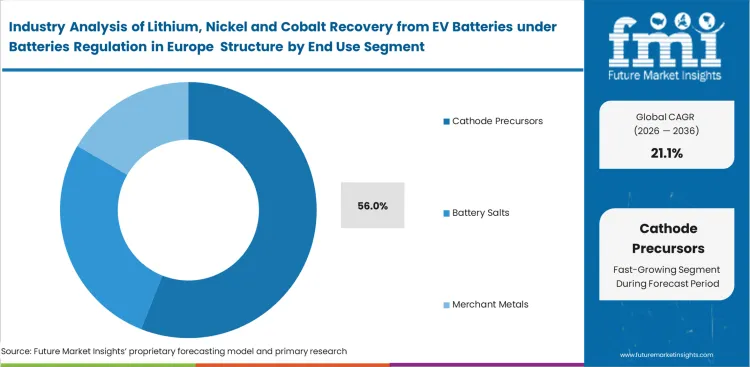
Material circularity in Europe depends on converting recovered metals back into active cell components that can re-enter battery production. Many lithium mining advocates still underestimate this issue, because secondary cathode precursors must often meet purity expectations that are at least as demanding as those applied to primary material. The recycling loop also introduces contaminants such as fluorine from electrolyte-related inputs, which makes purification more complex. Cathode precursors are set to hold a 56.0% share in 2026, reflecting how closely recovery value is tied to battery-grade conversion rather than lower-spec secondary outputs. Recyclers that cannot meet those specifications remain limited in their access to premium automotive programs.
- Qualification barrier reality: Cell manufacturers subject secondary precursors to extensive cycle-life testing before approval. Quality assurance directors reject off-spec batches. Forcing recyclers to reprocess material at a loss destroys early business models.
- Fluorine contamination risk: Electrolyte residues introduce corrosive elements into refining circuits. Process engineers deploy specialized scrubbing units. Preventing fluorine from degrading final cathode performance maintains critical battery-grade qualification.
- Premium pricing capture: Meeting gigafactory purity metrics unlocks highest possible commercial valuation for recovered metals. Sales directors secure long-term contracts. Demonstrating consistent batch-to-batch chemical reliability ensures survival in competitive EU markets.
Industry Analysis of Lithium, Nickel and Cobalt Recovery from EV Batteries under Batteries Regulation in Europe Drivers, Restraints, and Opportunities
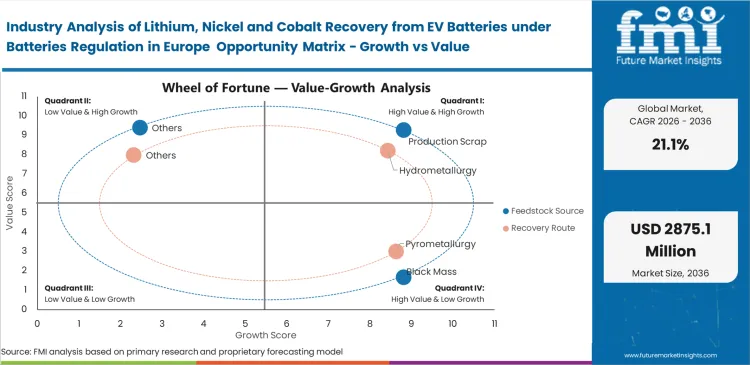
EU recycled-content deadlines are bringing material sourcing decisions forward across the regional EV battery chain. Battery packs that fail to meet minimum recycled-content thresholds risk losing access to the industry, so automakers are securing compliant material earlier and at a higher initial cost. Regulatory pressure is therefore accelerating capital allocation toward green leaching agents, higher-yield recovery systems, and more advanced refining routes. Lithium recovery from EV batteries has moved from a longer-term circularity objective into an immediate operating requirement.
Consistent, high-purity feedstock remains one of the main restraints on efficient refining. Pre-processing streams often combine multiple battery chemistries into black mass with uneven composition, which reduces visibility on lithium, nickel, and cobalt content before chemical treatment begins. Refining performance becomes harder to stabilize when input quality shifts from batch to batch, leaving leaching conditions, reagent use, and recovery efficiency less predictable. Upstream sorting, chemistry segregation, and diagnostic control still need to improve if downstream plants are to run closer to designed output levels.
Opportunities in the Industry Analysis of Lithium, Nickel and Cobalt Recovery from EV Batteries under Batteries Regulation in Europe
- Direct cathode recycling: Preserving the crystalline geometry of active materials reduces the need for full chemical breakdown. Re-lithiation routes are becoming more relevant where recovered material quality is high enough to support direct restoration with lower processing intensity.
- Closed-loop gigafactory partnerships: Co-locating recovery assets near cell manufacturing plants can cut hazardous transport complexity and improve access to consistent cathode scrap. Stable scrap streams also make feedstock planning easier for refining operations.
- Automated pack disassembly: Robotic dismantling can improve throughput, reduce manual handling of high-voltage systems, and preserve component integrity for more targeted recycling routes. Better disassembly control also supports safer and more selective material recovery.
Demand Analysis of Lithium, Nickel, and Cobalt Recovery from EV Batteries under Europe’s Batteries Regulation
Europe has moved from incentive-led battery policy to a compliance-led framework built around recycled-content thresholds, recovery targets, and tighter control over hazardous battery flows. Regional supply chains are being reorganized around more localized metal recovery because long-distance movement adds cost, regulatory friction, and execution risk. Clustering of recycling and refining assets reflects the need to keep collection, black-mass processing, and downstream conversion within workable transport corridors. Environmental permitting still differs across member states, which slows multi-country rollout and keeps reverse logistics for end-of-life battery packs among the main operating constraints across the region.
Based on regional analysis, Lithium, Nickel and Cobalt Recovery from EV Batteries under EU Batteries Regulation is segmented into Europe across 40 plus countries.
.webp "Top Country Growth Comparison Industry Analysis Of Lithium, Nickel And Cobalt Recovery From Ev Batteries Under Batteries Regulation In Europe Cagr (2026 2036)")
| Country | CAGR (2026 to 2036) |
|---|---|
| Germany | 22.6% |
| Belgium | 21.8% |
| France | 20.7% |
| Hungary | 20.4% |
| Sweden | 20.1% |
| Poland | 19.9% |
| Finland | 19.3% |
Source: Future Market Insights (FMI) analysis, based on proprietary forecasting model and primary research
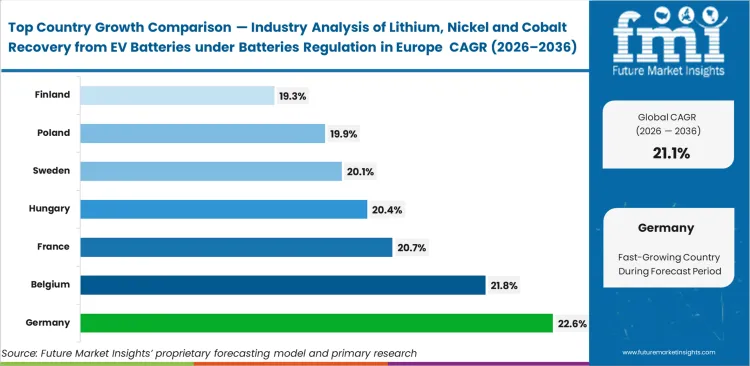
- Germany: Germany combines a large automotive base with rising pressure to close material loops within domestic and nearby European networks. Industry outlook for lithium, nickel, and cobalt recovery from EV batteries in Germany points to a 22.6% CAGR through 2036. Local recycling and refining capacity remains commercially important because OEM supply chains are under pressure to secure compliant material with lower transport exposure. Hydrometallurgical expansion is therefore becoming central to Germany’s role in the regional black-mass and refined-metal chain.
- Belgium: Belgium benefits from an established metallurgical base that can be adapted for battery-grade refining with less operational disruption than newer sites. Existing processing expertise supports handling of chemically complex secondary feedstock and improves the route from black mass to specification-grade output. Demand analysis for lithium, nickel, and cobalt recovery from EV batteries in Belgium indicates a 21.8% CAGR through 2036. This leaves the country well placed in higher-value stages of metal recovery rather than only in intermediate processing.
- France: France is aligning battery recycling capacity with a broader domestic push to keep battery materials closer to cell manufacturing and refining activity. Co-location matters here because shorter transport distances improve economics and reduce handling complexity for regulated battery waste. Sales of lithium, nickel, and cobalt recovery from EV batteries in France are anticipated to rise at a CAGR of 20.7% during the forecast period. This supports the case for integrated recycling loops tied to national battery-industrial expansion.
- Hungary: Industry demand for lithium, nickel, and cobalt recovery from EV batteries in Hungary is likely to advance at a CAGR of 20.4% through 2036. Hungary’s battery manufacturing base is generating a meaningful stream of production scrap, which supports earlier monetization for recycling operators before end-of-life pack volumes become larger. Immediate access to adjacent shredding and pre-processing routes improves feedstock visibility and lowers ramp-up risk for regional facilities. Early processing of manufacturing rejects is expected to remain an important cash-flow support for the sector.
- Sweden: Sweden offers a strong operating case for energy-intensive refining routes because electricity sourcing remains an important factor in battery-material economics. Low-carbon power availability also improves the commercial position of recycled outputs in supply chains that are increasingly sensitive to embedded emissions. Lithium, nickel, and cobalt recovery from EV batteries in Sweden is set to post a 20.1% CAGR through 2036. This keeps the country relevant where processing quality and carbon profile both influence material placement.
- Poland: Demand for lithium, nickel, and cobalt recovery from EV batteries in Poland is projected to rise at a CAGR of 19.9% over the forecast period. Faster adaptation of current assets gives the country a practical route into broader EV battery metal recovery. Poland enters this industry with useful experience in battery-related and electronics-linked recycling activity, which shortens the learning curve for larger EV battery modules. Existing mechanical handling and separation capability can be upgraded faster than building entirely new facilities from the ground up.
- Finland: Finland already has refining capability linked to nickel and cobalt, which improves the case for integrating secondary feedstock into existing industrial routes. Combining virgin and recycled streams can help operators maintain output quality while smoothing raw-material variability. Industry analysis of lithium, nickel, and cobalt recovery from EV batteries in Finland suggests a 19.3% CAGR through 2036. Existing refining depth also strengthens the commercial case for lithium extraction as regional black-mass volumes rise.
FMI’s report includes additional countries beyond those listed above. Regulatory differences in hazardous-waste classification and cross-border movement rules continue to create localized bottlenecks for battery transit across parts of Europe.
Competitive Aligners for Market Players
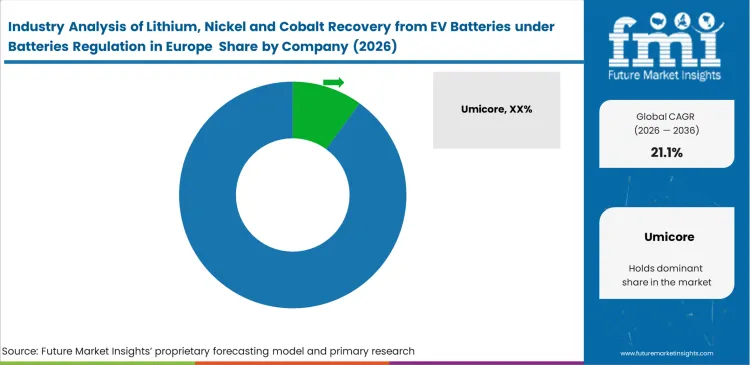
Companies like Umicore, Fortum, and BASF compete from a stronger chemical-processing base than operators focused mainly on mechanical shredding. Regional market control depends less on access to black mass and more on the ability to convert intermediate material into battery-grade outputs with tight purity tolerances. Technical-grade black mass is becoming easier to secure as European collection and pre-processing networks expand. Refining it into lithium compound with 99.9% purity remains far more capital-intensive because crystallization, impurity removal, and wastewater control require a deeper processing setup. Competitive advantage therefore sits with companies that can combine metallurgical discipline, chemical engineering depth, and stable long-term feedstock access.
Established operators also benefit from regulatory positioning that is difficult to replicate quickly. Acid leaching, solvent handling, and wastewater neutralization require permits that often take years to obtain, especially where local environmental scrutiny is high. Existing industrial footprints give Hydrovolt and Stena Recycling a clearer path to capacity expansion because brownfield adaptation usually moves faster than fully new chemical-processing sites. New entrants trying to build fresh refining assets often face slower site execution, longer approval cycles, and greater uncertainty around commissioning timelines. Permitting barriers are therefore reinforcing the position of operators already aligned with compliant lithium recovery and battery-grade processing requirements.
Market competition is also being shaped by how EV battery returns are allocated across the recycling chain. Automakers are avoiding excessive dependence on any single recovery partner, which keeps volumes distributed across multiple regional processors and limits early concentration. cylib and tozero are gaining attention because localized recovery models can align more closely with gigafactory scrap flows and cell-design requirements. Centralized large-scale refining still carries advantages in purification efficiency and output consistency, while decentralized recovery nodes offer shorter logistics loops and faster feedstock capture near production sites. Capital allocation across the market is increasingly balancing those two models rather than moving fully toward only one route.
Key Players in Industry Analysis of Lithium, Nickel and Cobalt Recovery from EV Batteries under Batteries Regulation in Europe
- Umicore
- Fortum
- BASF
- Hydrovolt
- Stena Recycling
- cylib
- tozero
- Company ver
Scope of the Report
| Metric | Value |
|---|---|
| Quantitative Units | USD 350.0 million to USD 2,380.0 million, at a CAGR of 21.1% |
| Market Definition | Industrial extraction and purification of critical metals from spent automotive cells and manufacturing waste, governed by European Union recycled content mandates and recovery yield targets. |
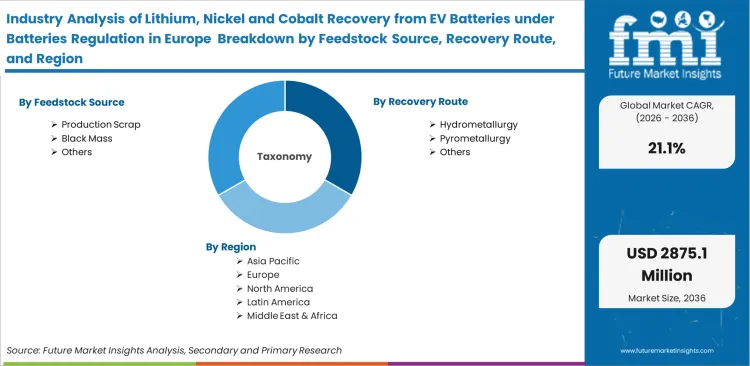
| Segmentation | Feedstock Source, Recovery Route, Battery Chemistry, Recovered Material, End Use, Region |
| Regions Covered | Europe, North America, Latin America, Asia Pacific, Middle East and Africa |
| Countries Covered | Germany, Belgium, France, Hungary, Sweden, Poland, Finland |
| Key Companies Profiled | Umicore, Fortum, BASF, Hydrovolt, Stena Recycling, cylib, tozero, Company ver |
| Forecast Period | 2026 to 2036 |
| Approach | Installed black mass processing capacity multiplied by average utilization rates and realized metal prices. |
Source: Future Market Insights (FMI) analysis, based on proprietary forecasting model and primary research
Industry Analysis of Lithium, Nickel and Cobalt Recovery from EV Batteries under Batteries Regulation in Europe Analysis by Segments
Feedstock Source
- Production scrap
- End-of-life packs
- Black mass
Recovery Route
- Hydrometallurgy
- Pyrometallurgy
- Integrated route
Battery Chemistry
- NMC
- NCA
- LFP
- Mixed scrap
Recovered Material
- Nickel compounds
- Lithium compounds
- Cobalt compounds
End Use
- Cathode precursors
- Battery salts
- Merchant metals
Region
- North America
- Latin America
- Europe
- Asia Pacific
- Middle East and Africa
Bibliography
- European Automobile Manufacturers’ Association. (2026, January 27). New car registrations: +1.8% in 2025; battery-electric 17.4% market share.
- European Parliamentary Research Service. (2025, January 24). Powering the EU’s future: Strengthening the battery industry.
- International Council on Clean Transportation. (2024, December 1). Electrifying road transport with less mining.
- International Energy Agency. (2024, October 22). EU Sustainable Batteries Regulation.
- Transport & Environment. (2024, December). Battery recycling report.
This bibliography is provided for reader reference. The full FMI report contains the complete reference list with primary source documentation.
This Report Addresses
- Regulatory compliance thresholds forcing cell manufacturers into immediate secondary material offtake agreements.
- Hydrometallurgy scale limitations creating specialized chemical bottlenecks downstream of mechanical shredding.
- Crystallization equipment capital requirements dividing technical-grade suppliers from battery-grade precursor producers.
- Chemistry transition risks isolating operators dependent strictly on nickel and cobalt extraction margins.
- Production scrap dominance fueled by complex diagnostic delays associated with field-returned battery packs.
- Fluorine contamination from electrolyte binders demanding specialized scrubbing units during chemical refinement.
- Localized closed-loop nickel sulfate networks bypassing cross-border hazardous waste transport friction.
- Environmental permitting timelines acting as a protective moat for established metallurgical processors.
Frequently Asked Questions
What is the baseline valuation for the sector?
FMI's model indicates a 2025 starting valuation of USD 290.0 million before comprehensive recovery mandates.
How fast is industry demand expanding?
Revenue tracks at a 21.1% CAGR, reflecting mandatory integration thresholds forcing OEMs to secure secondary supplies.
What value does the industry reach by 2036?
The valuation expands to USD 2,380.0 million as capital flows into necessary chemical purification facilities.
Why does hydrometallurgy hold majority share?
Thermal smelting permanently traps lithium in slag matrices. Chemical leaching isolates and precipitates these specific salts.
Why do recyclers prefer production scrap?
Manufacturing rejects offer known chemical homogeneity, allowing continuous leaching without daily recalibration.
What creates pricing premiums for secondary nickel?
Achieving 99.9% purity requires expensive fractional crystallization to remove trace iron and copper contaminants.
How does fluorine impact refining operations?
Electrolyte residues introduce corrosive elements. Scrubbing units must prevent fluorine from degrading final cathode performance.
Why do chemical transitions threaten independent shredders?
Incoming iron-phosphate packs require entirely new revenue models focused strictly on efficient lithium and lithium ion salt capture.
Why does Germany outpace regional neighbors?
Concentrated automotive manufacturing compels low cobalt precursors sourcing managers to establish domestic closed loops.
What advantage do established metallurgical hubs possess?
Legacy alloy processors hold existing environmental permits for acid leaching, bypassing greenfield regulatory delays.
How do automakers leverage multiple recyclers?
Supply chain directors divide pack returns among several regional processors to enforce price competition.
Why is closed-loop gigafactory integration expanding?
Co-locating recovery nodes adjacent to cell production captures uniform lithium cobalt oxide reject material immediately.
What operational risk do mixed chemistries present?
Unpredictable compositions cause cascading precipitation failures. Operators face complete batch spoilage when sorting protocols fail.
How does direct cathode recycling alter operations?
Bypassing chemical breakdown preserves active material geometry. Research directors pursuing battery electrode re-lithiation capture energy savings.
Why do qualification barriers lock out early-stage recyclers?
Cell manufacturers subject secondary precursors to extensive cycle-life testing, rejecting off-spec batches completely.
What drives the push for automated pack disassembly?
Robotic systems dismantle debonding on demand modules safely, isolating components to prevent downstream contamination.
How do capacity announcements distort market reality?
Press releases frequently highlight mechanical shredding capacity without matching chemical refining throughput, creating material surpluses.
Why do OEMs hesitate relying on spot markets?
Volatility exposes cell producers to severe operational interruptions when mandated secondary inputs become scarce.
What role does chain of custody verification play?
Tracking systems matching end-of-life packs to new nickel cobalt aluminum cathode production guarantee regulatory compliance.
How does renewable energy access alter recycling economics?
Abundant green electricity lowers processing carbon footprints, creating premium pricing tiers for recovered metals.
Why do primary refiners integrate secondary black mass?
Legacy mining processors blend virgin and recycled streams to achieve required output purities efficiently.
What dictates balance between centralized and decentralized recovery?
Automakers weigh heavy pack transport costs against superior yield efficiencies of massive chemical refineries.
Preview the report firsthand - request a free sample
Get SampleGet the brochure for pricing and purchase details.
Get PDFTable of Content
- Executive Summary
- Global Market Outlook
- Demand-side Trends
- Supply-side Trends
- Technology Roadmap Analysis
- Analysis and Recommendations
- Market Overview
- Market Coverage / Taxonomy
- Market Definition / Scope / Limitations
- Research Methodology
- Chapter Orientation
- Analytical Lens and Working Hypotheses
- Market Structure, Signals, and Trend Drivers
- Benchmarking and Cross-market Comparability
- Market Sizing, Forecasting, and Opportunity Mapping
- Research Design and Evidence Framework
- Desk Research Programme (Secondary Evidence)
- Company Annual and Sustainability Reports
- Peer-reviewed Journals and Academic Literature
- Corporate Websites, Product Literature, and Technical Notes
- Earnings Decks and Investor Briefings
- Statutory Filings and Regulatory Disclosures
- Technical White Papers and Standards Notes
- Trade Journals, Industry Magazines, and Analyst Briefs
- Conference Proceedings, Webinars, and Seminar Materials
- Government Statistics Portals and Public Data Releases
- Press Releases and Reputable Media Coverage
- Specialist Newsletters and Curated Briefings
- Sector Databases and Reference Repositories
- FMI Internal Proprietary Databases and Historical Market Datasets
- Subscription Datasets and Paid Sources
- Social Channels, Communities, and Digital Listening Inputs
- Additional Desk Sources
- Expert Input and Fieldwork (Primary Evidence)
- Primary Modes
- Qualitative Interviews and Expert Elicitation
- Quantitative Surveys and Structured Data Capture
- Blended Approach
- Why Primary Evidence is Used
- Field Techniques
- Interviews
- Surveys
- Focus Groups
- Observational and In-context Research
- Social and Community Interactions
- Stakeholder Universe Engaged
- C-suite Leaders
- Board Members
- Presidents and Vice Presidents
- R&D and Innovation Heads
- Technical Specialists
- Domain Subject-matter Experts
- Scientists
- Physicians and Other Healthcare Professionals
- Governance, Ethics, and Data Stewardship
- Research Ethics
- Data Integrity and Handling
- Primary Modes
- Tooling, Models, and Reference Databases
- Desk Research Programme (Secondary Evidence)
- Data Engineering and Model Build
- Data Acquisition and Ingestion
- Cleaning, Normalisation, and Verification
- Synthesis, Triangulation, and Analysis
- Quality Assurance and Audit Trail
- Market Background
- Market Dynamics
- Drivers
- Restraints
- Opportunity
- Trends
- Scenario Forecast
- Demand in Optimistic Scenario
- Demand in Likely Scenario
- Demand in Conservative Scenario
- Opportunity Map Analysis
- Product Life Cycle Analysis
- Supply Chain Analysis
- Investment Feasibility Matrix
- Value Chain Analysis
- PESTLE and Porter’s Analysis
- Regulatory Landscape
- Regional Parent Market Outlook
- Production and Consumption Statistics
- Import and Export Statistics
- Market Dynamics
- Global Market Analysis 2021 to 2025 and Forecast, 2026 to 2036
- Historical Market Size Value (USD Million) Analysis, 2021 to 2025
- Current and Future Market Size Value (USD Million) Projections, 2026 to 2036
- Y-o-Y Growth Trend Analysis
- Absolute $ Opportunity Analysis
- Global Market Pricing Analysis 2021 to 2025 and Forecast 2026 to 2036
- Global Market Analysis 2021 to 2025 and Forecast 2026 to 2036, By Feedstock Source
- Introduction / Key Findings
- Historical Market Size Value (USD Million) Analysis By Feedstock Source , 2021 to 2025
- Current and Future Market Size Value (USD Million) Analysis and Forecast By Feedstock Source , 2026 to 2036
- Production Scrap
- Black Mass
- Others
- Production Scrap
- Y-o-Y Growth Trend Analysis By Feedstock Source , 2021 to 2025
- Absolute $ Opportunity Analysis By Feedstock Source , 2026 to 2036
- Global Market Analysis 2021 to 2025 and Forecast 2026 to 2036, By Recovery Route
- Introduction / Key Findings
- Historical Market Size Value (USD Million) Analysis By Recovery Route, 2021 to 2025
- Current and Future Market Size Value (USD Million) Analysis and Forecast By Recovery Route, 2026 to 2036
- Hydrometallurgy
- Pyrometallurgy
- Others
- Hydrometallurgy
- Y-o-Y Growth Trend Analysis By Recovery Route, 2021 to 2025
- Absolute $ Opportunity Analysis By Recovery Route, 2026 to 2036
- Global Market Analysis 2021 to 2025 and Forecast 2026 to 2036, By Battery Chemistry
- Introduction / Key Findings
- Historical Market Size Value (USD Million) Analysis By Battery Chemistry, 2021 to 2025
- Current and Future Market Size Value (USD Million) Analysis and Forecast By Battery Chemistry, 2026 to 2036
- NMC
- NCA
- LFP
- NMC
- Y-o-Y Growth Trend Analysis By Battery Chemistry, 2021 to 2025
- Absolute $ Opportunity Analysis By Battery Chemistry, 2026 to 2036
- Global Market Analysis 2021 to 2025 and Forecast 2026 to 2036, By Recovered Material
- Introduction / Key Findings
- Historical Market Size Value (USD Million) Analysis By Recovered Material, 2021 to 2025
- Current and Future Market Size Value (USD Million) Analysis and Forecast By Recovered Material, 2026 to 2036
- Nickel Compound
- Lithium Compound
- Cobalt Compound
- Nickel Compound
- Y-o-Y Growth Trend Analysis By Recovered Material, 2021 to 2025
- Absolute $ Opportunity Analysis By Recovered Material, 2026 to 2036
- Global Market Analysis 2021 to 2025 and Forecast 2026 to 2036, By End Use
- Introduction / Key Findings
- Historical Market Size Value (USD Million) Analysis By End Use, 2021 to 2025
- Current and Future Market Size Value (USD Million) Analysis and Forecast By End Use, 2026 to 2036
- Cathode Precursors
- Battery Salts
- Merchant Metals
- Cathode Precursors
- Y-o-Y Growth Trend Analysis By End Use, 2021 to 2025
- Absolute $ Opportunity Analysis By End Use, 2026 to 2036
- Global Market Analysis 2021 to 2025 and Forecast 2026 to 2036, By Region
- Introduction
- Historical Market Size Value (USD Million) Analysis By Region, 2021 to 2025
- Current Market Size Value (USD Million) Analysis and Forecast By Region, 2026 to 2036
- North America
- Latin America
- Western Europe
- Eastern Europe
- East Asia
- South Asia and Pacific
- Middle East & Africa
- Market Attractiveness Analysis By Region
- North America Market Analysis 2021 to 2025 and Forecast 2026 to 2036, By Country
- Historical Market Size Value (USD Million) Trend Analysis By Market Taxonomy, 2021 to 2025
- Market Size Value (USD Million) Forecast By Market Taxonomy, 2026 to 2036
- By Country
- USA
- Canada
- Mexico
- By Feedstock Source
- By Recovery Route
- By Battery Chemistry
- By Recovered Material
- By End Use
- By Country
- Market Attractiveness Analysis
- By Country
- By Feedstock Source
- By Recovery Route
- By Battery Chemistry
- By Recovered Material
- By End Use
- Key Takeaways
- Latin America Market Analysis 2021 to 2025 and Forecast 2026 to 2036, By Country
- Historical Market Size Value (USD Million) Trend Analysis By Market Taxonomy, 2021 to 2025
- Market Size Value (USD Million) Forecast By Market Taxonomy, 2026 to 2036
- By Country
- Brazil
- Chile
- Rest of Latin America
- By Feedstock Source
- By Recovery Route
- By Battery Chemistry
- By Recovered Material
- By End Use
- By Country
- Market Attractiveness Analysis
- By Country
- By Feedstock Source
- By Recovery Route
- By Battery Chemistry
- By Recovered Material
- By End Use
- Key Takeaways
- Western Europe Market Analysis 2021 to 2025 and Forecast 2026 to 2036, By Country
- Historical Market Size Value (USD Million) Trend Analysis By Market Taxonomy, 2021 to 2025
- Market Size Value (USD Million) Forecast By Market Taxonomy, 2026 to 2036
- By Country
- Germany
- UK
- Italy
- Spain
- France
- Nordic
- BENELUX
- Rest of Western Europe
- By Feedstock Source
- By Recovery Route
- By Battery Chemistry
- By Recovered Material
- By End Use
- By Country
- Market Attractiveness Analysis
- By Country
- By Feedstock Source
- By Recovery Route
- By Battery Chemistry
- By Recovered Material
- By End Use
- Key Takeaways
- Eastern Europe Market Analysis 2021 to 2025 and Forecast 2026 to 2036, By Country
- Historical Market Size Value (USD Million) Trend Analysis By Market Taxonomy, 2021 to 2025
- Market Size Value (USD Million) Forecast By Market Taxonomy, 2026 to 2036
- By Country
- Russia
- Poland
- Hungary
- Balkan & Baltic
- Rest of Eastern Europe
- By Feedstock Source
- By Recovery Route
- By Battery Chemistry
- By Recovered Material
- By End Use
- By Country
- Market Attractiveness Analysis
- By Country
- By Feedstock Source
- By Recovery Route
- By Battery Chemistry
- By Recovered Material
- By End Use
- Key Takeaways
- East Asia Market Analysis 2021 to 2025 and Forecast 2026 to 2036, By Country
- Historical Market Size Value (USD Million) Trend Analysis By Market Taxonomy, 2021 to 2025
- Market Size Value (USD Million) Forecast By Market Taxonomy, 2026 to 2036
- By Country
- China
- Japan
- South Korea
- By Feedstock Source
- By Recovery Route
- By Battery Chemistry
- By Recovered Material
- By End Use
- By Country
- Market Attractiveness Analysis
- By Country
- By Feedstock Source
- By Recovery Route
- By Battery Chemistry
- By Recovered Material
- By End Use
- Key Takeaways
- South Asia and Pacific Market Analysis 2021 to 2025 and Forecast 2026 to 2036, By Country
- Historical Market Size Value (USD Million) Trend Analysis By Market Taxonomy, 2021 to 2025
- Market Size Value (USD Million) Forecast By Market Taxonomy, 2026 to 2036
- By Country
- India
- ASEAN
- Australia & New Zealand
- Rest of South Asia and Pacific
- By Feedstock Source
- By Recovery Route
- By Battery Chemistry
- By Recovered Material
- By End Use
- By Country
- Market Attractiveness Analysis
- By Country
- By Feedstock Source
- By Recovery Route
- By Battery Chemistry
- By Recovered Material
- By End Use
- Key Takeaways
- Middle East & Africa Market Analysis 2021 to 2025 and Forecast 2026 to 2036, By Country
- Historical Market Size Value (USD Million) Trend Analysis By Market Taxonomy, 2021 to 2025
- Market Size Value (USD Million) Forecast By Market Taxonomy, 2026 to 2036
- By Country
- Kingdom of Saudi Arabia
- Other GCC Countries
- Turkiye
- South Africa
- Other African Union
- Rest of Middle East & Africa
- By Feedstock Source
- By Recovery Route
- By Battery Chemistry
- By Recovered Material
- By End Use
- By Country
- Market Attractiveness Analysis
- By Country
- By Feedstock Source
- By Recovery Route
- By Battery Chemistry
- By Recovered Material
- By End Use
- Key Takeaways
- Key Countries Market Analysis
- USA
- Pricing Analysis
- Market Share Analysis, 2025
- By Feedstock Source
- By Recovery Route
- By Battery Chemistry
- By Recovered Material
- By End Use
- Canada
- Pricing Analysis
- Market Share Analysis, 2025
- By Feedstock Source
- By Recovery Route
- By Battery Chemistry
- By Recovered Material
- By End Use
- Mexico
- Pricing Analysis
- Market Share Analysis, 2025
- By Feedstock Source
- By Recovery Route
- By Battery Chemistry
- By Recovered Material
- By End Use
- Brazil
- Pricing Analysis
- Market Share Analysis, 2025
- By Feedstock Source
- By Recovery Route
- By Battery Chemistry
- By Recovered Material
- By End Use
- Chile
- Pricing Analysis
- Market Share Analysis, 2025
- By Feedstock Source
- By Recovery Route
- By Battery Chemistry
- By Recovered Material
- By End Use
- Germany
- Pricing Analysis
- Market Share Analysis, 2025
- By Feedstock Source
- By Recovery Route
- By Battery Chemistry
- By Recovered Material
- By End Use
- UK
- Pricing Analysis
- Market Share Analysis, 2025
- By Feedstock Source
- By Recovery Route
- By Battery Chemistry
- By Recovered Material
- By End Use
- Italy
- Pricing Analysis
- Market Share Analysis, 2025
- By Feedstock Source
- By Recovery Route
- By Battery Chemistry
- By Recovered Material
- By End Use
- Spain
- Pricing Analysis
- Market Share Analysis, 2025
- By Feedstock Source
- By Recovery Route
- By Battery Chemistry
- By Recovered Material
- By End Use
- France
- Pricing Analysis
- Market Share Analysis, 2025
- By Feedstock Source
- By Recovery Route
- By Battery Chemistry
- By Recovered Material
- By End Use
- India
- Pricing Analysis
- Market Share Analysis, 2025
- By Feedstock Source
- By Recovery Route
- By Battery Chemistry
- By Recovered Material
- By End Use
- ASEAN
- Pricing Analysis
- Market Share Analysis, 2025
- By Feedstock Source
- By Recovery Route
- By Battery Chemistry
- By Recovered Material
- By End Use
- Australia & New Zealand
- Pricing Analysis
- Market Share Analysis, 2025
- By Feedstock Source
- By Recovery Route
- By Battery Chemistry
- By Recovered Material
- By End Use
- China
- Pricing Analysis
- Market Share Analysis, 2025
- By Feedstock Source
- By Recovery Route
- By Battery Chemistry
- By Recovered Material
- By End Use
- Japan
- Pricing Analysis
- Market Share Analysis, 2025
- By Feedstock Source
- By Recovery Route
- By Battery Chemistry
- By Recovered Material
- By End Use
- South Korea
- Pricing Analysis
- Market Share Analysis, 2025
- By Feedstock Source
- By Recovery Route
- By Battery Chemistry
- By Recovered Material
- By End Use
- Russia
- Pricing Analysis
- Market Share Analysis, 2025
- By Feedstock Source
- By Recovery Route
- By Battery Chemistry
- By Recovered Material
- By End Use
- Poland
- Pricing Analysis
- Market Share Analysis, 2025
- By Feedstock Source
- By Recovery Route
- By Battery Chemistry
- By Recovered Material
- By End Use
- Hungary
- Pricing Analysis
- Market Share Analysis, 2025
- By Feedstock Source
- By Recovery Route
- By Battery Chemistry
- By Recovered Material
- By End Use
- Kingdom of Saudi Arabia
- Pricing Analysis
- Market Share Analysis, 2025
- By Feedstock Source
- By Recovery Route
- By Battery Chemistry
- By Recovered Material
- By End Use
- Turkiye
- Pricing Analysis
- Market Share Analysis, 2025
- By Feedstock Source
- By Recovery Route
- By Battery Chemistry
- By Recovered Material
- By End Use
- South Africa
- Pricing Analysis
- Market Share Analysis, 2025
- By Feedstock Source
- By Recovery Route
- By Battery Chemistry
- By Recovered Material
- By End Use
- USA
- Market Structure Analysis
- Competition Dashboard
- Competition Benchmarking
- Market Share Analysis of Top Players
- By Regional
- By Feedstock Source
- By Recovery Route
- By Battery Chemistry
- By Recovered Material
- By End Use
- Competition Analysis
- Competition Deep Dive
- Umicore
- Overview
- Product Portfolio
- Profitability by Market Segments (Product/Age /Sales Channel/Region)
- Sales Footprint
- Strategy Overview
- Marketing Strategy
- Product Strategy
- Channel Strategy
- Fortum
- BASF
- Hydrovolt
- Stena Recycling
- cylib
- Umicore
- Competition Deep Dive
- Assumptions & Acronyms Used


