

- Market Size (2026)
- USD 121.0 Mn
- Forecast (2036)
- USD 212.6 Mn
- CAGR (2026 to 2036)
- 5.8%
Laminated Safety Glass and Window Unit Material Recovery Systems in Europe Industry Size, Market Forecast and Outlook By FMI
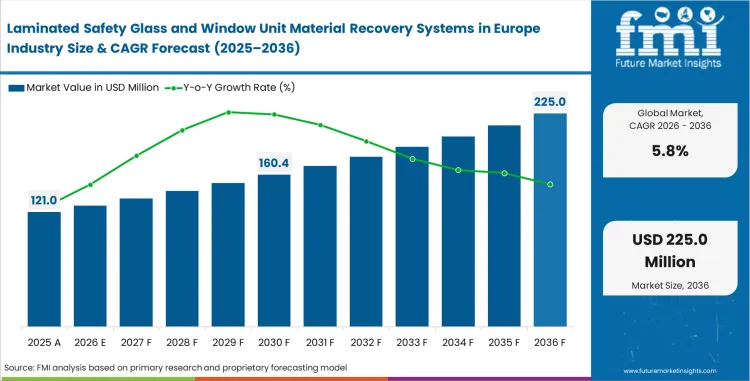
The laminated safety glass and window unit material recovery systems in Europe industry was valued at USD 114.4 million in 2025. Industry demand is expected to reach USD 121.0 million in 2026 at a CAGR of 5.8% during the forecast period. Cumulative spending is expected to lift the market to USD 212.6 million by 2036 as Europe moves from bulk glazing disposal toward cleaner recovery of laminated panes, spacer metals, and polymer layers that can return to controlled recycling streams.
Summary of Laminated Safety Glass and Window Unit Material Recovery Systems in Europe Industry
- The laminated safety glass and window unit material recovery systems in Europe industry is projected to reach USD 212.6 million by 2036.
- Industry demand is expected to grow at a 5.8% CAGR from 2026 to 2036.
- The market was valued at USD 114.4 million in 2025.
- Demand is expected to reach USD 121.0 million in 2026.
- Window units are expected to lead the source stream segment with 54.0% share in 2026.
- Fixed plants are projected to lead installation type with 69.0% share in 2026.
- Glass cullet is expected to remain the leading recovery output with 57.0% share in 2026.
- Country-level growth is strongest in Belgium, where demand is projected to expand at 6.6% CAGR through 2036.
Key Takeaways, Market Size, and Forecast
- Laminated Safety Glass and Window Unit Material Recovery Systems in Europe Industry is projected to grow from USD 121.0 million in 2026 to USD 212.6 million by 2036, at a CAGR of 5.8%.
- The laminated safety glass and window unit material recovery systems in Europe industry was valued at USD 114.4 million in 2025.
- By 2036, the Laminated Safety Glass and Window Unit Material Recovery Systems in Europe Industry is expected to be worth USD 212.6 million.
- From 2026 to 2036, the industry is projected to expand at a CAGR of 5.8%.
- The industry is projected to create an incremental opportunity of USD 91.6 million between 2026 and 2036.
- In 2026, Window Units are expected to account for 54.0% of the source stream segment.
- Belgium (6.6%) and the Netherlands (6.4%) are two of the fastest growing markets.
Laminated Safety Glass and Window Unit Material Recovery Systems in Europe Industry Key Takeaways
| Parameter | Details |
|---|---|
| Market value (2026) | USD 121.0 million |
| Forecast value (2036) | USD 212.6 million |
| CAGR (2026 to 2036) | 5.8% |
| Estimated market value (2025) | USD 114.4 million |
| Incremental opportunity | USD 91.6 million |
| Leading source stream | Window units |
| Leading recovery output | Glass cullet |
| Leading system type | Integrated lines |
| Leading processing stage | Dismantling |
| Leading separation technology | Mechanical separation |
| Leading installation type | Fixed plants |
| Leading end use | Flat-glass plants |
| Key supplier brands referenced in market landscape | AGC Glass Europe, Saint-Gobain Glass, NSG Group, Glas Trösch Group |
Source: Future Market Insights (FMI) analysis, based on proprietary forecasting model and primary research
Demolition contractors and flat-glass processors now must decide whether old glazing should leave a site as mixed waste or as a feedstock that can be dismantled, sorted, and sold back into higher-value loops. That choice mattered less when landfill remained cheaper and when recycled glass systems were built mainly around container streams. Window replacement and façade renewal now put more pressure on site handling quality because mixed breakage destroys cullet value before it reaches a recycler. A less obvious point sits underneath this change. Buyers do not win by collecting more tones alone. They win when the glass arrives clean enough to justify separation, because poor inbound quality turns a recovery line into an expensive crushing step.
A wider shift happens once demolition crews, glass processors, and remelt users work to one acceptance standard for incoming units and laminated scrap. Once that gate is crossed, spending on recycling equipment and machinery becomes easier to justify because buyers can measure yield, reject levels, and resale value on the same line instead of across disconnected handling steps.
Belgium is projected to record the fastest market growth in Europe, with demand for Laminated Safety Glass and Window Unit Material Recovery Systems expected to rise at a 6.6% CAGR through 2036. The Netherlands follows at 6.4% CAGR, while Germany is estimated at 6.2% and France at 6.0%. Market expansion in the United Kingdom is likely to reach 5.5% CAGR, compared with 5.3% for Italy and 5.1% for Spain over the forecast period. Belgium and the Netherlands are moving ahead more quickly because glass recovery activity is supported by a stronger flat-glass recycling flow and shorter logistical distance between collection, cleaning, and remelting operations. Southern European demand remains more measured, as equipment spending is still more closely tied to project economics, feedstock consistency, and the quality of collected material.
Deconstruction Quality Now Determines System Economics
In this industry, the commercial question is no longer whether laminated safety glass and insulated window units can be recovered, but whether they can be recovered cleanly enough to justify specialized sorting, delamination, and secondary-material sales. That distinction matters because Europe’s construction and demolition waste stream already accounts for more than one-third of all EU waste, yet high-value recovery still depends on source separation, traceability, and contamination control rather than simple collection volume. Buyers evaluating recovery systems are therefore solving an operational problem, not a purely environmental one: poor inbound quality turns potential cullet and interlayer recovery into mixed waste handling. The strongest system proposition in Europe is now built around selective dismantling, pre-processing discipline, and downstream outlet certainty, not just installed processing capacity.
Segmental Analysis
Key Facts of Segments
- Window units are expected to account for 54.0% of source-stream demand in 2026. Refurbishment and retrofit activity generates repeat volumes that keep recovery lines supplied more steadily than smaller laminated interior items or less consistent streams.
- Glass cullet is projected to contribute 57.0% share in 2026. Its commercial lead comes from a clearer resale path into remelt use, while polymer fractions and spacer metals remain more supportive than primary to project economics.
- Integrated lines are anticipated to represent 46.0% of system demand in 2026. Buyers typically prefer one controlled process with fewer transfer points because it reduces handling loss and internal breakage.
- Dismantling is expected to hold 29.0% share in 2026 within processing stages. Early-stage control remains important because poor removal quality can damage cullet value before the glass reaches advanced recovery steps.
- Mechanical separation is projected to account for 41.0% of separation-technology demand in 2026. Buyers continue to favor it because it fits daily plant routines more easily than heat-intensive or sensor-heavy alternatives.
- Fixed plants are likely to secure 69.0% of installation-type demand in 2026. Stable throughput, repeat feed, and tighter quality control make permanent sites more commercially practical than project-led mobile setups.
- Flat-glass plants are forecast to represent 38.0% of end-use demand in 2026. They provide the clearest route for clean cullet to return into a higher-value industrial reuse loop.
Laminated Safety Glass and Window Unit Material Recovery Systems in Europe Industry Analysis by Source Stream
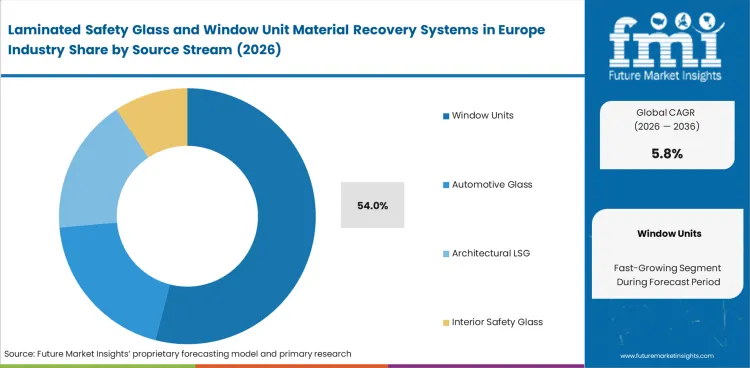
Window units are expected to represent 54.0% of source-stream demand in 2026. Recovery planning starts with feed quality because larger assemblies usually offer a clearer route to value once frames, seals, and spacer components are removed in the right order. Buyers prioritize this stream because refurbishment and retrofit work releases repeat volumes that can keep recovery lines supplied more steadily than smaller laminated interior items. Automotive glazing still matters, yet it is harder to capture cleanly before shredding, while architectural laminated sheets vary more by coating type and jobsite handling. Upstream consistency from a glazing machine environment also helps keep unit formats more predictable before they enter dismantling and sorting operations. Poor source-stream discipline quickly raises reject rates, labor time, and downstream contamination. Recovery performance is set much earlier than many operators expect, and cleaner intake usually preserves more usable value through the rest of the line.
- Feed stability: Larger batches of window units help operators plan line time and labor with fewer interruptions.
- Capture quality: Cleaner take-out from refurbishment work preserves glass surfaces and improves downstream separation quality.
- Jobsite sorting: Mixed inbound loads reduce recovery value when seals, metals, and coated panes arrive unsorted.
Laminated Safety Glass and Window Unit Material Recovery Systems in Europe Industry Analysis by Recovery Output
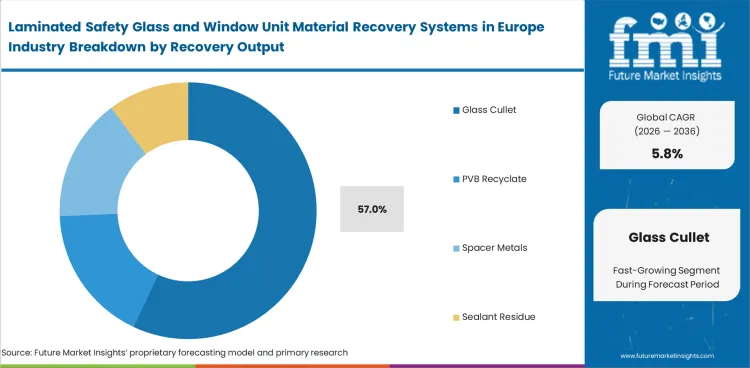
Sales logic in this market still depends on which recovered fraction can leave the plant in a form another buyer will accept with minimal rework. Glass cullet holds that position most clearly, and 57.0% share is expected for it in 2026 because remelt outlets continue to provide the strongest price reference for recovered material. Polymer recovery can improve economics, and spacer metals add useful secondary value when separation is done early, but neither replaces cullet as the main commercial anchor for most lines. The same practical rule applies in automotive glass handling, where downstream buyers want output that moves with limited argument over contamination or grading. Sealant residue remains more of a removal burden than a revenue stream. Commercial returns improve when the system produces a cleaner cullet stream early, rather than relying on secondary fractions to make up for quality losses later in the process.
- Offtake certainty: Cullet remains easier to place because remelt buyers already understand its grade and contamination limits.
- Secondary yield: Metals and polymer fractions help margins when they are separated well, though they rarely carry the project alone.
- Residue burden: Sealants and mixed fines reduce value when the line cannot remove them early and consistently.
Laminated Safety Glass and Window Unit Material Recovery Systems in Europe Industry Analysis by System Type
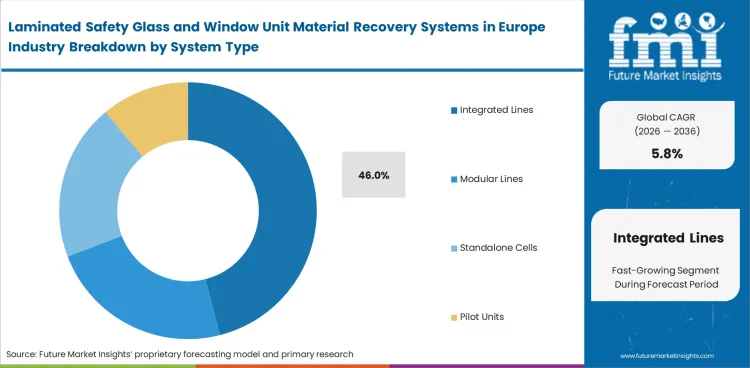
Integrated lines lead this market because buyers usually prefer one controlled process over a chain of separate machines that shifts responsibility from one stage to another. Workflow control matters more than simple scale, since a single line can cut, open, sort, clean, and transfer material with fewer handling losses and less internal breakage. Integrated lines are anticipated to represent 46.0% of system demand in 2026. Modular lines still appeal where feed supply is uncertain, or capital spending must be phased, while standalone cells suit narrower tasks but often introduce more transfer points and more labor. Pilot units remain useful for validation and proof of work, though they are rarely the final answer for sustained industrial operation. Recovery needs linked to impact resistant glass also support this pattern because layered products reward tighter process discipline from start to finish. Plants that reduce handoffs and internal handling usually protect yield more effectively than those trying to correct avoidable losses after the material has already moved through too many separate steps.
- Workflow control: Fewer transfer points reduce breakage and make yield measurement easier to trust.
- Capital phasing: Modular systems suit operators that want expansion room without funding a full integrated build immediately.
- Pilot validation: Smaller units help verify feed quality and output grades before larger spending is approved.
Laminated Safety Glass and Window Unit Material Recovery Systems in Europe Industry Analysis by Processing Stage
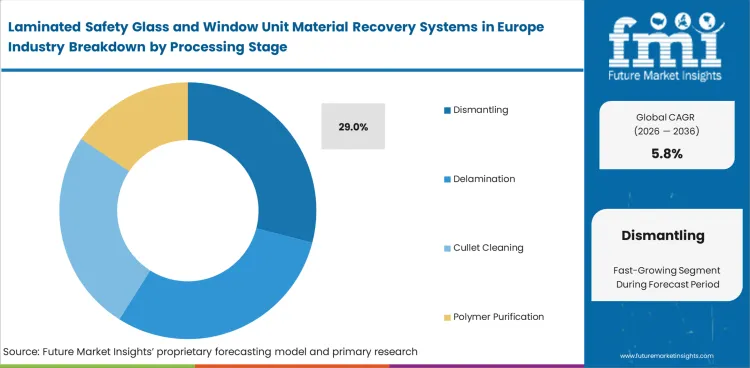
Material value is often won or lost before glass reaches any advanced separation step, which is why dismantling stays at the center of the commercial argument. Clean removal protects surfaces and edges needed for later sorting, cleaning, and remelt use, while poor first-stage handling can introduce contamination that later steps cannot fully correct. Operators that skip discipline here usually pay for it through lower cullet quality, higher residue loads, and weaker downstream yield. Dismantling is expected to account for 29.0% of processing-stage demand in 2026 because early-stage control determines whether the feed is worth carrying into more specialized recovery work. Delamination becomes more valuable once the input is clean enough to justify layer-specific separation, and cullet cleaning then decides whether output can move back into higher-grade uses. Links with float glass production make this especially important because remelt plants still depend on stable material input. Early-stage execution has a direct effect on how much downstream value remains available, and once contamination enters the sequence, later recovery becomes more expensive and less reliable.
- Entry discipline: Careful dismantling protects downstream value better than any late-stage correction can recover.
- Layer access: Delamination performs better when units reach that stage without heavy contamination or uncontrolled breakage.
- Clean output: Cullet cleaning determines whether recovered glass can re-enter higher-grade industrial applications.
Laminated Safety Glass and Window Unit Material Recovery Systems in Europe Industry Analysis by Separation Technology
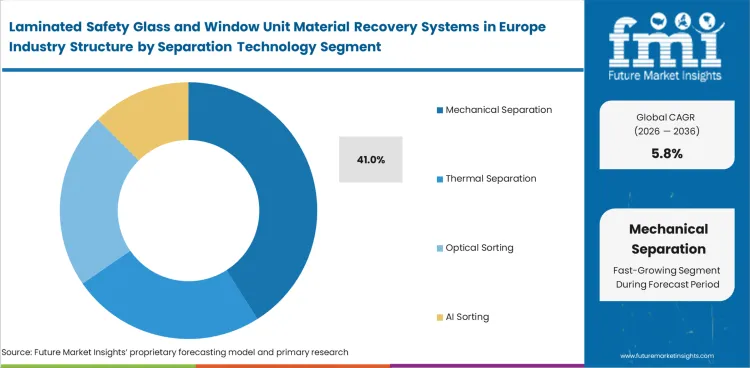
Mechanical separation remains the preferred route because many buyers need a system that can run every day with ordinary labor, ordinary upkeep, and mixed post-consumer feedstock. Crushers, cutters, screens, and guided opening systems fit existing plant routines more easily than heat-intensive or sensor-heavy alternatives, which is why practicality still outweighs novelty in most investment decisions. Thermal routes can help release bonded layers, and optical sorting can support quality control after breakage, but both depend on cleaner upstream handling to justify their added burden. AI-enabled sorting retains promise, though it still needs disciplined feed preparation and a reliable training base to perform consistently. Buyers processing architectural flat glass streams tend to prefer proven steps first and more specialized layers later. Mechanical separation is projected to contribute 41.0% of separation-technology demand in 2026 because predictable uptime and manageable service needs remain more valuable than theoretical precision alone. Operators usually protect margin better through stable feed handling and disciplined plant routines than through more complex separation layers added to an unstable input stream.
- Practical upkeep: Mechanical systems suit sites that need predictable uptime and faster maintenance response.
- Energy burden: Thermal routes can solve difficult material combinations, though they raise operating load when feed quality varies.
- Sorting precision: Optical and AI tools add value when the plant already controls breakage, contamination, and feed coding.
Laminated Safety Glass and Window Unit Material Recovery Systems in Europe Industry Analysis by Installation Type
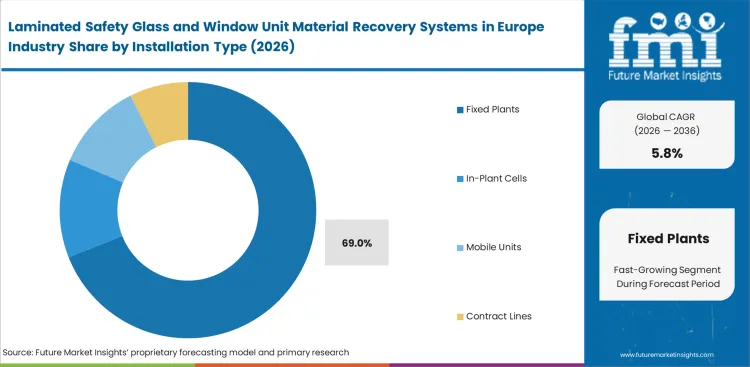
Fixed plants dominate this category because the economics of recovery reward stable throughput, repeated feed, and consistent quality control more than short-term mobility. Buyers usually prefer permanent sites where systems can be tied to recycler yards, flat-glass processors, or industrial cleaning lines that already have storage, logistics, and output conditioning in place. In-plant cells still make sense when processors want to capture value before material leaves the site, and mobile units can support selected demolition projects, though variable feed preparation often weakens their yield. Contract lines also remain relevant in smaller markets that cannot justify dedicated assets. Demand connected to energy efficient windows replacement reinforces the case for stable installations because retrofit flows are recurring enough to support long-term fixed operations. Fixed plants are likely to secure 69.0% of installation-type demand in 2026. Permanent setups usually perform better when recurring feed allows tighter quality control, steadier labor use, and more predictable output grading across the operating cycle.
- Throughput base: Permanent sites handle steadier volumes and support tighter quality checks across operating shifts.
- Site capture: In-plant cells help processors retain value when they already control incoming material flow.
- Mobility limits: Mobile systems help on selected projects, but feed inconsistency can weaken yield and raise handling time.
Laminated Safety Glass and Window Unit Material Recovery Systems in Europe Industry Analysis by End Use
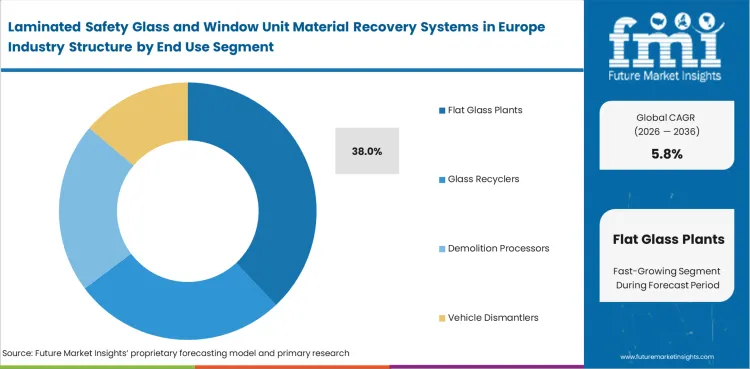
End-use demand follows the buyer group that can turn recovered output into a repeated purchase pattern with the least downgrade pressure. Flat-glass plants remain closest to that commercial center because they provide the clearest route for clean cullet to move back into a higher-value industrial loop. Glass recyclers still matter because they aggregate, condition, and resell material across several outlets, while demolition processors influence feed quality earlier in the chain than final value realization. Vehicle dismantlers also play a role in some streams, though their scale is less reliable where glass is not removed before shredding. Work associated with silicone structural glazing and other complex façade systems makes this even more important because layered assemblies require end users that can absorb recovered material without extensive reprocessing. Flat-glass plants are forecast to represent 38.0% of end-use demand in 2026 because they provide the market’s strongest remelt signal when cullet quality meets furnace expectations. End-market strength improves when recovered glass reaches industrial buyers in a condition that limits downgrade risk and reduces the need for repeated conditioning before reuse.
- Remelt pull: Flat-glass plants provide the clearest value signal when cullet quality meets furnace requirements.
- Aggregation role: Recyclers matter because they turn scattered feed into volumes that industrial buyers can accept.
- Early handling: Demolition and dismantling sites influence the result well before any remelt decision is made.
Laminated Safety Glass and Window Unit Material Recovery Systems in Europe Industry Drivers, Restraints, and Opportunities
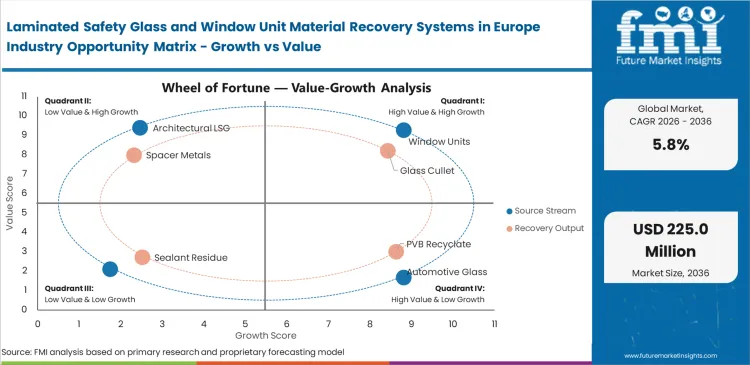
Buyers are being pushed to choose between mixed disposal and clean recovery at a much earlier point in the removal cycle. Once laminated units break into uncontrolled mixed waste, later processing options narrow fast and value drops with them. FMI analysts opine that rising attention to circular construction and lower-carbon materials is giving this decision more weight, especially where advanced glass specification is already tied to embodied-carbon and recycled-content discussions. Recovery-system demand grows because more owners want proof that old glazing can move into a managed material stream instead of an open waste route. Commercial value sits in the quality of feed, not in tonnage alone.
Clean recovery still slows down when too many parties touch the same unit before it reaches a processor that can separate it properly. Site removal crews, haulage providers, temporary waste handlers, and recyclers often work on different acceptance rules, which makes accountability harder to pin down when cullet arrives contaminated. Separation equipment can solve part of the problem, yet it cannot fully undo poor take-out and poor storage. This remains a structural barrier because collection discipline is built into contracts and site routines rather than into the machine itself. Adoption moves faster where handling rules are clear from the start.
Opportunities in the Laminated Safety Glass and Window Unit Material Recovery Systems in Europe Industry
- Retrofit Pull: Window replacement and façade renewal create cleaner post-consumer feed that specialized recovery lines can monetize more effectively.
- Secondary Uses: Lower-grade output can still find value in applications related to recycled glass aggregates when remelt quality is not achievable on the first pass.
- Closed-Loop Supply: Processors that can connect collection, cleaning, and remelt sale in one commercial chain are better placed to defend margins and secure repeat industrial demand.
Regional Analysis
Regional demand does not move at the same speed across Europe because recovery systems depend on local demolition practice, cullet outlets, and the maturity of flat-glass collection networks. Markets with cleaner strip-out routines and shorter links between removal and remelt tend to justify system spending earlier.
Key Facts of Country
- Shorter industrial links between collection, cleaning, and remelt operations give Belgium the strongest country outlook in this study. Demand in Belgium is expected to rise at a 6.6% CAGR through 2036.
- Circular construction discipline and clearer site-level separation practices support the Netherlands. Recovery-system demand in the Netherlands is likely to expand at 6.4% CAGR over the forecast period.
- Industrial scale and broad building stock renewal keep Germany commercially important. Germany is projected to record a 6.2% CAGR during 2026 to 2036.
- Building-renewal activity and rising attention to product responsibility support France. Market expansion in France is expected to run at a 6.0% CAGR through 2036.
- Urban regeneration and office refurbishment keep the United Kingdom relevant in this market. Sales in the U.K. are expected to increase at a 5.5% CAGR during the forecast period.
- A strong fabrication and glazing base supports Italy, though adoption remains more phased. Demand in Italy is likely to expand at a 5.3% CAGR through 2036.
- Replacement demand across a large building stock keeps Spain in the country mix, though feed clustering remains important for line economics. Spain is expected to post a 5.1% CAGR over the forecast period.
.webp "Top Country Growth Comparison Laminated Safety Glass And Window Unit Material Recovery Systems In Europe Industry Cagr (2026 2036)")
| Country | CAGR (2026 to 2036) |
|---|---|
| Belgium | 6.6% |
| Netherlands | 6.4% |
| Germany | 6.2% |
| France | 6.0% |
| United Kingdom | 5.5% |
| Italy | 5.3% |
| Spain | 5.1% |
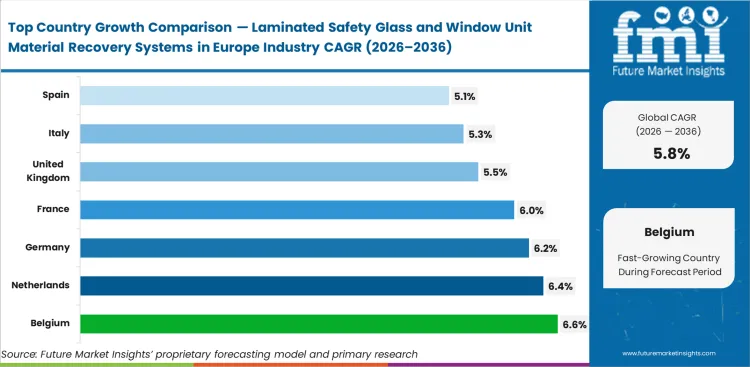
Source: Future Market Insights (FMI) analysis, based on proprietary forecasting model and primary research
Western Europe Laminated Safety Glass and Window Unit Material Recovery Systems in Europe Industry Analysis
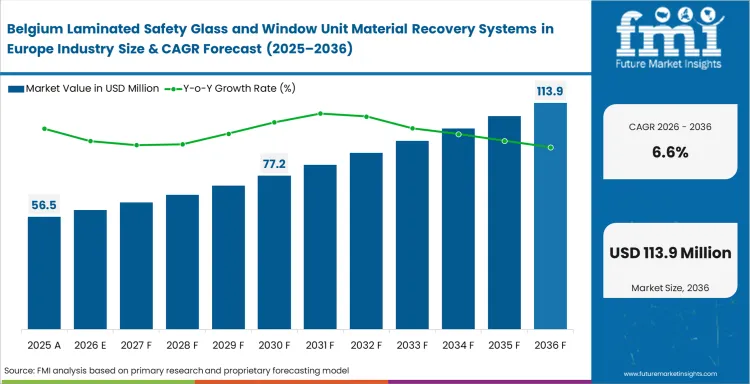
Western Europe provides the clearest base for this market because flat-glass recycling is already tied to construction decarbonization, building renewal, and cleaner demolition practices. Belgium, the Netherlands, Germany, and France all benefit from shorter industrial routes between removal, sorting, and reuse than many other parts of Europe. Use of energy efficient window and door systems in retrofit activity also helps increase the volume of old units coming back into controlled recovery streams. Europe’s most investable recovery projects tend to appear where take-back discipline and remelt demand meet in the same corridor. Value therefore builds from operating fit, not from waste volume alone.
- Belgium: Belgium leads the country set because flat-glass recovery has moved closer to an industrial routine instead of remaining a trial-only activity. Clean collection is easier to organize in a compact geography where processors and end users sit closer together. Demand for these systems is expected to rise at a CAGR of 6.6% from 2026 to 2036, supported by better alignment between removal work, sorting capacity, and remelt demand. Buyers in Belgium also benefit from shorter transport loops, which helps protect cullet quality and keeps handling costs under better control. That combination gives Belgium a practical edge when new recovery capacity is evaluated.
- Netherlands: Circular construction already has stronger practical meaning in the Netherlands because material reuse is discussed earlier in project planning and waste separation rules tend to be clearer at the site level. Recovery-system demand in the country is likely to expand at 6.4% CAGR over the forecast years as processors work with cleaner incoming units and tighter logistics. Dutch operators also benefit from a business culture that accepts service contracts and sorting discipline more readily than many fragmented markets do. Better inbound control helps lines run closer to the designed output quality. That is why the Dutch segment stays near the top of the regional growth range.
- Germany: Germany remains one of the most important demand bases because its industrial scale supports both specialized processing and downstream material use. Large building stock renewal and a wide manufacturing base keep the feed opportunity real, yet buyers still expect recovery systems to show dependable output before approving spend. Germany is projected to record a CAGR of 6.2% in this industry during the forecast years. Stronger growth is held back by the need to coordinate more actors across larger project chains, which can slow clean collection. Even so, once contracts define handling standards clearly, Germany gives suppliers one of Europe’s most durable operating bases.
- France: France combines strong building-renewal logic with rising attention to product responsibility, which gives recovery systems a meaningful policy and commercial backdrop. Growth in the laminated safety glass and window unit material recovery systems segment in France is expected to run at 6.0% CAGR over the forecast period, yet line adoption still depends on whether incoming units can be separated early enough to protect cullet value. French operators often see good project logic in urban refurbishment work where window replacement volumes are concentrated. Wider rollout remains tied to repeatable collection quality rather than to one-off demonstration value. Buyers who secure cleaner inbound streams are likely to justify equipment to spend sooner than those relying on mixed demolition loads.
Western Europe will keep setting the pace for Europe because it combines removal volume with the operating discipline needed to protect glass quality before treatment begins. Adjacent markets such as Austria, Switzerland, and Luxembourg are smaller, yet they follow similar logic when high-value refurbishment work creates a cleaner recovery feed. Scale alone does not decide the outcome here. Clean handling does.
Northern Europe Laminated Safety Glass and Window Unit Material Recovery Systems in Europe Industry Analysis
Northern Europe shows a narrower country mix in this assessment, yet it remains important because selective demolition and regeneration work can release high-value glazing streams when site handling is controlled from the start. The United Kingdom activity illustrates this pattern well. Interest in linked waste processing also keeps this region close to adjacent categories such as demolition equipment, where site efficiency and material separation already shape capital choices. Project economics still matter, but operating discipline matters more once laminated units leave the frame. Good inbound handling is the difference between a recycling opportunity and a downgraded waste flow.
- United Kingdom: Regeneration work and office refurbishment give the United Kingdom a steady reason to examine glass recovery systems, especially in urban projects where old façades and sealed units are removed in concentrated volumes. Sales in the country are expected to increase at a CAGR of 5.5% during the forecast period, though growth still depends on how consistent contractors preserve material quality during take-out and storage. In the United Kingdom, recovery systems are commonly evaluated against established skip‑based disposal practices, reinforcing the importance of measurable yield outcomes and demonstrable logistics efficiencies. Suppliers that can show a cleaner route from site removal to industrial reuse are better placed to win.
Northern Europe is likely to stay selective rather than broad-based. More countries may open as project pipelines thicken, yet wider adoption still depends on whether recovery can fit mainstream construction practice without adding too much coordination burden. Progress here comes from disciplined execution on a small number of visible projects. It does not come from volume alone.
Southern Europe Laminated Safety Glass and Window Unit Material Recovery Systems in Europe Industry Analysis
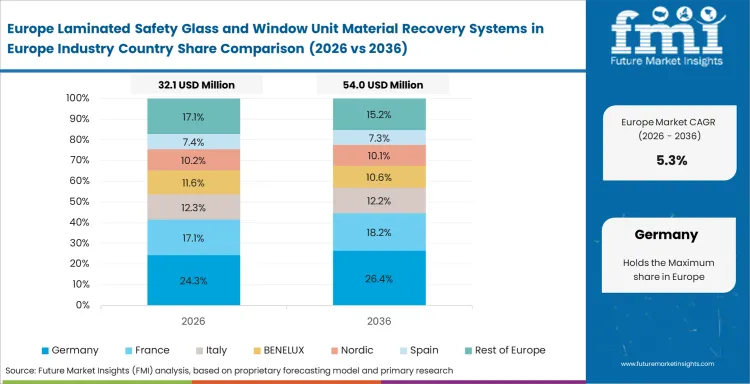
Southern Europe offers real feed potential because renovation and replacement needs are large, yet system adoption moves more carefully as project budgets and collection discipline vary more from site to site. Italy and Spain capture that balance. Material-recovery logic in this region often intersects with broader investment in metal recycling equipment, sorting, and waste handling, because buyers want lines that can justify their place within a wider plant rather than as a stand-alone specialty purchase. Recovery therefore advances where glass can be gathered with less contamination and less transport loss. Capital approval stays tighter when those conditions are not yet in place.
- Italy: Italy has a strong fabrication and glazing base, which helps keep end-of-life glass in view when refurbishment work begins, but line spending still depends on whether processors can gather clean enough feed to protect recovered value. Demand in Italy is likely to expand at 5.3% CAGR during the forecast period. Buyers often favor staged adoption here, starting with sorting and cleaner take-out before moving into more integrated recovery systems. That pattern reflects practical caution rather than weak interest. Italy can support steady growth, yet the strongest projects will remain the ones that connect removal, storage, cleaning, and offtake in one workable chain.
- Spain: Spain benefits from a wide building stock that will continue to generate replacement demand, yet recovery economics can weaken when feed is scattered, and hauling distances rise. A CAGR of 5.1% is expected for the Europe laminated safety glass and window unit material recovery systems in Spain from 2026 to 2036, and that pace reflects both opportunity and restraint. Processors in Spain often need stronger local aggregation before a dedicated line can run efficiently. Project logic improves in dense urban zones where window replacement and commercial refurbishment can produce cleaner batches. Better clustering of feed sources is likely to matter as much as technology choice in this market.
Southern Europe remains promising, though its route is more uneven than Western Europe’s. Markets in Portugal, Greece, and selected Balkan countries may add to future demand where urban retrofit work becomes easier to aggregate. Buyers in this part of Europe tend to reward flexible project design first. Large, fixed commitments usually come later.
Competitive Aligners for Market Players
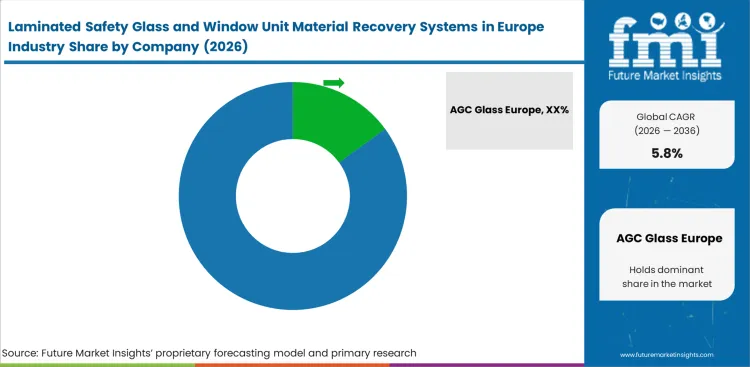
Strong alignment with flat glass reuse applications continues to shape competitive credibility in this market. AGC Glass Europe and Saint Gobain Glass benefit from their close involvement in reuse processes and remelt expectations. Buyers tend to trust suppliers who understand acceptance limits and downstream quality requirements. NSG Group is often assessed within the same context because its reuse of insight helps connect incoming material quality with cullet value. This level of application understanding often outweighs the appeal of a wide range of equipment offering. Recovery systems gain faster acceptance when suppliers explain how quality decisions influence reuse outcomes rather than relying on machinery breadth.
In recovery models that involve sealed units, intact handling becomes a defining factor. Glas Trösch Group and HEGLA are better recognized in these scenarios because processors focus closely on machine design, cleaning logic, and line flow. Evaluations usually prioritize process stability over installed capacity figures. Experience drawn from laminated glass and automotive front windshield handling strengthens supplier credibility. Buyers look for structured systems that reduce avoidable handoffs. Clear and stable flow remains essential as it supports consistent output quality and easier plant operation.
Positioning near collection, conditioning, and resale channels creates a different source of advantage. Maltha Glass Recycling and Reiling gain relevance when buyers seek proof that recovered output can move into repeat offtake routes. This reduces the risk of material remaining limited to trial batches. As the market evolves, competition increasingly centres on clean take-out, stable processing, and reliable offtake. Suppliers that align across all three pillars are more likely to sustain buyer attention as maturity increases.
Key Players in Laminated Safety Glass and Window Unit Material Recovery Systems in Europe Market
- AGC Glass Europe
- Saint-Gobain Glass
- NSG Group
- Glas Trösch Group
- Maltha Glass Recycling
- HEGLA GmbH & Co. KG
- Reiling Unternehmensgruppe
Scope of the Report
| Metric | Value |
|---|---|
| Quantitative Units | USD 121.0 million to USD 212.6 million, at a CAGR of 5.8% |
| Market Definition | This report covers systems and services used to recover material from laminated safety glass and end-of-life window units in Europe. Scope includes dismantling, separation, cleaning, material handling, and related line support used to convert post-consumer glazing into reusable glass, polymer, and metal fractions. |
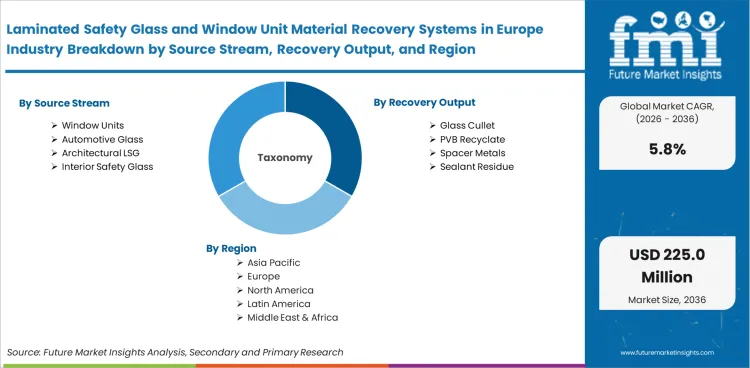
| Source Stream Segmentation | Window Units, Automotive Glass, Architectural LSG, Interior Safety Glass |
| Recovery Output Segmentation | Glass Cullet, PVB Recyclate, Spacer Metals, Sealant Residue |
| System Type Segmentation | Integrated Lines, Modular Lines, Standalone Cells, Pilot Units |
| Processing Stage Segmentation | Dismantling, Delamination, Cullet Cleaning, Polymer Purification |
| Separation Technology Segmentation | Mechanical Separation, Thermal Separation, Optical Sorting, AI Sorting |
| Installation Type Segmentation | Fixed Plants, In-Plant Cells, Mobile Units, Contract Lines |
| End Use Segmentation | Flat Glass Plants, Glass Recyclers, Demolition Processors, Vehicle Dismantlers |
| Regions Covered | Western Europe, Northern Europe, Southern Europe |
| Countries Covered | Belgium, Netherlands, Germany, France, United Kingdom, Italy, Spain |
| Key Companies Profiled | AGC Glass Europe, Saint-Gobain Glass, NSG Group, Glas Trösch Group, Maltha Glass Recycling, HEGLA GmbH & Co. KG, Reiling Unternehmensgruppe |
| Forecast Period | 2026 to 2036 |
| Approach | FMI combined primary interviews across glass processing, demolition, recycling, and façade-removal chains with desk review of public circularity, construction, and flat-glass material sources. Market sizing was anchored to European end-of-life glazing flows and then tested against plant logic, company relevance, and expected recovery economics. Country forecasts were validated through differences in retrofit intensity, collection quality, and remelt access. |
Source: Future Market Insights (FMI) analysis, based on proprietary forecasting model and primary research
Laminated Safety Glass and Window Unit Material Recovery Systems in Europe Industry Analysis by Segments
Source Stream
- Window Units
- Automotive Glass
- Architectural LSG
- Interior Safety Glass
Recovery Output
- Glass Cullet
- PVB Recyclate
- Spacer Metals
- Sealant Residue
System Type
- Integrated Lines
- Modular Lines
- Standalone Cells
- Pilot Units
Processing Stage
- Dismantling
- Delamination
- Cullet Cleaning
- Polymer Purification
Separation Technology
- Mechanical Separation
- Thermal Separation
- Optical Sorting
- AI Sorting
Installation Type
- Fixed Plants
- In-Plant Cells
- Mobile Units
- Contract Lines
End Use
- Flat Glass Plants
- Glass Recyclers
- Demolition Processors
- Vehicle Dismantlers
Region
- Western Europe
- Germany
- France
- Belgium
- Netherlands
- Northern Europe
- United Kingdom
- Southern Europe
- Italy
- Spain
Bibliography
- Glass for Europe. (2024). Recycling of end-of-life building glass. Glass for Europe.
- Buildings Performance Institute Europe. (2024). Extended Producer Responsibility in the construction sector. BPIE.
- FERVER. (2024). Joint statement on ELV dismantling glass. FERVER.
- Lu, Z., Ambaye, T. G., Mao, R., Hauschild, M., Ottosen, L. M., Montalbano, G., Zerbino, P., Aloini, D., & Lima, A. T. (2026). Resource efficiency for closed-loop circularity of building insulation materials in Europe.
- Pilkington United Kingdom Limited. (2026, January 19). Pilkington UK brings end-of-life glass recycling to St Helens town center regeneration initiative.
This bibliography is provided for reader reference. The full FMI report contains the complete reference list with primary source documentation.
This Report Addresses
- Market intelligence to support strategic decisions across laminated glazing recovery lines, insulated unit separation, cullet cleaning, and polymer handling in Europe.
- Market size estimation and 10-year forecasts from 2026 to 2036, supported by primary interviews and FMI's proprietary market modelling.
- Growth opportunity mapping across source streams, recovery outputs, system types, installation models, and end uses.
- Segment and country analysis covering Belgium, Netherlands, Germany, France, United Kingdom, Italy, and Spain.
- Competitive assessment across line integration, service reach, processing flow, material quality control, and industrial offtake alignment.
- Recovery-system scope covering dismantling, delamination, separation, cleaning, handling, and related plant support used for end-of-life glazing.
- Commercial interpretation of the main operating barrier, which remains the loss of material quality before units reach a qualified recovery line.
- Practical insight into where Europe can move closer to closed-loop flat-glass reuse and where economics still favor slower adoption.
Frequently Asked Questions
How large is the Europe laminated safety glass and window unit material recovery systems industry in 2025?
FMI estimates the Europe laminated safety glass and window unit material recovery systems industry at USD 114.4 million in 2025.
What level can Europe demand reach in 2026?
Demand for laminated safety glass and window unit material recovery systems in Europe is expected to reach USD 121.0 million in 2026.
Where can the Europe laminated safety glass and window unit material recovery systems industry stand by 2036?
FMI projects the Europe laminated safety glass and window unit material recovery systems industry to reach USD 212.6 million by 2036.
What growth rate is expected for laminated safety glass and window unit material recovery systems in Europe?
FMI expects the Europe industry for laminated safety glass and window unit material recovery systems to advance at a CAGR of 5.80% from 2026 to 2036.
Which source stream leads demand in this report?
Window units lead the source stream mix and are expected to account for 54.0% of demand in 2026.
Window units lead the source stream mix and are expected to account for 54.0% of demand in 2026.
Window units enter recovery flows in larger and more repeatable volumes because retrofit and replacement activity produces steadier material batches than most other laminated glass streams.
Which recovered output leads the Europe industry?
Glass cullet leads recovered output and is projected to represent 57.0% of demand in 2026.
Why does glass cullet stay central to laminated safety glass recovery economics?
Glass cullet remains the main recovered output because it has the clearest resale path into remelt use once contamination is brought under control.
Which system type stays ahead across Europe?
Integrated lines are expected to represent 46.0% of system demand in 2026.
Why do integrated lines fit laminated safety glass and window unit recovery work so well?
Integrated lines cut handling gaps between steps and make output quality easier to control on one operating flow.
Which processing stage carries the most weight at the front end of recovery?
Dismantling leads the processing-stage mix and is projected to account for 29.0% of demand in 2026.
Why does dismantling shape later value in laminated safety glass and window unit recovery?
Dismantling matters early because removal quality determines whether laminated glass reaches later treatment stages clean enough for efficient separation and reuse.
Which separation route leads current system demand?
Mechanical separation is expected to capture 41.0% of separation-technology demand in 2026.
Why does mechanical separation remain ahead of thermal and optical routes in Europe?
Mechanical separation stays ahead because more plants can install and run it without redesigning the full recovery line around narrower feed conditions.
Which installation model dominates the Europe industry?
Fixed plants dominate installation type and are expected to make up 69.0% of demand in 2026.
Why do fixed plants hold the strongest position in this report?
Fixed plants stay ahead because steady feed intake and tighter process control suit laminated glazing recovery better than project-led mobile setups.
Which end-use group creates the largest demand base?
Flat glass plants lead end use with an expected 38.0% share in 2026.
Which country has the fastest growth outlook in this report?
Belgium is expected to post the fastest growth in Europe with a forecast CAGR of 6.6% from 2026 to 2036.
What keeps Belgium ahead in laminated safety glass and window unit material recovery systems?
Belgium moves ahead because shorter industrial links between collection, cleaning, and remelt use make recovery-system spending easier to justify.
What is the main barrier to wider use of laminated safety glass and window unit recovery systems in Europe?
Material quality often drops before units reach a qualified processor because too many handling steps sit between removal and treatment.
What does this report include within the market scope?
Scope includes equipment and services used to dismantle, separate, clean, handle, and prepare laminated safety glass and window units for reuse or recycling.
What does this report leave out of market scope?
Scope excludes ordinary mixed-glass collection, standard container-glass recycling, and unrelated waste-processing systems that do not focus on laminated glazing or end-of-life window units.
Preview the report firsthand - request a free sample
Get SampleGet the brochure for pricing and purchase details.
Get PDFTable of Content
- Executive Summary
- Global Market Outlook
- Demand-side Trends
- Supply-side Trends
- Technology Roadmap Analysis
- Analysis and Recommendations
- Market Overview
- Market Coverage / Taxonomy
- Market Definition / Scope / Limitations
- Research Methodology
- Chapter Orientation
- Analytical Lens and Working Hypotheses
- Market Structure, Signals, and Trend Drivers
- Benchmarking and Cross-market Comparability
- Market Sizing, Forecasting, and Opportunity Mapping
- Research Design and Evidence Framework
- Desk Research Programme (Secondary Evidence)
- Company Annual and Sustainability Reports
- Peer-reviewed Journals and Academic Literature
- Corporate Websites, Product Literature, and Technical Notes
- Earnings Decks and Investor Briefings
- Statutory Filings and Regulatory Disclosures
- Technical White Papers and Standards Notes
- Trade Journals, Industry Magazines, and Analyst Briefs
- Conference Proceedings, Webinars, and Seminar Materials
- Government Statistics Portals and Public Data Releases
- Press Releases and Reputable Media Coverage
- Specialist Newsletters and Curated Briefings
- Sector Databases and Reference Repositories
- FMI Internal Proprietary Databases and Historical Market Datasets
- Subscription Datasets and Paid Sources
- Social Channels, Communities, and Digital Listening Inputs
- Additional Desk Sources
- Expert Input and Fieldwork (Primary Evidence)
- Primary Modes
- Qualitative Interviews and Expert Elicitation
- Quantitative Surveys and Structured Data Capture
- Blended Approach
- Why Primary Evidence is Used
- Field Techniques
- Interviews
- Surveys
- Focus Groups
- Observational and In-context Research
- Social and Community Interactions
- Stakeholder Universe Engaged
- C-suite Leaders
- Board Members
- Presidents and Vice Presidents
- R&D and Innovation Heads
- Technical Specialists
- Domain Subject-matter Experts
- Scientists
- Physicians and Other Healthcare Professionals
- Governance, Ethics, and Data Stewardship
- Research Ethics
- Data Integrity and Handling
- Primary Modes
- Tooling, Models, and Reference Databases
- Desk Research Programme (Secondary Evidence)
- Data Engineering and Model Build
- Data Acquisition and Ingestion
- Cleaning, Normalisation, and Verification
- Synthesis, Triangulation, and Analysis
- Quality Assurance and Audit Trail
- Market Background
- Market Dynamics
- Drivers
- Restraints
- Opportunity
- Trends
- Scenario Forecast
- Demand in Optimistic Scenario
- Demand in Likely Scenario
- Demand in Conservative Scenario
- Opportunity Map Analysis
- Product Life Cycle Analysis
- Supply Chain Analysis
- Investment Feasibility Matrix
- Value Chain Analysis
- PESTLE and Porter’s Analysis
- Regulatory Landscape
- Regional Parent Market Outlook
- Production and Consumption Statistics
- Import and Export Statistics
- Market Dynamics
- Global Market Analysis 2021 to 2025 and Forecast, 2026 to 2036
- Historical Market Size Value (USD Million) Analysis, 2021 to 2025
- Current and Future Market Size Value (USD Million) Projections, 2026 to 2036
- Y-o-Y Growth Trend Analysis
- Absolute $ Opportunity Analysis
- Global Market Pricing Analysis 2021 to 2025 and Forecast 2026 to 2036
- Global Market Analysis 2021 to 2025 and Forecast 2026 to 2036, By Source Stream
- Introduction / Key Findings
- Historical Market Size Value (USD Million) Analysis By Source Stream , 2021 to 2025
- Current and Future Market Size Value (USD Million) Analysis and Forecast By Source Stream , 2026 to 2036
- Window Value (USD Million)s
- Automotive Glass
- Architectural LSG
- Interior Safety Glass
- Window Value (USD Million)s
- Y-o-Y Growth Trend Analysis By Source Stream , 2021 to 2025
- Absolute $ Opportunity Analysis By Source Stream , 2026 to 2036
- Global Market Analysis 2021 to 2025 and Forecast 2026 to 2036, By Recovery Output
- Introduction / Key Findings
- Historical Market Size Value (USD Million) Analysis By Recovery Output, 2021 to 2025
- Current and Future Market Size Value (USD Million) Analysis and Forecast By Recovery Output, 2026 to 2036
- Glass Cullet
- PVB Recyclate
- Spacer Metals
- Sealant Residue
- Glass Cullet
- Y-o-Y Growth Trend Analysis By Recovery Output, 2021 to 2025
- Absolute $ Opportunity Analysis By Recovery Output, 2026 to 2036
- Global Market Analysis 2021 to 2025 and Forecast 2026 to 2036, By System Type
- Introduction / Key Findings
- Historical Market Size Value (USD Million) Analysis By System Type, 2021 to 2025
- Current and Future Market Size Value (USD Million) Analysis and Forecast By System Type, 2026 to 2036
- Integrated Lines
- Modular Lines
- Standalone Cells
- Pilot Value (USD Million)s
- Integrated Lines
- Y-o-Y Growth Trend Analysis By System Type, 2021 to 2025
- Absolute $ Opportunity Analysis By System Type, 2026 to 2036
- Global Market Analysis 2021 to 2025 and Forecast 2026 to 2036, By Processing Stage
- Introduction / Key Findings
- Historical Market Size Value (USD Million) Analysis By Processing Stage, 2021 to 2025
- Current and Future Market Size Value (USD Million) Analysis and Forecast By Processing Stage, 2026 to 2036
- Dismantling
- Delamination
- Cullet Cleaning
- Polymer Purification
- Dismantling
- Y-o-Y Growth Trend Analysis By Processing Stage, 2021 to 2025
- Absolute $ Opportunity Analysis By Processing Stage, 2026 to 2036
- Global Market Analysis 2021 to 2025 and Forecast 2026 to 2036, By Separation Technology
- Introduction / Key Findings
- Historical Market Size Value (USD Million) Analysis By Separation Technology, 2021 to 2025
- Current and Future Market Size Value (USD Million) Analysis and Forecast By Separation Technology, 2026 to 2036
- Mechanical Separation
- Thermal Separation
- Optical Sorting
- AI Sorting
- Mechanical Separation
- Y-o-Y Growth Trend Analysis By Separation Technology, 2021 to 2025
- Absolute $ Opportunity Analysis By Separation Technology, 2026 to 2036
- Global Market Analysis 2021 to 2025 and Forecast 2026 to 2036, By Installation Type
- Introduction / Key Findings
- Historical Market Size Value (USD Million) Analysis By Installation Type, 2021 to 2025
- Current and Future Market Size Value (USD Million) Analysis and Forecast By Installation Type, 2026 to 2036
- Fixed Plants
- In-Plant Cells
- Mobile Value (USD Million)s
- Contract Lines
- Fixed Plants
- Y-o-Y Growth Trend Analysis By Installation Type, 2021 to 2025
- Absolute $ Opportunity Analysis By Installation Type, 2026 to 2036
- Global Market Analysis 2021 to 2025 and Forecast 2026 to 2036, By End Use
- Introduction / Key Findings
- Historical Market Size Value (USD Million) Analysis By End Use, 2021 to 2025
- Current and Future Market Size Value (USD Million) Analysis and Forecast By End Use, 2026 to 2036
- Flat Glass Plants
- Glass Recyclers
- Demolition Processors
- Vehicle Dismantlers
- Flat Glass Plants
- Y-o-Y Growth Trend Analysis By End Use, 2021 to 2025
- Absolute $ Opportunity Analysis By End Use, 2026 to 2036
- Global Market Analysis 2021 to 2025 and Forecast 2026 to 2036, By Region
- Introduction
- Historical Market Size Value (USD Million) Analysis By Region, 2021 to 2025
- Current Market Size Value (USD Million) Analysis and Forecast By Region, 2026 to 2036
- North America
- Latin America
- Western Europe
- Eastern Europe
- East Asia
- South Asia and Pacific
- Middle East & Africa
- Market Attractiveness Analysis By Region
- North America Market Analysis 2021 to 2025 and Forecast 2026 to 2036, By Country
- Historical Market Size Value (USD Million) Trend Analysis By Market Taxonomy, 2021 to 2025
- Market Size Value (USD Million) Forecast By Market Taxonomy, 2026 to 2036
- By Country
- USA
- Canada
- Mexico
- By Source Stream
- By Recovery Output
- By System Type
- By Processing Stage
- By Separation Technology
- By Installation Type
- By End Use
- By Country
- Market Attractiveness Analysis
- By Country
- By Source Stream
- By Recovery Output
- By System Type
- By Processing Stage
- By Separation Technology
- By Installation Type
- By End Use
- Key Takeaways
- Latin America Market Analysis 2021 to 2025 and Forecast 2026 to 2036, By Country
- Historical Market Size Value (USD Million) Trend Analysis By Market Taxonomy, 2021 to 2025
- Market Size Value (USD Million) Forecast By Market Taxonomy, 2026 to 2036
- By Country
- Brazil
- Chile
- Rest of Latin America
- By Source Stream
- By Recovery Output
- By System Type
- By Processing Stage
- By Separation Technology
- By Installation Type
- By End Use
- By Country
- Market Attractiveness Analysis
- By Country
- By Source Stream
- By Recovery Output
- By System Type
- By Processing Stage
- By Separation Technology
- By Installation Type
- By End Use
- Key Takeaways
- Western Europe Market Analysis 2021 to 2025 and Forecast 2026 to 2036, By Country
- Historical Market Size Value (USD Million) Trend Analysis By Market Taxonomy, 2021 to 2025
- Market Size Value (USD Million) Forecast By Market Taxonomy, 2026 to 2036
- By Country
- Germany
- UK
- Italy
- Spain
- France
- Nordic
- BENELUX
- Rest of Western Europe
- By Source Stream
- By Recovery Output
- By System Type
- By Processing Stage
- By Separation Technology
- By Installation Type
- By End Use
- By Country
- Market Attractiveness Analysis
- By Country
- By Source Stream
- By Recovery Output
- By System Type
- By Processing Stage
- By Separation Technology
- By Installation Type
- By End Use
- Key Takeaways
- Eastern Europe Market Analysis 2021 to 2025 and Forecast 2026 to 2036, By Country
- Historical Market Size Value (USD Million) Trend Analysis By Market Taxonomy, 2021 to 2025
- Market Size Value (USD Million) Forecast By Market Taxonomy, 2026 to 2036
- By Country
- Russia
- Poland
- Hungary
- Balkan & Baltic
- Rest of Eastern Europe
- By Source Stream
- By Recovery Output
- By System Type
- By Processing Stage
- By Separation Technology
- By Installation Type
- By End Use
- By Country
- Market Attractiveness Analysis
- By Country
- By Source Stream
- By Recovery Output
- By System Type
- By Processing Stage
- By Separation Technology
- By Installation Type
- By End Use
- Key Takeaways
- East Asia Market Analysis 2021 to 2025 and Forecast 2026 to 2036, By Country
- Historical Market Size Value (USD Million) Trend Analysis By Market Taxonomy, 2021 to 2025
- Market Size Value (USD Million) Forecast By Market Taxonomy, 2026 to 2036
- By Country
- China
- Japan
- South Korea
- By Source Stream
- By Recovery Output
- By System Type
- By Processing Stage
- By Separation Technology
- By Installation Type
- By End Use
- By Country
- Market Attractiveness Analysis
- By Country
- By Source Stream
- By Recovery Output
- By System Type
- By Processing Stage
- By Separation Technology
- By Installation Type
- By End Use
- Key Takeaways
- South Asia and Pacific Market Analysis 2021 to 2025 and Forecast 2026 to 2036, By Country
- Historical Market Size Value (USD Million) Trend Analysis By Market Taxonomy, 2021 to 2025
- Market Size Value (USD Million) Forecast By Market Taxonomy, 2026 to 2036
- By Country
- India
- ASEAN
- Australia & New Zealand
- Rest of South Asia and Pacific
- By Source Stream
- By Recovery Output
- By System Type
- By Processing Stage
- By Separation Technology
- By Installation Type
- By End Use
- By Country
- Market Attractiveness Analysis
- By Country
- By Source Stream
- By Recovery Output
- By System Type
- By Processing Stage
- By Separation Technology
- By Installation Type
- By End Use
- Key Takeaways
- Middle East & Africa Market Analysis 2021 to 2025 and Forecast 2026 to 2036, By Country
- Historical Market Size Value (USD Million) Trend Analysis By Market Taxonomy, 2021 to 2025
- Market Size Value (USD Million) Forecast By Market Taxonomy, 2026 to 2036
- By Country
- Kingdom of Saudi Arabia
- Other GCC Countries
- Turkiye
- South Africa
- Other African Union
- Rest of Middle East & Africa
- By Source Stream
- By Recovery Output
- By System Type
- By Processing Stage
- By Separation Technology
- By Installation Type
- By End Use
- By Country
- Market Attractiveness Analysis
- By Country
- By Source Stream
- By Recovery Output
- By System Type
- By Processing Stage
- By Separation Technology
- By Installation Type
- By End Use
- Key Takeaways
- Key Countries Market Analysis
- USA
- Pricing Analysis
- Market Share Analysis, 2025
- By Source Stream
- By Recovery Output
- By System Type
- By Processing Stage
- By Separation Technology
- By Installation Type
- By End Use
- Canada
- Pricing Analysis
- Market Share Analysis, 2025
- By Source Stream
- By Recovery Output
- By System Type
- By Processing Stage
- By Separation Technology
- By Installation Type
- By End Use
- Mexico
- Pricing Analysis
- Market Share Analysis, 2025
- By Source Stream
- By Recovery Output
- By System Type
- By Processing Stage
- By Separation Technology
- By Installation Type
- By End Use
- Brazil
- Pricing Analysis
- Market Share Analysis, 2025
- By Source Stream
- By Recovery Output
- By System Type
- By Processing Stage
- By Separation Technology
- By Installation Type
- By End Use
- Chile
- Pricing Analysis
- Market Share Analysis, 2025
- By Source Stream
- By Recovery Output
- By System Type
- By Processing Stage
- By Separation Technology
- By Installation Type
- By End Use
- Germany
- Pricing Analysis
- Market Share Analysis, 2025
- By Source Stream
- By Recovery Output
- By System Type
- By Processing Stage
- By Separation Technology
- By Installation Type
- By End Use
- UK
- Pricing Analysis
- Market Share Analysis, 2025
- By Source Stream
- By Recovery Output
- By System Type
- By Processing Stage
- By Separation Technology
- By Installation Type
- By End Use
- Italy
- Pricing Analysis
- Market Share Analysis, 2025
- By Source Stream
- By Recovery Output
- By System Type
- By Processing Stage
- By Separation Technology
- By Installation Type
- By End Use
- Spain
- Pricing Analysis
- Market Share Analysis, 2025
- By Source Stream
- By Recovery Output
- By System Type
- By Processing Stage
- By Separation Technology
- By Installation Type
- By End Use
- France
- Pricing Analysis
- Market Share Analysis, 2025
- By Source Stream
- By Recovery Output
- By System Type
- By Processing Stage
- By Separation Technology
- By Installation Type
- By End Use
- India
- Pricing Analysis
- Market Share Analysis, 2025
- By Source Stream
- By Recovery Output
- By System Type
- By Processing Stage
- By Separation Technology
- By Installation Type
- By End Use
- ASEAN
- Pricing Analysis
- Market Share Analysis, 2025
- By Source Stream
- By Recovery Output
- By System Type
- By Processing Stage
- By Separation Technology
- By Installation Type
- By End Use
- Australia & New Zealand
- Pricing Analysis
- Market Share Analysis, 2025
- By Source Stream
- By Recovery Output
- By System Type
- By Processing Stage
- By Separation Technology
- By Installation Type
- By End Use
- China
- Pricing Analysis
- Market Share Analysis, 2025
- By Source Stream
- By Recovery Output
- By System Type
- By Processing Stage
- By Separation Technology
- By Installation Type
- By End Use
- Japan
- Pricing Analysis
- Market Share Analysis, 2025
- By Source Stream
- By Recovery Output
- By System Type
- By Processing Stage
- By Separation Technology
- By Installation Type
- By End Use
- South Korea
- Pricing Analysis
- Market Share Analysis, 2025
- By Source Stream
- By Recovery Output
- By System Type
- By Processing Stage
- By Separation Technology
- By Installation Type
- By End Use
- Russia
- Pricing Analysis
- Market Share Analysis, 2025
- By Source Stream
- By Recovery Output
- By System Type
- By Processing Stage
- By Separation Technology
- By Installation Type
- By End Use
- Poland
- Pricing Analysis
- Market Share Analysis, 2025
- By Source Stream
- By Recovery Output
- By System Type
- By Processing Stage
- By Separation Technology
- By Installation Type
- By End Use
- Hungary
- Pricing Analysis
- Market Share Analysis, 2025
- By Source Stream
- By Recovery Output
- By System Type
- By Processing Stage
- By Separation Technology
- By Installation Type
- By End Use
- Kingdom of Saudi Arabia
- Pricing Analysis
- Market Share Analysis, 2025
- By Source Stream
- By Recovery Output
- By System Type
- By Processing Stage
- By Separation Technology
- By Installation Type
- By End Use
- Turkiye
- Pricing Analysis
- Market Share Analysis, 2025
- By Source Stream
- By Recovery Output
- By System Type
- By Processing Stage
- By Separation Technology
- By Installation Type
- By End Use
- South Africa
- Pricing Analysis
- Market Share Analysis, 2025
- By Source Stream
- By Recovery Output
- By System Type
- By Processing Stage
- By Separation Technology
- By Installation Type
- By End Use
- USA
- Market Structure Analysis
- Competition Dashboard
- Competition Benchmarking
- Market Share Analysis of Top Players
- By Regional
- By Source Stream
- By Recovery Output
- By System Type
- By Processing Stage
- By Separation Technology
- By Installation Type
- By End Use
- Competition Analysis
- Competition Deep Dive
- AGC Glass Europe
- Overview
- Product Portfolio
- Profitability by Market Segments (Product/Age /Sales Channel/Region)
- Sales Footprint
- Strategy Overview
- Marketing Strategy
- Product Strategy
- Channel Strategy
- Saint-Gobain Glass
- NSG Group
- Glas Trösch Group
- Maltha Glass Recycling
- HEGLA GmbH & Co. KG
- Reiling Unternehmensgruppe
- AGC Glass Europe
- Competition Deep Dive
- Assumptions & Acronyms Used


