

- Industry Size (2026)
- USD 43.6 Mn
- Forecast (2036)
- USD 76.6 Mn
- CAGR (2026 to 2036)
- 5.8%
WEEE Flat Panel Display and Monitor Glass and Phosphor Recovery in EU Industry Size, Market Forecast and Outlook By FMI
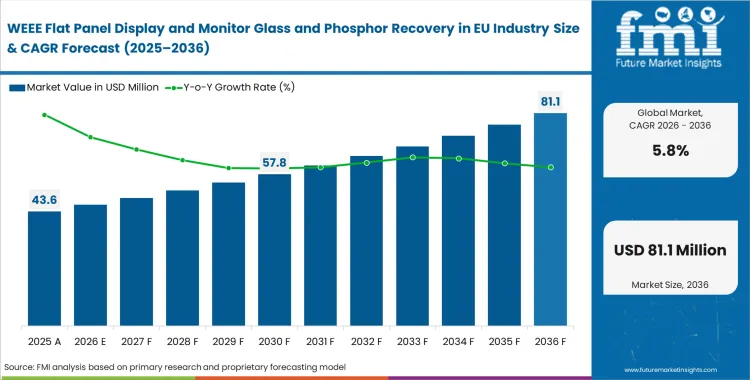
The WEEE flat panel display and monitor glass and phosphor recovery industry in the EU crossed a valuation of USD 41.2 million in 2025 and is estimated to reach USD 43.6 million in 2026. FMI estimates the industry will advance at a CAGR of 5.8% from 2026 to 2036, taking total valuation to USD 76.6 million by 2036. Industry expansion is being shaped by tighter downstream quality requirements, especially where recyclers and metallurgical processors are imposing stricter limits on phosphor residue in recovered glass streams.
Summary of WEEE Flat Panel Display and Monitor Glass and Phosphor Recovery in the EU Industry
- The market is forecast to reach USD 76.6 million by 2036.
- The market is expected to grow at a CAGR of 5.8% from 2026 to 2036.
- The market was estimated at USD 41.2 million in 2025.
- The forecast period represents an incremental opportunity of USD 33.0 million.
- The industry is a compliance-driven recovery niche focused on glass, indium-bearing coatings, and phosphor materials from end-of-life screens and monitors under EU WEEE treatment rules.
- Demand is supported by steady monitored WEEE flows and the need for specialized recovery infrastructure, even as screen waste is no longer the fastest-growing category.
- Semi-automated and robotics-assisted dismantling is improving recovery economics by enabling cleaner fraction separation compared to conventional crushing methods.
- Recovery value is linked to indium in LCD glass and rare-earth elements such as yttrium and europium in phosphor residues.
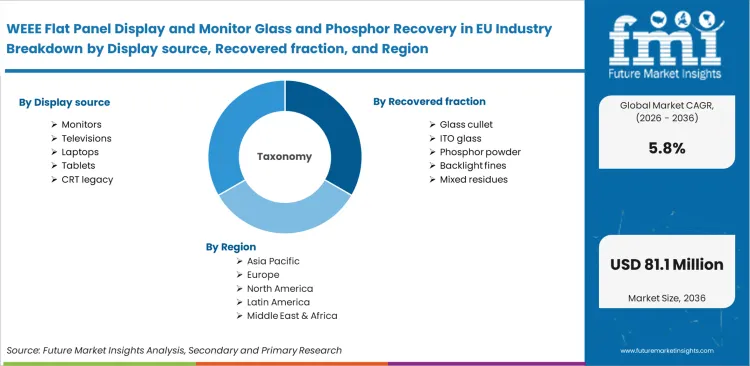
- Monitors lead the display source segment with 38% share, while glass cullet dominates recovered fractions with 56% share.
- Producer schemes account for 44% of collection channels, reflecting the continued importance of EPR-based WEEE systems in Europe.
- Poland, the Netherlands, and Spain are among the fastest-growing markets, with Poland leading at 6.7% CAGR.
- Renewi E-Waste, Stena Recycling, Kuusakoski, Electrocycling, Veolia, and Sims Lifecycle Services are among the key companies active in this market.
Commercial performance in this segment depends increasingly on output quality rather than collection volume alone. Poor phosphor removal lowers the value of glass cullet and can push processors toward lower-grade end markets with weaker pricing. Legacy extraction systems face greater pressure under these conditions because residual yttrium, europium, and similar contaminants reduce buyer acceptance for cleaner recycled inputs. Manual dismantling also slows line speed when screen returns rise, weakening plant utilization and recovery economics. Market conditions are therefore becoming more process-driven, with buyers paying closer attention to how efficiently operators can deliver clean fractions suited for technical reuse. This matters more where recycled material is expected to move into applications such as PCR in consumer electronics, where consistency carries more value than collection tonnage alone.
Payment structures are also moving the market toward tighter performance discipline. Once compensation becomes more closely tied to purity thresholds, investment in semi-automated separation is easier to justify on commercial grounds. This shift changes the balance across the industry by favoring facilities with stronger liberation, sorting, and decontamination capability. Such operators are better placed to secure higher-value contracts when recovered materials are expected to re-enter electronics-grade or specialty-material supply chains. Competitive advantage is therefore moving toward process control and output quality, not collection scale alone.
Poland is projected to witness 6.7% CAGR through 2036, supported by its role in regional collection and cross-border processing of discarded display waste. The Netherlands is expected to expand at 6.2%, helped by established secondary-material networks and stronger links to downstream recovery infrastructure. Spain is likely to grow at 6.0% as processing discipline improves and more operators move toward higher-quality output streams. France is estimated at 5.8%, where regulatory enforcement continues to support cleaner recovery practices. Sweden is anticipated to register 5.5% CAGR, reflecting steady progress in controlled separation and material handling. Germany is projected to post 5.2%, with advancement tied more to yield improvement and process efficiency than to large gains in inbound volume. Italy is expected to record 5.0% during the forecast period as better recovery performance, rather than raw collection expansion, runs the industry movement. Across the EU, this market is separating along technical execution lines, with cleaner extraction capability and tighter contamination control defining which operators move into better-value recovery positions.
Segmental Analysis
WEEE Flat Panel Display and Monitor Glass and Phosphor Recovery in EU Industry Analysis by Display source
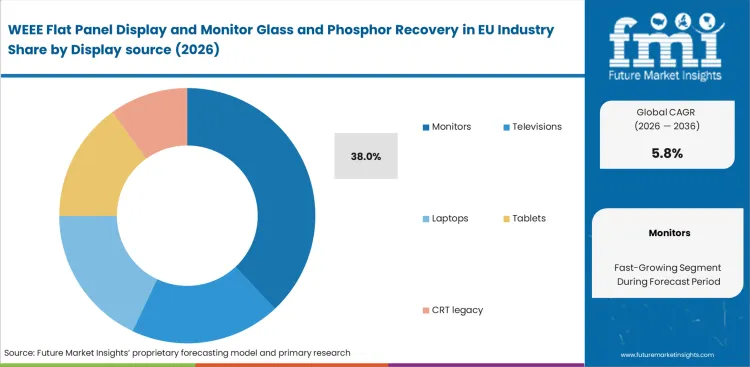
Monitor waste has become a more practical processing stream than mixed television loads because product form is more uniform and easier to dismantle at scale. Corporate desktop refresh cycles also generate steadier batches that fit semi-structured recovery lines better than inconsistent municipal collections. Monitors are estimated to account for 38.0% of the source segment in 2026. Uniform geometry helps operators reduce manual adjustment, improve line speed, and preserve the quality of extracted recycled glass. Mixed television input often weakens these economics because adhesive layouts, panel structures, and embedded components vary too widely across units. Plants that depend too heavily on shredding instead of controlled dismantling can lose indium recovery potential and reduce the value of downstream material output. This keeps monitor waste in a stronger position where process stability and material recovery quality matter most.
- Initial qualification: Corporate IT teams assess recycling partners on secure data destruction and verifiable downstream recovery records. This strengthens the preference for formal monitor recovery channels over fragmented disposal routes.
- Processing economics: Uniform monitor batches reduce sorting error and simplify jig design across dismantling lines. This lowers secondary handling time and improves throughput discipline.
- Contract renewal: OEM compliance teams extend recycler relationships when audited recovery performance meets tighter European material treatment targets. This gives established operators a stronger position in repeat monitor programs.
WEEE Flat Panel Display and Monitor Glass and Phosphor Recovery in EU Industry Analysis by Recovered fraction
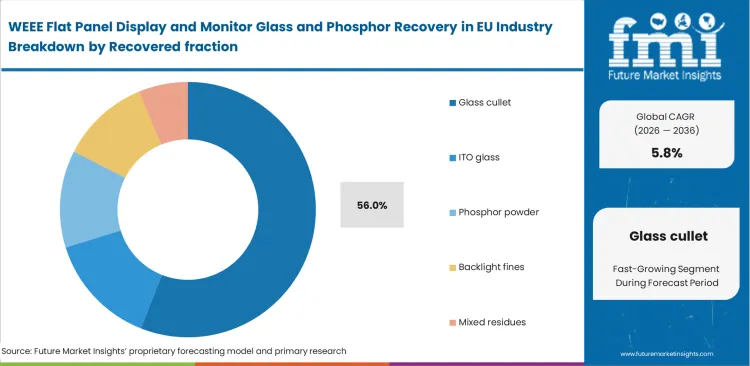
Glass cullet continues to remain the primary output because screen recovery economics depend heavily on efficient handling of the heaviest material fraction. Buyers seeking high-purity cullet provide a practical outlet that helps plants clear floor space and maintain steady intake flow. Glass cullet is estimated to account for 56.0% of the output segment in 2026. Its importance extends beyond volume alone, because compliance performance is also influenced by the total weight recovered through the process. Commercial results still depend on disciplined contamination control, as a broken lamp tube or mishandled dust can reduce the value of an entire batch. Cullet marketability improves when processors apply tighter separation discipline, maintain downstream controls for flat glass quality, and use stabilization additives selectively where required. This keeps glass cullet central to both recovery economics and downstream acceptance.
- Contamination breach: Mishandled dismantling can break fluorescent components and spread hazardous residue through otherwise usable cullet. That can force full batch downgrades and destroy buyer acceptance.
- Residual hazard: Optical sorting alone often fails to remove all fine conductive and phosphor residues. Additional cleaning steps are usually needed before cullet reaches acceptable purity thresholds.
- Value capture: Plants use advanced scanning and verification tools to prove purity before shipment. Higher confidence in material quality supports stronger buyer acceptance and more stable outlet conditions.
WEEE Flat Panel Display and Monitor Glass and Phosphor Recovery in EU Industry Analysis by Treatment process
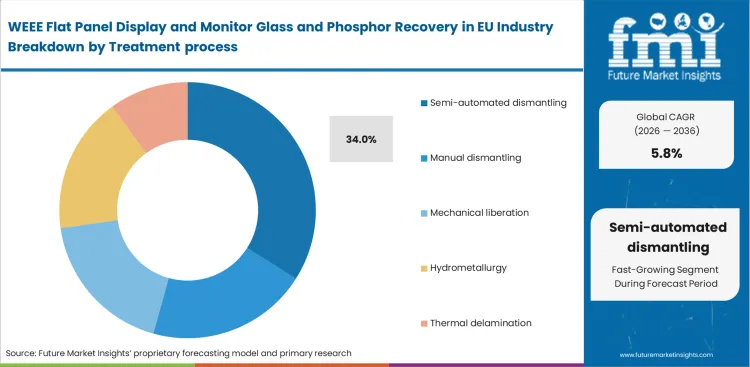
Processing economics in Europe are shaped by a clear trade-off between labor cost and material preservation. Full manual dismantling is too slow for large-volume operations, but uncontrolled shredding destroys recoverable layers and makes hazardous dust harder to manage. Semi-automated dismantling is set to account for 34.0% share in 2026 because it offers a more workable balance between throughput and material control. Robotic unscrewing, guided cutting, and manual inspection allow recyclers to preserve transparent conductive films while preparing cleaner fractions for downstream handling. FMI analysts note that purely mechanical plants often depend on specialist facilities for this step rather than risk fines or excessive contamination. Clean physical separation also improves the usefulness of any follow-on chemical recycling service arrangement.
- Labor scaling: Operators identify repetitive screw removal and panel opening as core bottlenecks in display dismantling. Robotic assistance helps raise throughput without giving up material control.
- Hidden maintenance: Fine glass dust creates wear on moving equipment and raises upkeep needs across semi-automated lines. Maintenance discipline therefore becomes part of treatment economics.
- Lifecycle economics: Hybrid dismantling lines justify investment when better output purity supports higher-value material placement. That makes capital payback more realistic despite high European labor costs.
WEEE Flat Panel Display and Monitor Glass and Phosphor Recovery in EU Industry Analysis by Output use
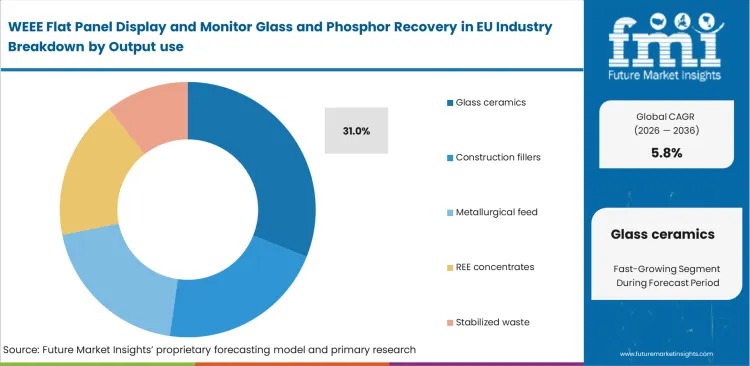
In downstream use, purity carries more weight than volume when recovered screen glass is expected to replace higher-grade industrial materials. Ceramics manufacturers value cullet from flat panels because it offers better thermal behavior and more consistent dimensions under high-temperature processing conditions. Glass ceramics are estimated to account for 31.0% of the end-use segment in 2026. Recyclers that meet these specifications are better placed to avoid lower-value aggregate markets, where margins are tighter and qualification standards offer less commercial upside. Output quality becomes even more important when recovery lines also handle multilayer transparent conductors and phosphor-bearing streams containing rare earth elements. Plants that fall short of ceramics-grade standards can lose access to more attractive end-use channels. This keeps process control and material consistency central to value realization in downstream applications.
- Thermal performance: Ceramics producers test panel-derived cullet for stability under demanding firing conditions. Consistent behavior under heat supports its use in more specialized applications.
- Edge failures: Buyers reject shipments quickly when residual films or bonded layers remain on recovered glass surfaces. Small quality lapses can therefore remove material from premium channels.
- Acceptance standards: Continuous analytical reporting helps recyclers maintain qualification with industrial customers. Reliable proof of composition is often as important as the material itself.
WEEE Flat Panel Display and Monitor Glass and Phosphor Recovery in EU Industry Analysis by Collection channel
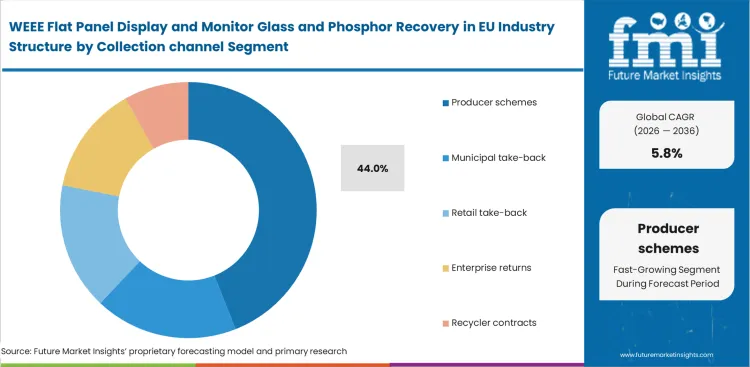
Producer-backed systems continue to anchor collection because manufacturers need a compliant way to manage end-of-life obligations across the region. These schemes also give recyclers steadier baseline volumes than fragmented local collection routes can usually provide. Local underperformance still exists, especially where rural electronics leak into informal channels, but centralized systems remain the dominant formal intake path. Producer schemes are anticipated to account for 44.0% share in 2026. Independent recyclers outside these networks often struggle to secure regular feedstock and plan capacity with confidence. Design changes at the product stage, including the use of debonding adhesive tapes, could gradually make this return flow easier to process and less costly to dismantle.
- Baseline generation: Producer-funded systems support national collection coverage and provide recyclers with more dependable intake. This improves planning visibility across treatment networks.
- Volume constraints: Plants relying on stand-alone municipal contracts often face uneven seasonal inflow of discarded displays. Feedstock inconsistency then weakens labor and equipment utilization.
- Consolidation reality: Regional collection structures are gradually moving toward larger integrated return systems. That shift favors operators positioned within formal producer-led channels.
WEEE Flat Panel Display and Monitor Glass and Phosphor Recovery in EU Industry Drivers, Restraints, and Opportunities
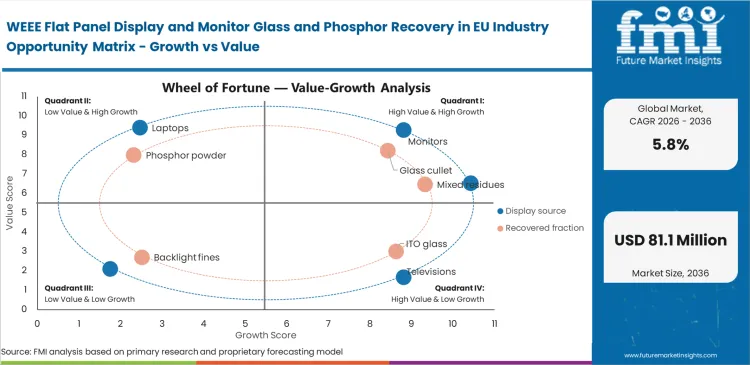
Hazardous waste penalties are increasing the need for immediate isolation of critical screen fractions. Mixed screen residue has become harder to store or dispose of economically when hazardous classification can raise treatment cost and compliance burden. This pressure is pushing operators away from bulk landfilling and toward earlier-stage extraction of phosphor-bearing and rare-earth-containing material streams. Recovery upgrades are gaining priority because better separation helps protect both material value and regulatory compliance. Optical sorting also carries added importance where clean glass fractions can lose commercial value once hazardous contaminants spread across the batch. This makes early-stage control a central requirement in monitor phosphor recovery rather than a secondary processing choice.
Cross-contamination during high-speed shredding continues to weaken recovery economics. Mechanical breakage can spread hazardous fragments from fluorescent tubes, LED assemblies, and coated components into bulk glass streams, making downstream purification more difficult and more expensive. Full cleanup often requires chemical treatment capability that many local facilities cannot justify on cost or permitting grounds. Transporting contaminated glass dust to specialized recycling services can also erode margins because the material is heavy, low in value before treatment, and costly to move. Process economics therefore favor controlled dismantling and cleaner fraction separation before contamination spreads through the line.
Opportunities in the WEEE Flat Panel Display and Monitor Glass and Phosphor Recovery in EU Industry
- Hydrometallurgical extraction integration: Chemical engineers establishing localized leaching tanks capture premium pricing from rare-earth refiners while safely processing battery materials recycling inputs simultaneously.
- Closed-loop supply agreements: Display manufacturers secure domestic supply‑chain resilience by contracting directly with specialized integrated recycling hubs.
- Automated delamination scaling: Thermal debonding line deployment reduces manual labor requirements while enabling higher value capture from rare‑earth elements in monitor phosphors.
Regional Analysis
Based on regional analysis, WEEE Flat Panel Display and Monitor Glass and Phosphor Recovery in EU is segmented into Poland, Netherlands, Spain, France, Sweden, Germany, and Italy across 40 plus countries.
.webp "Top Country Growth Comparison Weee Flat Panel Display And Monitor Glass And Phosphor Recovery In Eu Industry Cagr (2026 2036)")
| Country | CAGR (2026 to 2036) |
|---|---|
| Poland | 6.7% |
| Netherlands | 6.2% |
| Spain | 6.0% |
| France | 5.8% |
| Sweden | 5.5% |
| Germany | 5.2% |
| Italy | 5.0% |
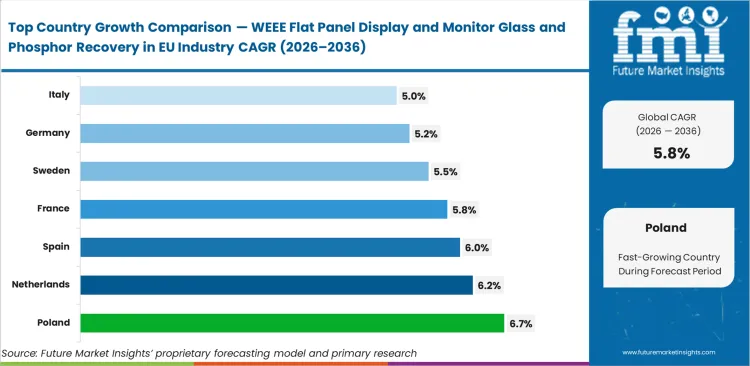
Source: Future Market Insights (FMI) analysis, based on proprietary forecasting model and primary research
Poland WEEE Flat Panel Display and Monitor Glass and Phosphor Recovery in EU Industry Analysis
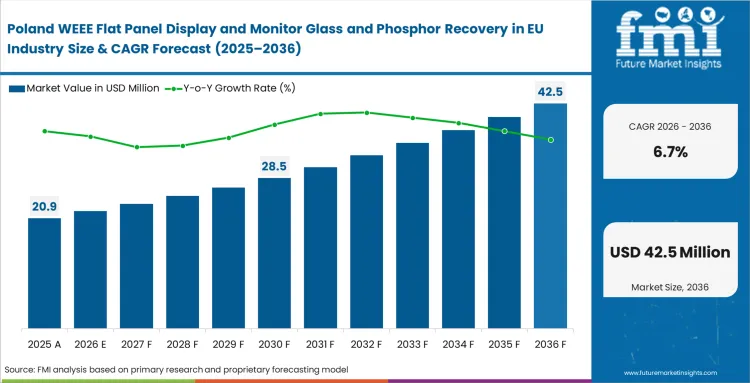
Cross-border logistics positioning transforms eastern European processing hubs into primary sorting destinations. Favorable labor economics allow facilities to scale complex semi-automated dismantling lines faster than western counterparts. FMI's analysis indicates aggressive formalization of previously informal e-waste streams creates massive volume consolidation across this Poland display glass recycling market. Inbound shipments from neighboring states are processed strictly to new EU specifications. Securing advanced processing permits locks in lucrative, multi-year intake contracts from multinational producer responsibility organizations.
- Poland: High-complexity monitor batches are actively routed eastward to optimize manual separation costs. Local treatment centers expand capacity rapidly to handle the influx of intact screens. Demand for monitor glass recovery in Poland is anticipated to rise at a CAGR of 6.7% during the forecast in period. Early specialization and licensing grants local recyclers dominant commercial contracts across central European recovery corridors.
Netherlands WEEE Flat Panel Display and Monitor Glass and Phosphor Recovery in EU Industry Analysis
High port infrastructure connectivity accelerates the movement of secondary metallurgical feeds. Dense inland waterway networks facilitate the efficient shipment of bulk glass cullet to industrial ceramics buyers. Based on FMI's assessment, strong early adoption of producer scheme funding created highly capitalized recycling sectors. Focus remains entirely on increasing purity parts-per-million rather than simply chasing raw tonnage. Continuous optimization of recycling feedstock hub services signals complete transitions toward high-purity chemical processing over mechanical shredding.
- Netherlands: Strict zero-landfill policies compel recycling centers to monetize every fraction of incoming display units. The Netherlands is projected to witness 6.2% CAGR in the flat panel recovery market through 2036. Advanced optical sorting becomes mandatory for commercial survival. National material recovery ecosystems rapidly approach a state where pure material output values eclipse initial collection subsidies, ensuring sustained operational viability.
Spain WEEE Flat Panel Display and Monitor Glass and Phosphor Recovery in EU Industry Analysis
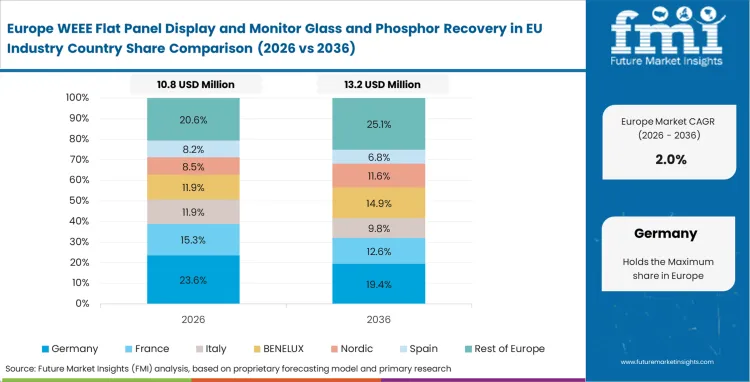
Upgrading regional mechanical shredding lines to accommodate dedicated flat panel dismantling dictates southern European expansion. Mixed WEEE processing historically dominated, but contamination penalties now require isolated screen environments. FMI observes localized collection networks are rapidly integrating with national producer schemes. Regional glass manufacturers increasingly substitute raw silica with certified clean cullet. Domestic recyclers achieving high-purity output position themselves effectively against cheaper imported secondary materials from non-EU processors.
- Spain: Urgent mandates to clear legacy CRT stockpiles coincide with the necessity of building modern LED separation lines. Balancing these dual operational loads requires precise capital deployment. Sales of secondary glass and phosphor outputs in Spain are poised to grow at a CAGR of 6.0% during the forecast period. Surviving facilities emerge with highly flexible architectures, outcompeting slower legacy processors across adjacent Mediterranean markets.
FMI's report includes France, Sweden, Germany, and Italy. Established infrastructure limits raw volume growth across this Germany monitor glass recovery market, pushing facilities to invest heavily in advanced metal recycling equipment. Squeezing fractional yields from mature collection streams remains critical while matching broader display glass recovery CAGR Europe trends.
Competitive Aligners for Market Players
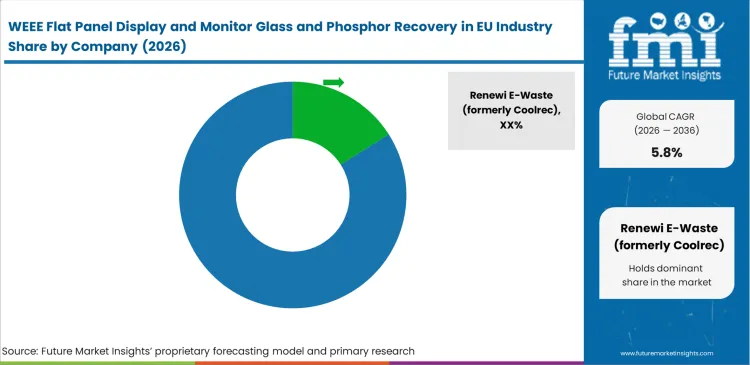
Handling hazardous display fractions profitably requires regulatory certification, which creates meaningful operating barriers across this market. Large processors hold an advantage because dedicated negative-pressure dismantling lines require capital, process discipline, and approved handling capability. Smaller local scrap yards often remain limited to collection or pre-sorting roles when full screen processing demands tighter compliance control. Competitive strength is therefore shaped less by intake volume alone and more by the ability to deliver low-contamination glass cullet and cleaner downstream fractions. This keeps certified processing capability central to both margin protection and contract retention.
Established processors also benefit from broader assay records and product-specific processing knowledge built over time. That operating intelligence helps improve batch selection, recovery planning, and line efficiency across corporate IT return streams with more predictable value. Corporate buyers in this segment also place greater weight on downstream auditability and traceable material handling. New entrants face a slower path because process databases, model-specific dismantling knowledge, and stable automation settings are difficult to build quickly. Unexpected adhesive types, mixed assemblies, and inconsistent product construction can reduce line efficiency and weaken recovery value when systems are not tuned to handle them. This gives experienced operators an advantage in protecting both throughput and output quality.
Producer responsibility structures also influence how national volumes move through the market. Downstream transparency, documented final treatment pathways, and consistent compliance records carry clear weight in processor selection. Contract continuity depends heavily on reliable documentation and disciplined hazardous fraction management. Market concentration therefore remains stronger where processors can combine certified handling, traceable downstream control, and stable operating execution across large intake volumes.
Key Players in WEEE Flat Panel Display and Monitor Glass and Phosphor Recovery in EU Industry
- Renewi E-Waste (formerly Coolrec)
- Stena Recycling
- Kuusakoski
- Electrocycling
- Veolia
- Sims Lifecycle Services
Scope of the Report
| Metric | Value |
|---|---|
| Quantitative Units | USD 43.6 million to USD 76.6 million, at a CAGR of 5.80% |
| Market Definition | Industrial extraction and purification of glass substrates and rare-earth phosphor compounds from discarded flat panel screens, separating hazardous materials generating clean secondary feeds. |
| Segmentation | Display source, Recovered fraction, Treatment process, Output use, Collection channel, Region |
| Regions Covered | North America, Latin America, Western Europe, Eastern Europe, Asia Pacific |
| Countries Covered | Poland, Netherlands, Spain, France, Sweden, Germany, Italy |
| Key Companies Profiled | Renewi E-Waste (formerly Coolrec), Stena Recycling, Kuusakoski, Electrocycling, Veolia, Sims Lifecycle Services |
| Forecast Period | 2026 to 2036 |
| Approach | Authorized facility intake tonnages and secondary material sales cross-referencing |
Source: Future Market Insights (FMI) analysis, based on proprietary forecasting model and primary research
WEEE Flat Panel Display and Monitor Glass and Phosphor Recovery in EU Industry Analysis by Segments
Display source
- Monitors
- Televisions
- Laptops
- Tablets
- CRT legacy
Recovered fraction
- Glass cullet
- ITO glass
- Phosphor powder
- Backlight fines
- Mixed residues
Treatment process
- Semi-automated dismantling
- Manual dismantling
- Mechanical liberation
- Hydrometallurgy
- Thermal delamination
Output use
- Glass ceramics
- Construction fillers
- Metallurgical feed
- REE concentrates
- Stabilized waste
Collection channel
- Producer schemes
- Municipal take-back
- Retail take-back
- Enterprise returns
- Recycler contracts
Region
- Poland
- Netherlands
- Spain
- France
- Sweden
- Germany
- Italy
Bibliography
- Figueiredo, F. M. J., Leal, J. P., Bordado, J., Durão, F., Marçalo, J., & Sardinha, J. P. (2025). A comprehensive review on Y and Eu recovery from cathode-ray tube phosphors. Resources, Conservation and Recycling, 223, 108481.
- Hamzat, A. K., Murad, M. S., Subeshan, B., Asmatulu, R., & Asmatulu, E. (2025). Rare earth element recycling: A review on sustainable solutions and impacts on semiconductor and chip industries. Journal of Material Cycles and Waste Management, 27, 3009-3032.
- Mohapatra, S. S., Sahu, R., Ramakrishna, D. S., & Lakshmi Praveen, P. (2026). Analysis of molecular structures for pollutant degradation: Recovery of liquid crystals and heavy metals from display panels via physical and chemical processes. Journal of Molecular Structure, 1335, 144078.
- Romagnoli, V., Berlinghof, T., Parchomenko, A., Weissenbacher, J., Fratini, L., López Hernández, V., Baron, Y., Lorösch, H., Moch, K., Graulich, K., Stalmans, A., Asscherickx, L., Duhoux, T., Gama Caldas, M., & Senatore, V. (2026). Study on the destruction of unsold products. Publications Office of the European Union.
- Serpe, A., Purchase, D., Bisschop, L., Chatterjee, D., De Gioannis, G., Garelick, H., Kumar, A., Peijnenburg, W. J. G. M., Piro, V. M. I., Cera, M., Shevah, Y., & Verbeek, S. (2024). 2002-2022: 20 years of e-waste regulation in the European Union and the worldwide trends in legislation and innovation technologies for a circular economy. RSC Sustainability, 3(3), 1039-1083.
This bibliography is provided for reader reference. The full FMI report contains the complete reference list with primary source documentation.
This Report Addresses
- Specific processing economics of semi-automated dismantling lines for enterprise monitor streams.
- Downstream commercial requirements for integrating glass cullet into high-temperature ceramics.
- Technical limitations of mechanical shredding when managing hazardous backlight cross-contamination.
- Financial mechanisms connecting OEM producer responsibility schemes to specialized local treatment facilities.
- Purity thresholds mandated by metallurgical buyers for europium and yttrium recovery.
- Cross-border logistics impacts on processing consolidation in eastern European recycling hubs.
- Robotics integration costs versus manual labor expenditure in advanced European treatment plants.
- Chemical leaching scalability for extracting trace rare-earth elements from phosphor powder.
Frequently Asked Questions
What is the market size of EU display glass recycling?
Demand is expected to reach USD 43.6 million in 2026. This valuation reflects baseline processing fees paid by producer schemes combined with secondary material sales of clean glass cullet and extracted metals.
Tell me the EU industry outlook for monitor glass recovery?
Revenues are projected to cross USD 76.6 million by 2036. Stricter European mandates forcing verified closed-loop recycling of critical raw materials run this sustained expansion across authorized treatment facilities.
How big is the EU phosphor recovery opportunity from monitors?
Sales expansion is poised to advance at 5.80% CAGR through 2036. Heavy capital expenditure requirements for advanced optical sorting and chemical leaching technologies moderate overall speed of capacity growth.
Who are the top players in monitor glass recovery EU?
Leading processors operating certified negative-pressure lines include Renewi E-Waste, Stena Recycling, Kuusakoski, Electrocycling, Veolia, and Sims Lifecycle Services. These entities dominate highly regulated commercial contracts.
How is monitor glass recycled in Europe?
Facilities combine semi-automated unscrewing robots with human inspection sorting. This hybrid process removes hazardous backlights safely before remaining silica substrates undergo optical laser scanning and crushing.
What is included in the EU monitor glass and phosphor recovery market?
Operations covering physical dismantling, mechanical separation, and chemical leaching of flat panel components fall strictly within scope. Focus remains entirely on isolating clean cullet and concentrated rare-earth powders.
Why is monitor glass recovery different from general e-waste recycling?
Shattering modern flat panels releases microscopic mercury and phosphor dust that permanently poisons bulk glass streams. Handling these screens requires specialized negative-pressure ventilation absent in standard appliance shredding yards.
Which materials are recovered from flat panel displays and old monitors?
Primary extracted fractions include glass cullet, indium tin oxide glass, concentrated phosphor powder containing yttrium and europium, and isolated backlight fines. High-purity silica dictates base facility profitability.
Which EU countries are growing fastest in this niche?
Poland leads adoption at 6.7% CAGR, functioning as a cross-border logistics hub where favorable labor economics permit rapid scaling of complex semi-automated dismantling lines.
Who are the leading recyclers in EU display glass recovery?
Facilities backed by deep capital reserves, such as Veolia and Stena Recycling, control premium outputs. These operators afford required environmental permits impossible for independent municipal scrap yards securing.
How does phosphor recovery create value in legacy monitor streams?
Extracting yttrium and europium provides lucrative secondary revenue channels. Metallurgical buyers increasingly seek domestic European sources for these critical rare-earth elements securing supply chain resilience against import volatility.
What is the role of indium-bearing LCD glass in market growth?
Properly isolating indium tin oxide layers prevents cross-contamination of bulk ceramics-grade cullet. Advanced facilities deploy specialized chemical washing capturing this high-value trace metal before shipping silica substrates.
Why does selective dismantling matter more than simple shredding?
Mechanical impact destroys polarizing films and embedded LED arrays, grinding hazardous components directly into recoverable glass. Selective dismantling preserves clean silica mass securing premium prices from industrial ceramics buyers.
What does EU WEEE regulation require for screen and monitor treatment?
Updated environmental directives mandate strict removal of all mercury-bearing components and fluorescent powders before any subsequent material crushing occurs, heavily penalizing operators attempting bulk landfilling.
How does the LCD glass recovery industry in Europe operate?
Industrial ceramics buyers prioritize screen-derived cullet due to its superior dimensional stability and resistance to thermal deformation at elevated firing temperatures compared with standard bottle glass. Continuous spectrographic analysis maintains vendor qualification status.
How does phosphor recovery for rare earth extraction function?
Chemical engineers establish localized hydrometallurgical leaching tanks separating toxic binders from critical elements. Safely processed powders command premium pricing from domestic rare-earth refiners lacking alternative primary inputs.
What challenges constrain the flat panel display glass recycling market in Europe?
Transporting heavy, toxic phosphor dust to specialized processing hubs destroys localized margins. Most local mechanical recyclers lack environmental permits building dedicated chemical leaching tanks on-site.
What is the primary operational friction slowing facility upgrades?
Robotic joint actuators degrade rapidly when exposed to abrasive glass dust inside dismantling environments. Financial controllers must balance lowered labor costs against significantly inflated annual maintenance budgets.
How do corporate IT refresh cycles influence processing economics?
Enterprise asset disposition yields uniform pallets of identical commercial monitors. Robotic jigs are optimized for these predictable formats, drastically reducing per-unit disassembly time.
Why do ceramics manufacturers prefer monitor-derived cullet over bottle glass?
Production engineers validate flat panel silica for superior dimensional stability under extreme firing temperatures. Guaranteeing parts-per-million purity levels secures long-term offtake agreements.
How do inland waterway logistics benefit Dutch recycling operators?
Dense canal networks minimize bulk transport costs for heavy glass outputs. High-purity cullet is shipped directly to industrial buyers efficiently, offsetting initial domestic collection expenses.
Why are independent municipal scrap yards losing flat panel feedstock volumes?
Producer responsibility organizations centralize national e-waste funding toward preferred partners. Smaller operators failing downstream transparency audits lose access to subsidized baseline volumes permanently.
What penalty do firms face for mercury cross-contamination?
Shipments are rejected immediately if sensors detect trace hazardous powders. Contaminated batches require expensive reclassification and specialized disposal, destroying entire monthly operating margins.
How do debonding tapes improve manual dismantling speeds?
Hardware manufacturers integrating specialized thermal release adhesives drastically reduce downstream disassembly time. Recyclers process these screens exponentially faster than units bonded with permanent industrial glues.
Preview the report firsthand - request a free sample
Get SampleGet the brochure for pricing and purchase details.
Get PDFTable of Content
- Executive Summary
- Global Market Outlook
- Demand-side Trends
- Supply-side Trends
- Technology Roadmap Analysis
- Analysis and Recommendations
- Market Overview
- Market Coverage / Taxonomy
- Market Definition / Scope / Limitations
- Research Methodology
- Chapter Orientation
- Analytical Lens and Working Hypotheses
- Market Structure, Signals, and Trend Drivers
- Benchmarking and Cross-market Comparability
- Market Sizing, Forecasting, and Opportunity Mapping
- Research Design and Evidence Framework
- Desk Research Programme (Secondary Evidence)
- Company Annual and Sustainability Reports
- Peer-reviewed Journals and Academic Literature
- Corporate Websites, Product Literature, and Technical Notes
- Earnings Decks and Investor Briefings
- Statutory Filings and Regulatory Disclosures
- Technical White Papers and Standards Notes
- Trade Journals, Industry Magazines, and Analyst Briefs
- Conference Proceedings, Webinars, and Seminar Materials
- Government Statistics Portals and Public Data Releases
- Press Releases and Reputable Media Coverage
- Specialist Newsletters and Curated Briefings
- Sector Databases and Reference Repositories
- FMI Internal Proprietary Databases and Historical Market Datasets
- Subscription Datasets and Paid Sources
- Social Channels, Communities, and Digital Listening Inputs
- Additional Desk Sources
- Expert Input and Fieldwork (Primary Evidence)
- Primary Modes
- Qualitative Interviews and Expert Elicitation
- Quantitative Surveys and Structured Data Capture
- Blended Approach
- Why Primary Evidence is Used
- Field Techniques
- Interviews
- Surveys
- Focus Groups
- Observational and In-context Research
- Social and Community Interactions
- Stakeholder Universe Engaged
- C-suite Leaders
- Board Members
- Presidents and Vice Presidents
- R&D and Innovation Heads
- Technical Specialists
- Domain Subject-matter Experts
- Scientists
- Physicians and Other Healthcare Professionals
- Governance, Ethics, and Data Stewardship
- Research Ethics
- Data Integrity and Handling
- Primary Modes
- Tooling, Models, and Reference Databases
- Desk Research Programme (Secondary Evidence)
- Data Engineering and Model Build
- Data Acquisition and Ingestion
- Cleaning, Normalisation, and Verification
- Synthesis, Triangulation, and Analysis
- Quality Assurance and Audit Trail
- Market Background
- Market Dynamics
- Drivers
- Restraints
- Opportunity
- Trends
- Scenario Forecast
- Demand in Optimistic Scenario
- Demand in Likely Scenario
- Demand in Conservative Scenario
- Opportunity Map Analysis
- Product Life Cycle Analysis
- Supply Chain Analysis
- Investment Feasibility Matrix
- Value Chain Analysis
- PESTLE and Porter’s Analysis
- Regulatory Landscape
- Regional Parent Market Outlook
- Production and Consumption Statistics
- Import and Export Statistics
- Market Dynamics
- Global Market Analysis 2021 to 2025 and Forecast, 2026 to 2036
- Historical Market Size Value (USD Million) Analysis, 2021 to 2025
- Current and Future Market Size Value (USD Million) Projections, 2026 to 2036
- Y-o-Y Growth Trend Analysis
- Absolute $ Opportunity Analysis
- Global Market Pricing Analysis 2021 to 2025 and Forecast 2026 to 2036
- Global Market Analysis 2021 to 2025 and Forecast 2026 to 2036, By Display source
- Introduction / Key Findings
- Historical Market Size Value (USD Million) Analysis By Display source , 2021 to 2025
- Current and Future Market Size Value (USD Million) Analysis and Forecast By Display source , 2026 to 2036
- Monitors
- Televisions
- Laptops
- Tablets
- CRT legacy
- Monitors
- Y-o-Y Growth Trend Analysis By Display source , 2021 to 2025
- Absolute $ Opportunity Analysis By Display source , 2026 to 2036
- Global Market Analysis 2021 to 2025 and Forecast 2026 to 2036, By Recovered fraction
- Introduction / Key Findings
- Historical Market Size Value (USD Million) Analysis By Recovered fraction, 2021 to 2025
- Current and Future Market Size Value (USD Million) Analysis and Forecast By Recovered fraction, 2026 to 2036
- Glass cullet
- ITO glass
- Phosphor powder
- Backlight fines
- Mixed residues
- Glass cullet
- Y-o-Y Growth Trend Analysis By Recovered fraction, 2021 to 2025
- Absolute $ Opportunity Analysis By Recovered fraction, 2026 to 2036
- Global Market Analysis 2021 to 2025 and Forecast 2026 to 2036, By Treatment process
- Introduction / Key Findings
- Historical Market Size Value (USD Million) Analysis By Treatment process, 2021 to 2025
- Current and Future Market Size Value (USD Million) Analysis and Forecast By Treatment process, 2026 to 2036
- Semi-automated dismantling
- Manual dismantling
- Mechanical liberation
- Hydrometallurgy
- Thermal delamination
- Semi-automated dismantling
- Y-o-Y Growth Trend Analysis By Treatment process, 2021 to 2025
- Absolute $ Opportunity Analysis By Treatment process, 2026 to 2036
- Global Market Analysis 2021 to 2025 and Forecast 2026 to 2036, By Output use
- Introduction / Key Findings
- Historical Market Size Value (USD Million) Analysis By Output use, 2021 to 2025
- Current and Future Market Size Value (USD Million) Analysis and Forecast By Output use, 2026 to 2036
- Glass ceramics
- Construction fillers
- Metallurgical feed
- REE concentrates
- Stabilized waste
- Glass ceramics
- Y-o-Y Growth Trend Analysis By Output use, 2021 to 2025
- Absolute $ Opportunity Analysis By Output use, 2026 to 2036
- Global Market Analysis 2021 to 2025 and Forecast 2026 to 2036, By Collection channel
- Introduction / Key Findings
- Historical Market Size Value (USD Million) Analysis By Collection channel, 2021 to 2025
- Current and Future Market Size Value (USD Million) Analysis and Forecast By Collection channel, 2026 to 2036
- Producer schemes
- Municipal take-back
- Retail take-back
- Enterprise returns
- Recycler contracts
- Producer schemes
- Y-o-Y Growth Trend Analysis By Collection channel, 2021 to 2025
- Absolute $ Opportunity Analysis By Collection channel, 2026 to 2036
- Global Market Analysis 2021 to 2025 and Forecast 2026 to 2036, By Region
- Introduction
- Historical Market Size Value (USD Million) Analysis By Region, 2021 to 2025
- Current Market Size Value (USD Million) Analysis and Forecast By Region, 2026 to 2036
- North America
- Latin America
- Western Europe
- Eastern Europe
- East Asia
- South Asia and Pacific
- Middle East & Africa
- Market Attractiveness Analysis By Region
- North America Market Analysis 2021 to 2025 and Forecast 2026 to 2036, By Country
- Historical Market Size Value (USD Million) Trend Analysis By Market Taxonomy, 2021 to 2025
- Market Size Value (USD Million) Forecast By Market Taxonomy, 2026 to 2036
- By Country
- USA
- Canada
- Mexico
- By Display source
- By Recovered fraction
- By Treatment process
- By Output use
- By Collection channel
- By Country
- Market Attractiveness Analysis
- By Country
- By Display source
- By Recovered fraction
- By Treatment process
- By Output use
- By Collection channel
- Key Takeaways
- Latin America Market Analysis 2021 to 2025 and Forecast 2026 to 2036, By Country
- Historical Market Size Value (USD Million) Trend Analysis By Market Taxonomy, 2021 to 2025
- Market Size Value (USD Million) Forecast By Market Taxonomy, 2026 to 2036
- By Country
- Brazil
- Chile
- Rest of Latin America
- By Display source
- By Recovered fraction
- By Treatment process
- By Output use
- By Collection channel
- By Country
- Market Attractiveness Analysis
- By Country
- By Display source
- By Recovered fraction
- By Treatment process
- By Output use
- By Collection channel
- Key Takeaways
- Western Europe Market Analysis 2021 to 2025 and Forecast 2026 to 2036, By Country
- Historical Market Size Value (USD Million) Trend Analysis By Market Taxonomy, 2021 to 2025
- Market Size Value (USD Million) Forecast By Market Taxonomy, 2026 to 2036
- By Country
- Germany
- UK
- Italy
- Spain
- France
- Nordic
- BENELUX
- Rest of Western Europe
- By Display source
- By Recovered fraction
- By Treatment process
- By Output use
- By Collection channel
- By Country
- Market Attractiveness Analysis
- By Country
- By Display source
- By Recovered fraction
- By Treatment process
- By Output use
- By Collection channel
- Key Takeaways
- Eastern Europe Market Analysis 2021 to 2025 and Forecast 2026 to 2036, By Country
- Historical Market Size Value (USD Million) Trend Analysis By Market Taxonomy, 2021 to 2025
- Market Size Value (USD Million) Forecast By Market Taxonomy, 2026 to 2036
- By Country
- Russia
- Poland
- Hungary
- Balkan & Baltic
- Rest of Eastern Europe
- By Display source
- By Recovered fraction
- By Treatment process
- By Output use
- By Collection channel
- By Country
- Market Attractiveness Analysis
- By Country
- By Display source
- By Recovered fraction
- By Treatment process
- By Output use
- By Collection channel
- Key Takeaways
- East Asia Market Analysis 2021 to 2025 and Forecast 2026 to 2036, By Country
- Historical Market Size Value (USD Million) Trend Analysis By Market Taxonomy, 2021 to 2025
- Market Size Value (USD Million) Forecast By Market Taxonomy, 2026 to 2036
- By Country
- China
- Japan
- South Korea
- By Display source
- By Recovered fraction
- By Treatment process
- By Output use
- By Collection channel
- By Country
- Market Attractiveness Analysis
- By Country
- By Display source
- By Recovered fraction
- By Treatment process
- By Output use
- By Collection channel
- Key Takeaways
- South Asia and Pacific Market Analysis 2021 to 2025 and Forecast 2026 to 2036, By Country
- Historical Market Size Value (USD Million) Trend Analysis By Market Taxonomy, 2021 to 2025
- Market Size Value (USD Million) Forecast By Market Taxonomy, 2026 to 2036
- By Country
- India
- ASEAN
- Australia & New Zealand
- Rest of South Asia and Pacific
- By Display source
- By Recovered fraction
- By Treatment process
- By Output use
- By Collection channel
- By Country
- Market Attractiveness Analysis
- By Country
- By Display source
- By Recovered fraction
- By Treatment process
- By Output use
- By Collection channel
- Key Takeaways
- Middle East & Africa Market Analysis 2021 to 2025 and Forecast 2026 to 2036, By Country
- Historical Market Size Value (USD Million) Trend Analysis By Market Taxonomy, 2021 to 2025
- Market Size Value (USD Million) Forecast By Market Taxonomy, 2026 to 2036
- By Country
- Kingdom of Saudi Arabia
- Other GCC Countries
- Turkiye
- South Africa
- Other African Union
- Rest of Middle East & Africa
- By Display source
- By Recovered fraction
- By Treatment process
- By Output use
- By Collection channel
- By Country
- Market Attractiveness Analysis
- By Country
- By Display source
- By Recovered fraction
- By Treatment process
- By Output use
- By Collection channel
- Key Takeaways
- Key Countries Market Analysis
- USA
- Pricing Analysis
- Market Share Analysis, 2025
- By Display source
- By Recovered fraction
- By Treatment process
- By Output use
- By Collection channel
- Canada
- Pricing Analysis
- Market Share Analysis, 2025
- By Display source
- By Recovered fraction
- By Treatment process
- By Output use
- By Collection channel
- Mexico
- Pricing Analysis
- Market Share Analysis, 2025
- By Display source
- By Recovered fraction
- By Treatment process
- By Output use
- By Collection channel
- Brazil
- Pricing Analysis
- Market Share Analysis, 2025
- By Display source
- By Recovered fraction
- By Treatment process
- By Output use
- By Collection channel
- Chile
- Pricing Analysis
- Market Share Analysis, 2025
- By Display source
- By Recovered fraction
- By Treatment process
- By Output use
- By Collection channel
- Germany
- Pricing Analysis
- Market Share Analysis, 2025
- By Display source
- By Recovered fraction
- By Treatment process
- By Output use
- By Collection channel
- UK
- Pricing Analysis
- Market Share Analysis, 2025
- By Display source
- By Recovered fraction
- By Treatment process
- By Output use
- By Collection channel
- Italy
- Pricing Analysis
- Market Share Analysis, 2025
- By Display source
- By Recovered fraction
- By Treatment process
- By Output use
- By Collection channel
- Spain
- Pricing Analysis
- Market Share Analysis, 2025
- By Display source
- By Recovered fraction
- By Treatment process
- By Output use
- By Collection channel
- France
- Pricing Analysis
- Market Share Analysis, 2025
- By Display source
- By Recovered fraction
- By Treatment process
- By Output use
- By Collection channel
- India
- Pricing Analysis
- Market Share Analysis, 2025
- By Display source
- By Recovered fraction
- By Treatment process
- By Output use
- By Collection channel
- ASEAN
- Pricing Analysis
- Market Share Analysis, 2025
- By Display source
- By Recovered fraction
- By Treatment process
- By Output use
- By Collection channel
- Australia & New Zealand
- Pricing Analysis
- Market Share Analysis, 2025
- By Display source
- By Recovered fraction
- By Treatment process
- By Output use
- By Collection channel
- China
- Pricing Analysis
- Market Share Analysis, 2025
- By Display source
- By Recovered fraction
- By Treatment process
- By Output use
- By Collection channel
- Japan
- Pricing Analysis
- Market Share Analysis, 2025
- By Display source
- By Recovered fraction
- By Treatment process
- By Output use
- By Collection channel
- South Korea
- Pricing Analysis
- Market Share Analysis, 2025
- By Display source
- By Recovered fraction
- By Treatment process
- By Output use
- By Collection channel
- Russia
- Pricing Analysis
- Market Share Analysis, 2025
- By Display source
- By Recovered fraction
- By Treatment process
- By Output use
- By Collection channel
- Poland
- Pricing Analysis
- Market Share Analysis, 2025
- By Display source
- By Recovered fraction
- By Treatment process
- By Output use
- By Collection channel
- Hungary
- Pricing Analysis
- Market Share Analysis, 2025
- By Display source
- By Recovered fraction
- By Treatment process
- By Output use
- By Collection channel
- Kingdom of Saudi Arabia
- Pricing Analysis
- Market Share Analysis, 2025
- By Display source
- By Recovered fraction
- By Treatment process
- By Output use
- By Collection channel
- Turkiye
- Pricing Analysis
- Market Share Analysis, 2025
- By Display source
- By Recovered fraction
- By Treatment process
- By Output use
- By Collection channel
- South Africa
- Pricing Analysis
- Market Share Analysis, 2025
- By Display source
- By Recovered fraction
- By Treatment process
- By Output use
- By Collection channel
- USA
- Market Structure Analysis
- Competition Dashboard
- Competition Benchmarking
- Market Share Analysis of Top Players
- By Regional
- By Display source
- By Recovered fraction
- By Treatment process
- By Output use
- By Collection channel
- Competition Analysis
- Competition Deep Dive
- Renewi E-Waste (formerly Coolrec)
- Overview
- Product Portfolio
- Profitability by Market Segments (Product/Age /Sales Channel/Region)
- Sales Footprint
- Strategy Overview
- Marketing Strategy
- Product Strategy
- Channel Strategy
- Stena Recycling
- Kuusakoski
- Electrocycling
- Veolia
- Sims Lifecycle Services
- Renewi E-Waste (formerly Coolrec)
- Competition Deep Dive
- Assumptions & Acronyms Used


