

- Industry Size (2026)
- USD 3240 Mn
- Forecast (2036)
- USD 8960 Mn
- CAGR (2026 to 2036)
- 10.7%
Integrated Recycling Hubs Market Size and Share Forecast Outlook 2026 to 2036
The integrated recycling hubs market revenue is likely to total USD 3,240 million in 2026, rising further to USD 8,960 million by 2036, at a CAGR of 10.7%. Future Market Insights analysis indicates this market is evolving from basic material recovery facilities into sophisticated industrial platforms that serve as the foundational infrastructure for the circular economy. This expansion through 2026 is propelled by legislation enforcing extended producer responsibility, corporate demand for traceable recycled feedstocks, and significant public-private investment in recycling modernization.
A central driver shaping the integrated recycling hubs market is the operationalization of EPR frameworks, which require producers to finance the collection, sorting, and recycling of post-consumer waste. In Europe, packaging EPR schemes have moved beyond basic compliance toward performance-based requirements, reinforcing the need for higher sorting efficiency and output quality. In Germany, ongoing tightening of packaging compliance rules, including updated minimum standards for recyclability and material recovery, has strengthened the investment case for large-scale, centralized sorting and recycling infrastructure capable of delivering cleaner secondary raw materials at industrial scale.
The economic rationale for integrated hubs is increasingly validated by their impact on material yield and quality. Co-locating advanced sorting technologies such as near-infrared identification with washing, densification, and pre-processing stages reduces handling losses and contamination that typically arise in fragmented processing chains. Industry case evidence from advanced material recovery and plastics recycling facilities in Europe shows that integrated configurations materially improve polymer purity and consistency, addressing long-standing concerns among converters and brand owners regarding recycled feedstock reliability for packaging and consumer goods applications.
Investment momentum is particularly visible in North America, where waste management companies are repositioning material recovery facilities as upstream feedstock suppliers rather than downstream sorting endpoints. Republic Services has publicly committed to expanding its network of integrated plastics recycling polymer centers, which combine post-collection sorting with washing and flake production to supply higher-quality post-consumer recycled plastics. This strategy reflects a broader shift toward vertical integration, enabling waste operators to capture more value while supporting manufacturers’ growing demand for consistent PCR inputs aligned with recycled-content targets.
Policy direction further reinforces the strategic role of integrated recycling hubs. At the European level, the proposed 2040 climate target under the EU Climate Law and parallel circular-economy initiatives emphasize higher material circularity, recycled-content mandates, and improved waste-to-resource efficiency. While funding mechanisms are spread across multiple instruments rather than dedicated solely to recycling hubs, the regulatory trajectory reduces long-term demand risk for advanced recycling infrastructure. As a result, integrated hubs are increasingly viewed as critical enablers of compliance-driven demand for secondary materials in packaging, durable goods, and industrial applications.
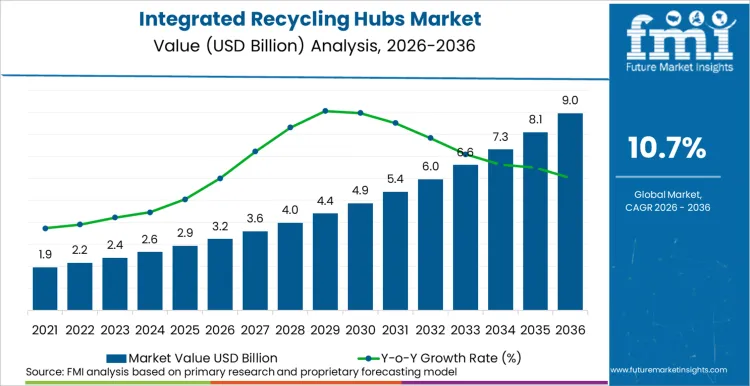
Summary of the Integrated Recycling Hubs Market
What is the Long-Term Growth Outlook for the Integrated Recycling Hubs Market?
FMI projects the global integrated recycling hubs market to expand from USD 3,240 million in 2026 to USD 8,960 million by 2036, registering a 10.7% CAGR. This robust growth is structurally underpinned by the global push towards a circular economy, which necessitates a complete overhaul of linear waste management. Integrated hubs are the capital-intensive answer, designed to bridge the gap between complex post-consumer waste and the stringent quality specifications of modern manufacturing.
FMI Research Approach: This projection is derived from FMI's proprietary model analyzing global EPR and recycled content legislation, announced investment in recycling infrastructure by waste management firms and chemical companies, and the projected supply gap for food-grade and technical-grade recycled polymers.
How do FMI Analysts Expect the Integrated Recycling Hubs Market to Evolve Structurally?
FMI analysts anticipate a market evolution from single-material hubs (e.g., only PET) toward true multi-material recovery campuses. Future hubs will integrate chemical recycling technologies (depolymerization, pyrolysis) alongside mechanical recycling to handle contaminated or mixed streams. They will also incorporate advanced data analytics and AI for real-time sorting optimization and material traceability, functioning as data-rich resource nodes within smart city and industrial ecosystems.
FMI Research Approach: Insights are informed by tracking public-private partnership announcements for hub development, technology procurement trends in the waste sector, and analysis of regional waste composition studies that dictate hub design.
Which Geographies Command Strategic Importance in the Integrated Recycling Hubs Market?
Strategic growth is concentrated in regions implementing aggressive circular economy policies. The European Union, led by Germany and France, is the regulatory frontrunner. The United States shows strong growth driven by state-level policies and corporate investment. China and India represent high-growth markets where government initiatives are formalizing waste management and building large-scale infrastructure. Japan leads in technological integration for efficiency.
FMI Research Approach: Regional market sizing is based on the stringency of recycling and landfill diversion targets, levels of public and private infrastructure investment, and the maturity of the local manufacturing sector's demand for recycled materials.
What Will Be the Market Size of Integrated Recycling Hubs by 2036?
By 2036, the integrated recycling hubs market is expected to reach USD 8,960 million. This expansion will be sustained as recycled content mandates in packaging, construction, and automotive sectors reach 30-50%, creating an inexorable demand for high-volume, high-quality recycled material streams that can only be reliably supplied by large-scale, integrated facilities.
FMI Research Approach: The long-term outlook incorporates forecasts for global waste generation, projected recycling rate targets set by national governments, and the capital expenditure required to meet the resulting processing capacity shortfall.
What are some Globally Distinct Trends Shaping the Integrated Recycling Hubs Market?
Globally, the market is shaped by the integration of digital product passports, the co-location of recycling with manufacturing (“right-to-shore”), and the hub’s role in carbon accounting. Digital watermarks on packaging enable AI-powered sorting at hubs. Locating hubs near industrial clusters reduces transport emissions. Furthermore, hubs are becoming critical for measuring and verifying the carbon reduction benefits of using recycled materials, providing data for corporate ESG reporting.
FMI Research Approach: Trend identification involves monitoring pilot projects for smart packaging (e.g., HolyGrail 2.0), analyzing location strategies of new hub announcements, and reviewing the growing demand for life-cycle assessment services tied to specific material streams.
Integrated Recycling Hubs Market Key Takeaways
| Metrics | Values |
|---|---|
| Expected Value (2026E) | USD 3,240 million |
| Projected Value (2036F) | USD 8,960 million |
| CAGR (2026-2036) | 10.7% |
Source: Future Market Insights (FMI) analysis, based on proprietary forecasting model and primary research
Why is the Integrated Recycling Hubs Market Growing?
The primary growth catalyst is the economic internalization of waste management costs through EPR. As producers become financially responsible for the end-of-life of their products, they seek the most cost-effective and reliable recycling outcomes. Investing in or partnering with integrated hubs that guarantee high material yield and quality becomes a strategic financial decision, driving capital towards these efficient, large-scale facilities.
Corporate supply chain security for recycled content is a powerful demand driver. Global brands with public commitments to use 25-50% recycled plastic cannot rely on volatile, fragmented spot markets for PCR. They require secured, multi-year offtake agreements. Integrated hubs, with their scale and consistent output, are uniquely positioned to sign these long-term contracts, providing the revenue certainty needed to justify their high capital expenditure. This corporate pull is transforming hubs from waste processors into essential raw material suppliers.
Technological convergence makes integration economically viable. Advances in AI-based optical sorters, robotic pickers, and high-efficiency wash lines have dramatically improved sorting purity and material recovery rates. When these technologies are deployed in a sequential, integrated flow within a single facility, the logistical cost of transporting semi-processed materials between separate sites is eliminated, and process control is maximized. This synergy is the key economic argument for the hub model over a dispersed system.
How is Integrated Recycling Hubs Market Segmented?
The market segment landscape is defined by the need for scale, material diversity, and process integration to serve broad industrial demand. The production of multi-material PCR is the core service, most efficiently delivered by centralized recycling parks. These hubs primarily process mixed rigid and flexible plastic streams through fully integrated sorting, washing, and reprocessing lines.
How is Multi-Material PCR Production Defining the Service Model?
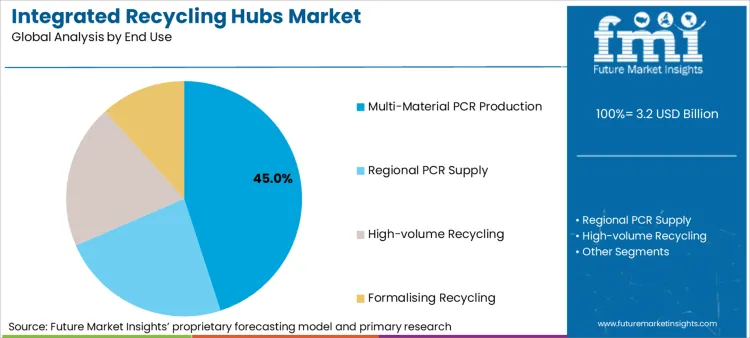
Multi-material PCR production represents the largest end-use segment with a 45.0% share. This reflects the reality of post-consumer waste, which is a mix of PET, HDPE, PP, and films. Hubs designed for multi-material output can accept a broader range of feedstock including mixed residential curbside recyclables and produce a diversified product portfolio, making them more resilient to market fluctuations for any single polymer. They serve as one-stop shops for manufacturers needing various recycled polymers.
This segment’s dominance validates the hub’s economic rationale. By recovering and purifying multiple high-value streams from a single input waste flow, the hub maximizes revenue per ton of waste processed. This multi-output model is essential to achieve the financial return on investment required for billion-dollar facilities.
Which Physical Model Delivers Maximum Economies of Scale?
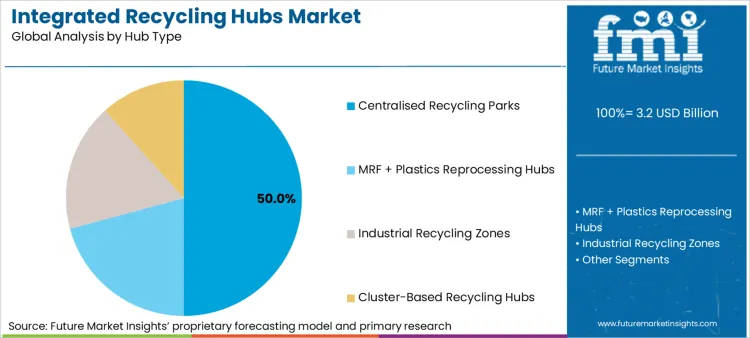
Centralized recycling parks constitute the leading hub type segment with a 50.0% share. These are large, greenfield or retrofitted industrial sites that consolidate all recycling steps from initial receipt of commingled recyclables to the production of finished marketable flakes or pellets within a contiguous operational area. Centralization minimizes transportation, allows for shared utilities and management, and enables the continuous optimization of material flow.
The preference for this model is evident in new project announcements. Major waste management firms are consolidating operations from several older, single-function facilities into new, mega-scale parks, citing projected operational cost savings of 20-30% and a 50% reduction in the carbon footprint of the recycling process itself due to eliminated inter-facility transport.
What are the Primary Feedstock Streams?
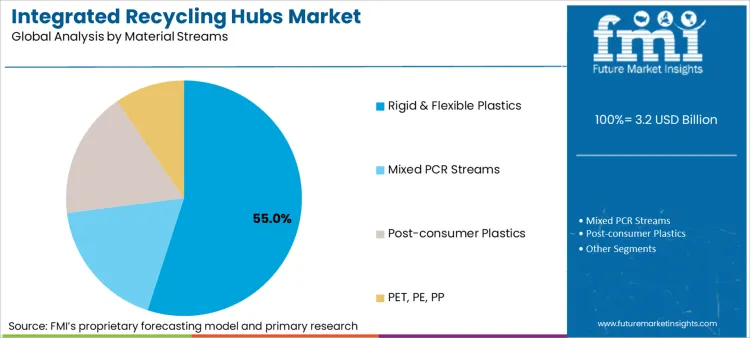
Rigid and flexible plastics constitute the leading material streams segment with a 55.0% share. This encompasses the full spectrum of plastic packaging, which represents the largest and most legislatively targeted waste stream. Hubs are engineered to handle the technical challenge of separating and cleaning these materials: rigid containers and flexible films require different handling, shredding, and washing technologies. Mastering both within one facility is a key competitive advantage.
The focus on this stream is driven by volume and regulatory urgency. With dozens of countries enacting laws targeting plastic packaging waste, hubs capable of processing these materials at scale are positioned at the epicenter of a global policy-driven market.
Which Integrated Process Chain is the Industry Standard?
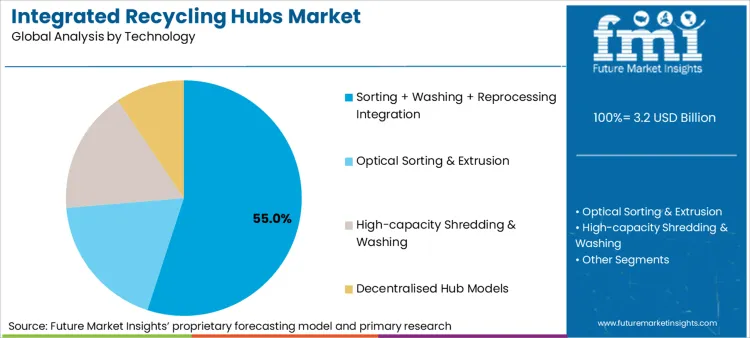
The integration of sorting, washing, and reprocessing is the dominant technology segment with a 55.0% share. This represents the core mechanical recycling value chain. Sorting+ involves advanced AI and NIR sorters to separate polymers by type and color. Washing+ involves hot wash, friction washing, and float-sink separation to remove contaminants. Reprocessing+ involves extrusion, filtration, and pelletization. When these stages are physically connected and digitally coordinated in real-time, contamination is minimized, yield is maximized, and the final product’s quality is assured.
Mastery of this integrated chain is the defining capability of a hub operator. It requires significant engineering expertise and capital to design a facility where the output of one stage is perfectly optimized as the input for the next, creating a seamless and efficient material transformation pipeline.
What Drivers, Restraints, Opportunities, and Trends Prevail in the Integrated Recycling Hubs Market?
Market expansion is critically driven by landfill and incineration bans. Jurisdictions like the Netherlands, Austria, and several US states are implementing policies that progressively ban the landfilling or incineration of recyclable materials. This legislative push forces waste handlers to invest in recycling infrastructure that can achieve high diversion rates, making the high-efficiency hub model not just attractive but necessary for regulatory compliance and continued operation.
A primary restraint is the high capital intensity and long payback periods. Developing an integrated hub requires hundreds of millions to billions of dollars in upfront investment. Securing this financing depends on long-term waste supply contracts and PCR offtake agreements in markets that can still be volatile. This financial risk can deter investment, especially in regions without strong policy signals or guaranteed demand.
A significant opportunity lies in integrating chemical recycling modules within mechanical hubs. Mechanical recycling has limits with heavily contaminated or multi-layer plastics. By adding a chemical recycling unit (e.g., depolymerization for PET or pyrolysis for mixed polyolefins) within the hub complex, operators can process the residual “rejects” from mechanical sorting into valuable feedstocks. This creates a “zero waste to landfill” hub and taps into growing demand for chemically recycled, virgin-quality polymers.
A defining trend is the hub as a “materials bank” for carbon credits. The carbon reduction achieved by recycling plastics versus producing virgin plastic is quantifiable. Integrated hubs, with their precise input and output data, can certify the volume of CO2 emissions avoided. This carbon benefit can be monetized through voluntary carbon markets or used to comply with internal carbon pricing schemes, creating a new revenue stream and improving the hub’s financial model.
The trend toward “Resource Parks” co-locates recycling with manufacturing. Beyond just recycling, next-generation hubs are being planned as industrial symbiosis parks. A plastic recycling hub may be situated next to a packaging converter or an automotive parts manufacturer that uses the PCR. This eliminates transportation, fosters innovation, and creates a powerful localized circular economy cluster, as seen in developments like the Circularity Center project in the US Southeast.
Analysis of Integrated Recycling Hubs Market by Key Countries
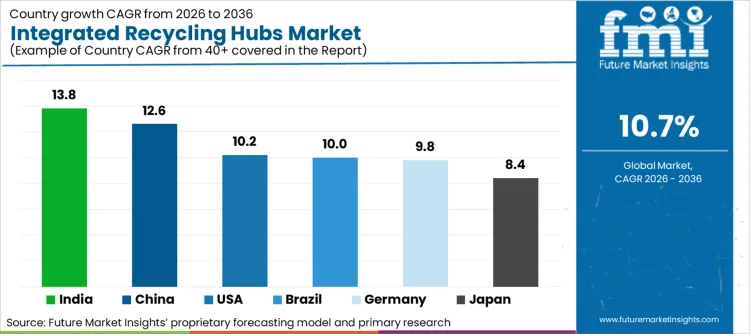
| Country | CAGR (2026-2036) |
|---|---|
| India | 13.8% |
| China | 12.6% |
| USA | 10.2% |
| Brazil | 10.0% |
| Germany | 9.8% |
| Japan | 8.4% |
Source: Future Market Insights (FMI) analysis, based on proprietary forecasting model and primary research
How are Formalization and Public Infrastructure Investment Driving the Indian Market?
India is projected to expand at a 13.8% CAGR through 2036, the highest among key nations. The government’s Swachh Bharat Mission 2.0 and new Extended Producer Responsibility rules that mandate brand owners to ensure recycling of their packaging propel this. The market is transitioning from a vast informal recycling sector to formalized, large-scale operations.
Public-private partnerships are forming to develop cluster-based integrated recycling hubs, like those proposed under the GOBARdhan scheme, which aim to aggregate waste from multiple cities and process it in centralized, modern facilities to supply consistent PCR to India’s growing manufacturing base.
How do National Scale and Policy Directives Shape the Chinese Market?
China’s market is growing at a 12.6% CAGR, driven by its Dual Carbon goals and the No Waste City” initiatives. The national policy framework directs substantial state-backed investment into building large-scale, standardized industrial recycling zones.
Companies like GEM Co., specializing in e-waste and battery recycling, are expanding into integrated plastic hubs. The focus is on high-capacity, automated facilities that can process the immense volumes of urban waste generated, with output feeding both domestic and export markets for recycled materials.
Which Combination of Corporate and State-Level Action Defines the US Market?
The United States market, with a 10.2% CAGR, is characterized by action from major waste corporations and state-level recycling laws. Companies like WM and Republic Services are driving the market through billion-dollar hub investment programs. Simultaneously, states like California and Oregon have passed laws setting high recycled content targets and providing grants for recycling infrastructure. This creates a favorable environment where private investment aligns with regulatory demand, focusing on building regional PCR supply hubs to service specific geographic manufacturing corridors.
How do Circular Economy Policies and Regional Integration Influence the Brazilian Market?
The National Solid Waste Policy and growing corporate sustainability commitments influence Brazil’s market, expanding at a 10.0% CAGR. The development of integrated hubs is seen as a solution to improve historically low recycling rates.
Projects often focus on serving specific industrial clusters, such as the packaging hub in São Paulo or the agricultural plastics recycling zone in the south. Regional integration within Mercosur also presents an opportunity for hubs to serve a broader South American market for recycled commodities.
Which Regulatory Precision and Engineering Focus Steer the German Market?
Germany’s market, growing at a 9.8% CAGR, operates under the EU’s most precise and enforced recycling regulations. The focus for hub operators like PreZero and Veolia is on technological excellence to achieve the purity levels required for closed-loop recycling, especially for food-grade applications.
German hubs are becoming testing grounds for next-generation sorting and purification technologies, with a strong emphasis on data transparency and integrating digital watermarks from projects like HolyGrail 2.0 to push sorting accuracy beyond 90%.
How does Space Constraint and Technological Innovation Define the Japanese Market?
Japan’s market, with an 8.4% CAGR, is shaped by severe space limitations and a cultural emphasis on zero waste. This drives innovation in highly compact, automated, and efficient hub designs. Japanese technology firms are leaders in developing high-precision optical sorters and robotic systems that maximize recovery from waste in minimal footprint. Hubs in Japan often focus on producing very high quality, mono-material PCR streams for the country’s high-tech manufacturing sector, prioritizing quality over sheer volume.
What is the Competition Outlook for Integrated Recycling Hubs?
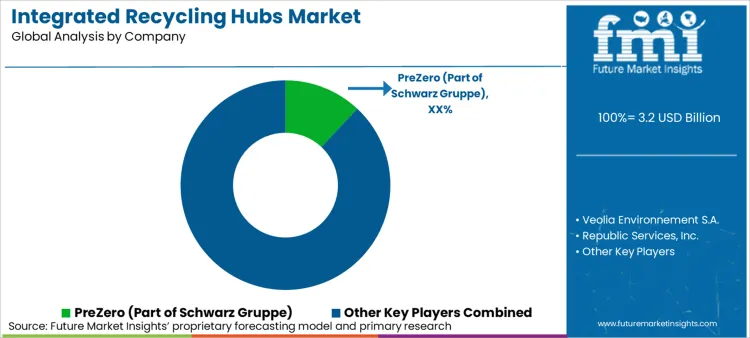
Competitive intensity centers on securing long-term waste supply contracts and PCR offtake agreements. The landscape is dominated by large, transnational waste management corporations with the balance sheets to fund hub development, and by consortia formed between chemical companies, consumer brands, and waste handlers. Success depends on securing “anchor” supply from municipalities or commercial waste generators and “anchor” demand from major manufacturers, creating a de-risked business model before breaking ground.
Vertical integration and partnership models characterize strategic moves. Waste companies are moving downstream into recycling and pellet production, while chemical companies are moving upstream by partnering with or acquiring waste management assets to secure feedstock for their circular polymer initiatives. The competitive battleground is shifting to who can control the most efficient and technology-advanced nodes in the circular economy network.
Key Developments
- TotalEnergies is scaling circular polymers through multiple recycling initiatives and partnerships, and TotalEnergies and Veolia signed a memorandum of understanding in October 2025 to expand cooperation across energy-transition and circular-economy areas (not a 2024 announcement specifically about a Europe-wide network of plastic recycling hubs).
- Republic Services opened its first Polymer Center in Las Vegas in late 2023, positioning it as an integrated plastics processing hub where post-collection plastics are secondarily processed to produce rPET flake and other high-quality recycled plastic outputs.
- In Indonesia, the Alliance to End Plastic Waste has supported integrated waste-management pilots and, in October 2024, announced with AIIB a co-financing initiative to expand integrated solid waste management solutions across more than 10 cities and districts.
Key Players Profiled
- PreZero (Part of Schwarz Gruppe)
- Veolia Environnement S.A.
- Republic Services, Inc.
- WM (Waste Management, Inc.)
- GEM Co., Ltd.
- China Everbright Environment Group Limited
- Ramco Industries (Recycling Division)
Market Definition
The integrated recycling hubs market comprises revenue generated from the development, operation, and ownership of large-scale industrial facilities that consolidate multiple recycling processes, including sorting, washing, size reduction, and reprocessing (e.g., extrusion, pelletizing), into a single, coordinated operation. These hubs transform mixed post-consumer or post-commercial recyclable materials (primarily plastics, but also often paper, metals, and glass) into purified, market-ready secondary raw materials.
The market scope includes revenue from tipping fees for waste received, the sale of processed recyclates (flakes, pellets), and service fees for material management. It covers both greenfield developments and major retrofits of existing material recovery facilities (MRFs). The market excludes standalone collection services, single-material recycling plants (e.g., a standalone PET bottle wash plant), and landfill or waste-to-energy operations without integrated material recovery.
Scope of Report
| Items | Values |
|---|---|
| Quantitative Units | USD 3,240 Million |
| End-use | Multi-material PCR Production, Regional PCR Supply, High-volume Recycling, Formalising Recycling, Other |
| Hub Type | Centralised Recycling Parks, MRF + Plastics Reprocessing Hubs, Industrial Recycling Zones, Cluster-Based Recycling Hubs, Other |
| Material Streams | Rigid & Flexible Plastics, Mixed PCR Streams, Post-consumer Plastics, PET, PE, PP, Other |
| Technology | Sorting + Washing + Reprocessing Integration, Optical Sorting & Extrusion, High-capacity Shredding & Washing, Decentralised Hub Models, Other |
| Regions Covered | North America, Europe, Asia-Pacific, Latin America, Middle East & Africa |
| Countries | USA, Germany, China, India, Brazil, Japan and 40+ countries |
| Key Companies | PreZero, Veolia, Republic Services, WM, GEM Co., Everbright Environment, Ramco Industries |
Source: Future Market Insights (FMI) analysis, based on proprietary forecasting model and primary research
Integrated Recycling Hubs Market Key Segments
End-use:
- Multi-material PCR Production
- Regional PCR Supply
- High-volume Recycling
- Formalising Recycling
- Others
Hub Type:
- Centralised Recycling Parks
- MRF + Plastics Reprocessing Hubs
- Industrial Recycling Zones
- Cluster-Based Recycling Hubs
- Others
Material Streams:
- Rigid & Flexible Plastics
- Mixed PCR Streams
- Post-consumer Plastics
- PET, PE, PP
- Others
Technology:
- Sorting + Washing + Reprocessing Integration
- Optical Sorting & Extrusion
- High-capacity Shredding & Washing
- Decentralised Hub Models
- Others
Region:
- North America
- Europe
- Asia-Pacific
- Latin America
- Middle East & Africa
Bibliography
- Organisation for Economic Co-operation and Development. (2024). Monitoring progress towards a resource-efficient and circular economy.
- United Nations Environment Programme & International Solid Waste Association. (2024). Global waste management outlook 2024.
- SCYCLE & United Nations Institute for Training and Research. (2024). The global e-waste monitor 2024: Quantities, flows and the circular economy potential.
- Spyridis, Y., Argyriou, V., Sarigiannidis, A., Radoglou, P., & Sarigiannidis, P. (2024). Autonomous AI-enabled industrial sorting pipeline for advanced textile recycling. arXiv.
- Qiao, Z. (2024). Advancing recycling efficiency: A comparative analysis of deep learning models in waste classification. arXiv.
Frequently Asked Questions
How big is the integrated recycling hubs market in 2026?
The global integrated recycling hubs market is estimated to be valued at USD 3.2 billion in 2026.
What will be the size of integrated recycling hubs market in 2036?
The market size for the integrated recycling hubs market is projected to reach USD 9.0 billion by 2036.
How much will be the integrated recycling hubs market growth between 2026 and 2036?
The integrated recycling hubs market is expected to grow at a 10.7% CAGR between 2026 and 2036.
What are the key product types in the integrated recycling hubs market ?
The key product types in integrated recycling hubs market are .
Which hub type segment to contribute significant share in the integrated recycling hubs market in 2026?
In terms of hub type, centralised recycling parks segment to command 50.0% share in the integrated recycling hubs market in 2026.
Preview the report firsthand - request a free sample
Get SampleGet the brochure for pricing and purchase details.
Get PDFTable of Content
- Executive Summary
- Global Market Outlook
- Demand-side Trends
- Supply-side Trends
- Technology Roadmap Analysis
- Analysis and Recommendations
- Market Overview
- Market Coverage / Taxonomy
- Market Definition / Scope / Limitations
- Research Methodology
- Chapter Orientation
- Analytical Lens and Working Hypotheses
- Market Structure, Signals, and Trend Drivers
- Benchmarking and Cross-market Comparability
- Market Sizing, Forecasting, and Opportunity Mapping
- Research Design and Evidence Framework
- Desk Research Programme (Secondary Evidence)
- Company Annual and Sustainability Reports
- Peer-reviewed Journals and Academic Literature
- Corporate Websites, Product Literature, and Technical Notes
- Earnings Decks and Investor Briefings
- Statutory Filings and Regulatory Disclosures
- Technical White Papers and Standards Notes
- Trade Journals, Industry Magazines, and Analyst Briefs
- Conference Proceedings, Webinars, and Seminar Materials
- Press Releases and Reputable Media Coverage
- Specialist Newsletters and Curated Briefings
- Sector Databases and Reference Repositories
- FMI Internal Proprietary Databases and Historical Market Datasets
- Subscription Datasets and Paid Sources
- Social Channels, Communities, and Digital Listening Inputs
- Additional Desk Sources
- Expert Input and Fieldwork (Primary Evidence)
- Primary Modes
- Qualitative Interviews and Expert Elicitation
- Quantitative Surveys and Structured Data Capture
- Blended Approach
- Why Primary Evidence is Used
- Field Techniques
- Interviews
- Surveys
- Focus Groups
- Observational and In-context Research
- Social and Community Interactions
- Stakeholder Universe Engaged
- C-suite Leaders
- Board Members
- Presidents and Vice Presidents
- R&D and Innovation Heads
- Technical Specialists
- Domain Subject-matter Experts
- Scientists
- Physicians and Other Healthcare Professionals
- Governance, Ethics, and Data Stewardship
- Research Ethics
- Data Integrity and Handling
- Primary Modes
- Tooling, Models, and Reference Databases
- Desk Research Programme (Secondary Evidence)
- Data Engineering and Model Build
- Data Acquisition and Ingestion
- Cleaning, Normalisation, and Verification
- Synthesis, Triangulation, and Analysis
- Quality Assurance and Audit Trail
- Market Background
- Market Dynamics
- Drivers
- Restraints
- Opportunity
- Trends
- Scenario Forecast
- Demand in Optimistic Scenario
- Demand in Likely Scenario
- Demand in Conservative Scenario
- Opportunity Map Analysis
- Product Life Cycle Analysis
- Supply Chain Analysis
- Investment Feasibility Matrix
- Value Chain Analysis
- PESTLE and Porter’s Analysis
- Regulatory Landscape
- Regional Parent Market Outlook
- Production and Consumption Statistics
- Import and Export Statistics
- Market Dynamics
- Global Market Analysis 2021 to 2025 and Forecast, 2026 to 2036
- Historical Market Size Value (USD Million) Analysis, 2021 to 2025
- Current and Future Market Size Value (USD Million) Projections, 2026 to 2036
- Y-o-Y Growth Trend Analysis
- Absolute $ Opportunity Analysis
- Global Market Pricing Analysis 2021 to 2025 and Forecast 2026 to 2036
- Global Market Analysis 2021 to 2025 and Forecast 2026 to 2036, By End Use
- Introduction / Key Findings
- Historical Market Size Value (USD Million) Analysis By End Use , 2021 to 2025
- Current and Future Market Size Value (USD Million) Analysis and Forecast By End Use , 2026 to 2036
- Y-o-Y Growth Trend Analysis By End Use , 2021 to 2025
- Absolute $ Opportunity Analysis By End Use , 2026 to 2036
- Global Market Analysis 2021 to 2025 and Forecast 2026 to 2036, By Hub Type
- Introduction / Key Findings
- Historical Market Size Value (USD Million) Analysis By Hub Type, 2021 to 2025
- Current and Future Market Size Value (USD Million) Analysis and Forecast By Hub Type, 2026 to 2036
- Y-o-Y Growth Trend Analysis By Hub Type, 2021 to 2025
- Absolute $ Opportunity Analysis By Hub Type, 2026 to 2036
- Global Market Analysis 2021 to 2025 and Forecast 2026 to 2036, By Material Streams
- Introduction / Key Findings
- Historical Market Size Value (USD Million) Analysis By Material Streams, 2021 to 2025
- Current and Future Market Size Value (USD Million) Analysis and Forecast By Material Streams, 2026 to 2036
- Y-o-Y Growth Trend Analysis By Material Streams, 2021 to 2025
- Absolute $ Opportunity Analysis By Material Streams, 2026 to 2036
- Global Market Analysis 2021 to 2025 and Forecast 2026 to 2036, By Technology
- Introduction / Key Findings
- Historical Market Size Value (USD Million) Analysis By Technology, 2021 to 2025
- Current and Future Market Size Value (USD Million) Analysis and Forecast By Technology, 2026 to 2036
- Y-o-Y Growth Trend Analysis By Technology, 2021 to 2025
- Absolute $ Opportunity Analysis By Technology, 2026 to 2036
- Global Market Analysis 2021 to 2025 and Forecast 2026 to 2036, By Region
- Introduction
- Historical Market Size Value (USD Million) Analysis By Region, 2021 to 2025
- Current Market Size Value (USD Million) Analysis and Forecast By Region, 2026 to 2036
- North America
- Latin America
- Western Europe
- Eastern Europe
- East Asia
- South Asia and Pacific
- Middle East & Africa
- Market Attractiveness Analysis By Region
- North America Market Analysis 2021 to 2025 and Forecast 2026 to 2036, By Country
- Historical Market Size Value (USD Million) Trend Analysis By Market Taxonomy, 2021 to 2025
- Market Size Value (USD Million) Forecast By Market Taxonomy, 2026 to 2036
- By Country
- USA
- Canada
- Mexico
- By End Use
- By Hub Type
- By Material Streams
- By Technology
- By Country
- Market Attractiveness Analysis
- By Country
- By End Use
- By Hub Type
- By Material Streams
- By Technology
- Key Takeaways
- Latin America Market Analysis 2021 to 2025 and Forecast 2026 to 2036, By Country
- Historical Market Size Value (USD Million) Trend Analysis By Market Taxonomy, 2021 to 2025
- Market Size Value (USD Million) Forecast By Market Taxonomy, 2026 to 2036
- By Country
- Brazil
- Chile
- Rest of Latin America
- By End Use
- By Hub Type
- By Material Streams
- By Technology
- By Country
- Market Attractiveness Analysis
- By Country
- By End Use
- By Hub Type
- By Material Streams
- By Technology
- Key Takeaways
- Western Europe Market Analysis 2021 to 2025 and Forecast 2026 to 2036, By Country
- Historical Market Size Value (USD Million) Trend Analysis By Market Taxonomy, 2021 to 2025
- Market Size Value (USD Million) Forecast By Market Taxonomy, 2026 to 2036
- By Country
- Germany
- UK
- Italy
- Spain
- France
- Nordic
- BENELUX
- Rest of Western Europe
- By End Use
- By Hub Type
- By Material Streams
- By Technology
- By Country
- Market Attractiveness Analysis
- By Country
- By End Use
- By Hub Type
- By Material Streams
- By Technology
- Key Takeaways
- Eastern Europe Market Analysis 2021 to 2025 and Forecast 2026 to 2036, By Country
- Historical Market Size Value (USD Million) Trend Analysis By Market Taxonomy, 2021 to 2025
- Market Size Value (USD Million) Forecast By Market Taxonomy, 2026 to 2036
- By Country
- Russia
- Poland
- Hungary
- Balkan & Baltic
- Rest of Eastern Europe
- By End Use
- By Hub Type
- By Material Streams
- By Technology
- By Country
- Market Attractiveness Analysis
- By Country
- By End Use
- By Hub Type
- By Material Streams
- By Technology
- Key Takeaways
- East Asia Market Analysis 2021 to 2025 and Forecast 2026 to 2036, By Country
- Historical Market Size Value (USD Million) Trend Analysis By Market Taxonomy, 2021 to 2025
- Market Size Value (USD Million) Forecast By Market Taxonomy, 2026 to 2036
- By Country
- China
- Japan
- South Korea
- By End Use
- By Hub Type
- By Material Streams
- By Technology
- By Country
- Market Attractiveness Analysis
- By Country
- By End Use
- By Hub Type
- By Material Streams
- By Technology
- Key Takeaways
- South Asia and Pacific Market Analysis 2021 to 2025 and Forecast 2026 to 2036, By Country
- Historical Market Size Value (USD Million) Trend Analysis By Market Taxonomy, 2021 to 2025
- Market Size Value (USD Million) Forecast By Market Taxonomy, 2026 to 2036
- By Country
- India
- ASEAN
- Australia & New Zealand
- Rest of South Asia and Pacific
- By End Use
- By Hub Type
- By Material Streams
- By Technology
- By Country
- Market Attractiveness Analysis
- By Country
- By End Use
- By Hub Type
- By Material Streams
- By Technology
- Key Takeaways
- Middle East & Africa Market Analysis 2021 to 2025 and Forecast 2026 to 2036, By Country
- Historical Market Size Value (USD Million) Trend Analysis By Market Taxonomy, 2021 to 2025
- Market Size Value (USD Million) Forecast By Market Taxonomy, 2026 to 2036
- By Country
- Kingdom of Saudi Arabia
- Other GCC Countries
- Turkiye
- South Africa
- Other African Union
- Rest of Middle East & Africa
- By End Use
- By Hub Type
- By Material Streams
- By Technology
- By Country
- Market Attractiveness Analysis
- By Country
- By End Use
- By Hub Type
- By Material Streams
- By Technology
- Key Takeaways
- Key Countries Market Analysis
- USA
- Pricing Analysis
- Market Share Analysis, 2025
- By End Use
- By Hub Type
- By Material Streams
- By Technology
- Canada
- Pricing Analysis
- Market Share Analysis, 2025
- By End Use
- By Hub Type
- By Material Streams
- By Technology
- Mexico
- Pricing Analysis
- Market Share Analysis, 2025
- By End Use
- By Hub Type
- By Material Streams
- By Technology
- Brazil
- Pricing Analysis
- Market Share Analysis, 2025
- By End Use
- By Hub Type
- By Material Streams
- By Technology
- Chile
- Pricing Analysis
- Market Share Analysis, 2025
- By End Use
- By Hub Type
- By Material Streams
- By Technology
- Germany
- Pricing Analysis
- Market Share Analysis, 2025
- By End Use
- By Hub Type
- By Material Streams
- By Technology
- UK
- Pricing Analysis
- Market Share Analysis, 2025
- By End Use
- By Hub Type
- By Material Streams
- By Technology
- Italy
- Pricing Analysis
- Market Share Analysis, 2025
- By End Use
- By Hub Type
- By Material Streams
- By Technology
- Spain
- Pricing Analysis
- Market Share Analysis, 2025
- By End Use
- By Hub Type
- By Material Streams
- By Technology
- France
- Pricing Analysis
- Market Share Analysis, 2025
- By End Use
- By Hub Type
- By Material Streams
- By Technology
- India
- Pricing Analysis
- Market Share Analysis, 2025
- By End Use
- By Hub Type
- By Material Streams
- By Technology
- ASEAN
- Pricing Analysis
- Market Share Analysis, 2025
- By End Use
- By Hub Type
- By Material Streams
- By Technology
- Australia & New Zealand
- Pricing Analysis
- Market Share Analysis, 2025
- By End Use
- By Hub Type
- By Material Streams
- By Technology
- China
- Pricing Analysis
- Market Share Analysis, 2025
- By End Use
- By Hub Type
- By Material Streams
- By Technology
- Japan
- Pricing Analysis
- Market Share Analysis, 2025
- By End Use
- By Hub Type
- By Material Streams
- By Technology
- South Korea
- Pricing Analysis
- Market Share Analysis, 2025
- By End Use
- By Hub Type
- By Material Streams
- By Technology
- Russia
- Pricing Analysis
- Market Share Analysis, 2025
- By End Use
- By Hub Type
- By Material Streams
- By Technology
- Poland
- Pricing Analysis
- Market Share Analysis, 2025
- By End Use
- By Hub Type
- By Material Streams
- By Technology
- Hungary
- Pricing Analysis
- Market Share Analysis, 2025
- By End Use
- By Hub Type
- By Material Streams
- By Technology
- Kingdom of Saudi Arabia
- Pricing Analysis
- Market Share Analysis, 2025
- By End Use
- By Hub Type
- By Material Streams
- By Technology
- Turkiye
- Pricing Analysis
- Market Share Analysis, 2025
- By End Use
- By Hub Type
- By Material Streams
- By Technology
- South Africa
- Pricing Analysis
- Market Share Analysis, 2025
- By End Use
- By Hub Type
- By Material Streams
- By Technology
- USA
- Market Structure Analysis
- Competition Dashboard
- Competition Benchmarking
- Market Share Analysis of Top Players
- By Regional
- By End Use
- By Hub Type
- By Material Streams
- By Technology
- Competition Analysis
- Competition Deep Dive
- Competition Deep Dive
- Assumptions & Acronyms Used


