

- Industry Size (2026)
- USD 7.4 Bn
- Forecast (2036)
- USD 12.2 Bn
- CAGR (2026 to 2036)
- 5.1%
Integrated Clinical Chemistry & Immunoassay Analyzer Market Size, Market Forecast and Outlook By FMI
In 2026, the integrated clinical chemistry & immunoassay analyzer market was valued at USD 7.4 billion. Based on Future Market Insights analysis, demand for integrated clinical chemistry & immunoassay analyzers is estimated to grow to USD 12.2 billion by 2036. FMI projects a CAGR of 5.1% during the forecast period.
Absolute dollar growth of USD 4.8 billion over the decade signals steady scale-up rather than a broad replacement wave. As per FMI, growth is expected to be supported by high-volume labs shifting assays onto integrated platforms to reduce manual handoffs, while budget approvals and method verification workload are expected to keep upgrade cadence controlled in mature networks. “The development of the DxC 500i Analyzer is yet another example of how Beckman Coulter is investing in the needs of a broad range of laboratories across healthcare systems, The DxC 500i Clinical Analyzer powers both clinical chemistry and immunoassay testing in one space-saving package. With steadfast performance, practical simplicity, and trusted clinical quality, this analyzer meets the specific demands of the low-volume laboratory customer, standalone laboratories and community hospitals.” said Kathleen Orland, Senior Vice President, Business Unit, General Manager, Chemistry and Immunoassay for Beckman Coulter Diagnostics. [1]
Summary of Integrated Clinical Chemistry & Immunoassay Analyzer Market
- Integrated Clinical Chemistry & Immunoassay Analyzer Market Definition
- The industry covers platforms that combine clinical chemistry and immunoassay testing within integrated analyzer configurations, supported by instrument placements, reagent and consumable pull-through, and software workflows used in routine and specialty diagnostics.
- Demand Drivers in The Market
- Laboratories are consolidating chemistry and immunoassay workflows to reduce manual handling, shorten turnaround time, and stabilize daily throughput.
- High chronic-disease testing volumes are sustaining demand for integrated menus that run routine panels and immunoassays on fewer systems.
- Staffing pressure is pushing labs toward integrated platforms and automation features that reduce operator touchpoints and repeat work.
- Key Segments Analyzed in The FMI Report
- By Product Type: reagents and consumables lead at 54% share in 2026, followed by instruments at 32% share.
- By Analyzer Configuration: integrated single-platform leads at 46% share in 2026, followed by modular integrated at 24% share.
- Geography: India and China show the fastest growth at 7.2% and 6.8% CAGR, supported by diagnostic capacity expansion and higher routine testing demand.
- Analyst Opinion at FMI
- Sabyasachi Ghosh, Principal Consultant at Future Market Insights, opines, ‘Buying decisions are being shaped by reagent continuity, uptime performance, and service response, since consolidated chemistry and immunoassay workflows concentrate operational risk into fewer platforms.’
- Strategic Implications and Executive Takeaways
- Protect reagent and consumables pull-through with strong supply execution and calibration stability that keeps repeat ordering predictable.
- Position integrated single-platform systems for mid-to-high throughput labs that want fewer instruments and tighter workflow control.
- Build replacement and upgrade programs for hospital and reference labs where routine volume and menu breadth drive switching decisions.
- Methodology
- As per FMI, a bottom up as well as top-down approach used during sizing and splits were triangulated using company primary disclosures, installed-base logic, and reagent pull-through dynamics by end user.
- Segment shares were validated by mapping analyzer configuration and throughput class to typical test-volume patterns and menu mix.
- Pricing sensitivity was stress tested across instrument placements versus recurring reagents and consumables to confirm revenue movement under realistic mix shifts.
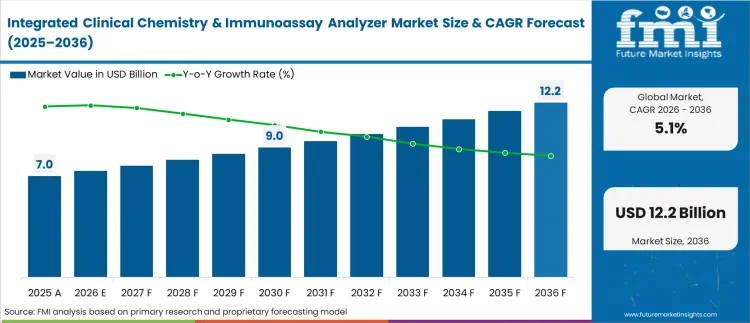
Purchasing behaviour is being shaped by analyser standardisation and reagent continuity planning, with buyers prioritising uptime, calibration stability, and service response time that reduces disruption risk. Multi-year reagent and service agreements are being used to stabilise operating cost, while instrument refresh is being aligned to throughput growth and automation line integration needs.
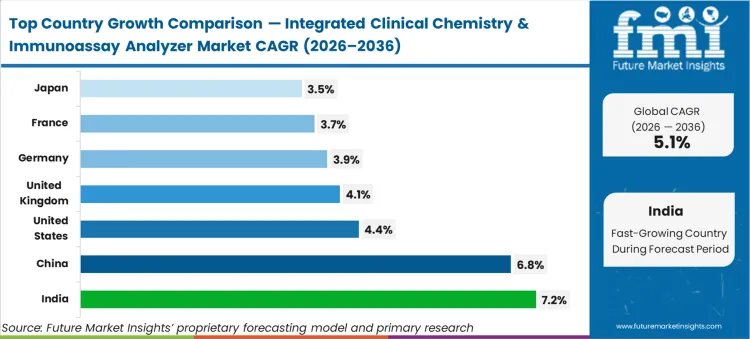
India (7.2% CAGR, supported by expanding private lab networks and rising test volumes) and China (6.8% CAGR, driven by hospital capacity growth and higher immunoassay utilisation) are expected to lead growth. The USA (4.4% CAGR) and the UK (4.1% CAGR) are expected to expand through platform consolidation and replacement purchasing. Mature markets including Germany (3.9%), France (3.7%), and Japan (3.5%) are expected to contribute more through replacement demand, constrained by procurement controls and verification timelines.
Integrated Clinical Chemistry & Immunoassay Analyzer Market Definition
The market covers integrated laboratory platforms that run clinical chemistry and immunoassay testing within a single system or integrated configuration. These platforms are purchased by hospital laboratories, reference laboratories, independent or private labs, and academic or research settings to deliver routine and specialised testing with controlled turnaround time and QC discipline. Offerings include instruments, reagents and consumables, and software supporting workflow and connectivity. Analyzer configurations range from compact integrated systems to automation line or workcell integrations, with throughput classes spanning low to ultra-high. Demand is shaped by rising test volumes, staffing efficiency needs, and menu consolidation.
Integrated Clinical Chemistry & Immunoassay Analyzer Market Inclusions
The report includes global and regional market sizes and a 10-year forecast for 2026 to 2036. Segment-level sizing is provided by product type, analyzer configuration, immunoassay detection, throughput class, and end user, supported by country-level CAGR comparisons. Coverage includes assessment of procurement patterns tied to analyser standardisation, automation line adoption, reagent contracting, and service coverage expectations, alongside competitive benchmarking of leading system providers, as per FMI analysis.
Integrated Clinical Chemistry & Immunoassay Analyzer Market Exclusions
The scope excludes standalone clinical chemistry analysers and standalone immunoassay analysers sold outside integrated platform configurations. Point-of-care immunoassay devices, lateral flow tests, and manual ELISA workflows are excluded. Laboratory information systems and middleware sold as independent products are excluded unless packaged as part of the integrated analyser offering. General lab consumables not tied to analyser operation and testing services revenue are excluded. The focus remains on integrated chemistry and immunoassay analyser platforms and their associated reagent, instrument, and software components.
Integrated Clinical Chemistry & Immunoassay Analyzer Market Research Methodology
- Primary Research: Interviews were conducted with laboratory directors, automation managers, procurement teams, and OEM service stakeholders to validate platform selection criteria and replacement cadence.
- Desk Research: Public information was reviewed from regulators, standards bodies, public health system publications, and company primary disclosures to benchmark quality expectations and installed-base positioning.
- Market-Sizing and Forecasting: A hybrid model was applied using end-user testing demand logic and segment mix by throughput and configuration, then reconciled to product type value splits for instruments, reagents, and software.
- Data Validation and Update Cycle: Outputs were checked through internal consistency screening across segment totals and country growth rates, with variance review applied prior to release.
Segmental Analysis
Integrated Clinical Chemistry & Immunoassay Analyzer Market Analysis by Product Type

Based on FMI’s report, reagents and consumables are estimated to hold 54% share in 2026, followed by instruments at 32% share. Reagents lead because routine diagnostics depend on continuous replenishment tied to daily test volumes, which creates stable recurring purchasing once an analyzer is embedded. Instruments remain the second position since placements and replacements happen in cycles, with purchasing paced by capex approvals and lab consolidation plans.
- Public Procurement Often Uses Reagent-Rental Models: Government hospitals commonly procure integrated clinical chemistry + immunoassay analyzers on a reagent-rental basis, explicitly bundling instrument placement with long-term reagent supply, which anchors the commercial value in consumables rather than upfront capex.[2]
- Test Volume Directly Converts into Reagent Reorders: Lab cost and workflow publications describe reagents/consumables as per-test inputs (calculated as requirements per assay multiplied by routine test counts), so once a platform is installed and menus are running daily, replenishment becomes a predictable, recurring purchase.[3]
- High SKU Breadth Multiplies Spend: A single integrated platform typically runs dozens to hundreds of assays, and each assay needs its own calibrated reagent pack plus controls/calibrators and routine QC materials, so consumable purchasing scales with menu breadth, not just instrument count.
Integrated Clinical Chemistry & Immunoassay Analyzer Market Analysis by Analyzer Configuration
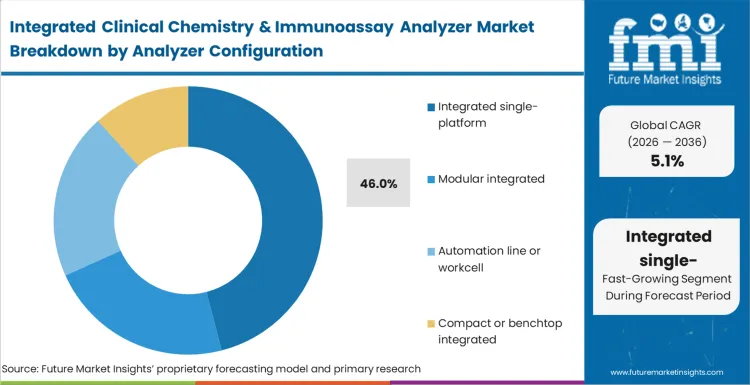
Integrated single-platform systems account for 46% share in 2026, followed by modular integrated at 24%, based on FMI’s report. Single-platform leadership is supported by workflow simplification where one integrated system reduces sample routing, staffing touchpoints, and cross-instrument reconciliation. Modular systems follow because large labs value scalability, adding modules to expand lanes without rebuilding the full setup, though integration effort and footprint planning shape adoption.
- Simpler Staffing and Training: Standardizing on one platform reduces SOP count, operator cross-training time, and daily troubleshooting complexity, which becomes a practical advantage when labs face staffing gaps and frequent shift rotations.[4]
- Procurement Reality Favors Consolidation: Public and large health systems increasingly specify fully automated biochemistry and immunoassay capability together to improve accuracy and expand test access without building multiple instrument islands, reinforcing demand for integrated single-platform setups.[5]
- Lower Pre-Analytical Risk: A single integrated platform reduces tube movement between instruments, which cuts mix-ups, repeat runs, and sample handling errors. That reliability benefit pushes many routine labs to prefer one consolidated system over multi-instrument workflows.
Integrated Clinical Chemistry & Immunoassay Analyzer Market Drivers, Restraints, And Opportunities
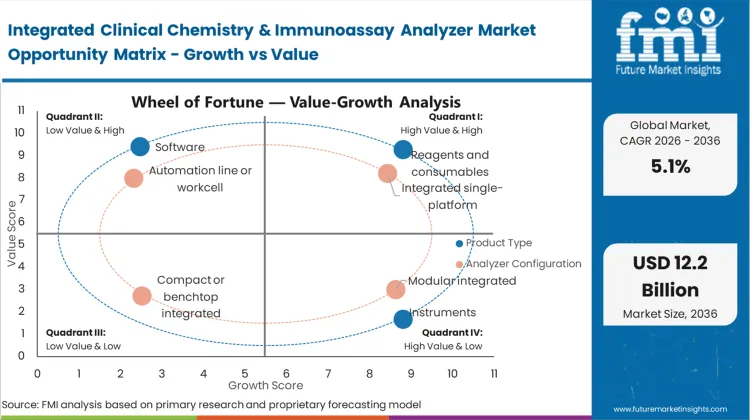
Future Market Insights analysis that historical patterns point at a workflow-consolidation diagnostics category where demand is anchored in high routine testing volumes and the need to reduce sample handling across chemistry and immunoassay lanes. Current demand is being shaped by staffing constraints, turnaround expectations, and the operational benefit of running consolidated menus through fewer platforms, as per FMI.
While growth is being restrained by long replacement cycles, capital budgeting discipline, and switching friction linked to assay validation and LIS integration, value expansion is being supported by recurring reagent pull-through and wider consolidation in hospital and reference laboratories. Based on FMI’s report, purchasing decisions are increasingly being filtered by uptime performance, service reach, and reagent continuity rather than by instrument price alone.
- Automation-Led Upgrading: Growth is shifting toward integrated platforms that reduce manual steps and stabilize turnaround time under staffing constraints.
- Validation and Switching Restraint: Assay revalidation and LIS integration effort slow platform changes once a system is embedded.
- Reagent Pull-Through Mechanism: Reagents and consumables remain the revenue anchor as standardized menus drive repeat purchasing over long instrument lifecycles.
Regional Analysis
Based on the regional analysis, integrated clinical chemistry & immunoassay analyzer market is segmented into North America, Latin America, East Asia, South Asia & Pacific, Western Europe, Eastern Europe and Middle East & Africa across 40+ countries. Regional performance is interpreted through replacement cycles for integrated and modular analyzers, expansion of CLIA and ECLIA testing, throughput-driven automation investments, and reagent-consumables pull across hospital and reference labs, as per FMI. The full report also offers market attractiveness analysis based on regional trends.
.webp "Top Country Growth Comparison Integrated Clinical Chemistry & Immunoassay Analyzer Market Cagr (2026 2036)")
| Country | CAGR |
|---|---|
| United States | 4.4% |
| China | 6.8% |
| Germany | 3.9% |
| Japan | 3.5% |
| India | 7.2% |
| United Kingdom | 4.1% |
| France | 3.7% |
Source: Future Market Insights (FMI) analysis, based on proprietary forecasting model and primary research
North America Integrated Clinical Chemistry & Immunoassay Analyzer Market Analysis
North America is driven by network-level lab consolidation, where reagent and consumables contracts determine platform continuity and where throughput class selection is linked to hub-and-spoke testing models. Roche Diagnostics remains strongly placed in integrated single-platform systems with recurring reagent pull. Abbott maintains broad share through immunoassay coverage and hospital lab placements. Siemens Healthineers is positioned where automation lines and workcells are adopted in higher-volume reference labs. FMI analysts note that hospital laboratories remain the core end users, with reference labs driving high and ultra-high throughput demand.
- United States: In the USA, integrated clinical chemistry and immunoassay analyzers are expected to advance at 4.4% CAGR through 2036, with growth supported by continued replacement cycles in hospital laboratories and expansion of hub reference testing. Reagents and consumables remain the dominant product type in revenue, reinforcing bundled contracting that ties instruments to long-term supply agreements. Low and mid throughput systems keep relevance in community hospitals, while high throughput lines expand in central labs managing consolidated volumes.
FMI’s report includes a detailed analysis of the growth in the North American region, along with a country-wise assessment that includes the USA, Canada and Mexico. Readers can also find regional trends, regulations, and market growth based on different segments and countries in the North America region.
East Asia Integrated Clinical Chemistry & Immunoassay Analyzer Market Analysis
East Asia is defined by rapid lab modernisation and expanding routine testing volumes, where modular integrated systems gain share in large hospitals and automation workcells rise in high-throughput environments. Roche Diagnostics and Abbott participate through installed base and reagent economics, while Mindray expands placements where procurement favours cost efficiency and local service coverage. Sysmex and Fujirebio add regional strength in diagnostics ecosystems that support immunoassay adoption. FMI is of the opinion that growth remains led by reagents and consumables as installed base expands.
- China: China leads at 6.8% CAGR through 2036, supported by rising hospital test volumes and greater deployment of modular integrated analyzers in tertiary facilities. CLIA remains widely used, while ECLIA adoption expands where menu breadth and sensitivity requirements increase. Automation lines and workcells gain share in reference laboratories and high-volume hospital labs, with throughput class selection increasingly linked to centralised testing strategy.
- Japan: Japan is forecast at 3.5% CAGR through 2036, reflecting a mature installed base and replacement-driven upgrades rather than rapid net expansion. Compact and benchtop integrated systems remain preferred in space-constrained hospitals, while high throughput platforms concentrate in larger reference labs. CLIA and ECLIA coexist, with choice influenced by legacy workflows and assay menu continuity.
FMI’s report includes a detailed analysis of the growth in the East Asia region, along with a country-wise assessment that includes China, Japan and South Korea. Readers can also find regional trends, regulations, and market growth based on different segments and countries in the East Asia region.
South Asia & Pacific Integrated Clinical Chemistry & Immunoassay Analyzer Market Analysis
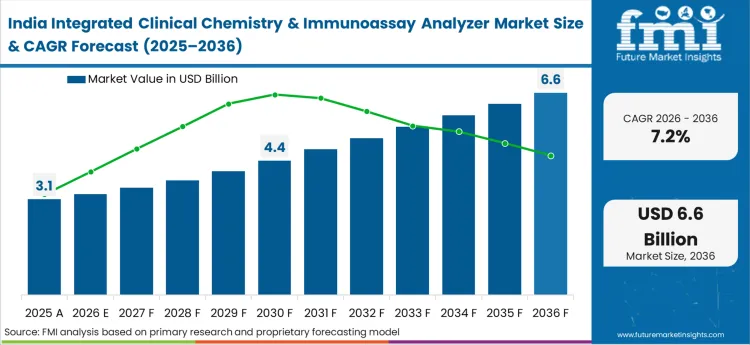
South Asia & Pacific is characterised by rapid expansion of diagnostic chains and rising test volumes beyond tier-1 cities, which supports mid throughput adoption and gradual movement toward automation workcells in hub labs. Roche Diagnostics and Abbott retain premium placements in hospitals, while Mindray and other value-focused suppliers gain share where service response times and distributor coverage influence uptime. QuidelOrtho and Randox participate through immunoassay and chemistry offerings aligned to routine testing. FMI analysts note that reagent and consumables remain the largest revenue stream, reinforcing long-term supply contracts.
- India: India registers 7.2% CAGR through 2036, driven by private diagnostic chain growth and increasing use of integrated platforms in hospital laboratories and independent labs. Mid throughput systems see strong pull as they match typical sample volumes in urban hubs, while low throughput units remain relevant in smaller centres managing staffing constraints. CLIA dominates routine workflows, with selective ECLIA uptake where higher sensitivity assays and menu breadth are prioritised.
FMI’s report includes a detailed analysis of the growth in the South Asia & Pacific region, along with a country-wise assessment that includes India, ASEAN Countries, Australia & New Zealand and Rest of South Asia. Readers can also find regional trends, regulations, and market growth based on different segments and countries in the South Asia & Pacific region.
Western Europe Integrated Clinical Chemistry & Immunoassay Analyzer Market Analysis
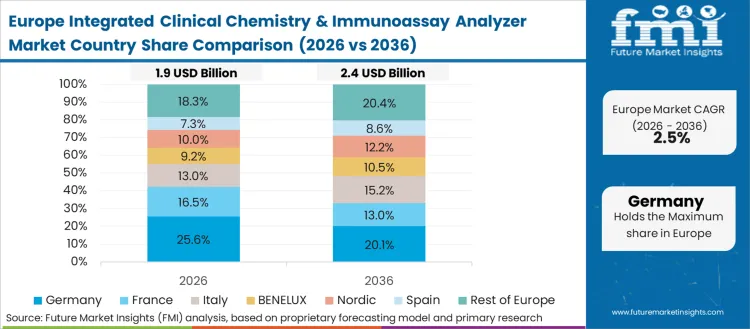
Western Europe is procurement-led and replacement-driven, where platform choice is shaped by tender frameworks, total cost of ownership, and long-term reagent economics. Roche Diagnostics retains strong continuity in integrated single-platform systems. Siemens Healthineers is positioned in automation line and workcell deployments for high-volume sites. Abbott remains relevant through broad immunoassay menus and hospital reach. Beckman Coulter (Danaher) supports adoption where automation integration and throughput upgrades are prioritised. FMI is of the opinion that value remains driven by reagents and consumables, with instruments tied to scheduled refresh cycles.
- Germany: Germany posts 3.9% CAGR through 2036, supported by replacement demand in hospital and reference laboratories and selective upgrades toward automation workcells in high-volume hubs. High throughput platforms expand where consolidation increases sample load, while integrated single-platform systems remain common in mid-size hospitals.
- UK: The UK is expected to expand at 4.1% CAGR through 2036, shaped by hub-and-spoke testing models and structured purchasing routes that standardise analyzer fleets across networks. Automation adoption is concentrated in reference labs managing higher volumes, while compact integrated systems remain important in hospital laboratories requiring footprint efficiency.
- France: France is projected at 3.7% CAGR through 2036, with growth supported by steady hospital lab replacement and broader adoption of integrated platforms that reduce hands-on time. Modular integrated analyzers gain share where hospitals expand menus and manage variable throughput across departments.
FMI’s analysis of integrated clinical chemistry & immunoassay analyzer market in Western Europe consists of country-wise assessment that includes Germany, UK, France, Italy, Spain, BENELUX, Nordic Countries and Rest of Western Europe. Readers can know various regulations and latest trends in the regional market.
Competitive Aligners for Market Players
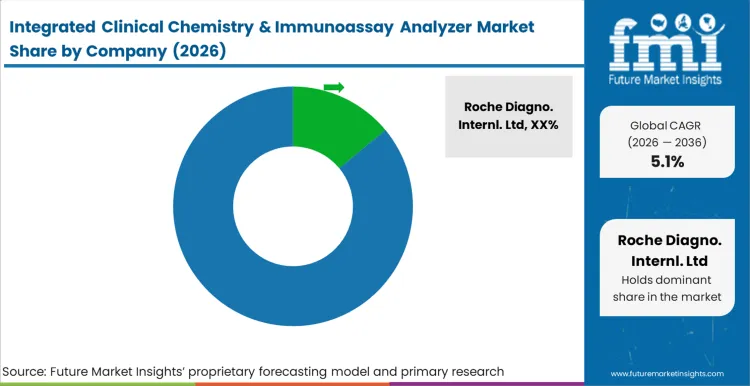
Market structure remains fragmented, yet practical competition is concentrated among a limited set of suppliers that can place analyzers at scale, protect uptime through dense field service coverage, and sustain recurring reagent pull-through under multi-year contracting. Competition is shaped by cost per reported result and operational continuity rather than short-cycle instrument pricing, since purchases are tied to platform standardisation, staff training, and workflow redesign in laboratories. The updated segmentation reinforces this dynamic because reagents and consumables remain the largest product value pool, so suppliers that control assays, calibrators, and QC ecosystems carry stronger competitive control, as per FMI.
Companies with structural advantages typically combine large installed bases with proprietary reagent menus and middleware layers that raise switching friction after validation. Integrated single-platform configurations are favored where mid throughput workloads dominate and footprint discipline is required, while modular integrated and automation line workcells are preferred in networks seeking higher throughput and consolidation. Suppliers able to support both ends of this configuration spectrum, with consistent assay performance and stable lot management, tend to retain accounts during contract renewal cycles. Firms with thinner assay breadth or weaker service reach face slower conversions because performance evidence, uptime history, and response time discipline are scrutinised before a network expands placements, based on FMI’s report.
Customer concentration reinforces buyer leverage. Hospital laboratories and reference labs typically run competitive tenders, qualify more than one vendor, and use performance-based contracts that include uptime commitments, response time terms, and reagent supply continuity clauses to reduce dependency. Independent and private labs often negotiate volume tiers tied to throughput class and keep alternates active for critical assays, which limits supplier ability to push through broad price increases. Pricing power is constrained for routine chemistry and immunoassay panels, while measured premiums are retained mainly where a supplier reduces hands-on time, improves turnaround consistency, or supports consolidation into fewer workcells without service disruption, Future Market Insights analysis.
Recent Developments
The report includes full coverage of key trends from competitive benchmarking. Some of the recent developments covered in the reports:
- In August 2025, QuidelOrtho Corporation has launched a Certified Analyzer Program, an innovative initiative designed to expand access to high-quality diagnostic testing in rural and community hospitals across the United States.[6]
- In March 2025, Beckman Coulter Diagnostics, a clinical diagnostics leader, announced that the new DxC 500i Clinical Analyzer, an integrated clinical chemistry and immunoassay analyzer, received 510(k) clearance from the USA Food and Drug Administration.[7]
Key Players in Integrated Clinical Chemistry and Immunoassay Analyzer Market
- Roche Diagnostics International Ltd
- Abbott Laboratories
- Siemens Healthineers AG
- Beckman Coulter, Inc.
- Sysmex Corporation
- QuidelOrtho Corporation
- Mindray Bio-Medical Electronics Co., Ltd.
- Thermo Fisher Scientific Inc.
- Randox Laboratories Ltd
- Fujirebio Holdings, Inc.
Scope of the Report
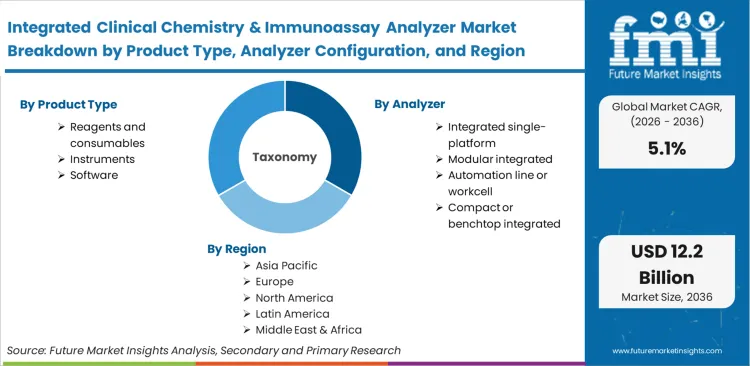
| Metric | Value |
|---|---|
| Quantitative Units | USD 7.4 Billion (2026) to USD 12.2 Billion (2036), at a CAGR of 5.1% |
| Market Definition | The integrated clinical chemistry and immunoassay analyzer market comprises global production and trade of analyzer systems that consolidate chemistry and immunoassay testing within integrated platforms, enabling laboratories to run routine and specialty panels under defined quality and regulatory requirements, where demand is shaped by test volume growth, automation priorities, and reagent continuity expectations. |
| Product Type Segmentation | Reagents and consumables, Instruments, Software |
| Analyzer Configuration Segmentation | Integrated single-platform, Modular integrated, Automation line or workcell, Compact or benchtop integrated |
| Immunoassay Detection Segmentation | CLIA, ECLIA, ELFA, Fluorescence immunoassay, Other |
| Throughput Class Segmentation | Low (<200 tests/hr), Mid (200-800), High (801-2000), Ultra-high (>2000) |
| End User Coverage | Hospital laboratories, Reference laboratories, Independent or private labs, Academic or research |
| Regions Covered | North America, Latin America, East Asia, South Asia & Pacific, Western Europe, Eastern Europe, and Middle East & Africa. |
| Countries Covered | United States, Canada, Mexico, Brazil, Argentina, Germany, France, United Kingdom, Italy, Spain, China, India, Japan, South Korea, Indonesia, Australia and 40+ countries |
| Key Companies Profiled | Roche Diagnostics International Ltd, Abbott Laboratories, Siemens Healthineers AG, Beckman Coulter, Inc., Sysmex Corporation, QuidelOrtho Corporation, Mindray Bio-Medical Electronics Co., Ltd., Thermo Fisher Scientific Inc., Randox Laboratories Ltd, Fujirebio Holdings, Inc. |
| Forecast Period | 2026 to 2036 |
| Approach | Hybrid top down and bottom up market modeling validated through primary interviews with laboratory directors, procurement stakeholders, and manufacturers, supported by installed base triangulation and reagent placement benchmarking, as per FMI. |
Integrated Clinical Chemistry and Immunoassay Analyzer Market Analysis by Segments
Product Type
- Reagents and consumables
- Instruments
- Software
Analyzer Configuration
- Integrated single-platform
- Modular integrated
- Automation line or workcell
- Compact or benchtop integrated
Immunoassay Detection
- CLIA
- ECLIA
- ELFA
- Fluorescence immunoassay
- Other
Throughput Class
- Low (<200 tests/hr)
- Mid (200-800)
- High (801-2000)
- Ultra-high (>2000)
End User
- Hospital laboratories
- Reference laboratories
- Independent or private labs
- Academic or research
Region
- North America
- USA
- Canada
- Mexico
- Latin America
- Brazil
- Argentina
- Rest of Latin America
- East Asia
- China
- Japan
- South Korea
- South Asia & Pacific
- India
- ASEAN Countries
- Australia & New Zealand
- Rest of South Asia
- Western Europe
- Germany
- UK
- France
- Italy
- Spain
- BENELUX
- Nordic Countries
- Rest of Western Europe
- Eastern Europe
- Russia
- Hungary
- Poland
- Rest of Eastern Europe
- Middle East & Africa
- Saudi Arabia
- Türkiye
- South Africa
- Other African Union
- Rest of Middle East & Africa
Bibliography
- [1] Beckman Coulter Diagnostics (2024). Beckman Coulter Introduces New Integrated Chemistry and Immunoassay Analyzer
- [2] AIIMS, New Delhi- (2025) Purchase of Supply, Installation, Commissioning and Maintaining the Fully Automated Integrated Immunoassay and Clinical Chemistry Analyzer on reagent rental basis
- [3] Science Direct (2019). Estimated costs of 51 commonly ordered laboratory tests in Canada.
- [4] Roche (2021). Roche Launches cobas pure Integrated Solutions Analyser Offering More than 230 Tests across Disease Areas.
- [5] Times of India (2025). The Delhi health department has selected 11 hospitals across.
- [6] QuidelOrtho (2025). QuidelOrtho Launches Certified Analyzer Program
- [7] Beckman Coulter (2025) Beckman Coulter Announces FDA clearance of DxC 500i Clinical Analyzer, an integrated Clinical Chemistry and Immunoassay System
This Report Addresses
- Market intelligence to enable structured decision making across lab automation planning and integrated platform selection
- Market size estimation and 10-year revenue forecasts from 2026 to 2036 for integrated chemistry and immunoassay analyzer demand
- Growth opportunity mapping across product type, analyzer configuration, immunoassay detection, throughput class, and end user demand pools
- Segment and regional revenue forecasts aligned to the stated taxonomy and covered geographies
- Competition strategy assessment including placement models, menu breadth positioning, and service coverage benchmarking
- Product and compliance tracking focused on IVD quality system requirements, laboratory accreditation needs, and documentation discipline
- Regulatory impact analysis covering IVD compliance expectations and laboratory quality requirements affecting purchasing and upgrades
- Market report delivery in PDF, Excel, PPT, and interactive dashboard formats for executive and operational use
Frequently Asked Questions
How large is the demand for Integrated Clinical Chemistry and Immunoassay Analyzers in the global market in 2026?
Demand for Integrated Clinical Chemistry and Immunoassay Analyzers in the global market is estimated to be valued at USD 7.4 Billion in 2026, as per FMI.
What will be the market size of Integrated Clinical Chemistry and Immunoassay Analyzers in the global market by 2036?
Market size for Integrated Clinical Chemistry and Immunoassay Analyzers is projected to reach USD 12.2 Billion by 2036.
What is the expected demand growth for Integrated Clinical Chemistry and Immunoassay Analyzers in the global market between 2026 and 2036?
Demand for Integrated Clinical Chemistry and Immunoassay Analyzers in the global market is expected to grow at a CAGR of 5.1% between 2026 and 2036.
Which immunoassay detection format is poised to lead global demand by 2026?
CLIA is expected to be the dominant immunoassay detection format, capturing 52% share in 2026.
Which analyzer configuration is expected to account for the largest share in 2026?
Integrated single-platform is expected to hold the highest share at 46% in 2026.
Which product type accounts for the largest share in 2026?
Reagents and consumables are projected to account for 54% share in 2026.
Preview the report firsthand - request a free sample
Get SampleGet the brochure for pricing and purchase details.
Get PDFTable of Content
- Executive Summary
- Global Market Outlook
- Demand-side Trends
- Supply-side Trends
- Technology Roadmap Analysis
- Analysis and Recommendations
- Market Overview
- Market Coverage / Taxonomy
- Market Definition / Scope / Limitations
- Research Methodology
- Chapter Orientation
- Analytical Lens and Working Hypotheses
- Market Structure, Signals, and Trend Drivers
- Benchmarking and Cross-market Comparability
- Market Sizing, Forecasting, and Opportunity Mapping
- Research Design and Evidence Framework
- Desk Research Programme (Secondary Evidence)
- Company Annual and Sustainability Reports
- Peer-reviewed Journals and Academic Literature
- Corporate Websites, Product Literature, and Technical Notes
- Earnings Decks and Investor Briefings
- Statutory Filings and Regulatory Disclosures
- Technical White Papers and Standards Notes
- Trade Journals, Industry Magazines, and Analyst Briefs
- Conference Proceedings, Webinars, and Seminar Materials
- Government Statistics Portals and Public Data Releases
- Press Releases and Reputable Media Coverage
- Specialist Newsletters and Curated Briefings
- Sector Databases and Reference Repositories
- FMI Internal Proprietary Databases and Historical Market Datasets
- Subscription Datasets and Paid Sources
- Social Channels, Communities, and Digital Listening Inputs
- Additional Desk Sources
- Expert Input and Fieldwork (Primary Evidence)
- Primary Modes
- Qualitative Interviews and Expert Elicitation
- Quantitative Surveys and Structured Data Capture
- Blended Approach
- Why Primary Evidence is Used
- Field Techniques
- Interviews
- Surveys
- Focus Groups
- Observational and In-context Research
- Social and Community Interactions
- Stakeholder Universe Engaged
- C-suite Leaders
- Board Members
- Presidents and Vice Presidents
- R&D and Innovation Heads
- Technical Specialists
- Domain Subject-matter Experts
- Scientists
- Physicians and Other Healthcare Professionals
- Governance, Ethics, and Data Stewardship
- Research Ethics
- Data Integrity and Handling
- Primary Modes
- Tooling, Models, and Reference Databases
- Desk Research Programme (Secondary Evidence)
- Data Engineering and Model Build
- Data Acquisition and Ingestion
- Cleaning, Normalisation, and Verification
- Synthesis, Triangulation, and Analysis
- Quality Assurance and Audit Trail
- Market Background
- Market Dynamics
- Drivers
- Restraints
- Opportunity
- Trends
- Scenario Forecast
- Demand in Optimistic Scenario
- Demand in Likely Scenario
- Demand in Conservative Scenario
- Opportunity Map Analysis
- Product Life Cycle Analysis
- Supply Chain Analysis
- Investment Feasibility Matrix
- Value Chain Analysis
- PESTLE and Porter’s Analysis
- Regulatory Landscape
- Regional Parent Market Outlook
- Production and Consumption Statistics
- Import and Export Statistics
- Market Dynamics
- Global Market Analysis 2021 to 2025 and Forecast, 2026 to 2036
- Historical Market Size Value (USD Million) Analysis, 2021 to 2025
- Current and Future Market Size Value (USD Million) Projections, 2026 to 2036
- Y-o-Y Growth Trend Analysis
- Absolute $ Opportunity Analysis
- Global Market Pricing Analysis 2021 to 2025 and Forecast 2026 to 2036
- Global Market Analysis 2021 to 2025 and Forecast 2026 to 2036, By Product Type
- Introduction / Key Findings
- Historical Market Size Value (USD Million) Analysis By Product Type , 2021 to 2025
- Current and Future Market Size Value (USD Million) Analysis and Forecast By Product Type , 2026 to 2036
- Reagents and consumables
- Instruments
- Software
- Reagents and consumables
- Y-o-Y Growth Trend Analysis By Product Type , 2021 to 2025
- Absolute $ Opportunity Analysis By Product Type , 2026 to 2036
- Global Market Analysis 2021 to 2025 and Forecast 2026 to 2036, By Analyzer Configuration
- Introduction / Key Findings
- Historical Market Size Value (USD Million) Analysis By Analyzer Configuration, 2021 to 2025
- Current and Future Market Size Value (USD Million) Analysis and Forecast By Analyzer Configuration, 2026 to 2036
- Integrated single-platform
- Modular integrated
- Automation line or workcell
- Compact or benchtop integrated
- Integrated single-platform
- Y-o-Y Growth Trend Analysis By Analyzer Configuration, 2021 to 2025
- Absolute $ Opportunity Analysis By Analyzer Configuration, 2026 to 2036
- Global Market Analysis 2021 to 2025 and Forecast 2026 to 2036, By Region
- Introduction
- Historical Market Size Value (USD Million) Analysis By Region, 2021 to 2025
- Current Market Size Value (USD Million) Analysis and Forecast By Region, 2026 to 2036
- North America
- Latin America
- Western Europe
- Eastern Europe
- East Asia
- South Asia and Pacific
- Middle East & Africa
- Market Attractiveness Analysis By Region
- North America Market Analysis 2021 to 2025 and Forecast 2026 to 2036, By Country
- Historical Market Size Value (USD Million) Trend Analysis By Market Taxonomy, 2021 to 2025
- Market Size Value (USD Million) Forecast By Market Taxonomy, 2026 to 2036
- By Country
- USA
- Canada
- Mexico
- By Product Type
- By Analyzer Configuration
- By Country
- Market Attractiveness Analysis
- By Country
- By Product Type
- By Analyzer Configuration
- Key Takeaways
- Latin America Market Analysis 2021 to 2025 and Forecast 2026 to 2036, By Country
- Historical Market Size Value (USD Million) Trend Analysis By Market Taxonomy, 2021 to 2025
- Market Size Value (USD Million) Forecast By Market Taxonomy, 2026 to 2036
- By Country
- Brazil
- Chile
- Rest of Latin America
- By Product Type
- By Analyzer Configuration
- By Country
- Market Attractiveness Analysis
- By Country
- By Product Type
- By Analyzer Configuration
- Key Takeaways
- Western Europe Market Analysis 2021 to 2025 and Forecast 2026 to 2036, By Country
- Historical Market Size Value (USD Million) Trend Analysis By Market Taxonomy, 2021 to 2025
- Market Size Value (USD Million) Forecast By Market Taxonomy, 2026 to 2036
- By Country
- Germany
- UK
- Italy
- Spain
- France
- Nordic
- BENELUX
- Rest of Western Europe
- By Product Type
- By Analyzer Configuration
- By Country
- Market Attractiveness Analysis
- By Country
- By Product Type
- By Analyzer Configuration
- Key Takeaways
- Eastern Europe Market Analysis 2021 to 2025 and Forecast 2026 to 2036, By Country
- Historical Market Size Value (USD Million) Trend Analysis By Market Taxonomy, 2021 to 2025
- Market Size Value (USD Million) Forecast By Market Taxonomy, 2026 to 2036
- By Country
- Russia
- Poland
- Hungary
- Balkan & Baltic
- Rest of Eastern Europe
- By Product Type
- By Analyzer Configuration
- By Country
- Market Attractiveness Analysis
- By Country
- By Product Type
- By Analyzer Configuration
- Key Takeaways
- East Asia Market Analysis 2021 to 2025 and Forecast 2026 to 2036, By Country
- Historical Market Size Value (USD Million) Trend Analysis By Market Taxonomy, 2021 to 2025
- Market Size Value (USD Million) Forecast By Market Taxonomy, 2026 to 2036
- By Country
- China
- Japan
- South Korea
- By Product Type
- By Analyzer Configuration
- By Country
- Market Attractiveness Analysis
- By Country
- By Product Type
- By Analyzer Configuration
- Key Takeaways
- South Asia and Pacific Market Analysis 2021 to 2025 and Forecast 2026 to 2036, By Country
- Historical Market Size Value (USD Million) Trend Analysis By Market Taxonomy, 2021 to 2025
- Market Size Value (USD Million) Forecast By Market Taxonomy, 2026 to 2036
- By Country
- India
- ASEAN
- Australia & New Zealand
- Rest of South Asia and Pacific
- By Product Type
- By Analyzer Configuration
- By Country
- Market Attractiveness Analysis
- By Country
- By Product Type
- By Analyzer Configuration
- Key Takeaways
- Middle East & Africa Market Analysis 2021 to 2025 and Forecast 2026 to 2036, By Country
- Historical Market Size Value (USD Million) Trend Analysis By Market Taxonomy, 2021 to 2025
- Market Size Value (USD Million) Forecast By Market Taxonomy, 2026 to 2036
- By Country
- Kingdom of Saudi Arabia
- Other GCC Countries
- Turkiye
- South Africa
- Other African Union
- Rest of Middle East & Africa
- By Product Type
- By Analyzer Configuration
- By Country
- Market Attractiveness Analysis
- By Country
- By Product Type
- By Analyzer Configuration
- Key Takeaways
- Key Countries Market Analysis
- USA
- Pricing Analysis
- Market Share Analysis, 2025
- By Product Type
- By Analyzer Configuration
- Canada
- Pricing Analysis
- Market Share Analysis, 2025
- By Product Type
- By Analyzer Configuration
- Mexico
- Pricing Analysis
- Market Share Analysis, 2025
- By Product Type
- By Analyzer Configuration
- Brazil
- Pricing Analysis
- Market Share Analysis, 2025
- By Product Type
- By Analyzer Configuration
- Chile
- Pricing Analysis
- Market Share Analysis, 2025
- By Product Type
- By Analyzer Configuration
- Germany
- Pricing Analysis
- Market Share Analysis, 2025
- By Product Type
- By Analyzer Configuration
- UK
- Pricing Analysis
- Market Share Analysis, 2025
- By Product Type
- By Analyzer Configuration
- Italy
- Pricing Analysis
- Market Share Analysis, 2025
- By Product Type
- By Analyzer Configuration
- Spain
- Pricing Analysis
- Market Share Analysis, 2025
- By Product Type
- By Analyzer Configuration
- France
- Pricing Analysis
- Market Share Analysis, 2025
- By Product Type
- By Analyzer Configuration
- India
- Pricing Analysis
- Market Share Analysis, 2025
- By Product Type
- By Analyzer Configuration
- ASEAN
- Pricing Analysis
- Market Share Analysis, 2025
- By Product Type
- By Analyzer Configuration
- Australia & New Zealand
- Pricing Analysis
- Market Share Analysis, 2025
- By Product Type
- By Analyzer Configuration
- China
- Pricing Analysis
- Market Share Analysis, 2025
- By Product Type
- By Analyzer Configuration
- Japan
- Pricing Analysis
- Market Share Analysis, 2025
- By Product Type
- By Analyzer Configuration
- South Korea
- Pricing Analysis
- Market Share Analysis, 2025
- By Product Type
- By Analyzer Configuration
- Russia
- Pricing Analysis
- Market Share Analysis, 2025
- By Product Type
- By Analyzer Configuration
- Poland
- Pricing Analysis
- Market Share Analysis, 2025
- By Product Type
- By Analyzer Configuration
- Hungary
- Pricing Analysis
- Market Share Analysis, 2025
- By Product Type
- By Analyzer Configuration
- Kingdom of Saudi Arabia
- Pricing Analysis
- Market Share Analysis, 2025
- By Product Type
- By Analyzer Configuration
- Turkiye
- Pricing Analysis
- Market Share Analysis, 2025
- By Product Type
- By Analyzer Configuration
- South Africa
- Pricing Analysis
- Market Share Analysis, 2025
- By Product Type
- By Analyzer Configuration
- USA
- Market Structure Analysis
- Competition Dashboard
- Competition Benchmarking
- Market Share Analysis of Top Players
- By Regional
- By Product Type
- By Analyzer Configuration
- Competition Analysis
- Competition Deep Dive
- Roche Diagno. Internl. Ltd
- Overview
- Product Portfolio
- Profitability by Market Segments (Product/Age /Sales Channel/Region)
- Sales Footprint
- Strategy Overview
- Marketing Strategy
- Product Strategy
- Channel Strategy
- Abbott Laboratories
- Siemens Healthineers AG
- Beckman Coulter, Inc.
- Sysmex Corporation
- QuidelOrtho Corporation
- Mindray Bio-Medical Electronics Co., Ltd.
- Thermo Fisher Scientific Inc.
- Randox Laboratories Ltd
- Fujirebio Holdings, Inc.
- Roche Diagno. Internl. Ltd
- Competition Deep Dive
- Assumptions & Acronyms Used


