

- Industry Size (2026)
- USD 64.7 Mn
- Forecast (2036)
- USD 185.4 Mn
- CAGR (2026 to 2036)
- 11.1%
Integrated Battery Emissions and Off-Gassing Characterization Systems Market Size, Market Forecast and Outlook By FMI
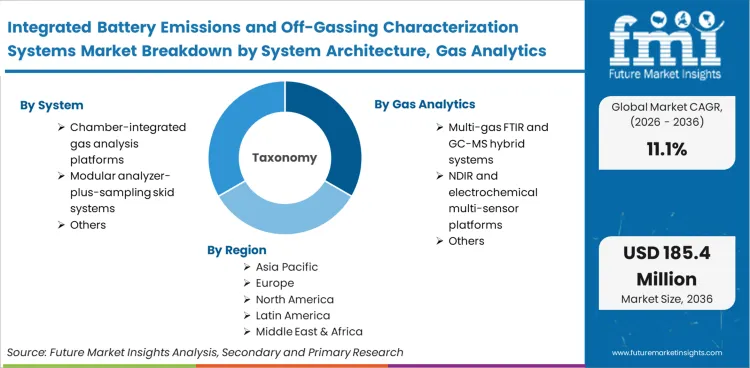
The integrated battery emissions and off-gassing characterization systems market crossed a valuation of USD 58.2 million in 2025. The sector is set to reach USD 64.7 million in 2026 and climb to USD 185.4 million by 2036, reflecting an 11.1% CAGR across the forecast period. Market expansion is being driven by sustained spending from automakers that are developing in-house thermal propagation baselines to strengthen validation control.
Automotive Tier-1 procurement directors are facing lead times of up to 14 weeks for high-fidelity gas analyzers, forcing validation teams to qualify secondary equipment suppliers at much greater speed. Testing programs become more compressed when engineering groups must detect trace hydrogen fluoride and phosphoryl fluoride during pack-level destruction events. Any delay in capital spending can push vehicle homologation schedules off track. Growing variation in cell chemistry is making venting behavior harder to predict, increasing reliance on comprehensive battery vent gas analysis systems.
Summary of Integrated Battery Emissions and Off-Gassing Characterization Systems Market
- Integrated Battery Emissions and Off-Gassing Characterization Systems Market Definition:
- Instrumentation designed to capture and quantify volatile compounds and particulate matter ejected during energy storage device failure modes.
- Demand Drivers in the Market:
- Evolving homologation standards compel automotive safety directors to profile exact toxic release compositions during pack failures.
- Grid-scale storage deployments force utility integrators to model exact lower flammability limits of containerized battery racks.
- Next-generation chemistry variations push R&D scientists to detect precursor off-gassing events seconds before thermal runaway occurs.
- Key Segments Analyzed in the FMI Report:
- System Architecture: Chamber-integrated gas analysis platforms are poised to record 39.0% share in 2026, driven by repeatable containment capabilities during destructive testing.
- Gas analytics technology: Multi-gas FTIR and GC-MS hybrid systems is anticipated to hold 34.0% share, supported by ability to differentiate complex electrolyte breakdown products.
- Battery level: Module- and pack-level systems is expected to capture 44.0% share, as vehicle integration validation requires full-scale propagation data.
- End user: Battery developers and OEM validation centers are estimated to account for 37.0% share, reflecting massive internal capital allocation for safety engineering.
- Application: Thermal runaway and abuse characterization is projected to reach 41.0% share, representing baseline requirements for all commercialized cell formats.
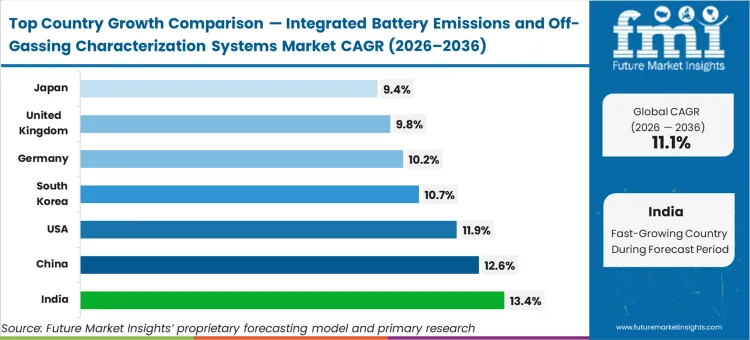
- India: 13.4% compound growth, anchored by aggressive build-out of localized testing laboratories supporting domestic manufacturing quotas.
- Analyst Opinion at FMI:
- Nikhil Kaitwade, Principal Analyst, Automation, at FMI, points out, "Validation engineers frequently assume standard gas chromatography offers sufficient resolution. Transient electrolyte decomposition ensures crucial toxic intermediates vanish before traditional sampling lines reach sensors. Facilities relying on legacy environmental chambers miss initial hydrogen fluoride spikes completely. Leading laboratories invest heavily in in-situ optical spectroscopy to capture millisecond-level temporal resolution."
- Strategic Implications / Executive Takeaways:
- Instrumentation vendors must accelerate calibration routines as testing laboratories cannot afford week-long sensor downtime between destructive tests.
- Regulatory compliance managers face higher capital costs to meet emerging passenger cabin toxicity standards requiring continuous multi-gas profiling.
- Independent certification centers capture premium pricing by offering synchronized particulate and chemical analysis in single test reports.
- Methodology:
- Primary Research: Procurement heads at global battery testing facilities.
- Desk Research: Homologation standards and cell safety patents.
- Market-Sizing and Forecasting: Analyzer vendor revenue disclosures.
- Data Validation and Update Cycle: Global safety certification facility expansion tracking.
The introduction of explicit vent-gas toxicity thresholds for passenger cabins would force OEMs to rethink established safety validation practices. Qualification cycles gain speed when testing facilities replace discrete sampling methods with synchronized particle and gas characterization systems. Early movement toward unified lithium-ion off-gas analysis platforms suggests that the industry is moving beyond pass-fail safety testing and toward predictive emission assessment.
India leads adoption at 13.4% as domestic cell manufacturing initiatives require localized safety validation infrastructure. Investments in China battery off-gas characterization systems follow closely at 12.6% driven by aggressive export compliance requirements for high-nickel cathode formats. United States testing centers expand capacity at 11.9% to support utility-scale storage deployments. South Korea advances at 10.7% as incumbent battery producers integrate gas analytics into production quality sampling. Germany tracks at 10.2% on back of stringent automotive safety directives. United Kingdom engineering labs record 9.8% expansion while Japan grows at 9.4% through continuous improvement of solid-state validation protocols. Divergence across this range stems directly from whether regional regulators prioritize passenger safety or grid-level containment.
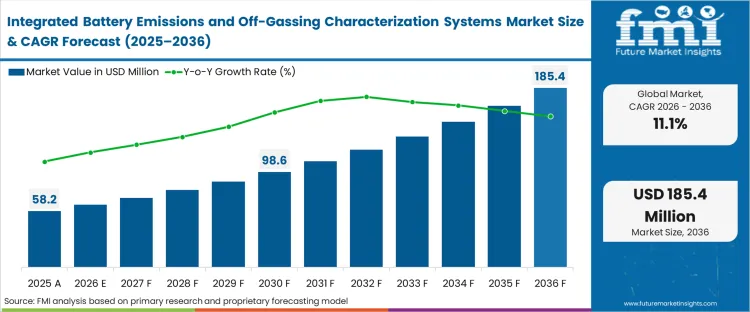
Integrated Battery Emissions and Off-Gassing Characterization Systems Market Key Takeaways
| Metric | Details |
|---|---|
| Industry Size (2026) | USD 64.7 million |
| Industry Value (2036) | USD 185.4 million |
| CAGR (2026 to 2036) | 11.1% |
Source: Future Market Insights (FMI) analysis, based on proprietary forecasting model and primary research
Integrated Battery Emissions and Off-Gassing Characterization Systems Market Definition
Functional boundaries center on instrumentation designed explicitly to capture, measure, and analyze volatile compounds ejected from energy storage devices under thermal or electrical stress. Hardware integrates specialized sampling enclosures with high-speed spectroscopy or spectrometry to profile toxic and flammable release events. Core capability rests on surviving catastrophic device failure while maintaining sensor calibration. These highly specialized battery off-gassing characterization systems provide granular data necessary for global homologation.
Integrated Battery Emissions and Off-Gassing Characterization Systems Market Inclusions
Instrumentation encompassing hermetically sealed test chambers, multi-component gas analyzers, and real-time particulate counters falls within scope. Capital equipment purchased by independent testing laboratories to evaluate forms primary revenue streams. Buyers increasingly source dedicated gas analysis equipment for battery abuse testing to ensure quantifiable concentration data replaces simple binary detection.
Integrated Battery Emissions and Off-Gassing Characterization Systems Market Exclusions
Standard environmental cycling chambers lacking dedicated emission quantification systems fall outside analytical boundaries. Ambient air quality monitors installed for facility safety rather than direct device characterization belong to separate procurement categories. Basic voltage or temperature data loggers used during routine electrical cycling do not qualify as emission analysis platforms.
Integrated Battery Emissions and Off-Gassing Characterization Systems Market Research Methodology
- Primary Research: Test facility directors and homologation engineers at major automotive manufacturers.
- Desk Research: European testing directives and UNECE vehicle safety regulation filings.
- Market-Sizing and Forecasting: Capital expenditure budgets for independent battery certification laboratories.
- Data Validation and Update Cycle: Procurement announcements from tier-1 gas analyzer instrumentation suppliers.
Segmental Analysis
Integrated Battery Emissions and Off-Gassing Characterization Systems Market Analysis by System architecture
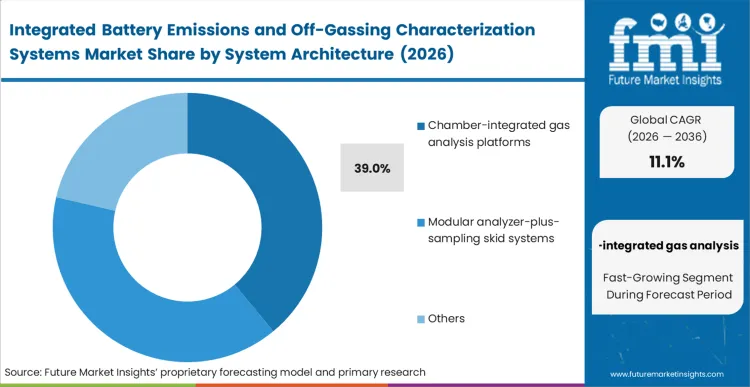
Complete physical containment drives procurement parameters for destructive testing facilities. Chamber-integrated gas analysis platforms account for 39.0% share in 2026. FMI's analysis indicates this dominance stems from workflow efficiency rather than raw sensor performance alone. Facility managers at independent laboratories require a dedicated thermal runaway test chamber that safely scrubs toxic exhaust immediately after test conclusions. Connecting disparate analyzers to standard explosion-proof boxes creates unacceptable leak risks and invalidates concentration calculations. What generalist buyers miss is that chamber volume directly dictates minimum detection limits. Oversized enclosures dilute early venting signals below sensor thresholds. Test facility directors attempting to build custom setups using modular parts face unpredictable data scatter during rapid pressure spikes.
- Containment verification: Operators seal primary volumes before initiating electrical abuse sequences. Lab managers prevent catastrophic facility contamination.
- Volume optimization: Engineers match free space exactly to device dimensions. Technicians capture high-fidelity early venting signatures before dilution occurs.
- Automated purging: Software initiates deep exhaust scrubbing immediately upon test completion. Safety directors accelerate physical turnaround times protecting lab personnel.
Integrated Battery Emissions and Off-Gassing Characterization Systems Market Analysis by Gas analytics technology
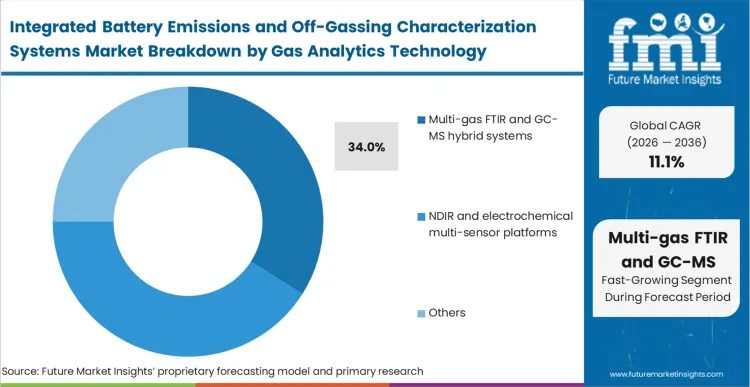
Discrete electrochemical sensors fail resolving complex chemical soups generated during catastrophic electrolyte ignition. Multi-gas FTIR and GC-MS hybrid systems hold 34.0% share in 2026, reflecting industry-wide pivots toward broadband spectroscopic capabilities. R&D directors at cell manufacturing plants must identify transient fluorinated compounds disappearing milliseconds after formation. Based on FMI's assessment, reliance on legacy nondispersive infrared limits visibility to simple hydrocarbons and carbon oxides. What product specifications omit is extreme cross-sensitivity of basic sensors. High hydrogen concentrations completely blind traditional carbon monoxide detectors during runaway events. Homologation engineers delaying upgrades to advanced hybrids submit incomplete toxicity profiles to regulators. Purchasing teams constantly weigh FTIR vs GC-MS for battery vent gas characterization to balance speed against compound resolution.
- Transient capture: Optical paths measure absorption spectra at millisecond intervals. Chemical engineers detect exact decomposition initiation points accurately.
- Cross-interference elimination: Algorithms separate overlapping spectral signatures in dense smoke. Data analysts prevent false-positive concentration spikes verifying true FTIR and GC-MS battery off-gas analysis system capabilities.
- Calibration drift mitigation: Background referencing occurs continuously throughout baseline periods. Maintenance supervisors reduce hardware recalibration frequency significantly.
Integrated Battery Emissions and Off-Gassing Characterization Systems Market Analysis by Battery level
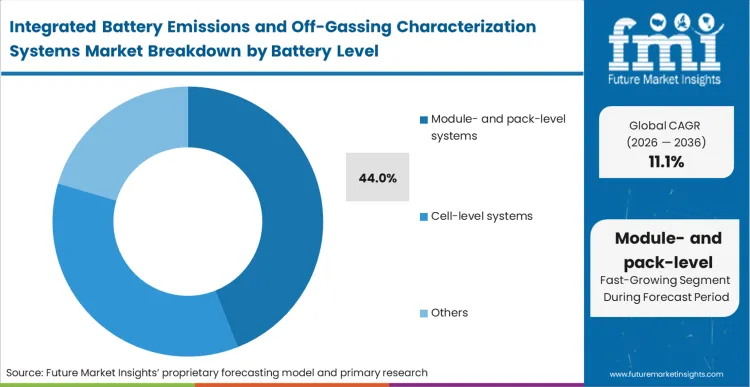
Automotive safety directors must evaluate exactly how localized cell failures propagate through heavily managed thermal barriers. Module- and pack-level systems capture 44.0% share in 2026 as buyers prioritize full-scale validation over isolated component testing. Selecting these massive characterization rigs requires significant facility upgrades handling multi-megawatt energy releases and corresponding exhaust volumes. FMI observes that characterizing single cells provides almost no actionable data regarding real-world during crashes. Share figures conceal massive operational bottlenecks. Only fractions of existing laboratories possess environmental permits necessary for venting full pack-level explosions. Integrators miscalculating required exhaust treatment capacity face immediate facility shutdowns from local environmental agencies. Accurate pack-level thermal runaway emissions analysis dictates facility survival.
- Propagation tracking: Thermocouples map heat transfer while gas probes track localized venting. Systems engineers validate firewall effectiveness across entire modules.
- Volume scaling: Enclosures withstand sudden pressure waves from cascading cell ruptures. Operations managers ensure physical building safety during extreme off-gas characterization for BESS enclosures.
- Coolant interaction: Analyzers detect vaporized glycol mixing with electrolyte compounds. Design teams redesign liquid cooling architectures mitigating secondary ignition risks.
Integrated Battery Emissions and Off-Gassing Characterization Systems Market Analysis by End user
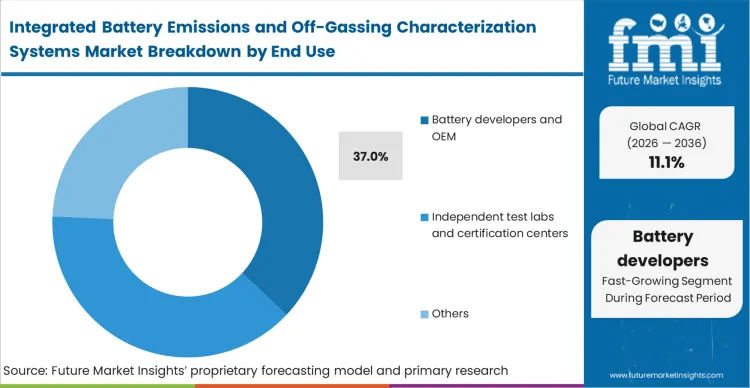
Severe conflicts exist between desires to outsource destructive testing and needs to protect proprietary chemistry formulations. Battery developers and OEM validation centers command 37.0% share in 2026 driven by aggressive internal capital expenditure programs. Procurement officers authorize multi-million-dollar test bays maintaining absolute secrecy over next-generation solid-state failure modes. As per FMI's projection, external certification remains necessary, but manufacturers refuse sharing raw off-gassing data from developmental prototypes with third parties. What external utilization metrics hide is sheer volume of baseline characterization occurring behind closed doors before designs reach independent labs. Companies lacking internal validation capabilities iterate designs too slowly to remain competitive. This secrecy creates immense leverage for niche battery off-gas analysis system suppliers.
- Confidentiality control: Dedicated servers process spectral data without external network connections. Intellectual property directors secure proprietary failure profiles completely.
- Rapid iteration: Engineers run destructive sequences immediately after prototype assembly. Development teams shorten overall design cycles outpacing reliance on external partners.
- Custom protocol execution: Technicians apply non-standard abuse parameters finding edge-case vulnerabilities. Safety leads discover hidden design flaws before public certification begins.
Integrated Battery Emissions and Off-Gassing Characterization Systems Market Analysis by Application
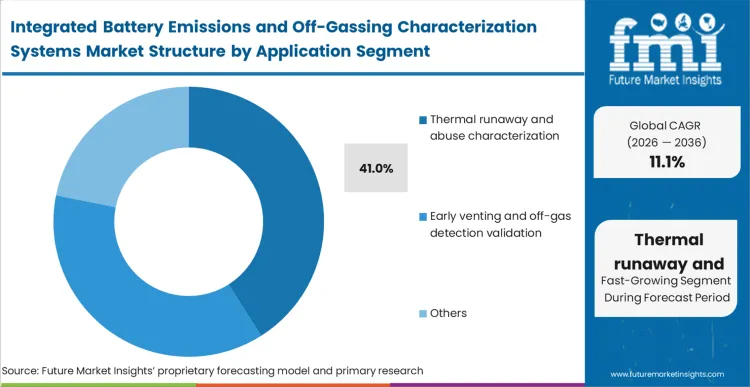
Quantifying exact toxicity limits during catastrophic failure dictates whether passenger vehicle platforms receive regulatory approval. Thermal runaway and abuse characterization secures 41.0% share in 2026 serving as foundational requirements for all global homologation efforts. Regulatory compliance managers depend on these precise volumetric measurements designing cabin ventilation and passenger evacuation protocols. FMI analysts note that early venting detection tools offer preventive value, but full-scale abuse testing remains legally recognized proof of safety. Practitioners analyzing this segment know that degrade incredibly fast during explosions. This rapid degradation drives massive recurring maintenance revenues hidden within initial capital purchases. Laboratories failing to execute standardized battery thermal runaway gas composition analysis lose testing accreditation instantly.
- Nail penetration baseline: Probes measure immediate hydrogen release upon mechanical short circuits. Certification engineers document primary ignition risks validating structural integrity.
- Overcharge forcing: Heaters drive cells past voltage limits while analyzers capture electrolyte boiling points. System architects validate electrical cutoff redundancies using specialized battery off-gas characterization equipment for UL 9540A testing.
- Toxicity profiling: Spectrometers calculate total parts-per-million exposure for specific cabin volumes. Vehicle designers size emergency exhaust fans ensuring safe passenger evacuation windows.
Integrated Battery Emissions and Off-Gassing Characterization Systems Market Drivers, Restraints, and Opportunities
Strict toxicity thresholds for enclosed passenger cabins force automotive homologation engineers to abandon generic flammability testing in favor of precise chemical profiling. Vehicles cannot achieve European certification if pack failures vent fatal concentrations of hydrogen fluoride into passenger compartments within specified evacuation windows. Zero-tolerance regulatory stances compel automakers to purchase high-fidelity optical spectrometers capable of detecting parts-per-billion concentrations in dense smoke. Delaying these capability upgrades leaves testing facilities unable to bid on next-generation platform validation contracts. Rapidly evolving require continuous re-baselining of expected emission profiles. This dynamic sustains permanent hardware upgrade cycles across major laboratories focused on battery thermal runaway emissions testing.
Extreme sensor degradation during routine operation cripples testing throughput. Exposing delicate optical lenses and mass spectrometer filaments to highly corrosive fluorinated compounds causes rapid baseline drift and eventual hardware failure. Test facility managers must pause operations frequently rebuilding sampling lines and recalibrating detectors. This downtime reduces the number of billable tests chambers execute weekly, inflating the total battery emissions characterization system price dramatically. Self-cleaning purge systems mitigate minor fouling but cannot prevent fundamental chemical attacks on measurement infrastructure.
Opportunities in the Integrated Battery Emissions and Off-Gassing Characterization Systems Market
- In-line production sampling: Quality control managers require non-destructive off-gas sniffers on assembly lines. Equipment vendors adapt laboratory-grade sensors for continuous manufacturing environments supporting broader.
- Grid storage continuous monitoring: Utility operators demand early-warning sniffer networks inside containerized installations. Sensor manufacturers deploy advanced architectures enabling comprehensive BESS explosion hazard testing at scale.
- Recycling facility emission control: Plant managers face strict environmental limits when shredding spent packs. Instrumentation providers modify runaway chambers to monitor continuous bulk processing exhaust streams accurately.
Regional Analysis
Based on regional analysis, integrated battery emissions and off-gassing characterization systems market is segmented into North America, Europe, and Asia Pacific across 40 plus countries.
.webp "Top Country Growth Comparison Integrated Battery Emissions And Off Gassing Characterization Systems Market Cagr (2026 2036)")
| Country | CAGR (2026 to 2036) |
|---|---|
| India | 13.4% |
| China | 12.6% |
| United States | 11.9% |
| South Korea | 10.7% |
| Germany | 10.2% |
| United Kingdom | 9.8% |
| Japan | 9.4% |
Source: Future Market Insights (FMI) analysis, based on proprietary forecasting model and primary research
Asia Pacific Integrated Battery Emissions and Off-Gassing Characterization Systems Market Analysis
Massive domestic cell manufacturing quotas dictate immediate needs for localized safety validation infrastructure across Asia. Regional testing directors scramble building high-capacity abuse chambers as governments mandate stringent certification for locally produced storage devices. According to FMI's estimates, reliance on overseas laboratories creates unacceptable shipping delays for dangerous goods prototypes. Pushes toward high-nickel and solid-state chemistries accelerate capital expenditure on mass spectrometry systems capable of resolving novel degradation compounds.
- India: India’s production-linked incentive framework is encouraging cell manufacturers to validate battery designs through local testing programs. Quality leaders are accelerating investment in internal abuse chambers to prevent sensitive prototype cells from being exported for external evaluation. The market is forecast to grow at 13.4% CAGR as domestic capability expands. Early participants that establish trusted validation infrastructure are likely to capture substantial testing business from new Indian automotive brands.
- China: Export compliance forces battery giants to adopt European testing standards natively. Homologation managers purchase dual-standard characterization rigs satisfying multiple regulatory bodies simultaneously. Revenue is anticipated growing at 12.6%. Independent laboratories capture premium pricing by guaranteeing rapid turnaround times.
- South Korea: Incumbent cell suppliers integrate gas analytics directly into pilot production lines. Process engineers map off-gassing profiles across thousands of subtle formulation tweaks. Demand is poised expanding at 10.7%. Deep chemistry knowledge allows these players to outpace competitors establishing safety baselines.
- Japan: Solid-state battery commercialization requires entirely new pressure and gas evolution metrics. R&D heads design custom rigid containment vessels measuring extreme internal pressure spikes. Sales are projected rising at 9.4%. Facility managers struggle sourcing optical windows capable of surviving novel failure modes.
FMI's report includes detailed assessments of emerging testing hubs across Southeast Asia. Developing localized safety standards forces regional regulators sponsoring national laboratory upgrades verifying imported cell compliance.
North America Integrated Battery Emissions and Off-Gassing Characterization Systems Market Analysis
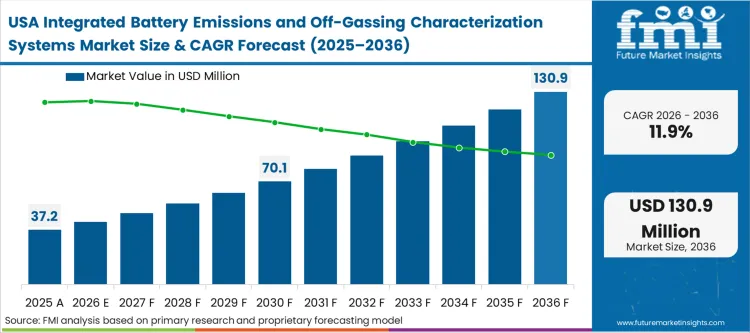
Utility-scale storage deployments define operational requirements for testing facilities in North America. Site operators face intense scrutiny from local fire marshals demanding exact lower flammability limit data for megawatt-scale installations. Based on FMI's assessment, isolated cell testing fails satisfying municipal authorities. Laboratories must construct massive reinforced structures capable of containing multi-rack propagation events alongside advanced.
- United States: Thermal runaway gas composition data has become critical for grid storage integrators working to design adequate ventilation for battery sites. Engineering firms are increasingly requiring full-scale destruction testing before municipal permits receive technical support. The market is expected to expand at 11.9%, reflecting growing attention to failure-mode validation. Certification centers with these advanced testing capabilities carry significant bargaining power when negotiating project terms.
FMI's report includes analysis of Canadian safety validation landscapes. Cold-weather performance testing creates unique demands for heated sampling lines preventing heavy hydrocarbons from condensing before analysis.
Europe Integrated Battery Emissions and Off-Gassing Characterization Systems Market Analysis
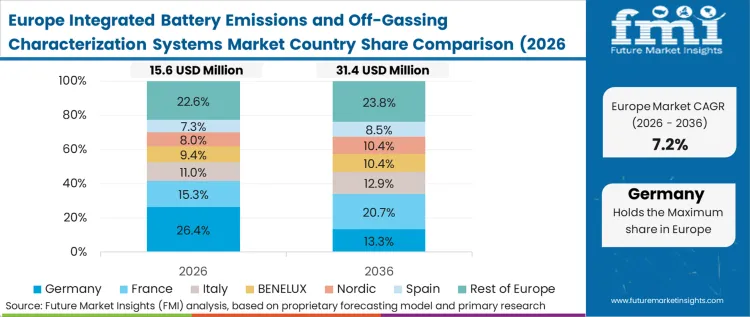
Stringent passenger safety directives transform how regional automakers approach crash testing and battery homologation. Vehicle integration teams must prove catastrophic pack failure leaves passenger cabins habitable long enough for safe evacuation. FMI observes basic temperature monitoring no longer satisfies regional authorities. Testing centers upgrade to multi-point optical gas arrays mapping exactly how toxic plumes travel through vehicle chassis structures.
- Germany: Premium automotive manufacturers establish incredibly tight toxicity thresholds for electric platforms. Safety directors require parts-per-billion resolution detecting hydrogen fluoride alongside precision. Revenue is estimated growing at 10.2%. Instrumentation vendors meeting these stringent limits dominate regional supply chains.
- United Kingdom: Aerospace electrification is pushing laboratories to seek ultra-lightweight containment testing capabilities. Managers are adapting automotive characterization systems to function across high-altitude pressure differentials while meeting specialized aerospace testing needs. Demand is advancing at 9.8% as aviation battery programs place greater emphasis on structural safety validation. Engineers are directly incorporating aviation safety protocols into advanced containment and validation frameworks, giving the testing environment a more stringent certification-oriented structure.
FMI’s report covers testing dynamics across the Nordic region. Deep integration between renewable grid assets and mobile storage platforms is pushing localized testing centers to evaluate hybrid failure modes that affect whole system safety and performance.
Competitive Aligners for Market Players
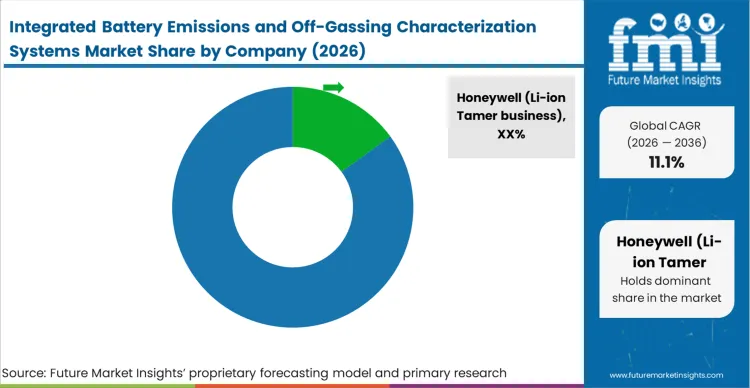
Buyers evaluating integrated battery emissions and off-gassing characterization systems are increasingly prioritizing open data architecture over proprietary design barriers. Competitive strength comes from maintaining sensor calibration under repeated exposure to corrosive fluorinated gases released during severe battery failure events. Suppliers like HORIBA and Dräger secure higher margins because their optical benches and sampling manifolds can survive repeated catastrophic thermal runaway tests without factory rebuilds. Independent laboratories judge solutions by total cost of ownership, since cheaper analyzers often create prolonged downtime and major revenue loss. Facility profitability depends heavily on selecting a reliable integrated battery vent gas analyzer OEM.
Market leaders defend their position with proprietary gas conditioning systems that filter dense soot and particulate loads without removing the target analytes needed for downstream analysis. While challengers may purchase strong spectrometer hardware, detector performance can collapse during the first megawatt-scale explosion if they do not pair it with proven multi-stage sampling skids used in advanced emissions characterization. Incumbents further strengthen their advantage through large baseline spectral libraries, enabling software to distinguish overlapping absorption features that frequently undermine newer test configurations.
Facility managers actively resist vendor lock-in by demanding open data architectures exporting raw spectral feeds rather than encrypted proprietary file types. Hardware suppliers must integrate with agnostic data acquisition platforms ensuring laboratories can mix specific sensor technologies. This interoperability allows independent certification centers to build customized abuse chambers optimized for localized regulatory protocols, integrating alongside traditional sniffers. Flexible systems adapt rapidly to diverse safely.
Key Players in Integrated Battery Emissions and Off-Gassing Characterization Systems Market
- Honeywell (Li-ion Tamer business)
- HORIBA
- NevadaNano
- Dräger
- Weiss Technik
- H2scan
- UL Solutions
Scope of the Report
| Metric | Value |
|---|---|
| Quantitative Units | USD 64.7 million to USD 185.4 million, at a CAGR of 11.1% |
| Market Definition | Instrumentation designed explicitly to capture, measure, and analyze volatile compounds ejected from energy storage devices under thermal or electrical stress. Hardware integrates specialized sampling enclosures with high-speed spectroscopy profiling toxic release events. |
| Segmentation | System architecture, Gas analytics technology, Battery level, End user, Application |
| Regions Covered | North America, Latin America, Western Europe, Eastern Europe, Asia Pacific, Middle East and Africa |
| Countries Covered | United States, Canada, Brazil, Mexico, Germany, United Kingdom, France, Spain, Italy, China, Japan, South Korea, India, GCC Countries, South Africa |
| Key Companies Profiled | Honeywell (Li-ion Tamer business), HORIBA, NevadaNano, Dräger, Weiss Technik, H2scan, UL Solutions |
| Forecast Period | 2026 to 2036 |
| Approach | Capital expenditure budgets for independent battery certification laboratories |
Source: Future Market Insights (FMI) analysis, based on proprietary forecasting model and primary research
Integrated Battery Emissions and Off-Gassing Characterization Systems Market Analysis by Segments
System architecture:
- Chamber-integrated gas analysis platforms
- Modular analyzer-plus-sampling skid systems
- Portable research-grade characterization setups
- Containerized large-format battery abuse characterization systems
Gas analytics technology:
- Multi-gas FTIR and GC-MS hybrid systems
- NDIR and electrochemical multi-sensor platforms
- Mass spectrometry-linked vent-gas characterization systems
- Particle-plus-gas synchronized emission analysis systems
Battery level:
- Module- and pack-level systems
- Cell-level systems
- Rack- and enclosure-level systems for BESS
- Material- and coupon-level gas evolution rigs
End user:
- Battery developers and OEM validation centers
- Independent test labs and certification centers
- Universities and national laboratories
- Energy storage integrators and utilities
Application:
- Thermal runaway and abuse characterization
- Early venting and off-gas detection validation
- Regulatory and certification support testing
- Aging, degradation, and lifecycle emissions characterization
Region:
- North America
- United States
- Canada
- Latin America
- Brazil
- Mexico
- Western Europe
- Germany
- United Kingdom
- France
- Italy
- Spain
- Eastern Europe
- Russia
- Poland
- Asia Pacific
- China
- Japan
- South Korea
- India
- ASEAN
- Oceania
- Middle East and Africa
- GCC Countries
- South Africa
Bibliography
- International Energy Agency. (2025, May). Global EV Outlook 2025. IEA.
- U.S. Energy Information Administration. (2026, March). U.S. battery storage market trends.
- Torres-Castro, L., Bates, A. M., Johnson, N. B., Quintana, G., & Gray, L. S. (2024). Early Detection of Li-Ion Battery Thermal Runaway Using Commercial Diagnostic Technologies. Journal of the Electrochemical Society.
- Nilsson, E. J. K., & Ahlberg Tidblad, A. (2024). Gas Emissions from Lithium-Ion Batteries: A Review of Experimental Results and Methodologies. Batteries.
- Gu, X., Shang, Y., Li, J., Zhu, Y., Tao, X., Geng, H., Zhang, Z., & Zhang, C. (2025). Early warning of thermal runaway based on state of safety for lithium-ion batteries. Communications Engineering.
This bibliography is provided for reader reference. The full FMI report contains the complete reference list with primary source documentation.
This Report Addresses
- Sensor calibration degradation limits encountered during repeated catastrophic thermal runaway tests.
- Procurement timelines for chamber-integrated gas analysis platforms within independent testing laboratories.
- Software integration challenges when merging mass spectrometry outputs with rapid thermal monitoring streams.
- Regulatory shifts forcing automakers measuring parts-per-billion hydrogen fluoride concentrations during vehicle homologation.
- Operational gaps between cell-level toxicity testing and full-scale module propagation exhaust treatment.
- Facility safety constraints regarding venting heavy hydrocarbons generated by high-nickel cathode failures.
- Cross-interference risks when utilizing nondispersive infrared sensors in hydrogen-rich explosion environments.
- Recurring maintenance costs associated with soot fouling in primary exhaust sampling lines.
Frequently Asked Questions
What gases are released during lithium-ion battery thermal runaway?
Electrolyte decomposition produces highly toxic hydrogen fluoride and phosphoryl fluoride alongside flammable hydrogen and carbon monoxide. Testing facilities must quantify these transient intermediate compounds accurately before they dissipate entirely into surrounding environments.
How is battery off-gas measured in testing labs?
Engineers utilize chamber-integrated multi-gas FTIR or GC-MS hybrid systems. These advanced setups capture synchronized optical absorption spectra measuring transient compounds at millisecond intervals during catastrophic electrical abuse testing.
How does UL 9540A affect battery emissions testing demand?
Stringent fire safety mandates for energy storage deployments force integrators profiling precise lower flammability limits. Compliance requires testing facilities installing massive reinforced enclosures capable of containing and analyzing multi-rack propagation events safely.
Can off-gas sensing provide early warning before thermal runaway?
Chemical engineers use highly sensitive probes detecting precursor off-gassing events seconds before violent ruptures occur. This capability allows R&D teams identifying exact decomposition initiation points mitigating ignition risks proactively.
Build a buying checklist for battery thermal runaway emissions analysis equipment.
Procurement directors evaluate hardware resilience against fluorinated gas corrosion and automated purge capabilities. Secondary checks include data acquisition interoperability and proven success filtering heavy soot without scrubbing target analytes.
Battery off-gas detection vs gas chromatography: what differs?
Detection provides simple binary alerts identifying dangerous thresholds for facility evacuation. Chromatography physically separates complex chemical mixtures identifying exact toxic compound compositions necessary for rigorous regulatory homologation reporting.
FTIR vs GC-MS for battery vent gas characterization: which is better?
FTIR captures highly transient compounds at millisecond intervals excelling at continuous live monitoring. GC-MS offers superior chemical resolution identifying unknown breakdown products definitively but struggles tracking rapid concentration spikes instantly.
Why do chamber-integrated platforms command significant segment share?
Facility managers prioritize physical containment above raw sensor performance alone. Connecting disparate analyzers to standard explosion-proof boxes creates leak risks invalidating concentration calculations during extreme pressure spikes.
How does pack-level testing alter capital requirements?
Validating multi-megawatt energy releases requires massive environmental permits and specialized exhaust scrubbing infrastructure. Integrators must treat massive volumes of vaporized coolant mixing with toxic electrolyte.
What limits adoption of custom-built testing arrays?
Matching free space to device size dictates minimum detection limits. Oversized enclosures dilute early venting signals below sensor thresholds, forcing laboratories purchasing perfectly scaled, purpose-built chambers.
How do independent laboratories maintain throughput?
Operations managers invest heavily in automated purging systems initiating deep exhaust scrubbing immediately upon test completion. Faster physical turnaround times directly increase weekly billable testing hours.
Why do OEMs conduct testing internally?
Intellectual property directors secure proprietary failure profiles running destructive sequences on dedicated offline servers. External validation risks leaking raw off-gassing data for next-generation solid-state architectures.
What causes standard sensors to fail during abuse testing?
Extreme hydrogen concentrations completely blind traditional carbon monoxide detectors. High-temperature fluorinated gases attack unprotected optical lenses and mass spectrometer filaments rapidly.
How does Indian regulatory environments impact analyzer procurement?
Domestic production-linked incentives require cell manufacturers validating designs locally. Quality directors build internal abuse chambers rapidly avoiding exporting proprietary prototype cells to overseas laboratories.
What drives North American testing facility expansion?
Site operators face scrutiny from fire marshals demanding exact lower flammability limits for megawatt-scale utility deployments. Engineering firms mandate full-scale destruction testing before approving municipal permits.
Why do premium automakers require parts-per-billion resolution?
Vehicle integration teams must prove catastrophic pack failure leaves passenger cabins habitable. Advanced ventilation systems rely on precise toxicity limits sizing emergency exhaust fans accurately.
How do vendors prevent cross-interference in dense smoke?
Advanced algorithms separate overlapping spectral signatures continuously throughout baseline periods. Data analysts rely on these corrections preventing false-positive concentration spikes during complex multi-gas releases.
Why do solid-state batteries require new testing paradigms?
Novel chemistries generate extreme internal pressure spikes rather than typical venting volumes. Facility managers struggle sourcing optical windows capable surviving rigid containment vessel tests.
How do testing centers capture premium pricing?
Independent laboratories offer synchronized particulate and chemical analysis within single test reports. Regulatory compliance managers pay premiums satisfying multiple safety directives simultaneously.
What operational bottleneck plagues full-scale propagation testing?
Only fractions of existing laboratories possess environmental permits necessary venting pack-level explosions. Integrators miscalculating exhaust capacity face immediate facility shutdowns.
Why is standard environmental cycling equipment insufficient?
Ambient air quality monitors track facility safety but lack temporal resolution capturing millisecond-level hydrogen fluoride spikes inside actual test enclosures.
How do sampling manifolds survive catastrophic failure?
Incumbents design proprietary gas conditioning systems filtering out heavy soot and blinding particulates without scrubbing target analytes before they reach optical benches.
What prevents vendor lock-in at certification centers?
Facility managers demand open data architectures exporting raw spectral feeds. This allows laboratories mixing technologies building customized abuse chambers optimized for specific protocols.
How do export requirements affect Chinese laboratories?
Export compliance forces domestic cell manufacturers adopting European testing standards natively. Homologation managers purchase dual-standard characterization rigs satisfying overseas regulatory bodies.
Preview the report firsthand - request a free sample
Get SampleGet the brochure for pricing and purchase details.
Get PDFTable of Content
- Executive Summary
- Global Market Outlook
- Demand-side Trends
- Supply-side Trends
- Technology Roadmap Analysis
- Analysis and Recommendations
- Market Overview
- Market Coverage / Taxonomy
- Market Definition / Scope / Limitations
- Research Methodology
- Chapter Orientation
- Analytical Lens and Working Hypotheses
- Market Structure, Signals, and Trend Drivers
- Benchmarking and Cross-market Comparability
- Market Sizing, Forecasting, and Opportunity Mapping
- Research Design and Evidence Framework
- Desk Research Programme (Secondary Evidence)
- Company Annual and Sustainability Reports
- Peer-reviewed Journals and Academic Literature
- Corporate Websites, Product Literature, and Technical Notes
- Earnings Decks and Investor Briefings
- Statutory Filings and Regulatory Disclosures
- Technical White Papers and Standards Notes
- Trade Journals, Industry Magazines, and Analyst Briefs
- Conference Proceedings, Webinars, and Seminar Materials
- Government Statistics Portals and Public Data Releases
- Press Releases and Reputable Media Coverage
- Specialist Newsletters and Curated Briefings
- Sector Databases and Reference Repositories
- FMI Internal Proprietary Databases and Historical Market Datasets
- Subscription Datasets and Paid Sources
- Social Channels, Communities, and Digital Listening Inputs
- Additional Desk Sources
- Expert Input and Fieldwork (Primary Evidence)
- Primary Modes
- Qualitative Interviews and Expert Elicitation
- Quantitative Surveys and Structured Data Capture
- Blended Approach
- Why Primary Evidence is Used
- Field Techniques
- Interviews
- Surveys
- Focus Groups
- Observational and In-context Research
- Social and Community Interactions
- Stakeholder Universe Engaged
- C-suite Leaders
- Board Members
- Presidents and Vice Presidents
- R&D and Innovation Heads
- Technical Specialists
- Domain Subject-matter Experts
- Scientists
- Physicians and Other Healthcare Professionals
- Governance, Ethics, and Data Stewardship
- Research Ethics
- Data Integrity and Handling
- Primary Modes
- Tooling, Models, and Reference Databases
- Desk Research Programme (Secondary Evidence)
- Data Engineering and Model Build
- Data Acquisition and Ingestion
- Cleaning, Normalisation, and Verification
- Synthesis, Triangulation, and Analysis
- Quality Assurance and Audit Trail
- Market Background
- Market Dynamics
- Drivers
- Restraints
- Opportunity
- Trends
- Scenario Forecast
- Demand in Optimistic Scenario
- Demand in Likely Scenario
- Demand in Conservative Scenario
- Opportunity Map Analysis
- Product Life Cycle Analysis
- Supply Chain Analysis
- Investment Feasibility Matrix
- Value Chain Analysis
- PESTLE and Porter’s Analysis
- Regulatory Landscape
- Regional Parent Market Outlook
- Production and Consumption Statistics
- Import and Export Statistics
- Market Dynamics
- Global Market Analysis 2021 to 2025 and Forecast, 2026 to 2036
- Historical Market Size Value (USD Million) Analysis, 2021 to 2025
- Current and Future Market Size Value (USD Million) Projections, 2026 to 2036
- Y-o-Y Growth Trend Analysis
- Absolute $ Opportunity Analysis
- Global Market Pricing Analysis 2021 to 2025 and Forecast 2026 to 2036
- Global Market Analysis 2021 to 2025 and Forecast 2026 to 2036, By System Architecture
- Introduction / Key Findings
- Historical Market Size Value (USD Million) Analysis By System Architecture , 2021 to 2025
- Current and Future Market Size Value (USD Million) Analysis and Forecast By System Architecture , 2026 to 2036
- Chamber-integrated gas analysis platforms
- Modular analyzer-plus-sampling skid systems
- Others
- Chamber-integrated gas analysis platforms
- Y-o-Y Growth Trend Analysis By System Architecture , 2021 to 2025
- Absolute $ Opportunity Analysis By System Architecture , 2026 to 2036
- Global Market Analysis 2021 to 2025 and Forecast 2026 to 2036, By Gas Analytics Technology
- Introduction / Key Findings
- Historical Market Size Value (USD Million) Analysis By Gas Analytics Technology, 2021 to 2025
- Current and Future Market Size Value (USD Million) Analysis and Forecast By Gas Analytics Technology, 2026 to 2036
- Multi-gas FTIR and GC-MS hybrid systems
- NDIR and electrochemical multi-sensor platforms
- Others
- Multi-gas FTIR and GC-MS hybrid systems
- Y-o-Y Growth Trend Analysis By Gas Analytics Technology, 2021 to 2025
- Absolute $ Opportunity Analysis By Gas Analytics Technology, 2026 to 2036
- Global Market Analysis 2021 to 2025 and Forecast 2026 to 2036, By Battery Level
- Introduction / Key Findings
- Historical Market Size Value (USD Million) Analysis By Battery Level, 2021 to 2025
- Current and Future Market Size Value (USD Million) Analysis and Forecast By Battery Level, 2026 to 2036
- Module- and pack-level systems
- Cell-level systems
- Others
- Module- and pack-level systems
- Y-o-Y Growth Trend Analysis By Battery Level, 2021 to 2025
- Absolute $ Opportunity Analysis By Battery Level, 2026 to 2036
- Global Market Analysis 2021 to 2025 and Forecast 2026 to 2036, By End Use
- Introduction / Key Findings
- Historical Market Size Value (USD Million) Analysis By End Use, 2021 to 2025
- Current and Future Market Size Value (USD Million) Analysis and Forecast By End Use, 2026 to 2036
- Battery developers and OEM
- Independent test labs and certification centers
- Others
- Battery developers and OEM
- Y-o-Y Growth Trend Analysis By End Use, 2021 to 2025
- Absolute $ Opportunity Analysis By End Use, 2026 to 2036
- Global Market Analysis 2021 to 2025 and Forecast 2026 to 2036, By Application
- Introduction / Key Findings
- Historical Market Size Value (USD Million) Analysis By Application, 2021 to 2025
- Current and Future Market Size Value (USD Million) Analysis and Forecast By Application, 2026 to 2036
- Thermal runaway and abuse characterization
- Early venting and off-gas detection validation
- Others
- Thermal runaway and abuse characterization
- Y-o-Y Growth Trend Analysis By Application, 2021 to 2025
- Absolute $ Opportunity Analysis By Application, 2026 to 2036
- Global Market Analysis 2021 to 2025 and Forecast 2026 to 2036, By Region
- Introduction
- Historical Market Size Value (USD Million) Analysis By Region, 2021 to 2025
- Current Market Size Value (USD Million) Analysis and Forecast By Region, 2026 to 2036
- North America
- Latin America
- Western Europe
- Eastern Europe
- East Asia
- South Asia and Pacific
- Middle East & Africa
- Market Attractiveness Analysis By Region
- North America Market Analysis 2021 to 2025 and Forecast 2026 to 2036, By Country
- Historical Market Size Value (USD Million) Trend Analysis By Market Taxonomy, 2021 to 2025
- Market Size Value (USD Million) Forecast By Market Taxonomy, 2026 to 2036
- By Country
- USA
- Canada
- Mexico
- By System Architecture
- By Gas Analytics Technology
- By Battery Level
- By End Use
- By Application
- By Country
- Market Attractiveness Analysis
- By Country
- By System Architecture
- By Gas Analytics Technology
- By Battery Level
- By End Use
- By Application
- Key Takeaways
- Latin America Market Analysis 2021 to 2025 and Forecast 2026 to 2036, By Country
- Historical Market Size Value (USD Million) Trend Analysis By Market Taxonomy, 2021 to 2025
- Market Size Value (USD Million) Forecast By Market Taxonomy, 2026 to 2036
- By Country
- Brazil
- Chile
- Rest of Latin America
- By System Architecture
- By Gas Analytics Technology
- By Battery Level
- By End Use
- By Application
- By Country
- Market Attractiveness Analysis
- By Country
- By System Architecture
- By Gas Analytics Technology
- By Battery Level
- By End Use
- By Application
- Key Takeaways
- Western Europe Market Analysis 2021 to 2025 and Forecast 2026 to 2036, By Country
- Historical Market Size Value (USD Million) Trend Analysis By Market Taxonomy, 2021 to 2025
- Market Size Value (USD Million) Forecast By Market Taxonomy, 2026 to 2036
- By Country
- Germany
- UK
- Italy
- Spain
- France
- Nordic
- BENELUX
- Rest of Western Europe
- By System Architecture
- By Gas Analytics Technology
- By Battery Level
- By End Use
- By Application
- By Country
- Market Attractiveness Analysis
- By Country
- By System Architecture
- By Gas Analytics Technology
- By Battery Level
- By End Use
- By Application
- Key Takeaways
- Eastern Europe Market Analysis 2021 to 2025 and Forecast 2026 to 2036, By Country
- Historical Market Size Value (USD Million) Trend Analysis By Market Taxonomy, 2021 to 2025
- Market Size Value (USD Million) Forecast By Market Taxonomy, 2026 to 2036
- By Country
- Russia
- Poland
- Hungary
- Balkan & Baltic
- Rest of Eastern Europe
- By System Architecture
- By Gas Analytics Technology
- By Battery Level
- By End Use
- By Application
- By Country
- Market Attractiveness Analysis
- By Country
- By System Architecture
- By Gas Analytics Technology
- By Battery Level
- By End Use
- By Application
- Key Takeaways
- East Asia Market Analysis 2021 to 2025 and Forecast 2026 to 2036, By Country
- Historical Market Size Value (USD Million) Trend Analysis By Market Taxonomy, 2021 to 2025
- Market Size Value (USD Million) Forecast By Market Taxonomy, 2026 to 2036
- By Country
- China
- Japan
- South Korea
- By System Architecture
- By Gas Analytics Technology
- By Battery Level
- By End Use
- By Application
- By Country
- Market Attractiveness Analysis
- By Country
- By System Architecture
- By Gas Analytics Technology
- By Battery Level
- By End Use
- By Application
- Key Takeaways
- South Asia and Pacific Market Analysis 2021 to 2025 and Forecast 2026 to 2036, By Country
- Historical Market Size Value (USD Million) Trend Analysis By Market Taxonomy, 2021 to 2025
- Market Size Value (USD Million) Forecast By Market Taxonomy, 2026 to 2036
- By Country
- India
- ASEAN
- Australia & New Zealand
- Rest of South Asia and Pacific
- By System Architecture
- By Gas Analytics Technology
- By Battery Level
- By End Use
- By Application
- By Country
- Market Attractiveness Analysis
- By Country
- By System Architecture
- By Gas Analytics Technology
- By Battery Level
- By End Use
- By Application
- Key Takeaways
- Middle East & Africa Market Analysis 2021 to 2025 and Forecast 2026 to 2036, By Country
- Historical Market Size Value (USD Million) Trend Analysis By Market Taxonomy, 2021 to 2025
- Market Size Value (USD Million) Forecast By Market Taxonomy, 2026 to 2036
- By Country
- Kingdom of Saudi Arabia
- Other GCC Countries
- Turkiye
- South Africa
- Other African Union
- Rest of Middle East & Africa
- By System Architecture
- By Gas Analytics Technology
- By Battery Level
- By End Use
- By Application
- By Country
- Market Attractiveness Analysis
- By Country
- By System Architecture
- By Gas Analytics Technology
- By Battery Level
- By End Use
- By Application
- Key Takeaways
- Key Countries Market Analysis
- USA
- Pricing Analysis
- Market Share Analysis, 2025
- By System Architecture
- By Gas Analytics Technology
- By Battery Level
- By End Use
- By Application
- Canada
- Pricing Analysis
- Market Share Analysis, 2025
- By System Architecture
- By Gas Analytics Technology
- By Battery Level
- By End Use
- By Application
- Mexico
- Pricing Analysis
- Market Share Analysis, 2025
- By System Architecture
- By Gas Analytics Technology
- By Battery Level
- By End Use
- By Application
- Brazil
- Pricing Analysis
- Market Share Analysis, 2025
- By System Architecture
- By Gas Analytics Technology
- By Battery Level
- By End Use
- By Application
- Chile
- Pricing Analysis
- Market Share Analysis, 2025
- By System Architecture
- By Gas Analytics Technology
- By Battery Level
- By End Use
- By Application
- Germany
- Pricing Analysis
- Market Share Analysis, 2025
- By System Architecture
- By Gas Analytics Technology
- By Battery Level
- By End Use
- By Application
- UK
- Pricing Analysis
- Market Share Analysis, 2025
- By System Architecture
- By Gas Analytics Technology
- By Battery Level
- By End Use
- By Application
- Italy
- Pricing Analysis
- Market Share Analysis, 2025
- By System Architecture
- By Gas Analytics Technology
- By Battery Level
- By End Use
- By Application
- Spain
- Pricing Analysis
- Market Share Analysis, 2025
- By System Architecture
- By Gas Analytics Technology
- By Battery Level
- By End Use
- By Application
- France
- Pricing Analysis
- Market Share Analysis, 2025
- By System Architecture
- By Gas Analytics Technology
- By Battery Level
- By End Use
- By Application
- India
- Pricing Analysis
- Market Share Analysis, 2025
- By System Architecture
- By Gas Analytics Technology
- By Battery Level
- By End Use
- By Application
- ASEAN
- Pricing Analysis
- Market Share Analysis, 2025
- By System Architecture
- By Gas Analytics Technology
- By Battery Level
- By End Use
- By Application
- Australia & New Zealand
- Pricing Analysis
- Market Share Analysis, 2025
- By System Architecture
- By Gas Analytics Technology
- By Battery Level
- By End Use
- By Application
- China
- Pricing Analysis
- Market Share Analysis, 2025
- By System Architecture
- By Gas Analytics Technology
- By Battery Level
- By End Use
- By Application
- Japan
- Pricing Analysis
- Market Share Analysis, 2025
- By System Architecture
- By Gas Analytics Technology
- By Battery Level
- By End Use
- By Application
- South Korea
- Pricing Analysis
- Market Share Analysis, 2025
- By System Architecture
- By Gas Analytics Technology
- By Battery Level
- By End Use
- By Application
- Russia
- Pricing Analysis
- Market Share Analysis, 2025
- By System Architecture
- By Gas Analytics Technology
- By Battery Level
- By End Use
- By Application
- Poland
- Pricing Analysis
- Market Share Analysis, 2025
- By System Architecture
- By Gas Analytics Technology
- By Battery Level
- By End Use
- By Application
- Hungary
- Pricing Analysis
- Market Share Analysis, 2025
- By System Architecture
- By Gas Analytics Technology
- By Battery Level
- By End Use
- By Application
- Kingdom of Saudi Arabia
- Pricing Analysis
- Market Share Analysis, 2025
- By System Architecture
- By Gas Analytics Technology
- By Battery Level
- By End Use
- By Application
- Turkiye
- Pricing Analysis
- Market Share Analysis, 2025
- By System Architecture
- By Gas Analytics Technology
- By Battery Level
- By End Use
- By Application
- South Africa
- Pricing Analysis
- Market Share Analysis, 2025
- By System Architecture
- By Gas Analytics Technology
- By Battery Level
- By End Use
- By Application
- USA
- Market Structure Analysis
- Competition Dashboard
- Competition Benchmarking
- Market Share Analysis of Top Players
- By Regional
- By System Architecture
- By Gas Analytics Technology
- By Battery Level
- By End Use
- By Application
- Competition Analysis
- Competition Deep Dive
- Honeywell (Li-ion Tamer business)
- Overview
- Product Portfolio
- Profitability by Market Segments (Product/Age /Sales Channel/Region)
- Sales Footprint
- Strategy Overview
- Marketing Strategy
- Product Strategy
- Channel Strategy
- HORIBA
- NevadaNano
- Dräger
- Weiss Technik
- H2scan
- UL Solutions
- Honeywell (Li-ion Tamer business)
- Competition Deep Dive
- Assumptions & Acronyms Used


