

- Market Size (2026)
- USD 3.42 Bn
- Forecast (2036)
- USD 5.98 Bn
- CAGR (2026 to 2036)
- 5.8%
48V Mild Hybrid Battery Pack Systems Market Size, Market Forecast and Outlook By FMI
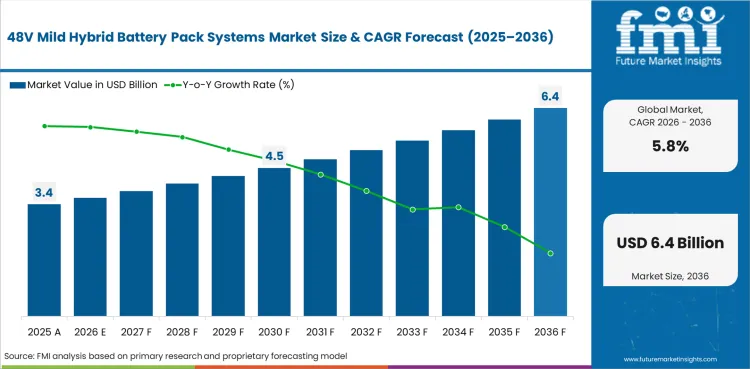
The 48V mild hybrid battery pack systems market was valued at USD 3.23 billion in 2025. The industry is expected to reach USD 3.42 billion by 2026 and advance at a CAGR of 5.8% from 2026 to 2036 to reach USD 5.98 billion by 2036. Lithium-ion NMC is projected to lead with a 48.0% share, while passenger cars are expected to account for a 64.0% share in 2026.
Summary of the 48V Mild Hybrid Battery Pack Systems Market
- Demand and Growth Drivers
- Emissions control pressure and fuel efficiency targets are expected to support demand for 48V mild hybrid battery packs as automakers seek cost efficient electrification routes. Full hybrid systems carry higher system cost.
- Compact lithium ion packs are likely to stay important because they support recuperation and boost functions with easier vehicle packaging.
- Hybrid heavy passenger vehicle registrations in Europe and other regulated markets are expected to keep OEM sourcing active.
- Product and Segment View
- Lithium ion NMC is likely to lead the battery chemistry segment, supported by demand for compact packs that balance power delivery and packaging fit.
- Passenger cars are likely to lead because they represent the largest commercial base for 48V mild hybrid deployment across key automotive markets.
- P0 systems are likely to stay important in the architecture segment as automakers prefer layouts that add mild hybrid support with lower platform disruption.
- Geography and Competitive Outlook
- China is likely to be a major market because broad vehicle manufacturing depth and a strong electrification supply base support mild hybrid battery pack demand.
- India is expected to be one of the faster growing markets as cost sensitive electrification gains space in mainstream passenger vehicle programs.
- Companies that can combine battery management integration and compact packaging design are likely to gain traction.
- Analyst Opinion
- Nikhil Kaitwade, Principal Consultant at FMI says, “Companies that can improve coolant routing precision, support compact thermal packaging, and deliver dependable actuator performance are likely to strengthen their position over the forecast period, as EV makers keep raising expectations around charging efficiency, battery durability, and pack thermal stability.”
- Battery Pack Cooling Valve Actuator Systems Market Value Analysis
- The market is moving from a narrower thermal-control component category into a more visible part of EV system spending.
- Demand is rising as battery packs carry higher thermal loads and need tighter temperature control during charging and discharge cycles.
- Adoption is also supported by the wider use of cold plates and battery thermal materials in EV pack design.
- Spending remains linked to vehicle electrification with battery safety work and better thermal efficiency inside integrated cooling architectures.
Key Takeaways
- The 48V mild hybrid battery pack systems market was valued at USD 3.23 billion in 2025.
- By 2036, the 48V mild hybrid battery pack systems market is expected to be worth USD 5.98 billion.
- From 2026 to 2036, the market is projected to expand at a CAGR of 5.8%.
- The market is projected to create an incremental opportunity of USD 2.56 billion between 2026 and 2036.
- In 2026, Lithium-ion NMC is expected to account for 48.0% of the battery chemistry segment.
- India (7.1%) and China (6.7%) are two of the fastest growing markets in the world.
48V Mild Hybrid Battery Pack Systems Market Definition
This market covers low-voltage battery packs designed specifically for 48V mild hybrid automotive systems. Scope includes lithium-ion battery packs, pack-level electronics, thermal management features, and battery management functionality used in passenger cars, SUVs, and selected light commercial vehicles.
48V Mild Hybrid Battery Pack Systems Market Inclusions
Included within scope are 48V lithium-ion battery packs used in mild hybrid powertrains, whether passively cooled, air-cooled, or liquid-cooled. Integrated battery management systems, embedded safety controls, pack housing design, and closely linked electronics fall within scope where the battery pack remains the central commercial unit.
48V Mild Hybrid Battery Pack Systems Market Exclusions
Full hybrid traction batteries, plug-in hybrid battery packs, high-voltage BEV battery systems, stationary energy storage products, and stand-alone starter batteries sit outside this market boundary. Starter-generators, motors, inverters, and full e-axles are treated as neighboring categories unless they are sold as part of a battery-pack-centered low-voltage system package.
48V Mild Hybrid Battery Pack Systems Market Research Methodology
- Primary Research: FMI evaluates supplier participation, vehicle electrification pathways, and pack configuration trends through official company disclosures, product pages, and current industry releases tied to hybrid vehicle deployment and low-voltage system design.
- Desk Research: Secondary review includes government and trade association releases on vehicle registrations, fleet emissions policy, and electrification trends across Europe, China, Japan, India, Brazil, South Korea, and North America.
- Market Sizing and Forecasting: Sizing is modeled from expected 48V-equipped vehicle volumes, battery pack attachment rates, and pack value by design type. Forecasting reflects regulation pressure, hybrid program continuity, and cost positioning relative to full hybrid systems.
- Data Validation and Update Cycle: Numbers are checked against supplier product availability, current hybrid registration trends, and policy updates affecting light vehicle efficiency performance and electrification planning across major automotive regions.
Why is the 48V Mild Hybrid Battery Pack Systems Market Growing?
- Automakers continue to use 48V systems where fuel economy gains are needed without full hybrid system cost.
- Compact lithium-ion packs are gaining use because they support recuperation and boost functions with easier vehicle packaging.
- Hybrid-heavy registration growth in Europe keeps OEM sourcing active for battery packs and related controls.
Fleet emissions pressure remains the clearest growth driver for this market. European CO2 rules for cars and vans continue to push automakers toward lower fleet emissions, while the U.S. EPA has tightened standards for model years 2027 and later. 48V mild hybrid systems are useful because they improve restart response and recover braking energy. Full hybrid architectures carry higher system cost. cars outlook is relevant here because passenger vehicle demand is the main commercial base for these battery packs. OEM sourcing is strongest in vehicle lines where manufacturers want compliance support and measured cost control within existing platform programs.
Market Segmentation Analysis
- Lithium-ion NMC leads battery chemistry demand with 48.0% share because compact mild hybrid packs need strong power delivery and proven automotive integration.
- Passenger cars account for 64.0% of vehicle-type demand while P0 systems hold 37.0% of architecture-compatibility demand in 2026.
- Passive cooling remains the leading cooling type with 54.0% share, while OEM fitment dominates the sales channel with 88.0% share because 48V battery packs are specified during vehicle platform engineering.
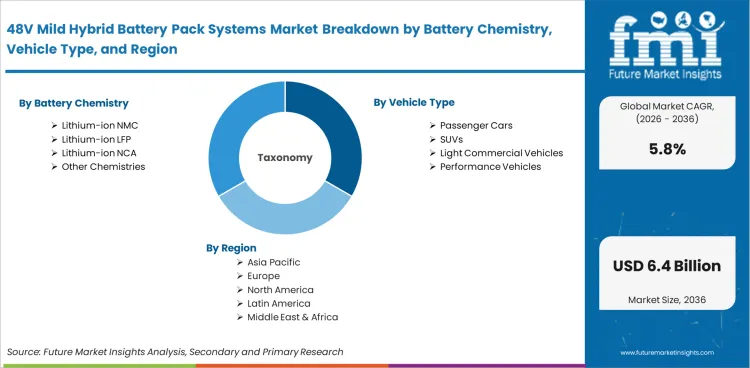
The 48V mild hybrid battery pack systems market is segmented by battery chemistry, vehicle type, architecture compatibility, cooling type, sales channel, and region. Battery chemistry covers lithium-ion NMC, lithium-ion LFP, lithium-ion NCA, and other chemistries. Vehicle type includes passenger cars, SUVs, light commercial vehicles, and performance vehicles. Architecture compatibility includes P0 systems, P1 systems, P2 systems, P3 systems, and P4 systems. Cooling type covers passive cooling, air cooling, and liquid cooling. Sales channel includes OEM fitment, Tier 1 supply, and replacement aftermarket.
Insights into the Lithium-ion NMC Segment
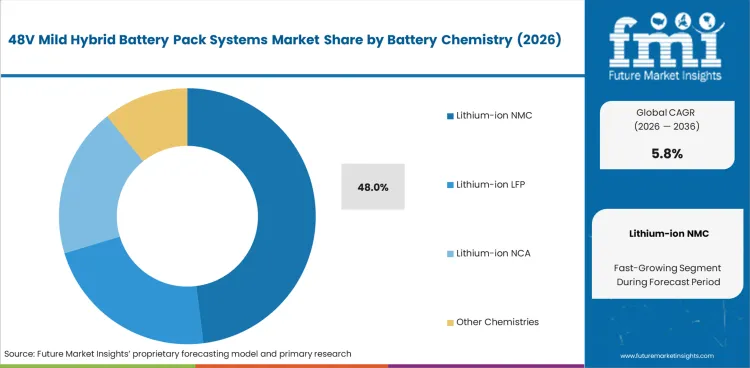
- Lithium-ion NMC is anticipated to represent 48.0% of the battery chemistry segment in 2026. This reflects stronger demand for compact battery packs that can deliver reliable power support for recuperation and boost functions in mild hybrid layouts.
- This chemistry works well where usable power and vehicle integration need to stay balanced within a smaller 48V system. LFP and other chemistries retain relevance in selected programs.
Insights into the Passenger Cars Segment
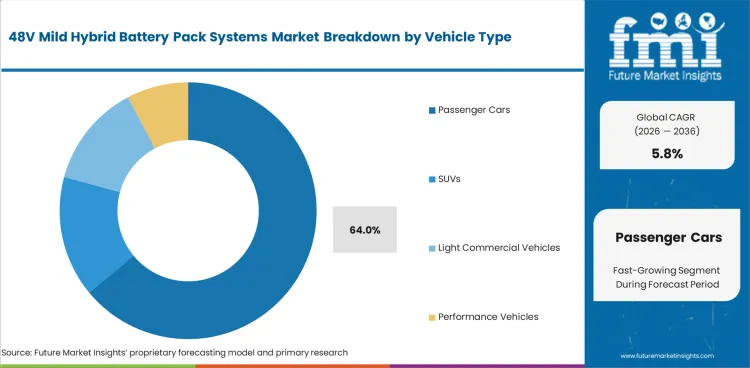
- Passenger cars are set to make up 64.0% of the vehicle-type segment in 2026 as this vehicle class represents the largest base for 48V mild hybrid deployment across key automotive markets.
- Their scale generates high unit demand for compact 48V battery packs than SUVs in narrower performance applications or light commercial vehicles with different electrification economics.
Insights into the P0 Systems Segment
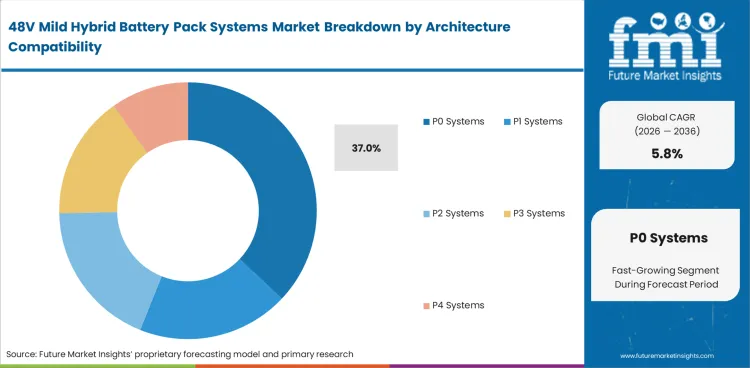
- P0 systems are expected to account for 37.0% of the architecture compatibility segment in 2026. These systems are widely used because they allow automakers to add mild hybrid support with limited platform disruption.
- Their strength is easier integration into existing internal combustion vehicle platforms, especially where OEMs want practical electrification with controlled engineering cost. P1 and P2 systems hold space in selected programs.
Insights into the Passive Cooling Segment
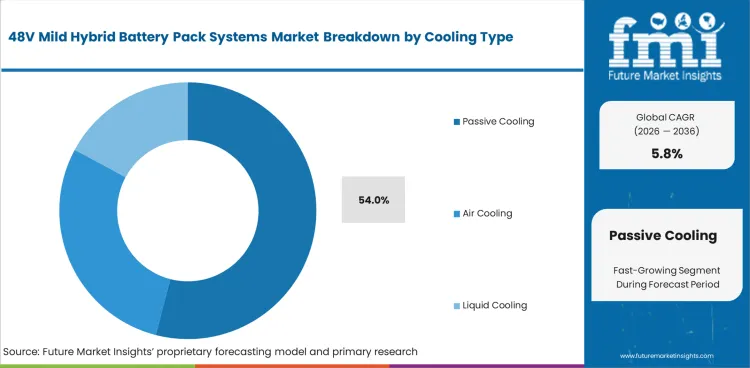
- Passive cooling is likely to secure 54.0% share in 2026 because many 48V mild hybrid battery packs operate with lower thermal stress than larger high-voltage traction batteries.
- Simpler cooling layouts are attractive where compact energy storage and easier packaging are priorities during vehicle integration. Air cooling and liquid cooling still serve programs with different thermal requirements. Passive cooling leads where cost control and packaging simplicity carry higher importance.
Insights into the OEM Fitment Segment
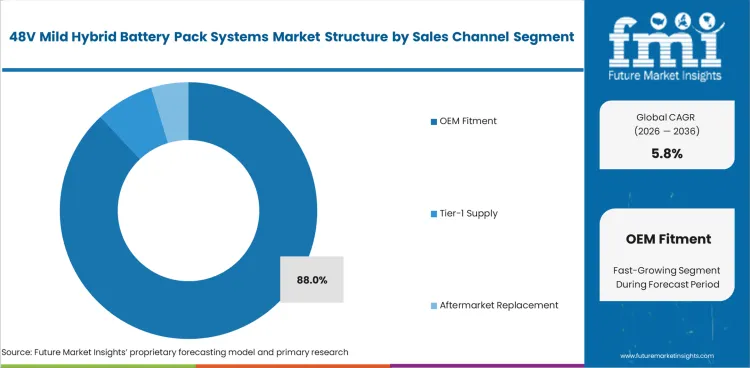
- OEM fitment is expected to account for 88.0% share in 2026. Mild hybrid battery pack systems are selected during vehicle development and aligned directly with platform packaging and control strategy.
- This channel is dominant because 48V battery packs are tightly linked to factory calibration and vehicle-level validation. Tier 1 supply supports the broader sourcing chain. Final commercial demand is centered on original vehicle programs where engineering alignment at the platform stage determines most of the component value.
What are the drivers, restraints, and key trends in the 48V mild hybrid battery pack systems market?
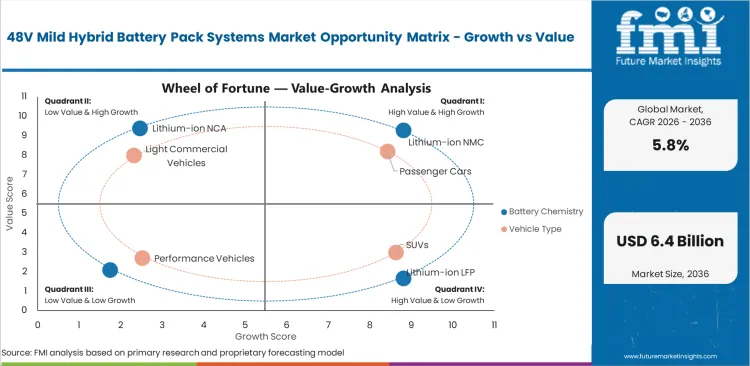
- A major driver comes from fleet emission pressure across high-volume passenger vehicle regions.
- A key restraint comes from stronger capital allocation toward BEVs and full hybrids in some automaker portfolios.
- A major trend is rising integration of battery management and compact flatpack hardware.
Policy pressure influences this market, though vehicle program economics still decide how widely 48V content gets sourced in practice. These battery packs serve a useful role because they deliver measurable efficiency support with lower system burden. High-voltage hybrids carry higher system complexity. Current supplier activity shows a move toward tighter electronics integration and easier packaging. The industrial battery charger outlook shows that battery control and charging support infrastructure are gaining value as electrified systems become more dependent on electronics. Growth is moderate because this category fits specific cost and packaging windows.
Emissions compliance support
EU and U.S. policy keeps pressure on automakers to lower fleet emissions through the second half of this decade. That supports mild hybrid systems in vehicle lines where full hybrid cost or packaging creates limited business case. Bosch states that 48V hybrid solutions can reduce CO2 emissions, which supports continued use of compact battery packs in suitable programs. Battery pack suppliers benefit when automakers need clear efficiency gains across large combustion vehicle fleets. Demand is strongest in vehicle lines where manufacturers want a cost efficient answer that improves restart response and recuperation capability.
Cost and platform fit
Pack demand is closely linked to platform economics. Suppliers position 48V mild hybrid systems as affordable electrification that can be added with limited disruption. Passive cooling and compact battery sizing help keep component count lower. This supports a demand base in price-sensitive passenger segments. This focus on system cost is one of the clearest reasons why 48V battery packs keep a place in selected internal combustion vehicle strategies.
Analysis of 48V mild hybrid battery pack systems market by key countries
.webp "Top Country Growth Comparison 48v Mild Hybrid Battery Pack Systems Market Cagr (2026 2036)")
| Country | CAGR |
|---|---|
| China | 6.7% |
| Germany | 5.5% |
| France | 5.3% |
| Japan | 4.8% |
| India | 7.1% |
| South Korea | 5.0% |
| Brazil | 6.2% |
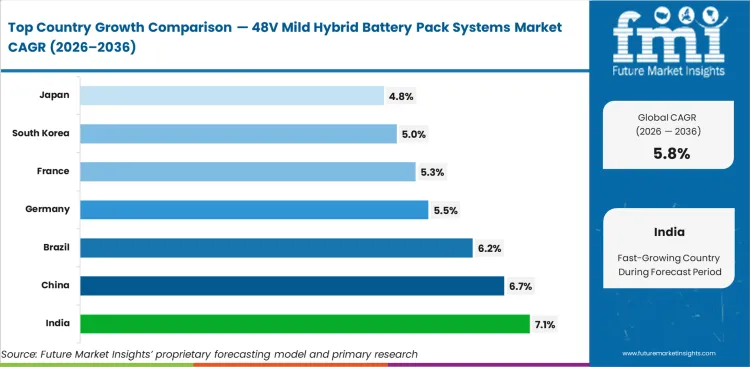
48V mild hybrid battery pack systems market By Key Country
- India is expected to lead growth at 7.1% CAGR, supported by cost-sensitive electrification demand in mainstream passenger vehicle programs.
- China is projected at 6.7% CAGR, supported by broad vehicle manufacturing depth and a stronger electrification supply base.
- Brazil is forecast at 6.2% CAGR, reflecting place for practical low-voltage efficiency upgrades in price-sensitive vehicle segments.
- Germany at 5.5% CAGR and France at 5.3% CAGR hold a strong present base linked to Europe’s hybrid passenger vehicle mix.
- South Korea at 5.0% CAGR and Japan at 4.8% CAGR remain steady through supplier capability and established hybrid demand.
Opportunity Analysis of Battery Pack Cooling Valve Actuator Systems Market in China
The China battery pack cooling valve actuator systems market is projected to grow at a CAGR of 9.7% through 2036. This market leads major country growth because China is the largest center for EV production and new energy vehicle supply-chain activity. Large program volume and fast model turnover expand the installed base for battery cooling hardware at a faster pace than most other countries.
- Large EV scale supports broader line-fit demand for battery cooling valves.
- Supplier density keeps local sourcing active across thermal hardware.
- Program volume gives China the strongest near-term expansion profile.
Opportunity Analysis of Battery Pack Cooling Valve Actuator Systems Market in Germany
The Germany battery pack cooling valve actuator systems market is projected to grow at a CAGR of 8.9% through 2036. Demand is strong because Germany combines premium EV engineering with rising battery electric registrations and deep supplier capability in thermal systems. That combination supports higher-value demand for compact and durable battery cooling valves used in refined EV thermal architectures. Germany is important for suppliers that can meet strict qualification expectations and deliver battery cooling hardware with stable actuation performance.
- Premium EV engineering supports higher thermal content per vehicle.
- Strong supplier capability keeps Germany important for qualification-heavy programs.
- Demand remains healthy across premium and upper-volume EV platforms.
Opportunity Analysis of Battery Pack Cooling Valve Actuator Systems Market in the United Kingdom
The United Kingdom battery pack cooling valve actuator systems market is projected to grow at a CAGR of 8.4% through 2036. Expansion in the UK comes mainly from rising BEV penetration and steady electrification across passenger vehicle demand. The market is smaller than leading manufacturing bases, though the adoption curve keeps local demand relevant for actuator-controlled battery cooling hardware. UK growth depends mainly on EV uptake and vehicle mix.
- BEV adoption is increasing the local base for battery cooling content.
- Vehicle mix remains an important support factor for thermal hardware demand.
- The UK holds steady relevance through electrification progress.
Opportunity Analysis of Battery Pack Cooling Valve Actuator Systems Market in France
The France battery pack cooling valve actuator systems market is projected to grow at a CAGR of 8.2% through 2036. France benefits from wider European EV expansion and from supply-chain participation across regional automotive production. France is commercially relevant as part of the broader European EV build cycle and offers steady demand for qualified battery cooling components.
- French EV growth supports ongoing sourcing of thermal assemblies.
- Supply-chain participation strengthens local relevance in Europe.
- Demand remains tied to the wider European BEV cycle.
Opportunity Analysis of Battery Pack Cooling Valve Actuator Systems Market in South Korea
The South Korea battery pack cooling valve actuator systems market is projected to grow at a CAGR of 8.1% through 2036. Growth is supported by strong supplier capability and continued EV thermal development among Korean automotive firms. South Korea is important through engineering depth and system capability. Local EV demand adds more support. That profile makes the country important for battery cooling hardware linked to compact module design and integrated thermal systems.
- Korean suppliers remain active in integrated EV thermal modules.
- Engineering capability keeps the country relevant for higher-value components.
- Growth stays supported by both domestic and export-linked EV programs.
Opportunity Analysis of Battery Pack Cooling Valve Actuator Systems Market in the United States
The United States battery pack cooling valve actuator systems market is projected to grow at a CAGR of 7.8% through 2036. U.S. demand is supported by high-value EV platforms and stronger engineering attention to battery protection. The commercial opportunity in this country comes less from volume leadership and more from better component value per vehicle across heavier and more feature-rich EV platforms. Suppliers with strong validation support and dependable actuator durability remain well placed in this market.
- Larger EV formats help support better value per battery cooling assembly.
- Battery protection work raises the relevance of stable thermal control.
- U.S. demand remains strong in higher-content vehicle programs.
Opportunity Analysis of Battery Pack Cooling Valve Actuator Systems Market in Japan
The Japan battery pack cooling valve actuator systems market is projected to grow at a CAGR of 7.1% through 2036. Expansion is steadier because battery electric rollout is moving more gradually than in China or the stronger European EV markets. Japan is important through engineering quality and supplier participation in electrified thermal architectures.
- Japan remains relevant through engineering-led automotive programs.
- EV thermal development supports steady component demand.
- The market carries a more measured expansion pace than leading EV regions.
Competitive landscape of 48V mild hybrid battery pack systems market
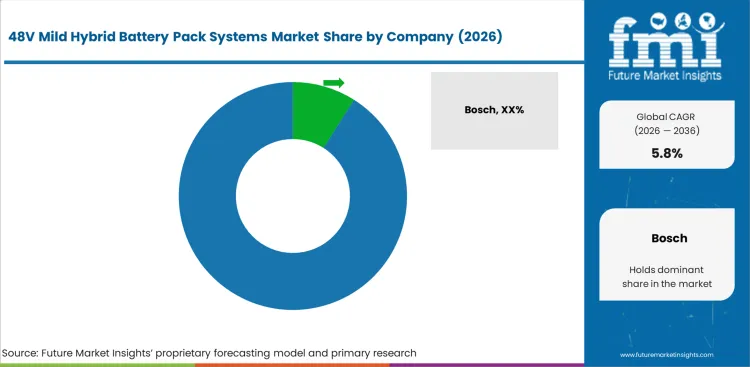
- Competition remains moderately concentrated around large automotive suppliers with proven electrification capability.
- Leading suppliers compete on battery management, packaging fit, and OEM vehicle program access.
- Specialist suppliers can still win where compact design and electronics integration offer a stronger fit.
Bosch holds a strong position because it offers defined 48V battery products and ties them to clear efficiency benefits inside mild hybrid systems. Valeo remains relevant through its broader mild hybrid system position, which links the battery pack to starter-generator architecture and easier vehicle integration. The FMI automotive battery management system outlook supports this section because battery control quality is a central competitive factor in low-voltage hybrid programs. Incumbents hold an advantage where OEM validation and pack packaging have to work together inside one vehicle platform.
FORVIA HELLA is strengthening its position through tighter electronic integration. Its recent focus on integrated flatpack hardware and broader battery management capability matters because automakers increasingly value compact modules that reduce packaging burden and simplify system coordination. Clarios remains relevant through its low-voltage energy storage background, while A123 Systems stays visible through dedicated 48V battery solutions.
Major industry players
- Bosch, Valeo, Schaeffler, and FORVIA HELLA fit this group because they combine wide OEM access with battery hardware and established electrification engineering depth across multiple vehicle programs.
- MAHLE, Clarios, and A123 Systems fit this group because each brings useful battery or low-voltage storage capability, though program breadth in 48V mild hybrid packs remains more selective than the largest system suppliers.
- Suppliers building adaptable 48V battery management products and compact integrated modules remain the strongest emerging contenders because platform flexibility and packaging efficiency are gaining value in sourcing rounds.
Competitive Benchmarking: 48V Mild Hybrid Battery Pack Systems Market
| Company | 48V Battery Pack Capability | Battery Management Integration | OEM Program Access | Geographic Footprint |
|---|---|---|---|---|
| Bosch | High | High | Strong | Global |
| Valeo | High | Medium | Strong | Global |
| FORVIA HELLA | High | High | Strong | Global |
| Schaeffler | Medium | Medium | Strong | Global |
| MAHLE | High | Medium | Strong | Global |
| Clarios | High | Medium | Strong | Global |
| A123 Systems | Medium | Medium | Moderate | North America, Asia |
| CATL | Medium | Medium | Strong | Global |
| VARTA | Medium | Low | Moderate | Europe |
| SEG Automotive | Medium | Low | Moderate | Europe, Asia |
Source: Future Market Insights competitive analysis, 2026.
Key developments in 48V mild hybrid battery pack systems market
- In July 2025, FORVIA HELLA expanded attention around integrated 48V flatpack hardware and battery management capability, which supports tighter system packaging in OEM mild hybrid programs.
Key players in the 48V mild hybrid battery pack systems market
Major global players
- Bosch
- Valeo
- Schaeffler
- FORVIA HELLA
Key emerging players/startups
- Clarios
- MAHLE
- A123 Systems
Scope of the report
| Metric | Value |
|---|---|
| Quantitative Units | USD 3.42 billion in 2026 and USD 5.98 billion by 2036, at a CAGR of 5.8%. |
| Market Definition | Low-voltage battery packs and closely linked pack electronics used in 48V mild hybrid vehicle systems |
| Regions Covered | North America, Latin America, Europe, Asia Pacific, Middle East and Africa |
| Countries Covered | China, Germany, France, Japan, India, South Korea, Brazil |
| Key Companies Profiled | Bosch, Valeo, Schaeffler, FORVIA HELLA, Clarios, MAHLE, A123 Systems |
| Forecast Period | 2026 to 2036 |
| Approach | FMI model based on mild hybrid vehicle demand, battery pack attachment rates, supplier product availability, and regulation-linked efficiency needs |
48V mild hybrid battery pack systems market by segments
48V mild hybrid battery pack systems market segmented as Battery Chemistry
- Lithium-ion NMC
- Lithium-ion LFP
- Lithium-ion NCA
- Other Chemistries
48V mild hybrid battery pack systems market classified by Vehicle Type
- Passenger Cars
- SUVs
- Light Commercial Vehicles
- Performance Vehicles
48V mild hybrid battery pack systems market by Architecture Compatibility
- P0 Systems
- P1 Systems
- P2 Systems
- P3 Systems
- P4 Systems
48V mild hybrid battery pack systems market classified by Cooling Type
- Passive Cooling
- Air Cooling
- Liquid Cooling
48V mild hybrid battery pack systems market classified by Sales Channel
- OEM Fitment
- Tier-1 Supply
- Aftermarket Replacement
48V mild hybrid battery pack systems market classified by Regions
- North America
- USA
- Canada
- Mexico
- Latin America
- Brazil
- Chile
- Rest of Latin America
- Western Europe
- Germany
- UK
- Italy
- Spain
- France
- Nordic
- BENELUX
- Rest of Western Europe
- Eastern Europe
- Russia
- Poland
- Hungary
- Balkan & Baltic
- Rest of Eastern Europe
- East Asia
- China
- Japan
- South Korea
- South Asia and Pacific
- India
- ASEAN
- Australia & New Zealand
- Rest of South Asia and Pacific
- Middle East & Africa
- Kingdom of Saudi Arabia
- Other GCC Countries
- Turkiye
- South Africa
- Other African Union
- Rest of Middle East & Africa
Bibliography
- FORVIA HELLA. (2025, July 2). FORVIA HELLA successfully launches first series production of highly integrated 48V Flatpack in China.
- Schaeffler AG. (2024, October 1). Merger of Vitesco Technologies Group AG into Schaeffler AG completed.
- A123 Systems. (2025, October 8). A123 Systems showcases advanced low-voltage electrification portfolio at The Battery Show North America 2025.
- European Automobile Manufacturers’ Association. (2026, January 27). New car registrations: +1.8% in 2025; battery-electric 17.4% market share.
Bibliography is provided for reader reference.
This Report Answers
- What is the current and future size of the 48V mild hybrid battery pack systems market?
- How fast is the 48V mild hybrid battery pack systems market expected to grow between 2026 and 2036?
- Which battery chemistry segment is likely to lead the market by 2026?
- Which vehicle type is expected to account for the highest demand by 2026?
- What factors are driving demand for 48V mild hybrid battery pack systems globally?
- How are fuel-efficiency targets and emissions-control programs influencing adoption?
- Why do passenger vehicle platforms remain the main demand center for 48V mild hybrid battery packs?
- How are packaging efficiency and battery management integration supporting supplier selection?
- Which countries are projected to show the fastest growth through 2036?
- What is driving market expansion in India and China?
- Who are the key companies active in the 48V mild hybrid battery pack systems market?
- How does FMI estimate and validate the market forecast?
Frequently Asked Questions
48V Mild Hybrid Battery Pack Systems Market
FMI estimates the 48V mild hybrid battery pack systems market at USD 3.42 billion in 2026.
What is the projected market value by 2036?
The market is projected to reach USD 5.98 billion by 2036 based on modeled vehicle adoption and supplier activity.
What is the forecast CAGR from 2026 to 2036?
The market is expected to expand at a 5.8% CAGR during the forecast period.
Which segment is expected to lead by chemistry?
Lithium-ion NMC is expected to lead because it balances compact size with strong power delivery for mild hybrid duty.
Which end-use segment leads demand?
Passenger cars lead demand because 48V systems fit mainstream vehicle programs focused on practical fuel economy improvement.
Which architecture segment holds the leading share?
P0 systems are expected to remain the leading architecture segment in 2026 because they allow easier integration into existing vehicle platforms.
Preview the report firsthand - request a free sample
Get SampleGet the brochure for pricing and purchase details.
Get PDFTable of Content
- Executive Summary
- Global Market Outlook
- Demand-side Trends
- Supply-side Trends
- Technology Roadmap Analysis
- Analysis and Recommendations
- Market Overview
- Market Coverage / Taxonomy
- Market Definition / Scope / Limitations
- Research Methodology
- Chapter Orientation
- Analytical Lens and Working Hypotheses
- Market Structure, Signals, and Trend Drivers
- Benchmarking and Cross-market Comparability
- Market Sizing, Forecasting, and Opportunity Mapping
- Research Design and Evidence Framework
- Desk Research Programme (Secondary Evidence)
- Company Annual and Sustainability Reports
- Peer-reviewed Journals and Academic Literature
- Corporate Websites, Product Literature, and Technical Notes
- Earnings Decks and Investor Briefings
- Statutory Filings and Regulatory Disclosures
- Technical White Papers and Standards Notes
- Trade Journals, Industry Magazines, and Analyst Briefs
- Conference Proceedings, Webinars, and Seminar Materials
- Government Statistics Portals and Public Data Releases
- Press Releases and Reputable Media Coverage
- Specialist Newsletters and Curated Briefings
- Sector Databases and Reference Repositories
- FMI Internal Proprietary Databases and Historical Market Datasets
- Subscription Datasets and Paid Sources
- Social Channels, Communities, and Digital Listening Inputs
- Additional Desk Sources
- Expert Input and Fieldwork (Primary Evidence)
- Primary Modes
- Qualitative Interviews and Expert Elicitation
- Quantitative Surveys and Structured Data Capture
- Blended Approach
- Why Primary Evidence is Used
- Field Techniques
- Interviews
- Surveys
- Focus Groups
- Observational and In-context Research
- Social and Community Interactions
- Stakeholder Universe Engaged
- C-suite Leaders
- Board Members
- Presidents and Vice Presidents
- R&D and Innovation Heads
- Technical Specialists
- Domain Subject-matter Experts
- Scientists
- Physicians and Other Healthcare Professionals
- Governance, Ethics, and Data Stewardship
- Research Ethics
- Data Integrity and Handling
- Primary Modes
- Tooling, Models, and Reference Databases
- Desk Research Programme (Secondary Evidence)
- Data Engineering and Model Build
- Data Acquisition and Ingestion
- Cleaning, Normalisation, and Verification
- Synthesis, Triangulation, and Analysis
- Quality Assurance and Audit Trail
- Market Background
- Market Dynamics
- Drivers
- Restraints
- Opportunity
- Trends
- Scenario Forecast
- Demand in Optimistic Scenario
- Demand in Likely Scenario
- Demand in Conservative Scenario
- Opportunity Map Analysis
- Product Life Cycle Analysis
- Supply Chain Analysis
- Investment Feasibility Matrix
- Value Chain Analysis
- PESTLE and Porter’s Analysis
- Regulatory Landscape
- Regional Parent Market Outlook
- Production and Consumption Statistics
- Import and Export Statistics
- Market Dynamics
- Global Market Analysis 2021 to 2025 and Forecast, 2026 to 2036
- Historical Market Size Value (USD Million) Analysis, 2021 to 2025
- Current and Future Market Size Value (USD Million) Projections, 2026 to 2036
- Y-o-Y Growth Trend Analysis
- Absolute $ Opportunity Analysis
- Global Market Pricing Analysis 2021 to 2025 and Forecast 2026 to 2036
- Global Market Analysis 2021 to 2025 and Forecast 2026 to 2036, By Battery Chemistry
- Introduction / Key Findings
- Historical Market Size Value (USD Million) Analysis By Battery Chemistry , 2021 to 2025
- Current and Future Market Size Value (USD Million) Analysis and Forecast By Battery Chemistry , 2026 to 2036
- Lithium-ion NMC
- Lithium-ion LFP
- Lithium-ion NCA
- Other Chemistries
- Lithium-ion NMC
- Y-o-Y Growth Trend Analysis By Battery Chemistry , 2021 to 2025
- Absolute $ Opportunity Analysis By Battery Chemistry , 2026 to 2036
- Global Market Analysis 2021 to 2025 and Forecast 2026 to 2036, By Vehicle Type
- Introduction / Key Findings
- Historical Market Size Value (USD Million) Analysis By Vehicle Type, 2021 to 2025
- Current and Future Market Size Value (USD Million) Analysis and Forecast By Vehicle Type, 2026 to 2036
- Passenger Cars
- SUVs
- Light Commercial Vehicles
- Performance Vehicles
- Passenger Cars
- Y-o-Y Growth Trend Analysis By Vehicle Type, 2021 to 2025
- Absolute $ Opportunity Analysis By Vehicle Type, 2026 to 2036
- Global Market Analysis 2021 to 2025 and Forecast 2026 to 2036, By Architecture Compatibility
- Introduction / Key Findings
- Historical Market Size Value (USD Million) Analysis By Architecture Compatibility, 2021 to 2025
- Current and Future Market Size Value (USD Million) Analysis and Forecast By Architecture Compatibility, 2026 to 2036
- P0 Systems
- P1 Systems
- P2 Systems
- P3 Systems
- P4 Systems
- P0 Systems
- Y-o-Y Growth Trend Analysis By Architecture Compatibility, 2021 to 2025
- Absolute $ Opportunity Analysis By Architecture Compatibility, 2026 to 2036
- Global Market Analysis 2021 to 2025 and Forecast 2026 to 2036, By Cooling Type
- Introduction / Key Findings
- Historical Market Size Value (USD Million) Analysis By Cooling Type, 2021 to 2025
- Current and Future Market Size Value (USD Million) Analysis and Forecast By Cooling Type, 2026 to 2036
- Passive Cooling
- Air Cooling
- Liquid Cooling
- Passive Cooling
- Y-o-Y Growth Trend Analysis By Cooling Type, 2021 to 2025
- Absolute $ Opportunity Analysis By Cooling Type, 2026 to 2036
- Global Market Analysis 2021 to 2025 and Forecast 2026 to 2036, By Sales Channel
- Introduction / Key Findings
- Historical Market Size Value (USD Million) Analysis By Sales Channel, 2021 to 2025
- Current and Future Market Size Value (USD Million) Analysis and Forecast By Sales Channel, 2026 to 2036
- OEM Fitment
- Tier-1 Supply
- Aftermarket Replacement
- OEM Fitment
- Y-o-Y Growth Trend Analysis By Sales Channel, 2021 to 2025
- Absolute $ Opportunity Analysis By Sales Channel, 2026 to 2036
- Global Market Analysis 2021 to 2025 and Forecast 2026 to 2036, By Region
- Introduction
- Historical Market Size Value (USD Million) Analysis By Region, 2021 to 2025
- Current Market Size Value (USD Million) Analysis and Forecast By Region, 2026 to 2036
- North America
- Latin America
- Western Europe
- Eastern Europe
- East Asia
- South Asia and Pacific
- Middle East & Africa
- Market Attractiveness Analysis By Region
- North America Market Analysis 2021 to 2025 and Forecast 2026 to 2036, By Country
- Historical Market Size Value (USD Million) Trend Analysis By Market Taxonomy, 2021 to 2025
- Market Size Value (USD Million) Forecast By Market Taxonomy, 2026 to 2036
- By Country
- USA
- Canada
- Mexico
- By Battery Chemistry
- By Vehicle Type
- By Architecture Compatibility
- By Cooling Type
- By Sales Channel
- By Country
- Market Attractiveness Analysis
- By Country
- By Battery Chemistry
- By Vehicle Type
- By Architecture Compatibility
- By Cooling Type
- By Sales Channel
- Key Takeaways
- Latin America Market Analysis 2021 to 2025 and Forecast 2026 to 2036, By Country
- Historical Market Size Value (USD Million) Trend Analysis By Market Taxonomy, 2021 to 2025
- Market Size Value (USD Million) Forecast By Market Taxonomy, 2026 to 2036
- By Country
- Brazil
- Chile
- Rest of Latin America
- By Battery Chemistry
- By Vehicle Type
- By Architecture Compatibility
- By Cooling Type
- By Sales Channel
- By Country
- Market Attractiveness Analysis
- By Country
- By Battery Chemistry
- By Vehicle Type
- By Architecture Compatibility
- By Cooling Type
- By Sales Channel
- Key Takeaways
- Western Europe Market Analysis 2021 to 2025 and Forecast 2026 to 2036, By Country
- Historical Market Size Value (USD Million) Trend Analysis By Market Taxonomy, 2021 to 2025
- Market Size Value (USD Million) Forecast By Market Taxonomy, 2026 to 2036
- By Country
- Germany
- UK
- Italy
- Spain
- France
- Nordic
- BENELUX
- Rest of Western Europe
- By Battery Chemistry
- By Vehicle Type
- By Architecture Compatibility
- By Cooling Type
- By Sales Channel
- By Country
- Market Attractiveness Analysis
- By Country
- By Battery Chemistry
- By Vehicle Type
- By Architecture Compatibility
- By Cooling Type
- By Sales Channel
- Key Takeaways
- Eastern Europe Market Analysis 2021 to 2025 and Forecast 2026 to 2036, By Country
- Historical Market Size Value (USD Million) Trend Analysis By Market Taxonomy, 2021 to 2025
- Market Size Value (USD Million) Forecast By Market Taxonomy, 2026 to 2036
- By Country
- Russia
- Poland
- Hungary
- Balkan & Baltic
- Rest of Eastern Europe
- By Battery Chemistry
- By Vehicle Type
- By Architecture Compatibility
- By Cooling Type
- By Sales Channel
- By Country
- Market Attractiveness Analysis
- By Country
- By Battery Chemistry
- By Vehicle Type
- By Architecture Compatibility
- By Cooling Type
- By Sales Channel
- Key Takeaways
- East Asia Market Analysis 2021 to 2025 and Forecast 2026 to 2036, By Country
- Historical Market Size Value (USD Million) Trend Analysis By Market Taxonomy, 2021 to 2025
- Market Size Value (USD Million) Forecast By Market Taxonomy, 2026 to 2036
- By Country
- China
- Japan
- South Korea
- By Battery Chemistry
- By Vehicle Type
- By Architecture Compatibility
- By Cooling Type
- By Sales Channel
- By Country
- Market Attractiveness Analysis
- By Country
- By Battery Chemistry
- By Vehicle Type
- By Architecture Compatibility
- By Cooling Type
- By Sales Channel
- Key Takeaways
- South Asia and Pacific Market Analysis 2021 to 2025 and Forecast 2026 to 2036, By Country
- Historical Market Size Value (USD Million) Trend Analysis By Market Taxonomy, 2021 to 2025
- Market Size Value (USD Million) Forecast By Market Taxonomy, 2026 to 2036
- By Country
- India
- ASEAN
- Australia & New Zealand
- Rest of South Asia and Pacific
- By Battery Chemistry
- By Vehicle Type
- By Architecture Compatibility
- By Cooling Type
- By Sales Channel
- By Country
- Market Attractiveness Analysis
- By Country
- By Battery Chemistry
- By Vehicle Type
- By Architecture Compatibility
- By Cooling Type
- By Sales Channel
- Key Takeaways
- Middle East & Africa Market Analysis 2021 to 2025 and Forecast 2026 to 2036, By Country
- Historical Market Size Value (USD Million) Trend Analysis By Market Taxonomy, 2021 to 2025
- Market Size Value (USD Million) Forecast By Market Taxonomy, 2026 to 2036
- By Country
- Kingdom of Saudi Arabia
- Other GCC Countries
- Turkiye
- South Africa
- Other African Union
- Rest of Middle East & Africa
- By Battery Chemistry
- By Vehicle Type
- By Architecture Compatibility
- By Cooling Type
- By Sales Channel
- By Country
- Market Attractiveness Analysis
- By Country
- By Battery Chemistry
- By Vehicle Type
- By Architecture Compatibility
- By Cooling Type
- By Sales Channel
- Key Takeaways
- Key Countries Market Analysis
- USA
- Pricing Analysis
- Market Share Analysis, 2025
- By Battery Chemistry
- By Vehicle Type
- By Architecture Compatibility
- By Cooling Type
- By Sales Channel
- Canada
- Pricing Analysis
- Market Share Analysis, 2025
- By Battery Chemistry
- By Vehicle Type
- By Architecture Compatibility
- By Cooling Type
- By Sales Channel
- Mexico
- Pricing Analysis
- Market Share Analysis, 2025
- By Battery Chemistry
- By Vehicle Type
- By Architecture Compatibility
- By Cooling Type
- By Sales Channel
- Brazil
- Pricing Analysis
- Market Share Analysis, 2025
- By Battery Chemistry
- By Vehicle Type
- By Architecture Compatibility
- By Cooling Type
- By Sales Channel
- Chile
- Pricing Analysis
- Market Share Analysis, 2025
- By Battery Chemistry
- By Vehicle Type
- By Architecture Compatibility
- By Cooling Type
- By Sales Channel
- Germany
- Pricing Analysis
- Market Share Analysis, 2025
- By Battery Chemistry
- By Vehicle Type
- By Architecture Compatibility
- By Cooling Type
- By Sales Channel
- UK
- Pricing Analysis
- Market Share Analysis, 2025
- By Battery Chemistry
- By Vehicle Type
- By Architecture Compatibility
- By Cooling Type
- By Sales Channel
- Italy
- Pricing Analysis
- Market Share Analysis, 2025
- By Battery Chemistry
- By Vehicle Type
- By Architecture Compatibility
- By Cooling Type
- By Sales Channel
- Spain
- Pricing Analysis
- Market Share Analysis, 2025
- By Battery Chemistry
- By Vehicle Type
- By Architecture Compatibility
- By Cooling Type
- By Sales Channel
- France
- Pricing Analysis
- Market Share Analysis, 2025
- By Battery Chemistry
- By Vehicle Type
- By Architecture Compatibility
- By Cooling Type
- By Sales Channel
- India
- Pricing Analysis
- Market Share Analysis, 2025
- By Battery Chemistry
- By Vehicle Type
- By Architecture Compatibility
- By Cooling Type
- By Sales Channel
- ASEAN
- Pricing Analysis
- Market Share Analysis, 2025
- By Battery Chemistry
- By Vehicle Type
- By Architecture Compatibility
- By Cooling Type
- By Sales Channel
- Australia & New Zealand
- Pricing Analysis
- Market Share Analysis, 2025
- By Battery Chemistry
- By Vehicle Type
- By Architecture Compatibility
- By Cooling Type
- By Sales Channel
- China
- Pricing Analysis
- Market Share Analysis, 2025
- By Battery Chemistry
- By Vehicle Type
- By Architecture Compatibility
- By Cooling Type
- By Sales Channel
- Japan
- Pricing Analysis
- Market Share Analysis, 2025
- By Battery Chemistry
- By Vehicle Type
- By Architecture Compatibility
- By Cooling Type
- By Sales Channel
- South Korea
- Pricing Analysis
- Market Share Analysis, 2025
- By Battery Chemistry
- By Vehicle Type
- By Architecture Compatibility
- By Cooling Type
- By Sales Channel
- Russia
- Pricing Analysis
- Market Share Analysis, 2025
- By Battery Chemistry
- By Vehicle Type
- By Architecture Compatibility
- By Cooling Type
- By Sales Channel
- Poland
- Pricing Analysis
- Market Share Analysis, 2025
- By Battery Chemistry
- By Vehicle Type
- By Architecture Compatibility
- By Cooling Type
- By Sales Channel
- Hungary
- Pricing Analysis
- Market Share Analysis, 2025
- By Battery Chemistry
- By Vehicle Type
- By Architecture Compatibility
- By Cooling Type
- By Sales Channel
- Kingdom of Saudi Arabia
- Pricing Analysis
- Market Share Analysis, 2025
- By Battery Chemistry
- By Vehicle Type
- By Architecture Compatibility
- By Cooling Type
- By Sales Channel
- Turkiye
- Pricing Analysis
- Market Share Analysis, 2025
- By Battery Chemistry
- By Vehicle Type
- By Architecture Compatibility
- By Cooling Type
- By Sales Channel
- South Africa
- Pricing Analysis
- Market Share Analysis, 2025
- By Battery Chemistry
- By Vehicle Type
- By Architecture Compatibility
- By Cooling Type
- By Sales Channel
- USA
- Market Structure Analysis
- Competition Dashboard
- Competition Benchmarking
- Market Share Analysis of Top Players
- By Regional
- By Battery Chemistry
- By Vehicle Type
- By Architecture Compatibility
- By Cooling Type
- By Sales Channel
- Competition Analysis
- Competition Deep Dive
- Bosch
- Overview
- Product Portfolio
- Profitability by Market Segments (Product/Age /Sales Channel/Region)
- Sales Footprint
- Strategy Overview
- Marketing Strategy
- Product Strategy
- Channel Strategy
- Valeo
- Schaeffler
- FORVIA HELLA
- Clarios
- MAHLE
- A123 Systems
- Bosch
- Competition Deep Dive
- Assumptions & Acronyms Used


