

- Market Size (2026)
- USD 9.6 Bn
- Forecast (2036)
- USD 24.7 Bn
- CAGR (2026 to 2036)
- 9.9%
Hybrid Power-Split Drivetrain System Components Market Size, Market Forecast and Outlook By FMI
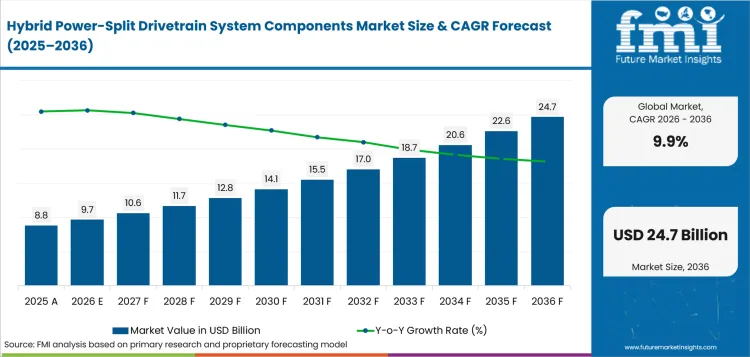
The hybrid power-split drivetrain system components market is expected to grow from USD 8.8 billion in 2025 to USD 24.7 billion by 2036 at 9.9% CAGR. OEM fitment is forecast to hold 88.1% share in 2026 and passenger cars are projected to hold 64.7% share as automakers install power-split hybrid hardware inside factory-approved drivetrain platforms.
Key Takeaways, Market Size, and Forecast
- 2026 Market Size: USD 9.6 billion
- 2036 Market Size: USD 24.7 billion
- Forecast CAGR: 9.9% from 2026 to 2036
- Leading Sales Channel: OEM fitment
- OEM Fitment Share in 2026: 88.1%
- Leading Vehicle Type: Passenger cars
- Passenger Cars Share in 2026: 64.7%
- Fastest-growing Country: China
- China CAGR: 11.6% by 2036
Summary of Hybrid Power-Split Drivetrain System Components Market
- Demand and Growth Drivers
- Automakers are using power-split hybrid systems to improve fuel economy in passenger cars and compact sport utility vehicles.
- Factory validation keeps drivetrain component revenue concentrated in OEM fitment and calibrated system supply.
- Plug-in hybrid platforms increase supplier value by adding stronger inverters and higher-output motor interfaces.
- Product and Segment View
- OEM fitment is projected to hold 88.1% share in 2026, influenced by factory approval and drivetrain safety validation.
- Passenger cars are expected to represent 64.7% share in 2026, driven by high-volume hybrid sedan and crossover programs.
- Full hybrid architecture is forecast to secure 45.8% share in 2026 due to no-plug fuel economy gains.
- Geography and Competitive Outlook
- China is projected to record 11.6% CAGR by 2036, reflected by plug-in hybrid platform expansion across domestic automakers.
- India is expected to expand at 11.1% CAGR by 2036 through local transmission and hybrid component sourcing.
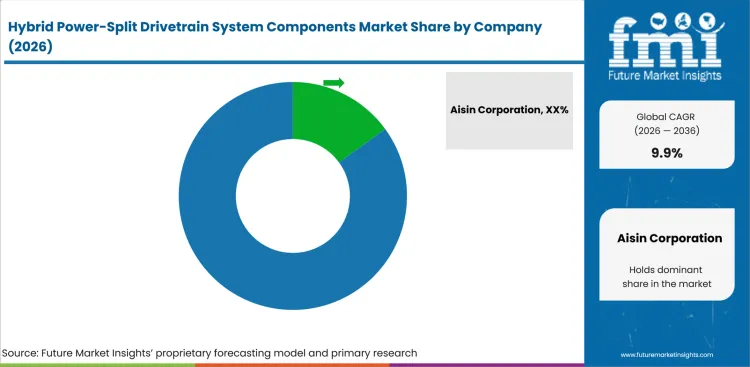
- Aisin Corporation and Toyota Industries Corporation compete based on long-running power-split hybrid system experience.
- ZF Friedrichshafen AG and BorgWarner Inc. compete based on hybrid transmission integration and high-output motor interfaces.
- Analyst Opinion
- Nikhil Kaitwade, Principal Consultant for Automotive at FMI, observes, “Hybrid power-split buying has moved beyond a single transmission module. Automakers now compare launch smoothness and inverter efficiency before awarding platform work. Suppliers with proven hybrid calibration and local production support should gain repeat orders from automakers expanding hybrid portfolios.”
- Hybrid Power-Split Drivetrain System Components Market Value Analysis
- Market value is tied to factory-installed drivetrain hardware before replacement demand affects service revenue.
- Supplier pricing reflects motor-generator output and e-CVT gear complexity before control software raises platform value.
- Revenue improves as automakers use full hybrid systems across passenger cars and compact sport utility vehicles.
- Component trust rises as automakers require lower vibration and smoother launch response from calibrated hybrid systems.
Packaging space and shift feel are now the main pressure points for automakers designing power-split hybrid drivetrains. BorgWarner’s October 2025 7-in-1 drive module combines two electric motors with a dual inverter and eGear transmission. The module supports up to 160 kW at a 450V peak operating voltage and exceeds 3400 Nm peak drive torque. Integrated modules reduce handoffs between motor suppliers and power electronics suppliers. Aisin’s September 2025 production plan targets annual output of 4.5 million electric units and includes PHEV hybrid-unit production in China. Local hybrid-unit production gives automakers a clearer supply route for platform refreshes. FCA’s 2025 power-split patent adds a second pressure around smoother range shifts. The filing covers an engine and a controller. Suppliers with strong control software and actuator know-how gain an advantage as hybrid systems need smoother torque transfer without major hardware redesign.
Hybrid Power-Split Drivetrain System Components Market Definition
Hybrid power-split drivetrain system components market covers mechanical and electrical hardware used to divide and combine engine and electric motor torque in hybrid vehicles. Scope includes e-CVT planetary modules, motor-generators, inverters, control units, dampers and related transmission interface parts. Revenue includes factory-fitted components supplied to automakers and Tier 1 system integrators. Power-split systems used in full hybrid and plug-in hybrid vehicles are included.
Hybrid Power-Split Drivetrain System Components Market Inclusions
Market scope covers commercially traded components for hybrid power-split drivetrain systems by sales channel such as OEM fitment and replacement supply, vehicle type such as passenger cars and light commercial vehicles, hybrid architecture such as full hybrid and plug-in hybrid formats, power rating such as under 80 kW and 80 kW to 150 kW systems, and component such as e-CVT modules and motor-generators. Revenue scope covers market activity from 2026 to 2036 across complete power-split drivetrain component packages. Stakeholders include transmission suppliers, motor-generator makers, inverter producers, control module suppliers, automakers and service networks.
Hybrid Power-Split Drivetrain System Components Market Exclusions
Scope excludes battery packs sold as separate high-voltage storage systems. Conventional automatic transmissions without hybrid power-split operation are outside scope. Battery electric vehicle single-speed drive units are excluded. Routine transmission fluids, repair labor and general drivetrain fasteners are counted only if sold within a validated power-split hybrid component package.
Hybrid Power-Split Drivetrain System Components Market Research Methodology
- Primary Research: FMI analysts reviewed automaker hybrid platform disclosures and supplier feedback across major drivetrain manufacturing countries.
- Desk Research: Public data from ACEA and EPA were checked with SIAM releases and SMMT outlooks against hybrid drivetrain evidence.
- Market Sizing and Forecasting: Market size used hybrid vehicle production exposure and power-split platform penetration. e-CVT module pricing and inverter integration intensity were used for cross-checks.
- Data Validation: Forecast checks compared 2026 value with 2036 value and tested CAGR consistency across seven country rates. Official supplier launches and hybrid transmission investments were reviewed across component demand.
Why is the Hybrid Power-Split Drivetrain System Components Market Growing?
- Automakers are extending hybrid power-split systems into high-volume passenger cars and compact sport utility vehicles.
- Factory-integrated e-CVT hardware is gaining value as vehicle programs need smoother engine-electric torque blending.
- Plug-in hybrid platforms are raising component content through stronger inverters and higher-output motor interfaces.
Demand is supported as power-split systems give automakers a bridge between combustion-only platforms and battery electric programs. EPA stated in February 2026, model year 2024 minivan and van fuel economy rose by 0.6 mpg through a 5.0% PHEV share. Such vehicle mix pressure encourages automakers to use hybrid systems in body styles needing fuel economy improvement. Component suppliers serving hybrid vehicles and hybrid powertrain programs should benefit from longer platform supply cycles.
Market Segmentation Analysis
- OEM fitment is projected to account for 88.1% share in 2026, driven by automakers approving power-split drivetrain components during platform design and safety validation cycles.
- Passenger cars are expected to represent 64.7% share in 2026, led by hybrid systems being applied across sedans and compact sport utility vehicles.
- Full hybrid architecture is forecast to hold 45.8% share in 2026 since no-plug operation supports fuel economy gains without charging behavior change.
- 80 kW to 150 kW systems are anticipated to capture 41.3% share in 2026, influenced by mid-size hybrid models needing balanced electric launch and highway assist.
- e-CVT planetary modules are projected to secure 37.6% share in 2026 due to power-split systems relying on blended engine-electric gear paths.
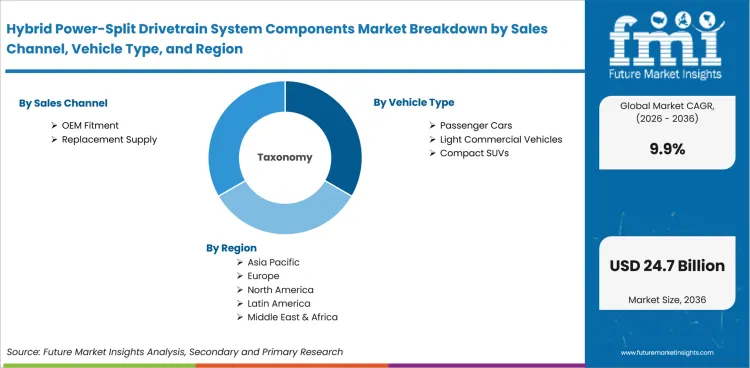
The hybrid power-split drivetrain component market is divided into groups based on sales channel, vehicle type, hybrid architecture, power rating, component and region. Sales channel includes OEM fitment and replacement supply. Vehicle type covers passenger cars, light commercial vehicles, compact sport utility vehicles and performance vehicles. Hybrid architecture includes full hybrid, plug-in hybrid and range extender formats. Power rating includes under 80 kW, 80 kW to 150 kW and above 150 kW. Component coverage connects with hybrid power-split couplings, e-CVT modules and power electronics used inside automotive transmission programs.
Insights into Hybrid Power-Split Drivetrain System Components Market by Sales Channel
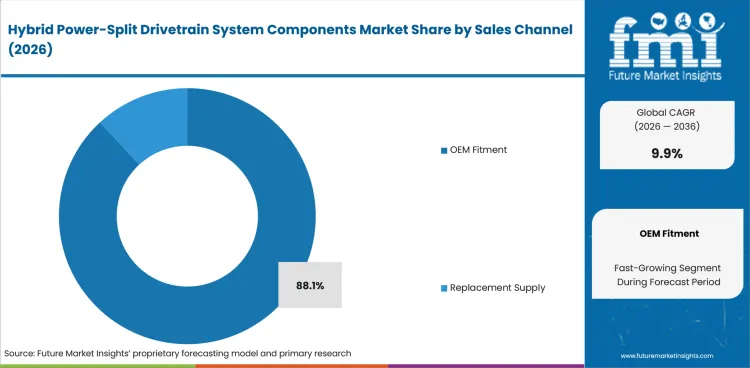
- OEM fitment is projected to account for 88.1% share in 2026, led by automakers approving drivetrain components during platform validation before retail launch.
- Replacement supply gains attention as hybrid vehicles age, but validated factory supply will control most revenue due to safety and calibration requirements.
Insights into Hybrid Power-Split Drivetrain System Components Market by Vehicle Type
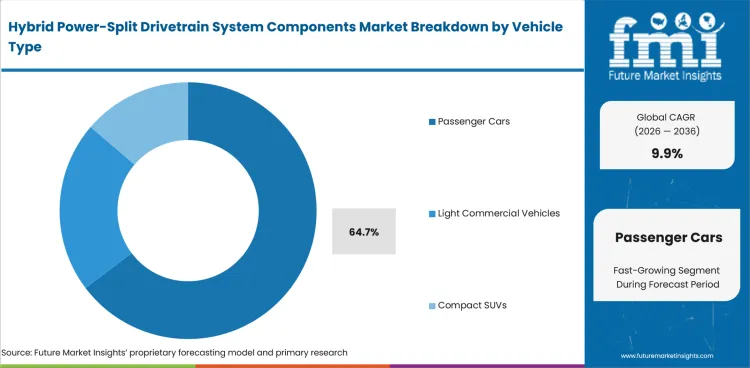
- Passenger cars are expected to represent 64.7% share in 2026, supported by high-volume hybrid sedans and compact crossover platforms.
- Light commercial vehicles gain selective interest as delivery fleets compare fuel economy improvement against the cost of full battery electric operation.
Insights into Hybrid Power-Split Drivetrain System Components Market by Hybrid Architecture
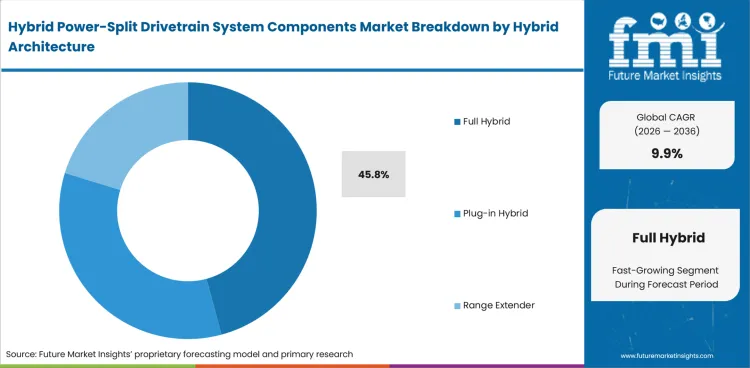
- Full hybrid architecture is forecast to hold 45.8% share in 2026, shaped by no-plug operation and strong suitability for urban traffic cycles.
- Plug-in hybrid systems raise unit value through larger motors, stronger inverters and more complex thermal management inside automotive electric drivetrain components.
Insights into Hybrid Power-Split Drivetrain System Components Market by Power Rating
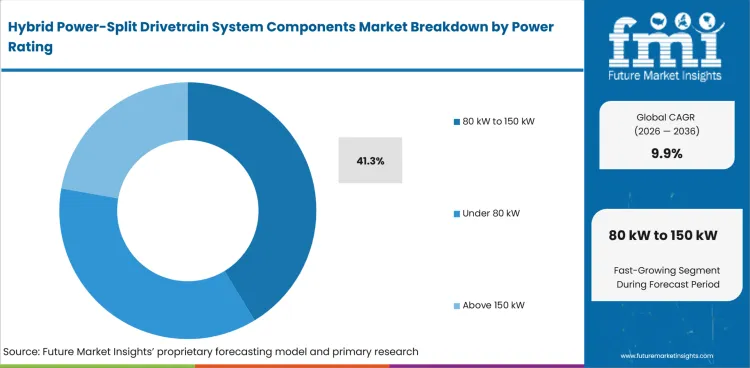
- 80 kW to 150 kW systems are anticipated to capture 41.3% share in 2026, supported by mid-size vehicles needing electric launch and engine assist.
- Above 150 kW systems gain value in plug-in hybrid sport utility vehicles as stronger electric output needs higher-voltage inverter control.
Insights into Hybrid Power-Split Drivetrain System Components Market by Component
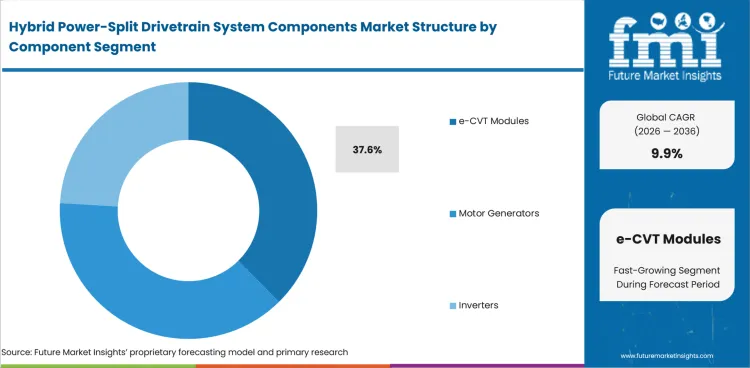
- e-CVT planetary modules are projected to secure 37.6% share in 2026, reflecting a core role in engine-electric torque division.
- Inverters and control units gain design weight as software calibration affects launch feel, energy recovery and system reliability.
Hybrid Power-Split Drivetrain System Components Market Drivers, Restraints and Opportunities
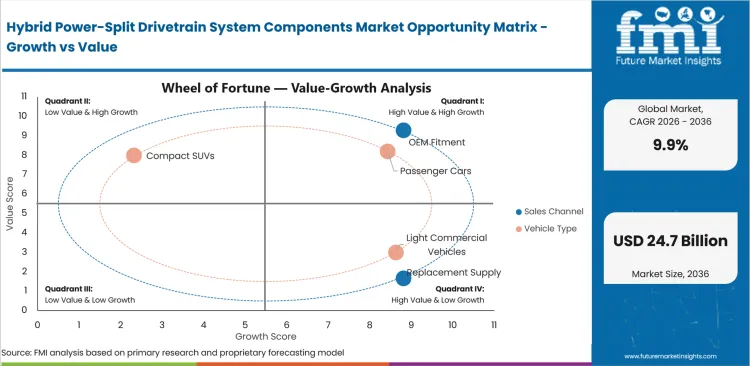
- Driver: Hybrid platform expansion is raising demand for validated torque-split modules and integrated control hardware.
- Restraint: Cost pressure can slow adoption in entry vehicles with limited room for higher drivetrain bill of materials.
- Opportunity: Localized transmission and hybrid component production can lower supply risk for regional vehicle programs.
Demand is strongest in markets combining fuel economy pressure with uneven charging access. ACEA stated in January 2026, EU hybrid-electric registrations reached 3,733,325 units in 2025 and plug-in hybrid registrations reached 1,015,887 units. Such scale supports component suppliers offering e-CVT modules and control units for dual-clutch hybrid driveline integration components and power-split platforms.
Price Benchmarking Analysis
Equipment price benchmarking should focus on control-equipment cost movement inside automation cells, since hybrid drivetrain component plants need precise controls for machining and test lines. BLS-sourced PPI series for industrial process control instruments reported an April 2026 index of 335.765 and a December 2025 index of 329.811. This price movement supports closer quote checks for control panels and process instruments used around e-CVT and motor-generator production lines. Suppliers with standardized control packages are likely to protect margins better as OEMs compare automation system cost before awarding production-linked contracts.
Base and Replacement Cycle Analysis
Installed base analysis should track factory robotics and automation renewal rather than only new equipment purchases, since hybrid drivetrain plants rely on repeatable assembly and inspection. International Federation of Robotics stated in September 2025, factories installed 542,000 industrial robots in 2024 and global operational stock reached 4,664,000 units. This installed base creates a large upgrade pool for motion systems and inspection equipment across drivetrain component production. Component suppliers with service-ready automation partners are likely to gain as manufacturers replace older lines with systems suited to tighter hybrid module tolerances.
Analysis of Hybrid Power-Split Drivetrain System Components Market by Key Countries
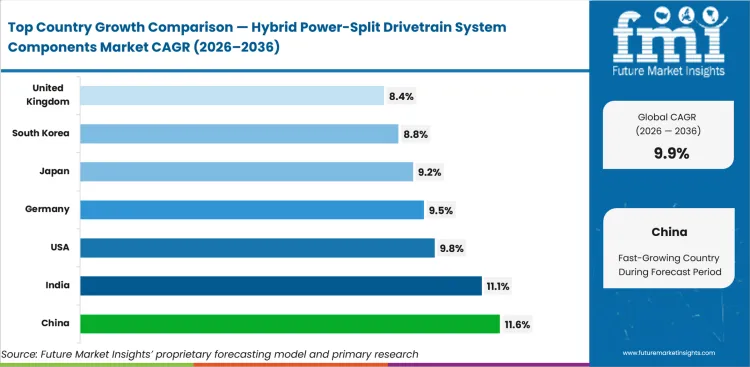
.webp "Top Country Growth Comparison Hybrid Power Split Drivetrain System Components Market Cagr (2026 2036)")
| Country | CAGR |
|---|---|
| China | 11.6% |
| India | 11.1% |
| United States | 9.8% |
| Germany | 9.5% |
| Japan | 9.2% |
| South Korea | 8.8% |
| United Kingdom | 8.4% |
Source: Future Market Insights, 2026.
Sales Analysis for Hybrid Power-Split Drivetrain System Components Market in China
Large plug-in hybrid production center · 2026 to 2036
Country Market Snapshot Table
| Parameter | Value |
|---|---|
| Market Size in 2025 (Value) | USD 2.0 billion |
| Market Size in 2026 (Value) | USD 2.2 billion |
| Market Forecast in 2036 (Value) | USD 6.6 billion |
| CAGR (2026-2036) | 11.6% |
| Years Considered | 2021-2036 |
| Base Year | 2025 |
| Forecast Period | 2026-2036 |
| Units Considered | Value (USD billion) |
| Leading Sub-Region | Yangtze River Delta |
China Hybrid Power-Split Drivetrain System Components Market Outlook
China demand is shaped by plug-in hybrid platform scale and domestic transmission sourcing. Automakers in Shanghai and Anhui are raising local component needs across passenger models and compact sport utility vehicles.
Component suppliers gain from vehicle makers needing compact transmission modules and lower-cost electronics. Power-split hardware should stay concentrated in factory programs with high repeat-volume potential.
Key Growth Drivers
- National vehicle planning supports local hybrid suppliers, as China targeted about 15.5 million new energy vehicle sales in 2025. Component makers can plan around large domestic platform volume.
- Passenger platform turnover favors e-CVT module orders, reflected by China setting a 2025 total vehicle sales target of about 32.3 million units. Large model volume supports repeat drivetrain supply.
- Supply-chain policy favors domestic content, supported by the two-year sector plan listing more than 60 measures across demand stimulation and supply-chain strengthening. Local firms can deepen gearset and inverter production.
- Automotive manufacturing remains a policy priority, with the sector plan targeting a 6.0% rise in auto manufacturing added value during 2025. Higher factory output supports calibrated control module demand.
Key Restraints
- Price pressure can lower supplier margins, as national planning placed 2025 vehicle sales growth near 3.0% despite heavy competition. Component makers may face tougher unit pricing.
- Inventory risk can slow drivetrain awards, since the plan stressed stronger market order and business-environment controls across the auto sector. Automakers may delay risky supplier switches.
- Export programs face stricter quality checks, while the same plan calls for steady auto export growth rather than a sharp volume push. Suppliers need stronger validation before overseas shipment.
What makes China unique
China is unique due to large electrified vehicle output and fast domestic hybrid platform turnover.
Key Companies
- BYD
- Geely
- Aisin Corporation
- Toyota Industries Corporation
- BorgWarner Inc.
- Schaeffler AG
- ZF Friedrichshafen AG
Sales & Marketing Channels
- Automaker sourcing programs
- Tier 1 supply agreements
- Transmission system partnerships
- Engineering validation contracts
- Dealer service channels
- Replacement supply programs
Country Segment Breakdown Table
| Segment | Sub-Segments |
|---|---|
| By Sales Channel | OEM Fitment · Replacement Supply |
| By Vehicle Type | Passenger Cars · Light Commercial Vehicles · Compact SUVs · Performance Vehicles |
| By Hybrid Architecture | Full Hybrid · Plug-in Hybrid · Range Extender |
| By Power Rating | Under 80 kW · 80 to 150 kW · Above 150 kW |
| By Component | e-CVT Modules · Motor Generators · Inverters · Control Units · Dampers |
| Key Sub-Regions Covered, Vehicle Clusters | Shanghai · Guangdong · Anhui · Chongqing · Zhejiang · Jiangsu |
Frequently Asked Questions
How fast is China hybrid power-split drivetrain system components market growing?
Sales in China are forecast to scale at 11.6% CAGR by 2036, driven by plug-in hybrid platforms expansion.
Who leads China hybrid power-split drivetrain system components market?
BYD, Geely, Aisin and BorgWarner compete based on hybrid drivetrain production and system integration capability.
What is driving adoption in China hybrid power-split drivetrain system components market?
Domestic vehicle programs are raising demand for compact e-CVT modules and control units.
Demand Outlook for Hybrid Power-Split Drivetrain System Components Market in India
Localized transmission production center · 2026 to 2036
Country Market Snapshot Table
| Parameter | Value |
|---|---|
| Market Size in 2025 (Value) | USD 620.4 million |
| Market Size in 2026 (Value) | USD 689.3 million |
| Market Forecast in 2036 (Value) | USD 1,976.8 million |
| CAGR (2026-2036) | 11.1% |
| Years Considered | 2021-2036 |
| Base Year | 2025 |
| Forecast Period | 2026-2036 |
| Units Considered | Value (USD million) |
| Leading Sub-Region | Haryana and Gujarat cluster |
India Hybrid Power-Split Drivetrain System Components Market Outlook
India demand is moving from imported hybrid drivetrain packages toward selective local production. Haryana and Gujarat are expected to support stronger component sourcing as fuel economy pressure rises.
Passenger vehicle makers need local parts development and vehicle-level validation support. Supplier value should depend on cost control and platform approval rather than generic component availability.
Key Growth Drivers
- Haryana transmission activity gains attention, after Aisin selected an Indian subsidiary for an automatic transmission production demonstration in October 2025. Local work can support future hybrid supply.
- Passenger vehicle depth supports drivetrain localization, as SIAM reported 4,643,439 passenger vehicle sales during April 2025 to March 2026. Larger vehicle volume strengthens supplier scale.
- Near-term dispatch strength supports component planning, with SIAM listing 437,312 passenger vehicle sales in April 2026. Such volume allows suppliers to justify local validation resources.
- Quarterly vehicle demand supports factory-linked parts programs, after SIAM reported 1,316,282 passenger vehicle sales during January to March 2026. Automakers can test hybrid sourcing in high-volume models.
Key Restraints
- Cost-sensitive vehicle bands can slow power-split adoption, since SIAM listed 10,79,871 commercial vehicle sales during FY 2025 to 2026 across a lower-margin user pool. Suppliers need careful pricing.
- Local qualification can take longer, as SIAM noted total industry production of 34,708,984 units during FY 2025 to 2026. Large output raises supplier audit demands.
- Model mix creates uneven scale for higher-output hybrids, with SIAM showing two-wheeler sales at 21,705,974 units in FY 2025 to 2026. Passenger hybrid component programs remain a narrower opportunity.
What makes India unique
India is unique due to cost-focused vehicle buying and rising local interest in transmission component production.
Key Companies
- Aisin Corporation
- Toyota Industries Corporation
- Denso Corporation
- BorgWarner Inc.
- Schaeffler AG
- ZF Friedrichshafen AG
- Magna International Inc.
Sales & Marketing Channels
- Automaker sourcing programs
- Tier 1 supply agreements
- Transmission system partnerships
- Engineering validation contracts
- Dealer service channels
- Replacement supply programs
Country Segment Breakdown Table
| Segment | Sub-Segments |
|---|---|
| By Sales Channel | OEM Fitment · Replacement Supply |
| By Vehicle Type | Passenger Cars · Light Commercial Vehicles · Compact SUVs · Performance Vehicles |
| By Hybrid Architecture | Full Hybrid · Plug-in Hybrid · Range Extender |
| By Power Rating | Under 80 kW · 80 to 150 kW · Above 150 kW |
| By Component | e-CVT Modules · Motor Generators · Inverters · Control Units · Dampers |
| Market Taxonomy and Sub-Regions Covered | Haryana · Gujarat · Karnataka · Tamil Nadu · Maharashtra · Uttar Pradesh |
Frequently Asked Questions
How fast is India hybrid power-split drivetrain system components market growing?
Demand in India is projected to rise at 11.1% CAGR by 2036 as local sourcing improves.
Who leads India hybrid power-split drivetrain system components market?
Aisin, Toyota Industries and Denso compete depending on transmission knowledge and component manufacturing depth.
What is driving adoption in India hybrid power-split drivetrain system components market?
Local transmission production and fuel economy pressure are moving automakers toward hybrid drivetrain component sourcing.
Growth Outlook for Hybrid Power-Split Drivetrain System Components Market in the United States
Hybrid SUV and PHEV transmission center · 2026 to 2036
Country Market Snapshot Table
| Parameter | Value |
|---|---|
| Market Size in 2025 (Value) | USD 1.9 billion |
| Market Size in 2026 (Value) | USD 2.1 billion |
| Market Forecast in 2036 (Value) | USD 5.3 billion |
| CAGR (2026-2036) | 9.8% |
| Years Considered | 2021-2036 |
| Base Year | 2025 |
| Forecast Period | 2026-2036 |
| Units Considered | Value (USD billion) |
| Leading Sub-Region | Midwest and Southeast manufacturing belt |
United States Hybrid Power-Split Drivetrain System Components Market Outlook
Demand in the United States is supported by hybrid sport utility vehicles and localized plug-in hybrid transmission production. Automakers need drivetrain systems for larger vehicles needing efficiency gains without full charging reliance.
Local production reduces delivery risk for high-value transmission modules. Component suppliers serving motor-generators and inverters should benefit from platform programs needing North American content.
Key Growth Drivers
- South Carolina gains drivetrain investment, as ZF announced Gray Court preparation for 8HP Gen4 PHEV transmission production in February 2024. Regional output can improve hybrid supply security.
- SUV fuel economy pressure supports hybrid hardware, with EPA reporting truck SUV fuel economy rose by 1.0 mpg to 25.7 mpg in model year 2024. Hybrid modules can improve large-vehicle compliance.
- Sedan and wagon platforms support power electronics demand since EPA reported PHEVs added 1.0% share within model year 2024 cars. Component suppliers can target higher-value hybrid programs.
- Pickup applications create a smaller but useful path, after EPA reported 2.0% BEV share in model year 2024 pickups. Hybrid systems can address users not ready for full battery operation.
Key Restraints
- Platform approval timelines can slow supplier wins, since EPA recorded 4.0% PHEV share in model year 2024 truck SUVs. Limited share leaves automakers selective on new components.
- Entry trims face cost pressure, as EPA stated sedan and wagon fuel economy was 1.8 mpg higher through electrified models in 2024. Lower-price vehicles may resist costly power-split systems.
- Battery electric investment can divert spending, with EPA reporting 30.0% BEV share in model year 2024 car SUVs. Hybrid suppliers must defend platform budget against BEV programs.
What makes United States unique
United States demand is unique due to large SUV exposure and North American PHEV transmission localization.
Key Companies
- ZF Friedrichshafen AG
- BorgWarner Inc.
- Schaeffler AG
- Magna International Inc.
- Aisin Corporation
- Toyota Industries Corporation
- Denso Corporation
Sales & Marketing Channels
- Automaker sourcing programs
- Tier 1 supply agreements
- Transmission system partnerships
- Engineering validation contracts
- Dealer service channels
- Replacement supply programs
Country Segment Breakdown Table
| Segment | Sub-Segments |
|---|---|
| By Sales Channel | OEM Fitment · Replacement Supply |
| By Vehicle Type | Passenger Cars · Light Commercial Vehicles · Compact SUVs · Performance Vehicles |
| By Hybrid Architecture | Full Hybrid · Plug-in Hybrid · Range Extender |
| By Power Rating | Under 80 kW · 80 to 150 kW · Above 150 kW |
| By Component | e-CVT Modules · Motor Generators · Inverters · Control Units · Dampers |
| Key Sub-Regions Covered, Vehicle Clusters | Michigan · Ohio · South Carolina · Tennessee · Kentucky · Texas |
Frequently Asked Questions
How fast is United States hybrid power-split drivetrain system components market growing?
The market in United States is anticipated to grow at 9.8% CAGR from 2026 to 2036 led by hybrid SUVs expansion.
Who leads United States hybrid power-split drivetrain system components market?
ZF, BorgWarner, Schaeffler, Magna and Aisin compete through transmission and hybrid drive hardware capability.
What is driving adoption in United States hybrid power-split drivetrain system components market?
PHEV transmission localization and SUV fuel economy needs are raising demand for hybrid drivetrain components.
Industry Analysis for Hybrid Power-Split Drivetrain System Components Market in Germany
Engineering and hybrid transmission center · 2026 to 2036
Country Market Snapshot Table
| Parameter | Value |
|---|---|
| Market Size in 2025 (Value) | USD 913.2 million |
| Market Size in 2026 (Value) | USD 1.0 billion |
| Market Forecast in 2036 (Value) | USD 2.5 billion |
| CAGR (2026-2036) | 9.5% |
| Years Considered | 2021-2036 |
| Base Year | 2025 |
| Forecast Period | 2026-2036 |
| Units Considered | Value (USD billion) |
| Leading Sub-Region | Baden-Württemberg and Bavaria |
Germany Hybrid Power-Split Drivetrain System Components Market Outlook
Germany demand is driven by premium hybrid platforms and engineering depth in transmissions. Component suppliers are expected to meet strict validation needs across mechanical and electronic drivetrain layers.
German automakers focus on lower energy loss and compact packaging. Supplier awards should favor companies with software control and drivetrain testing support across multiple model lines.
Key Growth Drivers
- German hybrid registrations support supplier work, as ACEA reported Germany’s hybrid-electric car registrations rose 7.4% in Q1 2026. Local platforms keep component orders active.
- Plug-in hybrid programs strengthen transmission demand, since ACEA recorded Germany PHEV volume growth of 19.3% in Q1 2026. Higher-output modules need stronger inverters and dampers.
- ZF’s hybrid transmission upgrade supports domestic expertise, with the 8HP evo raising maximum electrical output to 200 kW. German suppliers can use such proof in premium bids.
- Transmission efficiency gains support future sourcing, after ZF stated input-shaft losses fall by around 28.0% in the 8HP evo. Such gains improve the case for integrated hybrid hardware.
Key Restraints
- Premium engineering requirements raise entry cost, as ZF stated the 8HP evo maximum electrical torque reaches 600 Nm. Smaller suppliers need higher test capability.
- Battery electric pressure can narrow hybrid budgets, since ACEA reported Germany BEV registrations grew 41.3% in Q1 2026. Automakers may prioritize BEV programs in selected lines.
- Component qualification remains demanding, reflected by ZF citing at least 10.0% additional range for the 8HP evo. Suppliers must prove measurable efficiency improvements.
What makes Germany unique
Germany is unique due to supplier engineering depth and premium hybrid drivetrain validation standards.
Key Companies
- ZF Friedrichshafen AG
- Schaeffler AG
- Bosch
- BorgWarner Inc.
- Aisin Corporation
- Magna International Inc.
- Denso Corporation
Sales & Marketing Channels
- Automaker sourcing programs
- Tier 1 supply agreements
- Transmission system partnerships
- Engineering validation contracts
- Dealer service channels
- Replacement supply programs
Country Segment Breakdown Table
| Segment | Sub-Segments |
|---|---|
| By Sales Channel | OEM Fitment · Replacement Supply |
| By Vehicle Type | Passenger Cars · Light Commercial Vehicles · Compact SUVs · Performance Vehicles |
| By Hybrid Architecture | Full Hybrid · Plug-in Hybrid · Range Extender |
| By Power Rating | Under 80 kW · 80 to 150 kW · Above 150 kW |
| By Component | e-CVT Modules · Motor Generators · Inverters · Control Units · Dampers |
| Key Sub-Regions Covered, Vehicle Clusters | Baden-Württemberg · Bavaria · Lower Saxony · Saxony · Hesse · North Rhine-Westphalia |
Frequently Asked Questions
How fast is Germany hybrid power-split drivetrain system components market growing?
Germany sector is expected to rise at 9.5% CAGR from 2026 to 2036 as hybrid platforms stay active.
Who leads Germany hybrid power-split drivetrain system components market?
ZF, Schaeffler and Bosch compete through transmission engineering and power electronics depth.
What is driving adoption in Germany hybrid power-split drivetrain system components market?
Premium hybrid programs and EU registration trends are supporting power-split drivetrain component demand.
Demand Outlook for Hybrid Power-Split Drivetrain System Components Market in Japan
Power-split hybrid origin and supplier center · 2026 to 2036
Country Market Snapshot Table
| Parameter | Value |
|---|---|
| Market Size in 2025 (Value) | USD 1.3 billion |
| Market Size in 2026 (Value) | USD 1.4 billion |
| Market Forecast in 2036 (Value) | USD 3.4 billion |
| CAGR (2026-2036) | 9.2% |
| Years Considered | 2021-2036 |
| Base Year | 2025 |
| Forecast Period | 2026-2036 |
| Units Considered | Value (USD billion) |
| Leading Sub-Region | Aichi manufacturing cluster |
Japan Hybrid Power-Split Drivetrain System Components Market Outlook
Japan demand is shaped by long-running full hybrid expertise and export-oriented vehicle platforms. Aichi remains central for hybrid systems and control hardware tied to global passenger models.
Supplier value improves as automakers refine motor output and compact packaging. Power-split component demand should remain closely tied to Toyota-related hybrid architecture and regional supply depth.
Key Growth Drivers
- Aichi hybrid engineering supports new component demand, after Toyota unveiled a sixth-generation RAV4 using a newly developed plug-in hybrid system in May 2025. Supplier work will follow platform refresh cycles.
- Power control unit upgrades support inverter sourcing, since Toyota stated the RAV4 PHEV uses silicon carbide semiconductors at the front axle. Electronics suppliers gain a clearer upgrade path.
- Higher output supports stronger drivetrain components, as Toyota stated the RAV4 PHEV delivers maximum output of 242 kW. Shafts and dampers need stronger validation.
- Charging interface changes support control hardware, with Toyota stating DC rapid charging reaches 80.0% capacity in around 30 minutes. Integrated power control gains importance.
Key Restraints
- High precision requirements can raise production cost, since Toyota lifted RAV4 PHEV BEV-mode range from about 95 km to about 150 km. Suppliers must meet tighter efficiency targets.
- Domestic pricing limits room for costly modules, as Toyota listed the RAV4 PHEV Z grade at JPY 6,000,000 in February 2026. Component cost control remains important.
- Premium trim dependence can narrow volume, with Toyota pricing the GR SPORT PHEV at JPY 6,300,000. High-value parts may stay concentrated in select variants.
What makes Japan unique
Japan is unique due to long-running power-split hybrid knowledge and close automaker-supplier integration.
Key Companies
- Toyota Industries Corporation
- Aisin Corporation
- Denso Corporation
- JATCO Ltd.
- ZF Friedrichshafen AG
- BorgWarner Inc.
- Schaeffler AG
Sales & Marketing Channels
- Automaker sourcing programs
- Tier 1 supply agreements
- Transmission system partnerships
- Engineering validation contracts
- Dealer service channels
- Replacement supply programs
Country Segment Breakdown Table
| Segment | Sub-Segments |
|---|---|
| By Sales Channel | OEM Fitment · Replacement Supply |
| By Vehicle Type | Passenger Cars · Light Commercial Vehicles · Compact SUVs · Performance Vehicles |
| By Hybrid Architecture | Full Hybrid · Plug-in Hybrid · Range Extender |
| By Power Rating | Under 80 kW · 80 to 150 kW · Above 150 kW |
| By Component | e-CVT Modules · Motor Generators · Inverters · Control Units · Dampers |
| Key Sub-Regions Covered, Vehicle Clusters | Aichi · Shizuoka · Kanagawa · Fukuoka · Saitama · Tochigi |
Frequently Asked Questions
How fast is Japan hybrid power-split drivetrain system components market growing?
Industry Japan is forecast to record 9.2% CAGR from 2026 to 2036 since hybrid systems advance.
Who leads Japan hybrid power-split drivetrain system components market?
Toyota Industries, Aisin and Denso compete led by hybrid drivetrain manufacturing and calibration depth.
What is driving adoption in Japan hybrid power-split drivetrain system components market?
Toyota hybrid platforms and supplier specialization are raising the need for power-split drivetrain components.
Sales Outlook for Hybrid Power-Split Drivetrain System Components Market in South Korea
Electrified SUV and hybrid export center · 2026 to 2036
Country Market Snapshot Table
| Parameter | Value |
|---|---|
| Market Size in 2025 (Value) | USD 548.1 million |
| Market Size in 2026 (Value) | USD 596.3 million |
| Market Forecast in 2036 (Value) | USD 1,384.6 million |
| CAGR (2026-2036) | 8.8% |
| Years Considered | 2021-2036 |
| Base Year | 2025 |
| Forecast Period | 2026-2036 |
| Units Considered | Value (USD million) |
| Leading Sub-Region | Ulsan and Gyeonggi cluster |
South Korea Hybrid Power-Split Drivetrain System Components Market Outlook
South Korea demand is supported by hybrid sport utility vehicle exports and domestic supplier capability. Vehicle makers in Ulsan and Gyeonggi serve overseas programs through electrified platforms.
Local suppliers gain from close automaker ties and power electronics capability. Component demand should favor motor interfaces and control units for hybrid vehicle programs.
Key Growth Drivers
- Ulsan and Gyeonggi programs gain hybrid depth, as Hyundai sold 634,990 HEVs globally in 2025. Such volume supports drivetrain component planning.
- Hybrid share supports power electronics demand, after Hyundai stated HEVs reached 15.3% of total global sales in 2025. Control hardware suppliers can scale across models.
- Electrified sales growth supports future sourcing, as Hyundai recorded 961,812 electrified vehicles globally during 2025. Hybrid component makers can compete for multi-platform orders.
- Long-term product planning supports supplier investment, with Hyundai targeting 18+ hybrid models by 2030. Local suppliers can prepare motor and inverter interfaces.
Key Restraints
- Export dependence can raise exposure to policy shifts, since Hyundai reported 855,547 units sold outside Korea in Q4 2025. Overseas rules can alter component timing.
- Profit pressure can affect hybrid sourcing, due to Hyundai reporting Q4 2025 operating profit down 39.9% year over year. Automakers may press suppliers for cost cuts.
- Battery electric programs compete for capital, reflected by Hyundai planning KRW 17.8 trillion total investment for 2026. Hybrid components must compete within a wider electrification budget.
What makes South Korea unique
South Korea is unique due to export-oriented hybrid sport utility vehicle platforms and electronics supplier capability.
Key Companies
- Hyundai Transys
- Hyundai Mobis
- BorgWarner Inc.
- ZF Friedrichshafen AG
- Schaeffler AG
- Aisin Corporation
- Denso Corporation
Sales & Marketing Channels
- Automaker sourcing programs
- Tier 1 supply agreements
- Transmission system partnerships
- Engineering validation contracts
- Dealer service channels
- Replacement supply programs
Country Segment Breakdown Table
| Segment | Sub-Segments |
|---|---|
| By Sales Channel | OEM Fitment · Replacement Supply |
| By Vehicle Type | Passenger Cars · Light Commercial Vehicles · Compact SUVs · Performance Vehicles |
| By Hybrid Architecture | Full Hybrid · Plug-in Hybrid · Range Extender |
| By Power Rating | Under 80 kW · 80 to 150 kW · Above 150 kW |
| By Component | e-CVT Modules · Motor Generators · Inverters · Control Units · Dampers |
| Key Sub-Regions Covered, Vehicle Clusters | Ulsan · Gyeonggi · Asan · Hwaseong · Gwangju · Busan |
Frequently Asked Questions
How fast is South Korea hybrid power-split drivetrain system components market growing?
South Korea industry is projected at 8.8% CAGR from 2026 to 2036 as hybrid exports increase.
Who leads South Korea hybrid power-split drivetrain system components market?
Hyundai Transys, Hyundai Mobis and BorgWarner compete through drivetrain integration and electronics capability.
What is driving adoption in South Korea hybrid power-split drivetrain system components market?
Hybrid sport utility vehicle exports are raising demand for motor interfaces and control units.
Demand Analysis for Hybrid Power-Split Drivetrain System Components Market in the United Kingdom
Hybrid registration and premium service center · 2026 to 2036
Country Market Snapshot Table
| Parameter | Value |
|---|---|
| Market Size in 2025 (Value) | USD 359.7 million |
| Market Size in 2026 (Value) | USD 389.9 million |
| Market Forecast in 2036 (Value) | USD 873.9 million |
| CAGR (2026-2036) | 8.4% |
| Years Considered | 2021-2036 |
| Base Year | 2025 |
| Forecast Period | 2026-2036 |
| Units Considered | Value (USD million) |
| Leading Sub-Region | West Midlands and North West |
United Kingdom Hybrid Power-Split Drivetrain System Components Market Outlook
United Kingdom demand is shaped by hybrid registrations and premium vehicle engineering. West Midlands engineering activity supports drivetrain validation and specialist service support.
Component opportunities should center on OEM fitment and replacement control units. Calibrated power electronics will gain attention as hybrid vehicles age through dealer and specialist repair networks.
Key Growth Drivers
- Hybrid registration depth supports component demand, as SMMT recorded 131,802 HEV registrations year to date through May 2026. Service channels can plan for future parts needs.
- Plug-in hybrid activity supports higher-value electronics, with SMMT listing 121,430 PHEV registrations year to date through May 2026. Inverters and control units gain stronger replacement exposure.
- Forward vehicle volume supports OEM programs, as SMMT’s April 2026 outlook placed 2026 new car registrations at 2.093 million units. Hybrid suppliers gain a stable planning signal.
- Hybrid model supply stays meaningful, with SMMT’s April 2026 outlook expecting 310,000 HEV registrations in 2026. Drivetrain component demand can extend beyond premium brands.
Key Restraints
- Battery electric policy can narrow hybrid program life, since SMMT’s April 2026 outlook expected 514,000 BEV registrations in 2026. Some platform spending may shift away from hybrids.
- PHEV demand stays below full hybrid volume, with SMMT’s April 2026 outlook placing 2026 PHEV registrations at 191,000 units. Higher-output power-split systems may remain selective.
- Import reliance can affect timing, after SMMT reported 220,629 BEV registrations year to date through May 2026. Import-heavy electrified supply chains can strain parts availability.
What makes United Kingdom unique
United Kingdom demand is unique due to hybrid registration depth and premium drivetrain engineering capability.
Key Companies
- ZF Friedrichshafen AG
- BorgWarner Inc.
- Schaeffler AG
- Magna International Inc.
- Aisin Corporation
- Toyota Industries Corporation
- Denso Corporation
Sales & Marketing Channels
- Automaker sourcing programs
- Tier 1 supply agreements
- Transmission system partnerships
- Engineering validation contracts
- Dealer service channels
- Replacement supply programs
Country Segment Breakdown Table
| Segment | Sub-Segments |
|---|---|
| By Sales Channel | OEM Fitment · Replacement Supply |
| By Vehicle Type | Passenger Cars · Light Commercial Vehicles · Compact SUVs · Performance Vehicles |
| By Hybrid Architecture | Full Hybrid · Plug-in Hybrid · Range Extender |
| By Power Rating | Under 80 kW · 80 to 150 kW · Above 150 kW |
| By Component | e-CVT Modules · Motor Generators · Inverters · Control Units · Dampers |
| Key Sub-Regions Covered, Vehicle Clusters | West Midlands · North West · Oxfordshire · Sunderland · Derbyshire · South Wales |
Frequently Asked Questions
How fast is United Kingdom hybrid power-split drivetrain system components market growing?
United Kingdom demand is expected to expand at 8.4% CAGR from 2026 to 2036 as hybrid sales continue.
Who leads United Kingdom hybrid power-split drivetrain system components market?
ZF, BorgWarner and Schaeffler compete through hybrid drivetrain parts and service support.
What is driving adoption in United Kingdom hybrid power-split drivetrain system components market?
Hybrid registrations and premium engineering activity support demand for validated drivetrain components.
Competitive Landscape and Strategic Positioning
- Complete hybrid drivetrain suppliers hold an advantage led by e-CVT modules and validated power electronics.
- Transmission specialists gain orders by serving gear noise reduction and compact packaging for hybrid platforms.
- Power electronics suppliers improve platform value through inverter efficiency and motor control stability.
- Local production support reduces adoption risk as automakers plan regional hybrid vehicle programs.
Competitive structure is led by transmission suppliers and electrified drivetrain specialists. Aisin Corporation and Toyota Industries Corporation hold positions in power-split hybrid systems tied to full hybrid vehicle platforms. ZF Friedrichshafen AG and BorgWarner Inc. compete through hybrid transmission integration and high-output motor interfaces. Schaeffler AG, Denso Corporation and Magna International Inc. add value through dampers, control units and electrified drivetrain modules.
Supplier wins will depend on platform approval more than stand-alone component price. Automakers need smooth launch feel, lower noise and stable thermal behavior across repeat drive cycles. Companies with validated mechanical hardware and software control depth are better placed to win multi-year supply programs. Regional production in China, India, North America and Japan will shape contract decisions as automakers reduce delivery risk.
Key Companies in the Hybrid Power-Split Drivetrain System Components Market
Competitive structure is differentiated by transmission system makers, electrified drivetrain specialists and hybrid control suppliers.
- Transmission System Makers: Aisin Corporation, Toyota Industries Corporation and ZF Friedrichshafen AG compete based on e-CVT modules and hybrid transmission platforms.
- Electrified Drivetrain Specialists: BorgWarner Inc., Schaeffler AG and Magna International Inc. compete through motor interfaces and integrated drive modules.
- Hybrid Control Suppliers: Denso Corporation, Hyundai Transys and JATCO Ltd. compete led by control hardware and automaker-linked supply programs.
Competitive Benchmarking: Hybrid Power-Split Drivetrain System Components Market
| Company | e-CVT Depth | Motor Interface | Control Support | Footprint |
|---|---|---|---|---|
| Aisin | Very Strong | Strong | Strong | Global |
| Toyota Industries | Very Strong | Very Strong | Strong | Japan and global |
| ZF | Strong | Very Strong | Very Strong | Global |
| BorgWarner | Strong | Very Strong | Strong | Global |
| Schaeffler AG | Moderate | Strong | Strong | Global |
| Denso | Moderate | Very Strong | Very Strong | Global |
| Magna | Moderate | Strong | Strong | Global |
Source: Future Market Insights competitive analysis, 2026.
Key Developments in Hybrid Power-Split Drivetrain System Components Market
- In September 2025, Schaeffler presented a dedicated hybrid transmission combining power electronics with smart hydraulics and a parking lock mechanism.
- In November 2025, Toyota announced a USD 912 million investment across five USA manufacturing plants involved in hybrid vehicle production.
- In May 2026, NHTSA filed Part 573 Safety Recall Report 26V308 covering 54,337 Hyundai Elantra Hybrid vehicles.
Key Players in the Hybrid Power-Split Drivetrain System Components Market
- Aisin Corporation
- Toyota Industries Corporation
- ZF Friedrichshafen AG
- BorgWarner Inc.
- Schaeffler AG
- Denso Corporation
- Magna International Inc.
- Hyundai Transys
- JATCO Ltd.
Market Report Scope
| Item | Value |
|---|---|
| Market size by 2036 | USD 24.7 billion |
| Growth rate | 9.9% CAGR (2026-2036) |
| Forecast period | 2026 to 2036 |
| Base year value (2026) | USD 9.6 billion |
| By sales channel | OEM fitment, replacement supply |
| By vehicle type | Passenger cars, light commercial vehicles, compact SUVs, performance vehicles |
| By hybrid architecture | Full hybrid, plug-in hybrid, range extender |
| By power rating | Under 80 kW, 80 to 150 kW, above 150 kW |
| By component | e-CVT modules, motor-generators, inverters, control units, dampers |
| Regions covered | North America, Latin America, Europe, Asia Pacific, Middle East and Africa |
| Countries covered | China, India, United States, Germany, Japan, South Korea, United Kingdom |
| Key companies profiled | Aisin, Toyota Industries, ZF, BorgWarner, Schaeffler, Denso, Magna, Hyundai Transys, JATCO |
| Approach | Bottom-up component checks with hybrid vehicle production, supplier releases and official registration sources |
Source: Future Market Insights competitive analysis, 2026.
Hybrid Power-Split Drivetrain System Components Market Breakdown by Sales Channel, Vehicle Type, Hybrid Architecture, Power Rating, Component, and Region
By Sales Channel:
- OEM Fitment
- Replacement Supply
By Vehicle Type:
- Passenger Cars
- Light Commercial Vehicles
- Compact SUVs
- Performance Vehicles
By Hybrid Architecture:
- Full Hybrid
- Plug-in Hybrid
- Range Extender
By Power Rating:
- Under 80 kW
- 80 to 150 kW
- Above 150 kW
By Component:
- e-CVT Modules
- Motor Generators
- Inverters
- Control Units
- Dampers
By Region:
- North America
- Latin America
- Europe
- Asia Pacific
- Middle East and Africa
Research Sources and Bibliography
- USA Bureau of Labor Statistics. (2026, May 13). Producer Price Index by commodity: Machinery and equipment: Industrial process control instruments [WPS118201] [Data set]. Federal Reserve Bank of St. Louis.
- International Federation of Robotics. (2025, September 25). World Robotics 2025 report: Industrial robots released by IFR.
- European Automobile Manufacturers’ Association. (2026, January 27). New car registrations: +1.8% in 2025; battery-electric 17.4% market share.
- European Automobile Manufacturers’ Association. (2026, April 23). New car registrations: +4% in Q1 2026; battery-electric 19.4% market share.
- USA Environmental Protection Agency. (2026, February 19). Highlights of the Automotive Trends Report.
- ZF Friedrichshafen AG. (2024, February 6). ZF plans $500 million investment, brings next generation mobility to Gray Court.
- ZF Friedrichshafen AG. (2025, November 7). Further development for hybrid drive: ZF presents 8HP evo, transmission update at the IAA 2025.
- Toyota Motor Corporation. (2025, May 21). New RAV4 makes world premiere in Japan.
- Toyota Motor Corporation. (2026, February 19). Toyota launches new RAV4 (PHEV) in Japan.
- Aisin Corporation. (2025, October 17). AISIN’s overseas production demonstration project for automatic transmissions selected for METI subsidy program.
- Hyundai Motor Company. (2026, January 29). Hyundai Motor announces 2025 annual and Q4 business results.
- Hyundai Motor Company. (2025, September 18). Hyundai Motor Company unveils bold 2030 vision and product roadmap at 2025 CEO Investor Day.
- Society of Indian Automobile Manufacturers. (2026, April 14). Auto industry performance of Q4 (Jan-March 2026) & FY 2025-26.
- Society of Indian Automobile Manufacturers. (2026, April 28). Auto industry performance of April-2026.
- The State Council of the People’s Republic of China. (2025, September 13). China sets 2025 auto sales target at 32.3 mln units.
- Society of Motor Manufacturers and Traders. (2026, May). Electric vehicle registrations.
- Society of Motor Manufacturers and Traders. (2026, April). UK new car and van outlook.
- Schaeffler AG. (2025, September 3). Shaping the future of mobility with electric axle drives, hybrid solutions, steer-by-wire technologies, and software.
- National Highway Traffic Safety Administration. (2026, May 15). Part 573 Safety Recall Report 26V308. USA Department of Transportation.
- Toyota Motor Corporation. (2025, November 18). Toyota announces USD 912 million investment in USA to expand hybrid vehicle production capacity.
Bibliography uses English-language official public body and company sources dated 2024 onward.
This Report Answers
- What is the 2026 value and 2036 forecast for hybrid power-split drivetrain system components market?
- What sales channel is projected to hold the leading share during the forecast period?
- What vehicle type is expected to account for the leading 2026 share?
- How do full hybrid and plug-in hybrid architectures affect component demand?
- What companies compete in hybrid power-split drivetrain system components?
Frequently Asked Questions
What is the hybrid power-split drivetrain system components market size in 2026?
The hybrid power-split drivetrain system components market is expected to surpass USD 9.6 billion in 2026 through OEM component demand.
What is the forecast value of hybrid power-split drivetrain system components market by 2036?
The hybrid power-split drivetrain system components market is predicted to scale USD 24.7 billion by 2036 as hybrid platforms expand.
What is the forecast CAGR for hybrid power-split drivetrain system components market?
The hybrid power-split drivetrain system components sector is projected to expand at 9.9% CAGR from 2026 to 2036.
What sales channel leads hybrid power-split drivetrain system components market?
OEM fitment is expected to garner 88.1% share in 2026 due to factory validation and platform approval needs.
What vehicle type leads hybrid power-split drivetrain system components market?
Passenger cars are forecast to account for 64.7% share in 2026 as high-volume hybrid models continue.
Preview the report firsthand - request a free sample
Get SampleGet the brochure for pricing and purchase details.
Get PDFTable of Content
- Executive Summary
- Global Market Outlook
- Demand-side Trends
- Supply-side Trends
- Technology Roadmap Analysis
- Analysis and Recommendations
- Market Overview
- Market Coverage / Taxonomy
- Market Definition / Scope / Limitations
- Research Methodology
- Chapter Orientation
- Analytical Lens and Working Hypotheses
- Market Structure, Signals, and Trend Drivers
- Benchmarking and Cross-market Comparability
- Market Sizing, Forecasting, and Opportunity Mapping
- Research Design and Evidence Framework
- Desk Research Programme (Secondary Evidence)
- Company Annual and Sustainability Reports
- Peer-reviewed Journals and Academic Literature
- Corporate Websites, Product Literature, and Technical Notes
- Earnings Decks and Investor Briefings
- Statutory Filings and Regulatory Disclosures
- Technical White Papers and Standards Notes
- Trade Journals, Industry Magazines, and Analyst Briefs
- Conference Proceedings, Webinars, and Seminar Materials
- Government Statistics Portals and Public Data Releases
- Press Releases and Reputable Media Coverage
- Specialist Newsletters and Curated Briefings
- Sector Databases and Reference Repositories
- FMI Internal Proprietary Databases and Historical Market Datasets
- Subscription Datasets and Paid Sources
- Social Channels, Communities, and Digital Listening Inputs
- Additional Desk Sources
- Expert Input and Fieldwork (Primary Evidence)
- Primary Modes
- Qualitative Interviews and Expert Elicitation
- Quantitative Surveys and Structured Data Capture
- Blended Approach
- Why Primary Evidence is Used
- Field Techniques
- Interviews
- Surveys
- Focus Groups
- Observational and In-context Research
- Social and Community Interactions
- Stakeholder Universe Engaged
- C-suite Leaders
- Board Members
- Presidents and Vice Presidents
- R&D and Innovation Heads
- Technical Specialists
- Domain Subject-matter Experts
- Scientists
- Equipment OEMs, suppliers, and service professionals
- Governance, Ethics, and Data Stewardship
- Research Ethics
- Data Integrity and Handling
- Primary Modes
- Tooling, Models, and Reference Databases
- Desk Research Programme (Secondary Evidence)
- Data Engineering and Model Build
- Data Acquisition and Ingestion
- Cleaning, Normalisation, and Verification
- Synthesis, Triangulation, and Analysis
- Quality Assurance and Audit Trail
- Market Background
- Market Dynamics
- Drivers
- Restraints
- Opportunity
- Trends
- Scenario Forecast
- Demand in Optimistic Scenario
- Demand in Likely Scenario
- Demand in Conservative Scenario
- Opportunity Map Analysis
- Product Life Cycle Analysis
- Supply Chain Analysis
- Investment Feasibility Matrix
- Value Chain Analysis
- PESTLE and Porter’s Analysis
- Regulatory Landscape
- Regional Parent Market Outlook
- Production and Consumption Statistics
- Import and Export Statistics
- Market Dynamics
- Global Market Analysis 2021 to 2025 and Forecast, 2026 to 2036
- Historical Market Size Value (USD Million) Analysis, 2021 to 2025
- Current and Future Market Size Value (USD Million) Projections, 2026 to 2036
- Y-o-Y Growth Trend Analysis
- Absolute $ Opportunity Analysis
- Global Market Pricing Analysis 2021 to 2025 and Forecast 2026 to 2036
- Global Market Analysis 2021 to 2025 and Forecast 2026 to 2036, By Sales Channel
- Introduction / Key Findings
- Historical Market Size Value (USD Million) Analysis By Sales Channel , 2021 to 2025
- Current and Future Market Size Value (USD Million) Analysis and Forecast By Sales Channel , 2026 to 2036
- OEM Fitment
- Replacement Supply
- OEM Fitment
- Y-o-Y Growth Trend Analysis By Sales Channel , 2021 to 2025
- Absolute $ Opportunity Analysis By Sales Channel , 2026 to 2036
- Global Market Analysis 2021 to 2025 and Forecast 2026 to 2036, By Vehicle Type
- Introduction / Key Findings
- Historical Market Size Value (USD Million) Analysis By Vehicle Type, 2021 to 2025
- Current and Future Market Size Value (USD Million) Analysis and Forecast By Vehicle Type, 2026 to 2036
- Passenger Cars
- Light Commercial Vehicles
- Compact SUVs
- Passenger Cars
- Y-o-Y Growth Trend Analysis By Vehicle Type, 2021 to 2025
- Absolute $ Opportunity Analysis By Vehicle Type, 2026 to 2036
- Global Market Analysis 2021 to 2025 and Forecast 2026 to 2036, By Hybrid Architecture
- Introduction / Key Findings
- Historical Market Size Value (USD Million) Analysis By Hybrid Architecture, 2021 to 2025
- Current and Future Market Size Value (USD Million) Analysis and Forecast By Hybrid Architecture, 2026 to 2036
- Full Hybrid
- Plug-in Hybrid
- Range Extender
- Full Hybrid
- Y-o-Y Growth Trend Analysis By Hybrid Architecture, 2021 to 2025
- Absolute $ Opportunity Analysis By Hybrid Architecture, 2026 to 2036
- Global Market Analysis 2021 to 2025 and Forecast 2026 to 2036, By Power Rating
- Introduction / Key Findings
- Historical Market Size Value (USD Million) Analysis By Power Rating, 2021 to 2025
- Current and Future Market Size Value (USD Million) Analysis and Forecast By Power Rating, 2026 to 2036
- 80 kW to 150 kW
- Under 80 kW
- Above 150 kW
- 80 kW to 150 kW
- Y-o-Y Growth Trend Analysis By Power Rating, 2021 to 2025
- Absolute $ Opportunity Analysis By Power Rating, 2026 to 2036
- Global Market Analysis 2021 to 2025 and Forecast 2026 to 2036, By Component
- Introduction / Key Findings
- Historical Market Size Value (USD Million) Analysis By Component, 2021 to 2025
- Current and Future Market Size Value (USD Million) Analysis and Forecast By Component, 2026 to 2036
- e-CVT Modules
- Motor Generators
- Inverters
- e-CVT Modules
- Y-o-Y Growth Trend Analysis By Component, 2021 to 2025
- Absolute $ Opportunity Analysis By Component, 2026 to 2036
- Global Market Analysis 2021 to 2025 and Forecast 2026 to 2036, By Region
- Introduction
- Historical Market Size Value (USD Million) Analysis By Region, 2021 to 2025
- Current Market Size Value (USD Million) Analysis and Forecast By Region, 2026 to 2036
- North America
- Latin America
- Western Europe
- Eastern Europe
- East Asia
- South Asia and Pacific
- Middle East & Africa
- Market Attractiveness Analysis By Region
- North America Market Analysis 2021 to 2025 and Forecast 2026 to 2036, By Country
- Historical Market Size Value (USD Million) Trend Analysis By Market Taxonomy, 2021 to 2025
- Market Size Value (USD Million) Forecast By Market Taxonomy, 2026 to 2036
- By Country
- USA
- Canada
- Mexico
- By Sales Channel
- By Vehicle Type
- By Hybrid Architecture
- By Power Rating
- By Component
- By Country
- Market Attractiveness Analysis
- By Country
- By Sales Channel
- By Vehicle Type
- By Hybrid Architecture
- By Power Rating
- By Component
- Key Takeaways
- Latin America Market Analysis 2021 to 2025 and Forecast 2026 to 2036, By Country
- Historical Market Size Value (USD Million) Trend Analysis By Market Taxonomy, 2021 to 2025
- Market Size Value (USD Million) Forecast By Market Taxonomy, 2026 to 2036
- By Country
- Brazil
- Chile
- Rest of Latin America
- By Sales Channel
- By Vehicle Type
- By Hybrid Architecture
- By Power Rating
- By Component
- By Country
- Market Attractiveness Analysis
- By Country
- By Sales Channel
- By Vehicle Type
- By Hybrid Architecture
- By Power Rating
- By Component
- Key Takeaways
- Western Europe Market Analysis 2021 to 2025 and Forecast 2026 to 2036, By Country
- Historical Market Size Value (USD Million) Trend Analysis By Market Taxonomy, 2021 to 2025
- Market Size Value (USD Million) Forecast By Market Taxonomy, 2026 to 2036
- By Country
- Germany
- UK
- Italy
- Spain
- France
- Nordic
- BENELUX
- Rest of Western Europe
- By Sales Channel
- By Vehicle Type
- By Hybrid Architecture
- By Power Rating
- By Component
- By Country
- Market Attractiveness Analysis
- By Country
- By Sales Channel
- By Vehicle Type
- By Hybrid Architecture
- By Power Rating
- By Component
- Key Takeaways
- Eastern Europe Market Analysis 2021 to 2025 and Forecast 2026 to 2036, By Country
- Historical Market Size Value (USD Million) Trend Analysis By Market Taxonomy, 2021 to 2025
- Market Size Value (USD Million) Forecast By Market Taxonomy, 2026 to 2036
- By Country
- Russia
- Poland
- Hungary
- Balkan & Baltic
- Rest of Eastern Europe
- By Sales Channel
- By Vehicle Type
- By Hybrid Architecture
- By Power Rating
- By Component
- By Country
- Market Attractiveness Analysis
- By Country
- By Sales Channel
- By Vehicle Type
- By Hybrid Architecture
- By Power Rating
- By Component
- Key Takeaways
- East Asia Market Analysis 2021 to 2025 and Forecast 2026 to 2036, By Country
- Historical Market Size Value (USD Million) Trend Analysis By Market Taxonomy, 2021 to 2025
- Market Size Value (USD Million) Forecast By Market Taxonomy, 2026 to 2036
- By Country
- China
- Japan
- South Korea
- By Sales Channel
- By Vehicle Type
- By Hybrid Architecture
- By Power Rating
- By Component
- By Country
- Market Attractiveness Analysis
- By Country
- By Sales Channel
- By Vehicle Type
- By Hybrid Architecture
- By Power Rating
- By Component
- Key Takeaways
- South Asia and Pacific Market Analysis 2021 to 2025 and Forecast 2026 to 2036, By Country
- Historical Market Size Value (USD Million) Trend Analysis By Market Taxonomy, 2021 to 2025
- Market Size Value (USD Million) Forecast By Market Taxonomy, 2026 to 2036
- By Country
- India
- ASEAN
- Australia & New Zealand
- Rest of South Asia and Pacific
- By Sales Channel
- By Vehicle Type
- By Hybrid Architecture
- By Power Rating
- By Component
- By Country
- Market Attractiveness Analysis
- By Country
- By Sales Channel
- By Vehicle Type
- By Hybrid Architecture
- By Power Rating
- By Component
- Key Takeaways
- Middle East & Africa Market Analysis 2021 to 2025 and Forecast 2026 to 2036, By Country
- Historical Market Size Value (USD Million) Trend Analysis By Market Taxonomy, 2021 to 2025
- Market Size Value (USD Million) Forecast By Market Taxonomy, 2026 to 2036
- By Country
- Kingdom of Saudi Arabia
- Other GCC Countries
- Turkiye
- South Africa
- Other African Union
- Rest of Middle East & Africa
- By Sales Channel
- By Vehicle Type
- By Hybrid Architecture
- By Power Rating
- By Component
- By Country
- Market Attractiveness Analysis
- By Country
- By Sales Channel
- By Vehicle Type
- By Hybrid Architecture
- By Power Rating
- By Component
- Key Takeaways
- Key Countries Market Analysis
- USA
- Pricing Analysis
- Market Share Analysis, 2025
- By Sales Channel
- By Vehicle Type
- By Hybrid Architecture
- By Power Rating
- By Component
- Canada
- Pricing Analysis
- Market Share Analysis, 2025
- By Sales Channel
- By Vehicle Type
- By Hybrid Architecture
- By Power Rating
- By Component
- Mexico
- Pricing Analysis
- Market Share Analysis, 2025
- By Sales Channel
- By Vehicle Type
- By Hybrid Architecture
- By Power Rating
- By Component
- Brazil
- Pricing Analysis
- Market Share Analysis, 2025
- By Sales Channel
- By Vehicle Type
- By Hybrid Architecture
- By Power Rating
- By Component
- Chile
- Pricing Analysis
- Market Share Analysis, 2025
- By Sales Channel
- By Vehicle Type
- By Hybrid Architecture
- By Power Rating
- By Component
- Germany
- Pricing Analysis
- Market Share Analysis, 2025
- By Sales Channel
- By Vehicle Type
- By Hybrid Architecture
- By Power Rating
- By Component
- UK
- Pricing Analysis
- Market Share Analysis, 2025
- By Sales Channel
- By Vehicle Type
- By Hybrid Architecture
- By Power Rating
- By Component
- Italy
- Pricing Analysis
- Market Share Analysis, 2025
- By Sales Channel
- By Vehicle Type
- By Hybrid Architecture
- By Power Rating
- By Component
- Spain
- Pricing Analysis
- Market Share Analysis, 2025
- By Sales Channel
- By Vehicle Type
- By Hybrid Architecture
- By Power Rating
- By Component
- France
- Pricing Analysis
- Market Share Analysis, 2025
- By Sales Channel
- By Vehicle Type
- By Hybrid Architecture
- By Power Rating
- By Component
- India
- Pricing Analysis
- Market Share Analysis, 2025
- By Sales Channel
- By Vehicle Type
- By Hybrid Architecture
- By Power Rating
- By Component
- ASEAN
- Pricing Analysis
- Market Share Analysis, 2025
- By Sales Channel
- By Vehicle Type
- By Hybrid Architecture
- By Power Rating
- By Component
- Australia & New Zealand
- Pricing Analysis
- Market Share Analysis, 2025
- By Sales Channel
- By Vehicle Type
- By Hybrid Architecture
- By Power Rating
- By Component
- China
- Pricing Analysis
- Market Share Analysis, 2025
- By Sales Channel
- By Vehicle Type
- By Hybrid Architecture
- By Power Rating
- By Component
- Japan
- Pricing Analysis
- Market Share Analysis, 2025
- By Sales Channel
- By Vehicle Type
- By Hybrid Architecture
- By Power Rating
- By Component
- South Korea
- Pricing Analysis
- Market Share Analysis, 2025
- By Sales Channel
- By Vehicle Type
- By Hybrid Architecture
- By Power Rating
- By Component
- Russia
- Pricing Analysis
- Market Share Analysis, 2025
- By Sales Channel
- By Vehicle Type
- By Hybrid Architecture
- By Power Rating
- By Component
- Poland
- Pricing Analysis
- Market Share Analysis, 2025
- By Sales Channel
- By Vehicle Type
- By Hybrid Architecture
- By Power Rating
- By Component
- Hungary
- Pricing Analysis
- Market Share Analysis, 2025
- By Sales Channel
- By Vehicle Type
- By Hybrid Architecture
- By Power Rating
- By Component
- Kingdom of Saudi Arabia
- Pricing Analysis
- Market Share Analysis, 2025
- By Sales Channel
- By Vehicle Type
- By Hybrid Architecture
- By Power Rating
- By Component
- Turkiye
- Pricing Analysis
- Market Share Analysis, 2025
- By Sales Channel
- By Vehicle Type
- By Hybrid Architecture
- By Power Rating
- By Component
- South Africa
- Pricing Analysis
- Market Share Analysis, 2025
- By Sales Channel
- By Vehicle Type
- By Hybrid Architecture
- By Power Rating
- By Component
- USA
- Market Structure Analysis
- Competition Dashboard
- Competition Benchmarking
- Market Share Analysis of Top Players
- By Regional
- By Sales Channel
- By Vehicle Type
- By Hybrid Architecture
- By Power Rating
- By Component
- Competition Analysis
- Competition Deep Dive
- Aisin Corporation
- Overview
- Product Portfolio
- Profitability by Market Segments (Product/Sales Channel/Region)
- Sales Footprint
- Strategy Overview
- Marketing Strategy
- Product Strategy
- Channel Strategy
- Toyota Industries Corporation
- ZF Friedrichshafen AG
- BorgWarner Inc.
- Schaeffler AG
- Denso Corporation
- Aisin Corporation
- Competition Deep Dive
- Assumptions & Acronyms Used


