

- Market Size (2026)
- USD 502.5 Mn
- Forecast (2036)
- USD 1376.1 Mn
- CAGR (2026 to 2036)
- 10.6%
Hybrid-Electric Propulsion Power Management Systems Market Size, Forecast and Outlook By FMI
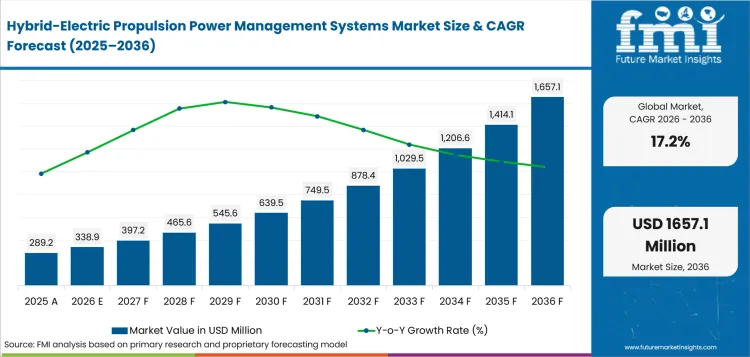
The hybrid-electric propulsion power management systems are projected to expand from USD 289.2 million in 2025 to USD 1,657.1 million by 2036 at 17.2% CAGR, influenced by aircraft makers shifting hybrid-electric programs from component trials to integrated propulsion systems requiring high-voltage distribution and battery-interface management. OEM integration is forecast to hold 61.8% share in 2026 and regional aircraft is projected at 48.3% share as aircraft makers test power flow between turbines and control units.
Key Takeaways, Market Size, and Forecast
- 2026 Market Size: USD 338.9 million
- 2036 Market Size: USD 1,657.1 million
- Forecast CAGR: 17.2% from 2026 to 2036
- Leading Sales Channel: OEM integration
- OEM Integration Share in 2026: 61.8%
- Leading Aircraft Platform: Regional aircraft
- Regional Aircraft Share in 2026: 48.3%
- Fastest-growing Country: United States
- United States CAGR: 20.4% by 2036
Summary of the Hybrid-Electric Propulsion Power Management Systems Market
- Demand and Growth Drivers
- Aircraft makers are using hybrid-electric control systems to manage turbine power and motor assist during aircraft-level propulsion trials.
- Regional aircraft programs are moving early demand toward flight-safe power distribution and battery interface packages.
- Certification progress for electric propulsion motors is giving aircraft electrical suppliers a clearer approval path.
- Product and Segment View
- OEM integration is projected to hold 61.8% share in 2026, influenced by aircraft makers placing power management inside early propulsion design.
- Regional aircraft is expected to represent 48.3% share in 2026, driven by shorter-route platforms entering hybrid-electric validation first.
- Turbine assist is forecast to secure 46.9% share in 2026 as aircraft programs combine gas turbine output with electric motor support.
- Geography and Competitive Outlook
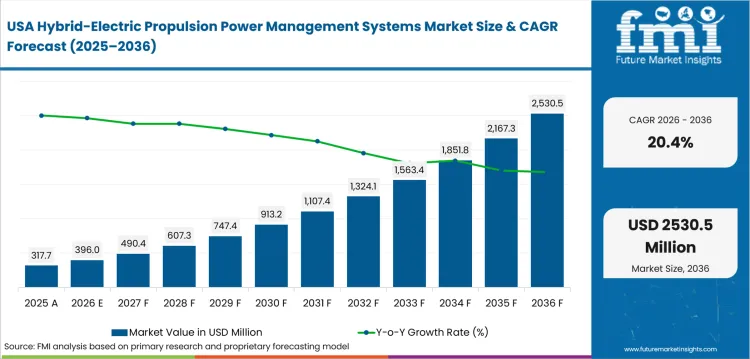
- United States is projected to record 20.4% CAGR by 2036, reflected by aircraft electrification programs tied to NASA and defense testing.
- France is expected to expand at 19.8% CAGR by 2036 through electric propulsion certification and aircraft electrical system strength.
- Collins Aerospace and Safran Electrical & Power compete based on aircraft power systems and certification support.
- GE Aerospace and Honeywell Aerospace Technologies compete based on propulsion links and high-voltage aerospace electrical systems.
- Analyst Opinion
- Nikhil Kaitwade, Principal Consultant for Automotive at FMI, observes, “Hybrid-electric aircraft power management is more than a simple controller opportunity. Aircraft makers are judging how safely a supplier can move high-voltage power between converters, and motors during flight. Power density is one part of the decision. Certification files and fault response evidence will shape supplier selection. Early revenue should collect around regional aircraft and military demonstrators before wider civil aircraft adoption. Companies with proven aircraft electrical systems and megawatt-class test evidence should gain earlier program roles.”
- Hybrid-Electric Propulsion Power Management Systems Market Value Analysis
- Market value is tied to aircraft program timing before recurring software and service revenue starts to form.
- Supplier pricing reflects power rating and certification work before flight-test support changes final system cost.
- Revenue expands as hybrid demonstrators move from single components into integrated propulsion packages.
- Program trust rises as power control systems reduce voltage instability during turbine-to-electric power transfer.
Aircraft makers need power management systems passing certification and work safely with electric engines. FAA’s ZeroAvia ZA601 special conditions showing inverters and low- and high-voltage systems are now part of the electric engine approval path, supporting demand across the aircraft electric motors market. This makes control logic and voltage safety documents important for suppliers. Safran’s ENGINe US100 series update also shows that approval is moving beyond one engine model with US100B1 and US100B2 added to the requested certificate.
This helps suppliers reuse technical files across related aircraft programs. EASA’s EHPS guidance connects ratings with endurance and operating limits. FAA’s BETA H500A special conditions add another signal by placing motor controllers and high-voltage electrical systems inside the certification basis. This gives suppliers a clearer route to sell controller safety files alongside aircraft electrical hardware used in the aircraft wire and cable and validation tools in the aviation test equipment.
Hybrid-Electric Propulsion Power Management Systems Market Definition
Hybrid-electric propulsion power management systems cover controllers, converters, DC distribution hardware, battery interface units, and control software used in hybrid-electric aircraft propulsion. Scope includes systems balancing turbine-generated power, battery power, and electric motor load during flight or ground tests. Pure battery aircraft powertrains without turbine-electric interaction are outside scope. General avionics and cabin electrical systems are counted only if sold as propulsion-linked power management packages.
Hybrid-Electric Propulsion Power Management Systems Market Inclusions
Market scope covers commercially traded hybrid-electric propulsion power management systems by sales channel such as OEM integration and retrofit programs. Aircraft platform coverage includes regional aircraft and eVTOL aircraft. Propulsion architecture includes turbine assist and battery boost. Power rating covers above 500 kW and megawatt class systems.
System type includes power control software and converter units. Revenue scope covers market activity from 2026 to 2036 across propulsion-linked power control hardware, high-voltage distribution units, and software tied to hybrid-electric aircraft operation. Key participants include aircraft electrical system suppliers, power electronics manufacturers, engine makers, aircraft OEMs, demonstrator program teams, certification advisers, and service organizations.
Hybrid-Electric Propulsion Power Management Systems Market Exclusions
Scope excludes pure electric propulsion systems with no turbine or fuel-based power source. Conventional aircraft electrical distribution used for cabin or avionics load is outside scope unless tied directly to propulsion power management. Ground electric vehicle inverters, drone battery controllers, and non-aviation power electronics are excluded. General aerospace cables and connectors are counted only if sold as part of a complete propulsion power management package.
Hybrid-Electric Propulsion Power Management Systems Market Research Methodology
- Primary Research: FMI analysts reviewed aircraft electrification program activity, hybrid propulsion supplier portfolios, OEM integration routes, and aerospace electrical system checks across major aviation markets.
- Desk Research: Public data from FAA, EASA, NASA, Clean Aviation, CORDIS, official company releases, certification documents, and technical program records were checked against hybrid-electric propulsion power management evidence.
- Market Sizing and Forecasting: Estimated using a bottom-up product-boundary approach. Eligible controller, converter, DC distribution, battery-interface, and power control software revenue were assessed with aircraft platform timing, power rating, sales channel, and country-level program activity to construct the 2026 market estimate.
- Data Validation: Forecast checks compared certification progress, demonstrator timing, megawatt-class test evidence, OEM integration activity, propulsion architecture fit, and active supplier portfolios.
Why is the Hybrid-Electric Propulsion Power Management Systems Market Growing?
- Aircraft makers are moving from component trials toward integrated propulsion control that manages turbine and electric power together.
- Regional flight programs are creating early demand for lighter power distribution and safer high-voltage control.
- Certification progress for electric propulsion parts is lowering uncertainty for aircraft electrical system suppliers.
Industry outlook is driven by hybrid aircraft programs move closer to full powertrain trials. Clean Aviation launched eight hybrid-electric regional aircraft projects in July 2024 with €227.0 million in public funding and over 160 participants. NASA’s electrified aircraft propulsion work includes a 1.4 MW high-efficiency motor project for future aircraft. Such evidence supports demand for aircraft electrification and more-electric aircraft power generation systems as aircraft makers move beyond lab-scale components.
Market Segmentation Analysis
- OEM integration is expected to represent 61.8% share in 2026, influenced by aircraft makers placing power control inside propulsion architecture before certification work begins.
- Regional aircraft is projected to account for 48.3% share in 2026, led by short-sector aircraft programs giving suppliers clearer test routes and system sizing needs.
- Turbine assist is forecast to capture 46.9% share in 2026 due to aircraft programs combining gas turbine output with electric motor support during high-load phases.
- Above 500 kW systems are anticipated to hold 44.5% share in 2026 as aircraft demonstrators need higher voltage handling and thermal control.
- Power control software is expected to represent 42.7% share in 2026 due to hybrid operation needing coordinated commands across converters and batteries.
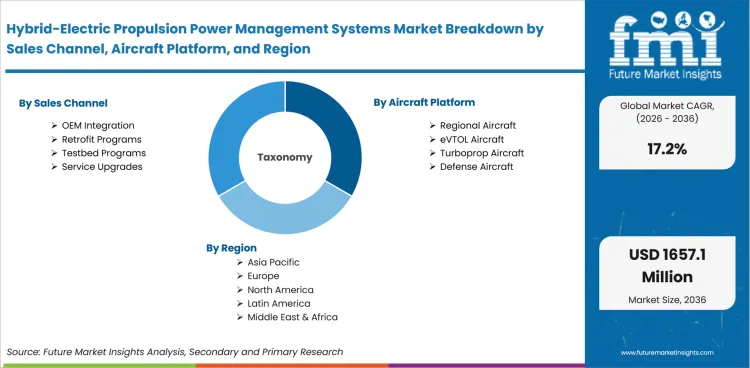
The hybrid-electric propulsion power management systems market is divided into groups based on sales channel, aircraft platform, propulsion architecture, power rating, system type, and region. Sales channel includes OEM integration, retrofit programs, testbed programs, and service upgrades. Aircraft platform coverage includes regional aircraft, eVTOL aircraft, turboprop aircraft, and defense aircraft. Propulsion architecture covers turbine assist, battery boost, fuel cell hybrid, and series hybrid designs. System type analysis includes power control software, DC distribution, converter units, and battery interface packages.
Insights into Hybrid-Electric Propulsion Power Management Systems Market by Sales Channel
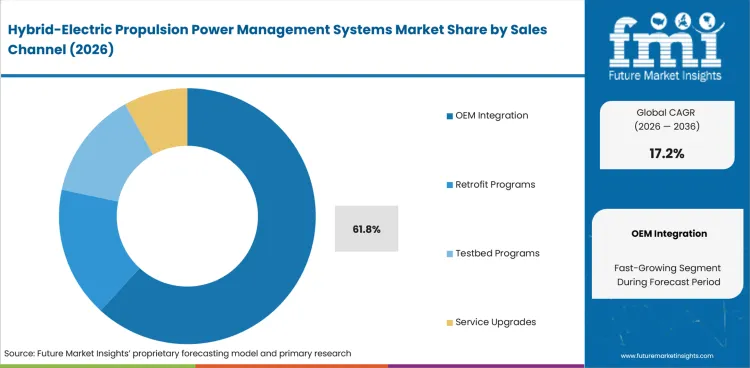
- OEM integration is projected to account for 61.8% share in 2026, led by aircraft makers designing power management around propulsion layout and certification files.
- Retrofit programs gain interest from test aircraft conversions requiring tailored converters and flight-safe control changes.
Insights into Hybrid-Electric Propulsion Power Management Systems Market by Aircraft Platform
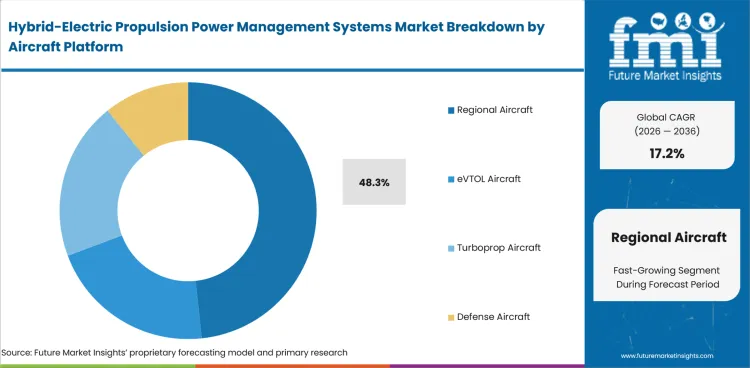
- Regional aircraft is forecast to hold 48.3% share in 2026 due to 30-seat to 100-seat programs creating early hybrid system value.
- eVTOL aircraft demand improves for compact controllers led by aircraft makers comparing distributed propulsion with electric aircraft sensors.
Insights into Hybrid-Electric Propulsion Power Management Systems Market by Propulsion Architecture
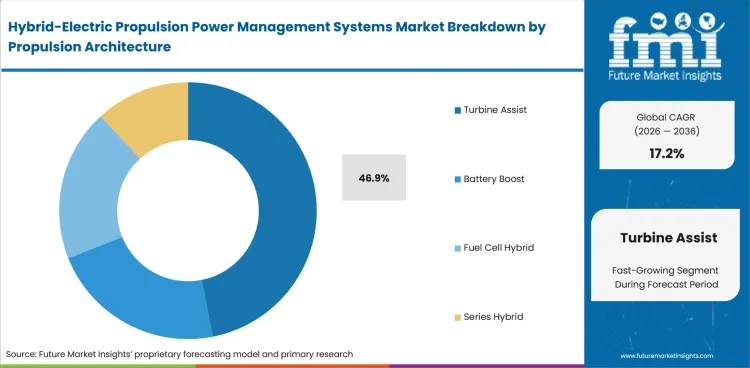
- Turbine assist is expected to account for 46.9% share in 2026, reflected by aircraft programs using electric support during climb and peak load.
- Battery boost gains use in aircraft designs needing short bursts of electric power without full electric operation.
Insights into Hybrid-Electric Propulsion Power Management Systems Market by Power Rating
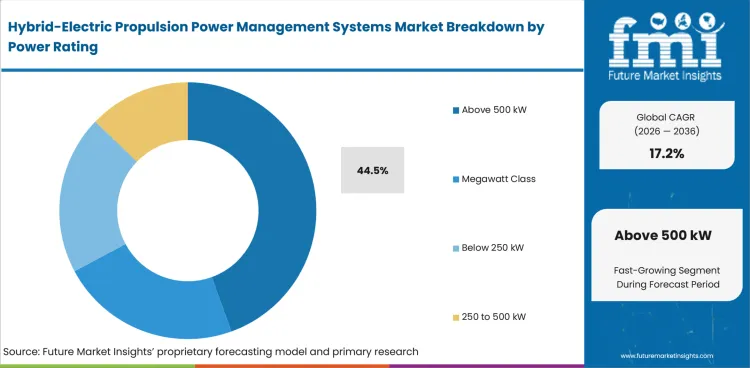
- Above 500 kW systems are anticipated to represent 44.5% share in 2026 as hybrid flight demonstrators move toward larger electrical loads.
- Megawatt class systems gain supplier attention due to thermal design and electrical fault handling deciding system readiness.
Insights into Hybrid-Electric Propulsion Power Management Systems Market by System Type
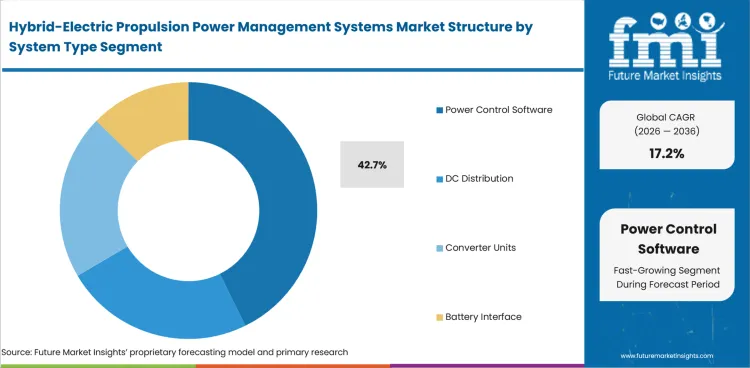
- Power control software is projected to hold 42.7% share in 2026 since hybrid propulsion needs real-time load balance and safety commands.
- DC distribution gains value as aircraft programs raise voltage and connect converter units with aerospace DC-DC converters.
Hybrid-Electric Propulsion Power Management Systems Market Drivers, Restraints, and Opportunities
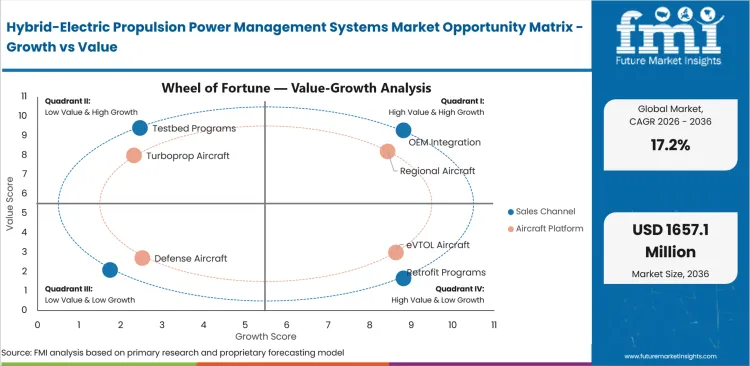
- Driver: Aircraft electrification programs are increasing demand for certified power control and high-voltage management systems.
- Restraint: Case-by-case approval pathways can delay supplier revenue across early electric and hybrid propulsion programs.
- Opportunity: Regional aircraft programs are creating early positions for suppliers that can support propulsion control, battery interface, and power conversion packages
Industry growth is shifting toward suppliers connecting power control hardware with certification evidence and airport-readiness planning. GAO reported, 47 USA airports had identified electric aircraft charging stations in airport plans by December 2025, which supports longer-term demand for propulsion-linked charging interfaces and power electronics market. FAA certification remains a restraint since GAO also reported 23 electric-propulsion certification projects, with special conditions issued for only 4 engine models by March 2026. This keeps approval documentation important for suppliers of digital power conversion systems and high-voltage control units. Regional aircraft remain the main opportunity path, as Clean Aviation selected PHARES for €69 million in EU funding to advance hybrid-electric propulsion for regional aircraft. This supports early demand for power distribution and validation tools linked with the power electronics GaN and SiC device reliability test systems market.
Application-wise Equipment Deployment Analysis
Hybrid-electric propulsion power management equipment is likely to deploy first in aircraft program environments where propulsion and energy storage must be tested together before aircraft entry. NASA stated in its 2025 electrified aircraft propulsion tutorial, the EPFD program is retiring technical risks for next-generation aircraft technologies targeting a 30% fuel-burn reduction, which makes equipment deployment stronger around system testbeds and battery-interface control rather than routine aftermarket upgrades.
Buyer Identification and Procurement Structure Analysis
Buyer activity is expected to center on aircraft OEMs and test-facility teams proving system behavior before certification filings. NASA’s 2025 SUSAN power/propulsion HIL report describes a 20-MW hybrid-electric powertrain linked with 16 contra-rotating electric ducted fans, showing that procurement is moving toward integrated packages where controllers and hardware-in-the-loop validation are purchased together rather than as isolated components.
Analysis of Hybrid-Electric Propulsion Power Management Systems Market by Key Countries
.webp "Top Country Growth Comparison Hybrid Electric Propulsion Power Management Systems Market Cagr (2026 2036)")
| Country | CAGR |
|---|---|
| United States | 20.4% |
| France | 19.8% |
| United Kingdom | 19.1% |
| Germany | 18.6% |
| Canada | 18.0% |
| Sweden | 17.5% |
| Italy | 16.7% |
Source: Future Market Insights, 2026.
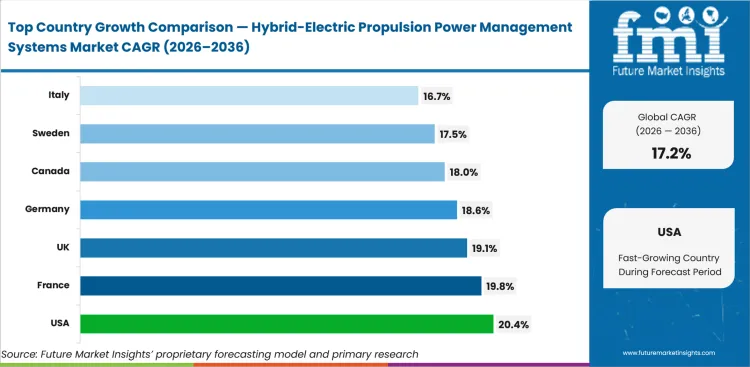
Hybrid-Electric Propulsion Power Management Systems Market CAGR Analysis by Country
- United States is forecast to lead with 20.4% CAGR by 2036 as NASA and defense propulsion programs deepen aircraft-grade power control testing.
- France is expected to expand at 19.8% CAGR through 2036 as electrical power certification and Clean Aviation participation support early system roles.
- United Kingdom is likely to advance at 19.1% CAGR by 2036 as power electronics work and regional aircraft programs sustain controller demand.
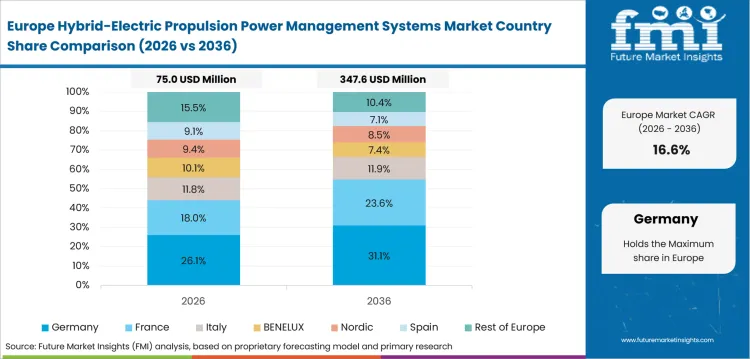
- Germany is projected to grow at 18.6% CAGR over the assessment period as high-voltage engineering supports aircraft electrical validation.
- Canada is set to record 18.0% CAGR through 2036 owing to turboprop hybrid programs and regional aircraft supply-chain depth.
- Sweden is predicted to rise at 17.5% CAGR by 2036 as hybrid regional aircraft demonstrators shape compact power management demand.
- Italy is estimated to post 16.7% CAGR during the forecast period as regional aircraft research projects support subsystem participation.
Sales Outlook for Hybrid-Electric Propulsion Power Management Systems Market in United States
Aircraft demonstrator and defense test center 2026 to 2036
Country Market Snapshot Table
| Parameter | Value |
|---|---|
| Market Size in 2025 (Value) | USD 62.3 million |
| Market Size in 2026 (Value) | USD 75.0 million |
| Market Forecast in 2036 (Value) | USD 480.1 million |
| CAGR (2026-2036) | 20.4% |
| Years Considered | 2021-2036 |
| Base Year | 2025 |
| Forecast Period | 2026-2036 |
| Units Considered | Value (USD million) |
| Leading Sub-Region | Ohio and Washington State aerospace corridors |
United States Hybrid-Electric Propulsion Power Management Systems Market Outlook
- United States demand is shaped by federal aircraft electrification work and engine-linked hybrid propulsion testing. Aircraft makers are using power management systems to coordinate high-voltage flow between electric machines and turbine engines.
- Defense research adds a second path for suppliers serving civil aircraft programs. Companies with flight-test data and certification documents can gain earlier roles in hybrid-electric propulsion power control.
Key Growth Drivers
- Defense-linked propulsion work gives suppliers a direct test route, backed by GE Aerospace demonstrating a hybrid-electric propulsion system under a USD 5.1 million USA Army research contract.
- Electric aircraft propulsion programs are raising power management requirements, supported by ZeroAvia’s FAA-backed work for electric propulsion systems designed for 2 MW to 5 MW powertrain applications.
- Aircraft makers can use federal research links to move converter and controller designs toward flight-test quality without relying only on internal program budgets.
- USA suppliers benefit from aircraft electrical system depth across engines, power electronics and certification support for hybrid propulsion projects.
Key Restraints
- Cryogenic system validation adds a technical burden, since NASA’s HEMM rotor coils need to be kept near -223°C during superconducting operation.
- Flight-ready power management units need long safety reviews before commercial aircraft makers can shift from ground tests to aircraft use.
- Defense-led trials may not convert into civil aircraft orders unless suppliers can translate test data into certification-ready packages.
What makes United States unique
United States is rising due to NASA research depth and defense-backed hybrid propulsion testing.
Key Companies
- GE Aerospace
- Collins Aerospace
- Honeywell Aerospace Technologies
- Parker Meggitt
- Eaton Aerospace
- magniX
- Safran Electrical & Power
Sales & Marketing Channels
- Aircraft OEM integration
- Defense research contracts
- NASA program collaboration
- Engine maker partnerships
- Flight-test integrators
- Aerospace system distributors
Market Taxonomy and Sub-Regions Covered
| Segment | Sub-Segments |
|---|---|
| By Sales Channel | OEM Integration Retrofit Programs Testbed Programs Service Upgrades |
| By Aircraft Platform | Regional Aircraft eVTOL Aircraft Turboprop Aircraft Defense Aircraft |
| By Propulsion Architecture | Turbine Assist Battery Boost Fuel Cell Hybrid Series Hybrid |
| By Power Rating | Below 250 kW 250 to 500 kW Above 500 kW Megawatt Class |
| By System Type | Power Control Software DC Distribution Converter Units Battery Interface |
| Key Sub-Regions Covered, Aerospace Clusters | Ohio Washington State Arizona Connecticut Kansas California |
Frequently Asked Questions
How fast is United States Hybrid-Electric Propulsion Power Management Systems Market growing?
Demand in United States is forecast at 20.4% CAGR from 2026 to 2036 as aircraft programs raise power levels.
Who leads United States Hybrid-Electric Propulsion Power Management Systems Market?
GE Aerospace, Collins Aerospace and Honeywell Aerospace Technologies lead through propulsion electrical systems and aerospace certification support.
What is driving adoption in United States Hybrid-Electric Propulsion Power Management Systems Market?
NASA research and defense test programs are moving suppliers toward megawatt-class power control and aircraft-grade safety proof.
Demand Outlook for Hybrid-Electric Propulsion Power Management Systems Market in France
Electrical power system and certification center 2026 to 2036
Country Market Snapshot Table
| Parameter | Value |
|---|---|
| Market Size in 2025 (Value) | USD 31.7 million |
| Market Size in 2026 (Value) | USD 38.0 million |
| Market Forecast in 2036 (Value) | USD 231.4 million |
| CAGR (2026-2036) | 19.8% |
| Years Considered | 2021-2036 |
| Base Year | 2025 |
| Forecast Period | 2026-2036 |
| Units Considered | Value (USD million) |
| Leading Sub-Region | Paris and Niort aerospace power systems |
France Hybrid-Electric Propulsion Power Management Systems Market Outlook
- France demand is supported by aircraft electrical system strength and electric propulsion certification progress. French suppliers are moving from motor certification toward broader aircraft power control and system integration.
- Aerospace power management value is tied to certification support as much as hardware supply. Companies able to connect converters, controls and safety files should gain early program positions.
- Demand Outlook for Hybrid-Electric Propulsion Power Management Systems Market in France
Key Growth Drivers
- Safran strengthens France’s certification base, supported by a motor certification campaign involving 1,500 hours of testing for ENGINeUS 100.
- European regional aircraft funding improves project continuity, backed by Clean Aviation reporting €227.0 million in public funding for hybrid-electric regional aircraft work.
- Toulouse and Paris aerospace teams can connect aircraft power management work with propulsion certification and electrical distribution planning.
- French suppliers hold an advantage in early hybrid programs due to close links between electrical system design and aircraft-level safety review.
Key Restraints
- Mechanical interface reviews can slow integration, since EASA type certificate data states 6 mountings transmit propeller loads to the airframe.
- French suppliers must handle thermal and airworthiness reviews before hybrid-electric power management systems can move into production aircraft.
- Aircraft makers may stage spending carefully as electric propulsion certification and hybrid power distribution advance at different speeds.
What makes France unique
France is unique due to aircraft electrical certification experience and strong Clean Aviation participation.
Key Companies
- Safran Electrical & Power
- Collins Aerospace
- GE Aerospace
- Honeywell Aerospace Technologies
- Eaton Aerospace
- Parker Meggitt
- magniX
Sales & Marketing Channels
- Aircraft OEM programs
- Clean Aviation projects
- Electrical system supplier bids
- Engine maker alliances
- Certification support packages
- Flight-test system contracts
Market Taxonomy and Sub-Regions Covered
| Segment | Sub-Segments |
|---|---|
| By Sales Channel | OEM Integration Retrofit Programs Testbed Programs Service Upgrades |
| By Aircraft Platform | Regional Aircraft eVTOL Aircraft Turboprop Aircraft Defense Aircraft |
| By Propulsion Architecture | Turbine Assist Battery Boost Fuel Cell Hybrid Series Hybrid |
| By Power Rating | Below 250 kW 250 to 500 kW Above 500 kW Megawatt Class |
| By System Type | Power Control Software DC Distribution Converter Units Battery Interface |
| Key Sub-Regions Covered, Aerospace Power Centers | Paris Toulouse Niort Lyon Bordeaux Marseille |
Frequently Asked Questions
How fast is France Hybrid-Electric Propulsion Power Management Systems Market growing?
Sector in France is projected to rise at 19.8% CAGR from 2026 to 2036 as electrical power projects advance.
Who leads France Hybrid-Electric Propulsion Power Management Systems Market?
Safran Electrical & Power leads France through electric propulsion certification experience and aircraft power distribution capability.
What is driving adoption in France Hybrid-Electric Propulsion Power Management Systems Market?
Clean Aviation projects and Safran electrical system strength are moving France toward hybrid propulsion power management roles.
Sales Analysis of Hybrid-Electric Propulsion Power Management Systems Market in United Kingdom
Power electronics and regional aircraft project center 2026 to 2036
Country Market Snapshot Table
| Parameter | Value |
|---|---|
| Market Size in 2025 (Value) | USD 25.2 million |
| Market Size in 2026 (Value) | USD 30.0 million |
| Market Forecast in 2036 (Value) | USD 172.3 million |
| CAGR (2026-2036) | 19.1% |
| Years Considered | 2021-2036 |
| Base Year | 2025 |
| Forecast Period | 2026-2036 |
| Units Considered | Value (USD million) |
| Leading Sub-Region | Midlands and South East aerospace suppliers |
United Kingdom Hybrid-Electric Propulsion Power Management Systems Market Outlook
- United Kingdom demand is guided by aerospace power electronics and aircraft systems engineering. Local suppliers are positioned around controller design and electric motor drive work for hybrid-electric aircraft programs.
- Regional aircraft and short-to-medium range demonstrators create a practical entry point for UK power management suppliers. Supplier progress will depend on validated hardware and aircraft-level documentation.
Key Growth Drivers
- UK controller work gains program depth, with Collins Aerospace validating 2 megawatt-class electric motor generators for the SWITCH hybrid-electric powertrain.
- Clean Aviation funding supports UK-linked system work, with CORDIS listing SWITCH total project cost at €67.6 million.
- Midlands and South East aerospace suppliers can serve controller design, subsystem testing and aircraft electrical safety work.
- UK research links support early system validation across software control, motor drive integration and aircraft power distribution.
Key Restraints
- Public and private funding alignment can shape project timing, since Clean Aviation’s programme budget combines €1.7 billion in EU funding with at least €2.4 billion in private funding.
- Multinational program structures can lengthen UK supplier decisions before controller and power distribution hardware enters the next test phase.
- Powertrain validation requires several aircraft system owners to align on safety files before UK suppliers can scale deliveries.
What makes United Kingdom unique
United Kingdom is unique due to power electronics depth and aircraft systems engineering capability.
Key Companies
- Collins Aerospace
- Safran Electrical & Power
- Parker Meggitt
- Honeywell Aerospace Technologies
- GE Aerospace
- Eaton Aerospace
- magniX
Sales & Marketing Channels
- Aircraft system supplier bids
- Research consortium programs
- OEM engineering partnerships
- Certification support contracts
- Testbed hardware supply
- Service upgrade channels
Market Taxonomy and Sub-Regions Covered
| Segment | Sub-Segments |
|---|---|
| By Sales Channel | OEM Integration Retrofit Programs Testbed Programs Service Upgrades |
| By Aircraft Platform | Regional Aircraft eVTOL Aircraft Turboprop Aircraft Defense Aircraft |
| By Propulsion Architecture | Turbine Assist Battery Boost Fuel Cell Hybrid Series Hybrid |
| By Power Rating | Below 250 kW 250 to 500 kW Above 500 kW Megawatt Class |
| By System Type | Power Control Software DC Distribution Converter Units Battery Interface |
| Key Sub-Regions Covered, Aerospace Engineering Centers | Midlands South East Bristol Cambridge Wales Northern Ireland |
Frequently Asked Questions
How fast is United Kingdom Hybrid-Electric Propulsion Power Management Systems Market growing?
Industry in United Kingdom is expected to grow at 19.1% CAGR from 2026 to 2036.
Who leads United Kingdom Hybrid-Electric Propulsion Power Management Systems Market?
Collins Aerospace, Safran Electrical & Power and Parker Meggitt compete through aircraft power and control system depth.
What is driving adoption in United Kingdom Hybrid-Electric Propulsion Power Management Systems Market?
Clean Aviation participation and aerospace electrical engineering strength are moving suppliers toward hybrid propulsion power control work.
Demand Analysis of Hybrid-Electric Propulsion Power Management Systems Market in Germany
Certification culture and high-voltage engineering center 2026 to 2036
Country Market Snapshot Table
| Parameter | Value |
|---|---|
| Market Size in 2025 (Value) | USD 23.6 million |
| Market Size in 2026 (Value) | USD 28.0 million |
| Market Forecast in 2036 (Value) | USD 154.2 million |
| CAGR (2026-2036) | 18.6% |
| Years Considered | 2021-2036 |
| Base Year | 2025 |
| Forecast Period | 2026-2036 |
| Units Considered | Value (USD million) |
| Leading Sub-Region | Bavaria and Baden-Württemberg aerospace corridor |
Germany Hybrid-Electric Propulsion Power Management Systems Market Outlook
- Germany demand is shaped by high-voltage engineering and aircraft certification discipline. Local suppliers are positioned around power distribution panels and electromagnetic safety work.
- Aircraft power management programs need precise fault handling before aircraft integration. German suppliers can gain if they prove thermal behavior and documentation quality across hybrid propulsion subsystems.
Key Growth Drivers
- German high-voltage work gains support from HECATE, after RTX reported testing of a hybrid-electric system producing more than 500 kW of power.
- Cross-border aircraft electrification work gives German suppliers wider test exposure, with Clean Aviation describing HECATE as a €68.0 million initiative.
- Bavaria and Baden-Württemberg suppliers can link aerospace electronics experience with aircraft-grade converter and protection system design.
- German engineering discipline supports suppliers able to document electromagnetic safety and thermal behavior for hybrid-electric aircraft systems.
Key Restraints
- Program coordination can slow technical decisions, since CORDIS states the HECATE consortium mobilizes 37 members across the supply chain.
- German suppliers face strict evidence demands as hybrid-electric power systems must prove fault response before aircraft installation.
- Cross-border demonstrator programs can delay local order timing if aircraft makers split validation tasks across several partners.
What makes Germany unique
Germany is unique due to strict technical approval culture and high-voltage engineering depth.
Key Companies
- Collins Aerospace
- Safran Electrical & Power
- Honeywell Aerospace Technologies
- Parker Meggitt
- Eaton Aerospace
- GE Aerospace
- magniX
Sales & Marketing Channels
- Clean Aviation consortia
- Aircraft OEM engineering bids
- Engine maker partnerships
- High-voltage test programs
- Certification support packages
- Aerospace electronics distributors
Market Taxonomy and Sub-Regions Covered
| Segment | Sub-Segments |
|---|---|
| By Sales Channel | OEM Integration Retrofit Programs Testbed Programs Service Upgrades |
| By Aircraft Platform | Regional Aircraft eVTOL Aircraft Turboprop Aircraft Defense Aircraft |
| By Propulsion Architecture | Turbine Assist Battery Boost Fuel Cell Hybrid Series Hybrid |
| By Power Rating | Below 250 kW 250 to 500 kW Above 500 kW Megawatt Class |
| By System Type | Power Control Software DC Distribution Converter Units Battery Interface |
| Key Sub-Regions Covered, Aerospace Clusters | Bavaria Baden-Württemberg Hamburg Bremen Lower Saxony Berlin |
Frequently Asked Questions
How fast is Germany Hybrid-Electric Propulsion Power Management Systems Market growing?
Germany is expected to advance at 18.6% CAGR from 2026 to 2036 as aircraft electrical testing deepens.
Who leads Germany Hybrid-Electric Propulsion Power Management Systems Market?
Collins Aerospace, Honeywell Aerospace Technologies and Safran Electrical & Power compete through aircraft electrical system capability.
What is driving adoption in Germany Hybrid-Electric Propulsion Power Management Systems Market?
High-voltage engineering and certification discipline are moving German suppliers toward hybrid propulsion power control programs.
Opportunity Analysis of Hybrid-Electric Propulsion Power Management Systems Market in Canada
Turboprop hybrid system and regional aircraft center 2026 to 2036
Country Market Snapshot Table
| Parameter | Value |
|---|---|
| Market Size in 2025 (Value) | USD 16.1 million |
| Market Size in 2026 (Value) | USD 19.0 million |
| Market Forecast in 2036 (Value) | USD 99.4 million |
| CAGR (2026-2036) | 18.0% |
| Years Considered | 2021-2036 |
| Base Year | 2025 |
| Forecast Period | 2026-2036 |
| Units Considered | Value (USD million) |
| Leading Sub-Region | Quebec and Ontario aerospace corridor |
Canada Hybrid-Electric Propulsion Power Management Systems Market Outlook
- Canada demand is centered on turboprop hybrid systems and regional aircraft operations. Quebec aerospace suppliers are positioned near engine makers and aircraft system partners.
- Hybrid-electric power management in Canada is linked to fuel efficiency and short-route aircraft use. Suppliers that connect power control with turboprop integration should gain program visibility.
Key Growth Drivers
- Canada’s turboprop hybrid path is strengthened by PHARES, which targets up to 20.0% improved fuel efficiency on regional aircraft missions.
- Federal support improves Canada’s propulsion R&D base, with Innovation, Science and Economic Development Canada announcing CAD 11.3 million for Pratt & Whitney Canada’s aerospace technology project.
- Quebec aerospace suppliers can connect hybrid propulsion design with turboprop engine knowledge and regional aircraft service needs.
- Canadian test capability supports battery interface work and power control software for regional hybrid-electric flight programs.
Key Restraints
- High-power battery infrastructure adds operating complexity, since NRC Canada’s mobile charging work is aimed at improving high-voltage charging capability for hybrid-electric propulsion systems.
- Canadian suppliers may need partner access before entering engine-linked hybrid propulsion system packages.
- Cold-weather operating needs can raise validation work for battery interface units and high-voltage control systems.
What makes Canada unique
Canada is unique due to turboprop hybrid work and a strong regional aircraft supply chain.
Key Companies
- Pratt & Whitney Canada
- Collins Aerospace
- Safran Electrical & Power
- GE Aerospace
- Honeywell Aerospace Technologies
- Eaton Aerospace
- magniX
Sales & Marketing Channels
- Engine maker partnerships
- Regional aircraft OEM programs
- Clean Aviation projects
- Federal research support
- Service upgrade contracts
- Aerospace supplier networks
Market Taxonomy and Sub-Regions Covered
| Segment | Sub-Segments |
|---|---|
| By Sales Channel | OEM Integration Retrofit Programs Testbed Programs Service Upgrades |
| By Aircraft Platform | Regional Aircraft eVTOL Aircraft Turboprop Aircraft Defense Aircraft |
| By Propulsion Architecture | Turbine Assist Battery Boost Fuel Cell Hybrid Series Hybrid |
| By Power Rating | Below 250 kW 250 to 500 kW Above 500 kW Megawatt Class |
| By System Type | Power Control Software DC Distribution Converter Units Battery Interface |
| Key Sub-Regions Covered, Aerospace Corridors | Quebec Ontario British Columbia Manitoba Alberta Nova Scotia |
Frequently Asked Questions
How fast is Canada Hybrid-Electric Propulsion Power Management Systems Market growing?
Canada is forecast at 18.0% CAGR from 2026 to 2036 as turboprop hybrid programs advance.
Who leads Canada Hybrid-Electric Propulsion Power Management Systems Market?
Pratt & Whitney Canada and Collins Aerospace hold key positions through turboprop hybrid powertrain work.
What is driving adoption in Canada Hybrid-Electric Propulsion Power Management Systems Market?
Regional aircraft needs and Quebec aerospace capability are moving Canada toward hybrid turboprop power management.
Future Outlook for Hybrid-Electric Propulsion Power Management Systems Market in Sweden
Hybrid regional aircraft demonstrator center 2026 to 2036
Country Market Snapshot Table
| Parameter | Value |
|---|---|
| Market Size in 2025 (Value) | USD 11.9 million |
| Market Size in 2026 (Value) | USD 14.0 million |
| Market Forecast in 2036 (Value) | USD 70.2 million |
| CAGR (2026-2036) | 17.5% |
| Years Considered | 2021-2036 |
| Base Year | 2025 |
| Forecast Period | 2026-2036 |
| Units Considered | Value (USD million) |
| Leading Sub-Region | Gothenburg and regional airport networks |
Sweden Hybrid-Electric Propulsion Power Management Systems Market Outlook
- Sweden demand is shaped by hybrid regional aircraft development and short-route aviation concepts. Heart Aerospace gives domestic suppliers a direct program around propulsion management and aircraft power coordination.
- Swedish opportunity is narrower than large aerospace countries but more focused. Power management suppliers can gain if demonstrator evidence moves into certifiable aircraft systems.
Key Growth Drivers
- Public FAST funding supports Swedish-linked control system work, with FAA announcing nearly USD 300.0 million in awards for sustainable aviation fuels and low-emission aviation technologies.
- Regional route economics support Swedish aircraft planning, with ES-30 positioned as a 30-passenger hybrid-electric regional aircraft.
- Local aircraft design activity creates early needs for battery interface hardware and automated power control software.
- Swedish regional aviation concepts support compact propulsion management systems for short routes and lower ground infrastructure burden.
Key Restraints
- Payload-range planning can limit route flexibility, since ES-30’s longer hybrid operating case is tied to 25 passengers.
- Grant-backed system work must still move through certification before Swedish suppliers can treat it as production demand.
- USA execution of grant work may reduce the share of early system activity captured by Sweden-based suppliers.
What makes Sweden unique
Sweden is unique due to Heart Aerospace’s hybrid regional aircraft demonstrator activity.
Key Companies
- Heart Aerospace
- Safran Electrical & Power
- Collins Aerospace
- Honeywell Aerospace Technologies
- GE Aerospace
- magniX
- Eaton Aerospace
Sales & Marketing Channels
- Aircraft OEM integration
- Demonstrator program contracts
- FAA-supported research channels
- Regional airport partnerships
- Supplier engineering agreements
- Flight-test support services
Market Taxonomy and Sub-Regions Covered
| Segment | Sub-Segments |
|---|---|
| By Sales Channel | OEM Integration Retrofit Programs Testbed Programs Service Upgrades |
| By Aircraft Platform | Regional Aircraft eVTOL Aircraft Turboprop Aircraft Defense Aircraft |
| By Propulsion Architecture | Turbine Assist Battery Boost Fuel Cell Hybrid Series Hybrid |
| By Power Rating | Below 250 kW 250 to 500 kW Above 500 kW Megawatt Class |
| By System Type | Power Control Software DC Distribution Converter Units Battery Interface |
| Key Sub-Regions Covered, Regional Aircraft Centers | Gothenburg Stockholm Linköping Västerås Malmö Umeå |
Frequently Asked Questions
How fast is Sweden Hybrid-Electric Propulsion Power Management Systems Market growing?
Sweden is projected at 17.5% CAGR from 2026 to 2036 as hybrid regional aircraft programs advance.
Who leads Sweden Hybrid-Electric Propulsion Power Management Systems Market?
Heart Aerospace leads domestic activity, supported by global suppliers in motors, converters and power management systems.
What is driving adoption in Sweden Hybrid-Electric Propulsion Power Management Systems Market?
Hybrid regional aircraft demonstrator work is moving Sweden toward battery interface and propulsion control system demand.
In-depth Analysis of Hybrid-Electric Propulsion Power Management Systems Market in Italy
Regional aircraft research and turboprop system center 2026 to 2036
Country Market Snapshot Table
| Parameter | Value |
|---|---|
| Market Size in 2025 (Value) | USD 10.3 million |
| Market Size in 2026 (Value) | USD 12.0 million |
| Market Forecast in 2036 (Value) | USD 56.2 million |
| CAGR (2026-2036) | 16.7% |
| Years Considered | 2021-2036 |
| Base Year | 2025 |
| Forecast Period | 2026-2036 |
| Units Considered | Value (USD million) |
| Leading Sub-Region | Turin and Lombardy aerospace corridor |
Italy Hybrid-Electric Propulsion Power Management Systems Market Outlook
- Italy demand is linked to European aircraft research and regional propulsion system work. Italian suppliers can serve power electronics and aircraft subsystem packages through consortium-based development.
- Near-term opportunity is research-heavy rather than production-heavy. Supplier gains will depend on moving validated controls and converter packages into aircraft program decisions.
Key Growth Drivers
- Hybrid propulsion design supports Italian subsystem work, as Clean Aviation describes AMBER as a megawatt-class project of about 2.0 MW for regional aircraft.
- Italian aircraft powertrain research gains a decarbonization case, with CORDIS stating AMBER targets at least 50.0% lower greenhouse gas emissions and fuel burn versus a 2020 regional aircraft baseline.
- Turin and Lombardy aerospace suppliers can connect propulsion research with converter packaging and aircraft electrical controls.
- Italian firms can support European regional aircraft work through propulsion design, test support and subsystem integration partnerships.
Key Restraints
- Program coordination can slow component entry, since Fraunhofer states around 20 partners are developing the AMBER hybrid-electric turboprop engine.
- Research-heavy work can delay direct orders if suppliers remain outside aircraft demonstrator consortia.
- Certification proof may raise the cost of converting Italian subsystem designs into aircraft-grade power management packages.
What makes Italy unique
Italy is unique due to regional aircraft research and European program participation.
Key Companies
- Collins Aerospace
- Safran Electrical & Power
- Leonardo
- Honeywell Aerospace Technologies
- Eaton Aerospace
- Parker Meggitt
- GE Aerospace
Sales & Marketing Channels
- European program consortia
- Aircraft supplier bids
- Regional aircraft research links
- OEM engineering agreements
- Testbed hardware contracts
- Certification support channels
Market Taxonomy and Sub-Regions Covered
| Segment | Sub-Segments |
|---|---|
| By Sales Channel | OEM Integration Retrofit Programs Testbed Programs Service Upgrades |
| By Aircraft Platform | Regional Aircraft eVTOL Aircraft Turboprop Aircraft Defense Aircraft |
| By Propulsion Architecture | Turbine Assist Battery Boost Fuel Cell Hybrid Series Hybrid |
| By Power Rating | Below 250 kW 250 to 500 kW Above 500 kW Megawatt Class |
| By System Type | Power Control Software DC Distribution Converter Units Battery Interface |
| Key Sub-Regions Covered, Aerospace Clusters | Turin Lombardy Campania Apulia Lazio Emilia-Romagna |
Frequently Asked Questions
How fast is Italy hybrid-electric propulsion power management systems market growing?
Italy is expected to post 16.7% CAGR from 2026 to 2036 as regional aircraft research continues.
Who leads Italy Hybrid-Electric Propulsion Power Management Systems Market?
Leonardo and global electrical system suppliers compete through aircraft programs and European research partnerships.
What is driving adoption in Italy Hybrid-Electric Propulsion Power Management Systems Market?
Regional aircraft research and European program participation are moving Italy toward hybrid propulsion power management activity.
Competitive Landscape and Strategic Positioning
- Integrated aircraft electrical suppliers hold an advantage due to certified power distribution and high-voltage controls.
- Engine-linked system suppliers gain early roles by joining turbine operation with electric power transfer.
- Software control depth improves supplier standing as hybrid propulsion needs real-time battery and motor coordination.
- Flight-test support reduces adoption risk by proving thermal behavior and fault response before certification filing.
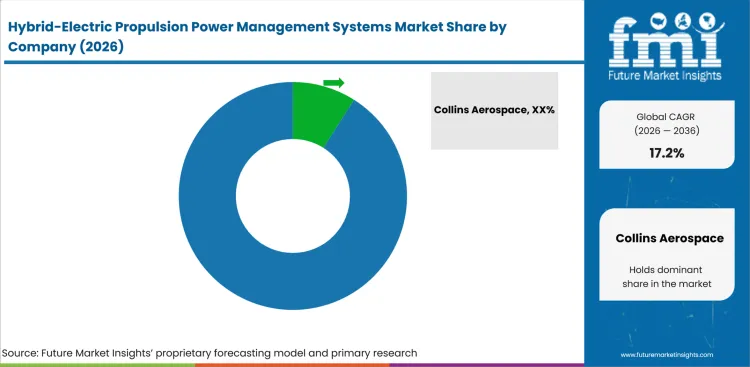
Competition is shifting toward suppliers combining high-voltage protection and certification support in one system package. Buyer preference is moving toward partners proving fault response and integration readiness before aircraft makers commit to wider hybrid-electric propulsion programs. Competition is led by aerospace electrical system suppliers and power electronics specialists. Collins Aerospace and Safran Electrical & Power hold strong positions due to aircraft power distribution experience and certification support. GE Aerospace adds value through engine-linked hybrid propulsion work. Honeywell Aerospace Technologies, Parker Meggitt, and Eaton Aerospace compete through aircraft electrical systems and high-voltage hardware.
Channel strength now carries similar weight to power rating. Direct aircraft maker programs support system-specific design paths and warranty control. Aircraft makers need partners able to supply controllers and test documentation together. Adjacent spending across aircraft automated inspection and monitoring and aircraft ice accretion detection sensors can create bundled opportunities for suppliers serving electric aircraft safety.
Key Companies in the Hybrid-Electric Propulsion Power Management Systems Market
Competitive structure is differentiated by aircraft electrical system suppliers, propulsion integrators and electric aircraft specialists.
- Aircraft Electrical System Suppliers: Collins Aerospace, Safran Electrical & Power and Honeywell Aerospace Technologies compete through certified power distribution and aircraft system support.
- Propulsion Integrators: GE Aerospace, Parker Meggitt and Eaton Aerospace compete through engine-linked hybrid propulsion work and high-voltage component capability.
- Electric Aircraft Specialists: magniX and Heart Aerospace compete through electric propulsion experience and aircraft power electronics support.
Competitive Benchmarking: Hybrid-Electric Propulsion Power Management Systems Market
| Company | HVDC Control Depth | Megawatt Test Evidence | Certification Support Range | Channel Reach | Geographic Footprint |
|---|---|---|---|---|---|
| Collins Aerospace | Very Strong | Very Strong | Very Strong | Very Strong | Global |
| Safran Electrical & Power | Very Strong | Strong | Very Strong | Strong | Global |
| GE Aerospace | Strong | Very Strong | Strong | Very Strong | Global |
| Honeywell Aerospace Technologies | Strong | Moderate | Strong | Very Strong | Global |
| Parker Meggitt | Strong | Moderate | Strong | Strong | Global |
| Eaton Aerospace | Moderate | Moderate | Strong | Strong | Global |
| magniX | Strong | Strong | Moderate | Moderate | North America and Europe |
| Heart Aerospace | Moderate | Moderate | Moderate | Moderate | Europe and North America |
Source: Future Market Insights competitive analysis, 2026.
Key Developments in Hybrid-Electric Propulsion Power Management Systems Market
- In May 2025, NASA’s electrified aircraft propulsion testing tutorial described the NASA Electric Aircraft Testbed and Hybrid Propulsion Emulation Rig as facilities used to verify megawatt-scale electrical components and to test electrified aircraft propulsion control systems before full aircraft integration.
- In September 2025, Clean Aviation selected POWER4AIR under its Fast Track Areas portfolio to address arc fault detection and reliability for electric aircraft power electronics.
- In September 2025, Clean Aviation selected OSYRYS under the Ultra-Efficient Regional Aircraft portfolio, with Safran Electrical & Power listed as project coordinator.
Key Players in the Hybrid-Electric Propulsion Power Management Systems Market
- Collins Aerospace
- Safran Electrical & Power
- GE Aerospace
- Honeywell Aerospace Technologies
- Parker Meggitt
- Eaton Aerospace
- magniX
- Heart Aerospace
Hybrid-Electric Propulsion Power Management Systems Market Report Scope
| Parameter | Details |
|---|---|
| Market size by 2036 | USD 1,657.1 million |
| Growth rate | 17.2% CAGR from 2026 to 2036 |
| Forecast period | 2026 to 2036 |
| Base year value (2025) | USD 289.2 million |
| By sales channel | OEM integration, retrofit programs, testbed programs, service upgrades |
| By aircraft platform | Regional aircraft, eVTOL aircraft, turboprop aircraft, defense aircraft |
| By propulsion architecture | Turbine assist, battery boost, fuel cell hybrid, series hybrid |
| By power rating | Below 250 kW, 250 to 500 kW, above 500 kW, megawatt class |
| By system type | Power control software, DC distribution, converter units, battery interface |
| Regions covered | North America, Latin America, Europe, Asia Pacific, Middle East and Africa |
| Countries covered | United States, France, United Kingdom, Germany, Canada, Sweden, Italy |
| Key companies profiled | Collins Aerospace, Safran Electrical & Power, GE Aerospace, Honeywell Aerospace Technologies, Parker Meggitt, Eaton Aerospace, magniX |
| Approach | Bottom-up aircraft program checks with power rating, demonstrator timing and supplier validation |
Source: Future Market Insights competitive analysis, 2026.
Hybrid-Electric Propulsion Power Management Systems Market Breakdown by Sales Channel, Aircraft Platform, Propulsion Architecture, Power Rating, System Type, and Region
By Sales Channel:
- OEM Integration
- Retrofit Programs
- Testbed Programs
- Service Upgrades
By Aircraft Platform:
- Regional Aircraft
- eVTOL Aircraft
- Turboprop Aircraft
- Defense Aircraft
By Propulsion Architecture:
- Turbine Assist
- Battery Boost
- Fuel Cell Hybrid
- Series Hybrid
By Power Rating:
- Below 250 kW
- 250 to 500 kW
- Above 500 kW
- Megawatt Class
By System Type:
- Power Control Software
- DC Distribution
- Converter Units
- Battery Interface
By Region:
- North America
- Latin America
- Europe
- Asia Pacific
- Middle East and Africa
Research Sources and Bibliography
- Clean Aviation Joint Undertaking. (2024, July 9). Hybrid electric regional thrust in Clean Aviation: Enhancing cooperation.
- Clean Aviation Joint Undertaking. (2025, September 9). €945 million in total research effort for 12 new Clean Aviation projects.
- Connolly, J. W., Bianco, S. J., Buescher, H. E., Lantz, T. J., & Hill, E. D. (2025, May 27). Tutorial: Electrified aircraft propulsion approaches for modeling and electrical hardware-in-the-loop testing. NASA Technical Reports Server.
- European Union Aviation Safety Agency. (2024, December 19). Means of compliance with the special condition EHPS: Ratings and operating limitations, MOC-EHPS.40.
- European Union Aviation Safety Agency. (2025, February 4). How EASA certified Safran’s ENGINeUS 100 electric engine.
- European Union Aviation Safety Agency. (2025, February 17). Type-certificate data sheet: ENGINeUS100 engine series, EASA.E.251.
- Federal Aviation Administration. (2024, December 17). Special conditions: BETA Technologies Inc. Model H500A electric engines. Federal Register.
- Federal Aviation Administration. (2026, January 27). Special conditions: Safran Electric & Power S.A. ENGINe™ US100 series electric engines. Federal Register.
- Federal Aviation Administration. (2026, March 18). Special conditions: ZeroAvia, Inc. Model ZA601 electric engines. Federal Register.
- GE Aerospace. (2024, November 21). GE Aerospace demonstrates hybrid electric propulsion system for USA Army.
- Heart Aerospace. (2024, September 4). Heart Aerospace and Loganair enter exclusive partnership to advance hybrid-electric aviation in the UK.
- Heart Aerospace. (2024, September 6). Heart Aerospace awarded USD 4.1 million in FAA FAST grant to advance electric aviation in the USA
- NASA. (2025, April 13). High-Efficiency Megawatt Motor.
- Sachs-Wetstone, J. J., Buescher, H. E., & Horning, M. A. (2025, March 1). SUbsonic Single Aft eNgine (SUSAN) power/propulsion system hardware-in-the-loop test results (NASA/TM-20250002147). NASA Technical Reports Server.
- USA Government Accountability Office. (2026, May 27). Electric aircraft: FAA is evaluating designs for certification and considering long-term regulatory approaches (GAO-26-107816).
- Clean Aviation Joint Undertaking. (2026, May 19). HECATE delivers ambitious electric aviation programme.
- Fraunhofer ICT. (2026, February). Project Clean Aviation - Amber.
- RTX. (2026, March 16). RTX’s Collins Aerospace initiates powertrain testing for Clean Aviation SWITCH project at The Grid.
- RTX. (2026, March 17). RTX’s Collins Aerospace announces completion of Clean Aviation Joint Undertaking HECATE project.
This bibliography is provided for reader reference and is not exhaustive. The full report contains the complete reference list and detailed citations.
This Report Answers
- What is the 2026 value and 2036 forecast for hybrid-electric propulsion power management systems market?
- What sales channel is projected to hold the leading share during the forecast period?
- What aircraft platform is expected to account for the leading 2026 share?
- How do megawatt-class systems affect power management system design and project pricing?
- What companies compete in hybrid-electric propulsion power management systems?
Frequently Asked Questions
What is the hybrid-electric propulsion power management systems market size in 2026?
The hybrid-electric propulsion power management systems market value is anticipated to cross USD 338.9 million in 2026 as aircraft electrification programs advance.
What is the forecast value of hybrid-electric propulsion power management systems market by 2036?
The hybrid-electric propulsion power management systems industry revenue is predicted to scale USD 1,657.1 million by 2036 as regional aircraft programs expand.
What is the forecast CAGR for hybrid-electric propulsion power management systems market?
The hybrid-electric propulsion power management systems sector is projected to expand at 17.2% CAGR from 2026 to 2036.
What sales channel leads hybrid-electric propulsion power management systems market?
OEM integration is expected to garner 61.8% share in 2026 due to early aircraft maker control over propulsion architecture.
What aircraft platform leads hybrid-electric propulsion power management systems market?
Regional aircraft are forecast to account for 48.3% share in 2026 as short-sector demonstrator programs move first.
Preview the report firsthand - request a free sample
Get SampleGet the brochure for pricing and purchase details.
Get PDFTable of Content
- Key Takeaways
- Market Size and CAGR
- Top Growth Driver
- Fastest Growing Segment
- Leading Region
- Key Companies
- Emerging Opportunities
- Executive Summary
- Global Market Outlook
- Demand-side Trends
- Supply-side Trends
- Technology Roadmap Analysis
- Analysis and Recommendations
- Analyst Perspective (What is happening? Why now? What should investors know?)
- Key Questions Answered
- How large is the market?
- What is the CAGR?
- What are key trends?
- Which region dominates?
- Who are the leaders?
- Market Overview
- Market Coverage / Taxonomy
- Market Definition / Scope / Limitations
- Research Methodology
- Chapter Orientation
- Analytical Lens and Working Hypotheses
- Market Structure, Signals, and Trend Drivers
- Benchmarking and Cross-market Comparability
- Market Sizing, Forecasting, and Opportunity Mapping
- Research Design and Evidence Framework
- Desk Research Programme (Secondary Evidence)
- Expert Input and Fieldwork (Primary Evidence)
- Tooling, Models, and Reference Databases
- Data Engineering and Model Build
- Quality Assurance and Audit Trail
- Market Background
- Market Dynamics (Drivers, Restraints, Opportunity, Trends)
- Scenario Forecast (Optimistic, Likely, Conservative)
- Impact Analysis
- AI Impact
- Sustainability Impact
- Regulatory Impact
- Technology Impact
- Consumer / Buyer Analysis
- Purchase Drivers
- Adoption Barriers
- Buyer Journey
- Opportunity Map Analysis
- Product Life Cycle Analysis
- Supply Chain Analysis
- Investment Feasibility Matrix
- Value Chain Analysis
- PESTLE and Porter's Analysis
- Regulatory Landscape
- Regional Parent Market Outlook
- Production and Consumption Statistics
- Import and Export Statistics
- Global Market Analysis and Forecast, 2021 to 2036
- Historical Market Size Value (USD Million) & Volume (Unit) Analysis, 2021 to 2025
- Current and Future Market Size Value (USD Million) & Volume (Unit) Projections, 2026 to 2036
- Y-o-Y Growth Trend Analysis
- Absolute $ Opportunity Analysis
- Global Market Pricing Analysis, 2021 to 2036
- Global Market Analysis and Forecast, By Sales Channel, 2021 to 2036
- Introduction / Key Findings
- Historical Market Size Value (USD Million) & Volume (Unit) Analysis By Sales Channel, 2021 to 2025
- Current and Future Market Size Value (USD Million) & Volume (Unit) Analysis and Forecast By Sales Channel, 2026 to 2036
- OEM Integration
- Retrofit Programs
- Testbed Programs
- Service Upgrades
- OEM Integration
- Y-o-Y Growth Trend Analysis By Sales Channel, 2021 to 2025
- Absolute $ Opportunity Analysis By Sales Channel, 2026 to 2036
- Global Market Analysis and Forecast, By Aircraft Platform, 2021 to 2036
- Introduction / Key Findings
- Historical Market Size Value (USD Million) & Volume (Unit) Analysis By Aircraft Platform, 2021 to 2025
- Current and Future Market Size Value (USD Million) & Volume (Unit) Analysis and Forecast By Aircraft Platform, 2026 to 2036
- Regional Aircraft
- eVTOL Aircraft
- Turboprop Aircraft
- Defense Aircraft
- Regional Aircraft
- Y-o-Y Growth Trend Analysis By Aircraft Platform, 2021 to 2025
- Absolute $ Opportunity Analysis By Aircraft Platform, 2026 to 2036
- Global Market Analysis and Forecast, By Propulsion Architecture, 2021 to 2036
- Introduction / Key Findings
- Historical Market Size Value (USD Million) & Volume (Unit) Analysis By Propulsion Architecture, 2021 to 2025
- Current and Future Market Size Value (USD Million) & Volume (Unit) Analysis and Forecast By Propulsion Architecture, 2026 to 2036
- Turbine Assist
- Battery Boost
- Fuel Cell Hybrid
- Series Hybrid
- Turbine Assist
- Y-o-Y Growth Trend Analysis By Propulsion Architecture, 2021 to 2025
- Absolute $ Opportunity Analysis By Propulsion Architecture, 2026 to 2036
- Global Market Analysis and Forecast, By Power Rating, 2021 to 2036
- Introduction / Key Findings
- Historical Market Size Value (USD Million) & Volume (Unit) Analysis By Power Rating, 2021 to 2025
- Current and Future Market Size Value (USD Million) & Volume (Unit) Analysis and Forecast By Power Rating, 2026 to 2036
- Above 500 kW
- Below 250 kW
- 250 to 500 kW
- Megawatt Class
- Above 500 kW
- Y-o-Y Growth Trend Analysis By Power Rating, 2021 to 2025
- Absolute $ Opportunity Analysis By Power Rating, 2026 to 2036
- Global Market Analysis and Forecast, By System Type, 2021 to 2036
- Introduction / Key Findings
- Historical Market Size Value (USD Million) & Volume (Unit) Analysis By System Type, 2021 to 2025
- Current and Future Market Size Value (USD Million) & Volume (Unit) Analysis and Forecast By System Type, 2026 to 2036
- Power Control Software
- DC Distribution
- Converter Value (USD Million) & Volume (Unit)s
- Battery Interface
- Power Control Software
- Y-o-Y Growth Trend Analysis By System Type, 2021 to 2025
- Absolute $ Opportunity Analysis By System Type, 2026 to 2036
- Global Market Analysis and Forecast, By Region, 2021 to 2036
- Introduction
- Historical Market Size Value (USD Million) & Volume (Unit) Analysis By Region, 2021 to 2025
- Current Market Size Value (USD Million) & Volume (Unit) Analysis and Forecast By Region, 2026 to 2036
- North America
- Latin America
- Western Europe
- Eastern Europe
- East Asia
- South Asia and Pacific
- Middle East & Africa
- Market Attractiveness Analysis By Region
- North America Market Analysis and Forecast, By Country, 2021 to 2036
- Historical Market Size Value (USD Million) & Volume (Unit) Trend Analysis By Market Taxonomy, 2021 to 2025
- Market Size Value (USD Million) & Volume (Unit) Forecast By Market Taxonomy, 2026 to 2036
- By Country
- USA
- Canada
- Mexico
- By Sales Channel
- By Aircraft Platform
- By Propulsion Architecture
- By Power Rating
- By System Type
- By Country
- Market Attractiveness Analysis
- By Country
- By Sales Channel
- By Aircraft Platform
- By Propulsion Architecture
- By Power Rating
- By System Type
- Key Takeaways
- Latin America Market Analysis and Forecast, By Country
- Historical Market Size Value (USD Million) & Volume (Unit) Trend Analysis By Market Taxonomy, 2021 to 2025
- Market Size Value (USD Million) & Volume (Unit) Forecast By Market Taxonomy, 2026 to 2036
- By Country
- Brazil
- Chile
- Rest of Latin America
- By Sales Channel
- By Aircraft Platform
- By Propulsion Architecture
- By Power Rating
- By System Type
- By Country
- Market Attractiveness Analysis
- By Country
- By Sales Channel
- By Aircraft Platform
- By Propulsion Architecture
- By Power Rating
- By System Type
- Key Takeaways
- Western Europe Market Analysis and Forecast, By Country
- Historical Market Size Value (USD Million) & Volume (Unit) Trend Analysis By Market Taxonomy, 2021 to 2025
- Market Size Value (USD Million) & Volume (Unit) Forecast By Market Taxonomy, 2026 to 2036
- By Country
- Germany
- UK
- Italy
- Spain
- France
- Nordic
- BENELUX
- Rest of Western Europe
- By Sales Channel
- By Aircraft Platform
- By Propulsion Architecture
- By Power Rating
- By System Type
- By Country
- Market Attractiveness Analysis
- By Country
- By Sales Channel
- By Aircraft Platform
- By Propulsion Architecture
- By Power Rating
- By System Type
- Key Takeaways
- Eastern Europe Market Analysis and Forecast, By Country
- Historical Market Size Value (USD Million) & Volume (Unit) Trend Analysis By Market Taxonomy, 2021 to 2025
- Market Size Value (USD Million) & Volume (Unit) Forecast By Market Taxonomy, 2026 to 2036
- By Country
- Russia
- Poland
- Hungary
- Balkan & Baltic
- Rest of Eastern Europe
- By Sales Channel
- By Aircraft Platform
- By Propulsion Architecture
- By Power Rating
- By System Type
- By Country
- Market Attractiveness Analysis
- By Country
- By Sales Channel
- By Aircraft Platform
- By Propulsion Architecture
- By Power Rating
- By System Type
- Key Takeaways
- East Asia Market Analysis and Forecast, By Country
- Historical Market Size Value (USD Million) & Volume (Unit) Trend Analysis By Market Taxonomy, 2021 to 2025
- Market Size Value (USD Million) & Volume (Unit) Forecast By Market Taxonomy, 2026 to 2036
- By Country
- China
- Japan
- South Korea
- By Sales Channel
- By Aircraft Platform
- By Propulsion Architecture
- By Power Rating
- By System Type
- By Country
- Market Attractiveness Analysis
- By Country
- By Sales Channel
- By Aircraft Platform
- By Propulsion Architecture
- By Power Rating
- By System Type
- Key Takeaways
- South Asia and Pacific Market Analysis and Forecast, By Country
- Historical Market Size Value (USD Million) & Volume (Unit) Trend Analysis By Market Taxonomy, 2021 to 2025
- Market Size Value (USD Million) & Volume (Unit) Forecast By Market Taxonomy, 2026 to 2036
- By Country
- India
- ASEAN
- Australia & New Zealand
- Rest of South Asia and Pacific
- By Sales Channel
- By Aircraft Platform
- By Propulsion Architecture
- By Power Rating
- By System Type
- By Country
- Market Attractiveness Analysis
- By Country
- By Sales Channel
- By Aircraft Platform
- By Propulsion Architecture
- By Power Rating
- By System Type
- Key Takeaways
- Middle East & Africa Market Analysis and Forecast, By Country
- Historical Market Size Value (USD Million) & Volume (Unit) Trend Analysis By Market Taxonomy, 2021 to 2025
- Market Size Value (USD Million) & Volume (Unit) Forecast By Market Taxonomy, 2026 to 2036
- By Country
- Kingdom of Saudi Arabia
- Other GCC Countries
- Türkiye
- South Africa
- Other African Union
- Rest of Middle East & Africa
- By Sales Channel
- By Aircraft Platform
- By Propulsion Architecture
- By Power Rating
- By System Type
- By Country
- Market Attractiveness Analysis
- By Country
- By Sales Channel
- By Aircraft Platform
- By Propulsion Architecture
- By Power Rating
- By System Type
- Key Takeaways
- Key Countries Market Analysis
- USA
- Pricing Analysis
- Market Share Analysis, 2025
- By Sales Channel
- By Aircraft Platform
- By Propulsion Architecture
- By Power Rating
- By System Type
- Canada
- Pricing Analysis
- Market Share Analysis, 2025
- By Sales Channel
- By Aircraft Platform
- By Propulsion Architecture
- By Power Rating
- By System Type
- Mexico
- Pricing Analysis
- Market Share Analysis, 2025
- By Sales Channel
- By Aircraft Platform
- By Propulsion Architecture
- By Power Rating
- By System Type
- Brazil
- Pricing Analysis
- Market Share Analysis, 2025
- By Sales Channel
- By Aircraft Platform
- By Propulsion Architecture
- By Power Rating
- By System Type
- Chile
- Pricing Analysis
- Market Share Analysis, 2025
- By Sales Channel
- By Aircraft Platform
- By Propulsion Architecture
- By Power Rating
- By System Type
- Germany
- Pricing Analysis
- Market Share Analysis, 2025
- By Sales Channel
- By Aircraft Platform
- By Propulsion Architecture
- By Power Rating
- By System Type
- UK
- Pricing Analysis
- Market Share Analysis, 2025
- By Sales Channel
- By Aircraft Platform
- By Propulsion Architecture
- By Power Rating
- By System Type
- Italy
- Pricing Analysis
- Market Share Analysis, 2025
- By Sales Channel
- By Aircraft Platform
- By Propulsion Architecture
- By Power Rating
- By System Type
- Spain
- Pricing Analysis
- Market Share Analysis, 2025
- By Sales Channel
- By Aircraft Platform
- By Propulsion Architecture
- By Power Rating
- By System Type
- France
- Pricing Analysis
- Market Share Analysis, 2025
- By Sales Channel
- By Aircraft Platform
- By Propulsion Architecture
- By Power Rating
- By System Type
- India
- Pricing Analysis
- Market Share Analysis, 2025
- By Sales Channel
- By Aircraft Platform
- By Propulsion Architecture
- By Power Rating
- By System Type
- ASEAN
- Pricing Analysis
- Market Share Analysis, 2025
- By Sales Channel
- By Aircraft Platform
- By Propulsion Architecture
- By Power Rating
- By System Type
- Australia & New Zealand
- Pricing Analysis
- Market Share Analysis, 2025
- By Sales Channel
- By Aircraft Platform
- By Propulsion Architecture
- By Power Rating
- By System Type
- China
- Pricing Analysis
- Market Share Analysis, 2025
- By Sales Channel
- By Aircraft Platform
- By Propulsion Architecture
- By Power Rating
- By System Type
- Japan
- Pricing Analysis
- Market Share Analysis, 2025
- By Sales Channel
- By Aircraft Platform
- By Propulsion Architecture
- By Power Rating
- By System Type
- South Korea
- Pricing Analysis
- Market Share Analysis, 2025
- By Sales Channel
- By Aircraft Platform
- By Propulsion Architecture
- By Power Rating
- By System Type
- Russia
- Pricing Analysis
- Market Share Analysis, 2025
- By Sales Channel
- By Aircraft Platform
- By Propulsion Architecture
- By Power Rating
- By System Type
- Poland
- Pricing Analysis
- Market Share Analysis, 2025
- By Sales Channel
- By Aircraft Platform
- By Propulsion Architecture
- By Power Rating
- By System Type
- Hungary
- Pricing Analysis
- Market Share Analysis, 2025
- By Sales Channel
- By Aircraft Platform
- By Propulsion Architecture
- By Power Rating
- By System Type
- Kingdom of Saudi Arabia
- Pricing Analysis
- Market Share Analysis, 2025
- By Sales Channel
- By Aircraft Platform
- By Propulsion Architecture
- By Power Rating
- By System Type
- Türkiye
- Pricing Analysis
- Market Share Analysis, 2025
- By Sales Channel
- By Aircraft Platform
- By Propulsion Architecture
- By Power Rating
- By System Type
- South Africa
- Pricing Analysis
- Market Share Analysis, 2025
- By Sales Channel
- By Aircraft Platform
- By Propulsion Architecture
- By Power Rating
- By System Type
- USA
- Market Structure Analysis
- Competition Dashboard
- Competition Benchmarking
- Market Share Analysis of Top Players
- By Regional
- By Sales Channel
- By Aircraft Platform
- By Propulsion Architecture
- By Power Rating
- By System Type
- Emerging Startups
- Innovation Benchmarking
- Competition Analysis
- Competition Deep Dive
- Collins Aerospace
- Overview
- Product Portfolio
- Profitability by Market Segments (Product/Region/Sales Channel)
- Sales Footprint
- Strategy Overview
- Marketing Strategy
- Product Strategy
- Channel Strategy
- Safran Electrical & Power
- GE Aerospace
- Honeywell Aerospace Technologies
- Parker Meggitt
- Eaton Aerospace
- magniX
- Heart Aerospace
- Collins Aerospace
- Case Studies
- Success Stories
- Recent Developments
- Competition Deep Dive
- Assumptions & Acronyms Used


