

- Industry Size (2026)
- USD 1.9 Bn
- Forecast (2036)
- USD 2.4 Bn
- CAGR (2026 to 2036)
- 2.60%
Aircraft Ice Accretion Detection Sensors Market Size, Market Forecast and Outlook By FMI
The aircraft ice accretion detection sensors market was valued at USD 1.8 billion in 2025. The sector is expected to reach USD 1.9 billion in 2026 at a CAGR of 2.60% during the forecast period. Sustained investment propels the total opportunity to USD 2.4 billion through 2036 as the incremental integration of primary detection systems into regional aircraft and high-altitude UAV fleets aligns with updated all-weather operations safety standards.
Flight operations heads are currently forced to decide between maintaining legacy advisory sensors or investing in characterization-capable systems that can distinguish between standard rime and supercooled large droplets. This shift is not merely a hardware upgrade but a structural response to Appendix O regulatory updates that tighten the operational window for aircraft lacking high-fidelity icing data. According to FMI's view, the failure to transition to predictive sensors increases the frequency of weather-related diversions, creating a direct operational cost penalty that outweighs the initial capital outlay for ice detection system hardware. A non-obvious reality within the cockpit is that sensor sensitivity is often secondary to optimal placement relative to the wing's leading edge, yet procurement remains focused on raw detection speed.
Summary of Aircraft Ice Accretion Detection Sensors Market
- Aircraft Ice Accretion Detection Sensors Market Definition
- The market is defined by the hardware and signal processing logic used to detect frozen moisture on flight-critical surfaces, providing the data necessary to trigger thermal or pneumatic protection systems.
- Demand Drivers in the Market
- The requirement for Appendix O compliance compels commercial airframers to integrate sensors capable of detecting supercooled large droplets in icing conditions.
- Expansion of autonomous flight operations forces UAV manufacturers to adopt high-reliability sensors as a primary safety layer for beyond-line-of-sight missions.
- Incremental modernization of aging military fleets requires the integration of digital ice detectors to replace legacy mechanical systems that have high false-positive rates.
- Key Segments Analyzed in the FMI Report
- Magneto Restrictive Ice Detector: This segment is expected to hold 60.0% share in 2026, driven by its robust performance in high-vibration engine inlet environments.
- Electrical Technology: Predicted to record 57.0% share in 2026 as the aerospace industry shifts away from chemical sensing toward integrated digital avionics.
- Airplanes: Estimated to dominate with 62.0% share in 2026 due to the high volume of narrow-body jet deliveries in emerging markets.
- China: Registering a 2.9% compound growth rate as domestic aircraft manufacturing programs reach full production scale.
- Analyst Opinion at FMI
- Nikhil Kaitwade, Principal Analyst, Chemicals, at FMI, suggests, "Practitioners are currently grappling with a significant measurement gap where standard icing metrics provide accurate presence data but fail to capture the severity of accretion on complex surfaces like propellers or sensors. My research suggests that the next decade will be defined by the shift from discrete probes to integrated smart skins that provide a holistic map of ice distribution. This transition is critical because current single-point detection can miss localized icing that fundamentally alters the stall characteristics of modern, thin-wing profiles."
- Strategic Implications / Executive Takeaways
- Avionics integration managers must prioritize sensors that offer characterization capabilities to meet the tightening qualification standards for transatlantic routes.
- Tier-2 sensor manufacturers should focus on reducing the weight and power footprint of detectors to avoid being engineered out of the next generation of electric aircraft.
- MRO operators face a structural bottleneck in sensor calibration that requires investment in specialized testing rigs capable of simulating high-velocity icing tunnels.
- Methodology
- FMI’s methodology combines fleet delivery tracking with primary interviews to establish a baseline for sensor demand. Data validation utilizes regulatory filings to ensure that forecasts reflect the actual pace of airworthiness certification rather than generic industry sentiment.
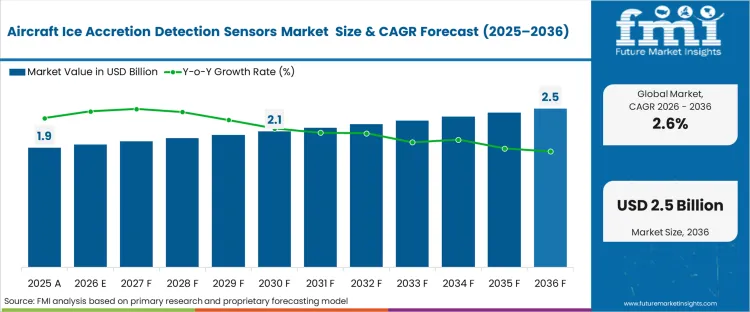
Aircraft Ice Accretion Detection Sensors Market Key Takeaways
| Metric | Details |
|---|---|
| Industry Size (2026) | USD 1.9 Billion |
| Industry Value (2036) | USD 2.4 Billion |
| CAGR (2026-2036) | 2.60% |
Source: Future Market Insights (FMI) analysis, based on proprietary forecasting model and primary research
The structural gate for self-reinforcing growth in this market is the transition of ice detection from an "advisory" function to a "primary" flight control input for unmanned systems. Regulatory bodies trigger this shift when they certify autonomous flight corridors where human visual verification is impossible, necessitating high-reliability sensor feedback. Once this threshold is crossed, the requirement for redundant sensor arrays becomes standard, doubling the unit volume per airframe for the next generation of logistics drones and urban air mobility vehicles.
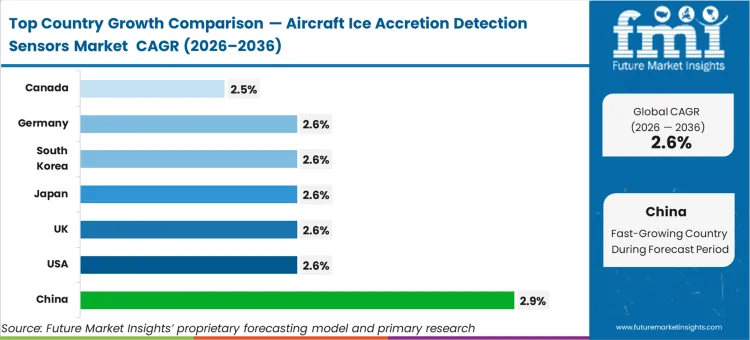
China's domestic regional jet expansion and high-altitude infrastructure investment lead the market with a CAGR of 2.9%. The United States is projected to record a CAGR of 2.6%, followed by the United Kingdom and Japan at 2.6% respectively. South Korea is expected to garner a 2.6% CAGR, while Germany is likely to track a 2.6% growth rate. Canada is estimated to expand at 2.5% through 2036. This narrow range of growth rates reflects a globalized airworthiness standard where structural divergence is driven by fleet renewal cycles rather than regional policy differences.
Aircraft Ice Accretion Detection Sensors Market Definition
The Aircraft Ice Accretion Detection Sensors Market comprises the specialized hardware and software interfaces designed to identify, quantify, and report the accumulation of frozen moisture on aerodynamic surfaces. This market is analytically distinct from general weather instrumentation as it focuses on the real-time physical change in airframe properties, such as mass, vibration frequency, or light refraction, that signal an immediate threat to lift or engine performance.
Aircraft Ice Accretion Detection Sensors Market Inclusions
This market includes magneto-restrictive probes, optical infrared sensors, and ultrasonic vibrating elements installed on wing leading edges and engine inlets. It further encompasses the signal processing units that translate physical accretion rates into cockpit alerts or automated de-icing triggers. Service-based monitoring and software-defined icing characterization algorithms are included within the scope of advanced sensor packages.
Aircraft Ice Accretion Detection Sensors Market Exclusions
The scope excludes general meteorological ground stations and satellite-based weather forecasting systems that do not interact with a specific airframe in flight. Manual ground-based aircraft de-icing equipment and chemical fluids are also excluded, as they represent a separate operational category focused on remediation rather than detection. Generic cabin temperature sensors that do not possess icing-specific diagnostic capabilities are omitted from this valuation.
Aircraft Ice Accretion Detection Sensors Market Research Methodology
- Primary Research: FMI conducted interviews with Avionics Systems Engineers, Chief Technical Officers at airframe OEMs, and Maintenance, Repair, and Overhaul (MRO) Directors specializing in cold-weather instrumentation.
- Desk Research: Data aggregation utilized type certificate data sheets (TCDS), aerospace procurement archives, Federal Aviation Administration (FAA) safety registry filings, and International Civil Aviation Organization (ICAO) fleet modernization reports.
- Market-Sizing and Forecasting: The baseline anchors to annual airframe delivery volumes and historical sensor replacement cycles for narrow-body and wide-body commercial jets.
- Data Validation and Update Cycle: Forecasts were triangulated using independent sensor patent filing trends and public financial disclosures from tier-1 aerospace suppliers.
Segmental Analysis
Aircraft Ice Accretion Detection Sensors Market Analysis by Product Type
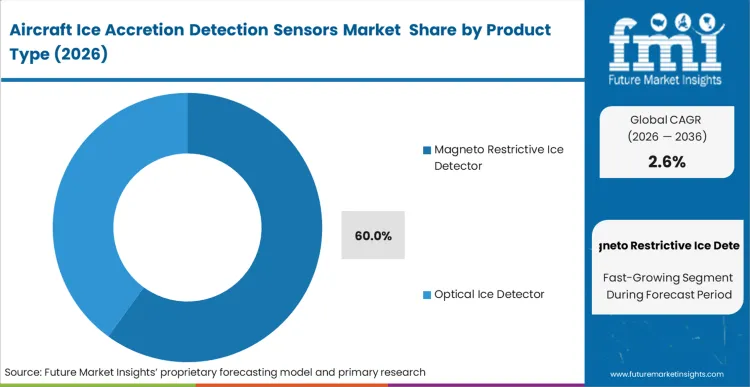
The structural reason magneto restrictive ice detectors hold 60.0% of this market is rooted in their inherent resilience against the thermal and mechanical fatigue common in engine nacelle environments. According to FMI's view, these sensors are not selected for cost alone but because their frequency-shift detection mechanism provides a reliable baseline that remains stable across the entire flight envelope. Fleet procurement directors at commercial airlines prioritize this technology to minimize the maintenance burden of aircraft cabin environment sensor arrays that must be calibrated alongside ice detectors. As buyers move toward more integrated avionics, the operational consequence of a magneto restrictive choice is a simplified qualification path for all-weather certification. Carriers that delay upgrading their older optical units often face higher false-alert frequencies, which disrupts scheduled maintenance intervals.
- Resonance Threshold: The sensor identifies ice through a shift in natural vibration frequency that occurs as mass accumulates on the probe surface. This mechanism allows pilots to receive instantaneous accretion alerts without waiting for visual confirmation.
- Surface Resilience: Magneto-restrictive alloys withstand the abrasive effects of high-altitude particulates and de-icing fluids during the takeoff and landing phases. This durability ensures that the sensor maintains calibration accuracy over thousands of flight hours.
- Integration Baseline: This sub-segment serves as the primary data input for most legacy electric aircraft onboard sensors architectures. Buyers benefit from a mature supply chain and established MRO protocols that reduce the total lifecycle cost of the airframe.
Aircraft Ice Accretion Detection Sensors Market Analysis by Technology
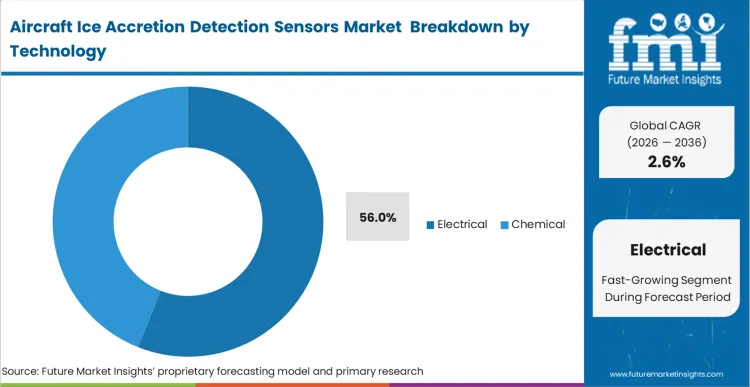
The transition from chemical-based sensing to electrical detection systems is driven by the failure of passive approaches to provide the real-time granularity required for modern fly-by-wire controls. As per FMI's projection, electrical sensors offer the only pathway to characterization-level data, which is essential for aircraft operating in regions where supercooled large droplets are prevalent. Systems engineers are increasingly engineering out chemical indicators in favor of aeroderivative sensor architectures that can be updated via software to improve detection sensitivity. The operational consequence of choosing electrical technology is the ability to integrate icing data directly into the flight management computer, allowing for automated responses. Buyers who cling to legacy chemical indicators find themselves unable to qualify for the newest "Category III" landing standards in inclement weather.
- Procurement Savings: Electrical sensors eliminate the recurring cost of chemical strip replacements and the labor hours associated with physical inspection of indicator windows. Logistics managers see a return on investment within the first three years of airframe operation.
- Calibration Drift: Modern electrical units utilize self-compensating logic to account for environmental degradation, ensuring that sensitivity remains within the certified window. This feature reduces the risk of undetected sensor failure during critical descent phases.
- Cycle Cost Comparison: While the initial hardware cost for electrical sensors is higher, the total lifecycle expense is significantly lower due to the absence of consumable components. Financial officers at tier-1 airlines favor this model for long-term fleet planning.
Aircraft Ice Accretion Detection Sensors Market Analysis by End Use
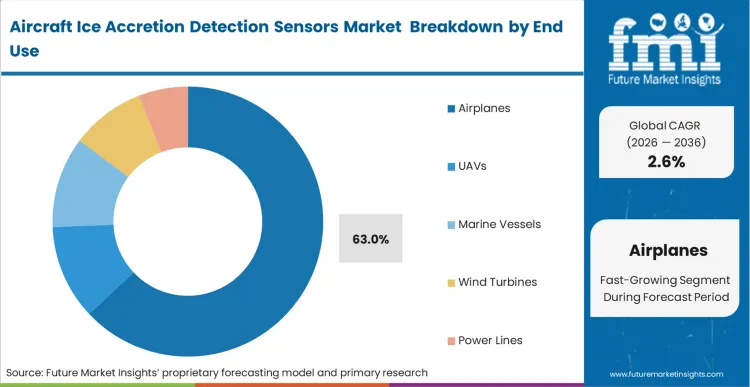
The decision to adopt high-fidelity ice detectors in airplanes is increasingly focused on the requirement for Appendix O compliance for new airframe certifications. According to FMI's estimates, airplane manufacturers are the primary drivers of sensor volume as they ramp up production of narrow-body jets for short-haul regional routes where icing is a frequent operational constraint. Sourcing teams at major OEMs are moving toward aircraft smoke detection and ice detection suites that share a common data bus to reduce wiring weight. This sequence of adoption begins with long-haul wide-body jets and is now migrating into the regional jet and high-end turboprop segments. The commercial outcome for manufacturers who lead this integration is a more competitive airframe that offers higher dispatch reliability in cold-weather hubs.
- Certification Trigger: The initial purchase decision for new airplane fleets is mandated by airworthiness authorities who require primary ice detection for all-weather operations. This regulatory floor ensures a steady baseline of demand for sensor manufacturers.
- Fleet Qualification: During the flight testing phase, the ice detection system must be validated across the entire icing envelope to secure the type certificate. Engineering teams rely on high-frequency sensor data to prove that de-icing triggers occur before performance degradation.
- Service Expansion: Once an airframe is qualified, the sensor choice often locks in the airline for a decade of replacement parts and software updates. Manufacturers use this expansion to build recurring revenue streams through long-term service agreements.
Aircraft Ice Accretion Detection Sensors Market Analysis by Platform
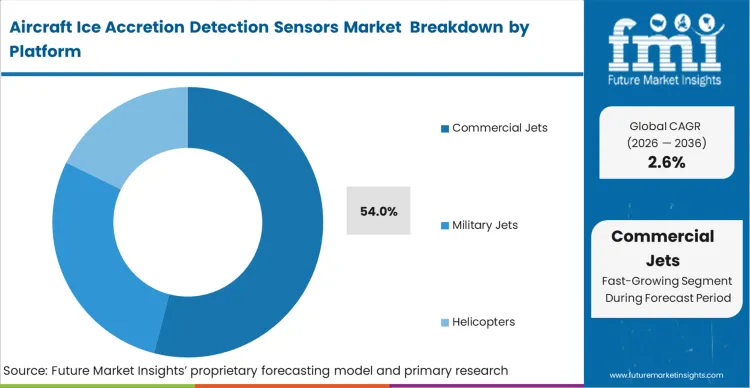
The tension between commercial jet operators' need for zero-latency detection and the weight penalties of redundant sensor arrays defines the platform dynamics. Commercial jets hold a dominant 54.0% share because their high utilization rates and tight schedules leave no margin for visual-only icing checks. FMI analysts opine that the platform's reliance on automated de-icing triggers makes the ice detector a mission-critical component rather than a secondary instrument. As platform managers evaluate icephobic nano-structured coatings, the sensor's role shifts from a basic alert to a performance monitor for the coating itself. Failure to maintain these sensors can lead to inadvertent icing encounters that force emergency descents, incurring significant fuel and safety costs.
- False Positive Prevention: Sensors on commercial platforms are designed with voting logic to prevent unnecessary activation of de-icing systems, which consume valuable engine bleed air. This failure mode protection preserves fuel efficiency during transcontinental flights.
- Probe Obstruction: Structural icing on the detector probe itself can lead to erroneous data if the heating element fails. Maintenance crews must ensure that the internal heater is qualified for continuous operation in severe icing conditions.
- System Redundancy: Commercial jets typically carry dual or triple sensor arrays to ensure that a single component failure does not ground the aircraft. This requirement creates a multiplier effect for sensor volume per airframe delivered.
Aircraft Ice Accretion Detection Sensors Market Drivers, Restraints, and Opportunities
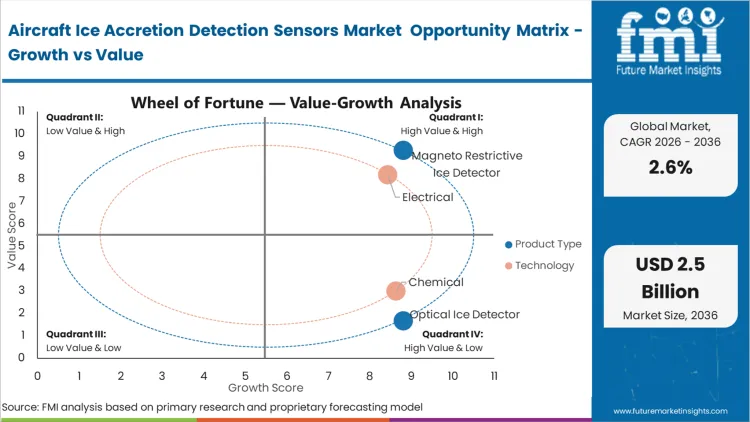
The structural forcing condition driving this market is the mandate for commercial aircraft to detect and characterize supercooled large droplets to avoid severe aerodynamic stalls. Procurement directors at global airlines are currently facing a decision window where upgrading to high-fidelity sensors is required to maintain access to high-latitude routes during winter months. According to FMI's assessment, the commercial stakes of acting are the preservation of dispatch reliability, while delay leads to increased diversion costs and potential regulatory fines. This driver is particularly acute for the aircraft contaminant resistant coatings segment, where sensors must validate the efficacy of surface treatments in real-time.
The primary structural friction in the market is the certification latency inherent in aerospace electronics. An operational obstacle arises when a sensor manufacturer introduces a superior technology that cannot be integrated into current flight decks without a full supplemental type certificate (STC). This friction is structural because the safety-critical nature of ice detection prevents the rapid adoption seen in consumer electronics, forcing vendors to maintain decade-old designs to remain compatible with existing airframes. A partial solution is emerging through software-defined sensors, but these still face rigorous DO-178C qualification standards that slow the market's response to new icing threats.
Opportunities in the Aircraft Ice Accretion Detection Sensors Market
- Conformal Smart Skins: The development of sensors that can be embedded directly into the integrated sensor-ready coatings allows for detection across the entire wing surface rather than at a single probe point. Sourcing managers at electric aircraft startups are the primary buyers capturing this opportunity to reduce aerodynamic drag.
- UAV All-Weather Operations: As cargo drone operators seek to fly beyond-line-of-sight in all seasons, the demand for lightweight, low-power icing sensors creates a new high-volume segment. Logistics firms capture this by integrating miniature sensors that enable safe flight in conditions that previously grounded small airframes.
- Predictive Analytics Integration: FMI notes that linking ice detectors to iot in aviation platforms allows for the aggregation of fleet-wide icing data to optimize maintenance schedules. Fleet managers use this data to predict sensor failure before it occurs, clearing maintenance bottlenecks during peak winter operations.
Regional Analysis
Based on the regional analysis, the Aircraft Ice Accretion Detection Sensors market is segmented into North America, Europe, Asia Pacific, Latin America, Middle East, and Africa across 40 plus countries.
.webp "Top Country Growth Comparison Aircraft Ice Accretion Detection Sensors Market Cagr (2026 2036)")
| Country | CAGR (2026 to 2036) |
|---|---|
| China | 2.9% |
| United States | 2.6% |
| United Kingdom | 2.6% |
| Japan | 2.6% |
| South Korea | 2.6% |
| Germany | 2.6% |
| Canada | 2.5% |
Source: Future Market Insights (FMI) analysis, based on proprietary forecasting model and primary research
North America Aircraft Ice Accretion Detection Sensors Market Analysis
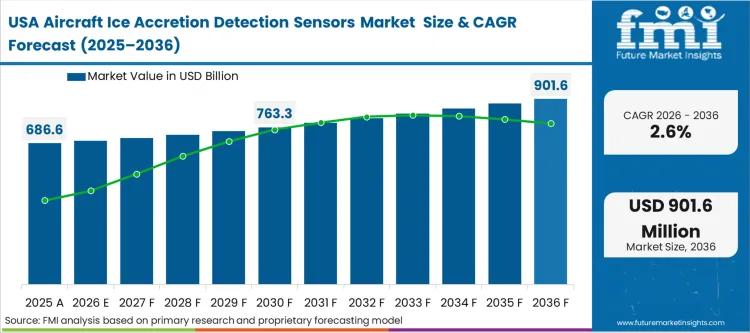
The North American market is primarily policy-led, dictated by the Federal Aviation Administration's stringent stance on Appendix O icing standards. This regulatory environment forces airframe manufacturers to prioritize the integration of sensors capable of detecting hazardous icing conditions during the initial design phase of multi-layer anti-icing systems. Based on FMI's assessment, the region's adoption pattern is characterized by a high rate of retrofitting as older narrow-body fleets are modernized to extend their service life. This dynamic is unique because of the high concentration of regional jets operating in the northern United States and Canada, where icing is a daily operational reality for much of the year.
- United States: The concentration of major airframers like Boeing ensures that the United States remains the primary hub for ice detection sensor innovation and qualification. Logistics managers at major domestic carriers have realized that upgrading to primary ice detection systems reduces the frequency of "advisory only" flight delays. The market is advancing at a 2.6% compound rate through 2036. This operational outcome simplifies flight planning and allows for more aggressive scheduling in winter-weather hubs.
- Canada: Canadian operators face some of the most consistent icing challenges in the world, leading to a structural requirement for sensors that can withstand prolonged exposure to severe accretion environments. Sourcing teams at regional airlines focus on sensors that provide characterization data to safely navigate high-latitude routes without over-relying on de-icing fluid. A CAGR of 2.5% is expected for the sector over the forecast period. This adoption clears the operational bottleneck of seasonal flight cancellations in remote territories.
Europe Aircraft Ice Accretion Detection Sensors Market Analysis
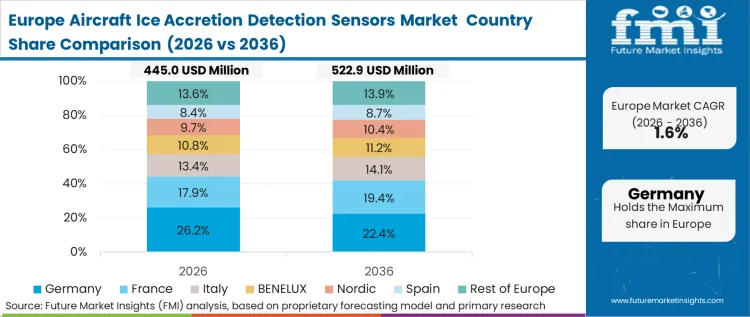
Economics-led dynamics drive the European market, where the high cost of airport de-icing services and environmental levies on chemical runoff incentivize precise icing detection. FMI analysts opine that European carriers are the fastest to adopt sensors that link directly to thermal management exterior coatings to optimize the use of engine bleed air for anti-icing. This structural pressure is amplified by the European Union Aviation Safety Agency's (EASA) move toward more granular reporting of icing encounters.
- United Kingdom: The United Kingdom’s aerospace sector is poised for a 2.6% CAGR as it focuses on the development of next-generation sensor arrays for the urban air mobility market. Procurement standards here are increasingly focused on the interoperability of sensors across different airframe types to reduce fleet-wide spare parts inventories. Buyers who act now secure preferred status in the emerging logistics drone ecosystems.
- Germany: German aerospace engineering firms are at the forefront of integrating ice detectors into bio-based aircraft coatings to monitor the performance of environmentally friendly de-icing alternatives. The market is likely to post a 2.6% CAGR as the region modernizes its military transport fleets. German buyers who achieve early adoption realize a significant competitive advantage in procurement frameworks for multi-national defense programs.
Asia Pacific Aircraft Ice Accretion Detection Sensors Market Analysis
The Asia Pacific region follows an infrastructure-led structural lens, where the rapid construction of new airports in high-altitude and sub-zero climates across Western China and Northern Japan necessitates a modern sensor baseline. According to FMI's view, the region's growth is tied to the expansion of domestic aircraft manufacturing programs that are engineering in Western-standard sensors from the start to facilitate international export.
- China: China's regional aircraft industry is anticipated to increase by a CAGR of 2.9% as the COMAC program reaches full production scale. This structural trajectory is defined by the move toward domestic self-sufficiency in avionics, though initial platforms remain dependent on established Western sensor designs. The market is set for sustained expansion as the national fleet size for high-altitude regional routes grows.
- Japan: In Japan, the market is influenced by the high density of helicopter and regional jet operations in mountainous northern prefectures. Sales of sensors are projected to rise by 2.6% CAGR through 2036. A practitioner reality here is that the rapid onset of coastal icing requires sensors with exceptionally low latency to trigger protection systems before lift is compromised.
- South Korea: South Korea's chrome-free corrosion protection coatings programs are being integrated with sensor monitoring to assess material durability in icing conditions. The market is forecast to register a CAGR of 2.6% as the nation expands its footprint in the global aerospace supply chain. Commercial opportunities are opening for local manufacturers to partner with international tier-1 suppliers for localized sensor assembly.
FMI's report includes additional coverage across 40 plus countries including France, Italy, and Brazil. The structural pattern across these markets indicates a gradual convergence on digital detection as the cost of sensor hardware decreases relative to the rising price of aviation fuel and de-icing consumables.
Competitive Aligners for Market Players
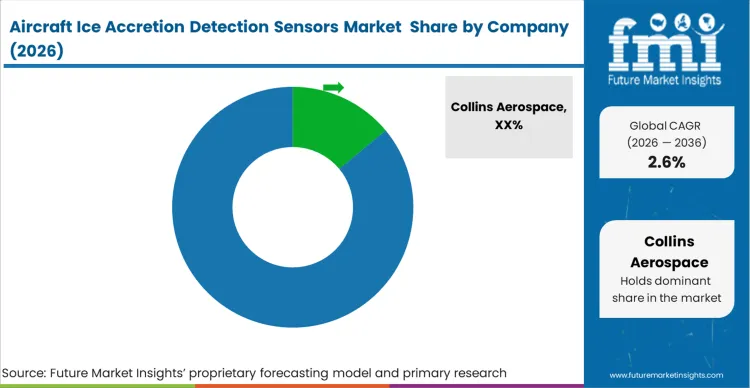
The high capital requirement and stringent AS9100 quality standards result in a concentrated market dominated by a few tier-1 aerospace suppliers. Leading companies such as Collins Aerospace and Safran Aerosystems leverage their long-term relationships with Boeing and Airbus to lock in sensor specifications during the initial airframe design phase. Buyers actually use the track record of airworthiness certification and the global availability of MRO support to distinguish qualified vendors from new entrants. Because the ice detector is a safety-critical component, the primary variable for selection is the proven mean-time-between-failure (MTBF) in severe icing conditions rather than initial unit price.
Incumbents like Honeywell and Curtiss-Wright possess a structural advantage through their deep integration into the bio-based and low-voc aircraft exterior coating systems ecosystem, where sensors and coatings are increasingly validated as a single system. To replicate this, a challenger must build not just a sensor, but a comprehensive data processing platform that can withstand the rigorous qualification levels (DAL) required for primary flight controls. One FMI hyperlink within the competitive landscape reveals that vendors who can offer anti-soiling and easy-clean exterior coatings integrated with icing sensors capture a higher share of the premium wide-body segment. This persists because airframers prefer a single point of accountability for the entire icing protection suite.
Large buyers resist vendor lock-in by mandating open-architecture data buses that allow for the potential replacement of sensors during mid-life fleet upgrades. The structural tension between airline preferences for interchangeable parts and dominant vendor incentives to create proprietary interfaces will define the competitive landscape through 2036. As the market moves toward electric aircraft, the trajectory is toward higher concentration as the complexity of integrating sensors into high-voltage systems increases the barriers to entry. By 2036, the successful market players will be those who have transitioned from being hardware providers to being icing-intelligence partners for autonomous flight operators.
Key Players in Aircraft Ice Accretion Detection Sensors Market
- Collins Aerospace
- Safran Aerosystems
- Parker Meggitt
- Curtiss-Wright
- Honeywell Aerospace
- CAV Systems
- AeroTex GmbH
Scope of the Report
| Metric | Value |
|---|---|
| Quantitative Units | USD 1.9 Billion to USD 2.4 Billion, at a CAGR of 2.60% |
| Market Definition | The market covers sensors and signal processing units used to detect and characterize ice accretion on aircraft surfaces to trigger protection systems and ensure flight safety. |
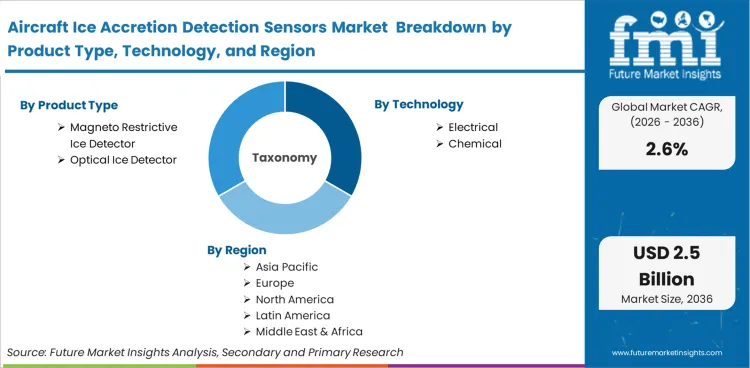
| Product Type Segmentation | Magneto Restrictive Ice Detector, Optical Ice Detector |
| Technology Segmentation | Electrical, Chemical |
| End Use Segmentation | Airplanes, UAVs, Marine Vessels, Wind Turbines, Power Lines |
| Platform Segmentation | Commercial Jets, Military Jets, Helicopters |
| Regions Covered | North America, Europe, Asia Pacific, Latin America, Middle East, Africa |
| Countries Covered | China, USA, UK, Japan, South Korea, Germany, Canada, and 40 plus countries |
| Key Companies Profiled | Collins Aerospace, Safran Aerosystems, Parker Meggitt, Curtiss-Wright, Honeywell Aerospace, CAV Systems, AeroTex GmbH |
| Forecast Period | 2026 to 2036 |
| Approach | FMI utilizes a bottom-up approach anchored to aircraft delivery volumes and sensor replacement cycles. Data is cross-validated through interviews with avionics engineers and analysis of aerospace regulatory filings. |
Source: Future Market Insights (FMI) analysis, based on proprietary forecasting model and primary research
Aircraft Ice Accretion Detection Sensors Market Analysis by Segments
Product Type:
- Magneto Restrictive Ice Detector
- Optical Ice Detector
Technology:
- Electrical
- Chemical
End Use:
- Airplanes
- UAVs
- Marine Vessels
- Wind Turbines
- Power Lines
Platform:
- Commercial Jets
- Military Jets
- Helicopters
Application:
- Wings
- Engine Inlets
- Nacelle
- Tail
- Propellers
- Windshields
- Sensors
- Air Data Probes
Region:
- North America
- United States
- Canada
- Europe
- United Kingdom
- Germany
- Asia Pacific
- China
- Japan
- South Korea
- Latin America
- Middle East
- Africa
Bibliography
- Renno, N. O., et al. (2026, January). A new type of aircraft icing detection system. Scientific Reports.
- Maio, L., et al. (2025, February). A review of ice detection technologies. Progress in Aerospace Sciences.
- Deiler, C. (2025, March). Testing of an indirect ice detection methodology in the Horizon 2020 project SENS4ICE. CEAS Aeronautical Journal.
- Yan, Y. (2025, July). Visual Detection on Aircraft Wing Icing Process Using a Lightweight Deep Learning Model. Aerospace.
- NASA. (2024, May). NASA Icing Research Update 2024. NASA Technical Reports Server.
This bibliography is provided for reader reference. The full FMI report contains the complete reference list with primary source documentation.
Frequently Asked Questions
How large is the Aircraft Ice Accretion Detection Sensors Market in 2025?
The market was valued at USD 1.8 billion in 2025, reflecting a stable demand from the commercial airframe manufacturing sector. This figure signals that the market is currently in a replacement and modernization phase rather than a rapid expansion phase.
What will it be valued at by 2036?
The industry value is projected to cross USD 2.4 billion by 2036 as next-generation electric aircraft and UAV fleets integrate advanced sensor suites. This growth signals a structural shift toward higher-value, software-defined sensing technologies.
What CAGR is projected for the Aircraft Ice Accretion Detection Sensors Market?
A CAGR of 2.60% is expected during the forecast period from 2026 to 2036. This rate reflects the long lifecycle of aircraft platforms, where growth is constrained by multi-year airframe production schedules and certification timelines.
Which Product Type segment leads the market?
Magneto Restrictive Ice Detectors lead with 60.0% share in 2026 because they provide the most reliable detection in high-vibration environments like engine inlets. This dominance is sustained by their proven track record in meeting the safety-critical requirements of commercial jet engines.
Which Technology segment is dominant?
Electrical Technology is the leader with 57.0% share in 2026, as it offers the precision required for karakterization of ice severity. The industry is structurally moving away from chemical indicators that require manual inspection and offer no digital data feedback.
Which Platform segment holds the largest share?
Commercial Jets hold 54.0% of the market share, driven by the intense utilization of these aircraft in varying weather conditions. The need for automated de-icing triggers in narrow-body and wide-body fleets makes these sensors a mandatory component for dispatch reliability.
What drives rapid growth in the Aircraft Ice Accretion Detection Sensors Market?
Growth is primarily driven by the structural requirement to comply with Appendix O regulations which demand detection of supercooled large droplets. This forcing condition ensures that all new aircraft certifications must include sensors capable of high-fidelity characterization.
What is the primary restraint facing the market?
The primary restraint is certification latency, where the rigorous testing required for new sensor technologies can delay market entry by several years. This friction is structural, as the aerospace industry prioritizes safety and historical performance over the rapid adoption of unproven digital systems.
Which country grows the fastest in this market?
China grows the fastest with a CAGR of 2.9%, compared to the United States at 2.6%. The structural difference is China's massive investment in domestic regional aircraft manufacturing programs, whereas the US market is more focused on the replacement of sensors in existing mature fleets.
How do Appendix O regulations affect sensor procurement?
Appendix O mandates that sensors move beyond simple "ice present" alerts to characterizing the type and severity of icing, specifically supercooled large droplets. For procurement directors, this means that legacy sensors are increasingly disqualified from new airframe builds, forcing a shift toward more expensive, characterization-capable units.
What is the significance of "smart skins" in the future of ice detection?
Smart skins represent a structural shift from discrete, probe-based sensors to conformal arrays that monitor the entire aerodynamic surface. This technology addresses the measurement gap where localized icing on a wing could be missed by a single probe, providing a more holistic safety profile for next-generation electric aircraft.
How does the rise of UAVs impact the ice detection sensor market?
UAVs are forcing the development of miniaturized, low-power sensors that can be integrated into small airframes without compromising payload capacity. This opens a new high-volume segment for manufacturers who can downscale their technology while maintaining aerospace-grade reliability.
Why are magneto restrictive sensors preferred over optical sensors in engine inlets?
Magneto restrictive sensors are preferred because they are less susceptible to false positives caused by oil, dirt, or light interference within the nacelle. Their mechanism relies on mass-based frequency shifts, which provides a more consistent data stream in the harsh conditions found at the front of a jet engine.
What role does MRO play in the sensor replacement cycle?
MRO operators drive a steady stream of secondary market demand as sensors are replaced during major airframe overhauls or when heating elements fail. The complexity of calibrating these sensors means that MRO centers must invest in specialized testing infrastructure, creating a structural link between sensor sales and maintenance capabilities.
How do airframe manufacturers avoid vendor lock-in?
Manufacturers are increasingly using standardized communication protocols that allow for different sensor brands to be integrated into the same avionics bus. This competitive pressure prevents a single tier-1 supplier from monopolizing the replacement parts market for the entire 30-year life of the airframe.
What is the impact of electric aircraft on sensor design?
Electric aircraft require sensors that do not rely on engine bleed air for heating, leading to a surge in demand for highly efficient electrical de-icing and detection suites. This structural change forces sensor vendors to innovate in thermal management to avoid draining the aircraft's battery during icing encounters.
Are there exclusions in the FMI ice detection report?
Yes, the report excludes ground-based de-icing equipment and generic weather forecasting systems that are not physically integrated into the aircraft. This exclusion ensures the analysis remains focused on the high-value avionics segment.
How does FMI validate its ice detection sensor data?
FMI validates data through a combination of FAA/EASA type certificate analysis and primary interviews with avionics system integrators. This ensures that the forecasts reflect actual airframe delivery schedules rather than optimistic industry projections.
What is the expected end state of the market by 2036?
By 2036, ice detection will be fully integrated into autonomous flight management systems, where sensors act as primary decision-makers for route changes. The market will have shifted from selling hardware components to providing integrated "icing-as-a-service" data streams for fleet operators.
How do regional jet fleets in North America drive sensor demand?
The high frequency of short-haul flights in icing-prone regions like the Midwest and Canada necessitates robust, high-cycle sensors. This operational reality makes North America the largest regional market by volume, as these aircraft encounter icing conditions more frequently than long-haul wide-body jets.
What is the commercial consequence of failing to upgrade ice detectors?
Airlines that delay upgrades face a higher risk of in-flight icing incidents and increased regulatory scrutiny, which can lead to higher insurance premiums and route restrictions. Structurally, this creates a competitive gap between modernized fleets and those clinging to legacy advisory systems.
Does the report cover sensors for wind turbines and power lines?
Yes, the report includes these in the "End Use" segmentation, though they represent a smaller portion of the total market compared to aerospace. These segments are growing as renewable energy providers in cold climates seek to reduce downtime caused by blade icing.
Preview the report firsthand - request a free sample
Get SampleGet the brochure for pricing and purchase details.
Get PDFTable of Content
- Executive Summary
- Global Market Outlook
- Demand-side Trends
- Supply-side Trends
- Technology Roadmap Analysis
- Analysis and Recommendations
- Market Overview
- Market Coverage / Taxonomy
- Market Definition / Scope / Limitations
- Research Methodology
- Chapter Orientation
- Analytical Lens and Working Hypotheses
- Market Structure, Signals, and Trend Drivers
- Benchmarking and Cross-market Comparability
- Market Sizing, Forecasting, and Opportunity Mapping
- Research Design and Evidence Framework
- Desk Research Programme (Secondary Evidence)
- Company Annual and Sustainability Reports
- Peer-reviewed Journals and Academic Literature
- Corporate Websites, Product Literature, and Technical Notes
- Earnings Decks and Investor Briefings
- Statutory Filings and Regulatory Disclosures
- Technical White Papers and Standards Notes
- Trade Journals, Industry Magazines, and Analyst Briefs
- Conference Proceedings, Webinars, and Seminar Materials
- Government Statistics Portals and Public Data Releases
- Press Releases and Reputable Media Coverage
- Specialist Newsletters and Curated Briefings
- Sector Databases and Reference Repositories
- FMI Internal Proprietary Databases and Historical Market Datasets
- Subscription Datasets and Paid Sources
- Social Channels, Communities, and Digital Listening Inputs
- Additional Desk Sources
- Expert Input and Fieldwork (Primary Evidence)
- Primary Modes
- Qualitative Interviews and Expert Elicitation
- Quantitative Surveys and Structured Data Capture
- Blended Approach
- Why Primary Evidence is Used
- Field Techniques
- Interviews
- Surveys
- Focus Groups
- Observational and In-context Research
- Social and Community Interactions
- Stakeholder Universe Engaged
- C-suite Leaders
- Board Members
- Presidents and Vice Presidents
- R&D and Innovation Heads
- Technical Specialists
- Domain Subject-matter Experts
- Scientists
- Physicians and Other Healthcare Professionals
- Governance, Ethics, and Data Stewardship
- Research Ethics
- Data Integrity and Handling
- Primary Modes
- Tooling, Models, and Reference Databases
- Desk Research Programme (Secondary Evidence)
- Data Engineering and Model Build
- Data Acquisition and Ingestion
- Cleaning, Normalisation, and Verification
- Synthesis, Triangulation, and Analysis
- Quality Assurance and Audit Trail
- Market Background
- Market Dynamics
- Drivers
- Restraints
- Opportunity
- Trends
- Scenario Forecast
- Demand in Optimistic Scenario
- Demand in Likely Scenario
- Demand in Conservative Scenario
- Opportunity Map Analysis
- Product Life Cycle Analysis
- Supply Chain Analysis
- Investment Feasibility Matrix
- Value Chain Analysis
- PESTLE and Porter’s Analysis
- Regulatory Landscape
- Regional Parent Market Outlook
- Production and Consumption Statistics
- Import and Export Statistics
- Market Dynamics
- Global Market Analysis 2021 to 2025 and Forecast, 2026 to 2036
- Historical Market Size Value (USD Million) Analysis, 2021 to 2025
- Current and Future Market Size Value (USD Million) Projections, 2026 to 2036
- Y-o-Y Growth Trend Analysis
- Absolute $ Opportunity Analysis
- Global Market Pricing Analysis 2021 to 2025 and Forecast 2026 to 2036
- Global Market Analysis 2021 to 2025 and Forecast 2026 to 2036, By Product Type
- Introduction / Key Findings
- Historical Market Size Value (USD Million) Analysis By Product Type , 2021 to 2025
- Current and Future Market Size Value (USD Million) Analysis and Forecast By Product Type , 2026 to 2036
- Magneto Restrictive Ice Detector
- Optical Ice Detector
- Magneto Restrictive Ice Detector
- Y-o-Y Growth Trend Analysis By Product Type , 2021 to 2025
- Absolute $ Opportunity Analysis By Product Type , 2026 to 2036
- Global Market Analysis 2021 to 2025 and Forecast 2026 to 2036, By Technology
- Introduction / Key Findings
- Historical Market Size Value (USD Million) Analysis By Technology, 2021 to 2025
- Current and Future Market Size Value (USD Million) Analysis and Forecast By Technology, 2026 to 2036
- Electrical
- Chemical
- Electrical
- Y-o-Y Growth Trend Analysis By Technology, 2021 to 2025
- Absolute $ Opportunity Analysis By Technology, 2026 to 2036
- Global Market Analysis 2021 to 2025 and Forecast 2026 to 2036, By End Use
- Introduction / Key Findings
- Historical Market Size Value (USD Million) Analysis By End Use, 2021 to 2025
- Current and Future Market Size Value (USD Million) Analysis and Forecast By End Use, 2026 to 2036
- Airplanes
- UAVs
- Marine Vessels
- Wind Turbines
- Power Lines
- Airplanes
- Y-o-Y Growth Trend Analysis By End Use, 2021 to 2025
- Absolute $ Opportunity Analysis By End Use, 2026 to 2036
- Global Market Analysis 2021 to 2025 and Forecast 2026 to 2036, By Platform
- Introduction / Key Findings
- Historical Market Size Value (USD Million) Analysis By Platform, 2021 to 2025
- Current and Future Market Size Value (USD Million) Analysis and Forecast By Platform, 2026 to 2036
- Commercial Jets
- Military Jets
- Helicopters
- Commercial Jets
- Y-o-Y Growth Trend Analysis By Platform, 2021 to 2025
- Absolute $ Opportunity Analysis By Platform, 2026 to 2036
- Global Market Analysis 2021 to 2025 and Forecast 2026 to 2036, By Region
- Introduction
- Historical Market Size Value (USD Million) Analysis By Region, 2021 to 2025
- Current Market Size Value (USD Million) Analysis and Forecast By Region, 2026 to 2036
- North America
- Latin America
- Western Europe
- Eastern Europe
- East Asia
- South Asia and Pacific
- Middle East & Africa
- Market Attractiveness Analysis By Region
- North America Market Analysis 2021 to 2025 and Forecast 2026 to 2036, By Country
- Historical Market Size Value (USD Million) Trend Analysis By Market Taxonomy, 2021 to 2025
- Market Size Value (USD Million) Forecast By Market Taxonomy, 2026 to 2036
- By Country
- USA
- Canada
- Mexico
- By Product Type
- By Technology
- By End Use
- By Platform
- By Country
- Market Attractiveness Analysis
- By Country
- By Product Type
- By Technology
- By End Use
- By Platform
- Key Takeaways
- Latin America Market Analysis 2021 to 2025 and Forecast 2026 to 2036, By Country
- Historical Market Size Value (USD Million) Trend Analysis By Market Taxonomy, 2021 to 2025
- Market Size Value (USD Million) Forecast By Market Taxonomy, 2026 to 2036
- By Country
- Brazil
- Chile
- Rest of Latin America
- By Product Type
- By Technology
- By End Use
- By Platform
- By Country
- Market Attractiveness Analysis
- By Country
- By Product Type
- By Technology
- By End Use
- By Platform
- Key Takeaways
- Western Europe Market Analysis 2021 to 2025 and Forecast 2026 to 2036, By Country
- Historical Market Size Value (USD Million) Trend Analysis By Market Taxonomy, 2021 to 2025
- Market Size Value (USD Million) Forecast By Market Taxonomy, 2026 to 2036
- By Country
- Germany
- UK
- Italy
- Spain
- France
- Nordic
- BENELUX
- Rest of Western Europe
- By Product Type
- By Technology
- By End Use
- By Platform
- By Country
- Market Attractiveness Analysis
- By Country
- By Product Type
- By Technology
- By End Use
- By Platform
- Key Takeaways
- Eastern Europe Market Analysis 2021 to 2025 and Forecast 2026 to 2036, By Country
- Historical Market Size Value (USD Million) Trend Analysis By Market Taxonomy, 2021 to 2025
- Market Size Value (USD Million) Forecast By Market Taxonomy, 2026 to 2036
- By Country
- Russia
- Poland
- Hungary
- Balkan & Baltic
- Rest of Eastern Europe
- By Product Type
- By Technology
- By End Use
- By Platform
- By Country
- Market Attractiveness Analysis
- By Country
- By Product Type
- By Technology
- By End Use
- By Platform
- Key Takeaways
- East Asia Market Analysis 2021 to 2025 and Forecast 2026 to 2036, By Country
- Historical Market Size Value (USD Million) Trend Analysis By Market Taxonomy, 2021 to 2025
- Market Size Value (USD Million) Forecast By Market Taxonomy, 2026 to 2036
- By Country
- China
- Japan
- South Korea
- By Product Type
- By Technology
- By End Use
- By Platform
- By Country
- Market Attractiveness Analysis
- By Country
- By Product Type
- By Technology
- By End Use
- By Platform
- Key Takeaways
- South Asia and Pacific Market Analysis 2021 to 2025 and Forecast 2026 to 2036, By Country
- Historical Market Size Value (USD Million) Trend Analysis By Market Taxonomy, 2021 to 2025
- Market Size Value (USD Million) Forecast By Market Taxonomy, 2026 to 2036
- By Country
- India
- ASEAN
- Australia & New Zealand
- Rest of South Asia and Pacific
- By Product Type
- By Technology
- By End Use
- By Platform
- By Country
- Market Attractiveness Analysis
- By Country
- By Product Type
- By Technology
- By End Use
- By Platform
- Key Takeaways
- Middle East & Africa Market Analysis 2021 to 2025 and Forecast 2026 to 2036, By Country
- Historical Market Size Value (USD Million) Trend Analysis By Market Taxonomy, 2021 to 2025
- Market Size Value (USD Million) Forecast By Market Taxonomy, 2026 to 2036
- By Country
- Kingdom of Saudi Arabia
- Other GCC Countries
- Turkiye
- South Africa
- Other African Union
- Rest of Middle East & Africa
- By Product Type
- By Technology
- By End Use
- By Platform
- By Country
- Market Attractiveness Analysis
- By Country
- By Product Type
- By Technology
- By End Use
- By Platform
- Key Takeaways
- Key Countries Market Analysis
- USA
- Pricing Analysis
- Market Share Analysis, 2025
- By Product Type
- By Technology
- By End Use
- By Platform
- Canada
- Pricing Analysis
- Market Share Analysis, 2025
- By Product Type
- By Technology
- By End Use
- By Platform
- Mexico
- Pricing Analysis
- Market Share Analysis, 2025
- By Product Type
- By Technology
- By End Use
- By Platform
- Brazil
- Pricing Analysis
- Market Share Analysis, 2025
- By Product Type
- By Technology
- By End Use
- By Platform
- Chile
- Pricing Analysis
- Market Share Analysis, 2025
- By Product Type
- By Technology
- By End Use
- By Platform
- Germany
- Pricing Analysis
- Market Share Analysis, 2025
- By Product Type
- By Technology
- By End Use
- By Platform
- UK
- Pricing Analysis
- Market Share Analysis, 2025
- By Product Type
- By Technology
- By End Use
- By Platform
- Italy
- Pricing Analysis
- Market Share Analysis, 2025
- By Product Type
- By Technology
- By End Use
- By Platform
- Spain
- Pricing Analysis
- Market Share Analysis, 2025
- By Product Type
- By Technology
- By End Use
- By Platform
- France
- Pricing Analysis
- Market Share Analysis, 2025
- By Product Type
- By Technology
- By End Use
- By Platform
- India
- Pricing Analysis
- Market Share Analysis, 2025
- By Product Type
- By Technology
- By End Use
- By Platform
- ASEAN
- Pricing Analysis
- Market Share Analysis, 2025
- By Product Type
- By Technology
- By End Use
- By Platform
- Australia & New Zealand
- Pricing Analysis
- Market Share Analysis, 2025
- By Product Type
- By Technology
- By End Use
- By Platform
- China
- Pricing Analysis
- Market Share Analysis, 2025
- By Product Type
- By Technology
- By End Use
- By Platform
- Japan
- Pricing Analysis
- Market Share Analysis, 2025
- By Product Type
- By Technology
- By End Use
- By Platform
- South Korea
- Pricing Analysis
- Market Share Analysis, 2025
- By Product Type
- By Technology
- By End Use
- By Platform
- Russia
- Pricing Analysis
- Market Share Analysis, 2025
- By Product Type
- By Technology
- By End Use
- By Platform
- Poland
- Pricing Analysis
- Market Share Analysis, 2025
- By Product Type
- By Technology
- By End Use
- By Platform
- Hungary
- Pricing Analysis
- Market Share Analysis, 2025
- By Product Type
- By Technology
- By End Use
- By Platform
- Kingdom of Saudi Arabia
- Pricing Analysis
- Market Share Analysis, 2025
- By Product Type
- By Technology
- By End Use
- By Platform
- Turkiye
- Pricing Analysis
- Market Share Analysis, 2025
- By Product Type
- By Technology
- By End Use
- By Platform
- South Africa
- Pricing Analysis
- Market Share Analysis, 2025
- By Product Type
- By Technology
- By End Use
- By Platform
- USA
- Market Structure Analysis
- Competition Dashboard
- Competition Benchmarking
- Market Share Analysis of Top Players
- By Regional
- By Product Type
- By Technology
- By End Use
- By Platform
- Competition Analysis
- Competition Deep Dive
- Collins Aerospace
- Overview
- Product Portfolio
- Profitability by Market Segments (Product/Age /Sales Channel/Region)
- Sales Footprint
- Strategy Overview
- Marketing Strategy
- Product Strategy
- Channel Strategy
- Safran Aerosystems
- Parker Meggitt
- Curtiss-Wright
- Honeywell Aerospace
- CAV Systems
- AeroTex GmbH
- Collins Aerospace
- Competition Deep Dive
- Assumptions & Acronyms Used


