

- Industry Size (2026)
- USD 118.9 Bn
- Forecast (2036)
- USD 69.7 Bn
- CAGR (2026 to 2036)
- 5.5%
PFAS Detection Devices Market Forecast and Outlook 2026 to 2036
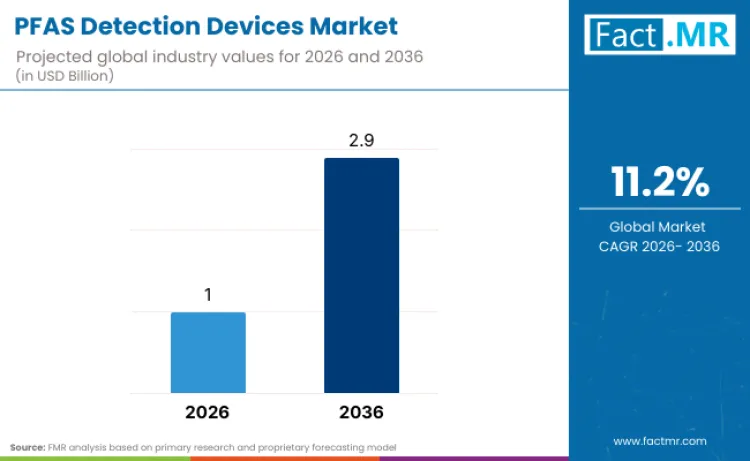
The PFAS detection devices market is slated to reach USD 1.0 billion in 2026, expected to incline to USD 2.9 billion by 2036, advancing at an 11.2% CAGR. The global market for PFAS detection devices is entering a peak enforcement phase as 2026 marks the convergence of several federal and international reporting mandates, as per FMI’s analysis. The transition from voluntary screening to mandatory, high-precision compliance is driving a structural shift in analytical demand.
Compliance showdown in USA and EU defines the trajectory. The EPA has designated April 13, 2026, as the official launch date for the TSCA Section 8(a)(7) data submission window, requiring nearly 15 years of retrospective data on PFAS manufacturing and imports (SGS, 2026). This federal pressure is amplified by state-level enforcement; for instance, Minnesota’s PFAS reporting mandate took effect on January 1, 2026, forcing manufacturers to move beyond"no added PFAS claims to verified laboratory data.
The European Union implemented systematic monitoring of "forever chemicals" in drinking water on January 12, 2026, under the recast Drinking Water Directive. This regulation establishes harmonized limit values that necessitate detection at the parts-per-trillion (ppt) level (European Commission, 2026). To meet these thresholds, manufacturers like Shimadzu and Agilent are launching next-generation high-performance liquid chromatograph mass spectrometers (LC-MS/MS). Shimadzu’s LCMS-8065XE, launched in mid-2025, specifically targets these 2026 European standards by providing 3- to 48-fold sensitivity enhancements over previous models (Shimadzu, 2025).
The commercial impact of these regulations is evident in corporate financial performance. Agilent Technologies reported that PFAS-related demand provided an incremental 80 basis points to their Q2 2025 growth, with the segment annualizing to over USD 100 million. This growth is supported by strategic acquisitions, such as SGS’s purchase of RTI Laboratories in January 2025 to expand its certified laboratory footprint (SGS, 2025).
The leadership driving the industry’s analytical response perhaps best captures the scale of this transition."PFAS testing remains strong for Agilent globally and we see it continuing to expand into other end markets, such as Food and Chemicals & Advanced Materials. In Q2, PFAS grew more than 70 percent year over year globally with Europe and China more than doubling their business. PFAS provided an incremental 80 basis points to our growth in the quarter and is now annualizing to well over 100 million dollars. We continue to be very optimistic about the long-term growth prospects globally in PFAS as regulations and standards continue to be put in place." - Padraig McDonnell, President and CEO, Agilent Technologies.
Summary of PFAS Detection Devices Market
What is Growth Outlook for PFAS Detection Devices Market as per Future Market Insights Projection?
Future Market Insights projects the PFAS detection devices market to expand at a CAGR of 11.2% from 2026 to 2036, increasing from USD 1.0 billion in 2026 to USD 2.9 billion by 2036.
FMI Research Approach: FMI proprietary forecasting model integrating enforceable PFAS reporting mandates, drinking water and groundwater monitoring requirements, and capital deployment toward high-sensitivity analytical instrumentation across regulated regions.
How do FMI Analysts Perceive PFAS Detection Devices Market to Evolve?
FMI analysts perceive the market evolving from discretionary screening toward enforcement-driven, legally defensible compliance testing. Demand is increasingly anchored in mandatory reporting windows, retrospective disclosure requirements, and ultra-trace detection thresholds that favor standardized, high-throughput analytical platforms.
FMI Research Approach: Assessment of federal and regional PFAS regulations, laboratory accreditation requirements, and instrument utilization trends across environmental, industrial, and food safety testing.
Which Country Holds Largest Share in Global PFAS Detection Devices Market?
China holds the largest share of the global PFAS detection devices market, supported by national chemical control roadmaps, expansion of automated environmental monitoring networks, and mandatory installation of high-precision analytical systems across industrial chemical and municipal water infrastructure.
FMI Research Approach: Country-level modeling based on environmental surveillance expansion, regulatory enforcement intensity, and public investment in analytical laboratory capacity.
How Large will the PFAS Detection Devices Market Be by 2036?
The global PFAS detection devices market is projected to reach USD 2.9 billion by 2036.
FMI Research Approach: Long-term revenue forecasting derived from statutory PFAS monitoring programs, laboratory infrastructure expansion, and replacement cycles for compliance-grade analytical instrumentation.
What is the Definition of PFAS Detection Devices Market?
The PFAS detection devices market comprises analytical instruments and systems designed to identify and quantify per- and polyfluoroalkyl substances at ultra-trace levels across environmental, industrial, and biological matrices, enabling compliance with regulatory thresholds that increasingly require parts-per-trillion detection accuracy.
FMI Research Approach: FMI market taxonomy and inclusion-exclusion framework covering laboratory-grade and field-deployable PFAS detection technologies used for regulatory, industrial, and environmental compliance.
What are some Globally Unique Trends Shaping PFAS Detection Devices Market?
Globally unique trends include the entrenchment of LC-MS platforms as the compliance baseline, rising reliance on centralized laboratories for litigation-grade analysis, integration of automation and AI-driven data processing to manage high sample volumes, and growing demand for non-targeted screening capabilities to address emerging PFAS variants.
FMI Research Approach: Synthesis of regulatory enforcement timelines, instrument technology evolution, and laboratory workflow optimization trends across major PFAS-regulated markets.
PFAS Detection Devices Market Key Takeaways
| Metric | Value |
|---|---|
| Expected Value (2026E) | USD 1.0 billion |
| Projected Valued (2036F) | USD 2.9 billion |
| CAGR (2026-2036) | 11.2% |
Source: FMI analysis based on primary research and proprietary forecasting model
Why is the PFAS Detection Devices Market Growing?
Increasing legal liabilities and the introduction of advanced analytical systems are the primary mechanisms driving expansion. Legal counsel and industrial manufacturers are increasingly commissioning extensive baseline testing to manage exposure to litigation and characterize the extent of historical contamination.
This shift toward risk mitigation is evident in the medical device sector, where Eurofins Medical Device Services North America launched the first Good Manufacturing Practice PFAS testing solution in late 2025. This specialized offering allows manufacturers to navigate evolving global safety standards and ensure patient safety by identifying trace fluorinated compounds in clinical components.
Technological innovation is overcoming traditional throughput bottlenecks that previously limited high-volume monitoring. Thermo Fisher Scientific unveiled the Orbitrap Exploris EFOX Mass Detector in October 2025, a high-resolution accurate mass system engineered specifically for routine environmental and food safety workflows.
Unlike research-grade predecessors, this platform features streamlined automation that enables testing facilities to process complex samples within minutes while capturing full-scan data for retrospective analysis. This hardware evolution is paired with Waters Corporation's integration of cyclic ion mobility technology, which distinguishes PFAS isomers from matrix interferences to prevent false detections in drinking water and human serum.
Strategic infrastructure investments are also localizing testing capabilities in high-growth regions to bypass logistical delays. In March 2025, the Union Minister of State for Food Processing Industries in India announced a capital injection of Rs. 503.47 crores to establish 205 new laboratories by 2026 under the PMKSY framework.
This expansion supports the rising demand for indigenous testing of food-contact materials and groundwater. PerkinElmer has focused on StayClean technology within its LC/MS/MS systems to reduce downtime from ion source contamination, allowing contract laboratories to maintain 24/7 operational reliability for industrial pre-treatment monitoring.
How is the PFAS Detection Devices Market Segmented?
The PFAS detection market’s segmentation reflects a market transitioning from specialized research to standardized, high-volume industrial and environmental surveillance. It is segmented in terms of technology, deployment, and end user.
Why is LC-MS becoming the Permanent Baseline for Global Compliance?
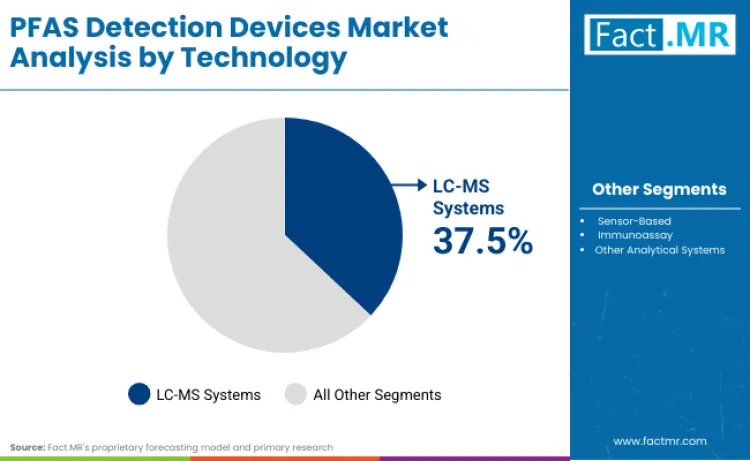
Liquid chromatography-mass spectrometry, or LC-MS technology, accounts for 37.5% of the technology segment, reinforcing their status as the definitive analytical architecture for PFAS detection. This share is sustained by the unique requirement for sub-part-per-trillion sensitivity in complex matrices like wastewater sludge and human serum, where other analytical methods frequently fail to achieve the necessary signal-to-noise ratios. The high adoption rate is directly linked to the technical necessity of tandem mass spectrometry for differentiating between branched and linear PFAS isomers, a critical factor for accurate quantification in regulatory audits.
The concentration of market share in LC-MS systems is also a result of the rigorous validation required for non-water samples, such as biosolids and textiles. As of 2026, the complexity of matrix interferences in these materials has solidified the reliance on triple quadrupole and high-resolution mass spectrometry platforms that offer the robustness needed for 24/7 contract laboratory operations. While alternative sensors are emerging for rapid screening, they lack the legal defensibility and broad-spectrum compound identification that provide the LC-MS segment its substantial market lead.
Will Logistical Advantages of Central Labs maintain their lead over Field Testing?
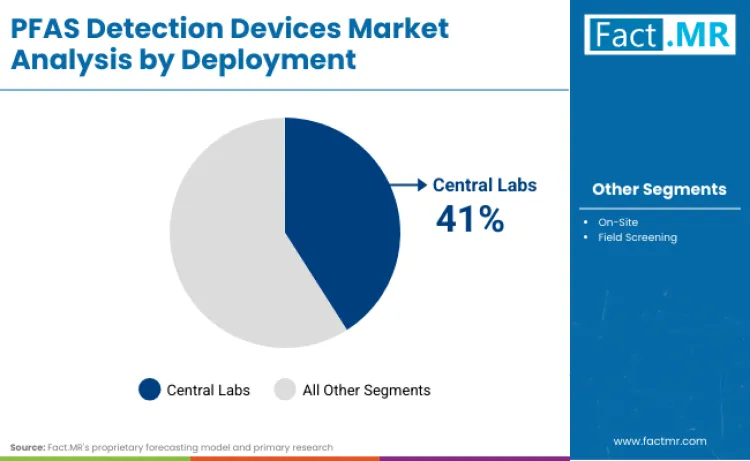
Central laboratories command 41% of the deployment segment, functioning as the primary hubs for certified PFAS analysis. This concentration of market share is driven by the extreme capital intensity and environmental control required to operate high-end mass spectrometry equipment. Centralized facilities are better equipped to mitigate the high risk of cross-contamination, which is a persistent threat in PFAS testing due to the ubiquity of fluorochemicals in standard laboratory supplies and field equipment.
The reliance on centralized deployment also stems from the deficit in skilled analytical personnel capable of interpreting high-dimensional data sets. By funneling samples through a central laboratory, organizations can leverage economies of scale and maintain a singular, auditable chain of custody that is often required for litigation-grade evidence. Despite the rise in demand for faster turnaround times, the central lab model remains the dominant deployment strategy for 2026 because it ensures the high degree of reproducibility that on-site or field-screening methods currently cannot guarantee for regulated contaminants.
How are Environmental Labs evolving into the Primary Architects of Demand?
Environmental Laboratories represent the largest end-user segment with a 46% market share. These entities have become the primary purchasers of detection devices as they scale up to meet the surge in routine monitoring volumes triggered by mandatory groundwater and drinking water surveillance programs. Their dominance is fueled by a business model shift from project-based testing to long-term service contracts with municipal water utilities and remediation firms, requiring constant upgrades to their analytical fleets.
This segment’s significant share is protected by the increasing accreditation requirements that favor established third-party laboratories over in-house industrial testing. As regulatory agencies broaden the list of target analytes, environmental labs are the first to invest in NTS capabilities needed to identify emerging replacement PFAS. This proactive capacity building ensures that environmental laboratories remain the central pillar of the detection market, acting as the bridge between regulatory intent and industrial compliance.
What Drivers, Restraints, Opportunities, and Trends Shape the PFAS Detection Devices Market?
The global PFAS detection market is navigating a pivot from exploratory monitoring to high-stakes enforcement, defined by a shift from voluntary screening to non-discretionary compliance. A primary driver of this expansion is the adoption of rigorous federal mandates, such as the U.S. EPA’s finalization of Maximum Contaminant Levels (MCLs) for six PFAS compounds, including PFOA and PFOS at 4.0 ppt. This regulation compels over 66,000 public water systems to initiate quarterly sampling by 2027, creating an immediate demand surge for high-sensitivity detection hardware.
Regional overhauls like South Korea’s 2025 Chemical Control Act revision, which introduces new registration thresholds for over 1,100 chemicals, require importers to re-validate safety dossiers by July 1, 2026, fueling local laboratory infrastructure investments. Consumer product accountability is intensifying; Japan’s Consumer Affairs Agency established strict safety limits for PFAS in sterilized mineral water effective April 1, 2026, forcing distributors to modernize supply chain oversight and detection protocols to maintain domestic market access.
However, the market faces significant restraints, notably methodological complexity and fiscal volatility. The absence of standardized protocols for over 12,000 "intentionally added" PFAS variants, demanded by California's AB 1817 textile ban, stalls market entry for non-liquid matrices. This is compounded by shifting federal priorities; in May 2025, the U.S. EPA announced a two-year delay for PFOA/PFOS compliance and the rescission of standards for four other PFAS subtypes.
Such backsliding de-incentivizes immediate capital expenditure by smaller utilities. The FY2026 U.S. NDAA proposed slashing DOD environmental cleanup budgets by nearly $200 million, directly reducing the funds available for groundwater characterization at hundreds of military installations.
Despite these hurdles, industry trends are moving toward standardized surrogacy and targeted restrictions. To harmonize global results, NIST released its first certified reference material for biological tissues (SRM 1947a) in late 2025, enabling labs to provide consistent data for fish and food safety.
The UK Health and Safety Executive launched the Annex 15 restriction proposal in August 2025, prioritizing action on firefighting foams and shifting focus toward specialized detection at petrochemical sites. In sectors like apparel, where individual compound analysis remains difficult, the adoption of TOF as a primary screening metric is becoming the standard for high-volume manufacturing compliance.
What is the Analysis PFAS Detection Devices Market in Key Countries?
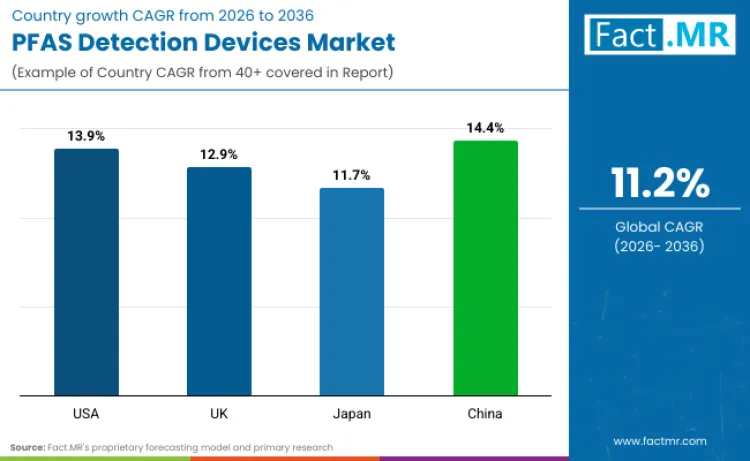
The global PFAS detection market is characterized by double-digit growth rates across key industrialized regions, primarily driven by the transition of provisional guidelines into statutory enforcement. The United States, United Kingdom, Japan, and China are each accelerating investment in analytical infrastructure to meet these localized regulatory deadlines between 2026 and 2036.
| Country | CAGR (2026-2036) |
|---|---|
| USA | 13.9% |
| UK | 12.9% |
| Japan | 11.7% |
| China | 14.4% |
Source: FMI analysis based on primary research and proprietary forecasting model
How is Federal Funding Impacting USA’s PFAS Detection Devices Market?
USA is projected to expand at a 13.9% CAGR through 2036. This growth is anchored by the EPA’s finalization of the National Primary Drinking Water Regulation, which establishes legally enforceable Maximum Contaminant Levels for six PFAS variants. Public water systems must complete initial monitoring by 2027, forcing an immediate scale-up in laboratory throughput.
To support this transition, the federal government has allocated USD 1 billion through the Infrastructure Investment and Jobs Act specifically for PFAS testing and treatment at public water systems and for private well owners.
Will the inaugural National Plan redefine the British detection sector?
PFAS detection devices sales in UK are expected to rise at a 12.9% CAGR during the forecast period. On February 3, 2026, the Department for Environment, Food & Rural Affairs unveiled the nation’s first-ever PFAS Plan, a framework designed to manage the lifecycle of these chemicals from manufacture to waste.
A central component of this strategy is the launch of a consultation to introduce a statutory limit for PFAS in England’s public supply regulations, which will grant regulators new powers to enforce rules against water companies. This initiative includes new monitoring mandates for soil, sediment, and invertebrates to be conducted by the Environment Agency and the British Geological Survey.
Can Japan’s Mandatory Water Standards Catalyze a Nationwide Hardware Upgrade?
Japan’s market is set to grow at an 11.7% CAGR as it shifts from provisional target values to mandatory water quality standards. Effective April 1, 2026, the Ministry of the Environment and the Ministry of Health, Labour and Welfare will enforce mandatory testing for PFOA and PFOS in tap water.
The Consumer Affairs Agency has established a strict limit of 50 ng/L for these substances in sterilized mineral water. These dual regulations require water producers and distributors to modernize their testing procedures and supply chain oversight to maintain market access.
Is China’s Comprehensive Chemical Roadmap the Primary Engine of Regional Growth?
China leads the profiled countries with a 14.4% CAGR, driven by the 2025-2030 National Implementation Plan for fulfilling international chemical obligations. This roadmap, enacted in April 2025, mandates the installation of automated monitoring systems for producers of controlled by-product substances and enforces a ban on certain PFAS-related solvents by mid-2026.
The 2025-2030 Healthy Environment Action Plan targets continuous improvement in drinking water quality and risk assessment, necessitating a massive expansion of the national pollutant discharge permit system and environmental monitoring network.
How Competitive is the PFAS Detection Devices Market?
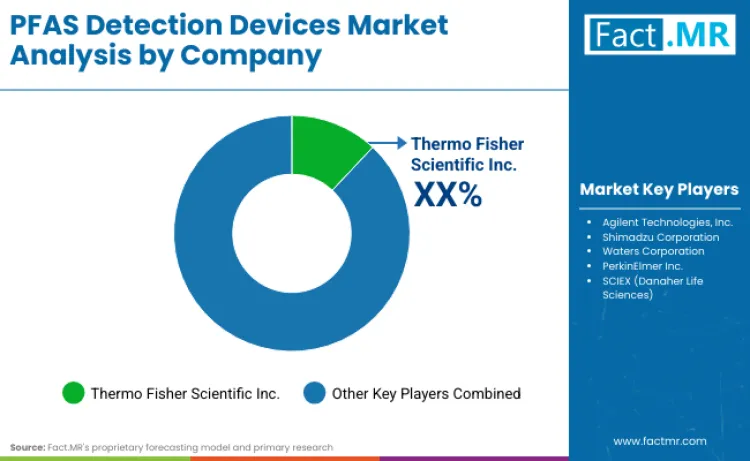
The competitive landscape for PFAS detection is currently defined by a standardization race, where leaders are shifting from selling standalone hardware to providing end-to-end, legally defensible analytical workflows. As 2026, the primary competitive differentiator has transitioned from raw sensitivity to matrix-specific robustness.
With the activation of the EU Drinking Water Directive's sum of PFAS-20 limit on January 12, 2026, and Germany’s more stringent 0.1 µg/L threshold, manufacturers are forced to optimize systems for high-throughput compliance testing rather than just research-grade detection.
A significant industry pattern emerging in 2026 is the vertical integration of AI-driven automation into mass spectrometry ecosystems. Strategic leaders are no longer just measuring parts-per-trillion; they are implementing automated data-review software to eliminate the manual bottleneck of peak integration.
This trend is a response to the critical shortage of skilled mass-spectroscopists required to manage the massive influx of samples from the U.S. EPA’s April 2026 data submission window under TSCA Section 8(a)(7). The focus has moved to "StayClean" technologies and delay columns that differentiate instrument-source contamination from sample analytes, ensuring operational continuity in 24/7 contract labs.
Recent Strategic Developments
- On January 29, 2026, Thermo Fisher Scientific reported that active capital deployment and the strengthening of HRMS pipelines to address emerging PFAS monitoring requirements bolstered 2025 results.
- On August 7, 2025, Shimadzu Corporation released the LCMS-8065XE, featuring StreamFocus technology specifically designed to enhance ESI ion source robustness for long-term environmental surveillance.
- SCIEX (Danaher) Launched the ZenoTOF 8600 system on June 2, 2025 and new software collaborations, setting a new standard for accurate mass quantitation in both targeted and non-targeted PFAS screening.
How has Competitive Strategy Evolved over the Years?
Historical Consolidation and Validation up to 2024
Competitive strategies through 2024 were dominated by accreditation-led expansion and method validation. Market participants focused on securing EPA Method 1633 and 533 certifications for their existing LC-MS/MS fleets. The objective was to build regulatory credibility where instrument vendors partnered with reference labs to prove that their hardware could meet the looming parts-per-trillion thresholds. M&A activity was tactical, focusing on acquiring regional lab capacity to be physically closer to contaminated sites.
Strategic Direction, the Service-Software Hybrid (2026 and Beyond)
The observable strategic direction for 2026 centers on future-proof compliance. Fact-grounded hypotheses suggest that the market is moving toward a subscription-service model for analytical methods. Vendors are increasingly bundling hardware with pre-vetted, ready-to-use method packages that include specific columns, standards, and AI-assisted software.
This direction indicates that firms that can reduce the cost-per-sample through extreme automation and minimized downtime, rather than firms offering the highest absolute sensitivity will win the next phase of competition.
Key Players Profiled
- Thermo Fisher Scientific Inc.
- Agilent Technologies, Inc.
- Shimadzu Corporation
- Waters Corporation
- PerkinElmer Inc.
- SCIEX (Danaher Life Sciences)
- Eurofins Technologies (Eurofins Scientific SE)
- Metrohm AG
- IDEXX Laboratories, Inc.
- Hach Company (Danaher Corporation)
Market Definition
The PFAS detection devices market comprises analytical instruments and systems designed to identify, quantify, and monitor per- and polyfluoroalkyl substances (PFAS) at ultra-trace levels across environmental, industrial, and biological matrices. These devices enable compliance with emerging regulatory thresholds that increasingly require detection at parts-per-trillion concentrations. The market reflects a structural shift from discretionary screening toward mandatory, legally defensible measurement as PFAS regulation transitions into an enforcement-driven phase across major economies.
The report includes laboratory-grade and field-deployable PFAS detection technologies such as liquid chromatography-mass spectrometry (LC-MS and LC-MS/MS) systems, high-resolution mass spectro-meters, sensor-based platforms, immunoassay systems, and other validated analytical tools. It covers deployment across central laboratories, on-site industrial facilities, and limited field-screening environments, with end users including environmental testing laboratories, industrial manufacturers, consultants and remediation firms, and regulatory or government agencies. The scope encompasses applications in drinking water, groundwater, wastewater, food-contact materials, industrial effluents, biosolids, and selected biological samples.
The scope excludes PFAS treatment, filtration, or destruction technologies, as well as chemical remediation systems that do not perform analytical detection. It also excludes laboratory services as a standalone offering, consumables such as columns and reagents sold independently of detection platforms, and research-only instrumentation not validated for regulatory or compliance-grade PFAS analysis. Soil remediation without analytical measurement, legacy water-testing devices incapable of ppt-level detection, and non-PFAS environmental monitoring equipment fall outside the defined market boundary.
Scope of Report
| Items | Values |
|---|---|
| Quantitative Units (2026) | USD 1.0 billion |
| Technology | LC-MS Systems, Sensor-Based, Immunoassay, Other Analytical Systems |
| Deployment | Central Labs, On-Site, Field Screening |
| End User | Environmental Labs, Industrial Facilities, Consultants & Remediation Firms, Regulators & Government Agencies |
| Regions Covered | North America, Western Europe, Eastern Europe, East Asia, South Asia & Pacific, Latin America, Middle East & Africa |
| Countries Covered | USA, UK, South Korea, Japan and 40+ Countries |
| Key Companies Profiled | Thermo Fisher Scientific Inc., Agilent Technologies, Inc., Shimadzu Corporation, Waters Corporation, PerkinElmer Inc., SCIEX (Danaher Life Sciences), Eurofins Technologies (Eurofins Scientific SE), Metrohm AG, IDEXX Laboratories, Inc., Hach Company (Danaher Corporation) |
Source: FMI analysis based on primary research and proprietary forecasting model
PFAS Detection Devices Market by Key Segments
Technology
- LC-MS Systems
- Sensor-Based
- Immunoassay
- Other Analytical Systems
Deployment
- Central Labs
- On-Site
- Field Screening
End User
- Environmental Labs
- Industrial Facilities
- Consultants & Remediation Firms
- Regulators & Government Agencies
Region
- North America
- Western Europe
- Eastern Europe
- East Asia
- South Asia & Pacific
- Latin America
- Middle East & Africa
Bibliography
- National Institute of Standards and Technology. (2025). SRM 1947a: Organics in whale blubber (certified reference material for PFAS analysis). NIST Special Publication.
- Shimadzu Corporation. (2025). Ultra-trace PFAS analysis using next-generation LC-MS/MS platforms. Shimadzu Analytical & Measuring Instruments Technical Note.
- Agilent Technologies, Inc. (2025). Targeted and non-targeted PFAS workflows for environmental and food matrices. Agilent Application Compendium.
- Thermo Fisher Scientific Inc. (2025). High-resolution mass spectrometry solutions for routine PFAS monitoring. Orbitrap Environmental Analysis Technical Brief.
- UK Drinking Water Inspectorate. (2026). PFAS monitoring, analytical performance requirements, and compliance guidance. DWI Technical Guidance Note.
- Kannan, K., et al. (2024). Analytical challenges and advances in the detection of emerging PFAS in environmental and biological matrices. TrAC Trends in Analytical Chemistry, 171, 117078.
Frequently Asked Questions
How large is the global PFAS detection devices market?
The PFAS detection devices market is valued at around USD 1.0 billion in 2026, reflecting the transition from voluntary monitoring to mandatory, high-precision analytical compliance across environmental, industrial, and food safety domains.
What technologies form the backbone of PFAS detection systems?
Liquid chromatography-mass spectrometry platforms dominate the market, particularly triple quadrupole and high-resolution systems, due to their ability to detect PFAS at parts-per-trillion levels across complex matrices.
Why is LC-MS considered the compliance-grade standard for PFAS analysis?
LC-MS systems provide the sensitivity, compound selectivity, and legal defensibility required for regulated testing, including differentiation of PFAS isomers and retrospective data analysis demanded by enforcement agencies.
How are deployment models evolving for PFAS detection technologies?
Central laboratories remain the primary deployment model due to capital intensity, contamination control requirements, and the need for skilled analysts, while field and on-site screening tools are used mainly for preliminary assessment.
What technical challenges limit faster adoption of PFAS detection devices?
Key challenges include instrument cost, method complexity across thousands of PFAS variants, contamination risk within analytical workflows, and the shortage of trained personnel capable of managing high-throughput compliance testing.
Preview the report firsthand - request a free sample
Get SampleGet the brochure for pricing and purchase details.
Get PDFTable of Content
- Executive Summary
- PFAS Detection Devices Market Forecast and Outlook (2026-2036)
- Why is the PFAS Detection Devices Market Growing?
- Transition from Voluntary Screening to Mandatory Compliance
- Expansion of Enforceable Drinking Water and Groundwater Standards
- Litigation Risk and Retrospective Data Disclosure Requirements
- Automation and Throughput Optimization in Analytical Workflows
- How is the PFAS Detection Devices Market Segmented?
- By Technology
- By Deployment Model
- By End User
- By Region
- What Drivers, Restraints, Opportunities, and Trends Shape the Market?
- Ultra-trace Detection and Legal Defensibility Requirements
- Methodological Complexity across Expanding PFAS Lists
- Capital Intensity and Skilled Workforce Constraints
- Standardization of Non-targeted Screening and AI-assisted Analytics
- What is the PFAS Detection Devices Market Outlook by Key Countries?
- United States
- United Kingdom
- Japan
- China
- How Competitive is the PFAS Detection Devices Market?
- Competitive Landscape and Market Structure
- Shift from Hardware Sales to Service-software Ecosystems
- Recent Strategic Developments
- Key Players Profiled
- Thermo Fisher Scientific Inc.
- Agilent Technologies, Inc.
- Shimadzu Corporation
- Waters Corporation
- PerkinElmer Inc.
- SCIEX (Danaher Life Sciences)
- Eurofins Technologies (Eurofins Scientific SE)
- Metrohm AG
- IDEXX Laboratories, Inc.
- Hach Company (Danaher Corporation)
- Market Definition
- Scope of Report
- PFAS Detection Devices Market by Key Segments
- Bibliography
- Frequently Asked Questions (FAQs)


